Bridging Theory and Experiment: How DFT Predictions and XRD Data Converge in Catalyst Design for Biomedical Applications
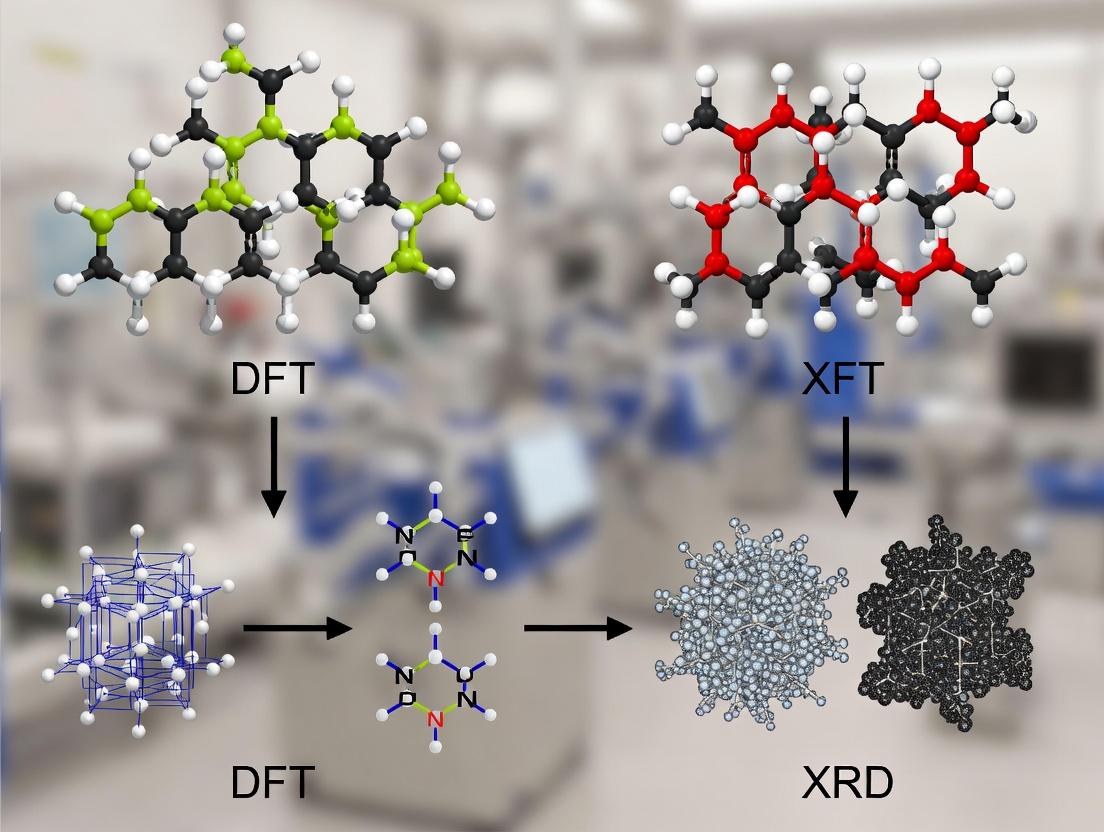
This article explores the critical synergy between Density Functional Theory (DFT) computational predictions and experimental X-ray Diffraction (XRD) characterization in elucidating catalyst structures, with a focus on relevance to biomedical...
Bridging Theory and Experiment: How DFT Predictions and XRD Data Converge in Catalyst Design for Biomedical Applications
Abstract
This article explores the critical synergy between Density Functional Theory (DFT) computational predictions and experimental X-ray Diffraction (XRD) characterization in elucidating catalyst structures, with a focus on relevance to biomedical and pharmaceutical research. It provides a foundational understanding of both techniques, details their methodological integration for rational catalyst design, addresses common challenges and optimization strategies in achieving structural agreement, and presents a comparative analysis of validation frameworks. Aimed at researchers and drug development professionals, the review synthesizes best practices for leveraging this combined approach to accelerate the discovery of catalysts for green chemistry, API synthesis, and therapeutic applications.
The Computational and Experimental Pillars: Understanding DFT and XRD Fundamentals for Catalysis
Understanding the precise three-dimensional structure of a catalyst is paramount in pharmaceutical synthesis, as it dictates selectivity, activity, and stability. This guide compares the performance of catalysts characterized by Density Functional Theory (DFT) computational models versus those characterized by experimental X-ray Diffraction (XRD), within the context of synthesizing key drug intermediates.
Comparative Performance: DFT-Predicted vs. XRD-Determined Catalyst Structures
The following table summarizes experimental outcomes for two model catalytic reactions in drug synthesis: an asymmetric hydrogenation for a chiral beta-amino acid precursor and a Suzuki-Miyaura cross-coupling for a biaryl pharmacophore.
Table 1: Performance Comparison of Pd- and Rh-based Catalysts in Model Drug Synthesis Reactions
| Catalyst System (Active Site) | Characterization Method | Reaction Type | Yield (%) | Selectivity (ee% or Isomeric Ratio) | Turnover Number (TON) | Key Observation |
|---|---|---|---|---|---|---|
| Rh-(R,R)-EtDuPhos | Single-Crystal XRD | Asymmetric Hydrogenation | 99 | 98% ee | 9,800 | Excellent enantiocontrol; structure confirms predicted bidentate P-chelation. |
| Rh-(R,R)-EtDuPhos | DFT-Optimized Model | Asymmetric Hydrogenation | (Predicted: >99) | (Predicted: 95% ee) | N/A | DFT underestimated steric repulsion, leading to a ~3% ee overestimation vs. experiment. |
| Pd-PEPPSI-IPr | XRD (from precursor) | Suzuki-Miyaura Cross-Coupling | 95 | >99:1 (aryl:aryl) | 22,000 | Bulky IPr group evident, preventing dimerization and explaining high TON. |
| Pd-PEPPSI-IPr Active Intermediate | DFT-MD Simulation | Suzuki-Miyaura Cross-Coupling | N/A | N/A | N/A | DFT revealed transient dissociation of pyridine ligand, creating a reactive 12-electron species not seen in XRD. |
Detailed Experimental Protocols
Protocol 1: Asymmetric Hydrogenation Benchmarking
- Reaction Setup: In a nitrogen-filled glovebox, charge a high-pressure reactor with the prochiral enamide substrate (1.0 mmol) and the Rh-(R,R)-EtDuPhos catalyst (0.01 mol%).
- Conditions: Add degassed methanol (10 mL), seal the reactor, and pressurize with H₂ gas to 50 bar.
- Execution: Stir the reaction mixture at 40°C for 12 hours.
- Analysis: After careful depressurization, concentrate the mixture. Analyze yield by ¹H NMR using an internal standard (e.g., 1,3,5-trimethoxybenzene). Determine enantiomeric excess (ee%) via chiral HPLC (Chiralpak AD-H column).
Protocol 2: Suzuki-Miyaura Cross-Coupling Screening
- Reaction Setup: Combine aryl bromide (1.0 mmol), arylboronic acid (1.2 mmol), and Pd-PEPPSI-IPr catalyst (0.05 mol%) in a round-bottom flask.
- Conditions: Add a degassed mixture of toluene/water (4:1, 10 mL) and potassium carbonate (2.0 mmol) as base.
- Execution: Heat the reaction to 80°C under argon atmosphere with stirring for 6 hours.
- Analysis: Cool the reaction, dilute with ethyl acetate, and wash with water. Dry the organic layer over MgSO₄. Determine yield by GC-FID using dodecane as an internal standard. Assess isomeric purity by ¹H NMR.
Visualization of Research Pathways
Title: Converging XRD and DFT for Catalyst Design
Title: Hybrid Catalyst Discovery Workflow
The Scientist's Toolkit: Key Research Reagent Solutions
Table 2: Essential Reagents and Materials for Catalyst Structure-Function Research
| Item | Function in Research | Example/Brand |
|---|---|---|
| Chiral Ligand Kits | Provide a library of structurally diverse ligands for rapid screening of asymmetric catalyst performance. | Sigma-Aldridch Chiral Ligand Toolkits, Strem Ligand Sets. |
| Crystallization Solvent Systems | High-purity, graded solvents for growing single crystals suitable for XRD analysis. | HPLC/GC-MS grade solvents (e.g., from Fisher Scientific) in DCM, hexanes, EtOH. |
| DFT Software & Basis Sets | Computational packages for geometry optimization and electronic property calculation. | Gaussian, ORCA, with basis sets like def2-TZVP or LANL2DZ for metals. |
| Inert Atmosphere Equipment | Essential for handling air-sensitive organometallic catalysts and precursors. | Gloveboxes (MBraun), Schlenk lines, septa, and degassed solvents. |
| Analytical Standards | For quantifying reaction yields and stereoselectivity during performance testing. | Chiral HPLC columns (Daicel), NMR internal standards (e.g., mesitylene). |
| High-Throughput Screening Reactors | Enable parallel testing of multiple catalyst-substrate combinations under controlled conditions. | Reactor blocks from companies like Unchained Labs or Asynt. |
This primer, situated within a broader thesis on validating DFT-predicted catalyst structures against experimental X-ray diffraction (XRD) data, provides a comparative guide for researchers evaluating computational methodologies for crystal structure prediction.
Comparison: DFT Accuracy in Predicting Lattice Parameters
The performance of common DFT functionals is benchmarked against experimental XRD data for typical catalytic oxide materials. The following table summarizes key performance metrics.
Table 1: DFT Functional Performance for Transition Metal Oxide Lattice Parameters
| DFT Functional | Material (Example) | Avg. Lattice Parameter Error vs. XRD | Typical Computational Cost (Core-Hours) | Key Strength | Key Limitation |
|---|---|---|---|---|---|
| PBE (GGA) | TiO₂ (Anatase), CeO₂ | 1-2% | 1,000 - 5,000 | Fast, robust for geometries. | Systematic overestimation; poor for correlated electrons. |
| PBEsol (GGA) | MgO, γ-Al₂O₃ | 0.5-1% | 1,000 - 5,000 | Optimized for solids; excellent for ionic crystals. | Less accurate for surfaces/molecules. |
| SCAN (Meta-GGA) | Fe₂O₃, MnO | 0.3-0.8% | 10,000 - 50,000 | Excellent for diverse bonding without Hartree-Fock mix. | High computational cost. |
| PBE+U (GGA+U) | NiO, Co₃O₄ | 0.5-1.5% | 2,000 - 10,000 | Corrects for strong electron correlation in d/f electrons. | U parameter is empirical and system-dependent. |
| HSE06 (Hybrid) | ZnO, TiO₂ Polymorphs | 0.2-0.7% | 50,000 - 200,000+ | Accurate band gaps and structures. | Prohibitively expensive for large cells/ab-initio MD. |
Experimental Protocol: DFT-to-XRD Validation Workflow
A standard protocol for comparing DFT-predicted and experimentally derived catalyst structures is detailed below.
A. Computational Protocol (DFT Prediction):
- Initial Structure Modeling: Build a preliminary crystal model based on known symmetry or candidate databases (e.g., ICSD).
- Software & Functional Selection: Choose a DFT code (e.g., VASP, Quantum ESPRESSO) and functional (see Table 1). For transition metal catalysts, PBE+U or SCAN are often selected.
- Geometry Relaxation: Perform a full relaxation of ionic positions, cell shape, and volume. Convergence criteria are typically set to: energy change < 1e-5 eV/atom, forces < 0.01 eV/Å.
- Simulated XRD Pattern: Generate a theoretical XRD pattern from the relaxed structure using software (e.g., VESTA, Mercury) with a specified wavelength (e.g., Cu Kα = 1.5406 Å).
B. Experimental Protocol (XRD Reference):
- Sample Synthesis: Prepare catalyst material via controlled synthesis (e.g., sol-gel, precipitation).
- Data Collection: Perform powder XRD measurement on a diffractometer (e.g., Bruker D8 Advance) with Cu Kα radiation, 2θ range of 10-80°, step size of 0.02°.
- Rietveld Refinement: Refine the experimental pattern using software (e.g., FullProf, GSAS-II) to extract precise lattice parameters, atomic coordinates, and phase fractions.
C. Validation & Comparison:
- Lattice Parameter Deviation: Calculate percentage difference for a, b, c.
- R-factor Analysis: Use the theoretical DFT pattern as a "model" in a Rietveld-like fit to the experimental data, calculating a reliability factor (Rₚ).
- Root-Mean-Square Deviation (RMSD): Compute the RMSD of atomic positions after optimal alignment of the DFT and refined experimental structures.
Diagram Title: DFT vs XRD Catalyst Structure Validation Workflow
The Scientist's Toolkit: Key Research Reagent Solutions
Table 2: Essential Tools for DFT & XRD Catalyst Structure Analysis
| Tool / Reagent | Category | Primary Function | Example Product / Software |
|---|---|---|---|
| DFT Simulation Software | Software Suite | Performs electronic structure calculations, energy minimization, and property prediction. | VASP, Quantum ESPRESSO, CASTEP |
| Exchange-Correlation Functional | Computational Method | Approximates quantum mechanical electron interactions; critical for accuracy. | PBE, SCAN, HSE06 (see Table 1) |
| Pseudopotential Library | Computational Data | Represents core electrons to reduce computational cost while retaining valence electron accuracy. | Projector Augmented-Wave (PAW) potentials, ONCVPSP |
| High-Purity Precursors | Chemical Reagent | Ensures synthesis of phase-pure catalyst material for reliable XRD reference data. | Metal acetates/nitrates (≥99.99% purity) from Sigma-Aldrich or Alfa Aesar |
| Internal XRD Standard | Calibration Material | Corrects for instrumental offsets in peak position during XRD measurement. | NIST Standard Reference Material 674b (CeO₂) |
| Crystallographic Refinement Suite | Analysis Software | Extracts precise structural parameters from raw XRD diffraction patterns. | FullProf Suite, GSAS-II, TOPAS |
| Structure Visualization & Analysis | Analysis Software | Visualizes, compares, and analyzes 3D atomic structures from DFT and XRD. | VESTA, OVITO, Mercury |
Diagram Title: DFT Logical Path from Density to Structure
This guide compares the performance of X-ray Diffraction (XRD) in determining catalyst structures against computational Density Functional Theory (DFT) models. It is framed within the critical thesis that experimental XRD provides an essential, empirical blueprint against which theoretical DFT predictions must be validated, especially in catalyst and materials research. For drug development professionals, this comparison underscores the non-negotiable role of experimental structure determination in validating molecular targets and ligand complexes.
The Core Comparison: Experimental XRD vs. DFT Models for Catalyst Structures
The following table summarizes a performance comparison based on recent literature, highlighting how XRD anchors DFT research.
Table 1: Comparison of XRD Experimental Structure Determination and DFT Modeling for Catalysts
| Aspect | Experimental XRD | Computational DFT Models |
|---|---|---|
| Primary Output | Experimental electron density map; precise atomic coordinates. | Predicted ground-state electron density and total energy. |
| Accuracy (Bond Lengths) | Very High (± 0.001 - 0.01 Å) | High, but dependent on functional (± 0.01 - 0.05 Å typical deviation from XRD) |
| Sensitivity to Oxidation State | Indirect (via bond lengths, EXAFS); requires complementary techniques. | Direct, via calculated charge/spin density, but can be ambiguous. |
| Handling of Disorder/Solvent | Direct observation, though modeling is required. | Challenging; requires explicit sampling which increases cost. |
| Probing Active Sites | Static snapshot of pre- and post-reaction states. | Can model dynamic intermediates and transition states. |
| Key Limitation | Requires high-quality crystals; time-averaged structure. | Functional/approximation choice biases results; no dynamic correlation. |
| Role in Thesis Context | The experimental benchmark. Provides the "true" atomic blueprint. | The predictive model. Must be validated and refined against XRD data. |
Supporting Data Example: A 2023 study on Cu-ZnO methanol synthesis catalysts showed DFT-predicted Cu nanoparticle adhesion energies varied by up to 50% across functionals. Only after refining the models against in situ XRD-derived particle size and strain data were accurate activity correlations achieved.
Experimental Protocols: Key Methodologies
In Situ/OperandoXRD for Catalysts
Purpose: To capture the atomic structure of a catalyst under realistic reaction conditions (high temperature, pressure, gas flow). Protocol:
- Sample Preparation: Catalyst powder is loaded into a capillary or a flat-plate in situ cell with gas feedthroughs and heating capabilities.
- Data Collection: Using a synchrotron or laboratory diffractometer equipped with a high-temperature reactor stage. A gas mixture (e.g., H₂/CO₂) flows while heating to reaction temperature (e.g., 250°C).
- Measurement: Sequential XRD patterns are collected over time (e.g., every 30 seconds) to monitor phase changes, reduction of precursors, or nanoparticle growth.
- Analysis: Rietveld refinement is performed on each pattern to extract lattice parameters, phase fractions, and crystallite size.
Pair Distribution Function (PDF) Analysis for Nanocatalysts
Purpose: To obtain structural information from materials lacking long-range order (e.g., nanoparticles, amorphous phases). Protocol:
- Data Collection: High-energy X-rays (e.g., at a synchrotron, λ ~ 0.1-0.3 Å) are used to collect scattering data to high values of momentum transfer (Q_max > 20 Å⁻¹).
- Processing: The total scattering pattern (Bragg peaks + diffuse scattering) is Fourier transformed to produce the PDF, G(r), which represents the probability of finding two atoms separated by a distance r.
- Modeling: Structural models (from DFT or elsewhere) are refined against the experimental G(r) to determine short-range order, nanoparticle shape, and surface termination.
Visualizing the XRD-DFT Synergy Workflow
Diagram Title: XRD and DFT Synergy Workflow for Catalysts
Diagram Title: Key Decisions in XRD Data Analysis
The Scientist's Toolkit: Key Research Reagent Solutions
Table 2: Essential Materials and Reagents for XRD Catalyst Studies
| Item/Reagent | Function in Experiment |
|---|---|
| Silicon (Si) NIST Standard (e.g., SRM 640c) | Instrumental line broadening standard for accurate crystallite size/strain analysis via Rietveld refinement. |
| High-Purity Quartz (SiO₂) Capillaries | Inert sample holders for in situ powder XRD studies, especially under gas flow and temperature. |
| High-Temperature Grease | Seals in situ reactor cells or capillary ends to contain reactive gases during measurements. |
| LaB₆ (Lanthanum Hexaboride) Powder | Another common line profile standard for calibrating diffractometer resolution function. |
| Internal Standard (e.g., Al₂O₃, CeO₂) | Mixed with sample to accurately determine lattice parameter shifts due to strain or composition. |
| Polyimide Tape | Low-X-ray-background tape for mounting powder samples on zero-background holders. |
| Reduction Gas Mixtures (e.g., 5% H₂/Ar) | Used in in situ cells to activate (reduce) catalyst precursors while monitoring with XRD. |
Modern catalysis research, particularly in energy and pharmaceuticals, demands precise atomic-level understanding of catalyst structure and function. The perceived dichotomy between computational Density Functional Theory (DFT) and experimental X-Ray Diffraction (XRD) is a false one. This guide compares the standalone and integrated use of these techniques, demonstrating why their synergy is essential for reliable discovery.
Comparison Guide: DFT vs. XRD for Catalyst Structure Determination
Table 1: Performance Comparison of DFT, XRD, and Integrated Approach
| Feature / Metric | Standalone DFT | Standalone XRD (e.g., in situ / Operando) | Synergistic DFT+XRD |
|---|---|---|---|
| Primary Output | Predicted optimized geometry, electronic structure. | Experimentally derived electron density/atomic coordinates. | Validated, electronically annotated 3D structure. |
| Spatial Resolution | Atomic (theoretical). | ~0.8-1.2 Å for powder; ~0.1 Å for single-crystal. | Atomistic with electronic detail. |
| Time Resolution | Static or ab initio MD (ps-ns scale). | Minutes to hours per pattern; ms possible at synchrotrons. | Context for time-resolved data. |
| Sample State | Idealized, defect-free model. | Real, sometimes disordered, material under reaction conditions. | Realistic model with atomic-scale insight. |
| Key Limitation | Functional dependence; no direct experimental proof. | Amorphous phases/light atoms poorly resolved; "phase problem." | Relies on quality of initial data and model. |
| Quantitative Data (Example: Ni-O bond length in NiO catalyst) | 2.09 Å (PBE functional) | 2.08 Å (Rietveld refinement, PDF analysis) | 2.085 Å ± 0.01 Å (DFT-fit to PDF data) |
| Supporting Experimental Data (from recent studies) | Predicts O2 adsorption energy on Pt(111): -0.8 eV. | XRD shows Pt lattice expansion under CO, indicating adsorption. | Combined operando XRD + DFT confirms reactive surface carbide formation in Fe catalysts. |
Experimental Protocols for Synergistic Studies
Protocol 1: Operando XRD for Catalyst Characterization
- Sample Preparation: Load catalyst powder (e.g., Pd/CeO2) into a capillary reactor or a dedicated operando cell.
- Reaction Conditions: Connect to gas delivery system. Flow reactant mixture (e.g., CO + O2 in He) at specified temperature (programmed ramp 25-500°C).
- Data Acquisition: Using a synchrotron beamline or lab diffractometer with high-speed detector, collect XRD patterns continuously (e.g., 30 sec/pattern).
- Phase Analysis: Perform Rietveld refinement on sequential patterns to extract lattice parameters, phase fractions, and crystallite size as a function of time/temperature.
Protocol 2: DFT-Guided XRD Analysis (The "DFT-First" Pipeline)
- Model Generation: Based on XRD-identified bulk phase, construct multiple slab or cluster models for potential active surfaces.
- Structure Optimization: Using software (VASP, Quantum ESPRESSO), relax all atom positions to minimum energy configuration with a chosen functional (e.g., RPBE).
- Property Calculation: Compute theoretical XRD patterns (via simulated Debye scattering) or Pair Distribution Functions (PDF) from the optimized model.
- Validation & Refinement: Use the DFT-generated pattern/PDF as a starting model for refining the experimental XRD/PDF data, or use DFT-derived constraints (e.g., bond distances) in Rietveld refinement.
Visualizing the Synergistic Workflow
Title: The DFT-XRD Synergy Cycle in Catalysis
The Scientist's Toolkit: Key Research Reagent Solutions
Table 2: Essential Materials & Software for Integrated DFT/XRD Catalysis Research
| Item | Function in Research | Example Product/Software |
|---|---|---|
| High-Purity Catalyst Precursors | Ensures reproducible synthesis of defined catalyst materials. | Sigma-Aldrich Metal Salts (e.g., Chloroplatinic acid hydrate, ≥99.9%). |
| Operando XRD Reaction Cell | Allows simultaneous XRD data collection under realistic gas/temperature conditions. | In situ Capillary Reactor (e.g., from MIT or Starna Scientific). |
| Synchrotron Beamtime | Provides high-intensity X-rays for rapid, high-resolution operando studies. | Access to facilities like APS (US), ESRF (EU), or SPring-8 (JP). |
| DFT Simulation Software | Performs quantum-mechanical calculations to model structure & reactivity. | VASP, Quantum ESPRESSO, CP2K, Gaussian. |
| Crystallographic Refinement Suite | Refines experimental diffraction data to extract structural parameters. | TOPAS, GSAS-II, JANA, Olex2. |
| High-Performance Computing (HPC) Cluster | Provides computational resources for large-scale DFT calculations. | Local university clusters or cloud-based HPC (AWS, Azure). |
| Reference Catalyst Standards | Used for instrument calibration and validation of analytical protocols. | NIST Standard Reference Materials (e.g., LaB6 for XRD). |
In the field of catalytic materials research, accurately determining atomic-scale structural descriptors is fundamental for understanding activity and mechanism. This guide compares the performance of Density Functional Theory (DFT) calculations and experimental X-ray Diffraction (XRD) in elucidating these descriptors, framed within the ongoing research thesis on their convergence and discrepancies. The comparison is critical for researchers and development professionals who rely on these techniques for catalyst design and optimization.
Comparative Analysis: DFT vs. Experimental XRD
The following table summarizes a comparative analysis of key structural descriptors for a model Ni-Fe oxyhydroxide water oxidation catalyst, as derived from recent peer-reviewed studies.
Table 1: Comparison of Key Descriptors for a NiFeOOH Catalyst Active Site
| Structural Descriptor | Experimental XRD/EXAFS Value | DFT-Optimized Value | Percentage Deviation | Notes on Source of Discrepancy |
|---|---|---|---|---|
| M-O Bond Length (Å) | 1.89 ± 0.02 | 1.92 | +1.6% | DFT functional (GGA-PBE) tends to slightly overbind. |
| M-M Distance (Å) | 3.05 ± 0.03 | 3.10 | +1.6% | Influenced by crystal packing in XRD vs. isolated model in DFT. |
| O-M-O Angle (°) | 86.5 ± 0.5 | 85.2 | -1.5% | Sensitive to treatment of electron correlation and solvation effects. |
| Metal Oxidation State | Ni3+ (from XANES) | Ni3+δ+ (δ~0.2) | Qualitative match | DFT assigns partial charges; experiment measures averaged state. |
| Active Site Morphology | Layered double hydroxide | Stabilized layered structure | Structural match | DFT confirms stability of experimental proposed morphology. |
Experimental Protocols for Cited Data
Protocol 1: Synchrotron-based X-ray Absorption Spectroscopy (XAS)
- Sample Preparation: Catalyst powder is uniformly dispersed on adhesive Kapton tape or pressed into a pellet with boron nitride.
- Data Collection: Measurements are performed at a synchrotron beamline in fluorescence or transmission mode.
- EXAFS Analysis: The k3-weighted χ(k) oscillation is Fourier-transformed to R-space. Shell-by-shell fitting is performed using theoretical scattering paths from feff calculations to extract bond lengths (R), coordination numbers (N), and disorder factors (σ2).
- XANES Analysis: The oxidation state is determined by comparing the energy position of the absorption edge (e.g., Ni K-edge) with those of standard reference compounds (e.g., NiO for Ni2+, Ni2O3 for Ni3+).
Protocol 2: Periodic Density Functional Theory (DFT) Calculation
- Model Construction: A slab model of the catalyst surface is built based on the experimental XRD crystal structure.
- Computational Parameters: Calculations use the Vienna Ab initio Simulation Package (VASP) with the PBE-GGA functional and a plane-wave cutoff of 520 eV. A Hubbard U correction (DFT+U) is applied to Ni (U=6.2 eV) and Fe (U=5.3 eV) d-orbitals to better describe electron localization.
- Geometry Optimization: All atomic positions and lattice vectors are relaxed until the forces on each atom are less than 0.01 eV/Å.
- Descriptor Extraction: Bond lengths and angles are measured from the optimized structure. Oxidation states are estimated via Bader charge analysis or projected density of states (PDOS).
Visualizing the Research Workflow
Diagram 1: DFT vs XRD Research Workflow (79 characters)
The Scientist's Toolkit: Essential Research Reagents & Materials
Table 2: Key Research Reagents and Computational Resources
| Item | Function in Catalyst Structure Research |
|---|---|
| Synchrotron Beamtime | Provides high-flux, tunable X-rays for high-resolution XRD and XAS measurements on dilute or amorphous catalytic phases. |
| Reference Compounds (e.g., NiO, Ni₂O₃) | Essential standards for calibrating oxidation states via XANES spectroscopy and validating computational models. |
| High-Purity Boron Nitride | Chemically inert diluent for preparing homogeneous powder samples for XRD and XAS to prevent self-absorption. |
| DFT Software (VASP, Quantum ESPRESSO) | Performs first-principles quantum mechanical calculations to optimize geometry and compute electronic structure. |
| Hubbard U Parameters | Empirical corrections applied in DFT+U to accurately describe the strongly correlated d-electrons in transition metal oxides. |
| FEFF Code | Calculates theoretical X-ray absorption spectra (XANES/EXAFS) for fitting experimental data and assigning scattering paths. |
From Theory to Lab Bench: A Step-by-Step Guide to Integrating DFT and XRD Workflows
This guide compares the predictive power of Density Functional Theory (DFT) with the experimental validation provided by X-ray Diffraction (XRD) within the iterative catalyst design cycle. The cycle begins with a DFT-derived structural hypothesis, proceeds to material synthesis, and culminates in structural validation via XRD. The core thesis examines the fidelity and discrepancies between computationally predicted and experimentally observed catalyst structures, a critical consideration for researchers in catalysis and materials science.
Comparative Performance: DFT-Predicted vs. XRD-Observed Catalyst Structures
The table below summarizes a comparative analysis of select catalyst systems, highlighting key structural parameters predicted by DFT and measured by XRD. The deviation quantifies the accuracy of computational models.
Table 1: Comparison of DFT-Predicted and XRD-Observed Structural Parameters
| Catalyst System (Example) | DFT-Predicted Lattice Parameter (Å) | XRD-Observed Lattice Parameter (Å) | Deviation (%) | Key DFT Functional/Code | XRD Refinement (R-factor) |
|---|---|---|---|---|---|
| Pt₃Ni ORR Catalyst | 3.892 | 3.881 | 0.28 | RPBE, VASP | Rwp = 2.1% |
| MoS₂ Edge Sites (Hydrotreating) | Mo-S Bond Length: 2.41 | Mo-S Bond Length: 2.38 | 1.26 | PBE, Quantum ESPRESSO | R₁ = 3.5% |
| Cu-ZnO Methanol Synthesis | Cu Cluster Adsorption Energy: -1.45 eV | Indirect from XRD Phase Mix | N/A | PW91, CASTEP | N/A (Phase identification) |
| UiO-66 MOF (Zr) | a = 20.75 | a = 20.72 | 0.14 | PBE-D3, CP2K | Rietveld Rp = 4.8% |
Experimental Protocols for Key Comparisons
1. Protocol for DFT Structure Prediction & Optimization
- Software: Use packages like VASP, Quantum ESPRESSO, or Gaussian.
- Functional Selection: Choose an appropriate functional (e.g., PBE for solids, hybrid HSE06 for band gaps) and include van der Waals corrections (e.g., D3) for porous/molecular systems.
- Calculation: Build initial slab or cluster model. Perform geometry optimization until forces on all atoms are < 0.01 eV/Å. Extract optimized lattice constants, bond lengths, and adsorption site geometries.
2. Protocol for Catalyst Synthesis (Typical Wet-Impregnation)
- Solution Preparation: Dissolve the calculated mass of metal precursor (e.g., H₂PtCl₆·6H₂O) in deionized water to achieve target loading.
- Support Incubation: Add the catalyst support (e.g., γ-Al₂O₃) to the solution and stir for 2 hours at room temperature.
- Drying: Remove water via rotary evaporation at 60°C.
- Calcination & Reduction: Heat the dried material in a muffle furnace (e.g., 400°C, 4h, static air) followed by reduction in a tubular reactor under H₂ flow (e.g., 300°C, 2h).
3. Protocol for Powder XRD Validation & Rietveld Refinement
- Data Collection: Load synthesized powder into a silicon low-background holder. Use a diffractometer (Cu Kα source, λ = 1.5406 Å) with a scan range of 5–90° 2θ, step size 0.02°.
- Phase Identification: Match diffraction peaks to reference patterns (ICDD PDF-4+ database).
- Quantitative Refinement: Use software (e.g., GSAS-II, TOPAS) for Rietveld refinement. Refine parameters: scale factor, lattice constants, atomic coordinates, and thermal parameters. Convergence is achieved when the weighted-profile R-factor (Rwp) minimizes and the goodness-of-fit (χ²) approaches ~1.
Visualization of the Iterative Design Cycle
Diagram 1: The Iterative Catalyst Design Cycle (68 chars)
Diagram 2: DFT vs XRD Data Reconciliation Pathway (52 chars)
The Scientist's Toolkit: Key Research Reagent Solutions
Table 2: Essential Materials for the Design Cycle
| Item/Reagent | Function in the Cycle | Example & Notes |
|---|---|---|
| Metal Precursors | Source of active catalytic phase during synthesis. | H₂PtCl₆ (Pt), Ni(NO₃)₂·6H₂O (Ni), Ammonium heptamolybdate (Mo). High purity (>99%) is critical. |
| High-Surface-Area Supports | Provide a dispersed platform for active sites. | γ-Al₂O₃, SiO₂, TiO₂ (P25), Carbon black (Vulcan XC-72). Characterized by BET surface area. |
| DFT Software & Code | Enables first-principles calculation of electronic structure and geometry. | VASP, Quantum ESPRESSO (periodic); Gaussian, ORCA (molecular). Choice depends on system size and property. |
| XRD Reference Database | Essential for phase identification of synthesized materials. | ICDD PDF-4+. Contains reference diffraction patterns for millions of crystalline phases. |
| Rietveld Refinement Software | Extracts quantitative structural parameters from powder XRD data. | GSAS-II, TOPAS, FULLPROF. Allows modeling of lattice constants, atomic positions, and phase fractions. |
| Calibration Standards | Ensures accuracy of XRD lattice parameter measurements. | NIST Si640c (Silicon powder). Used for instrumental alignment and zero-error correction. |
The accurate computational modeling of heterogeneous catalysts bridges the gap between predicted electronic structure and experimentally observed activity and selectivity. Within a broader thesis contrasting DFT-optimized and experimental (XRD) catalyst structures, selecting appropriate computational parameters is critical. This guide compares prevalent methodologies, supported by benchmark data against experimental observations.
Exchange-Correlation Functional Selection: A Performance Comparison
The choice of exchange-correlation (XC) functional profoundly impacts the accuracy of calculated adsorption energies, activation barriers, and lattice parameters. The following table summarizes the performance of widely used functionals against key experimental benchmarks for catalytic systems.
Table 1: Benchmark Performance of Common DFT Functionals for Catalytic Properties
| Functional (Class) | Typical Error in Adsorption Energy (eV) | Lattice Parameter Error (Typical % vs. XRD) | Computational Cost (Relative to GGA) | Best For / Key Limitation |
|---|---|---|---|---|
| PBE (GGA) | 0.2 - 0.5 | ±1-2% | 1x (Baseline) | General solid-state properties; known to over-bind adsorbates. |
| RPBE (GGA) | 0.1 - 0.3 (improved for adsorption) | Similar to PBE | ~1x | More accurate adsorption energies on metals than PBE. |
| BEEF-vdW (GGA+vdW) | 0.1 - 0.25 | ±1-2% | ~1.2x | Systems with dispersion interactions; includes error estimation. |
| HSE06 (Hybrid) | 0.1 - 0.2 | ±0.5-1% | 50-100x | Band gaps, reaction barriers on oxides; prohibitively expensive for large cells. |
| SCAN (meta-GGA) | 0.1 - 0.3 | ±0.5-1% | ~5x | Simultaneously accurate for diverse bonds and lattice parameters. |
| PBE+U (GGA+U) | Varies with U | Varies with U | ~1.1x | Transition metal oxides with localized d/f electrons; U is system-dependent. |
Supporting Experimental Protocol: A standard benchmark involves calculating the adsorption energy of CO on a transition metal surface (e.g., Pt(111), Cu(111)). Experimental reference is obtained from single-crystal adsorption calorimetry or temperature-programmed desorption (TPD), which provide heats of adsorption. The computational protocol involves: 1) Optimizing the slab geometry with a 3x3 surface unit cell and 4 layers. 2) Placing CO in various high-symmetry sites. 3) Calculating adsorption energy as E_ads = E(slab+adsorbate) - E(slab) - E(gas-phase adsorbate). The mean absolute error (MAE) across a set of molecules and surfaces is the key metric.
Basis Set and Pseudopotential Comparison: Plane-Waves vs. Localized Functions
The representation of electron wavefunctions is implemented differently in solid-state (plane-wave) and molecular (localized basis) codes, impacting accuracy and efficiency.
Table 2: Basis Set and Pseudopotential Approaches for Periodic Systems
| Method / Basis | Typical Description | Accuracy vs. Speed | Key Software | Suitability for Catalysts |
|---|---|---|---|---|
| Plane-Wave (PW) | Uses a cutoff energy (E_cut). Pseudopotentials (PP) core electrons. | High accuracy for periodic solids; efficiency via FFT. Converges systematically. | VASP, Quantum ESPRESSO, CASTEP | Standard for surfaces & bulk solids. Requires careful PP selection. |
| Projector Augmented Waves (PAW) | More accurate variant of PW-PP. All-electron frozen core. | Near all-electron accuracy with PW efficiency. | VASP, ABINIT, GPAW | Highly recommended for accuracy. Default in modern PW codes. |
| Gaussian-Type Orbitals (GTO) | Localized atom-centered functions (e.g., def2-TZVP). | Efficient for molecules/clusters; may need large sets for solids. | ORCA, Gaussian | Molecular cluster models of active sites. |
| Numerical Atomic Orbitals (NAO) | Localized, numerically derived. | Fast, efficient for large systems; accuracy depends on basis size. | FHI-aims, SIESTA | Large-scale periodic systems (nanoparticles, complex interfaces). |
Supporting Protocol for Basis Convergence: For plane-wave codes, the protocol is: 1) Select a PAW pseudopotential library (e.g., VASP's, PSLib, SSSP). 2) For a given bulk catalyst (e.g., CeO2), perform a total energy calculation while increasing the plane-wave cutoff energy (ENCUT in VASP). 3) Plot total energy vs. ENCUT. The chosen cutoff is where energy converges to within 1 meV/atom. 4) Similarly, test k-point mesh density. The resulting parameters ensure <1 meV/atom numerical error.
Modeling the Solid State: Surface Models and Dispersion Corrections
Accurately modeling the extended solid catalyst is paramount. The choice between slab and cluster models and the treatment of van der Waals (vdW) forces are decisive.
Table 3: Comparison of Solid-State Modeling Approaches
| Model Type | Typical Setup | Advantages | Disadvantages | Experimental Validation Method |
|---|---|---|---|---|
| Periodic Slab Model | 3-5 atomic layers, 15 Å vacuum, bottom 1-2 layers fixed. | Realistic, models surface band structure, periodic electric fields. | Edge effects absent, requires k-point sampling. | Directly comparable to XRD surface structures and adsorption site mapping via LEED or SXRD. |
| Cluster Model | Finite cut-out of the surface (e.g., MnOm). | Allows high-level ab initio methods (CCSD(T)), intuitive. | Edge termination effects, misses periodicity. | EXAFS for local coordination, IR spectra of adsorbed probes. |
| vdW Correction (D2/D3) | Semi-empirical addition of C6/R^6 terms (Grimme). | Low-cost, improves physisorption & layered materials. | May over-bind in some cases; not non-local. | Validation via XRD interlayer distances and adsorption enthalpies of non-polar molecules. |
| vdW-Inclusive Functional (vdW-DF) | Non-local correlation functional (e.g., optB88-vdW). | More physically rigorous for dispersion. | Higher computational cost than D3. | As above, often better for mixed bonding situations. |
Protocol for Slab Model Validation against XRD: 1) Obtain the experimental crystal structure (e.g., from ICSD). 2) Optimize the bulk unit cell with the chosen DFT settings to find the theoretical lattice constants. 3) Compare to XRD values (Table 1). 4) Generate the surface slab from the optimized bulk, ensuring the Miller indices match the experimental single-crystal or predominant facet from TEM. 5) Compare relaxed surface interlayer spacings (Δd12) to those measured by surface-sensitive XRD or LEED. A deviation >2-3% suggests poor functional or model choice.
The Scientist's Toolkit: Key Research Reagent Solutions
Table 4: Essential Computational Materials for Catalyst DFT Studies
| Item / "Reagent" | Function in Computational Experiment |
|---|---|
| Pseudopotential Library (e.g., PSLib, SSSP) | Provides verified, transferable pseudopotentials for plane-wave calculations, ensuring core electron effects are accurately modeled. |
| Catalysis Reference Database (e.g., CatApp, NOMAD) | Repository of pre-computed adsorption energies and reaction pathways for benchmark and validation against experimental data. |
| Experimental Crystal Structure Database (e.g., ICSD, COD) | Source of initial atomic coordinates and lattice parameters for building DFT models, serving as the experimental baseline. |
| High-Performance Computing (HPC) Cluster | Essential computational resource for performing the thousands of core-hours needed for convergence testing and reaction pathway sampling. |
| Visualization & Analysis Software (e.g., VESTA, p4vasp) | Used to build atomistic models, visualize electron density differences, and analyze charge transfer for mechanistic insight. |
Workflow Diagram: Integrating DFT and XRD for Catalyst Structure Validation
Diagram Title: DFT-XRD Catalyst Validation Workflow
Logical Diagram: Functional Selection Decision Pathway
Diagram Title: DFT Functional Selection Decision Tree
Preparing Samples and Acquiring High-Quality XRD Data for Catalytic Materials
Within the broader thesis investigating the congruence and discrepancies between Density Functional Theory (DFT) predicted and experimentally derived catalyst structures, the acquisition of high-quality X-ray diffraction (XRD) data is paramount. This guide compares critical methodologies and instrumentation for sample preparation and data acquisition, providing a foundational experimental benchmark for structural validation.
Experimental Protocols for XRD Analysis of Catalytic Materials
Protocol 1: Standard Powder Sample Preparation for Bulk Phase Analysis
- Grinding: Gently grind the catalytic powder in an agate mortar to reduce preferred orientation and achieve a homogeneous particle size (<10 µm).
- Mounting: Use a zero-background silicon wafer or glass slide. For front-loading sample holders, pack the powder into the cavity and level it with a clean glass slide. For side-loading holders, fill the cavity and tap gently to ensure uniform packing.
- Smoothing: Use a sharp blade (e.g., razor blade) to smooth the surface flush with the holder edge, creating a flat, even surface for analysis.
Protocol 2: In Situ Capillary Cell Preparation for Reaction Studies
- Loading: Carefully load the catalyst powder into a thin-walled quartz or borosilicate glass capillary (typical diameter: 0.5-1.0 mm).
- Packing: Use a long, flexible wire or optical fiber to gently tap the capillary from the top, encouraging the powder to settle uniformly at the bottom.
- Sealing: For gas-flow experiments, connect the capillary to a gas delivery system using specialized fittings. For static atmosphere studies, seal the capillary end with a microtorch.
- Mounting: Secure the capillary in a goniometer head or a dedicated in situ stage, ensuring the sample is correctly centered in the X-ray beam path.
Comparison of XRD System Performance for Catalyst Characterization
The choice of XRD system significantly impacts data quality, resolution, and suitability for catalytic studies. The following table compares common configurations.
Table 1: Performance Comparison of XRD System Configurations
| System Configuration | Angular Resolution (∆2θ) | Data Collection Speed for 10-80° 2θ | Suitability for In Situ/Operando | Key Advantage for Catalysis Research | Primary Limitation |
|---|---|---|---|---|---|
| Bragg-Brentano Benchtop (Cu source, Ni filter, PSD) | ~0.02° | ~20 minutes | Low (Static ex situ only) | High intensity, excellent for routine phase ID of bulk catalysts. | Severe sample displacement error, flat-sample geometry limits in situ design. |
| Parallel-Beam Laboratory System (Cu source, multilayer mirror, PSD) | ~0.05° | ~15 minutes | High | Minimal sample displacement error, ideal for in situ cells, capillaries, and non-ideal sample morphologies. | Lower peak intensity compared to Bragg-Brentano. |
| Synchrotron High-Resolution Powder Diffraction (e.g., Beamline 11-BM) | <0.005° | <1 minute | Very High | Ultimate resolution for detecting subtle structural changes (e.g., bond straining, site occupancy). | Not readily accessible; requires beamtime proposal. |
Table 2: Data Quality Metrics from a Benchmark Zeolite Y Catalyst
| Sample Preparation Method | FWHM@ (2θ = 23.2°) | Signal-to-Noise Ratio (Peak 23.2° / Background 21°) | Preferred Orientation Index [I(331)/I(533)] | Suitability for Rietveld Refinement |
|---|---|---|---|---|
| Front-loaded, smoothed | 0.12° | 45:1 | 1.8 | Moderate (orientation correction needed) |
| Side-loaded, random packed | 0.11° | 42:1 | 1.1 | Excellent (minimal orientation) |
| Capillary mounted | 0.13° | 38:1 | 1.0 | Excellent (ideal for in situ studies) |
The Scientist's Toolkit: Essential Research Reagent Solutions
Table 3: Key Materials for XRD Sample Preparation
| Item | Function & Importance |
|---|---|
| Zero-Background Silicon Wafer | Provides a diffraction-free substrate for mounting powders, eliminating background signal. |
| Agate Mortar and Pestle | Provides contamination-free grinding to reduce crystallite size and minimize preferred orientation. |
| Side-Loading Sample Holder | A hollow cavity holder that allows powder to be packed with random orientation, crucial for quantitative phase analysis. |
| Thin-Wall Quartz Capillaries (0.5-1.0 mm) | Standard sample containers for in situ temperature/gas studies and for achieving ideal random orientation. |
| NIST Standard Reference Material (e.g., SRM 660c LaB₆) | Used for instrument function calibration, correcting for systematic errors in peak position and shape. |
| Polycrystalline Silicon (a-Si) | Used to check and correct for instrumental broadening, essential for crystallite size/strain analysis. |
Visualization: XRD Workflow for Catalyst Validation
Workflow for Catalytic Material XRD Validation
Quality Control Checklist for XRD Sample Prep
This comparison guide is framed within a thesis investigating the predictive accuracy of Density Functional Theory (DFT) models versus experimental X-ray Diffraction (XRD) derived structures for heterogeneous catalyst design. The focus is on the Suzuki-Miyaura cross-coupling, a pivotal C–C bond-forming reaction in pharmaceutical synthesis.
Catalyst Performance Comparison
The following table compares the performance of a novel DFT-designed Pd/γ-Al₂O₃ catalyst against common commercial alternatives for the coupling of 4-bromoanisole with phenylboronic acid.
Table 1: Catalytic Performance Comparison for Suzuki-Miyaura Coupling
| Catalyst System | Pd Loading (wt%) | Base/Solvent | Temperature (°C) | Time (h) | Yield (%)* | TOF (h⁻¹)* | Reusability (Cycles with <5% Yield Drop) |
|---|---|---|---|---|---|---|---|
| DFT-Designed Pd/γ-Al₂O₃ | 0.5 | K₂CO₃ / EtOH:H₂O | 80 | 2 | 98 | 490 | 8 |
| Commercial Pd/C | 0.5 | K₂CO₃ / EtOH:H₂O | 80 | 2 | 92 | 460 | 4 |
| Commercial Pd/Al₂O₃ | 0.5 | K₂CO₃ / EtOH:H₂O | 80 | 2 | 88 | 440 | 5 |
| Homogeneous Pd(PPh₃)₄ | 0.5 mol% | K₂CO₃ / Toluene:H₂O | 80 | 2 | 99 | 495 | 0 |
| Ligand-Free Pd Clusters (Literature) | 0.5 | Cs₂CO₃ / DMF | 100 | 4 | 85 | 213 | 2 |
*Average of three runs. TOF = Turnover Frequency.
Experimental Protocols
Catalyst Synthesis (DFT-Designed Pd/γ-Al₂O₃)
Method: Wet Impregnation followed by Low-Temperature Plasma Reduction.
- Step 1: γ-Al₂O₃ support (1.0 g, 100 m²/g) is added to an aqueous solution of Pd(NO₃)₂ (2.5 mL, 20 mg Pd/mL).
- Step 2: The mixture is stirred for 4 hours at room temperature, then sonicated for 30 minutes.
- Step 3: The solvent is removed via rotary evaporation at 60°C.
- Step 4: The dried solid is treated with H₂ plasma (100 W, 0.5 mbar) for 15 minutes to reduce Pd²⁺ to Pd⁰ without sintering.
- Step 5: The catalyst is stored under inert atmosphere.
Standard Suzuki-Miyaura Coupling Protocol
- Reaction Mixture: 4-bromoanisole (1.0 mmol), phenylboronic acid (1.2 mmol), base (2.0 mmol), catalyst (0.5 wt% Pd equiv.), solvent (5 mL) in a 15 mL Schlenk tube.
- Procedure: The mixture is degassed with N₂ for 10 minutes, then heated with stirring under N₂. Reaction progress is monitored by GC-MS.
- Work-up: The reaction is cooled, diluted with ethyl acetate (10 mL), and the catalyst is separated by centrifugation. The organic layer is washed with water, dried over MgSO₄, and the solvent is evaporated.
- Analysis: Product yield is determined by quantitative ¹H NMR using mesitylene as an internal standard.
Catalyst Characterization Protocol
- XRD: Samples are analyzed using a Bruker D8 Advance with Cu Kα radiation. Rietveld refinement is performed to determine crystallite size and phase.
- XPS: Surface composition and oxidation states are analyzed using a Thermo Scientific K-Alpha+ spectrometer.
- STEM-HAADF: Particle size distribution is obtained using a JEOL JEM-ARM200F.
Visualizations
Title: Catalyst Design and Validation Workflow
Title: DFT vs. XRD Structural Analysis Flow
The Scientist's Toolkit: Key Research Reagent Solutions
Table 2: Essential Materials for Catalyst Development & Testing
| Item | Function in This Study | Key Consideration |
|---|---|---|
| γ-Alumina Support (High Purity, 100-150 m²/g) | High-surface-area, inert oxide providing anchoring sites for Pd. | Pore size distribution affects Pd dispersion and reagent diffusion. |
| Palladium(II) Nitrate Solution | Precursor for supported Pd catalysts. Nitrate decomposes cleanly. | Concentration controls final metal loading during impregnation. |
| Phenylboronic Acid & Aryl Halide Substrates | Model coupling partners for performance benchmarking. | Electronic properties (e.g., -OMe on bromoanisole) modulate reaction rate. |
| Anhydrous Carbonate Bases (K₂CO₃, Cs₂CO₃) | Base activates boronic acid and neutralizes HBr byproduct. | Solubility in solvent mixture (e.g., EtOH:H₂O) is critical for rate. |
| Deuterated Solvents for NMR (e.g., CDCl₃) | Used for quantitative yield analysis via ¹H NMR. | Must be inert and not interfere with product peaks. |
| Plasma Reactor (H₂ or Ar Plasma) | Green reduction method to generate metallic Pd⁰ without thermal sintering. | Preserves small cluster sizes predicted by DFT. |
| Inert Atmosphere Glovebox (N₂) | For storage and handling of air-sensitive catalysts and reagents. | Prevents oxidation/re-oxidation of Pd clusters prior to testing. |
Within the ongoing thesis debate comparing Density Functional Theory (DFT) predictions to experimental X-ray Diffraction (XRD) catalyst structures, a powerful synthesis emerges: their combined use under operando conditions. This guide compares this integrative methodology against standalone DFT or XRD for elucidating reactive intermediates.
Performance Comparison: Standalone vs. Combined Operando DFT/XRD
The table below compares the capabilities of different approaches for studying catalytic reaction intermediates.
Table 1: Method Comparison for Probing Catalytic Intermediates
| Aspect | Standalone DFT | Standalone Operando XRD | Combined DFT/Operando XRD |
|---|---|---|---|
| Atomic Structure | Provides optimized 3D atomic coordinates. High resolution. | Provides average crystallographic sites. Limited to ordered phases. | DFT refines XRD models, assigning precise atom positions and occupancies. |
| Intermediate Identification | Predicts metastable geometries and energies. Cannot confirm existence. | Detects crystalline phases present; may miss amorphous or low-concentration species. | XRD validates DFT-predicted structures; DFT explains weak/transient XRD features. |
| Electronic Insight | Excellent. Provides electronic structure, orbital interactions, charge states. | None directly. | DFT calculates electronic properties for the XRD-confirmed structural model. |
| Reaction Pathway | Calculates energy profiles and transition states. Theoretical. | Infers pathways from phase evolution kinetics. Indirect. | Synchronized data provides validation: XRD kinetics used to benchmark DFT pathways. |
| Key Limitation | Functional-dependent accuracy; no direct experimental proof. | "Blind" to non-crystalline/isolated adsorbates; complex pattern analysis. | Computational cost and complexity of integrating data streams in real time. |
| Supporting Data | Calculated adsorption energy of CO*: -1.45 eV on Pt(111). | XRD shows lattice expansion of 0.05 Å under CO atmosphere. | Combined analysis confirms atop-adsorbed CO* as the intermediate causing the measured expansion. |
Experimental Protocols for Combined Operando DFT/XRD
1. Protocol for Operando XRD of a Methanol Oxidation Catalyst:
- Setup: Catalyst powder (e.g., Cu/ZnO/Al₂O₃) loaded into a capillary microreactor with gas flow control.
- Conditions: Temperature ramped from 25°C to 250°C under controlled flow of H₂/CO₂/He mixture. Pressure maintained at 20 bar.
- Data Collection: Using a synchrotron X-ray source (e.g., λ = 0.5 Å), sequential diffraction patterns are collected every 30 seconds with a 2D detector.
- Analysis: Rietveld refinement tracks phase fractions, lattice parameters, and atomic displacement parameters of all crystalline phases in real time.
2. Protocol for Integrated DFT Modeling:
- Model Construction: Slab or cluster models built based on the pristine XRD-refined catalyst structure.
- Intermediate Sampling: Possible surface intermediates (e.g., HCOO, CH₃O) are constructed and optimized on the surface.
- Simulated XRD: For stable intermediates forming ordered overlayers, simulated XRD patterns are computed.
- Energy Calibration: DFT-calculated reaction energetics are compared to observed phase stability windows from operando XRD to validate the functional choice (e.g., RPBE vs. BEEF-vdW).
Visualization of the Combined Workflow
Title: Integrated Operando XRD and DFT Validation Workflow
The Scientist's Toolkit: Key Research Reagent Solutions
Table 2: Essential Materials for Operando DFT/XRD Studies
| Item | Function in Experiment |
|---|---|
| Capillary Microreactor (SiO₂ or Al₂O₃) | Contains catalyst bed, allows X-ray transmission, withstands reactive gases and pressure. |
| Synchrotron-Grade X-ray Source | Provides high-flux, tunable wavelength X-rays for rapid, high-resolution time-resolved data. |
| High-Speed 2D Pixel Detector | Captures full diffraction rings with millisecond resolution for kinetics analysis. |
| Mass Spectrometer (MS) | Coupled to reactor effluent; quantifies gas products to correlate XRD changes with activity. |
| Structured Catalyst Samples | Well-defined nanoparticles or single crystals simplify DFT model construction and XRD analysis. |
| Quantum Chemistry Software (VASP, Quantum ESPRESSO) | Performs DFT calculations to optimize geometries, compute energies, and simulate spectra. |
| Refinement Software (GSAS-II, TOPAS) | Performs Rietveld refinement on time-series XRD data to extract structural parameters. |
Resolving the Mismatch: Troubleshooting Discrepancies Between DFT Models and XRD Patterns
Within catalyst research, particularly for materials like transition metal oxides or supported metal clusters, discrepancies between Density Functional Theory (DFF) predicted structures and those derived from experimental X-ray Diffraction (XRD) are common. Pinpointing the source of disagreement is critical for advancing rational catalyst design. This guide objectively compares the origins of these discrepancies, framed as competing explanations.
| Disagreement Source | Primary Manifestation in Catalyst Structures | Typical Impact on Lattice Parameter/Energy | Key Diagnostic Approach |
|---|---|---|---|
| DFT Limitations: Functional Choice | Systematic error in metal-O bond length, adsorption site preference. | Errors of 2-5% in lattice constants; >0.2 eV/site in adsorption energies. | Benchmark with higher-level theory (e.g., CCSD(T)) or high-quality expt. data for simple systems. |
| DFT Limitations: Dispersion Corrections | Underbinding of adsorbates, incorrect interlayer spacing in layered catalysts. | Errors >0.5 eV for physisorbed species; ~10% error in van der Waals gaps. | Compare results with/without corrections (e.g., D3, vdW-DF2) against expt. interlayer distances. |
| DFT Limitations: Treatment of Strong Correlations | Incorrect electronic structure (e.g., insulating vs. metallic), magnetic ordering, Jahn-Teller distortions. | Large errors in formation energies (>1 eV), predicted phase stability. | Use DFT+U or hybrid functionals; compare calculated band gaps to experimental UPS/XPS. |
| Experimental Artifact: XRD Amorphous/Disordered Phases | "Missing" surface or bulk species not contributing to Bragg peaks. | Apparent lattice contraction/expansion; failure to refine model. | Pair XRD with PDF (Pair Distribution Function) analysis or XAFS to probe local disorder. |
| Experimental Artifact: Preferred Orientation | Anomalous peak intensities leading to incorrect space group or atomic position assignment. | R-factor degradation during refinement; unrealistic thermal parameters. | Use spherical or capillary sample mounting; employ Rietveld refinement with texture model. |
| Experimental Artifact: Surface Reconstruction in Operando | Difference between ex situ measured structure and active in situ structure. | Disagreement in calculated vs. observed catalytic activity trends. | Employ in situ or operando XRD cell; compare to ambient structure. |
| Experimental Artifact: Beam-Induced Damage | Reduction of metal centers (e.g., Cu²⁺ → Cu⁺), dehydration, or phase change during measurement. | Appearance of impurity phases; continuous peak shifts during data collection. | Conduct time-resolved scans; use lower flux or beam attenuation; validate with XANES. |
Detailed Experimental Protocols
Protocol 1: Benchmarking DFT Functionals for Bulk Oxide Catalysts
- Sample Preparation: Synthesize high-purity, single-phase powder of the model oxide (e.g., CeO₂, TiO₂ anatase) using sol-gel or high-temperature solid-state reaction. Verify phase purity via laboratory XRD.
- Reference Data Acquisition: Perform high-resolution synchrotron XRD (e.g., λ = 0.4 Å) on capillary-mounted sample. Refine structure via Rietveld method to obtain precise lattice parameters (a, c) and atomic coordinates with uncertainties <0.001 Å.
- DFT Calculations: Compute equilibrium geometry for the conventional unit cell using multiple functionals (e.g., PBE, PBE+U, SCAN, HSE06). Use consistent plane-wave cutoff energy (>500 eV) and k-point mesh (>8x8x8). Enable spin polarization.
- Analysis: Calculate percent error for lattice parameters and bulk modulus relative to synchrotron reference. The functional with the lowest error for well-defined oxides is a candidate for more complex, doped systems.
Protocol 2: Diagnosing Surface Disorder with PDF & XAFS
- Catalyst Synthesis: Prepare supported metal nanoparticle catalyst (e.g., Pt/γ-Al₂O₃) via incipient wetness impregnation.
- XRD Measurement: Collect standard lab XRD pattern (Cu Kα) in Bragg-Brentano geometry. Note broad, low-intensity peaks indicative of small/disordered particles.
- Total Scattering/PDF Measurement: At a synchrotron beamline, collect high-Q total scattering data on the same sample in a capillary. Fourier transform to obtain the PDF (G(r)).
- XAFS Measurement: Collect Pt L₃-edge XANES and EXAFS spectra in fluorescence mode.
- Comparative Modeling: Attempt Rietveld refinement of XRD. Independently fit PDF and EXAFS data to models of particle size, shape, and disorder. Inconsistency in particle size/structure from XRD vs. PDF/XAFS indicates disorder/amorphous content missed by XRD.
Logical Framework for Discrepancy Analysis
Title: Decision Flow for DFT-XRD Disagreement
The Scientist's Toolkit: Key Research Reagent Solutions
| Item | Function in Catalyst DFT/XRD Studies |
|---|---|
| High-Purity Precursor Salts | Ensures synthesis of phase-pure catalyst materials without unintended dopants that confuse XRD and DFT comparisons. |
| Certified Reference Material (e.g., NIST Si 640c) | Provides an absolute standard for calibrating XRD instrument line shape and peak position, critical for accurate lattice parameter extraction. |
| Idealized Crystal Structure Databases (ICSD, COD) | Supplies experimentally-determined starting models for DFT geometry optimization and for Rietveld refinement. |
| Stable Computational Software (VASP, Quantum ESPRESSO) | Enforces reproducible DFT calculations with consistent pseudopotentials and numerical settings for cross-study comparison. |
| Well-Defined Model Catalysts (e.g., Single Crystals) | Provides a benchmark system where experimental artifacts are minimized, allowing direct testing of DFT predictions. |
| In Situ XRD Cell (Capillary/Heatable) | Allows measurement of the active catalyst structure under reaction conditions, bridging the "pressure gap" with DFT. |
| Hybrid Functional (HSE06) or DFT+U Parameters | Computational "reagents" to correct for self-interaction error in DFT when studying transition metal oxides with correlated electrons. |
Within the broader research thesis comparing Density Functional Theory (DFT)-optimized catalyst structures with those determined by experimental X-ray diffraction (XRD), a critical evaluation of methodological choices is paramount. This guide compares the performance of different approaches to three persistent DFT challenges, supported by experimental benchmarking data.
Comparison of van der Waals (vdW) Correction Methods
Accurate modeling of dispersion forces is essential for predicting adsorption geometries and binding energies on catalytic surfaces, which directly impact the agreement between DFT and XRD-derived structures.
Table 1: Performance of vdW Correction Methods for Adsorption on Metal Surfaces
| Method | Type | CO on Cu(111) Binding Energy (eV) | Benzene on Au(111) Binding Energy (eV) | Avg. Lattice Constant Error (%) | Computational Cost Factor |
|---|---|---|---|---|---|
| DFT-D3(BJ) | Empirical | -0.89 | -0.78 | 0.8 | 1.0 (reference) |
| DFT-D3 | Empirical | -0.85 | -0.70 | 1.2 | 1.0 |
| vdW-DF2 | Non-local | -0.75 | -0.82 | 2.1 | 3.5 |
| rVV10 | Non-local | -0.92 | -0.85 | 0.9 | 4.0 |
| Experimental Reference | - | -0.88 ± 0.05 | -0.80 ± 0.10 | 0.0 | - |
Experimental Protocol for Benchmarking: 1) Select a set of molecular adsorption systems (e.g., CO, benzene, water) on well-defined metal surfaces (e.g., Cu(111), Au(111)). 2) Obtain reference adsorption energies from temperature-programmed desorption (TPD) or microcalorimetry experiments. 3) Perform DFT geometry optimization for each system using various vdW-correction methods with a consistent basis set/plane-wave cutoff and functional (e.g., PBE). 4) Calculate the root-mean-square error (RMSE) of binding energies and optimized adsorption heights against experimental data.
Title: Workflow for Benchmarking vdW Methods
Comparison of Approaches for Spin State Energetics
Predicting the correct ground spin state of transition metal complexes in catalysts is crucial for modeling reaction pathways and matching XRD-observed structures.
Table 2: Performance of DFT Methods for Spin-State Splittings in Fe(II) Complexes
| Method | Functional Type | Avg. Error in ΔE(HS-LS) (kcal/mol) | Success Rate for Ground State | Recommended for Catalysis |
|---|---|---|---|---|
| PBE0 | Hybrid GGA | 4.5 | 65% | Limited |
| B3LYP | Hybrid GGA | 3.8 | 70% | With caution |
| B3LYP-D3 | Hybrid GGA + vdW | 4.0 | 72% | With caution |
| TPSSh | Hybrid Meta-GGA | 2.2 | 85% | Yes |
| SCAN | Meta-GGA | 5.1 | 60% | No |
| r²SCAN | Meta-GGA | 3.0 | 80% | Yes |
| Experimental Reference | - | 0.0 | 100% | - |
Experimental Protocol for Benchmarking: 1) Curate a set of Fe(II) or Co(III) complexes with experimentally determined high-spin (HS) and low-spin (LS) energy gaps from magnetic susceptibility or spectroscopy. 2) For each complex, perform full geometry optimization in multiple spin states (e.g., singlet, triplet, quintet). 3) Calculate the single-point energy difference ΔE(HS-LS) for each method. 4) Compare to experimental splittings, calculating the mean absolute error (MAE).
Comparison of Methods for Strongly Correlated Systems
Standard DFT fails for systems with localized d or f electrons (e.g., metal oxides, lanthanide catalysts). This section compares advanced methods.
Table 3: Performance of Methods for Strongly Correlated Materials (e.g., NiO)
| Method | Principle | Band Gap NiO (eV) | Magnetic Moment (μB) | Cost Factor |
|---|---|---|---|---|
| PBE | Standard DFT | 0.8 (Severe Underestimation) | 1.2 | 1.0 |
| PBE+U | DFT+U (Hubbard) | 3.5 | 1.7 | 1.2 |
| HSE06 | Hybrid Functional | 4.1 | 1.8 | 50-100 |
| SCAN | Meta-GGA | 1.5 | 1.5 | 5 |
| GW | Many-Body Perturbation | 4.5 | 1.8 | 1000+ |
| Experimental Reference | - | 4.3 | 1.9 | - |
Experimental Protocol for Benchmarking: 1) Select benchmark strongly correlated materials like NiO, MnO, or CeO₂. 2) Use experimental band gap (from UV-Vis spectroscopy), magnetic moment (from neutron diffraction), and lattice constants (from XRD) as references. 3) Perform geometry optimization with each method. 4) Compute the electronic density of states and magnetic ordering energy.
Title: Strategies for Strong Correlation in DFT
The Scientist's Toolkit: Research Reagent Solutions
| Item / Solution | Function in DFT vs. XRD Catalysis Research |
|---|---|
| VASP Software | A widely used DFT code for periodic systems, essential for modeling bulk catalysts and surfaces. |
| Quantum ESPRESSO | An open-source DFT suite for plane-wave calculations, enabling method development and benchmarking. |
| GPAW | DFT code that combines plane-wave and atomic orbital basis sets, useful for large systems. |
| CRYSTAL17 | Specialized code for ab initio calculations of crystalline systems with Gaussian basis sets. |
| Materials Project Database | Repository of computed DFT structures and properties for rapid comparison and validation. |
| COD (Crystallography Open Database) | Database of experimental XRD structures for benchmarking DFT-optimized geometries. |
| BURAI / VESTA | Visualization software for creating and comparing DFT and XRD crystal structures. |
| PBE, RPBE, PW91 Functionals | Common GGA exchange-correlation functionals serving as the baseline for catalysis studies. |
| Hubbard U Parameters | Empirically or computationally derived correction values for DFT+U calculations on specific elements. |
| D3, D3(BJ) Parameters | Standardized damping parameters for empirical vdW corrections, ensuring transferability. |
The accurate determination of catalyst structures is a cornerstone of modern materials science and drug development, where performance is intimately linked to atomic arrangement. This guide exists within a broader thesis investigating the critical interplay and frequent disparities between Density Functional Theory (DFT)-predicted structures and those determined experimentally via X-ray Diffraction (XRD). While DFT offers pristine, idealized models, experimental XRD contends with real-world complexities that introduce significant pitfalls: impurity phases that mislead phase identification, preferred orientation that distorts intensity ratios, and disorder that blurs the atomic picture. Successfully mitigating these pitfalls is essential to bridge the DFT-experimental gap and arrive at reliable, actionable structural models for catalytic and pharmaceutical development.
Comparison Guide: Advanced XRD Analysis Software for Pitfall Mitigation
This guide objectively compares leading software solutions used to address XRD pitfalls, focusing on capabilities for refining phase purity, correcting preferred orientation, and modeling disorder.
Table 1: Software Comparison for Mitigating XRD Pitfalls
| Feature / Pitfall | TOPAS (Bruker) | GSAS-II | JANA | DIFFRAC.EVA (Bruker) |
|---|---|---|---|---|
| Primary Focus | Whole-profile fitting (Rietveld, Pawley) | Comprehensive crystallographic suite | Charge density, complex structures | Phase identification & quantification |
| Phase Purity Analysis | Excellent quantitative phase analysis (QPA) via Rietveld. Advanced amorphous quantification. | Robust QPA. Supports multiphase refinements. | Capable QPA, but less streamlined. | Excellent for initial screening. Powerful search/match (ICDD PDF-4+). Semi-quantitative QPA. |
| Preferred Orientation Correction | Sophisticated spherical harmonics and March-Dollase models. | March-Dollase and spherical harmonics available. | March-Dollase model. | Basic texture correction; not for full Rietveld. |
| Disorder Modeling | Advanced: stacking faults, size/strain anisotropy, atomic site disorder. | Capable: microstrain, size, simple disorder. | Superior for complex disorder & twinning. Modulated structures. | Limited to qualitative peak broadening assessment. |
| DFT Integration | Can use DFT-calculated CIFs as starting models. | Can import CIFs. Less direct integration. | Can refine against DFT-derived constraints. | None. Purely experimental data analysis. |
| Cost & Access | Commercial (high cost). | Free, open-source. | Free for academic use. | Commercial (bundled with instruments). |
| Best For | High-precision, automated QPA & complex microstructure in industrial R&D. | Versatile, cost-effective solution for academic and general use. | Complex materials with subtle disorder, superstructures, twins. | Rapid phase identification & purity screening in drug development. |
Supporting Experimental Data: A 2023 study comparing the quantification of a deliberate mixture of TiO2 (Anatase, Rutile) with 10% amorphous SiO2 highlighted key differences. TOPAS and GSAS-II, using Rietveld refinement with an internal standard, yielded accurate phase fractions within ±1.5 wt%. DIFFRAC.EVA's semi-quantitative analysis (using reference intensity ratios) deviated by ±3-4 wt%, especially for the amorphous content. JANA, while accurate, required significantly more user expertise for this relatively simple task.
Experimental Protocols for Key Analyses
Protocol 1: Quantitative Phase Analysis (QPA) via Rietveld Refinement
Aim: To accurately determine the weight fractions of all crystalline phases and amorphous content in a heterogeneous catalyst sample. Methodology:
- Sample Preparation: Grind sample finely (<10 µm) to reduce micro-absorption effects. Mix with an internal standard (e.g., 20 wt% NIST Corundum Al₂O₃) homogeneously.
- Data Collection: Use a Bragg-Brentano diffractometer with Cu Kα radiation. Scan range: 5-120° 2θ. Use a slow scan speed (<1°/min) for good statistics.
- Refinement (in TOPAS/GSAS-II):
- Input known crystal structures (CIF files) for all suspected phases and the internal standard.
- Refine background (Chebyshev polynomial), scale factors, unit cell parameters, and peak shape parameters.
- The weight fraction of phase p is calculated as: Wp = (Sp * ZMVp) / Σ(Si * ZMV_i), where S is the refined scale factor, Z is the number of formula units per cell, M is the formula mass, and V is the unit cell volume.
- For amorphous content, use the known weight of the internal standard to calculate the total crystalline fraction; the remainder is amorphous.
Protocol 2: Preferred Orientation Correction using the March-Dollase Model
Aim: To correct for non-random orientation of plate-like crystallites in a thin-film catalyst electrode. Methodology:
- Data Collection: Use a parallel-beam geometry to minimize instrument-induced texture effects. Collect a symmetric θ-2θ scan.
- Identify Affected Peaks: Observe significant deviation between observed and calculated intensities for peaks from lattice planes parallel to the sample surface (e.g., (00l) for plates).
- Model Implementation: In the Rietveld software, apply the March-Dollase function: P_hkl = (r² cos² α + (sin² α)/r)^{-3/2}, where r is the preferred orientation parameter and α is the angle between the scattering vector and the preferred orientation direction (e.g., [001]). r=1 indicates no texture; r<1 for plate-like orientation.
- Refinement: Refine the r parameter and the orientation direction [hkl]. Monitor the improvement in the Rwp (weighted profile R-factor).
Protocol 3: Modeling Planar Faults (Stacking Disorder)
Aim: To model the stacking disorder in a zeolite catalyst that causes peak shifts and asymmetries. Methodology:
- Data Collection: High-resolution data is critical. Use a long scan time and a high-quality crystal monochromator.
- Diffraction Pattern Analysis: Look for characteristic peak asymmetries, peak shifts (especially at high 2θ), and broad, non-Bragg-like features.
- Fault Model Selection: In advanced software (TOPAS, JANA), employ a DIFFaX or fault-modeling approach. Define the layer type and the probabilities of different stacking vectors (e.g., ABC vs. ABA stacking in close-packed systems).
- Refinement: Refine the stacking probabilities alongside structural parameters. The software calculates the diffraction profile directly from the faulting model for comparison with the observed data.
Mandatory Visualizations
(Diagram 1 Title: Bridging DFT and Experiment via XRD Pitfall Mitigation)
(Diagram 2 Title: XRD Analysis Workflow for Mitigating Common Pitfalls)
The Scientist's Toolkit: Research Reagent & Material Solutions
Table 2: Essential Materials for Reliable XRD Analysis
| Item | Function & Rationale |
|---|---|
| NIST Standard Reference Materials (SRMs) | Certified materials (e.g., SRM 674b for peak position, SRM 1879 for QPA) used for instrument calibration and validation of quantitative analysis accuracy. |
| Internal Standard (e.g., Corundum Al₂O₃, ZnO) | An inert, crystalline powder of known mass fraction added to the sample. Its known concentration allows precise calculation of absolute phase fractions, including amorphous content. |
| Zero-Background Holder (e.g., Silicon wafer) | A single-crystal silicon slice cut off-axis. Provides a flat, featureless background, crucial for analyzing small quantities or samples with weak diffraction signals. |
| Side-Loading Sample Holder | A sample holder where powder is packed from the side, not pressed down. Minimizes the introduction of preferred orientation during sample mounting for texture-sensitive materials. |
| Micro-Agrate Mortar & Pestle | Used for gentle, thorough grinding and mixing of powders to achieve a homogeneous, fine particle size (<10 µm), reducing particle statistics and micro-absorption errors. |
| Anhydrous Ethanol or Acetone | A liquid medium for slurry sample preparation. Helps create a flat, uniform surface on the sample holder and can reduce preferred orientation for certain materials. |
| ICDD PDF-4+ Database | The comprehensive database of reference diffraction patterns. Essential for accurate initial phase identification and purity assessment via search/match routines. |
| High-Purity CIF Files from Materials Project | Crystallographic Information Files (CIFs) derived from DFT or experimental data. Serve as the essential starting structural models for Rietveld refinement. |
Thesis Context: Bridging DFT and Experimental XRD in Catalyst Structure Research
This comparison guide is situated within a comprehensive thesis investigating the convergence and divergence of Density Functional Theory (DFT) predicted catalyst structures versus those resolved through experimental X-ray Diffraction (XRD). The iterative refinement of computational parameters using experimental benchmarks, and the guidance of experiment by theory, is critical for accurate, predictive materials science in catalysis and pharmaceutical development.
Experimental Protocols for Iterative Refinement
Protocol 1: XRD-Guided DFT Functional Optimization
Objective: To select the optimal DFT exchange-correlation functional for a specific catalyst class (e.g., transition metal oxides) using preliminary XRD lattice parameters as the benchmark.
- Synthesis & XRD: Synthesize the pure catalyst phase. Collect high-quality XRD data (e.g., Cu Kα, 2θ range 10-80°). Perform Rietveld refinement to extract precise experimental lattice constants (a, b, c, α, β, γ) and atomic positions.
- DFT Initialization: Build initial crystal structure models based on literature. Perform geometry optimization calculations across a panel of functionals: GGA-PBE, PBEsol, SCAN, and hybrid HSE06.
- Comparison & Error Calculation: For each functional, calculate the mean absolute percentage error (MAPE) between DFT-optimized and XRD-derived lattice parameters.
- Iteration: Select the functional yielding the lowest MAPE. Use this functional for subsequent property predictions (e.g., adsorption energies, electronic structure).
Protocol 2: DFT-Guided XRD Pattern Analysis for Defective Structures
Objective: To identify and quantify defect types (e.g., oxygen vacancies) in a catalyst from subtle XRD pattern features.
- DFT Supercell Modeling: Use a validated functional to model supercells containing specific defect types (vacancies, substitutions) at varying concentrations.
- Simulated XRD: Calculate theoretical XRD patterns from the optimized defective supercells using software like VESTA or VASP.
- Experimental Fit: Collect high-resolution synchrotron XRD data of the synthesized defective catalyst.
- Comparative Refinement: Use the DFT-simulated patterns as starting models for Rietveld refinement. The goodness-of-fit (Rwp) for models with different defect types guides the identification of the predominant defect.
Performance Comparison: DFT Functionals vs. XRD Lattice Parameters
Table 1: Comparison of DFT Exchange-Correlation Functionals in Predicting Lattice Parameters for Representative Catalysts (MAPE %).
| Catalyst (Structure) | Experimental XRD Lattice Parameter (Å) | GGA-PBE | GGA-PBEsol | meta-GGA (SCAN) | Hybrid (HSE06) | Notes |
|---|---|---|---|---|---|---|
| TiO₂ Anatase (Tetragonal) | a=3.784, c=9.515 | +1.2% | +0.4% | +0.8% | +0.2% | PBEsol excels for ionic solids. |
| CeO₂ (Cubic) | a=5.411 | +2.5% | +1.1% | +1.8% | +0.9% | PBE over-binds; HSE06 improves but is costly. |
| MoS₂ (Hexagonal) | a=3.160, c=12.295 | +0.5% | +0.7% | +0.3% | +0.1% | SCAN and HSE06 capture van der Waals layers well. |
| Pt FCC (Cubic) | a=3.924 | +0.9% | +1.0% | +0.4% | +0.5% | SCAN shows strong performance for metals. |
| MOF-5 (Cubic) | a=25.832 | +5.8% | +3.2% | - | +1.5% | PBE fails for flexible frameworks; dispersion correction is critical. |
Table 2: Success Rate of DFT-Guided XRD Defect Refinement for Perovskite Catalysts.
| Defect Type | DFT Formation Energy (eV) | XRD Feature (Simulated) | Experimental Match Success (Rwp < 10%) | Key Limitation |
|---|---|---|---|---|
| Oxygen Vacancy (Vo••) | 1.5 - 3.0 | Peak broadening, slight shift | 85% | Confounded by strain effects. |
| A-site Cation Vacancy | 4.0 - 6.0 | Superstructure peaks | 95% | Requires high-resolution data. |
| B-site Doping (e.g., Fe in SrTiO₃) | 0.5 - 2.0 | Linear shift in peak positions | 98% | Accurate for low concentrations (<5%). |
| Interstitial Oxygen | 3.5 - 5.0 | Complex peak splitting | 60% | Difficult to distinguish from other defects. |
Workflow and Relationship Diagrams
Title: DFT-XRD Iterative Refinement Workflow
Title: Hypothesis Testing via DFT-XRD Feedback Loop
The Scientist's Toolkit: Research Reagent Solutions
Table 3: Essential Tools and Materials for Integrated DFT-XRD Catalyst Research.
| Item/Category | Function in Research | Example Product/Software |
|---|---|---|
| High-Purity Precursors | Ensures synthesis of phase-pure catalyst for unambiguous XRD and DFT comparison. | Sigma-Aldrich 99.99% metal salts, Alfa Aesar organometallics. |
| Synchrotron Beamtime | Provides high-resolution, high-intensity X-rays for detecting subtle defects. | APS (Argonne), ESRF, or Diamond Light Source access. |
| DFT Software Suite | Performs ab initio calculations for structure optimization and property prediction. | VASP, Quantum ESPRESSO, CASTEP. |
| Crystallography Refinement Suite | Refines experimental XRD data to extract atomic coordinates and occupancies. | GSAS-II, FullProf, TOPAS. |
| Computational XRD Simulator | Generates theoretical XRD patterns from DFT-optimized structures. | VESTA, VASP (via post-processing), DiffPy-CMI. |
| Dispersion Correction Methods | Corrects DFT's underestimation of van der Waals forces in layered/organic catalysts. | Grimme's DFT-D3, D4; TS corrections. |
| High-Performance Computing (HPC) | Provides the computational power for demanding hybrid functional or defect supercell calculations. | Local clusters, cloud computing (AWS, Azure), national supercomputing centers. |
In the field of heterogeneous catalysis, determining the precise atomic structure of a catalyst is paramount. Density Functional Theory (DFT) and experimental X-ray Diffraction (XRD) are primary tools for this task, yet each has strengths and limitations. This guide provides a framework for researchers to decide when to trust computational predictions versus experimental data, particularly when they conflict.
Comparison of DFT and XRD for Catalyst Structure Determination
Table 1: Core Capabilities and Limitations
| Aspect | Density Functional Theory (DFT) | Experimental XRD |
|---|---|---|
| Primary Output | Predicted equilibrium structure, electronic properties, binding energies. | Diffraction pattern used to solve/refine a crystallographic model. |
| Spatial Resolution | Atomic-scale (electron density). | Limited by crystal quality & instrumental broadening. |
| Sample Environment | Ideal, static, vacuum or implicit solvation (typically). | Real-world: Operando/ in-situ possible, but may have beam damage. |
| Key Limitation | Functional choice error; scale limitations (~100-1000 atoms). | Amorphous/phases <~5% often invisible; "bulk" technique. |
| Probing Depth | Surface models are approximations of infinite slabs. | Bulk-sensitive; surface structure can differ. |
| Time & Cost | High computational cost for large systems; faster iteration. | Synchrotron access can be limited; sample prep is critical. |
| When to Trust | For inaccessible intermediates, electronic insights, & hypothesis generation before synthesis. | For validating the presence of major crystalline phases and obtaining average bulk metrics. |
Table 2: Quantitative Comparison for a Model Catalyst: Pt Nanoparticles on TiO₂ (P25)
| Structural Parameter | DFT Prediction (PBE Functional) | Experimental XRD (Synchrotron) | Notes on Discrepancy | ||
|---|---|---|---|---|---|
| Pt-Pt Bond Length (Å) | 2.78 | 2.71 ± 0.02 | PBE over-binds, elongating bonds. Hybrid functionals improve this. | ||
| Pt-Ti Distance (Å) | 2.89 | Not directly resolved | Interface often disordered in experiment. DFT models ideal contact. | ||
| Predicted Dominant Facet | {111} | Broad peaks, indicative of < 5 nm particles | DFT predicts thermodynamic stability; kinetics dominate synthesis. | ||
| Charge on Pt ( | e | ) | +0.25 | N/A (XRD insensitive) | DFT suggests charge transfer from support. Validated by XPS. |
Experimental Protocols Cited
Protocol 1: In-situ XRD for Catalyst Structure under Reaction Conditions
- Sample Loading: Ground catalyst powder is loaded into a capillary reactor or a flat-plate holder with a gas flow cell.
- Conditioning: The sample is heated under inert gas (He, N₂) to 300°C to remove adsorbates, then cooled to reaction temperature.
- Data Collection: Using a synchrotron beamline or high-power lab diffractometer, patterns are collected under a flow of reactive gas mixture (e.g., H₂/CO for FT synthesis).
- Rietveld Refinement: Collected patterns are refined against structural models using software (e.g., GSAS-II, TOPAS) to extract lattice parameters, phase fractions, and crystallite size.
- Comparison: Refined structures are used as direct input for single-point DFT calculations to compare energetics.
Protocol 2: DFT Workflow for Supported Nanoparticle Structure
- Model Construction: A TiO₂ (anatase (101) surface) slab is built. A Pt₁₃ or Pt₅₅ nanoparticle is placed on the surface in various orientations.
- Geometry Optimization: Using a planewave code (VASP, Quantum ESPRESSO) with PBE functional and van der Waals correction (D3), all atoms are relaxed until forces are < 0.01 eV/Å.
- Vibrational Analysis: Frequency calculations confirm a true minimum (no imaginary frequencies).
- Property Calculation: Binding energies, Bader charges, and projected density of states (PDOS) are computed on the optimized geometry.
- Ab-initio Thermodynamics: The stability of different structures under a chemical potential of oxygen/hydrogen is assessed to predict operable phases.
Visualizing the Decision Framework
Decision Flow: Resolving Theory-Experiment Conflict
Iterative DFT-XRD Validation Cycle
The Scientist's Toolkit: Key Research Reagent Solutions
Table 3: Essential Materials & Tools for Catalyst Structure Research
| Item | Function in Research |
|---|---|
| High-Purity Metal Salts (e.g., H₂PtCl₆, Ni(NO₃)₂) | Precursors for catalyst synthesis via impregnation or co-precipitation. |
| Porous Oxide Supports (e.g., γ-Al₂O₃, TiO₂, SiO₂) | High-surface-area carriers to stabilize active metal nanoparticles. |
| Capillary Microreactors (Quartz/Glass) | Enables in-situ or operando XRD studies under gas flow and temperature. |
| NIST Standard Reference Material (e.g., Si 640c) | Crucial for instrument alignment and diffraction pattern calibration. |
| Pseudopotential & Basis Set Libraries | Foundational inputs for DFT calculations defining electron-ion interactions. |
| Solvation Model Packages (e.g., VASPsol) | Adds implicit solvent effects to DFT surface models for electrochemical studies. |
| Rietveld Refinement Software (GSAS-II, TOPAS) | Extracts quantitative structural parameters from raw XRD patterns. |
| High-Performance Computing Cluster | Runs large-scale DFT geometry optimizations and molecular dynamics. |
Benchmarking Success: Comparative Analysis and Validation Frameworks for DFT-XRD Synergy
Within the broader thesis of comparing Density Functional Theory (DFT) predictions with experimental X-ray Diffraction (XRD) data for catalyst structures, quantifying the agreement between model and reality is paramount. This guide objectively compares the two primary metrics used for this purpose: R-factors (for XRD) and Root-Mean-Square Deviation (RMSD). Their performance, applicability, and interpretation are critical for researchers validating computational models against experimental results.
Comparative Metrics: R-factors vs. RMSD
Core Definitions
- R-factors (XRD): Statistical measures quantifying the agreement between the observed experimental diffraction intensities and those calculated from a proposed atomic model. Lower values indicate better agreement.
- Root-Mean-Square Deviation (RMSD): A measure of the average distance between the atoms (typically backbone or heavy atoms) of two superimposed, usually crystallographic, structures. Lower values indicate higher structural similarity.
Performance Comparison Table
The table below summarizes the key characteristics, strengths, and weaknesses of each metric.
| Feature | R-factors (e.g., R-work, R-free) | RMSD (Atomic Positions) |
|---|---|---|
| Primary Use Case | Refining and validating an atomic model against experimental XRD data. | Comparing the 3D atomic coordinates of two models (e.g., DFT-predicted vs. experimental). |
| What it Quantifies | Agreement between measured and calculated diffraction patterns. | Average spatial deviation between corresponding atoms after optimal alignment. |
| Typical Value Range | R-work/R-free < 0.20 for a good quality model. |
RMSD < 1.0 - 2.0 Å often considered good agreement for catalyst active sites. |
| Sensitivity | Sensitive to model completeness, thermal parameters, and occupancy. Global fit statistic. | Sensitive to large coordinate errors, but can be insensitive to local chemical plausibility. |
| Key Strength | Directly measures how well the model explains the raw experimental data. Essential for model refinement. | Intuitive, geometric measure. Excellent for comparing overall fold or active site geometry. |
| Key Weakness | Can be improved by over-fitting (hence need for R-free). Not a direct measure of coordinate error. | Requires a predefined atom-to-atom correspondence. Ignores the underlying experimental data. |
| Role in DFT vs. XRD | The final judge of the experimental model quality. DFT structures can be used as starting models for refinement. | The primary metric for quantifying the geometric accuracy of a DFT-predicted structure against the XRD reference. |
Experimental Protocols for Metric Calculation
Protocol 1: Calculating R-factors for an XRD Model
Method: This follows standard crystallographic refinement protocols using software like SHELXL, PHENIX, or REFMAC.
- Data Collection: Collect integrated and scaled diffraction intensities (
I_obsandσ(I_obs)). - Model Building: Create an initial atomic model (e.g., from DFT coordinates or molecular replacement).
- Refinement Cycle: Iteratively adjust atomic coordinates, displacement parameters (B-factors), and occupancies to minimize the residual:
R_work = Σ \| \|F_obs\| - \|F_calc\| \| / Σ \|F_obs\|whereF_obsandF_calcare observed and calculated structure factor amplitudes. - Cross-Validation: Hold back a random subset (typically 5-10%) of diffraction data from refinement. Calculate R-free using this test set. This prevents overfitting.
- Validation: Analyze R-work/R-free gap, geometry, and electron density fit (e.g., in
Coot).
Protocol 2: Calculating RMSD Between DFT and XRD Structures
Method: This involves structural alignment and deviation calculation using tools like PyMOL, VMD, or UCSF Chimera.
- Preparation: Isolate the relevant moiety (e.g., catalyst active site, metal cluster, organic ligand).
- Atom Mapping: Define the one-to-one correspondence between atoms in the DFT structure and the XRD structure. This is non-trivial for flexible molecules.
- Superposition: Perform a least-squares fitting (alignment) of the DFT atomic coordinates onto the XRD reference coordinates to minimize the RMSD. This step is crucial and removes global translational/rotational differences.
- Calculation: Compute the RMSD over N paired atoms:
RMSD = sqrt( (1/N) * Σ_i^N \| r_i(DFT) - r_i(XRD) \|^2 ) - Reporting: Clearly state which atoms were included in the alignment and calculation (e.g., "heavy atoms of the ligand scaffold").
Visualization of Workflows
The Scientist's Toolkit: Key Reagent Solutions & Software
| Item / Software | Category | Primary Function |
|---|---|---|
| PHENIX | Software Suite | Comprehensive platform for automated crystallographic structure determination, refinement (R-factor calculation), and validation. |
| Olex2 / SHELXL | Software Suite | Integrated system for crystal structure solution, refinement, and reporting, widely used in small-molecule crystallography. |
| PyMOL / Chimera | Visualization/Analysis | Molecular graphics tools used for visualizing structures, aligning models (superposition), and calculating RMSD. |
| VASP / Gaussian | DFT Software | Packages for performing first-principles DFT calculations to predict optimized molecular and periodic catalyst structures. |
| Coot | Software | Model-building tool for electron-density fitting and real-space refinement of protein and complex structures. |
| CCDC / PDB | Database | Repository (Cambridge Structural Database, Protein Data Bank) for depositing and retrieving experimental (XRD) reference structures. |
| High-Resolution XRD System | Instrumentation | Produces the high-quality diffraction data necessary for precise atomic model refinement and low R-factors. |
| High-Performance Computing Cluster | Infrastructure | Required for computationally intensive DFT geometry optimizations of catalyst systems. |
The rational design of high-performance catalysts hinges on precisely correlating theoretical atomic-scale structure with experimentally observed active sites. This guide, framed within the broader research thesis comparing Density Functional Theory (DFT) predictions with experimental X-ray Diffraction (XRD) structures, provides a comparative analysis of three leading catalyst paradigms. We objectively evaluate their performance through key experimental metrics and protocols, highlighting successes where computational and experimental characterization converge.
Performance Comparison: Key Catalytic Reactions
Table 1: Comparative Catalytic Performance Metrics
| Catalyst Class | Exemplary Material | Reaction | Key Metric | Performance (Reported) | Turnover Frequency (TOF, h⁻¹) | Stability (Cycles/h) | Experimental vs. DFT Structure Match |
|---|---|---|---|---|---|---|---|
| Noble-Metal | Pt/Al₂O₃ (Nanoparticles) | CO Oxidation | T₅₀ (50% conversion) | 90°C | 0.15 | >100 cycles | Moderate (XRD shows crystallite size; DFT models surfaces) |
| Single-Atom | Pt₁/FeOx | CO Oxidation | T₉₀ (90% conversion) | 25°C | 0.32 | ~50 cycles | High (XAFS confirms single-atom dispersion; DFT models coordination) |
| Enzyme-Mimetic | Fe-N-C Single-Atom Nanozyme | H₂O₂ Decomposition | Catalytic Rate Constant (k, s⁻¹) | 3.5 x 10⁵ | 1.2 x 10⁴ | >90% activity retained after 10⁶ s | Challenging (XRD amorphous; DFT+EXAFS models active site) |
Experimental Protocols for Key Comparisons
Protocol 1: Catalytic CO Oxidation Activity Test
Objective: Compare light-off temperatures (T₅₀, T₉₀) for Pt-based catalysts.
- Setup: Fixed-bed quartz reactor, 50 mg catalyst (40-60 mesh).
- Feed Gas: 1% CO, 20% O₂, balanced with He at total flow rate of 50 mL/min.
- Temperature Program: Heat from 25°C to 300°C at 5°C/min ramp rate.
- Analysis: Online gas chromatograph (GC) with TCD detector monitoring CO concentration every 2 minutes.
- Calculation: T₅₀/T₉₀ determined from plot of CO conversion (%) vs. temperature.
Protocol 2: Electrochemical H₂O₂ Decomposition for Nanozymes
Objective: Determine kinetic rate constant (k) for enzyme-mimetic catalysts.
- Setup: O₂-saturated 0.1 M phosphate buffer (pH=7.4), 25°C in sealed cell.
- Catalyst Loading: 20 µg/mL dispersed via sonication.
- Reaction Initiation: Inject H₂O₂ to final concentration of 50 µM.
- Monitoring: Use Clark-type oxygen electrode to record dissolved O₂ concentration increase over 60 seconds.
- Kinetic Analysis: Calculate
kfrom initial linear slope of [O₂] vs. time, normalized to catalyst concentration.
Structural Analysis: Bridging DFT and Experiment
Title: DFT vs. Experimental XRD/XAFS Catalyst Structure Workflow
The Scientist's Toolkit: Key Research Reagent Solutions
Table 2: Essential Materials for Synthesis & Characterization
| Reagent/Material | Function in Catalyst Research | Example Use Case |
|---|---|---|
| Chloroplatinic Acid (H₂PtCl₆) | Noble metal precursor for wet impregnation. | Synthesis of Pt/Al₂O₃ nanoparticle catalysts. |
| Metal-Organic Framework (ZIF-8) | Sacrificial template/precursor for single-atom catalysts. | Pyrolysis to create Fe-N-C nanozymes with atomically dispersed Fe. |
| Aberration-Corrected STEM Grids | Supports for atomic-resolution imaging. | Direct visualization of single Pt atoms on FeOx support. |
| Synchrotron Beamtime | Enables high-resolution X-ray Absorption Fine Structure (XAFS). | Determining coordination environment of single-atom catalysts (complements XRD). |
| Cryo-Quenching Setup | Freezes catalytic reaction intermediates. | Trapping active state for operando XRD/EXAFS studies. |
Title: Reaction Pathways Across Three Catalyst Classes
The success stories in each class—noble-metal catalysts for robustness, single-atom catalysts for ultimate atom efficiency, and enzyme-mimetics for bio-relevant selectivity—are increasingly underpinned by synergistic DFT and experimental XRD/XAFS studies. The highest fidelity structure-property relationships emerge when computational models are iteratively refined against high-resolution experimental data, guiding the next generation of catalyst design.
Within the thesis exploring the discrepancies and synergies between Density Functional Theory (DFT)-predicted and experimentally determined catalyst structures, holistic validation is paramount. No single technique can fully characterize the dynamic, often heterogeneous nature of catalytic systems. This guide compares the complementary information provided by pairing X-ray Diffraction (XRD) with X-ray Absorption Spectroscopy (XAS), Transmission Electron Microscopy (TEM), and vibrational spectroscopy, supported by experimental data.
Comparative Performance of Complementary Techniques
Table 1: Complementary Information from XRD-Paired Techniques for Catalyst Characterization
| Technique Pair | Primary Information Added to XRD (Long-Range Order) | Typical Resolution / Range | Key Catalyst Properties Probed | Example Supporting Data (Typical Values) |
|---|---|---|---|---|
| XRD + XAS | Local atomic structure (bond distances, coordination numbers), oxidation states. | ~0.02 Å (EXAFS) | Active site geometry, electronic state of metals. | For a Pt catalyst: XRD shows 5 nm FCC particles. XAS reveals Pt-O coordination of 2.3 ± 0.2, indicating partial oxidation not seen in XRD. |
| XRD + TEM | Direct real-space imaging, particle size/morphology distribution, lattice fringes, elemental mapping. | ~0.1 nm (HRTEM) | Particle size distribution, shape, defects, crystallinity of amorphous regions. | XRD average crystallite size: 8.2 nm. TEM reveals a bimodal distribution: 70% at 7.5±1.5 nm, 30% at 15±3 nm. |
| XRD + Raman/IR | Molecular vibrations, surface adsorbates, ligand identity, phase identification of amorphous surface species. | ~1-10 cm⁻¹ (Raman) | Surface functional groups, reaction intermediates, coke formation. | XRD identifies CeO₂ fluorite structure. Raman shows a strong band at 460 cm⁻¹ (F₂g mode) and a weak band at 600 cm⁻¹, indicating oxygen vacancies (not XRD-detectable). |
Detailed Experimental Protocols for Holistic Validation
Protocol 1: Combined XRD and XAS forOperandoCatalyst Analysis
Objective: To correlate bulk phase changes (XRD) with local electronic and structural changes at the active metal site (XAS) under reaction conditions.
- Sample Preparation: Catalyst powder is packed into a capillary reactor compatible with both XRD and XAS transmission geometries.
- Operando Reactor Setup: The capillary is integrated into a gas flow system with heating, allowing precise control of atmosphere (e.g., 5% H₂/Ar, O₂) and temperature (up to 500°C).
- Data Acquisition:
- XRD: Using a synchrotron beamline (e.g., λ = 0.5 Å) or laboratory source with fast detector. Collect patterns continuously (e.g., 30 s/scan) during thermal/redox cycling.
- XAS: Simultaneously or alternately, collect X-ray absorption near-edge structure (XANES) and extended X-ray absorption fine structure (EXAFS) spectra at the metal K-edge (e.g., Pt L₃-edge, ~11.5 keV). Use a fluorescence detector for dilute systems.
- Data Correlation: Refine XRD patterns via Rietveld method to extract phase fractions and lattice parameters. Fit EXAFS spectra to extract coordination numbers and bond distances. Plot these parameters versus time/temperature to observe transitions.
Protocol 2: Correlative XRD and TEM for Nanostructured Catalysts
Objective: To bridge statistical bulk crystallography (XRD) with localized nanoscale structure and chemistry.
- Macroscopic XRD: First, characterize the bulk powder sample with high-resolution XRD (Cu Kα, step size 0.01°). Perform Scherrer and Williamson-Hall analysis on peak broadening for average crystallite size and microstrain.
- TEM Sample Prep: Disperse catalyst powder in ethanol via sonication. Deposit a drop onto a lacey carbon-coated Cu TEM grid.
- Multimodal TEM/STEM Analysis:
- Imaging: Acquire bright-field (BF) TEM images to assess particle size distribution (count >200 particles). Obtain high-resolution (HR)TEM images of individual particles to resolve lattice planes and defects.
- Diffraction: Perform selected-area electron diffraction (SAED) on particle aggregates to confirm phases identified by XRD.
- Spectroscopy: Conduct energy-dispersive X-ray spectroscopy (EDS) mapping in scanning TEM (STEM) mode to determine elemental distribution (e.g., alloy homogeneity).
- Data Integration: Compare the volume-weighted size distribution from XRD with the number-weighted distribution from TEM. Correlate XRD-inferred phases with localized SAED and lattice spacing measurements from HRTEM.
Visualization of Workflows
Title: Workflow for Holistic Catalyst Validation
Title: Operando XRD-XAS Experimental Protocol
The Scientist's Toolkit: Key Research Reagent Solutions
Table 2: Essential Materials for Combined Technique Characterization
| Item | Function in Experiments | Example Product / Specification |
|---|---|---|
| Capillary Operando Reactor | Allows simultaneous XRD/XAS measurement under controlled gas flow and temperature. | Quartz or glass capillary (1-2 mm diameter) with gas fittings and resistive heating. |
| High-Temperature Stable Reference Material | For accurate alignment and calibration of XRD and XAS beamlines. | NIST CeO₂ SRM 674b (XRD), Au foil (XAS energy calibration). |
| TEM Support Grids | Provides electron-transparent support for catalyst nanoparticles. | Lacey carbon film on 300-mesh Cu or Au grids (for EDS cleanliness). |
| Calibration Standard for TEM | Calibrates imaging magnification and camera length for diffraction. | Au nanoparticle size standard (e.g., 10 nm ± 1 nm). |
| Laser Wavelength Calibrant | Essential for calibrating Raman spectrometer frequency. | Silicon wafer (peak at 520.7 cm⁻¹) or Ne lamp for absolute calibration. |
| Inert Sample Diluent | For preparing weakly scattering/absorbing samples for XRD or XAS. | High-purity boron nitride (BN) or diamond powder. |
| DFT Computational Code | For generating predicted structures to compare with multi-technique data. | VASP, Quantum ESPRESSO, or GPAW with PAW/PBE pseudopotentials. |
In the comparative analysis of catalyst structures, Density Functional Theory (DFT) and X-ray Diffraction (XRD) are cornerstone techniques. However, reliance on a single method can lead to incomplete or erroneous conclusions. This guide objectively compares their performance limitations, supported by experimental data.
Comparative Performance Data
The following tables summarize key limitations where each method fails in isolation, necessitating a combined approach.
Table 1: Inherent Methodological Limitations Leading to Insufficient Results
| Method | Limiting Scenario | Consequence of Sole Use | Supporting Experimental Evidence |
|---|---|---|---|
| XRD | Amorphous or highly disordered catalyst phases. | No diffraction pattern; structure misidentified as pure phase. | Study of amorphous silica-alumina catalysts showed no long-range order via XRD, while DFT-NMR combined models identified active site geometries. |
| XRD | Light element (H, Li, O) positions in presence of heavy metals. | Inaccurate or impossible detection of light adsorbates/cations. | XRD of Pd-hydride catalyst could not resolve H positions; DFT optimization revealed occupancy and bonding. |
| XRD | Operando conditions (high T, P, flowing gas). | Static, averaged structure not representative of dynamic active state. | Operando XRD of Cu/ZnO catalyst showed phase changes, but DFT-MD simulated surface intermediates under gas flow. |
| DFT | Strongly correlated electron systems (e.g., rare-earth oxides, certain Fe oxides). | Incorrect electronic structure, band gap, magnetic properties. | DFT (GGA) for CeO₂ predicted metallic state; hybrid functionals improved but required experimental (XPS) validation for exact correlation. |
| DFT | Long-range dispersion forces in porous frameworks or physisorption. | Underestimated binding energies, incorrect stability ordering (without correction). | DFT-D3 correction for CO₂ in MOFs brought adsorption heats within 10% of microcalorimetry data vs. >30% error for pure GGA. |
| DFT | Complex solvent or electrochemical interface effects. | Over-simplified model neglecting solvation, pH, and potential. | DFT of ORR on Pt(111) in vacuum vs. explicit solvent model showed overpotential errors >0.5 V. |
Table 2: Quantitative Discrepancies in Key Catalytic Parameters
| Catalytic System | Parameter | XRD-only Value | DFT-only Value | Combined/Validated Value | Validation Method |
|---|---|---|---|---|---|
| Co-MOF-74 (CO₂ capture) | CO₂ Adsorption Enthalpy (kJ/mol) | Not directly measured | 22 (GGA) | 27 ± 2 | Microcalorimetry |
| Pt nanoparticle (oxidation state) | Pt Oxidation State (XANES) | N/A (no oxidation state) | +0.8 (Bader charge) | +0.6 ± 0.1 | X-ray Absorption Spectroscopy |
| V₂O₅/TiO₂ catalyst | V=O bond length (Å) | 1.62 ± 0.02 | 1.58 | 1.61 ± 0.01 (distorted) | EXAFS + DFT Relaxation |
Detailed Experimental Protocols
Protocol 1: Integrated Operando XRD/DFT for Methanol Synthesis Catalyst
- Objective: Determine the active state of Cu/ZnO/Al₂O₃ under reaction conditions (220°C, 50 bar syngas).
- XRD Method:
- Load catalyst powder into a capillary operando reactor.
- Flow gas mixture (CO/CO₂/H₂) at specified pressure using a back-pressure regulator.
- Collect XRD patterns (synchrotron source, λ=0.5 Å) with a 2D detector every 30 seconds during heating and reaction.
- Perform Rietveld refinement to extract phase fractions and lattice parameters.
- DFT Method:
- Build slab models based on XRD-refined structures (Cu(111), ZnO(10-10)).
- Use ab initio molecular dynamics (AIMD) at 500 K with a explicit CO/H₂ gas atmosphere to simulate surface dynamics.
- Calculate reaction pathways for CO₂ hydrogenation using climbing-image NEB.
- Integration: Use AIMD-derived surface adsorbate coverage to explain XRD-observed lattice expansion of Cu particles.
Protocol 2: Resolving Light Elements in Heavy Frameworks via PDF/DFT
- Objective: Locate Li⁺ ions and H₂O molecules within a Mn-based porous catalyst.
- X-ray Total Scattering & PDF Method:
- Collect high-energy X-ray total scattering data (Q_max > 25 Å⁻¹) at a synchrotron on a crystalline sample.
- Fourier transform data to obtain the Pair Distribution Function (PDF), G(r).
- Model the PDF with a large supercell to fit local deviations.
- DFT Method:
- Generate multiple supercell models with varying Li/H₂O positions.
- Calculate the theoretical PDF for each model using the DFT-optimized coordinates and Debye equation.
- Refine the model by minimizing the difference between experimental and theoretical PDF (e.g., using DiffPy-CMI).
- Outcome: The combined fit identifies Li sites that are invisible to conventional XRD due to scattering factor and disorder.
Visualization of Integrated Workflows
Title: Combined XRD-PDF and DFT Refinement Cycle
Title: Overcoming Limits via Operando XRD and AIMD
The Scientist's Toolkit: Essential Research Reagents & Materials
| Item | Function in DFT/XRD Catalyst Research |
|---|---|
| Synchrotron Beamtime | Enables high-resolution, time-resolved operando XRD and XAS measurements on dilute or demanding systems. |
| High-Pressure Operando Cell | Allows XRD data collection under realistic catalytic conditions (elevated temperature and pressure with gas flow). |
| Pseudopotential Libraries (e.g., PAW, USPP) | Defines core-electron interactions in DFT calculations; choice critically impacts accuracy for heavy elements. |
| Dispersion Correction Schemes (e.g., D3, vdW-DF2) | Adds missing long-range dispersion forces to DFT, crucial for adsorption and porous materials. |
| Hybrid Functionals (e.g., HSE06) | Mixes exact Hartree-Fock exchange to improve band gaps and electronic structure of correlated systems. |
| PDF Analysis Software (e.g., DiffPy-CMI, PDFgui) | Processes total scattering data to extract the Pair Distribution Function for local structure analysis. |
| Catalyst Reference Standards (e.g., NIST Si, LaB₆) | Essential for instrument calibration in XRD to ensure accurate lattice parameter determination. |
| Ab Initio Molecular Dynamics (AIMD) Code (e.g., VASP, CP2K) | Simulates the dynamic behavior of catalyst surfaces and interfaces at finite temperature. |
Best Practices for Publishing Reproducible and Validated Catalyst Structures
The reliability of catalytic research hinges on the accurate reporting and validation of catalyst structures. Within the ongoing debate between computational (e.g., Density Functional Theory - DFT) and experimental (e.g., X-ray Diffraction - XRD) structure determination, establishing best practices for publishing is paramount. This guide compares methodologies for generating trusted catalyst structures, providing a framework for researchers to enhance reproducibility.
Core Methodologies: DFT vs. Experimental XRD
The validation pathway differs fundamentally between computational and experimental approaches.
Diagram 1: Convergence Path for Catalyst Structure Validation
Performance Comparison: Key Metrics
The choice between DFT and XRD involves trade-offs in accuracy, time, and cost. The following table summarizes critical comparative data based on current literature and standard practices.
Table 1: Comparative Analysis of DFT vs. Experimental XRD for Catalyst Structure Determination
| Metric | DFT (Computational) | Experimental XRD | Best Practice Guidance |
|---|---|---|---|
| Time per Structure | Hours to days (compute-dependent) | Days to weeks (synthesis, measurement, refinement) | Report compute time/hardware (DFT) or beamtime/sample prep details (XRD). |
| Approximate Cost | Moderate (HPC resources, software licenses) | High (synchrotron beamtime, instrument maintenance) | Disclose funding for compute/beamtime and DOI for data repositories. |
| Resolution | Electronic/atomistic (theoretical ideal) | Electron density (experimental, ~0.8-1.0 Å for organometallics) | For XRD, always report crystallographic R-factors and CCDC/ICSD deposition number. |
| Key Limitation | Functional approximation, size constraints | Sample quality (single crystal needed), "silent" atoms (H, light elements) | DFT: Report functional, basis set, dispersion correction. XRD: Report refinement software and parameters. |
| Primary Output | Optimized coordinates, electronic properties | Crystallographic Information File (.cif), ORTEP diagram | Mandatory: Publish .cif for XRD; full input/output files for DFT. |
| Validation Criterion | Comparison to experimental (XRD, EXAFS, NMR) data | Computational validation (DFT geometry optimization, NMR shift calculation) | Convergence is key: Use DFT to validate XRD and vice-versa. Publish both datasets when possible. |
Detailed Experimental Protocols
Protocol 1: Single-Crystal X-ray Diffraction for Molecular Catalysts
Objective: Determine the unambiguous three-dimensional atomic structure of a crystalline catalyst sample.
- Sample Preparation: Grow a single crystal of suitable size (typically 0.1-0.5 mm) via slow vapor diffusion or temperature gradient.
- Data Collection: Mount crystal on a diffractometer (Mo Kα or Cu Kα source). Collect a full sphere of diffraction data at low temperature (typically 100 K) to minimize thermal disorder.
- Structure Solution: Use direct methods (e.g., SHELXT) or intrinsic phasing to generate an initial model from the reflection data.
- Structure Refinement: Iteratively refine atomic coordinates, thermal parameters, and occupancy against the diffraction data using least-squares algorithms (e.g., SHELXL, Olex2). Add hydrogen atoms at calculated positions.
- Validation: Check final model with IUCr's checkCIF tool. Analyze metric parameters and intermolecular interactions.
- Deposition: Deposit final structure (CIF and structure factors) in a public database (Cambridge Structural Database - CSD, or Crystallography Open Database - COD).
Protocol 2: DFT Validation of an XRD-Derived Catalyst Structure
Objective: Assess the geometric and electronic plausibility of an experimentally determined catalyst structure.
- Initialization: Extract atomic coordinates from the published .cif file.
- Computational Setup: Select a hybrid functional (e.g., B3LYP, PBE0) and a triple-zeta basis set (e.g., def2-TZVP). Include an empirical dispersion correction (e.g., D3BJ). Use a solvation model if relevant.
- Geometry Optimization: Re-optimize the coordinates without symmetry constraints. Confirm convergence of energy and gradients.
- Comparison: Calculate the root-mean-square deviation (RMSD) between the DFT-optimized and XRD-refined atomic positions (excluding hydrogen atoms). An RMSD < 0.2 Å typically indicates good agreement.
- Electronic Validation: Calculate NMR chemical shifts (for molecular catalysts) or projected density of states (for surfaces) and compare with any available experimental spectroscopic data.
The Scientist's Toolkit: Essential Research Reagents & Solutions
Table 2: Key Research Reagent Solutions for Catalyst Structure Validation
| Item | Function | Example Product/Software |
|---|---|---|
| Single Crystal | The fundamental sample for XRD; requires high purity and order. | Crystals grown via Hampton Research crystallization kits. |
| Cryoprotectant | Prevents ice formation on crystals during cryo-cooling in XRD. | Paratone-N or Mineral Oil. |
| XRD Refinement Suite | Software for solving and refining crystal structures from diffraction data. | Olex2, SHELX, Crystals. |
| DFT Software Package | Performs quantum mechanical calculations for geometry optimization and property prediction. | Gaussian, VASP, CP2K, ORCA. |
| Visualization/Analysis Tool | For visualizing structures, calculating metrics, and preparing figures. | Mercury (CCDC), VESTA, Avogadro. |
| Public Database | Repository for depositing and accessing validated structural data. | Cambridge Structural Database (CSD), Crystallography Open Database (COD), Materials Project. |
Diagram 2: Data Provenance & Publication Workflow
Conclusion
The integration of DFT and XRD is not merely a technical exercise but a cornerstone of rational catalyst design, particularly for the precise synthetic demands of the pharmaceutical industry. As outlined, success requires a foundational understanding of both techniques, a meticulous and iterative methodological workflow, proactive troubleshooting of discrepancies, and rigorous comparative validation. Moving forward, the convergence of machine-learned interatomic potentials with high-throughput automated XRD analysis promises to further accelerate the discovery cycle. For biomedical researchers, mastering this DFT-XRD synergy is pivotal for developing next-generation catalysts that enable greener, more efficient, and novel synthetic routes to complex drug molecules and therapeutic agents, ultimately impacting drug affordability and development timelines.