Forward Screening vs. Inverse Design in Catalysis: A Strategic Guide for Accelerating Discovery
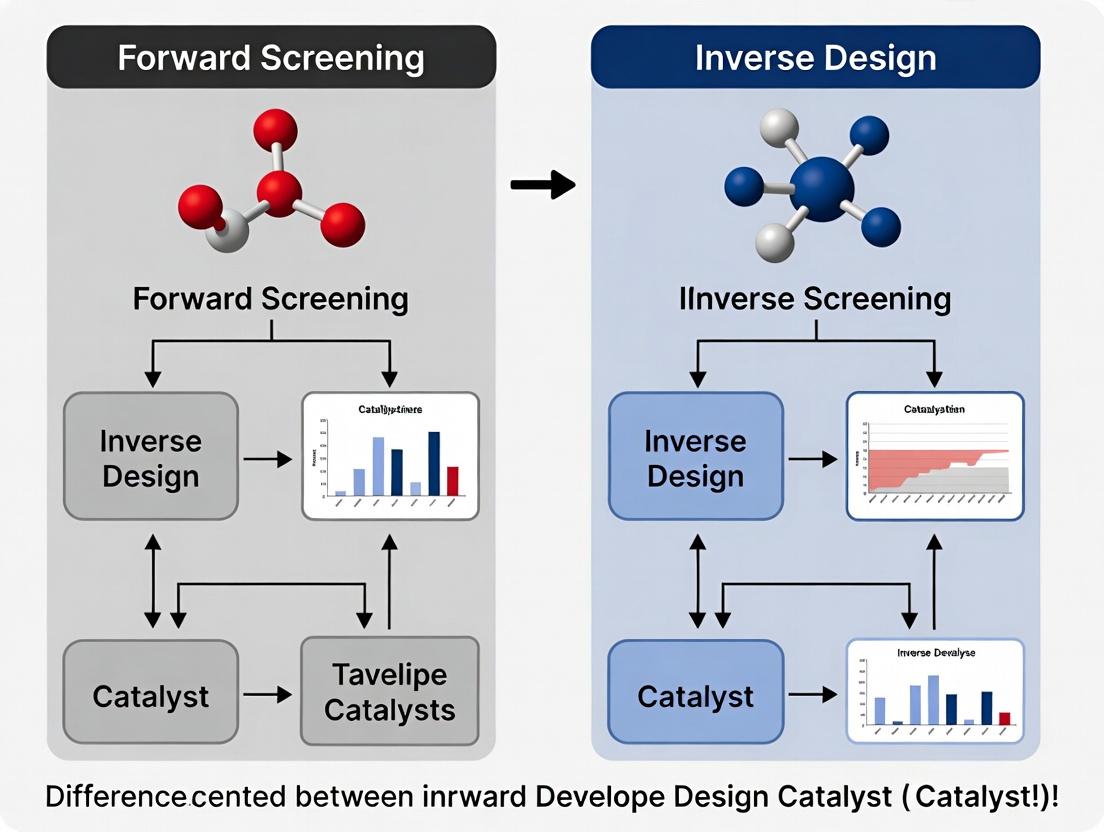
This article provides a comprehensive comparison of forward screening (high-throughput experimentation/virtual screening) and inverse design (generative models, active learning) for catalyst discovery and optimization.
Forward Screening vs. Inverse Design in Catalysis: A Strategic Guide for Accelerating Discovery
Abstract
This article provides a comprehensive comparison of forward screening (high-throughput experimentation/virtual screening) and inverse design (generative models, active learning) for catalyst discovery and optimization. Aimed at researchers and professionals, it covers foundational principles, practical methodologies, common challenges, and validation metrics. The analysis highlights how the strategic choice between these paradigms can streamline workflows, from biomimetic catalysts to pharmaceutical synthesis, ultimately accelerating the development of novel therapeutics and sustainable processes.
Foundations of Catalyst Discovery: Demystifying Forward Screening and Inverse Design
This whitepaper delineates the two dominant computational paradigms in modern materials science, with a specific focus on catalyst research. The selection, discovery, and optimization of catalysts are pivotal for advancing sustainable energy, chemical synthesis, and pharmaceutical development. The core thesis is that Forward Screening and Inverse Design represent fundamentally complementary but philosophically opposed approaches. Forward screening is a selection process from a vast, pre-defined candidate space, guided by predictive models. In stark contrast, Inverse Design is a generation process, where desired performance metrics dictate the creation of novel candidate structures, often residing outside of known chemical libraries. The effective integration of these paradigms is accelerating the design cycle for next-generation catalysts.
Defining Forward Screening
Forward screening, often termed high-throughput virtual screening (HTVS), follows a conventional "cause-to-effect" logic. The process begins with a large set of candidate materials (e.g., molecules, alloys, porous frameworks). Computational models, ranging from density functional theory (DFT) to machine learning (ML) surrogates, are used to predict key performance descriptors (e.g., adsorption energy, activation barrier, selectivity) for each candidate. Candidates are then ranked, and the top performers are selected for experimental validation.
Core Workflow: Candidate Library → Property Prediction → Ranking → Experimental Validation.
Detailed Experimental Protocol for a Forward Screening Study (Heterogeneous Catalysis)
- Library Curation: Define a chemical space. For a metal alloy catalyst study, this may involve generating surface slabs for binary/ternary combinations of 4-6 transition metals (e.g., Pt, Pd, Ni, Co, Fe, Cu) across various compositions and facets (e.g., (111), (211)).
- Descriptor Calculation: Employ DFT (using software like VASP, Quantum ESPRESSO) to calculate adsorption energies (E_ads) of key reaction intermediates (e.g., *CO, *O, *OH for oxygen reduction reaction). The computational hydrogen electrode model is often used for electrochemical reactions.
- Activity Prediction: Apply a scaling relation or a microkinetic model. A classic proxy is the adsorption free energy of a single intermediate (e.g., ΔG_*OH for ORR) based on the Sabatier principle. Candidates are plotted on a "volcano plot."
- Stability Filtering: Screen predicted candidates for thermodynamic and electrochemical stability using metrics like surface formation energy or dissolution potential.
- Synthesis & Testing: Top-ranked stable candidates are synthesized (e.g., via impregnation, co-reduction for alloys) and tested in a plug-flow reactor or electrochemical cell for activity, selectivity, and stability.
Diagram Title: Forward Screening Workflow for Catalyst Discovery
Defining Inverse Design
Inverse design flips the workflow, operating on an "effect-to-cause" principle. The researcher first defines the target property profile (e.g., optimal *CO adsorption energy of -0.8 eV, high stability under oxidizing conditions). An optimization algorithm (e.g., genetic algorithm, Bayesian optimization, generative model) then searches or generates atomic configurations that satisfy these constraints, often exploring uncharted chemical spaces.
Core Workflow: Target Property → Search/Generation Algorithm → Candidate Proposals → Validation.
Detailed Experimental Protocol for an Inverse Design Study (Molecular Catalyst)
- Target Specification: Define a multi-objective fitness function. For a photocatalyst, this could be: a) Ideal HOMO-LUMO gap (~2.0 eV), b) Specific redox potential relative to a reference, c) Synthetic accessibility score.
- Algorithmic Search: Employ a generative deep learning model (e.g., Variational Autoencoder, Generative Adversarial Network) trained on a database of organic molecules (e.g., QM9). The model's latent space is sampled or optimized to produce novel molecular structures.
- Property Prediction & Feedback Loop: Generated candidates are evaluated rapidly using a fast ML predictor. Their fitness scores are fed back to the generative algorithm to steer subsequent generations toward the target.
- Candidate Refinement: Top-generated molecules are re-evaluated with higher-fidelity methods (e.g., TD-DFT) to confirm properties.
- Synthesis Planning & Validation: Retrosynthetic analysis (e.g., using NLP-based tools) assesses feasibility. Proposed catalysts are then synthesized and tested experimentally.
Diagram Title: Inverse Design Closed-Loop Optimization
Comparative Analysis
Table 1: Paradigm Comparison in Catalyst Research
| Feature | Forward Screening | Inverse Design |
|---|---|---|
| Philosophy | Selection: Find the best from a known set. | Creation: Generate the optimal from a vast space. |
| Search Direction | Structure → Property (Forward) | Property → Structure (Inverse) |
| Candidate Source | Pre-enumerated library (databases, combinatorial expansion). | Algorithmically generated, often novel and non-intuitive. |
| Exploration vs. Exploitation | High exploitation of defined space; limited exploration beyond it. | High exploration of unknown space; targeted exploitation of fitness landscape. |
| Computational Cost | Cost scales linearly with library size (mitigated by ML). | Cost shifts to algorithm training and iterative evaluation loops. |
| Primary Output | Ranked list of known/derivative materials. | Novel structures optimized for multi-property targets. |
| Best Suited For | Well-defined chemical spaces with established descriptors (e.g., alloy catalysts, MOFs). | Problems where the optimal solution is unknown or requires breaking traditional design rules. |
Table 2: Quantitative Performance Metrics (Illustrative Data from Recent Literature)
| Metric | Forward Screening (e.g., MOF for CO2 capture) | Inverse Design (e.g., Organic LED molecule) |
|---|---|---|
| Typical Library Size | 10^4 – 10^6 candidates | Latent space: 10^8 – 10^20 potential points |
| Success Rate (Expt. Validation) | ~5-15% (high for top 100 ranked) | ~10-30% for meeting in silico target, <5% for full expt. validation |
| Time to Candidate (CPU hrs) | ~50,000 hrs for 50k DFT calculations (can be <100 hrs with ML). | ~10,000 hrs for model training + ~1,000 hrs for iterative optimization. |
| Novelty of Output | Low to Medium (known or derivative structures). | Very High (majority are previously unreported). |
The Scientist's Toolkit: Research Reagent Solutions
Table 3: Essential Tools and Materials for Computational Catalyst Research
| Item | Function & Application | Example Vendor/Software |
|---|---|---|
| High-Performance Computing (HPC) Cluster | Provides the computational power for DFT calculations, ML model training, and large-scale simulations. | Local university clusters, Cloud providers (AWS, Google Cloud), National labs. |
| Quantum Chemistry Software | Performs ab initio calculations (DFT, ab initio molecular dynamics) to obtain accurate electronic structure and energies. | VASP, Gaussian, Quantum ESPRESSO, CP2K. |
| Machine Learning Frameworks | Enables building and training surrogate models for property prediction and generative design. | PyTorch, TensorFlow, scikit-learn. |
| Catalyst Databases | Provides curated datasets for training ML models and initializing screening libraries. | CatHub, NOMAD, Materials Project, QM9 (for molecules). |
| Automated Workflow Managers | Automates complex, multi-step computational pipelines (e.g., DFT relaxation → frequency calculation → analysis). | AiiDA, FireWorks, ASE. |
| Chemical Structure Generators | Algorithmically generates molecular or crystal structures for inverse design. | RDKit, PyChemia, GASP (Genetic Algorithm for Structure Prediction). |
| Microkinetic Modeling Software | Translates atomic-scale descriptors (adsorption energies) into macroscopic rates and selectivities. | CATKINAS, Kinetics, homemade scripts (Python/Fortran). |
Historical Context and Evolution of Catalyst Discovery Strategies
The discovery of catalysts, pivotal for chemical synthesis and drug development, has evolved through distinct paradigms. This whitepaper delineates the historical progression from empirical and high-throughput "forward screening" approaches to the modern, knowledge-driven paradigm of "inverse design," framed within their respective scientific and technological contexts. The core thesis is that while forward screening empirically probes large libraries for activity, inverse design computationally defines a desired performance profile a priori and engineers catalysts to meet it, representing a fundamental shift from discovery to rational design.
Historical Context: The Empirical and High-Throughput Eras
The Empirical Dawn (Pre-20th Century)
Catalyst discovery was serendipitous and observation-driven. Examples include the use of platinum for sulfuric acid production (Peregrine Phillips, 1831) and nickel for hydrogenation (Paul Sabatier, 1897). No theoretical framework guided selection; discovery relied on trial-and-error.
The Rise of Forward Screening (Late 20th Century)
The advent of combinatorial chemistry and automation enabled forward screening (also called high-throughput screening, HTS). This strategy involves:
- Creating Diverse Libraries: Vast arrays of potential catalytic materials (e.g., metal complexes, solid surfaces) are synthesized combinatorially.
- Parallelized Testing: Libraries are screened in parallel for a target reaction under standardized conditions.
- Hit Identification: Active "hits" are identified via rapid analysis (e.g., GC, MS, fluorescence).
- Iterative Optimization: Hits are refined through subsequent rounds of synthesis and screening.
Thesis Context: Forward screening is a property-driven approach. It asks: "Which materials in my library exhibit the desired catalytic activity?" The design loop is Library → Synthesis → Screening → Analysis.
Key Quantitative Data: Forward Screening Era
Table 1: Milestones in Forward Screening Throughput and Scale
| Era | Decade | Typical Library Size | Throughput (Samples/Day) | Key Enabling Technology | Representative Catalyst Class |
|---|---|---|---|---|---|
| Early Combinatorial | 1990s | 10² - 10³ | 10² | Automated liquid handlers, parallel reactors | Heterogeneous mixed oxides, ligand libraries |
| Advanced HTS | 2000s | 10³ - 10⁵ | 10⁴ | Microarray printing, high-pressure parallel reactors, rapid GC/MS | Homogeneous organometallic complexes, polymerization catalysts |
| Ultra-HTS | 2010s-Present | 10⁵ - 10⁶ | 10⁵ | Droplet microfluidics, capillary electrophoresis, photochemical screening | Enantioselective organocatalysts, photocatalytic systems |
The Paradigm Shift: Inverse Design
The Computational Foundation
Inverse design emerged from advances in quantum chemistry, machine learning (ML), and computing power. Instead of screening existing libraries, it starts with a target performance profile (activity, selectivity, stability) and computationally identifies or constructs candidates that fulfill it.
Thesis Context: Inverse design is a first-principles-driven approach. It inverts the forward screening logic, asking: "What material has the theoretical properties needed for this specific reaction?" The design loop is Target Property → Computational Model → Candidate Prediction → Synthesis & Validation.
Core Methodologies for Inverse Design
A. Descriptor-Based and ML Models:
- Data Curation: Assemble a dataset of known catalysts and their performance metrics.
- Descriptor Calculation: Compute features (descriptors) e.g., d-band center for metals, steric/electronic parameters for ligands, MOF pore characteristics.
- Model Training: Train ML models (e.g., Random Forest, Neural Networks, Gaussian Processes) to map descriptors to performance.
- Inverse Query: Use the model to search a vast virtual chemical space for structures predicted to have optimal performance.
B. First-Principles Computational Workflow:
- Reaction Mechanism Elucidation: Use Density Functional Theory (DFT) to map the reaction pathway and identify the transition state and rate-determining step.
- Identification of Activity Descriptors: Correlate catalytic activity with a computable electronic/geometric descriptor (e.g., adsorption energies of key intermediates forming a "scaling relation").
- Virtual Screening: Use the descriptor as a proxy to computationally evaluate thousands of potential materials from databases.
- Down-Selection & Refinement: Select top candidates for more detailed DFT study and experimental validation.
Key Quantitative Data: Inverse Design Era
Table 2: Comparison of Forward Screening vs. Inverse Design Paradigms
| Parameter | Forward Screening | Inverse Design |
|---|---|---|
| Starting Point | Diverse material/library | Target performance metrics |
| Core Philosophy | Empirical discovery & optimization | Rational, first-principles design |
| Primary Cost Driver | Physical synthesis & screening | Computational resource & model development |
| Timescale (Per Cycle) | Weeks to months (experiment-heavy) | Days to weeks (computation-heavy) |
| Chemical Space Explored | Limited by synthetic accessibility (10³-10⁶) | Vast virtual space (10⁸-10¹²) |
| Optimal For | Reactions with poorly understood mechanisms; serendipitous discovery | Reactions with established descriptors; optimizing known materials |
| Key Limitation | "Needle in a haystack"; may miss optimal candidates | Model accuracy & transferability; synthesis feasibility of predicted candidates |
Experimental Protocols
Protocol for a Modern Forward Screening Campaign (Heterogeneous Catalysis)
- Objective: Identify active oxidation catalysts from a 1000-member mixed-metal oxide library.
- Materials: See "The Scientist's Toolkit" below.
- Procedure:
- Library Synthesis: Using an automated inkjet dispenser, deposit aqueous precursor solutions of various metals onto a monolithic alumina substrate in predefined combinations and ratios. Dry and calcine in a programmable furnace.
- High-Throughput Testing: Place the library in a scanning mass spectrometer reactor. Expose each spot sequentially to a reactant gas stream (e.g., CO + O₂). Monitor product formation (CO₂) in real-time via the mass spectrometer.
- Data Analysis: Map CO₂ production rates to library composition coordinates. Identify "hit" regions with activity exceeding a set threshold.
- Hit Validation & Re-synthesis: Re-synthesize hit compositions on a larger scale (mg-g) in fixed-bed reactors for detailed kinetic analysis (TOF, activation energy).
Protocol for an Inverse Design Workflow (Homogeneous Catalysis)
- Objective: Design a novel asymmetric organocatalyst for a specific Mannich reaction.
- Procedure:
- Dataset Construction: Curate a literature dataset of 500 known organocatalysts, their structural features (fingerprints or 3D descriptors), and enantiomeric excess (ee) for model reactions.
- Model Training: Train a graph neural network (GNN) to predict ee from molecular graph input.
- Inverse Design Loop: a. Generation: Use a generative model (e.g., Variational Autoencoder) to propose new catalyst structures in latent space. b. Prediction: Feed generated structures to the trained GNN for ee prediction. c. Optimization: Apply Bayesian optimization to steer generation towards regions of latent space predicted to yield high ee. d. Feasibility Filter: Filter top candidates with a synthesisability score model.
- Validation: Synthesize the top 5-10 computationally predicted catalysts and test them experimentally in the target Mannich reaction.
Mandatory Visualizations
Forward Screening Workflow: An Empirical, Loop-Based Process
Inverse Design Workflow: A Rational, Prediction-First Process
The Scientist's Toolkit: Research Reagent Solutions
Table 3: Essential Materials for Modern Catalyst Discovery Research
| Item | Function & Technical Relevance | Example Application |
|---|---|---|
| High-Throughput Microreactor Arrays | Allows parallel testing of 48-256 catalyst samples under controlled temperature/pressure. Essential for forward screening. | Testing zeolite libraries for cracking reactions. |
| Automated Liquid Handling Robots | Enables precise, reproducible dispensing of microliter volumes for library synthesis. | Preparing ligand/metal complex libraries in 96-well plates. |
| Metal Organic Framework (MOF) Kits | Pre-synthesized, diverse sets of MOF structures for screening gas storage or separation catalysts. | Screening for CO₂ hydrogenation catalysts. |
| Chiral Ligand/Primary Amine Toolkits | Commercial libraries of diverse, often modular, chiral building blocks. Core to asymmetric catalyst discovery. | Rapid assembly of organocatalysts for enantioselective screening. |
| Immobilized Catalyst Scaffolds | Functionalized resins/silica with anchor points (e.g., -NH₂, -COOH) for rapid heterogenization of homogeneous catalysts. | Creating supported catalyst libraries for flow chemistry. |
| Computational Catalyst Databases | Curated databases (e.g., NOMAD, Materials Project, CatApp) providing DFT-calculated properties for thousands of materials. | Source of data for training ML models in inverse design. |
| Descriptor Calculation Software | Tools (e.g., Dragon, RDKit, pymatgen) to compute molecular and material descriptors for QSAR/ML modeling. | Generating features for catalyst activity prediction models. |
Catalyst discovery and optimization represent a critical challenge in chemical engineering and pharmaceuticals. Traditionally, forward screening involves defining a set of candidate materials (a descriptor library), simulating or measuring their properties, and evaluating their performance to identify the best candidates. This is a "trial-and-error" approach, albeit an informed one. In contrast, inverse design begins with the desired target performance metrics and works backward to identify the material structures and descriptors that can achieve them. This paradigm shift, enabled by machine learning and advanced computation, seeks to directly solve for the optimal catalyst given a set of constraints and objectives.
This guide details the technical workflow for moving from comprehensive descriptor libraries to specific, high-value performance metrics, framing the discussion within this pivotal methodological dichotomy.
Constructing Comprehensive Descriptor Libraries
Descriptors are quantitative representations of a catalyst's properties. A robust library is the foundational input for both forward and inverse approaches.
Key Descriptor Categories:
- Geometric: Surface area, pore size distribution, coordination numbers, particle size.
- Electronic: d-band center, oxidation state, work function, band gap.
- Compositional: Elemental identity, doping concentration, alloying ratios.
- Thermodynamic: Adsorption energies (ΔGH, ΔGO, etc.), formation energy, activation barriers.
- Synthetic: Precursor type, calcination temperature, reduction protocol.
Experimental Protocol for Descriptor Acquisition (e.g., Adsorption Energy via Temperature-Programmed Desorption - TPD):
- Sample Preparation: Load 50-100 mg of catalyst into a U-shaped quartz tube reactor.
- Pretreatment: Reduce/activate the catalyst in situ under 5% H2/Ar at 500°C for 1 hour.
- Adsorption: Cool to 50°C under inert flow. Expose to 10% CO/He (for metal sites) for 30 minutes.
- Purge: Flush with pure He for 1 hour to remove physisorbed species.
- Desorption: Heat the sample at a constant rate (e.g., 10°C/min) to 800°C under He flow.
- Detection: Monitor desorbing molecules with a mass spectrometer (MS).
- Analysis: Calculate the adsorption energy (Eads) by analyzing the peak temperature (Tp) using the Redhead equation, assuming a pre-exponential factor of 1013 s-1.
Table 1: Exemplar Descriptor Library for Bimetallic Nanoparticle Catalysts
| Catalyst ID | Composition (Core@Shell) | Mean Particle Size (nm) | d-band Center (eV) | ΔGH* (eV) | ΔGCO* (eV) | Synthesis Temp. (°C) |
|---|---|---|---|---|---|---|
| Cat_01 | Pt@Pt | 2.5 ± 0.4 | -2.45 | -0.12 | -0.98 | 350 |
| Cat_02 | Pt@Pd | 3.1 ± 0.6 | -2.78 | -0.08 | -0.85 | 400 |
| Cat_03 | Pd@Pt | 2.8 ± 0.5 | -2.55 | -0.15 | -1.05 | 375 |
| Cat_04 | Pt3Ni@Pt | 2.9 ± 0.5 | -2.95 | 0.02 | -0.72 | 450 |
Defining Target Performance Metrics
Performance metrics are the quantitative objectives of catalyst design. They must be measurable, relevant, and aligned with application goals.
Primary Metrics:
- Activity: Turnover Frequency (TOF, s-1), Rate per mass/area.
- Selectivity: % Yield of desired product.
- Stability: % Activity retention over time (e.g., 100 hours).
- Faradaic Efficiency (Electrocatalysis): % of charge used for desired product.
Experimental Protocol for Measuring Turnover Frequency (TOF) in Heterogeneous Catalysis:
- Kinetic Setup: Use a fixed-bed plug-flow reactor operating at differential conversion (<10%).
- Condition Standardization: Set precise temperature (T), pressure (P), and feed partial pressures (pi).
- Rate Measurement: Analyze inlet/outlet stream via online Gas Chromatography (GC) to determine moles of product formed per unit time (r).
- Active Site Quantification: Perform in situ CO chemisorption via pulsed titration on the same catalyst sample to count surface metal atoms (Ms).
- Calculation: TOF = (r) / (Ms), expressed in molecules per active site per second.
The Forward Screening Pathway
This pathway maps descriptors to performance through systematic experimentation or simulation.
Workflow:
- Library Definition: Assemble a diverse but finite set of candidate catalysts.
- High-Throughput Experimentation/DFT: Perform parallelized testing or computation to generate performance data.
- Modeling: Construct a statistical or machine learning model (e.g., Linear Regression, Random Forest) correlating descriptors to target metrics.
- Prediction & Validation: Use the model to predict performance for untested candidates in the library and validate top hits experimentally.
Diagram 1: Forward Screening Workflow for Catalysts
The Inverse Design Pathway
This pathway inverts the problem, starting from the performance target and solving for the optimal descriptors and material.
Workflow:
- Target Definition: Specify precise constraints (e.g., cost, stability) and objectives (e.g., maximize TOF, selectivity >99%).
- Inverse Model: Employ an optimization algorithm (e.g., Bayesian Optimization, Generative Model) to explore the vast, continuous chemical space.
- Solution Generation: The model proposes optimal descriptor combinations (the "ideal catalyst").
- Material Realization: Use the proposed descriptors to guide synthesis (e.g., via heuristic rules or a separate synthesis model).
- Validation & Iteration: Test the synthesized material. Feedback results to refine the inverse model.
Diagram 2: Inverse Design Loop for Catalyst Discovery
Comparative Analysis and Integration
Table 2: Forward Screening vs. Inverse Design for Catalysts
| Aspect | Forward Screening | Inverse Design |
|---|---|---|
| Problem Direction | Descriptors → Performance | Performance → Descriptors |
| Search Space | Discrete, pre-enumerated library | Continuous, vast chemical space |
| Primary Tools | High-throughput experiment, QSPR | Bayesian Optimization, Generative AI |
| Exploration vs. Exploitation | Strong exploration of defined set | Balances exploration with targeted exploitation |
| Optimality Guarantee | Finds best within library | Aims for global optimum within constraints |
| Synthesis Integration | Post-hoc; synthesis conditions are a descriptor | Often integrated; model suggests synthesizable materials |
| Computational Cost | Scales with library size (N) | Scales with iterations and model complexity |
The Scientist's Toolkit: Research Reagent Solutions
Table 3: Essential Materials and Reagents for Catalyst Research
| Item | Function/Brief Explanation |
|---|---|
| High-Purity Metal Salts (e.g., H2PtCl6, Ni(NO3)2) | Precursors for impregnation or colloidal synthesis of catalytic active phases. |
| Porous Supports (e.g., γ-Al2O3, Carbon Black Vulcan XC-72) | Provide high surface area for metal dispersion, influence stability and electronic properties. |
| Structure-Directing Agents (e.g., CTAB, PVP) | Control morphology and particle size during nanoparticle synthesis. |
| Calibration Gas Mixtures (e.g., 5% H2/Ar, 10% CO/He) | Essential for chemisorption measurements (active site counting) and TPD experiments. |
| Custom Alloy Catalyst Libraries | Commercially available thin-film or powder libraries for primary high-throughput screening. |
| In Situ/Operando Cells (e.g., XRD, IR) | Specialized reactors allowing real-time characterization of catalysts under working conditions. |
| Computational Catalyst Databases (e.g., NOMAD, Materials Project) | Source of pre-computed DFT descriptors (formation energies, band structures) for initial modeling. |
| Active Learning Software Platforms (e.g., AMP, CAT) | Integrated toolkits automating the inverse design loop through machine learning. |
The search for high-performance catalysts is a cornerstone of modern chemical engineering and drug development. Within this domain, two computational paradigms have emerged: Forward Screening and Inverse Design. This whitepaper examines the divergent roles of data within these approaches, specifically contrasting the requirement for extensive quantitative datasets in forward screening against the need for precise, high-quality physicochemical data in inverse design. The choice of strategy fundamentally dictates the nature, scale, and application of the required data.
Forward Screening: A Data-Quantity-Driven Paradigm
Forward screening follows a "discover from a known set" logic. It involves evaluating a vast library of candidate materials against a set of target properties (e.g., adsorption energy, turnover frequency) using computational models, such as Density Functional Theory (DFT) or machine learning (ML) surrogates.
Core Data Requirement: The engine of forward screening is volume. Success is statistically driven, requiring large, consistent datasets to train accurate ML models or to populate comprehensive search spaces.
Key Data Sources & Characteristics:
- High-Throughput Computation Databases: Materials Project, Catalysis-Hub, NOMAD.
- Uniformity: Data must be generated or curated using consistent computational parameters (exchange-correlation functional, k-point grid, convergence criteria) to ensure comparability.
- Feature-Rich Descriptors: Each material is represented by a vector of hundreds to thousands of features (compositional, structural, electronic).
Experimental Protocol for Generating Screening Data (High-Throughput DFT):
- Library Definition: Generate candidate structures via substitutional doping, strain application, or sampling from crystal structure databases.
- Workflow Automation: Use frameworks like
FireWorksorAiiDAto manage thousands of DFT jobs across high-performance computing clusters. - Property Calculation: a. Structure Relaxation: Optimize geometry until forces on atoms are < 0.01 eV/Å. b. Electronic Analysis: Perform static calculation on relaxed geometry to obtain the density of states. c. Reaction Energy Calculation: Compute energies of reaction intermediates adsorbed onto catalyst surfaces (e.g., *CO, *OOH for CO₂ reduction).
- Descriptor Extraction: Use tools like
pymatgento compute features (d-band center, coordination number, electronegativity variance). - Model Training: Train a kernel ridge regression or neural network model on the DFT-calculated properties using the descriptors as input.
Table 1: Quantitative Data Scale in Forward Screening
| Data Component | Typical Scale | Purpose | Example Source |
|---|---|---|---|
| Candidate Materials Library | 10⁴ – 10⁷ compounds | Define search space | ICSD, OQMD |
| DFT Training Data Points | 10³ – 10⁵ calculations | Train surrogate ML models | Materials Project (> 150,000 entries) |
| Material Descriptor Dimensions | 10² – 10³ features | Represent each candidate | Magpie, matminer featurizers |
| Screening Output Metrics | 1 – 10 target properties/ candidate | Rank candidates | Adsorption energy, activity volcano plot position |
Research Reagent Solutions for Forward Screening
| Item | Function |
|---|---|
| VASP / Quantum ESPRESSO | Software for performing high-throughput DFT calculations. |
pymatgen / ase |
Python libraries for structure generation, analysis, and workflow automation. |
matminer |
Library for featurizing materials and managing datasets. |
scikit-learn / TensorFlow |
Frameworks for building and training machine learning surrogate models. |
| High-Performance Computing (HPC) Cluster | Essential computational resource for parallel processing of thousands of simulations. |
Title: Forward Screening High-Throughput Workflow
Inverse Design: A Data-Quality-Driven Paradigm
Inverse design inverts the workflow: it starts with a set of desired target properties and seeks to identify or generate an optimal structure that meets them, often using generative models or global optimization algorithms.
Core Data Requirement: The foundation of inverse design is precision and mechanistic depth. It requires high-fidelity, well-validated data that captures complex structure-property relationships, often at a smaller scale but with greater physical rigor.
Key Data Sources & Characteristics:
- Benchmark-Quality Datasets: Small, meticulously validated datasets from peer-reviewed literature or ultra-high-accuracy computations (e.g., CCSD(T), hybrid functionals).
- Mechanistic Insight: Data must inform the underlying physical constraints (e.g., transition state geometries, scaling relations, electronic density maps).
- Active Learning Integration: Data acquisition is iterative and targeted, designed to query regions of chemical space that reduce model uncertainty.
Experimental Protocol for Generating Inverse Design Data (Active Learning Loop):
- Define Target Property Space: Specify precise constraints (e.g., "CO adsorption energy = -0.8 ± 0.1 eV, stability > 1.0 eV/atom").
- Initialize with Priors: Train a Bayesian neural network or Gaussian process on a small, high-quality seed dataset.
- Generate Candidates: Use a generative model (VAE, GAN) or genetic algorithm to propose structures meeting targets.
- Acquisition & Validation: Calculate the uncertainty of the model's prediction for each candidate. Select the candidate(s) with highest uncertainty or highest expected improvement for high-fidelity DFT validation. a. Perform rigorous convergence tests (cutoff energy, k-points). b. Use a higher-level functional (e.g., RPBE, HSE06) or include van der Waals corrections. c. Confirm key transition states via nudged elastic band (NEB) calculations.
- Iterate: Add the new, high-quality data point to the training set and retrain the model. Repeat until a candidate satisfies all target criteria.
Table 2: Quantitative Data Scale in Inverse Design
| Data Component | Typical Scale | Purpose | Quality Requirement |
|---|---|---|---|
| Seed / Training Dataset | 10¹ – 10³ compounds | Establish foundational physical model | Ultra-high accuracy (e.g., experimental or CCSD(T) benchmarked) |
| Active Learning Iterations | 10¹ – 10² cycles | Refine model in targeted space | Each new point requires high-fidelity validation |
| Generated Candidate Pool per Cycle | 10² – 10³ structures | Propose solutions | Evaluated by surrogate model; only top-uncertain validated |
| Property Constraints | 3 – 10 multi-fidelity targets | Define the "inverse" problem | Can include stability, activity, selectivity, cost |
Research Reagent Solutions for Inverse Design
| Item | Function |
|---|---|
| Gaussian / ORCA | Software for high-accuracy ab initio calculations (e.g., coupled cluster) for benchmark data. |
GPy / GPflow |
Libraries for implementing Gaussian Process models for uncertainty quantification. |
PyTorch / TensorFlow Probability |
Frameworks for building Bayesian Neural Networks and generative models (VAEs). |
Atomic Simulation Environment (ase) + NEB |
For performing transition state searches and validating reaction pathways. |
Active Learning Platform (molmod, COMBO) |
Specialized software to manage the query, training, and iteration loop. |
Title: Inverse Design Active Learning Loop
The choice between forward screening and inverse design is dictated by the problem scope and data landscape.
Table 3: Data Requirement Comparison: Forward Screening vs. Inverse Design
| Aspect | Forward Screening | Inverse Design |
|---|---|---|
| Primary Data Driver | Quantity & Uniformity | Quality & Fidelity |
| Dataset Size | Very Large (10³–10⁶) | Small to Medium (10¹–10³), then targeted |
| Data Generation Goal | Populate a known space uniformly | Illuminate a constrained, optimal region |
| Key Computational Cost | Massive parallel DFT for training data | Intensive, serial high-fidelity validation |
| Optimal Use Case | Exploring broad trends; discovering promising material classes from vast spaces | Designing a catalyst with multiple precise constraints; navigating complex trade-offs |
| Risk | May miss optimal, non-intuitive solutions outside the library | Generative space may be chemically unrealistic; requires excellent physical priors |
Title: Strategy Selection Based on Data & Goals
In catalyst research, data is not a monolithic resource. Forward screening demands large-scale, consistent data to power statistical discovery, treating data as a quantitative fuel for exploration. Conversely, inverse design relies on high-fidelity, information-rich data to guide a precision-focused search, treating data as a qualitative map of a complex landscape. The strategic integration of both paradigms—using forward screening to identify promising regions and inverse design to optimize within them—represents the most powerful approach, necessitating a hybrid data infrastructure that accommodates both volume and rigor.
Methodologies in Action: Practical Guide to Screening and Design Workflows
In the modern discovery paradigm for catalysts and functional molecules, two principal strategies exist: forward screening and inverse design. This whitepaper focuses on the practical implementation of forward screening. While inverse design begins with a desired property or function and uses computational models to design a structure that fulfills it, forward screening starts with a large set of candidate structures and screens them to identify those with the desired performance. Forward screening is agnostic to the underlying structure-property rules, making it exceptionally powerful for complex, poorly understood systems. High-Throughput Experimentation (HTE) and screening of Virtual Libraries are its two most potent enabling technologies, often used in tandem to accelerate discovery.
High-Throughput Experimentation (HTE): Core Methodologies
HTE refers to the automated, parallel synthesis and testing of large libraries of candidate materials (e.g., catalysts, ligands) under controlled conditions. The core principle is miniaturization, parallelization, and automation.
Key Experimental Protocol: Parallel Catalyst Screening for Cross-Coupling Reactions
- Objective: To evaluate 384 distinct Pd-based catalyst formulations for a Suzuki-Miyaura cross-coupling.
- Materials: 384-well microtiter plate, automated liquid handler, plate shaker/heater, UHPLC-MS for analysis.
- Procedure:
- Library Preparation: An automated dispenser aliquots different pre-formed catalyst complexes (or separate ligand/metal precursor combinations) into each well of the plate.
- Substrate Dispensing: A solution containing aryl halide and boronic acid substrates in a degassed solvent (e.g., dioxane/water mixture) is added to all wells.
- Base Addition: A solution of base (e.g., K₃PO₄) is added to initiate the reaction.
- Reaction Execution: The sealed plate is agitated and heated in a parallel reactor block (e.g., 80°C for 18 hours).
- Quenching & Analysis: The plate is cooled, and an analytical internal standard in acetonitrile is added via automated handler to quench and dilute. The plate is then analyzed by UHPLC-MS with an autosampler.
- Data Processing: Conversion and selectivity for each well are automatically calculated from chromatographic data and compiled into a heatmap.
The Scientist's Toolkit: Essential HTE Reagents & Materials
| Item | Function in HTE |
|---|---|
| Microtiter Plates (96, 384, 1536-well) | Miniaturized reaction vessels enabling massive parallelization. Often pre-loaded with solid reagents. |
| Automated Liquid Handler/Pipettor | Precisely dispenses microliter-to-nanoliter volumes of reagents, catalysts, and solvents for library assembly. |
| Modular Parallel Reactor Blocks | Provide controlled heating, cooling, stirring, and pressure for arrays of reactions simultaneously. |
| High-Throughput Analytics (UHPLC-MS, GC-MS) | Rapid, automated separation and quantification of reaction outcomes from micro-scale samples. |
| Chemspeed, Unchained Labs, etc. | Integrated robotic platforms that automate the entire workflow from synthesis to work-up. |
| Statistical Design of Experiments (DoE) Software | Optimizes the selection of variable combinations (catalyst, ligand, solvent, temp) to maximize information gain. |
Virtual Library Screening: Computational Forward Screening
When physical libraries are impractically large (>10⁶ members), computational screening of virtual libraries acts as a pre-filter. This involves generating a vast number of in silico structures and predicting their properties via quantum mechanical (QM) or machine learning (ML) models to prioritize candidates for synthesis and HTE testing.
Key Computational Protocol: Virtual Screening of Organocatalysts
- Objective: Identify promising asymmetric organocatalysts from a virtual library of 50,000 chiral amine derivatives.
- Workflow:
- Library Enumeration: Use a rule-based algorithm (e.g., in RDKit) to generate all structurally valid molecules from a set of core scaffolds and substituents.
- Property Filtering: Apply calculated filters (e.g., molecular weight <500, synthetic accessibility score, absence of toxicophores) to reduce the library to 10,000 candidates.
- Conformational Sampling: Generate low-energy 3D conformers for each candidate.
- Activity Prediction: For each candidate, compute a descriptor (e.g., the energy of the transition state for a key step using a fast QM method like GFN2-xTB, or a predicted enantiomeric excess from a previously trained ML model).
- Ranking & Prioritization: Rank candidates by the predicted performance metric. The top 100-500 are selected for physical synthesis and HTE validation.
Data Presentation: Comparative Performance of Screening Approaches
Table 1: Quantitative Comparison of Forward Screening Modalities
| Parameter | Traditional Sequential Screening | Physical HTE | Virtual Library Screening |
|---|---|---|---|
| Library Size Practicable | 10¹ - 10² | 10² - 10⁵ | 10⁵ - 10¹² |
| Typical Cycle Time | Weeks - Months | Days - Weeks | Hours - Days |
| Material Consumption per Test | Milligram - Gram | Microgram - Milligram | None (Computational) |
| Primary Cost Driver | Labor & Materials | Equipment & Automation | Compute Time / Software |
| Information Output | Single data point per run | Multivariate landscape | Predictive model + rankings |
| Key Limitation | Extremely low throughput | Library must be synthesized | Accuracy of predictive model |
Integrated Workflow: Combining Virtual and Physical Screening
The most effective modern pipelines combine computational and experimental forward screening iteratively.
Integrated Forward Screening Pipeline
Forward screening via HTE and virtual libraries represents a robust, empirically-driven discovery engine. It is complementary to inverse design: while inverse design seeks the optimal solution within a defined design space, forward screening is superior for exploring vast, unknown chemical spaces and for systems where accurate first-principles models are unavailable. The integration of rapid physical experimentation with increasingly sophisticated computational pre-screening creates a powerful, iterative cycle that continues to accelerate the discovery of novel catalysts and bioactive molecules. The future lies in tightening this loop, using HTE data to constantly improve the predictive models that guide virtual screening.
The search for novel catalysts, critical for pharmaceuticals, energy, and chemical manufacturing, follows two primary paradigms. Forward Screening involves the empirical testing of large libraries of candidate materials to identify those with desirable properties. Inverse Design reverses this workflow: it starts with a set of desired performance criteria and computationally designs a material structure predicted to meet them before any physical synthesis. This whitepaper details the modern toolkit—combinatorial chemistry, robotics, and Density Functional Theory (DFT) screening—that enables both approaches, accelerating the catalyst discovery pipeline.
Core Methodologies and Integration
Combinatorial Chemistry for Library Generation
Combinatorial chemistry enables the rapid, parallel synthesis of vast, diverse libraries of molecular or material candidates. For heterogeneous catalysis, this often involves creating composition-spread thin films or arrays of solid-state materials.
- Experimental Protocol (Solid-State Catalyst Array Synthesis via Sputtering):
- Substrate Preparation: A temperature-resistant substrate (e.g., Al2O3 wafer) is patterned with masking materials to define array regions.
- Target Configuration: Multiple elemental targets (e.g., Pt, Pd, Co, Fe) are mounted in a multi-gun magnetron sputtering system.
- Combinatorial Deposition: The substrate is rastered under the targets using computer-controlled stages. The dwell time under each target is precisely varied across the substrate, creating a continuous gradient of elemental compositions.
- Post-Deposition Treatment: The array is annealed in a controlled atmosphere (e.g., O2, H2) at 400-800°C for 1-4 hours to induce crystallization and phase formation.
- Characterization: High-throughput X-ray Diffraction (HT-XRD) and X-ray Photoelectron Spectroscopy (HT-XPS) map phase and surface composition across the array.
Robotics and High-Throughput Experimentation (HTE)
Automation bridges synthesis and testing. Liquid-handling robots and automated reactor systems perform parallelized, reproducible experiments.
- Experimental Protocol (High-Throughput Catalytic Testing of an Array):
- Reactor Sealing: The synthesized material array is placed in a custom reactor chamber with a gas-tight seal.
- Gas Delivery: An automated mass flow controller system delivers a reactant gas mixture (e.g., CO + O2 for oxidation studies) at specified flow rates and pressure.
- Temperature Ramping: The reactor is heated according to a programmed temperature profile (e.g., 50°C to 500°C at 10°C/min).
- Product Analysis: The effluent from each distinct catalyst spot is sampled sequentially via a capillary probe connected to a quadrupole mass spectrometer (QMS) or gas chromatograph (GC). Automation software correlates activity (e.g., CO2 production) with each composition.
- Data Logging: Conversion and selectivity data for each spot are automatically recorded in a database linked to its composition coordinates.
Density Functional Theory (DFT) Screening
DFT provides quantum-mechanical calculations of electronic structure to predict catalytic properties like adsorption energies and reaction energy pathways.
- Computational Protocol (DFT Screening for Catalyst Activity):
- Model Construction: Build slab models of potential catalyst surfaces (e.g., Pt(111), PdFe(100)) using atomic modeling software.
- Geometry Optimization: Use a DFT code (e.g., VASP, Quantum ESPRESSO) with a selected exchange-correlation functional (e.g., RPBE) and plane-wave basis set to relax the structure to its minimum energy configuration.
- Adsorption Energy Calculation: Place adsorbates (e.g., *CO, *O, *H) at various surface sites and re-optimize. Calculate adsorption energy: Eads = E(surface+adsorbate) - Esurface - Eadsorbate.
- Reaction Pathway Mapping: Use the Nudged Elastic Band (NEB) method to locate transition states and calculate activation barriers for elementary steps.
- Descriptor Identification: Corrogate calculated parameters (e.g., *O or *CO binding energy) with known catalytic activity to establish a "volcano plot" descriptor. New materials are screened by computing this descriptor.
Data Presentation: Comparative Performance of Methodologies
Table 1: Throughput and Scale of Discovery Techniques
| Technique | Typical Library Size | Testing Rate (Experiments/Week) | Key Output Metric | Primary Role in Paradigm |
|---|---|---|---|---|
| Traditional Sequential | 1-10 | 1-5 | Conversion/Selectivity | Baseline |
| Combinatorial HTE (Robotics) | 100 - 10,000 | 100 - 1,000 | Activity/Selectivity Maps | Forward Screening Core |
| DFT Computational Screening | 1,000 - 100,000+ | Varies (Compute-bound) | Adsorption Energies, Activity Descriptors | Inverse Design / Pre-screening |
Table 2: Representative DFT-Calculated Adsorption Energies for CO on Transition Metal Surfaces*
| Catalyst Surface | DFT-Functional | CO Adsorption Energy (eV) | Relative Activity Prediction (for CO Oxidation) |
|---|---|---|---|
| Pt(111) | RPBE | -1.45 | High (Near Volcano Peak) |
| Pd(111) | RPBE | -1.78 | Medium (Strong Binding Limb) |
| Au(111) | RPBE | -0.30 | Low (Weak Binding Limb) |
| Pt3Fe(111) | RPBE | -1.62 | Very High (Predicted Optimal) |
Data is illustrative, based on common findings in literature (e.g., *J. Phys. Chem. C, 2021, 125, 124*).
Workflow Visualizations
Forward vs Inverse Catalyst Design
Integrated HTE-DFT-ML Discovery Pipeline
The Scientist's Toolkit: Essential Research Reagent Solutions
Table 3: Key Materials and Reagents for Catalytic Discovery Workflows
| Item | Function & Explanation |
|---|---|
| Precursor Salts & Complexes (e.g., H2PtCl6, Pd(NO3)2, metal acetylacetonates) | Soluble metal sources for liquid-phase robotic synthesis of supported catalyst libraries via impregnation. |
| High-Purity Elemental Targets (e.g., Pt, Pd, Fe, Co discs, 99.99+%) | Sputtering targets for physical vapor deposition (PVD) synthesis of thin-film catalyst libraries. |
| Functionalized Solid Supports (e.g., γ-Al2O3, SiO2, TiO2 powders, Carbon nanotubes) | High-surface-area carriers for dispersing active catalytic phases. Surface properties dictate metal-support interactions. |
| Calibrated Gas Mixtures (e.g., 5% CO/He, 10% O2/He, 5% H2/Ar) | Standardized reactants and calibration standards for high-throughput catalytic activity and selectivity testing. |
| Reference Catalysts (e.g., EUROPT-1 [Pt/SiO2], commercial Pd/C) | Benchmarks for validating the performance of both experimental setups and newly discovered materials. |
| Computational Pseudopotentials (e.g., Projector Augmented-Wave (PAW) sets) | Pre-calculated potential files representing core electrons in DFT codes, crucial for accuracy and efficiency. |
| High-Throughput Microreactor Arrays (e.g., 16- or 48-well parallel reactor blocks) | Enables simultaneous testing of multiple catalyst samples under identical temperature and pressure conditions. |
The discovery of novel catalysts has traditionally relied on forward screening, a high-throughput experimental or computational process that evaluates a vast array of candidate materials against a set of target properties. This approach, while powerful, is often inefficient, exploring a chemically sparse space guided by intuition and known motifs. Inverse design inverts this paradigm: it starts with a set of desired, optimal performance criteria and computationally generates candidate structures that satisfy them before synthesis, drastically narrowing the search space.
This whitepaper details the practical implementation of inverse design, focusing on the synergistic integration of generative models and active learning loops to accelerate the discovery of catalytic materials and drug candidates.
Core Methodology: Integrating Generative AI with Active Learning
The inverse design workflow is a closed-loop, iterative cycle. The following diagram illustrates this core process.
Title: Inverse Design Active Learning Cycle
Detailed Experimental Protocols
1. Generative Model Training (e.g., for Molecular Catalysts)
- Objective: Train a model to learn a continuous latent representation of chemical space from a dataset of known molecules/crystals.
- Protocol: A Variational Autoencoder (VAE) is commonly used. The SMILES string or graph representation of each molecule in a database (e.g., QM9, Materials Project) is fed into an encoder network, which maps it to a probability distribution in a latent space. A decoder network reconstructs the original representation from a sample of this distribution. The model is trained to minimize reconstruction loss while keeping the latent distribution close to a standard normal distribution (KL divergence).
2. Active Learning Loop for Catalyst Optimization
- Step 1 - Initial Proposal: The trained generative model samples the latent space, or uses a Bayesian optimization controller, to propose 100-1000 initial candidate structures predicted to have high activity (e.g., high CO₂ adsorption energy, optimal d-band center).
- Step 2 - Low-Fidelity Screening: Candidates are evaluated using rapid, approximate methods (e.g., machine learning force fields, semi-empirical quantum mechanics). The top 10-50 candidates are selected based on predicted properties.
- Step 3 - High-Fidelity Validation: Selected candidates undergo Density Functional Theory (DFT) calculations for precise energy and electronic structure analysis. A subset (1-5) of the most promising candidates is synthesized and tested experimentally (e.g., in a microreactor for turnover frequency).
- Step 4 - Data Augmentation & Retraining: All results (successful and failed candidates) are added to the training dataset. The generative model is retrained on this expanded dataset, refining its understanding of the structure-property landscape. The loop repeats from Step 1.
Data Presentation: Performance Comparison
Table 1: Comparative Metrics of Forward Screening vs. Inverse Design for a Hypothetical CO₂ Reduction Catalyst Search
| Metric | Forward High-Throughput Screening | Inverse Design with Active Learning |
|---|---|---|
| Initial Candidates Evaluated | 50,000 (All via DFT) | 5,000 (Via ML Surrogate) |
| High-Fidelity (DFT) Calculations | 50,000 | 150 |
| Experimental Syntheses Tested | 200 | 12 |
| Time to Lead Candidate (Estimated) | 24 months | 8 months |
| Discovery Hit Rate | ~0.4% (2/200) | ~25% (3/12) |
| Computational Resource Cost | 1.0x (Baseline) | 0.05x |
Table 2: Key Performance Indicators for Different Generative Model Architectures
| Model Type | Example | Sample Diversity | Novelty Rate* | Property Optimization Success Rate* |
|---|---|---|---|---|
| Variational Autoencoder (VAE) | ChemVAE | High | ~70% | Moderate |
| Generative Adversarial Network (GAN) | MolGAN | Moderate | ~60% | High |
| Autoregressive Model | GPT for Molecules | Low | ~40% | Very High |
| Diffusion Model | GeoDiff | Very High | >80% | High |
*Reported ranges from recent literature (2023-2024) for molecular generation tasks.
The Scientist's Toolkit: Key Research Reagent Solutions
Table 3: Essential Computational & Experimental Tools for Inverse Design
| Item / Solution | Function in Inverse Design Workflow |
|---|---|
| Graph Neural Network (GNN) Library (e.g., PyTorch Geometric) | Framework for building generative models that operate directly on molecular graphs, capturing bond and node features. |
| High-Throughput DFT Software (e.g., VASP, Quantum ESPRESSO) | Provides the "ground truth" electronic structure data for training surrogate models and final candidate validation. |
| Active Learning Platform (e.g., ChemOS, AMP) | Orchestrates the loop between proposal, calculation, and model updating. |
| Chemical Database (e.g., Materials Project, PubChemQC) | Source of initial training data for generative models. |
| Automated Synthesis Robot | Enables rapid experimental validation of computationally proposed catalysts or ligands. |
| In-Situ/Operando Characterization Suite (e.g., FTIR, XAFS) | Provides real-time feedback on catalyst structure under working conditions to inform model constraints. |
Pathway and Workflow Visualization
The following diagram details the logical decision pathway within the candidate selection and evaluation phase of the active learning loop.
Title: Candidate Selection & Evaluation Pathway
Inverse design, powered by generative models and steered by active learning, represents a foundational shift in catalyst and drug discovery. By framing the search as a direct optimization from property to structure, it achieves a dramatically higher efficiency than forward screening. The closed-loop integration of computation, data, and experiment creates a continuously improving system, promising to rapidly navigate the vast combinatorial spaces of materials and molecular science towards bespoke, high-performance solutions.
The search for optimal catalysts operates across two distinct paradigms. Forward screening involves simulating or testing a vast, often pre-defined, library of candidate materials to evaluate their performance against target metrics (e.g., activity, selectivity). It is a high-throughput exploration of a known chemical space. In contrast, inverse design flips this process: it starts with a desired set of performance criteria and computationally generates candidate structures predicted to meet those goals, often navigating previously unexplored regions of material space. The "Tools of the Trade" discussed herein are computational engines powering this paradigm shift, enabling efficient navigation of complex, high-dimensional design landscapes in catalysis and drug discovery.
Core Methodologies: Technical Foundations
Variational Autoencoders (VAEs)
VAEs are generative models that learn a compressed, continuous latent representation of input data (e.g., molecular structures). They consist of an encoder that maps inputs to a distribution in latent space and a decoder that reconstructs inputs from samples of this space.
Key Experimental Protocol for Molecular Generation:
- Data Preparation: Curate a dataset of molecular structures (e.g., SMILES strings) and associated property labels. Perform tokenization and canonicalization.
- Model Architecture: Implement an encoder (typically RNN or Transformer) that outputs parameters (μ, σ) for a Gaussian latent distribution
z. The decoder is a network that reconstructs the molecular sequence from a sample ofz. - Training: Optimize the evidence lower bound (ELBO) loss, which balances reconstruction accuracy and the Kullback–Leibler divergence between the learned latent distribution and a prior (usually standard normal).
- Generation: Sample a vector
zfrom the latent space and pass it through the decoder to generate novel molecular structures.
Generative Adversarial Networks (GANs)
GANs pit two neural networks against each other: a Generator (G) creates candidate data from noise, and a Discriminator (D) evaluates their authenticity against real data.
Key Experimental Protocol for Material Design:
- Network Design: Design
G(often a deconvolutional network) to output structural descriptors. DesignD(a convolutional or dense network) to output a probability of the input being "real." - Adversarial Training: Train in alternating steps. Step 1: Update
Dto maximize its ability to distinguish real training data from fakes generated byG. Step 2: UpdateGto minimizeD's ability to detect its fakes (i.e., trickD). - Conditional Generation: For targeted design, both
GandDare conditioned on desired property vectors, guidingGto produce structures with specific traits.
Bayesian Optimization (BO)
BO is a sample-efficient strategy for optimizing expensive black-box functions. It uses a surrogate model (usually a Gaussian Process) to approximate the objective function and an acquisition function to decide where to sample next.
Key Experimental Protocol for Catalyst Optimization:
- Surrogate Model: Define a Gaussian Process prior over the function mapping catalyst descriptors (e.g., composition, surface area) to target performance (e.g., yield).
- Acquisition Function: Select the next catalyst to test by maximizing an acquisition function (e.g., Expected Improvement, Upper Confidence Bound), which balances exploration and exploitation.
- Iterative Loop: For iteration
t: a) Use the surrogate model to compute the acquisition function over the candidate set. b) Select and synthesize/test the top candidate. c) Update the surrogate model with the new data point. d) Repeat until convergence or budget exhaustion.
Genetic Algorithms (GAs)
GAs are evolutionary-inspired optimization algorithms that maintain a population of candidate solutions (e.g., molecular graphs). Candidates are selected based on fitness (performance) and undergo "genetic" operations to produce new generations.
Key Experimental Protocol:
- Initialization: Create a random population of candidate solutions encoded as strings or graphs.
- Evaluation: Compute the fitness (target property) for each candidate via simulation or a proxy model.
- Selection: Use a method (e.g., tournament selection) to choose parent candidates, favoring higher fitness.
- Variation: Apply crossover (combining parts of two parents) and mutation (random alterations) to produce offspring.
- Replacement: Form a new generation from parents and offspring, iterating steps 2-5 until a stopping criterion is met.
Table 1: Method Comparison for Catalyst Design
| Tool | Primary Strength | Typical Search Mode | Sample Efficiency | Key Challenge |
|---|---|---|---|---|
| VAE | Continuous latent space enables smooth interpolation and exploration. | Inverse Design | High (after training) | Can generate invalid structures; mode collapse. |
| GAN | Can produce highly realistic, novel samples. | Inverse Design | Moderate (training can be unstable) | Training instability; evaluation of generated samples. |
| Bayesian Optimization | Direct optimization of expensive experiments; quantifies uncertainty. | Forward Screening / Guided Inverse | Very High | Scalability to very high dimensions. |
| Genetic Algorithm | Flexible, handles complex representations; good for multi-objective. | Forward Screening / Hybrid | Low (requires many evaluations) | Premature convergence; parameter tuning. |
Table 2: Representative Performance Metrics (Hypothetical Data from Recent Literature)
| Study Focus | Method Used | Key Metric | Result | Compared to Random Search |
|---|---|---|---|---|
| Perovskite Catalyst Discovery | VAE + BO | Overpotential for OER | Found candidate with 320 mV in 50 cycles | 5x faster convergence |
| Drug-like Molecule Generation | Conditional GAN | Synthetic Accessibility (SA) Score | 85% of generated molecules had SA < 4 | 40% improvement in validity |
| CO2 Reduction Catalyst | Genetic Algorithm | Faradaic Efficiency for C2+ | Identified alloy with 75% efficiency | Discovered in 15 vs. 50 generations |
| Photocatalyst Bandgap Tuning | Bayesian Optimization | Bandgap Error (eV) | Achieved target ±0.1 eV in 20 experiments | Reduced required experiments by 70% |
Workflow Visualization
Title: Forward vs. Inverse Catalyst Design Workflow
Title: Interaction of ML Tools in Catalyst Discovery
The Scientist's Toolkit: Essential Research Reagents & Solutions
Table 3: Key Computational & Experimental Reagents for AI-Driven Catalyst Research
| Tool/Reagent Name | Category | Primary Function in Research |
|---|---|---|
| RDKit | Software Library | Open-source cheminformatics for molecule manipulation, descriptor calculation, and fingerprint generation. Essential for encoding molecular structures for VAEs/GANs. |
| Density Functional Theory (DFT) | Computational Method | Provides high-fidelity quantum mechanical calculations of catalyst properties (e.g., adsorption energies, activation barriers) for training surrogate models and validating candidates. |
| Gaussian Process Regression | Surrogate Model | The statistical engine behind Bayesian Optimization, modeling the uncertainty of property predictions across the material space. |
| PyTorch/TensorFlow | Deep Learning Framework | Enables the construction, training, and deployment of neural network models (VAEs, GANs) for generative and predictive tasks. |
| COMETS / High-Throughput Robotics | Experimental Platform | Automated liquid handling and screening systems that physically execute the synthesis and testing of candidate libraries proposed by algorithms. |
| PubChem / Materials Project | Database | Large-scale repositories of chemical structures and computed material properties used as training data for generative models and baseline for forward screening. |
| Acquisition Function (EI, UCB) | Algorithmic Component | Guides the iterative selection of experiments in BO by balancing the exploration of uncertain regions with the exploitation of known high-performing areas. |
| Fitness Function | Algorithmic Component | In GAs, this user-defined function quantifies the "goodness" of a candidate (e.g., weighted sum of activity and stability), driving evolutionary selection pressure. |
The quest for efficient, selective, and robust catalysts is a cornerstone of modern chemical synthesis and drug development. This pursuit is framed by two complementary paradigms: Forward Screening and Inverse Design.
- Forward Screening (Phenotype-first): This empirical approach involves testing vast libraries of candidate molecules (e.g., synthetic complexes, peptides, supramolecular structures) against a target reaction. High-Throughput Screening (HTS) is its primary engine, rapidly identifying "hits" with desired catalytic activity from a largely unexplored chemical space. The path is from a diverse library to an identified function.
- Inverse Design (Function-first): This principle-driven approach starts with a precise set of target catalytic properties (e.g., transition state geometry, substrate affinity). Computational models, often based on quantum mechanics and machine learning, are used to design a catalyst structure predicted to meet these specifications. The path is from a defined function to a theoretically optimal structure.
This case study focuses on the forward screening approach, detailing its implementation for discovering non-biological enzyme mimic catalysts via HTS. We position HTS as a powerful tool for empirical discovery, which can generate data to feed and validate inverse design models, creating a synergistic cycle in catalyst research.
Core Principles of Enzyme Mimic Catalysis
Enzyme mimics (syn. artificial enzymes, synzymes) aim to replicate key features of natural enzymes:
- Catalytic Site: A microenvironment for substrate binding and activation (e.g., Lewis acid/base, hydrogen-bond donors, metal ions).
- Substrate Binding Pocket: A cavity providing shape selectivity and non-covalent interactions.
- Transition State Stabilization: The primary driver of catalysis, often achieved through complementary electrostatic and geometric interactions.
HTS for enzyme mimics typically targets one or more of these features, using reporter systems that translate catalytic events into measurable signals (e.g., fluorescence, absorbance).
High-Throughput Screening Methodologies: Protocols & Workflows
Generic HTS Workflow for Catalyst Discovery
Diagram Title: HTS Workflow for Catalyst Discovery
Detailed Protocol: Fluorescence-Based HTS for Hydrolytic Enzyme Mimics
Objective: Discover artificial esterases from a library of metallo-complexes.
Key Reagents & Materials:
- Substrate: Fluorescein diacetate (FDA). Non-fluorescent until hydrolyzed.
- Library: 10,000-member array of Schiff-base Mn/Zn/Fe complexes in DMSO (10 mM stock).
- Buffer: 50 mM HEPES, pH 7.4, 100 mM NaCl.
- Plate: 384-well black-walled, clear-bottom microtiter plates.
- Instrument: Automated liquid handler, plate incubator, fluorescence plate reader (λex/λem = 485/535 nm).
Procedure:
- Dispensing: Using an automated handler, transfer 90 nL of each catalyst stock solution from library plates to corresponding assay plate wells. Include control wells (no catalyst, known catalyst, no substrate).
- Reaction Initiation: Add 20 µL of assay buffer to all wells, followed by 10 µL of FDA substrate (final concentration 50 µM). Final assay volume: 30 µL; final DMSO concentration: 0.3% v/v.
- Incubation: Seal plate and incubate at 25°C for 30 minutes.
- Detection: Read fluorescence intensity (FI) on plate reader.
- Data Analysis: Calculate percent activity:
% Activity = [(FI_sample - FI_negative_control) / (FI_positive_control - FI_negative_control)] * 100. Hits are defined as compounds showing >3 standard deviations above the mean library activity.
Secondary Validation Protocol: Kinetic Parameter Determination
Objective: Characterize validated hits.
Procedure:
- Prepare serial dilutions of the hit catalyst (e.g., 0.5 µM to 100 µM).
- For each concentration, monitor fluorescence increase over time (2-5 minutes) using a kinetic read mode.
- Plot initial velocity (V0, RFU/min) against catalyst concentration to confirm catalytic (not stoichiometric) behavior.
- At a fixed catalyst concentration, vary substrate concentration (e.g., 5-500 µM FDA).
- Fit Michaelis-Menten curve to obtain apparent kinetic parameters:
k_cat(turnover frequency) andK_M(Michaelis constant).
Data Presentation: Quantitative Comparison of Screening Outcomes
Table 1: Representative HTS Data for an Esterase Mimic Library (n=10,000)
| Metric | Value | Description |
|---|---|---|
| Library Size | 10,000 compounds | Schiff-base metal complexes |
| Primary Hits | 127 compounds | >3σ above mean library activity |
| Hit Rate | 1.27% | (Hits / Library Size) * 100 |
| Z'-Factor | 0.72 | Assay quality statistic (Robust: >0.5) |
| Signal-to-Noise | 18:1 | Ratio (Positive Control / Negative Control) |
Table 2: Kinetic Parameters of Top Validated Hits vs. Natural Enzyme
| Catalyst | k_cat (min⁻¹) | K_M (µM) | kcat / KM (M⁻¹s⁻¹) |
|---|---|---|---|
| Hit A (Zn-complex) | 4.5 x 10² | 120 | 6.3 x 10⁴ |
| Hit B (Mn-complex) | 8.9 x 10² | 95 | 1.6 x 10⁵ |
| Natural Esterase | 1.0 x 10⁶ | 80 | 2.1 x 10⁸ |
The Scientist's Toolkit: Key Research Reagent Solutions
Table 3: Essential Materials for Enzyme Mimic HTS
| Item | Function & Rationale |
|---|---|
| Fluorogenic/Chemilumogenic Substrates (e.g., FDA, AMC/ MCA derivatives) | Provide a "turn-on" signal upon catalytic conversion; essential for sensitive, high S/N detection in miniaturized formats. |
| Diverse Chelating Ligand Libraries (e.g., porphyrin, phenanthroline, peptide-based) | Scaffolds for constructing metal-binding sites that mimic enzyme active centers, enabling exploration of combinatorial chemical space. |
| Quenched Activity-Based Probes (qABPs) | Covalently label active catalysts, allowing for pull-down and identification from complex mixtures or for activity-based protein profiling (ABPP)-inspired screening. |
| LC-MS/MS Platforms with Automation | Enable rapid analysis of reaction mixtures from HTS to confirm substrate conversion, identify by-products, and assess selectivity. |
| Microfluidics Droplet Systems | Allow for ultra-high-throughput screening (uHTS) by compartmentalizing single catalysts and substrates in picoliter droplets, enabling >10⁷ reactions per day. |
Conceptual Framework: Integrating Forward Screening with Inverse Design
Diagram Title: Synergy of Forward Screening and Inverse Design
This case study demonstrates that High-Throughput Screening remains an indispensable forward screening strategy for the discovery of enzyme mimic catalysts, capable of empirically navigating vast chemical space to yield functional hits with quantifiable activities. The data-rich output from HTS, as systematized in this guide, provides the essential experimental grounding for training and refining the computational models that drive inverse design. The future of catalyst research lies not in choosing one paradigm over the other, but in leveraging their synergy: using HTS to discover unexpected active motifs and validate design principles, and using inverse design to rationally optimize leads and explore targeted regions of chemical space, thereby accelerating the development of next-generation catalysts.
The search for novel catalysts, particularly transition metal complexes (TMCs), has traditionally relied on forward screening. This approach involves synthesizing and experimentally testing a large library of candidate compounds, guided by heuristic rules and computational screening of known chemical spaces. It is inherently serial, resource-intensive, and limited to exploring perturbations around known molecular scaffolds.
In contrast, inverse design flips this paradigm. It starts by defining desired target properties (e.g., redox potential, catalytic activity, selectivity) and then computationally generates molecular structures predicted to fulfill those criteria. This de novo generation explores a vastly broader, potentially undiscovered chemical space. Conditional generative models represent a powerful machine learning-driven inverse design methodology, where the generation of new molecular structures is explicitly conditioned on numerical or categorical property targets.
This case study details the implementation of a conditional generative model for the de novo design of a novel TMC with target photophysical properties, embodying the inverse design approach.
Core Methodology: Conditional Generative Model Architecture
The implemented model is a Conditional Variational Autoencoder (CVAE). It learns a continuous, latent representation of TMC structures, conditioned on target properties.
- Encoder: Maps an input molecular graph (atom types, bonds, coordination environment) and a conditional property vector
c(e.g., target triplet energy (T₁) and redox potential) to a latent probability distributionz. - Latent Space: A multivariate normal distribution
z ~ N(μ, σ). Sampling from this space allows for the generation of novel structures. - Decoder: Takes a sampled latent vector
zand the conditioncto reconstruct or generate a new molecular graph.
The model is trained to maximize the evidence lower bound (ELBO), balancing reconstruction accuracy and the regularity of the latent space.
Experimental Protocol for Model Training and Validation
Step 1: Dataset Curation
- Source: A cleaned dataset of ~15,000 experimentally characterized TMCs was compiled from the Cambridge Structural Database (CSD) and relevant literature.
- Representation: Each complex was represented as a molecular graph with nodes (atoms) and edges (bonds). The metal center, ligands, and first coordination sphere were explicitly included.
- Conditional Properties: Key calculated quantum chemical properties (TD-DFT for T₁, DFT for redox potentials) were appended to each graph as the condition
c.
Step 2: Model Training
- Split: 80/10/10 train/validation/test split.
- Hyperparameters: (See Table 1).
- Training: The model was trained for 500 epochs using the Adam optimizer with a learning rate of 0.001 and a batch size of 128. The loss function was a weighted sum of graph reconstruction loss (cross-entropy for atoms/bonds) and the Kullback-Leibler divergence loss.
Step 3: Generation and Filtering
- Generation: Latent vectors
zwere sampled and combined with a target conditionc_target(e.g., T₁ = 2.1 eV, E_red = -1.8 V vs. Fc/Fc⁺). The decoder generated novel molecular graphs. - Validity Filter: Generated structures were passed through a rule-based chemical validity checker (valency, bond consistency).
- Property Prediction Filter: Valid structures were screened with a fast, pre-trained property predictor (a Graph Neural Network) to select candidates likely to meet
c_target. - DFT Verification: Top candidates underwent full geometry optimization and property calculation using DFT/TD-DFT (B3LYP/def2-SVP level).
Results and Data Presentation
Table 1: Key Hyperparameters for the Conditional VAE Model
| Hyperparameter | Value | Description |
|---|---|---|
| Latent Dimension | 256 | Size of the latent vector z |
| Encoder Hidden Layers | [512, 256] | GNN layer sizes |
| Decoder Hidden Layers | [256, 512] | Graph generation layer sizes |
| Property Condition Dim | 8 | Size of conditional vector c |
| Learning Rate | 0.001 | Adam optimizer setting |
| KL Loss Weight (β) | 0.01 | Weight for latent space regularization |
Table 2: Performance Metrics of the Generative Pipeline
| Metric | Value | Note |
|---|---|---|
| Training Set Size | 12,000 complexes | Curated from CSD/Literature |
| Reconstruction Accuracy (Test Set) | 94.7% | Atom & bond-level accuracy |
| Uniqueness of Generated Structures | 99.2% | Fraction of unique SMILES in a 10k sample |
| Validity Rate (Post-Check) | 88.5% | Fraction chemically valid |
| Success Rate (DFT Verification) | 1 in 15 | Generated candidates meeting c_target within 5% error |
Table 3: Top Generated Candidate vs. Design Target
| Property | Target (c_target) |
Generated Candidate (DFT-Verified) |
|---|---|---|
| Triplet Energy (T₁) | 2.10 eV | 2.07 eV |
| Reduction Potential (E_red) | -1.80 V | -1.83 V |
| Proposed Structure | -- | [Ir(III) center with π-extended cyclometalating ligand and modified β-diketonate ancillary ligand] |
| Estimated Synthetic Accessibility Score | -- | 3.2 (1=Easy, 10=Hard) |
The Scientist's Toolkit: Research Reagent Solutions
Table 4: Essential Computational Tools & Materials
| Item | Function/Description | Example/Format |
|---|---|---|
| CSD Python API | Programmatic access to the Cambridge Structural Database for dataset mining. | Query by metal, coordination, etc. |
| RDKit | Open-source cheminformatics toolkit for molecular representation, manipulation, and validity checks. | SMILES, molecular graph objects |
| PyTorch Geometric | Library for building and training Graph Neural Networks on molecular data. | Custom CVAE model implementation |
| Quantum Chemistry Suite | Software for DFT/TD-DFT validation of generated complexes. | ORCA, Gaussian, or CP2K input/output files |
| Synthetic Accessibility (SA) Predictor | Fast ML model to estimate the ease of synthesis for a proposed molecule. | SA Score (1-10) |
| High-Throughput Computation Cluster | Necessary for parallel DFT validation of hundreds of candidate structures. | Slurm-managed cluster with ~1000 cores |
Visualization of Workflows
Diagram Title: Inverse Design Workflow for TMCs using a CVAE
Diagram Title: Conditional Variational Autoencoder (CVAE) Architecture
Navigating Challenges: Optimizing Screening Campaigns and Design Algorithms
In the pursuit of novel catalysts and therapeutic agents, two dominant computational paradigms exist: forward screening and inverse design. Forward screening involves evaluating a pre-defined, often vast, library of candidate materials or molecules against a target property to identify promising leads. Inverse design, conversely, starts with a desired set of properties and uses optimization algorithms to generate candidate structures that fulfill those criteria. This whitepaper delves into the technical challenges inherent to the forward screening approach, which remains widely used despite its significant methodological pitfalls.
Core Pitfalls in Forward Screening
Bias in Library Generation and Evaluation
Bias is systematically introduced through the initial construction of the screening library and the chosen evaluation function.
- Source Bias: Libraries are often built from known chemical subspaces (e.g., commercially available building blocks, previously synthesized compounds), inherently favoring "similar" chemistry and overlooking novel scaffolds.
- Algorithmic Bias: The physical approximations in density functional theory (DFT) or the parameterization of force fields in molecular dynamics can favor or penalize certain chemical groups, skewing predicted activities.
Coverage Gaps and the Limits of Sampling
Even large libraries represent a minuscule fraction of chemical space, estimated to contain >10⁶⁰ drug-like molecules. Gaps arise from:
- Combinatorial Explosion: It is computationally infeasible to enumerate all possible variants of a core scaffold.
- Discontinuous Property Landscapes: Promising candidates may reside in narrow, isolated regions of chemical space not sampled by standard diversity- or similarity-based library generation.
The "Needle-in-a-Haystack" Problem
This refers to the extreme inefficiency of identifying the few active candidates amidst a overwhelming majority of inactive ones. The signal-to-noise ratio is exceptionally low when screening for rare, high-performance properties like specific catalytic turnover or potent inhibition of a protein target with minimal off-target effects.
Table 1: Comparison of Forward Screening Success Rates Across Domains
| Domain | Typical Library Size | Hit Rate (Experimental) | Primary Source of Bias |
|---|---|---|---|
| Heterogeneous Catalyst Discovery | 10² - 10⁴ bimetallic alloys | 0.1% - 1% | DFT functional choice, surface model simplification |
| Drug Discovery (HTS) | 10⁵ - 10⁶ compounds | <0.1% | Library bias toward "Lipinski-compliant" space, assay interference |
| Enzyme Engineering | 10⁴ - 10⁸ mutants | 0.01% - 0.1% | Focus on active site residues, ignoring allosteric networks |
Table 2: Impact of Different DFT Functionals on Screening Results for CO₂ Reduction Catalysts
| Catalyst Candidate (Material) | Adsorption Energy ΔECO* (eV) | Predicted Overpotential (V) | Ranking Change |
|---|---|---|---|
| Cu(211) | -0.85 | 0.74 | Baseline (PBE) |
| Au@Cu core-shell | -0.72 | 0.68 | Top Candidate (PBE) |
| Cu(211) | -0.98 | 0.81 | Baseline (RPBE) |
| Au@Cu core-shell | -0.88 | 0.79 | 3rd Rank (RPBE) |
Data illustrates how the choice of RPBE over PBE functional, which better accounts for van der Waals interactions, can significantly alter the final ranking of candidates, a form of algorithmic bias.
Experimental Protocols for Mitigation
Protocol 1: Active Learning Loop for Bias Reduction
Aim: To iteratively refine a screening library and model, reducing initial bias.
- Initial Library: Generate a diverse seed library (1,000-10,000 candidates) using a breadth-first algorithm.
- Initial Evaluation: Compute target property (e.g., adsorption energy, binding affinity) using a rapid but approximate method (e.g., semi-empirical quantum mechanics).
- Model Training: Train a machine learning model (e.g., Gaussian Process, Graph Neural Network) on the computed data.
- Uncertainty Sampling: Use the model to predict properties and associated uncertainty for a hold-out pool of 10⁶ candidates. Select the top 100 candidates with the highest uncertainty.
- High-Fidelity Validation: Re-evaluate the 100 high-uncertainty candidates using high-fidelity methods (e.g., hybrid DFT, free-energy perturbation).
- Iteration: Add the new high-fidelity data to the training set. Retrain the model and repeat steps 4-6 for 5-10 cycles.
Protocol 2: Exploration-Exploitation Sampling for Coverage Gaps
Aim: To balance the search between promising regions (exploitation) and unexplored space (exploration).
- Define Descriptors: Choose relevant chemical/materials descriptors (e.g., Morgan fingerprints, elemental composition, coordination number).
- Cluster Initial Library: Perform k-means clustering on the descriptor space of the initial library.
- Score Clusters: Score each cluster by the average predicted property of its members.
- Sampling: For the next batch of candidates to evaluate:
- Allocate 70% of resources to the top 3 scoring clusters (exploitation).
- Allocate 30% of resources to the 3 least-sampled clusters (exploration).
- Update: Re-cluster and re-score after each batch evaluation.
Visualizations
Title: Active Learning Workflow to Mitigate Screening Bias
Title: The Needle-in-a-Haystack Problem in Chemical Space
The Scientist's Toolkit: Research Reagent Solutions
Table 3: Essential Materials for Forward Screening Validation
| Item | Function in Experimental Validation | Example Product/Catalog |
|---|---|---|
| High-Throughput Microreactor Array | Enables parallel synthesis and testing of hundreds of catalyst candidates under controlled flow conditions. | HTE Lab Station (Unchained Labs) |
| Fragment Library for Drug Discovery | A curated, low-molecular-weight (~150-300 Da) compound collection designed to efficiently sample chemical space in protein binding sites. | Maybridge Rule of 3 Fragment Library (Thermo Fisher) |
| Site-Directed Mutagenesis Kit | Allows for the precise construction of targeted mutant libraries for enzyme screening, moving beyond random mutagenesis. | Q5 Site-Directed Mutagenesis Kit (NEB) |
| Phage-Display Peptide Library | A diverse library of >10⁹ peptide sequences displayed on phage particles for biopanning against protein targets. | Ph.D.-12 Phage Display Peptide Library (NEB) |
| Transition State Analog | A stable molecule mimicking the transition state of a catalytic reaction; critical for screening inhibitors or catalytic antibodies. | Custom synthesis from suppliers like Sigma-Aldrich or Enamine. |
| Computational Ligand Screening Service | Cloud-based platforms providing access to massive virtual libraries and GPU-accelerated docking. | Google Cloud Vertex AI, Schrodinger Drug Discovery Platform. |
The pursuit of novel catalysts operates on two complementary paradigms: forward screening and inverse design. Forward screening involves evaluating large, diverse molecular libraries against a target property or activity to identify promising hits. Inverse design starts with a desired set of properties and uses computational models to generate candidate structures that fulfill them. This guide focuses on the critical first step of the forward screening pipeline: the construction and optimization of the screening library itself. A well-designed library maximizes the probability of discovery by balancing diversity, representativeness of chemical space, and the intelligent application of pre-filters to remove undesirable candidates early.
Core Principles of Library Optimization
Diversity
Diversity ensures exploration of a broad region of chemical space. It is typically quantified using molecular descriptors (e.g., fingerprints, physicochemical properties) and similarity metrics (e.g., Tanimoto coefficient). A diverse library minimizes redundant sampling.
Representativeness
Representativeness ensures the library accurately reflects the region of chemical space it is intended to sample, whether that is all drug-like molecules or a specific class of organometallic catalysts. It guards against bias.
Smart Pre-filters
Pre-filters are rules or models applied prior to screening to remove compounds with undesirable traits (e.g., poor synthetic accessibility, predicted toxicity, structural alerts, or violations of catalytic site geometric constraints). This increases the functional enrichment of the library.
Quantitative Metrics and Data Presentation
Key metrics for assessing library quality are summarized below.
Table 1: Common Metrics for Library Diversity Assessment
| Metric | Formula/Description | Ideal Range | Utility | ||||
|---|---|---|---|---|---|---|---|
| Pairwise Tanimoto Similarity | ( T(A,B) = \frac{ | A \cap B | }{ | A \cup B | } ) for fingerprints A, B | Mean < 0.15 (for high diversity) | Measures similarity between all compound pairs. Lower mean indicates higher diversity. |
| Population Coverage | Percentage of bins in a partitioned descriptor space that are occupied. | >80% for target space | Ensures broad coverage of a defined chemical space. | ||||
| Nearest Neighbor Distance (NND) | Average distance of each compound to its closest neighbor in descriptor space. | Higher is better | Direct measure of how "spread out" the library is. | ||||
| Sphere Exclusion Algorithms | Iteratively selects compounds not within a threshold similarity of any already selected compound. | N/A | Algorithm for maximizing diversity. |
Table 2: Common Pre-filters for Catalyst & Drug Screening Libraries
| Filter Type | Typical Criteria | Purpose in Forward Screening |
|---|---|---|
| Property-Based | Molecular Weight < 500 Da, LogP < 5, Rotatable bonds < 10 | Enforces "drug-like" or "lead-like" properties, improving pharmacokinetic prospects. |
| Structural Alerts | Presence of toxicophores, reactive functional groups (e.g., Michael acceptors, aldehydes). | Removes compounds likely to exhibit toxicity or non-specific reactivity. |
| Synthetic Accessibility (SA) | SA Score (e.g., using RDKit or AI-based models) below a threshold. | Prioritizes compounds that are realistically synthesizable. |
| Catalytic Site Filters | Geometric constraints (e.g., metal-ligand bond length, coordination angle) from a protein active site or inorganic cluster. | Removes candidates incompatible with the catalytic environment, informed by inverse design principles. |
Experimental Protocols for Library Curation and Validation
Protocol 1: Building a Diverse, Representative Library via Clustering and Stratified Sampling
Objective: To select a subset of N compounds from a large vendor catalog that maximizes diversity and represents all major chemical classes present.
- Descriptor Calculation: For all compounds in the source collection, compute a set of molecular descriptors (e.g., ECFP4 fingerprints, molecular weight, LogP, topological polar surface area).
- Dimensionality Reduction: Apply t-SNE or UMAP to project high-dimensional fingerprint data into a 2D or 3D chemical space.
- Clustering: Perform clustering (e.g., k-means, hierarchical) on the reduced space to identify natural groupings of similar compounds.
- Stratified Sampling: From each cluster, select compounds proportionally to the cluster size (or based on cluster density) until N compounds are chosen. This ensures representativeness.
- Validation: Calculate the pairwise Tanimoto similarity matrix and the NND for the selected subset. Compare to the source library to confirm enhanced diversity.
Protocol 2: Applying a Smart Pre-filter Workflow for Catalysts
Objective: To filter a virtual library of potential ligand-metal complexes based on stability, synthetic feasibility, and catalytic site compatibility.
- Rule-Based Initial Filter: Apply SMARTS patterns to remove ligands with unstable or incompatible coordinating groups (e.g., peroxides, certain halides under reaction conditions).
- DFT-Based Pre-Screening (Low Accuracy): Use semi-empirical or low-level DFT methods (e.g., PM6, GFN2-xTB) to perform a geometry optimization on the metal complex. Filter out compounds with:
- Unfavorable formation energy (ΔE > threshold).
- Incorrect coordination geometry (e.g., wrong bond angles for a desired square planar complex).
- Synthetic Accessibility Scoring: Employ a retrosynthesis-based AI tool (e.g., ASKCOS, IBM RXN) to assess and rank the feasible syntheses of the remaining ligand candidates.
- Output: A refined library enriched for stable, synthetically tractable complexes ready for high-throughput experimental or high-fidelity computational screening.
Visualizing Workflows and Relationships
Library Optimization & Screening Pipeline
Forward vs. Inverse Design in Catalyst Research
The Scientist's Toolkit: Research Reagent Solutions
Table 3: Essential Resources for Computational Library Curation
| Item/Software | Function | Example/Provider |
|---|---|---|
| Chemical Databases | Source of commercial and virtual compounds for library building. | ZINC20, PubChem, Enamine REAL, Molport. |
| Cheminformatics Toolkit | Calculates descriptors, fingerprints, handles file formats, applies molecular filters. | RDKit (Open Source), KNIME, Schrödinger Canvas. |
| Clustering & Sampling Algorithms | Executes diversity selection and representative sampling. | Scikit-learn (k-means, hierarchical), OptiSim (sphere exclusion). |
| Synthetic Accessibility (SA) Tools | Predicts ease of synthesis for virtual compounds. | RDKit SA Score, SYBA (AI-based), ASKCOS (Retrosynthesis). |
| Fast Quantum Chemistry | Performs rapid geometry and energy calculations for pre-filtering. | GFN-xTB, MOPAC (PM6/PM7), ANI-2x (ML-based). |
| High-Performance Computing (HPC) | Provides the computational power for large-scale library generation and pre-screening. | Local clusters, Cloud computing (AWS, GCP, Azure). |
| Property Prediction Models | Estimates ADMET, solubility, reactivity from structure. | SwissADME, QSAR models, pKa predictors. |
Optimizing a screening library is a critical, multi-faceted process that sits at the foundation of successful forward screening campaigns in catalyst and drug discovery. By rigorously applying principles of diversity and representativeness, and deploying smart, context-aware pre-filters, researchers can dramatically increase the hit rate and quality of discovered candidates. This process is inherently synergistic with inverse design, where the constraints and objectives defined by inverse models can inform the pre-filters, and the results from forward screening can validate and refine generative algorithms. The integration of robust computational protocols, quantitative metrics, and modern cheminformatics tools, as outlined in this guide, is essential for advancing efficient discovery pipelines.
The pursuit of novel catalysts traditionally follows a forward screening paradigm. This involves selecting or creating a candidate set of materials, simulating or synthesizing them, and then evaluating their catalytic properties (e.g., activity, selectivity) through high-throughput experimentation or computation. The process is iterative and guided by human intuition, often leading to incremental improvements.
In contrast, inverse design inverts this workflow. It starts by defining the desired catalytic performance profile as an objective function. An algorithm, typically a generative machine learning model, then searches the vast chemical space to propose novel catalyst structures that fulfill these target properties de novo. While promising a revolutionary acceleration in discovery, this approach introduces unique technical pitfalls that can undermine its practical success.
Core Pitfalls in Inverse Design for Catalysts
Mode Collapse in Generative Models
Mode collapse occurs when a generative model, such a Generative Adversarial Network (GAN) or Variational Autoencoder (VAE), fails to capture the full diversity of the training data distribution. Instead, it produces a limited variety of outputs, often converging on a few seemingly optimal but structurally similar candidates.
- Cause: Imbalanced training data, poor model architecture, or unstable adversarial training.
- Impact in Catalysis: The design space is artificially narrowed, missing potentially superior but chemically distinct scaffolds. It yields repetitive suggestions centered on a local optimum in the property landscape.
- Quantitative Diagnostics:
- Low Validated Structural Diversity: Measured by pairwise Tanimoto distances or Morgan fingerprint diversity.
- High Fréchet ChemNet Distance (FCD): Measures divergence between the distributions of generated molecules and a reference set.
Experimental Protocol: Diagnosing Mode Collapse
- Model Training: Train a generative model (e.g., a GAN with a graph convolutional network generator) on a diverse dataset of known catalyst ligands or active site descriptors.
- Sample Generation: Generate 10,000 candidate structures from the trained model.
- Descriptor Calculation: Compute a set of relevant molecular descriptors (e.g., MW, logP, topological surface area, Morgan fingerprints) for both generated and training set molecules.
- Diversity Metric: Calculate the average pairwise Tanimoto similarity within the generated set. A very high average similarity (>0.7) suggests collapse.
- Distribution Metric: Use the FCD or the Inception Distance (for molecules) to quantify the difference between the generated and training distributions.
Table 1: Quantitative Indicators of Mode Collapse
| Metric | Healthy Model Range | Mode Collapse Indicator | Measurement Tool |
|---|---|---|---|
| Intra-set Tanimoto Similarity | 0.2 - 0.4 | > 0.7 | RDKit, cheminformatics libraries |
| Fréchet ChemNet Distance | Low, stable | High and increasing | ChemNet model, specialized scripts |
| Unique@k Ratio | High (e.g., >80% @ 1000) | Very low (e.g., <20% @ 1000) | Custom enumeration script |
| Property Range Coverage | Matches or exceeds training range | Significantly narrower than training | Statistical comparison of histograms |
Diagram Title: Generative Adversarial Network with Mode Collapse Feedback Loop
Physicochemical Violations
Inverse design algorithms may propose structures that excel numerically on the target objective but violate fundamental physical or chemical laws, rendering them non-viable.
- Common Violations: Unstable valence states, impossibly strained rings (e.g., planar cyclooctane), prohibitive steric clashes, or unrealistic coordination geometries for metal centers.
- Root Cause: The model's objective function lacks constraints for basic chemical realism, operating on an oversimplified representation (e.g., 2D graphs without 3D conformation).
Experimental Protocol: Implementing Physicochemical Constraints
- Rule-Based Filtering: Apply a post-generation filter using rules (e.g., Pauling's rules for coordination complexes, Bredt's rule for bridgehead alkenes, stability checks for oxidation states).
- Energetic Penalization: Integrate a penalty term into the generator's loss function. This requires rapid energy evaluation.
- Perform a fast conformational search (e.g., using ETKDG) and preliminary geometry optimization with a force field (MMFF94).
- Calculate a rough steric energy or identify clashes (interatomic distances < 80% of van der Waals sum).
- Scale the penalty and backpropagate to discourage such structures.
Table 2: Key Checks for Physicochemical Validity in Catalyst Design
| Constraint Type | Specific Check | Acceptable Range | Tool/Method |
|---|---|---|---|
| Valence & Bonding | Atom valency, allowed bond orders | According to periodic group | RDKit's SanitizeMol |
| Steric Clash | Interatomic distance vs. vdW radius | ≥ 0.8 * (rvdw1 + rvdw2) | UFF/MMFF geometry optimization |
| Coordination | Metal coordination number & geometry | Based on crystal field theory | Ligand field analysis scripts |
| Ring Strain | Estimated strain energy for small rings | < ~25 kcal/mol for key cycles | Molecular mechanics calculation |
Diagram Title: Physicochemical Validity Screening Workflow
Synthetic Inaccessibility
The most pernicious pitfall is the generation of molecules that are theoretically ideal but cannot be synthesized with known or plausible chemistry, making them "digital phantoms."
- Challenge: The algorithm is agnostic to synthetic feasibility, lacking knowledge of retrosynthetic pathways, available building blocks, and reaction yields.
- Solution: Integrate synthetic accessibility (SA) scoring and retrosynthetic planning directly into the generative loop.
Experimental Protocol: Integrating Synthetic Accessibility
- SA Scoring: Use a dedicated SA Score (e.g., RDKit's SA_Score, which penalizes complex ring systems, stereocenters, and uncommon fragments) as a filter or penalty term.
- Retrosynthetic Analysis:
- For each generated candidate, run a rule-based retrosynthetic analysis (e.g., using IBM RXN for Chemistry, ASKCOS, or local AiZynthFinder).
- Evaluate if a pathway exists leading to commercially available or easily synthesized building blocks.
- Define a Synthetic Cost Score based on the number of steps, predicted yields, and rarity of reactions.
- Reinforcement Learning: Train the generator with a reinforcement learning reward that includes a penalty proportional to the Synthetic Cost Score.
Table 3: Synthetic Accessibility Metrics and Thresholds
| Metric | Description | Target for "Easily Synthesizable" | Source/Library |
|---|---|---|---|
| SA_Score | Complexity score from 1 (easy) to 10 (hard) | ≤ 4.5 | RDKit Contrib |
| SCScore | Neural network based score 1-5 | ≤ 3.5 | Published model |
| RetroPath Confidence | Likelihood of a successful retrosynthetic step | > 0.7 | AiZynthFinder, ASKCOS |
| Number of Steps | Steps from available building blocks | ≤ 6-8 | Custom retrosynthetic pipeline |
Diagram Title: Synthetic Accessibility Integration in Inverse Design Loop
The Scientist's Toolkit: Research Reagent Solutions
Table 4: Essential Tools for Mitigating Inverse Design Pitfalls
| Item/Category | Function in Inverse Design Workflow | Example Tools/Software |
|---|---|---|
| Generative Model Frameworks | Core architecture for de novo molecule generation. | PyTorch, TensorFlow, JAX; specialized: G-SchNet, MolGAN, JT-VAE |
| Cheminformatics Library | Molecule manipulation, descriptor calculation, and basic filtering. | RDKit (open-source), Open Babel, Schrödinger's Canvas |
| Quantum Chemistry Engine | Validate stability and calculate target properties (e.g., adsorption energy). | Gaussian, ORCA, ASE, CP2K (for periodic systems) |
| Retrosynthesis Software | Assess synthetic feasibility and propose routes. | AiZynthFinder, IBM RXN, ASKCOS, Spaya AI |
| High-Throughput Screening | Experimental validation of generated catalysts. | Chemspeed, Unchained Labs robotic platforms; custom parallel reactors |
| Catalyst Database | Source of training data and benchmark comparisons. | CatHub, NOMAD, Catalysis-Hub.org, Cambridge Structural Database |
| Conformational Sampling | Generate 3D structures for steric and geometry checks. | RDKit's ETKDG, OpenMM, CREST (for complex conformers) |
Inverse design represents a paradigm shift from forward screening, directly targeting performance. However, its success in delivering practical catalyst candidates hinges on proactively addressing mode collapse, physicochemical violations, and synthetic inaccessibility. This requires moving beyond pure property prediction to integrated frameworks that embed chemical knowledge, structural realism, and synthetic logic directly into the generative process. The future of the field lies in the development of "chemistry-aware" AI models that navigate the complex trade-offs between ideal performance and real-world realizability.
This technical guide explores advanced optimization techniques for generative models, specifically within the framework of a broader thesis comparing forward screening and inverse design in catalyst research. Inverse design, the goal-oriented search for novel materials with predefined optimal properties, relies fundamentally on generative models. These models must be meticulously optimized to navigate vast chemical spaces efficiently. Forward screening, in contrast, involves evaluating known or generated candidates against performance metrics. This document details how incorporating domain-specific constraints and sophisticated reward shaping is critical for bridging the gap between generative capacity and experimentally viable catalyst discovery, thereby enabling true inverse design.
Core Optimization Techniques
Constraint Incorporation
Constraints enforce hard or soft rules during generation, ensuring molecular validity and synthesizability.
- Hard Constraints: Enforced via model architecture (e.g., valence rules in graph neural networks) or rejection sampling.
- Soft Constraints: Integrated into the loss function as penalty terms, guiding the model toward regions of space that satisfy desirable properties.
Reward Shaping
Reward shaping designs a surrogate objective function ( R(x) ) that accurately guides the generative model ( G\theta ) towards high-performance candidates. [ R(x) = \sum{i} wi \cdot fi(Pi(x)) + \sum{j} cj \cdot \text{penalty}j(x) ] where ( Pi ) are predicted properties, ( fi ) are transformation functions, ( wi ) are weights, and ( cj ) are penalty coefficients.
Table 1: Comparison of Optimization Techniques in Recent Catalyst Design Studies
| Study Reference | Generative Model | Primary Constraint | Reward Metric(s) | Result (Improvement over Baseline) |
|---|---|---|---|---|
| Schmidt et al. (2023) | Conditional VAE | Synthetic Accessibility (SA) Score < 4.5 | Catalytic Activity (ΔG) | 68% of generated molecules were synthetically accessible vs. 12% (Unconstrained) |
| Chen & Abild-Pedersen (2024) | Reinforcement Learning (PPO) | Elemental Composition (Pd, Au, Cu alloys) | Stability & CO₂ Reduction Overpotential | Found 3 novel alloys with overpotential < 0.35V, 40% faster search. |
| Torres et al. (2023) | Graph Transformer | Valency & Ring Size | BET Surface Area, Active Site Density | Achieved 92% validity rate; 15% predicted performance increase per design cycle. |
| Lundberg et al. (2024) | Flow-based Model | Adsorption Energy Range (-0.8 to -1.2 eV) | Selectivity for N₂ Reduction | Narrowed candidate pool by 75% while maintaining 99% recall of high-selectivity catalysts. |
Table 2: Typical Reward Function Weights for Heterogeneous Catalyst Design
| Property (P_i) | Prediction Model | Weight (w_i) | Transformation f_i | Rationale |
|---|---|---|---|---|
| Adsorption Energy (ΔG_*) | DFT or ML Surrogate | 0.50 | Sigmoid to target window | Primary activity descriptor (Sabatier principle). |
| Stability | Phase Diagram Analysis | 0.25 | Linear penalty for > 50 meV/atom above hull | Ensures synthesizability. |
| Electronic Conductivity | Band Structure ML | 0.15 | Step function above threshold | Critical for charge transfer in electrocatalysis. |
| Poisoning Resistance | Molecular Dynamics | 0.10 | Inverse of adsorbate binding strength | Promotes catalyst longevity. |
Experimental Protocols
Protocol for Benchmarking Constrained Generative Models
Objective: Evaluate the trade-off between diversity, constraint satisfaction, and property optimization.
- Model Training: Train a base generative model (e.g., JT-VAE) on a curated dataset of known catalysts (e.g., from the ICSD or OQMD).
- Constraint Implementation: Implement a specific constraint (e.g., allowed elements, minimum/maximum coordination number) via a masked output layer or a post-processor.
- Generation: Sample 10,000 candidate structures from both the constrained and unconstrained models.
- Validation: Use a high-throughput DFT workflow (e.g., ASE, FireWorks) or a pretrained surrogate model to calculate key properties (formation energy, band gap, adsorption energy).
- Analysis: Compare the distributions of properties, the percentage of valid/stable structures, and the novelty (Tanimoto similarity < 0.3 to training set) between the two model outputs.
Protocol for Iterative Reward Shaping via Active Learning
Objective: Refine a generative model to maximize a complex, expensive-to-evaluate reward.
- Initialization: Train an initial generative model ( G{\theta0} ) and a property predictor ( Q_\phi ) on available data.
- Generation & Screening: Generate a batch of 500 candidates. Use ( Q_\phi ) to predict reward ( R ) and select the top 50.
- High-Fidelity Evaluation: Execute DFT calculations on the 50 candidates to obtain accurate property values ( R_{DFT} ).
- Retraining:
- Update ( Q\phi ) with the new ( R{DFT} ) data.
- Update ( G\theta ) using reinforcement learning (e.g., REINFORCE or PPO) with reward ( R' = R{DFT} + \lambda \cdot H(G_\theta) ) where ( H ) is entropy for exploration.
- Loop: Repeat steps 2-4 for n cycles (typically 10-20).
- Validation: Select the top 5 candidates from the final batch for experimental synthesis and testing.
Visualization Diagrams
Title: Generative Model Optimization for Inverse Catalyst Design
Title: Active Learning Loop for Reward Optimization
The Scientist's Toolkit: Research Reagent Solutions
Table 3: Essential Computational Tools for Optimized Generative Modeling
| Item/Software | Function in Workflow | Key Application in Catalyst Design |
|---|---|---|
| PyTorch/TensorFlow | Deep Learning Framework | Building and training generative models (VAEs, GANs, Transformers). |
| RDKit | Cheminformatics Library | Handling molecular representations (SMILES, graphs), enforcing chemical rules, calculating descriptors (SA Score, QED). |
| ASE (Atomic Simulation Environment) | Atomistic Modeling | Building catalyst slab models, setting up and analyzing DFT calculations, high-throughput screening. |
| VASP/Quantum ESPRESSO | DFT Software | Performing high-fidelity electronic structure calculations for accurate property prediction (adsorption energy, band structure). |
| Open Catalyst Project (OC20/OC22) Dataset | Training Data | Provides a massive dataset of relaxed structures and energies for training surrogate models. |
| DGL-LifeSci/CHGNet | Graph Neural Network Libraries | Specialized architectures for molecular and crystal graph representation learning. |
| Stable-Baselines3/RLlib | Reinforcement Learning Library | Implementing policy gradient methods (PPO, REINFORCE) for reward-shaped training of generative agents. |
| MatErials Graph Network (MEGNet) | Pretrained Surrogate Model | Rapid prediction of material properties (formation energy, band gap) for initial reward scoring. |
In catalyst research, the fundamental distinction between forward screening and inverse design creates unique challenges regarding data. Forward screening involves experimentally or computationally testing a vast library of candidates to identify those with desired properties, generating large but often noisy datasets. Inverse design starts with a target property and works backward to compute an optimal structure, requiring high-fidelity models built from limited, precise data. Both paradigms face a data bottleneck: forward screening contends with voluminous but noisy data, while inverse design struggles with sparse, high-quality data. This guide details strategies to overcome these bottlenecks within catalysis and related fields like drug development.
Core Strategies by Paradigm
Table 1: Strategy Comparison for Data Bottlenecks
| Paradigm | Primary Data Challenge | Core Strategies | Typical Techniques |
|---|---|---|---|
| Forward Screening | High-throughput, noisy, imbalanced data from experiments/calculations. | Noise Robustness, Imbalanced Learning, Active Learning | Robust loss functions (e.g., Huber), Data Augmentation, Transfer Learning, Uncertainty Sampling |
| Inverse Design | Small, high-quality datasets insufficient for direct model training. | Data Augmentation, Leveraging Prior Knowledge, Multi-fidelity Learning | DFT/MD simulation, Generative Models (VAEs, GANs), Bayesian Optimization, Physics-Informed Neural Networks (PINNs) |
Detailed Methodologies & Protocols
Protocol for Forward Screening with Noisy Data
Aim: To identify catalyst candidates from high-throughput density functional theory (DFT) calculations with significant uncertainty. Workflow:
- Data Acquisition: Perform high-throughput DFT using a standardized protocol (e.g., PBE functional, D3 dispersion correction) on a material database (e.g., Materials Project, OQMD).
- Uncertainty Quantification: For each calculated property (e.g., adsorption energy, activation barrier), compute an error estimate using ensemble methods (e.g., train multiple models with different hyperparameters) or Bayesian neural networks.
- Robust Model Training: Train a surrogate model (e.g., graph neural network) using a loss function less sensitive to outliers (e.g., Huber loss, Quantile loss).
- Active Learning Loop: a. Use the model to predict properties for the unscreened library. b. Select the next batch of candidates for actual DFT calculation based on maximum uncertainty (exploration) and predicted performance (exploitation). c. Retrain the model with the new, high-fidelity data.
- Validation: Validate top candidates with higher-fidelity computational methods (e.g., hybrid functionals, coupled cluster) or targeted experimentation.
Protocol for Inverse Design with Sparse Data
Aim: To design a novel catalyst with a specific activation energy using a small dataset of known catalysts. Workflow:
- Prior Knowledge Integration: Encode physical constraints (e.g., scaling relations, Brønsted-Evans-Polanyi principles) directly into the model architecture using Physics-Informed Neural Networks (PINNs).
- Data Augmentation: Use generative models (e.g., a Variational Autoencoder) trained on the small dataset of known structures and properties to create a larger, synthetic dataset of plausible catalysts.
- Multi-fidelity Learning: Train a model using both high-fidelity (small experimental dataset) and low-fidelity (large computational dataset, e.g., from semi-empirical methods) data. A Gaussian Process with a multi-fidelity kernel is commonly used.
- Inverse Optimization: Use the trained model as a forward predictor within a Bayesian optimization or genetic algorithm loop to propose structures that maximize the probability of achieving the target property.
- Experimental Verification: Synthesize and test the top-designed candidates to close the loop.
The Scientist's Toolkit: Key Research Reagent Solutions
| Item | Function/Description | Example/Supplier |
|---|---|---|
| High-Throughput DFT Software | Automates quantum mechanical calculations for screening. | VASP, Quantum ESPRESSO, Gaussian |
| Active Learning Platform | Framework for iterative model training and data acquisition. | ChemOS, DeepChem, scikit-learn |
| Generative Model Library | Tools for creating synthetic molecular/material structures. | RDKit, MatGAN, PyTorch/PyTorch Geometric |
| Multi-Fidelity Modeling Tool | Implements models that learn from data of varying accuracy. | GPyTorch, Dragonfly, SAASBO |
| Physics-Informed NN Library | Embeds physical laws into neural network loss functions. | PyTorch, TensorFlow, DeepXDE |
| Catalyst Synthesis Kit | For validating designed catalysts (e.g., impregnation, pyrolysis). | Precursor Salts, Support Materials, Tube Furnace |
| Characterization Suite | Validates synthesized catalyst structure and activity. | BET Surface Area Analyzer, XRD, Mass Spectrometer |
Table 3: Performance of Data Strategies in Catalyst Discovery
| Study Focus | Paradigm | Strategy Used | Baseline Performance | Improved Performance | Key Metric |
|---|---|---|---|---|---|
| OER Catalyst Discovery | Forward Screening | Active Learning + Uncertainty | 5% hit rate after 200 DFT calcs | 20% hit rate after 200 DFT calcs | Hit Rate (ΔG < 0.3eV) |
| Methane Activation | Inverse Design | VAE + Bayesian Optimization | No novel design from seed data | 3 novel candidates with >2x activity | Turnover Frequency (TOF) |
| CO2 Reduction | Hybrid | Multi-fidelity PINNs | MAE: 0.45 eV (model only) | MAE: 0.15 eV (model + physics) | Mean Absolute Error (eV) |
| Drug Candidate Screening | Forward Screening | Robust Loss + Transfer Learning | AUC-ROC: 0.72 | AUC-ROC: 0.89 | Area Under ROC Curve |
The data bottleneck manifests differently but is addressable in both forward and inverse paradigms. Forward screening benefits from strategies that manage noise and prioritize informative experiments, while inverse design relies on augmenting sparse data with physics and generative models. The convergence of these approaches—using active learning to guide inverse design or generative models to enrich screening libraries—represents the next frontier in efficient catalyst and therapeutic discovery. Success hinges on selecting the appropriate toolkit and rigorously validating computational predictions with targeted experiments.
The discovery and optimization of catalysts, whether for industrial chemical synthesis or drug development, traditionally rely on two distinct paradigms: forward screening and inverse design.
Forward Screening is an empirical, property-driven approach. Researchers define a target property (e.g., catalytic activity, selectivity) and screen a vast library of candidate materials or molecules—either experimentally or computationally—to identify leads that meet the criteria. It is a "search-and-test" methodology, often limited by the scope and bias of the predefined library.
Inverse Design flips this workflow. Starting from a desired performance profile (e.g., a specific transition state energy), computational algorithms iteratively propose and optimize candidate structures to meet that target, often exploring a broader, unbounded chemical space. It is a "define-and-generate" approach.
The core thesis framing this guide is that forward screening and inverse design are not mutually exclusive but are complementary. A hybrid strategy that intelligently integrates inverse design at critical junctures within a broader screening pipeline can dramatically accelerate discovery, reduce costs, and uncover novel solutions inaccessible to pure screening methods.
The Hybrid Strategy Framework: Decision Points for Inverse Design
The optimal introduction of inverse design depends on project phase, data availability, and the nature of the design challenge.
Table 1: Decision Matrix for Introducing Inverse Design
| Pipeline Stage | Primary Challenge | Forward Screening Suitability | Inverse Design Trigger Point | Hybrid Benefit |
|---|---|---|---|---|
| Initial Discovery | Exploring vast, unknown chemical space. | Low: Library may lack relevant motifs. | Immediate: Use generative models to create a focused, novel initial library. | Seeds pipeline with de novo, property-oriented candidates. |
| Lead Optimization | Improving specific properties (e.g., selectivity, stability). | Moderate: Can test discrete variants. | Upon identifying a promising scaffold: Use inverse design to propose optimal substituents or modifications. | Systematically explores local chemical space around the lead. |
| Overcoming Plateaus | Performance metrics stagnate after iterative screening. | Low: Limited by library diversity. | When screening hits a plateau: Use inverse design to "jump" to new chemical regions. | Breaks out of local minima in property landscapes. |
| Multi-Objective Optimization | Balancing >3 competing properties (activity, selectivity, cost, solubility). | Very Low: Exponentially harder to sample. | When property trade-offs are complex: Use multi-objective optimization algorithms. | Finds Pareto-optimal frontiers efficiently. |
Detailed Methodologies and Protocols
Protocol: Generative Model-Driven Initial Library Design
This protocol uses a conditional generative model to create a targeted initial library for experimental screening.
- Data Curation: Assemble a dataset of known catalysts (e.g., transition metal complexes) with associated performance data (e.g., turnover frequency).
- Model Training: Train a conditional variational autoencoder (VAE) or generative adversarial network (GAN). The condition is the target property range.
- Sampling: Sample novel molecular structures from the latent space under the desired property condition.
- Filtration & Validation: Filter generated structures for synthetic accessibility (e.g., using SA score) and validate stability via quick quantum mechanical (QM) single-point calculations.
- Output: A focused library of 100-1000 novel, target-informed candidates for downstream screening.
Protocol: Bayesian Optimization for Lead Optimization
This protocol integrates inverse design iteratively within an active learning loop.
- Initial Data: Start with a small set of experimental data (~20-50 data points) from initial screening on a lead series.
- Surrogate Model: Train a Gaussian Process (GP) regression model to map molecular descriptors to target property.
- Acquisition Function: Use an acquisition function (e.g., Expected Improvement) to query the inverse design algorithm for the candidate structure that maximizes improvement.
- Inverse Proposal: The inverse design algorithm (e.g., a genetic algorithm coupled with a neural network predictor) proposes a new candidate structure.
- Iteration: The proposed candidate is synthesized, tested, and added to the dataset. Steps 2-4 repeat until performance targets are met.
Visualization of Workflows
Title: Hybrid Screening Pipeline Decision Logic
Title: Multi-Objective Inverse Design Workflow
The Scientist's Toolkit: Key Research Reagent Solutions
Table 2: Essential Tools for Hybrid Catalyst Design
| Tool / Reagent Category | Example Product / Platform | Function in Hybrid Pipeline |
|---|---|---|
| Generative Chemistry Software | IBM RXN for Chemistry, MolecularAI, REINVENT | Generates novel, synthetically accessible molecular structures conditioned on target properties. |
| High-Throughput Experimentation (HTE) | Chemspeed, Unchained Labs, BioAutomation platforms | Rapidly synthesizes and tests the large libraries produced by forward and inverse design stages. |
| Automated Synthesis Platforms | CMAC Flow, Automated Parallel Reactors (e.g., from Asynt) | Enables rapid physical realization of computationally designed catalysts. |
| Quantum Chemistry Codes | Gaussian, ORCA, NWChem, VASP (for materials) | Provides high-fidelity property predictions (energies, spectra) to validate and score generated designs. |
| Machine Learning Force Fields | ANI, MACE, CHGNET | Accelerates molecular dynamics simulations for stability and conformational analysis of designed catalysts. |
| Catalyst Databases | CatApp, NOMAD, Cambridge Structural Database | Provides essential training data for generative and predictive models in inverse design. |
| Synthetic Accessibility Tools | RDKit (SA Score), AiZynthFinder | Filters computationally generated molecules for realistic laboratory synthesis. |
Validation and Strategic Choice: Comparing Efficacy, Cost, and Future-Proofing
The pursuit of novel catalysts, materials, and drug candidates is governed by two overarching computational paradigms: Forward Screening and Inverse Design. The choice between these frameworks fundamentally shapes the discovery campaign and the interpretation of its success metrics.
- Forward Screening: This high-throughput approach evaluates a vast, predefined library of candidates against a target property or activity. It is an evaluate-filter process, seeking the best options from a known chemical space. Success is measured by efficiently navigating this space.
- Inverse Design: This objective-first approach defines a target performance profile and uses computational models to generate novel candidates predicted to meet it. It is a specify-generate process, exploring uncharted regions of chemical space. Success is measured by the feasibility and novelty of the proposed solutions.
This whitepaper explores the core metrics—Hit Rate, Novelty, and Optimality—that quantify the success of discovery campaigns within these two paradigms, with a focus on catalytic materials research.
Core Metrics: Definitions and Interplay
The three metrics form a triad that balances immediate success against long-term innovation.
| Metric | Definition & Calculation | Primary Association |
|---|---|---|
| Hit Rate | The proportion of tested candidates that meet a predefined success threshold. Hit Rate = (Number of Hits) / (Total Tested) * 100% |
Forward Screening |
| Novelty | A measure of the chemical or structural dissimilarity of a discovered "hit" from a known reference set (e.g., known catalysts, existing drugs). Often quantified via Tanimoto similarity, Euclidean distance in descriptor space, or structural fingerprint analysis. | Inverse Design |
| Optimality | The performance gap between a discovered candidate and the theoretical or known practical limit for the target property (e.g., turnover frequency, binding affinity, selectivity). Optimality = (Achieved Performance) / (Theoretical Maximum) * 100% |
Both Paradigms |
The interplay is critical: a high Hit Rate on a well-trodden library yields low Novelty. A highly Novel candidate from inverse design may have poor Optimality. The ideal campaign optimizes for all three, often requiring iterative loops between screening and design.
Experimental & Computational Protocols
3.1 High-Throughput Forward Screening Protocol (Catalyst Example)
- Library Curation: Define a combinatorial space (e.g., bimetallic alloys, ligand sets). Generate structures computationally or via robotic synthesis.
- Descriptor Calculation: Compute relevant features (d-band center, coordination number, adsorption energies via DFT).
- Primary Screening: Use a surrogate model (machine learning regressor) to predict target property (e.g., activation energy) for all candidates. Rank predictions.
- Validation Pool Selection: Select top N candidates and a random sample from the mid-tier for validation.
- Experimental Validation: Synthesize and test selected catalysts in a standardized microreactor platform (see Toolkit).
- Metric Calculation: Determine Hit Rate from validation pool. Assess Novelty against known catalyst databases. Calculate Optimality against Sabatier's principle limits or state-of-the-art.
3.2 Inverse Design Protocol (Catalyst Example)
- Target Specification: Define multi-objective targets (e.g., CO₂ reduction overpotential < 0.4 V, selectivity to CH₄ > 80%).
- Search Space Definition: Establish constraints (e.g., elements, maximum composition, stability criteria).
- Generator-Optimizer Loop: Use a genetic algorithm, variational autoencoder (VAE), or diffusion model to propose candidates. A surrogate model (e.g., graph neural network) scores candidates against targets.
- High-Fidelity Verification: Perform first-principles DFT calculations on top-generated candidates to verify stability and activity.
- Downselection & Characterization: Select candidates with verified performance for experimental synthesis and operando characterization.
- Metric Calculation: Evaluate Novelty of final candidates versus training data. Measure Optimality of achieved performance. A Hit Rate can be calculated as
(Verified Candidates) / (Generated Candidates).
Visualizing the Discovery Workflows
The Scientist's Toolkit: Research Reagent Solutions
| Item / Solution | Function in Discovery Campaigns | Example Vendor/Product |
|---|---|---|
| High-Throughput Synthesis Robot | Enables automated, parallel synthesis of catalyst or compound libraries for forward screening. | Chemspeed Technologies, Unchained Labs |
| Plug-and-Play Microreactor Array | Allows simultaneous catalytic testing of dozens of samples under controlled temperature/pressure. | AMT (Advanced Microfluidic Technology), HTE Lab Systems |
| DFT Software & Computing | Performs first-principles calculations for descriptor generation (screening) and candidate verification (design). | VASP, Quantum ESPRESSO, Gaussian |
| Chemical Descriptor Database | Provides pre-computed features (e.g., adsorption energies) for common materials, accelerating model training. | CatApp, Materials Project, Catalysis-Hub |
| Active Learning Platform | Manages the iterative loop between experiment, data, and model updates to optimize all three metrics. | Citrination, Aqulab |
| In-Situ/Operando Characterization Cell | Provides real-time, atomic-level insight into catalyst structure under reaction conditions, informing design. | Specs, Harrick, Reactell |
| Generative AI Model Suite | Open-source or commercial platforms for inverse design (VAEs, GANs, Diffusion models). | PyTorch, TensorFlow, IBM RXN |
| Standardized Performance Benchmark | Well-characterized reference catalysts (e.g., Pt/C for ORR) for calculating Optimality and calibrating assays. | Tanaka, Alfa Aesar |
Within the paradigm of catalyst research, two primary computational strategies exist: forward screening and inverse design. This whitepaper provides a comparative analysis of these approaches, focusing on their computational cost, time-to-solution, and resource intensity. The analysis is framed within the broader thesis that forward screening is a high-throughput, knowledge-driven method, whereas inverse design is an objective-driven, generative method that often leverages advanced optimization and machine learning.
Core Methodologies
Forward Screening
Objective: To evaluate a predefined, often large, set of candidate catalyst materials against a set of performance descriptors to identify promising leads. Experimental Protocol:
- Database Curation: Define a chemical space (e.g., all known perovskites, a subset of metal-organic frameworks) from an existing materials database (Materials Project, ICSD, QMOF).
- Descriptor Calculation: For each candidate, compute relevant physicochemical descriptors using Density Functional Theory (DFT) or machine learning (ML) surrogates. Common descriptors include adsorption energies (E_ads), d-band center, formation energy, and activation barriers.
- Activity Mapping: Apply a scaling relationship or a microkinetic model to map descriptors to a target catalytic activity or selectivity metric (e.g., turnover frequency, overpotential).
- Ranking & Selection: Rank all candidates by the target metric and select top performers for subsequent experimental validation.
Inverse Design
Objective: To directly generate candidate catalyst structures that satisfy a set of predefined optimal property criteria, often without iterating through a pre-enumerated list. Experimental Protocol:
- Target Specification: Define the objective function, e.g., minimize overpotential for Oxygen Evolution Reaction (OER) with constraints on stability and elemental abundance.
- Search Algorithm Initialization: Employ a generative algorithm such as a Genetic Algorithm (GA), Bayesian Optimization (BO), or a deep generative model (Variational Autoencoder, Generative Adversarial Network) within a defined compositional/structural space.
- Iterative Proposal & Evaluation: The algorithm proposes new candidate structures. An evaluator (DFT, ML force field) computes the objective function for each proposal.
- Feedback & Convergence: The algorithm uses the evaluation feedback to refine its subsequent proposals. The loop continues until a candidate meeting the target criteria is found or computational resources are exhausted.
Comparative Quantitative Analysis
Table 1: High-Level Comparison of Strategic Approaches
| Aspect | Forward Screening | Inverse Design |
|---|---|---|
| Philosophy | Evaluate known chemical space. | Search unexplored chemical space. |
| Driver | High-throughput computation. | Objective-first optimization. |
| Output | Ranked list of candidates. | One or more optimized structures. |
| Knowledge Dependency | High (relies on existing databases). | Lower (can explore novel compositions). |
| Optimality Guarantee | No (limited to search space). | Potentially higher (global optimization). |
Table 2: Computational Cost & Resource Intensity
| Metric | Forward Screening | Inverse Design | Notes |
|---|---|---|---|
| Typical System Count | 10³ - 10⁶ | 10² - 10⁴ | Screening evaluates all; design explores selectively. |
| Cost per Evaluation | Medium-High (DFT) / Low (ML) | High (DFT) / Medium (ML) | Design often requires accurate, expensive evaluations. |
| Total Compute Cost | Very High (if DFT) | Variable, can be very high | Screening cost scales linearly with N. Design depends on convergence. |
| Primary Compute Resource | High-Performance Computing (HPC) clusters for massive parallelism. | HPC clusters, often with GPU acceleration for ML-driven methods. | |
| Time-to-Solution | Predictable (function of N * t_eval). | Unpredictable; depends on optimization convergence. | Design time is non-linear. |
| Memory/Storage Needs | Very High (large database of results). | Moderate (focused on current optimization state). |
Table 3: Key Research Reagent Solutions (The Scientist's Toolkit)
| Item / Solution | Function in Catalyst Computational Research |
|---|---|
| VASP, Quantum ESPRESSO | First-principles DFT software for calculating electronic structure, energies, and accurate descriptors. |
| ASE (Atomic Simulation Environment) | Python toolkit for setting up, running, and analyzing DFT calculations and molecular dynamics. |
| pymatgen, matminer | Libraries for materials analysis, generating descriptors, and managing high-throughput data. |
| CATLAS, AMP | Machine learning interatomic potentials for rapid energy and force evaluation in large-scale screening or dynamics. |
| GPyOpt, BoTorch | Libraries for Bayesian Optimization, commonly used in inverse design loops. |
| JAX, PyTorch | Frameworks for building and training deep generative models for inverse design. |
| FireWorks, AiiDA | Workflow managers for automating, tracking, and managing complex computational pipelines on HPC. |
Visualized Workflows
Diagram 1: Forward Screening Computational Workflow
Diagram 2: Inverse Design Optimization Loop
The strategic development of catalytic materials is governed by two dominant, complementary paradigms: forward screening and inverse design. This analysis provides a side-by-side SWOT (Strengths, Weaknesses, Opportunities, Threats) evaluation of catalysis projects, explicitly contextualized within the tension between these two approaches.
- Forward Screening (High-Throughput Experimentation/Computation): An empirical, discovery-driven approach. It involves the rapid synthesis and testing of vast libraries of catalyst candidates against a target reaction to identify leads. The workflow moves from composition/ structure → property/performance.
- Inverse Design (Rational Design): A knowledge-driven, target-first approach. It begins with a defined set of desired catalytic properties (activity, selectivity, stability) and employs theoretical models and AI/ML to inverse engineer candidate structures that meet these criteria. The workflow moves from desired property → target structure.
The following SWOT analysis dissects the inherent advantages, challenges, and strategic implications of projects operating within or bridging these paradigms.
SWOT Analysis: Forward Screening vs. Inverse Design Projects
Table 1: SWOT Analysis for Forward Screening-Driven Catalysis Projects
| Category | Analysis |
|---|---|
| Strengths | • Empirical Discovery: Unbiased exploration can reveal novel, unexpected catalysts outside existing theoretical models.• Handles Complexity: Effective for reactions where the mechanistic landscape or deactivation pathways are poorly understood.• Immediate Validation: High-throughput experimentation (HTE) provides direct experimental proof-of-concept data.• Technology Maturity: Well-established robotic synthesis and screening platforms exist. |
| Weaknesses | • Resource Intensive: Requires significant investment in equipment, materials, and time for library generation.• Combinatorial Explosion: The parameter space (elements, ratios, conditions) is vast and cannot be exhaustively sampled.• "Needle in a Haystack": Often low hit rates with limited fundamental understanding of why a lead works.• Data Quality Variance: High-throughput can sometimes compromise data fidelity per sample. |
| Opportunities | • Integration with AI/ML: Rich experimental datasets are ideal for training machine learning models to uncover hidden trends.• Advanced Characterization HTE: Coupling with rapid in-situ/operando spectroscopy to add mechanistic insight to screening.• Accelerated Optimization: Rapid iterative cycling around a discovered lead for further refinement. |
| Threats | • Diminishing Returns: Incremental improvements may not justify the cost of ever-larger screens.• Black Box" Criticism: Lack of mechanistic insight can hinder scalability and rational improvement.• Reproducibility Challenges: Scalability from micro-screening to practical catalyst forms (e.g., pellets) is non-trivial. |
Table 2: SWOT Analysis for Inverse Design-Driven Catalysis Projects
| Category | Analysis |
|---|---|
| Strengths | • Targeted Efficiency: Aims directly for the desired property, potentially reducing wasted synthesis efforts.• Deep Mechanistic Insight: Relies on and generates fundamental understanding of structure-property relationships.• Predictive Power: Successful models can predict performance of unseen compositions, guiding synthesis.• Explores Inaccessible Space: Can propose stable materials or active sites not yet synthesized. |
| Weaknesses | • Model Dependency: Accuracy is wholly contingent on the quality of the underlying theory (DFT, microkinetics, ML model).• Oversimplification Risk: Models often neglect real-world complexities (e.g., solvent effects, heterogeneity, decay).• Synthesis Gap: Predicted materials may be thermodynamically or kinetically challenging to synthesize.• High Initial Knowledge Barrier: Requires deep expertise in computational chemistry and data science. |
| Opportunities | • AI/ML Revolution: Growth in graph neural networks and large language models for materials drastically improves prediction fidelity.• Multi-scale Modeling Integration: Coupling electronic-structure calculations with meso-scale reactor engineering.• Paradigm Shift: Moving from catalyst discovery to reaction network design for complex feedstock upgrading. |
| Threats | • Data Scarcity: For novel chemistries, lack of training data can limit ML-based inverse design.• Computational Cost: High-accuracy methods (e.g., coupled-cluster, high-level DFT) remain prohibitive for large searches.• Validation Lag: Theoretical predictions require experimental validation, creating a bottleneck. |
Experimental & Computational Protocols
Protocol 1: High-Throughput Experimental Screening for Olefin Hydrogenation (Forward Screening Example)
- Objective: Identify active bimetallic nanoparticle catalysts from a 96-element library.
- Workflow:
- Library Synthesis: Using inkjet deposition or robotic impregnation to create composition gradients on a planar substrate or in microreactor wells.
- Pre-treatment: Automated reduction station (flowing H₂, programmed temperature ramp) to activate metals.
- Reaction Screening: Parallel batch or gas-phase continuous flow using mass spectrometry or GC as a detector. Conditions: T = 100-200°C, P(H₂) = 1-10 bar.
- Primary Readout: Conversion of ethylene (or propylene) measured after a fixed time-on-stream.
- Hit Validation: Top performers are re-synthesized as powdered catalysts and tested in a plug-flow reactor for kinetic analysis.
Protocol 2: Density Functional Theory (DFT) Guided Inverse Design for an Oxygen Reduction Reaction (ORR) Catalyst
- Objective: Identify a non-PGM (platinum-group metal) catalyst with a predicted overpotential < 0.4 V.
- Workflow:
- Descriptor Identification: Establish a computational descriptor, e.g., adsorption energy of oxygen intermediate (ΔEO).
- Volcano Model Construction: Use scaling relations to plot known catalyst activity vs. ΔEO, identifying the theoretical peak.
- Candidate Generation: Use a materials database (e.g., Materials Project) to screen for materials with a specific d-band center or composition, then compute ΔE_O for surfaces.
- Stability Filter: Calculate the formation energy and aqueous dissolution potential to filter for synthesizable, stable candidates.
- Microkinetic Modeling: For top candidates, compute free energy diagrams and simulate turnover frequencies (TOFs) under realistic potentials.
- Synthesis Directive: Output includes predicted stable crystal facets and suggested synthesis conditions (e.g., precursors, annealing T).
Diagram: Strategic Workflow Integration
Title: Integrated Catalyst Discovery Workflow
The Scientist's Toolkit: Essential Research Reagents & Materials
Table 3: Key Reagent Solutions and Materials for Integrated Catalysis Research
| Item | Function | Application Context |
|---|---|---|
| High-Throughput Synthesis Kit | Robotic liquid handlers, inkjet dispensers, auto-impregnation stations. | Enables precise, parallel synthesis of composition-spread libraries for forward screening. |
| Planar Catalyst Substrates | Micromachined Si wafers or porous Alumina plates with well-defined cavities. | Serves as a substrate for creating spatially addressable catalyst libraries for rapid screening. |
| Standardized Precursor Solutions | Metal salts (nitrates, chlorides, acetylacetonates) in controlled-concentration, compatible solvents. | Ensures reproducibility in library synthesis for both screening and validation. |
| Quadrupole Mass Spectrometer (QMS) | Real-time gas analysis with multi-stream sampling capabilities. | Primary detector for high-throughput gas-phase reaction screening (e.g., hydrogenation, oxidation). |
| High-Performance Computing (HPC) Cluster | Infrastructure for parallelized DFT, molecular dynamics, and AI/ML training. | The core engine for inverse design calculations and data analysis. |
| Materials Database API | Programmatic access to repositories like Materials Project, NOMAD, or CatHub. | Source of structural and computed properties for initial candidate generation in inverse design. |
| Operando Spectroscopy Cell | Reactor cell compatible with XAFS, IR, or Raman spectroscopy under reaction conditions. | Critical for mechanistic validation of both screening hits and inverse design predictions. |
| Active Learning Software Platform | e.g., AMP, ChemML). Algorithms that iteratively select the most informative next experiment. | Bridges forward and inverse loops by using model uncertainty to guide subsequent screening. |
The exploration of catalyst discovery methodologies—specifically, the dichotomy between forward screening and inverse design—demands rigorous validation frameworks. Forward screening involves testing a large library of candidate materials against a target reaction, a high-throughput but often low-efficiency process. Inverse design starts with a desired set of catalytic properties and uses computational models to propose candidate structures. This whitepaper details the validation frameworks essential for bridging these approaches, focusing on experimental confirmation and multi-fidelity modeling to ensure predicted catalysts translate to real-world performance.
Core Concepts of Validation Frameworks
Validation is the iterative process of assessing the predictive accuracy of computational models against empirical evidence. In catalyst research, this forms a closed-loop cycle:
- Experimental Confirmation: The ultimate test, where synthesized and characterized predicted catalysts are evaluated under operational conditions.
- Multi-Fidelity Modeling: The strategic use of computational methods of varying cost and accuracy (e.g., DFT, force fields, microkinetic modeling) to navigate vast design spaces before committing to expensive high-fidelity experiments.
Multi-Fidelity Modeling: A Hierarchical Approach
Multi-fidelity modeling accelerates discovery by filtering design spaces with low-cost calculations, reserving high-cost methods for the most promising candidates.
Fidelity Levels in Catalyst Design
Table 1: Hierarchy of Computational Methods for Catalyst Validation
| Fidelity Level | Example Methods | Typical Use Case | Computational Cost | Predictive Accuracy |
|---|---|---|---|---|
| Low | Quantitative Structure-Activity Relationships (QSAR), Linear Scaling Relations | Initial candidate screening, identifying descriptor trends | Low | Low-Medium |
| Medium | Density Functional Theory (DFT) with generalized gradient approximation (GGA) | Adsorption energy calculation, reaction pathway mapping | Medium | Medium-High |
| High | DFT with hybrid functionals, ab initio molecular dynamics (AIMD), Microkinetic Modeling | Accurate barrier calculation, ensemble behavior, turnover frequency prediction | High | High |
A Workflow for Integrating Multi-Fidelity Data
The workflow connects forward and inverse paradigms by using validation to refine models.
Validation Workflow: From Design to Database
Experimental Confirmation: Protocols and Practices
Experimental validation provides the ground-truth data essential for framework credibility.
Key Validation Experiments
Table 2: Core Experimental Protocols for Catalyst Validation
| Experiment | Primary Objective | Key Measured Metrics | Protocol Summary |
|---|---|---|---|
| Catalytic Activity Test | Measure turnover frequency (TOF) and selectivity under relevant conditions. | TOF, Selectivity (%), Conversion (%) | 1. Load catalyst in fixed-bed or batch reactor.2. Introduce reactant feed under controlled T/P.3. Analyze effluent via GC/MS to determine conversion and product distribution.4. Calculate TOF based on active site count. |
| Active Site Characterization | Quantify number and type of active sites. | Active Site Density, Oxidation State | 1. Chemisorption: Pulse or flow chemisorption of probe molecules (e.g., CO, H₂).2. X-ray Absorption Spectroscopy (XAS): Collect XANES/EXAFS data to determine coordination and oxidation state.3. Temperature-Programmed Reduction (TPR): Profile reducibility of catalyst phases. |
| Stability & Deactivation Test | Assess catalyst lifetime and failure modes. | Activity decay rate, Sintering/Leaching extent | 1. Perform long-duration (e.g., 100+ hour) activity test.2. Analyze spent catalyst via TEM (particle size) and ICP-MS (leaching).3. Characterize coke formation via TGA. |
The Scientist's Toolkit: Research Reagent Solutions
Table 3: Essential Materials for Experimental Validation of Catalysts
| Item | Function in Validation |
|---|---|
| High-Purity Gases (H₂, CO, O₂, reactant mixes) | Serve as reactants, reductants, or probes for chemisorption in activity and characterization tests. |
| Standard Reference Catalysts (e.g., EUROCATs) | Provide benchmark performance data to calibrate reactors and validate experimental protocols. |
| Porous Support Materials (γ-Al₂O₃, SiO₂, Carbon) | High-surface-area platforms for dispersing active catalytic phases in supported catalyst synthesis. |
| Metal Precursor Salts (e.g., H₂PtCl₆, Ni(NO₃)₂, HAuCl₄) | Source of active metal components for catalyst synthesis via impregnation or deposition methods. |
| Probe Molecules for Characterization (CO, NH₃, N₂O) | Used in chemisorption and titration experiments to quantify active site density and type (acidic, metallic). |
| Calibration Standards for GC/MS | Essential for accurate quantification of reaction products and calculation of conversion/selectivity. |
Integrated Framework: Closing the Loop
The synergy between multi-fidelity modeling and experiment is depicted in the following validation cycle, central to both forward and inverse strategies.
The Catalyst Validation Cycle
Case Study: CO₂ Hydrogenation Catalyst
A recent study (2023) on inverse-designed Ni-In alloys for CO₂-to-methanol demonstrates this framework.
- Inverse Design: Desired property: CO₂ activation with weak formate binding. DFT-based search identified Ni₃In.
- Multi-Fidelity Pathway: Low-fidelity scaling relations screened 50 alloys. Medium-fidelity DFT on 10 candidates calculated binding energies. High-fidelity microkinetic modeling on 3 finalists predicted TOF.
- Experimental Confirmation:
- Synthesis: Prepared via incipient wetness impregnation on ZrO₂, followed by H₂ reduction.
- Characterization: XAS confirmed alloy formation; CO chemisorption quantified sites.
- Activity Test: At 220°C, 20 bar, H₂:CO₂ = 3:1. Result: Ni₃In/ZrO₂ showed a TOF of 0.12 s⁻¹ and 85% methanol selectivity, within 15% of model prediction.
- Validation Outcome: Data fed back to refine the adsorption energy model in the inverse design code.
Robust validation frameworks are the critical bridge between the high-throughput exploration of forward screening and the target-driven inverse design in catalyst research. The integration of multi-fidelity modeling with rigorous experimental confirmation creates a virtuous, data-driven cycle that accelerates discovery, enhances model reliability, and ultimately leads to the rational design of high-performance catalysts.
The contemporary landscape of catalyst discovery is fundamentally shaped by two dominant paradigms: forward screening and inverse design. This guide provides a structured framework for selecting the optimal approach based on project-specific goals, constraints, and available data. The choice between these methodologies hinges on the nature of the problem, the scale of the search space, and the desired endpoint.
Forward Screening is an experimental or computational high-throughput process that evaluates a vast, often pre-defined, library of candidate materials against target performance metrics (e.g., activity, selectivity, stability). It is a "discovery-driven" approach.
Inverse Design inverts this workflow. It begins with a set of desired target properties and performance criteria, then uses computational models (often AI/ML) to propose candidate catalyst structures predicted to meet those criteria. It is a "property-driven" approach.
The core distinction lies in the direction of the search: from structure to property (forward) vs. from property to structure (inverse).
Core Decision Framework
The selection process should be guided by answering the following sequential questions, summarized in the decision diagram below.
Decision Workflow for Catalyst Project Approach
Comparative Analysis: Methodology & Data
The following tables contrast the two paradigms across critical dimensions.
Table 1: Philosophical & Practical Comparison
| Dimension | Forward Screening | Inverse Design |
|---|---|---|
| Core Philosophy | Explore a known space to find the best candidate. | Define the ideal candidate and find the structure that matches it. |
| Problem Direction | Structure → Property | Desired Property → Optimal Structure |
| Typical Starting Point | A defined library of materials (e.g., metal alloys, zeolites). | Target performance metrics & constraints (e.g., TOF > 1000 s⁻¹, selectivity > 99%). |
| Primary Driver | High-throughput experimentation (HTE) or simulation. | Computational models, AI, and optimization algorithms. |
| Best for | Validating hypotheses, optimizing within known families, exploratory research when relationships are unclear. | Discovering novel materials, navigating immense search spaces, tackling problems with clear target metrics. |
| Key Limitation | Can be resource-intensive; limited to the explored library; may miss optimal solutions outside the defined space. | Heavily reliant on model accuracy and training data quality; proposed candidates may be synthetically infeasible. |
Table 2: Quantitative Performance Metrics (Typical Ranges)
| Metric | Forward Screening | Inverse Design | Notes |
|---|---|---|---|
| Candidates Evaluated | 10² – 10⁶ per campaign | 10⁶ – 10¹² in silico | Inverse design can explore vastly larger virtual spaces. |
| Time per Candidate (Expt.) | 1 hr – 1 week | N/A (Pre-synthesis) | Experimental validation remains the rate-limiting step for both. |
| Time per Candidate (Comp.) | Seconds – minutes (DFT) | Milliseconds – seconds (ML inference) | ML models in inverse design enable rapid candidate scoring. |
| Success Rate (Lead ID) | 0.1% – 5% | 1% – 20% (in silico) | Inverse design success is highly dependent on model predictive power. Reported in silico lead rates can drop significantly upon experimental validation. |
| Resource Intensity | High (lab equipment, materials) | High (computational, data science expertise) | Costs shift from wet-lab to computational infrastructure. |
Detailed Methodologies
Forward Screening: High-Throughput Experimental Protocol
Objective: To experimentally test an array of catalyst formulations for activity and selectivity in a target reaction.
Workflow:
- Library Design: Define compositional spread (e.g., 5-component alloy) using design-of-experiment (DoE) principles.
- Parallel Synthesis: Use automated platforms (e.g., liquid handlers, sputter systems) to prepare catalyst samples on multi-well plates or wafer chips.
- High-Throughput Characterization: Employ rapid, parallel techniques (e.g., XRD, XRF, automated SEM/EDS) for phase and compositional analysis.
- Parallelized Testing: Utilize multi-channel microreactors or pulsed injection systems to test all candidates under identical process conditions (Temperature, Pressure, Flow rate).
- Product Analysis: Integrate with fast GC-MS or mass spectrometry for online product quantification.
- Data Analysis: Use statistical software to correlate composition/structure with performance metrics (activity, selectivity).
Forward Screening Experimental Workflow
Inverse Design: Machine Learning-Driven Protocol
Objective: To generate novel catalyst structures predicted to meet or exceed a set of target property criteria.
Workflow:
- Target Definition: Quantitatively define the objective function (e.g., maximize activity, minimize cost) and constraints (e.g., stability range, forbidden elements).
- Data Curation: Assemble a high-quality dataset linking catalyst descriptors (composition, morphology, electronic features) to target properties.
- Model Training: Train a surrogate model (e.g., Graph Neural Network for structures, Transformer for molecules) to predict properties from descriptors.
- Search & Optimization: Use the trained model within an optimization loop (e.g., Genetic Algorithm, Bayesian Optimization) to query or generate candidate structures that optimize the objective function.
- Stability & Feasibility Filter: Apply secondary filters (e.g., DFT-based stability check, synthetic accessibility score) to down-select candidates.
- Experimental Validation: Synthesize and test top-ranked candidates, feeding results back to improve the dataset and model (active learning).
Inverse Design Computational Workflow
The Scientist's Toolkit: Research Reagent Solutions
Table 3: Essential Materials & Reagents for Catalyst Research
| Item | Function/Benefit | Typical Example/Supplier |
|---|---|---|
| High-Throughput Microreactor Array | Enables parallel testing of up to 256 catalyst samples under identical conditions, drastically reducing experimental time. | AMTEC spr microreactor series, HTE ChemScan libraries. |
| Automated Liquid Handling/Synthesis Robot | For precise, reproducible preparation of catalyst precursor libraries on multi-substrate wafers or in well plates. | Unchained Labs Freeslate, Chemspeed Technologies SWING. |
| Combinatorial Sputtering System | Deposits thin-film catalyst libraries with controlled compositional gradients for rapid initial activity mapping. | Ossila Combinatorial Thermal Evaporator, Kurt J. Lesker PVD systems. |
| Fast GC-MS / Multistream MS | Provides rapid, online quantification of reaction products from parallel reactor channels (<1 min per sample). | Thermo Fisher TRACE 1600 Series GC, Hiden Analytical HPR-40 MS. |
| High-Throughput XRD/XRF | Automated phase and elemental analysis of entire catalyst libraries on a single wafer or plate. | Malvern Panalytical Empyrean with PreFIX, Bruker D8 ADVANCE with automatic stage. |
| DFT Software & Catalysis Databases | Computational foundation for calculating descriptors and training machine learning models in inverse design. | VASP, Quantum ESPRESSO; Catalysis-Hub.org, NOMAD. |
| ML/AI Framework for Materials | Specialized libraries for building, training, and deploying surrogate models for catalyst property prediction. | matminer, dscribe (descriptors); MEGNet, CHGNet (graph networks). |
| Synthetic Accessibility Prediction Tool | Filters computationally proposed catalysts by estimating the difficulty of laboratory synthesis. | RAscore, AiZynthFinder, ASKCOS. |
The paradigm for materials discovery, particularly in catalysis, is shifting from traditional Edisonian approaches to data-driven, autonomous methodologies. This transformation centers on two complementary strategies: Forward Screening and Inverse Design.
- Forward Screening: A high-throughput, iterative search through a defined chemical or compositional space. AI models predict promising candidates (e.g., for catalytic activity, selectivity), which are synthesized and tested. The resulting data feeds back to improve the model. This is an evolutionary, search-based optimization.
- Inverse Design: Starts with a defined target property profile (e.g., high activity for CO₂ reduction at low overpotential). An AI generative model directly proposes novel molecular or material structures predicted to meet these specifications. This is a goal-oriented, creation-based approach.
The convergence of these strategies within AI-driven autonomous laboratories represents the future of accelerated discovery.
Core Architecture of an Autonomous Lab for Catalysis
An autonomous lab integrates four key modules into a closed-loop system: Planning, Synthesis, Characterization, and Analysis.
Diagram Title: Closed-Loop Autonomous Discovery Workflow
Experimental Protocols for AI-Driven Catalyst Research
Protocol 1: High-Throughput Forward Screening of Bimetallic Nanoparticles
This protocol implements a forward screening loop to discover alloy catalysts for oxygen reduction reactions (ORR).
1. AI Planning: A Bayesian Optimization model suggests the next composition (e.g., PtₓPdᵧCu₂) and synthesis parameters from a pre-defined search space. 2. Robotic Synthesis: * Precursor solutions are dispensed by liquid handlers into a 96-well electrochemical plate. * Co-precipitation is induced via automated addition of reducing agent (NaBH₄). * The plate is transferred to a robotic centrifuge for washing and re-dispersion in electrolyte. 3. Automated Characterization: * The plate is loaded into a robotic rotating disk electrode (RDE) station. * Linear sweep voltammetry (LSV) is performed in O₂-saturated 0.1M HClO₄. * Key metrics: Half-wave potential (E₁/₂), kinetic current density (jₖ). 4. AI Analysis & Model Update: The (composition, E₁/₂) data pair is used to retrain the Bayesian Optimization model's surrogate function, guiding the next iteration.
Protocol 2: Inverse Design of Molecular Organocatalysts
This protocol uses a generative model to design new organic molecules for asymmetric catalysis.
1. Target Specification: Define property constraints: enantiomeric excess (ee) > 95%, turnover number (TON) > 1000, molecular weight < 500 g/mol. 2. Generative AI Proposal: A conditional variational autoencoder (cVAE) or transformer model generates novel molecular structures (SMILES strings) conditioned on the target properties. 3. Robotic Synthesis & Testing: * Generated SMILES are translated into robotic synthesis scripts for a flow chemistry platform. * Products are automatically purified via inline cartridge-based systems. * The output stream is analyzed by inline HPLC/MS to determine ee and conversion. 4. Validation & Feedback: Experimental results are compared to predictions. Discrepancies are used to fine-tune the generative model's chemical space mapping.
Quantitative Data & Performance Metrics
Table 1: Performance Comparison of Discovery Approaches for Electrocatalysts (Representative Data from Recent Literature)
| Metric | Traditional Human-Driven | AI-Guided Forward Screening | AI Inverse Design |
|---|---|---|---|
| Experiments per Week | 10-50 | 200-1000 | 50-200* |
| Candidate Success Rate | ~0.1-1% | ~5-10% | ~10-20% |
| Time to Lead Candidate | 24-36 months | 6-12 months | 3-9 months |
| Key Limitation | Human bottleneck, small search space | Limited to pre-defined space | Synthesis feasibility of designs |
* Lower throughput due to complex synthesis steps for novel structures. * Higher success rate and shorter time are predicted but depend heavily on model accuracy and robotic synthesis capability.
Table 2: Key Reagent Solutions for Automated High-Throughput Catalyst Screening
| Reagent / Material | Function in Experiment | Example Vendor / Specification |
|---|---|---|
| Multi-Element Precursor Stock Solutions | Source of metal ions for combinatorial synthesis. Must be stable and compatible. | Custom blends, e.g., 0.1M in ethanol/water from Sigma-Aldrich. |
| Automation-Compatible Reductant | Induces nanoparticle formation in a high-throughput format. | Sodium borohydride (NaBH₄) solution, stabilized for robotic dispensing. |
| IKA Electrochemical ScreenCell | Standardized 96-well plate for parallel RDE measurements. | Commercially available HTE platform from IKA or Pine Research. |
| O₂-Saturated Electrolyte Cartridges | Ensures consistent reactant concentration for ORR/OER testing. | Pre-saturated 0.1M HClO₄ or KOH in sealed, robotically opened vials. |
| Calibration Reference Standards | For daily validation of robotic pipettors and analytical instruments. | ASTM-traceable reference materials for ICP-MS, HPLC, etc. |
Signaling and Decision Pathways in Autonomous Operation
The core logic governing the closed-loop system is based on decision algorithms.
Diagram Title: AI Decision Logic for Next Experiment Selection
Conclusion
Forward screening and inverse design represent complementary, not opposing, philosophies in modern catalyst discovery. Forward screening excels in exploring bounded, known chemical spaces with established validation pathways, making it robust for incremental optimization. Inverse design, powered by generative AI, offers a paradigm shift towards exploring vast, uncharted territories to discover truly novel catalysts with pre-specified properties. The optimal strategy often involves a synergistic hybrid approach, using inverse design to propose innovative candidates and forward screening to validate and refine them. For biomedical research, this convergence promises accelerated discovery of biocatalysts for drug synthesis, novel metalloenzyme mimics for therapeutic intervention, and more efficient routes to complex active pharmaceutical ingredients (APIs). The future lies in integrated, autonomous platforms that seamlessly combine generative exploration with high-throughput physical validation, dramatically shortening the innovation cycle in catalytic science and therapeutic development.