From AI to Lab: A Practical DFT Validation Protocol for Generative Model Catalyst Candidates in Drug Discovery
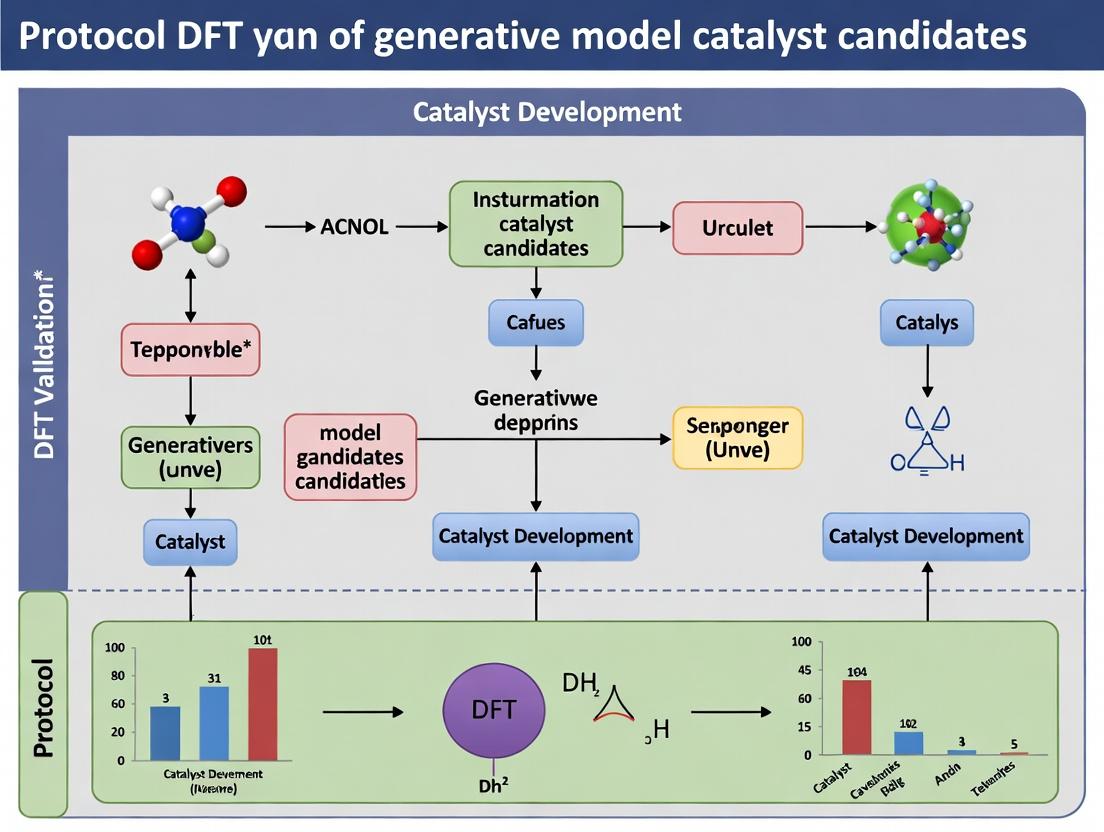
This article provides a comprehensive, step-by-step protocol for validating catalyst candidates generated by machine learning models using Density Functional Theory (DFT).
From AI to Lab: A Practical DFT Validation Protocol for Generative Model Catalyst Candidates in Drug Discovery
Abstract
This article provides a comprehensive, step-by-step protocol for validating catalyst candidates generated by machine learning models using Density Functional Theory (DFT). Tailored for computational chemists and drug development researchers, it bridges the gap between generative AI discovery and experimental reality. We cover the foundational principles of selecting appropriate DFT functionals and basis sets for catalyst systems, detail a rigorous workflow for calculating key energetic and electronic properties, address common computational challenges and optimization strategies, and establish benchmarks for validation against experimental data. The guide empowers scientists to build confidence in AI-generated leads and accelerate the design of novel catalysts for pharmaceutical synthesis.
Laying the Groundwork: Core DFT Principles for Validating Generative AI Catalysts
1. Introduction: The AI-Genesis-to-Lab Workflow Generative AI models (e.g., GNNs, VAEs, Diffusion Models) can propose millions of novel molecular or material structures as potential catalysts. However, these candidates exist in silico and their predicted properties (e.g., adsorption energy, activation barrier) are based on surrogate models with inherent uncertainty. Density Functional Theory (DFT) serves as the essential, physics-based validation gatekeeper, providing high-fidelity quantum mechanical evaluation before costly experimental synthesis and testing. This protocol details the systematic validation process within the broader research thesis on establishing a reliable pipeline for AI-generated catalyst candidates.
2. Quantitative Benchmark: AI Prediction vs. DFT Validation The following table summarizes common discrepancies observed in benchmark studies between AI-predicted and DFT-validated properties for catalytic materials (e.g., transition metal surfaces, single-atom alloys, MOFs).
Table 1: Benchmark Comparison of AI Predictions vs. DFT Validation for Key Catalytic Properties
| Property | Typical AI Model MAE | DFT Reference Error | Critical Threshold for Reliability | Action on Discrepancy > Threshold |
|---|---|---|---|---|
| Adsorption Energy (ΔE_ads) | 0.10 - 0.25 eV | ~0.05 eV (relative) | ±0.15 eV | Reject candidate or retrain AI model on this class. |
| d-band Center (ε_d) | 0.20 - 0.40 eV | ~0.10 eV | ±0.30 eV | Flag for electronic structure review. |
| Reaction Energy (ΔE_rxn) | 0.15 - 0.30 eV | ~0.10 eV | ±0.20 eV | Proceed with caution; validate full pathway. |
| Activation Barrier (E_a) | 0.25 - 0.50 eV | ~0.15 eV | ±0.30 eV | Candidate likely non-viable; pathway investigation needed. |
| Formation Energy (ΔH_f) | 25 - 50 meV/atom | ~10 meV/atom | ±30 meV/atom | Critical for stability check; failure rejects candidate. |
MAE: Mean Absolute Error; Reference errors are for well-established DFT functionals (e.g., RPBE) vs. higher-level methods or experiment.
3. Core DFT Validation Protocol This protocol is designed for validating AI-proposed heterogeneous or electrocatalysts.
Protocol 1: DFT Validation Workflow for a Single AI-Proposed Catalyst Candidate
Objective: To computationally validate the stability and activity of an AI-generated catalyst candidate using DFT.
Materials & Computational Environment:
- Software: DFT code (VASP, Quantum ESPRESSO, CP2K), structure visualization (VESTA, OVITO), workflow manager (ASE, pymatgen).
- Hardware: High-Performance Computing (HPC) cluster with minimum 24 CPU cores per calculation, 64 GB RAM, and high-speed parallel filesystem.
- Pseudopotentials/ Basis Sets: Projector-Augmented Wave (PAW) pseudopotentials or norm-conserving pseudopotentials appropriate for all elements.
- Exchange-Correlation Functional: Select based on material system (e.g., RPBE for adsorption on metals, SCAN for bulk properties, HSE06 for electronic structure).
Procedure:
- Structure Preparation:
- Input the AI-generated 3D atomic structure (e.g., POSCAR, .cif file).
- Clean the structure: ensure correct periodicity, remove spurious atoms, and create a supercell of sufficient size to avoid periodic interactions (≥ 10 Å vacuum for surfaces).
- For surfaces, generate slab models with ≥ 4 atomic layers and fix the bottom 1-2 layers.
Structure Relaxation:
- Perform ionic relaxation until all forces on atoms are < 0.02 eV/Å.
- Use a conjugate gradient or BFGS algorithm.
- Employ a plane-wave energy cutoff ≥ 400 eV (or functional-specific recommended value).
- Use a k-point mesh (e.g., Monkhorst-Pack) with density ≥ 30 points per Å⁻¹.
- Output: Fully relaxed ground-state geometry.
Stability Validation (Prerequisite):
- Calculate the formation energy (for alloys/composites) or surface energy (for slabs).
- Perform ab initio molecular dynamics (AIMD) at target temperature (e.g., 500 K) for 5-10 ps to assess dynamic stability.
- Criterion: Positive formation energy or structural collapse during AIMD leads to candidate rejection.
Electronic Structure Analysis:
- Perform a static single-point calculation on the relaxed structure.
- Extract the density of states (DOS), specifically the d-band center for transition metals.
- Calculate the projected density of states (PDOS) to identify active sites.
- Criterion: Compare d-band center to known catalyst trends (e.g., scaling relations).
Activity Validation (Microkinetic Input):
- Identify the putative active site and adsorb relevant reaction intermediates (, CO, OH, OOH, etc.).
- Relax all adsorption geometries.
- Calculate the adsorption free energy (ΔG_ads) for each key intermediate at relevant conditions (pH, U) using computational hydrogen electrode for electrocatalysis.
- Construct the reaction free energy diagram.
- Criterion: Identify the potential-determining step (PDS) and its ΔG. Compare to ideal catalyst (ΔG ~ 0 eV) or known materials.
Reporting & Decision:
- Compile all calculated properties into a validation report.
- Compare directly to the AI model's predictions.
- Decision Logic: Stable structure + improved/competitive activity metrics → Pass for experimental consideration. Unstable or poor activity → Fail. Ambiguous → Flag for higher-level theory (e.g., DLPNO-CCSD(T)) validation on a smaller cluster model.
DFT Validation Workflow for AI Candidates
4. The Scientist's Toolkit: Essential Research Reagents & Solutions
Table 2: Key Computational "Reagents" for DFT Validation
| Item/Category | Function & Rationale | Example/Note |
|---|---|---|
| Exchange-Correlation Functional | Defines the quantum mechanical approximation for electron-electron interactions; choice critically impacts accuracy. | RPBE: For adsorption energies on metals. SCAN: For diverse chemical bonding. HSE06: For band gaps. |
| Pseudopotential Library | Replaces core electrons with a potential, reducing computational cost. Must be consistent with the functional. | PAW (VASP): Standard for solid-state. SG15 (QE): Optimized for efficiency. |
| k-point Mesh Sampler | Numerical integration over the Brillouin zone; density determines accuracy of total energy. | Monkhorst-Pack grid: Standard for regular cells. Gamma-centered: For slabs/vacuum. |
| Solvation Model | Approximates solvent effects in electrocatalytic or liquid-phase reactions. | Implicit: VASPsol, CANDLE. Explicit: Adding H₂O molecules (costly). |
| Computational Hydrogen Electrode (CHE) | References electron/proton energy to H₂, enabling calculation of potentials in electrocatalysis. | Essential for ORR, HER, OER, CO2RR free energy diagrams. |
| Workflow Manager | Automates sequence of calculations (relax → static → DOS), ensuring reproducibility. | ASE (Atomistic Simulation Environment), pymatgen. |
| Benchmark Dataset | Set of high-quality experimental/theoretical data for functional/approach validation. | CatApp, Materials Project, NOMAD. |
5. Advanced Multi-Scale Validation Protocol For candidates passing initial validation, a deeper protocol assesses performance under realistic conditions.
Protocol 2: Assessing Catalytic Performance under Reaction Conditions
Objective: To evaluate the catalyst's activity, selectivity, and stability under simulated operational conditions (finite temperature, pressure, potential).
Procedure:
- Free Energy Correction: Calculate vibrational frequencies for all adsorbed intermediates and transition states. Apply zero-point energy, enthalpy, and entropy corrections to convert electronic energies (ΔE) to free energies (ΔG) at target temperature and pressure.
- Potential-Dependent Analysis: For electrocatalysts, use the CHE to shift intermediate free energies as a function of applied electrode potential (U): ΔG(U) = ΔG(U=0) + eU.
- Microkinetic Modeling (MKM): Construct a reaction network. Use DFT-derived activation barriers (E_a) and ΔG values as input. Solve rate equations to predict turnover frequencies (TOF), selectivity, and reaction orders under continuous flow conditions.
- Site Stability under Coverage: Perform DFT calculations with increasing adsorbate coverage to model high-conversion environments. Check for site blocking or modification of electronic structure.
- Degradation Screening: Calculate dissolution potentials (for electrocats) or sintering barriers (for nanoparticles) using nudged elastic band (NEB) calculations.
Multiscale Performance Assessment Workflow
6. Conclusion: Closing the AI-DFT-Experiment Loop Rigorous DFT validation is non-negotiable. It transforms AI-generated candidates from statistical possibilities into theoretically credible leads. The systematic protocols outlined here—from basic stability checks to microkinetic modeling—provide the essential framework to bridge the gap between generative AI output and tangible catalytic discovery. The resulting high-fidelity DFT data must then be fed back to retrain and improve the generative AI models, creating a closed, accelerating discovery loop.
Within the Protocol for DFT validation of generative model catalyst candidates, computational screening must be anchored by experimentally relevant success metrics. Density Functional Theory (DFT) calculations translate electronic structure data into quantitative descriptors for catalytic activity, selectivity, and stability. This Application Note details the protocols for calculating these key catalytic properties, ensuring robust validation of AI-generated candidates.
DFT-Calculated Success Metrics: Quantitative Descriptors
The following table summarizes the core DFT-derived descriptors used to define success metrics for heterogeneous catalysis.
Table 1: Key DFT-Derived Descriptors for Catalytic Success Metrics
| Catalytic Property | Primary DFT Descriptor | Calculation Formula/Description | Target Range (Typical) | Validation Experiment |
|---|---|---|---|---|
| Activity | Reaction Energy (ΔErxn) | ΔErxn = ΣEproducts - ΣEreactants on surface | — | Microkinetic modeling |
| Activation Energy Barrier (Ea) | Ea = ETS - Einitial state | < 0.8 eV for high activity | Temperature-Programmed Reaction | |
| Adsorption Energy (ΔEads) | ΔEads = Esurface+adsorbate - Esurface - Eadsorbate | Sabatier principle optimum (scaling relations) | Calorimetry, TPD | |
| Selectivity | Transition State Energy Difference (ΔETS) | ΔETS = Ea, path A - Ea, path B | > 0.3 eV for high selectivity | Product distribution analysis (GC/MS) |
| Intermediate Binding Energy Difference | ΔΔEint = ΔEads, int A - ΔEads, int B | Guides preferred reaction pathway | In-situ spectroscopy (DRIFTS) | |
| Stability | Surface Formation Energy (Ef) | Ef = (Eslab - N * Ebulk) / (2A) | Positive, lower values preferred | High-Temp XRD, STEM |
| Dissolution Potential (Udiss) | Udiss = -ΔGdiss / (n*F); ΔG from DFT | Higher values indicate better stability | Electrochemical cycling, ICP-MS | |
| Pourbaix Diagram Slopes | Plot of stable phases vs. pH & potential from DFT | Regions of catalyst stability | Corrosion tests |
Detailed Experimental & Computational Protocols
Protocol 2.1: Calculating Activity Descriptors (Adsorption & Activation Energies)
Objective: Determine the adsorption strength of key intermediates and the activation barrier for the potential-determining step (PDS).
Methodology:
- Surface Model: Build a periodic slab model (≥ 4 atomic layers) with a ≥ 15 Å vacuum. Use a p(3x3) or larger supercell to minimize adsorbate interactions.
- Geometry Optimization: Employ the VASP or Quantum ESPRESSO code with a PAW-PBE functional. Use an energy cutoff of 450 eV (VASP) and a k-point mesh of (3x3x1). Optimize all atoms in the top two layers + adsorbate.
- Adsorption Energy Calculation: Calculate total energies for the clean slab (Eslab), the relaxed adsorbate in a large box (Eadsorbate), and the combined system (Eslab+ads). Compute ΔEads using the formula in Table 1.
- Transition State Search: Use the Climbing Image Nudged Elastic Band (CI-NEB) method with 5-7 images. Confirm the single imaginary frequency in the vibrational analysis.
- Microkinetic Modeling Integration: Input ΔEads and Ea values into a microkinetic model (e.g., using CatMAP) to predict turnover frequencies (TOFs).
Protocol 2.2: Calculating Selectivity Descriptors (Branching Point Analysis)
Objective: Quantify the energetic preference between competing reaction pathways.
Methodology:
- Identify Branching Point Intermediate: Locate the first common intermediate that leads to multiple products (e.g., *CH2O for CO2RR to CH4 vs. CH3OH).
- Map Parallel Pathways: Fully optimize subsequent intermediates and transition states for each pathway (A and B) originating from the branching point.
- Compute Differential Barriers: Calculate the difference in activation energies (ΔETS) from the branching intermediate to the next step on each path (see Table 1). A positive ΔETS favors path B.
- Grand Canonical Analysis: For electrochemical reactions, recalculate energies as a function of applied potential (U) via the Computational Hydrogen Electrode (CHE) model: ΔG = ΔE + ΔZPE - TΔS + neU.
Protocol 2.3: Calculating Stability Descriptors (Surface & Electrochemical)
Objective: Assess thermodynamic stability under operational conditions.
Methodology:
- Surface Formation Energy: Calculate energy of a bulk unit cell (Ebulk). For a slab model with N atoms, compute Ef per area (see Table 1). Compare different surface terminations.
- Ab Initio Thermodynamics: Calculate the Gibbs free energy of surface phases as a function of reactant chemical potentials (ΔμO, ΔμH): γ(T,p) = [Gslab - Ncatμcat, bulk - Σniμi] / 2A.
- Pourbaix Diagram Construction:
- Calculate dissolution free energies (ΔGdiss) for possible surface phases (e.g., metal, oxide, hydroxide).
- For each phase, solve the Nernst equation: U(pH) = U0 - (kBT ln10 / ne) * pH.
- The phase with the lowest formation free energy at each (U, pH) point is the stable phase.
Visualization of Workflows
Title: DFT Validation Workflow for Generative Model Catalysts
Title: Selectivity Analysis via Transition State Energy Difference
The Scientist's Toolkit: Key Research Reagent Solutions
Table 2: Essential Computational & Experimental Resources for Validation
| Item / Solution | Provider / Example | Function in Validation Protocol |
|---|---|---|
| DFT Software Suite | VASP, Quantum ESPRESSO, CP2K | Core computational engine for electronic structure and energy calculations. |
| Transition State Search Tool | ASE (Atomistic Simulation Environment) Neb Module | Implements CI-NEB and dimer methods for locating activation barriers. |
| Microkinetic Modeling Package | CatMAP, KiNet | Translates DFT energies into predicted rates and TOFs for activity validation. |
| High-Throughput Computation Manager | FireWorks, AiiDA | Automates workflow submission and data management for screening candidates. |
| Reference Catalyst Datasets | CatHub, NOMAD, Materials Project | Provides benchmark adsorption energies and activity data for DFT functional validation. |
| In-Situ Spectroscopy Cell | Harrick (DRIFTS), Specac (ATR) | Experimental validation of predicted intermediates and binding modes. |
| Electrochemical Analyzer | Bio-Logic, PalmSens | Measures activity (current density) and stability (chronoamperometry) for electrocatalysts. |
| Product Analysis System | Gas Chromatograph (GC-FID/TCD), Mass Spectrometer (MS) | Quantifies product distribution for experimental selectivity determination. |
This guide provides application notes and protocols for selecting Density Functional Theory (DFT) functionals within the framework of validating generative model catalyst candidates. Generative models can propose novel catalytic materials, but their stability, activity, and selectivity must be rigorously validated using DFT. The choice of functional (GGA, Hybrid, Meta-GGA) critically impacts the accuracy of computed properties like adsorption energies, reaction barriers, and electronic structure, directly determining the success of the validation protocol.
Functional Classes: Theory and Applications in Catalysis
Generalized Gradient Approximation (GGA)
GGA functionals incorporate the local electron density and its gradient. They offer a good balance between accuracy and computational cost, making them a common starting point for large catalytic systems (e.g., extended surfaces, nanoparticles).
- Strengths: Efficient for geometry optimization, reasonable lattice constants, works well for metallic systems.
- Weaknesses: Systematic errors: underestimates band gaps, over-binds adsorbates, poor for strongly correlated systems.
- Catalytic Application: Initial structural screening, phonon calculations, ab initio molecular dynamics (AIMD) on large models.
Meta-GGA
Meta-GGA functionals include the kinetic energy density in addition to the density and its gradient, improving the description of inhomogeneous electron systems.
- Strengths: Better performance for solid-state properties, surface energies, and some reaction energies without the high cost of hybrids.
- Weaknesses: More expensive than GGA; performance can be system-dependent.
- Catalytic Application: Improved adsorption energies, more accurate characterization of transition states for certain reactions.
Hybrid Functionals
Hybrids mix a portion of exact Hartree-Fock (HF) exchange with GGA or meta-GGA exchange-correlation. This mitigates the self-interaction error.
- Strengths: More accurate band gaps, reaction barriers, and adsorption energies. Crucial for systems where electronic structure accuracy is paramount.
- Weaknesses: High computational cost (scaling with system size). Use of HF exchange can complicate calculations on metallic systems.
- Catalytic Application: Definitive single-point energy calculations on critical reaction steps, validation of electronic properties (d-band center, PDOS), study of oxide catalysts and semiconductors.
Quantitative Comparison of Functional Performance
Table 1: Benchmark Performance of Common Functionals for Catalytic Properties Data compiled from recent benchmarks (e.g., Materials Project, NREL, CatApp). MAE = Mean Absolute Error.
| Functional | Class | Typical % HF Exchange | Adsorption Energy MAE (eV)⁽¹⁾ | Band Gap MAE (eV)⁽²⁾ | Reaction Barrier MAE (eV)⁽³⁾ | Relative Computational Cost |
|---|---|---|---|---|---|---|
| PBE | GGA | 0% | ~0.2 - 0.5 | ~1.0 - 2.0 | ~0.2 - 0.4 | 1.0 (Reference) |
| RPBE | GGA | 0% | Improved over PBE for adsorption | Similar to PBE | Similar to PBE | ~1.0 |
| SCAN | meta-GGA | 0% | ~0.1 - 0.3 | ~0.5 - 1.0 | ~0.1 - 0.3 | ~3-5 |
| HSE06 | Hybrid | 25% (short-range) | ~0.1 - 0.2 | ~0.1 - 0.3 | ~0.05 - 0.15 | ~10-50 |
| PBE0 | Hybrid | 25% (full) | ~0.1 - 0.2 | ~0.1 - 0.3 | ~0.05 - 0.15 | ~50-100 |
| B3LYP | Hybrid | 20-25% | Good for molecules, less for solids | Variable for solids | Good for organometallic clusters | ~50-100 |
(1) For small molecules (CO, H, O, OH) on transition metals. (2) Compared to experimental gaps. (3) For typical elementary steps (e.g., C-H cleavage, O-O formation).
Experimental Protocols for Functional Validation
Protocol 1: Systematic Workflow for Functional Selection in Catalyst Validation
Objective: To establish a tiered protocol for validating catalytic properties (adsorption energy, reaction energy, activation barrier) of generative model candidates using DFT.
Materials (Computational):
- Structure Files: Candidate catalyst structure (CIF/POSCAR) and adsorbate/molecule geometries.
- Software: DFT code (VASP, Quantum ESPRESSO, CP2K, Gaussian), transition state search tool (e.g., Dimer method, NEB), post-processing tools.
- Computational Resources: HPC cluster with suitable nodes and cores.
Procedure:
- Geometry Optimization (GGA/Meta-GGA Tier):
- Use a standard GGA (PBE) or meta-GGA (SCAN) functional with appropriate PAW/Pseudopotentials.
- Relax the bulk catalyst and clean surface model. Converge forces (< 0.01 eV/Å) and energy (10⁻⁵ eV).
- Optimize the adsorbate-surface system. Record final structure and energy.
- Note: For large, metallic systems, this is the final structural step.
Single-Point Energy Refinement (Hybrid Tier):
- Take the converged geometries from Step 1.
- Perform a single-point energy calculation using a hybrid functional (e.g., HSE06).
- This provides a more accurate total energy for computing adsorption and reaction energies without the prohibitive cost of hybrid geometry optimization.
Transition State Characterization (Hybrid/Meta-GGA Tier):
- For the elementary step of interest, identify a reaction pathway.
- Perform a climbing-image nudged elastic band (CI-NEB) calculation using the GGA/meta-GGA functional to locate an approximate transition state (TS).
- Refine the TS using a dimer or quasi-Newton method.
- Critical: Recalculate the barrier height by performing a single-point hybrid calculation on the GGA-optimized TS and initial/final state geometries.
Electronic Structure Analysis (Hybrid Tier):
- Compute the projected density of states (PDOS), band structure, or d-band center using the hybrid functional on the relaxed geometry.
- This data is essential for validating electronic descriptors predicted by the generative model.
Data Analysis:
- Calculate adsorption energy: E_ads = E_(surface+ads) - E_surface - E_ads(gas).
- Calculate reaction energy: ΔE = E(final state) - E(initial state)*.
- Calculate activation barrier: Ea = E(TS) - E_(initial state)*.
- Compare trends across candidate materials and against known experimental or high-level theoretical benchmarks.
Protocol 2: Benchmarking Against a Known Catalytic System
Objective: To calibrate the DFT protocol by computing known properties of a standard catalyst (e.g., CO adsorption on Pt(111), O₂ dissociation on Au(111)).
Procedure:
- Select 2-3 benchmark reactions with reliable experimental or CCSD(T) reference data.
- Apply Protocol 1 using 3 different functionals: one GGA (PBE), one meta-GGA (SCAN), and one hybrid (HSE06).
- Compute the target properties (adsorption energy, barrier) with each functional.
- Calculate the Mean Absolute Error (MAE) for each functional against the reference set.
- Select the functional that offers the best trade-off between accuracy and cost for your specific class of candidate materials (e.g., metals, oxides, single-atom catalysts).
Visualization of Workflows and Relationships
DFT Validation Protocol Workflow
DFT Functional Classes & Trade-offs
The Scientist's Toolkit: Research Reagent Solutions
Table 2: Essential Computational "Reagents" for DFT Catalyst Validation
| Item/Category | Example(s) | Function in Protocol |
|---|---|---|
| Core DFT Software | VASP, Quantum ESPRESSO, CP2K, Gaussian | Performs the electronic structure calculations, solving the Kohn-Sham equations. |
| Pseudopotentials/PAW Sets | PBE, PBE0, HSE06-specific sets from the code repository | Replace core electrons, dramatically reducing computational cost while maintaining accuracy. Must match the functional. |
| Transition State Search Tools | CI-NEB (VASP, ASE), Dimer Method, LST/QST | Locate first-order saddle points on the potential energy surface to determine activation barriers. |
| High-Performance Computing (HPC) Resources | CPU/GPU Clusters (Slurm/PBS schedulers) | Provides the necessary parallel computing power for calculations on catalytic systems (100-1000s of atoms). |
| Visualization & Analysis Software | VESTA, Jmol, VMD, p4vasp, ASE | Visualizes atomic structures, charge densities, and processes output files for analysis. |
| Benchmark Databases | Materials Project, CatApp, NOMAD, CCCBDB | Provides reference data (lattice constants, formation energies, adsorption energies) for functional validation and calibration. |
| Workflow Management | AiiDA, ASE, custom Python scripts | Automates multi-step protocols, ensures reproducibility, and manages complex calculation trees and data. |
This Application Note details a critical step within a broader thesis protocol for validating generative model-derived catalyst candidates. The protocol aims to establish a rigorous, cost-effective Density Functional Theory (DFT) pipeline to filter and prioritize computationally generated transition metal complexes (TMCs) and organocatalysts for experimental synthesis and testing. Basis set selection is a foundational decision in this pipeline, as it directly governs the trade-off between the accuracy of computed properties (e.g., reaction energies, barrier heights, spectroscopic predictions) and the computational cost, which scales with the number of candidates.
Core Principles & Key Considerations
For transition metals, the challenge lies in describing electrons near the nucleus (core) and those involved in bonding and reactivity (valence). Organocatalysts (e.g., N-heterocyclic carbenes, amine catalysts) require accurate descriptions of polarization, dispersion, and weak interactions. Key considerations include:
- Basis Set Size: Split-valence (e.g., 6-31G), triple-zeta (e.g., def2-TZVP), and quadruple-zeta sets.
- Diffuse Functions: Crucial for anions, excited states, and weak interactions (noted with "+").
- Polarization Functions: Essential for correct geometry and reaction barriers (noted with "*" or "d,p").
- Effective Core Potentials (ECPs): For elements ≥ Br, ECPs (like Stuttgart-Dresden) replace core electrons, drastically reducing cost.
- Basis Set Superposition Error (BSSE): Must be corrected (e.g., via Counterpoise) when computing weak interactions with smaller basis sets.
Table 1: Recommended Basis Set Combinations for Routine Screening
| System Type | Recommended Basis Set | Typical Cost (Rel.) | Key Rationale | Primary Use in Pipeline |
|---|---|---|---|---|
| TM (3d) & Main Group | def2-SVP | 1x (Baseline) | Good speed/accuracy balance for geometry optimization. | Initial geometry relax, conformational search. |
| TM (4d, 5d) & Heavy Main Group | SDD (ECP) + def2-SVP on others | 1.2x | ECP on heavy atoms manages cost for larger metals. | Primary screening of generative model outputs. |
| Organocatalyst (C,H,N,O,F,P,S,Cl) | 6-31G(d) | 0.9x | Robust, well-tested, efficient for organic frameworks. | Initial optimization of organic catalyst candidates. |
| Single-Point Energy Refinement | def2-TZVP / def2-QZVP | 3-10x | Higher accuracy for final energies, barriers, properties. | Final ranking of top candidate catalysts. |
| Non-Covalent Interactions | ma-def2-TZVP / 6-311++G(d,p) | 4-8x | Diffuse functions critical for dispersion. | Evaluating substrate binding or supramolecular features. |
Table 2: Accuracy vs. Cost Benchmark for a Model Reaction (Ni-catalyzed cross-coupling)
Reaction Energy Error (kcal/mol) vs. CCSD(T)/CBS reference, using ωB97X-D functional.
| Basis Set (Ni / C,H,N,O) | CPU Time (hours) | ΔE Reaction | ΔG‡ (Barrier) |
|---|---|---|---|
| LANL2DZ / 6-31G(d) | 2.1 | 8.7 | 5.2 |
| def2-SVP / def2-SVP | 3.5 | 4.5 | 2.8 |
| def2-TZVP / def2-TZVP | 18.7 | 1.2 | 1.1 |
| def2-QZVP / def2-QZVP | 112.4 | 0.3 (Ref.) | 0.2 (Ref.) |
Experimental Protocols
Protocol 1: Basis Set Convergence Test for Generative Model Candidates
Purpose: To determine the minimal basis set yielding property differences within a defined threshold (e.g., 1 kcal/mol) for a representative subset of generated catalysts. Materials: 5-10 representative candidate structures (QM input files), DFT software (e.g., ORCA, Gaussian). Steps:
- Select Basis Set Ladder: Choose an ascending series (e.g., def2-SVP → def2-TZVP → def2-QZVP).
- Geometry Optimization: Optimize all representative structures at the lowest level (def2-SVP) with an appropriate functional (e.g., ωB97X-D or PBE0-D3).
- Single-Point Energy Calculation: Using the optimized geometries, compute single-point energies at each higher level in the basis set ladder.
- Property Calculation: Compute the target property (e.g., ligand dissociation energy, HOMO-LUMO gap) at each level.
- Analysis: Plot property value vs. basis set cardinal number/inverse cardinal number. Identify the point where the relative difference between levels falls below the pre-defined threshold.
- Protocol Decision: Adopt the smallest adequate basis set for high-throughput screening of the full generative model candidate list.
Protocol 2: Balanced Composite Protocol for Final Candidate Validation
Purpose: To obtain highly accurate energies for final candidate ranking with managed computational cost. Materials: Top 20-50 candidate structures after initial screening. Steps:
- Geometry & Frequency: Optimize geometry and compute vibrational frequencies using a medium basis set (e.g., def2-SVP) to confirm minima and obtain thermal corrections.
- High-Level Single Point: Perform a single-point energy calculation on the optimized geometry using a large basis set (e.g., def2-TZVP or ma-def2-TZVP for non-covalent interactions).
- Free Energy Construction: Combine the high-level electronic energy (Step 2) with the thermal/entropic corrections (Step 1) to obtain the final Gibbs free energy: Gfinal = Eelec(high-level) + G_therm(medium-level).
- BSSE Correction (if needed): For interaction energies involving weak binding, apply the Counterpoise correction method at the high-level single-point stage.
- Ranking: Rank final candidates based on computed reaction free energies or activation barriers.
Visualizations
Basis Set Selection Protocol in Catalyst Screening
Factors Influencing Basis Set Choice
The Scientist's Toolkit: Essential Research Reagents & Materials
Table 3: Computational Research Reagent Solutions
| Item/Software | Function in Protocol | Example/Note |
|---|---|---|
| Basis Set Libraries | Provides pre-defined, optimized basis sets for all elements. | CRENBS, def2- series (Turbomole), cc-pVXZ (EMSL). Essential for consistency. |
| DFT Software Package | Performs the quantum chemical calculations. | ORCA (academic-friendly), Gaussian, Q-Chem, Psi4 (open-source). |
| Automation Scripting | Automates job submission, file processing, and data extraction for high-throughput runs. | Python with libraries (ASE, cclib), Bash/shell scripting. Critical for handling 1000s of candidates. |
| Molecular Builder/Visualizer | Prepares input coordinates and analyzes output geometries. | Avogadro, GaussView, Molden, VMD. |
| Conformational Search Tool | Ensures the lowest-energy conformer is used before single-point refinement. | CREST (GFN-FF/GFN2-xTB), Conformer-Rotamer Ensemble Sampling Tool. |
| Non-Covalent Interaction Analysis | Visualizes and quantifies weak interactions critical to catalysis. | NCIplot, Multiwfn. Used with wavefunction files from large basis set calculations. |
| High-Performance Computing (HPC) Cluster | Provides the necessary parallel computing resources. | Local cluster or cloud-based HPC (AWS, Azure). Requires job scheduler (Slurm, PBS) expertise. |
Within the broader thesis Protocol for DFT Validation of Generative Model Catalyst Candidates, establishing a rigorous and systematic computational environment is foundational. The choice of solvation model—from the simplicity of the gas phase to the complexity of explicit solvent shells—directly impacts the predicted thermodynamics, kinetics, and electronic structure of candidate catalysts. This document provides application notes and protocols for this critical phase of the validation pipeline.
The selection of a solvation model involves trade-offs between computational cost and accuracy. The following table summarizes key characteristics.
Table 1: Comparison of Computational Solvation Environments
| Model Type | Description | Typical Computational Cost Increase (vs. Gas Phase) | Key Applications in Catalyst Validation | Limitations |
|---|---|---|---|---|
| Gas Phase | No solvent effects; vacuum conditions. | 1x (Baseline) | Initial geometry optimization, screening of intrinsic electronic properties. | Neglects critical solvent interactions, often yielding unrealistic barriers and energies. |
| Implicit (Continuum) | Solvent as a uniform dielectric continuum (e.g., SMD, PCM). | ~1.1 - 1.5x | Calculating solvation-free energies, pKa estimation, standard reduction potentials, routine geometry optimization in solution. | Cannot model specific solute-solvent interactions (H-bonds, coordination). |
| Explicit Solvent | Discrete solvent molecules included in the quantum mechanics (QM) region. | 2x - 10x+ | Modeling solvent as an active participant (e.g., proton transfer), studying short-range coordination effects. | High cost; conformational sampling required; potential for over-coordination. |
| Mixed (QM/MM) | QM region for active site + Molecular Mechanics (MM) region for explicit solvent bath. | 5x - 50x+ | Enzymatic or heterogeneous catalytic environments where long-range bulk effects couple with specific short-range QM interactions. | Complex setup; risk of artifacts at the QM/MM boundary. |
Experimental Protocols
Protocol 1: Gas-Phase Baseline Calculation
Purpose: To establish a baseline geometry and electronic structure for the catalyst candidate without solvent influence. Software: Common DFT packages (Gaussian, ORCA, VASP, CP2K). Procedure:
- Input Preparation: Generate initial 3D coordinates for the catalyst molecule or cluster.
- Functional/Basis Set Selection: Select an appropriate DFT functional (e.g., B3LYP, PBE, ωB97X-D) and basis set (e.g., def2-SVP for geometry, def2-TZVP for single-point energy).
- Charge & Multiplicity: Set the correct molecular charge and spin multiplicity.
- Geometry Optimization: Run a geometry optimization calculation with the
gas phasekeyword or without any solvation model defined.- Convergence criteria: Energy change < 1e-6 Eh, Max force < 4.5e-4 Eh/Bohr, RMS force < 3e-4 Eh/Bohr.
- Frequency Calculation: Perform a frequency calculation on the optimized geometry to confirm it is a true minimum (no imaginary frequencies) and to obtain thermochemical corrections (ZPE, enthalpy, entropy).
- Analysis: Record the optimized geometry, electronic energy, HOMO/LUMO energies, and molecular orbitals.
Protocol 2: Implicit Solvation (SMD Model) Calculation
Purpose: To model the catalyst in a realistic solvated environment at a low computational cost. Software: Gaussian, ORCA, Q-Chem. Procedure:
- Gas-Phase Optimization: Begin with the gas-phase optimized geometry from Protocol 1.
- Model Selection: Enable the SMD (or other continuum model like CPCM) solvation model. Specify the solvent (e.g.,
Water,Acetonitrile,Toluene). - Single-Point Energy: Perform a single-point energy calculation on the gas-phase geometry in the implicit solvent to estimate the solvation energy.
- Re-optimization in Solvent (Recommended): Re-optimize the catalyst geometry fully within the implicit solvation model. The solute's electron density polarizes the continuum, which in turn polarizes the solute.
- Frequency Calculation: Perform a frequency calculation within the solvation model to obtain solution-phase thermochemistry.
- Analysis: Calculate the solvation free energy: ΔGsolv ≈ E(implicit) + Gcorr(implicit) - [E(gas) + G_corr(gas)]. Analyze shifts in frontier orbital energies compared to the gas phase.
Protocol 3: Explicit Solvation Shell Setup and Sampling
Purpose: To incorporate specific, directional solute-solvent interactions. Software: CP2K, ORCA (for QM/MD), Amber/GROMACS (for MD pre-processing). Procedure:
- System Building: a. Start with the implicit-solvent optimized catalyst. b. Place the catalyst in a simulation box (e.g., cubic, dodecahedron) with dimensions ensuring at least 10 Å clearance from the box edges. c. Fill the box with solvent molecules (e.g., ~100 H₂O for aqueous systems) using packing software (PACKMOL).
- Classical Equilibration: a. Assign MM force fields (e.g., OPLS-AA, GAFF) to the solvent and, if applicable, the non-reactive parts of the catalyst. b. Run a short energy minimization to remove bad contacts. c. Perform an NVT (constant particle number, volume, temperature) and then NPT (constant pressure) molecular dynamics (MD) simulation (e.g., 1-5 ns at 300 K) to equilibrate the solvent density.
- QM Region Sampling: a. Extract multiple snapshots (e.g., 10-20) from the equilibrated classical MD trajectory, spaced ~100 ps apart. b. For each snapshot, define the QM region: the catalyst + first solvation shell (e.g., all solvent molecules within 3.5 Å of any catalyst atom).
- QM Calculation on Snapshots: a. Perform a DFT geometry optimization fixing the positions of solvent molecules beyond the first solvation shell (or use QM/MM). Alternatively, run a short ab initio MD (AIMD) simulation. b. Perform a high-accuracy single-point energy calculation.
- Analysis: Average energies over snapshots. Analyze the structure and stability of specific catalyst-solvent interactions (H-bonds, coordination bonds).
Mandatory Visualizations
Workflow for DFT Solvation Model Setup and Validation
Conceptual Diagram of Solvation Model Types
The Scientist's Toolkit
Table 2: Essential Research Reagents and Software Solutions
| Item / Software | Function / Description | Example in Protocol |
|---|---|---|
| DFT Software (ORCA, Gaussian, CP2K) | Performs the core quantum mechanical electronic structure calculations. | All geometry optimizations, frequency, and single-point energy calculations. |
| Continuum Solvation Model (SMD, PCM) | A computational method that models solvent as a polarizable continuum with a cavity. | Protocol 2 for calculating solvation energies and solution-phase properties. |
| Molecular Dynamics Engine (GROMACS, Amber, OpenMM) | Simulates the classical motion of atoms over time using Newton's equations. | Protocol 3, Step 2: Equilibration of the explicit solvent box. |
| System Builder (PACKMOL, CHARMM-GUI) | Software to create initial coordinates of complex molecular systems (solute in a solvent box). | Protocol 3, Step 1: Placing catalyst in a solvated periodic box. |
| Visualization & Analysis (VMD, ChimeraX, Jupyter w/ MDAnalysis) | Tools to visualize molecular structures, trajectories, and analyze geometrical/energetic data. | Inspecting MD trajectories, measuring distances/H-bonds, plotting results. |
| Basis Set Library (def2-SVP, def2-TZVP, 6-31G) | Sets of mathematical functions used to represent molecular orbitals. | Selected in all protocols to balance accuracy and computational cost. |
| Pseudopotentials (for CP2K, VASP) | Simplify calculations by replacing core electrons with an effective potential, critical for heavy elements. | Necessary for transition metal catalyst systems in plane-wave codes. |
The Step-by-Step DFT Validation Workflow: From AI Output to Reliable Data
1. Introduction & Thesis Context Within the broader thesis on Protocol for DFT Validation of Generative Model Catalyst Candidates, the initial pre-processing of AI-generated molecular structures is a critical, non-negotiable step. Generative models (e.g., diffusion models, GANs, VAEs) often produce candidate catalysts—such as organometallic complexes, heterogeneous surface adsorbates, or organic molecules—with unrealistic bond lengths, angles, or torsional strains. Direct submission of these raw coordinates to computationally expensive Density Functional Theory (DFT) validation leads to convergence failures, incorrect electronic property predictions, and wasted resources. This application note details standardized protocols for geometry optimization and conformational sampling to transform raw AI outputs into physically plausible, DFT-ready structures, ensuring the subsequent validation phase is robust and meaningful.
2. Core Pre-Processing Workflow
Diagram 1: Pre-processing workflow for AI catalyst candidates.
3. Detailed Experimental Protocols
Protocol 3.1: Universal Force Field Optimization
- Objective: Rapidly correct severe structural distortions (e.g., van der Waals clashes, aberrant bond lengths) from generative model output.
- Software: Open Babel, RDKit, or Schrodinger's MacroModel.
- Methodology:
- Input: 3D molecular structure file (e.g., .mol, .sdf, .xyz).
- Parameterization: Assign atomic charges and force field types. For broad candidate screening, Universal Force Field (UFF) or Merck Molecular Force Field (MMFF94) is recommended due to their wide coverage of the periodic table.
- Minimization: Perform energy minimization using a steepest descent algorithm for the first 100 steps, followed by conjugate gradient until convergence.
- Convergence Criteria: Set gradient norm threshold to < 0.05 kcal/mol/Å and energy change between iterations to < 1e-4 kcal/mol.
- Output: A preliminary, physically reasonable 3D geometry.
Protocol 3.2: Conformational Sampling for Flexible Candidates
- Objective: Systematically explore the low-energy conformational space of flexible catalyst ligands or linkers to identify the global minimum.
- Software: CREST (GFN2-FF/GFN2-xTB), RDKit's ETKDG algorithm, or OMEGA.
- CREST (Recommended) Methodology:
- Input: Force field-optimized structure from Protocol 3.1.
- Calculation Type: Run in conformational search mode (
crest input.xyz --cbonds). - Settings: Use the GFN2-FF for initial screening, followed by GFN2-xTB refinement. For explicit solvent effects, use the
--alpb [solvent]flag (e.g., water, acetonitrile). - Post-Processing: CREST outputs an ensemble of conformers ranked by energy. Select the lowest-energy conformer, or all conformers within a 2.5 kcal/mol window for subsequent refinement.
- Output: A representative set of low-energy conformers.
Protocol 3.3: Semi-Empirical/Low-Level DFT Refinement
- Objective: Further refine geometries using electronic structure methods to achieve a structure suitable for high-level DFT validation.
- Software: ORCA, Gaussian, or xtb.
- Semi-Empirical (GFN2-xTB) Protocol:
- Input: Global minimum conformer from Protocol 3.2.
- Calculation: Geometry optimization using the
--optflag in xtb. - Settings: Use the
--alpb [solvent]for solvation. Convergence criteria:--gfn 2 --opt tight. - Output: Refined 3D structure.
- Low-Basis DFT (Hybrid) Protocol:
- Functional/Basis Set: Use PBEh-3c or B3LYP/def2-SVP for cost-effective refinement.
- Implicit Solvation: Employ the SMD or CPCM solvation model.
- Convergence: Set optimization convergence to "Tight" (e.g., RMS gradient ~1e-4 Eh/Bohr).
- Output: Final DFT-ready 3D structure for the validation thesis.
4. Quantitative Data Summary
Table 1: Comparison of Pre-Processing Methods for AI-Generated Catalyst Candidates
| Method | Typical System Size | Avg. Compute Time | Accuracy (RMSD vs. High-Level DFT) | Primary Use Case |
|---|---|---|---|---|
| UFF/MMFF94 | 10-200 atoms | Seconds to minutes | 0.5 - 1.5 Å | Initial "cleaning" of gross distortions. |
| CREST (GFN2-xTB) | 10-100 atoms | Minutes to hours | 0.1 - 0.5 Å | Comprehensive conformational search. |
| Semi-Empirical (PM7/GFN2) | 10-150 atoms | Minutes | 0.05 - 0.3 Å | Fast electronic refinement. |
| Low-Basis DFT (PBEh-3c) | 10-50 atoms | Hours | < 0.05 Å | Final pre-DFT refinement for small/medium candidates. |
Table 2: Recommended Protocol Selection Matrix
| Candidate Type | Flexibility | Recommended Protocol Stack | Key Metric for Proceed to DFT |
|---|---|---|---|
| Rigid Organometallic Core | Low (<3 rot. bonds) | Protocol 3.1 → Protocol 3.3 (Low-Basis DFT) | Max force component < 0.001 Ha/Bohr |
| Flexible Ligand/MOF Linker | High (>5 rot. bonds) | Protocol 3.1 → Protocol 3.2 → Protocol 3.3 (Semi-Empirical) | Conformer energy window < 2.5 kcal/mol |
| Surface Adsorbate | Medium | Protocol 3.1 (with periodic UFF) → Protocol 3.3 (Low-Basis DFT) | Adsorption energy change < 0.01 eV between steps |
5. The Scientist's Toolkit: Research Reagent Solutions
Table 3: Essential Software and Computational Tools
| Item | Function in Pre-Processing | Typical License/Access |
|---|---|---|
| RDKit | Open-source cheminformatics toolkit for force field optimization (UFF/MMFF), basic conformational sampling (ETKDG), and file format conversion. | Open Source (BSD) |
| CREST (xtb) | Powerful, automated conformational search and ensemble refinement using semi-empirical quantum mechanics (GFN methods). Handles organometallics. | Open Source (GPL) |
| ORCA | Quantum chemistry package for performing the semi-empirical and low-basis DFT refinement calculations with excellent performance and solvation models. | Free for academic research |
| Open Babel | A cross-platform tool for interconverting chemical file formats and performing batch force field optimizations. | Open Source (GPL) |
| CP2K | For pre-processing periodic AI candidates (e.g., slab models, MOFs) using Quickstep DFT with mixed Gaussian/plane-wave basis sets. | Open Source (GPL) |
| Schrodinger Suite (MacroModel, ConfGen) | Commercial, high-throughput solution for force field optimization and rigorous conformational analysis with extensive force field libraries. | Commercial |
This document provides detailed application notes and protocols for calculating reaction energies, constructing free energy diagrams, and identifying rate-determining steps (RDS). This workflow is a critical, validated component within the broader thesis: "Protocol for DFT Validation of Generative Model Catalyst Candidates." The objective is to establish a standardized, reproducible computational methodology to validate and analyze novel catalyst structures proposed by generative AI models, focusing on their predicted activity through thermodynamic and kinetic profiling.
Core Theoretical Framework & Data Presentation
Key Energy Definitions
The following energies, computed via Density Functional Theory (DFT), form the basis of catalytic cycle analysis.
Table 1: Key DFT-Calculated Energy Quantities
| Energy Quantity | Symbol | DFT Calculation Protocol | Relevance to Catalysis |
|---|---|---|---|
| Electronic Energy | E_elec | SCF convergence of the Schrödinger equation. | Base energy for a static geometry. |
| Zero-Point Energy | ZPE | Sum of vibrational energies (0.5*hν) from frequency calculation. | Corrects for vibrational energy at 0 K. |
| Enthalpy Correction | H_corr | Eelec + ZPE + thermal enthalpy (Htrans + Hrot + Hvib). | Energy at constant pressure. |
| Gibbs Free Energy Correction | G_corr | H_corr - T*S, where S is total entropy. | Crucial quantity. Free energy at temperature T and pressure P. |
| Gibbs Free Energy | G | Eelec + Gcorr. | The operational energy for constructing diagrams and determining spontaneity. |
| Solvation Free Energy | ΔG_solv | Calculated via implicit (e.g., PCM, SMD) or explicit solvation models. | Corrects for solvent effects in the reaction medium. |
| Adsorption Energy | ΔE_ads | E(surface+adsorbate) - Esurface - E_adsorbate(gas). | Strength of binding on catalyst surface. |
Free Energy Change Calculation Protocol
For an elementary step A → B:
- Geometry Optimization: Fully optimize structures for A and B.
- Frequency Calculation: Perform vibrational frequency analysis on optimized geometries.
- Critical Check: Confirm all reactants and intermediates have only real frequencies (all positive).
- Confirm transition states have exactly one imaginary frequency (negative frequency) corresponding to the reaction coordinate.
- Energy Extraction: Extract the Gibbs free energy (G) at the desired temperature (e.g., 298.15 K) from the frequency calculation output.
- Calculate ΔG: ΔG_step = G(B) - G(A).
- Apply Corrections (if needed): For electrochemical steps, apply a potential correction (ΔG = -neU). For solvated systems, ensure ΔG_solv is consistently applied.
Experimental Protocol: Constructing Free Energy Diagrams & Identifying the RDS
Protocol 3.1: Full Workflow for Catalytic Cycle Analysis
Objective: To compute a complete free energy profile for a catalytic cycle and identify the rate-determining step. Software: Quantum Chemistry Package (e.g., VASP, Gaussian, CP2K, Quantum ESPRESSO).
Steps:
- Define the Catalytic Cycle: Enumerate all stable intermediates (I1, I2,...) and the transition states (TS1, TS2,...) connecting them. Close the cycle back to the initial catalyst state.
- DFT Calculations: a. For each intermediate and product/reactant, perform Geometry Optimization + Frequency Calculation. b. For each hypothesized transition state: i. Perform a transition state search (e.g., CI-NEB, Dimer method, TS optimization). ii. Perform a frequency calculation to confirm one imaginary frequency. iii. Perform an Intrinsic Reaction Coordinate (IRC) calculation to confirm the TS connects the correct intermediates.
- Data Curation:
a. Compile the Gibbs free energy (G) for all species.
b. Choose a consistent reference. Typically, set G(catalyst + reactants) = 0 eV or 0 kJ/mol.
c. Calculate the free energy of each intermediate and TS relative to this reference.
- G_rel(X) = G(X) - G(Reference State)
- Diagram Construction: Plot G_rel on the y-axis vs. reaction coordinate on the x-axis.
- Identify the RDS: The step with the largest positive free energy barrier (ΔG‡) is the RDS.
- ΔG‡step-n = Grel(TSn) - Grel(Intermediate before TS_n)
- RDS = step with MAX(ΔG‡step-1, ΔG‡step-2, ...)
- Calculate Turnover Frequency (TOF) Estimate: Use the Eyring-Polanyi equation: TOF ≈ (kB*T/h) * exp(-ΔG‡RDS / (R*T))
Protocol 3.2: Validation within Generative Model Pipeline
Objective: To use the RDS energy as a validation metric for AI-generated catalysts. Prerequisite: A generative model has proposed a set of novel catalyst candidates (e.g., alloy surfaces, molecular complexes).
Steps:
- Microkinetic Reaction Network: Define the minimal essential reaction network (2-4 key steps) common to all candidates.
- High-Throughput DFT Setup: Use automated workflow tools (e.g., FireWorks, AiiDA) to submit calculations for all intermediates and TSs for all candidate catalysts.
- Data Aggregation: For each candidate, extract ΔG‡ for each step.
- Candidate Ranking: Rank candidates by the ΔG‡ of their identified RDS. Lower ΔG‡_RDS suggests higher predicted activity.
- Correlation Analysis: Compare DFT-predicted ΔG‡_RDS with the generative model's initial activity score to refine the AI model.
Table 2: Example Candidate Ranking Data
| Catalyst Candidate ID | ΔG‡ Step 1 (eV) | ΔG‡ Step 2 (eV) | ΔG‡ Step 3 (eV) | RDS Barrier (eV) | Predicted TOF (s⁻¹) |
|---|---|---|---|---|---|
| Gen-Cat-001 | 0.85 | 1.20 | 0.70 | 1.20 | 1.5e+3 |
| Gen-Cat-002 | 0.95 | 0.98 | 1.05 | 1.05 | 8.2e+4 |
| Gen-Cat-003 | 1.30 | 0.80 | 0.90 | 1.30 | 2.1e+1 |
| Baseline (Pt(111)) | 1.10 | 0.95 | 0.88 | 1.10 | 1.1e+4 |
Mandatory Visualization
Title: DFT Workflow for RDS Identification in Catalyst Validation
Title: Free Energy Diagram Showing the Rate-Determining Step
The Scientist's Toolkit
Table 3: Essential Research Reagent Solutions for Computational Catalysis
| Item / Software | Category | Function in Protocol |
|---|---|---|
| VASP / Gaussian / CP2K | Quantum Chemistry Code | Performs core DFT calculations: geometry optimization, frequency, TS search. |
| Atomic Simulation Environment (ASE) | Python Library | Interfaces with DFT codes, automates workflows, and analyzes structures/energies. |
| CI-NEB or Dimer Method | Algorithm (in VASP/ASE) | Locates transition states between known reactant and product states. |
| Implicit Solvation Model (e.g., SMD, PCM) | Solvation Method | Estimates solvent effects on energies within DFT calculations. |
| High-Performance Computing (HPC) Cluster | Hardware | Provides the computational power required for large-scale DFT calculations. |
| AiiDA / FireWorks | Workflow Manager | Automates, manages, and reproduces complex high-throughput DFT workflows. |
| Catalysis-hub.org / NOMAD | Database | Source of reference DFT data for benchmarking and validation of methods. |
| Python (NumPy, Matplotlib, Pandas) | Data Analysis | Scripting for energy data extraction, diagram plotting, and candidate ranking. |
This document provides detailed application notes and protocols for the computational analysis of Frontier Molecular Orbitals (FMOs) and the Density of States (DOS). These techniques are fundamental components of a broader thesis protocol aimed at validating catalyst candidates generated by machine learning models. The accurate prediction of electronic properties via Density Functional Theory (DFT) serves as the critical validation step, bridging generative AI output with actionable physical insights for researchers in catalysis, materials science, and drug development.
Core Theoretical Background and Key Parameters
Analysis of the Highest Occupied Molecular Orbital (HOMO), Lowest Unoccupied Molecular Orbital (LUMO), and their density-derived counterparts (e.g., PDOS, TDOS) provides quantitative metrics for reactivity, stability, and electronic character.
Table 1: Key Electronic Properties Derived from HOMO/LUMO and DOS Analysis
| Property | Definition | Catalytic Relevance | Typical DFT Functional/Basis Set |
|---|---|---|---|
| HOMO Energy (E_HOMO) | Energy of the highest occupied orbital. | Related to electron-donating ability (oxidation potential). | PBE/def2-SVP for screening; B3LYP/def2-TZVP for accuracy. |
| LUMO Energy (E_LUMO) | Energy of the lowest unoccupied orbital. | Related to electron-accepting ability (reduction potential). | PBE/def2-SVP; ωB97X-D/def2-QZVP for excited states. |
| HOMO-LUMO Gap (ΔE_ gap) | ΔE = ELUMO - EHOMO. | Proxy for kinetic stability, optical properties, and chemical hardness. | Hybrid functionals (e.g., HSE06) recommended for accuracy. |
| Partial DOS (PDOS) | Contribution of specific atoms/orbitals to total DOS. | Identifies active sites and orbital contributions to reactivity. | Projector augmented-wave (PAW) methods in plane-wave codes. |
| d-band Center (ε_d) | Average energy of the d-band PDOS for transition metals. | Primary descriptor for adsorption strength on surfaces. | RPBE/PW91 with plane-wave basis sets for surfaces. |
| Fukui Indices (f⁺, f⁻) | Response of electron density to changes in electron number. | Predicts sites for nucleophilic/electrophilic attack. | Calculated via finite difference using B3LYP/6-31G(d). |
Application Notes and Protocols
Protocol 3.1: DFT Setup for FMO Calculation of Molecular Catalysts
Objective: Obtain converged, reliable HOMO/LUMO energies and wavefunctions for a molecular catalyst candidate.
Initial Geometry Optimization:
- Software: Gaussian 16, ORCA, or CP2K.
- Method: Use a generalized gradient approximation (GGA) functional like PBE or BP86 with a moderate basis set (e.g., def2-SVP) for initial optimization.
- Protocol: Perform a geometry optimization followed by a frequency calculation to confirm a true minimum (no imaginary frequencies).
- Convergence Criteria: Set energy convergence to 1x10⁻⁶ Ha, gradient convergence to 4.5x10⁻⁴ Ha/Bohr.
Single-Point Energy & FMO Analysis:
- Method: Perform a higher-accuracy single-point calculation on the optimized geometry using a hybrid functional (e.g., B3LYP, ωB97X-D) with a larger basis set (e.g., def2-TZVP).
- Key Output: Extract
E_HOMOandE_LUMOdirectly from the output file. Visualize orbital isosurfaces (isovalue typically 0.02-0.04 a.u.) using GaussView, VMD, or PyMOL. - Solvent Correction: For realistic conditions, employ an implicit solvation model (e.g., SMD, COSMO) in the single-point calculation.
Protocol 3.2: Projected Density of States (PDOS) for Solid Surfaces/Clusters
Objective: Decompose the total DOS to understand orbital contributions from specific elements in a periodic or cluster model.
System Setup & Optimization:
- Software: VASP, Quantum ESPRESSO.
- Model: Build a periodic slab model (≥ 3 layers) with a ≥ 15 Å vacuum for surfaces. Use a k-point mesh ensuring convergence (e.g., 3x3x1 Monkhorst-Pack).
- Optimization: Optimize ionic positions until forces are < 0.02 eV/Å.
Self-Consistent Field (SCF) & DOS Calculation:
- Functional: Use PBE or RPBE for GGAs; HSE06 for hybrid accuracy.
- INCAR/Input Parameters: Set
LORBIT = 11(VASP) or equivalent to enable projected DOS. Use a high-energy cutoff (ENMAX + 30%). Employ a finer k-mesh or the tetrahedron method (ISMEAR = -5) for DOS smearing. - Analysis: Parse the
PROCARorpdos*.datfiles. Use p4vasp or custom Python scripts (e.g., usingpymatgen.electronic_structure.plotter) to plot Total DOS (TDOS) and PDOS for relevant atoms (e.g., metal d-orbitals, adsorbate p-orbitals).
Protocol 3.3: d-band Center Analysis for Transition Metal Catalysts
Objective: Calculate the d-band center, a critical descriptor for adsorption energy prediction on transition metal surfaces.
- Perform PDOS Calculation: Follow Protocol 3.2 to obtain the PDOS for the d-orbitals of the surface metal atoms of interest.
- Data Processing: Extract the energy grid (E) and the corresponding d-orbital projected DOS (ρ_d(E)).
- Calculation: Compute the d-band center (ε_d) using the formula:
ε_d = ∫ E * ρ_d(E) dE / ∫ ρ_d(E) dEThe integration range should cover the entire d-band. - Validation: Compare the calculated ε_d for a known standard (e.g., Pt(111) surface) with literature values to benchmark the computational setup.
The Scientist's Toolkit: Research Reagent Solutions
Table 2: Essential Computational Tools and Resources
| Item / Software | Category | Function in FMO/DOS Analysis |
|---|---|---|
| Gaussian 16 | Quantum Chemistry Suite | Industry-standard for molecular FMO calculations, optimization, and frequency analysis. |
| VASP | Plane-wave DFT Code | High-performance code for periodic PDOS, band structure, and surface d-band calculations. |
| ORCA | Quantum Chemistry Package | Efficient, feature-rich open-source alternative for molecular DFT and high-level correlated methods. |
| CP2K | Atomistic Simulation Package | Optimized for large-scale systems (molecular & periodic) using mixed Gaussian/plane-wave basis. |
| Pymatgen | Python Library | Framework for analyzing DOS, parsing VASP outputs, and automating workflows. |
| VESTA/GaussView | Visualization Software | For visualizing crystal structures, electron densities, and molecular orbitals. |
| def2 Basis Sets | Basis Set Library | Hierarchical Gaussian-type orbital basis sets (SVP, TZVP, QZVP) for balanced accuracy/speed. |
| Pseudopotential Libraries (PAW, USPP) | Pseudopotential Sets | Pre-defined potentials for plane-wave calculations, essential for efficient periodic DFT. |
Visualized Workflows
Title: DFT Validation Workflow for Generative Model Catalyst Candidates
Title: Relationship Between Electronic Structure and Catalytic Activity
Within the broader thesis on "Protocol for DFT Validation of Generative Model Catalyst Candidates," the calculation of precise electronic structure descriptors is a critical validation step. This protocol details the computation of three key quantum-chemical descriptors: the d-band center (for metallic/surface catalysis), Fukui functions (for molecular reactivity prediction), and Molecular Electrostatic Potential (MESP) maps (for identifying electrophilic/nucleophilic sites). These metrics serve as the fundamental bridge between generative AI model outputs (candidate structures) and predicted catalytic activity or molecular reactivity, enabling rigorous, physics-based validation before experimental synthesis.
Key Descriptors: Definitions & Quantitative Data
Table 1: Core Descriptors for Catalyst & Molecular Reactivity Validation
| Descriptor | System Type | Physical Meaning | Key Predictive Correlation | Typical Calculation Method |
|---|---|---|---|---|
| d-Band Center (εₒ) | Transition metal surfaces/clusters | Average energy of the d-electron band relative to the Fermi level. | Adsorption strength of intermediates; activity volcano plots. | Projected Density of States (PDOS) integration. |
| Fukui Functions (f⁺, f⁻, f⁰) | Molecules, clusters, periodic slabs | Response of electron density to a change in the number of electrons. | Sites for nucleophilic (f⁺), electrophilic (f⁻), or radical (f⁰) attack. | Finite difference using N, N+1, N-1 electron calculations. |
| Molecular Electrostatic Potential (MESP) | Molecules, surfaces | Electrostatic potential felt by a point positive charge at a given point in space. | Non-covalent interaction sites, proton affinity, binding pockets. | Calculation of the Coulomb potential from nuclei and electrons. |
Table 2: Typical DFT Calculation Parameters for Descriptor Computation
| Parameter | d-Band Center | Fukui Functions | MESP | Notes |
|---|---|---|---|---|
| Functional | RPBE, BEEF-vdW | B3LYP, ωB97X-D | PBE0, M06-2X | Meta-GGAs/hybrids improve accuracy for molecules. |
| Basis Set / Plane-Wave Cutoff | ≥ 400 eV (PW) | def2-TZVP, 6-311+G(d,p) | def2-TZVP, 6-311+G(d,p) | Augmented basis sets critical for Fukui & MESP. |
| k-point Grid | (4x4x1) for slabs | Γ-point only (molecule) | Γ-point only (molecule) | Denser grids for bulk or small surface cells. |
| Convergence (Energy) | 1e-6 eV | 1e-8 Ha | 1e-8 Ha | Tighter thresholds for electron density accuracy. |
| Charge Scheme | Bader, DDEC6 | Hirshfeld, Mulliken | N/A | Population analysis needed for Fukui indexing. |
Experimental Protocols
Protocol 3.1: Computing the d-Band Center for a Slab Model
Objective: Calculate the d-band center for a transition metal surface to predict adsorption energetics. Steps:
- Structure Optimization: Build a periodic slab model (≥ 4 atomic layers, ≥ 15 Å vacuum). Optimize lattice and atomic positions until forces < 0.01 eV/Å.
- Self-Consistent Field (SCF) Calculation: Perform a static DFT calculation on the optimized structure using a metallic electronic smearing (e.g., Methfessel-Paxton, σ = 0.1 eV).
- Projected Density of States (PDOS): Run a non-SCF calculation with a dense k-point grid to obtain the PDOS projected onto the d-orbitals of the surface atom(s) of interest.
- Integration: Extract the d-PDOS data (energy ε vs. density ρd(ε)). Compute the first moment (weighted average) of the PDOS relative to the Fermi level (εF): εd = ∫ (ε - εF) ρd(ε) dε / ∫ ρd(ε) dε (Integration range typically from -10 eV to ε_F).
- Validation: Compare the calculated d-band center against known values for standard surfaces (e.g., Pt(111), Cu(111)) to validate the computational setup.
Protocol 3.2: Computing Fukui Functions for a Molecular Catalyst Candidate
Objective: Identify local reactivity sites for electrophilic/nucleophilic attack on a molecular complex. Steps:
- Optimize Neutral Molecule: Fully optimize the geometry of the candidate molecule (charge N, multiplicity M).
- Single Point on Neutral System: Perform a high-quality single-point calculation on the optimized geometry to obtain the electron density ρ_N(r).
- Calculate Anionic and Cationic Systems:
- For f⁺(r): Using the geometry of the neutral molecule, perform a single-point calculation for the N-1 electron system (cation). Obtain ρ{N-1}(r).
- For f⁻(r): Using the geometry of the neutral molecule, perform a single-point calculation for the N+1 electron system (anion). Obtain ρ{N+1}(r).
- Finite Difference Calculation: Compute the condensed Fukui functions on atom k using Hirshfeld charges (q):
- Nucleophilic attack: f⁺k = qk(N) - qk(N+1)
- Electrophilic attack: f⁻k = qk(N-1) - qk(N)
- Radical attack: f⁰k = (qk(N-1) - q_k(N+1))/2
- Visualization: Map f⁺(r) and f⁻(r) as isosurfaces onto the molecular structure.
Protocol 3.3: Computing Molecular Electrostatic Potential (MESP)
Objective: Generate a 3D map of electrostatic potential to visualize reactive surfaces. Steps:
- Optimized Geometry: Start with a fully optimized molecular structure.
- Density Calculation: Perform a high-accuracy single-point calculation to obtain the converged electron density.
- Potential Calculation: Compute the MESP V(r) at points in space surrounding the molecule: V(r) = Σ{A} (ZA / |RA - r|) - ∫ (ρ(r') / |r' - r|) dr' where ZA are nuclear charges at positions R_A and ρ is the electron density.
- Grid Generation: Define a 3D cubic grid (e.g., 0.1 Å spacing) encompassing the molecule with a margin of ~4-5 Å.
- Analysis & Mapping: Calculate V(r) at each grid point. Generate both 3D isosurface plots (e.g., at ±0.05 a.u.) and 2D contour plots on defined molecular planes. Color code: red (negative, electron-rich), blue (positive, electron-deficient).
Visualization of Workflows
DFT Validation Workflow for AI-Generated Catalysts
The Scientist's Toolkit: Research Reagent Solutions
Table 3: Essential Computational Tools & Materials
| Item / Software | Category | Function in Protocol | Notes |
|---|---|---|---|
| VASP, Quantum ESPRESSO | DFT Code | Performs core electronic structure calculations (geometry optimization, PDOS). | Essential for periodic d-band & surface MESP. |
| Gaussian, ORCA, CP2K | DFT/MD Code | Performs high-accuracy molecular DFT calculations (Fukui, MESP). | Preferred for molecular systems; supports advanced functionals. |
| BEEF-vdW, RPBE | Exchange-Correlation Functional | Models adsorption on metals accurately; BEEF provides ensemble for error estimation. | Critical for surface catalyst validation. |
| B3LYP, ωB97X-D | Exchange-Correlation Functional | Provides accurate electron densities and frontier orbitals for molecules. | Standard for molecular Fukui & MESP. |
| def2-TZVP, 6-311+G(d,p) | Gaussian Basis Set | Provides a flexible basis for describing electron density changes in Fukui calculations. | Augmented with diffuse functions for anions. |
| VESTA, VMD, Jmol | Visualization Software | Creates 3D isosurface and contour plots of Fukui functions and MESP maps. | Necessary for intuitive interpretation. |
| pymatgen, ASE | Python Library | Automates workflow: job submission, data extraction (d-band center), and analysis. | Key for high-throughput screening of AI candidates. |
| DDEC6, Hirshfeld | Population Analysis Method | Partitions electron density to atoms for calculating condensed Fukui functions. | Hirshfeld is robust for Fukui; DDEC6 for accurate charges. |
| High-Performance Computing (HPC) Cluster | Hardware | Provides the computational resource for expensive DFT calculations. | Nodes with high RAM & CPU cores are essential. |
Thesis Context: Within the broader thesis on "Protocol for DFT Validation of Generative Model Catalyst Candidates," the accurate assessment of catalyst stability is paramount. Generative models often propose novel, low-energy geometries, but their operational viability hinges on kinetic stability under reaction conditions. This document details protocols for using Density Functional Theory (DFT) to systematically calculate decomposition pathways and identify the catalyst resting state, critical validation steps to filter candidate catalysts for synthetic prioritization.
Protocol: Computational Assessment of Decomposition Pathways
Objective: To identify and rank plausible unimolecular and bimolecular decomposition routes for a generated catalyst candidate, providing a stability metric beyond simple thermodynamic single-point energy.
Methodology:
Candidate Preparation: The 3D geometry of the catalyst candidate, as output by the generative model, is optimized at the chosen DFT level of theory (e.g., ωB97X-D/def2-SVP in solvent continuum model). Frequency calculations confirm a true minimum (no imaginary frequencies).
Hypothesis Generation: Using chemical intuition and analogy to known systems, propose 3-5 likely decomposition mechanisms. Common pathways include:
- Ligand Dissociation: Cleavage of a metal-ligand bond.
- Reductive Elimination/ β -Hydride Elimination: For metal-organic complexes.
- Dimerization/Oligomerization: Reaction with a second catalyst molecule.
- Ligand Decomposition: e.g., C-H activation within a phosphine ligand.
Transition State (TS) Search: For each proposed pathway, locate the transition state using methods like:
- QST2/QST3: If reactant and product structures are known.
- Guided Scan: Constrained geometry scan followed by TS optimization.
- Automated TS Search Tools: Use of algorithms (e.g., GSM, NEB) implemented in packages like ORCA, Gaussian, or CP2K.
Intrinsic Reaction Coordinate (IRC) Calculations: Verify that the optimized TS correctly connects to the hypothesized reactant and product structures.
Energy Calculation: Perform high-level single-point energy calculations (e.g., DLPNO-CCSD(T)/def2-TZVPP) on the optimized geometries (reactant, TS, product) to obtain accurate barrier heights (ΔG‡) and reaction energies (ΔG).
Kinetic Analysis: The lowest ΔG‡ pathway defines the most facile decomposition route. The half-life ( t 1/2 ) can be estimated using Transition State Theory: t1/2 = ln(2) / ( kB T / h ) * exp(ΔG‡/ R T ), at a relevant temperature (e.g., 298 K or reaction temperature).
Data Presentation:
Table 1: Calculated Decomposition Pathways for Candidate Catalyst [M]-Ln
| Pathway ID | Description | ΔG‡ (kcal/mol) | ΔG (kcal/mol) | Estimated t1/2 (298 K) |
|---|---|---|---|---|
| D1 | Dissociation of Phosphine Ligand (L) | 24.3 | +8.7 | 4.2 hours |
| D2 | Reductive Elimination to form C-C bond | 18.1 | -12.4 | 2.5 minutes |
| D3 | Bimolecular Dimerization via Metal-Metal Bond Formation | 31.5 | +5.2 | 1.8 years |
| D4 | Intramolecular C-H Activation in Ligand Backbone | 35.8 | +10.9 | 45 years |
Interpretation: Pathway D2 has the lowest kinetic barrier and is exergonic, identifying it as the dominant decomposition route. A catalyst with a t1/2 of minutes is likely unsuitable for a slow catalytic process, providing a critical fail criterion for the generative model candidate.
Protocol: Determination of the Catalyst Resting State
Objective: To identify the lowest free-energy intermediate along the catalytic cycle, which governs the catalyst's concentration and observed kinetics.
Methodology:
- Catalytic Cycle Mapping: Using the proposed mechanism from generative model context, map all key intermediates (Int_n) and transition states.
- Conformer Search: For each intermediate, perform a comprehensive conformer search (e.g., using CREST or molecular mechanics) to locate the global minimum geometry.
- DFT Optimization & Frequency: Optimize all conformers and unique intermediates at a consistent DFT level (including solvation). Perform frequency calculations to obtain Gibbs free energy corrections (Gcorr).
- Relative Free Energy Calculation: Compute the relative Gibbs free energy (ΔGsolv) for all intermediates, referencing the energy of the presumed starting catalyst or a common standard state.
- Identification: The intermediate with the lowest ΔGsolv is identified as the thermodynamic resting state.
- Microkinetic Modeling (Optional): Construct a simple microkinetic model using the calculated ΔG‡ and ΔG values to dynamically confirm the resting state under simulated turnover conditions.
Data Presentation:
Table 2: Relative Free Energies of Catalytic Cycle Intermediates for [M]-Catalyzed Alkene Insertion
| Intermediate | Description | ΔGsolv (kcal/mol) |
|---|---|---|
| Int_B | Alkene π-Complex | 0.0 (by definition) |
| Int_A | Pre-catalyst Activation State | +3.2 |
| Int_C | Alkyl Migratory Insertion Product | -5.7 |
| Int_D | Post-Elimination Unsaturated Complex | +2.1 |
Interpretation: IntC is the thermodynamic resting state (most stable intermediate). This predicts that under reaction conditions, the catalyst pool will accumulate as IntC. Spectroscopic validation (e.g., NMR, IR) should target signatures of this species.
Visualizations
Title: Dominant Decomposition Pathways for Catalyst Candidate
Title: DFT Workflow for Stability Assessment
The Scientist's Toolkit: Key Research Reagent Solutions
Table 3: Essential Computational Tools & Parameters
| Item | Function/Brief Explanation |
|---|---|
| DFT Software (ORCA, Gaussian, CP2K) | Primary engine for performing electronic structure calculations, including optimization, frequency, and TS searches. |
| Conformer Search Tool (CREST, CONFAB) | Systematically explores rotational conformers to locate the global minimum geometry for each intermediate. |
| Solvation Model (SMD, COSMO-RS) | Implicit solvent model critical for obtaining accurate energetics in solution-phase catalysis. |
| Dispersion Correction (D3(BJ), D4) | Empirical correction added to DFT functionals to properly model London dispersion forces, essential for organometallics. |
| High-Level Correlation Method (DLPNO-CCSD(T)) | "Gold standard" method for accurate single-point energies on DFT-optimized structures to refine barriers and energies. |
| Kinetics Analysis Script (Python/TST) | Custom script to calculate rate constants and half-lives from calculated ΔG‡ values using Transition State Theory. |
| Microkinetic Modeling Package (CatMAP, KinBot) | For advanced simulation of reaction networks to dynamically identify resting states and turnover frequencies. |
Overcoming Computational Hurdles: Troubleshooting DFT for Complex Catalyst Systems
Within the thesis framework of a Protocol for DFT validation of generative model catalyst candidates, managing computational convergence failures is critical. This document provides detailed application notes and protocols for diagnosing and resolving failures in the Self-Consistent Field (SCF) procedure, geometry optimization, and frequency calculations in Density Functional Theory (DFT). These steps are essential for validating the stability, electronic structure, and vibrational properties of AI-generated catalyst candidates.
SCF Convergence Failures: Diagnosis and Protocols
Core Challenges
SCF failures often stem from poor initial guesses, complex electronic structures (e.g., near-degeneracies, metallic systems), or inappropriate numerical settings.
Quantitative Data & Common Parameters
Table 1: Common SCF Mixing Parameters and Their Impact
| Parameter | Typical Range | Purpose | Effect of High Value | Effect of Low Value |
|---|---|---|---|---|
| Mixing Fraction (β) | 0.01 - 0.2 | Controls amount of new density mixed into old. | Accelerates convergence but can cause divergence. | Stabilizes but slows convergence. |
| Kerker Damping (q) | 0.5 - 1.5 Å⁻¹ | Screens long-wavelength charge sloshing. | Over-damps long-range oscillations. | Under-damps, leading to instability. |
| History Steps | 5 - 20 | Number of previous steps used in mixing (e.g., Pulay, DIIS). | Better convergence but higher memory. | May fail for oscillatory systems. |
| Smearing Width (σ) | 0.001 - 0.2 eV | Occupancy smearing for metallic systems. | Helps convergence but adds electronic entropy. | May not resolve degeneracy issues. |
Detailed Experimental Protocol: Restarting a Stalled SCF
Protocol 2.3.1: Stepwise SCF Recovery
- Initial Assessment: Check the output for oscillating or monotonically increasing total energy. Examine the density matrix for large, off-diagonal elements.
- Increase Smearing: Apply a modest smearing (e.g., Gaussian, σ = 0.1 eV) for the first 10-20 steps to break degeneracies, then reduce it.
- Alter Mixing Strategy:
- For charge sloshing (common in large, metallic cells), enable Kerker damping with
q = 1.0. - For oscillatory divergence, reduce the mixing fraction
βto 0.05. - Switch to a direct inversion in the iterative subspace (DIIS) algorithm with a longer history (8-10 steps).
- For charge sloshing (common in large, metallic cells), enable Kerker damping with
- Provide a Better Initial Guess:
- Use the electron density from a converged calculation of a similar structure (e.g., a slightly different adsorption site).
- Perform a single-point calculation with a simpler functional (e.g., LDA) or smaller basis set, then use the resulting wavefunction.
- Gradual Convergence: If steps 1-4 fail, employ a "level-shifting" technique to virtual orbitals to penalize unoccupied states and stabilize the SCF loop.
- Final Validation: Confirm convergence by monitoring both the total energy difference (< 1e-5 eV/atom) and the absolute value of the density matrix change.
Research Reagent Solutions (SCF)
Table 2: Key Software "Reagents" for SCF Troubleshooting
| Item (Software/Module) | Function | Example Use Case |
|---|---|---|
| Advanced Mixing Algorithms (Pulay, DIIS, Broyden) | Accelerates SCF convergence using history of previous steps. | Oscillatory convergence in transition metal complexes. |
| Occupancy Smearing (Fermi-Dirac, Gaussian) | Artificially broadens orbital occupancy near Fermi level. | Metallic catalyst surfaces or systems with dense electronic states. |
| Charge Density/Potential Damping (Kerker) | Suppresses long-range oscillations in the electron density. | Large supercells with periodic boundary conditions. |
| Level Shifter | Shifts the energy of unoccupied orbitals to improve stability. | Systems with small HOMO-LUMO gaps or near-degeneracies. |
| Initial Guess Tools (Atomic Overlap, Hückel, Restart Files) | Provides a better starting electron density/wavefunction. | Radical species or charged systems where atomic guess fails. |
SCF Convergence Troubleshooting Workflow
Geometry Optimization Failures
Core Challenges
Failures manifest as bond dissociation, unrealistic structures, persistent force residuals, or cyclical coordinate changes. Common causes are overly aggressive optimization steps, shallow potential energy surfaces (PES), or conflicting constraints.
Quantitative Data
Table 3: Key Convergence Criteria for Geometry Optimization
| Criterion | Typical Threshold (Strict) | Typical Threshold (Loose) | Purpose |
|---|---|---|---|
| Max Force | 0.01 eV/Å | 0.05 eV/Å | Maximum residual force on any atom. |
| RMS Force | 0.005 eV/Å | 0.02 eV/Å | Root-mean-square of all atomic forces. |
| Max Displacement | 0.001 Å | 0.005 Å | Maximum atomic displacement between steps. |
| RMS Displacement | 0.0005 Å | 0.002 Å | RMS of all atomic displacements. |
| Energy Change | 1e-5 eV/atom | 1e-4 eV/atom | Total energy difference between steps. |
Detailed Experimental Protocol: Rescuing a Stalled Optimization
Protocol 3.3.1: Systematic Optimization Recovery
- Diagnosis: Examine the optimization trajectory. Identify if the structure is "rattling" (cyclic changes), drifting (steady change in one coordinate), or catastrophically distorting.
- Immediate Intervention (Mid-Calculation):
- For Rattling/Oscillation: Switch the optimizer from quasi-Newton (e.g., BFGS) to a slower but more robust conjugate gradient (CG) algorithm.
- For Drifting/Distortion: Reduce the trust radius (maximum step size) by 50%.
- For Persistent Forces: Tighten the SCF convergence criteria by one order of magnitude to ensure force accuracy.
- Restart with Modified Parameters:
- Start from the last reasonable geometry in the failed trajectory.
- Use looser SCF criteria initially but tighter force/energy convergence for the optimizer.
- For suspected shallow PES, use a tighter force convergence (0.01 eV/Å) to prevent premature stopping.
- Constraint Management: If optimizing an adsorbed species on a catalyst, consider freezing the bottom 1-2 layers of the slab and the adsorbate's binding atom initially, then relax all atoms in a final step.
- Alternative Path: If standard methods fail, perform a molecular dynamics simulation at a low temperature (e.g., 300 K) for a few ps, then quench and re-optimize the resulting structure.
Research Reagent Solutions (Geometry Optimization)
Table 4: Essential Tools for Geometry Optimization
| Item | Function | Example Use Case |
|---|---|---|
| Optimization Algorithms (BFGS, L-BFGS, CG, FIRE) | Finds local minima on the PES. | BFGS for efficiency; CG for tough, oscillatory cases. |
| Line Search Methods (Backtracking, Trust Region) | Determines optimal step size along search direction. | Prevents over-shooting in systems with strong anharmonicity. |
| Internal Coordinate Systems (Z-matrix, DLC) | Optimizes in chemically intuitive coordinates. | Flexible molecules with many rotational degrees of freedom. |
| Constraints & Restraints (Fixed atoms, bond length, spring) | Limits optimization to a subset of degrees of freedom. | Studying an adsorbate on a fixed catalyst surface. |
Geometry Optimization Rescue Protocol
Frequency Calculation Challenges
Core Challenges
The primary challenges are (i) obtaining numerically stable second derivatives (Hessian) when the geometry is not a true minimum, and (ii) the high computational cost. Imaginary frequencies indicate either a transition state or an incomplete optimization.
Quantitative Data
Table 5: Interpreting Harmonic Frequency Results
| Frequency Value | Interpretation | Required Action | ||
|---|---|---|---|---|
| Large Imaginary ( | ν | > 50 cm⁻¹) | Structure is not a minimum (saddle point). | Re-optimize geometry, possibly along the imaginary mode. |
| Small Imaginary ( | ν | < 20 cm⁻¹) | Possibly numerical noise from finite differences. | Tighten geometry convergence criteria (forces < 0.001 eV/Å) and recalculate. |
| Low Real (0 < ν < 50 cm⁻¹) | May indicate shallow PES or "soft" modes. | Verify zero-point energy; consider anharmonic corrections. | ||
| All Real, No Imaginary | Confirms a local minimum on the PES. | Proceed to thermodynamic analysis. |
Detailed Experimental Protocol: Stable Frequency Calculation
Protocol 4.3.1: Ensuring Reliable Vibrational Analysis
- Pre-Frequency Validation:
- Confirm geometry optimization convergence to a strict force threshold (< 0.01 eV/Å maximum force).
- Visually inspect the final structure for chemical reasonableness.
- Hessian Calculation Method Selection:
- For systems < 50 atoms, use analytical Hessians if available in the code.
- For larger systems, use finite difference of analytical gradients. Choose a displacement step size (δ) carefully: too small amplifies numerical noise; too large invokes anharmonicity. Start with δ = 0.015 Å.
- Managing Computational Cost:
- Employ point group symmetry to reduce the number of unique displacements.
- For very large catalyst models, use a "partial Hessian" approach, calculating frequencies only for the adsorbate and nearest catalyst atoms.
- Post-Processing and Validation:
- Examine Output: Check for exactly one very small real frequency (0-10 cm⁻¹) corresponding to rotational/translational modes (for gas-phase molecules). More or large values indicate issues.
- Correct for Anharmonicity: For key vibrations (e.g., reaction coordinate precursors), apply scaling factors (empirical) or run limited anharmonic calculations.
- Thermodynamic Corrections: Use the harmonic frequencies to compute zero-point energy (ZPE) and thermal corrections to enthalpy and entropy (within the ideal gas, rigid rotor, harmonic oscillator approximation).
Research Reagent Solutions (Frequency Analysis)
Table 6: Key Computational Tools for Frequency Calculations
| Item | Function | Example Use Case |
|---|---|---|
| Analytical Second Derivatives | Computes Hessian directly from 2nd derivative of energy. | Most accurate and efficient for small-medium molecules. |
| Finite-Difference of Gradients | Numerical approximation of Hessian by displacing atoms. | Large systems or functionals where analytical Hessian is unavailable. |
| Hessian Update/Guess Methods (BFGS, Lindh) | Approximates initial Hessian to speed up frequency calc. | Starting frequency calculation for similar molecular frames. |
| Partial Hessian Vibrational Analysis (PHVA) | Calculates Hessian only for a subset of atoms. | Large catalyst slab with a small, active adsorbate region. |
| Frequency Scaling Factors (Empirical) | Corrects systematic overestimation by DFT. | Producing accurate vibrational wavenumbers for IR prediction. |
Frequency Calculation Validation Workflow
Dealing with Spin States and Multi-Reference Character in Transition Metal Complexes
The validation of generative model-derived catalyst candidates via Density Functional Theory (DFT) hinges on accurately predicting electronic structure. For transition metal complexes (TMCs), this is fundamentally complicated by (i) the existence of multiple, often closely spaced, spin states and (ii) significant multi-reference (static correlation) character where a single Slater determinant is insufficient. Failure to properly address these aspects invalidates subsequent predictions of reactivity, redox potentials, and spectroscopic properties. This protocol provides application notes and experimental workflows to systematically diagnose and treat these issues within a catalyst validation pipeline.
Diagnostic Protocols for Spin and Multi-Reference Character
Protocol: Initial Spin State Energy Mapping
Objective: Determine the relative energies of all plausible spin multiplicities for the TMC. Methodology:
- Construct Input Geometry: Use a geometry from generative model or a minimal idealized structure (e.g., perfect octahedron).
- DFT Functional Selection: Employ a hybrid functional with moderate exact exchange (e.g., B3LYP, PBE0). Avoid pure GGA functionals for this step.
- Basis Set: Use a polarized triple-zeta basis for main group elements (e.g., def2-TZVP) and the associated effective core potential (ECP) basis for transition metals (≥ 3rd row).
- Computational Experiment:
- For a metal with
d^nconfiguration, calculate all possible spin multiplicities allowed by the coordination geometry. - Perform a constrained single-point energy calculation for each multiplicity, ensuring the calculation is converged to the specified spin state (using
SPINandROHForUKSkeywords as needed). - Perform a geometry optimization for each spin state starting from the same initial structure. This is critical as bond lengths vary significantly with spin.
- For a metal with
- Analysis: Compare final electronic energies. The energy ordering is sensitive to functional choice, necessitating validation via Protocol 2.2.
Protocol: Diagnostic for Multi-Reference Character
Objective: Quantify the deviation from single-reference behavior to assess DFT reliability. Methodology:
- Perform a CASSCF Calculation: For the DFT-optimized geometry of the ground state (and key excited states), conduct a Complete Active Space Self-Consistent Field calculation.
- Active Space Selection (
CAS(n,m)): Include all metaldorbitals and relevant ligand orbitals (e.g., σ-donor or π-acceptor). A typical starting point is CAS(5,5) for a first-row metal with σ-only ligands. - State-Average: Compute several roots (e.g., 3-5) of the same spin symmetry.
- Active Space Selection (
- Calculate Diagnostics:
T1Diagnostic (from coupled-cluster, e.g., CCSD(T)): Values > 0.02 indicate mild multi-reference character; > 0.045 indicate strong character.%TAEDiagnostic: Percentage of total atomization energy recovered by a single determinant. Low values indicate multi-reference issues.- Weight of Leading Determinant (
C0^2) from CASSCF: Values < 0.85-0.90 indicate significant static correlation.
- Thresholds for Action: See Table 1.
Table 1: Multi-Reference Diagnostic Thresholds and Implications for DFT Validation
| Diagnostic | Acceptable Range (Single-Ref) | Caution Range | Action Required (Multi-Ref) | Recommended DFT Method |
|---|---|---|---|---|
T1 (CCSD(T)) |
< 0.02 | 0.02 - 0.045 | > 0.045 | Use multi-reference methods (CASPT2, NEVPT2) or special functionals. |
C0^2 (CASSCF) |
> 0.90 | 0.85 - 0.90 | < 0.85 | Do not use standard DFT. Employ multi-reference wavefunction methods. |
| Energy Gap (ΔE) | > 3.0 eV | 1.0 - 3.0 eV | < 1.0 eV (Quasi-Degenerate) | Treat entire low-energy manifold with multi-reference methods. |
Advanced Computational Protocols
Protocol: Spin-State Energetics with Multi-Reference Methods
Objective: Obtain accurate spin-state splitting energies for diagnostically challenging complexes. Methodology:
- Reference Geometry: Use geometries optimized with a functional that performs well for spin states (e.g., r^2SCAN-3c or TPSSh) or, ideally, at the CASPT2 level if feasible.
- High-Level Single-Point: Perform single-point energy calculations on each optimized spin state geometry using:
- CASPT2/NEVPT2: With a carefully chosen active space. State-average over relevant multiplicities.
- Domain-Based Local Pair Natural Orbital Coupled-Cluster (DLPNO-CCSD(T)): For larger complexes, using TightPNO settings. This is often the gold standard for single-reference systems bordering multi-reference character.
- Correction for Dynamics Correlation: If using CASSCF as reference, apply second-order perturbation corrections (CASPT2, NEVPT2) to account for dynamic correlation.
Protocol: Broken-Symmetry DFT for Coupled Systems
Objective: Model bi- or multi-metallic centers with potential antiferromagnetic coupling. Methodology:
- Setup: Optimize geometry in a high-spin (ferromagnetically coupled) state.
- Broken-Symmetry (BS) Calculation: Perform a single-point calculation where the alpha and beta electron densities are localized on different metal centers, creating a mixed-spin determinant. This approximates the singlet (or low-spin) coupled state.
- Energy Mapping: Use the Yamaguchi formula to extract the magnetic coupling constant (J):
J = (EBS - EHS) / (
E_BSandE_HSare Broken-Symmetry and High-Spin energies, and<S^2>are their respective spin expectation values.
Workflow for DFT Validation Pipeline
Title: DFT Validation Workflow for TMC Spin & Multi-Reference Issues
The Scientist's Toolkit: Essential Research Reagents & Solutions
Table 2: Key Computational Reagents for TMC Electronic Structure Analysis
| Reagent / Software Solution | Function in Protocol | Key Consideration |
|---|---|---|
| Hybrid DFT Functionals (PBE0, B3LYP, TPSSh) | Initial geometry optimization & spin-state screening. TPSSh often better for organometallics. | Exact exchange percentage affects spin splitting; not definitive for multi-reference cases. |
| Range-Separated Hybrids (ωB97X-D, CAM-B3LYP) | Treatment of charge-transfer states & long-range correlation. | Useful for spectroscopy validation but may worsen spin-state energies. |
| def2 Basis Set Series (def2-SVP, def2-TZVP, def2-QZVP) | Balanced quality/speed basis sets with matching ECPs for heavy metals. | Always use the matching ECP for metals beyond Kr (e.g., def2-ECP for Ru, Pd). |
| DLPNO-CCSD(T) | "Gold-standard" single-point energies for large complexes (~100+ atoms) with mild static correlation. | Must check PNO occupancy and use TightPNO settings for accuracy. |
| OpenMolcas, ORCA, PySCF | Software packages enabling CASSCF, CASPT2, NEVPT2, and DLPNO calculations. | Active space selection is critical and user-dependent. |
| Multiwfn, Jupyter with py3Dmol | Wavefunction analysis (C0^2, orbital visualization) and results processing. | Essential for diagnosing multi-reference character and validating active spaces. |
| Broken-Symmetry DFT Methodology | Modeling antiferromagnetic coupling in polynuclear complexes. | Requires careful calculation of spin contamination and use of Yamaguchi correction. |
Within the protocol for DFT validation of generative model catalyst candidates, the accurate description of non-covalent interactions is paramount. Generative models often propose complex, porous, or organic-inorganic hybrid materials where van der Waals (vdW) forces critically influence adsorption energies, reaction barriers, and overall stability. Omitting dispersion correction leads to qualitatively and quantitatively incorrect results, invalidating the screening process. This application note details the essential protocols for selecting, applying, and validating dispersion-corrected Density Functional Theory (DFT) calculations, forming a critical checkpoint in the candidate validation pipeline.
Core Dispersion Correction Methods: Quantitative Comparison
The following table summarizes the primary classes of dispersion corrections, their key parameters, and recommended use cases within catalytic material screening.
Table 1: Overview of Common Dispersion Correction Schemes for Catalysis
| Method Class | Specific Examples | Functional Form | Key Parameters / Description | Typical Use Case in Catalysis |
|---|---|---|---|---|
| Empirical (Pairwise) | DFT-D3(BJ), DFT-D3(0), DFT-D2 | Edisp = -∑∑ (Cn^AB)/(rAB^n) * sn * fdamp(rAB) | s6, sr6, s8 (scaling factors); damping function form. |
Broad screening of inorganic surfaces (metals, oxides) and molecular physisorption. Fast and robust. |
| Non-Local Correlation | vdW-DF2, rVV10, optB88-vdW | Ec^nl = ∫∫ n(r) φ(q, q', rAB) n(r') dr dr' | Kernel choice (φ). Captures medium-range correlation. | Systems with sparse electron density: porous frameworks (MOFs, COFs), layered materials (graphene, BN). |
| Meta-GGA + vdW | SCAN+rVV10, B97M-rV | Combines advanced exchange-correlation with non-local term. | Fewer empirical parameters. | Challenging materials with mixed bonding character and crucial for accurate geometries. |
| Hybrid + vdW | ωB97X-D, PBE0-D3, B3LYP-D3 | Exact HF exchange mixed with DFT-D or non-local term. | HF %; separate scaling for HF and DFT terms in D3. | Molecular catalysts, organic linkers, where electronic structure detail is key. |
Table 2: Performance Benchmark Data for Adsorption Energies (in kJ/mol)
| System / Molecule | Experiment (Ref.) | PBE (No Dispersion) | PBE-D3(BJ) | rVV10 | SCAN+rVV10 | Recommended for Validation |
|---|---|---|---|---|---|---|
| CO on Pt(111) | -142 ± 15 | -85 | -138 | -145 | -141 | PBE-D3(BJ) |
| Benzene on Au(111) | -62 ± 10 | -12 | -58 | -65 | -61 | vdW-DF2 or rVV10 |
| H2 in MOF-5 | -4.5 ± 1.0 | -1.2 | -5.1 | -4.8 | -4.9 | Any D3 or non-local |
| Water on TiO2(110) | -50 ± 10 | -30 | -65 | -55 | -52 | SCAN+rVV10 |
| Mean Absolute Error (MAE) vs Exp. | - | 38.5 | 6.2 | 5.8 | 4.1 |
Protocol: Systematic Application and Validation of Dispersion Corrections
This protocol integrates dispersion correction validation into the broader DFT workflow for assessing generative model candidates.
Protocol 3.1: Initial Method Selection and Geometry Optimization
Objective: Select an appropriate dispersion method and obtain a reliable minimum-energy structure.
- Candidate Categorization: Classify the generative model output.
- Category A (Inorganic Bulk/Surface): Start with PBE-D3(BJ). Use standard D3 parameters (s6=1.000, sr6=1.261, s8=1.703 for PBE).
- Category B (Porous/Molecular Crystal): Start with a non-local functional (e.g., rev-vdW-DF2) or B97M-rV.
- Category C (Molecular/Cluster Catalyst): Start with a hybrid functional including dispersion (e.g., ωB97X-D or PBE0-D3).
- Software Setup: In your DFT code (VASP, Quantum ESPRESSO, CP2K, Gaussian), explicitly enable the chosen dispersion correction. Do not rely on defaults without verification.
- Geometry Optimization: Perform a full relaxation (ions + cell if periodic) with:
- High plane-wave cutoff / dense basis set.
- Tight convergence criteria:
< 0.01 eV/Åfor forces,< 1e-5 eVfor electronic steps. - Critical Note: The chosen dispersion method must be used consistently across all subsequent single-point energy and transition state searches.
Protocol 3.2: Validation Against Benchmark Data
Objective: Quantify the accuracy of the chosen method for the specific chemical system.
- Identify Reference Data: For your candidate's class (e.g., metal-organic framework, metal surface), locate reliable experimental or high-level theoretical (CCSD(T)) benchmarks for:
- Unit cell parameters (deviation
< 2%acceptable). - Binding/adsorption energy of small probe molecules (CO, H2, benzene).
- Intramolecular geometry in constrained environments.
- Unit cell parameters (deviation
- Compute Benchmark Set: Calculate the same properties using at least two different dispersion schemes (e.g., D3 and a non-local method).
- Calculate Metrics: Determine Mean Absolute Error (MAE) and Root Mean Square Error (RMSE) against the benchmark set (as in Table 2). The method with the lowest error for key properties proceeds to the production calculation phase.
Protocol 3.3: Production Calculation & Error Reporting
Objective: Perform final calculations with the validated method and document uncertainty.
- Execute: Calculate the target properties (adsorption energies, reaction energies, barrier heights) for the generative candidate.
- Report with Error Bars: The MAE from Protocol 3.2 serves as a systematic error estimate. Report final energies as:
E = X ± Y kJ/mol, where Y is the MAE from validation. - Sensitivity Check: Perform a single-point energy calculation on the final geometry using the next-best dispersion method. Report the energy difference as an indicator of methodological uncertainty.
Visual Workflows
Title: Dispersion Method Selection & Validation Workflow
Title: Error Analysis in DFT-Dispersion Calculations
The Scientist's Toolkit: Research Reagent Solutions
Table 3: Essential Computational Tools for Dispersion-Corrected DFT Validation
| Item / Software | Category | Primary Function in Protocol | Key Considerations |
|---|---|---|---|
| VASP | DFT Code | Primary engine for periodic calculations on surfaces and materials. | Requires IVDW flag for dispersion; LUSE_VDW for non-local. |
| Quantum ESPRESSO | DFT Code | Open-source alternative for periodic systems. | Dispersion via vdw_corr='DFT-D3' or using specific non-functional plugins. |
| Gaussian/ORCA | Quantum Chemistry Code | For molecular/cluster catalyst validation. | Extensive built-in dispersion options (e.g., empiricaldispersion=GD3BJ). |
| CP2K | DFT/MD Code | Efficient for large hybrid systems and MD with dispersion. | Uses &VDW_POTENTIAL section for various corrections. |
| Materials Project | Database | Source of experimental crystal structures for inorganic benchmarks. | Critical for validation step (Protocol 3.2). |
| NIST CCCBDB | Database | Source of high-accuracy thermochemical data for molecular benchmarks. | For validating molecular adsorption/activation energies. |
| dftd3 (Standalone) | Utility | Computes D3 corrections for any geometry. Useful for testing parameters. | Can be used to verify software implementation. |
| ASE (Atomic Simulation Environment) | Python Library | Scripting workflow automation, from geometry generation to job submission. | Essential for automating Protocol 3.2 across many candidates. |
| Pymatgen | Python Library | Advanced analysis of structures, energies, and generation of input files. | Used for post-processing results and error metric calculation. |
1. Introduction & Thesis Context Within the broader thesis "Protocol for DFT Validation of Generative Model Catalyst Candidates," efficient computational resource management is paramount. Generative models can propose thousands of potential catalyst structures, creating a bottleneck at the validation stage where Density Functional Theory (DFT) calculations are computationally intensive. This document details parallelization strategies and workflow automation to enable high-throughput, reliable DFT screening.
2. Parallelization Strategies for DFT Calculations DFT calculations can be parallelized at multiple levels. The optimal strategy depends on the available hardware (e.g., multi-core nodes, GPU accelerators, multi-node clusters).
Table 1: Hierarchy of Parallelization Strategies for DFT Validation
| Parallelization Level | Description | Key Enabling Technology/Code | Typical Speed-up Factor | Best For |
|---|---|---|---|---|
| Task-Level (High-Throughput) | Parallel execution of independent DFT jobs on different catalyst candidates. | Workflow managers (FireWorks, AiiDA, Snakemake), Job arrays (Slurm, PBS). | Near-linear with number of tasks. | Screening 100s-1000s of candidate structures. |
| Multi-Node (K-point) | Distribution over multiple compute nodes, primarily for k-point sampling in periodic systems. | MPI (Message Passing Interface) in codes like VASP, Quantum ESPRESSO. | 2-10x (depends on system & k-mesh). | Large, periodic surface or bulk catalyst models. |
| Node-Level (k-point & Band) | Parallelization across CPU cores within a single node, handling k-points and band distribution. | OpenMP, MPI, or hybrid. Standard in all major DFT codes. | 4-32x (scales with core count). | Most medium-to-large calculations on a single server/node. |
| Orbital/GPU Acceleration | Offloading specific linear algebra operations (e.g., FFT, diagonalization) to GPUs. | GPU-ported codes (VASP-GPU, GPW mode in CP2K). | 3-8x faster per node vs. CPU-only. | Large molecular systems or plane-wave basis sets. |
3. High-Throughput Workflow Protocol This protocol outlines a complete, automated workflow for validating batch-generated catalyst candidates.
Protocol 1: Automated High-Throughput DFT Validation Pipeline
A. Prerequisite Setup
- Computational Environment: Establish a shared filesystem (e.g., NFS, Lustre) accessible to all compute nodes.
- Software Stack: Install and configure DFT software (e.g., VASP, Quantum ESPRESSO), workflow manager (FireWorks), and database (MongoDB for FireWorks).
- Template Inputs: Prepare validated, base input files for your DFT code (INCAR, POTCAR, cell templates).
B. Workflow Steps
- Candidate Ingestion: The workflow receives a batch of candidate structures (e.g., in
.cifor.xyzformat) from the generative model. - Structure Preprocessing & Sanitization (FireTask 1):
- Script: A Python script using Pymatgen/ASE.
- Actions: Checks for unrealistic interatomic distances, adds missing hydrogens for adsorbates, and centers the structure in the simulation box.
- Output: A sanitized structure file.
- Input File Generation (FireTask 2):
- Script: A Python script using Pymatgen's
InputSetfor VASP or ASE's IO for Quantum ESPRESSO. - Actions: Generates complete, calculation-specific input files (POSCAR, INCAR, KPOINTS, POTCAR) from the template, applying predefined settings for relaxation, static energy, or frequency calculations.
- Script: A Python script using Pymatgen's
- Job Submission & Monitoring (FireTask 3):
- Tool: FireWorks
ScriptTaskor customPowerup. - Actions: Writes a job script for the scheduler (Slurm/PBS), submits the DFT job to the queue, and monitors for completion. Failed jobs are flagged for review.
- Tool: FireWorks
- Result Parsing & Storage (FireTask 4):
- Script: Python parser (Pymatgen's
Vasprunor ASE). - Actions: Extracts key properties: total energy, forces, band gap, magnetic moment, adsorption energy (if applicable).
- Storage: Writes structured data (JSON, YAML) to a centralized database (e.g., MongoDB, PostgreSQL) or file system with unique IDs linking to the generative candidate.
- Script: Python parser (Pymatgen's
- Basic Validation Check (FireTask 5):
- Logic: Compares parsed results against quality thresholds (e.g., convergence criteria, maximum force, energy change between ionic steps). Flags candidates that fail for manual inspection or recalculation.
C. Diagram: High-Throughput DFT Validation Workflow
Diagram Title: Automated DFT Validation Pipeline for Catalyst Screening
4. The Scientist's Toolkit: Research Reagent Solutions Table 2: Essential Software & Hardware for High-Throughput DFT Validation
| Item / Solution | Function / Purpose | Example / Note |
|---|---|---|
| Workflow Manager | Orchestrates tasks, manages dependencies, and tracks execution state across hundreds of jobs. | FireWorks, AiiDA, Snakemake, Nextflow. |
| DFT Software | Performs the core electronic structure calculations. | VASP, Quantum ESPRESSO, CP2K, Gaussian. |
| Materials Informatics Library | Scripting, structure manipulation, and file parsing. | Pymatgen, Atomic Simulation Environment (ASE). |
| Job Scheduler | Manages computational resources on an HPC cluster. | Slurm, PBS Professional, IBM LSF. |
| High-Performance Compute Cluster | Provides the parallel compute resources. | CPU nodes (≥ 24 cores/node), GPU nodes (NVIDIA A100/V100), High-speed interconnect (Infiniband). |
| Shared Parallel Filesystem | Enables simultaneous data access for all compute nodes during workflow execution. | Lustre, BeeGFS, NFS (for smaller scales). |
| NoSQL / SQL Database | Stores structured results, metadata, and links to raw outputs for analysis and provenance. | MongoDB (for document storage), PostgreSQL. |
5. Advanced Parallel Workflow Diagram This diagram illustrates the interaction between parallelization levels within the cluster environment.
Diagram Title: Multi-Level Parallelization in a Computational Cluster
This Application Note provides detailed protocols for the computational screening of large candidate libraries, specifically within the broader thesis research on Protocol for DFT validation of generative model catalyst candidates. The primary challenge is the prohibitive cost and time of performing Density Functional Theory (DFT) calculations on every candidate generated by a machine learning model. This document outlines smart, multi-fidelity screening strategies that trade marginal accuracy for substantial gains in throughput, enabling the prioritization of the most promising candidates for full DFT validation.
Multi-Fidelity Screening Protocol: A Tiered Workflow
Protocol: Tiered Screening for Catalyst Candidates
Objective: To efficiently filter a library of 10,000+ generative model-derived catalyst candidates down to a shortlist of <50 for rigorous DFT validation.
Workflow Overview:
- Tier 1: Ultra-Fast Descriptor Filtering. Apply simple geometric and electronic descriptors (e.g., coordination number, d-band center estimates via simple linear models) to remove clearly non-viable candidates.
- Tier 2: Medium-Fidelity Semi-Empirical Methods. Use faster, less computationally intensive methods (e.g., GFNn-xTB, PM7) to calculate approximate adsorption energies and reaction barriers.
- Tier 3: High-Fidelity DFT on Shortlist. Perform full DFT calculations (with appropriate functional and basis set) only on the top-ranked candidates from Tier 2.
Detailed Tier 1 Protocol:
- Input: 3D molecular/atomic structures of candidates in
.xyzor.cifformat. - Software: Python environment with libraries (ASE, pymatgen, scikit-learn).
- Steps:
- Compute geometric descriptors: nearest-neighbor distances, local symmetry indices, bulk/surface coordination numbers.
- Compute simple electronic descriptors: using pre-trained
OCP(Open Catalyst Project) models for rapid energy predictions, orMendeleevlibrary for elemental properties (electronegativity, group number). - Apply rule-based filters: e.g., discard any candidate where the active site metal is fully coordinated (no open sites), or where estimated cohesive energy is outside a plausible range.
- Output: A reduced candidate list (e.g., ~2,000 candidates) for Tier 2 processing.
Detailed Tier 2 Protocol:
- Input: Filtered structures from Tier 1.
- Software: ORCA, Gaussian, or ASE coupled with xTB.
- Steps:
- Geometry re-optimization using the GFN2-xTB method.
- Single-point energy calculation for the catalyst and key adsorbates (e.g., *CO, *H, *OOH) using the same semi-empirical method.
- Calculate approximate adsorption energies: ΔE_ads ≈ E(catalyst+adsorbate) - E(catalyst) - E(adsorbate).
- Rank all candidates based on the approximate adsorption energy of the potential-determining step.
- Output: A ranked shortlist of top 50 candidates for Tier 3 validation.
Detailed Tier 3 Protocol (DFT Validation):
- Input: Top 50 candidates from Tier 2.
- Software: VASP, Quantum ESPRESSO, CP2K.
- Steps:
- Full DFT geometry optimization using the RPBE-D3 functional and a plane-wave basis set (cutoff 450 eV). Use PAW pseudopotentials.
- Converge forces to <0.01 eV/Å.
- Calculate accurate adsorption and reaction energies.
- Perform final validation ranking. The top 5-10 candidates are recommended for experimental synthesis.
Workflow Visualization
Tiered Catalyst Screening Workflow
Quantitative Data on Trade-offs
The table below summarizes the estimated computational cost and accuracy of different methods used in the tiered screening protocol, based on benchmark studies for transition metal surface catalysis.
Table 1: Computational Method Trade-offs for Adsorption Energy Prediction
| Method (Fidelity Tier) | Avg. Time per Calculation | Mean Absolute Error (MAE) vs. High-Quality DFT [eV] | Typical Use Case in Workflow |
|---|---|---|---|
| Rule-Based Descriptors (T1) | <1 sec | 0.5 - 1.2 | Initial bulk filtering, removing clear failures. |
| Machine Learning Force Fields (T1/2) | 1-10 sec | 0.1 - 0.3 | High-throughput property prediction on known spaces. |
| Semi-Empirical (GFN2-xTB) (T2) | 1-10 min | 0.2 - 0.5 | Medium-fidelity ranking of 1000s of candidates. |
| DFT (GGA/PBE) (T3) | 10-100 CPU-hrs | 0.05 - 0.15 (self-consistency) | Final validation of shortlisted candidates. |
| DFT (Hybrid/HSE06) (Benchmark) | 100-1000 CPU-hrs | Benchmark (~0.0) | Used for creating training data or final benchmark. |
Case Study Protocol: Screening for Oxygen Reduction Reaction (ORR) Catalysts
Objective: Identify non-precious metal catalysts for ORR from a generative library of M-N-C structures.
Specific Protocol Modifications:
- Tier 1 Descriptors: Filter for Fe or Co centered in a porphyrin-like N4 environment. Apply a stability descriptor based on the formation energy of the M-N4 site from a pretrained graph neural network.
- Tier 2 Reaction Pathway: Using GFN2-xTB, calculate approximate binding energies for *O2 and *OH intermediates. Use a scaling relation to estimate the overpotential.
- Tier 3 DFT Validation: Full free energy diagram calculation at pH=0 and U=0 V vs. SHE using the computational hydrogen electrode (CHE) model. Include solvation corrections via an implicit model (e.g., VASPsol).
Visualization of ORR Screening Logic
ORR Catalyst Screening Decision Logic
The Scientist's Toolkit: Key Research Reagent Solutions
Table 2: Essential Computational Tools for Multi-Fidelity Screening
| Tool / Solution | Function in Workflow | Example / Provider |
|---|---|---|
| Atomic Simulation Environment (ASE) | Python framework for setting up, running, and analyzing atomistic simulations. Interfaces with all major DFT and semi-empirical codes. | ase.io.read, ase.calculators.vasp |
| Extended Tight-Binding (xTB) Package | Provides fast, semi-empirical quantum chemical methods (GFN2-xTB) for Tier 2 geometry optimization and energy calculations. | xtb program, ase.calculators.xtb |
| Open Catalyst Project (OCP) Models | Pre-trained deep learning models for rapid prediction of energies and forces on catalytic surfaces. Useful for Tier 1 screening. | ocp Python package, DimeNet++ model |
| pymatgen & matminer | Libraries for materials analysis, generating descriptors, and managing high-throughput computational data. | pymatgen.core.Structure, matminer.featurizers |
| High-Performance Computing (HPC) Scheduler | Manages job queues and resource allocation for thousands of concurrent Tier 2/3 calculations. | SLURM, PBS Pro |
| Workflow Management Software | Automates the multi-step screening pipeline, handling data passing and error recovery between tiers. | FireWorks, AiiDA, nextflow |
Benchmarking and Confidence: Correlating DFT Predictions with Experimental Reality
This application note details the critical step of establishing a validation set of known catalysts to calibrate and benchmark Density Functional Theory (DFT) protocols. Within the broader thesis on "Protocol for DFT validation of generative model catalyst candidates," this process ensures computational predictions are reliable, accurate, and transferable to novel, AI-generated candidate materials.
The Scientist's Toolkit: Essential Research Reagents & Materials
| Item/Category | Function in DFT Catalyst Validation |
|---|---|
| Catalyst Validation Set Database | Curated collection of experimentally characterized catalysts with known performance metrics (e.g., turnover frequency, overpotential). Serves as ground truth for calibration. |
| DFT Software Suite | Computational engine (e.g., VASP, Quantum ESPRESSO, GPAW) for solving electronic structure equations and calculating catalyst properties. |
| Exchange-Correlation Functional | Mathematical approximation defining electron-electron interactions (e.g., PBE, RPBE, BEEF-vdW). Choice is critical and requires validation. |
| Pseudopotential Library | Set of pre-calculated potentials representing core electrons, reducing computational cost while maintaining accuracy for valence electrons. |
| High-Performance Computing Cluster | Essential hardware for performing the large number of computationally intensive DFT calculations required for statistical validation. |
| Structure Database/Generator | Source or tool for obtaining atomic coordinates of catalyst surfaces, active sites, and reaction intermediates in standard formats (e.g., CIF, POSCAR). |
Protocol: Building and Using a Catalyst Validation Set
Step 1: Curate the Validation Set
Objective: Assemble a diverse set of catalytic reactions and materials with high-quality experimental reference data. Methodology:
- Define Scope: Select catalytic reactions relevant to your generative model's target (e.g., CO₂ reduction, oxygen evolution, C-H activation).
- Literature Mining: Use resources like the Catalysis-Hub.org or the NIST Catalyst Database to identify systems with:
- Well-defined catalyst structures (e.g., specific crystal facet, cluster size).
- Reproducible experimental activity metrics under standard conditions (e.g., Tafel slope, overpotential @ 10 mA/cm², activation energy).
- Known reaction mechanisms and key intermediates.
- Prioritize Diversity: Ensure the set includes variations in:
- Catalyst composition (metals, alloys, oxides).
- Descriptors (e.g., d-band center, adsorption energies of key intermediates).
- Experimental performance range (low, medium, high activity).
Example Validation Set for Oxygen Evolution Reaction (OER): Table 1: Sample Validation Set for OER Catalysts on Metallic Surfaces (111 facet)
| Catalyst | Experimental Overpotential η @ 10 mA/cm² (mV) | Key Experimental Reference | Primary Proposed Descriptor |
|---|---|---|---|
| IrO₂(110) | 270 ± 30 | J. Phys. Chem. C 123, 2019 | ΔG(O) - ΔG(OH) |
| RuO₂(110) | 300 ± 40 | Nat. Mater. 15, 2016 | ΔG(O*) |
| Pt(111) | 720 ± 100 | J. Am. Chem. Soc. 139, 2017 | ΔG(OH*) |
| Au(111) | > 900 | Electrochim. Acta 56, 2011 | ΔG(O*) |
Step 2: Define and Execute the DFT Calculation Protocol
Objective: Calculate the chosen activity descriptor(s) for each catalyst in the validation set using a consistent, detailed DFT protocol.
Detailed Methodology:
- Structure Preparation:
- Obtain bulk crystal structures from materials databases (e.g., Materials Project, ICSD).
- Optimize bulk lattice parameters using your chosen DFT functional.
- Generate the relevant surface slab model (e.g., (111) facet for fcc metals) with sufficient vacuum (~15 Å) and slab thickness (> 3 atomic layers).
- Fix bottom layers in their bulk positions and relax the top layers and adsorbates.
DFT Computational Parameters:
- Software: Specify code and version (e.g., VASP 6.3.0).
- Functional: Select and justify (e.g., RPBE for adsorption energies).
- Dispersion Correction: Include if necessary (e.g., D3(BJ) for van der Waals interactions).
- Pseudopotentials: Specify projectoraugmented wave (PAW) set and version.
- Plane-wave Cutoff: Set energy cutoff (e.g., 520 eV for VASP PAW-PBE).
- k-point Sampling: Use a Monkhorst-Pack grid (e.g., 4x4x1 for surface slab).
- Electronic Convergence: Set criteria (e.g., 10⁻⁵ eV for SCF cycle).
- Ionic Convergence: Set force criteria (e.g., 0.02 eV/Å on all movable atoms).
- Solvation Model: If applicable, specify implicit model (e.g., VASPsol) for electrochemical systems.
Descriptor Calculation:
- Calculate adsorption free energies (ΔG) for key intermediates (e.g., *OH, *O, *OOH for OER) using the Computational Hydrogen Electrode (CHE) model for electrochemical steps.
- Use the formula: ΔG = ΔEDFT + ΔZPE - TΔS + ΔGU + ΔG_pH, where terms account for DFT energy, zero-point energy, entropy, electrode potential, and pH corrections.
Diagram: Workflow for DFT Validation Protocol
Diagram Title: DFT Protocol Validation and Calibration Workflow
Step 3: Analysis, Calibration, and Benchmarking
Objective: Quantify the accuracy of the DFT protocol and establish error estimates.
Methodology:
- Linear Scaling Relations: Plot calculated descriptor values against each other (e.g., ΔGOOH vs. ΔGOH) to verify internal consistency of the computational model.
- Activity Plot: Plot the experimental activity metric (e.g., overpotential) against the calculated descriptor (e.g., ΔGO - ΔGOH). The accuracy of the theoretical activity volcano apex is a key benchmark.
- Error Quantification:
- Calculate Mean Absolute Error (MAE) and Root Mean Square Error (RMSE) between calculated and experimental descriptor values, if experimental benchmarks exist.
- For activity, calculate the error in predicting the overpotential at a standard current density.
Example Benchmarking Results: Table 2: Benchmark of Different DFT Functionals for OER ΔG(OH) on Pt(111)*
| DFT Functional | Dispersion Correction | Calculated ΔG(OH*) (eV) | Expected Range (eV) | MAE across Validation Set (eV) |
|---|---|---|---|---|
| PBE | None | 0.78 | 0.80 ± 0.10 | 0.15 |
| RPBE | None | 0.95 | 0.80 ± 0.10 | 0.18 |
| BEEF-vdW | Included | 0.82 | 0.80 ± 0.10 | 0.09 |
| PBE | D3(BJ) | 0.81 | 0.80 ± 0.10 | 0.11 |
- Protocol Calibration: Based on the error analysis:
- If errors are systematic (e.g., all adsorption energies are too strong/weak), consider applying a uniform scaling correction.
- If errors are functional-dependent, select the functional that minimizes MAE across the entire validation set for subsequent screening of generative model candidates.
Final Validated Workflow for Screening Generative Model Outputs:
Diagram Title: Thesis DFT Validation Protocol Overview
1. Introduction & Thesis Context Within the broader research thesis on establishing a Protocol for DFT validation of generative model catalyst candidates, this document details the critical step of error quantification. Before deploying high-throughput density functional theory (DFT) calculations as a validation filter for AI-generated candidates, a rigorous statistical framework must be established to calibrate DFT predictions against experimental reality. This protocol outlines the systematic collection, comparison, and statistical analysis of DFT-derived descriptors (e.g., adsorption energies, d-band centers, reaction barriers) against experimental metrics of catalytic activity (e.g., turnover frequency, overpotential) and selectivity (e.g., Faradaic efficiency, product ratio).
2. Core Data Compilation Protocol
Protocol 2.1: Data Harvesting from Literature
- Objective: To build a curated, homogeneous dataset for analysis.
- Materials:
- Literature search databases (e.g., SciFinder, Reaxys, Web of Science).
- Computational chemistry data repositories (e.g., Materials Project, CatHub, NOMAD).
- Data extraction and management software (e.g., Python with Pandas, Excel).
- Procedure:
- Define System Scope: Select a specific, well-studied catalytic reaction (e.g., CO₂ electroreduction to C₂+ products, oxygen reduction reaction).
- Parallel Search: Execute concurrent searches for (a) experimental studies reporting activity/selectivity under standardized conditions and (b) computational studies reporting relevant DFT descriptors for the same or analogous catalyst surfaces.
- Data Extraction: For each catalyst entry, populate a unified table with fields for: Catalyst Composition/Structure, Experimental Condition (Potential, pH, T), Activity Metric (e.g., Current Density at η=0.3V), Selectivity Metric (e.g., %FE for Product X), DFT Functional, Model Geometry, and calculated Descriptors (e.g., CO adsorption energy, OOH binding energy).
- Normalization: Normalize experimental conditions where possible (e.g., referencing potentials to RHE, reporting rates per active site). Note all assumptions.
Protocol 2.2: DFT Calculation for Missing Descriptors
- Objective: To compute missing DFT descriptors for catalysts with experimental data but no published calculations, ensuring dataset consistency.
- Materials: High-performance computing cluster, DFT software (VASP, Quantum ESPRESSO, Gaussian), atomic structure visualization software.
- Procedure:
- Model Construction: Build slab or cluster models based on reported catalyst structures. Standardize supercell size, vacuum thickness, and k-point sampling.
- Calculation Parameters: Employ a standardized computational setup (e.g., RPBE-D3 functional, plane-wave cutoff 450 eV, convergence criteria) documented in the thesis master protocol.
- Descriptor Calculation: Systematically calculate the agreed-upon set of electronic and thermodynamic descriptors.
- Archive: Store all input and output files in a structured database with unique identifiers linking to the experimental data entry.
3. Statistical Analysis Workflow
Diagram Title: DFT-Experiment Statistical Analysis & Validation Workflow
Protocol 3.1: Quantitative Error Analysis for Activity Trends
- Objective: To quantify the predictive error of DFT descriptors for continuous activity metrics.
- Methodology:
- Perform linear or non-linear regression (e.g., scaling relations) between the primary DFT descriptor (X) and the experimental activity metric (Y).
- Calculate the residuals (Error = Yactual - Ypredicted) for each data point.
- Compute the Mean Absolute Error (MAE) and Root Mean Square Error (RMSE) to quantify average error magnitude.
- Calculate the coefficient of determination (R²) to assess the proportion of variance explained by the DFT model.
- Data Presentation:
Table 1: Statistical Error Metrics for DFT-Predicted Activity Trends (Example: ORR Overpotential vs. *OH Binding Energy)
| Catalytic System (Example) | N (Data Points) | DFT Descriptor (X) | Exp. Activity (Y) | Regression R² | MAE (mV) | RMSE (mV) | Notes |
|---|---|---|---|---|---|---|---|
| Pt-based Alloys | 24 | ΔE_OH (eV) | Overpotential @ 1 mA/cm² (mV) | 0.88 | 28 | 35 | Strong correlation, low error |
| Transition Metal Oxides | 18 | ΔE_OH (eV) | Overpotential @ 1 mA/cm² (mV) | 0.62 | 45 | 58 | Moderate correlation, higher spread |
| Single-Atom M-N-C | 15 | Metal d-band Center (eV) | Log(TOF) | 0.75 | 0.8 (log) | 1.1 (log) | Descriptor choice critical |
Protocol 3.2: Classification Performance for Selectivity
- Objective: To assess DFT's ability to correctly classify catalysts into selectivity categories.
- Methodology:
- Define selectivity classes based on experimental outcomes (e.g., "C₂+ Selective" vs. "CH₄ Selective").
- Plot the distributions of relevant DFT descriptors for each class.
- Perform a Receiver Operating Characteristic (ROC) analysis if a continuous probability score can be derived.
- Report the Area Under the Curve (AUC), accuracy, precision, and recall for classification based on optimal descriptor thresholds.
- Data Presentation:
Table 2: DFT Descriptor Performance in Classifying CO₂RR Selectivity (C₂+ vs. C₁)
| Primary Descriptor | AUC | Optimal Threshold | Accuracy | Precision (C₂+) | Recall (C₂+) | Key Limitation |
|---|---|---|---|---|---|---|
| *CO Dimerization Barrier (eV) | 0.92 | ~0.85 eV | 0.89 | 0.91 | 0.93 | Sensitive to solvation model |
| *CO vs. *H Binding Energy Difference | 0.81 | ~-0.3 eV | 0.78 | 0.83 | 0.80 | Fails for complex alloys |
| Generalized Coordination Number | 0.70 | ~7.5 | 0.72 | 0.75 | 0.78 | Poor for non-metallic sites |
4. The Scientist's Toolkit: Research Reagent Solutions
Table 3: Essential Materials & Tools for DFT-Experiment Validation Studies
| Item/Category | Function/Benefit | Example/Note |
|---|---|---|
| High-Performance Computing (HPC) Resources | Enables high-throughput, consistent DFT calculations across the dataset. | Cloud-based (AWS, GCP) or institutional clusters with standardized software containers. |
| Curated Computational Databases | Provides benchmarked DFT data, accelerating initial analysis. | Materials Project (bulk properties), CatHub (surface reactions), NOMAD (archive). |
| Data Analysis & Visualization Software | Performs statistical analysis and generates publication-quality plots. | Python (SciPy, scikit-learn, Matplotlib, Seaborn), R, Jupyter Notebooks. |
| Chemical Literature Databases | Source of experimental data for building the validation set. | SciFinder, Reaxys, Web of Science. APIs can automate searches. |
| Standardized Experimental Benchmark Data | Provides a reliable "ground truth" for method calibration. | Datasets from standardized testing labs or multi-lab consortiums (e.g., FCCS). |
| Electronic Structure Software | Core engine for calculating DFT descriptors. | VASP, Quantum ESPRESSO, Gaussian, CP2K. Choice must be fixed in protocol. |
| Data Management Platform | Tracks provenance, links computational inputs/outputs to experimental data. | Custom SQL/NoSQL database, or platforms like AiiDA, Kepler. |
Diagram Title: Role of Error Analysis in the Broader Thesis Protocol
5. Conclusion & Integration into Thesis This protocol provides a standardized method to quantify the systematic errors and predictive confidence of DFT descriptors used in catalyst discovery. The resulting statistical metrics (MAE, R², AUC) are not merely diagnostic; they are integral parameters for the broader thesis validation protocol. They define the acceptable uncertainty windows when filtering generative model outputs and determine whether a DFT-predicted "hit" is sufficiently robust to justify experimental synthesis and testing. This transforms DFT from a black-box predictor into a statistically calibrated validation tool.
This application note provides a structured protocol for the computational evaluation and validation of novel catalyst scaffolds generated by artificial intelligence (AI) models, specifically within the context of density functional theory (DFT) validation workflows. We present a comparative analysis framework to benchmark AI-generated catalytic structures against known, experimentally characterized catalyst scaffolds. The aim is to elucidate novel design rules and identify promising candidates for subsequent experimental synthesis and testing in drug development and chemical synthesis.
The acceleration of catalyst discovery is critical for sustainable chemical synthesis and pharmaceutical development. Generative machine learning models can propose millions of novel molecular structures with putative catalytic activity. However, distinguishing chemically plausible, synthesizable, and active candidates from a vast generative space requires a robust, multi-stage validation protocol. This document details a comparative analysis pipeline where AI-generated catalyst scaffolds are systematically compared to a curated set of known catalysts using DFT calculations as the primary validation tool, forming a core component of a broader thesis on generative model candidate validation.
Application Notes: Core Comparative Framework
Curation of Known Catalyst Scaffold Database
A benchmark set of known catalyst scaffolds is essential for validation. This set should encompass diverse catalyst classes (e.g., organocatalysts, transition metal complexes, enzymatic cofactor mimics) with experimentally verified activity data.
Key Parameters for Database Curation:
- Source: Cambridge Structural Database (CSD), Catalysis-Hub.org, published literature.
- Data Points: 3D geometry (crystallographic or optimized), turnover frequency (TOF), turnover number (TON), substrate scope, known mechanistic pathways.
- Standardization: All structures are geometry-optimized at a consistent DFT theory level (e.g., B3LYP/def2-SVP) in a defined electronic state (singlet, doublet, etc.) to ensure a consistent baseline for comparison.
Generation of Novel Catalyst Scaffolds
AI models, such as Generative Adversarial Networks (GANs), Variational Autoencoders (VAEs), or diffusion models trained on chemical databases, are used to propose novel molecular entities within user-defined constraints (e.g., presence of specific metal atoms, organic functional groups, solubility parameters).
Comparative Analysis Metrics
The core analysis compares known and AI-generated scaffolds across multiple computational descriptors predictive of catalytic function. Quantitative data should be summarized as below:
Table 1: Key Comparative Descriptors for Catalyst Scaffold Evaluation
| Descriptor Category | Specific Metric | Known Scaffold (Avg. ± Std Dev) | AI-Generated Scaffold (Example Candidate A) | Evaluation Purpose |
|---|---|---|---|---|
| Electronic Structure | HOMO Energy (eV) | -5.2 ± 0.8 | -4.9 | Electron-donating capability |
| LUMO Energy (eV) | -1.8 ± 0.6 | -2.1 | Electron-accepting capability | |
| HOMO-LUMO Gap (eV) | 3.4 ± 0.5 | 2.8 | Kinetic stability, reactivity | |
| Steric & Topological | Steric Map Volume (ų) | 285 ± 75 | 310 | Active site accessibility |
| Principal Moment of Inertia Ratio | 1.5 ± 0.3 | 1.7 | Molecular shape/symmetry | |
| Topological Polar Surface Area (Ų) | 80 ± 25 | 95 | Solubility, membrane permeability | |
| Binding & Energetics | Substrate Binding Energy (kcal/mol)* | -15.3 ± 4.2 | -17.8 | Precursor to activation |
| Transition State Stabilization (kcal/mol)* | -25.1 ± 6.5 | -28.4 | Direct measure of catalytic proficiency | |
| Product Desorption Energy (kcal/mol)* | 8.5 ± 3.1 | 10.2 | Catalyst regeneration barrier | |
| Synthetic Accessibility | SAScore (1-10) | 3.2 ± 1.5 | 4.8 | Estimated ease of synthesis |
*Values are example averages for a hypothetical organocatalyst class; actual values are system-dependent.
Detailed Experimental Protocols
Protocol: High-Throughput DFT Pre-Screening
Objective: To rapidly filter AI-generated candidates by calculating essential electronic properties.
- Input Preparation: Convert SMILES strings of AI-generated candidates to 3D coordinates using RDKit's ETKDG conformer generation.
- Geometry Optimization: Perform a constrained optimization using a fast, lower-level DFT method (e.g., GFN2-xTB or PM6) to obtain a reasonable initial geometry.
- Single-Point DFT Calculation: Execute a single-point energy calculation at the B3LYP-D3(BJ)/def2-SVP level of theory in a continuum solvation model (e.g., SMD, water).
- Descriptor Extraction: Use scripts (e.g., with
cclib) to parse output files and extract HOMO/LUMO energies, dipole moment, and partial charges. - Filtering: Apply rule-based filters (e.g., -7 eV < HOMO < -4 eV; Gap > 1.5 eV) to select candidates for full mechanistic analysis. Candidates falling within 2 standard deviations of the known scaffold descriptor distributions (Table 1) are prioritized.
Protocol: Full Catalytic Cycle DFT Validation
Objective: To compute the full free energy landscape for the most promising candidate and compare it to a known analog.
- Model System Definition: Define the catalyst, primary substrate, solvent model, and a representative elementary step (e.g., hydride transfer, oxidative addition).
- Conformational Sampling: For each reaction intermediate (Reactant, Transition State, Product), perform a conformational search using molecular mechanics or meta-dynamics.
- Geometry Optimization & Frequency Calculation:
- Optimize all structures at the PBE0-D3(BJ)/def2-SVP level.
- Perform a vibrational frequency calculation on each optimized structure to confirm minima (zero imaginary frequencies) or transition states (one imaginary frequency), and to obtain Gibbs free energy corrections at 298.15 K.
- Intrinsic Reaction Coordinate (IRC): For each transition state, perform an IRC calculation to confirm it connects the correct reactant and product intermediates.
- High-Level Energy Refinement: Perform a single-point energy calculation on each optimized geometry using a higher-level method (e.g., DLPNO-CCSD(T)/def2-TZVP) on the larger system or a domain-based local pair natural orbital (DLPNO) scheme.
- Free Energy Profile Construction: Combine the high-level electronic energies with the thermal corrections to construct the Gibbs free energy profile (ΔG). Compare the rate-determining barrier and overall thermodynamics to the known catalyst benchmark.
Protocol: Analysis & Design Rule Extraction
Objective: To identify correlations between descriptor outliers and catalytic performance, leading to novel design rules.
- Principal Component Analysis (PCA): Perform PCA on the combined descriptor matrix (known + AI candidates) to visualize the chemical space coverage and identify clusters or outliers.
- Regression Modeling: Train a simple linear or random forest model on the known catalyst data to predict the activation energy (or TOF) from the computed descriptors.
- Rule Induction: Analyze the top-performing AI candidates that were validated by the full cycle protocol (3.2). Identify common structural or electronic motifs not prevalent in the known set. Formulate these as testable design hypotheses (e.g., "Bidentate ligands with a torsion angle of 45°±10° enhance TS stabilization in this reaction class").
Mandatory Visualizations
Diagram 1: DFT validation workflow for AI catalyst candidates.
Diagram 2: Comparative analysis and design rule extraction.
The Scientist's Toolkit
Table 2: Essential Research Reagent Solutions & Computational Tools
| Item Name | Function in Protocol | Example/Notes |
|---|---|---|
| RDKit | Open-source cheminformatics toolkit. Used for molecule manipulation, SMILES parsing, conformer generation, and descriptor calculation. | rdkit.org - Critical for Steps 3.1 & 3.3. |
| GFN2-xTB | Semi-empirical quantum mechanical method. Used for fast, preliminary geometry optimization and screening of large candidate libraries. | xtb-docs.readthedocs.io - Used in Protocol 3.1. |
| Gaussian, ORCA, or CP2K | DFT Calculation Software. Core engines for performing high-level geometry optimizations, frequency, and single-point energy calculations. | ORCA (free academic) recommended for its DLPNO capabilities in Protocol 3.2. |
| cclib | Open-source library for parsing computational chemistry log files. Automates extraction of energies, orbital levels, and other properties. | cclib.github.io - Essential for data analysis in Protocols 3.1 & 3.2. |
| Python (Sci-Kit Learn) | Data analysis and machine learning. Used for statistical analysis, PCA, and regression modeling to identify design rules. | Primary environment for Protocol 3.3. |
| Cambridge Structural Database (CSD) | Repository of experimentally determined organic and metal-organic crystal structures. Source for known catalyst scaffold geometries. | www.ccdc.cam.ac.uk - Required for building the benchmark set. |
| Catalysis-Hub.org | Database of catalytic reactions with computed and experimental energy profiles. Source for benchmarking catalytic cycles. | Critical for validating computed energy landscapes in Protocol 3.2. |
| SAScore | Synthetic Accessibility Score. A heuristic metric to estimate the ease of synthesizing a proposed molecule. | Implemented within RDKit; used in pre-filtering (Table 1). |
This document outlines detailed application notes and protocols for the spectroscopic validation of catalytic materials predicted by generative machine learning models. Within the broader thesis on a Protocol for DFT validation of generative model catalyst candidates, this section addresses the critical step of moving beyond computed energetics and reaction pathways to experimentally verifiable spectroscopic fingerprints. The successful correlation of predicted Infrared (IR) and Nuclear Magnetic Resonance (NMR) spectra with empirical data provides a higher-order validation of the generative model's structural predictions, increasing confidence in proposed catalyst candidates before resource-intensive synthesis and catalytic testing.
Core Validation Philosophy
Generative models for catalyst discovery often output low-energy structures with favorable adsorption energies or reaction barriers. However, multiple minima or isomeric forms can possess similar energies. Spectroscopic validation serves as a structural "ground truth" test. The protocol follows a cyclic workflow: Generate Candidate → DFT Optimization → Predict Spectra (IR/NMR) → Synthesize & Measure → Compare & Validate → Refine Model.
Diagram Title: DFT Spectroscopic Validation Workflow for Catalyst Candidates
Protocol for Infrared (IR) Spectroscopy Validation
Computational Protocol for IR Prediction
Objective: Calculate harmonic vibrational frequencies and IR intensities from the DFT-optimized catalyst structure.
Methodology:
- Software & Functional: Use quantum chemistry packages (Gaussian, ORCA, VASP). For organometallic catalysts, hybrid functionals (B3LYP-D3, ωB97X-D) with a triple-zeta basis set (def2-TZVP) are recommended. Include an effective core potential (ECP) for heavy metals.
- Calculation Steps:
- Perform a geometry optimization with tight convergence criteria.
- On the optimized structure, execute a frequency calculation at the same level of theory. This confirms a true minimum (no imaginary frequencies).
- Apply a linear scaling factor to correct systematic DFT errors. Common factors are 0.967 for B3LYP/6-31G(d) or 0.955 for ωB97X-D/def2-TZVP.
- Output Processing: Extract wavenumbers (cm⁻¹) and intensities (km/mol). Simulate a broadened spectrum (Lorentzian/Gaussian, FWHM = 4-8 cm⁻¹) for direct comparison with experiment.
Experimental Protocol for IR Measurement (Representative)
Objective: Acquire a high-quality FTIR spectrum of the synthesized catalyst candidate.
Methodology for Solid Catalyst:
- Sample Preparation (KBr Pellet):
- Dry approximately 1-2 mg of catalyst sample and 200 mg of spectroscopic grade KBr at 105°C for 1 hour.
- Mix thoroughly in an agate mortar and press into a clear 13 mm pellet under vacuum (8-10 tons for 2 minutes).
- Instrumentation: Use an FTIR spectrometer with DTGS detector.
- Acquisition Parameters:
- Resolution: 4 cm⁻¹
- Scans: 64-128
- Range: 4000 - 400 cm⁻¹
- Record background spectrum with a pure KBr pellet.
- Data Processing: Perform atmospheric correction (remove CO₂, H₂O vapor). Apply baseline correction (concave rubber band, 10-20 points).
Quantitative Comparison Metrics
Correlation Metrics Table:
| Metric | Formula | Ideal Value | Purpose |
|---|---|---|---|
| Root Mean Square Error (RMSE) | $\sqrt{\frac{1}{n}\sum{i=1}^{n}(yi^{pred}-y_i^{exp})^2}$ | < 15 cm⁻¹ | Measures average deviation of peak positions. |
| Pearson's R² | $\frac{\text{Cov}(Y^{pred}, Y^{exp})}{\sigma{pred}\sigma{exp}}$ | > 0.95 | Measures linear correlation of spectral shapes. |
| Weighted Spectral Overlap (SO) | $\frac{\int I^{pred}(ν) I^{exp}(ν) dν}{\sqrt{\int (I^{pred}(ν))^2 dν \int (I^{exp}(ν))^2 dν}}$ | 1.0 | Measures global similarity of broadened spectra. |
Protocol for Nuclear Magnetic Resonance (NMR) Validation
Computational Protocol for NMR Shielding Prediction
Objective: Calculate isotropic magnetic shielding constants (σ) for nuclei of interest (¹H, ¹³C, ³¹P, etc.).
Methodology:
- Software & Functional: Use GIAO (Gauge-Independent Atomic Orbital) method. Recommended: B3LYP/6-311+G(2d,p) for light elements; WP04/def2-TZVP for transition metal chemical shifts.
- Calculation Steps:
- Perform a geometry optimization (as in 3.1).
- On the optimized structure, run a single-point NMR calculation.
- For ¹³C and ¹H, select a reference compound (e.g., TMS for ¹H/¹³C in solution). Compute its shielding constant (σ_ref) at the same level of theory.
- Calculate the chemical shift δ (in ppm): δ = σref - σsample.
- Solvent & Dynamics: For solution-phase catalysts, apply a solvation model (SMD, CPCM). For flexible molecules, perform a conformational search and compute Boltzmann-weighted average shifts.
Experimental Protocol for NMR Measurement (Representative)
Objective: Acquire high-resolution ¹H and ¹³C NMR spectra of the purified catalyst.
Methodology:
- Sample Preparation: Dissolve 5-10 mg of catalyst in 0.6 mL of deuterated solvent (CDCl₃, DMSO-d₆, etc.). Filter through a plug of cotton or basic alumina into a clean NMR tube.
- Instrumentation: Use a NMR spectrometer (≥ 400 MHz for ¹H).
- Acquisition Parameters (¹³C NMR):
- Pulse sequence: Proton-decoupled (zgpg30)
- Spectral width: 240 ppm
- Number of scans: 1024-4096
- Relaxation delay (D1): 2 seconds
- Temperature: 298 K
- Referencing: Reference spectrum to residual solvent peak (e.g., CDCl₃ at 7.26 ppm for ¹H, 77.16 ppm for ¹³C).
Quantitative Comparison Metrics
Chemical Shift Comparison Table:
| Nucleus Type | Typical DFT Error Range (ppm) | Key Systematic Corrections | Validation Threshold (MAE*) |
|---|---|---|---|
| ¹H NMR | 0.1 - 0.3 ppm | Scaling rarely needed. Account for solvent explicitly. | < 0.2 ppm |
| ¹³C NMR | 2 - 5 ppm | Apply linear regression (δexp = a * δcalc + b). | < 3 ppm |
| ³¹P NMR | 5 - 20 ppm | Highly dependent on metal/ligand. Use reference set. | < 10 ppm |
| Metal Nuclei (e.g., ⁵⁹Co) | 100 - 1000 ppm | Use specialized functionals (WP04). Qualitative often sufficient. | N/A |
*Mean Absolute Error
The Scientist's Toolkit: Essential Research Reagents & Materials
Table: Key Research Reagent Solutions for Spectroscopic Validation
| Item | Function & Specification | Example Product/Catalog |
|---|---|---|
| Deuterated NMR Solvents | Provides lock signal and dissolves sample without interfering proton signals. Must be >99.8% D. | Dimethyl sulfoxide-d₆ (DMSO-d₆), Chloroform-d (CDCl₃) |
| Spectroscopic Grade KBr | Infrared-transparent matrix for preparing solid samples for FTIR measurement. Must be dry, FTIR grade. | Sigma-Aldrich 221864 |
| NMR Reference Standard | Provides internal chemical shift calibration (e.g., 0 ppm). | Tetramethylsilane (TMS) in deuterated solvent |
| Solid-Phase Extraction Cartridges | For rapid purification of small molecule catalysts prior to NMR, removing paramagnetic impurities. | Silica gel or basic alumina cartridges (e.g., 500 mg) |
| Computational Chemistry Software | Performs DFT geometry optimization and spectroscopic property prediction. | Gaussian 16, ORCA 5.0, Amsterdam Modeling Suite |
| Spectral Processing Software | Enables baseline correction, peak picking, and quantitative comparison of predicted vs. experimental spectra. | MestReNova, ACD/Spectrus Processor, Python (NumPy, SciPy) |
Integrated Validation Decision Protocol
Diagram Title: Decision Protocol for Spectroscopic Validation Outcome
Procedure:
- Input predicted and experimental spectra into processing software.
- Align spectra (e.g., to a key peak or by global shift).
- Calculate RMSE (IR) and MAE (NMR) as per Tables in Sections 3.3 and 4.3.
- Apply Decision Logic:
- If IR RMSE < 15 cm⁻¹ AND ¹H NMR MAE < 0.2 ppm AND ¹³C NMR MAE < 3 ppm → Validation PASS.
- If any metric fails → Validation FAIL. Initiate diagnostic checks on synthesis purity, DFT functional choice, solvation model, and reference compound selection.
- Log all results for generative model feedback loop.
This application note details the implementation of a complete validation protocol for catalyst candidates generated by a machine learning model, as required by the broader thesis framework. The study focuses on palladium-catalyzed Suzuki-Miyaura cross-coupling, a critical reaction in pharmaceutical and fine chemical synthesis. A generative deep learning model (ChemBERTa) was used to propose novel phosphine ligand candidates. The full protocol, from in silico screening to experimental kinetic validation, is applied to the top three model-proposed candidates (L1-L3) and benchmarked against two known ligands (XPhos and SPhos).
Table 1: Generative Model Output & DFT Screening Results
| Ligand ID | Source | Proposed Structure (SMILES) | DFT ΔG‡ (kcal/mol) | Predicted krel (vs. XPhos) |
|---|---|---|---|---|
| XPhos | Benchmark | CC(C)(C)C1=CC=C(C=C1)C2(C3=C(C=CC=C3)OP(C4CCCCC4)C5CCCCC5)C6=CC=CC=C6 | 18.2 | 1.0 |
| SPhos | Benchmark | C1=CC=C(C=C1)C2(C3=C(C=CC=C3)OP(C4CCOCC4)C5CCOCC5)C6=CC=CC=C6 | 17.8 | 2.1 |
| L1 | Generative Model | CC(C)(C)P(C1=CC=C(C=C1)C2=CC=CC=C2)C3=CC(C)=CC(C)=C3 | 16.9 | 8.5 |
| L2 | Generative Model | CN(C)P(C1=CC=CC=C1)C2=CC=C(O)C=C2 | 17.5 | 3.2 |
| L3 | Generative Model | C1=CN=CC=C1P(C2=CC=CC=C2)C3=CC=CC=C3 | 18.5 | 0.6 |
Table 2: Experimental Validation Results (Suzuki-Miyaura Coupling)
| Ligand ID | Yield (%) at 1h | Yield (%) at 4h (Final) | TOF (h⁻¹) | Observed krel |
|---|---|---|---|---|
| XPhos | 45 ± 2 | 98 ± 1 | 29 | 1.0 |
| SPhos | 65 ± 3 | 99 ± 1 | 42 | 1.4 ± 0.1 |
| L1 | 85 ± 4 | 99 ± 1 | 78 | 2.7 ± 0.2 |
| L2 | 58 ± 3 | 97 ± 2 | 35 | 1.2 ± 0.1 |
| L3 | 20 ± 5 | 85 ± 3 | 12 | 0.4 ± 0.1 |
Reaction Conditions: 4-bromotoluene (1.0 mmol), phenylboronic acid (1.2 mmol), Pd(OAc)₂ (1 mol%), Ligand (2 mol%), K₂CO₃ (2.0 mmol), 80°C, 1,4-dioxane/H₂O (4:1).
Experimental Protocols
Protocol A: DFT Validation Workflow
Purpose: To calculate the free energy barrier (ΔG‡) for the oxidative addition transition state. Software: Gaussian 16, Revision C.01. Methodology:
- Geometry Optimization: All structures (reactant complex, transition state, product complex) were optimized using the ωB97X-D functional with the Def2SVP basis set for all atoms.
- Frequency Calculation: Vibrational frequency calculations at the same level of theory were performed to confirm transition states (one imaginary frequency) and minima (no imaginary frequencies), and to obtain thermal corrections to Gibbs free energy at 298.15 K.
- Single-Point Energy Refinement: Single-point energies were calculated on optimized geometries using the M06-L functional with the Def2TZVP basis set and the SMD solvation model (dioxane).
- Free Energy Calculation: The final Gibbs free energy in solution was obtained by combining the single-point electronic energy with the thermal and solvation corrections.
Protocol B: Experimental Kinetic Profiling
Purpose: To determine the initial rate and turnover frequency (TOF) for each ligand. Procedure:
- In a nitrogen-filled glovebox, add Pd(OAc)₂ (2.24 mg, 0.01 mmol) and ligand (0.02 mmol) to a 10 mL Schlenk tube.
- Add anhydrous 1,4-dioxane (4 mL) and stir at 25°C for 15 minutes to pre-form the catalytic species.
- Charge the tube with 4-bromotoluene (171 mg, 1.0 mmol), phenylboronic acid (146 mg, 1.2 mmol), and K₂CO₃ (276 mg, 2.0 mmol).
- Add deionized H₂O (1 mL), seal the tube, and remove it from the glovebox.
- Immerse the reaction vessel in a pre-heated oil bath at 80.0 ± 0.5°C under magnetic stirring (800 rpm). This is time = 0.
- At specified time intervals (5, 10, 15, 20, 30, 45, 60, 120, 240 min), withdraw a 50 µL aliquot using a syringe.
- Immediately dilute the aliquot with 1 mL of ethyl acetate, pass through a short plug of silica gel, and analyze by GC-FID (Agilent HP-5 column) using dodecane as an internal standard.
- Perform each reaction in triplicate. The initial rate (first 20 min) is used to calculate TOF.
Visualization
Title: Full Validation Protocol for Generative Catalyst Design
Title: DFT Calculated Oxidative Addition Step
The Scientist's Toolkit: Research Reagent Solutions
Table 3: Essential Materials for Catalyst Validation
| Item / Reagent | Specification / Function |
|---|---|
| Pd(OAc)₂ | Source: Strem Chemicals, 99% purity. Function: Pd(0) precursor for in situ catalyst formation. |
| XPhos & SPhos | Source: Sigma-Aldrich, >97% purity. Function: Benchmark biarylphosphine ligands. |
| Anhydrous 1,4-Dioxane | Source: Acros Organics, Sure/Seal. Function: Oxygen- and moisture-free reaction solvent. |
| K₂CO₃ (Anhydrous) | Source: Fisher Scientific, powder. Function: Base for transmetalation and boronic acid activation. |
| Phenylboronic Acid | Source: Combi-Blocks, >98% purity. Function: Common nucleophilic coupling partner. |
| 4-Bromotoluene | Source: TCI America, >99% purity. Function: Model electrophilic substrate. |
| GC-FID System | Model: Agilent 8890 with HP-5 column. Function: Quantitative analysis of reaction conversion. |
| Schlenk Line | Double-manifold with N₂/vacuum. Function: Maintain inert atmosphere during catalyst handling. |
| Gaussian 16 | Software License. Function: Ab initio quantum chemistry calculations for ΔG‡. |
Conclusion
A robust, well-documented DFT validation protocol is the essential bridge that transforms promising generative AI candidates into credible leads for experimental testing. By mastering the foundational principles, implementing a rigorous methodological workflow, proactively troubleshooting computational challenges, and rigorously benchmarking predictions against experimental data, researchers can build significant confidence in AI-driven catalyst discovery. This systematic approach not only filters out unrealistic proposals but also provides deep mechanistic insights that can feedback to improve the generative models themselves. The future lies in closing this iterative loop between AI generation, high-fidelity DFT validation, and experimental synthesis, dramatically accelerating the development of next-generation catalysts for constructing complex pharmaceutical molecules and enabling novel therapeutic modalities.