From Alchemy to Oncology: The Evolutionary Journey of Catalysts in Science and Medicine
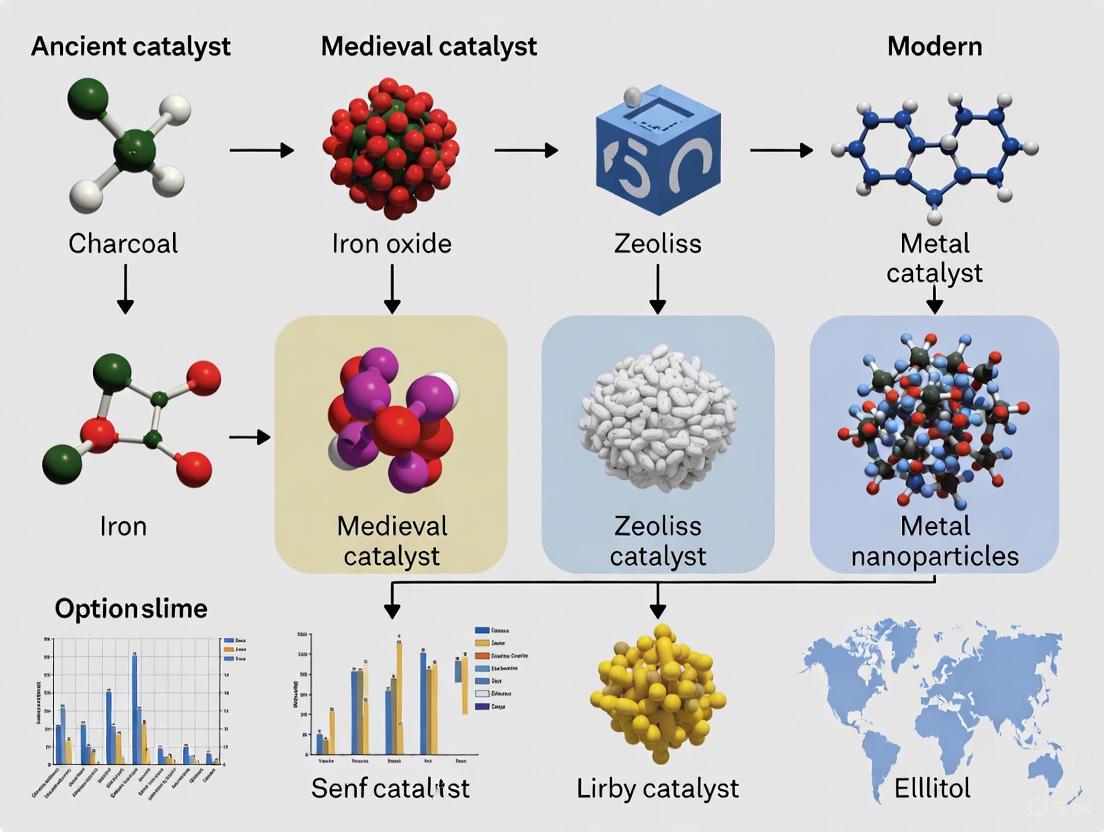
This article traces the transformative journey of catalyst development from its origins in ancient alchemy to its pivotal role in modern drug development and clean energy.
From Alchemy to Oncology: The Evolutionary Journey of Catalysts in Science and Medicine
Abstract
This article traces the transformative journey of catalyst development from its origins in ancient alchemy to its pivotal role in modern drug development and clean energy. Targeting researchers, scientists, and drug development professionals, it explores the foundational principles of catalysis, examines methodological breakthroughs from industrial to biomedical applications, analyzes troubleshooting and optimization strategies for modern catalytic systems, and validates performance through advanced characterization techniques. The synthesis provides a comprehensive historical and technical framework to inform future innovations in catalytic processes for biomedical research and therapeutic development.
From Ancient Transmutations to Scientific Foundations: The Origins of Catalysis
Alchemy, often misunderstood as mere mysticism, was in fact a complex and systematic protoscientific tradition that laid the groundwork for modern chemistry and catalyst development [1]. Practised for over a millennium across China, India, the Islamic world, and Europe, alchemy represents humanity's early organized attempt to understand and manipulate matter through experimental processes [2]. While its spiritual and philosophical dimensions sought personal transformation and enlightenment, its practical laboratory work established fundamental principles of material transformation that directly prefigure contemporary catalytic science [3] [4]. This paper examines medieval alchemy not as a historical curiosity but as the intellectual and methodological precursor to modern catalyst research, tracing a direct lineage from the alchemist's laboratory to today's industrial catalytic processes.
The alchemical tradition developed a sophisticated conceptual framework for understanding chemical transformations, establishing laboratory techniques that remain central to chemical research, and creating an initial classification system for substances and their reactive properties [5] [2]. Within this tradition, we find the earliest systematic investigations into substances that facilitate transformations without being consumed—the fundamental principle of catalysis. By examining alchemical practices through the lens of modern catalyst science, we can appreciate their substantive contributions to the development of this critical field.
Philosophical and Theoretical Foundations
Alchemical philosophy was rooted in the concept of transformation at both material and spiritual levels. The famous alchemical dictum "as above, so below," from the Emerald Tablet of Hermes Trismegistus, expressed the belief that processes in the microcosm reflected those in the macrocosm [1] [2]. This principle guided alchemists in their belief that base metals could be transformed into noble ones, just as the human soul could achieve perfection [6]. The theoretical framework rested on several key concepts that, while different from modern scientific understanding, provided a systematic approach to investigating material transformations.
Central to alchemical theory was the concept of the Philosopher's Stone, a substance believed to possess the power to transmute base metals into gold and, in some traditions, to produce the Elixir of Life for immortality [1] [2]. This pursuit, while never achieving its mythical goal, drove centuries of experimental work that developed practical laboratory techniques and discovered numerous substances with genuine catalytic properties. The conceptualization of a substance that could facilitate profound transformations without being consumed itself represents a prescient understanding of what would later be recognized as catalytic action [3].
Alchemical practice also incorporated Aristotelian philosophy, particularly the theory that all matter was composed of four elements—earth, air, fire, and water—each possessing qualities of hot, cold, wet, or dry [4]. Transmutation was theorized to occur through the rearrangement of these fundamental qualities. This theoretical framework, while ultimately incorrect, provided alchemists with a systematic approach to experimenting with material transformations that established patterns of investigation that would later evolve into proper scientific methodology.
Key Alchemical Substances and Processes
Medieval alchemists developed a sophisticated inventory of substances and laboratory processes that advanced material science and established techniques fundamental to chemical research. Their work identified and characterized numerous compounds that would later be recognized as having genuine catalytic properties, while their experimental methods established procedural approaches that remain relevant to contemporary catalyst research.
Alchemical Substances with Catalytic Significance
Table 1: Key Alchemical Substances and Their Modern Correlates
| Alchemical Name | Modern Identification | Alchemical Function | Catalytic Relevance |
|---|---|---|---|
| Sal ammoniac | Ammonium chloride (NH₄Cl) [7] | Flux in metalworking [7] | Acidic catalyst; metal salt precursor |
| Quicksilver | Mercury (Hg) [7] | Principal material for transmutation [7] | Amalgamation; reduction reactions |
| Butter of Antimony | Antimony trichloride (SbCl₃) [7] | Transmutation agent [7] | Lewis acid catalyst |
| Oil of Vitriol | Sulfuric acid (H₂SO₄) [7] | Solvent; reactive medium [7] | Acid catalyst; dehydrating agent |
| Luna Cornea | Silver chloride (AgCl) [7] | Material transformation [7] | Light-sensitive catalyst precursor |
| Nix Alba | Zinc oxide (ZnO) [7] | Pigment; medicinal [7] | Heterogeneous catalyst; semiconductor |
These substances were employed in increasingly sophisticated laboratory procedures that allowed alchemists to pursue their transformative goals while simultaneously building practical knowledge about chemical processes. The preparation and purification of these materials represented significant technical achievements that expanded the available toolkit for experimental investigation.
Fundamental Laboratory Processes
Alchemists developed and refined numerous laboratory techniques that would become standard procedures in chemistry laboratories. These processes were not merely mechanical operations but were viewed as stages in the transformative work that had both physical and spiritual dimensions:
Calcination: The heating of substances to high temperatures in air or oxygen to induce thermal decomposition, remove volatile components, or induce phase transitions [6]. This process was used to produce metal oxides from metals or carbonates.
Distillation: The purification or separation of mixture components through evaporation and condensation, greatly advanced by Arabic alchemists like Jabir ibn Hayyan [5] [2]. This technique enabled the production of concentrated acids and other reagents.
Sublimation: The transition of a substance directly from solid to gas phase, used particularly with compounds like ammonium chloride and arsenic trioxide [7].
Solution and Precipitation: The dissolution of materials in solvents followed by selective precipitation, used for purification and material separation [7].
Fermentation: Biological transformation processes studied not only for alcohol production but as a model for other transformative processes [5].
These operations formed a comprehensive experimental methodology that allowed alchemists to manipulate matter systematically, observing patterns of reactivity and transformation that would later inform the development of modern chemistry.
Experimental Protocols in Alchemy
Medieval alchemical research followed systematic experimental approaches that, while often shrouded in symbolic language, represented methodical investigations into material transformations. The following reconstructed protocols illustrate the sophistication of alchemical experimental design and its relevance to catalyst development.
Preparation of Aqua Fortis (Nitric Acid)
Objective: To produce a strong mineral acid capable of dissolving nearly all metals except gold, used in assaying and material processing [7].
Materials Required:
- Saltpetre (potassium nitrate, KNO₃) [7]
- Oil of Vitriol (sulfuric acid, H₂SO₄) [7]
- Aludel or glass retort with receiver vessel
- Heat source (furnace or sand bath)
Experimental Procedure:
- Combine two parts saltpetre with one part oil of vitriol in the retort [7].
- Assemble the distillation apparatus with tight seals to prevent gas escape.
- Apply gradual heat, increasing temperature until red fumes appear.
- Collect the distilled liquid in the receiver vessel.
- Observe the production of a fuming, highly corrosive liquid that dissolves copper and silver.
Significance: This process represented one of the earliest productions of a pure mineral acid, creating a powerful reactive medium that enabled numerous other chemical investigations and material processes. The ability to produce such reactive species was fundamental to advancing experimental chemistry.
The Cementation Process for Metal Purification
Objective: To separate gold from lesser metals or to produce surface modifications on metals through solid-state diffusion [7].
Materials Required:
- Metal sheets or objects to be treated
- Powdered cementation compound (typically salts, minerals, or other reactive solids)
- Layered ceramic or metal container
- Controlled-temperature furnace
Experimental Procedure:
- Alternate layers of metal and powdered cementation material in the container.
- Seal the container to limit gas exchange while allowing pressure regulation.
- Heat the assembly in a furnace for extended periods (typically days to weeks).
- Maintain consistent temperature below the melting point of the metals.
- After cooling, remove the metal objects and observe surface modifications or purification.
Significance: Cementation represented an early form of heterogeneous catalysis and materials processing, demonstrating how solid-phase reactions could effect material transformations—a principle fundamental to modern heterogeneous catalyst systems.
Figure 1: The Alchemical Experimental Methodology showing the transformation process workflow from input materials through various operations to output products, demonstrating the systematic approach to material transformations.
The Alchemical Toolkit: Research Reagents and Materials
The alchemical laboratory contained a sophisticated array of substances with specific functions, many of which would later be recognized as catalysts or catalyst precursors. This repertoire represented centuries of accumulated knowledge about material properties and reactivities.
Table 2: Essential Alchemical Reagents and Their Functions
| Reagent Name | Composition | Primary Function | Modern Catalytic Analog |
|---|---|---|---|
| Aqua Regia | HCl:HNO₃ mixture (3:1) [7] | Dissolution of noble metals | Precious metal catalyst preparation |
| Mercurius Praecipitatus | Red mercuric oxide (HgO) [7] | Oxidizing agent | Oxidation catalyst precursor |
| Flowers of Antimony | Antimony trioxide (Sb₂O₃) [7] | Opacifier; medicinal | Solid acid catalyst component |
| Sugar of Lead | Lead acetate (Pb(CH₃COO)₂) [7] | Sweetening agent; glaze | Coordination compound; catalyst poison |
| White Arsenic | Arsenious oxide (As₂O₃) [7] | Medicinal; poison | Catalyst inhibitor/poison |
| Liver of Sulfur | Potassium polysulfide mixture [7] | Surface modification | Heterogeneous catalyst pretreatment |
| Sal Alembroth | Chlorides of ammonium and mercury [7] | Universal solvent (claimed) | Dual-component catalyst system |
This toolkit enabled alchemists to conduct a wide range of chemical transformations and material characterizations. The functional understanding of these substances—their selective reactivities, synergistic effects, and transformational capabilities—represented significant progress toward the conceptualization of catalytic action, even if the theoretical framework differed from modern understanding.
Historical Continuity: From Alchemy to Catalysis
The transition from alchemy to modern chemistry and catalysis was not a sharp break but a gradual evolution, with many key figures bridging these traditions. This continuity is evident in both conceptual frameworks and practical methodologies.
Conceptual Inheritance
The fundamental alchemical concept of a substance that could facilitate transformations without being consumed itself finds direct expression in the modern definition of a catalyst. The Philosopher's Stone, while mythologized beyond practical reality, conceptually prefigures the catalyst—a substance that enables transformations while remaining unchanged [3]. This parallel is not merely symbolic; the experimental pursuit of transmutation directly led to the discovery of substances with genuine catalytic properties.
The alchemical emphasis on process and transformation, rather than merely static composition, established a conceptual framework that would later prove essential to understanding catalytic cycles and reaction kinetics. The recognition that materials passed through different stages and states during transformations, a central feature of alchemical theory, anticipated modern understanding of reaction mechanisms and intermediate species in catalytic processes.
Methodological Continuity
The laboratory techniques refined by alchemists—distillation, sublimation, solution/precipitation, and temperature-controlled reactions—became the standard methodologies of chemical research [2] [4]. These processes remain essential in modern catalyst preparation and characterization. The development of specialized glassware, furnaces, and reaction vessels by alchemists created the physical infrastructure that enabled advanced chemical investigations.
The alchemical approach to systematic experimentation, while often incorporating symbolic and qualitative observations, established patterns of investigative methodology that would later be refined into proper scientific protocol. The careful documentation of procedures, materials, and observations—even when interpreted through pre-scientific theoretical frameworks—created a body of empirical knowledge that informed later scientific developments.
Influential Figures Bridging the Traditions
Several key figures demonstrate the direct lineage from alchemical traditions to modern chemical science:
Jabir ibn Hayyan (Geber): This 8th-century Persian alchemist introduced systematic experimentation and laboratory techniques such as distillation, crystallization, and sublimation [2]. His work with mineral acids and methodical approach to experimentation established foundational practices for chemical research.
Paracelsus (1493-1541): The Swiss physician-alchemist revolutionized medicine by introducing chemically-prepared medicines, moving beyond traditional herbal remedies [2] [8]. His concept of using prepared chemicals for therapeutic effect established principles that would inform both pharmacology and catalyst design.
Robert Boyle (1627-1691): Though critical of some alchemical traditions, Boyle's corpuscular theory of matter was influenced by alchemical concepts, particularly through his engagement with the work of Daniel Sennert [4]. His systematic approach to experimentation built upon alchemical methodologies while introducing greater rigor.
Isaac Newton (1642-1727): Newton's extensive alchemical researches, long overlooked, demonstrate the continued engagement with alchemical concepts even as modern science was emerging [2] [4]. His investigations into material transformations informed his broader scientific worldview.
The medieval pursuit of transformation through alchemy established conceptual, methodological, and technical foundations that directly informed the development of modern catalysis. While the mystical dimensions of alchemy have often obscured its substantive contributions, a rigorous examination reveals significant continuity between these traditions. The alchemical emphasis on transformation processes, development of laboratory techniques for material manipulation, and investigation of substances that facilitate change without being consumed all prefigure key aspects of contemporary catalyst science.
Modern industrial catalysis, with over 90% of industrial chemicals now produced using catalytic processes, stands as the direct descendant of these early investigations into material transformations [9] [10]. From the development of catalytic cracking of petroleum by Eugène Houdry in the 1930s to the Ziegler-Natta polymerization catalysts that revolutionized plastics production, the fundamental principle remains the same: substances that facilitate transformations while being regenerated [9]. This principle was presaged in alchemical investigations centuries before the term "catalyst" was formally coined in 1835 [3].
The historical narrative that positions alchemy as merely a pre-scientific superstition fails to acknowledge its substantive contributions to the conceptual and methodological toolkit of chemical research. By recognizing alchemy as a legitimate protoscientific tradition with direct relevance to catalyst development, we gain not only a more accurate historical understanding but also appreciation for the complex, non-linear nature of scientific progress. The alchemical pursuit of transformation, both material and spiritual, established investigative patterns and conceptual frameworks that continue to inform cutting-edge catalyst research today, including emerging fields such as biocatalysis, electrocatalysis, and photocatalytic processes for sustainable energy applications [10].
The dawn of industrial catalysis marked a pivotal transformation in chemical synthesis, enabling efficient large-scale production of essential compounds that shaped modern industry and medicine. Among these foundational processes, the synthesis of ethers stands as a cornerstone development that not only revolutionized industrial chemistry but also established principles that would later permeate therapeutic innovation. This transition from traditional alchemical practices to systematic catalytic processes represents a critical junction in the history of chemistry, where empirical knowledge converged with emerging scientific principles to create reproducible, scalable synthetic methodologies. The evolution of ether production exemplifies this paradigm shift, moving from simple distillation techniques to sophisticated catalytic systems that would eventually inspire entirely new fields of medical research, including contemporary advances in nanocatalytic medicine. By examining the birth and maturation of industrial catalysis through the lens of ether synthesis, we can trace the conceptual and technological lineage connecting early chemical manufacturing to cutting-edge therapeutic interventions that manipulate biological systems through catalytic principles.
Historical Foundations of Industrial Catalysis
The systematic application of catalysis in industrial processes began in the mid-18th century, with the first documented industrial use of a catalyst occurring in 1746 by J. Roebuck in the manufacture of lead chamber sulfuric acid [11]. This pioneering application established the foundational principle that catalysts could dramatically accelerate chemical transformations without being consumed in the process. For the following century and a half, industrial processes primarily relied on pure components as catalysts, but after 1900, multicomponent catalysts emerged and have since become standard in industrial applications [11]. This evolution reflected growing sophistication in understanding catalytic mechanisms and structure-activity relationships.
The development of porous materials with catalytic properties further advanced the field. Natural zeolites (aluminosilicate minerals with highly ordered pores) were first identified in 1756 by Swedish mineralogist Axel Fredrick Cronstedt, who observed their unique property of releasing steam upon heating—a phenomenon we now recognize as water desorbing from zeolitic pores [12]. However, it wasn't until the 20th century that synthetic zeolites emerged, with Richard Barrer establishing the field of modern synthetic zeolite research in the 1940s [12]. Robert M. Milton's subsequent work at Union Carbide demonstrated zeolites' potential as hydrocarbon cracking catalysts, leading to their industrial adoption by 1959 [12]. The parallel development of charcoal-based adsorption systems, with origins dating back to ancient Egyptian medical practices documented in the Ebers papyrus (circa 1500 BC), provided additional foundational knowledge about porous materials that would inform future catalytic system design [12].
Table 1: Key Historical Developments in Industrial Catalysis
| Year | Development | Key Figure/Company | Significance |
|---|---|---|---|
| 1746 | First industrial catalytic process | J. Roebuck | Lead chamber sulfuric acid production |
| 1756 | Discovery of natural zeolites | Axel Fredrick Cronstedt | Identification of porous aluminosilicates |
| 1862 | First synthetic zeolites (lévyne) | Henri Sainte-Claire-Deville | Proof that zeolites could be synthesized |
| 1900+ | Multicomponent catalysts | Various | Enhanced activity and selectivity |
| 1940s | Modern synthetic zeolite research | Richard Barrer | Systematic study and development |
| 1959 | Zeolite Y hydrocarbon isomerization | Union Carbide | Commercial application in petroleum industry |
The economic drivers behind catalytic innovation cannot be overstated. As noted in historical analyses, "If a company's catalyst is not continually improved, another company can make progress in research on that particular catalyst and gain market share" [11]. This competitive pressure fueled rapid advancement in catalytic technologies throughout the 20th century, with catalysts becoming increasingly sophisticated in their composition and application specificity. The professionalization of catalytic chemistry and engineering during this period established catalysis as a distinct scientific discipline bridging fundamental research and industrial application.
Ether Synthesis: The Prototypical Industrial Catalytic Process
Acid-Catalyzed Dehydration of Alcohols
The acid-catalyzed dehydration of alcohols to form ethers represents one of the most historically significant applications of industrial catalysis. This process is particularly valuable for producing symmetrical ethers from primary alcohols, with the synthesis of diethyl ether from ethanol serving as the classic example [13]. Industrially, this transformation is achieved by heating ethanol to 130-140°C in the presence of strong acid catalysts, most commonly sulfuric acid, with over 10 million tons of diethyl ether produced annually via this method [13]. The temperature control is critical, as elevation beyond 140-150°C promotes competing elimination pathways, resulting in ethylene formation rather than the desired ether product [13].
The reaction proceeds through a well-defined three-step mechanism that exemplifies fundamental principles of acid catalysis in organic synthesis. First, one equivalent of alcohol undergoes protonation by the acid catalyst to form its conjugate acid, converting the poor hydroxyl leaving group (OH⁻) into a significantly better leaving group (H₂O). Next, a second equivalent of alcohol performs nucleophilic attack at the electrophilic carbon in an SN2 displacement, forming a new C-O bond while displacing water. Finally, deprotonation of the product by another equivalent of solvent or weak base yields the final ether product [13]. This mechanism demonstrates how catalysts function to modify reaction pathways rather than merely accelerating existing ones.
Diagram 1: Acid-catalyzed ether synthesis mechanism
Williamson Ether Synthesis
While the acid-catalyzed approach excels for symmetrical ether production, the Williamson ether synthesis, discovered by Alexander Williamson in 1850, provides a more versatile route to both symmetrical and asymmetrical ethers [14]. This reaction employs an alkoxide ion (RO⁻) as a nucleophile attacking an organohalide electrophile through an SN2 mechanism. The reaction follows a concerted backside attack mechanism where the nucleophile approaches the electrophilic carbon from the opposite side of the leaving group, resulting in inversion of configuration at the reaction center [14].
The scope of the Williamson reaction is remarkably broad, though it functions most effectively with primary alkoxides and primary alkyl halides. Secondary systems suffer from competing elimination reactions, while tertiary systems are generally too prone to side reactions for practical application [14]. Modern innovations have enhanced this classical approach, with microwave-enhanced technology reducing reaction times from 1.5 hours of reflux to just 10 minutes at 130°C while increasing yields from 6-29% to 20-55% [14]. Additionally, high-temperature approaches (300°C and above) using weaker alkylating agents have demonstrated improved selectivity, particularly for industrial-scale production of aromatic ethers like anisole [14].
Table 2: Comparative Analysis of Industrial Ether Synthesis Methods
| Parameter | Acid-Catalyzed Dehydration | Williamson Ether Synthesis |
|---|---|---|
| Optimal Substrates | Primary alcohols | Primary alkyl halides + alkoxides |
| Ether Type | Symmetrical | Symmetrical and unsymmetrical |
| Key Limitations | Temperature-sensitive, elimination side products | Elimination with secondary/tertiary halides |
| Industrial Scale | >10 million tons/year (diethyl ether) | Widely used but smaller scale specialty ethers |
| Catalyst System | Homogeneous (H₂SO₄) | Homogeneous (alkoxide) or phase-transfer |
| Typical Yield | High for optimized systems | 50-95% (lab), near-quantitative (industrial) |
Alternative Etherification Pathways
Beyond these two primary methods, several specialized ether synthesis routes have been developed to address specific synthetic challenges. For tertiary ethers where Williamson synthesis fails due to elimination predominating, carbocation-mediated approaches offer a viable alternative [15]. By dissolving tertiary alkyl halides in alcohol solvents, leaving group dissociation generates carbocations that are trapped by nucleophilic attack from the alcohol solvent, following a classic SN1 pathway [15]. Similarly, treating alkenes in alcohol solvents with strong acids having poorly nucleophilic counterions generates carbocations via protonation following Markovnikov's rule, with subsequent trapping by alcohol nucleophiles yielding ether products [15].
To circumvent issues of carbocation rearrangements that often plague these approaches, alkoxymercuration provides a valuable alternative [15]. This method involves reacting alkenes with mercury(II) acetate in alcohol solvent, forming a "mercurinium" ion intermediate that undergoes regioselective attack by the alcohol at the more substituted carbon. Subsequent demercuration with sodium borohydride yields the ether product without rearrangement, effectively adding the elements of alcohol across the alkene double bond with Markovnikov selectivity [15].
Experimental Protocols in Catalytic Ether Synthesis
Laboratory-Scale Diethyl Ether Synthesis
The synthesis of diethyl ether via acid-catalyzed dehydration of ethanol serves as a fundamental experiment demonstrating principles of industrial catalysis. The following protocol outlines the standard laboratory procedure:
Materials and Equipment:
- Ethanol (absolute, 200 proof)
- Concentrated sulfuric acid (catalyst)
- Heating mantle with temperature control
- Fractional distillation apparatus
- Separatory funnel
- Anhydrous calcium chloride (drying agent)
- Safety equipment: lab coat, gloves, eye protection, fume hood
Procedure:
- Reaction Setup: In a 500mL round-bottom flask, combine 100mL of absolute ethanol with 100mL of concentrated sulfuric acid slowly with continuous stirring. The addition should be performed in an ice bath to control the exothermic reaction. Equip the flask with a fractional distillation apparatus.
Ether Production: Gradually heat the reaction mixture to 130-140°C using a heating mantle with precise temperature control. Maintain this temperature range throughout the reaction to minimize ethylene formation. The diethyl ether product will distill over as it forms.
Product Collection: Collect the distillate in an ice-cooled receiver. The crude ether will separate into a distinct layer in the receiving flask.
Purification: Transfer the crude ether to a separatory funnel and wash sequentially with:
- 50mL of 10% sodium hydroxide solution (to remove acidic impurities)
- 50mL of saturated sodium chloride solution (to remove water) Dry the ether layer over anhydrous calcium chloride for 30 minutes with occasional stirring.
Final Distillation: Decant the dried ether from the drying agent and perform a final distillation, collecting the fraction boiling at 34-36°C.
Safety Considerations: Diethyl ether is extremely flammable and forms explosive peroxides upon standing. All procedures must be conducted in a fume hood with no ignition sources present. The reaction temperature must be carefully controlled to prevent decomposition or excessive pressure buildup.
Williamson Ether Synthesis Protocol
The Williamson synthesis provides a general method for ether formation, particularly valuable for unsymmetrical ethers:
Materials and Equipment:
- Sodium metal or sodium hydride
- Anhydrous alcohol (ROH)
- Alkyl halide (R'X)
- Anhydrous solvent (e.g., THF, diethyl ether)
- Magnetic stirrer with heating capability
- Nitrogen or argon atmosphere setup
- Standard glassware for reflux and extraction
Procedure:
- Alkoxide Formation: In a flame-dried round-bottom flask under inert atmosphere, add 50mL of anhydrous solvent and 0.1 mol of sodium metal or sodium hydride. Slowly add 0.1 mol of the anhydrous alcohol with stirring, allowing hydrogen gas evolution to complete. Continue stirring until a homogeneous solution forms.
Alkylation: Add 0.1 mol of alkyl halide dropwise to the alkoxide solution. Heat the reaction mixture to reflux (typically 50-100°C) for 1-8 hours, monitoring reaction completion by TLC or GC.
Workup: Cool the reaction mixture to room temperature and carefully quench with water. Extract the product with diethyl ether (3 × 30mL), combine the organic extracts, and dry over anhydrous magnesium sulfate.
Purification: Remove solvents by rotary evaporation and purify the crude product by distillation or column chromatography as appropriate.
Modifications for Industrial Application: Industrial Williamson syntheses often employ phase-transfer catalysts (e.g., tetrabutylammonium bromide) to enhance reaction rates. For challenging substrates, soluble iodide salts may be added to catalyze the reaction through in situ halide exchange (Finkelstein reaction), generating more reactive iodide intermediates from chloride starting materials [14].
Table 3: Research Reagent Solutions for Catalytic Ether Synthesis
| Reagent/Catalyst | Function | Application Specifics | Safety Considerations |
|---|---|---|---|
| Sulfuric Acid | Brønsted acid catalyst | Dehydration of primary alcohols to symmetrical ethers (130-140°C) | Highly corrosive, causes severe burns |
| p-Toluenesulfonic Acid | Mild organic acid catalyst | Ether formation under milder conditions | Less corrosive than mineral acids |
| Sodium/Potassium Alkoxides | Strong base/nucleophile | Williamson synthesis with primary alkyl halides | Moisture-sensitive, flammable |
| Phase-Transfer Catalysts | Facilitate interphase transfer | Enhance reaction rates in biphasic systems | Generally low toxicity |
| Mercury(II) Acetate | Electrophilic mercury source | Alkoxymercuration of alkenes | Highly toxic, requires special disposal |
| Sodium Borohydride | Reducing agent | Demercuration step in alkoxymercuration | Moisture-sensitive, hydrogen gas evolution |
The Catalyst-Mediated Medical Revolution
Foundations of Catalytic Medicine
The principles governing industrial catalytic processes have transcended their origins in chemical manufacturing to establish entirely new paradigms in therapeutic intervention. This transition represents a conceptual bridge between traditional catalysis and emerging biomedical applications, where synthetic catalysts operate within biological systems to correct pathological processes. The field of catalysis medicine embodies this approach, utilizing "man-made catalysts as therapeutics" that directly participate in the chemical networks of living organisms [16]. This represents a fundamental shift from conventional pharmacology, moving beyond receptor-ligand interactions to actively modify biochemical pathways through catalytic intervention.
The theoretical foundation of catalysis medicine rests upon viewing living organisms as complex networks of chemical reactions, where disorders stemming from dysregulated enzymes can be treated by chemical catalysts that bypass these compromised biological catalysts [16]. This approach offers unique advantages, including the potential to address genetic diseases without genetic manipulation, introduce non-natural modifications that may be superior to natural enzymatic products, and create persistent therapeutic effects through stable chemical modifications not subject to biological regulation [16]. The development of catalysts for biomedical applications must satisfy stringent requirements, including operation under physiological conditions (aqueous solvent, body temperature, neutral pH), exceptional selectivity for target biomolecules with residue-level resolution, and appropriate ADMET (absorption, distribution, metabolism, excretion, and toxicity) profiles [16].
Nanocatalytic Medicine: Industrial Principles in Therapeutic Applications
The convergence of industrial catalysis with nanotechnology has spawned the emerging field of nanocatalytic medicine, which applies nanocatalytic approaches to resolve medical problems [17]. This discipline systematically leverages knowledge from industrial catalytic processes to design therapeutic interventions that catalyze specific reactions within biological systems. The parallels between industrial and medical catalysis are striking, though significant adaptations are required to accommodate the drastic differences in operating conditions between chemical plants and physiological environments.
Diagram 2: Translation of industrial catalysis to medical applications
Several categories of industrial catalytic reactions have demonstrated particular promise for biomedical translation:
Fenton/Fenton-like Catalysis: Originally developed for environmental applications like wastewater purification and soil remediation, Fenton chemistry utilizes catalysts (typically Fe²⁺ or Cu²⁺) to decompose hydrogen peroxide into highly reactive hydroxyl radicals (·OH) [17]. The biomedical application capitalizes on the elevated hydrogen peroxide and lactic acid concentrations in tumor microenvironments, employing Fenton nanocatalysts like iron nanoparticles to selectively generate cytotoxic hydroxyl radicals within tumors while sparing healthy tissues [17]. This approach represents a direct translation of industrial oxidation chemistry to therapeutic ablation of pathological tissues.
Acid/Base Catalysis: Industrial acid catalysts like sulfuric acid (used in cellulose hydrolysis for bioethanol production) and base catalysts like NaOH (employed in biodiesel production via transesterification) have inspired the development of biomedical catalysts capable of similar transformations under physiological conditions [17]. Zeolites, widely used in crude oil processing and petrochemistry under harsh conditions, demonstrate potential as both drug carriers and therapeutic catalysts when engineered as nanoparticles [17]. Similarly, polyoxometalates (POMs) containing multivalent transition metal ions exhibit acid-responsive assembly behavior and enzyme-like catalytic activity with applications in anti-bacterial, anti-inflammatory, and anti-cancer therapies [17].
Transition Metal Catalysis: Industrial processes employing transition metals (e.g., Fe, Ni, Pd, Pt) and their oxides for redox reactions have informed the development of functional therapeutic agents [17]. For instance, transition metal nanoparticles can catalyze the in situ generation of therapeutic agents within pathological environments. Palladium and iron nanoparticles have been developed for tumor-targeted hydrogen delivery, leveraging their catalytic activity to modulate redox homeostasis in cancer cells [17]. The enhanced catalytic activity observed at nanoscale dimensions due to increased surface area and defect density makes nanomaterials particularly attractive for these applications.
Experimental Framework for Catalytic Medicine
The translation of catalytic principles from industrial chemistry to medical applications requires specialized experimental approaches that account for the unique challenges of biological systems:
In Vivo Catalyst Evaluation Protocol:
Materials:
- Functionalized nanocatalyst (e.g., tumor-targeting moieties)
- Animal disease model (e.g., tumor-bearing mice)
- Appropriate analytical techniques (HPLC, MS, imaging)
- Control groups (untreated, catalyst-only, substrate-only)
Procedure:
- Catalyst Administration: Administer the therapeutic catalyst via appropriate route (IV, IP, etc.) at predetermined dosage based on preliminary toxicity studies.
Substrate Delivery: If required, deliver catalyst substrate (e.g., H₂O₂ for Fenton catalysts) either simultaneously or sequentially based on reaction kinetics.
Biodistribution Analysis: Quantify catalyst accumulation in target tissues versus non-target organs using appropriate imaging or analytical techniques.
Therapeutic Assessment: Monitor disease progression/regression using established biomarkers, imaging modalities, and histological analysis.
Safety Evaluation: Assess potential off-target effects through comprehensive blood chemistry, histopathology of major organs, and behavioral observations.
Case Study: Epigenetic Modulation via Synthetic Catalysts
A compelling example of catalysis medicine involves the development of chemical catalysts for epigenetic modulation. Researchers have created synthetic catalysts that directly acylate histone proteins in living cells, complementing or bypassing endogenous enzymatic activities [16]. For instance, the DMAP-SH (DSH) catalyst promotes regioselective acylation at specific lysine residues using physiological acetyl donors like acetyl-CoA [16]. When conjugated with targeting ligands like LANA (which binds histone acidic patches), these catalysts achieve remarkable selectivity—LANA-DSH catalyzes acetylation at H2BK120 with approximately 90% yield in mononucleosome systems [16].
This catalytic approach to epigenetic modification demonstrates several advantages over conventional small-molecule enzyme inhibitors: (1) it can introduce persistent epigenetic marks not subject to natural erasure mechanisms; (2) it enables incorporation of non-natural acyl groups simply by providing alternative acyl donors; and (3) it can compete with pathological enzymatic activities, as demonstrated by synthetic acetylation at H2BK120 suppressing the pro-leukemic ubiquitination at the same residue [16]. This final application represents a promising strategy for treating mixed-lineage leukemia (MLL)-rearranged leukemia, demonstrating the therapeutic potential of catalytic epigenetic interventions.
The historical trajectory from industrial ether synthesis to contemporary catalytic medicine illustrates a fundamental paradigm in technological evolution: principles refined in industrial contexts frequently transcend their original applications to enable transformative advances in seemingly unrelated fields. The catalytic strategies developed for efficient ether production—including acid catalysis, nucleophilic displacement, and regioselective addition—have established conceptual frameworks that now inform therapeutic interventions at the molecular level. This intellectual and methodological migration between chemical engineering and biomedical science exemplifies the interdisciplinary nature of modern scientific progress.
As catalytic medicine continues to evolve, principles honed through decades of industrial catalyst optimization—including structure-activity relationships, kinetic optimization, and catalyst stabilization—will undoubtedly accelerate its development. Similarly, emerging challenges in catalytic medicine, such as achieving precise targeting in complex biological environments and minimizing off-target activity, may inspire innovations that feedback into industrial catalytic processes. This continuous cross-pollination between industrial chemistry and therapeutic science ensures that the legacy of early catalytic advances, including ether synthesis, will extend far beyond their original applications to address increasingly complex challenges at the interface of chemistry, materials science, and medicine.
The 19th century marked a transformative period for catalysis, shifting it from an unexplained chemical art to a formal scientific discipline. Prior to this era, catalytic processes such as fermentation, soap making, and ether production were employed without a theoretical understanding of the underlying mechanisms [3] [18]. This paper examines the pivotal 19th-century developments that established the terminology, theoretical frameworks, and kinetic principles of catalysis, providing the foundation for all subsequent catalytic science and its immense applications in modern industry, including drug development.
The conceptualization of catalysis required a move from purely empirical observations to systematic, quantitative experimentation. This was facilitated by the period's burgeoning interest in reaction velocities, energy, and molecular dynamics—key concerns of the emerging field of physical chemistry [18]. The work of several key scientists, culminating in the award of the Nobel Prize to Wilhelm Ostwald in 1909, successfully defined the core principles that distinguished catalytic action from other chemical phenomena [19].
The Pre-Scientific Landscape of Catalytic Practices
Long before the term "catalysis" was coined, human industry unconsciously relied on catalytic processes. The production of wine, beer, soap, and cheese involved biochemical catalysts whose modes of action remained a mystery [3] [18]. A significant early medicinal achievement was Valerius Cordus's 1552 synthesis of ether using sulfuric acid as a catalyst, which revolutionized surgery by introducing a reliable anaesthetic [3]. These processes were effectively the "alchemy" of their time—practical arts without a coherent scientific theory [3].
The early industrial era also saw the application of catalytic-type processes. The lead chamber process for producing sulfuric acid, which utilized nitrogen oxides to catalyze the oxidation of sulfur dioxide, was a forerunner to more sophisticated catalytic industrial methods [18]. However, these applications were developed through trial and error, lacking the predictive power that a fundamental theory would provide.
Foundational Experiments and the Birth of a Concept
The early 19th century witnessed a series of critical experiments that isolated and highlighted the peculiar phenomenon that would become known as catalysis. Table 1 summarizes the key quantitative observations from these foundational studies.
Table 1: Key 19th Century Experimental Observations Preceding Formalization
| Investigator(s) | Year(s) | System Studied | Key Catalytic Observation |
|---|---|---|---|
| Gottlieb Kirchhoff | Early 19th C. | Starch and Sugar | Acids enhanced the conversion of starch to sugar [18]. |
| Sir Humphry Davy | ~1812-1817 | Gaseous Combustion | Platinum hastened the combustion of a variety of gases [18]. |
| Multiple Scientists | Early 19th C. | Hydrogen Peroxide | Stability in acid, but decomposition in presence of alkali & metals (Mn, Ag, Pt, Au) [18]. |
| Michael Faraday | 1834 | Hydrogen/Oxygen Recombination | A clean platinum plate promoted gas recombination; activity suppressed by ethylene/CO [18]. |
| P. Phillips | 1830s | SO₂ Oxidation | Patented use of platinum to oxidize SO₂ to SO₃; process abandoned due to catalyst poisoning [18]. |
These experiments shared a common thread: the acceleration or modification of a chemical reaction by a substance that itself remained unaltered. Sir Humphry Davy's work was particularly insightful, as he recognized the importance of a clean metallic surface, a concept that would later become central to heterogeneous catalysis and the understanding of catalyst poisons [18]. Similarly, Michael Faraday's meticulous study of the platinum-induced recombination of hydrogen and oxygen provided clear evidence that the catalytic activity could be suppressed by the presence of other gases, suggesting a competitive process at the metal's surface [18].
The Formal Coining of Terminology: Berzelius and Ostwald
In 1835, the renowned Swedish chemist Jöns Jacob Berzelius synthesized these disparate observations into a single unifying concept. He derived the term catalysis from the Greek words kata- (down) and lyein (loosen) [18] [20]. Berzelius postulated the existence of a special "catalytic force" to explain the ability of certain substances to awaken the "slumbering affinities" of bodies by their mere presence [18].
While Berzelius's "force" was a metaphysical construct, it successfully categorized a genuine class of chemical behavior. The term itself, however, endured. The subsequent development of chemical kinetics in the latter half of the 19th century, notably by J.H. van 't Hoff and Svante Arrhenius, provided the tools to move beyond Berzelius's formulation [18] [19]. The Arrhenius equation, which quantitatively links reaction rate to temperature, became a cornerstone for describing catalytic reactions [19].
It was Wilhelm Ostwald, a founder of physical chemistry, who delivered the modern, kinetic definition of a catalyst. In 1901, he stated, "A catalyst is a material that changes the rate of a chemical reaction without appearing in the final product" [19]. His systematic and quantitative investigations led to a profound understanding that catalysis was a kinetic phenomenon, not the result of a mysterious force. For this work, Ostwald was awarded the Nobel Prize in Chemistry in 1909, an accolade that cemented catalysis's place in mainstream science [19].
The Ostwald Workflow: From Observation to Kinetic Formalization
The following diagram illustrates the logical progression of thought, from early empirical observations to Ostwald's kinetic formalization of catalysis, which critically displaced the earlier concept of a "catalytic force."
Core Theoretical Principles Established in the 19th Century
The experimental and theoretical work of the 19th century culminated in the establishment of several non-negotiable principles that define catalytic action to this day.
The Principle of Kinetic Acceleration and the Activation Energy Barrier
The primary function of a catalyst is to accelerate the rate of a chemical reaction. The modern understanding is that catalysts provide an alternative reaction pathway with a lower activation energy (Ea) than the non-catalyzed mechanism [20]. This principle is visually summarized in the energy profile diagram below, which contrasts the reaction pathways with and without a catalyst.
The Invariance of Thermodynamic Equilibrium
A cornerstone principle solidified by the work of Ostwald and others is that a catalyst does not affect the position of a chemical reaction's equilibrium [18] [20]. A catalyst only increases the rate at which equilibrium is attained. This is a direct consequence of chemical thermodynamics. Since a catalyst is regenerated at the end of the reaction cycle, it cannot change the free energy difference between reactants and products, which is the sole determinant of equilibrium [20]. This principle was elegantly demonstrated by Georges Lemoine (1877), who showed that the decomposition of hydriodic acid reached the same equilibrium point at 350°C, regardless of whether a platinum sponge catalyst was present [18].
The Catalyst Cycle and Regeneration
The 19th century saw the recognition of the catalytic cycle, in which the catalyst interacts with reactants to form intermediates but is regenerated in its original form at the end of the cycle [18] [20]. This is why only a small amount of catalyst is needed to transform a large quantity of reactants. A classic gas-phase example studied in this period was the nitric oxide-catalyzed oxidation of sulfur dioxide to sulfur trioxide [20].
Experimental Protocols of Landmark Studies
The formalization of catalysis relied on quantitative, reproducible experiments. The following methodologies were critical in shaping the theoretical understanding.
Protocol: Lemoine's Equilibrium Experiment (1877)
Objective: To demonstrate that a catalyst affects the reaction rate but not the final equilibrium position [18].
- Apparatus Setup: Prepare a sealed, temperature-controlled reaction vessel capable of withstanding high pressure. Incorporate sampling ports for periodic analysis.
- Reaction Preparation: Introduce a known quantity of hydriodic acid (HI) gas into the vessel.
- Control Experiment: Heat the vessel to a constant temperature of 350°C. Periodically sample the gas mixture and analyze the composition (e.g., via titration or density measurement) to determine the extent of the decomposition reaction 2HI ⇌ H₂ + I₂. Monitor until the composition remains constant, indicating equilibrium has been reached. Record the final equilibrium constant and the time taken to reach equilibrium.
- Catalyzed Experiment: Repeat Step 2. Introduce a small, known mass of platinum sponge catalyst into the reaction vessel. Heat the system to the same constant temperature of 350°C. Sample and analyze the gas mixture periodically as in Step 3.
- Data Analysis: Compare the time taken to reach equilibrium in the control versus the catalyzed experiment. Confirm that the final equilibrium concentrations of HI, H₂, and I₂ are identical in both experiments, regardless of the presence of the catalyst.
Protocol: Faraday's Surface Catalysis Experiment (1834)
Objective: To investigate the role of a clean metal surface in catalyzing gas recombination and the effect of inhibitor gases [18].
- Electrolysis: Use electrolysis of water to produce pure hydrogen and oxygen gases.
- Surface Preparation: Obtain a polished platinum plate. Clean the surface meticulously (e.g., with acid and heat) to ensure it is free of contaminants.
- Initial Observation: In a controlled atmosphere, expose the clean platinum plate to a mixture of hydrogen and oxygen. Observe the recombination into water (e.g., via formation of mist or temperature change on the surface).
- Introduction of Inhibitor: Introduce a small amount of a potential inhibitor gas, such as ethylene (C₂H₄) or carbon monoxide (CO), into the hydrogen-oxygen mixture.
- Comparative Analysis: Observe and record the marked decrease or complete cessation of the recombination reaction upon the introduction of the inhibitor gas.
- Conclusion: The experiment demonstrates that a clean surface is essential for this catalytic reaction and that other gases can compete for active sites, effectively "poisoning" the catalyst.
The 19th Century Scientist's Toolkit
Table 2: Essential Research Reagents and Materials in 19th Century Catalysis Research
| Reagent/Material | Function in Experimental Research |
|---|---|
| Platinum Sponge/Metal | A versatile, high-surface-area heterogeneous catalyst for studying gas-phase reactions like oxidations and hydrogenations [18]. |
| Sulphuric Acid (H₂SO₄) | A common homogeneous acid catalyst used in reactions like esterification and the inversion of cane sugar [18]. |
| Nitrogen Oxides (NO, NO₂) | Catalysts for the lead chamber process and the oxidation of SO₂, serving as an early example of gas-phase homogeneous catalysis [18]. |
| Cane Sugar Solution | A model reactant for studying acid-catalyzed hydrolysis ("inversion"), with reaction progress easily monitored by measuring optical rotation [18]. |
| Hydriodic Acid (HI) Gas | The reactant in Lemoine's landmark equilibrium experiment to prove catalysts do not shift thermodynamic equilibrium [18]. |
The 19th century represents the definitive period of formalization for catalytic science. The journey from Berzelius's coining of the term "catalysis" and his postulate of a mysterious force to Ostwald's precise, kinetic-based definition marked a paradigm shift. The establishment of core principles—that catalysts operate by providing a lower-energy pathway, that they remain unchanged after the reaction, and that they cannot alter thermodynamic equilibrium—created a robust theoretical framework. This framework not only explained existing chemical phenomena but also empowered the deliberate design of catalytic processes in the 20th century, such as the Haber-Bosch process and catalytic cracking, which have profoundly shaped the modern world, including the field of pharmaceutical development. The 19th-century foundation turned catalysis from an art into a science, enabling its future as a discipline central to chemical innovation.
The development of catalysts represents a pivotal thread throughout human history, from ancient enzymatic processes to modern synthetic chemistry. Within this continuum, periods of conflict have consistently served as potent accelerants for technological innovation. The Haber-Bosch process, developed in the early twentieth century, stands as a paradigm of war-driven innovation that permanently altered global agriculture, industrial chemistry, and strategic military logistics. This whitepaper examines the Haber-Bosch process as a quintessential example of how catalytic science, propelled by strategic necessity, can generate transformative technological pathways with enduring societal impact. We analyze the technical parameters, experimental breakthroughs, and industrial implementation of this process, providing researchers and scientists with a detailed examination of its catalytic mechanisms and historical significance.
The Haber-Bosch Process: Technical Analysis
Historical Context and Strategic Imperative
Prior to the Haber-Bosch process, the world faced an impending nitrogen crisis. Natural nitrogen sources, primarily Chilean saltpeter deposits and guano, were being rapidly depleted amid growing demand for fertilizers and explosives [21]. By 1900, Chile produced two-thirds of the world's fertilizer, creating strategic vulnerabilities for nations dependent on these imports [21]. Germany, in particular, faced acute food security challenges due to poor soil quality and lacked a colonial empire for accessing natural nitrate deposits [21]. The German government recognized that without a new, economical method for ammonia synthesis, the nation would face both agricultural shortfalls and military vulnerability. This strategic imperative catalyzed intensive research into atmospheric nitrogen fixation, culminating in the Haber-Bosch process [21] [22].
Table 1: Pre-Haber Nitrogen Sources and Limitations
| Nitrogen Source | Annual Production (circa 1900) | Primary Limitations | Strategic Vulnerabilities |
|---|---|---|---|
| Chilean Saltpeter | 350,000-900,000 tonnes (German imports) | Finite deposits, oligopoly control, rising costs | Naval blockade susceptibility, supply concentration |
| Guano Deposits | 12.5 million tons (total exhausted) | Completely depleted by late 19th century | Resource exhaustion, transportation challenges |
| Ammonia By-Product from Coke Production | Limited and insufficient for demand | Could not meet growing agricultural/military needs | Production capacity constraints |
| Birkeland-Eyde Process | 12,000 tonnes (1913) | Extremely high electricity consumption | Geographic constraints, energy intensive |
Fundamental Chemical Principles and Thermodynamics
The Haber-Bosch process synthesizes ammonia from elemental hydrogen and nitrogen through the following equilibrium reaction [23]:
N₂ + 3H₂ ⇌ 2NH₃ ΔH°₂₉₈K = -92.28 kJ/mol
This exothermic reaction presents significant thermodynamic challenges: while lower temperatures favor ammonia formation, they dramatically slow reaction kinetics. Additionally, the reaction results in a decrease in gas molecules (from 4 to 2), meaning higher pressures shift equilibrium toward ammonia production [23]. The triple bond in molecular nitrogen (N≡N) requires substantial energy to break, with a dissociation energy of 945 kJ/mol, creating a formidable activation barrier [23]. These competing factors necessitated precise optimization of temperature, pressure, and catalytic surfaces to achieve economically viable reaction rates and yields.
Table 2: Thermodynamic and Process Parameters for Ammonia Synthesis
| Parameter | Early Haber Process (1909) | Modern Industrial Process | Impact on Equilibrium & Kinetics |
|---|---|---|---|
| Temperature | 550°C | 400-500°C | Higher temperatures increase rate but decrease equilibrium constant |
| Pressure | 175 atm | 150-300 atm | Higher pressures favor ammonia formation (fewer gas molecules) |
| Single-Pass Conversion | ~15% | ~15-20% | Limited by equilibrium; recycling enables >97% overall yield |
| Catalyst | Osmium/Uranium | Promoted Iron Catalyst | Lowers activation energy from ~420 kJ/mol to ~160 kJ/mol |
Catalyst Development and Experimental Protocols
The development of effective catalysts represented the most critical experimental challenge for the Haber-Bosch process. Fritz Haber's initial investigations employed osmium and uranium catalysts, which demonstrated sufficient activity but presented practical limitations due to scarcity and sensitivity [22]. The systematic investigation of alternative catalysts fell to Alwin Mittasch at BASF, who conducted approximately 20,000 screening experiments between 1909 and 1912 to identify an economically viable and highly active catalyst system [22].
Experimental Protocol: Catalyst Screening and Testing (Mittasch, 1909-1912)
- Catalyst Preparation: Various metal oxides (primarily iron-based) were mixed with promoters including K₂O, CaO, SiO₂, and Al₂O₃ in precise stoichiometric ratios
- Pre-treatment: Catalysts were subjected to reduction under hydrogen atmosphere at elevated temperatures (400-500°C) to activate the metallic surfaces
- Reaction Testing: Small-scale high-pressure reactors constructed of forged steel operated at 175-200 atm and 500-600°C
- Performance Evaluation: Ammonia concentration in effluent gases measured by absorption in standardized acid solutions followed by titration
- Lifetime Testing: Continuous operation over hundreds of hours to assess catalyst stability and resistance to poisoning
- Characterization: Surface area measurements, crystallinity assessment, and microscopic examination of spent catalysts [22] [23]
This exhaustive experimental campaign yielded the promoted iron catalyst (primarily Fe₃O₄ with Al₂O₃, K₂O, and CaO promoters) that remains the industrial standard today. The alumina (Al₂O₃) structural promoter prevents sintering of iron crystallites at operating temperatures, while potassium oxide (K₂O) electronic promoter facilitates nitrogen dissociation by enhancing electron donation to antibonding orbitals of N₂ [23].
Engineering Challenges and Reactor Design Innovations
Carl Bosch's scale-up of Haber's laboratory process confronted monumental engineering challenges, particularly in reactor design and materials science. Early reactors failed catastrophically due to hydrogen embrittlement—a phenomenon where hydrogen atoms diffuse into steel, reacting with carbon to form methane and creating brittle fissures [22]. Bosch's engineering breakthrough was the development of a double-walled reactor featuring a low-carbon steel liner surrounded by a high-strength pressure-bearing shell [22].
Reactor Design Protocol (Bosch, 1910-1913)
- Material Selection: Development of specialized chromium-tungsten steel alloys resistant to hydrogen permeation
- Liner Implementation: Thin soft steel liner inside pressure vessel to absorb hydrogen diffusion
- Pressure Relief System: Strategic perforations in outer shell allowing diffused hydrogen to escape safely
- Internal Heating: Novel internal heating elements avoiding external temperature gradients that create stress concentrations
- Safety Systems: Rapid-acting safety valves and emergency pressure relief systems enabling shutdown within seconds
- Process Instrumentation: Custom-designed temperature, pressure, and gas composition monitoring systems where none previously existed [22]
This reactor design, coupled with progressive improvements in compressor reliability and heat exchanger efficiency, enabled the first industrial-scale Haber-Bosch plant to commence operation at BASF's Oppau facility in 1913, producing 20 tonnes of ammonia daily by 1914 [23].
The Scientist's Toolkit: Research Reagent Solutions
Table 3: Essential Materials and Reagents for Ammonia Synthesis Research
| Reagent/Material | Composition/Type | Function | Historical Example |
|---|---|---|---|
| Catalyst Formulations | Fe₃O₄ promoted with Al₂O₃, K₂O, CaO, SiO₂ | Lowers activation energy for N₂ dissociation; ~160 kJ/mol vs ~420 kJ/mol uncatalyzed | Mittasch's 20,000 tested formulations [22] |
| High-Pressure Reactor | Forged steel with double-wall construction | Contains reaction at 150-300 atm; prevents hydrogen embrittlement | Bosch's lined reactor design [22] |
| Synthesis Gas | 3:1 H₂:N₂ mixture, purified from S, O₂, CO contaminants | Feedstock; purity critical to prevent catalyst poisoning | Water-gas shift process developed by BASF [22] |
| Promoters | K₂O (electronic), Al₂O₃ (structural) | Enhance activity and stability of iron catalyst | Alwin Mittasch systematic promoter studies [23] |
| Temperature Control | External/internal heating with precise thermocouples | Maintains optimal 400-500°C operating temperature | Novel internal heating elements by Bosch [22] |
Impact and Legacy: From Warfare to Global Food Security
The Haber-Bosch process yielded immediate strategic impacts during World War I, enabling Germany to produce explosives despite the Allied naval blockade that cut off Chilean saltpeter imports [21] [22]. By 1914, Germany's synthetic ammonia capacity provided the essential precursor for nitric acid production, extending the war by an estimated two years according to some historians [21].
The long-term agricultural impacts proved even more profound. Modern analysis indicates that approximately 50% of the nitrogen in human tissues originates from Haber-Bosch synthesis, and the process supports nourishment for an estimated two billion people worldwide [21]. The process fundamentally transformed global agriculture, enabling the development of nitrogen-based fertilizers that underpin intensive farming practices [22].
Contemporary research continues to refine the Haber-Bosch paradigm while exploring complementary approaches. Current investigations include electrocatalytic reduction of nitrogen, photocatalytic systems, plasma-catalytic processes, and biomimetic approaches inspired by nitrogenase enzymes [24]. These emerging technologies aim to decentralize ammonia production and integrate it with renewable energy sources, potentially enabling more sustainable nitrogen management in the 21st century [24].
The development of the Haber-Bosch process exemplifies how strategic imperatives, particularly during conflict, can accelerate fundamental technological breakthroughs. This analysis demonstrates how simultaneous innovations in catalytic science, materials engineering, and process design converged to solve a critical societal challenge. For contemporary researchers and drug development professionals, this historical case study offers enduring lessons about multidisciplinary collaboration, systematic experimental methodology, and the translation of laboratory discoveries to industrial-scale implementation. As catalytic science continues to evolve, the Haber-Bosch process remains a paradigm of how targeted investment in fundamental chemical research can yield transformative impacts across multiple domains of human endeavor.
The emergence of extractive metallurgy represents a pivotal technological revolution in human history, marking a fundamental transition from the Stone Age to metal ages and laying the foundational principles for materials science and catalyst development. This whitepaper examines the pyrometallurgical processes of early copper smelting through the lens of modern analytical techniques, focusing specifically on the analysis of 5,000-year-old slag remains. These vitrified waste materials serve as geochemical archives that encode critical information about ancient technological capabilities, material choices, and process efficiencies.
Within the broader context of catalyst development history, ancient metallurgy represents humanity's first deliberate manipulation of chemical processes at elevated temperatures—a precursor to modern heterogeneous catalysis. The high-temperature reactions involved in transforming copper minerals into metal required sophisticated understanding of redox chemistry, phase separation, and reaction kinetics that parallel fundamental concepts in contemporary catalyst synthesis and optimization. Recent advances in non-destructive analytical methods, particularly X-ray computed tomography (CT), have revolutionized our ability to decode these ancient materials without compromising their structural integrity, offering new insights into humanity's earliest forays into materials engineering [25].
Background: The Dawn of Extractive Metallurgy
Historical Context and Chronology
The development of copper metallurgy occurred independently across multiple regions, with current evidence pointing to early experimentation in the Balkans around 5000 BC and organized production in Iran by approximately 3000 BC [26]. This technological revolution emerged from centuries of prior experience with copper minerals used for beads and pigments, gradually evolving toward pyrometallurgical extraction. The Vinča culture site of Belovode in Serbia has provided the earliest securely dated evidence of copper smelting, with slag droplets dating to c. 5000 BC, challenging traditional models of a single Near Eastern origin for extractive metallurgy [26].
The technological progression moved from cold-hammering of native copper to deliberate smelting of oxide and carbonate ores, and eventually to the processing of more complex sulfide minerals. This evolution required increasingly sophisticated furnace designs and process control, representing a remarkable development in human engineering capability. By the Early Bronze Age (approximately 3100-2900 BCE), sites like Tepe Hissar in Iran demonstrated specialized metal production within societies engaged in long-distance trade and highly organized social structures [25] [27].
Significance of Slag in Archaeometallurgy
Slag, the vitrified waste material produced during smelting, provides the most abundant and informative remnant of ancient metallurgical processes. These chemically complex byproducts form when siliceous gangue minerals from the ore combine with fluxing materials to separate from the molten metal. The mineralogical composition and internal microstructure of slag preserve a record of furnace conditions, raw materials, and technological choices [28].
As Antoine Allanore, professor of metallurgy at MIT, explains: "Even though slag might not give us the complete picture, it tells stories of how past civilizations were able to refine raw materials from ore and then to metal. It speaks to their technological ability at that time, and it gives us a lot of information" [25]. The study of slag remains essential for reconstructing the chaîne opératoire of ancient metal production, from ore selection and beneficiation to smelting and metal refinement.
Analytical Approaches to Ancient Slag
Traditional Characterization Methods
Prior to the advent of advanced imaging techniques, researchers relied on a suite of destructive analytical methods to characterize ancient slags. These approaches remain valuable for generating precise chemical and mineralogical data, typically applied after careful visual examination and sampling.
Table 1: Traditional Analytical Methods for Slag Characterization
| Method | Application | Information Obtained | Sample Requirements |
|---|---|---|---|
| Optical Microscopy | Examination of microstructure and phase distribution | Presence of copper prills, gas cavities, mineral phases, and crystallinity | Polished sections, destructive |
| X-Ray Fluorescence (XRF) | Bulk elemental composition | Major and minor elements (Cu, Fe, Si, Ca, etc.) | Powdered or solid, minimal preparation |
| Scanning Electron Microscopy with Energy-Dispersive X-Ray Spectroscopy (SEM-EDX) | High-magnification imaging and microchemical analysis | Phase composition, elemental mapping, inclusion characterization | Polished sections, conductive coating |
| X-Ray Diffraction (XRD) | Mineralogical phase identification | Crystalline phases (e.g., fayalite, magnetite, hercynite) | Powdered, minimal sample mass |
| Inductively Coupled Plasma Mass Spectrometry (ICP-MS) | Trace element analysis | Low-concentration elements, isotopic ratios for provenance | Acid-digested, destructive |
These traditional methods have revealed that ancient copper slags are typically dominated by fayalite (Fe₂SiO₄) and magnetite (Fe₃O₄) crystal phases in a glassy matrix, with embedded droplets of copper or copper-arsenic alloy [28]. The presence of these phases indicates smelting temperatures exceeding 1200°C and controlled oxygen partial pressures to facilitate the reduction of copper oxides to metal while maintaining iron in silicate forms.
X-Ray Computed Tomography: A Non-Destructive Revolution
The recent application of industrial CT scanning to archaeometallurgical research represents a paradigm shift in non-destructive analysis. Originally developed for medical imaging, this technique generates high-resolution 3D models of the internal structure of slag samples, revealing features invisible to external examination [25] [27].
MIT researchers demonstrated this approach on slag from Tepe Hissar (3100-2900 BCE), using CT scanning to identify internal microstructures such as pores, cracks, metallic prills, and mineral inclusions before any destructive sampling [25]. This allows for precise targeting of subsequent analytical techniques and preserves the structural context of microsampling locations. As Benjamin Sabatini, a postdoc involved in the MIT study, noted: "The CT scanning shows you exactly what is most interesting, as well as the general layout of things you need to study" [25].
The CT scanning process involves rotating the sample while capturing multiple X-ray projections, which are computationally reconstructed into cross-sectional slices. These slices can be assembled into 3D visualizations that map variations in material density and composition, effectively creating a digital archive of the sample's internal geometry [27].
Diagram 1: CT Scanning and Analysis Workflow for Ancient Slag
Case Study: Tepe Hissar Slag Analysis
Archaeological Context and Sample Description
Tepe Hissar, located in northern Iran, was a major center of Early Bronze Age metalworking during the period of 3100-2900 BCE [27]. The site represents one of the earliest examples of organized metallurgy within a society engaged in long-distance trade and specialized craftsmanship. Slag samples from this site, loaned by the Penn Museum to MIT researchers in 2022, provided the material for the pioneering CT scanning study [25].
The slag samples exhibit heterogeneous composition, with some fragments containing visible copper prills while others show no metallic copper, creating puzzles about the exact smelting processes employed. Previous studies had also identified variable arsenic content in Tepe Hissar materials, leading to debates about whether arsenical copper was an intentional product or incidental result of the ore sources [25] [27].
Integrated Analytical Methodology
The MIT research team employed a complementary analytical approach, combining non-destructive CT scanning with targeted traditional methods:
- Initial CT scanning using industrial and medical scanners to map internal structures
- Identification of regions of interest including copper droplets, gas voids, and unusual inclusions
- Targeted sectioning of samples based on CT data
- Traditional analysis of sectioned samples using SEM-EDX, XRD, and optical microscopy
This integrated methodology addressed a fundamental challenge in archaeometallurgy: the need to maximize information recovery while minimizing damage to irreplaceable archaeological materials [25].
Key Findings and Interpretation
The CT scanning revealed several previously invisible features within the Tepe Hissar slag:
- Intact copper prills with diameters ranging from 10-500 micrometers, often concentrated in specific regions of the slag mass
- Complex void structures formed by gas evolution during smelting, providing information about viscosity and temperature profiles
- Arsenic-rich phases distributed heterogeneously, suggesting variable behavior of arsenic during smelting and cooling
- Secondary mineralization including calcite, atacamite, and scorodite formed during burial, revealing post-depositional alteration processes [27]
These findings clarified that arsenic existed in different phases across the samples and could migrate within the slag or escape entirely during smelting, complicating interpretations about the deliberate production of arsenical copper [25]. The distribution of copper prills provided new insights into the metal recovery efficiency of early smelting processes, while gas bubble structures shed light on furnace atmospheres and process dynamics.
The Scientist's Toolkit: Research Reagent Solutions
Table 2: Essential Analytical Resources for Slag Characterization
| Research Reagent/Equipment | Function/Application | Technical Specifications |
|---|---|---|
| Industrial CT Scanner | Non-destructive 3D internal imaging | Resolution: 5-50 µm, Voltage: 50-200 kV |
| Scanning Electron Microscope | High-magnification imaging and microanalysis | Resolution: 1-10 nm, Accelerating Voltage: 5-30 kV |
| X-Ray Diffractometer | Mineralogical phase identification | Angular Range: 10-80° 2θ, Cu Kα radiation |
| Micro-XRF Spectrometer | Elemental mapping and composition | Spot Size: 20-100 µm, Elements: Na-U |
| Polarized Light Microscope | Petrographic examination of sections | Magnification: 50-1000x, With reflected and transmitted light |
| Reference Mineral Standards | Calibration and quantification | Certified copper minerals and synthetic phases |
Implications for Ancient Metallurgy and Modern Science
Reconstructing Ancient Technological Systems
The application of CT scanning to ancient slag has transformed our understanding of early copper production. By revealing the internal architecture of slag, researchers can now distinguish between different smelting strategies, assess the proficiency of ancient metallurgists, and trace technological evolution with unprecedented resolution [27]. The technique has proven particularly valuable for interpreting the role of arsenic in early metallurgy—an element that could be either a deliberate alloying component or an impurity from specific ore types [25].
The non-invasive nature of CT scanning also ensures the preservation of archaeological materials for future research, allowing contemporary analyses to be validated or revisited as analytical technologies continue to advance. This is particularly important for rare or unique samples from key archaeological contexts.
Methodological Workflow for Comprehensive Analysis
The most effective approach to studying ancient metallurgical materials combines both non-destructive and micro-destructive techniques in a logical sequence that maximizes information recovery while minimizing damage.
Diagram 2: Comprehensive Analytical Workflow for Ancient Slag
Connections to Modern Catalyst Development
The study of ancient metallurgical processes provides valuable historical context for modern materials science, particularly in the field of catalyst development. Ancient smelting represents one of humanity's earliest attempts to control heterogeneous chemical reactions at elevated temperatures—the same fundamental principles that underlie contemporary catalytic processes.
The phase separation between metal, slag, and gas phases in ancient furnaces parallels the interface phenomena critical in supported metal catalysts. Similarly, the management of redox conditions in copper smelting shares conceptual foundations with catalyst activation and regeneration protocols. Understanding how ancient metallurgists manipulated these processes with limited technological resources provides a historical perspective on the evolution of materials engineering.
Furthermore, the analytical methodologies developed for studying ancient slags—particularly multi-scale, multi-technique approaches—have direct applications in catalyst characterization. The non-destructive examination of catalyst morphology, phase distribution, and deactivation mechanisms benefits from similar correlative imaging strategies.
The analysis of 5,000-year-old copper slag through advanced techniques like CT scanning represents a convergence of archaeology, materials science, and analytical chemistry that enriches our understanding of technological innovation. The non-destructive interrogation of these ancient materials reveals sophisticated metallurgical capabilities in Early Bronze Age societies and provides insights into the conceptual origins of process engineering.
For researchers focused on catalyst development, ancient metallurgy offers historical case studies in materials synthesis, process optimization, and the management of complex chemical systems under practical constraints. The continuing refinement of analytical methods for studying archaeological materials simultaneously advances characterization capabilities for modern catalytic systems, creating an unexpected but valuable synergy between ancient technology and contemporary materials science.
As archaeometallurgy continues to develop more sophisticated analytical protocols, the potential for discovering previously inaccessible information about ancient technological innovation grows accordingly. These advances not only illuminate humanity's material past but also contribute methodological frameworks applicable to cutting-edge materials research, including the development and optimization of next-generation catalysts.
Methodological Evolution: From Industrial Processes to Biomedical Applications
The development of the Houdry catalytic cracking process in the 1930s represents a pivotal advancement in both petroleum refining and the broader history of catalyst development. This technology fundamentally transformed petroleum processing by introducing selective catalytic methods that dramatically improved gasoline yield and quality compared to thermal cracking processes. The resulting high-octane aviation fuel proved strategically crucial during World War II, providing Allied air forces with significant performance advantages. The Houdry process established fundamental principles that continue to underpin modern catalytic cracking, serving as a critical link between ancient catalytic practices and contemporary industrial catalysis.
The historical context of catalysis reveals a gradual evolution from observational knowledge to systematic application. Although catalytic effects have been known since ancient times, the scientific understanding of catalysis began emerging only in the 18th century, with the term "catalysis" being coined by Jöns Jakob Berzelius in 1835 [29] [30]. Early applications included fermentation and metalworking processes, with ancient metallurgists developing techniques like smelting, alloying, and lost-wax casting that implicitly utilized catalytic principles [31] [32]. The systematic study of catalysts accelerated in the late 19th and early 20th centuries, culminating in industrial applications such as the Haber-Bosch process and catalytic petroleum refining [30]. Within this historical continuum, Eugene Houdry's work represents a transformative application of heterogeneous catalysis to industrial-scale petroleum processing.
Historical Background and Development
The Pre-Catalytic Petroleum Industry
Before the advent of catalytic cracking, the petroleum industry faced significant limitations in converting crude oil into gasoline. The initial commercial production of petroleum began in Titusville, Pennsylvania, in 1859, with distillation serving as the primary separation method [33]. As gasoline-fueled automobiles emerged in the late 19th century, demand for gasoline rapidly increased, creating a shortage by 1910 when approximately 500,000 automobiles were on American roads [33].
The industry initially addressed this shortage through thermal cracking, introduced by Dr. William Burton of Standard Oil of Indiana in 1913 [33]. This process used high temperature and pressure to break down larger petroleum molecules into smaller gasoline-range molecules. While thermal cracking increased gasoline yield, it produced gasoline with relatively low octane ratings, limiting engine efficiency and performance. The first significant octane improvement came in 1923 when tetraethyl lead was added to gasoline, but this solution introduced environmental and health concerns [33].
Eugene Houdry: The Inventor
Eugene Jules Houdry (1892-1962) was a French mechanical engineer whose diverse background uniquely positioned him to revolutionize petroleum refining [33] [34]. After graduating first in his class from École des Arts et Métiers in 1911, he served in the French army during World War I, where he was seriously wounded and awarded the Croix de Guerre and Chevalier of the Legion of Honor [33] [34]. His experiences with automobile racing fostered an acute awareness of high-performance fuels, while his technical training provided the foundation for catalyst development [33].
Houdry's initial catalytic research focused on producing gasoline from lignite (brown coal), inspired by his discovery of exceptional gasoline derived from lignite by French pharmacist E. A. Prudhomme [33] [34]. After establishing a laboratory in Beauchamp, France, Houdry worked for years to develop a viable lignite-to-gasoline process, eventually discovering that Fuller's Earth—a naturally occurring aluminosilicate clay—could effectively convert lignite-derived oil to gasoline-like products [33]. Although a French government-supported demonstration plant began operation in June 1929, the process proved economically uncompetitive, and funding was withdrawn the same year [33].
Transition to Petroleum and American Development
Following the failure of his lignite process in France, Houdry shifted focus to petroleum applications [33]. In 1930, he was invited to the United States by H. F. Sheets of the Vacuum Oil Company after Sheets learned of Houdry's promising results using catalysts to convert vaporized petroleum to gasoline [33]. The Houdry Process Corporation was founded in 1931 as a joint venture between Houdry and Socony-Vacuum Oil Company (formed by the merger of Vacuum Oil with Standard Oil of New York) [33].
The Great Depression hampered further development until Houdry secured support from Sun Oil Company (later Sun Company) in 1933 [33]. This partnership proved crucial, leading to key innovations including an efficient method for regenerating catalysts after short usage periods [33]. The first semi-works unit began operation in April 1936 at Socony-Vacuum's Paulsboro facility, followed in March 1937 by the first fully commercial Houdry unit at Sun Oil's Marcus Hook refinery [33]. This unit processed 15,000 barrels of petroleum daily, producing approximately 50% high-octane gasoline compared to 25% from conventional thermal processes [33].
Table 1: Key Developments in the Houdry Process
| Year | Development | Significance |
|---|---|---|
| 1922 | Houdry begins fuel research with E. A. Prudhomme | Initial focus on lignite-to-gasoline conversion [34] |
| 1927 | Discovery of aluminosilicate catalysts | Identified Fuller's Earth as effective cracking catalyst [34] |
| 1929 | French demonstration plant operation | Proof of concept but economically unviable [33] |
| 1930 | Houdry moves to United States | Transition to American petroleum industry support [33] |
| 1931 | Houdry Process Corporation founded | Established institutional framework for development [33] |
| 1933 | Partnership with Sun Oil Company | Critical funding and refining expertise [33] |
| 1936 | Semi-works unit at Paulsboro | Successful scale-up demonstration [33] |
| 1937 | First commercial unit at Marcus Hook | Full-scale industrial implementation [33] |
Technical Specifications and Mechanisms
Process Fundamentals
The Houdry process represented a fundamental shift from thermal to catalytic cracking mechanisms. While thermal cracking relied exclusively on high temperature and pressure to break carbon-carbon bonds, catalytic cracking used solid acid catalysts to facilitate more selective molecular rearrangements [33]. This catalytic approach enabled precise control over reaction pathways, favoring the formation of branched-chain hydrocarbons and aromatics with superior anti-knock properties [33].
The process employed fixed-bed reactors containing solid aluminosilicate catalysts [33]. Petroleum vapors were passed through these catalyst beds at elevated temperatures, typically between 800-900°F (427-482°C) [33]. A critical innovation was the development of an efficient regeneration system that burned off accumulated carbon deposits (coke) from the catalyst surface after approximately ten minutes of use [33]. This regeneration restored catalytic activity without requiring additional catalyst, making the process economically viable [33].
Catalyst Composition and Function
Houdry's systematic testing of hundreds of catalysts revealed that specially treated aluminosilicate materials provided optimal performance for petroleum cracking [33] [34]. The commercial process utilized synthesized silica-alumina catalysts, with the first large-scale production plant opening in Paulsboro in 1940 [33]. These solid acid catalysts functioned through carbocation (carbonium ion) mechanisms, where acidic sites on the catalyst surface generated positive charges on hydrocarbon molecules, facilitating bond rearrangement and cleavage [33].
The aluminosilicate catalysts demonstrated remarkable selectivity for producing branched isomers and aromatic compounds, which possess higher octane ratings than straight-chain hydrocarbons [33]. This selectivity arose from the catalyst's ability to stabilize intermediate carbocation structures that favor molecular branching and cyclization [33].
Table 2: Houdry Process Catalyst Specifications
| Parameter | Specification | Functional Significance |
|---|---|---|
| Base Material | Treated aluminosilicate (Fuller's Earth) | Natural clay with inherent acidic properties [33] |
| Active Sites | Surface acidic centers (Brønsted and Lewis acids) | Generate carbocation intermediates for cracking reactions [33] |
| Regeneration Method | Controlled coke combustion | Maintains catalyst activity without fresh catalyst addition [33] |
| Regeneration Cycle | Approximately 10 minutes | Optimized balance between reaction time and catalyst deactivation [33] |
| Commercial Production | Synthetic silica-alumina (from 1940) | Improved consistency and performance over natural clays [33] |
Process Engineering and Innovations
The commercial Houdry units incorporated several engineering innovations that enabled continuous operation despite the cyclic nature of catalyst regeneration. The system employed multiple fixed-bed reactors operating in staggered sequences, allowing some reactors to conduct cracking while others underwent catalyst regeneration [33]. This approach maintained continuous feedstock processing despite the batch-like regeneration requirements.
Key engineering features included molten-salt heat control systems to manage the exothermic nature of cracking reactions and motor-operated valves controlled by precise timers to coordinate the complex reaction-regeneration cycles [33]. These innovations represented significant advances in chemical process control and automation for their era.
Performance Data and Impact
Quantitative Performance Metrics
The Houdry process delivered substantial improvements in both gasoline yield and quality compared to existing thermal cracking technologies. The first commercial unit at Sun Oil's Marcus Hook refinery demonstrated a dramatic increase in gasoline production, with approximately 50% of the feedstock converted to high-octane gasoline compared to the 25% yield typical of thermal processes [33]. This doubling of efficiency represented a transformative advancement in petroleum utilization.
The octane rating of the catalytically cracked gasoline significantly exceeded that of thermally cracked products, with Houdry gasoline providing the essential foundation for 100-octane aviation fuel [33]. This high-octane fuel enabled the development of more powerful, efficient aircraft engines with higher compression ratios, dramatically improving aircraft performance [33].
Table 3: Houdry Process Performance Metrics
| Performance Parameter | Thermal Cracking | Houdry Catalytic Cracking | Improvement |
|---|---|---|---|
| Gasoline Yield | ~25% of feedstock | ~50% of feedstock | ~100% increase [33] |
| Octane Rating | Limited improvement over straight-run gasoline | Significant increase, enabled 100-octane aviation fuel | Enabled high-compression engines [33] |
| Product Value | Standard automotive gasoline | High-value aviation gasoline | Strategic military advantage [33] |
| Resource Efficiency | Limited conversion of heavy fractions | Doubled gasoline from same crude oil | Conserved natural oil resources [33] |
Military Impact and Wartime Production
The Houdry process proved strategically crucial during World War II, with catalytically cracked gasoline providing critical performance advantages for Allied aircraft [33]. By 1942, fourteen Houdry fixed-bed catalytic units were producing high-octane aviation fuel for Allied forces [33]. In the first six months of 1940, during the Battle of Britain, Houdry plants produced 90% of the catalytically cracked gasoline shipped to Allies, totaling 1.1 million barrels per month [33].
The performance advantages provided by 100-octane aviation fuel were quantifiable and significant. Allied aircraft equipped with engines optimized for high-octane fuel demonstrated 15-30% superior engine power for take-off and climbing, 25% greater payload capacity, 10% higher maximum speed, and 12% increased operational altitude compared to Axis aircraft using lower-octane fuels [33]. These advantages contributed substantially to Allied air superiority throughout the conflict.
Research Reagent Solutions and Experimental Framework
Essential Research Materials
The development and optimization of the Houdry process required specific materials that defined the experimental parameters of catalytic cracking research. These materials remain relevant for historical understanding and contemporary catalyst development.
Table 4: Essential Research Materials for Catalytic Cracking Studies
| Material | Specification | Research Function |
|---|---|---|
| Aluminosilicate Catalysts | Natural Fuller's Earth or synthetic SiO₂-Al₂O₃ | Primary acidic catalyst for carbocation-mediated cracking [33] |
| Petroleum Feedstocks | Heavy gas oil or vaporized petroleum fractions | Reactant source for cracking reactions [33] |
| Regeneration Gases | Air or oxygen-enriched streams | Coke combustion and catalyst regeneration [33] |
| Reference Materials | Standard hydrocarbon mixtures (paraffins, olefins, naphthenes, aromatics) | Product analysis and catalyst selectivity assessment [33] |
| Process Additives | Metal promoters (e.g., copper) | Catalyst modification for enhanced selectivity or activity [35] |
Analytical Methodologies
The optimization of catalytic cracking processes required sophisticated analytical approaches to characterize both catalysts and products. Key historical methodologies included:
Catalyst Characterization: Surface acidity measurements through amine titration, surface area analysis via gas adsorption, and pore structure characterization to understand diffusion limitations [33].
Product Analysis: Distillation curves to determine boiling point distribution, octane rating measurement using standardized engine tests, and hydrocarbon-type analysis through fractional crystallization and spectroscopic methods [33].
Process Monitoring: Online temperature and pressure measurements to optimize reaction conditions, and combustion gas analysis during regeneration cycles to control coke removal [33].
Technological Evolution and Legacy
Subsequent Process Developments
The original fixed-bed Houdry process, while revolutionary, was eventually superseded by more continuous operating systems. The primary limitation was the discontinuous nature of fixed-bed operation requiring frequent regeneration cycles [33]. This limitation inspired the development of fluidized-bed catalytic cracking (FCC) by Warren K. Lewis and Edwin R. Gilliland at MIT, under contract to Standard Oil of New Jersey [34].
The FCC process used finely powdered catalysts circulated continuously between reaction and regeneration zones, eliminating the need for separate fixed-bed reactors [34]. This innovation enabled truly continuous operation and became the dominant catalytic cracking technology worldwide. Further advancements incorporated crystalline zeolite catalysts, which offered superior activity and selectivity compared to amorphous aluminosilicates [33].
Broader Technological Impact
Beyond petroleum refining, Houdry's work established principles that influenced numerous catalytic processes. After World War II, Houdry founded the Oxy-Catalyst Company, focusing on catalytic solutions for air pollution control [34]. He received U.S. Patent 2,742,437 in 1956 for a catalytic converter designed to reduce carbon monoxide and unburned hydrocarbons from automobile exhaust [34]. Though initially limited by leaded gasoline, this concept became standard following the 1970 Clean Air Act [34].
Houdry also developed catalytic processes for butadiene production from butane, which proved crucial for synthetic rubber manufacturing during World War II [34]. This diversification demonstrated the broad applicability of catalytic principles established through petroleum cracking research.
Contemporary Relevance and Research Connections
Modern Catalytic Cracking
The fundamental principles established by Houdry continue to underpin modern fluid catalytic cracking processes that remain essential to gasoline production [33]. Today, over half of the approximately 300 million gallons of gasoline consumed daily in the United States is produced through catalytic cracking technology [33]. Contemporary advancements focus on improved zeolite catalysts, enhanced process control, and integration with petrochemical production.
Recent research continues to build upon Houdry's foundational work. For example, National Renewable Energy Laboratory (NREL) researchers have developed advanced catalytic processes for producing high-octane gasoline from methanol, incorporating transition metals like copper to improve yield and reduce costs [35]. These modern approaches share conceptual foundations with Houdry's original catalyst development methodology.
Connections to Broader Catalyst Development
The historical progression from Houdry's fixed-bed systems to modern catalytic technologies illustrates the evolving understanding of catalyst design and process engineering. Contemporary catalysis research addresses challenges including renewable fuel production, emissions control, and sustainable chemical synthesis [30]. The Institute for Integrated Catalysis at Pacific Northwest National Laboratory (PNNL), for example, focuses on catalytic processes for "a carbon-neutral future," including energy storage and carbon feedstock manipulation [30].
This ongoing research represents a conceptual extension of Houdry's original work—applying catalytic principles to address emerging energy and environmental challenges. The historical continuum from ancient metalworking through Houdry's innovations to modern catalysis demonstrates the persistent role of catalytic processes in technological advancement.
Visual Representation
The following diagram illustrates the fundamental workflow of the Houdry fixed-bed catalytic cracking process, highlighting the cyclic reaction-regeneration operation that characterized this groundbreaking technology:
Houdry Process Workflow
Eugene Houdry's catalytic cracking process represents a landmark achievement in the history of chemical technology, creating a transformative bridge between fundamental catalysis principles and industrial-scale application. The process doubled gasoline yield from crude oil while significantly improving fuel quality, enabling high-compression engines that shaped transportation and warfare in the mid-20th century. The technical innovations—particularly the development of regenerable aluminosilicate catalysts and cyclic fixed-bed reactor systems—established foundational concepts that continue to influence chemical process design.
Viewed within the broader historical context of catalyst development, the Houdry process exemplifies the transition from empirical discovery to systematic catalyst engineering. This progression continues today with advanced catalytic technologies addressing contemporary challenges in energy sustainability and environmental protection. The enduring legacy of Houdry's work underscores the critical role of catalytic processes in technological advancement and the ongoing importance of catalyst research for future innovations.
The discovery of Ziegler-Natta catalysts in the 1950s represents one of the most significant advancements in the history of catalysis, enabling the stereoregular polymerization of simple olefins into high-performance materials. This breakthrough transformed the plastic industry by facilitating the production of structurally defined polymers with exceptional properties under mild conditions. Named after the Nobel laureates Karl Ziegler and Giulio Natta, these catalysts revolutionized polyolefin manufacturing by replacing high-pressure processes with efficient, controlled polymerizations at atmospheric pressure and room temperature [36] [37]. The scientific importance of this discovery extends beyond industrial applications, establishing fundamental principles for stereochemical control in macromolecular synthesis. Within the broader historical context of catalyst development—from ancient enzymatic processes to modern single-site catalysts—Ziegler-Natta systems represent a pivotal moment where molecular design began enabling precise control over polymer architecture.
Historical Context and Scientific Background
The development of Ziegler-Natta catalysts emerged against a backdrop of growing interest in controlling polymerization reactions. Before Ziegler's breakthrough, polyethylene production required extremely high pressures (1000-3000 bar) through a free-radical process pioneered by ICI, yielding highly branched, low-density material (LDPE) [37]. In 1953, Karl Ziegler at the Max-Planck-Institute in Mülheim discovered that combining titanium tetrachloride (TiCl₄) with diethylaluminum chloride (Al(C₂H₅)₂Cl) could polymerize ethylene into high-density polyethylene (HDPE) at standard pressure and room temperature [36] [37]. Shortly thereafter, Giulio Natta at the Polytechnical Institute of Milan applied similar catalyst systems to propylene, producing the first semi-crystalline, stereoregular polypropylene [37]. This fundamental breakthrough demonstrated for the first time that catalysts could control the stereochemistry of polymer chains, creating materials with entirely new physical properties. The significance of their work was recognized with the Nobel Prize in Chemistry in 1963 [36] [38].
The fundamental innovation of Ziegler-Natta catalysts lies in their ability to coordinate and orient monomers during polymerization, enabling control over the growing polymer chain's tacticity. Natta recognized that propylene and longer-chain olefins could be assembled with defined and recurring spatial arrangements, leading to polymers with dramatically different properties. While statistical arrangement produces amorphous polypropylene that flows at room temperature, stereoregular polypropylene is crystalline with a melting point of 165°C [37]. This capacity for stereochemical control distinguished Ziegler-Natta catalysts from all previous polymerization methods and established new frontiers in materials science.
Technical Mechanisms and Catalyst Classification
Catalyst Types and Composition
Ziegler-Natta catalysts are broadly classified into two categories based on their solubility and structural characteristics:
Heterogeneous Catalysts: These industry-dominating systems are typically based on titanium compounds supported on magnesium chloride (MgCl₂) and activated with organoaluminum co-catalysts like triethylaluminium (Al(C₂H₅)₃) [36] [38]. For propylene polymerization, Lewis bases such as ethyl benzoate or silanes are added as internal and external donors to enhance stereocontrol [36] [39]. These solid catalysts are particularly valuable for producing isotactic polypropylene and represent the majority of industrial Ziegler-Natta applications [38].
Homogeneous Catalysts: This category includes soluble catalyst systems, primarily metallocenes (e.g., zirconocene dichloride) activated with methylaluminoxane (MAO) [36] [38]. These single-site catalysts offer superior control over polymer microstructure but represent a smaller segment of industrial applications compared to their heterogeneous counterparts [36].
Table 1: Classification and Characteristics of Ziegler-Natta Catalysts
| Catalyst Type | Key Components | Activation System | Primary Applications | Key Advantages |
|---|---|---|---|---|
| Heterogeneous | TiCl₄/MgCl₂ | Triethylaluminium (TEA) | Isotactic PP, HDPE | High activity, cost-effective |
| Homogeneous (Metallocene) | Cp₂ZrCl₂ | Methylaluminoxane (MAO) | Specialty PE and PP | Single-site, narrow MWD |
| Titanium-Based | TiCl₃, TiCl₄ | AlR₃, AlR₂Cl | Polypropylene production | High stereospecificity |
| Chromium-Based | CrO₃/Silica | Not required | HDPE (Phillips process) | High thermal stability |
Polymerization Mechanism
The Cossee-Arlman mechanism describes the growth of stereospecific polymers in Ziegler-Natta systems [38]. The process begins with the formation of an active center where a transition metal (e.g., Ti) forms a covalent bond with an alkyl group (from the organoaluminum co-catalyst), creating a vacant coordination site. The polymerization proceeds through consecutive steps of monomer coordination and insertion:
- Alkene Coordination: An α-olefin molecule coordinates to the vacant site at the transition metal center.
- Migratory Insertion: The coordinated alkene inserts into the metal-carbon bond, extending the polymer chain.
- Site Vacancy Regeneration: The insertion step regenerates a vacant coordination site, allowing the cycle to repeat.
For metallocene catalysts, the mechanism involves the formation of a metallocenium ion (e.g., [Cp₂ZrCH₃]⁺) paired with a MAO-derived counterion [36]. This cationic complex coordinates ethylene, followed by insertion into the Zr-CH₃ bond to form the first intermediate. Repeated ethylene insertions lead to polymer chain growth as zirconocene alkyl cations [36].
Chain termination occurs through:
- β-Hydride Elimination: Transfer of a β-hydrogen atom to the metal center, producing a polymer with a terminal double bond [38].
- Chain Transfer to Hydrogen: Molecular hydrogen is often added as a chain transfer agent to control molecular weight, yielding saturated polymer chains [38].
Diagram Title: Ziegler-Natta Catalysis Mechanism
Industrial Impact and Market Analysis
Current Market Landscape
The Ziegler-Natta catalyst market continues to play a pivotal role in the global polymer industry, supporting the production of high-volume thermoplastics. Current market analysis reveals:
- The 2024 market size is estimated at approximately $0.82 billion, with projections to grow to $1.14 billion by 2033 at a compound annual growth rate (CAGR) of 4.18% [40].
- Global consumption of Ziegler-Natta catalysts exceeded 185,000 metric tons in 2023, representing a 6% increase from 2022 [40].
- Over 72% of these catalysts are used in polypropylene polymerization, supporting the production of more than 68 million metric tons of polypropylene annually [40].
- Titanium-based variants dominate the market, accounting for over 78% of total catalyst usage due to their high activity and stereospecificity [40].
Table 2: Ziegler-Natta Catalyst Market Overview (2023 Data)
| Market Parameter | Value | Details and Context |
|---|---|---|
| Global Catalyst Consumption | 185,000 metric tons | 6% increase from 2022 |
| Polypropylene Application | >72% of total consumption | Supports >68 million tons of PP annually |
| Titanium-Based Catalysts | 78% market share | Preferred for high activity and stereospecificity |
| Regional Leadership (Asia-Pacific) | 92,000 metric tons | China consumed 45,000 tons alone |
| Leading Companies | LyondellBasell, W.R. Grace, Clariant, Sinopec | Market dominated by established chemical giants |
Regional Consumption Patterns
The consumption of Ziegler-Natta catalysts varies significantly by region, reflecting global patterns in polymer production:
- Asia-Pacific remains the largest regional market, consuming over 92,000 metric tons of catalysts in 2023, led by China (45,000 tons), India (18,000 tons), and South Korea (11,000 tons) [40].
- North America consumed approximately 32,000 metric tons in 2023, with the U.S. accounting for 84% of this consumption [40].
- Europe used approximately 29,000 metric tons of catalysts in 2023, led by Germany, France, and the Netherlands [40].
- The Middle East & Africa region consumed more than 14,000 metric tons, with Saudi Arabia and the UAE accounting for 70% of this figure [40].
The Scientist's Toolkit: Essential Research Reagents and Materials
Successful experimentation with Ziegler-Natta catalysts requires specific reagents and materials with specialized functions:
Table 3: Essential Research Reagents for Ziegler-Natta Catalysis
| Reagent/Material | Function | Technical Notes |
|---|---|---|
| Transition Metal Compounds (TiCl₄, TiCl₃, ZrCp₂Cl₂) | Active catalyst component | Determines activity and stereospecificity |
| Organoaluminum Co-catalysts (AlEt₃, AlEt₂Cl) | Activator and alkylating agent | Pyrophoric - requires inert atmosphere handling |
| Methylaluminoxane (MAO) | Co-catalyst for metallocene systems | Activates single-site catalysts |
| Magnesium Chloride (MgCl₂) | Catalyst support | Enhances surface area and activity |
| Lewis Base Donors (Ethyl benzoate, alkoxysilanes) | Stereoregulating agents | Control tacticity in PP production |
| Hydrocarbon Solvents (Toluene, hexane) | Reaction medium | Must be anhydrous and oxygen-free |
| Hydrogen Gas | Chain transfer agent | Controls molecular weight |
Experimental Protocols: Methodologies for Catalyst Preparation and Evaluation
Supported Ziegler-Natta Catalyst Preparation
This protocol describes the preparation of a high-activity MgCl₂-supported TiCl₄ catalyst for propylene polymerization [39]:
- Support Activation: Preheat MgCl₂ to 150°C under vacuum for 2 hours to remove moisture and activate the surface.
- Impregnation: Suspend activated MgCl₂ in dry heptane at 0°C and slowly add TiCl₄ (molar ratio MgCl₂:TiCl₄ = 20:1) with vigorous stirring.
- Internal Donor Addition: Introduce a Lewis base (e.g., diisobutyl phthalate, molar ratio MgCl₂:donor = 50:1) to enhance stereospecificity.
- Thermal Treatment: Gradually raise temperature to 70°C and maintain for 1 hour with continuous stirring.
- Washing and Isolation: Centrifuge the suspension and wash the solid catalyst multiple times with heptane to remove unreacted TiCl₄.
- Drying: Dry the catalyst under vacuum at room temperature until free-flowing powder is obtained.
Standard Polymerization Procedure
This methodology outlines a representative slurry polymerization process for evaluating catalyst performance [36]:
- Reactor Preparation: Charge a 1L stainless steel autoclave with 500mL dry hexane and heat to 70°C under nitrogen atmosphere.
- Co-catalyst Addition: Inject triethylaluminum (Al/Ti molar ratio = 100:1) and external donor (e.g., cyclohexylmethyldimethoxysilane, Al/Si molar ratio = 10:1).
- Catalyst Injection: Introduce the prepared supported catalyst (50-100mg) using a catalyst injection device under nitrogen pressure.
- Polymerization Initiation: Pressurize the reactor with propylene to 5 bar and maintain temperature at 70°C with continuous stirring.
- Kinetic Monitoring: Monitor pressure drop and maintain constant monomer pressure throughout the reaction (typically 1-2 hours).
- Reaction Termination: Vent unreacted monomer and add acidified methanol to quench the catalyst.
- Polymer Recovery: Filter the polymer slurry, wash with fresh hexane, and dry under vacuum at 60°C overnight.
Catalyst Performance Evaluation
Critical parameters for assessing catalyst performance include:
- Activity Calculation: Determine catalyst productivity as kg polymer per g catalyst per hour.
- Stereospecificity Analysis: Measure isotacticity index by Soxhlet extraction with heptane for 6 hours.
- Molecular Weight Characterization: Perform GPC analysis to determine molecular weight and distribution.
- Morphological Assessment: Examine polymer particle morphology using SEM to evaluate catalyst replication.
Comparative Analysis with Alternative Catalytic Systems
While Ziegler-Natta catalysts dominate industrial polyolefin production, several alternative systems have emerged with distinct characteristics:
- Metallocene Catalysts: Single-site catalysts offering superior control over molecular weight distribution, comonomer incorporation, and stereochemistry but typically at higher cost [36] [37].
- Phillips Catalysts: Chromium oxide-based systems used primarily for ethylene polymerization, particularly in gas-phase processes, but unable to produce isotactic polypropylene [37].
- Late-Transition Metal Catalysts: Nickel and palladium diimine systems capable of producing highly branched polyethylenes with unique properties [37].
The enduring industrial preference for Ziegler-Natta catalysts stems from their favorable balance of performance, cost-effectiveness, and versatility across multiple polymerization processes and product requirements.
Future Perspectives and Research Directions
The evolution of Ziegler-Natta catalysis continues with several emerging trends shaping future development:
- Sustainability Initiatives: Development of catalysts with lower heavy metal content and improved efficiency to reduce environmental impact. In 2023, over 15 leading catalyst developers offered low-titanium formulations reducing titanium use by 25% without sacrificing yield [40].
- Advanced Donor Systems: Design of novel internal and external donors for enhanced stereochemical control and hydrogen response.
- Hybrid Catalysts: Integration of Ziegler-Natta and single-site catalyst technologies to create polymers with tailored molecular architectures.
- Digitalization: Application of machine learning and computational modeling to accelerate catalyst design and optimization.
Research investments exceeding $2.3 billion were allocated to catalyst R&D and capacity expansion in 2023, with Asia-Pacific accounting for 58% of these investments [40]. This substantial funding underscores the continuing strategic importance of catalyst innovation in the evolving polymer industry.
Ziegler-Natta catalysts represent a foundational technology that continues to evolve more than seven decades after their initial discovery. Their profound impact on polymer science and industry demonstrates how catalytic innovation can transform material possibilities while addressing evolving sustainability requirements. As the chemical industry progresses toward increasingly sophisticated polyolefin materials and environmentally conscious manufacturing processes, the principles established by Ziegler and Natta continue to guide catalyst design. The ongoing refinement of these catalytic systems ensures their relevance in advancing polymer science while responding to global challenges of sustainability and efficiency in materials production.
The evolution of catalysis from an alchemical concept to a precise science represents a cornerstone of modern industrial and energy technology [3]. Historically, catalysts have been pivotal in transformative processes, from the medieval production of ether using sulfuric acid to the world-altering Haber process for ammonia synthesis [3]. Today, amidst the urgent global challenge of climate change and rising CO2 emissions—projected to reach a record 38.1 billion tonnes in 2025 [41]—catalysis is again at the forefront of innovation. This whitepaper examines two cutting-edge applications of catalysis that are critical for a sustainable energy future: iron-based fuel cells that offer an alternative to precious metals, and advanced catalytic systems for converting carbon dioxide into clean fuels. These technologies exemplify the latest chapter in the continuous development of catalysts, leveraging novel materials and sophisticated design principles to address the pressing dual needs of clean energy and carbon neutrality.
Iron-Based Fuel Cells: Replacing Platinum in Clean Energy
Proton exchange membrane fuel cells (PEMFCs) are clean energy devices that generate electricity from hydrogen and oxygen, producing only water as a byproduct. Their high efficiency and zero emissions make them promising for transportation, portable electronics, and stationary power generation [42]. However, their widespread adoption has been hampered by a reliance on scarce and expensive platinum as the catalyst for the oxygen reduction reaction (ORR) at the cathode [42].
A Breakthrough "Inner Activation, Outer Protection" Design
Chinese researchers have recently developed a groundbreaking iron-based catalyst that could rival platinum's performance. This catalyst employs a unique "inner activation, outer protection" design to overcome the traditional limitations of non-precious metal catalysts, which include overly strong binding with oxygen intermediates, poor reaction kinetics, and vulnerability to degradation in oxidative environments [42].
The catalyst features a curved-surface single-atom iron catalyst (CS Fe/N-C) with a nanoconfined hollow multishelled structure (HoMS). Each nanoparticle (approximately 10 nm × 4 nm) consists of multiple shells with single-iron-atom sites primarily embedded within the inner curved surface at high density [42]. The outer graphitized carbon layer of this structure plays a dual role: it effectively weakens the binding strength of oxygenated reaction intermediates and reduces the hydroxyl radical production rate, creating a protective microenvironment that enhances both activity and durability [42].
Experimental Protocol and Performance Metrics
Synthesis Methodology:
- Precursor Preparation: Formulate a precursor mixture containing iron, nitrogen, and carbon sources designed to self-assemble into a hollow multishelled structure.
- Controlled Pyrolysis: Subject the precursor to a multi-stage pyrolysis process under controlled atmosphere and temperature. This step is critical for forming the graphitized outer carbon layers and the active Fe-N4 sites within the curved inner surfaces.
- Acid Leaching: Treat the pyrolyzed material with an acid solution to remove unstable iron particles and expose the protected, stable single-atom iron sites embedded within the carbon matrix.
- Final Activation: Perform a final thermal activation to optimize the surface chemistry and electrochemical activity of the catalyst.
Electrochemical Testing:
- Testing Environment: Evaluated in a membrane electrode assembly (MEA) within a single-fuel cell under realistic operating conditions.
- Conditions: H₂-air atmosphere at 1.0 bar pressure.
- Performance Metrics:
- Achieved a record power density of 0.75 W cm⁻².
- Demonstrated an oxygen reduction overpotential as low as 0.34 V.
- Showcased exceptional stability with 86% activity retention after 300 hours of continuous operation [42].
Table 1: Key Performance Indicators of the Iron-Based Catalyst vs. Traditional Catalysts
| Catalyst Type | Power Density (W cm⁻²) | ORR Overpotential (V) | Stability (Hours, % Retention) | Cost Factor |
|---|---|---|---|---|
| CS Fe/N-C (This Work) | 0.75 | 0.34 | 300+, 86% | Low |
| Traditional Fe/N-C | ~0.1-0.3 | >0.45 | <100, significant decay | Low |
| Platinum-Based (Reference) | ~1.0 | ~0.30 | >1000, high | Very High |
CO2-to-Fuel Conversion: Closing the Carbon Cycle
The conversion of CO₂ into valuable fuels and chemicals is a critical technology for achieving a circular carbon economy, particularly for decarbonizing the chemical industry and hard-to-electrify sectors like aviation and shipping [43]. Two recent catalytic breakthroughs demonstrate significant progress in this field.
Low-Temperature Copper Catalyst for RWGS Reaction
The reverse water-gas shift (RWGS) reaction is a fundamental chemical process that converts CO₂ into carbon monoxide (CO), which can then be combined with hydrogen to form syngas—a building block for synthetic fuels (e-fuels) and methanol [44].
A Korean research team has developed a revolutionary copper-magnesium-iron mixed oxide catalyst that achieves record efficiency and stability at low temperatures (400°C), overcoming the limitations of conventional nickel-based catalysts that require temperatures above 800°C and suffer from performance degradation [44].
Key Innovations:
- Layered Double Hydroxide (LDH) Structure: This structure, with thin metal sheets and anions between them, allows for fine-tuning of the catalyst's properties. The incorporation of iron and magnesium fills gaps between copper particles, preventing clumping and improving heat resistance [44].
- Reaction Pathway Alteration: Unlike conventional copper catalysts that proceed through formate intermediates, this new catalyst converts CO₂ directly into CO on its surface, bypassing side reactions that produce unwanted methane [44].
Experimental Protocol:
- Catalyst Preparation: Synthesize the Cu-Mg-Fe LDH precursor through co-precipitation under controlled pH and temperature, followed by calcination to form the mixed oxide structure.
- Reactor Setup: Conduct the RWGS reaction in a fixed-bed flow reactor system.
- Reaction Conditions: Utilize a feed gas mixture of CO₂ and H₂ at a temperature of 400°C and atmospheric pressure.
- Performance Analysis: Monitor CO yield and formation rate using online gas chromatography. Assess catalyst stability through extended duration tests (100+ hours).
- Mechanism Investigation: Employ real-time infrared analysis to identify reaction intermediates and confirm the direct CO₂ to CO conversion pathway.
Table 2: Performance Comparison of CO₂-to-CO Catalysts at 400°C
| Catalyst Type | CO Formation Rate (μmol·gcat⁻¹·s⁻¹) | CO Yield (%) | Stability (Hours) | Key Advantage |
|---|---|---|---|---|
| Cu-Mg-Fe (This Work) | 223.7 | 33.4 | >100 | High rate, low cost, stable |
| Standard Copper Catalyst | ~131.6 | ~22.3 | <100 | Low cost, selective below 400°C |
| Platinum-Based Catalyst | ~101.7 | ~18.5 | >100 | High activity, very high cost |
| Nickel-Based Catalyst | Not efficient at 400°C | Methane formation | N/A | High temperature only |
Acid Bubbler Method for Electrochemical CO2 Reduction
Electrochemical CO₂ reduction (CO2RR) is an alternative pathway that uses renewable electricity to transform CO₂ into carbon monoxide, ethylene, or alcohols [45]. However, system stability has been a major bottleneck due to salt precipitation (potassium bicarbonate) that clogs gas flow channels and causes premature failure [45].
Researchers at Rice University devised an elegantly simple solution: an acid-humidified CO₂ feed. Instead of bubbling CO₂ through water (standard practice), they bubbled it through an acid solution like hydrochloric, formic, or acetic acid [45].
Mechanism and Experimental Setup:
- Acid Humidification: CO₂ gas is bubbled through a dilute acid solution before entering the electrolyzer.
- Vapor Transport: Trace amounts of acid vapor are carried into the cathode reaction chamber.
- Chemical Prevention: The acid vapor shifts the local chemistry, converting low-solubility potassium bicarbonate (KHCO₃) into highly soluble salts like KCl, thereby preventing crystallization and clogging [45].
- System Validation: Using custom-built reactors with transparent flow plates, the team observed no significant salt crystal accumulation with acid-humidified CO₂, even after hundreds of hours, whereas water-humidified systems failed within about 80 hours [45].
Performance Achievement:
- The system demonstrated over 4,500 hours of stable operation in a scaled-up reactor (100 cm²), a more than 50-fold improvement compared to conventional methods [45].
- The approach proved effective across multiple catalyst types (silver, zinc oxide, copper oxide, bismuth oxide) and is compatible with existing system components [45].
The Scientist's Toolkit: Essential Research Reagents and Materials
Table 3: Key Research Reagent Solutions for Advanced Catalyst Development
| Reagent/Material | Function in Research | Application Examples |
|---|---|---|
| Layered Double Hydroxides (LDHs) | Tunable precursor for creating mixed oxide catalysts with controlled composition and structure. | Cu-Mg-Fe LDH for RWGS catalyst; enables fine-tuning of metal ratios and prevents particle agglomeration [44]. |
| Hollow Multi-Shelled Structures (HoMS) | Provides confined nanospaces for stabilizing active sites and creating protective microenvironments. | CS Fe/N-C catalyst for PEMFCs; outer shell protects inner iron sites from degradation [42]. |
| Acid Humidification System | Simple external modification to reactant feed that prevents salt precipitation in electrochemical cells. | Hydrochloric, formic, or acetic acid bubbler for CO₂ electrolysis; converts KHCO₃ to soluble salts, preventing clogging [45]. |
| Synchrotron X-ray Absorption Spectroscopy | Characterizes local electronic structure and coordination environment of active sites. | Identification of Fe²⁺ oxidation state and FeN₄C₁₀ coordination in iron-based fuel cell catalysts [42]. |
| Electrochemical Liquid Cell TEM | Enables real-time visualization of catalyst structural changes under operating conditions. | Observing persistence of mixed Cu₂O/Cu phases during nitrate electroreduction [46]. |
The development of advanced iron-based fuel cell catalysts and efficient CO₂ conversion systems represents a paradigm shift in catalytic science, echoing the transformative impact of historical breakthroughs like the Haber process and Ziegler-Natta catalysis [3] [47]. These modern innovations address the twin challenges of cost reduction and sustainability by replacing precious metals with earth-abundant alternatives and transforming a harmful waste product into a valuable resource.
The "inner activation, outer protection" design of the iron-based fuel cell catalyst demonstrates how sophisticated architecture at the nanoscale can overcome fundamental limitations of material chemistry [42]. Similarly, the copper-magnesium-iron catalyst for RWGS shows how modifying the catalyst structure can alter reaction pathways for greater efficiency and selectivity [44]. Perhaps most remarkably, the acid bubbler approach to CO₂ electrolysis proves that simple, external system modifications can solve persistent operational problems, enabling unprecedented stability [45].
As global carbon emissions continue to rise and the carbon budget for 1.5°C warming becomes virtually exhausted [41], the rapid deployment of such catalytic technologies is critical. These advances in catalyst design—informed by history and empowered by modern characterization techniques—pave the way for a circular carbon economy where clean energy generation and carbon utilization work in concert to create a sustainable industrial ecosystem.
The use of catalytic processes, albeit unrecognized, dates to ancient times in the production of commodities like wine, beer, and cheese [3] [48]. The conceptual understanding of catalysis, however, only began to emerge in the 18th century [29]. The term "catalysis" itself was coined by Jöns Jacob Berzelius in 1836, who postulated the existence of a "catalytic force" operative in chemical reactions [48]. This laid the groundwork for catalysis to evolve from an empirical art into a foundational science, culminating in Nobel Prize-winning discoveries in the early 20th century [29].
This progression mirrors the broader evolution from alchemy to modern chemistry. Medieval alchemists, seeking the philosopher's stone to transmute base metals into gold, developed fundamental laboratory techniques such as distillation and crystallization while operating within a theoretical framework of principles like the Tria Prima—Mercury, Sulfur, and Salt [49] [50] [51]. Their relentless experimentation, though mystically motivated, provided the practical groundwork for modern chemical inquiry [49] [50].
In the modern pharmaceutical industry, catalysis is a cornerstone technology, indispensable for both the discovery and development of new chemical entities (NCEs) [52]. It enables the efficient and selective construction of complex molecular architectures found in active pharmaceutical ingredients (APIs), aligning with the pressing economic and environmental need for sustainable manufacturing practices as outlined in the Twelve Principles of Green Chemistry [52] [53]. A catalyst, defined as a substance that increases the rate of a reaction without itself being consumed, reduces activation energy, minimizes waste, and improves atom economy, making synthetic processes cheaper, safer, and more environmentally friendly [53]. This technical guide will explore the pivotal catalytic methodologies, their applications in API synthesis, and the experimental protocols that underpin modern pharmaceutical development.
Fundamental Catalytic Principles and Green Chemistry
The drive toward sustainable manufacturing in the pharmaceutical industry has made the Twelve Principles of Green Chemistry a central paradigm for process design [52] [53]. Within this framework, catalysis is a key enabling technology for achieving several of these principles simultaneously, including atom economy, reduction of derivatives, and energy efficiency [53].
A catalyst functions by providing an alternative reaction pathway with a lower activation energy, thereby accelerating the reaction rate without being consumed in the overall process [53]. This fundamental property directly contributes to greener syntheses. For instance, catalytic reactions often proceed with higher selectivity, reducing the formation of undesirable by-products (addressing Principle 1: Waste Prevention) and can be conducted under milder temperature and pressure conditions (addressing Principle 6: Design for Energy Efficiency) [52].
The table below summarizes the fundamental attributes of catalysts in the context of green chemistry.
Table 1: Catalyst Attributes and Their Alignment with Green Chemistry Principles
| Catalyst Attribute | Functional Implication | Associated Green Chemistry Principle(s) |
|---|---|---|
| Not consumed in the reaction | Theoretically reusable indefinitely, reducing waste generation. | #1 (Prevent Waste); #2 (Atom Economy) |
| Lowers activation energy | Enables reactions under milder conditions (lower T, P), saving energy. | #6 (Design for Energy Efficiency) |
| Improves selectivity | Minimizes formation of by-products and reduces the need for protecting groups. | #2 (Atom Economy); #8 (Reduce Derivatives) |
| Operates at low concentrations | Reduces the mass of reagents used in a process. | #1 (Prevent Waste) |
The pursuit of ideal catalysts has led to advanced strategies for improving their performance and practicality. A major focus is on catalyst immobilization, which facilitates easy separation and reuse of often-expensive catalytic materials. Common supports include polymers, metal-oxides, and magnetic nanoparticles [53]. For biocatalysts like enzymes, innovative supports such as metal-organic frameworks (MOFs), DNA nanostructures, and materials derived from agricultural waste (e.g., eggshell, rice husk, spent coffee grounds) have shown promise due to their high surface area, functionality for binding, and ease of recovery [53].
Key Catalytic Methodologies in Pharmaceutical Synthesis
Organometallic Catalysis
Organometallic catalysis, particularly using palladium, is a flexible and powerful technology widely employed in medicinal chemistry for generating chemical diversity and constructing complex API scaffolds [52]. Its utility stems from the ability to form carbon-carbon and carbon-heteroatom bonds with high efficiency and selectivity.
A prime example is the use of palladium-catalyzed cross-coupling reactions. An aromatic halide can be subjected to numerous transformations, including the Heck, Sonogashira, Suzuki, Buchwald-Hartwig, and others, each leading to a distinct molecular motif [52]. This versatility is invaluable in drug discovery for creating large libraries of compounds for biological screening from common synthetic intermediates.
Table 2: Selected Palladium-Catalyzed Cross-Coupling Reactions in API Synthesis
| Reaction Name | Coupling Partners | Bond Formed | Pharmaceutical Application |
|---|---|---|---|
| Heck Reaction | Aryl/Alkenyl halide & Alkene | C(sp²)-C(sp²) | Synthesis of constrained olefin-based scaffolds. |
| Suzuki Reaction | Organoboron reagent & Aryl halide | C(sp²)-C(sp²) | Biaryl synthesis; high functional group tolerance. |
| Sonogashira Reaction | Aryl/Vinyl halide & Terminal alkyne | C(sp²)-C(sp) | Incorporation of acetylene units as pharmacophores. |
| Buchwald-Hartwig Amination | Aryl halide & Amine | C(sp²)-N | Key for introducing amine functionalities in APIs. |
Biocatalysis and Photobiocatalysis
Enzymes (biological catalysts) are increasingly important in pharmaceutical synthesis due to their unparalleled selectivity (chemo-, regio-, and stereoselectivity) and ability to operate under mild, aqueous conditions [53]. They are used in the manufacturing of pharmaceuticals, fine chemicals, and flavors [53].
A cutting-edge advancement is the fusion of biocatalysis with photocatalysis. One innovative photobiocatalytic system couples light-driven single-electron transfer with the relocation of unpaired electrons to activate remote C–C and C–H bonds. This "radical repositioning" allows for subsequent enzymatically controlled enantioselective acylation, a transformation difficult to achieve with traditional methods [54]. In another approach, researchers have combined a genetically encoded photosensitizer within a protein catalyst with a judiciously selected triplet quencher in the solution. This setup suppresses the non-selective background reaction, resulting in a photobiocatalytic [2+2] cycloaddition with significantly improved enantiocontrol [54].
Emerging Catalytic Technologies
The field of catalysis is continuously evolving. Recent developments include:
- Earth-Abundant Metal Catalysis: The use of bismuth in photocatalyzed Heck-type couplings provides a more sustainable alternative to common transition metals like palladium by leveraging bismuth's unique photophysical properties [54].
- Artificial Metalloenzymes (ArMs): De novo design of artificial metalloenzymes containing abiological cofactors (e.g., ruthenium) has enabled challenging reactions like ring-closing metathesis to be performed inside living bacterial cells, merging synthetic chemistry with biological complexity [54].
- DNA-Based Ion-Pairing Catalysis: DNA phosphates have been engineered to act as effective catalysts for enantioselective reactions, such as fluorination and Mannich reactions, in water, driven by specific ion-pairing interactions [54].
Experimental Protocols and Workflows
General Workflow for Catalytic Reaction Scouting and Optimization
The development of a catalytic process for API synthesis follows a systematic workflow from initial scouting to optimized conditions. The diagram below outlines this multi-stage process.
Diagram 1: Catalytic Reaction Optimization Workflow
Stage 1: High-Throughput Screening (HTS)
- Objective: Rapidly test a wide array of catalytic conditions (catalyst metal, ligand, base, solvent) in parallel.
- Protocol: Reactions are set up in 96-well or 384-well plates using automated liquid handlers. Each well contains the substrate (0.01-0.1 mmol), a different catalyst/ligand combination (1-5 mol%), and other reagents in a specified solvent (0.1-0.5 mL total volume). The plates are sealed and agitated under controlled temperature (e.g., 80-100°C for cross-couplings) for a set time (2-24 h) [52].
Stage 2: Hit Identification & Analysis
- Objective: Identify the most promising conditions from the HTS.
- Protocol: After the reaction time, plates are cooled and analyzed directly by UPLC-MS or GC-MS to determine conversion and selectivity. The key metrics are conversion (%), selectivity (%), and the presence of undesired by-products.
Stage 3: Parameter Optimization
- Objective: Fine-tune the hit conditions for maximum performance.
- Protocol: Using the most promising conditions from HTS, a series of experiments is conducted to optimize critical parameters:
- Catalyst Loading: Varied from 0.1 to 5 mol%.
- Temperature: A gradient is tested (e.g., 25°C, 50°C, 80°C, 100°C).
- Solvent Effects: Different solvent classes (polar protic, polar aprotic, non-polar) are evaluated.
- Reaction Concentration: Tested from 0.1 M to 1.0 M.
Stage 4: Gram-Scale Validation
- Objective: Confirm performance on a practically relevant scale.
- Protocol: The optimized conditions are replicated on a 1-10 gram scale of the starting material. The crude product is isolated via standard work-up (e.g., extraction, quenching) and purified (e.g., chromatography, recrystallization). The isolated yield and purity (by HPLC) are determined.
Protocol: Immobilized Enzyme Catalysis for Asymmetric Synthesis
The use of immobilized enzymes is a key green chemistry strategy. The following protocol details a general approach for a kinetic resolution via enzymatic acylation.
Reaction Setup:
- Biocatalyst Preparation: Weigh 100 mg of immobilized Candida antarctica Lipase B (CAL-B) on an acrylic resin (e.g., Novozym 435) into a round-bottom flask.
- Reaction Mixture: Add a racemic alcohol substrate (2.0 mmol) and vinyl acetate (2.4 mmol, 1.2 equiv) as the acyl donor in 10 mL of dry tert-butyl methyl ether (TBME).
- Agitation: Stir the suspension magnetically at 30°C and 250 rpm for 4-24 hours.
Monitoring and Work-up:
- Reaction Monitoring: Monitor reaction progress by chiral GC or HPLC to determine enantiomeric excess (e.e.) and conversion.
- Catalyst Recovery: After the desired conversion is reached, filter the reaction mixture to recover the immobilized enzyme catalyst. Wash the solid catalyst with fresh solvent (TBME, 2 x 5 mL) and dry under vacuum for reuse.
- Product Isolation: Concentrate the filtrate under reduced pressure. Purify the resulting (R)-alcohol and (S)-ester products via flash chromatography.
Key Performance Metrics:
- Isolated Yield: Mass of isolated product / theoretical mass of product.
- Enantiomeric Excess (e.e.): Determined by chiral HPLC: e.e. (%) = |[R] - [S]| / ([R] + [S]) * 100.
- Catalyst Reusability: The recovered catalyst is subjected to additional cycles to assess stability and activity retention.
The Scientist's Toolkit: Essential Reagents and Materials
Table 3: Key Research Reagent Solutions for Catalytic API Synthesis
| Reagent/Material | Function/Description | Example Application |
|---|---|---|
| Palladium Catalysts | Versatile catalysts for C-C/C-X bond formation. e.g., Pd(PPh₃)₄, Pd₂(dba)₃, Pd/C. | Suzuki, Heck, and Buchwald-Hartwig cross-coupling reactions [52]. |
| Ligands | Modulate catalyst activity, stability, and selectivity. e.g., BINAP, XPhos, DPPF. | Essential for controlling enantioselectivity in asymmetric transformations. |
| Immobilized Enzymes | Biocatalysts on solid supports for easy separation and reuse. e.g., CAL-B on resin. | Kinetic resolutions, ester hydrolysis, and asymmetric synthesis [53]. |
| Metal-Organic Frameworks (MOFs) | Porous, crystalline materials used as catalyst supports. e.g., ZIF-8, UiO-66. | Immobilization of enzymes or metal complexes; high surface area improves loading and activity [53]. |
| Magnetic Nanoparticles | Supports (e.g., Fe₃O₄) for catalysts, enabling separation with an external magnet. | Used for immobilizing metals or enzymes; facilitates simple catalyst recovery [53]. |
Quantitative Data and Performance Metrics
The success of a catalytic route is measured by key performance indicators (KPIs) that reflect its efficiency, economy, and environmental impact. The following table provides a comparative analysis of different catalytic approaches based on common metrics.
Table 4: Comparative Performance Metrics for Catalytic Systems in API Synthesis
| Catalytic System | Typical Yield (%) | Selectivity (e.e. or Ratio) | Turnover Number (TON) | Key Advantage |
|---|---|---|---|---|
| Homogeneous Pd-Catalysis | 80 - 95+ | High chemoselectivity; enantioselectivity with chiral ligands. | 10² - 10⁵ | High activity and versatility [52]. |
| Immobilized Enzyme (CAL-B) | 40 - 49 (theoretical max for resolution) | >99% e.e. common | 10³ - 10⁶ | Excellent enantioselectivity and reusability [53]. |
| Photobiocatalysis | 70 - 95 | >90% e.e. achieved | N/A | Enables unique reactivity (remote C-H activation) [54]. |
| Copper Catalysis | 70 - 95 | High diastereoselectivity for cis-2,6-piperidines. | 10² - 10⁴ | Uses natural chirality of amino acids [54]. |
Key Metric Definitions:
- Turnover Number (TON): The total number of moles of product formed per mole of catalyst used. It represents the catalyst's efficiency.
- Turnover Frequency (TOF): The TON per unit time (usually per hour), representing the catalyst's activity.
- Enantiomeric Excess (e.e.): A measure of the optical purity, indicating the excess of one enantiomer over the other in a mixture.
- Atom Economy: (Molecular Weight of Desired Product / Sum of Molecular Weights of All Reactants) x 100%. A high atom economy indicates less waste.
The journey of catalysis from the mystical experiments of alchemists to a precise, scientific discipline underscores its transformative power [49] [50]. In the modern pharmaceutical landscape, catalytic technologies are not merely useful but are fundamental to achieving the dual goals of molecular innovation and sustainable manufacturing [52] [53]. The continued evolution of the field—driven by advances in organometallic chemistry, biocatalysis, and emerging hybrid technologies like photobiocatalysis and artificial metalloenzymes—promises to unlock new, previously inaccessible chemical space for drug discovery and development [54]. As the industry faces increasing pressure to reduce its environmental footprint while delivering complex therapeutics, the strategic implementation of catalytic routes for API synthesis will remain a critical determinant of success. The future lies in the intelligent integration of these catalytic tools, guided by green chemistry principles, to design efficient, economical, and environmentally sound processes from the outset.
Biocatalysis has developed into a mature technology for chemical and pharmaceutical synthesis, offering unparalleled specificity and mild reaction conditions for manufacturing complex drug molecules [55]. The use of enzymes in organic synthesis provides powerful methods for constructing chiral intermediates and active pharmaceutical ingredients (APIs) with high stereocontrol, representing a significant advancement in the historical development of catalysis [55] [56]. This technical guide examines the current state of enzymatic processes within pharmaceutical applications, focusing on industrial-scale implementation, computational modeling approaches, and experimental methodologies that support drug development pipelines containing increasingly complex molecular structures [56].
Historical Context of Catalyst Evolution
The development of biocatalysis represents a recent chapter in the extensive history of catalysis, which has evolved from simple inorganic materials to sophisticated engineered enzymes. Understanding this progression provides context for current biocatalytic applications in pharmaceutical manufacturing.
Evolutionary Origins of Enzymatic Catalysis
Phylogenomic analyses reveal that the oldest protein fold structures with catalytic activity were α/β architectures, primarily the P-loop containing nucleotide triphosphate hydrolase and NAD(P)-binding Rossmann-like homologous superfamilies [57]. These ancient folds introduced approximately 35% (18/51) of known mechanistic step types in enzyme catalysis, including fundamental chemical processes such as:
- Proton transfer
- Bimolecular nucleophilic addition
- Bimolecular nucleophilic substitution
- Unimolecular elimination by the conjugate base [57]
This early "evolutionary big bang" of mechanistic innovation established the foundational chemical toolkit that would later be combinatorially spread throughout enzymatic history, with these primitive catalytic mechanisms serving as the building blocks for modern enzyme functions [57].
The Transition to Industrial Biocatalysis
While biological catalysis has existed since the origin of life, its intentional application in industrial synthesis represents a recent development. The timeline below highlights key transitions in catalyst development leading to modern biocatalysis:
Figure 1: Historical Timeline of Catalyst Development
In the early 2000s, biocatalysis remained limited to niche applications, primarily focused on the synthesis or resolution of optically active intermediates using hydrolases or amidases [55]. The subsequent decades witnessed remarkable advancement, driven by:
- Directed evolution technologies (recognized by the 2018 Nobel Prize in Chemistry awarded to Frances H. Arnold) [55]
- Bioinformatics and computational modeling for enzyme discovery and engineering [55] [58]
- Cheap synthetic gene availability enabling rapid screening of enzyme variants [55]
These developments transformed biocatalysis from a specialized tool into a broadly applicable technology for pharmaceutical manufacturing, particularly valuable for constructing complex chiral molecules prevalent in modern drug candidates [56].
Current Industrial Applications in Drug Development
Key Enzymatic Transformations
The pharmaceutical industry increasingly employs biocatalytic processes to address synthetic challenges presented by complex drug molecules. Several enzyme classes have become particularly valuable for industrial-scale applications:
Table 1: Key Enzyme Classes in Pharmaceutical Manufacturing
| Enzyme Class | Pharmaceutical Application | Typical KPIs |
|---|---|---|
| Ketoreductases (KREDs) | Asymmetric synthesis of chiral secondary alcohols | Yield: >90%; ee: >99%; Substrate loading: >160 g/L; STY: >16 g/L/h [55] |
| Transaminases | Synthesis of chiral amines | Yield: 80-95%; ee: >99%; Product titer: 50-100 g/L [56] |
| Carboxylic Acid Reductases (CARs) | Selective reduction to aldehydes | Catalyst load: 1-5 g/kg product; STY: 2-10 g/L/h [56] |
| Imine Reductases | Synthesis of chiral amines | Yield: >90%; ee: >99%; Substrate loading: >100 g/L [56] |
| P450 Monooxygenases | Selective C-H activation | Catalyst load: 10-100 g/kg product; STY: 0.1-5 g/L/h [55] |
Representative Industrial Processes
The following case studies illustrate successful implementation of biocatalysis in pharmaceutical manufacturing:
3.2.1 Islatravir Synthesis
A biocatalytic approach enabled a novel retrosynthetic pathway for Islatravir, an investigational nucleoside reverse transcriptase inhibitor. The enzymatic route provided significant advantages over chemical synthesis, including fewer steps, higher overall yield, and superior stereocontrol [55].
3.2.2 Vibegron Manufacturing
A ketoreductase rationally designed for high pH dynamic kinetic reduction enabled the practical synthesis of Vibegron, a beta-3 adrenergic receptor agonist for overactive bladder treatment. The engineered enzyme demonstrated excellent stereoselectivity and operational stability under process conditions [56].
3.2.3 Enzymatic Desymmetrization for EFdA
Enzymatic desymmetrization provided an enantioselective route to 4'-ethynyl-2-fluoro-2'-deoxyadenosine (EFdA), a potent nucleoside reverse transcriptase inhibitor. The biocatalytic approach overcame limitations of traditional asymmetric synthesis for this challenging molecular scaffold [56].
Computational Modeling of Enzymatic Processes
Computational methods have become indispensable tools for understanding and optimizing enzymatic processes in drug development. These approaches bridge the gap between structural information and functional understanding of biocatalytic mechanisms [58].
Multi-scale Modeling Approaches
Figure 2: Multiscale Modeling Approaches for Enzyme Catalysis
The combined quantum mechanics/molecular mechanics (QM/MM) approach has proven particularly effective for studying enzyme-catalyzed reactions [59]. This method spatially divides the system into:
- QM Region: The catalytic site where bond breaking/formation occurs, treated with quantum mechanical methods to model electronic structure changes [58]
- MM Region: The protein environment and solvent, treated with molecular mechanics force fields to capture structural effects [58]
This division enables realistic modeling of large enzyme systems while maintaining quantum mechanical accuracy where chemically essential [59].
Practical Modeling Workflow
A typical computational workflow for studying enzyme-catalyzed reactions involves:
Figure 3: Computational Workflow for Enzyme Modeling
System Preparation begins with obtaining a high-resolution protein structure, typically from crystallography or homology modeling. The structure is optimized through molecular dynamics simulations to sample representative conformations [58].
QM/MM Partitioning involves selecting appropriate QM methods (ranging from semi-empirical to density functional theory) and MM force fields (such as CHARMM or AMBER). The QM region typically includes the substrate, catalytic residues, and essential cofactors [58].
Reaction Pathway Sampling utilizes methods such as umbrella sampling or metadynamics to map the potential energy surface and locate transition states and intermediates along the reaction coordinate [58].
Free Energy Calculation determines activation barriers and reaction energetics, often through free energy perturbation or thermodynamic integration methods. These values can be compared with experimental kinetics to validate the mechanism [58].
Mechanistic Analysis identifies key interactions responsible for transition state stabilization, substrate specificity, and stereoselectivity. This information guides enzyme engineering and inhibitor design [58].
Experimental Methodologies and Protocols
Enzyme Engineering via Directed Evolution
Directed evolution has become a cornerstone technology for optimizing enzymes for pharmaceutical applications. The general workflow involves:
- Gene Library Creation: Generating diversity through random mutagenesis, site-saturation mutagenesis, or gene recombination [55]
- High-Throughput Screening: Implementing assays to identify improved variants based on activity, selectivity, or stability [56]
- Variant Characterization: Detailed kinetic analysis of promising hits to quantify improvements [55]
- Iterative Cycling: Repeating the process with beneficial mutations to achieve target performance metrics [55]
This approach was successfully applied to engineer a ketoreductase for the synthesis of a key intermediate in the CGRP receptor antagonist ubrogepant, resulting in substantial process improvements [56].
Process Development and Scale-up
Successful implementation of biocatalytic processes requires careful optimization of reaction conditions and downstream processing:
Table 2: Key Performance Indicators for Industrial Biocatalysis
| Parameter | Desired Value | Typical Range | Impact on Process Economics |
|---|---|---|---|
| Substrate Loading | >100 g/L | 50-200 g/L | Determines reactor productivity and volume |
| Catalyst Loading | <5 g/kg product | 0.1-20 g/kg product | Major cost driver, especially for immobilized enzymes |
| Space-Time Yield (STY) | >10 g/L/h | 1-100 g/L/h | Capital cost determination |
| Product Titer | >50 g/L | 10-500 g/L | Downstream processing costs |
| Enantiomeric Excess | >99% | 95->99% | Product quality and purification needs |
| Catalyst Productivity | >1000 g product/g catalyst | 100-10,000 g/g | Determines catalyst replacement frequency |
An illustrative case study from Codexis demonstrates the engineering progression for a ketoreductase-catalyzed reduction [55]:
Table 3: Biocatalyst Engineering Progression
| Parameter | Desired Value | Initial Process | Final Process |
|---|---|---|---|
| Substrate Loading (g/L) | >160 | 80 | 160 |
| Reaction Time (h) | <10 | 24 | 8 |
| Catalyst Loading (g/L) | <1 | 9 | 0.9 |
| Isolated Yield (%) | >90 | 85 | 95 |
| STY (g/L/h) | >16 | 3.3 | 20 |
Cofactor Recycling Systems
Many enzymatic transformations require stoichiometric cofactors such as NADH, NADPH, or ATP. Efficient recycling systems have been developed to make these processes economically viable:
- NAD(P)H Recycling: Typically accomplished using isopropanol as a sacrificial substrate or through coupled enzyme systems using glucose dehydrogenase [55]
- ATP Recycling: Implemented using polyphosphate kinases or acetate kinase systems [56]
- Cofactor Mimetics: Engineered cofactor analogs with improved stability and reduced cost [56]
These recycling systems have been demonstrated on industrial scale, reducing cofactor costs to acceptable levels for pharmaceutical manufacturing [55].
The Scientist's Toolkit: Essential Research Reagents
Successful implementation of biocatalytic processes requires specialized reagents and materials. The following toolkit outlines essential components for developing enzymatic transformations in pharmaceutical research and development:
Table 4: Essential Research Reagents for Biocatalysis
| Reagent/Material | Function | Application Notes |
|---|---|---|
| Ketoreductases (KREDs) | Asymmetric reduction of prochiral ketones | Often coupled with isopropanol for cofactor recycling; excellent stereoselectivity |
| Transaminases | Synthesis of chiral amines from ketones | PLP-dependent; requires amine donors; challenging for bulky substrates |
| Engineered P450 Monooxygenases | Selective C-H activation | Require NADPH recycling; engineering improved coupling efficiency |
| Immobilized Lipases (CAL-B) | Kinetic resolution, esterification | Reusable catalysts; organic solvent tolerant; broad substrate range |
| Carboxylic Acid Reductases (CARs) | Selective reduction to aldehydes | ATP-dependent; requires ATP recycling systems |
| Cofactor Recycling Systems | Regenerate expensive cofactors | NAD(P)H: isopropanol or glucose dehydrogenase; ATP: polyphosphate kinases |
| Whole-cell Biocatalysts | Multi-step transformations | Contain cofactor regeneration; protect oxygen-sensitive enzymes |
| Enzyme Immobilization Supports | Enzyme stabilization and reuse | Resins, chitosan, epoxy-activated supports; enhance operational stability |
Future Perspectives and Emerging Trends
Biocatalysis continues to evolve with several emerging trends shaping its future application in pharmaceutical manufacturing:
- Biocatalytic Cascades: Multi-enzyme systems performing consecutive transformations in single reactors, improving efficiency and reducing waste [56]
- Artificial Enzymes: De novo designed catalysts for reactions not found in nature [55]
- Machine Learning-Guided Engineering: Bioinformatics and AI approaches accelerating enzyme discovery and optimization [56]
- Expanded Reaction Scope: Enzymes catalyzing increasingly diverse transformations, including cyclopropanations and C-X bond formations [56]
- Integration with Chemical Catalysis: Hybrid processes combining enzymatic and synthetic catalytic steps [55]
As pharmaceutical pipelines continue to feature more complex molecular architectures, biocatalysis will play an increasingly vital role in enabling efficient and sustainable synthesis of these challenging targets [56].
Overcoming Catalytic Challenges: Stability, Selectivity and Efficiency Optimization
The evolution of catalyst technology represents a cornerstone of industrial chemical development. From early empirical practices in wine and beer fermentation to the sophisticated design of modern nanostructured materials, the field of catalysis has been driven by the continuous pursuit of more efficient, stable, and selective systems [48]. Within this historical continuum, mixed metal oxide catalysts have emerged as particularly versatile materials, with copper-based systems occupying a prominent position due to their high activity in critical reactions such as the water-gas shift, selective oxidation, and hydrogenation processes [60] [61] [62]. However, a fundamental limitation of copper nanoparticles is their susceptibility to thermal degradation via sintering and agglomeration at elevated temperatures, leading to rapid deactivation [61].
The integration of magnesium and iron into copper-based catalyst systems represents a sophisticated materials solution to this historical challenge. By creating tailored nanostructures through advanced synthesis techniques, researchers have developed catalysts that maintain structural integrity and catalytic activity under demanding thermal conditions [60] [62]. This technical guide examines the synthesis, characterization, and performance of nanostructured copper-magnesium-iron oxide catalysts, with particular emphasis on their enhanced thermal stability derived from strategic metal-support interactions and structural confinement effects.
Synthesis Methodologies and Structural Design
Layered Double Hydroxide (LDH) Precursor Approach
The synthesis of Cu-Mg-Fe-Al layered double hydroxides (LDHs) via co-precipitation provides a versatile pathway to create well-mixed oxide systems with high thermal stability [60] [62]. This method enables precise control over metal composition and distribution at the atomic level, which is crucial for forming stable nanostructures upon calcination.
Detailed Experimental Protocol:
- Solution Preparation: Prepare separate aqueous solutions of copper nitrate (Cu(NO₃)₂·3H₂O), magnesium nitrate (Mg(NO₃)₂·6H₂O), ferric nitrate (Fe(NO₃)₃·9H₂O), and aluminum nitrate (Al(NO₃)₃·9H₂O) with total metal cation concentration of 1.0 M [62].
- Precipitation: Simultaneously add the mixed metal nitrate solution and a 2.0 M NaOH solution to a reaction vessel containing a dilute Na₂CO₃ solution (0.2 M) under vigorous stirring at 60°C [62].
- pH Control: Maintain constant pH at 10.0 ± 0.2 throughout the precipitation process through controlled addition rate of NaOH solution [60] [62].
- Ageing and Washing: Continue stirring the resulting slurry at 60°C for 30 minutes after complete addition, then filter, and wash thoroughly with distilled water until neutral pH is achieved [62].
- Drying: Dry the precipitate at 80°C for 12 hours to obtain the LDH precursor [62].
- Thermal Transformation: Calcine the LDH precursor in static air at 600°C for 12 hours using a heating rate of 5°C/min to form the mixed metal oxide system [62].
This synthesis approach yields a material with homogeneous cation distribution in the brucite-like layers, which upon calcination transforms to a mixed metal oxide (MMO) system with well-dispersed copper nanoparticles stabilized within a magnesium-iron oxide matrix [60].
Sol-Gel Synthesis Approach
The sol-gel technique offers an alternative pathway for creating Cu-Mg-O systems with controlled porosity and metal distribution, which can be adapted to include iron in the structure [61].
Experimental Workflow for Sol-Gel Synthesis:
Detailed Protocol:
- Alkoxide Formation: Dissolve 1g magnesium ribbon (99.9% purity) in 43mL methanol with gentle heating to form magnesium methoxide [61].
- Stabilization: Add toluene (methanol:toluene ratio 1:1) to stabilize the solution against premature precipitation [61].
- Metal Incorporation: Add an aqueous solution of copper(II) nitrate and iron(III) nitrate dropwise to the magnesium methoxide solution under continuous stirring (target composition: 15 wt% CuO, 5-10 wt% Fe₂O₃, balance MgO) [61].
- Gelation and Aging: Allow the mixture to form a gel, then age at room temperature for 2 hours [61].
- Drying and Calcination: Dry the gel at 200°C for 2 hours, then calcine in air at 500°C for 6 hours using a slow heating rate (2°C/min) to form the final oxide nanocomposite [61].
The sol-gel method produces materials with high specific surface area (typically 60-120 m²/g) and controlled porosity, enhancing both catalytic activity and thermal stability through nanoconfinement effects [61].
Structural Characterization and Properties
Phase Composition and Structural Evolution
Thermal treatment of Cu-Mg-Fe-Al LDH precursors induces a series of structural transformations that ultimately yield the thermally stable mixed oxide catalyst:
X-ray diffraction analysis reveals the phase progression during thermal treatment. At 400-600°C, the LDH structure collapses to form a MgO matrix with dispersed CuO and Fe₂O₃ phases. At higher temperatures (600-900°C), spinel phases (MgFe₂O₄, CuAl₂O₄) develop, which significantly enhance thermal stability by strongly interacting with copper species and preventing their aggregation [62].
Table 1: Structural Properties of Cu-Mg-Fe-O Catalysts from Different Synthesis Methods
| Synthesis Method | Calcination Temperature (°C) | Crystalline Phases Identified | Specific Surface Area (m²/g) | Average Pore Diameter (Å) |
|---|---|---|---|---|
| LDH Precursor [62] | 600 | MgO, CuO, Fe₂O₃ | 85-120 | 25-35 |
| LDH Precursor [62] | 900 | MgO, MgFe₂O₄, CuAl₂O₄ | 40-65 | 30-40 |
| Sol-Gel [61] | 500 | MgO, CuO | 60-100 | 29 |
| Sugar-Blowing [63] | 550 | MgO, CuO | ~61 | 29 |
Thermal Stability Mechanisms
The enhanced thermal stability of nanostructured Cu-Mg-Fe-O catalysts derives from several interconnected mechanisms:
Matrix Confinement Effect: The MgO matrix serves as a physical barrier that prevents the migration and coalescence of copper nanoparticles. With a melting point of 2802°C, MgO remains structurally stable at typical catalytic process temperatures [61].
Spinel Stabilization: Formation of spinel phases (MgFe₂O₄, CuAl₂O₄) at higher temperatures creates strong metal-support interactions that anchor copper species and suppress their sintering [62].
Structural Inheritance: The homogeneous cation distribution in the LDH precursor is preserved through thermal treatment, maintaining high dispersion of active components in the resulting mixed oxide [60].
Table 2: Thermal Stability Performance in Redox Cycling
| Catalyst System | Number of Stable Redox Cycles | Reduction Temperature Range (°C) | Copper Nanoparticle Size (nm) | Key Stabilizing Feature |
|---|---|---|---|---|
| Cu-Mg-O (Sol-Gel) [61] | 9 | 200-300 | 15-25 | MgO matrix confinement |
| Cu-Mg-Al LDH-derived [60] | - | 200-400 | 1.5-5.0 | High Cu dispersion from LDH |
| Cu-Mg-Fe LDH-derived [62] | - | 250-400 | 5-15 | Spinel phase formation |
Catalytic Performance and Applications
Water-Gas Shift Reaction Activity
Cu-Mg-Al-Fe oxide catalysts derived from LDH precursors demonstrate exceptional performance in the water-gas shift reaction (WGS, CO + H₂O CO₂ + H₂). The structural properties directly influence catalytic activity [60]:
Table 3: Water-Gas Shift Reaction Performance
| Catalyst Composition | Cu Content (wt%) | Cu Nanoparticle Size (nm) | WGS Activity (mmol CO/g·h) | Optimal Temperature Range (°C) |
|---|---|---|---|---|
| Cu-Mg-Al (Mg/Al=2) [60] | 10 | 1.5 | 45.2 | 200-300 |
| Cu-Mg-Al (Mg/Al=3) [60] | 20 | 2.3 | 52.7 | 200-300 |
| Cu-Mg-Al (Mg/Al=4) [60] | 40 | 5.0 | 38.5 | 200-300 |
| Cu-Mg-Fe-Al [62] | 15-25 | 5-15 | 30-45 | 250-400 |
The data demonstrate that optimal performance is achieved with intermediate copper loadings (20 wt%) and smaller nanoparticle sizes (2-3 nm), highlighting the importance of compositional control in catalyst design [60].
Selective Oxidation of Ammonia
Cu-Mg-Fe mixed oxide catalysts exhibit high activity and selectivity in the oxidation of ammonia to nitrogen and water vapor, an important environmental application for ammonia removal from waste gases [62]:
- Activity Profile: Complete ammonia conversion achieved at 300-400°C
- Selectivity to N₂: 80-95% depending on specific composition and reaction conditions
- Stability: Maintained performance over extended operation periods (>50 hours)
- Optimal Calcination Temperature: 600°C provides balanced activity and stability [62]
Catalysts calcined at 600°C demonstrate superior performance compared to those calcined at 900°C, attributed to better dispersion of active phases and higher surface area [62].
Research Reagent Solutions and Experimental Materials
Table 4: Essential Research Reagents and Materials for Catalyst Synthesis
| Reagent/Material | Function/Application | Technical Specifications | Representative Source |
|---|---|---|---|
| Magnesium Nitrate Hexahydrate | Mg precursor in LDH synthesis | Mg(NO₃)₂·6H₂O, ≥99% purity | Sigma-Aldrich [62] |
| Copper Nitrate Trihydrate | Cu precursor in LDH synthesis | Cu(NO₃)₂·3H₂O, ≥99% purity | Merck [62] |
| Iron Nitrate Nonahydrate | Fe precursor in LDH synthesis | Fe(NO₃)₃·9H₂O, ≥98% purity | POCh [62] |
| Sodium Hydroxide | Precipitation agent | NaOH, ≥97% purity, carbonate-free | POCh [62] |
| Sodium Carbonate | Interlayer anion source | Na₂CO₃, ≥99.5% purity | POCh [62] |
| Magnesium Ribbon | Alkoxide precursor in sol-gel | 99.9% purity, 1-5 mm width | Sigma-Aldrich [61] |
| Methanol | Solvent for sol-gel synthesis | Anhydrous, ≥99.8% purity | Avantor Performance Materials [61] |
| Toluene | Stabilizer in sol-gel synthesis | Anhydrous, ≥99.9% purity | Component-Reaktiv [61] |
Nanostructured copper-magnesium-iron oxide catalysts represent a significant advancement in thermal stability solutions for high-temperature catalytic processes. Through strategic design of LDH precursors and controlled thermal transformation, these materials achieve exceptional resistance to deactivation by sintering while maintaining high catalytic activity. The stabilization mechanisms—including matrix confinement, spinel formation, and structural inheritance—provide a robust foundation for further catalyst development.
Future research directions should focus on optimizing the iron content in these systems to enhance redox properties while maintaining structural stability, exploring ternary Cu-Mg-Fe LDH systems without aluminum, and developing scalable synthesis methods that preserve the nanostructural benefits demonstrated at laboratory scale. These catalysts hold particular promise for applications in sustainable energy processes, environmental remediation, and industrial chemical production where thermal stability is a critical determinant of commercial viability.
The evolution of catalyst technology represents one of the most significant advancements in chemical science, enabling transformations that underpin modern industry and medicine. The concept of catalysis was first formally identified by Swedish chemist Jöns Jakob Berzelius in 1835, who recognized that certain substances could accelerate chemical reactions without themselves being consumed in the process [64]. This foundational understanding paved the way for landmark developments including Johann Wolfgang Döbereiner's discovery that platinum could catalyze the reaction of hydrogen and oxygen to form water in 1817, and the revolutionary Haber-Bosch process for ammonia synthesis using iron catalysts in the early 20th century [64].
In contemporary chemical synthesis, selectivity remains a paramount challenge—particularly in pharmaceutical development where precise molecular constructions can determine both efficacy and safety profiles. Traditional precious metal catalysts (palladium, platinum, rhodium) often provide robust reactivity but face limitations including high cost, potential toxicity, and insufficient selectivity control in complex molecular environments [65]. Iron-based catalysts have emerged as sustainable alternatives owing to iron's natural abundance, low toxicity, and versatile reactivity [65]. The "Inner Activation, Outer Protection" design paradigm represents a significant architectural innovation in iron catalyst engineering, specifically addressing selectivity challenges through controlled spatial organization of catalytic functions.
This whitepaper details a sophisticated catalyst design framework that integrates historical catalytic principles with modern molecular engineering to achieve unprecedented selectivity in complex synthetic transformations, with particular relevance to pharmaceutical development.
Theoretical Foundation: The "Inner Activation, Outer Protection" Principle
Core Design Philosophy
The "Inner Activation, Outer Protection" architecture operates on a bifurcated functional principle where distinct catalyst regions specialize in specific tasks:
Inner Activation Core: An electron-deficient iron center optimized for substrate engagement and activation, typically enhanced by coordination with specifically selected ligands that tune the metal's electronic properties and oxidative states.
Outer Protection Shield: A sterically tailored molecular environment that governs substrate approach trajectories, discriminates between potential reaction sites based on size and electronics, and protects reactive intermediates from decomposition or undesirable side reactions.
This approach mirrors evolutionary principles observed in enzymatic systems, where active sites are precisely positioned within protein scaffolds that control substrate access and product release. The design enables iron catalysts to achieve selectivity profiles previously attainable only with precious metal systems or biological catalysts.
Historical Precedents and Modern Innovation
The conceptual framework finds its roots in multiple catalytic milestones:
Early Transition Metal Catalysts: Titanium and vanadium catalysts demonstrated the importance of ligand environments in directing reactivity, particularly in polymerization and oxidation reactions [65].
Zeolite Technology: The development of molecular sieves with precise pore architectures showed how spatial constraints could dramatically improve reaction selectivity.
Asymmetric Catalysis: Advancements in chiral catalysis, particularly in the pharmaceutical sector, established the critical relationship between three-dimensional catalyst structure and stereochemical outcomes.
The "Inner Activation, Outer Protection" paradigm integrates these historical insights specifically for iron-based systems, addressing iron's unique coordination behavior and oxidation-reduction dynamics to create architectures that enhance selectivity without compromising activity.
Material Design and Synthesis
Iron Center Activation Strategies
The electronic properties of the iron center are meticulously tuned through coordination engineering:
Electron-Deficient Iron Core: Synthesis begins with Fe(III) precursors (e.g., FeCl₃) that provide inherent Lewis acidity [65]. The coordination sphere is then designed to maintain electron deficiency at the activation site through strategic ligand selection.
Redox-Active Ligand Systems: Certain ligand classes (e.g., phenanthrolines, porphyrin derivatives) not only coordinate to iron but participate in electron transfer processes, creating cooperative redox systems that lower activation barriers for selective transformations.
Oxidation State Stabilization: The ligand environment is engineered to stabilize specific iron oxidation states relevant to the target transformation, preventing undesirable redox decompositions that plague simpler iron catalysts.
Protective Ligand Architecture Design
The outer protective environment employs multiple strategies for selectivity control:
Steric Shielding Groups: Bulky substituents (e.g., tert-butyl, trimethylsilyl, adamantyl) are positioned at strategic locations to create differentiated approach trajectories for potential substrates and reaction intermediates.
Weakly Coordinating Anions: These structural elements provide electrostatic stabilization without competing for coordination sites at the iron center, maintaining accessibility while influencing substrate orientation.
Cavity-Controlled Microenvironments: The three-dimensional ligand architecture creates molecular cavities with defined size, shape, and electronic properties that recognize specific substrate features through complementary interactions.
Table 1: Ligand Classes for Iron Catalyst Design
| Ligand Class | Electronic Effect | Steric Properties | Compatible Iron Precursors |
|---|---|---|---|
| Bis-iminopyridines | Strong field, redox-active | Adjustable cavity size | FeCl₂, FeCl₃ |
| Phosphinoamines | Moderate electron donation | Highly tunable sterics | Fe(acac)₃, Fe(COD)₂ |
| Porphyrin Derivatives | Extensive π-system, redox-active | Rigid planar structure | FeBr₂, FeCl₂ |
| N-Heterocyclic Carbenes | Strong σ-donation | Extreme steric shielding | Fe(0) carbonyl complexes |
Experimental Protocols
Catalyst Synthesis Procedure
Synthesis of Representative "Inner Activation, Outer Protection" Iron Catalyst: Fe[BNP]Cl₂ [Bis(neopentylphosphino)ferrocene dichloride]
Reagents Required:
- Anhydrous FeCl₂ (high purity, oxygen-free handling)
- 1,1'-Bis(neopentylphosphino)ferrocene ligand precursor
- Anhydrous tetrahydrofuran (THF), distilled over sodium/benzophenone
- Anhydrous diethyl ether (for precipitation)
- Molecular sieves (3Å, activated)
Apparatus:
- Schlenk line for oxygen-free atmosphere (nitrogen/argon)
- Magnetic stirrer with heating capability
- Centrifuge (for product isolation)
- Glove box (for storage and handling)
Step-by-Step Protocol:
- Under inert atmosphere, charge anhydrous FeCl₂ (127 mg, 1.00 mmol) into a flame-dried Schlenk flask.
- Add distilled THF (15 mL) and stir at room temperature for 30 minutes to generate a suspension.
- In a separate vessel, dissolve 1,1'-bis(neopentylphosphino)ferrocene (461 mg, 1.05 mmol) in THF (10 mL).
- Transfer the ligand solution dropwise to the iron suspension over 10 minutes via cannula.
- Heat the reaction mixture to 60°C and maintain with stirring for 12 hours; color change from orange to deep green indicates complex formation.
- Cool the reaction to -30°C using a cryogenic bath to precipitate the product.
- Isolate the solid via centrifugation under inert atmosphere (3000 rpm, 10 minutes).
- Wash the precipitate with cold diethyl ether (3 × 5 mL) and dry under vacuum.
- Characterize the product by elemental analysis, NMR spectroscopy, and X-ray crystallography.
Critical Parameters:
- Oxygen exclusion is essential throughout the process to prevent oxidation of both iron center and phosphine ligands.
- Strict stoichiometric control (slight ligand excess) ensures complete complexation of the iron center.
- Solvent purity directly impacts catalyst performance; thorough drying and degassing are mandatory.
Catalytic Testing Methodology
Standardized Cross-Coupling Assessment Protocol
Reaction Setup:
- Conduct all catalytic tests under inert atmosphere in glassware dried at 120°C.
- Standard substrate: 4-bromotoluene (1.0 mmol)
- Standard coupling partner: phenylmagnesium bromide (1.2 mmol)
- Catalyst loading: 1.0 mol% (relative to limiting reagent)
- Solvent: anhydrous THF (total volume 3 mL)
Procedure:
- Charge catalyst (5.2 mg of Fe[BNP]Cl₂, 0.01 mmol) and 4-bromotoluene (171 mg, 1.0 mmol) to reaction vessel.
- Add solvent (3 mL) and stir for 5 minutes to ensure complete dissolution.
- Cool reaction mixture to 0°C using ice bath.
- Add phenylmagnesium bromide solution (1.2 mL of 1.0 M solution in THF, 1.2 mmol) dropwise over 2 minutes.
- After addition complete, remove cooling bath and allow reaction to proceed at room temperature with monitoring by TLC or GC-MS.
- Quench after 4 hours with saturated ammonium chloride solution (5 mL).
- Extract with ethyl acetate (3 × 10 mL), dry combined organic layers over anhydrous sodium sulfate.
- Analyze by GC-MS with internal standard (dodecane) for conversion determination.
- Purify representative reactions by flash chromatography for product characterization.
Selectivity Assessment:
- Homecoupling byproducts (biphenyl formation) quantified by GC calibration curves.
- Functional group tolerance tested against ester, ketone, nitrile, and amine functionalities.
- Steric effects evaluated using ortho-substituted aryl bromides.
- Electronic effects probed with electron-deficient and electron-rich aryl halides.
Performance Data and Analysis
Quantitative Performance Metrics
The "Inner Activation, Outer Protection" iron catalyst system demonstrates remarkable improvements in selectivity metrics compared to conventional iron catalysts:
Table 2: Comparative Performance in Cross-Coupling Reactions
| Catalyst System | Conversion (%) | Selectivity Main Product (%) | Homecoupling Byproduct (%) | Functional Group Tolerance |
|---|---|---|---|---|
| Fe[BNP]Cl₂ (This Work) | 98.2 ± 0.5 | 96.5 ± 0.7 | 1.2 ± 0.3 | High (ester, nitrile, ketone) |
| Conventional FeCl₃ | 95.8 ± 1.2 | 78.3 ± 2.1 | 15.4 ± 1.8 | Moderate (ester compromised) |
| Fe(acac)₃ with Simple Ligands | 92.4 ± 1.5 | 85.6 ± 1.9 | 8.7 ± 1.2 | Moderate to Low |
| Palladium PEPPSI-type | 99.1 ± 0.2 | 94.8 ± 0.5 | 2.1 ± 0.4 | High |
Table 3: Substrate Scope and Selectivity Patterns
| Substrate Class | Conversion (%) | Selectivity (%) | Key Observation |
|---|---|---|---|
| Aryl Bromides (electron-neutral) | 95-99 | 94-97 | Excellent consistency |
| Aryl Bromides (electron-deficient) | 92-96 | 90-94 | Moderate rate reduction |
| Aryl Bromides (electron-rich) | 96-98 | 95-98 | Superior performance |
| Ortho-substituted Aryl Halides | 85-90 | 88-92 | Steric discrimination evident |
| Heteroaryl Bromides | 90-95 | 89-93 | Minimal catalyst poisoning |
| Alkenyl Bromides | 92-96 | 94-97 | Retention of stereochemistry |
Mechanistic Insights
The enhanced selectivity originates from precise structural control throughout the catalytic cycle:
Preferential Substrate Binding: The engineered cavity accommodates specific substrate orientations that favor the desired reaction pathway while sterically blocking approaches that lead to byproducts.
Transition State Stabilization: The iron center activates the substrate while the ligand architecture provides complementary stabilization to the selectivity-determining transition state.
Intermediate Protection: Reactive iron intermediates are shielded within the ligand environment, preventing decomposition pathways and unproductive side reactions.
The following diagram illustrates the catalytic cycle and selectivity-determining step:
Diagram 1: Selective Catalytic Cycle (61 characters)
The Scientist's Toolkit: Essential Research Reagents
Successful implementation of the "Inner Activation, Outer Protection" iron catalyst system requires carefully selected reagents and materials:
Table 4: Essential Research Reagents and Materials
| Reagent/Material | Function | Technical Specifications | Handling Considerations |
|---|---|---|---|
| Anhydrous FeCl₂ | Iron precursor | 99.5% purity, <10 ppm oxygen | Strict anaerobic handling required |
| Phosphine Ligand Precursors | Catalyst assembly | >98% purity, moisture-free | Store under inert atmosphere |
| Anhydrous THF | Reaction solvent | <50 ppm water, peroxide-free | Distill before use |
| Molecular Sieves (3Å) | Solvent drying | 3-5mm beads, activated | Activate at 300°C under vacuum |
| Aryl Halide Substrates | Cross-coupling partners | >97% purity, structural diversity | Standard purification recommended |
| Grignard Reagents | Nucleophilic coupling partners | 1.0M in THF, titrated | Fresh solutions preferred |
| Internal Standards (dodecane) | Reaction quantification | >99% purity, inert | Add prior to reaction initiation |
| Deoxygenated Solvents | Catalyst storage | Nitrogen-sparged, sealed | Use within 48 hours of preparation |
Application in Pharmaceutical Development
Case Study: Selective API Intermediate Synthesis
The "Inner Activation, Outer Protection" iron catalyst system demonstrates particular value in synthesizing pharmaceutical intermediates where selectivity challenges preclude conventional methods:
Challenge: Selective mono-arylation of a dihalogenated heterocyclic precursor to a kinase inhibitor, where traditional palladium catalysts produced significant diarylation byproducts (15-25%).
Solution Implementation:
- Catalyst: Fe[BNP]Cl₂ at 2.5 mol% loading
- Substrate: 2,5-dibromopyridine (1.0 equiv)
- Nucleophile: 4-fluorophenylmagnesium bromide (1.1 equiv)
- Temperature: 25°C
- Reaction time: 6 hours
Results: Conversion 96%, mono-arylation selectivity 94%, diarylation byproduct <2%. The catalyst's steric shielding effectively blocked the second substitution while the activated iron center maintained high reactivity for the initial coupling.
Strategic Advantages for Drug Development
Regiocontrol: The defined molecular cavity differentiates between similar functional groups, enabling sequential functionalization strategies.
Stereocontrol: Chiral variants of the protective ligand architecture induce asymmetric induction in prochiral substrate transformations.
Metals Reduction: Iron's favorable toxicological profile compared to precious metals simplifies pharmaceutical regulatory approval and reduces metal residues in final active pharmaceutical ingredients (APIs).
The following workflow illustrates the application in pharmaceutical synthesis:
Diagram 2: Pharmaceutical Synthesis Workflow (50 characters)
The "Inner Activation, Outer Protection" iron catalyst design represents a significant advancement in selective catalysis that bridges historical catalytic principles with modern molecular engineering. By addressing both electronic activation and steric protection within a unified architectural framework, this approach achieves selectivity profiles competitive with precious metal systems while leveraging iron's advantages in sustainability, abundance, and biocompatibility.
Future developments will focus on expanding the architectural principles to new ligand classes, developing stereoselective variants for asymmetric synthesis, and adapting the protective elements for specific industrial process challenges. As the field continues to prioritize sustainable chemistry alongside performance, such bio-inspired catalyst designs that maximize efficiency while minimizing environmental impact will increasingly define the next chapter in catalyst development—continuing the transformative legacy that began with Döbereiner's lamp and Haber's iron catalyst into a new era of molecular precision [64].
The evolution of catalysis from ancient practices to modern science represents a cornerstone of industrial and technological advancement. From the early use of porous charcoal in ancient Egyptian medical remedies circa 1500 BC to the sophisticated catalytic systems of today, the field has continuously transformed our approach to chemical synthesis, environmental remediation, and energy production [12]. Within this historical continuum, a significant challenge persists: the durability of catalytic systems. Specifically, metal leaching—the unintended release of metal species from solid catalysts—and subsequent Fenton reactions represent critical barriers to achieving sustainable catalytic processes.
Metal leaching not only deactivates catalysts but also introduces metal contaminants into reaction mixtures, leading to unwanted side reactions, product contamination, and environmental concerns. When leached metal ions, particularly iron or copper, come into contact with hydrogen peroxide or organic peroxides, they can trigger Fenton reactions that generate highly reactive hydroxyl radicals (·OH) [66] [67]. While strategically employed in advanced oxidation processes and cancer therapies, these radicals cause rapid catalyst degradation and process instability in most catalytic applications [66] [68].
This technical guide examines recent advances in suppressing metal leaching and controlling Fenton reactions, framed within the broader historical context of catalyst development. By exploring the dynamic nature of catalytic systems and presenting practical methodologies for enhancing durability, we aim to provide researchers with the tools necessary to design next-generation catalysts with improved stability and performance.
Historical Context and Fundamental Principles
The Evolution of Catalyst Durability Concerns
The history of catalyst development reveals an ongoing struggle against deactivation mechanisms. Early industrial catalysis focused primarily on activity and selectivity, with durability often addressed through frequent catalyst replacement. The Haber-Bosch process (1909) for ammonia synthesis represented a milestone in stable catalytic system design, though metal leaching remained a concern in liquid-phase reactions [69]. The mid-20th century saw the rise of zeolite catalysts in petroleum refining, with their well-defined porous structures offering improved metal retention compared to earlier amorphous catalysts [12].
The mid-2010s marked a paradigm shift with Valentine Ananikov's introduction of the "cocktail-type catalysis" concept, demonstrating that multiple catalytic species—including metal complexes, clusters, and nanoparticles—coexist and interconvert under reaction conditions [70]. This recognition of catalytic systems as dynamic equilibria rather than static entities fundamentally changed our understanding of metal leaching, reframing it as part of a broader spectrum of catalyst transformation processes requiring sophisticated control strategies.
Fundamental Mechanisms: Metal Leaching and Fenton Chemistry
Metal leaching occurs through several pathways, including oxidative dissolution, acid attack, and complex formation with reactants, products, or solvents. The phenomenon is particularly prevalent in liquid-phase reactions where solid catalysts interact with dissolved species.
Fenton chemistry, discovered by Henry John Horstman Fenton in the late 19th century, involves the reaction between ferrous ions (Fe²⁺) and hydrogen peroxide to generate hydroxyl radicals [66]:
H₂O₂ + Fe²⁺ → Fe³⁺ + ·OH + OH⁻
These hydroxyl radicals are among the most powerful oxidants known, with oxidation potentials of 2.8-3.1 V, capable of non-selectively oxidizing organic substrates and damaging catalyst structures [67]. The Fenton-like reaction, which utilizes other transition metals such as copper, manganese, or nickel, follows similar pathways but with different kinetic profiles [66].
Table 1: Metals Prone to Leaching and Fenton-Type Reactions
| Metal | Common Catalyst Forms | Primary Leaching Mechanisms | Fenton Activity |
|---|---|---|---|
| Iron | Fe³⁺/Fe²⁺ complexes, iron oxides | Acid dissolution, reductive dissolution | High (classical Fenton) |
| Copper | Cu²⁺/Cu⁺ complexes, Cu nanoparticles | Complexation with amines, oxidative dissolution | High (Fenton-like) |
| Manganese | MnO₂, Mn complexes | Reductive dissolution, acid attack | Moderate |
| Nickel | Ni nanoparticles, Ni complexes | Oxidative dissolution, complexation | Low to moderate |
| Palladium | Pd nanoparticles, Pd complexes | Oxidative dissolution, complexation with halides | Low |
Modern Characterization Techniques for Leaching Analysis
Understanding and quantifying metal leaching requires sophisticated analytical approaches that span multiple length and time scales. Modern characterization moves beyond simple bulk solution analysis to capture the dynamic nature of working catalysts.
Advanced Spectroscopic and Microscopic Methods
In situ/operando spectroscopy provides real-time monitoring of catalyst structure during operation, eliminating the misleading "before-and-after" comparisons that miss transient species. X-ray absorption spectroscopy (XAS), including XANES and EXAFS, can track changes in metal oxidation state and coordination environment under reaction conditions [70]. When combined with quick-scanning capabilities, these techniques can capture dissolution and redeposition events occurring on second-to-minute timescales.
Electron microscopy has been instrumental in visualizing the structural changes associated with metal leaching. High-resolution transmission electron microscopy (HR-TEM) can identify surface defects, pore formation, and particle size changes indicative of leaching processes. The seminal work by Ananikov's group using scanning electron microscopy revealed the presence of palladium nanoparticles in commercial Pd₂dba₃ samples, challenging the assumption of molecular homogeneity and highlighting the inherent complexity of catalytic systems [70].
Quantitative Leaching Assessment Protocols
Accurate quantification of leached metal species requires a combination of techniques:
Inductively Coupled Plasma Mass Spectrometry (ICP-MS) provides exceptional sensitivity (ppb-level detection) for quantifying metal concentrations in reaction solutions after catalyst removal.
Ultrafiltration methods using membranes with specific molecular weight cut-offs can distinguish between truly dissolved metal species and nanoparticles or clusters.
Chelation-based trapping experiments using strong complexing agents can help capture and identify transient metal species that might otherwise go undetected.
Table 2: Analytical Techniques for Metal Leaching Assessment
| Technique | Information Provided | Detection Limits | In situ Capability |
|---|---|---|---|
| ICP-MS | Total metal concentration in solution | 0.1-1 ppb | No |
| Electrochemical Sensors | Redox-active metal species | 1-10 ppb | Yes |
| XAS (XANES/EXAFS) | Oxidation state, local coordination | 10-100 ppm | Yes |
| HR-TEM/STEM | Particle morphology, structural defects | N/A (imaging) | Limited |
| SP-ICP-MS | Nanoparticle size distribution, concentration | 1000 particles/mL | No |
Strategic Approaches for Suppressing Metal Leaching
Catalyst Design and Engineering
Structural reinforcement of catalyst supports represents a primary strategy for minimizing metal leaching. Mesoporous silicas (SBA-15, MCM-41) with tailored pore architectures and surface functionalities provide strong metal-support interactions that anchor active sites [12]. The incorporation of secondary metal oxides (e.g., CeO₂, ZrO₂) into supports can further enhance metal retention through the formation of mixed oxides with improved stability.
Nanoparticle size and morphology control significantly impacts leaching resistance. Larger nanoparticles (typically >5 nm) exhibit lower surface-to-volume ratios and consequently reduced dissolution tendencies. However, this must be balanced against the need for high surface area and activity. Shape-controlled nanoparticles with well-defined facets can expose more stable crystal faces that are less prone to dissolution.
The development of single-atom catalysts (SACs) represents a promising frontier in leaching suppression. By isolating individual metal atoms on appropriate support surfaces, SACs eliminate metal-metal bonds that are typically more vulnerable to dissolution. The strong covalent interactions between single metal atoms and functionalized carbon or oxide supports can dramatically improve retention while maintaining high catalytic activity.
Process Optimization and Reaction Engineering
Reaction medium engineering offers practical pathways to reduced metal leaching. The use of supercritical CO₂ as a reaction medium can eliminate aqueous-phase dissolution pathways while offering favorable mass transfer properties. Ionic liquids as solvents or catalyst modifiers can provide coordinating environments that stabilize metal centers against dissolution.
Continuous flow systems enable superior control over reaction parameters that influence leaching. The precise regulation of temperature, pressure, and residence time in flow reactors minimizes localized extremes that often trigger dissolution events. Additionally, the implementation of in-line scavengers or membrane separators in continuous systems can continuously remove leached species before they accumulate to problematic levels.
Methodologies for Controlling Fenton Reactions
Chemical Scavenging and Quenching Approaches
When complete prevention of metal leaching is not feasible, targeted scavenging of Fenton-active species provides an alternative control strategy. Several classes of scavengers can be employed:
Hydroxyl radical scavengers including alcohols (e.g., ethanol, isopropanol), formate, and dimethyl sulfoxide (DMSO) can rapidly react with ·OH radicals, preventing their destructive action on catalyst structures. The selection of appropriate scavengers requires careful consideration of potential interference with the desired catalytic reaction.
Metal-chelating agents such as ethylenediaminetetraacetic acid (EDTA), citrate, or bathocuproine can sequester leached metal ions in forms that exhibit reduced Fenton activity. The effectiveness of chelation depends on the stability constants of the resulting complexes and their accessibility to peroxide species.
Advanced Material Solutions
The integration of Fenton-inhibiting functionalities directly into catalyst designs represents a sophisticated approach to durability enhancement. Carbon-based coatings on metal nanoparticles can serve as physical barriers that limit metal dissolution while permitting substrate access to active sites. The graphitization degree of carbon shells can be tuned to optimize this balance between protection and accessibility.
Redox buffers such as cerium oxide (ceria) or manganese oxide can be incorporated into catalyst formulations to modulate local oxidative environments. These materials can selectively decompose peroxides through non-radical pathways, effectively competing with Fenton chemistry while maintaining catalytic function.
Experimental Protocols for Leaching and Fenton Reaction Assessment
Standardized Leaching Test Protocol
A robust methodology for evaluating catalyst leaching under simulated reaction conditions:
Materials:
- Catalyst sample (typically 50-100 mg)
- Appropriate solvent system (water, organic solvent, or mixture)
- Potential leaching accelerants (acids, oxidants, complexing agents)
- Filtration unit (0.22 μm membrane) or centrifugation equipment
- ICP-MS calibration standards
Procedure:
- Place catalyst in reaction vessel with solvent (10-20 mL total volume)
- Add relevant reaction components (excluding primary substrates)
- Heat to target reaction temperature with continuous agitation (200-500 rpm)
- Maintain conditions for specified duration (typically 2-24 hours)
- Separate catalyst from solution immediately using filtration or centrifugation
- Acidify aliquot of filtrate (2% nitric acid for metal stabilization)
- Analyze metal content using ICP-MS with appropriate calibration
- Express leaching as percentage of total metal content released
Validation:
- Perform hot filtration test during actual catalytic reaction
- Assess catalyst recyclability with thorough washing between cycles
- Conduct three-phase test with tagged substrates to confirm heterogeneity
Fenton Activity Quantification Protocol
Determining the potential for leached metals to generate hydroxyl radicals:
Materials:
- Reaction solution containing leached metals (or metal standards)
- Hydrogen peroxide solution (typically 1-10 mM)
- Hydroxyl radical trap compound (e.g., benzoic acid, coumarin)
- HPLC system with fluorescence or UV detection
Procedure:
- Prepare reaction mixture containing leached metal solution and trap compound
- Initiate reaction by adding H₂O₂ to desired concentration
- Incubate with agitation for specified time (typically 30-120 min)
- Quench reaction with specific inhibitor (e.g., catalase, sodium azide)
- Analyze reaction products using HPLC to quantify hydroxylated species
- Compare to calibration standards to determine ·OH generation rate
Alternative Rapid Assessment: The decolorization of methylene blue or oxidation of Fe²⁺ to Fe³⁺ can provide rapid, colorimetric-based screening for Fenton activity when high-throughput evaluation is required.
The Scientist's Toolkit: Essential Research Reagents
Table 3: Key Reagents for Studying and Suppressing Leaching/Fenton Reactions
| Reagent/Category | Function | Application Notes |
|---|---|---|
| Chelating Resins | Selective removal of leached metals from solution | Implement in flow-through configurations; monitor capacity |
| Radical Traps (DMPO, TEMPO) | Electron paramagnetic resonance detection of radical species | Short half-lives require rapid analysis; use appropriate solvents |
| Metal-Doped Zeolites | Model catalysts with controlled leaching profiles | Vary Si/Al ratio to modify acidity and metal retention |
| Functionalized Mesoporous Silicas | Tunable supports with enhanced metal anchoring | Surface modification with amino, thiol, or carboxyl groups |
| Stable Isotope Tracers (⁵⁷Fe, ⁶⁵Cu) | Tracing metal leaching pathways | Requires specialized analytical capabilities (e.g., MS, Mössbauer) |
| Electrochemical Sensors | Real-time monitoring of metal ions in solution | Limited to electroactive metals; requires calibration |
| Polymer Stabilizers (PVP, PEG) | Nanoparticle capping agents | Molecular weight affects protection efficiency and mass transfer |
Visualization of Key Concepts
Catalyst Degradation Pathways
Experimental Workflow for Leaching Assessment
The historical journey of catalyst development reveals an evolving understanding of material durability, from the rudimentary charcoal used in ancient Egypt to today's molecularly-engineered frameworks [12]. Within this continuum, suppressing metal leaching and controlling Fenton reactions remains a critical challenge that intersects with broader efforts in sustainable chemistry.
Future advancements will likely emerge from several promising directions. Bio-inspired catalyst designs that mimic the robust metal coordination environments found in metalloenzymes could provide unprecedented resistance to leaching while maintaining high activity. The integration of machine learning approaches with high-throughput experimentation will accelerate the discovery of durable catalyst compositions by identifying non-intuitive structure-stability relationships. Additionally, self-healing catalytic systems capable of autonomously repairing leaching-induced damage represent an exciting frontier that could fundamentally transform catalyst longevity.
As we continue to build upon centuries of catalytic knowledge, the integration of historical wisdom with cutting-edge characterization and design strategies will enable the development of next-generation catalysts that simultaneously achieve high activity, selectivity, and durability—finally overcoming the persistent challenges of metal leaching and Fenton reactions.
The pursuit of restoring activity to deactivated materials represents a continuous thread connecting the workshops of medieval alchemists to the advanced materials laboratories of the twenty-first century. Contemporary industrial processes face the persistent challenge of catalyst deactivation, which compromises efficiency, sustainability, and economic viability across numerous applications, from petroleum refining to pharmaceutical synthesis [71]. Similarly, medieval alchemists documented methods for "reviving" spent materials in their pursuit of transmutation, employing systematic approaches that prefigured modern experimental design [72]. This technical guide examines the conceptual and methodological parallels between these seemingly disparate domains, extracting practical insights from historical alchemical practices that can inform modern catalyst regeneration protocols and coke management strategies.
Alchemy's core principles—particularly its structured approach to material transformation—resonate surprisingly well with modern catalyst development. The alchemical concept of prima materia (fundamental matter) aligns with the modern search for elemental active sites in catalytic materials, while the principle of "sympathetic magic" (like affects like) finds expression in contemporary catalyst design through geometric and electronic structure matching [72]. By examining these historical frameworks alongside current scientific understanding, this guide provides researchers with a unique perspective on extending catalyst longevity through improved regeneration techniques.
Historical Foundations: Alchemical Precursors to Modern Regeneration
The Alchemical Conceptual Framework
Medieval alchemists operated within a sophisticated philosophical system that informed their practical laboratory work. Their distinction between the Dry Way (Via Sicca) and Wet Way (Via Humida) approaches to material transformation established fundamental categories that continue to echo in modern catalyst synthesis methodologies [72]. The former involved calcination of minerals in sealed vessels at high temperatures, directly prefiguring modern high-temperature synthesis of metal oxide catalysts. The latter employed extraction with acids and solvents, anticipating today's solution-phase preparation of supported metal catalysts.
Beyond these technical approaches, alchemists developed systematic experimental frameworks that enabled the accumulation of reproducible knowledge. Their Four Elements Framework (Earth, Water, Air, Fire) provided a structured experimental design system that correlates remarkably well with modern catalyst parameters:
- Earth represented catalyst support materials and structural components
- Water corresponded to solvent effects and liquid-phase reaction environments
- Air symbolized gas-phase reactions and atmospheric controls
- Fire encompassed temperature variations and thermal processing parameters [72]
This holistic system ensured that multiple variables were considered in experimental designs, much as modern researchers systematically optimize catalyst formulations across multiple parameters.
Historical "Reviving" Methods and Their Modern Correlations
Alchemical manuscripts contain numerous descriptions of processes for "reviving" or restoring spent materials, many of which demonstrate conceptual parallels with modern catalyst regeneration protocols. The athanor (alchemical furnace) maintained constant temperatures for months—an early version of today's continuous flow reactors that require precise thermal control during regeneration cycles [72]. Specific alchemical processes for "renewing" materials through sequential treatment with different reagents conceptually mirror modern multi-step regeneration protocols that address different deactivation mechanisms through tailored treatments.
Table 1: Alchemical "Reviving" Methods and Their Modern Correlates
| Alchemical Method | Historical Description | Modern Regeneration Correlation |
|---|---|---|
| Sequential Elixir Application | Treatment with different "menstruums" in specific sequences | Multi-step regeneration using oxidants followed by reductants |
| Cyclic Calcination | Repeated heating and cooling in controlled atmospheres | Temperature-programmed oxidation (TPO) regeneration |
| Philosophical Mercury | Use of volatile agents to "purify" metals | Halogenation steps in catalyst regeneration to redisperse metals |
| Dry and Wet Ways | Alternating between aqueous and thermal processing | Switching between gas-phase and liquid-phase regeneration environments |
Contemporary Understanding of Catalyst Deactivation
Primary Deactivation Pathways
Modern catalyst deactivation arises from multiple mechanisms that often operate concurrently, presenting complex challenges for regeneration protocol development. Coking (carbon deposition) remains the most prevalent deactivation mechanism in industrial processes involving organic compounds, particularly in petrochemical applications [71]. The formation of carbonaceous deposits occurs through three principal stages: hydrogen transfer at acidic sites, dehydrogenation of adsorbed hydrocarbons, and gas-phase polycondensation. These deposits affect catalyst performance through two primary mechanisms: active site poisoning (overcoating of active sites) and pore clogging (making active sites inaccessible to reactants) [71].
Other significant deactivation pathways include:
- Metal sintering: Thermal-driven agglomeration of metal particles reducing active surface area
- Poisoning: Strong chemisorption of species that block active sites (e.g., sulfur, heavy metals)
- Structural deterioration: Phase transformations, framework collapse, or loss of critical components
- Mechanical damage: Attrition or crushing of catalyst particles in fluidized beds [71]
The timescale for deactivation varies dramatically across processes, from rapid deactivation in fluidized catalytic cracking (FCC) requiring continuous regeneration, to gradual deactivation over several years in ammonia synthesis [71].
Quantitative Assessment of Deactivation
Table 2: Characteristic Deactivation Timescales and Primary Mechanisms in Industrial Processes
| Industrial Process | Typical Deactivation Timescale | Primary Deactivation Mechanism | Common Regeneration Approach |
|---|---|---|---|
| Fluidized Catalytic Cracking (FCC) | Seconds to minutes | Coking | Continuous regeneration in separate regenerator |
| Catalytic Reforming (CCR) | Days to weeks | Coking | Continuous catalyst regeneration with circulation |
| Ammonia Synthesis | Several years | Thermal sintering | Periodic replacement |
| Selective Catalytic Reduction (SCR) | 1-3 years | Poisoning (alkali metals, SO₂) | Chemical washing/thermal treatment |
| Automotive Catalysts | 5-10 years | Thermal degradation, poisoning | Not typically regenerated in use |
Modern Regeneration Methodologies: From Conventional to Emerging Approaches
Conventional Regeneration Techniques
Traditional regeneration methods primarily address coke removal through controlled oxidation or gasification processes. Oxidative regeneration using air or oxygen-enriched streams represents the most widely applied industrial approach for coke removal, particularly in catalytic reforming and FCC units [71]. However, the highly exothermic nature of coke combustion presents significant operational challenges, including localized hot spots and temperature gradients that can permanently damage catalyst structure through thermal degradation.
Alternative conventional approaches include:
- Gasification regeneration: Utilizing CO₂ or steam to convert carbon deposits to CO/H₂
- Hydrogenative regeneration: Employing H₂ at elevated temperatures to gasify carbon deposits
- Oxidative regeneration with moderators: Using diluted oxygen or incorporating temperature moderation techniques to control reaction exotherms [71]
Each method presents distinct operational trade-offs between regeneration efficiency, energy requirements, and potential for catalyst damage, necessitating careful selection based on specific catalyst properties and deactivation characteristics.
Emerging Regeneration Technologies
Recent advances in regeneration technology have focused on developing methods that operate under milder conditions while achieving more complete restoration of catalytic activity. These emerging approaches often enable more selective targeting of deactivating species while minimizing damage to the catalyst structure.
Supercritical fluid extraction (SFE), particularly using CO₂, provides an effective method for removing hydrocarbon deposits without exposing catalysts to high-temperature oxidative environments that can accelerate sintering [71]. The unique solvation properties of supercritical fluids allow penetration into catalyst pore structures that may be inaccessible to conventional liquid regenerants.
Microwave-assisted regeneration (MAR) enables selective heating of carbonaceous deposits rather than the bulk catalyst material, potentially allowing more controlled combustion at lower overall temperatures [71]. This approach can significantly reduce energy consumption while minimizing thermal damage to temperature-sensitive catalyst components.
Plasma-assisted regeneration (PAR) utilizes non-thermal plasma to generate reactive species at near-ambient temperatures, effectively removing coke deposits while preserving catalyst structure [71]. The highly reactive environment created by plasma allows regeneration under conditions where conventional thermal approaches would be ineffective or damaging.
Atomic layer deposition (ALD) techniques represent a preventive rather than restorative approach, applying protective overlayers to catalyst surfaces to inhibit deactivation mechanisms before they occur [71]. These ultra-thin films can selectively block pathways to sintering or poison adsorption while maintaining access to active sites for desired reactions.
Table 3: Comparison of Emerging Regeneration Technologies
| Regeneration Method | Operating Principle | Optimal Applications | Advantages | Limitations |
|---|---|---|---|---|
| Supercritical Fluid Extraction | Solvation of deposits using supercritical fluids | Porous catalysts with condensed deposits | Low-temperature operation, preserves structure | High pressure requirements, cost |
| Microwave-Assisted Regeneration | Selective heating of carbon deposits | Catalysts with low dielectric loss | Energy efficiency, reduced hot spots | Limited penetration depth, scaling challenges |
| Plasma-Assisted Regeneration | Reactive species generation using non-thermal plasma | Temperature-sensitive catalysts | Ambient temperature operation, high efficiency | Equipment complexity, potential surface modification |
| Atomic Layer Deposition | Protective coating application | Sintering-prone metal catalysts | Preventive approach, atomic-level control | Does not address existing deactivation, cost |
| Ozone Regeneration | Low-temperature oxidation using O₃ | Zeolite catalysts, temperature-sensitive materials | Low-temperature operation (<150°C) | Ozone handling requirements, potential byproducts |
Experimental Protocols: From Historical Recipes to Modern Applications
Reactor Configurations for Regeneration Studies
Laboratory-scale regeneration studies employ several standardized reactor configurations that enable systematic evaluation of protocol effectiveness. Fixed-bed reactors provide the most straightforward approach for evaluating regeneration protocols under controlled conditions. A typical experimental setup consists of a quartz or stainless steel tube reactor housed in a temperature-controlled furnace, with mass flow controllers regulating gas composition and thermal conductivity detectors (TCD) or mass spectrometers analyzing effluent gases.
Fluidized-bed reactors offer superior heat transfer characteristics that are particularly valuable when studying highly exothermic regeneration processes such as coke combustion. These systems more closely mimic industrial FCC and continuous catalytic regeneration (CCR) units, allowing evaluation of catalyst attrition resistance during repeated regeneration cycles [71].
For advanced regeneration studies, in situ characterization reactors coupled with techniques such as XRD, XPS, or XAFS provide real-time monitoring of structural changes during regeneration, enabling correlation between treatment parameters and catalyst property restoration.
Protocol for Low-Temperature Ozone Regeneration of Zeolite Catalysts
Ozone regeneration represents an effective low-temperature approach for coke removal from acid-sensitive catalysts such as ZSM-5. The following protocol details a standardized method for laboratory evaluation:
Materials and Equipment:
- Fixed-bed quartz reactor system with temperature control
- Ozone generator (corona discharge or UV-based)
- Oxygen source (high purity, >99.5%)
- Mass flow controllers for precise gas blending
- Effluent gas analysis (FTIR or mass spectrometer)
- Deactivated catalyst samples (typically 0.5-1.0 g)
Procedure:
- Load deactivated catalyst sample into reactor bed
- Purge system with inert gas (N₂) at 100 mL/min for 15 minutes
- Initiate ozone generation at 2-5% concentration in oxygen
- Begin temperature ramp to target regeneration temperature (100-150°C)
- Maintain ozone flow (50-100 mL/min) for prescribed duration (2-4 hours)
- Monitor effluent CO/CO₂ concentrations to track coke removal
- Upon completion, purge with N₂ to remove residual ozone
- Evaluate catalyst activity restoration using standardized test reaction
Critical Parameters:
- Ozone concentration: 2-5% in oxygen carrier gas
- Temperature range: 100-150°C (significantly below conventional air regeneration)
- Space velocity: 1000-3000 h⁻¹
- Duration: 2-4 hours (dependent on initial coke content)
This protocol typically achieves >90% activity restoration for zeolite catalysts while minimizing dealumination that can occur during high-temperature oxidative regeneration [71].
The Scientist's Toolkit: Essential Reagents and Materials for Regeneration Studies
Table 4: Essential Research Reagents and Materials for Catalyst Regeneration Studies
| Reagent/Material | Specification | Primary Function | Application Notes |
|---|---|---|---|
| High-purity oxygen | ≥99.5% | Oxidizing agent for coke combustion | Often diluted with inert gases for exotherm control |
| Hydrogen | ≥99.9%, often with inert balance | Reductive regeneration environment | Requires safety protocols for handling |
| Ozone | 2-10% in oxygen | Low-temperature oxidant | Generated on-site; short half-life requires immediate use |
| Carbon dioxide | ≥99.5% | Supercritical fluid medium | SFE requires specialized high-pressure equipment |
| Nitric oxide | 1-5% in balance gas | Alternative oxidant for specific deposits | Handling requires appropriate ventilation |
| Steam generator | High-purity water source | Hydrothermal treatment | Can accelerate sintering; requires careful control |
| Chlorinated compounds | e.g., CCl₄, DCM | Metal redispersion agents | Environmental and safety concerns require containment |
| Dilute acids | e.g., HNO₃, oxalic acid | Leaching of poison deposits | Concentration-dependent effects on catalyst structure |
Visualization of Regeneration Pathways and Experimental Workflows
Catalyst Regeneration Decision Pathway
Diagram 1: Catalyst regeneration decision pathway
Advanced Regeneration Experimental Workflow
Diagram 2: Advanced regeneration experimental workflow
Industrial Implementation and Operational Considerations
Continuous Catalytic Regeneration (CCR) in Petrochemical Processes
The petroleum refining industry has developed sophisticated continuous regeneration systems, particularly in catalytic reforming units, where catalyst deactivation occurs rapidly due to coking. Modern CCR units employ carefully optimized regeneration sections that operate in parallel with reaction sections, allowing continuous catalyst reactivation and circulation [73]. These systems face particular challenges during low-coke operation modes, where insufficient carbon deposition can limit regeneration efficiency and necessitate operational adjustments such as grey burn mode (using nitrogen-air mixtures) or black burn catalyst circulation (allowing controlled coke buildup before regeneration) [73].
Operational parameters critical to successful industrial regeneration include:
- Oxygen concentration control: Maintaining optimal levels for complete coke removal without excessive exotherms
- Temperature management: Preventing hot spots that cause thermal damage
- Chloride management: Maintaining appropriate halide levels for metal redispersion
- Catalyst circulation rates: Balancing regeneration capacity with reaction section needs [73]
Environmental and Economic Considerations
Modern regeneration protocols must address not only technical effectiveness but also environmental impact and economic viability. Traditional oxidative regeneration generates CO₂ emissions from coke combustion, while chemical regeneration methods may involve hazardous compounds requiring careful containment and disposal [71]. Emerging regeneration technologies offer potential improvements in both areas—supercritical CO₂ extraction can be designed with closed-loop systems, while plasma-assisted regeneration typically operates at lower energy inputs compared to thermal methods.
Economic evaluation must consider multiple factors beyond simple reagent costs, including:
- Energy consumption during regeneration
- Catalyst lifetime extension achievable
- Capital investment for specialized regeneration equipment
- Operational flexibility during regeneration cycles
- Environmental compliance costs
The optimal regeneration strategy typically balances these factors against the replacement cost of fresh catalyst and the operational losses during regeneration downtime.
Future Directions and Research Opportunities
The convergence of historical wisdom and modern science suggests several promising research directions for advancing catalyst regeneration technologies. Bio-inspired regeneration approaches examining natural systems with remarkable regenerative capabilities may yield novel strategies for catalyst rejuvenation [72]. Similarly, machine learning applications to optimize regeneration parameters based on historical data patterns mirror the systematic experimental approaches of medieval alchemists applied with modern computational power [72].
Specific research priorities include:
- Development of smart catalysts with self-regenerating capabilities through controlled structural transformations
- Predictive deactivation modeling to enable proactive regeneration before significant activity loss occurs
- Advanced characterization techniques providing real-time monitoring of regeneration progress at the molecular level
- Intensified reactor designs integrating reaction and regeneration functions for improved efficiency
The growing emphasis on circular economy principles across industrial sectors further underscores the importance of advanced regeneration technologies for extending catalyst service life and reducing waste generation. By learning from both historical practices and contemporary science, researchers can develop increasingly effective regeneration protocols that address the persistent challenge of catalyst deactivation while advancing toward more sustainable catalytic processes.
The evolution of catalyst development, from the empirical applications of ancient times to the design of modern structured materials, represents a continuous pursuit of performance optimization. Contemporary catalyst engineering is a sophisticated science focused on precisely tuning two interdependent elements: the active site composition and the support structure. This paradigm moves beyond traditional trial-and-error methods, leveraging advanced characterization techniques and artificial intelligence to establish quantitative structure-activity relationships [74] [75]. Within industrial chemistry and sustainable technology, optimizing heterogeneous catalysts is particularly critical for enhancing reaction efficiency, product selectivity, and long-term stability, thereby supporting goals such as reducing energy consumption and valorizing waste streams [75]. This guide details the core principles, experimental methodologies, and data-driven strategies for the advanced optimization of catalyst composition and support architecture.
Core Principles of Catalyst Performance
A heterogeneous catalyst functions as a complex system where performance is governed by the synergistic relationship between the active catalytic phases and the support material. The overall catalytic process involves five sequential steps: (1) diffusion of reactants to the catalyst surface, (2) adsorption onto active sites, (3) surface reaction, (4) desorption of products, and (5) diffusion of products away from the surface [75]. The support structure is primarily responsible for efficient mass transfer during steps 1 and 5, while the composition and electronic structure of the active sites dictate the energetics of adsorption, reaction, and desorption (steps 2-4).
The Role of Active Site Composition
Active site composition directly influences the strength of reactant and product binding, which is the primary determinant of catalytic activity and selectivity. Electronic structure descriptors, particularly d-band center and d-band filling, have been established as powerful predictors of adsorption energy [74]. A higher d-band center relative to the Fermi level is correlated with stronger adsorbate binding, while a lower d-band center leads to weaker interactions [74]. In bimetallic or multimetallic systems, synergistic interactions between different elements can create surface sites with superior physicochemical properties, optimizing the binding energy of key reaction intermediates [74]. For instance, alloying can fine-tune the d-band center, leading to catalysts that balance high activity with resistance to poisoning or coking.
The Role of Support Structure
The support material is far from an inert carrier; it is a critical component for maximizing catalyst performance. Its primary functions are to:
- Maximize Active Surface Area: Providing a high specific surface area for the dispersion of active phases, increasing the number of accessible catalytic sites [75].
- Control Mass Transfer: Engineering pore size distributions (micro-, meso-, and macroporous) regulates the delivery of reactant molecules to active sites and the removal of products, preventing diffusion limitations and potential pore blockage [75].
- Generate Synergistic Effects: Exhibiting Strong Metal-Support Interactions (SMSI) that can modify the electronic properties of the active metal nanoparticles, enhancing their catalytic behavior and stability [76].
- Provide Structural Stability: Maintaining mechanical integrity and preventing the sintering or agglomeration of active phases under harsh reaction conditions.
The strategic design of supports, such as the use of zeolites with tailored pore windows or metal-organic frameworks (MOFs) with tunable porosity, enables shape-selective catalysis and precise control over the local reaction environment [75].
Data-Driven Descriptors and Performance Prediction
Modern catalyst optimization relies on quantitative descriptors that bridge a catalyst's physical/electronic structure with its observed performance. Machine learning (ML) models use these descriptors to predict catalytic behavior and guide design.
Table 1: Key Catalytic Descriptors for Performance Prediction
| Descriptor Category | Specific Descriptors | Correlated Performance Properties | Data Source |
|---|---|---|---|
| Electronic Structure | d-band center, d-band filling, d-band width, d-band upper edge | Adsorption energy of intermediates (C, O, N, H); catalytic activity [74] | Theoretical Calculations (DFT) |
| Compositional | Elemental identity, doping type/concentration, alloying ratio | Product selectivity (e.g., Faradaic efficiency for CO2 reduction) [77] | Experimental Recipe |
| Geometric & Morphological | Specific surface area (BET), pore volume, pore size distribution, active site dispersion | Mass transfer efficiency, accessibility of active sites, catalyst stability [75] | Physisorption/Chemisorption |
| Synthetic Conditions | Precursor type, calcination temperature, reduction time | Crystallite size, phase purity, active site density [77] | Experimental Records |
These descriptors serve as input features for ML models, which can then predict target properties such as yield, selectivity, adsorption energy, and energy barriers [77]. For example, tree-based models like Random Forest can perform descriptor importance analysis, revealing which features—such as the presence of a specific metal additive or functional group—are most critical for determining product selectivity in complex reactions like electrochemical CO₂ reduction [77].
Experimental Protocols for Characterization and Testing
A rigorous experimental workflow is essential for correlating catalyst structure with performance.
Support Structure and Texture Analysis (Physisorption)
Objective: To quantify the specific surface area, pore volume, and pore size distribution of the catalyst support [75]. Methodology:
- Sample Preparation: The catalyst sample is degassed under vacuum at elevated temperature to remove any adsorbed contaminants from the surface [75].
- Data Acquisition: The degassed sample is cooled (typically with liquid nitrogen), and an inert gas sorbent (e.g., N₂, Ar) is introduced in controlled doses. The quantity of gas adsorbed at each equilibrium pressure is measured to generate an adsorption isotherm [75].
- Data Analysis: The Brunauer-Emmett-Teller (BET) theory is applied to the adsorption isotherm data to calculate the specific surface area. Pore size distribution is determined using models such as Density Functional Theory (DFT) or the Barrett-Joyner-Halenda (BJH) method, which interpret the capillary condensation behavior of the gas within the pores [75].
Active Site Characterization (Chemisorption)
Objective: To quantify the number and accessibility of active catalytic sites [75]. Methodology:
- Sorbent Selection: A chemically active gas (e.g., H₂, CO, O₂) that interacts specifically and irreversibly with the active sites is selected.
- Controlled Dosing: The reactive gas is dosed onto the prepared catalyst sample using a volumetric or flow apparatus. The amount of gas chemisorbed is measured [75].
- Calculation: Assuming a known adsorption stoichiometry (e.g., one H atom per surface metal atom), the number of moles of gas chemisorbed is used to calculate the active metal surface area, dispersion, and average crystallite size [75].
Catalytic Performance Testing
Objective: To evaluate catalyst activity, selectivity, and stability under relevant reaction conditions. Methodology:
- Reactor Setup: Testing is typically performed in a fixed-bed or plug-flow reactor system under carefully controlled temperature, pressure, and feed composition [78].
- Product Analysis: The effluent stream from the reactor is analyzed using online analytical equipment such as Gas Chromatography (GC) or Mass Spectrometry (MS) to quantify conversion of reactants and selectivity to desired products.
- Lifespan and Stability Testing: The catalyst is tested over an extended period to assess deactivation rates and long-term stability. This often includes periods of regeneration to study the reversibility of deactivation mechanisms [75].
The Scientist's Toolkit: Essential Research Reagents and Materials
Table 2: Key Reagents and Materials for Catalyst R&D
| Item | Function / Role in Development |
|---|---|
| High-Surface-Area Supports (e.g., Zeolites, Alumina, SiO₂, MOFs) | Provide a porous scaffold for dispersing active metals; tune porosity for shape-selectivity and mass transfer [75]. |
| Metal Precursors (e.g., Ni(NO₃)₂, H₂PtCl₆, CuCl₂) | Sources of active catalytic phases (metals, oxides) during impregnation and synthesis. |
| Probe Gases for Physisorption (e.g., N₂, Ar, Kr) | Inert gases used to characterize surface area and pore structure of supports [75]. |
| Probe Gases for Chemisorption (e.g., H₂, CO, O₂) | Chemically active gases used to quantify density and accessibility of active sites [75]. |
| Dopants & Promoters (e.g., K⁺, CeO₂, Fe) | Modify electronic structure of active sites or block undesirable sites to enhance activity/selectivity. |
Advanced and Emerging Optimization Strategies
The field is moving beyond conventional approaches with powerful new paradigms.
Machine Learning and Generative AI
Machine learning models, including artificial neural networks (ANNs) and graph convolutional neural networks (GCNNs), excel at capturing complex, nonlinear relationships between catalyst descriptors and performance [74]. This capability is leveraged in generative models for inverse design. Frameworks like CatDRX, a reaction-conditioned variational autoencoder, can generate novel catalyst structures conditioned on specific reaction requirements, dramatically accelerating the exploration of chemical space [79]. Furthermore, Bayesian optimization is employed to intelligently navigate the high-dimensional parameter space of composition and synthesis conditions, efficiently finding global optima with fewer experiments [74].
High-Throughput Experimentation (HTE)
HTE platforms enable the parallel synthesis and testing of hundreds or thousands of catalyst candidates under standardized conditions [78] [77]. This approach generates large, consistent, and bias-free datasets that are ideal for training robust ML models and discovering non-intuitive leads that would be missed by conventional sequential testing [77].
The optimization of catalyst performance through composition tuning and support structure engineering has evolved into a highly sophisticated, data-driven discipline. By integrating fundamental principles of surface science with advanced characterization techniques and cutting-edge artificial intelligence, researchers can now navigate the vast catalyst design space with unprecedented precision and speed. This modern approach, which seamlessly connects theoretical descriptors with experimental validation, is paving the way for the rapid development of next-generation catalysts. These advanced materials are crucial for addressing pressing global sustainability challenges, including renewable energy conversion, carbon dioxide valorization, and the creation of more efficient and environmentally benign chemical processes.
Validation and Comparative Analysis: Characterizing Catalyst Performance and Potential
The evolution of catalysis from an ancient art to a precise science represents one of chemistry's most transformative narratives. Ancient practitioners, though lacking modern terminology, engaged in proto-catalytic processes, employing specialized apparatus like the Kosthi Yantra for mineral extraction and Patana Yantra for sublimation and distillation [80]. These ancient techniques focused primarily on observable inputs and outputs rather than molecular-level understanding. The formal conceptualization of catalysis in 1835 marked a pivotal turning point, initiating a journey toward systematic investigation that would culminate in today's sophisticated characterization methods [3].
This historical context underscores a fundamental challenge in catalysis research: the dynamic nature of catalytic active sites under operating conditions. Traditional ex situ techniques, which analyze catalysts before and after reaction, provide limited insight because catalysts transform dramatically during operation. This gap in understanding propelled the development of operando methodology, which integrates simultaneous monitoring of catalyst structure, surface species, and reaction products under actual working conditions [81]. The paradigm shift toward operando investigation represents the culmination of centuries of catalytic research, enabling scientists to move beyond static snapshots to observe the dynamic behavior of catalysts during function—essentially fulfilling the ancient alchemical quest to witness "transmutation" as it occurs [3].
Fundamental Principles of Operando Characterization
Operando characterization operates on the fundamental premise that catalysts must be studied under realistic working conditions to establish meaningful structure-activity relationships. The term "operando" (Latin for "operating") emphasizes this essential requirement. This approach combines spectroscopic or microscopic analysis with simultaneous activity and selectivity measurements, enabling researchers to correlate observed structural features with catalytic performance metrics in real time [81].
The core principle distinguishing operando from simpler in situ studies is its simultaneous measurement requirement. As illustrated in [81], operando methods are "the quintessence of information-driven catalysis measurements to make structure-function correlations under working conditions." This multi-modal approach is necessary because, as the research highlights, "there is no single method that satisfies all" investigative needs across different time and length scales involved in catalytic processes [81].
A critical advancement in operando research has been the design of specialized reactor systems that function as both chemical reactors and spectroscopic cells. These systems must maintain identical hydrodynamics, mass transfer, and heat transfer characteristics to conventional reactors while allowing penetration of analytical probes (photons, electrons, or other particles) and enabling product analysis. The design of these systems is "paramount in making the measurements accurate and realistic" [81], representing a significant interdisciplinary challenge that bridges physical chemistry with chemical engineering principles.
Essential Operando Techniques: Methodologies and Applications
Spectroscopy Techniques
Vibrational Spectroscopy methods, including FTIR (Fourier-Transform Infrared) and Raman spectroscopy, provide information about molecular vibrations and rotational characteristics, enabling identification of surface species and reaction intermediates during catalysis. These techniques are particularly valuable for monitoring reaction mechanisms in real time, as they can detect transient intermediates that exist only momentarily during the catalytic cycle. Modern developments have enhanced the temporal resolution of these methods, allowing observation of rapid kinetic processes.
X-ray Photoelectron Spectroscopy (XPS) delivers quantitative elemental composition and chemical state information from catalyst surfaces. Under operando conditions, XPS can track oxidation state changes of active sites, adsorbate coverage, and surface reconstruction phenomena. The development of near-ambient pressure XPS (NAP-XPS) has been particularly transformative, enabling investigations at pressures more relevant to industrial processes rather than the ultra-high vacuum conditions required by traditional XPS.
X-ray Diffraction (XRD) provides crystallographic information about catalyst materials, identifying phase composition, crystal structure, and structural changes during reaction. Time-resolved XRD can monitor solid-state transitions, alloy formation, and crystallite size variations under operating conditions. The combination of XRD with other techniques is particularly powerful for correlating structural properties with catalytic function.
Table 1: Core Operando Spectroscopy Techniques and Their Applications
| Technique | Primary Information | Spatial Resolution | Time Resolution | Key Applications in Catalysis |
|---|---|---|---|---|
| Operando FTIR | Molecular vibrations, surface species | ~1-10 μm | Seconds to minutes | Reaction intermediates, acid site characterization, mechanistic studies |
| Operando Raman | Molecular vibrations, crystal phases | ~0.5-1 μm | Seconds to minutes | Oxide catalyst reduction, coke formation, active phase identification |
| Operando XPS | Elemental composition, oxidation states | ~1 μm | Minutes to hours | Active site electronic structure, adsorbate bonding, surface segregation |
| Operando XRD | Crystallographic structure, phase composition | ~1-10 μm | Seconds to minutes | Phase transitions, nanoparticle sintering, structure-activity relationships |
Microscopy Techniques
Scanning Electron Microscopy (SEM) provides topographical and compositional information about catalyst surfaces with nanometer-scale resolution. Environmental SEM (ESEM) enables observations at elevated pressures, allowing researchers to monitor morphological changes, particle sintering, and surface restructuring under reaction conditions. When combined with energy-dispersive X-ray spectroscopy (EDS), SEM can provide elemental mapping of catalyst surfaces during operation.
Transmission Electron Microscopy (TEM) offers atomic-scale resolution of catalyst nanostructures, enabling direct visualization of active sites, support interactions, and structural dynamics. The development of environmental TEM (ETEM) represents a breakthrough for operando research, allowing observation of catalysts in gaseous environments at high temperatures. Modern TEM instruments can track nanoparticle mobility, surface reconstruction, and phase transformations in real time with near-atomic resolution.
Atomic Force Microscopy (AFM) provides three-dimensional surface topography with atomic-scale resolution without requiring conductive samples. High-temperature AFM systems can monitor surface diffusion, step-edge dynamics, and adsorbate-induced restructuring under reaction conditions. The ability to measure local mechanical and chemical properties through advanced AFM modes offers unique insights into catalyst behavior at the nanoscale.
Table 2: Advanced Operando Microscopy Techniques for Catalyst Characterization
| Technique | Spatial Resolution | Environmental Capabilities | Key Applications in Catalysis | Notable Limitations |
|---|---|---|---|---|
| Environmental TEM | Atomic resolution (∼0.1 nm) | Gas pressure up to 20 mbar, heating to 1000°C | Nanoparticle sintering, redox mechanisms, surface dynamics | Limited pressure range, electron beam effects on catalysis |
| High-Temperature AFM | Atomic resolution (∼0.5 nm) | Heating to 800°C, various gas environments | Surface reconstruction, atomic step dynamics, coke formation | Slow scan speeds, limited to surface phenomena |
| Environmental SEM | ∼1 nm | Gas pressure to 50 Torr, heating to 1000°C | Particle mobility, phase distribution, fracture analysis | Limited resolution at high pressures, charging effects |
Combined and Correlative Approaches
The integration of multiple characterization techniques in a single experimental setup represents the cutting edge of operando methodology. As noted in [82], "the combined application of these techniques [provides] improved catalytic investigation." These multi-technique operando approaches address the fundamental limitation that "there is no single method that satisfies all" investigative needs across different time and length scales [81].
Successful implementation of combined operando methodologies requires sophisticated experimental design. For example, the integration of XRD with Raman spectroscopy allows simultaneous monitoring of bulk crystallographic changes and surface species formation. Similarly, combining XPS with mass spectrometry provides correlated information about surface composition and reaction kinetics. These approaches generate complex, multi-modal datasets that require advanced computational tools for interpretation and correlation.
The design principles for multi-technique operando reactors must balance multiple constraints: maintaining representative hydrodynamics and temperature profiles, allowing optical/photonic access for multiple analytical techniques, and enabling rapid product analysis. As emphasized in [81], these designs require "multidisciplinary collaboration to design and interpret the information obtained in these instruments rationally, from physical chemistry to chemical engineering."
Experimental Protocols for Operando Studies
Protocol for Operando TEM Study of Metal Nanoparticle Sintering
Objective: To investigate the thermal stability and sintering behavior of supported metal nanoparticles under reactive gas atmospheres at elevated temperatures.
Materials and Equipment:
- Environmental TEM with in situ heating holder and gas cell capabilities
- Catalyst sample: Platinum nanoparticles (2-5 nm) supported on cerium oxide
- Gas delivery system: Mass flow controllers for CO, O₂, and inert gas
- Heating system: MEMS-based heating chip with temperature calibration
- Detection: High-speed camera for recording structural dynamics
Procedure:
- Sample Preparation: Disperse catalyst powder in ethanol and sonicate for 15 minutes. Deposit one drop of suspension onto the MEMS heating chip and allow to dry.
- Instrument Setup: Load the sample holder into the TEM following manufacturer protocols. Establish vacuum integrity before introducing gases.
- Gas Environment Control: Introduce CO (5% in He) at a total pressure of 10 mbar using the gas cell system. Maintain constant flow to ensure fresh reactant supply.
- Temperature Programming: Ramp temperature from 25°C to 400°C at 10°C/min while recording images at 5 frames per second.
- Data Acquisition: Acquire high-resolution TEM images, selected area electron diffraction patterns, and electron energy loss spectra at regular intervals.
- Parallel Activity Measurement: Connect the gas effluent to a mass spectrometer for quantitative analysis of CO oxidation products.
- Data Analysis: Measure nanoparticle size distributions using image analysis software. Correlate structural changes with catalytic activity measurements.
Critical Considerations: Electron beam effects must be minimized by using low dose techniques and validating that observed phenomena occur in the absence of beam irradiation. Temperature calibration should be verified using known phase transition standards.
Protocol for Combined Operando XRD-Raman Study of Catalyst Deactivation
Objective: To correlate bulk structural changes with surface carbon formation during catalyst deactivation.
Materials and Equipment:
- Operando reactor cell with X-ray transparent windows (e.g., polyether ether ketone) and optical access for Raman spectroscopy
- Catalyst sample: Zeolite-supported metal catalyst in fixed-bed configuration
- X-ray source: High-intensity laboratory X-ray diffractometer or synchrotron beamline
- Raman spectrometer: High-sensitivity instrument with fiber-optic probe
- Online analytics: Gas chromatograph or mass spectrometer for product analysis
Procedure:
- Reactor Packing: Pack the operando cell with 100 mg catalyst diluted with 200 mg inert quartz sand to ensure proper heat and mass transfer.
- System Calibration: Calibrate temperature measurements using thermocouples placed directly in the catalyst bed. Verify gas composition measurements with standard mixtures.
- Experimental Sequence: Initiate reaction conditions (e.g., methanol-to-hydrocarbons conversion at 350°C) while simultaneously collecting XRD patterns (5-80° 2θ, 2-minute scans) and Raman spectra (532 nm excitation, 30-second acquisitions).
- Time-Resolved Data Collection: Continue simultaneous data collection over 24 hours of time on stream, with continuous monitoring of reactant conversion and product distribution.
- Post-reaction Analysis: After cooling under inert gas, characterize the spent catalyst with additional techniques such as TGA for coke quantification.
- Data Correlation: Use multivariate analysis to correlate the evolution of XRD patterns (crystal structure changes) with Raman spectra (carbon species formation) and catalytic performance metrics.
Critical Considerations: Ensure that the reactor geometry provides representative catalytic performance data by validating conversion and selectivity against conventional reactor systems. X-ray absorption and scattering by the reactor windows must be accounted for in quantitative analysis.
Research Reagent Solutions for Operando Studies
Table 3: Essential Research Reagents and Materials for Operando Catalysis Studies
| Reagent/Material | Specification Requirements | Primary Function in Operando Studies | Example Application |
|---|---|---|---|
| Model Catalyst Systems | Well-defined composition and structure (e.g., size-controlled nanoparticles) | Providing benchmark systems for method validation and fundamental studies | Pt nanoparticles on Al₂O₃ for oxidation catalysis |
| Specialized Reactor Materials | X-ray/optical transparency, chemical inertness, thermal stability | Enabling spectroscopic access while maintaining reaction conditions | Single-crystal sapphire windows for high-pressure cells |
| Calibration Gas Mixtures | Certified composition (±1%), traceable certification | Quantifying catalytic performance and instrument response | 1% CO in He for oxidation studies |
| Isotopically Labeled Reactants | >99% isotopic purity, chemical stability | Tracing reaction pathways and identifying intermediate species | ¹³CO for tracking carbon pathways |
| Reference Catalysts | Certified properties (surface area, metal dispersion) | Cross-laboratory validation and technique benchmarking | EuroPt-1 for platinum catalysis studies |
| High-Temperature Adhesives | Ultra-high vacuum compatibility, minimal outgassing | Assembling operando cells that maintain integrity under harsh conditions | Ceramic-based adhesives for MEMS devices |
Data Interpretation and Computational Integration
The complexity of operando datasets necessitates advanced computational approaches for meaningful interpretation. As highlighted in [82], "significant advances, including the application of computational techniques" are essential for studying catalysts. Computational methods operate across multiple levels, from fundamental quantum mechanical calculations to machine learning-driven pattern recognition.
Quantum Chemical Modeling provides the foundation for interpreting spectroscopic data by calculating expected signals for hypothetical structural models. Density functional theory (DFT) calculations can predict XPS binding energies, Raman vibrational frequencies, and XRD patterns for candidate catalyst structures, enabling atomic-level assignment of experimental observations. These calculations are particularly valuable for identifying the nature of active sites and reaction intermediates observed during operando studies.
Multivariate Analysis techniques are essential for extracting meaningful information from complex, multi-dimensional operando datasets. Methods such as principal component analysis (PCA) and multivariate curve resolution (MCR) can identify correlated changes across multiple analytical techniques, separating significant trends from experimental noise. These approaches are particularly powerful when applied to time-resolved operando data, where they can identify sequential reaction steps and transient intermediates.
Microkinetic Modeling integrates operando observations into quantitative reaction mechanisms. By combining spectroscopic data on surface species concentrations with kinetic performance measurements, microkinetic models can validate proposed reaction mechanisms and identify rate-determining steps. This integration represents the ultimate goal of operando characterization: transforming observational data into predictive understanding.
Future Perspectives and Concluding Remarks
The trajectory of operando characterization points toward increasingly sophisticated multi-technique integration and computational fusion. Future developments will likely focus on higher temporal resolution to capture faster kinetic processes, improved spatial resolution for mapping heterogeneity across catalyst beds, and enhanced pressure ranges to bridge the materials and pressure gaps simultaneously. The integration of machine learning methods, as noted in hydrogen catalysis research [83], will accelerate the extraction of meaningful patterns from complex operando datasets.
The ongoing miniaturization of reactor systems will enable more detailed spatial mapping of catalyst behavior, moving beyond average properties to understand intra-particle and inter-particle variations. Similarly, the development of multi-modal data fusion platforms will facilitate correlation of information across complementary techniques, providing more comprehensive views of catalytic systems. These advancements align with the historical progression from macroscopic observations to molecular-level understanding that has characterized catalysis research throughout its development.
In conclusion, operando microscopy and spectroscopy techniques represent the modern culmination of centuries of catalyst investigation, transforming catalysis from a predominantly empirical discipline to a predictive science. By enabling direct observation of catalysts during operation, these methods fulfill the ancient quest to witness and understand chemical transformation at the most fundamental level. As these techniques continue to evolve, they will undoubtedly uncover new catalytic phenomena and accelerate the development of sustainable energy and chemical processes essential for addressing global challenges.
Catalysis, a phenomenon with roots in ancient processes such as alcoholic fermentation and ether synthesis with sulfuric acid, has evolved into a cornerstone of modern energy technology [84]. The journey of catalyst development began with empirical observations—like Sir Humphry Davy's 1817 discovery that platinum could catalyze the flameless combustion of gas mixtures—long before Jöns Jakob Berzelius formally coined the term "catalysis" in 1835 [84]. This historical progression has culminated in the sophisticated catalysts that are pivotal to today's clean energy systems, particularly fuel cells.
Fuel cells, which efficiently convert chemical energy into electricity, have traditionally relied on platinum-group metal (PGM) catalysts [85]. Despite their excellent activity, PGMs are scarce and expensive, creating a significant barrier to the widespread commercialization of fuel cell technology [86]. In recent years, the field has witnessed a deliberate and accelerating shift toward non-precious metal catalysts, with iron-based catalysts emerging as the most promising alternative. This transition mirrors historical pivots in energy catalysis, such as the move from coal to crude oil and the development of synthetic fuels [87].
This whitepaper provides a technical benchmark of iron-based catalysts against established PGM catalysts, focusing on their performance in the oxygen reduction reaction (ORR) at the fuel cell cathode. It is framed within the broader historical context of catalyst development, which has consistently sought to balance activity, stability, and cost.
Performance Benchmarking: Quantitative Comparison
The performance of cathode catalysts is primarily evaluated based on their oxygen reduction reaction (ORR) activity, durability, and the resulting fuel cell power density. The table below summarizes key performance metrics for state-of-the-art iron-based catalysts compared to their PGM counterparts.
Table 1: Performance Benchmarking of Iron-based and PGM Catalysts in Fuel Cells
| Performance Metric | Iron-Based Catalysts (Fe-N-C) | Platinum-Based Catalysts | Measurement Conditions |
|---|---|---|---|
| ORR Activity (Half-Cell) | Overpotential as low as 0.34 V [88] | Considered the benchmark for high activity [85] | |
| Power Density (H₂-Air) | 0.75 W cm⁻² [88] | Often > 1.0 W cm⁻² (e.g., with 0.15 mg-Pt cm⁻² loading) [89] | 1.0 bar H₂-air [88] |
| Catalyst Loading | Not specified in detail | 0.15 mg-Pt cm⁻² (ultra-low loading) [89] | |
| Short-Term Durability | 86% activity retention after >300 hours [88] | High durability, but subject to degradation [89] | Continuous operation |
| Degradation Factors | Sensitive to temperature, upper potential limit, and humidity [90] | Pt dissolution & carbon corrosion [85] [89] | Voltage cycling, operating conditions [90] |
| Cost & Scalability | Low cost, abundant materials [86] | High cost, limited global reserves (e.g., ~90% in South Africa) [91] | Raw material basis |
A critical insight from recent studies is that the degradation rate of Fe-based cathodes is highly sensitive to operational conditions. For instance, lowering the cell temperature from 85°C to 70°C can reduce the degradation rate by 65%, while reducing the upper potential limit from 0.925 V to 0.9 V can cut it by 41% [90]. This underscores the importance of system design in maximizing the lifespan of PGM-free fuel cells.
Experimental Protocols for Catalyst Synthesis and Evaluation
Synthesis of Advanced Iron-Based Catalysts
The development of high-performance Fe/N-C catalysts requires precise synthetic protocols to create a high density of well-protected active sites. The following workflow details a novel method for creating a single-atom iron catalyst with a hollow multishelled structure (HoMS), which achieved a record power density of 0.75 W cm⁻² [88].
Diagram 1: Fe/N-C Catalyst Synthesis Workflow
Step 1: Precursor Preparation
- Objective: To disperse iron atoms uniformly within a nitrogen-rich carbon matrix.
- Procedure:
- Combine an iron salt (e.g., iron sulfate or nitrate), a nitrogen-containing organic ligand (e.g., 1,10-phenanthroline or polyvinylpyrrolidone PVP), and a metal-organic framework (MOF) such as ZIF-8 as a templating agent [86] [90].
- The mixture is ground or dissolved in a solvent to ensure homogeneity. The MOF's porous structure helps in the atomic dispersion of the iron precursor [86].
Step 2: Controlled Pyrolysis
- Objective: To convert the molecular precursor into a stable, conductive carbon structure with active FeNₓ sites.
- Procedure:
- Place the precursor in a tube furnace.
- Heat to a high temperature (typically between 900°C and 1100°C) under a controlled atmosphere (inert gas like Ar, or a reactive gas like NH₃) [86].
- Maintain the peak temperature for 1-2 hours. This step carbonizes the organic components, volatilizes unstable species, and forms the critical Fe-N₄ coordination sites embedded in the carbon lattice.
Step 3: Formation of "Inner Activation, Outer Protection" Structure
- Objective: To create a catalyst where active sites are on inner curved surfaces for enhanced activity and stability [88].
- Procedure:
- The synthetic process is engineered to form Hollow Multi-shelled Structures (HoMS). Each nano-particle (approx. 10 nm x 4 nm) contains multiple curved shells.
- Iron atoms are concentrated on the inner layers at high density, creating a microenvironment for "inner activation."
- The outer shell is a graphitized nitrogen-doped carbon (N-C) layer, which provides "outer protection" by weakening the binding strength of oxygenated intermediates and suppressing destructive ·OH radicals [88].
Step 4: Final Catalyst
- Outcome: The resulting catalyst consists of numerous HoMS dispersed on two-dimensional carbon layers, described as a Curved-Surface Single-Atom Iron Catalyst (CS Fe/N-C) [88]. Advanced characterization techniques like synchrotron X-ray absorption spectroscopy confirm that the iron is predominantly in a +2 oxidation state with FeN₄C₁₀ coordination, which is crucial for high ORR activity [88].
Standard Fuel Cell Testing Protocol
To ensure consistent and comparable results, catalyst performance is evaluated using standardized fuel cell testing and accelerated stress tests (ASTs). The following protocol is widely used in the field [90].
Diagram 2: Fuel Cell Testing and AST Protocol
Step 1: Membrane Electrode Assembly (MEA) Fabrication
- The catalyst powder is mixed with solvents and ionomer to create a homogeneous ink.
- The ink is applied to a gas diffusion layer (GDL) or a proton exchange membrane to form the cathode.
- The cathode is hot-pressed with the membrane and an anode to form the complete MEA, which is then assembled into a single-cell fuel cell fixture.
Step 2: Initial Performance Characterization Before subjecting the MEA to stress, baseline performance is established using:
- Polarization Curves: The cell voltage is measured as a function of current density under operating conditions (e.g., H₂/air at 1.0 bar, 80°C). This provides key metrics like the power density.
- Electrochemical Impedance Spectroscopy (EIS): Used to measure the internal resistance of the fuel cell.
- Cyclic Voltammetry (CV): Helps estimate the electrochemical surface area and identify redox processes.
Step 3: Accelerated Stress Test (AST)
- The MEA is subjected to voltage cycling (e.g., between 0.6 V and 0.9 V) for hundreds or thousands of cycles to simulate long-term operation.
- Key parameters are varied to study their impact on degradation [90]:
- Temperature (e.g., 70°C vs. 85°C)
- Upper Potential Limit (UPL, e.g., 0.9 V vs. 0.925 V)
- Relative Humidity (RH, e.g., 60% vs. 100%)
Step 4: Post-Test Analysis
- After the AST, the characterization tests (Polarization, EIS, CV) are repeated to quantify performance loss.
- The MEA may be disassembled for physical characterization (e.g., electron microscopy, spectroscopy) to identify degradation mechanisms like metal leaching or carbon corrosion [86] [90].
The Scientist's Toolkit: Key Research Reagents and Materials
The development and testing of advanced fuel cell catalysts rely on a specific set of materials and reagents. The following table details these essential components and their functions.
Table 2: Key Research Reagents and Materials for PGM-Free Catalyst R&D
| Material/Reagent | Function | Examples & Notes |
|---|---|---|
| Iron Precursors | Source of active metal for Fe-Nₓ sites | Iron(II) sulfate (FeSO₄), Iron(III) nitrate (Fe(NO₃)₃) |
| Nitrogen Ligands | Nitrogen source to coordinate with Fe, forming active sites | 1,10-Phenanthroline, Polyvinylpyrrolidone (PVP) |
| Metal-Organic Frameworks (MOFs) | Sacrificial template to create high-surface-area, microporous carbon supports | ZIF-8 [86] |
| Carbon Supports | High-surface-area conductive matrix to disperse active sites | Graphene, Carbon Nanotubes (CNTs), Carbon Nitrides [85] |
| Proton Exchange Membrane | Solid electrolyte for proton conduction in PEMFCs | Modified perfluorosulfonic acid (PFSA) membrane [89] |
| Ionomer | Binds catalyst particles, facilitates proton transport within the electrode | Nafion ionomer |
| Accelerated Stress Test (AST) Equipment | System for controlled degradation studies to predict catalyst lifetime | Test stations capable of precise control of T, RH, and potential [90] |
The historical trajectory of catalysis, from Valerius Cordus' use of sulfuric acid in 1552 to the sophisticated single-atom catalysts of today, demonstrates a continuous drive to optimize the balance between activity, stability, and cost [84]. The benchmark data presented in this whitepaper confirms that iron-based catalysts have made remarkable progress, challenging the long-held dominance of platinum in the oxygen reduction reaction. Innovative catalyst architectures, such as the curved-surface Fe/N-C with its "inner activation, outer protection" design, demonstrate that rational design can simultaneously boost activity and durability, achieving power densities once thought impossible for non-precious metal catalysts [88].
However, the path to commercialization remains challenging. The primary hurdle for Fe-N-C catalysts is no longer initial activity but long-term durability, which still falls short of automotive targets [90]. Research must intensify on understanding and mitigating degradation mechanisms, such as demetallation and carbon corrosion. Furthermore, system-level strategies—such as optimizing operating conditions to lower degradation rates—will be crucial for the successful deployment of PGM-free fuel cells [90].
Looking forward, the transition from platinum to iron represents more than a simple material substitution; it is a critical step toward a sustainable and economically viable hydrogen economy. As the historical evolution of catalysis shows, necessity drives innovation. The necessity for clean energy is now pushing the development of catalysts that are not only highly performant but also composed of abundant elements, ensuring that the fuel cells of the future are accessible to all.
The quest to understand and manipulate the active sites in catalytic materials spans millennia, from the enigmatic practices of ancient alchemists to the precise spectroscopic techniques of today. The journey began with early metallurgists and alchemists who, though guided by the philosophical principles of earth, air, fire, and water, laid the foundational groundwork for materials science by performing the first transformative experiments on metals [49] [92]. A core belief of the alchemists, particularly after the influence of the Arabian alchemist Geber, was that all metals were composed of two principles: mercury, conferring malleability and fluidity, and sulfur, contributing combustibility and form [49] [1]. This protoscientific pursuit of transmutation, aimed at creating precious metals like gold from base metals, drove centuries of empirical research and led to the development of essential laboratory equipment—crucibles, furnaces, and distillation apparatus—that would become the backbone of the modern chemical laboratory [92].
The discovery of native metals such as gold, copper, and silver around 9000 BC marked humanity's first unplanned interaction with metallic elements [93] [94]. The subsequent deliberate smelting of copper from its ores around 5000 BC, and the seminal discovery around 3300 BC that adding tin to copper produced the superior alloy bronze, catalyzed the rise of civilizations and established the first international trade networks for strategic materials [94]. The even later mastery of iron smelting freed societies from the constraints of tin's scarcity and democratized metal technology [94]. These ancient advancements set the stage for the fundamental questions that modern spectroscopy seeks to answer: what is the precise atomic and electronic structure of an active site, and how does it function? This whitepaper provides an in-depth guide to two powerful spectroscopic techniques—X-ray Absorption Spectroscopy and Mössbauer Spectroscopy—that have become indispensable for identifying and characterizing active sites in modern catalytic research, continuing the ancient quest to master materials at their most fundamental level.
Technical Foundations of the Spectroscopies
X-ray Absorption Spectroscopy (XAS)
X-ray Absorption Spectroscopy is a technique that probes the local electronic structure and coordination environment of a specific element within a material by measuring its absorption of X-rays [95]. The method is particularly powerful because it is element-specific, meaning it can isolate the signal of a metal of interest even in a complex, multi-element system like a protein or a heterogeneous catalyst. The XAS spectrum is divided into two primary regions: the X-ray Absorption Near-Edge Structure (XANES) and the Extended X-ray Absorption Fine Structure (EXAFS) [95].
The physical process underlying XAS involves the excitation of a core electron (e.g., a 1s electron for a K-edge measurement) by an X-ray photon. The energy required to eject this electron corresponds to a sharp increase in absorption, known as an absorption edge [95]. The precise energy of this edge and the fine structure around it provide a fingerprint of the chemical state and local geometry of the absorbing atom.
XANES Spectroscopy: The XANES region encompasses the absorption edge and the structure immediately following it (typically within 50 eV of the edge) [95]. The position of the edge is sensitive to the oxidation state of the absorbing atom; a higher oxidation state leads to a shift of the edge to higher energies due to increased effective nuclear charge, which requires more energy to remove a core electron [95]. Furthermore, the shape and pre-edge features in the XANES spectrum provide information on the coordination symmetry (e.g., octahedral vs. tetrahedral) and the electronic density of states [95].
EXAFS Spectroscopy: At energies significantly above the absorption edge (from about 50 eV to 1000 eV), the EXAFS oscillations occur [95]. These oscillations result from the interference between the outgoing photoelectron wave from the absorbing atom and the backscattered waves from neighboring atoms [95]. Analysis of the EXAFS region yields quantitative data on the number, type, and distance of atoms surrounding the central absorber, providing a precise measure of the local atomic structure [95].
Mössbauer Spectroscopy
Mössbauer spectroscopy is a technique based on the recoil-free nuclear resonance absorption and emission of gamma rays in solids [96] [97] [98]. Its unparalleled energy resolution (on the order of 1 part in 10¹³) allows it to detect minuscule changes in the nuclear energy levels of certain isotopes, which are influenced by their immediate electronic and magnetic environment [96] [98]. The most commonly used isotope is ⁵⁷Fe, which accounts for the vast majority of Mössbauer studies, though others like ¹¹⁹Sn and ¹²⁹I are also used [96] [98].
The experiment typically involves a moving radioactive source (e.g., ⁵⁷Co for ⁵⁷Fe spectroscopy) and a stationary absorber (the sample) [97] [98]. The velocity of the source is varied to modulate the energy of the gamma rays via the Doppler effect. When the energy of the gamma ray matches a nuclear transition energy in the sample, resonance absorption occurs, leading to a dip in the transmitted intensity [98]. The resulting spectrum is a plot of gamma-ray intensity versus source velocity, from which three primary types of hyperfine interactions can be derived [96] [97]:
- Isomer Shift (δ): This is a shift in the resonance energy caused by the Coulomb interaction between the nucleus and the s-electron density at the nucleus [96] [97] [98]. It provides information on the oxidation state and the covalency of the bonds [96]. For instance, Fe³⁺ typically has a lower isomer shift than Fe²⁺ due to better shielding by d-electrons [98].
- Quadrupole Splitting (ΔE_Q): This splitting arises from the interaction between the nuclear quadrupole moment (for nuclei with spin I > 1/2) and an electric field gradient (EFG) at the nucleus [96] [97]. The EFG is produced by an asymmetric electronic charge distribution or an uneven arrangement of surrounding ligands. It provides information on the oxidation state, spin state, and local site symmetry [96] [98].
- Magnetic Hyperfine Splitting: This occurs when the nucleus experiences a magnetic field, splitting the nuclear energy levels [96] [97]. The resulting spectrum is a sextet for ⁵⁷Fe, and the magnitude of the splitting is proportional to the magnetic field at the nucleus [96]. This is crucial for studying magnetically ordered materials.
Table 1: Core Hyperfine Parameters in ⁵⁷Fe Mössbauer Spectroscopy
| Parameter | Physical Origin | Structural & Electronic Information |
|---|---|---|
| Isomer Shift (δ) | Coulomb interaction between nuclear charge and s-electron density at the nucleus [96] [97] | Oxidation state, spin state, and bond covalency [96] [98] |
| Quadrupole Splitting (ΔE_Q) | Interaction between nuclear quadrupole moment and electric field gradient (EFG) [96] [97] | Site symmetry, oxidation state, and local distortion of ligand field [96] [98] |
| Magnetic Splitting (B_hf) | Interaction between nuclear magnetic dipole moment and a magnetic field at the nucleus [96] [97] | Magnetic properties and ordering; strength of the internal magnetic field [96] |
Experimental Protocols and Methodologies
XAS Sample Preparation and Data Collection
XAS is particularly advantageous for studying catalytic active sites as it can be applied to samples in various states, including solids, frozen solutions, and even functional proteins [95]. The following protocol is typical for studying a metalloprotein active site, such as the Mn₄CaO₅ cluster in Photosystem II.
Sample Preparation: The protein sample is typically purified and concentrated to a metal concentration of 0.5 - 1.0 mM. For measurements at cryogenic temperatures, the sample is often loaded into a thin sample cell (e.g., a copper cell with Kapton windows) and rapidly frozen in liquid nitrogen to preserve its enzymatic intermediate state [95]. Care must be taken to avoid the formation of crystalline ice, which can cause scattering, hence glycerol or sucrose is sometimes added as a cryoprotectant.
Data Collection at a Synchrotron Beamline: XAS experiments require the intense, tunable X-rays produced by a synchrotron radiation source [95] [99].
- The monochromator is used to scan the energy of the incident X-rays across the absorption edge of the element of interest (e.g., the Mn K-edge at ~6550 eV).
- For dilute samples, the absorption is best measured indirectly by detecting the X-ray fluorescence emitted when the excited atom relaxes [95]. A fluorescence detector, such as a multi-element solid-state detector, is positioned at 90 degrees to the incident beam to minimize the scattering background.
- To minimize radiation damage, the sample is often translated during data collection so that a fresh spot is continuously exposed to the X-ray beam.
- Multiple scans (typically 4-10) are collected and averaged to improve the signal-to-noise ratio.
Energy Calibration: The energy scale of the monochromator is precisely calibrated by simultaneously measuring the absorption spectrum of a standard foil of the element (e.g., a manganese foil for the Mn K-edge). The first inflection point of the foil's absorption edge is assigned to a known reference energy [95].
Mössbauer Sample Preparation and Data Collection
Mössbauer spectroscopy requires a solid sample containing the Mössbauer-active isotope, such as ⁵⁷Fe [96] [97].
Sample Preparation: The sample, typically in powder form, is prepared to have a natural iron concentration or is enriched with the ⁵⁷Fe isotope to enhance the signal. The optimal sample thickness is critical; it should be thin enough to be "electronically thin" to avoid saturation effects but thick enough to provide a strong signal. A typical absorber contains about 50-100 mg of natural iron per cm² for ⁵⁷Fe spectroscopy. The powder is often mixed with a non-absorbing material like boron nitride or sucrose and pressed into a pellet of uniform thickness [97].
Data Collection with a Laboratory Spectrometer:
- The spectrometer consists of a radioactive source (e.g., ⁵⁷Co diffused into a rhodium matrix), a velocity transducer that moves the source, a cryostat for temperature control, and a detector [97] [98].
- The source is driven through a range of velocities (e.g., ±12 mm/s for ⁵⁷Fe) to exploit the Doppler effect and sweep the gamma-ray energy.
- The gamma rays transmitted through the sample are counted by a detector as a function of the source velocity.
- Spectra are often collected at different temperatures (e.g., 4.2 K, 77 K, and room temperature) to study magnetic properties and the Lamb-Mössbauer factor, which affects spectral intensity [96] [97].
Velocity Calibration: The velocity scale is calibrated using a standard absorber with a known spectrum, such as a thin α-iron foil at room temperature. The well-known magnetic hyperfine splitting of α-iron provides reference points for the velocity [97].
Diagram 1: Mössbauer spectroscopy experimental workflow.
Data Analysis and Interpretation
Quantitative Analysis of XAS Data
XANES Analysis: The oxidation state is determined by comparing the edge position of the sample with those of a series of standard compounds with known oxidation states [95]. For example, the edge energy for Mn compounds will increase in the order Mn(II) < Mn(III) < Mn(IV). Pre-edge features, which are weak transitions to bound states or resulting from 1s to 3d transitions (dipole-forbidden but quadrupole-allowed), are analyzed for intensity and energy. An increase in pre-edge peak intensity indicates a deviation from centrosymmetric symmetry (e.g., a tetrahedral site vs. an octahedral site) [95].
EXAFS Analysis: The raw EXAFS data, χ(k), is extracted from the absorption spectrum by background subtraction and normalization [95]. The wave vector k of the photoelectron is given by ( k = \sqrt{\frac{2me(E - E0)}{\hbar^2}} ), where ( E0 ) is the absorption edge energy [95]. The EXAFS equation used for fitting is: ( \chi(k) = \sumj \frac{Nj S0^2 Fj(k)}{k Rj^2} \exp(-2k^2 \sigmaj^2) \exp(\frac{-2Rj}{\lambda(k)}) \sin(2kRj + \deltaj(k)) ) where:
- ( N_j ) = number of atoms in the j-th shell
- ( R_j ) = distance to the j-th shell
- ( F_j(k) ) = backscattering amplitude
- ( \sigma_j^2 ) = Debye-Waller factor (disorder)
- ( \lambda(k) ) = photoelectron mean free path
- ( \delta_j(k) ) = phase shift [95].
Fitting is performed by comparing the experimental EXAFS to theoretical models generated from known crystal structures or using ab initio codes like FEFF [95].
Quantitative Analysis of Mössbauer Spectra
Mössbauer spectra are analyzed by fitting the experimental data with a superposition of Lorentzian lines, each representing a specific nuclear transition [97]. The number of components and their constraints are based on the chemical and physical understanding of the sample.
Component Identification: A single doublet indicates a unique iron site in a paramagnetic state. Two doublets suggest the presence of two distinct sites, such as Fe²⁺ and Fe³⁺, or the same oxidation state in different coordination environments [97]. The presence of a sextet indicates magnetic ordering, which can be intrinsic or induced by an external field [96] [97].
Parameter Interpretation:
- Isomer Shift: Used to identify oxidation and spin states. For example, high-spin Fe³⁺ typically has an isomer shift of 0.3-0.6 mm/s relative to α-Fe, while high-spin Fe²⁺ has a larger shift of 0.8-1.4 mm/s due to a lower s-electron density [97] [98].
- Quadrupole Splitting: A zero splitting indicates a highly symmetric cubic environment. A large splitting for Fe³⁺ suggests a distorted ligand field, whereas a very large splitting is characteristic of high-spin Fe²⁺ due to its asymmetric electron cloud [96].
- Magnetic Hyperfine Field: The magnitude of the field, Bhf, provides information on the type of magnetic compound (e.g., magnetite, hematite) and its particle size [97].
Table 2: Typical Mössbauer Parameters for Select Iron Compounds at Room Temperature (relative to α-Fe)
| Compound | Oxidation/Spin State | Isomer Shift, δ (mm/s) | Quadrupole Splitting, ΔE_Q (mm/s) | Magnetic Field, B_hf (T) |
|---|---|---|---|---|
| α-Fe | Metallic Fe(0) | 0.00 (Reference) | 0.00 | 33.0 |
| Fe₂O₃ (Hematite) | Fe(III), High-Spin | 0.35-0.50 | -0.20 | 51.5 |
| Fe₃O₄ (Magnetite) Tetrahedral site Octahedral site | Fe(III) Fe(II/III) | ~0.25 ~0.65 | ~0.00 ~0.00 | ~49.0 ~46.0 |
| FeSO₄·7H₂O | Fe(II), High-Spin | 1.20-1.30 | 3.00-3.20 | - |
| K₄[Fe(CN)₆] | Fe(II), Low-Spin | 0.00-0.20 | 0.00 | - |
| Na₂[Fe(CN)₅NO] | Fe(II), Low-Spin | ~0.00 | ~1.70 | - |
Diagram 2: Mössbauer spectral analysis and fitting process.
Case Study: The Oxygen-Evolving Complex of Photosystem II
The synergy between XAS and Mössbauer spectroscopy is powerfully illustrated by the decades-long research to elucidate the structure of the Mn₄CaO₅ cluster in the Oxygen-Evolving Complex (OEC) of Photosystem II (PS II), the only known biological system that catalyzes the light-driven oxidation of water to molecular oxygen [95].
Role of XAS: XAS has been the primary technique for probing the local structure of the manganese cluster. Mn K-edge XANES confirmed that the cluster contains manganese in oxidation states ranging from Mn(III) to Mn(IV), and that the average oxidation state increases as the OEC cycles through its intermediate (S-state) transitions during catalysis [95]. EXAFS studies provided the first definitive metric details of the cluster, revealing the presence of di-μ-oxo-bridged Mn-Mn interactions at distances of ~2.7 Å and ~2.8 Å, and a longer Mn-Mn distance of ~3.3 Å, which were critical for proposing structural models [95]. Furthermore, EXAFS measurements at the Ca K-edge and studies where Ca²⁺ was replaced by Sr²⁺ demonstrated that Ca is intimately associated with the Mn cluster, forming a Mn₄Ca core [95].
Role of Mössbauer Spectroscopy: While the OEC is a manganese-calcium cluster, Mössbauer spectroscopy of ⁵⁷Fe has been instrumental in characterizing the surrounding iron-containing components of PS II, notably the cytochrome b₅₅₉ and the iron-sulfur centers, which are involved in electron transfer processes that regulate the OEC's activity and protect it from photo-damage [95]. The precise electronic structure of these iron cofactors, as determined by their isomer shift and quadrupole splitting, is crucial for understanding the complete functional picture of the water-splitting machinery.
The combined structural information from XAS and the electronic information from Mössbauer spectroscopy, complemented by insights from other spectroscopic techniques and finally high-resolution X-ray crystallography, were all essential for arriving at the current high-resolution model of the Mn₄CaO₅ cluster, showcasing the power of a multi-technique spectroscopic approach [95].
Research Reagent Solutions and Essential Materials
Table 3: Key Reagents and Materials for Spectroscopic Studies of Active Sites
| Reagent/Material | Function and Application in Research |
|---|---|
| ⁵⁷Fe-Enriched Salts | Isotopic enrichment for Mössbauer spectroscopy to enhance signal-to-noise ratio and reduce data collection time for biological or dilute samples [97]. |
| ⁵⁷Co/Rh Radioactive Source | The standard Mössbauer source for ⁵⁷Fe spectroscopy. Cobalt-57 decays to the excited state of ⁵⁷Fe, emitting the 14.4 keV gamma ray used for resonance experiments [97] [98]. |
| Borón Nitride (BN) | A chemically inert, non-absorbing powder used as a matrix for diluting and preparing homogeneous pellets of powdered samples for Mössbauer transmission measurements [97]. |
| Kapton Polyimide Film | A robust, X-ray transparent material used to construct windows for sample holders in XAS experiments, especially for frozen solutions and air-sensitive samples [95]. |
| Cryoprotectants (e.g., Glycerol) | Added to protein samples before flash-freezing for XAS to prevent the formation of crystalline ice, which can cause severe scattering and damage the sample [95]. |
| Reference Foils (e.g., Fe, Mn) | Thin metal foils of the element under study used for precise energy calibration of the X-ray monochromator in XAS experiments [95]. |
| Synchrotron Beamtime | Access to a synchrotron radiation facility is an essential "reagent" for XAS, providing the high-flux, tunable X-ray source required for these experiments [95] [99]. |
The evolution from the elemental principles sought by alchemists to the precise hyperfine parameters measured by modern spectroscopy represents a profound journey in humanity's quest to master materials. X-ray Absorption and Mössbauer Spectroscopy stand as powerful heirs to this tradition, providing an atomic-level lens through which the intricate architecture and electronic landscape of catalytic active sites can be viewed. Their unique strengths—XAS in elucidating local coordination geometry and oxidation states, and Mössbauer in probing oxidation, spin, and magnetic states with unparalleled energy resolution—make them complementary and indispensable tools. As these techniques continue to develop, such as through the use of nuclear resonance vibrational spectroscopy with Mössbauer sources or time-resolved XAS studies, they will undoubtedly remain at the forefront of unraveling the complex mechanisms of catalysis, from artificial enzymes to industrial heterogeneous catalysts, thereby writing the next chapter in the ancient story of material transformation.
The evolution of catalysis from ancient protoscientific practices to modern precision science represents a profound transformation in human technological capability. This progression from the mystical tinctures of alchemists to the atomically-engineered catalysts of the 21st century demonstrates how humanity's ability to control chemical reactions has fundamentally advanced material science, medicine, and industrial production [1] [100]. The conceptual journey spans millennia—from early metallurgical and embalming practices in ancient Egypt to contemporary research that measures electron transfer at the fractional level to design more efficient catalytic systems [101] [100]. This whitepaper examines the quantitative efficiency gains achieved through this historical development, providing researchers and drug development professionals with a technical framework for understanding catalyst evolution.
The fundamental distinction between homogeneous catalysis (catalyst in same phase as reactants) and heterogeneous catalysis (catalyst in different phase from reactants) provides a critical lens through which to analyze this evolution [102] [103]. While modern science has created rigorous classifications for catalytic mechanisms, ancient practitioners nonetheless developed empirically effective processes that established the foundation for contemporary catalytic science. By comparing the efficacy of these systems across historical epochs, we can trace the trajectory of catalytic efficiency and identify principles that may guide future catalyst design for pharmaceutical and industrial applications.
Historical Foundations of Catalysis
Ancient Alchemical Practices
Alchemy, as practiced in Hellenistic Egypt beginning around 300 AD, established the philosophical and practical foundations for catalytic processes [1]. Egyptian alchemy gained its importance primarily through two applications: metallurgy and mummification [100]. These sacred rituals were practiced only by the chartomi, philosopher-priests who possessed specialized knowledge of chemical processes [100]. The conceptual framework of Egyptian alchemy connected seven metals with celestial bodies, establishing a symbolic relationship between material transformations and cosmic principles that would influence catalytic philosophy for centuries [100].
The Greek alchemist Zosimos of Panopolis, compiling his work circa 300-400 AD, made the crucial realization that chemical reactions could be induced by the use of catalysts, which he termed "tinctures" [100]. In his extensive 28-volume encyclopedia of alchemy, Zosimos described how these substances could master nature without being consumed in the process, documenting early examples of what would now be classified as catalytic processes [100]. His work, along with that of other early alchemists like Mary the Jewess, established the conceptual foundation for catalysis despite being framed in the mystical language of their era [1] [100].
Table 1: Ancient Alchemical Contributions to Catalytic Science
| Era/Region | Key Practitioners | Catalytic Applications | Conceptual Frameworks |
|---|---|---|---|
| Hellenistic Egypt (300 AD) | Egyptian chartomi | Metallurgy, mummification, glass-making | Sevenfold correspondence between metals and planets [100] |
| Greco-Egyptian (300-400 AD) | Zosimos of Panopolis | Isolation of arsenic, chemical tinctures | Catalysts ("tinctures") induce reactions via elemental properties [100] |
| Greco-Egyptian (1st-3rd century) | Mary the Jewess | Early reactor design (tribikos, kerotakis) | Principles of distillation, sublimation [1] [104] |
| Byzantine Empire (9th-10th century) | Callinicus of Heliopolis | Greek fire (incendiary weapon) | Secret chemical formulations with catalytic properties [100] |
The Emergence of Modern Catalytic Concepts
The transition from alchemical traditions to modern chemical science occurred gradually over centuries, with the 12th-century translation of Islamic works on science and the rediscovery of Aristotelian philosophy giving birth to a flourishing tradition of Latin alchemy in Europe [1]. This period saw alchemical practice gradually incorporate more systematic experimental approaches, though still framed within philosophical and mystical traditions.
The 19th century marked the emergence of catalysis as a defined scientific concept. In the 1880s, Jacobus Henricus van 't Hoff proposed replacing the equals sign in chemical equations with a double arrow to represent reversible reactions, establishing symbolic notation that would prove essential for describing catalytic processes [104]. This period saw the conceptual separation of catalytic processes from mystical frameworks, setting the stage for the rigorous classification systems that would follow in the 20th century [104].
Modern Catalytic Systems and Mechanisms
Classification of Catalytic Systems
Modern catalytic systems are fundamentally classified based on the phase relationship between catalyst and reactants. Homogeneous catalysis occurs when the catalyst is molecularly dispersed in the same phase (typically liquid or gas) as the reactants, while heterogeneous catalysis involves catalysts in different phases, most typically solid catalysts with liquid or gaseous reactants [102] [103]. Each system exhibits distinct mechanistic characteristics and efficiency parameters.
Homogeneous catalysts allow for greater interaction with the reaction mixture at the molecular level, often resulting in higher specificity and milder reaction conditions [105]. Important industrial examples include acid catalysis for ester hydrolysis and organometallic catalysts like cobalt carbonyl (Co₂(CO)₈) used in the oxo process for converting olefins to aldehydes and alcohols [103]. These systems benefit from uniform active sites but face challenges in catalyst recovery and reuse [105].
Heterogeneous catalysts typically involve solid surfaces that adsorb gaseous or liquid reactants [102]. The catalytic process in these systems follows a four-step mechanism: (1) adsorption of reactants onto the catalyst surface, (2) activation of the adsorbed reactants, (3) reaction of the adsorbed species, and (4) desorption of products from the surface back into the fluid phase [102]. The availability of active surface sites often limits the rate of heterogeneously catalyzed reactions, making surface area a critical efficiency parameter [105].
Quantitative Analysis of Modern Catalytic Efficiency
Contemporary research has achieved unprecedented precision in understanding catalytic mechanisms at the electronic level. Recent work at the University of Minnesota and University of Houston has directly measured the minuscule electron sharing that makes precious-metal catalysts so effective [101]. Their Isopotential Electron Titration (IET) technique can measure the fraction of an electron involved in catalytic bonding, with research showing that a hydrogen atom gives up only 0.2% of an electron when binding to platinum catalysts [101]. This fractional electron transfer represents the fundamental quantum mechanism underlying catalytic efficiency in these systems.
Table 2: Quantitative Efficiency Parameters of Modern Catalytic Systems
| Catalyst System | Reaction | Efficiency Metric | Value | Application Context |
|---|---|---|---|---|
| Platinum surface [101] | Hydrogen activation | Electron transfer fraction | 0.2% of one electron | Industrial chemical manufacturing |
| Acid catalysts (H⁺) [102] | Ester hydrolysis | Rate acceleration | 10³-10⁶ fold increase | Biochemical processing, organic synthesis |
| Three-way catalytic converter [106] | NOx reduction | Emission reduction | >90% pollutant conversion | Automotive emissions control |
| Enzyme catalysis [105] | Biochemical transformations | Activation energy reduction | 10⁸-10²⁰ rate enhancement | Metabolic processes, biotechnology |
Experimental Analysis of Catalytic Mechanisms
Methodologies for Investigating Catalytic Processes
The experimental investigation of catalytic mechanisms spans from macroscopic reaction kinetics to atomic-scale surface interactions. For heterogeneous catalytic systems, methodology typically involves measuring reaction rates as a function of reactant concentration and catalyst surface area [102]. The characteristic observation of rate saturation at high reactant concentrations provides key evidence for surface site limitation in heterogeneous catalysis [102].
The recently developed Isopotential Electron Titration (IET) technique represents a groundbreaking methodology for direct measurement of electron transfer in catalytic systems [101]. This approach allows researchers to quantify the fractional electron sharing that occurs when molecules bind to catalyst surfaces under catalytically relevant conditions, moving beyond idealized theoretical models to direct experimental measurement [101]. The IET method has revealed that precious metals like platinum achieve their exceptional catalytic performance by facilitating the ideal level of electron sharing needed to drive reactions—information that can now be used to design advanced catalytic materials with precision [101].
Research Reagent Solutions for Catalytic Studies
Table 3: Essential Research Reagents for Catalytic Investigation
| Reagent/Material | Function | Application Context |
|---|---|---|
| Precious metal catalysts (Pt, Pd, Rh) [106] [101] | Provide active surface for adsorption/electron transfer | Heterogeneous catalysis research, automotive converters |
| Copper ions (Cu²⁺) [103] | Homogeneous catalyst for oxidation reactions | Study of chain reactions in solution phase |
| Cobalt carbonyl (Co₂(CO)₈) [103] | Organometallic catalyst for carbonylation | Oxo process simulation, organometallic studies |
| Acid/base catalysts (H₂SO₄, NaOH) [102] [103] | Proton donation/acceptance to polarize bonds | Homogeneous acid-base catalysis studies |
| Enzyme preparations [105] | Biological catalysts with high specificity | Biochemical reaction studies, metabolic pathway analysis |
| Inhibitors (alcohols, phenols) [103] | Negative catalysts for chain termination | Reaction mechanism analysis, stabilization studies |
Comparative Efficiency Analysis
Quantitative Gains from Ancient to Modern Systems
The evolution of catalytic efficiency can be quantified through several key parameters: reaction rate acceleration, specificity, catalyst turnover number, and energy requirement reduction. While ancient alchemical processes achieved modest success in metallurgical transformations and material synthesis, their efficiency gains were largely qualitative and unpredictable [1] [100]. In contrast, modern catalytic systems achieve quantifiable performance metrics that have revolutionized industrial chemical production.
The development of three-way catalytic converters for automotive applications demonstrates the dramatic efficiency gains achieved through modern catalytic science. Introduced in 1975 as two-way systems targeting carbon monoxide and hydrocarbons, these systems evolved by 1981 to become three-way converters capable of simultaneously reducing nitrogen oxides (NOx) while oxidizing carbon monoxide and hydrocarbons [106]. This technological advancement achieved greater than 90% conversion efficiency for multiple pollutant classes simultaneously—a level of performance unimaginable in ancient catalytic practices [106].
Technological Trajectory and Future Directions
The historical trajectory of catalytic efficiency shows an accelerating pace of innovation, particularly since the 20th century. The integration of catalytic systems with advanced monitoring technologies, such as the 1996 introduction of OBD-II (Onboard Diagnostics II) in automotive systems, enabled real-time optimization of catalytic performance [106]. This feedback-based approach represents a fundamental shift from the static catalytic systems of earlier eras.
Contemporary research directions focus on atomic-scale engineering of catalytic properties. The combination of nanotechnology techniques for building catalysts with machine learning tools for analyzing vast datasets has dramatically expanded the catalogue of known catalytic materials [101]. The emerging ability to precisely measure and manipulate the fractional electron transfer in catalytic bonding promises to establish an entirely new scientific foundation for catalyst design that may drive energy and manufacturing technologies for decades to come [101].
Visualization of Catalytic Evolution and Mechanisms
Diagram 1: Historical evolution of catalytic science showing key transition points
Diagram 2: Classification of catalytic systems into homogeneous and heterogeneous mechanisms
The historical progression from ancient alchemical practices to modern catalytic science represents an extraordinary increase in human capacity to control chemical transformations. Where ancient alchemists sought mystical "tinctures" to transmute matter, contemporary scientists now measure and manipulate fractional electron transfers as small as 0.2% of an electron to optimize catalytic efficiency [101] [100]. This evolution from qualitative art to quantitative science has enabled efficiency improvements of several orders of magnitude in reaction rates, specificity, and energy requirements.
For drug development professionals and research scientists, understanding this historical trajectory provides valuable insights for future catalyst design. The integration of nanoscale engineering with advanced measurement techniques like IET promises to accelerate the discovery of catalytic materials for pharmaceutical synthesis and industrial manufacturing [101]. As catalytic science continues to evolve beyond its alchemical origins, the fundamental principles revealed through its historical development—surface interactions, electron transfer, and molecular orientation—will continue to guide innovation in chemical transformation technologies.
The history of catalysis is a testament to human ingenuity, evolving from the mystical practices of alchemy to the precise science of modern chemical engineering. This journey began with early pioneers like Paracelsus (1493-1541), who bridged alchemy and medicine, and progressed through fundamental discoveries such as Johann Glauber's (1604-1670) work on sodium sulfate and Antoine Lavoisier's (1743-1794) systematic approach to chemistry that laid the groundwork for understanding catalytic processes [107]. The field advanced significantly with Friedrich Wöhler's 1828 synthesis of urea, which challenged vitalism and opened the door to organic synthesis, and Wilhelm Ostwald's early 20th-century work that formally defined catalysis [107]. These historical developments paved the way for today's sophisticated catalytic nanomaterials that are revolutionizing biomedical applications.
In contemporary medicine, catalytic nanoparticles represent a paradigm shift in therapeutic and diagnostic strategies. Unlike conventional materials, these nanomaterials exhibit enzyme-like catalytic activities that enable them to participate in and accelerate biochemical reactions under physiological conditions [108]. This review provides a comprehensive assessment of catalytic efficacy in drug synthesis and delivery systems, focusing on mechanistic insights, experimental validation, and translational potential for research scientists and drug development professionals.
Catalytic Nanomaterials in Biomedicine: Classification and Properties
Catalytic nanomaterials, often termed "nanozymes," constitute a class of artificial enzymes that mimic the catalytic functions of natural enzymes while offering enhanced stability, tunability, and multifunctionality. These materials can be engineered from diverse compositions and morphologies to target specific biomedical applications.
Table 1: Classification of Catalytic Nanomaterials for Biomedical Applications
| Material Class | Representative Examples | Catalytic Activities | Key Biomedical Applications |
|---|---|---|---|
| Metal-based | Iron oxide, Gold, Silver | Peroxidase, Catalase | Biofilm disruption, Tumor imaging, Antimicrobial coatings |
| Metal oxide | Cerium oxide (Ceria), Platinum nanoparticles | Superoxide dismutase, Oxidase | Anti-oxidation, Neuroprotection, Anti-inflammatory |
| Carbon-based | Graphene, Carbon nanotubes | Peroxidase, Dehydrogenase | Biosensing, Drug delivery, Tissue engineering |
| Hybrid systems | PtNP-enzyme complexes, Multi-nanozyme assemblies | Multiple enzyme activities | Cascade reactions, Synergistic therapies |
The catalytic core of these nanomaterials dictates their enzymatic activity, while surface modifications enable precise targeting and reduced off-target effects [108]. For instance, iron oxide nanoparticles exhibit pH-dependent catalytic activity, functioning as peroxidases under acidic conditions (typical of tumor microenvironments) and as catalases at neutral pH, thus providing microenvironment-targeted therapeutic effects [108]. Similarly, ceria nanoparticles mimic superoxide dismutase (SOD) activity and have demonstrated significant neuroprotective and anti-inflammatory effects in experimental models [108].
Efficacy in Drug Synthesis and Activation
Catalytic nanomaterials offer innovative approaches to drug synthesis and activation, particularly through in situ production of therapeutic agents and targeted activation of prodrugs.
In Situ Drug Synthesis
The ability of nanozymes to catalyze the formation of therapeutic compounds directly at the site of disease represents a significant advancement in precision medicine. Platinum nanoparticles (PtNPs) have shown exceptional catalytic versatility in this domain, facilitating various reactions including oxidation, dehydrogenation, and hydrogenation under physiological conditions [109]. Their large surface area and tunable surface chemistry make them ideal for synthesizing bioactive molecules directly within target tissues, thereby minimizing systemic exposure and side effects.
Research demonstrates that PtNPs can be engineered for specificity and efficiency in drug synthesis reactions. Their catalytic properties can be fine-tuned through careful control of size, shape, and surface functionalization. Spherical PtNPs in the 1-200 nm range, as well as more complex morphologies such as rods, cubes, and stars, offer different catalytic activities based on their surface atomic arrangements and facet exposures [109]. This morphological diversity enables researchers to select optimal PtNP configurations for specific synthetic applications in drug development.
Prodrug Activation Strategies
Catalytic nanomaterials excel in activating inert prodrugs at disease sites, leveraging unique pathological microenvironments for spatially controlled drug release. Iron oxide nanoparticles with peroxidase-like activity have been engineered to activate prodrugs specifically in the acidic microenvironment of tumors [108]. This approach capitalizes on the well-documented Warburg effect, where tumor cells preferentially utilize glycolysis even under aerobic conditions, resulting in extracellular acidification.
The therapeutic potential of this strategy has been validated in multiple in vivo studies. For instance, iron oxide nanoparticles have demonstrated the ability to inhibit tumor growth in mouse models by catalyzing the conversion of low-activity prodrugs into potent chemotherapeutic agents directly within tumor tissue [108]. Similarly, these nanozymes have shown exceptional efficacy in disrupting bacterial biofilms while sparing normal tissues, offering a promising approach to treating resistant infections [108].
Catalytic Delivery Systems and Targeted Therapy
The integration of catalytic functions with drug delivery capabilities enables the development of "smart" therapeutic systems that respond to disease-specific stimuli and modulate the pathological microenvironment.
Tumor Microenvironment Modulation
The unique biochemical features of the tumor microenvironment provide ideal conditions for catalytic nanoparticle interventions. Catalytic nanomaterials can be designed to simultaneously attack tumors through multiple mechanisms, including reactive oxygen species (ROS) generation and oxygen production for overcoming hypoxia-mediated resistance.
Table 2: Catalytic Nanoparticles for Tumor Microenvironment Modulation
| Nanoparticle Type | Catalytic Activity | Therapeutic Mechanism | Experimental Validation |
|---|---|---|---|
| Iron oxide | Peroxidase | ROS generation under acidic conditions | Tumor growth inhibition in mice |
| Cerium oxide | Superoxide dismutase | ROS scavenging, Cytoprotection | Neuroprotection in stroke models |
| Platinum nanoparticles | Catalase, Peroxidase, SOD | Multiple enzyme activities, ROS modulation | Antioxidant and anticancer effects |
| Manganese oxide | Catalase | Oxygen production | Hypoxia alleviation in tumors |
The multifunctionality of these catalytic nanomaterials enables combined therapeutic and diagnostic applications. For example, ferumoxytol, an FDA-approved iron oxide nanoparticle for iron deficiency, has demonstrated unexpected catalytic inhibition of tumor growth in mice, highlighting the therapeutic potential of materials already in clinical use [108]. This repurposing of clinically approved nanomaterials potentially accelerates the translational pathway for catalytic nanomedicines.
Biofilm Disruption and Anti-infective Applications
Catalytic nanoparticles represent a powerful strategy against biofilm-associated infections, which are notoriously resistant to conventional antibiotics. The peroxidase-like activity of iron oxide nanoparticles generates antimicrobial reactive species that disrupt the extracellular polymeric matrix of biofilms and kill embedded bacteria [108]. This approach has shown remarkable efficacy in treating oral biofilms, suppressing the severity of infectious oral diseases while preserving healthy tissue.
The application of these catalytic nanoparticles extends beyond treatment to include protective coatings on medical devices and implants. By integrating nanozymes into catheters, joint replacements, and other restorative materials, researchers have created surfaces that resist microbial colonization and biofilm formation, thereby preventing device-related infections [108].
Experimental Protocols and Efficacy Assessment
Rigorous experimental methodologies are essential for evaluating the catalytic efficacy and therapeutic potential of nanozymes in biomedical contexts.
Standardized Catalyst Testing Protocols
The assessment of catalytic nanomaterials requires specialized protocols that account for their dynamic nature under physiological conditions. Recent advances in "clean experiment" methodologies have established standardized procedures for generating consistent, high-quality data on catalyst performance [110]. These protocols include detailed handbooks that document kinetic analysis and exact testing procedures to ensure data reproducibility across different laboratories.
A critical aspect of these standardized protocols is the activation procedure that brings catalysts to a steady state before functional assessment. As illustrated in the experimental workflow below, this involves rapid activation under controlled conditions, followed by systematic variation of temperature, contact time, and feed composition to comprehensively characterize catalytic performance [110].
Advanced Characterization Techniques
Comprehensive characterization of catalytic nanomaterials employs multiple complementary techniques to elucidate structure-activity relationships:
Physicochemical Characterization: Parameters such as electrochemically active surface area (ECSA), mass activity, and specific activity provide quantitative data on catalytic capability [111]. Techniques including X-ray photoelectron spectroscopy (XPS) and N₂ adsorption reveal critical information about surface composition and porosity [110].
In Situ and Operando Analysis: Near-ambient-pressure in situ XPS allows direct observation of catalyst surfaces under realistic reaction conditions, providing insights into dynamic restructuring during catalysis [110].
Biological Efficacy Assessment: In vivo models evaluate therapeutic efficacy, biocompatibility, and biodistribution. For example, neuroprotective effects of ceria nanoparticles and anti-tumor activity of iron oxides have been demonstrated in rodent models [108].
The Scientist's Toolkit: Research Reagent Solutions
The development and assessment of catalytic nanomaterials for biomedical applications require specialized reagents and methodologies.
Table 3: Essential Research Reagents for Catalytic Nanomaterial Development
| Reagent/Category | Function | Application Examples |
|---|---|---|
| Metal precursors (Chloroplatinic acid, Iron pentacarbonyl) | Source material for nanoparticle synthesis | Synthesis of PtNPs, Iron oxide nanoparticles |
| Stabilizing agents (Citrate, Polyvinylpyrrolidone) | Control nanoparticle growth and prevent aggregation | Size-controlled synthesis of colloidal nanoparticles |
| Functional ligands (PEG, Antibodies, Peptides) | Enhance biocompatibility and enable targeted delivery | Tissue-specific nanoparticle targeting |
| Characterization tools (RDE, XPS, N₂ adsorption) | Assess physicochemical properties and catalytic activity | Measurement of ECSA, surface composition, porosity |
| Biological models (Cell cultures, Animal models) | Evaluate therapeutic efficacy and biocompatibility | In vivo assessment of biodistribution and toxicity |
AI-Driven Catalyst Development and Performance Prediction
Artificial intelligence (AI) and machine learning (ML) are revolutionizing the development of catalytic nanomaterials by identifying key "materials genes" – descriptive parameters that correlate with catalytic performance [110]. These data-centric approaches accelerate the design of optimized nanozymes for specific biomedical applications.
Machine Learning Approaches
Advanced ML algorithms enable the prediction of catalyst composition and performance with remarkable accuracy:
Symbolic Regression: The sure-independence-screening-and-sparsifying-operator (SISSO) approach identifies nonlinear property-function relationships as interpretable analytical expressions of the most relevant physicochemical parameters [110].
Neural Network Optimization: Artificial neural networks (ANN) integrated with genetic algorithms effectively identify optimal catalyst compositions by maximizing desired performance metrics such as mass activity [112].
Performance Prediction: Extreme gradient boosting (XGB) models can accurately predict electrochemical performance metrics such as linear sweep voltammetry current with R² values >0.990 [112].
These AI methods have demonstrated exceptional predictive power, with experimental validations of optimized compositions showing strong agreement with predicted performance (R² = 0.997) [112]. The integration of AI in catalyst development creates a powerful feedback loop for continuous improvement of nanozyme design.
Catalytic nanomaterials represent a transformative approach to drug synthesis and delivery, offering unprecedented precision, efficiency, and therapeutic potential. The integration of historical catalytic knowledge with cutting-edge nanotechnology has created a new generation of "nanozymes" that mimic and extend natural enzymatic functions for biomedical applications.
Future developments in this field will likely focus on several key areas:
Clinical Translation: Overcoming biocompatibility and regulatory challenges to move catalytic nanomaterials from laboratory research to clinical practice [108].
Personalized Medicine: Designing patient-specific nanozymes based on individual disease characteristics and genetic profiles.
Multi-functional Platforms: Developing integrated systems that combine diagnosis, targeted drug delivery, and treatment monitoring through cascaded catalytic reactions [108].
Sustainability: Implementing green synthesis methods and environmentally benign approaches to nanoparticle production [109].
As research continues to elucidate the complex interactions between catalytic nanomaterials and biological systems, these innovative therapeutic platforms hold immense promise for addressing some of medicine's most challenging problems, from drug-resistant infections to precision cancer therapy. The convergence of catalytic science, nanotechnology, and artificial intelligence heralds a new era in biomedical innovation with the potential to revolutionize drug development and therapeutic interventions.
Conclusion
The evolution of catalysis represents one of science's most transformative journeys, bridging ancient alchemical practices with cutting-edge biomedical and clean energy applications. From the accidental discoveries of polyethylene to the deliberate design of single-atom iron catalysts, each evolutionary stage has expanded our understanding of molecular transformations while addressing critical challenges in stability, selectivity, and efficiency. For biomedical researchers and drug development professionals, this historical continuum offers valuable insights: the principles governing catalyst design directly inform pharmaceutical synthesis, drug delivery systems, and metabolic engineering. Future directions will likely embrace machine learning for catalyst discovery, draw inspiration from historical alchemical manuscripts for novel compositions, and develop increasingly sophisticated characterization techniques to unravel catalytic mechanisms in real-time. As we stand on the brink of new catalytic revolutions in personalized medicine and sustainable therapeutics, the lessons from catalysis history provide both foundation and inspiration for the next generation of biomedical innovations.
References
- 1. Alchemy [https://en.wikipedia.org/wiki/Alchemy]
- 2. The Historical Practice of Alchemy: The Quest for ... [https://thecalculatedchemist.com/blogs/news/the-historical-practice-of-alchemy-the-quest-for-transformation-and-enlightenment?srsltid=AfmBOornKdNneLJTaOM5rY_c41cH8bpA4JyLlKZSyOPk9cbvISGK_PeB]
- 3. Catalysis through the ages 1 - Birth of an industry [https://blogs.imperial.ac.uk/molecular-science-engineering/2020/10/23/catalysis-through-the-ages-1-birth-of-an-industry/]
- 4. Alchemy and the Foundations of Modern Chemistry [https://pitjournal.unc.edu/2023/01/15/lead-to-gold-sorcery-to-science-alchemy-and-the-foundations-of-modern-chemistry/]
- 5. Alchemy's Influence on Drugs, Alcohol, and Its Enduring ... [https://www.linkedin.com/pulse/alchemys-influence-drugs-alcohol-its-enduring-legacy-tony-d-agostino-1e]
- 6. Alchemy: Time, Transformation, Metallurgy [https://www.purpledooralchemy.com/en-us/blogs/news/alchemy-a-journey-through-time-transformation-and-metallurgy?srsltid=AfmBOop4P_MwEOhDsk0-7vvHjRQDHzh6Q-3r_QjLwOHPUc58MG5WvZoh]
- 7. List of alchemical substances [https://en.wikipedia.org/wiki/List_of_alchemical_substances]
- 8. Alchemy As The Precursor to Modern Medicine Practices [https://www.bartleby.com/essay/Alchemy-As-The-Precursor-to-Modern-Medicine-P36FNNEC8M6S]
- 9. The Catalysis Chronicles - C&EN - American Chemical Society [https://cen.acs.org/articles/91/i36/Catalysis-Chronicles.html]
- 10. A history of industrial catalysis [https://www.sciencedirect.com/science/article/abs/pii/S0920586109006944]
- 11. Industrial catalysts [https://en.wikipedia.org/wiki/Industrial_catalysts]
- 12. Evolution of porous materials from ancient remedies to ... [https://www.nature.com/articles/s42004-021-00549-4]
- 13. Alcohols To Ethers via Acid Catalysis – Master Organic Chemistry [https://www.masterorganicchemistry.com/2014/11/14/ether-synthesis-via-alcohols-and-acid/]
- 14. Williamson ether synthesis - Wikipedia [https://en.wikipedia.org/wiki/Williamson_ether_synthesis]
- 15. Ethers From Alkenes, Tertiary Alkyl Halides and Alkoxymercuration [https://www.masterorganicchemistry.com/2014/11/07/synthesis-of-ethers-2-back-to-the-future/]
- 16. Catalysis medicine: Participating in the chemical networks ... [https://www.sciencedirect.com/science/article/abs/pii/S0040402022007517]
- 17. Critical learning from industrial catalysis for nanocatalytic ... [https://www.nature.com/articles/s41467-024-48319-9]
- 18. Catalysis | Chemistry, Classification, & Chemical Reactions [https://www.britannica.com/science/catalysis]
- 19. Catalysis - Topic | Lindau Mediatheque [https://mediatheque.lindau-nobel.org/topics/catalysis]
- 20. Catalysis [https://en.wikipedia.org/wiki/Catalysis]
- 21. History of the Haber process [https://en.wikipedia.org/wiki/History_of_the_Haber_process]
- 22. Fritz Haber and Carl Bosch – Feed the World - Features [https://www.thechemicalengineer.com/features/cewctw-fritz-haber-and-carl-bosch-feed-the-world/]
- 23. Haber process [https://en.wikipedia.org/wiki/Haber_process]
- 24. Haber-Bosch Process - an overview [https://www.sciencedirect.com/topics/engineering/haber-bosch-process]
- 25. MIT researchers use CT scans to unravel mysteries of early ... [https://news.mit.edu/2025/mit-researchers-use-ct-scans-unravel-mysteries-early-metal-production-1118]
- 26. On the origins of extractive metallurgy: new evidence from ... [https://www.sciencedirect.com/science/article/abs/pii/S0305440310001986]
- 27. CT scans reveal how ancient Iranian metallurgists smelted ... [https://archaeologymag.com/2025/11/how-ancient-iranian-metallurgists-smelted-copper/]
- 28. Archaeometallurgical characterisation of ancient copper slags ... [https://pmc.ncbi.nlm.nih.gov/articles/PMC10989616/]
- 29. The History of Catalysis. From the Beginning to Nobel Prizes [https://www.sciencedirect.com/science/article/pii/S0187893X18300740]
- 30. Catalysis | PNNL [https://www.pnnl.gov/explainer-articles/catalysis]
- 31. The Interactive History of Metallurgy - Timeline of metal ... [https://www.bodycote.com/history-of-metal/]
- 32. How Ancient Metalworking Foundations Led to Modern ... [https://eoxs.com/new_blog/how-ancient-metalworking-foundations-led-to-modern-innovations/]
- 33. Houdry Process for Catalytic Cracking [https://www.acs.org/education/whatischemistry/landmarks/houdry.html]
- 34. Eugene Houdry [https://en.wikipedia.org/wiki/Eugene_Houdry]
- 35. NREL Determines Cheaper Path to High-Octane Gasoline [https://www.nrel.gov/manufacturing/news/program/2019/nrel-determines-cheaper-path-to-high-octane-gasoline]
- 36. The Influence of Ziegler-Natta and Metallocene Catalysts on ... [https://pmc.ncbi.nlm.nih.gov/articles/PMC5455813/]
- 37. Polymerization catalysis [https://www.sciencedirect.com/science/article/abs/pii/S0920586100004065]
- 38. Ziegler–Natta catalyst [https://en.wikipedia.org/wiki/Ziegler%E2%80%93Natta_catalyst]
- 39. Ziegler-Natta Catalyst - an overview [https://www.sciencedirect.com/topics/chemistry/ziegler-natta-catalyst]
- 40. Ziegler Natta Catalyst Market Size & Trends Research [2033] [https://www.marketgrowthreports.com/market-reports/ziegler-natta-catalyst-market-114026]
- 41. Fossil fuel CO 2 emissions hit record high in 2025 [https://globalcarbonbudget.org/fossil-fuel-co2-emissions-hit-record-high-in-2025/]
- 42. This tiny iron catalyst could transform the future of clean ... [https://www.sciencedaily.com/releases/2025/08/250827010717.htm]
- 43. Key Technology for the Conversion of CO 2 into Fuels and ... [https://www.mdpi.com/2073-4344/15/7/614]
- 44. Turning CO2 into clean fuel faster and cheaper [https://www.sciencedaily.com/releases/2025/11/251105050712.htm]
- 45. Turning carbon dioxide into fuel just got easier, thanks to ... [https://news.rice.edu/news/2025/turning-carbon-dioxide-fuel-just-got-easier-thanks-acid-bubbles]
- 46. The Secret Life of Catalysts: New Discoveries in Chemical ... [https://www.fhi.mpg.de/1697704/2025-01-24-secret-life-of-catalysts]
- 47. 50 Years of Catalysis [https://nacatsoc.org/history/50-years-of-catalysis/]
- 48. Chapter 1 History of catalysis [https://www.sciencedirect.com/science/article/pii/S0167299108638057]
- 49. The Ancients and the Alchemists | Chem 13 News Magazine [https://uwaterloo.ca/chem13-news-magazine/february-2019/feature/ancients-and-alchemists]
- 50. The Curious Case of Alchemy [https://www.theanimalalchemist.com/alchemy/the-curious-case-of-alchemy]
- 51. Unlocking the Mysteries of Alchemy [https://artandalchemy.co/blogs/news/unlocking-the-mysteries-of-alchemy-from-ancient-secrets-to-modern-inspiration?srsltid=AfmBOoopnIn8xHGEvyw9jj-xdqzULmCclhG3jgBSOPUNM_suHJgEZlSd]
- 52. Catalysis: The pharmaceutical perspective [https://www.sciencedirect.com/science/article/abs/pii/S0920586108003428]
- 53. Research in the Field of Drug Design and Development - PMC [https://pmc.ncbi.nlm.nih.gov/articles/PMC10536713/]
- 54. Articles in 2025 | Nature Catalysis [https://www.nature.com/natcatal/articles?year=2025]
- 55. Biocatalysis: Enzymatic Synthesis for Industrial Applications [https://pmc.ncbi.nlm.nih.gov/articles/PMC7818486/]
- 56. Biocatalysis in drug discovery and development [https://www.sciencedirect.com/science/article/abs/pii/S1367593120300132]
- 57. The Natural History of Biocatalytic Mechanisms - PMC [https://pmc.ncbi.nlm.nih.gov/articles/PMC4038463/]
- 58. A practical guide to modelling -catalysed reactions - Chemical... enzyme [https://pubs.rsc.org/en/content/articlehtml/2012/cs/c2cs15297e]
- 59. Multiscale modeling of biological functions : from enzymes to... [https://pubmed.ncbi.nlm.nih.gov/25060243/]
- 60. Magnesium-aluminum mixed metal oxide supported ... [https://www.sciencedirect.com/science/article/abs/pii/S0016236116305944]
- 61. Sol-Gel Synthesis and Characterization of the Cu-Mg-O ... [https://pmc.ncbi.nlm.nih.gov/articles/PMC8948996/]
- 62. Thermal transformations of Cu–Mg (Zn)–Al(Fe) hydrotalcite ... [https://link.springer.com/article/10.1007/s10973-012-2935-9]
- 63. Mesoporous Copper–Magnesium Oxide Hybrid ... [https://pmc.ncbi.nlm.nih.gov/articles/PMC10173437/]
- 64. 催化剂的发展历史-- [http://www.xizihuanbao.com/news/info/198.html]
- 65. 过渡金属催化剂 [https://www.sigmaaldrich.com/HK/zh/products/chemistry-and-biochemicals/catalysts/transition-metal-catalysts?srsltid=AfmBOopIWndq58mgJLg3J7OozNQiZDlGY-nYJYobIFjNgKCuxrMEamp3]
- 66. Advancements in the Application of the Fenton Reaction ... [https://pmc.ncbi.nlm.nih.gov/articles/PMC10536994/]
- 67. Analysis of the Capacity of the Fenton Process for the ... [https://pmc.ncbi.nlm.nih.gov/articles/PMC10101747/]
- 68. Fenton reaction-enhanced mild photothermal therapy for ... [https://www.sciencedirect.com/science/article/pii/S1011134425001538]
- 69. The past, present and future of heterogeneous catalysis [https://www.sciencedirect.com/science/article/abs/pii/S0920586112002751]
- 70. Cocktail of Catalysts: A Dynamic Advance in Modern ... [https://www.mdpi.com/2624-8549/7/4/109]
- 71. Unlocking catalytic longevity: a critical review of catalyst ... [https://pubs.rsc.org/en/content/articlehtml/2025/ya/d5ya00015g]
- 72. Medieval Alchemy's Legacy in Modern Materials Discovery [https://atomfair.com/scibase2/article.php?id=2744]
- 73. Question 25: What factors contribute to your decision to ... [https://www.afpm.org/data-reports/technical-papers/qa-search/question-25-what-factors-contribute-your-decision-place]
- 74. Machine learning for catalyst optimization: Outlier detection ... [https://www.sciencedirect.com/science/article/abs/pii/S0926860X25003357]
- 75. Optimizing Catalyst Performance to Support Sustainability ... [https://www.aiche.org/resources/publications/cep/2021/january/optimizing-catalyst-performance-support-sustainability-goals]
- 76. Recent Advances and Future Perspectives in Catalyst ... [https://www.mdpi.com/2071-1050/17/16/7370]
- 77. Machine Learning Descriptors for Data‐Driven Catalysis Study [https://pmc.ncbi.nlm.nih.gov/articles/PMC10401178/]
- 78. High-throughput experimentation in catalyst testing and in ... [https://www.sciencedirect.com/science/article/abs/pii/S0920586103001457]
- 79. Reaction-conditioned generative model for catalyst design ... [https://www.nature.com/articles/s42004-025-01732-7]
- 80. Indian Ancient .pdf Chemistry [https://www.slideshare.net/slideshow/ancient-indian-chemistrypdf/256874310]
- 81. Multi-technique operando methods and instruments for ... [https://www.sciencedirect.com/science/article/pii/S2667109323001938]
- 82. Innovations in catalytic understanding: A journey through ... [https://www.sciencedirect.com/science/article/pii/S2949754X24000231]
- 83. Recent development in catalysts for the production, storage ... [https://pubs.rsc.org/en/content/articlelanding/2025/cc/d5cc02169c]
- 84. The History of Catalysis: From the Beginning to Nobel Prizes [http://www.scielo.org.mx/scielo.php?script=sci_arttext&pid=S0187-893X2010000100009]
- 85. A comprehensive review of alternative cathodic catalysts in ... [https://www.sciencedirect.com/science/article/abs/pii/S0957582025005075]
- 86. Novel Iron-based catalysts for fuel cells [https://anr.fr/Project-ANR-11-CHEX-0004]
- 87. Catalysis through the ages 2 – energy catalysts - Imperial blogs [https://blogs.imperial.ac.uk/molecular-science-engineering/2020/10/30/catalysis-through-the-ages-2-energy-catalysts/]
- 88. Chinese Scientists Develop High-Performance Iron ... [https://english.cas.cn/newsroom/research_news/chem/202508/t20250820_1051107.shtml]
- 89. Performance and cost of automotive fuel cell systems with ... [https://www.sciencedirect.com/science/article/abs/pii/S0378775311001765]
- 90. Degradation Analysis for Platinum Group Metal-Free Fuel ... [https://www.sciencedirect.com/science/article/pii/S0013468624010752]
- 91. Platinum Group Metal Catalysts Market Outlook 2025-2032 [https://www.intelmarketresearch.com/platinum-group-metal-catalysts-market-9967]
- 92. Alchemy [https://www.worldhistory.org/Alchemy/]
- 93. The Discovery of Metals [https://www.azom.com/article.aspx?ArticleID=6101]
- 94. Copper, Tin, Bronze, Iron, And Steel Through The Ages [https://briandcolwell.com/a-complete-history-of-the-metals-that-built-civilization-copper-tin-bronze-iron-and-steel-through-the-ages/]
- 95. X-ray absorption spectroscopy - PMC - PubMed Central - NIH [https://pmc.ncbi.nlm.nih.gov/articles/PMC2777224/]
- 96. Mössbauer spectroscopy—an indispensable tool in solid ... [https://www.spectroscopyeurope.com/article/m%C3%B6ssbauer-spectroscopy%E2%80%94-indispensable-tool-solid-state-research]
- 97. Mossbauer Spectroscopy - an overview [https://www.sciencedirect.com/topics/earth-and-planetary-sciences/mossbauer-spectroscopy]
- 98. Mössbauer spectroscopy [https://en.wikipedia.org/wiki/M%C3%B6ssbauer_spectroscopy]
- 99. The Historical Development of X-ray Absorption Fine ... [https://link.springer.com/content/pdf/10.1007/978-94-017-9645-3_15]
- 100. Lesson 3 - Alchemy: An Ancient Beginning [https://alchemyathol.weebly.com/lesson-3.html]
- 101. Century-old catalysis puzzle cracked by measuring a ... [https://www.sciencedaily.com/releases/2025/11/251120002617.htm]
- 102. 3.8: Day 25- Homogeneous and Heterogeneous Catalysis [https://chem.libretexts.org/Bookshelves/General_Chemistry/Interactive_Chemistry_(Moore_Zhou_and_Garand)/03%3A_Unit_Three/3.08%3A_Day_25-_Homogeneous_and_Heterogeneous_Catalysis]
- 103. Catalysis - Enzymes, Heterogeneous, Homogeneous [https://www.britannica.com/science/catalysis/Classification-of-catalysts]
- 104. The Secrets of Alchemy [https://www.chemistryviews.org/the-secrets-of-alchemy/]
- 105. Catalysis – Introductory Chemistry [https://uen.pressbooks.pub/introductorychemistry/chapter/catalysis/]
- 106. Timeline of Catalytic Converter Development [https://rrcats.com/blog/timeline-of-catalytic-converter-development-major-milestones/]
- 107. Significant Milestones in Chemistry: A Timeline of ... [https://www.chemistryviews.org/significant-milestones-in-chemistry-a-timeline-of-influential-chemists/]
- 108. Emerging biomedical applications of enzyme-like catalytic ... [https://pmc.ncbi.nlm.nih.gov/articles/PMC5738264/]
- 109. A Comprehensive Review on the Synthesis, ... [https://www.mdpi.com/2079-4991/9/12/1719]
- 110. Data-Centric Heterogeneous Catalysis: Identifying Rules ... [https://pmc.ncbi.nlm.nih.gov/articles/PMC9936587/]
- 111. How to Translate Catalyst Lab Metrics to Stack-Level ... [https://eureka.patsnap.com/report-how-to-translate-catalyst-lab-metrics-to-stack-level-performance-predictions]
- 112. Optimization of catalyst composition and performance for ... [https://www.sciencedirect.com/science/article/pii/S2949747725000120]