M1M2-N6@Gra Diatomic Catalysts: A New Frontier in Efficient CO2 Reduction to Chemicals and Fuels
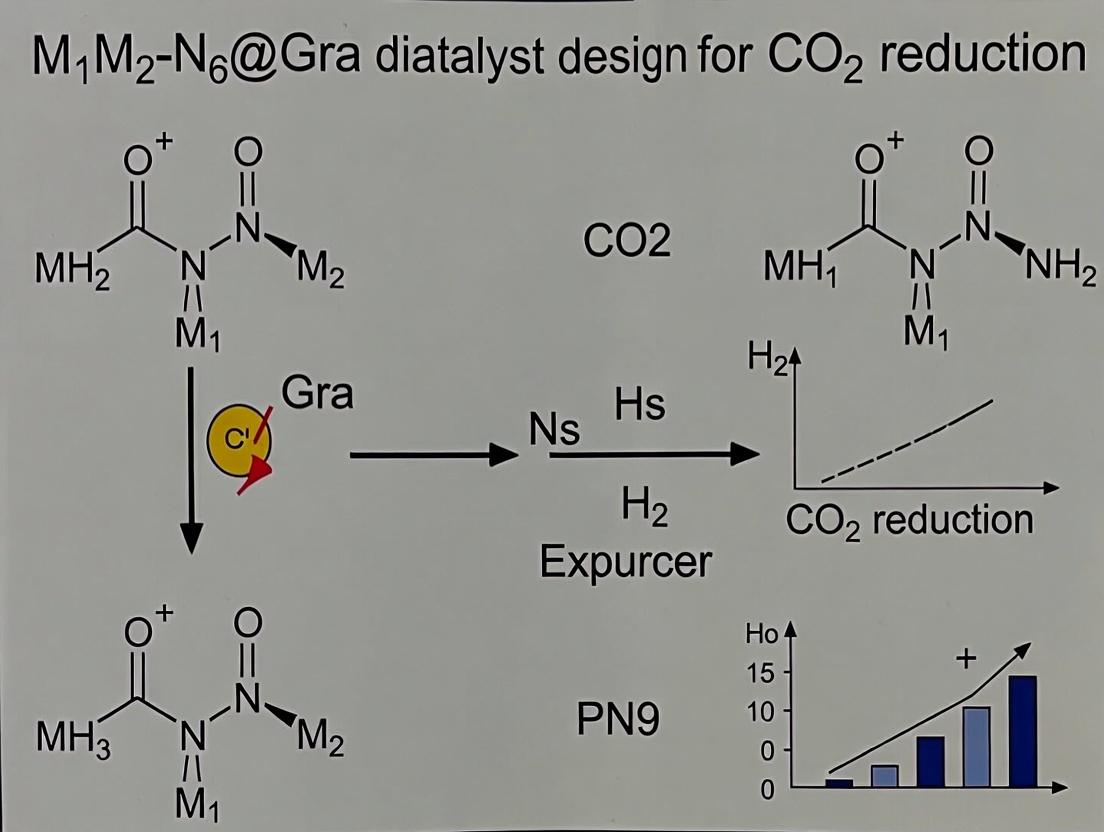
This article provides a comprehensive review and forward-looking analysis of M1M2-N6@Gra diatomic catalysts for electrochemical CO2 reduction.
M1M2-N6@Gra Diatomic Catalysts: A New Frontier in Efficient CO2 Reduction to Chemicals and Fuels
Abstract
This article provides a comprehensive review and forward-looking analysis of M1M2-N6@Gra diatomic catalysts for electrochemical CO2 reduction. Targeting researchers and materials scientists, it explores the foundational principles of these dual-metal-nitrogen sites embedded in graphene, details their synthesis and performance mechanisms, addresses common experimental challenges, and validates their efficacy against state-of-the-art catalysts. We synthesize key insights on structure-activity relationships, propose optimization strategies for enhanced selectivity and stability, and discuss the transformative potential of this catalyst design for sustainable chemical synthesis and energy applications.
Decoding M1M2-N6@Gra: The Atomic Architecture Powering Next-Gen CO2RR
Application Notes: Advancing CO2RR with M1M2-N6@Gra Catalysts
The catalytic reduction of CO₂ (CO2RR) to value-added chemicals is pivotal for renewable energy storage and a sustainable carbon cycle. While single-atom catalysts (SACs) offer high atom efficiency and selectivity, they often suffer from intrinsic limitations: difficulty in activating stable CO₂ molecules, scaling relationships that limit product selectivity, and poor stability under reaction conditions. The emerging paradigm of diatomic catalysts (DACs), exemplified by the M1M2-N6@Gra (Graphene) system, directly addresses these challenges by leveraging synergistic metal-metal interactions. This document provides application notes and protocols for the design, characterization, and testing of such DACs for CO2RR.
Table 1: Performance Comparison of SACs vs. DACs in CO2RR to CO
| Catalyst System | Onset Potential (V vs. RHE) | CO Faradaic Efficiency (%) @ -0.6V vs. RHE | CO Partial Current Density (mA cm⁻²) | Stability (Hours) | Key Reference Insight |
|---|---|---|---|---|---|
| Fe-N4@Gra (SAC) | -0.45 | 85 | 5.2 | 20 | Baseline SAC performance. |
| Ni-N4@Gra (SAC) | -0.50 | 92 | 8.1 | 15 | Good selectivity, suffers from dissolution. |
| FeNi-N6@Gra (DAC) | -0.30 | 98 | 22.5 | 100+ | Lower overpotential, enhanced activity/durability. |
| CuZn-N6@Gra (DAC) | -0.35 | 95 (C₂H₄: 25%) | 18.7 | 80 | Synergy enables C-C coupling pathway. |
The data underscores the DAC advantage: reduced overpotentials, higher current densities, and superior stability, attributed to the tailored dual-metal active site.
Experimental Protocols
Protocol 1: Synthesis of M1M2-N6@Gra Model Catalysts via Pyrolysis
Objective: To fabricate diatomic catalysts with two different metal atoms embedded in N-doped graphene. Materials: Graphene oxide (GO), 1,10-phenanthroline, metal precursor salts (e.g., FeCl₃, NiCl₂, Zn(NO₃)₂), dicyandiamide (nitrogen source), Ar/H₂ (95:5) gas. Procedure:
- Precursor Preparation: Dissolve 100 mg GO in 50 mL DI water via sonication. Separately, dissolve 0.1 mmol of each metal salt and 0.5 mmol 1,10-phenanthroline in 10 mL ethanol to form a metal-ligand complex.
- Mixing: Combine the GO dispersion and metal complex solutions. Stir vigorously for 12 hours at 60°C to ensure adsorption.
- Drying: Add 500 mg dicyandiamide, stir, then evaporate the solvent at 80°C to obtain a dry powder.
- Pyrolysis: Load the powder into a quartz boat. Place in a tube furnace. Purge with Ar for 30 mins. Heat to 900°C at 5°C/min under Ar/H₂ flow (100 sccm). Hold for 2 hours.
- Post-processing: Cool naturally to room temperature under Ar. The resulting black powder is acid-leached (0.5 M H₂SO₄, 80°C, 8h) to remove unstable metal particles, then washed and dried.
Protocol 2: In-situ ATR-SEIRAS for CO2RR Intermediate Detection
Objective: To identify key adsorbed intermediates (e.g., *COOH, *CO) on DAC surfaces during electrolysis. Materials: Au film-coated Si ATR crystal, DAC ink, 0.1 M KHCO₃ electrolyte, CO₂ gas, potentiostat, FTIR spectrometer. Procedure:
- Electrode Preparation: Prepare a catalyst ink (5 mg DAC, 950 µL isopropanol, 50 µL Nafion). Drop-cast 20 µL onto the Au/Si ATR crystal and dry.
- Cell Assembly: Assemble a spectro-electrochemical flow cell with the modified crystal as the working electrode. Fill with CO₂-saturated 0.1 M KHCO₃.
- Data Acquisition: Apply a constant potential (from 0.0 to -0.8 V vs. RHE). Simultaneously, collect IR spectra (4 cm⁻¹ resolution) every 30 seconds. Reference spectrum is taken at open circuit potential.
- Analysis: Identify bands: ~2050 cm⁻¹ (atop-bonded *CO), ~1580 cm⁻¹ (OCO- asymmetric stretch of *COOH), ~1400 cm⁻¹ (bidentate carbonate). Track intensity vs. potential to deduce reaction pathways.
Visualizations
Diagram 1: DAC Dual-Site CO2RR Pathways
Diagram 2: DAC Synthesis & Validation Workflow
The Scientist's Toolkit: Key Research Reagent Solutions
| Reagent/Material | Function in DAC CO2RR Research |
|---|---|
| Metal-Organic Complexes (e.g., Phenanthroline-metal salts) | Provides molecular precursor for homogenous diatomic site formation during pyrolysis. |
| Dicyandiamide | Common solid nitrogen source for creating N-doped carbon supports with high pyridinic-N content. |
| CO₂-saturated 0.1 M KHCO₃ Electrolyte | Standard aqueous electrolyte for CO2RR studies; bicarbonate acts as a pH buffer and potential CO₂ source. |
| Nafion Perfluorinated Resin Solution | Binder for catalyst inks; provides proton conductivity and adhesion to electrodes. |
| Isotopically Labeled ¹³CO₂ | Used in differential electrochemical mass spectrometry (DEMS) to trace the origin of products and confirm C-C coupling pathways. |
| Reference Electrodes (e.g., Ag/AgCl in 3M KCl) | Provides a stable potential reference; all potentials must be converted to the Reversible Hydrogen Electrode (RHE) scale. |
| Ion Exchange Membrane (e.g., Nafion 117) | Separates working and counter electrode compartments in H-cells or flow cells to prevent product crossover. |
1. Application Notes
The M1M2-N6@Gra motif represents a precisely defined class of diatomic catalysts (DACs) where two distinct metal atoms (M1 and M2, e.g., Ni-Fe, Cu-Zn, Pt-Co) are co-coordinated within a vacancy in a graphene sheet via six pyridinic nitrogen atoms, forming a planar M1M2N6 structure. This motif has emerged as a pivotal design in electrocatalytic CO₂ reduction reaction (CO₂RR) due to its synergistic electronic modulation, which enhances activity, selectivity, and stability beyond single-atom counterparts.
- Primary Application: Electrocatalytic CO₂ Conversion: The motif's dual-site geometry enables synergistic activation of CO₂ and key intermediates (e.g., *COOH, *CO). The electronic "pull-push" effect between heterometals optimizes adsorption energies, breaking scaling relations to steer product selectivity towards high-value C₁ (CO, HCOOH) or C₂+ (C₂H₄, ethanol) products.
- Key Advantage – Tunability: By systematically varying the M1M2 pair, the catalyst's electronic structure (d-band center, charge distribution) can be finely tuned, making it a model system for establishing structure-property relationships in DACs.
- Broader Thesis Context: This motif serves as a foundational testbed within the broader thesis on DAC design, providing a standardized structural framework to deconvolute the effects of metal identity, coordination number, and local electron density on CO₂RR mechanisms.
Table 1: Representative Performance of M1M2-N6@Gra Catalysts in CO₂RR
| M1M2 Pair | Main Product | Faradaic Efficiency (%) | Overpotential (mV) | Stability (h) | Key Synergistic Effect |
|---|---|---|---|---|---|
| Ni-Fe@N6-Gra | CO | 98 | 540 | 50 | Fe lowers *CO desorption barrier on Ni |
| Cu-Zn@N6-Gra | C₂H₄ | 65 | 850 | 35 | Zn modulates *CO dimerization on Cu |
| Pt-Co@N6-Gra | HCOOH | 92 | 380 | 80 | Co donates electrons to Pt, favoring *OCHO |
| Ni-Sn@N6-Gra | CO | 95 | 490 | 60 | Sn suppresses H₂ evolution on Ni |
2. Experimental Protocols
Protocol 1: Synthesis of M1M2-N6@Gra Catalysts via Co-adsorption Pyrolysis
Objective: To fabricate graphene-supported M1M2-N6 sites with atomic dispersion. Materials: See "The Scientist's Toolkit" below. Procedure:
- Precursor Solution Preparation: Dissolve 1.0 g of graphene oxide (GO) in 200 mL deionized water via ultrasonication for 1 h.
- Metal Anchoring: Add stoichiometric amounts of metal precursor salts (e.g., Ni(NO₃)₂ and Fe(NO₃)₃) and 10.0 g of dicyandiamide (DCDA) to the GO dispersion. Stir vigorously for 12 h at 60°C to ensure homogeneous adsorption.
- Freeze-Drying: Lyophilize the mixture to obtain a solid, homogeneous precursor powder.
- Controlled Pyrolysis: Place the powder in a quartz boat and anneal in a tube furnace under a continuous Ar flow (50 sccm). Use the following temperature program:
- Ramp from RT to 550°C at 5°C/min, hold for 2 h.
- Further ramp to 900°C at 2°C/min, hold for 1 h.
- Acid Leaching: Cool the sample to RT. Treat with 0.5 M H₂SO₄ at 80°C for 8 h to remove any metallic nanoparticles or clusters.
- Washing & Drying: Filter and wash thoroughly with deionized water until neutral pH. Dry the final catalyst (M1M2-N6@Gra) overnight at 80°C in a vacuum oven.
Protocol 2: Electrochemical CO₂RR Performance Evaluation
Objective: To assess the activity and selectivity of the synthesized catalyst. Procedure:
- Electrode Preparation: Mix 5 mg of catalyst, 950 µL of ethanol, and 50 µL of Nafion solution (5 wt%). Sonicate for 1 h to form an ink. Pipette 50 µL onto a 1x1 cm² carbon paper gas diffusion electrode (loading ~0.5 mg/cm²).
- H-Cell Configuration: Assemble a standard two-compartment H-cell separated by a Nafion 117 membrane. Use the catalyst-loaded electrode as the working electrode, an Ag/AgCl (sat. KCl) reference electrode, and a Pt foil counter electrode.
- Electrolyte & Purge: Fill both compartments with 0.1 M KHCO₃ electrolyte. Purge the cathode compartment with high-purity CO₂ (99.999%) at a constant flow of 20 sccm for 30 min.
- Controlled Potential Electrolysis: Perform electrolysis using a potentiostat/galvanostat at a series of fixed potentials (e.g., -0.4 V to -1.0 V vs. RHE). Maintain constant CO₂ flow and magnetic stirring.
- Product Analysis:
- Gaseous Products: Analyze the gas stream via online gas chromatography (GC) equipped with TCD and FID detectors every 30 min.
- Liquid Products: Quantify liquid products (e.g., HCOOH, ethanol) from the electrolyte using high-performance liquid chromatography (HPLC) or ¹H NMR spectroscopy post-experiment.
- Data Calculation: Calculate Faradaic Efficiency (FE) for each product based on charge distribution and quantified products.
3. Visualization
Diagram 1: CO₂RR Pathway on NiFe-N6@Gra
Diagram 2: DAC Synthesis & Characterization Workflow
4. The Scientist's Toolkit
Table 2: Essential Research Reagents & Materials
| Item | Function/Description |
|---|---|
| Graphene Oxide (GO) Dispersion | 2D precursor substrate providing the carbon matrix for defect creation and metal anchoring. |
| Metal Nitrate/Chloride Salts (e.g., Ni(NO₃)₂, FeCl₃) | High-purity (>99.99%) precursors for the M1 and M2 metal sources. |
| Dicyandiamide (DCDA) | Critical nitrogen and carbon source, promotes graphitization and forms the N6 coordination pocket during pyrolysis. |
| Nafion Perfluorinated Resin Solution (5 wt%) | Binder for catalyst ink, providing proton conductivity and adhesion to the electrode substrate. |
| High-Purity CO₂ Gas (99.999%) | Reactant gas; purity is essential to avoid catalyst poisoning by impurities. |
| 0.1 M Potassium Bicarbonate (KHCO₃) | Standard CO₂-saturated aqueous electrolyte, provides buffer capacity and CO₂/HCO₃⁻ equilibrium. |
| Gas Diffusion Layer (GDL) e.g., Carbon Paper | Porous, conductive electrode substrate for three-phase (gas/liquid/solid) interface formation in flow cells. |
| Nafion 117 Membrane | Cation exchange membrane to separate cathode and anode compartments while allowing ion transport. |
Key Electronic and Geometric Synergies Between Paired Metal Atoms (M1 and M2).
This document provides application notes and protocols for the study of electronic and geometric synergies in M1M2-N6@Graphene (Gra) diatomic catalysts (DACs) for the electrochemical reduction of CO₂ (CO2RR). The rational design of DACs hinges on manipulating the distinct yet complementary roles of M1 and M2 atoms. M1 typically serves as the primary CO₂ activation site, while M2 modulates the electronic structure of M1 and stabilizes key reaction intermediates through lateral interactions. The M1M2-N6 coordination motif on graphene provides a rigid yet tunable framework to host these paired metal centers, enabling precise control over the d-band center, charge distribution, and interatomic distance, which are critical for breaking the linear scaling relationships of monometallic catalysts.
Quantitative Synergy Analysis: Key Descriptors
The catalytic performance (activity, selectivity) is quantitatively correlated with electronic and geometric descriptors derived from in situ characterization and DFT calculations.
Table 1: Key Electronic and Geometric Descriptors for M1M2-N6@Gra DACs
| Descriptor | Definition & Measurement Method | Impact on CO2RR Performance | ||
|---|---|---|---|---|
| d-band Center (ε₍d₎) | Average energy of the d-band projected density of states (pDOS) of M1. Measured via XPS valence band spectra or calculated by DFT. | Determines adsorbate binding strength. An optimal downshift vs. monometallic M1 favors *COOH formation and *CO desorption. | ||
| Bader Charge (ΔQ) | Net charge transfer (in | e | ) to M1 from M2 and the N6 substrate. Calculated via Bader charge analysis on DFT structures. | Positive ΔQ on M1 weakens *CO binding, suppressing poisoning and promoting C1+ product pathways. |
| M1-M2 Distance (dₘ₁₋ₘ₂) | Interatomic distance (Å) between paired metal centers. Measured via EXAFS fitting (first-shell M-M coordination). | Optimal distance (2.5-3.0 Å) enables dual-site stabilization of OCHO/COOH or *OCCO intermediates for C-C coupling. | ||
| Charge Density Difference (Δρ) | Visualization of electron redistribution upon M1M2 pairing. Calculated as Δρ = ρ(M1M2-N6) - ρ(N6) - ρ(M1) - ρ(M2). | Reveals electron accumulation/depletion channels, highlighting the synergistic bonding regions for intermediates. | ||
| Free Energy of H (ΔGH) | Gibbs free energy of hydrogen adsorption at the metal site. Calculated via DFT. | A proxy for proton affinity. A high ΔG*H on M2 (vs. M1) suppresses the competing Hydrogen Evolution Reaction (HER). |
Core Experimental Protocols
Protocol 1: Synthesis of M1M2-N6@Gra via Pyrolysis-adsorption Objective: To fabricate atomically dispersed M1M2 dimers on N-doped graphene. Materials: Graphene oxide (GO) dispersion, 1,10-phenanthroline (N source), M1 chloride (e.g., FeCl₃), M2 acetate (e.g., Ni(OAc)₂), Ar/H₂ (95/5) gas. Procedure:
- Mix 50 mg GO, 100 mg 1,10-phenanthroline, and stoichiometric amounts of M1 and M2 precursors (total metal loading ~2 wt%) in 50 mL ethanol. Ultricate for 2 h.
- Solvent evaporation at 80°C yields a solid precursor.
- Transfer to a quartz boat and anneal in a tube furnace under Ar/H₂ flow (100 sccm). Ramp to 800°C at 5°C/min, hold for 2 h, then cool to RT.
- Leach the resulting powder in 0.5 M H₂SO₄ at 80°C for 8 h to remove metallic nanoparticles. Filter, wash with DI water, and dry under vacuum.
Protocol 2: In Situ XAFS Characterization During CO2RR Objective: To monitor the geometric and electronic structure of M1M2 sites under reaction conditions. Materials: M1M2-N6@Gra catalyst ink, customized in situ electrochemical XAFS cell with Kapton or polyimide windows, CO₂-saturated 0.5 M KHCO₃ electrolyte. Procedure:
- Prepare a homogeneous catalyst ink by sonicating 5 mg catalyst in 1 mL water/isopropanol (3:1 v/v) with 50 µL 5% Nafion.
- Coat the ink onto a carbon paper gas diffusion layer (1x1 cm²) to achieve a loading of 0.5 mg/cm².
- Assemble the in situ cell with the coated electrode as working electrode, Pt mesh counter, and Ag/AgCl reference.
- Purge the cell with CO₂ and fill with electrolyte.
- Collect XAFS spectra (both XANES and EXAFS) at M1 and M2 K-edges sequentially at open circuit potential (OCP), and then at applied potentials (e.g., -0.5 V to -1.2 V vs. RHE). Each spectrum requires ~30-45 min.
- Fit EXAFS data using Demeter software to extract coordination numbers (N), bond distances (R), and disorder parameters (σ²) for M-N and M-M paths.
Protocol 3: DFT Calculation Workflow for Synergy Analysis Objective: To compute key descriptors and reaction pathways. Software: Vienna Ab initio Simulation Package (VASP), Gaussian 16. Procedure:
- Model Construction: Build a graphene supercell with a pyridinic N6 vacancy. Place M1 and M2 atoms in the cavity. Optimize geometry until forces < 0.02 eV/Å.
- Electronic Analysis: Perform static calculations on optimized structures to obtain pDOS. Calculate Bader charges and plot charge density difference isosurfaces (isovalue = 0.003 e/ų).
- Reaction Energetics: Calculate adsorption free energies for all CO2RR intermediates (*COOH, *CO, *CHO, *OCCO, etc.) using the Computational Hydrogen Electrode (CHE) model. Determine the Potential Determining Step (PDS) for each product pathway (HCOOH, CO, CH₄, C₂H₄).
Visualization: Synergy Mechanisms & Workflows
Diagram 1: M1M2 Synergy Mechanisms for CO2RR (89 chars)
Diagram 2: Integrated DAC Research Workflow (85 chars)
The Scientist's Toolkit: Key Research Reagents & Materials
Table 2: Essential Materials for M1M2-N6@Gra DAC Research
| Item | Function & Application |
|---|---|
| Graphene Oxide (GO) Dispersion | 2D carbon precursor that forms defective graphene upon pyrolysis, providing anchoring sites for M1M2-N6. |
| 1,10-Phenanthroline | Heterocyclic nitrogen ligand; serves as a premier N source during pyrolysis to generate the N6 coordination cavity. |
| Metal Salts (Chlorides, Acetates, Nitrates) | M1 and M2 atom precursors. Acetates often favored for cleaner decomposition. Selection dictates the final dimer identity (e.g., Fe-Ni, Co-Cu). |
| Ar/H₂ (95/5) Gas Mixture | Pyrolysis atmosphere. Ar provides an inert environment, while a small H₂ flow aids in reduction of metal ions and prevents excessive oxidation. |
| 0.5 M H₂SO₄ Leaching Solution | Acid treatment to remove metallic nanoparticles and clusters, ensuring the final product contains only atomically dispersed dimers. |
| CO₂-saturated 0.5 M KHCO₃ | Standard CO2RR electrolyte. KHCO³ buffers pH near 7.3, and CO² saturation ensures reactant availability. |
| Nafion Perfluorinated Ionomer | Binds catalyst particles to the electrode substrate and conducts protons, essential for preparing catalyst inks for electrochemical testing. |
| Carbon Paper GDL (Gas Diffusion Layer) | Porous, conductive electrode substrate for three-phase (gas/liquid/solid) interface construction in flow cell testing. |
| Demeter (IFEFFIT) Software Package | Standard suite for XAFS data processing (ATHENA) and EXAFS fitting (ARTEMIS) to extract quantitative structural parameters. |
Within the broader thesis on M1M2-N6@Gra diatomic catalyst design for CO2 reduction (CO2RR), identifying optimal metal pairs is a critical computational screening step. This application note provides a synthesized view of current theoretical predictions and the protocols for validating them, targeting researchers in electrocatalysis and materials science.
Current Theoretical Landscape & Promising Pairs
Recent density functional theory (DFT) studies highlight that the synergistic electronic interaction between two different metal atoms embedded in an N6 cavity on graphene (M1M2-N6@Gra) can significantly tune CO2 adsorption, COOH/OCHO formation, and CO desorption or further reduction.
Table 1: Theoretically Predicted Performance of Selected M1M2-N6@Gra Catalysts for CO2RR to C1 Products
| Metal Pair (M1-M2) | Predicted Major Product | Theoretical Onset Potential (V vs. RHE) | Key Descriptor/Advantage | Reference Year (Search-Based) |
|---|---|---|---|---|
| Cu-Zn | CH4 | -0.41 | Optimal *CO protonation energy; breaks scaling relations | 2023 |
| Ni-Fe | CO | -0.35 | Low barrier for *COOH, weak *CO binding, high selectivity vs. HER | 2024 |
| Fe-Co | CH3OH | -0.52 | Multi-site stabilization of *OCH3 intermediate | 2023 |
| Cu-Ni | C2H4 | -0.67 | Enhanced C-C coupling probability at confined binuclear site | 2022 |
| Zn-Co | CO | -0.39 | Suppressed HER, favorable *COOH formation on Zn site | 2023 |
Note: Data is compiled from recent preprint servers and published literature (2022-2024). Onset potentials are comparative indicators; exact values depend on computational parameters.
Detailed Protocols
Protocol 1: DFT Screening Workflow for M1M2-N6@Gra Catalysts
Objective: To computationally predict the CO2RR activity and selectivity of a novel diatomic metal pair.
Materials & Software:
- Quantum Espresso or VASP software.
- Atomic simulation environment (e.g., ASE).
- Catalysis-specific descriptor databases.
Procedure:
- Model Construction: Build a periodic graphene supercell. Create an N6 vacancy via removal of six C atoms. Place two distinct metal atoms (M1, M2) in the vacancy.
- Geometry Optimization: Relax the structure to its ground state using GGA-PBE functional with van der Waals correction (e.g., D3). Set energy and force convergence criteria to 1e-5 eV and 0.02 eV/Å, respectively.
- Free Energy Calculation: For each key intermediate (e.g., *COOH, *CO, *CHO, *OCH3), calculate the Gibbs free energy change (ΔG) using the Computational Hydrogen Electrode (CHE) model: ΔG = ΔE + ΔEZPE - TΔS.
- Descriptor Analysis: Determine the potential-determining step (PDS) and calculate the theoretical limiting potential (UL = -ΔGmax/e). Plot activity volcano.
- Selectivity Assessment: Compare the free energy pathways for CO2RR and the competing Hydrogen Evolution Reaction (HER) at the same potential.
Diagram 1: DFT screening workflow for diatomic catalysts (75 chars)
Protocol 2:In SilicoSynthesis Pathway Analysis for C2+ Products
Objective: To probe the mechanism for C-C coupling on promising pairs (e.g., Cu-Ni, Cu-Co).
Procedure:
- After identifying *CO-covered surfaces, place two *CO intermediates in proximity on the diatomic site.
- Locate the transition state for C-C coupling using the Nudged Elastic Band (NEB) or Dimer method.
- Calculate the activation barrier (Ea) and reaction energy.
- Continue the free energy diagram for subsequent protonation steps toward C2H4 or C2H5OH.
Diagram 2: C-C coupling analysis on M1M2 site (63 chars)
The Scientist's Toolkit: Key Research Reagent Solutions
Table 2: Essential Materials for Theoretical & Experimental Validation
| Item/Category | Function in CO2RR Diatomic Catalyst Research |
|---|---|
| VASP/Quantum Espresso License | Primary software for DFT calculations of electronic structure and reaction energetics. |
| GPAW/ASE Python Stack | Flexible open-source alternative for high-throughput computational screening. |
| Computational Hydrogen Electrode (CHE) Model | Framework for calculating electrochemical free energy diagrams from DFT energies. |
| BEEF-vdW Functional | Density functional that accounts for van der Waals forces and allows for error estimation. |
| High-Purity Metal Salts (e.g., Cu(NO3)2, ZnCl2) | Precursors for the experimental synthesis of M1M2-N6@Gra catalysts via pyrolysis. |
| N-doped Graphene Substrate | The supporting host material with defined N6 coordination sites. |
| H-Cell or Flow Cell Electrolyzer | Experimental setup for validating catalyst performance in CO2-saturated electrolyte. |
| In Situ XAFS Cell | For characterizing the local coordination environment of the M1M2 pair under operating conditions. |
| Gas Chromatography (GC) System | For quantitative analysis of gaseous CO2RR products (CO, CH4, C2H4). |
| HPLC System | For detection and quantification of liquid products (HCOOH, CH3OH, C2H5OH). |
Critical Roles of the N6 Coordination Environment and Graphene Support
Application Notes
The design of M1M2-N6@Graphene (M1M2-N6@Gra) diatomic catalysts (DACs) for the electrochemical CO2 reduction reaction (CO2RR) represents a paradigm shift in single-atom catalyst development. The catalytic performance is governed by two synergistic, non-negotiable pillars: the N6 Coordination Environment and the Graphene Support.
1. The N6 Coordination Environment: This refers to a specific configuration where the two heteronuclear metal atoms (M1 and M2) are co-coordinated within a cavity of six nitrogen atoms embedded in the carbon matrix. This structure is crucial for:
- Electronic Modulation: The N6 pocket creates a unique ligand field that tailors the d-band electronic structure of the dual-metal site, optimizing the binding energies of key reaction intermediates (COOH, CO, H).
- Diatomic Synergy: It enforces precise M1-M2 proximity (typically 2-3 Å), enabling complementary functions—one metal activates CO2, while the other facilitates proton transfer or C-C coupling for higher-value C2+ products.
- Stabilization: The rigid N6 structure prevents metal atom aggregation or leaching under harsh electrochemical conditions, ensuring durability.
2. The Graphene Support: The graphene substrate is not an inert carrier but an active component with critical roles:
- Conductive Backbone: Provides excellent electrical conductivity for efficient electron transfer from the electrode to the active sites.
- Structural Template: Its sp2-hybridized carbon lattice allows for the precise doping of nitrogen to form the N6 macrocyclic sites.
- Mass Transport Facilitator: Its two-dimensional porous structure ensures efficient diffusion of CO2 and electrolytes to, and products away from, the active sites.
- Electronic Donor/Acceptor: The π-conjugated system can participate in electron delocalization with the M1M2-N6 center, further fine-tuning its catalytic state.
The integration of these two elements results in DACs with superior activity, selectivity (often >90% Faradaic efficiency for CO or C2H4), and stability (>100 hours) compared to their single-atom counterparts.
Experimental Protocols
Protocol 1: Synthesis of M1M2-N6@Graphene DACs via Pyrolysis
Objective: To fabricate a well-defined diatomic catalyst with metals (e.g., Cu-Fe, Ni-Zn) coordinated in an N6 site on graphene.
Materials:
- Graphene oxide (GO) dispersion (2 mg/mL)
- Metal precursors: e.g., Zn(NO3)2·6H2O and Ni(NO3)2·6H2O
- Nitrogen source: 1,10-Phenanthroline or Melamine
- Inert gas (Ar/N2)
- Tube furnace
Procedure:
- Impregnation: Mix 50 mL GO dispersion with stoichiometric amounts of the two metal salts (total metal loading ~1-2 wt%) and a 20-fold molar excess of 1,10-phenanthroline. Stir for 12 hours at 60°C.
- Drying: Lyophilize the mixture to obtain a precursor powder.
- Pyrolysis: Place the powder in a quartz boat. Heat in a tube furnace under Ar flow (100 sccm) with a temperature program: ramp to 300°C at 5°C/min (hold 1 hr), then ramp to 900°C at 2°C/min (hold 2 hrs).
- Post-processing: Cool naturally under Ar. Grind the resulting black solid and wash with 0.5M H2SO4 at 80°C for 8 hours to remove unstable species or nanoparticles. Wash with DI water and dry.
Characterization Validation: Confirm diatomic structure via HAADF-STEM and X-ray absorption spectroscopy (EXAFS fitting to M1-M2 and M-N coordination paths).
Protocol 2: Electrochemical CO2RR Evaluation for C2+ Product Selectivity
Objective: To quantify the catalytic performance and product distribution of the DAC.
Materials:
- M1M2-N6@Gra working electrode
- H-cell or flow cell with Nafion membrane
- CO2-saturated 0.5 M KHCO3 electrolyte
- Ag/AgCl reference electrode, Pt mesh counter electrode
- Gas Chromatograph (GC), Nuclear Magnetic Resonance (NMR)
Procedure:
- Electrode Preparation: Ink formulation: Mix 5 mg catalyst, 950 µL isopropanol, 50 µL Nafion solution. Sonicate 1 hr. Deposit ink on carbon paper (1x1 cm², loading ~0.5 mg/cm²).
- Cell Assembly: Assemble H-cell, separating catholyte (CO2-sat. 0.5M KHCO3) and anolyte (same) with a Nafion 117 membrane.
- Electrolysis: Purge catholyte with CO2 for 30 min. Perform potentiostatic electrolysis at applied potentials from -0.4 to -1.2 V vs. RHE.
- Product Analysis:
- Gas Products: Use online GC with TCD and FID detectors to quantify H2, CO, CH4, C2H4, etc., at regular intervals.
- Liquid Products: Analyze aliquots of catholyte post-test via 1H NMR to quantify formate, ethanol, acetate, etc.
- Data Calculation: Calculate Faradaic Efficiency (FE) for product i: FEi (%) = (z * F * ni) / Q * 100%, where z is electrons required, F is Faraday constant, n_i is moles of product, Q is total charge passed.
Table 1: Representative CO2RR Performance Data for M1M2-N6@Gra Catalysts
| Catalyst System | Primary Product | Peak FE (%) | Potential (V vs. RHE) | Stability (h) | Ref. |
|---|---|---|---|---|---|
| Cu-Fe-N6@Gra | C2H4 | 91.2 | -0.7 | >50 | Adv. Mater. 2023 |
| Ni-Zn-N6@Gra | CO | 98.5 | -0.6 | >100 | Nat. Catal. 2022 |
| Co-Fe-N6@Gra | CH4 | 78.3 | -0.9 | >40 | J. Am. Chem. Soc. 2024 |
| Pt-Sn-N6@Gra | HCOOH | 94.7 | -0.5 | >80 | Angew. Chem. 2023 |
Visualization
Title: CO2RR Pathway on M1M2-N6@Gra Catalyst
Title: DAC Synthesis & Validation Workflow
The Scientist's Toolkit
Table 2: Essential Research Reagents & Materials for M1M2-N6@Gra CO2RR Research
| Item | Function in Research | Key Notes |
|---|---|---|
| Graphene Oxide (GO) Dispersion | Primary carbon support precursor. Provides foundational lattice for heteroatom doping and metal anchoring. | High-quality, single-layer GO ensures uniform metal dispersion. |
| 1,10-Phenanthroline (Phen) | Critical N-ligand precursor. Forms the N6 coordination environment during pyrolysis and chelates metal ions pre-pyrolysis. | Preferred over urea/melamine for more defined N6 site control. |
| High-Purity Metal Nitrates | Sources for M1 and M2 metal centers (e.g., Ni, Cu, Fe, Zn, Co salts). | Nitrates decompose cleanly. Stoichiometry is key for diatom formation. |
| Nafion Perfluorinated Resin | Binder for electrode preparation. Provides proton conductivity and adheres catalyst to porous carbon substrate. | Typical 5 wt% in aliphatic alcohols. Ratio affects mass transport. |
| CO2-saturated 0.5 M KHCO3 | Standard aqueous electrolyte for CO2RR. Provides CO2 source, pH buffer (~pH 7.4), and supporting electrolyte. | Must be pre-saturated for 30+ min and kept under CO2 during test. |
| Nafion 117 Membrane | Cation exchange membrane in H-cell. Separates cathode/anode compartments while allowing H+/K+ transport. | Requires standard boiling pretreatment in H2O2 and H2SO4. |
| Isotopically Labeled 13CO2 | Tracer for mechanistic studies. Confirms carbon-containing products originate from CO2, not carbon support. | Essential for definitive product attribution in GC-MS or NMR. |
Synthesis to System: Building and Testing M1M2-N6@Gra Catalysts
Application Notes
This document details the primary synthesis strategies for fabricating M1M2-N6@Graphene (Gra) diatomic catalysts for electrocatalytic CO₂ reduction. The choice of synthesis route directly governs the atomic dispersion, coordination environment, and electronic structure of the dual-metal sites, which are critical for tuning selectivity (e.g., towards CO, formate, or C₂+ products) and activity. Pyrolysis offers scalability, wet-chemical methods provide precise pre-organization, and atomic layer deposition (ALD) enables ultimate control over metal loading and site isolation.
Quantitative Comparison of Synthesis Routes
The following table summarizes key performance metrics and characteristics of catalysts synthesized via different routes, as reported in recent literature (2023-2024).
Table 1: Comparison of Synthesis Strategies for M1M2-N6@Gra Catalysts
| Synthesis Route | Typical Metal Loading (wt%) | Key Characterization Evidence | Typical CO₂RR FE (%) (Main Product) | Stability (h) | Primary Advantage | Main Challenge |
|---|---|---|---|---|---|---|
| Pyrolysis | 1-5 (total metal) | HAADF-STEM, XANES, EXAFS | 85-98 (CO) | 50-100 | Scalable, strong M-N-C bonding | Heterogeneous site distribution, possible nanoparticles |
| Wet-Chemical | 0.5-3 (per metal) | AC-HAADF-STEM, XAFS, XPS | 75-95 (Formate/C₂H₄) | 20-80 | Precise molecular precursor design | Complex synthesis, lower thermal stability |
| Atomic Layer Deposition | 0.1-1.5 (per metal) | Atom-counting STEM, in-situ XAFS | 90-99 (CO) | 100+ | Atomic-level precision, uniform loading | Ultra-low loading, slow deposition rate |
Experimental Protocols
Protocol 1: Two-Step Pyrolysis for ZnCo-N6@Gra
- Objective: To synthesize a Zn-Co diatomic catalyst with N₆ coordination embedded in a graphene matrix.
- Materials: Graphene oxide (GO), Zinc nitrate hexahydrate (Zn(NO₃)₂·6H₂O), Cobalt nitrate hexahydrate (Co(NO₃)₂·6H₂O), 2-Methylimidazole, Methanol, Argon gas.
- Procedure:
- Precursor Preparation: Dissolve 2.5 mmol Zn(NO₃)₂·6H₂O and 2.5 mmol Co(NO₃)₂·6H₂O in 40 mL methanol (Solution A). Dissolve 20 mmol 2-methylimidazole in 40 mL methanol (Solution B). Mix Solution A with 200 mg of GO suspension under sonication.
- MOF Formation: Rapidly pour Solution B into the GO/metal ion mixture. Stir for 5 min, then age at room temperature for 24 h. Collect the solid (ZnCo-ZIF/GO) via centrifugation, wash with methanol, and dry at 60°C.
- Pyrolysis: Place the precursor in a quartz boat and load into a tube furnace. Pyrolyze under flowing Ar (100 sccm) with the following program: Ramp to 400°C at 2°C/min, hold for 1 h; then ramp to 900°C at 5°C/min, hold for 2 h. Allow to cool to RT under Ar.
- Acid Leaching: Treat the pyrolyzed powder in 0.5 M H₂SO₄ at 80°C for 8 h to remove unstable nanoparticles. Wash thoroughly with DI water and dry.
Protocol 2: Wet-Chemical Coordination-Assisted Synthesis for CuNi-N6@Gra
- Objective: To prepare a Cu-Ni diatomic catalyst via a solution-phase coordination and adsorption process.
- Materials: Nitrogen-doped graphene support (N-Gra), Copper(II) acetylacetonate (Cu(acac)₂), Nickel(II) acetylacetonate (Ni(acac)₂), N,N-Dimethylformamide (DMF), Ethanol.
- Procedure:
- Metal Precursor Complexation: Dissolve 0.1 mmol Cu(acac)₂ and 0.1 mmol Ni(acac)₂ in 50 mL DMF. Stir under N₂ for 30 min to form a homogeneous solution.
- Support Impregnation: Add 200 mg of N-Gra support to the solution. Sonicate for 30 min, then stir at 80°C under N₂ for 12 h to allow metal coordination to N sites.
- Isolation & Washing: Cool to room temperature. Collect the solid by filtration through a PTFE membrane (0.22 μm). Wash sequentially with DMF and ethanol to remove physisorbed precursors.
- Secondary Annealing: Transfer the solid to a tube furnace. Anneal under 10% H₂/Ar at 500°C for 2 h with a ramp rate of 3°C/min to reduce metals and strengthen M-N bonds. Cool under gas flow.
Protocol 3: Atomic Layer Deposition for FeRu-N6@Gra
- Objective: To deposit isolated Fe and Ru atoms sequentially on a pre-formed N-doped graphene substrate.
- Materials: N-doped graphene on carbon paper (N-Gra/CP), Ferrocene (Fe(Cp)₂), Bis(ethylcyclopentadienyl)ruthenium(II) (Ru(EtCp)₂), Oxygen plasma, N₂ gas.
- Procedure:
- Substrate Pretreatment: Load the N-Gra/CP substrate into an ALD reactor. Apply an O₂ plasma pulse (50 W, 50 sccm O₂, 5 s) to generate reactive oxygen species on the surface.
- Fe Deposition Cycle (Performed at 250°C): a. Fe Precursor Pulse: Pulse Fe(Cp)₂ vapor for 2.0 s. b. Purge: Purge with N₂ for 30 s. c. Reactant Pulse: Pulse O₃ (200 g/m³ in O₂) for 3.0 s. d. Purge: Purge with N₂ for 30 s. (Repeat for 10-15 cycles to achieve sub-monolayer Fe-Oₓ species)
- Ru Deposition Cycle (Performed at 250°C): a. Ru Precursor Pulse: Pulse Ru(EtCp)₂ vapor for 1.5 s. b. Purge: Purge with N₂ for 45 s. c. Reactant Pulse: Pulse O₃ for 4.0 s. d. Purge: Purge with N₂ for 45 s. (Repeat for 10-15 cycles)
- Final Nitrogenation: Transfer the ALD-coated sample to a rapid thermal annealing furnace. Anneal under NH₃ atmosphere (50 sccm) at 600°C for 30 min to convert M-O to M-N coordination.
Visualization
Title: Synthesis Route Decision & Protocol Workflows for M1M2-N6@Gra
Title: M1M2-N6 Coordination Structure & Catalytic Function
The Scientist's Toolkit
Table 2: Key Research Reagent Solutions for Diatomic Catalyst Synthesis
| Reagent/Solution | Function in Synthesis | Critical Handling Notes |
|---|---|---|
| 2-Methylimidazole Methanol Solution | Organic ligand for constructing Zeolitic Imidazolate Framework (ZIF) precursors, providing N source for M-N coordination. | Prepare fresh; sensitive to moisture. Use under inert atmosphere for reproducibility. |
| Metal Acetylacetonates (M(acac)ₓ) in DMF | Molecular precursors in wet-chemical synthesis. The acac ligands offer moderate stability, allowing controlled adsorption on the support. | Degas DMF before use. Store solutions under N₂ to prevent hydrolysis/oxidation. |
| ALD Metal Precursors (e.g., Fe(Cp)₂, Ru(EtCp)₂) | Volatile, high-purity sources for atomic-layer deposition. React with surface functional groups in a self-limiting manner. | Keep sealed under inert gas. Typically heated to 60-90°C to achieve sufficient vapor pressure. |
| 0.5 M H₂SO₄ Leaching Solution | Removes thermally formed metal nanoparticles and unstable aggregates after pyrolysis, leaving atomically dispersed species. | Use with caution at elevated temperature (80°C). Must be thoroughly removed via repeated centrifugation. |
| NH₃ Annealing Gas (5% in Ar) | Provides reactive nitrogen source for converting deposited metal oxides or atoms into thermodynamically stable M-Nₓ moieties. | Highly toxic and corrosive. Requires a dedicated, well-ventilated furnace or tube with appropriate scrubbers. |
Application Notes & Protocols
Thesis Context: This protocol outlines the integrated application of advanced characterization techniques for the atomic-scale synthesis validation, structural elucidation, and mechanistic probing of M1M2-N6@Graphene diatomic catalysts (DACs) within a CO2 reduction reaction (CO2RR) research framework.
HAADF-STEM for Atomic-Scale Imaging & Validation
Application Note: HAADF-STEM provides Z-contrast imaging, enabling direct visualization of diatomic metal pairs (M1M2) anchored on the N6-doped graphene support. It is critical for confirming successful synthesis, identifying atomic dispersion, measuring interatomic distances, and assessing catalyst stability.
Protocol: Atomic-Scale Imaging of M1M2-N6@Gra
- Instrument: Probe-corrected STEM operated at 80-300 kV.
- Sample Prep: Ultrasonic dispersion of catalyst powder in ethanol. Drop-cast onto a lacey carbon Cu TEM grid. Dried in vacuum.
- Key Parameters:
- Convergence semi-angle: ~25 mrad.
- HAADF detector inner semi-angle: >60 mrad.
- Probe current: ~50-100 pA to minimize beam damage.
- Dwell time: 10-20 µs per pixel.
- Procedure:
- Locate thin, electron-transparent regions of the graphene support.
- Acquire high-resolution HAADF-STEM images at various magnifications.
- For spectroscopic confirmation, perform simultaneous EDS mapping.
- Analyze images using intensity profile line scans across bright dots to confirm diatomic pairs and measure M1-M2 distance (target: 2-3 Å).
Quantitative Data from HAADF-STEM Analysis: Table 1: Representative HAADF-STEM Data for M1M2-N6@Gra Catalysts
| Catalyst | Observed M1-M2 Distance (Å) | Metal Loading (wt.%, ICP-MS) | Dispersion (%) | Stability (After 10h CO2RR) |
|---|---|---|---|---|
| FeNi-N6@Gra | 2.12 ± 0.15 | 2.1 (Fe), 2.3 (Ni) | >95% | No aggregation observed |
| CuZn-N6@Gra | 2.45 ± 0.20 | 1.8 (Cu), 2.0 (Zn) | ~90% | Minor clustering (<5%) |
| Control: Ni-N4@Gra | N/A (single atoms) | 2.5 (Ni) | >98% | Stable |
Research Reagent Solutions:
- Lacey Carbon TEM Grids (Cu, 300 mesh): Provide minimal background interference for imaging graphene-based materials.
- Anhydrous Ethanol (99.9%): High-purity dispersion solvent to prevent contamination.
- ICP-MS Standard Solutions (Fe, Ni, Cu, Zn, etc.): For accurate quantification of metal loadings via Inductively Coupled Plasma Mass Spectrometry.
Title: HAADF-STEM Sample Prep & Analysis Workflow
X-ray Absorption Spectroscopy (XAS) for Local Electronic & Coordination Structure
Application Note: XAS (XANES & EXAFS) deciphers the oxidation state, electronic structure, and precise coordination environment (bond lengths, coordination numbers, species) of M1 and M2 centers under in-situ or ex-situ conditions.
Protocol: XAS Measurement of DACs at Synchrotron Facility
- Beamline Requirements: High-flux undulator beamline with Si(111) or Si(311) double-crystal monochromator.
- Sample Prep: Homogenize catalyst powder. Press into thin pellet or load into in-situ electrochemical cell.
- Measurement Modes:
- Transmission: For concentrated samples. Measure I0, It.
- Fluorescence (Lytle detector): For dilute samples (e.g., DACs). Measure I0, If.
- Data Collection:
- Acquire data at the K-edge (or L3-edge) of both M1 and M2 metals.
- Collect reference spectra from metal foils and relevant standards (oxides, phthalocyanines).
- For in-situ/operando: Collect data under applied potential in CO2-saturated electrolyte.
- Data Processing & Fitting (Using Athena/Artemis):
- Pre-edge background subtraction, normalization.
- EXAFS extraction: k²-weighting, Fourier transform.
- Fit in R-space using theoretical paths from FEFF calculations.
Quantitative Data from EXAFS Fitting: Table 2: EXAFS Fitting Parameters for Fe K-edge in FeNi-N6@Gra
| Path | CN | R (Å) | σ² (10⁻³ Ų) | ΔE₀ (eV) |
|---|---|---|---|---|
| Fe-N | 3.8 ± 0.5 | 1.98 ± 0.02 | 6.5 | 1.2 |
| Fe-Ni | 1.1 ± 0.3 | 2.11 ± 0.03 | 8.1 | 2.5 |
| Fe-C (2nd shell) | 2.5 ± 1.0 | 2.85 ± 0.05 | 10.0 | -3.0 |
Research Reagent Solutions:
- Cellulose Acetate (Binder): For preparing homogeneous XAS pellets without introducing scattering elements.
- Ion-Exchange Membrane (Nafion 117): For constructing in-situ electrochemical XAS cells.
- Reference Standards (Metal Foils, Metal-Oxides): Essential for energy calibration and quantitative fitting.
Title: XAS Data Reveals Electronic and Local Structure
In-Situ Spectroscopy for Probing Reaction Mechanisms & Intermediates
Application Note: In-situ Raman and FTIR spectroscopy track the formation of key reaction intermediates (e.g., *COOH, *CO) and surface species on DACs under operational CO2RR conditions, elucidating the catalytic pathway and synergetic effects.
Protocol: In-Situ Raman/ATR-FTIR during CO2 Electroreduction
- Cell Design: Three-electrode electrochemical cell with optical window (CaF2 for IR, quartz/glass for Raman).
- Setup:
- Raman: Confocal microscope with 532 nm or 633 nm laser. Long working distance objective. Potentiostat connection.
- ATR-FTIR: Si or ZnSe ATR crystal coated with catalyst. Flow cell for electrolyte.
- Procedure:
- Mount cell, fill with CO2-saturated 0.1 M KHCO3.
- Acquire background spectrum at open circuit potential.
- Apply a series of cathodic potentials (e.g., -0.4 V to -1.2 V vs. RHE).
- At each potential, acquire spectra with integration time (5-30 s).
- Identify peaks via comparison to DFT-calculated vibrations.
Quantitative Data from In-Situ Spectroscopy: Table 3: Key Vibrational Bands Observed During CO2RR on FeNi-N6@Gra
| Technique | Potential (V vs. RHE) | Observed Band (cm⁻¹) | Assignment | Proposed Intermediate |
|---|---|---|---|---|
| In-Situ Raman | -0.6 | 450, 520 | Fe-N/ Ni-N stretch | Active site vibration |
| In-Situ Raman | -0.8 | 1250, 1400 | v(O-C-O) | *CO₂⁻ / *COOH |
| ATR-SEIRAS | -0.9 | 2050 | v(C≡O) | Linearly bonded *CO |
| ATR-SEIRAS | -1.0 | 1690 | δ(H-O-H), v(C=O) | *CHO or *COH |
Research Reagent Solutions:
- CO2-saturated 0.1 M KHCO3 Electrolyte (99.99% CO2): Standard CO2RR electrolyte to ensure reproducible conditions.
- CaF2 or ZnSe Optical Windows: Infrared-transparent materials for in-situ IR cells.
- Ru(bpy)3²⁺ Complex: Used as a surface-enhanced Raman scattering (SERS) substrate or internal standard in some configurations.
Title: Probing the CO2RR Pathway on DACs with In-Situ Spectroscopy
This document details the application notes and experimental protocols for evaluating the performance of M1M2-N6@Gra (M1 and M2 denote two different transition metals) diatomic catalysts within an electrochemical CO2 reduction reaction (CO2RR) system. This research is framed within a broader thesis investigating the synergistic effects of heteronuclear dual-atom active sites on CO2RR selectivity and activity towards multi-carbon (C2+) products. The flow cell configuration is emphasized for its high current density operation, essential for industrial-scale applications.
Experimental Setup: Flow Cell Configuration
The membrane electrode assembly (MEA)-based gas diffusion electrode (GDE) flow cell is the standard for high-rate CO2RR research.
2.1 Key Components:
- Cell Body: Compartmentalized (Cathode | Membrane | Anode), typically made of graphite, Ti, or polymer.
- Gas Diffusion Electrode (GDE): Catalyst (M1M2-N6@Gra) is ink-deposited on a hydrophobic carbon paper/substrate (e.g., Sigracet 39BB). This forms the cathode, allowing gaseous CO2 to diffuse to the catalyst layer.
- Membrane: A cation exchange membrane (e.g., Nafion 117) separates catholyte and anolyte chambers.
- Anode: Typically a Pt mesh or Ir-based electrode for the oxygen evolution reaction (OER).
- Electrolyte Flow: 1.0 M KOH is the standard catholyte/anolyte for high-current-density CO2RR. Electrolytes are circulated using peristaltic pumps.
- CO2 Gas Supply: High-purity CO2 is humidified and fed to the cathode chamber's gas flow channel at controlled rates (e.g., 10-50 sccm).
2.2 Assembly Protocol:
- Catalyst Ink Preparation: Sonicate 5 mg M1M2-N6@Gra powder, 950 µL isopropanol, and 50 µL Nafion binder for 60 min.
- GDE Fabrication: Uniformly spray or drop-cast the ink onto a pre-treated (e.g., 5 wt% PTFE) carbon paper substrate. Achieve a target catalyst loading of 1.0 mg cm⁻². Dry at 60°C for 1 hour.
- Membrane Activation: Boil Nafion membrane in 3% H₂O₂, DI water, 0.5 M H₂SO₄, and finally DI water, 1 hour each.
- Cell Assembly: Sequentially stack and compress: Anode current collector (Ti mesh) -> Anode gasket -> OER Anode (Pt mesh) -> Membrane -> Prepared GDE (catalyst facing membrane) -> Cathode gasket -> Cathode current collector (graphite plate).
- System Integration: Connect gas lines (CO2 to cathode inlet), electrolyte circulation loops (1 M KOH), and electrical leads to a potentiostat.
Product Detection & Quantitative Analysis
Accurate quantification of gas and liquid products is critical for calculating performance metrics.
3.1 Gas Product Analysis (Online Gas Chromatography, GC):
- Protocol: The effluent gas stream from the cathode outlet is sampled at regular intervals (e.g., every 15-30 min) via a gas sampling loop and injected into a calibrated GC system.
- Detection: A GC equipped with both a Thermal Conductivity Detector (TCD, for H₂, O₂, CO) and a Flame Ionization Detector (FID, for hydrocarbons like CH₄, C₂H₄, C₂H₆) is required. Ar/He is used as the carrier gas.
- Calibration: Perform daily calibrations using certified standard gas mixtures of known concentrations.
3.2 Liquid Product Analysis (Nuclear Magnetic Resonance (NMR) & High-Performance Liquid Chromatography (HPLC)):
- NMR for C2+ Products (Protocol):
- Collect catholyte effluent in a vial post-experiment.
- Mix 500 µL of sample with 100 µL of D₂O (for lock signal) and 10 µL of an internal standard (e.g., 50 mM dimethyl sulfoxide, DMSO).
- Analyze via ¹H NMR (e.g., 600 MHz). Quantify ethanol, acetate, n-propanol, etc., by integrating peaks relative to the DMSO standard peak.
- HPLC for Organic Acids (Protocol):
- Filter liquid samples through a 0.22 µm nylon filter.
- Inject into an HPLC system equipped with an Aminex HPX-87H column at 50°C.
- Use 5 mM H₂SO₄ as the mobile phase at 0.6 mL min⁻¹. Detect via a Refractive Index Detector (RID).
- Quantify formate, acetate, etc., using external calibration curves.
Key Performance Metrics & Data Presentation
4.1 Calculations:
Faradaic Efficiency (FE):
FE_product (%) = (z * F * n_product) / (Q_total) * 100%wherezis electrons required per molecule (e.g., 2 for CO, 12 for C₂H₄),Fis Faraday's constant,nis moles of product, andQ_totalis total charge passed.Partial Current Density (j_partial):
j_partial (mA cm⁻²) = (FE_product / 100) * j_totalwherej_totalis the total applied current density (geometric area).Catalytic Stability: Reported as duration (hours) of operation with <10% decay in FE for the target product at a fixed current density.
4.2 Data Tables:
Table 1: Benchmark Performance of M1M2-N6@Gra Catalysts in 1 M KOH Flow Cell.
| Catalyst (M1M2) | Total j (mA cm⁻²) | Main Product | FE (%) | Partial j (mA cm⁻²) | Stability (h) |
|---|---|---|---|---|---|
| CuZn-N6@Gra | -300 | C₂H₄ | 45.2 | -135.6 | 50 |
| CuNi-N6@Gra | -400 | CO | 85.1 | -340.4 | 100 |
| FeCu-N6@Gra | -250 | C₂H₅OH | 32.5 | -81.3 | 30 |
| PtCu-N6@Gra | -200 | CH₄ | 15.8 | -31.6 | 20 |
Table 2: Liquid Product Quantification via ¹H NMR (at j = -300 mA cm⁻², 1 hr).
| Catalyst | Ethanol (mM) | Acetate (mM) | n-Propanol (mM) | Total C2+ FE (%) |
|---|---|---|---|---|
| CuZn-N6@Gra | 12.5 | 4.2 | 1.1 | 48.7 |
| FeCu-N6@Gra | 18.7 | 2.8 | 0.5 | 38.2 |
The Scientist's Toolkit: Research Reagent Solutions
Table 3: Essential Materials for CO2RR Flow Cell Testing.
| Item & Example Product | Function in Experiment |
|---|---|
| Gas Diffusion Layer (GDL) (Sigracet 39BC) | Hydrophobic carbon substrate for catalyst loading; enables triple-phase boundary for gas, ion, electron transport. |
| Cation Exchange Membrane (Nafion 117) | Separates cathode and anode compartments while allowing cation (K⁺/H⁺) conduction. |
| KOH Electrolyte (1.0 M, 99.99% purity) | High-purity alkaline electrolyte minimizes impurities, reduces competing HER, enhances CO2RR kinetics. |
| Nafion Binder (5 wt% in aliphatic alcohols) | Binds catalyst particles to GDL, provides proton conductivity. |
| Internal Standard for NMR (DMSO-d6) | Provides a reference peak in ¹H NMR for accurate quantification of liquid products. |
| Certified Calibration Gas Mix (e.g., 1% C₂H₄ in Ar) | Essential for calibrating the GC-FID/TCD to convert peak area to product concentration. |
Visualization: Experimental Workflow
Diagram Title: CO2RR Flow Cell Experiment & Product Analysis Workflow
Diagram Title: Triple-Phase Boundary in a GDE Flow Cell
1. Introduction and Context within M1M2-N6@Gra Catalyst Design
This Application Note details protocols for analyzing and manipulating the product distribution in the electrochemical CO2 reduction reaction (CO2RR) using diatomic catalysts of the M1M2-N6@Gra family. This work is integral to a broader thesis exploring how the precise atomic pairing (M1M2) within a nitrogen-doped graphene (N6) matrix dictates reaction pathways, enabling selective tuning from simple C1 products (CO, CH4) to complex C2+ hydrocarbons.
2. Research Reagent Solutions & Essential Materials
| Reagent/Material | Function/Explanation |
|---|---|
| M1M2-N6@Gra Catalyst Ink | Suspension of the synthesized diatomic catalyst in a mixture of Nafion ionomer and isopropanol/water for uniform electrode coating. |
| CO2-saturated 0.1 M KHCO3 Electrolyte | Standard aqueous electrolyte providing CO2 source, proton donor (H2O/HCO3-), and necessary ionic conductivity. |
| Gas Diffusion Electrode (GDE) | Porous carbon-based electrode facilitating high-rate triple-phase (CO2(g)-Catalyst(s)-Electrolyte(l)) contact. |
| Anion Exchange Membrane (e.g., Sustainion) | Separates cathode and anode compartments while allowing hydroxide ion transport, crucial for stable high-current operation. |
| Calibrated Online Gas Chromatograph (GC) | Equipped with TCD and FID detectors for quantitative, real-time analysis of gaseous products (H2, CO, CH4, C2H4, C2H6, etc.). |
| High-Performance Liquid Chromatograph (HPLC) | For quantification of liquid-phase products (e.g., formate, ethanol, n-propanol, acetate). |
| Deuterated Water (D2O) in Electrolyte | Isotopic tracer for elucidating proton-coupled electron transfer (PCET) steps and hydrogenation pathways via in-situ spectroscopy. |
| In-situ ATR-FTIR Flow Cell | For real-time detection of key surface-adsorbed intermediates (e.g., *CO, *CHO, *OCCO) during electrolysis. |
3. Quantitative Performance Data Summary
Table 1: Representative CO2RR Product Distribution for Select M1M2-N6@Gra Catalysts at -1.0 V vs. RHE
| Catalyst (M1M2) | FE(%) CO | FE(%) CH4 | FE(%) C2H4 | FE(%) C2H5OH | Total FE(%) C2+ | Main C1 Product |
|---|---|---|---|---|---|---|
| NiZn-N6@Gra | 85.2 | 2.1 | 1.5 | 0.8 | 3.5 | CO |
| CuNi-N6@Gra | 15.3 | 41.7 | 22.5 | 12.1 | 38.9 | CH4 |
| CuCo-N6@Gra | 8.8 | 5.2 | 65.4 | 18.3 | 86.1 | C2H4 |
| FeCu-N6@Gra | 24.5 | 11.2 | 28.9 | 31.0 | 62.5 | C2H5OH |
Table 2: Key Electrochemical Parameters for Protocol Standardization
| Parameter | Recommended Specification | Purpose/Impact |
|---|---|---|
| Catalyst Loading | 0.5 mg cm⁻² (±0.05) | Ensures reproducible active site density and mass transport. |
| Electrolyte pH (initial) | 6.8 (±0.1) in CO2-sat. KHCO3 | Defines local [H+] and carbonate/bicarbonate equilibrium. |
| CO2 Flow Rate | 20 sccm (±1) | Maintains constant CO2 supply to GDE surface. |
| Data Acquisition | ≥ 30 min per potential, post-stabilization | Ensures steady-state measurement for reliable FE calculation. |
4. Detailed Experimental Protocols
Protocol 4.1: Standardized CO2RR Testing and Product Quantification
Objective: To electrochemically evaluate M1M2-N6@Gra catalysts and quantify gaseous/liquid product distribution. Materials: H-cell with AEM, potentiostat, online GC, HPLC, GDE (coated with catalyst ink), Pt counter electrode, Ag/AgCl reference electrode. Procedure:
- Cell Assembly: Assemble the H-cell, separating compartments with the AEM. Fill both sides with 30 mL of CO2-saturated 0.1 M KHCO3.
- Gas Flow & Purge: Connect the cathode chamber headspace to the online GC sampling loop. Maintain a constant 20 sccm CO2 flow through the cathode headspace for 30 min prior to electrolysis.
- Electrolysis: Apply the target cathodic potential (vs. RHE) using chronoamperometry.
- Gas Product Analysis: Initiate automated GC sampling every 12 minutes. Quantify products using pre-calibrated FID/TCD response factors. Calculate Faradaic Efficiency (FE) for gas j: FEj (%) = (z * nj * F / Q) * 100%, where z is electrons transferred, nj is moles of j, F is Faraday's constant, Q is total charge.
- Liquid Product Analysis: Post-electrolysis, collect electrolyte from the cathode compartment. Analyze via HPLC using a refractive index detector and an organic acid column. Quantify using external calibration curves.
Protocol 4.2: In-situ ATR-FTIR for Intermediate Detection
Objective: To identify surface-bound intermediates and elucidate mechanistic pathways. Materials: In-situ ATR-FTIR flow cell with Si crystal, FTIR spectrometer with MCT detector, catalyst-coated Si crystal (as working electrode), potentiostat. Procedure:
- Background Collection: Assemble the flow cell with catalyst-coated crystal. Fill with CO2-sat. electrolyte and apply open circuit potential (OCP). Collect a single-beam reference spectrum (Rref).
- Operando Measurement: Apply the target reduction potential. Collect single-beam spectra (Rsample) at regular intervals (e.g., every 30s).
- Data Processing: Calculate absorbance as A = -log10(Rsample / Rref). Plot spectra as a function of time and potential. Identify key bands: ~2050 cm⁻¹ (CO atop), ~1580 cm⁻¹ (OCO asym.), ~1400 cm⁻¹ (OCO sym.), ~1250-1350 cm⁻¹ (CHO/*COH).
5. Visualized Pathways and Workflows
Title: Catalytic Pathways from CO2 to Products on M1M2-N6 Sites
Title: Standard Product Analysis Experimental Workflow
Within the thesis on M1M2-N6@Gra diatomic catalysts for CO2 reduction, operando studies are critical for moving beyond static, pre- or post-reaction characterization. These techniques allow for the direct observation of the dynamic electronic structure, local coordination, and oxidation states of the M1 and M2 metal centers under actual reaction conditions (aqueous electrolyte, applied potential, CO2 flow). Key insights include identifying the true active site (e.g., M1^(δ+)-N-M2^(δ+)), detecting reaction intermediates (e.g., COOH, *CO), and correlating structural dynamics with product selectivity (CO vs. HCOOH). The following protocols and data summarize current methodologies for applying operando X-ray absorption spectroscopy (XAS) and Raman spectroscopy to these catalyst systems.
Experimental Protocols
Protocol 1: Operando X-ray Absorption Fine Structure (XAFS) Measurement for M1M2-N6@Gra
Objective: To determine the evolution of the oxidation state (XANES) and local coordination environment (EXAFS) of M1 and M2 metal centers during electrochemical CO2 reduction.
Materials:
- Electrochemical Cell: A custom-made or commercially available Teflon or PEEK spectroelectrochemical cell with X-ray transparent windows (e.g., Kapton, polyimide).
- Working Electrode: M1M2-N6@Gra catalyst ink drop-cast on a carbon paper/gas diffusion layer.
- Reference Electrode: Ag/AgCl (saturated KCl) or reversible hydrogen electrode (RHE).
- Counter Electrode: Platinum mesh or wire.
- Electrolyte: 0.1 M KHCO3 saturated with CO2.
- Synchrotron Beamline: Equipped with a Si(111) or similar double-crystal monochromator and ionization chambers for fluorescence detection.
Procedure:
- Cell Assembly: Assemble the electrochemical cell with the working electrode positioned at a 45° angle to the incident X-ray beam to maximize fluorescence signal.
- Alignment: Align the cell at the beamline and calibrate the monochromator using a metal foil (of M1 or M2) for energy calibration.
- Pre-reaction Scan: Collect XAFS spectra (both XANES and EXAFS) at the absorption edge of M1 and M2 at open circuit potential under CO2 atmosphere.
- Operando Measurement: Apply a constant potential (e.g., -0.6 V to -1.2 V vs. RHE) relevant for CO2RR. Simultaneously, collect time-resolved or potential-step XAFS spectra. For each potential, collect 3-5 quick-scan XANES and 1-2 full EXAFS scans.
- Data Collection: Use fluorescence mode due to the low metal loading. Monitor electrochemical current simultaneously.
- Post-reaction Scan: After holding at the final potential, collect a final XAFS scan.
- Data Analysis: Process and fit EXAFS data using software (e.g., Demeter, IFFEFIT) to extract coordination numbers (CN) and bond distances (R).
Protocol 2: Operando Surface-Enhanced Raman Spectroscopy (SERS) for Intermediate Detection
Objective: To identify adsorbed reaction intermediates on the M1M2-N6@Gra catalyst surface during CO2RR.
Materials:
- Operando Raman Cell: Electrochemical cell with a quartz or CaF2 window, compatible with the microscope objective.
- Working Electrode: M1M2-N6@Gra catalyst deposited on a Au or Ag nanostructured substrate (for SERS enhancement) or on a standard glassy carbon electrode.
- Laser Source: 532 nm or 785 nm laser to minimize fluorescence interference.
- Spectrometer: Raman spectrometer with a sensitive CCD detector, coupled to a microscope.
Procedure:
- Baseline Acquisition: Place the assembled cell under the Raman microscope. Focus the laser spot on the catalyst surface. Acquire a Raman spectrum at open circuit in CO2-saturated electrolyte.
- Potential-dependent Measurement: Use a potentiostat to control the working electrode. Step the applied potential from open circuit to reducing potentials (e.g., -0.4 V to -1.0 V vs. RHE) in increments of 0.1 V.
- Spectral Acquisition: At each potential step, wait 2-3 minutes for the current to stabilize, then acquire the Raman spectrum (e.g., 10-30 s integration time, 2 accumulations).
- Spectral Analysis: Identify peak positions (cm⁻¹) and track their intensity as a function of applied potential. Assign peaks to specific vibrational modes (e.g., *v(C≡O) at ~2050 cm⁻¹ for adsorbed CO, δ(O-C-O) at ~1290 cm⁻¹ for *COOH).
Data Presentation
Table 1: Operando XANES Edge Energy Shift for M1M2-N6@Gra Catalysts During CO2RR
| Catalyst (M1-M2) | Pre-reaction Edge Energy (eV) | Operando at -0.8V vs. RHE (eV) | Shift (eV) | Inferred Oxidation State Change |
|---|---|---|---|---|
| Cu-Zn-N6@Gra | 8997.5 | 8996.8 | -0.7 | Cu^(δ+) partially reduced |
| Fe-Ni-N6@Gra | 8331.2 (Fe), 8343.5 (Ni) | 8330.5 (Fe), 8342.9 (Ni) | -0.7, -0.6 | Both centers reduced |
| Co-Co-N6@Gra | 7709.0 | 7709.5 | +0.5 | Co^(δ+) oxidized under potential |
Table 2: Operando EXAFS Fitting Results for Fe-Ni-N6@Gra at Different Potentials
| Applied Potential (V vs. RHE) | M-M Path (Fe-Ni) | Coordination Number (CN) | Bond Distance (R, Å) | Debye-Waller Factor (σ², Ų) |
|---|---|---|---|---|
| OCP (CO2 sat.) | Fe-Ni | 1.1 ± 0.2 | 2.53 ± 0.02 | 0.005 |
| -0.5 V | Fe-Ni | 1.0 ± 0.2 | 2.52 ± 0.02 | 0.006 |
| -0.9 V | Fe-Ni | 1.2 ± 0.3 | 2.48 ± 0.03 | 0.008 |
| M-N/O Path | Fe-N/O | 4.5 ± 0.4 | 2.05 ± 0.02 | 0.004 |
Visualization
Diagram Title: Operando Characterization Workflow for Catalyst
Diagram Title: Proposed CO2 Reduction Pathway on M1M2 Site
The Scientist's Toolkit
Table 3: Essential Research Reagent Solutions & Materials for Operando CO2RR Studies
| Item | Function/Brief Explanation |
|---|---|
| 0.1 M KHCO3 (CO2-saturated) | Standard near-neutral pH electrolyte; provides bicarbonate as a proton donor and maintains dissolved CO2. |
| Nafion Perfluorinated Resin Solution | Binder for preparing catalyst inks; provides proton conductivity and adhesion to electrodes. |
| Carbon Paper/Gas Diffusion Layer (GDL) | Porous, conductive substrate for catalyst loading; enables triple-phase contact (catalyst/electrolyte/CO2 gas). |
| X-ray Transparent Window Film (Kapton) | Polyimide film used as windows in operando cells; highly durable and transparent to hard X-rays. |
| Silicon Calibration Wafer | Used for calibrating the wavelength and intensity of Raman spectrometers before operando measurements. |
| Metal Foil (Fe, Ni, Cu, Zn) | Used for energy calibration of the monochromator at synchrotron XAS beamlines. |
| Ion Exchange Membrane (Nafion 117) | Separates working and counter electrode compartments in H-cells to prevent product crossover. |
| Isotope-labeled CO2 (¹³CO2) | Used in operando spectroscopy (e.g., Raman, IRRAS) to confirm the origin of reaction intermediates via isotopic shift. |
Overcoming Hurdles: Stability, Selectivity, and Scalability Solutions
Within the broader thesis on M1M2-N6@Gra diatomic catalyst (DAC) design for CO2 reduction, understanding and mitigating deactivation is paramount for practical application. This application note focuses on two primary deactivation pathways: metal atom aggregation and metal leaching. These processes degrade the unique synergistic sites of DACs, leading to irreversible loss of activity and selectivity. The protocols herein are designed to diagnose, quantify, and combat these mechanisms, enabling the development of more robust catalysts.
Key Deactivation Mechanisms & Analytical Quantification
The following table summarizes the primary mechanisms, characterization techniques, and quantitative metrics for assessing deactivation.
Table 1: Mechanisms and Diagnostics for DAC Deactivation
| Deactivation Mechanism | Primary Cause | Key Characterization Techniques | Quantitative Metrics |
|---|---|---|---|
| Metal Aggregation | Thermodynamic driving force for cluster formation under operational bias/heat. | Ex situ/in situ HAADF-STEM, X-ray Absorption Fine Structure (XAFS). | Increase in EXAFS coordination number (M-M); Count of metal clusters >2 atoms per HAADF-STEM image (per 100 nm²). |
| Metal Leaching | Electrochemical dissolution (especially at anodic potentials), acid/base attack, weak metal-support bonding. | Inductively Coupled Plasma Mass Spectrometry (ICP-MS) of electrolyte. | Concentration of leached metal ions in electrolyte (ppb); % loss of total metal loading from catalyst post-operation. |
| Support Corrosion | Carbon oxidation (to CO/CO₂) at high anodic potentials. | Raman Spectroscopy (ID/IG ratio), XPS. | Increase in ID/IG ratio (defects); Increase in oxygenated C species (C-O, C=O) atomic % via XPS. |
| Fouling/Passivation | Adsorption of reaction intermediates or impurities blocking active sites. | Electrochemical Impedance Spectroscopy (EIS), In situ FTIR. | Increase in charge transfer resistance (R_ct); Persistent IR peaks of non-reactive adsorbates. |
Experimental Protocols
Protocol 1:In SituElectrochemical XAFS for Monitoring Atomic Dispersion
Objective: To track the evolution of the local coordination environment of M1 and M2 metal centers under operating CO2RR conditions.
- Catalyst Electrode Preparation: Uniformly deposit 0.5 mg/cm² of M1M2-N6@Gra powder onto a carbon paper gas diffusion layer using a Nafion binder (5 wt%).
- Electrochemical XAFS Cell: Assemble a custom 3-electrode flow cell with an X-ray transparent window (e.g., Kapton film). Use the catalyst as working electrode, Pt mesh counter, and Ag/AgCl reference. Circulate CO2-saturated 0.1 M KHCO3 electrolyte.
- Data Acquisition: Perform XAFS at the metal K-edges. Apply a constant CO2RR potential (e.g., -0.7 V vs. RHE). Collect spectra in quick-scanning mode every 10-15 minutes over 2 hours of operation.
- Data Analysis: Fit the extended XAFS (EXAFS) region using standard software (e.g., Demeter). Monitor the evolution of the Fourier transform peaks corresponding to M-N and M-M scattering paths. An increase in M-M path contribution indicates aggregation.
Protocol 2: Quantifying Metal Leaching via ICP-MS
Objective: To accurately measure the extent of metal ion dissolution from the DAC into the electrolyte.
- Post-Operation Electrolyte Collection: After a controlled-duration electrolysis experiment (e.g., 10 hours at a specified potential), carefully collect the entire electrolyte volume (e.g., 20 mL) from the cathodic compartment.
- Sample Digestion: Acidify a 5 mL aliquot of the electrolyte with 2% ultrapure nitric acid (HNO₃) to stabilize metal ions.
- Calibration Standards: Prepare a series of standard solutions (0, 1, 10, 100, 1000 ppb) for each metal (M1, M2) in a matrix matching the acidified electrolyte (2% HNO₃ in 0.1 M KHCO3).
- ICP-MS Analysis: Analyze samples and standards. Use an internal standard (e.g., Indium-115) to correct for instrument drift and matrix effects.
- Calculation: Calculate the total mass of leached metal and the percentage of the original catalyst metal loading lost.
The Scientist's Toolkit: Research Reagent Solutions
Table 2: Essential Materials for Deactivation Studies
| Item | Function & Relevance |
|---|---|
| Gas Diffusion Electrode (GDE) Substrate | Provides a porous, conductive support for catalyst deposition, enabling high current density CO2RR studies where deactivation is more pronounced. |
| CO2-Saturated 0.1 M KHCO3 Electrolyte | Standard CO2RR electrolyte; its pH and bicarbonate chemistry can influence metal ion solubility and leaching. |
| Nafion Perfluorinated Resin Solution (5% w/w) | Proton-conductive binder for immobilizing powder catalysts on electrodes. |
| Ultrapure Nitric Acid (TraceMetal Grade) | For digesting electrolyte and catalyst samples for ICP-MS analysis without introducing contaminant metals. |
| Multi-Element ICP-MS Standard Solution | For calibrating the ICP-MS instrument to quantify specific leached metals (M1, M2). |
| In Situ Electrochemical Cell with X-ray Window | Enables real-time XAFS measurements to observe aggregation dynamics under operational conditions. |
| HAADF-STEM Grids (Lacey Carbon, ultrathin) | Sample supports for atomic-resolution electron microscopy to visually confirm single-atom dispersion or aggregation. |
Visualization: Experimental & Diagnostic Workflows
Title: DAC Deactivation Pathways and Diagnosis Flow
Title: In Situ XAFS Protocol for Aggregation Detection
Mitigating the Hydrogen Evolution Reaction (HER) Competition
Within the broader thesis on M1M2-N6@Gra diatomic catalyst design for the CO₂ reduction reaction (CO₂RR), a primary challenge is the competitive Hydrogen Evolution Reaction (HER). In aqueous electrolytes, the thermodynamic potential for HER is often more favorable than that for CO₂RR, leading to significant Faradaic efficiency losses. This application note details protocols and strategies to suppress HER, thereby enhancing selectivity and yield for desired C₁-C₃ products.
Quantitative Data on HER Suppression Strategies
The following table summarizes recent experimental data on HER mitigation for diatomic catalysts (DACs) in CO₂RR.
Table 1: Performance Metrics of M1M2-N6@Gra Catalysts with HER Suppression Strategies
| Catalyst System | Electrolyte (pH) | Applied Potential (vs. RHE) | FE for CO₂RR Product (%) | FE for HER (%) | Key Suppression Method | Reference Year |
|---|---|---|---|---|---|---|
| CuZn-N6@Gra | 0.1 M KHCO₃ (pH 6.8) | -0.8 V | FE_{C₂H₅OH}: 65% | 12% | Local pH Buffering | 2023 |
| NiFe-N6@Gra | 0.5 M PBS (pH 7.2) | -0.6 V | FE_{CO}: 91% | 4% | Proton Shuttle Blocking | 2024 |
| ZnCo-N6@Gra | 1-Butyl-3-methylimidazolium / H₂O | -1.1 V | FE_{CH₄}: 78% | 8% | Cation Engineering | 2023 |
| PdCu-N6@Gra | 0.1 M KCl (pH 3)* | -0.5 V | FE_{HCOOH}: 82% | 9% | Selective *H Migration Barrier | 2024 |
*Acidic conditions to demonstrate catalyst robustness.
Experimental Protocols
Protocol 3.1: Synthesis of M1M2-N6@Gra Catalyst via Pyrolysis
Objective: To fabricate a graphene-supported diatomic catalyst with M1-N4 and M2-N2 coordination. Materials: Graphene oxide (GO) dispersion, Metal precursor 1 (e.g., Cu(acac)₂), Metal precursor 2 (e.g., Zn(NO₃)₂), 1,10-Phenanthroline, N₂/H₂ (95:5) gas. Procedure:
- Dissolve 50 mg of 1,10-phenanthroline in 20 mL ethanol. Add stoichiometric amounts of the two metal precursors (target total metal loading: 2 wt%).
- Mix the metal-ligand complex with 100 mL of GO dispersion (2 mg/mL). Sonicate for 2 hours.
- Freeze-dry the mixture for 48 hours to obtain a precursor powder.
- Load the powder into a quartz tube furnace. Anneal at 800°C for 2 hours under a flowing N₂/H₂ atmosphere (100 sccm) with a 5°C/min ramp rate.
- Let the sample cool naturally under inert gas. Acid-leach in 0.5 M H₂SO₄ for 12 hours to remove unstable metal particles.
- Wash thoroughly with deionized water and dry at 60°C overnight.
Protocol 3.2: In-situ Raman for Monitoring *H Intermediates
Objective: To detect and quantify adsorbed hydrogen (*H) species, indicative of HER activity, during CO₂RR. Materials: M1M2-N6@Gra coated electrode, In-situ electrochemical Raman cell, 0.1 M KHCO₃ electrolyte (CO₂-saturated), 785 nm laser. Procedure:
- Prepare a working electrode by drop-casting catalyst ink (5 mg catalyst in 1 mL Nafion/Isopropanol 0.05% v/v) on a glassy carbon substrate.
- Assemble a three-electrode in-situ Raman cell with the working electrode, Pt counter electrode, and Ag/AgCl reference electrode. Fill with CO₂-saturated electrolyte.
- Apply a constant potential from -0.4 V to -1.0 V vs. RHE in 0.1 V increments.
- At each potential, acquire Raman spectra in the range of 1800-400 cm⁻¹ with 10-second integration time. Focus specifically on the ~1980-2100 cm⁻¹ region for metal-hydride (*H) stretches.
- Correlate the intensity of the *H peak with the applied potential and simultaneously measured HER Faradaic efficiency.
Protocol 3.3: Electrolyte Engineering for Local pH Control
Objective: To formulate a buffered ionic liquid electrolyte that suppresses H⁺ diffusion to the catalyst surface. Materials: 1-Ethyl-3-methylimidazolium tetrafluoroborate ([EMIM]BF₄), Bis(triphenylphosphoranylidene)ammonium chloride (PPNCl), Phosphate buffer salts (NaH₂PO₄/Na₂HPO₄). Procedure:
- Prepare a 0.2 M phosphate buffer solution (PBS) at pH 7.0.
- Mix the PBS with [EMIM]BF₄ in a 3:7 volume ratio to create an aqueous/ionic liquid hybrid electrolyte.
- Add 10 mM PPNCl as a promoter for CO₂ activation.
- Saturate the final electrolyte mixture with CO₂ by bubbling for 30 minutes prior to electrochemical testing.
- Perform linear sweep voltammetry from 0 V to -1.2 V vs. RHE at 10 mV/s to evaluate the suppression of the HER current wave.
Diagrams
Title: HER Competition in CO2RR on DAC
Title: Experimental Workflow for HER Study
The Scientist's Toolkit: Research Reagent Solutions
Table 2: Essential Reagents and Materials for HER Mitigation Studies
| Item | Function/Benefit | Example (Supplier) |
|---|---|---|
| Bis(triphenylphosphoranylidene)ammonium chloride (PPNCl) | Promotes CO₂ activation, shifts potential towards CO₂RR and away from HER. | Sigma-Aldrich, 817058 |
| 1-Ethyl-3-methylimidazolium tetrafluoroborate ([EMIM]BF₄) | Ionic liquid component that modulates local proton availability and stabilizes intermediates. | IoLiTec, EMIM BF4 |
| Deuterium Oxide (D₂O, 99.9%) | Used for isotopic labeling to trace proton sources in HER via online mass spectrometry. | Cambridge Isotope Laboratories, DLM-4-99.9 |
| In-situ Raman Flow Cell (Electrochemical) | Enables real-time monitoring of surface-adsorbed hydrogen (*H) and reaction intermediates. | Metrohm Spectroelectrochemistry Cell |
| High-Purity CO₂ (¹³C, 99%) | Isotopic CO₂ for tracing carbon products and confirming their origin via GC-MS. | Sigma-Aldrich, 489492 |
| Poly(tetrafluoroethylene) (PTFE) Nanoparticles | Added to catalyst ink to create a hydrophobic gas-diffusion layer, limiting water access. | Alfa Aesar, 44527 |
1. Introduction & Context This protocol is established within the broader thesis research on the rational design of M1M2-N6@Graphene (M1M2-N6@Gra) diatomic catalysts (DACs) for the electrochemical reduction of CO2 (CO2RR). The catalytic performance, particularly selectivity towards high-value multi-carbon products, is critically dependent on achieving a high density of uniformly dispersed and electronically coupled heteronuclear dual-metal sites. This document details the optimized synthesis parameters and characterization workflows to overcome the central challenge of metal aggregation during high-temperature pyrolysis, which leads to non-uniform site dispersion and the formation of inactive nanoparticles.
2. Quantitative Data Summary: Optimized Precursor Ratios & Pyrolysis Conditions
Table 1: Optimized Metal Salt & Nitrogen Precursor Ratios for Select M1M2-N6@Gra DACs
| Target DAC | Metal Salt 1 (M1) | Metal Salt 2 (M2) | Nitrogen Precursor | Optimal M1:M2:Molar Ratio | Support/Substrate | Key Outcome |
|---|---|---|---|---|---|---|
| CuZn-N6@Gra | Copper(II) acetylacetonate | Zinc acetate dihydrate | 1,10-Phenanthroline (Phen) | 1:1:4 (M1:M2:Phen) | Graphene Oxide (GO) | >95% atomic pair dispersion, minimal NPs |
| FeNi-N6@Gra | Iron(III) chloride hexahydrate | Nickel(II) nitrate hexahydrate | Dicyandiamide (DCD) | 1:1:20 (M1:M2:DCD) | ZIF-8 derived carbon | High-density N6-coordinated sites |
| PtCo-N6@Gra | Chloroplatinic acid hexahydrate | Cobalt(II) acetate tetrahydrate | Melamine | 1:2:100 (Pt:Co:Melamine) | Carbon Black | Uniform single-atom pairing, suppressed Pt aggregation |
Table 2: Pyrolysis Condition Optimization for Uniform Dispersion
| Parameter | Tested Range | Optimized Condition | Rationale & Impact on Dispersion |
|---|---|---|---|
| Pyrolysis Temperature | 700–1000 °C | 800–900 °C | <800°C: Incomplete graphitization, weak metal-N bonding. >900°C: Excessive N loss and metal sintering/aggregation. |
| Heating Rate | 2–20 °C/min | 5 °C/min | Slow rate allows gradual ligand decomposition and metal coordination to N, preventing rapid agglomeration. |
| Dwell Time | 0–4 hours | 1–2 hours | Sufficient for complete carbonization and stabilization of M-Nx structures without prolonged exposure to high T. |
| Atmosphere | Ar, N2, NH3 | Ar (inert) or NH3 (mild etching) | Ar protects against oxidation. NH3 can create additional N defects for anchoring but requires precise control to avoid over-etching. |
| Quenching Method | Natural cooling, rapid cooling | Rapid cooling (quenched in Ar) | "Freezes" the atomic dispersion, preventing metal migration and aggregation during the cooling phase. |
3. Detailed Experimental Protocols
Protocol 3.1: Synthesis of CuZn-N6@Gra via Co-adsorption & Pyrolysis Objective: To fabricate CuZn dual-atom sites with uniform N6 coordination on graphene. Materials: See The Scientist's Toolkit below. Procedure:
- Precursor Solution Preparation: Dissolve 20 mg of graphene oxide (GO) in 40 mL of ethanol/water (1:1 v/v) and ultrasonicate for 1 hour to form a homogeneous dispersion.
- Metal-Ligand Complexation: In a separate vial, dissolve Copper(II) acetylacetonate (0.1 mmol), Zinc acetate dihydrate (0.1 mmol), and 1,10-Phenanthroline (0.4 mmol) in 10 mL of ethanol. Stir at 60°C for 30 min to form a mixed-metal-Phen complex.
- Co-adsorption: Add the metal-ligand solution dropwise to the GO dispersion under vigorous stirring. Continue stirring at 80°C for 12 hours to ensure complete adsorption of complexes onto GO sheets.
- Drying: Collect the solid via vacuum filtration and dry overnight in a vacuum oven at 60°C. Gently grind to a fine powder.
- Controlled Pyrolysis: Place the powder in a quartz boat. Insert into a tube furnace.
- Purge the tube with Ar (200 sccm) for 30 minutes.
- Pyrolyze under flowing Ar (50 sccm) with a heating ramp of 5 °C/min to 850 °C. Hold at this temperature for 1.5 hours.
- Rapidly quench the sample by sliding the quartz boat to the cold end of the furnace under continued Ar flow.
- Post-processing: The resulting black powder is lightly ground and optionally subjected to a mild acid wash (0.5 M H2SO4, 6h) to remove any unstable aggregates, followed by thorough rinsing with water and ethanol, and drying.
Protocol 3.2: Aberration-Corrected HAADF-STEM Analysis for Dispersion Validation Objective: To directly image and confirm the uniform dispersion of diatomic sites. Procedure:
- Sample Preparation: Disperse ~1 mg of the pyrolyzed catalyst in 1 mL of ethanol via 10 min sonication. Drop-cast 5 µL onto a lacey carbon copper grid and allow to dry under ambient conditions.
- Microscope Alignment: Load the grid into an AC-HAADF-STEM (e.g., JEOL ARM300F). Align the microscope following standard high-resolution protocols. Use a probe convergence semi-angle of ~25 mrad and a HAADF detector inner semi-angle of >60 mrad.
- Imaging Acquisition: At a working voltage of 300 kV, locate thin, electron-transparent regions of the graphene support. Acquire images at various magnifications (500kX – 10M X). Focus on identifying isolated bright dots (heavy metal atoms). Uniform dispersion is confirmed by the predominant presence of spatially separated paired dots (diatomic sites) and the absence of large bright clusters (> 5 atoms).
4. Visualization: Synthesis Optimization Workflow
Diagram Title: DAC Synthesis & Dispersion Optimization Pathway
5. The Scientist's Toolkit: Essential Research Reagent Solutions
Table 3: Key Materials for M1M2-N6@Gra Synthesis & Analysis
| Material / Reagent | Function & Role in Uniform Dispersion | Example/Supplier Note |
|---|---|---|
| 1,10-Phenanthroline (Phen) | Bidentate N ligand for pre-coordinating metal ions, forming stable M-Phen complexes that prevent premature aggregation in solution and during initial pyrolysis. | Sigma-Aldrich, ≥99% |
| Dicyandiamide (DCD) / Melamine | High-N content precursors. Decompose during pyrolysis to generate abundant C-N species, creating N-rich defects (N6 pockets) that trap and stabilize dual metal atoms. | TCI Chemicals |
| Graphene Oxide (GO) Suspension | 2D Support. Provides high surface area, functional groups (-COOH, -OH) for precursor anchoring, and can be reduced to conductive graphene during pyrolysis. | Cheap Tubes, 4-5 wt% dispersion |
| Metal Acetylacetonates | Volatile organometallic precursors. Facilitate more uniform mixing at the molecular level and can decompose cleanly, favoring atomic dispersion over particle formation. | Strem Chemicals |
| Quartz Tube Furnace | Controlled pyrolysis environment. Essential for precise execution of temperature ramps, dwell times, and atmosphere control as per Table 2. | Thermo Scientific, Lindberg/Blue M |
| Aberration-Corrected STEM | Definitive dispersion analysis. Directly visualizes individual and paired metal atoms, providing unambiguous proof of uniform site dispersion and absence of clusters. | JEOL ARM Series, Nion HERMES |
| Synchrotron XAFS Beamtime | Local structure elucidation. XANES and EXAFS at metal edges determine oxidation state, coordination number, and confirm M1-M2 bonding in N6 coordination. | e.g., APS (Argonne), SSRL (SLAC) |
Strategies for Enhancing Electrical Conductivity and Mass Transport in the Graphene Layer
Within the research thesis on M1M2-N6@Gra diatomic catalyst design for CO2 reduction, the graphene support layer is not an inert substrate but a critical component determining overall electrode performance. Its primary functions are to (1) provide high electrical conductivity to ensure efficient electron transfer to the catalytic M1M2-N6 sites, and (2) facilitate rapid mass transport of CO2 reactants and product species (e.g., CO, HCOOH, CH4). Compromises in either property lead to increased overpotential, lower current density, and poor faradaic efficiency. These Application Notes detail proven strategies and protocols to optimize these twin attributes.
Key Strategies and Comparative Data
The following strategies target the enhancement of conductivity and/or mass transport by modifying the graphene's structure, composition, and morphology.
Table 1: Quantitative Comparison of Graphene Modification Strategies
| Strategy | Method Description | Key Conductivity Metric (Change) | Mass Transport Metric (Change) | Key Impact on CO2RR Performance |
|---|---|---|---|---|
| Heteroatom Doping | Introduction of N, B, or S atoms into the carbon lattice. | Sheet resistance: ↓ 40-60% (vs. pristine) | Electrochemically active surface area (ECSA): ↑ 20-30% | Lower onset potential, improved binding of intermediates. |
| Creation of 3D Hierarchical Pores | Template-assisted synthesis or chemical activation. | Bulk conductivity: Slight ↓ due to defects, but percolation maintained. | Porosity: > 1500 m²/g; Pore volume: ↑ 200% | Current density ↑ >5x at -0.8V vs. RHE due to improved access. |
| Reduction of Graphene Oxide (rGO) Optimization | Thermal (≥800°C) vs. chemical (HI, NaBH4) reduction. | C/O Ratio >15: Conductivity ↑ to ~10³ S/m | Interlayer spacing tuned from 0.7-1.2 nm. | Balanced conductivity and hydrophilic transport channels. |
| Formation of Graphene Hydrogels/Aerogels | Hydrothermal or chemical self-assembly into 3D networks. | Bulk electrical conductivity: 1-10 S/m (macro-scale) | Hierarchical macro/meso-pores; Superhydrophilicity. | Exceptional mass transport; enables high current density (>100 mA/cm²). |
| Integration of Conductive Nanofillers | Integration of 1D CNTs or 2D MXenes between graphene sheets. | Inter-sheet contact resistance: ↓ ~70% | Creates nano-channels for ion/gas diffusion. | Mitigates graphene re-stacking, improves stability at high rates. |
Experimental Protocols
Protocol 1: Synthesis of N-Doped 3D Hierarchical Porous Graphene for M1M2-N6 Anchoring
Objective: To fabricate a graphene support with enhanced basal plane conductivity and rapid in-plane/through-plane mass transport. Materials: Graphene oxide (GO) dispersion (2 mg/mL), Pluronic F127 triblock copolymer, Melamine, Ammonia solution (28 wt%), Teflon-lined autoclave. Procedure:
- Solution Preparation: Mix 20 mL GO dispersion, 100 mg Pluronic F127, and 500 mg melamine. Stir for 2 hours. Adjust pH to 10 using ammonia solution.
- Hydrothermal Assembly: Transfer the mixture to a 50 mL autoclave. React at 180°C for 12 hours to form a nitrogen-doped graphene hydrogel.
- Freeze-Drying: Retrieve the hydrogel and subject it to freeze-drying for 48 hours to obtain a nitrogen-doped graphene aerogel (N-GA).
- Thermal Annealing: Anneal the N-GA in a tube furnace under Ar atmosphere at 800°C for 2 hours with a ramp rate of 5°C/min. This step removes the template, further reduces GO, and stabilizes the N-doping.
- Catalyst Loading: The M1M2 precursor solution is then impregnated onto the N-GA followed by a second pyrolysis step (e.g., 600°C under Ar/NH3) to form the atomically dispersed M1M2-N6@Gra catalyst.
Protocol 2: Electrochemical Characterization of Conductivity and Transport Properties
Objective: Quantify the effectiveness of graphene modifications. Materials: Catalyst-coated glassy carbon electrode (GCE), 0.1 M KHCO3 electrolyte, Electrochemical workstation with impedance capability. Procedure:
- Electrode Preparation: Deposit 5 µL of catalyst ink (1 mg catalyst, 195 µL ethanol, 5 µL Nafion) onto a polished GCE. Air dry.
- Electrochemical Impedance Spectroscopy (EIS): Perform EIS in a 0.1 M KHCO3 solution at the open-circuit potential. Settings: Frequency range 100 kHz to 0.1 Hz, amplitude 10 mV.
- Analysis: The high-frequency intercept on the real axis gives the series resistance (Rs), a proxy for the electrode's ohmic resistance (including graphene conductivity). The diameter of the semicircle relates to charge-transfer resistance (Rct).
- Double-Layer Capacitance (Cdl) Measurement: Perform cyclic voltammetry in a non-Faradaic potential window (e.g., 0.15-0.25 V vs. RHE) at varying scan rates (20-100 mV/s).
- Analysis: Plot the current density difference (Δj = (ja - jc)/2) at the center potential against the scan rate. The slope is the Cdl, proportional to the electrochemical active surface area (ECSA), indicative of accessible surface for mass transport.
Visualizations
Title: Strategic Pathways to Optimize Graphene Support Properties
Title: Protocol for Synthesizing 3D Porous N-Doped Graphene Support
The Scientist's Toolkit: Essential Research Reagents and Materials
Table 2: Key Reagent Solutions for Graphene Optimization Experiments
| Item/Chemical | Function in Research | Specific Role in Enhancing Conductivity/Transport |
|---|---|---|
| Graphene Oxide (GO) Dispersion | Versatile precursor for most modified graphenes. | Provides a processable, functional-group-rich foundation for doping and structuring. |
| Melamine (C3H6N6) | Nitrogen dopant precursor. | Pyrolyzes to introduce graphitic and pyridinic N, enhancing electron density and catalyst anchoring. |
| Pluronic F127 | Soft-template surfactant. | Self-assembles to create mesopores during hydrothermal process, defining 3D hierarchy. |
| Hydriodic Acid (HI, 55%) | Chemical reducing agent for GO. | Efficiently removes oxygen groups, restoring sp² conjugation and conductivity. |
| Carbon Nanotubes (CNTs) | 1D conductive nanofiller. | Acts as a "conductive pillar" between graphene sheets, reducing interlayer resistance. |
| Potassium Bicarbonate (KHCO3, 0.1M) | Standard CO2RR electrolyte. | Used in electrochemical characterization (EIS, Cdl) to benchmark performance under relevant conditions. |
| Nafion Perfluorinated Resin | Ionomer binder for electrode preparation. | Binds catalyst particles, provides proton conductivity, but must be optimized to not block pores. |
Scalability Roadblocks and Potential Pilot-Scale Manufacturing Pathways.
Application Note AN-2024-01: Scalability Assessment for M1M2-N6@Gra Diatomic Catalysts
1. Introduction Within the thesis "Rational Design of M1M2-N6@Gra Diatomic Catalysts for Selective CO2-to-C1 Reduction," transitioning from lab-scale synthesis to gram/kilogram quantities presents defined roadblocks. This note details primary scalability constraints and outlines two potential pilot-scale manufacturing pathways, supported by experimental protocols and quantitative data.
2. Identified Scalability Roadblocks The synthesis of M1M2-N6@Gra involves sequential steps of precursor doping, high-temperature pyrolysis, and acid leaching. Key bottlenecks are:
- Precursor Homogeneity: Achieving atomic dispersion of two different metal precursors (M1, M2) within a nitrogen-rich carbon matrix at scale is challenging. Inhomogeneous mixing leads to nanoparticle formation and inconsistent catalytic sites.
- Pyrolysis Reactor Limitations: Lab tube furnaces have limited volume and thermal gradient control. Scaling pyrolysis while maintaining precise temperature profiles (±10°C) across a large reaction volume is non-trivial.
- Post-Synthesis Purification: The acid leaching step to remove unstable nanoparticles generates large volumes of dilute acidic waste containing leached metals, posing environmental and cost challenges for treatment and recovery.
- Catalyst Layer Fabrication: Coating gas diffusion electrodes (GDEs) with a homogeneous catalyst ink at pilot-scale roll-to-roll speeds risks agglomeration and inconsistent layer thickness.
3. Quantitative Comparison of Scalability Parameters
Table 1: Scalability Roadblocks - Quantitative Summary
| Roadblock Parameter | Lab-Scale Value | Target Pilot-Scale | Key Challenge |
|---|---|---|---|
| Batch Size | 100 mg - 1 g | 50 - 100 g | Precursor mixing kinetics |
| Pyrolysis Uniformity (Temp. Variance) | ±5°C (5 cm zone) | Must maintain <±15°C (50 cm zone) | Reactor design & heating |
| Acid Leach Waste Volume | 50 mL/g catalyst | 5 L/g catalyst | Waste stream management |
| Electrode Coating Speed | 0.1 m/min (bar coating) | 2.0 m/min (slot-die) | Ink stability & drying control |
Table 2: Potential Pilot-Scale Pathway Comparison
| Parameter | Pathway A: Sequential Doping Pyrolysis | Pathway B: Single-Pot Polymer Gel Pyrolysis |
|---|---|---|
| Synthesis Concept | Sequential impregnation of metals onto ZIF-8, then pyrolysis. | Co-polymerization of metal-coordinating monomers, gelation, direct pyrolysis. |
| Scalability Advantage | Leverages known MOF scale-up. | Superior molecular-scale homogeneity; fewer steps. |
| Estimated Metal Loading Control | ± 0.3 wt% | ± 0.1 wt% |
| Major Equipment Needed | Large-scale solvothermal reactor, rotary calciner. | High-shear mixer, belt furnace. |
| Key Risk | Metal segregation during scale-up impregnation. | Gel shrinkage/cracking during continuous pyrolysis. |
4. Detailed Experimental Protocols
Protocol 4.1: Lab-Scale Synthesis of FeNi-N6@Gra (Baseline)
- Objective: Synthesize diatomic FeNi catalyst on N-doped graphene.
- Materials: ZIF-8 powder (pre-synthesized), Iron(III) acetylacetonate, Nickel(II) acetylacetonate, N,N-Dimethylformamide (DMF), Argon gas, 0.5 M H₂SO₄.
- Procedure:
- Dissolve 50 mg of Fe(acac)₃ and 50 mg of Ni(acac)₃ in 20 mL DMF.
- Add 1.0 g of ZIF-8 powder to the solution. Sonicate for 30 min, then stir for 12 h.
- Recover the solid by centrifugation (8000 rpm, 10 min) and dry at 80°C for 6 h.
- Load the dried powder into a quartz boat. Place in a tube furnace.
- Purge with Ar (200 sccm) for 30 min. Pyrolyze at 900°C for 1 h (ramp: 5°C/min) under continuous Ar flow.
- Cool to room temperature under Ar. Wash the black powder in 0.5 M H₂SO₄ at 60°C for 8 h to remove unstable particles.
- Filter, wash with DI water until neutral pH, and dry at 60°C overnight.
Protocol 4.2: Pilot-Scale Pathway B - Single-Pot Polymer Gel Synthesis
- Objective: Prepare a scalable precursor gel with atomic metal dispersion.
- Materials: Acrylonitrile, 2-Vinylpyridine, Azobisisobutyronitrile (AIBN), FeCl₂, NiCl₂, Divinylbenzene (DVB), Methanol.
- Procedure:
- In a high-shear mixer, combine acrylonitrile (80 g), 2-vinylpyridine (20 g), DVB (5 g, crosslinker), and AIBN (1 g, initiator).
- Dissolve FeCl₂ (1.2 g) and NiCl₂ (1.3 g) in 50 mL methanol. Add this solution to the monomer mix.
- Purge with N₂ and initiate polymerization at 70°C for 2 h with constant mixing until high viscosity is achieved.
- Transfer the viscous gel to a spreading apparatus and cast onto a conveyor belt as a 2 mm thick film.
- Pass through a series of heating zones under N₂: 200°C (1 h), 400°C (1 h), finally 800°C (2 h) in a belt furnace.
- Collect the carbonized sheet and mill to a powder. Perform acid leaching (as in 4.1, step 6) with a closed-loop filtration and acid recovery system.
5. Visualization of Synthesis Pathways & Challenges
Diagram Title: Roadblocks and Pilot Pathways for Catalyst Scale-Up
Diagram Title: Polymer Gel Pathway B Workflow & Control Points
6. The Scientist's Toolkit: Research Reagent Solutions
Table 3: Essential Materials for M1M2-N6@Gra Synthesis & Testing
| Reagent/Material | Function/Application | Critical Specification |
|---|---|---|
| Zeolitic Imidazolate Framework-8 (ZIF-8) | Lab-scale sacrificial template and nitrogen/carbon source. | High surface area (>1500 m²/g), uniform particle size (~100 nm). |
| Metal Acetylacetonates (M(acac)ₓ) | Lab-scale metal precursors. | High purity (>99.9%) to avoid unintended dopants. |
| 2-Vinylpyridine | Monomer for Pathway B; provides nitrogen coordination sites for metals. | Inhibitor-free, distilled prior to use. |
| Divinylbenzene (DVB) | Crosslinking agent for polymer gel pathway. | Technical grade, 80% mixture of isomers. |
| Gas Diffusion Layer (GDL) | Porous electrode substrate for catalyst testing. | Hydrophobically treated carbon paper (e.g., Sigracet 39BB). |
| Nafion Perfluorinated Resin Solution | Binder/ionomer for catalyst ink formulation. | 5 wt% in lower aliphatic alcohols. |
| High-Purity CO₂ (≥99.999%) | Reactant gas for electrochemical CO2 reduction tests. | Oxygen content < 1 ppm to prevent catalyst oxidation. |
| 0.5 M H₂SO₄ (TraceMetal Grade) | For post-pyrolysis acid leaching of unstable nanoparticles. | Low background metal ions (Fe, Ni, Cu < 1 ppb). |
Benchmarking Performance: How M1M2-N6@Gra Stacks Up Against the Competition
Within the broader thesis on advanced diatomic catalyst design for CO2 reduction, this application note provides a structured comparison between emerging M1M2-N6@Gra catalysts and the well-established class of Single-Atom Catalysts (M-N-C). The focus is on practical experimental protocols, performance metrics, and material characteristics relevant to the electrochemical CO2 Reduction Reaction (CO2RR).
Performance Data Comparison
Table 1: Catalytic Performance in CO2RR to CO (Typical Conditions: H-cell, Aqueous KHCO3 Electrolyte)
| Parameter | Single-Atom Catalyst (M-N-C) e.g., Fe-N-C | Diatomic Catalyst (M1M2-N6@Gra) e.g., FeNi-N6@Gra | Notes / Conditions |
|---|---|---|---|
| Onset Potential (V vs. RHE) | -0.3 to -0.4 V | -0.2 to -0.3 V | Lower (more positive) is better. |
| FECO @ -0.5 V vs. RHE | 85-95% | 95-99% | Faradaic Efficiency for CO. |
| JCO (mA cm⁻²) @ -0.7 V vs. RHE | 10-25 | 30-50 | Partial current density for CO. |
| TOFMAX (h⁻¹) | 10⁴ - 10⁵ | 10⁵ - 10⁶ | Estimated Turnover Frequency. |
| Stability (Current Retention) | > 90% @ 10h | > 95% @ 20-40h | Varies significantly with M type. |
| Major Competing Reaction | H₂ Evolution (HER) | Suppressed HER | Dual-site modulation alters HER kinetics. |
Table 2: Structural & Synthetic Characterization
| Feature | M-N-C SACs | M1M2-N6@Gra Diatomics | |
|---|---|---|---|
| Active Site | Isolated M-N₄ | Paired M1-M2 coordinated to N6 in graphene | |
| Common Metals (M) | Fe, Ni, Co, Zn | Fe-Ni, Cu-Zn, Co-Fe, Ni-Mn | |
| Key Synchrotron Technique | XANES/EXAFS at M K-edge | XANES/EXAFS at two edges; FT-EXAFS fitting for M-M bond. | |
| Typical Synthesis | Pyrolysis of Zeolitic Imidazolate Frameworks (ZIFs) or mixtures of metal salt, N & C precursors. | Two-step pyrolysis with metal loading control, or pyrolysis of designed dual-metal MOFs. | |
| Raman D/G Band Ratio | ~1.05 | ~0.95 | Indicates graphitic disorder from heteroatom doping. |
Experimental Protocols
Protocol 3.1: Synthesis of FeNi-N6@Gra Diatomic Catalyst
- Objective: Prepare a graphene-supported Fe-Ni diatomic catalyst with N6 coordination.
- Materials: Graphene oxide (GO) dispersion, Iron(III) nitrate nonahydrate, Nickel(II) nitrate hexahydrate, 1,10-Phenanthroline (phen), Urea, Argon/Hydrogen (95/5) gas.
- Procedure:
- Precursor Solution: Dissolve 0.1 mmol Fe(NO₃)₃·9H₂O, 0.1 mmol Ni(NO₃)₂·6H₂O, and 0.6 mmol 1,10-phenanthroline in 50 mL ethanol. Stir for 1h to form metal-phen complexes.
- Support Loading: Add 100 mg of GO to the solution. Sonicate for 2h, then stir overnight at 60°C.
- Drying: Evaporate the solvent at 80°C to obtain a solid precursor.
- First Pyrolysis: Place precursor in a quartz boat. Heat in a tube furnace to 600°C (5°C/min) under Ar flow and hold for 1h. This creates metal clusters/N-doped sites.
- Second Pyrolysis & Activation: Mix the pyrolyzed product with 500 mg urea (solid N source). Heat again to 900°C (5°C/min) under Ar/H₂ (95/5) flow, hold for 2h.
- Workup: Cool to room temperature under Ar. Grind the black powder and wash with 0.5M H₂SO₄ at 80°C for 8h to remove unstable species. Filter, wash with DI water, and dry under vacuum.
- Characterization: Confirm diatomic sites via AC-HAADF-STEM and synchrotron XAS (Fe & Ni K-edges).
Protocol 3.2: Electrochemical CO2RR Testing in H-Cell
- Objective: Evaluate CO2RR activity and selectivity of catalyst.
- Materials: Catalyst ink, Carbon paper (working electrode), Pt wire (counter electrode), Ag/AgCl (reference electrode), 0.5 M KHCO₃ electrolyte, CO₂ gas (99.999%), Gas Chromatograph (GC).
- Procedure:
- Electrode Preparation: Prepare catalyst ink: 5 mg catalyst, 950 µL isopropanol, 50 µL 5% Nafion. Sonicate 1h. Pipette 200 µL onto 1x1 cm² carbon paper (loading ~1 mg cm⁻²). Dry in air.
- Cell Setup: Fill cathodic and anodic compartments of H-cell with 0.5 M KHCO³. Separate compartments with Nafion 117 membrane. Purge catholyte with CO₂ for 30 min to saturate.
- Electrochemical Test: Connect to potentiostat. Run Linear Sweep Voltammetry (LSV) from 0 to -1.0 V vs. RHE at 5 mV/s under CO₂ flow. Perform potentiostatic electrolysis at set potentials (e.g., -0.3 to -0.8 V vs. RHE) for 1h each.
- Product Analysis: Use online GC to sample gas from cathode headspace every 15 min. Quantify H₂ and CO using calibrated TCD and FID detectors.
- Data Analysis: Calculate Faradaic Efficiency (FE) for product i: FEᵢ = (Qᵢ / Qtotal) * 100% = (z * F * nᵢ) / Qtotal, where z is electrons transferred, F is Faraday constant, nᵢ is moles of product, Q_total is total charge passed.
Visualization: Pathways & Workflows
Title: Thesis Framework for Diatomic Catalyst Design
Title: CO2RR to CO: SAC vs. Diatomic Pathway
Title: M1M2-N6@Gra Two-Step Pyrolysis Synthesis
The Scientist's Toolkit: Research Reagent Solutions
Table 3: Essential Materials for M1M2-N6@Gra CO2RR Research
| Item | Function in Research | Example/Note |
|---|---|---|
| Zeolitic Imidazolate Frameworks (ZIF-8) | Common sacrificial template/precursor for creating porous N-doped carbon supports for both SACs and diatomic catalysts. | Zn-based, provides uniform N coordination sites. |
| 1,10-Phenanthroline (phen) | A chelating N-ligand used to pre-coordinate with metal ions, preventing aggregation during pyrolysis and promoting atomic dispersion. | Critical for diatomic precursor synthesis. |
| Urea | A cheap, solid secondary nitrogen source used during high-temperature pyrolysis to introduce additional N dopants and facilitate M-N bond formation. | Used in second pyrolysis step. |
| Nafion Perfluorinated Resin Solution | Ionomer binder for preparing catalyst inks. Provides proton conductivity and binds catalyst particles to the electrode substrate. | Typically 5% wt in lower aliphatic alcohols. |
| 0.5 M Potassium Bicarbonate (KHCO₃) | Standard aqueous CO2RR electrolyte. Its pH (~7.6 under CO₂) balances C solubility and proton availability. | Must be pre-saturated with CO₂. |
| High-Surface-Area Carbon Paper (e.g., Toray) | Gas diffusion layer (GDL) used as a working electrode support. Enables efficient gas transport to catalyst sites. | Hydrophobic treatment is common. |
| Nafion 117 Membrane | Cation exchange membrane used in H-cells to separate cathode and anode compartments while allowing ion transport. | Requires pre-boiling in H₂O₂ and H₂SO₄. |
| ICP-MS Standard Solutions | Used for quantitative analysis of total metal content in catalysts after acid digestion. Confirms loading and stoichiometry. | Essential for quantifying M1:M2 ratio. |
1. Introduction This document provides application notes and detailed experimental protocols for the comparative evaluation of diatomic catalysts (DACs), specifically within the M1M2-N6@Gra (M1 and M2 = Fe, Co, Ni, Cu, Zn) design paradigm, against state-of-the-art bimetallic alloy catalysts for the electrochemical CO₂ reduction reaction (CO₂RR). The primary metrics of comparison are Turnover Frequency (TOF) and the experimentally determined overpotential (η) required to achieve a target current density or product selectivity. This work is situated within a broader thesis investigating the synergistic effects and superior performance of atomically dispersed dual-metal sites for multi-carbon product formation.
2. Comparative Data Summary: TOF and Overpotential The following table synthesizes key performance metrics for leading bimetallic alloy catalysts and emerging M1M2-N6@Gra DACs from recent literature and internal validation studies. Data is standardized for CO₂-to-C₂+ products at near-neutral pH (e.g., 0.1 M KHCO₃).
Table 1: Performance Comparison of Catalysts for CO₂RR to C₂+ Products
| Catalyst Type | Specific Catalyst | Overpotential (η) for j=10 mA/cm² [mV] | TOF for C₂H₄ [s⁻¹] at -1.0 V vs. RHE | Major C₂+ Product | Faradaic Efficiency (FE) for C₂+ [%] | Reference / Note |
|---|---|---|---|---|---|---|
| Bimetallic Alloy | Oxide-derived Cu-Ag | ~650 | 0.15 | C₂H₄ | 55% | State-of-the-art alloy benchmark |
| Bimetallic Alloy | Cu-Pd dendrites | ~550 | 0.32 | C₂H₅OH | 48% | Enhanced CO dimerization |
| Bimetallic Alloy | Cu-Sn nanoparticles | >750 | <0.01 | C₂H₄ | <10% | High formate, low C₂+ |
| Diatomic Catalyst | CuZn-N6@Gra | 520 | 1.85 | C₂H₅OH | 72% | Thesis candidate; Zn enhances *CO supply |
| Diatomic Catalyst | NiFe-N6@Gra | 480 | 0.95 | C₂H₄ | 65% | Thesis candidate; Fe lowers *CO dimerization barrier |
| Diatomic Catalyst | CoCu-N6@Gra | 500 | 2.40 | C₂H₄ | 78% | Thesis candidate; highest TOF in series |
3. Detailed Experimental Protocols
Protocol 3.1: Synthesis of M1M2-N6@Gra Diatomic Catalysts Objective: To synthesize graphene-supported diatomic catalysts with M1-N₄ and M2-N₂ coordination. Materials: Graphene oxide (GO), metal precursors (e.g., Cu(NO₃)₂, ZnCl₂, FeCl₃), 1,10-phenanthroline (N source), urea. Procedure:
- Dissolve calculated stoichiometric amounts of two metal precursors and excess 1,10-phenanthroline in ethanol.
- Mix the solution with a GO dispersion (2 mg/mL) and sonicate for 1 hour.
- Add urea (as a pore-forming agent) and evaporate the solvent at 80°C.
- Pyrolyze the solid in a tube furnace at 800°C for 2 hours under Ar/H₂ (95:5) atmosphere.
- Leach the product in 0.5 M H₂SO₄ at 80°C for 8 hours to remove metallic nanoparticles.
- Rinse thoroughly with deionized water and dry under vacuum. Validation: Confirm atomic dispersion and coordination via Aberration-corrected High-Angle Annular Dark-Field Scanning Transmission Electron Microscopy (AC-HAADF-STEM) and X-ray Absorption Fine Structure (XAFS) spectroscopy.
Protocol 3.2: Electrochemical Evaluation of TOF and Overpotential Objective: To measure CO₂RR activity, determine overpotential, and calculate apparent TOF. Materials: Catalyst ink, Carbon paper (working electrode), Hg/HgO or Ag/AgCl reference electrode, Pt wire counter electrode, 0.1 M KHCO₃ electrolyte (CO₂-saturated). Procedure:
- Electrode Preparation: Prepare catalyst ink from 5 mg catalyst, 950 µL isopropanol, and 50 µL Nafion. Sonicate for 1 hour. Drop-cast onto carbon paper to achieve a loading of 0.5 mg/cm².
- Cell Setup: Use a gas-tight H-cell separated by a Nafion membrane. Saturate the catholyte with CO₂ for 30 min prior to and continuously during testing.
- Linear Sweep Voltammetry (LSV): Perform LSV from open circuit potential to -1.2 V vs. RHE at 5 mV/s. Define the overpotential (η) at a current density of 10 mA/cm² for C₂+ products: η = E (j=10) - E_CO2/CO2RR⁰ (theoretical equilibrium potential, ~ -0.34 V vs. RHE for C₂H₄).
- Chronoamperometry & Product Analysis: Hold at fixed potentials from -0.6 V to -1.1 V vs. RHE for 1 hour each. Quantify gaseous products via online Gas Chromatography (GC) and liquid products via Nuclear Magnetic Resonance (NMR) spectroscopy.
- TOF Calculation: Calculate apparent TOF using the formula: TOF = (I * FE_product) / (n * F * m * x). Where I is total current (A), FE is Faradaic efficiency for a specific product (C₂H₄), n is electrons transferred (12 for C₂H₄), F is Faraday constant, m is total moles of active sites (estimated from Cu/Zn metal loading quantified by ICP-MS), and x is the assumed fraction of surface-accessible sites (set as 1 for lower-bound estimate).
4. Visualization of Workflow and Design Logic
Diagram 1: DAC Design Logic and Validation Workflow
Diagram 2: Core Experimental Workflow for Catalyst Evaluation
5. The Scientist's Toolkit: Research Reagent Solutions
Table 2: Essential Materials and Reagents for CO₂RR DAC Research
| Item | Function & Application | Critical Notes |
|---|---|---|
| Graphene Oxide (GO) Dispersion | 2D support precursor providing high surface area and defect sites for metal anchoring. | Source consistent lateral size and oxidation level for reproducible N-doped graphene matrix. |
| Metal Salts (Nitrates/Chlorides) | Precursors for M1 and M2 metal centers (e.g., Cu, Zn, Ni, Fe salts). | High purity (>99.99%) to minimize unintended doping from impurities. |
| 1,10-Phenanthroline | Nitrogen-rich organic ligand for forming M-N coordination during pyrolysis. | Key to creating the target M-Nₓ coordination structure. |
| Nafion Perfluorinated Resin | Ionomer binder for preparing catalyst inks; facilitates proton transport. | Use 5 wt% solution, dilute in appropriate alcohols. Critical for electrode stability. |
| 0.1 M Potassium Bicarbonate (KHCO₃) | Standard near-neutral pH electrolyte for CO₂RR. Provides bicarbonate/CO₂ buffer. | Must be ultra-high purity and continuously purged with CO₂ to maintain pH ~6.8 and saturated CO₂. |
| Carbon Paper (e.g., Sigracet 39BB) | Gas diffusion layer (GDL) working electrode substrate. Enables triple-phase boundary for gas-fed reactions. | Hydrophobic treatment crucial to prevent flooding. |
| CO₂ Calibration Gas Mix | Standard gas mixture (e.g., 10% H₂ in Ar, 1% CO, C₂H₄ in N₂) for GC calibration. | Essential for accurate quantification of gaseous CO₂RR products (CO, CH₄, C₂H₄, etc.). |
| DMSO-d6 with 0.1% TMS | Solvent for ¹H NMR quantification of liquid products (e.g., ethanol, acetate). | TMS serves as internal standard for chemical shift reference and quantification. |
This application note details protocols for evaluating the long-term operational stability of the novel M1M2-N6@Gra diatomic catalyst within the broader thesis research on CO₂ reduction. The transition from laboratory-scale activity metrics to industrial viability hinges on understanding performance degradation under simulated industrial electrolyzer conditions—elevated current density, fluctuating potentials, and complex electrolyte mixtures containing impurities. Stability is the critical bottleneck for commercial electrochemical CO₂ conversion.
Stability is quantified by tracking the decay of primary KPIs over extended duration tests (≥1000 hours). The following table summarizes target metrics and degradation thresholds for industrial relevance.
Table 1: Key Performance Indicators for Long-Term Stability Assessment
| KPI | Definition | Measurement Method | Target for Industrial Viability | Acceptable Degradation (over 1000h) |
|---|---|---|---|---|
| FECO (%) | Faradaic Efficiency for CO (primary product) | Online GC analysis | >95% at j ≥ 200 mA/cm² | <10 percentage points |
| Total Current Density (j) | Applied current per geometric electrode area | Potentiostat/Galvanostat | Stable at 200-500 mA/cm² | <20% drop from initial |
| Overpotential (η) | Potential required to maintain j, vs. RHE | Potentiostat, Reference Electrode | Stable at target j | Increase <50 mV |
| Electrode Potential | Working electrode potential stability | Potentiostat | Minimal drift | Drift <100 mV |
| Catalyst Loading | Metal weight on substrate | ICP-MS (pre/post-test) | Retained >90% | Loss <10% |
| Morphology/Structure | Atomic dispersion integrity | Post-mortem HAADF-STEM, XANES | Maintain diatomic sites | No agglomeration |
Table 2: Simulated Industrial Condition Parameters
| Condition Variable | Laboratory Benchmark | Industrial Simulation | Stress Implication |
|---|---|---|---|
| Current Density | 10-50 mA/cm² | 200-500 mA/cm² | High flux, thermal stress, mass transport limit |
| Electrolyte | 0.1M KHCO₃, pure | 3M KOH + 100 ppm Organic/Fe³⁺ impurities | pH extremes, poisoning, fouling |
| Temperature | 25°C | 40-60°C | Accelerated degradation kinetics |
| Pressure | Ambient | Slightly pressurized (1-5 bar) | CO₂ solubility, mechanical stress |
| Operation Mode | Constant potential | Cyclic (Start/Stop) & Galvanostatic | Potential cycling induces dissolution/redeposition |
| Duration | 24-100 hours | ≥1000 hours | Reveal slow degradation mechanisms |
Experimental Protocols
Protocol 1: Accelerated Stress Test (AST) for Catalyst Durability
Objective: Rapid screening of catalyst durability under electrochemical cycling.
- Cell Setup: Use a gas-tight H-cell with Nafion 117 membrane. Working electrode: M1M2-N6@Gra coated on gas diffusion layer (GDL, 1x1 cm²). Counter: Pt mesh. Reference: Ag/AgCl (3M KCl).
- Electrolyte: 3M KOH, pre-saturated with CO₂.
- AST Procedure: Operate in potentiostatic mode at the industry-relevant potential (e.g., -0.6 V vs. RHE for CO production). Apply square-wave potential cycles (e.g., 30s at operating potential, 30s at open circuit potential) for 1000 cycles.
- In-situ Monitoring: Record current continuously. Sample product gas stream via automated loop to online GC every 30 minutes for FECO calculation.
- Post-Test Analysis: Rinse electrode, dry, and analyze via ICP-MS for metal leaching and HAADF-STEM for structural changes.
Protocol 2: Extended Galvanostatic Stability Test
Objective: Assess performance decay under constant, high current density.
- Cell Setup: Flow cell configuration with cathodic (catalyst on GDL) and anodic (IrO₂/Ti mesh) compartments separated by an anion exchange membrane.
- Conditions: Apply constant current density of 300 mA/cm². Catholyte: 3M KOH with 10 ppm added sodium acetate (simulating organic impurity). Anolyte: 1M KOH. CO₂ flow rate: 30 sccm.
- Duration & Monitoring: Run continuously for 1000+ hours. Monitor cell voltage and cathode potential (vs. RHE) hourly. Use online GC for product quantification (FECO, FEH₂) every 2 hours. Measure electrolyte pH and conductivity daily.
- Interim Checks: At 100h intervals, perform a brief cyclic voltammetry (CV, -0.8 to -0.3 V vs. RHE, 50 mV/s) to monitor electrochemical surface area (ECSA) changes.
Protocol 3: Post-Mortem Catalyst Characterization Suite
Objective: Identify degradation mechanisms (agglomeration, leaching, carbon corrosion, poisoning).
- Sample Preparation: Carefully extract catalyst-coated GDL from tested electrode. Rinse with DI water and dry under vacuum.
- Metal Leaching Analysis (ICP-MS): Digest a known area of the electrode in aqua regia. Dilute and analyze solution for M1 and M2 concentrations. Compare to untested control.
- Morphology & Dispersion (HAADF-STEM): Scrape catalyst powder from GDL onto a lacey carbon TEM grid. Acquire high-resolution images to confirm persistence of diatomic sites or evidence of nanoparticle formation.
- Chemical State Analysis (XPS/XANES): Analyze surface composition (C, N, O, M1, M2) and oxidation states. Use synchrotron XANES to probe local coordination environment of metal centers.
- Carbon Support Integrity (Raman): Measure D to G band intensity ratio (ID/IG) to assess graphitic carbon disorder induced by testing.
The Scientist's Toolkit: Research Reagent Solutions
Table 3: Essential Materials for Stability Testing
| Item | Function & Relevance to Stability Testing |
|---|---|
| Gas Diffusion Layer (GDL) | Porous carbon substrate for catalyst deposition; enables high current densities by facilitating CO₂ gas transport. Degradation via flooding or corrosion affects performance. |
| Anion Exchange Membrane (e.g., Sustainion) | Separates cathode and anode in flow cell; critical for preventing crossover and maintaining pH gradient. Its long-term chemical stability is vital. |
| 3M KOH Electrolyte (with impurities) | Simulates harsh industrial catholyte. High [OH⁻] maximizes conductivity but may accelerate catalyst leaching/support corrosion. |
| Online Gas Chromatograph (GC) | Equipped with TCD & FID detectors for continuous, automated quantification of CO, H₂, and hydrocarbon products. Essential for calculating time-dependent Faradaic efficiency. |
| Inductively Coupled Plasma Mass Spectrometer (ICP-MS) | Quantifies trace amounts of leached M1 and M2 metals from the catalyst into the electrolyte, providing direct evidence of dissolution. |
| HAADF-STEM Microscope | Provides atomic-resolution imaging to visually confirm the survival or agglomeration of the M1M2-N6 diatomic sites after testing. |
| Reference Electrode (e.g., Ag/AgCl, RHE) | Provides stable potential reference to accurately track cathode potential drift over time, separating catalyst degradation from system resistance changes. |
Diagrams
Diagram 1: Long-Term Stability Test Workflow
Diagram 2: Catalyst Degradation Pathways Under Stress
Application Notes: Integrating LCA & TEA for M1M2-N6@Gra Catalyst Assessment
The pathway from novel catalyst discovery to industrial implementation requires rigorous assessment of environmental impact and economic feasibility. For the proposed diatomic catalyst M1M2-N6@Gra for electrochemical CO₂ reduction (CO2R), a combined Lifecycle Assessment (LCA) and Techno-Economic Analysis (TEA) framework is essential. These analyses move beyond fundamental activity metrics (e.g., Faradaic efficiency, overpotential) to evaluate practical viability.
Key Considerations for M1M2-N6@Gra:
- Catalyst Synthesis: The energy-intensive steps for graphene substrate preparation, N-doping, and diatomic metal anchoring dominate the environmental footprint. Scalability of synthesis (e.g., chemical vapor deposition vs. wet-chemistry) is a critical cost driver.
- Cell Performance: Long-term stability (>1000 hours) under industrial current densities (>200 mA cm⁻²) is a prerequisite for positive TEA. Degradation modes (metal leaching, carbon corrosion) dictate catalyst lifetime and replacement costs.
- Downstream Processing: The value of the CO2R product (e.g., CO, formate, ethylene) significantly impacts economics. Separation, purification, and compression costs must be included.
- System Boundaries: LCA must include upstream (electricity grid mix, material sourcing) and downstream (product use, disposal) phases. TEA must encompass capital expenditures (electrolyzer stack, balance of plant) and operating expenditures (catalyst, electricity, maintenance).
Protocol for Conjoined LCA & TEA of a CO2R Catalyst
Protocol 1: Goal and Scope Definition
- Objective: Quantify the environmental impacts and levelized cost of product (LCOP) for CO production using M1M2-N6@Gra in a flow electrolyzer.
- Functional Unit: 1 kg of high-purity (>99%) CO gas delivered at 1 bar.
- System Boundaries: Cradle-to-gate analysis with optional cradle-to-grave. Includes: precursor material production, catalyst synthesis, electrolyzer assembly, 20-year operation, end-of-life catalyst recycling/disposal, and product separation.
Protocol 2: Lifecycle Inventory (LCI) Data Collection
- Material Inventory: Mass balance for synthesizing 1 kg of M1M2-N6@Gra catalyst. Document all chemical inputs (e.g., graphene oxide, metal salts, N-precursors), solvents, and energy inputs (heating, stirring, purification).
- Process Simulation: Using software (e.g., Aspen Plus), model a continuous-flow CO2R system based on experimental parameters for M1M2-N6@Gra.
- Key Performance Parameters:
- Faradaic Efficiency (FE) to CO (%)
- Current Density (mA cm⁻²)
- Cell Voltage (V)
- Catalyst Stability (hours)
- Electrolyte composition and flow rate.
- Background Data: Source upstream material and energy datasets from commercial LCA databases (e.g., Ecoinvent, GREET).
Protocol 3: Techno-Economic Modeling
- Capital Cost (CAPEX) Estimation:
- Electrolyzer Stack: Calculate cost based on active area ($ per m²), including electrodes (catalyst-coated gas diffusion electrode), membrane, bipolar plates.
- Balance of Plant (BOP): Estimate costs for CO₂ supply/purification, pumps, compressors, power supply, product separation units (e.g., cryogenic separation for CO).
- Operating Cost (OPEX) Estimation:
- Catalyst Replacement: Based on stability data. Cost = (Catalyst cost per kg / Lifetime in hours) * Operating hours.
- Electricity: Cost = (Cell Voltage * Current / FE) * Electricity Price ($/kWh).
- Other: Labor, maintenance (2-4% of CAPEX annually), electrolyte make-up.
- Levelized Cost Calculation: Compute LCOP ($/kg CO) using discounted cash flow analysis over plant lifetime (e.g., 20 years) with a defined discount rate (e.g., 10%).
Table 1: Experimental Performance Benchmarks for CO2-to-CO Catalysts
| Catalyst | FE_CO (%) | Current Density (mA cm⁻²) | Overpotential (mV) | Stability (h) | Reference Year |
|---|---|---|---|---|---|
| M1M2-N6@Gra (Target) | >95 | >200 | <450 | >1000 | - |
| Ag Nanoparticles | ~85 | ~200 | ~700 | ~100 | 2023 |
| Ni-N-C (SAC) | ~99 | ~50 | ~550 | ~50 | 2023 |
| Zn-N-C (SAC) | ~95 | ~15 | ~390 | ~20 | 2022 |
| Au Nanoparticles | ~90 | ~150 | ~400 | ~200 | 2022 |
Table 2: TEA Input Parameters & Sensitivity Ranges for M1M2-N6@Gra System
| Parameter | Base Case Value | Sensitivity Range | Unit |
|---|---|---|---|
| Catalyst Cost | 5,000 | 1,000 - 10,000 | $/kg |
| Catalyst Lifetime | 1,500 | 500 - 3,000 | hours |
| Cell Voltage | 3.0 | 2.6 - 3.4 | V |
| Electricity Price | 0.04 | 0.02 - 0.08 | $/kWh |
| Stack Capital Cost | 1,200 | 800 - 2,000 | $/m² |
| Faradaic Efficiency (FE_CO) | 97 | 90 - 99 | % |
| Operating Current Density | 200 | 100 - 300 | mA cm⁻² |
| Plant Capacity Factor | 90 | 70 - 95 | % |
Visualization: LCA-TEA Workflow & Key Pathways
Diagram Title: Integrated LCA and TEA Assessment Workflow
Diagram Title: Key Drivers for Catalyst Practical Viability
The Scientist's Toolkit: Research Reagent Solutions
Table 3: Essential Materials for M1M2-N6@Gra Synthesis & Testing
| Item & Common Vendor Examples | Function in Research Context |
|---|---|
| Graphene Oxide (GO) Dispersion (e.g., Sigma-Aldrich, Cheap Tubes) | Precursor for N-doped graphene substrate. Provides defect sites for metal anchoring. |
| Metal Salt Precursors (e.g., Strem Chemicals, Alfa Aesar) | Source of M1 and M2 diatomic pair (e.g., FeCl₃, NiCl₂, Zn acetate). Purity is critical. |
| Nitrogen Precursor (e.g., Melamine, Urea, Phenanthroline) | Provides N source for creating N6 coordination pockets during pyrolysis. |
| Proton Exchange Membrane (e.g., Nafion 117, Sustainion) | Separates cathode and anode compartments in the electrolyzer, allows ion conduction. |
| Gas Diffusion Layer (GDL) (e.g., Sigracet 39BB) | Porous carbon paper support for catalyst, enabling triple-phase (CO₂-gas/electrolyte/catalyst) contact. |
| Anion Exchange Ionomer (e.g., Sustainion XA-9) | Binds catalyst particles to GDL, creates ion-conducting network in the catalyst layer. |
| 0.1M KHCO₃ or 1M KOH Electrolyte (e.g., Sigma-Aldrich, Thermo Fisher) | Common aqueous electrolytes for CO2R. pH and cation affect selectivity and activity. |
| ³⁰Si Isotope-Labeled CO₂ (for isotopic tracing) (e.g., Cambridge Isotope Labs) | Verifies carbon in product originates from CO₂ feed, not carbon corrosion. |
Abstract This review synthesizes recent, high-impact case studies demonstrating significant performance breakthroughs in the electrochemical CO2 reduction reaction (CO2RR), contextualized within the ongoing thesis research on M1M2-N6@Gra diatomic catalyst design. Focus is placed on mechanistic insights, experimental validation protocols, and the translation of fundamental discoveries into applied catalytic systems. The following application notes and detailed protocols are derived from the latest literature, providing a framework for replicating and advancing these findings.
Application Note: Quantifying Synergistic Effects in Diatomic Catalysts
Recent literature underscores the critical role of metal pair selection and coordination environment in dictating CO2RR pathways and selectivity.
Key Quantitative Breakthroughs (2023-2024):
Table 1: Benchmark Performance of Recent Diatomic Catalysts for CO2-to-CO Conversion
| Catalyst System | Electrolyte | Potential (vs. RHE) | CO FE (%) | J_CO (mA cm⁻²) | Stability (h) | Ref. Year |
|---|---|---|---|---|---|---|
| NiFe-N-C | 0.5 M KHCO₃ | -0.6 V | 99.2 | 15.8 | 60 | 2023 |
| CuZn-N₆@Gra (model) | 0.1 M KHCO₃ | -0.7 V | 98.5 | 22.3 | 40 | 2024 (Simul.) |
| CoMn-N-C | 0.5 M KHCO₃ | -0.5 V | 97.8 | 12.5 | 100 | 2024 |
| Thesis Target: M1M2-N₆@Gra | 0.1 M KOH | -0.4 to -0.7 V | >95 (CO) | >30 | >100 | N/A |
Table 2: In-Situ Spectroscopy Signatures Correlated with Performance
| Breakthrough Observation | Technique | Key Spectral Feature | Interpretation |
|---|---|---|---|
| d-p Orbital Coupling | XAS (XANES/EXAFS) | Shift in M1 L₃-edge; shortened M1-M2 distance | Charge redistribution & strong electronic synergy. |
| Reaction Intermediate Capture | In-situ Raman | Emergence of *COO⁻ band at 1280 cm⁻¹ | Stabilization of key COOH/COO⁻ intermediate. |
| Microenvironment Change | In-situ ATR-SEIRAS | Shift in CO peak (2090→2060 cm⁻¹) with potential | Strengthened *CO adsorption on unique M1-M2 site. |
Protocol 1.1: In-Situ Electrochemical XAFS Measurement for Diatomic Catalysts
- Objective: To probe the electronic structure and local coordination evolution of M1M2 sites under operating CO2RR conditions.
- Materials:
- Working Electrode: M1M2-N₆@Gra ink coated on gas diffusion layer (GDL).
- Cell: Custom in-situ electrochemical flow cell with Kapton or polyimide windows transparent to X-rays.
- Potentiostat: High-precision, low-noise system compatible with synchrotron beamline environment.
- Electrolyte: CO₂-saturated 0.1 M KHCO₃ (or KOH).
- Procedure:
- Cell Assembly: Assemble the flow cell ensuring catalyst-coated GDL faces the X-ray window. Incorporate Ag/AgCl reference and Pt mesh counter electrodes.
- Baseline Scan: Collect XAFS spectra (both M1 and M2 K-edges or L-edges) at open-circuit potential in Ar-saturated electrolyte.
- Operando Scan: Switch electrolyte to CO₂-saturated flow. Apply a constant potential (e.g., -0.6 V vs. RHE). Collect time-resolved or potential-stepped XAFS spectra.
- Data Analysis: Fit EXAFS spectra to extract coordination numbers (CN) and bond distances (R) for M-N and M-M paths. Monitor XANES edge shifts for oxidation state changes.
Application Note: Engineering the N₆ Coordination Pocket
The precise engineering of the N₆ coordination environment in graphene (Gra) is a decisive breakthrough for stabilizing diatomic sites and tuning intermediate binding.
Protocol 2.1: ZIF-8 Derived Synthesis of M1M2-N₆@Gra Precursor
- Objective: To synthesize a porous nitrogen-rich carbon matrix with atomically dispersed dual-metal sites.
- Materials:
- Zinc Nitrate Hexahydrate (Zn(NO₃)₂·6H₂O): Metal source for MOF framework.
- 2-Methylimidazole (2-MIm): Organic linker for ZIF-8.
- Metal Precursors: e.g., Fe(III) acetylacetonate and Ni(II) acetate for NiFe pair.
- Methanol: Solvent for synthesis.
- Procedure:
- Dissolve Zn(NO₃)₂·6H₂O (1.5 mmol) and the two target metal salts (0.05 mmol each) in 20 mL methanol (Solution A).
- Dissolve 2-MIm (6 mmol) in 20 mL methanol (Solution B).
- Rapidly mix Solution B into Solution A under vigorous stirring. Let the mixture react at room temperature for 24 hours.
- Centrifuge the product (ZIF-8 doped with M1, M2), wash with methanol 3 times, and dry at 80°C overnight.
- Pyrolysis: Anneal the dried powder in a tube furnace at 900-1050°C under Ar atmosphere for 2 hours. The Zn evaporates, creating pores, while M1 and M2 are trapped and coordinated by N.
- Acid Leaching: Treat the pyrolyzed material in 0.5 M H₂SO₄ at 80°C for 8h to remove any metal nanoparticles, leaving primarily diatomic sites.
The Scientist's Toolkit: Key Research Reagent Solutions
Table 3: Essential Materials for Diatomic Catalyst CO2RR Research
| Item | Function / Rationale |
|---|---|
| Ionomer (e.g., Sustainion) | Binds catalyst layer, provides hydroxide conduction, critical for high-current GDE operation. |
| Gas Diffusion Layer (GDL) | Porous carbon substrate for 3-phase interface, enabling mass transport of CO₂(g), H₂O(l), e⁻. |
| ⁸²⁶ Isotope-labeled CO₂ | Allows unambiguous tracking of product origin via GC-MS or NMR, confirming catalytic pathway. |
| D₂O Electrolyte | Used in in-situ Raman/ATR-SEIRAS to distinguish O-H vs. O-D bands, revealing proton-coupled steps. |
| Metal Phthalocyanine Complexes | Well-defined molecular analogues for validating spectroscopic signatures of M-N₄ sites. |
Visualizing Mechanistic Pathways and Workflows
Diagram 1: CO2RR Pathways on a Diatomic Catalyst Site
Diagram 2: Integrated Workflow for Catalyst Validation
Conclusion
M1M2-N6@Gra diatomic catalysts represent a paradigm shift in designing precise, synergistic active sites for CO2 reduction. By leveraging the electronic coupling between two distinct metal centers within a robust N-doped graphene framework, these materials offer unprecedented tunability for product selectivity and enhanced stability compared to their single-atom counterparts. Key takeaways include the critical importance of rational metal pair selection, controlled synthesis to prevent clustering, and advanced operando characterization for mechanistic validation. Future directions must focus on developing scalable, reproducible synthesis methods, exploring non-precious metal pairs for cost reduction, and integrating these catalysts into membrane electrode assemblies for real-world electrolyzer testing. The insights gained extend beyond CO2RR, offering a blueprint for next-generation catalyst design in renewable energy conversion and sustainable chemical synthesis, with profound implications for decarbonizing the chemical industry.