Metal-Based vs. Carbon-Based Catalysts for Biomass Gasification: A Comprehensive Review of Performance, Optimization, and Future Directions
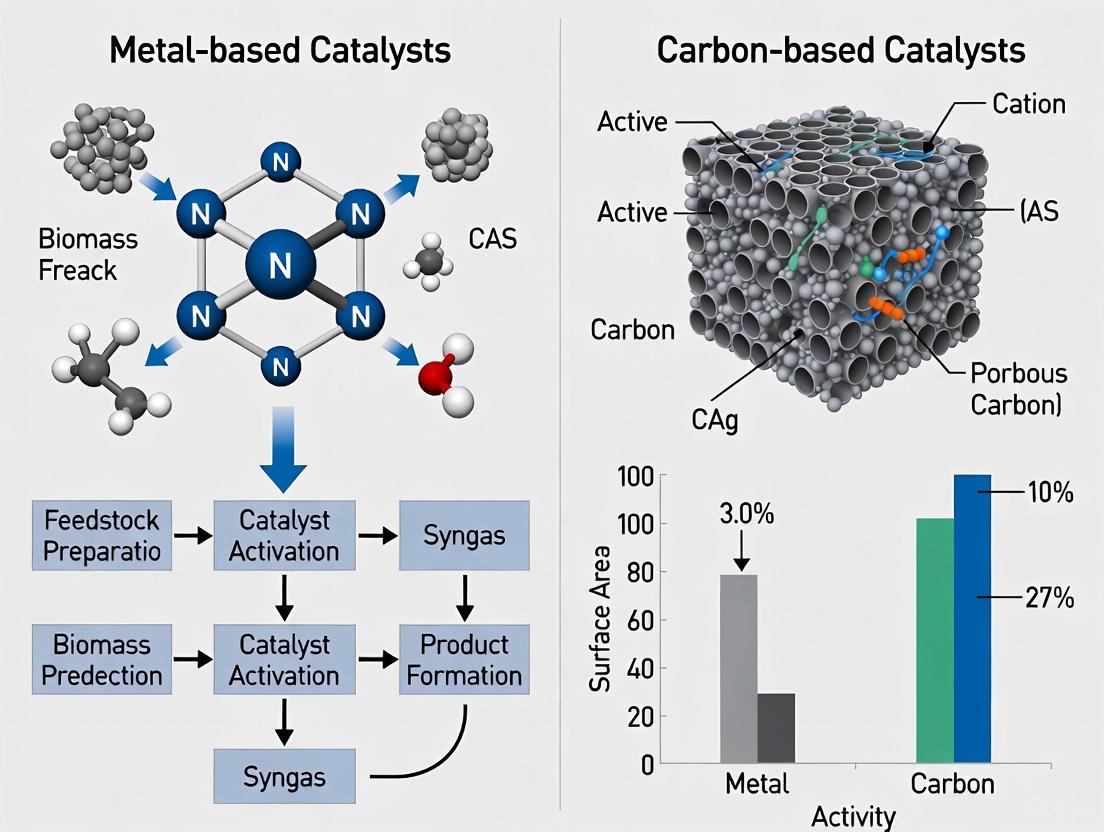
This article provides a systematic comparison of metal-based and carbon-based catalysts for biomass gasification, targeting researchers and scientists in sustainable energy and biofuel development.
Metal-Based vs. Carbon-Based Catalysts for Biomass Gasification: A Comprehensive Review of Performance, Optimization, and Future Directions
Abstract
This article provides a systematic comparison of metal-based and carbon-based catalysts for biomass gasification, targeting researchers and scientists in sustainable energy and biofuel development. It explores the fundamental characteristics, catalytic mechanisms, and operational roles of both catalyst classes in key reactions like tar reforming and hydrogen production. The content covers advanced optimization strategies to combat catalyst deactivation, process integration techniques for enhanced efficiency, and a critical validation of performance through experimental data and sustainability metrics. By synthesizing the latest research, this review aims to guide the selection and development of robust, cost-effective catalysts for advancing carbon-neutral biorefining and sustainable fuel production.
Understanding Catalyst Fundamentals: Composition, Mechanisms, and Roles in Gasification
Biomass gasification represents a pivotal technology for sustainable energy and chemical production, transforming diverse biomass feedstocks into valuable syngas (CO + H2), a key precursor for fuels, chemicals, and power generation [1]. The efficiency and product quality of this process are critically dependent on catalyst performance, particularly in addressing the significant challenge of tar formation. Tars are complex, recalcitrant mixtures of hydrocarbons formed during gasification that cause operational issues such as equipment clogging and corrosion, while also degrading process efficiency and gas quality [1] [2]. Catalytic intervention is essential not only for tar abatement but also for enhancing gas yields, particularly hydrogen, and facilitating desirable shifts in gas composition [1].
Within this context, metal-based catalysts are extensively employed to catalyze key reactions including tar cracking/reforming, water-gas shift, and methane reforming. These catalysts can be broadly categorized into two groups: transition metals (such as Ni, Co, and Fe) and noble metals (including Pt, Pd, and Ru). This guide provides a objective comparison of these two catalyst classes, framing their performance within the broader research on metal-based versus carbon-based catalysts for biomass gasification. The comparison focuses on their activity, selectivity, resistance to deactivation, and cost-effectiveness, supported by experimental data and detailed methodologies.
Fundamental Characteristics and Mechanisms
Transition metal catalysts, particularly those based on nickel (Ni), iron (Fe), and cobalt (Co), are widely utilized in biomass gasification due to their high catalytic activity for C-C bond cleavage and reforming reactions at a relatively lower cost compared to noble metals [3]. Their performance is often modulated by forming alloys or bimetallic systems; for example, the addition of Fe to Ni catalysts increases lattice oxygen content, which enhances carbon resistance by facilitating the removal of carbon deposits through oxidation [2]. The outermost electronic structure of Ni is similar to that of Pt, contributing to its good catalytic activity for steam reforming and methane decomposition [3].
Noble metal catalysts, including ruthenium (Ru), platinum (Pt), and palladium (Pd), are recognized for their superior catalytic activity and high resistance to poisoning [4] [5]. They often exhibit excellent performance at lower temperatures and demonstrate higher tolerance to carbon deposition (coking) and thermal sintering. Their activity is frequently enhanced by strong metal-support interactions (SMSIs) and the formation of alloyed structures, as seen in Ru-Ni architectures that synergistically suppress coke deposition and enhance hydrogen selectivity [1]. The interaction between the noble metal and its support, such as Pt with TiO2 or CeO2, plays a critical role in determining its overall activity and stability [5].
Quantitative Performance Comparison Table
The following table summarizes key performance metrics for transition and noble metal catalysts based on experimental studies from the literature.
Table 1: Performance Comparison of Transition Metal and Noble Metal Catalysts
| Catalyst Type | Specific Example | Reaction Conditions | Tar Conversion (%) | H₂ Selectivity / Yield | Stability & Deactivation Resistance | Reference |
|---|---|---|---|---|---|---|
| Transition Metal (Ni-Fe) | Ni₃-Fe₁/Al₂O₃ | Plasma-catalytic CO₂ reforming of toluene, 250°C | >90% (Toluene conversion) | High syngas (H₂+CO) selectivity | High carbon resistance due to strong basicity and redox capacity | [2] |
| Transition Metal (Ni) | Ni-Ce@SiC | Microwave-assisted cracking | >90% | Not Specified | 30% reduction in coke formation vs. conventional heating | [1] |
| Noble Metal (Ru) | Ru/Al₂O₃ | Toluene hydrogenation in liquid phase | High hydrogenation activity | Effective for hydrodearomatization | Performance affected by reduction procedure and oxide formation | [4] |
| Noble Metal (Pt) | Pt/TiO₂ | CO oxidation | Not Applicable (CO oxidation) | Not Applicable (CO oxidation) | 100% CO conversion at 100°C | [5] |
| Noble Metal (Pd) | Pd/CeO₂ | CO oxidation | Not Applicable (CO oxidation) | Not Applicable (CO oxidation) | 100% CO conversion at 150°C | [5] |
| Bimetallic (Noble-Transition) | Ru-Ni Alloy | Tar steam reforming | Not Specified | Enhanced hydrogen selectivity | Synergistically suppresses coke deposition | [1] |
Cost-Benefit Analysis Table
Beyond pure performance, the economic feasibility of catalysts is a critical factor for industrial application.
Table 2: Economic and Practical Considerations of Metal Catalysts
| Factor | Transition Metals (Ni, Fe, Co) | Noble Metals (Pt, Pd, Ru) |
|---|---|---|
| Raw Material Cost | Low cost and abundantly available [3]. | High cost due to scarcity and limited global supply [5]. |
| Primary Advantages | High activity for C-C bond breaking (Fe) [3]; good catalytic activity (Ni) [3]. | Excellent low-temperature activity, high stability, and superior resistance to poisoning [4] [5]. |
| Common Deactivation Issues | Prone to deactivation by coking and sintering [2] [3]. | Generally more resistant to carbon deposition and sintering [1]. |
| Regeneration Potential | Can be regenerated but may suffer from irreversible sintering. | Often maintain better dispersion and activity after regeneration cycles. |
| Ideal Application Context | Large-scale, cost-sensitive industrial gasification processes. | Applications requiring high stability, low-temperature operation, or where poisoning is a major concern. |
Experimental Protocols and Workflows
Representative Experimental Protocol: Ni-Fe/Al₂O₃ Catalyst Testing
To illustrate the methodology behind generating such performance data, the following workflow details a standard protocol for preparing and evaluating a bimetallic transition metal catalyst, as used in recent research on plasma-catalytic CO₂ reforming of tar [2].
Diagram 1: Catalyst Preparation and Testing Workflow
Step 1: Catalyst Synthesis via Wet Impregnation
- Procedure: The catalyst is prepared using wet impregnation. Aqueous solutions of metal precursors (e.g., RuCl₃·xH₂O, PdCl₂, PtCl₂ for noble metals; Ni and Fe nitrates for transition metals) are used to impregnate the support material, typically γ-Al₂O₃ [4] [2]. The suspension is stirred continuously at a defined temperature and pH to ensure uniform dispersion of metal precursors on the support surface.
Step 2: Reduction and Activation
- Procedure: The impregnated solid is subjected to a reduction process to convert metal salts into their active metallic states. This can be done using liquid reducing agents like formaldehyde (H₂CO) or sodium borohydride (NaBH₄) under mild conditions, or via ex situ reduction under a H₂ flow at high temperatures (e.g., 500°C for 2 hours) [4] [2]. The reduction method significantly impacts metal dispersion and final catalytic activity.
Step 3: Catalyst Characterization
- Crystalline Structure: X-ray diffraction (XRD) is used to identify crystalline phases, metal oxides, and alloy formation [2].
- Texture Properties: N₂ adsorption-desorption analysis (BET method) determines surface area, pore volume, and pore size distribution. Catalysts like Nix-Fey/Al₂O₃ typically exhibit type IV isotherms, indicating mesoporous structures [2].
- Morphology and Dispersion: Techniques like scanning electron microscopy (SEM) and transmission electron microscopy (TEM) are employed to visualize catalyst morphology, metal particle size, and distribution [1].
Step 4: Catalytic Performance Evaluation
- Reactor Setup: Testing is commonly performed in a fixed-bed quartz reactor or a dielectric barrier discharge (DBD) plasma reactor [2]. The catalyst is packed in the reactor zone.
- Reaction Conditions: For tar reforming, a model compound like toluene is vaporized and fed into the reactor with a carrier gas (CO₂, steam, or N₂). Typical conditions include temperatures of 250-800°C and ambient pressure [2].
- Performance Metrics: The key metrics measured are:
- Tar Conversion:
X_tar (%) = [(C_tar,in - C_tar,out) / C_tar,in] × 100% - Gas Yield: The yield of H₂, CO, and CO₂ in the product gas is quantified.
- Syngas Selectivity: The selectivity towards H₂ and CO in the gaseous products is calculated.
- Tar Conversion:
Step 5: Product Analysis and Deactivation Study
- Gas Analysis: The composition of the product gas is routinely analyzed by gas chromatography (GC) or mass spectrometry (MS) [2].
- Tar Analysis: Condensable tars are captured and analyzed gravimetrically or using chromatographic techniques.
- Stability Assessment: Long-term runs (e.g., >5 hours) are conducted to monitor changes in conversion and selectivity, followed by post-reaction characterization of spent catalysts to study deactivation mechanisms like coking or sintering [2].
The Scientist's Toolkit: Essential Research Reagents and Materials
Table 3: Key Reagents and Materials for Catalyst Research and Testing
| Item | Function / Application |
|---|---|
| γ-Al₂O₃ (Alumina) | A common catalyst support material; provides high surface area and thermal stability [4] [2]. |
| Metal Precursors (e.g., Ni(NO₃)₂, Fe(NO₃)₃, RuCl₃, PdCl₂) | Sources of active metal components for catalyst synthesis via impregnation [4] [2]. |
| Reducing Agents (e.g., H₂, NaBH₄, H₂CO) | Used during catalyst activation to convert metal oxides or salts into their active metallic state [4]. |
| Tar Model Compounds (e.g., Toluene, Naphthalene) | Simpler compounds representing biomass tar components, allowing controlled studies of reforming mechanisms [2]. |
| Gasifying Agents (e.g., CO₂, Steam) | Reactive gases used in the reforming process to convert tars into syngas [1] [2]. |
| Characterization Gases (e.g., N₂ for BET) | High-purity gases used for analyzing the physical properties of the catalyst, such as surface area and porosity. |
The choice between transition metal and noble metal catalysts for biomass gasification involves a multi-faceted trade-off between activity, stability, and cost. Transition metals, particularly Ni and Fe, offer a compelling balance of high activity for tar reforming and low cost, making them strong candidates for large-scale applications, though their susceptibility to deactivation requires mitigation through alloying or process optimization [2] [3]. Noble metals excel in specific performance metrics, including superior low-temperature activity and enhanced resistance to deactivation, but their high cost may limit widespread industrial deployment [4] [5].
The ongoing research paradigm is increasingly focused on developing sophisticated hybrid and bimetallic systems that combine the advantages of both classes, such as Ru-Ni and Ni-Fe alloys, to create synergistic effects that suppress coke deposition and enhance hydrogen selectivity [1]. Furthermore, the integration of these metal-based catalysts with emerging carbon-based materials like functionalized biochars, which offer multifunctionality and potential cost benefits, represents a promising direction for next-generation, carbon-neutral biomass gasification systems [1].
In the quest for sustainable energy, biomass gasification has emerged as a pivotal technology for producing syngas—a mixture primarily of hydrogen, carbon monoxide, and methane. A significant challenge in this process is the formation of tar, a complex mixture of hydrocarbons that condenses at lower temperatures, causing blockages, corrosion, and catalyst deactivation [6]. Traditionally, metal-based catalysts, particularly Ni-based ones, have been effective in tar reforming but face issues like coking, sintering, and high cost [2]. This context has propelled the development of carbon-based catalysts, notably biochar and activated carbon, which offer a promising, sustainable, and cost-effective alternative.
Carbon-based catalysts present several inherent advantages: they are typically derived from abundant and renewable biomass waste, exhibit inherent resistance to sulfur poisoning, and can be engineered with high surface areas and tailored surface chemistry. Furthermore, their conductive properties and ability to be functionalized or doped with active metals make them highly versatile. This guide provides a detailed, objective comparison of biochar and activated carbon, framing their performance within the broader research context of metal-based versus carbon-based catalytic strategies for advanced biomass gasification.
Performance Comparison: Biochar vs. Activated Carbon
The selection of a catalyst involves balancing performance, economic, and environmental factors. The following tables summarize a quantitative comparison between biochar and activated carbon, drawing from life cycle assessment and performance studies.
Table 1: Environmental and Economic Performance (Production Phase)
| Parameter | Biochar | Activated Carbon | Reference Context |
|---|---|---|---|
| Global Warming Potential (GWP) | 1.53 - 2.36 kg CO₂eq/kg | 8.34 - 8.96 kg CO₂eq/kg | Gate-to-grave LCA, date palm waste source [7] |
| Cumulative Energy Demand (CED) | 20.3 MJ/kg | 119.5 MJ/kg | Gate-to-grave LCA, date palm waste source [7] |
| Production Cost | $1.06/kg | $1.34/kg | Average production cost [7] |
| Adsorption Capacity | Comparable to AC | Benchmark | Performance in water treatment/adsorption [7] |
Table 2: Catalytic Performance in Biomass Gasification and Tar Removal
| Parameter | Biochar & Modified Biochar | Activated Carbon (AC) | Reference Context |
|---|---|---|---|
| Tar Removal Efficiency | Up to ~91% (KOH-activated) [6] | High (specific % not provided) [6] | Catalytic gasification, model tar compounds |
| Syngas Yield Enhancement | Significant increase reported | Higher than unmodified biochar | Use as catalyst/support in gasification [6] |
| Surface Area (BET) | Improves with activation (e.g., KOH) | Generally superior to unmodified biochar | Physicochemical characterization [6] [8] |
| Active Metal Dispersion | Effective support for Fe, Ni-Fe | Effective support, but raw biomass may offer better reduction | Catalyst preparation for gasification [6] |
The data reveals a clear trend: biochar holds a significant advantage in terms of environmental footprint and cost, while possessing comparable adsorption and catalytic potential to activated carbon when properly engineered. The high CED and GWP of activated carbon are attributed to its more energy-intensive production process, often involving higher temperatures and chemical activators.
Experimental Protocols and Methodologies
To contextualize the performance data, it is essential to understand the experimental methodologies used in preparing and evaluating these carbon catalysts.
Catalyst Preparation and Activation
1. Biochar and Activated Carbon Production:
- Pyrolysis: Biomass (e.g., sawdust, date palm waste) is pyrolyzed in an inert atmosphere at temperatures typically ranging from 400°C to 700°C to produce raw biochar [7] [6].
- Chemical Activation: To create activated carbon or activated biochar, the carbon material is impregnated with a chemical agent.
- KOH Activation: A common method involves impregnating biochar with KOH (e.g., at a 2:1 KOH-to-feedstock ratio) and heating to 800°C in an inert atmosphere [6]. The reactions produce gases (CO, CO₂) that etch pores, significantly increasing surface area.
- H₂O₂ Activation: For a milder activation, biochar can be stirred in a H₂O₂ solution (e.g., 1-10% w/v) for 24 hours at room temperature, then rinsed and dried [9].
2. Synthesis of Metal-Loaded Carbon Catalysts:
- Impregnation-Calcination: Carbon supports (raw biomass, biochar, or AC) are immersed in a solution containing metal precursors (e.g., Fe(NO₃)₃·9H₂O, Ni salts). The mixture is dried and then calcined at high temperatures (e.g., 300-500°C) in an inert atmosphere to decompose the salts and form metal oxide nanoparticles on the carbon surface [6] [2].
- Promoter Addition: Promoters like potassium (from K₂CO₃) can be co-impregnated with the active metals to enhance reducibility and catalytic activity, particularly in tar cracking and water-gas-shift reactions [6].
Catalytic Performance Evaluation
1. Tar Reforming Experiments:
- Setup: Experiments are conducted in a fixed-bed or fluidized-bed reactor system. A stream containing a model tar compound (e.g., toluene) is passed over the catalyst bed at controlled temperatures (e.g., 250-800°C) [6] [2].
- Plasma-Catalysis: Some advanced setups integrate a Dielectric Barrier Discharge (DBD) non-thermal plasma reactor with the catalyst, allowing for high-efficiency tar reforming at lower temperatures (~250°C) [2].
- Analysis: The product gas is analyzed using gas chromatography (GC) to determine syngas composition (H₂, CO, CO₂, CH₄). Tar conversion efficiency is calculated based on the difference in tar concentration at the inlet and outlet [6] [2].
2. Adsorption Performance Evaluation:
- Batch Experiments: For water treatment applications, a known amount of adsorbent (biochar or AC) is added to a solution of a target pollutant (e.g., ciprofloxacin, methylene blue). The mixture is agitated for a set time [8].
- Analysis: The concentration remaining in the solution is measured using techniques like UV-Vis spectroscopy or Total Organic Carbon (TOC) analysis. Adsorption isotherms (e.g., Langmuir, Freundlich) and kinetic models are then applied to the data to quantify performance and understand mechanisms [8].
Emerging Architectures and Functionalization
The frontier of carbon catalyst research involves engineering their architecture and chemistry to surpass traditional performance limits.
Metal-Carbon Hybrids: A primary strategy is embedding transition metals like Fe and Ni into the carbon matrix. Bimetallic Ni-Fe catalysts on biochar supports have demonstrated exceptional performance, where Fe promotes the reduction of Ni and provides lattice oxygen to gasify carbon deposits, mitigating deactivation [6] [2]. The Ni/Fe molar ratio is a critical design parameter, with Ni₃-Fe₁/Al₂O³ showing high syngas selectivity and carbon resistance [2].
Chemical Functionalization: Activating biochar with agents like KOH or H₂O₂ creates oxygen-containing functional groups (e.g., carboxyl, hydroxyl) on its surface. These groups enhance hydrophilicity and provide anchoring sites for metals, improving dispersion and catalytic activity [8] [9]. Studies show that H₂O₂-activated biochar can achieve contaminant rejection rates as high as 92.4% when embedded in membranes [9].
Morphological Tuning: Controlling pyrolysis and activation conditions (temperature, heating rate) allows for tuning of porosity and surface area. Fast pyrolysis and chemical activation are preferred for developing high surface area and micro/mesopores crucial for reactant access and mass transfer [6] [10].
The following diagram illustrates the interconnected strategies for developing advanced carbon-based catalysts.
The Scientist's Toolkit: Key Research Reagents and Materials
This table lists essential materials and their functions for researchers working in carbon-based catalysis for biomass gasification.
Table 3: Essential Research Reagents and Materials
| Reagent/Material | Function in Research | Specific Examples |
|---|---|---|
| Biomass Precursors | Feedstock for producing biochar and activated carbon, determining initial porosity and ash content. | Woody sawdust, date palm waste, oak shells, rice husk [6] [8] [10]. |
| Chemical Activators | Agents used to etch and develop porosity in carbon materials, increasing surface area and functionality. | KOH, K₂CO₃, H₃PO₄, H₂O₂, CO₂ (physical activation) [6] [8] [9]. |
| Metal Precursors | Sources of active catalytic metals for impregnation onto carbon supports to enhance tar cracking. | Fe(NO₃)₃·9H₂O, Ni(NO₃)₂·6H₂O [6] [2]. |
| Promoter Precursors | Additives that improve metal dispersion, reducibility, or specific catalytic functions (e.g., WGS reaction). | K₂CO₃ [6]. |
| Model Tar Compounds | Simplified surrogates for complex biomass tar, enabling controlled and reproducible catalytic testing. | Toluene, benzene, naphthalene [2]. |
| Polymer Binders/Supports | Used to create composite materials, such as catalytic membranes for integrated reaction-separation processes. | Polysulfone (PSf), N-Methyl-2-pyrrolidone (NMP) solvent [9]. |
The comparative analysis underscores that the choice between biochar and activated carbon is not a simple declaration of a superior material, but a strategic decision based on application priorities. Biochar stands out as the more sustainable and economically viable option, with a significantly lower environmental footprint and cost. Its performance is comparable to activated carbon, especially when modified through activation or metal functionalization. Activated carbon, while more energy-intensive to produce, often provides a benchmark in porosity and, in some cases, catalytic activity.
The future of carbon-based catalysts lies in the design of emerging hybrid architectures. The integration of inexpensive, active metals like Fe and Ni, combined with precise control over porosity and surface chemistry, creates synergistic effects that can outperform traditional catalysts. These advanced carbon materials bridge the gap between the sustainability of pure carbon and the high activity of metal-based systems, offering a compelling pathway for making biomass gasification a more efficient and commercially viable technology for renewable energy and chemicals production.
Gasification stands as a pivotal thermochemical technology for converting carbonaceous feedstocks like biomass and municipal solid waste into syngas, a valuable mixture of hydrogen, carbon monoxide, and other gases [11]. However, the formation of tar—a complex mixture of condensable, high molecular weight hydrocarbons—poses a significant challenge by degrading downstream equipment and poisoning catalytic processes [11]. Catalytic interventions are therefore indispensable for efficient gasification, primarily focusing on three core reactions: tar cracking, tar reforming, and the water-gas shift reaction [1] [12].
This guide objectively compares the performance of metal-based and carbon-based catalysts in driving these critical reactions, framing the analysis within ongoing research debates about catalyst selection for sustainable biomass gasification. Metal-based catalysts, particularly those incorporating nickel, are renowned for their high activity, while carbon-based catalysts, such as engineered biochars, offer advantages in cost, resistance to poisoning, and multifunctionality [1] [12]. The following sections provide a detailed comparison of their mechanistic actions, summarized experimental data, and essential research protocols.
Catalytic Mechanisms and Pathways
Metal-Based Catalysts
Metal-based catalysts, especially those incorporating transition metals like nickel, operate primarily through heterogeneous catalysis on their active metallic surfaces [1]. The process for tar reforming typically involves several key stages, as illustrated in the catalytic cycle below.
Tar Reforming Cycle on a Ni-based Catalyst
Figure 1: The catalytic cycle of tar steam reforming on a Ni-based catalyst surface.
The mechanism begins with the adsorption of tar molecules and steam onto the active metal sites (e.g., Ni). The C-C bonds in the tar are cleaved on the metal surface, while steam dissociates into hydroxyl species and hydrogen [1]. Subsequent surface reactions involve the reformed carbon species reacting with oxygen from hydroxyl groups to produce CO, while hydrogen atoms recombine into H2. Finally, the product molecules (CO and H2) desorb from the catalyst surface, regenerating the active sites for the next cycle [13]. The water-gas shift reaction (CO + H2O CO2 + H2) often proceeds in parallel on the same catalyst, further adjusting the syngas composition [14] [12].
Carbon-Based Catalysts
Carbon-based catalysts (CBCs), such as activated biochar, function through a combination of physical adsorption and surface-mediated reactions. Their functionality is heavily dependent on their engineered structure.
Dual-Function Mechanism of Activated Biochar
Figure 2: The multifunctional mechanism of tar removal using an activated biochar catalyst.
The process involves two synergistic mechanisms [1]. First, porous adsorption captures heavy tar molecules (e.g., fluorene) within the hierarchical pore structure of the biochar. Second, catalytic reforming occurs where inherent metal species (e.g., Ca, Al) or other active sites on the biochar surface catalyze the reforming of lighter tar compounds (e.g., phenol) into syngas [1]. This dual functionality allows CBCs to efficiently process a wide range of tar compounds.
Comparative Performance Data
Tar Conversion and Hydrogen Yield
The performance of metal-based and carbon-based catalysts is quantified through key metrics such as tar conversion efficiency and hydrogen yield. The table below summarizes experimental data from recent studies.
Table 1: Comparative performance of metal-based and carbon-based catalysts in gasification reactions.
| Catalyst Type | Specific Catalyst | Experimental Conditions | Tar Conversion (%) | H₂ Yield / Concentration | Key Findings | Reference |
|---|---|---|---|---|---|---|
| Metal-Based | Novel Ni-based (C&CS #1050 B) | 700-800 °C, GHSV: 6000 h⁻¹, 50-100 ppm H₂S | ~100% (at 700°C with 50 ppm H₂S) | Not Specified | Superior performance vs. commercial catalyst; high H₂S tolerance. | [15] |
| Metal-Based | Ni/Active Carbon | 800 °C, Steam/Biomass: 4 | Not Specified | 64.02 vol% | High Ni content (15%) crucial for maximizing H₂ yield. | [16] |
| Carbon-Based | Activated Biochar (A-Biochar) | 800 °C, coupled with SiC membrane | 96.4% | Not Specified | Hierarchical pores adsorbed heavy tar; inherent Ca/Al species reformed light tar. | [1] |
| Metal-Based | Red Mud (RM) | Not Specified | Not Specified | 50-55 vol% | Effective low-cost catalyst due to Fe₂O₃ and Al₂O₃ composition. | [16] |
| Homogeneous | K₂CO₃ | 600 °C, Batch Reactor | Not Specified | 28 mmol/g (from glucose) | Enhances water-gas shift reaction, limiting char formation. | [12] |
Catalyst Durability and Deactivation
Long-term stability is a critical differentiator between catalyst types.
Table 2: Comparison of catalyst deactivation mechanisms and regeneration strategies.
| Aspect | Metal-Based Catalysts | Carbon-Based Catalysts (CBCs) |
|---|---|---|
| Primary Deactivation Mechanisms | Coke (carbon) deposition, Sintering (loss of active surface), Poisoning (e.g., by sulfur) [1]. | Pore blockage by coke/ash, Attrition, Oxidation [1]. |
| Coke Formation Example | Conventional heating can lead to stable graphitic coke [1]. | Coke formation is suppressed in systems like microwave-assisted cracking [1]. |
| Regeneration Strategies | Controlled combustion to remove coke [1]. | Controlled combustion, Steam activation [1]. |
| Resistance to Poisons | Susceptible to sulfur poisoning (e.g., H₂S) [1]. | Often exhibit superior resistance to sulfur poisons [1]. |
Experimental Protocols and Methodologies
Catalyst Testing and Evaluation
Standardized experimental protocols are essential for comparing catalyst performance. A common setup involves a laboratory-scale packed bed reactor.
Typical Workflow for Catalytic Tar Reforming Experiments
Figure 3: Generalized experimental workflow for testing gasification catalysts.
Key steps include:
- Catalyst Preparation: Metal-based catalysts are often synthesized via impregnation, where a support material is infused with an aqueous solution of a metal salt (e.g., PtCl₄, Ni salts), followed by drying and reduction in a H₂ atmosphere at high temperatures (e.g., 1073 K) [14] [16]. Carbon-based catalysts may be derived from biomass precursors through pyrolysis and subsequent physical or chemical activation to develop porosity and surface functional groups [1].
- Reactor Setup: Experiments are frequently conducted in tubular fixed-bed quartz reactors [14] [15]. The catalyst is typically reduced in-situ under a H₂ flow before introducing reactants.
- Simulated Syngas Feed: To ensure reproducibility, model tar compounds like naphthalene and toluene are dissolved and vaporized into a carrier gas (e.g., N₂). Thiophene can be added as a source of H₂S to study poisoning [15]. Steam is co-fed as a reforming agent.
- Product Analysis: The composition of the outlet gas (H₂, CO, CO₂, CH₄) is analyzed using gas chromatography (GC). Tar conversion is calculated by quantifying the tar content before and after the catalytic reactor using standardized tar sampling protocols [15].
The Scientist's Toolkit: Key Research Reagents and Materials
Table 3: Essential materials and reagents for catalytic gasification research.
| Reagent/Material | Function in Research | Example Use Case |
|---|---|---|
| Nickel Salts (e.g., Ni(NO₃)₂) | Precursor for active metal in catalyst synthesis. | Impregnation of alumina or biochar supports to create Ni-based catalysts [16]. |
| Biochar / Activated Carbon | Catalyst support or catalyst itself. | Used as a low-cost support for Ni or as a standalone catalyst with inherent activity [1] [16]. |
| Alumina (Al₂O₃) | Stable, high-surface-area catalyst support. | A common support for Ni and other transition metals due to its stability and textural properties [16]. |
| Naphthalene / Toluene | Model tar compounds. | Used in simulated syngas feeds to study catalytic tar reforming efficiency under controlled conditions [15]. |
| Thiophene (C₄H₄S) | Source of H₂S for poisoning studies. | Added to the reactant stream to investigate catalyst resistance to sulfur poisoning [15]. |
| Calcium Oxide (CaO) | CO₂ adsorbent and catalyst. | Used in sorption-enhanced gasification to shift reaction equilibria and increase H₂ yield [16]. |
| Red Mud (RM) | Low-cost iron and aluminum-rich catalyst. | A waste-derived catalyst from aluminum processing used for tar reduction [16]. |
The comparative analysis presented in this guide demonstrates that the choice between metal-based and carbon-based catalysts is not a simple binary decision. Each class offers distinct advantages: metal-based catalysts, particularly advanced Ni formulations and bimetallics, provide exceptional activity and tar conversion efficiency [15] [1]. In contrast, carbon-based catalysts, such as engineered biochars, offer a compelling combination of multifunctionality, resistance to poisoning, and alignment with circular economy principles, often at a lower cost [1].
The optimal catalyst selection depends heavily on the specific gasification process conditions, feedstock composition, and economic constraints. Future research is trending towards hybrid and advanced material designs, such as nanostructuring, single-atom catalysts on carbon supports, and the use of AI-driven computational models to predict optimal catalyst formulations [1]. These innovations aim to bridge the performance gap between the two catalyst classes, ultimately leading to more robust, efficient, and economically viable biomass gasification systems.
In the quest for sustainable and carbon-neutral energy systems, biomass gasification stands out as a pivotal technology for converting biomass into syngas, a key precursor for fuels and chemicals. Within this field, the choice of catalyst is paramount, framing a central thesis of metal-based versus carbon-based catalysts. While traditional metal-based catalysts, such as nickel, are renowned for their high activity, particularly in C-C bond rupture and tar reforming, they often face challenges related to cost, sintering, coking, and deactivation [1] [16]. This comparison guide objectively explores the unique multifunctionality of carbon-based catalysts (CBCs), which present a compelling alternative by combining intrinsic catalytic activity with in-situ CO₂ adsorption capabilities. This dual functionality positions CBCs as robust, cost-effective, and environmentally benign candidates for next-generation gasification systems, aligning with the principles of a circular carbon economy [1] [17].
Comparative Performance Analysis: Carbon-Based vs. Metal-Based Catalysts
The performance of catalysts in biomass gasification is typically evaluated based on their tar conversion efficiency, hydrogen yield, resistance to deactivation, and additional functionalities such as CO₂ adsorption. The table below provides a structured comparison of carbon-based catalysts against common metal-based alternatives, synthesizing data from recent experimental studies.
Table 1: Performance comparison of carbon-based and metal-based catalysts in biomass gasification
| Catalyst Type | Specific Example | Tar Conversion Efficiency | H₂ Yield / Concentration | Key Advantages | Major Limitations |
|---|---|---|---|---|---|
| Carbon-Based Catalysts | Activated Biochar (A-biochar) | 96.4% [1] | – | Dual functionality (tar cracking & CO₂ adsorption), waste-derived, cost-effective, superior thermal & poison resistance [1] | Trade-offs between activity, adsorption capacity, and mechanical strength [1] |
| Ni/Active Carbon (15% Ni) | – | 64.02 vol% [16] | High H₂ production, activated carbon support enhances total gas yield [16] | Catalyst cost, potential Ni sintering [1] | |
| Metal-Based Catalysts | Ni-based Catalysts | >90% [1] | 60-70 vol% [16] | High activity for C-C bond rupture, widely used, effective for tar reduction [16] | Substantial cost, susceptibility to coking and sintering, deactivation [1] [16] |
| Red Mud (RM) | Effective in reduction [16] | 50-55 vol% [16] | Low-cost byproduct, composition of Fe₂O₃ and Al₂O₃ [16] | Limited number of studies, lower H₂ yield compared to Ni catalysts [16] | |
| CaO | – | Improved composition [16] | Excellent CO₂ adsorbent (shifts equilibrium for H₂ production) [16] | – |
The data indicates that CBCs, particularly activated biochar, can achieve performance on par with or even superior to traditional metal catalysts in key areas like tar conversion. Their defining advantage, however, lies in their multifunctionality. Unlike metal-based catalysts that primarily drive tar reforming, CBCs can simultaneously catalyze reactions like tar cracking and the water-gas shift while also adsorbing CO₂ in situ. This integrated approach simplifies process design and enhances overall system efficiency [1].
The Dual Functionality of Carbon-Based Catalysts: Mechanisms and Workflow
The superior performance of multifunctional carbon-based catalysts stems from their synergistic structural and chemical properties. The following diagram illustrates the concurrent processes and mechanisms within a gasification system employing a CBC.
Diagram 1: Multifunctional mechanisms of carbon-based catalysts in gasification.
Intrinsic Catalytic Activity
The catalytic activity of CBCs for tar cracking and reforming is a result of two primary factors:
- Hierarchical Pore Structure: Biomass-derived carbons possess a tunable pore structure, comprising micropores (<2 nm), mesopores (2-50 nm), and macropores (>50 nm) [17]. This hierarchy is critical, as macropores facilitate mass transfer, while micropores and mesopores provide a high surface area for reactions. For instance, hierarchical pores in activated biochar can physically adsorb heavy tars like fluorene [1].
- Active Sites: The inherent presence of alkali or alkaline earth metal species (e.g., K, Ca) and other inorganic impurities in the biochar matrix provides catalytic active sites [16] [17]. These sites, such as Ca/Al species, are highly effective in catalytically reforming light tars like phenol [1]. Furthermore, the carbon matrix can be functionalized or doped with heteroatoms (e.g., O, N) or transition metals (e.g., Ni) to significantly enhance active site density and stability for specific reactions [1].
In-Situ CO2 Adsorption
A unique property of CBCs is their ability to adsorb CO₂ generated during the gasification process. This occurs through two main mechanisms:
- Physicochemical Adsorption: The high surface area and porous structure enable physical adsorption of CO₂ molecules [1]. Additionally, surface oxygenated functional groups (e.g., carboxyl, carbonyl) can establish specific interactions with CO₂, facilitating chemisorption [1].
- Oxygen Vacancies and Defect Sites: In metal-oxide-functionalized carbons, surface defects and oxygen vacancies play a crucial role in CO₂ activation. These vacancies enrich transferable electrons and act as adsorption sites, promoting the transformation of the stable CO₂ molecule [18].
This in-situ CO₂ capture, particularly in processes like sorption-enhanced gasification (SEG), shifts the reaction equilibrium according to Le Chatelier's principle, leading to a significant increase in hydrogen yield and purity while simultaneously concentrating CO₂ for capture or utilization [1] [16].
Experimental Protocols for Evaluating Carbon Catalysts
To objectively compare catalyst performance, standardized experimental protocols are essential. Below are detailed methodologies for synthesizing and testing carbon-based catalysts, as cited in recent literature.
Catalyst Synthesis and Characterization
Protocol 1: Synthesis of Activated Biochar (A-Biochar) for Integrated Tar and PM Removal This protocol is adapted from the work of Ding et al., which demonstrated concurrent tar reforming and particulate matter (PM) filtration [1].
- Carbonization: Subject a selected biomass feedstock (e.g., sawdust, pruning remains) to pyrolysis under an inert atmosphere (e.g., N₂) at a temperature typically between 500-800°C to produce raw biochar.
- Activation: Activate the raw biochar using a physical or chemical agent. Common activating agents include CO₂, steam, or bases like KOH. This step develops porosity and increases the specific surface area.
- Characterization:
- Textural Properties: Use N₂ adsorption-desorption at -196°C to determine the specific surface area (BET method) and pore size distribution. Complementary CO₂ adsorption at 0°C can characterize the smallest micropores [17].
- Surface Chemistry: Analyze surface functional groups using Fourier Transform Infrared Spectroscopy (FTIR).
- Morphology and Composition: Examine the catalyst's morphology using Scanning Electron Microscopy (SEM) and determine elemental composition.
Protocol 2: Preparation of Ni/Active Carbon Catalyst This protocol is based on studies achieving high hydrogen production with Ni-supported on activated carbon [16].
- Support Preparation: Obtain or synthesize activated carbon with a high surface area, as detailed in Protocol 1.
- Metal Impregnation: Impregnate the activated carbon support with an aqueous solution of nickel nitrate (Ni(NO₃)₂) to achieve the desired metal loading (e.g., 15 wt% Ni).
- Drying and Calcination: Dry the impregnated catalyst followed by calcination in air at a specified temperature to convert the nickel salt to its oxide form.
- Reduction (Optional): Reduce the calcined catalyst in a H₂ stream at high temperature (e.g., 500-700°C) to form metallic Ni nanoparticles, which are the active sites for C-C bond rupture [16].
Catalytic Performance Testing
Protocol 3: Bench-Scale Gasification and Tar Conversion Test
- Reactor Setup: Conduct experiments in a fixed-bed or fluidized-bed reactor system. The reactor should be equipped with a temperature-controlled furnace, a biomass feeding unit, and a gasifying agent (steam, air) supply.
- Experimental Run: Load a specific amount of catalyst (e.g., 75 g of biomass mixture [16]) into the reactor. Initiate gasification at the target temperature (e.g., 800°C [1] [16]) with a controlled steam-to-biomass ratio (e.g., 4 [16]).
- Syngas Analysis: Analyze the product gas composition (H₂, CO, CO₂, CH₄) in real-time using online gas chromatography (GC).
- Tar Measurement: Collect tar samples from the syngas stream using a protocol such as the "Tar Protocol" [16]. Quantify tar species gravimetrically or using GC-MS.
- Performance Calculation:
- Tar Conversion Efficiency: Calculate as
(1 - (Tar output with catalyst / Tar output without catalyst)) * 100%. - H₂ Yield/Concentration: Determine from the GC data, reported as vol% in the product gas.
- Tar Conversion Efficiency: Calculate as
The Scientist's Toolkit: Essential Research Reagents and Materials
The following table details key materials and reagents essential for research and development in carbon-based catalysts for biomass gasification.
Table 2: Key research reagents and materials for carbon catalyst development
| Item Name | Function/Application | Key Characteristics & Considerations |
|---|---|---|
| Lignocellulosic Biomass | Feedstock for producing sustainable biochar and activated carbon [17]. | Composition (lignin, cellulose, hemicellulose) influences biochar yield and properties. Prefer terrestrial over aquatic materials [17]. |
| Activating Agents (KOH, CO₂) | Used in the chemical or physical activation of biochar to develop porosity [17]. | KOH creates uniform micropores; CO₂ activation is less corrosive. Choice affects final surface area and pore size distribution. |
| Metal Precursors (e.g., Ni(NO₃)₂) | For synthesizing metal-doped carbon catalysts to enhance tar reforming activity [1] [16]. | High-purity salts ensure consistent metal loading. Nitrates are common due to good solubility and decomposition properties. |
| Silicon Carbide (SiC) Membrane | Used in integrated reactor designs for simultaneous particulate matter (PM) removal, preventing catalyst fouling [1]. | High thermal stability and defined pore size (e.g., 2.6 μm) for efficient PM capture (>95.9%) at high temperatures [1]. |
| Model Tar Compounds | Used in controlled laboratory experiments to standardize the evaluation of catalytic tar cracking performance. | Phenol and fluorene are representative of light and heavy tars, respectively [1]. |
This comparison guide demonstrates that carbon-based catalysts are not merely substitutes for metal-based catalysts but represent a paradigm shift in catalyst design for biomass gasification. Their unique multifunctionality—integrating high catalytic activity for tar reduction with in-situ CO₂ adsorption—offers a pathway to more efficient, cost-effective, and environmentally sustainable gasification processes. While metal-based catalysts like Ni continue to be highly active, their limitations in cost and deactivation highlight the compelling advantages of CBCs. Future research, accelerated by computational tools like density functional theory (DFT) and machine learning, should focus on optimizing the trade-offs between catalytic activity, CO₂ adsorption capacity, and long-term stability under cyclic operations to fully realize the potential of carbon catalysts in enabling a circular carbon economy [1].
Strong Metal-Support Interactions (SMSI) and Alloying Effects in Advanced Catalytic Design
The pursuit of efficient and sustainable chemical processes, particularly in the realm of biomass gasification, hinges on advanced catalyst design. Two dominant paradigms have emerged: metal-based catalysts and carbon-based catalysts. Within metal-based systems, strategic engineering of Strong Metal-Support Interactions (SMSI) and deliberate alloying effects have proven to be powerful tools for enhancing catalytic performance, stability, and selectivity. SMSI describes a phenomenon where a reducible oxide support migrates onto supported metal nanoparticles under specific conditions, forming an encapsulating layer that modifies the electronic and geometric structure of the active metal sites [19]. This interaction can significantly alter adsorption strengths and reaction pathways. Concurrently, alloying—combining two or more metals—allows for the fine-tuning of electronic structures and the creation of unique active sites, with recent advances extending into high-entropy alloys (HEAs) that offer vast compositional space and synergistic effects [19]. This guide objectively compares the performance of catalysts leveraging these advanced design principles against more conventional alternatives, providing a foundational understanding for researchers and scientists developing next-generation solutions for biomass conversion and other critical processes.
Fundamental Mechanisms and Key Concepts
Strong Metal-Support Interactions (SMSI)
The classic SMSI effect is characterized by the encapsulation of metal nanoparticles by a partially reduced oxide support layer following high-temperature reductive treatment [20] [19]. This overlay induces both geometric and electronic modifications to the catalyst. Geometrically, the encapsulating layer can physically isolate active sites, altering selectivity by controlling access to reactants. Electronically, charge redistribution occurs at the metal-support interface, modulating the electron density of the metal sites and thereby influencing their binding strength with reaction intermediates [19]. Originally observed for Group VIII metals on reducible oxides like TiO2, Co3O4, and CeO2, the boundaries of SMSI have been expanded through innovative synthesis routes. These include treatments under oxidative atmospheres, wet chemistry approaches in aqueous solutions, and the use of strongly adsorbed molecules as mediators, making the effect accessible to a wider range of metals, including Au, Pt, Pd, and Rh [20].
A significant advancement is the concept of Strong Metal-Support Interaction via a Reverse Route (SMSIR). Unlike the conventional approach that starts from deposited metal nanoparticles and ends with encapsulation, SMSIR begins with a pre-formed core-shell structure (the final state of conventional SMSI) and applies a reductive treatment to create a porous yolk-shell structure. This "reverse" process results in a controlled, partial exposure of metal sites, offering an optimal balance between active site accessibility and nanoparticle stabilization [20].
Alloying and High-Entropy Alloy Effects
Alloying involves creating materials with two or more metallic elements. In catalysis, it is primarily used to tailor the electronic structure of active sites. Introducing a second metal can shift the d-band center of the primary active metal, thereby weakening or strengthening the adsorption of key intermediates and lowering energy barriers for catalytic reactions [21]. This electronic modulation is a key reason why Pt-based alloys often outperform pure Pt in reactions like the oxygen reduction reaction (ORR) [21].
HEAs represent a frontier in alloy catalysis. Composed of five or more elements in near-equiatomic proportions, they offer an immense compositional space for discovering new catalysts with unique properties [19]. Their complex compositions lead to pronounced synergistic effects and a diverse array of active sites, enabling fine control over reaction pathways. A critical challenge, however, is synthesizing ultrasmall HEA nanoparticles (<5 nm) that are resistant to aggregation and phase segregation under high-temperature conditions. Recent work demonstrates that leveraging the SMSI effect is an effective strategy to stabilize these ultrasmall HEAs, preventing Ostwald ripening and maintaining compositional homogeneity [19].
Comparative Performance Analysis of Catalytic Systems
The following tables provide a quantitative comparison of catalyst performance across different reactions, highlighting the impact of SMSI and alloying.
Table 1: Performance Comparison of Metal-Based Catalysts in Hydrogenation and Oxidation Reactions
| Catalyst | Reaction | Key Performance Metrics | Comparison / Notes |
|---|---|---|---|
| Pd–Fe₃O₄–H (SMSIR) [20] | Acetylene Semi-Hydrogenation | 100% Conversion, 85.1% Selectivity to Ethylene @ 80°C | Superior selectivity due to SMSIR favoring surface-H over hydride formation. |
| Ultrasmall HEA/TiO₂ (SMSI) [19] | Cinnamaldehyde Hydrogenation | High Conversion & Tunable Selectivity | SMSI layer stabilizes sub-3.7 nm particles and fine-tunes interfacial electronic structure. |
| Pt₁/FeOₓ (Single-Atom) [22] | CO Oxidation | Higher activity than Au Nanoparticle catalysts | Demonstrated the potential of single-atom catalysis with maximum atom utilization. |
| Ir₁/m-WO₃ (Single-Atom) [22] | CO-SCR (NO Reduction) | 73% NO Conversion @ 350°C; 100% N₂ Selectivity | Isolated active sites provide excellent selectivity for target products. |
Table 2: Performance of Catalysts in Biomass Gasification and Syngas Production
| Catalyst | Process / Reaction | Key Performance Metrics | Comparison / Notes |
|---|---|---|---|
| Ni/Active Carbon (15% Ni) [16] | Biomass Steam Gasification | 64.02 vol% H₂ Production @ 800°C, S/B=4 | High Ni content increases H₂ and gas yields; effective for tar reduction. |
| Red Mud (RM) Catalyst [16] | Biomass Gasification | 50-55 vol% H₂ Production | Effective low-cost catalyst due to Fe₂O₃ and Al₂O₃ composition. |
| Activated Biochar (A-Biochar) + SiC Membrane [1] | Syngas Purification (Tar & PM Removal) | 96.4% Tar Conversion, >95.9% PM Removal | Multifunctional carbon-based system for integrated syngas cleaning. |
| Ni–Ce@SiC (Microwave) [1] | Tar Reforming | >90% Tar Conversion, >30% Coke Reduction | Microwave heating suppresses coke deposition vs. conventional heating. |
Table 3: Advantages and Limitations of Catalyst Design Strategies
| Design Strategy | Key Advantages | Primary Challenges | Suitability |
|---|---|---|---|
| SMSI | Enhances thermal stability; suppresses sintering & dissolution; modulates selectivity [20] [19]. | Can over-encapsulate and block active sites; restricted to specific metal-support pairs [20]. | Ideal for high-temperature reactions where metal stability is critical. |
| Alloying & HEA | Vast tunability of electronic structure; synergistic effects; unique active sites [19] [21]. | Thermodynamic instability; aggregation & phase segregation (Ostwald ripening) [19]. | Optimal for reactions requiring precise adsorption energy tuning. |
| Carbon-Based Catalysts (e.g., Biochar) | Multifunctionality (catalyst & adsorbent); derived from waste resources; resistance to sulfur poisoning [1]. | Can suffer from pore blockage by coke/ash; lower activity for some reforming reactions [1]. | Excellent for integrated CO₂ capture and in syngas purification processes. |
Experimental Protocols and Methodologies
Inducing SMSI via the Reverse Route (SMSIR)
The SMSIR strategy represents a controlled method for constructing optimized metal-support interfaces [20].
- Synthesis of Core-Shell Nanoparticles: Begin with the synthesis of monodisperse Pd nanoparticles (∼5.5 nm) via the reduction of palladium(II) acetylacetonate (Pd(acac)₂) in oleylamine. Use these as seeds for a secondary growth step. Introduce iron(III) acetylacetonate to nucleate and grow an amorphous iron oxide (FeOₓ) shell around the Pd cores, resulting in core-shell Pd–FeOₓ nanoparticles.
- SMSIR Construction: Subject the pristine core-shell nanoparticles to a reductive annealing process. A typical protocol involves treating the material at 300°C under a gas mixture of 4% H₂ in Ar. This treatment triggers the crystallization of the shell into Fe₃O₄ and induces the formation of a porous yolk-shell structure (Pd–Fe₃O₄–H), characterized by abundant micropores (average ~0.73 nm) in the shell.
- Characterization: Use Aberration-corrected HAADF-STEM and EELS mapping to confirm the transformation from a core-shell to a porous yolk-shell morphology. XRD analysis will show the emergence of crystalline γ-Fe₃O₄ phases and intensified Pd (111) peaks after reductive treatment.
Synthesizing Ultrasmall High-Entropy Alloy Nanoparticles via SMSI
This quenching-based method stabilizes ultrasmall HEAs by leveraging SMSI [19].
- Support Pretreatment: Pre-calcine the anatase TiO₂ support in air. This step generates lattice defects and a controlled concentration of oxygen vacancies, which serve as anchoring sites for metal precursors.
- Quenching and Impregnation: Prepare an aqueous solution containing equimolar (e.g., 0.5 mmol each) salts of the target metals (e.g., Pt, Ni, Co, Cu, Fe) along with citric acid as a complexing agent. Rapidly quench the high-temperature TiO₂ support into this metal salt solution. The violent release of steam promotes the immediate and uniform adsorption of metal complexes onto the defect-rich TiO₂ surface.
- Reductive Annealing: Reduce the metal precursors under a H₂ atmosphere at high temperature (e.g., 500–700°C). This step forms the ultrasmall HEA nanoparticles and simultaneously induces the SMSI effect, resulting in the formation of a thin TiOₓ encapsulation layer that stabilizes the nanoparticles against aggregation.
- Characterization: Employ TEM to verify particle size (<3.7 nm) and dispersion. EDS and ICP-MS are used to confirm the homogeneous elemental distribution and composition of the HEA. XPS can be used to investigate the electronic interactions between the HEA and the support and the content of oxygen vacancies.
Visualization of Concepts and Workflows
SMSI Engineering Pathways
Table 4: The Scientist's Toolkit: Essential Research Reagents and Materials
| Reagent/Material | Function in Catalyst Synthesis/Reaction | Example Application |
|---|---|---|
| Palladium(II) acetylacetonate (Pd(acac)₂) | Metal precursor for synthesizing well-defined seed nanoparticles. | Synthesis of Pd seed NPs for core-shell structures [20]. |
| Iron(III) acetylacetonate (Fe(acac)₃) | Precursor for forming the oxide shell in core-shell nanoparticles. | Formation of FeOₓ shell in Pd–FeOₓ core-shell NPs [20]. |
| Anatase TiO₂ Nanoparticles | A common reducible oxide support for inducing SMSI effects. | Support for stabilizing ultrasmall HEA nanoparticles [19]. |
| Citric Acid | Serves as a complexing agent in precursor solutions to promote uniform metal dispersion. | Used in quench synthesis of HEA catalysts to prevent segregation [19]. |
| Oleylamine (OAM) | Acts as both a solvent and a stabilizing ligand in colloidal synthesis of nanoparticles. | Synthesis of monodisperse Pd NPs [20]. |
| Red Mud (RM) | Low-cost, waste-derived catalyst containing catalytic Fe₂O₃ and Al₂O₃. | Catalyst for tar reduction and H₂ production in biomass gasification [16]. |
The strategic application of Strong Metal-Support Interactions and alloying effects provides a powerful framework for advancing catalytic design, particularly within the context of metal-based catalysts for processes like biomass gasification. The comparative data and protocols presented in this guide demonstrate that SMSI engineering can drastically improve catalyst stability and selectivity, while alloying—especially in the form of high-entropy alloys—offers unparalleled tunability of active sites. When compared to carbon-based catalysts, which excel in multifunctionality and cost-effectiveness for specific tasks like syngas purification, these advanced metal-based systems show superior performance in demanding catalytic transformations requiring high activity and precise control. Future research will likely focus on broadening the scope of SMSI to non-classical metal-support pairs, improving the synthetic control over HEA composition and size, and integrating these design principles with emerging carbon-based materials to create next-generation hybrid catalysts for a sustainable energy future.
Catalyst Applications and Process Integration: From Laboratory to System Design
Gasification represents a cornerstone thermochemical process for converting diverse biomass and waste feedstocks into syngas, a valuable mixture of hydrogen, carbon monoxide, and light hydrocarbons [23] [24]. The efficiency and output of this process are profoundly influenced by the gasification technology employed and the catalysts integrated within the system. Catalysts are pivotal for enhancing reaction rates, improving syngas quality and yield, and mitigating operational challenges such as tar formation and catalyst deactivation [25] [2]. Within the context of biomass gasification research, a central thesis involves the comparative analysis of metal-based versus carbon-based catalysts. Metal-based catalysts, particularly Ni-Fe bimetallic systems, are renowned for their high catalytic activity and effectiveness in tar reforming [2]. Carbon-based catalysts, such as biochar, offer advantages of low cost and high resistance to contaminants [25].
This guide provides an objective comparison of three advanced gasification technologies: Fluidized Bed, Supercritical Water (SCWG), and Plasma Systems. It synthesizes experimental data on catalytic performance, summarizes methodologies from key studies, and outlines essential research tools, offering a structured resource for researchers and scientists in the field.
The selection of gasification technology significantly impacts process conditions, syngas composition, and optimal catalyst choice. Fluidized bed gasifiers are characterized by excellent mixing, uniform temperature distribution, and flexibility in feedstock, typically operating between 800–1000 °C [23] [24]. Supercritical Water Gasification (SCWG) utilizes water above its critical point (374 °C, 22.1 MPa) as the reaction medium, which is particularly advantageous for processing high-moisture feedstocks like sewage sludge without an energy-intensive drying step [26] [27] [28]. The unique properties of SCW, including low dielectric constant and high diffusivity, facilitate the efficient dissolution and gasification of organic compounds into a hydrogen-rich syngas [27] [29]. Plasma gasification employs a high-temperature plasma arc (often exceeding 3000 °C) to decompose organic material completely and inertize inorganic components into a vitrified slag. This technology is highly effective for treating refractory wastes and achieving high carbon conversion rates [23] [25].
Table 1: Overview and Comparative Performance of Gasification Technologies.
| Technology | Typical Operating Conditions | Syngas Characteristics | Advantages | Challenges |
|---|---|---|---|---|
| Fluidized Bed | 800–1000 °C; Atmospheric to elevated pressure [23] [24] | H₂: ~20-40%; CO: ~20-40%; LHV: 4-18 MJ/Nm³ [23] | Good temperature uniformity, feedstock flexibility, high efficiency [24] | Tar management, bed agglomeration, particulate carryover [24] |
| Supercritical Water (SCWG) | 374-700 °C; 22-30 MPa [27] [28] [29] | H₂-rich (up to 60% or more); CO variable [26] [27] | Direct wet feed processing, high H₂ yield, compact reactors [28] [29] | Salt precipitation/clogging, corrosion, high-pressure operation [29] |
| Plasma | 500-3000+ °C; Atmospheric pressure [25] | High H₂ and CO; very low tar [25] | Very high conversion, handles diverse wastes, vitrified slag [25] | High electricity consumption, reactor durability, capital cost [25] |
Catalytic Performance: Metal-Based vs. Carbon-Based
Catalysts are essential for optimizing gasification, with metal-based and carbon-based catalysts representing two major categories. The following table summarizes key experimental findings for different catalyst types within each gasification technology.
Table 2: Experimental Catalytic Performance in Different Gasification Systems.
| Gasification System | Catalyst Type & Example | Experimental Conditions | Key Performance Outcomes | Reference |
|---|---|---|---|---|
| Fluidized Bed | Metal-based (Ni-Fe/Al₂O₃) | ~800-900°C; Steam or CO₂ as agent [2] | High tar conversion (>90%); Enhanced syngas yield and H₂ selectivity; Improved carbon resistance vs. Ni-only [2] | [2] |
| Supercritical Water (SCWG) | Metal-based (K₂CO₃) | ~500-600°C; ~25 MPa [27] | Increased H₂ yield and gasification efficiency; Catalyzes water-gas shift reaction [27] | [27] |
| Supercritical Water (SCWG) | Carbon-based (Biochar) | ~374-700°C; ~22-30 MPa [29] | In-situ tar cracking; Provides active sites for reforming; Low-cost and resistant to poisoning [29] | [29] |
| Plasma | Metal-based (Ni-Fe/Al₂O₃) | ~500-800°C; Non-thermal plasma [25] [2] | Synergy between plasma and catalyst; High tar conversion (~90%) at lower temperatures; Reduced coke formation [25] [2] | [25] [2] |
| Plasma | Carbon-based (Char) | High temp. (>1000°C); Plasma zone [25] | Acts as catalyst and reactant; Contributes to CO production via Boudouard reaction [25] | [25] |
Experimental Protocols for Catalytic Gasification
Protocol for Plasma-Catalytic Reforming of Tar using Ni-Fe/Al₂O₃
This protocol details the experimental method for non-thermal plasma-catalytic CO₂ reforming of toluene, a model tar compound, as described in the search results [2].
Catalyst Synthesis (Impregnation Method):
- Support Preparation: Use γ-Al₂O₃ as the catalyst support. Pre-treat it by calcining at 500°C for 4 hours to remove impurities and stabilize the surface.
- Solution Preparation: Dissolve appropriate amounts of nickel nitrate (Ni(NO₃)₂·6H₂O) and iron nitrate (Fe(NO₃)₃·9H₂O) in deionized water to achieve the desired Ni/Fe molar ratios (e.g., 3:1, 2:1, 1:1).
- Impregnation: Slowly add the γ-Al₂O₃ support to the aqueous nitrate solution under continuous stirring. Allow the mixture to age for 12-24 hours at room temperature.
- Drying & Calcination: Recover the solid catalyst, dry it at 105°C for 12 hours, and then calcine in a muffle furnace at 500°C for 5 hours to decompose the nitrates into metal oxides.
Experimental Setup (Plasma-Catalytic Reactor):
- Employ a Dielectric Barrier Discharge (DBD) non-thermal plasma reactor.
- The reactor typically consists of a quartz tube with a high-voltage electrode and a ground electrode.
- Load the synthesized catalyst into the discharge zone of the reactor.
- Use mass flow controllers to introduce gaseous feeds: CO₂ and a carrier gas (e.g., N₂) saturated with toluene vapor by passing through a bubbler.
- Maintain the reactor at ambient pressure and a temperature of around 250°C.
Reaction and Analysis:
- Apply a high-voltage AC power to the DBD reactor to generate plasma. Systematically vary the discharge power (e.g., 20-100 W).
- Analyze the inlet and outlet gas composition using an online Gas Chromatograph (GC) equipped with a Thermal Conductivity Detector (TCD) for permanent gases (H₂, CO, CO₂) and a Flame Ionization Detector (FID) for hydrocarbons.
- Calculate key performance metrics:
- Tar (Toluene) Conversion (%):
(1 - [C₇H₈]_outlet / [C₇H₈]_inlet) * 100 - Syngas Selectivity (%):
(Moles of H₂ or CO produced / Total moles of gaseous products) * 100
- Tar (Toluene) Conversion (%):
Protocol for Catalytic Supercritical Water Gasification of Coal
This protocol is adapted from studies on SCWG of coal integrated with hydrogen oxidation for autothermal operation [27].
Feedstock Preparation:
- Pulverize the coal feedstock (e.g., Hongliulin coal) to a particle size of less than 100 μm.
- To prepare a pumpable slurry, mix the coal powder with water and a stabilizer like xanthan gum (e.g., 0.1 wt%).
Catalyst Addition:
- Use an alkali catalyst such as potassium carbonate (K₂CO₃). Add it directly to the coal-water slurry.
Experimental Setup (SCW Fluidized Bed with Oxidation Zone):
- Use a continuous-flow SCWG reactor system capable of operating above 22.1 MPa and 374°C.
- The reactor system should be divided into a gasification zone and an oxidation zone.
- Pump the coal slurry and supercritical water into the gasification zone using high-pressure pumps.
- In a separate stream, inject compressed air directly into the oxidation zone of the reactor.
- The heat released from the exothermic oxidation of hydrogen and other gaseous products in the oxidation zone provides the necessary energy for the endothermic gasification reactions.
Reaction and Analysis:
- Conduct experiments at varying temperatures (e.g., 500-600°C), mass ratios of coal to SCW, and oxidation equivalent ratios.
- After the system reaches steady-state, sample the gaseous effluent.
- Analyze the gas composition using GC. Key metrics include:
- Gas Yield: Moles of syngas produced per kilogram of feedstock.
- Hydrogen Yield: Specifically, the moles of H₂ produced per kilogram of feedstock.
- Carbon Gasification Efficiency (CE):
(Carbon in gaseous products / Total carbon in feedstock) * 100
Research Workflow and Catalyst Synergy
The experimental protocols for evaluating catalysts in advanced gasification systems follow a logical progression from catalyst design to performance assessment. The diagram below illustrates the workflow and synergistic relationship between plasma and catalysts.
The Scientist's Toolkit: Essential Research Reagents and Materials
This section lists key reagents, materials, and equipment essential for conducting experimental research in catalytic gasification, as derived from the cited protocols.
Table 3: Essential Research Reagents and Materials for Catalytic Gasification Studies.
| Item Name | Function/Application | Examples / Specifications |
|---|---|---|
| Nickel Nitrate Hexahydrate | Precursor for active metal in catalyst synthesis [2] | Ni(NO₃)₂·6H₂O, for preparing Ni-based and Ni-Fe bimetallic catalysts. |
| Iron Nitrate Nonahydrate | Precursor for secondary active metal [2] | Fe(NO₃)₃·9H₂O, used with Ni to form bimetallic catalysts for enhanced activity and carbon resistance. |
| Gamma-Alumina (γ-Al₂O₃) | High-surface-area catalyst support [2] | Porous γ-Al₂O₃ pellets or powder, providing a stable structure for dispersing active metals. |
| Potassium Carbonate (K₂CO₃) | Homogeneous alkali catalyst for SCWG [27] | Anhydrous K₂CO₃, catalyzes water-gas shift reaction to increase H₂ yield in supercritical water. |
| Toluene | Model tar compound for catalytic reforming studies [2] | C₇H₈, used as a representative of polycyclic aromatic hydrocarbons in biomass tar. |
| Dielectric Barrier Discharge (DBD) Reactor | Core component for non-thermal plasma generation [2] | Laboratory-scale reactor with high-voltage power supply for plasma-catalytic experiments. |
| High-Pressure Pump | Feeds slurry or water into SCWG reactors [27] [29] | HPLC or syringe pump capable of delivering fluids against very high pressures (>22 MPa). |
| Gas Chromatograph (GC) | Analyzes composition of product syngas [27] [2] | GC system equipped with TCD for H₂, CO, CO₂ and FID for hydrocarbons. |
The choice of gasification technology and catalyst is highly application-dependent. Fluidized bed systems benefit greatly from robust metal-based catalysts like Ni-Fe/Al₂O₃ for efficient tar cracking in conventional syngas production. SCWG is ideal for high-moisture feedstocks, where alkali catalysts significantly boost hydrogen yield, though materials and clogging present R&D challenges. Plasma gasification offers ultimate destruction efficiency for complex wastes, with plasma-catalysis synergy enabling high performance at lower temperatures.
The ongoing research into metal-based versus carbon-based catalysts underscores a trade-off between high activity/resistance (metal) and cost/durability (carbon). Future work should focus on developing more robust, cost-effective catalysts and integrating these advanced gasification systems with downstream synthesis processes for a comprehensive biorefinery approach.
The optimization of hydrogen yield and syngas ratio (H₂/CO) is a critical frontier in biomass gasification research, directly impacting the economic viability and downstream applicability of the produced syngas. The choice between metal-based and carbon-based catalysts represents a fundamental strategic decision, involving trade-offs between activity, cost, stability, and resistance to deactivation. This guide provides a comparative analysis of these catalyst families, focusing on their application-specific performance in enhancing hydrogen yield and optimizing the H₂/CO ratio for targeted industrial processes. We synthesize recent experimental data and methodologies to offer researchers a clear framework for catalyst selection and development.
Performance Comparison: Metal-Based vs. Carbon-Based Catalysts
The following tables summarize the performance characteristics of prominent metal-based and carbon-based catalysts, based on recent experimental studies.
Table 1: Performance Comparison of Metal-Based Catalysts
| Catalyst Type | Experimental Conditions | H₂ Yield / Production Rate | Syngas (H₂/CO) Ratio | Key Performance Findings | Citation |
|---|---|---|---|---|---|
| Ni₃-Fe₁/Al₂O₃ (Bimetallic) | Plasma-catalytic CO₂ reforming of toluene; 250°C | High H₂ selectivity | N/A (High CO selectivity also reported) | Highest toluene conversion & syngas selectivity; strong CO₂ adsorption & carbon resistance | [2] |
| PdFe/CeO₂-SiO₂ (Nano-interface) | CO₂-assisted oxidative dehydrogenation of ethane | 508.1 μmol·g⁻¹·min⁻¹ | ~0.58 (CO yield: 879.1 μmol·g⁻¹·min⁻¹) | Optimized Pd-O-Ce interface maximizes syngas yield; one of the highest reported rates | [30] |
| CoFe-Based (Non-noble) | Ammonia decomposition | Efficient H₂ production reported | N/A | Cost-effective alternative to noble metals for H₂ production from ammonia | [31] |
| Millimeter Al Sphere (Non-catalytic) | Reaction with sub/supercritical water | 1245 mL g⁻¹ (theoretical) | N/A | Achieves full H₂ yield without catalysts or additives; enables integrated H₂/electricity/heat | [32] |
Table 2: Performance Comparison of Carbon-Based Catalysts
| Catalyst Type | Experimental Conditions | H₂ Yield / Production Enhancement | Syngas (H₂/CO) Ratio | Key Performance Findings | Citation |
|---|---|---|---|---|---|
| Fe/K on Raw Biomass | Catalytic biomass gasification | Significantly enhanced syngas yield | Optimizable | Superior tar removal (>95%); generates in-situ reducing agents to activate Fe | [6] |
| KOH-Activated Carbon (AC) | Biomass gasification (tar removal) | N/A | N/A | High tar decomposition efficiency (91.75%) due to high porosity and surface area | [6] |
| Activated Biochar (A-Biochar) | Coupled with SiC membrane at 800°C | N/A | N/A | 96.4% tar conversion; multifunctional: adsorbs heavy tar, reforms light tar | [1] |
| Ni-Fe/Biochar | Biomass gasification | Increased syngas yield | Optimizable | Biochar acts as adsorbent and facilitates reduction of metal oxides | [6] |
Detailed Experimental Protocols
Protocol for Plasma-Catalytic CO₂ Reforming over Ni-Fe/Al₂O₃
This protocol details the methodology for evaluating bimetallic metal-based catalysts, as described in [2].
- Catalyst Synthesis (Impregnation Method): Support γ-Al₂O₃ is impregnated with aqueous solutions of nickel nitrate (Ni(NO₃)₂·6H₂O) and iron nitrate (Fe(NO₃)₃·9H₂O) to achieve desired Ni/Fe molar ratios (e.g., 3:1, 2:1, 1:1). The mixture is stirred, dried at 100°C for 12 hours, and subsequently calcined in air at a specified temperature (e.g., 500°C for 5 hours).
- Catalyst Characterization: The fresh catalysts are characterized using:
- X-Ray Diffraction (XRD): To identify crystalline phases (e.g., γ-Al₂O₃, NiAl₂O₄, Fe₂O₃).
- N₂ Physisorption: To determine textural properties like surface area, pore volume, and pore size distribution, which typically show type IV isotherms indicative of mesoporous structures.
- Basicity Measurement: Using techniques like CO₂-TPD to quantify catalyst basicity, which correlates with CO₂ adsorption capacity.
- Plasma-Catalytic Testing: The reaction is performed in a Dielectric Barrier Discharge (DBD) non-thermal plasma reactor at low temperatures (e.g., 250°C) and ambient pressure. Toluoid is used as a tar model compound. The feed gas consists of a controlled mixture of CO₂, toluene, and an inert carrier gas (e.g., Ar). The key operational parameters varied are:
- Discharge Power (e.g., 20-60 W): To study its effect on tar conversion and syngas selectivity.
- CO₂/C₇H₈ Molar Ratio: An optimal ratio of 1.5 was found to enhance performance.
- Product Analysis: The effluent gas is analyzed using online Gas Chromatography (GC) equipped with a TCD and/or FID to quantify the concentrations of H₂, CO, CO₂, CH₄, and other light hydrocarbons. Toluene conversion and syngas selectivity are calculated from these data.
Protocol for Carbon-Supported Iron Catalyst Testing
This protocol outlines the preparation and testing of carbon-based catalysts, as per the study in [6].
- Catalyst Preparation:
- Support Preparation: Carbon supports are prepared from raw biomass (e.g., woody sawdust), biochar (from pyrolysis of sawdust), and chemically activated carbon (AC) using KOH.
- Metal Loading: The supports are impregnated with an aqueous solution of iron nitrate (Fe(NO₃)₃·9H₂O), with or without a potassium promoter (K₂CO₃). The mixture is then dried and calcined under a nitrogen atmosphere.
- Catalyst Characterization:
- Ultimate and Proximate Analysis: To determine the elemental composition (C, H, O, N) and ash content of the supports and catalysts.
- Surface Area and Porosity (BET): To measure the specific surface area, which is significantly higher for AC than for raw biochar.
- X-Ray Diffraction (XRD): To identify the oxidation state of iron (e.g., Fe₂O₃, Fe₃O₄, Fe⁰), which is influenced by the carbon support.
- Scanning Electron Microscopy (SEM): To examine the surface morphology and dispersion of active metals.
- Catalytic Gasification Testing: The gasification experiments are performed in a fixed-bed or fluidized-bed reactor system. Biomass feedstock (e.g., sawdust) is fed into the reactor operating at high temperatures (e.g., 700-900°C). The catalyst is placed in a separate catalytic zone. The key parameters studied are:
- Reaction Temperature
- Catalyst-to-Feedstock Ratio
- Product Analysis:
- Syngas Composition: Analyzed by Micro-GC to determine the concentrations of H₂, CO, CO₂, and CH₄, from which H₂/CO ratio and syngas yield are calculated.
- Tar Content: Quantified using methods like the tar protocol (cold solvent trapping) or online measurement, to determine tar removal efficiency.
Visualization of Workflows and Mechanisms
Catalyst Synthesis and Testing Workflow
The following diagram illustrates the general experimental pathway for developing and evaluating both metal-based and carbon-based catalysts.
Catalytic Reaction Mechanisms in Syngas Production
This diagram outlines the key mechanistic pathways for tar reforming and syngas production over different catalyst types.
The Scientist's Toolkit: Essential Research Reagents and Materials
Table 3: Key Reagents and Materials for Catalyst Development and Testing
| Reagent/Material | Function/Application | Examples from Literature |
|---|---|---|
| Metal Precursors | Source of active catalytic metal phases. | Iron(III) nitrate nonahydrate (Fe(NO₃)₃·9H₂O), Nickel(II) nitrate hexahydrate (Ni(NO₃)₂·6H₂O), Potassium carbonate (K₂CO₃) as promoter [6] [2]. |
| Catalyst Supports | Provide high surface area, stabilize metal particles, and can possess intrinsic catalytic activity. | γ-Alumina (γ-Al₂O₃) [2], SiO₂ [30], Biochar, Activated Carbon (AC) [6]. |
| Activating Agents | Chemically modify supports to create porosity and enhance surface area. | Potassium hydroxide (KOH) for chemical activation of carbon [6]. |
| Biomass Feedstock | Raw material for gasification; also used as catalyst precursor. | Woody sawdust (sieved) as a representative biomass [6]. |
| Tar Model Compounds | Simplify the study of complex tar reforming mechanisms. | Toluene, benzene, naphthalene as model tar compounds [2]. |
| Process Gases | Act as gasifying agents, reactive media, or purge gases. | CO₂ (for dry reforming), high-purity N₂ (as carrier/calcination atmosphere), O₂ (for oxidative processes) [2] [33]. |
| Analytical Standards | Calibration and quantification in analytical instruments. | Certified calibration gas mixtures (H₂, CO, CO₂, CH₄ in N₂) for Gas Chromatography (GC) [6] [2]. |
The optimization of hydrogen yield and syngas ratio is highly application-specific, necessitating a careful balance between catalytic performance, cost, and durability. Metal-based catalysts, particularly bimetallic systems like Ni-Fe and Pd-Fe, demonstrate superior activity and syngas yield under optimized conditions, including novel plasma activation. Carbon-based catalysts, especially promoted and activated biochars, offer a cost-effective, multifunctional alternative with strong tar removal capabilities and the potential for in-situ reduction of active metals. The choice is dictated by the specific process requirements: high-purity, high-yield syngas production may favor advanced metal catalysts, while sustainable, cost-driven applications may benefit from the circular economy advantages of tailored carbon-based catalysts. Future research should focus on hybrid approaches that leverage the strengths of both families.
Performance Comparison of Catalyst Systems
The performance of bimetallic Ni-Fe and metal-doped carbon catalysts is evaluated across key applications in energy conversion and sustainable synthesis. The following tables summarize quantitative data on their activity, selectivity, and stability.
Table 1: Performance of Ni-Fe Bimetallic Catalysts in Syngas Production and Tar Reforming
| Catalyst | Application/Reaction | Performance Metrics | Experimental Conditions | Reference |
|---|---|---|---|---|
| Fe(3)Ni(7)-NC 800 °C | Electrocatalytic CO(_2) Reduction to Syngas | Max FE({CO}) = 81.3%; FE({H2}) = 16.3%; Current density = -22.5 mA cm(^{-2}) at -1.2 V; Stable for 12 h; Syngas (CO:H(2)) ratio adjustable from 1:1 to 3:1. | -0.9 V vs. RHE, Aqueous electrolyte [34] | [34] |
| Ni(3)-Fe(1)/Al(2)O(3) | Plasma-catalytic CO(_2) Reforming of Tar (Toluene) | High CO(2) adsorption capacity; Superior carbon resistance; Syngas selectivity order: Ni(3)Fe(1) > Ni(2)Fe(1) > Ni(1)Fe(1) > Ni(1)Fe(2) > Ni(1)Fe(_3). | 250 °C, Ambient pressure, DBD Plasma Reactor [35] | [35] |
| Ni-Co/Fe Oxide | Deoxygenation of Palm Kernel Oil for Bio-jet Fuel | High yield and selectivity towards kerosene-range hydrocarbons; Synergistic effect enhances activity at lower temperatures. | H(_2)-free atmosphere [36] | [36] |
Table 2: Performance of Metal-Doped Carbon Catalysts in Oxygen Reduction Reaction (ORR)
| Catalyst | Application | Performance Metrics | Key Findings | Reference |
|---|---|---|---|---|
| P(_{0.025})-FeCo/C | Oxygen Reduction Reaction (ORR) | E({onset}) = ~0.94 V; E({1/2}) = ~0.84 V; Limited current density = -3.98 mA/cm(^2); Stable for 5000 cycles. | P-doping optimizes electronic structure, enhancing activity and stability. [37] | [37] |
| FeNi–C–N | Oxygen Reduction Reaction (ORR) | High current density; Metal loading 8.61%; High surface area and pore volume. | Facilitates ORR via a two-step two-electron pathway. [38] | [38] |
| TM-O(_4)-OH-C | Oxygen Reduction Reaction (ORR) | Theoretical overpotential for Ni-O(_4)-OH-C = 0.39 V. | OH* modification improves ORR performance by optimizing intermediate adsorption. [39] | [39] |
Experimental Protocols and Workflows
Synthesis of Fe-Ni Bimetallic N-Doped Carbon Catalysts
Objective: To prepare a series of Fe-Ni bimetallic composite N-doped carbon catalysts for the electrocatalytic reduction of CO(_2) to syngas. [34]
Workflow:
- Precursor Synthesis (FeNi-ZIF): FeNi-ZIF precursors are synthesized by an in-situ doping method. Metal salts (e.g., Fe(NO(3))(3)·9H(2)O, Ni(NO(3))(2)·6H(2)O) and a organic linker (e.g., 2-methylimidazole) are dissolved in a solvent (e.g., methanol) and combined to form a nanoflower-structured precursor. [34]
- High-Temperature Pyrolysis: The synthesized FeNi-ZIF precursor is placed in a tube furnace and pyrolyzed under an inert atmosphere (e.g., Argon) at a high temperature (e.g., 800 °C). This process carbonizes the organic framework, reduces the metal ions, and allows the formation of FeNi alloy nanoparticles supported on an N-doped carbon substrate. [34]
- Post-processing: The resulting solid is collected and may be ground into a fine powder for further use and characterization. [34]
Synthesis of FeNi-NC Catalyst
Plasma-Catalytic CO(_2) Reforming of Tar
Objective: To evaluate the performance of Nix-Fey/Al(2)O(3) catalysts in the CO(_2) reforming of biomass tar (modeled by toluene) in a Dielectric Barrier Discharge (DBD) plasma reactor. [35]
Workflow:
- Catalyst Preparation: Supported Nix-Fey/Al(2)O(3) catalysts with varying Ni/Fe molar ratios (e.g., 3:1, 2:1, 1:1) are prepared, typically via an impregnation method where the Al(2)O(3) support is saturated with solutions of nickel and iron salts, followed by drying and calcination. [35]
- Reactor Setup: The catalyst is packed into a DBD plasma reactor. The reactor is connected to a gas delivery system for introducing CO(_2) and a vaporizer for introducing the tar model compound (toluene). The outlet is connected to analytical equipment like a gas chromatograph (GC). [35]
- Plasma-Catalytic Reaction: The reactor is operated at a specific temperature (e.g., 250 °C) and ambient pressure. A high voltage is applied to generate the non-thermal plasma. The discharge power, CO(_2) concentration, and gas hourly space velocity (GHSV) are key controlled parameters. [35]
- Product Analysis:
- Gas Analysis: The composition of the outlet gas (e.g., H(2), CO, CO(2), CH(_4)) is analyzed online by GC to determine conversion rates and product selectivity.
- Catalyst Characterization: Spent catalysts are characterized by techniques like X-ray diffraction (XRD) and temperature-programmed oxidation (TPO) to assess carbon deposition and structural stability. [35]
Comparative Analysis of Catalyst Systems
Advantages and Synergistic Mechanisms
- Synergistic Activity Enhancement: In Ni-Fe bimetallic catalysts, the synergy between the two metals creates more defective sites that serve as active centers. This interaction facilitates rapid electron transfer within the N-doped carbon matrix, significantly boosting activity for reactions like CO(_2) reduction. [34] In catalytic tar reforming, Fe addition provides redox capacity and lattice oxygen, which helps gasify carbon deposits and mitigates catalyst deactivation. [35]
- Product Selectivity Tuning: Bimetallic systems offer a powerful lever for controlling product distribution. In CO(2) electroreduction, the Fe/Ni ratio directly determines the CO:H(2) ratio in the produced syngas, enabling a tunable output from 1:1 to 3:1 for different industrial applications. [34] This tunability arises from the balanced adsorption strengths of key reaction intermediates on the alloy surface. [40]
- Stability and Anti-Coking Properties: A primary advantage of bimetallic catalysts is their improved resistance to deactivation. For instance, in tar reforming, the iron oxide in Ni-Fe catalysts migrates to the surface and helps oxidize and remove carbon deposits, thereby extending the catalyst's operational lifespan. [35] Doping the carbon matrix with heteroatoms like phosphorus also enhances stability by optimizing the electronic structure of metal centers, as seen in P-FeCo/C catalysts that maintain performance over 5000 cycles. [37]
System Selection Guide
The choice between metal-based and carbon-based catalyst systems depends heavily on the target application and process requirements.
- For Syngas Production from CO(2) or Tar: Ni-Fe bimetallic catalysts are highly effective. They are particularly suitable when a specific and tunable syngas (CO/H(2)) ratio is required for downstream processes like the synthesis of olefins or alcohols. [34] [35] Their high activity is advantageous but must be weighed against a higher susceptibility to coking compared to noble metal catalysts.
- For Electrochemical Energy Conversion (ORR): Metal-doped carbon matrices (e.g., Fe-, Co-, N-doped) are the superior choice. They offer excellent stability, high efficiency, and significantly lower cost compared to precious metal benchmarks like platinum, making them ideal for applications in fuel cells and metal-air batteries. [39] [37] [38]
- For Biomass Valorization to Hydrocarbon Fuels: Supported bimetallic catalysts (e.g., Ni-Co on magnetic supports) excel in deoxygenation reactions for producing bio-jet fuel. They facilitate the removal of oxygen as CO(2) or H(2)O, yielding hydrocarbons with high selectivity and allowing for easy magnetic separation. [36]
The Scientist's Toolkit: Essential Research Reagents
Table 3: Key Reagents for Catalyst Synthesis and Testing
| Reagent/Category | Function in Research | Specific Examples |
|---|---|---|
| Metal Precursors | Source of active catalytic metals (Ni, Fe, Co). | Nickel nitrate hexahydrate (Ni(NO(3))(2)·6H(2)O), Iron(III) chloride hexahydrate (FeCl(3)·6H(2)O), Cobalt nitrate (Co(NO(3))(_2)). [34] [37] [35] |
| Nitrogen & Carbon Sources | Form the N-doped carbon support structure. | 2-Methylimidazole (organic linker in MOFs), Polyacrylonitrile - PAN (precursor for carbon nanofibers). [34] [37] |
| Catalyst Supports | Provide high surface area and stabilize metal nanoparticles. | Alumina (Al(2)O(3)), Silica (SiO(2)), activated carbon, magnetic iron oxide (Fe(3)O(_4)). [36] [35] |
| Dopant Precursors | Modify electronic structure of carbon matrix to enhance activity. | Phosphoric acid (H(3)PO(4)) as a source of Phosphorus dopant. [37] |
| Feedstock & Model Compounds | Reactants for catalytic performance testing. | CO(_2) gas, Toluene (tar model compound), Palm kernel oil (non-edible feedstock). [34] [36] [35] |
Catalyst System Selection Guide
The transition to a sustainable energy system has catalyzed the development of advanced thermochemical processes that maximize resource efficiency and minimize environmental impact. Among these, sorption-enhanced gasification (SEG) has emerged as a viable low-carbon alternative to conventional gasification for hydrogen production [41]. This technology enables simultaneous gasification with in-situ CO₂ capture, enhancing hydrogen yield and purity while reducing the carbon footprint [42]. Concurrently, innovative approaches that integrate methane reforming with mineral carbonation processes present promising pathways for concurrent syngas production and CO₂ utilization [42].
This guide provides a comprehensive technical comparison of these process integration strategies, framed within the broader research context of metal-based versus carbon-based catalysts for biomass gasification. The objective analysis presented herein is supported by experimental data and modeling results from recent research, offering scientists and engineers a rigorous foundation for technology selection and development.
Sorption-Enhanced Gasification (SEG)
Sorption-enhanced gasification represents a significant advancement over conventional gasification by integrating in-situ CO₂ capture using solid sorbents, predominantly calcium-based materials such as limestone (CaCO₃) or dolomite (CaMg(CO₃)₂) [41] [42]. The presence of the sorbent shifts reaction equilibria by continuously removing CO₂, thereby promoting hydrogen production through the water-gas shift reaction while simultaneously capturing carbon dioxide.
Table 1: Performance Comparison of SEG Sorbents
| Sorbent Type | H₂ Production Efficiency | CO₂ Avoidance Cost | Optimal Temperature Range | Key Advantages | Technical Limitations |
|---|---|---|---|---|---|
| Natural Limestone | 48.0% | 114.9 €/tCO₂ | 600-700°C | Low cost, wide availability | Decreasing carbonation efficiency at higher temperatures |
| Doped Limestone | 50.0% | 117.7 €/tCO₂ | 600-700°C | Enhanced H₂ production efficiency | Production cost must be <42.6 €/t to be competitive |
| Dolomite | 46.0% | 130.4 €/tCO₂ | 600-700°C | Natural occurrence, magnesium content | Lowest H₂ production efficiency, highest cost |
Experimental results demonstrate that SEG can achieve hydrogen concentrations exceeding 70% in the product gas, significantly higher than the 30-50% typical of conventional gasification [42]. In a 30 kWth bubbling fluidized bed reactor utilizing municipal solid waste, SEG maintained tar content below 7 g/Nm³, demonstrating effectiveness in suppressing these problematic compounds [42].
Calcium Looping Integrated with Methane Reforming
An innovative calcium looping process (CaLP) integrates biomass sorption-enhanced gasification (BSEG) with CaCO₃-based methane reforming (CaMR) [42]. This configuration eliminates the energy-intensive calcination step typically required for sorbent regeneration in conventional calcium looping systems, instead utilizing CaCO₃ (generated during BSEG) as a feedstock for methane reforming.
Table 2: Performance Metrics of Integrated BSEG-CaMR System
| Operating Parameter | Condition Range | Effect on H₂ Production | Effect on CO Production | CH₄ Conversion |
|---|---|---|---|---|
| Gasification Temperature | 600-700°C | Increases from 44.0 to 48.5 kmol/h | Increases from 0.65 to 11.7 kmol/h | Not applicable |
| Reforming Temperature | 700-900°C | Significant increase | Significant increase | Improves from 64.78% to 81.29% |
| Steam to Carbon Ratio (αG) | Increased | Promoted | Suppressed | Not applicable |
| Steam in Reformer (αR) | Up to 0.5 | Enhanced | Not reported | Up to 97.30% |
This integrated approach demonstrates a closed-loop carbon utilization strategy, where CO₂ captured during biomass gasification is utilized in the methane reforming process, effectively reducing the overall carbon footprint while maximizing hydrogen production [42].
Experimental Protocols and Methodologies
Sorption-Enhanced Gasification Experimental Setup
Reactor Configuration: Most SEG processes employ dual-interconnected fluidized bed reactors or bubbling fluidized bed reactors [42]. The dual-reactor system separates the gasification/carbonation reactions from the sorbent regeneration zone, enabling continuous operation.
Typical Experimental Protocol:
- Biomass Preparation: Feedstock (e.g., rice husk, sawdust, municipal solid waste) is dried and crushed to particle sizes of 0.5-2.0 mm to ensure efficient heat transfer and reaction kinetics [42].
- Sorbent Preparation: Natural limestone or modified sorbents are calcined prior to initial use to convert CaCO₃ to active CaO.
- Process Conditions:
- Temperature: 600-750°C for gasification/carbonation
- Steam-to-Carbon ratio: 1.5-2.5 (optimal value approximately 2.18)
- CaO/C molar ratio: ~1.0
- Reaction time: Varies based on sorbent capacity and reactor design
- Product Analysis: Syngas composition is typically analyzed using gas chromatography, while tar content is determined through standard tar protocol methods [42].
Integrated BSEG-CaMR System Workflow
The integrated BSEG-CaMR process follows a sequential approach where outputs from one unit operation directly feed into subsequent steps:
Integrated BSEG-CaMR System Workflow
Environmental Performance and Life Cycle Assessment
Environmental life cycle assessment (LCA) provides critical insights into the sustainability credentials of different hydrogen production pathways. For biomass gasification systems, the global warming potential (GWP) varies significantly based on the gasification agent employed.
Table 3: Environmental Impact Comparison of Gasification Agents
| Gasification Agent | Global Warming Potential (kg CO₂-eq/kg H₂) | Ranking in Environmental Impact | Key Contributing Factors |
|---|---|---|---|
| Steam | Lowest | 1 | Lower external energy requirements |
| Oxygen | Intermediate | 2 | Energy intensity of oxygen production |
| Air | Highest | 3 | Nitrogen dilution requiring additional processing |
A gate-to-gate LCA of a 2 TPD high-calorific mixed waste gasification pilot plant reported a GWP of 9.80 kg CO₂-eq per kg of H₂ produced [43]. The primary environmental hotspots were identified as:
- External electricity consumption (37.0%)
- Chelated iron production for syngas cleaning (19.5%)
- Externally supplied oxygen (18.6%)
- Plant construction (12.3%)
Notably, the carbon footprint of sorption-enhanced gasification integrated with hot gas cleaning and CO₂ conversion has been reported at 2.3 kg CO₂/kg H₂, below the European Commission's threshold of 3 kg CO₂/kg H₂ for hydrogen to be classified as "clean" [44].
The Scientist's Toolkit: Essential Research Reagents and Materials
Table 4: Key Research Reagent Solutions for Sorption-Enhanced Gasification Studies
| Reagent/Material | Function | Application Notes | Performance Characteristics |
|---|---|---|---|
| CaO-based Sorbents | CO₂ capture, reaction equilibrium shift | Natural limestone, doped limestone, or dolomite | High CO₂ capacity (0.4-0.5 g CO₂/g sorbent), declining over cycles |
| Ni-based Catalysts | Methanation, tar cracking | Typically 10-20% loading on Al₂O₃ support | Promotes CH₄ formation from CO/H₂, operates at 300-550°C |
| Cu-ZnO-ZrO₂ Catalysts | Methanol synthesis, CO/CO₂ hydrogenation | Core-shell structures for enhanced stability | 52.8% higher methanol selectivity vs. commercial counterparts |
| Olivine | Bed material, tar reduction | Natural mineral, often pre-treated | Moderate tar cracking activity, lower cost than specialized catalysts |
| Activated Carbon | Adsorbent for contaminant removal | Fixed-bed filters for gas cleaning | Removes trace contaminants, H₂S, and tars |
| Ceramic Filters | Particulate removal | High-temperature filtration | Efficient dust removal at 400-600°C, maintains syngas heat |
Comparative Analysis with Alternative Hydrogen Production Pathways
When contextualized within the broader hydrogen production landscape, waste-to-hydrogen (WtH) technology via gasification demonstrates competitive environmental performance compared to conventional pathways:
- Steam Methane Reforming (SMR): The most common industrial method with significant CO₂ emissions (approximately 9-10 kg CO₂-eq/kg H₂) without carbon capture [43].
- Coal Gasification: Higher GWP than waste-based pathways, typically exceeding 12 kg CO₂-eq/kg H₂ [43].
- Waste-to-Hydrogen via Gasification: 9.80 kg CO₂-eq/kg H₂ in current configuration, reducible to 6.27 kg CO₂-eq/kg H₂ with 100% renewable electricity [43].
The scenario analysis based on national energy policies reveals a clear pathway for GWP reduction in WtH technology. Aligning with 2030 renewable energy targets (20% RE share) reduces GWP to 9.14 kg CO₂-eq, while a full transition to 100% wind power further lowers it to 6.27 kg CO₂-eq [43].
Sorption-enhanced gasification and integrated calcium looping with methane reforming represent technologically advanced pathways for sustainable hydrogen production with inherent carbon management capabilities. The experimental data and performance metrics compiled in this guide demonstrate that these integrated strategies offer compelling advantages over conventional gasification, including higher hydrogen purity, reduced tar formation, and lower carbon intensity.
The choice between metal-based and carbon-based catalytic approaches must be informed by specific application requirements, feedstock characteristics, and sustainability targets. Metal-based catalysts typically offer higher activity and specificity, while carbon-based materials provide cost advantages and resistance to poisoning. Ongoing research focuses on enhancing sorbent durability, optimizing reactor configurations, and reducing energy penalties associated with sorbent regeneration.
For researchers and industrial practitioners, these process integration strategies offer viable pathways to advance circular economy principles in the energy sector, transforming waste streams and greenhouse gases into valuable energy carriers while contributing to decarbonization goals.
The transition to a circular bioeconomy necessitates innovative approaches to waste management and renewable energy. Waste-derived catalysts, sourced from sewage sludge and industrial byproducts, represent a promising pathway for valorizing waste streams within biomass gasification processes [45] [46]. This approach aligns with circular economy principles by transforming potential environmental liabilities into valuable resources for sustainable energy production.
Biomass gasification, a key thermochemical conversion technology, faces significant challenges in commercialization due to tar formation—complex hydrocarbons that cause operational problems and reduce efficiency [47] [48]. Catalytic tar reforming has emerged as the most effective solution, with research primarily focusing on conventional metal-based and emerging carbon-based catalyst systems [1] [49]. Within this research landscape, waste-derived catalysts offer a dual advantage: they provide cost-effective alternatives to conventional catalysts while simultaneously addressing waste disposal challenges.
This review comprehensively compares waste-derived catalysts against conventional synthetic catalysts, with a specific focus on their application in biomass gasification and tar reforming. By examining performance metrics, experimental methodologies, and sustainability profiles, we aim to provide researchers with a rigorous assessment of this emerging technology category within the broader context of catalyst development for sustainable energy systems.
Catalyst Classification and Characterization
Conventional Catalyst Frameworks in Biomass Conversion
In biomass gasification research, catalysts are traditionally categorized by their composition and structure:
- Metal-Based Catalysts: Include transition metals (Ni, Fe, Co) and noble metals (Pt, Pd, Ru) supported on ceramic or oxide materials, prized for their high activity in tar cracking and reforming reactions [49].
- Carbon-Based Catalysts (CBCs): Encompass biochar, activated carbon, and advanced architectures like MOF-derived carbons, valued for their multifunctionality, tunable porosity, and potential for in-situ CO₂ capture [1].
- Waste-Derived Catalysts: Represent a cross-cutting category that can exhibit properties of both metal-based and carbon-based systems, depending on their source material and processing [45] [46].
Table 1: Fundamental Characteristics of Catalyst Categories in Biomass Gasification
| Catalyst Category | Typical Sources | Primary Advantages | Inherent Limitations |
|---|---|---|---|
| Transition Metal-Based | Synthetic Ni, Fe, Co salts | High activity for C-C bond cleavage, cost-effective | Rapid deactivation via coking/sintering [49] [47] |
| Noble Metal-Based | Synthetic Pt, Pd, Ru precursors | Superior activity/selectivity, resistant to coking | High cost, limited availability [49] |
| Carbon-Based Catalysts (CBCs) | Biomass, activated carbon | Tunable porosity, CO₂ adsorption, thermal stability | Variable composition depending on feedstock [1] |
| Waste-Derived Catalysts | Sewage sludge, red mud, industrial byproducts | Ultra-low cost, waste valorization, circular economy | Highly variable composition, potential contaminants [45] [46] |
Waste-derived catalysts originate from diverse feedstocks, each imparting distinct characteristics:
- Sewage Sludge: Contains significant organic matter (15-20 MJ/kg heating value) and nutrients (N, P), with embedded catalytic metals from wastewater streams [46] [50]. When processed via pyrolysis or gasification, it yields biochar with inherent catalytic activity.
- Red Mud (Bauxite Residue): An alkaline industrial byproduct rich in iron oxides, alumina, and titanium dioxide, providing natural catalytic activity for tar cracking [45].
- Biomass Ash: Contains alkali and alkaline earth metals (AAEMs) that catalyze tar reforming and water-gas shift reactions [1].
These waste materials typically require thermal processing (pyrolysis, gasification) or chemical activation to develop the porous structures and active sites necessary for catalytic function [45] [46].
Performance Comparison: Waste-Derived vs Conventional Catalysts
Tar Conversion Efficiency
Tar removal remains the primary application for catalysts in biomass gasification. Comparative experimental data reveals distinct performance profiles across catalyst categories.
Table 2: Experimental Performance in Biomass Tar Reforming
| Catalyst Type | Specific Formulation | Experimental Conditions | Tar Conversion | Key Findings | Reference |
|---|---|---|---|---|---|
| Bimetallic Transition Metal | Ni-Fe/γ-Al₂O₃ (3:1 molar ratio) | 250°C, ambient pressure, plasma-enhanced | >90% toluene conversion | Strong basicity enhanced CO₂ adsorption & carbon resistance | [2] |
| Waste-Derived Carbon | Activated biochar (A-biochar) | 800°C, coupled with SiC membrane | 96.4% tar conversion | Hierarchical pores adsorbed heavy tar, Ca/Al species reformed light tar | [1] |
| Waste-Derived Mineral | Red mud catalysts | Fluidized bed, 800-850°C | ~85% tar reduction | Iron oxides provided catalytic activity, alkaline nature enhanced cracking | [45] |
| Sewage Sludge Derivative | SS-derived biochar | Fixed-bed reactor, 750°C | 75-82% tar conversion | Carbon matrix with embedded metals provided active sites | [46] |
Hydrogen Production and Syngas Quality
Beyond tar removal, catalysts significantly influence syngas composition and hydrogen yield:
- Ni-Fe Bimetallic Systems: In plasma-catalytic CO₂ reforming, Ni₃-Fe₁/Al₂O₃ demonstrated superior syngas selectivity, with H₂ and CO yields increasing with discharge power [2].
- Waste-Derived Carbon Catalysts: Activated biochar systems achieved syngas with tar (3.6 g/m³) and particulate matter (0.03 g/m³) concentrations meeting solid oxide fuel cell requirements [1].
- AAEM-Rich Waste Catalysts: Alkali and alkaline earth metals naturally present in many waste-derived catalysts promote water-gas shift reaction, enhancing H₂ production [45].
Durability and Deactivation Resistance
Catalyst lifespan critically impacts economic viability:
- Conventional Metal Catalysts: Experience rapid deactivation via coking (carbon deposition), sintering, and poisoning, with Ni-based catalysts particularly susceptible [49] [47].
- Bimetallic Improvements: Ni-Fe alloys demonstrate enhanced carbon resistance through iron oxide migration, providing redox capacity for carbon deposit removal [2].
- Waste-Derived Carbon Catalysts: Exhibit superior tolerance to sulfur compounds and thermal stability, though subject to pore blockage by ash and oxidative degradation [1].
Experimental Methodologies in Catalyst Evaluation
Catalyst Synthesis Protocols
Waste-Derived Catalyst Preparation
Sewage Sludge-Based Catalysts:
- Feedstock Collection: Obtain dewatered sewage sludge from wastewater treatment plants (primary and secondary treatment streams) [46].
- Pre-treatment: Dry at 105°C for 24 hours to reduce moisture content to <10%.
- Pyrolysis: Process in fixed-bed reactor under inert atmosphere (N₂) at 500-800°C for 1-2 hours with heating rate of 10°C/min.
- Activation: Treat with chemical activators (KOH, ZnCl₂) or steam at elevated temperatures to develop porosity.
- Characterization: Analyze surface area (BET), porosity (SEM), functional groups (FTIR), and crystalline structure (XRD) [46].
Red Mud-Based Catalysts:
- Collection: Obtain red mud from alumina refineries.
- Drying and Grinding: Dry at 110°C for 12 hours, then grind to 100-200μm particle size.
- Pelletization: Mix with binder (optional) and form into pellets.
- Calcination: Heat in muffle furnace at 500-700°C for 4 hours to stabilize structure.
- Characterization: Conduct XRD for mineral composition, SEM-EDX for morphology and elemental distribution [45].
Conventional Catalyst Synthesis for Comparison
Ni-Fe/γ-Al₂O₃ Bimetallic Catalyst (Benchmark):
- Support Preparation: Pre-treat γ-Al₂O₃ support at 500°C for 2 hours to remove impurities.
- Wet Impregnation: Incubate support in aqueous solutions of Ni(NO₃)₂·6H₂O and Fe(NO₃)₃·9H₂O with varying molar ratios (3:1, 2:1, 1:1, 1:2, 1:3).
- Drying: Remove moisture at 110°C for 12 hours.
- Calcination: Heat in air at 500°C for 4 hours to convert precursors to oxides.
- Reduction: Treat with H₂ flow at 600°C for 2 hours to activate metallic sites [2].
Performance Testing Protocols
Tar Cracking Efficiency Assessment:
- Reactor System: Fixed-bed or fluidized-bed reactor with temperature control.
- Tar Model Compound: Use toluene, benzene, or naphthalene as tar surrogate (20-50 g/Nm³ concentration).
- Process Conditions: Temperature 600-900°C, atmospheric pressure, gas hourly space velocity 500-5000 h⁻¹.
- Feed Gas Composition: Simulated syngas mixture (H₂, CO, CO₂, CH₄) with 10-30% steam addition.
- Product Analysis:
Stability Testing:
- Time-on-Stream Analysis: Continuous operation for 10-50 hours.
- Deactivation Monitoring: Track tar conversion efficiency decline over time.
- Post-Test Characterization:
Advanced Characterization Techniques
Contemporary catalyst development employs sophisticated analytical methods:
- Synchrotron-Based XAS: Probes electronic states and metal coordination during operation.
- In Situ TEM: Visualizes real-time morphological changes and deactivation processes.
- DRIFTS: Identifies surface intermediates and reaction mechanisms.
- TPD: Quantifies active site density and strength [1].
The following workflow diagram illustrates the integrated experimental approach for developing and evaluating waste-derived catalysts:
Diagram 1: Integrated workflow for waste-derived catalyst development and evaluation
The Scientist's Toolkit: Essential Research Reagents and Materials
Table 3: Key Research Reagents and Materials for Catalyst Development
| Reagent/Material | Function | Application Notes |
|---|---|---|
| Sewage Sludge (EWC 190805) | Catalyst precursor | Pre-dry to <10% moisture; characterize heavy metal content [46] [50] |
| Red Mud (Bauxite Residue) | Iron-rich catalytic material | Grind to 100-200μm; monitor alkalinity (pH 10-13) [45] |
| γ-Al₂O₃ Support | High-surface-area support | Calcine at 500°C pre-use; surface area ~200 m²/g [2] |
| Ni(NO₃)₂·6H₂O | Nickel precursor for active sites | 99.9% purity for reproducible impregnation [2] |
| Fe(NO₃)₃·9H₂O | Iron promoter for bimetallic systems | Enhances carbon resistance in Ni catalysts [2] |
| KOH/ZnCl₂ | Chemical activation agents | Develop porosity in carbonaceous catalysts [1] |
| Toluene | Tar model compound | Representative mono-aromatic; 20-50 g/Nm³ in feed [2] |
Sustainability and Circular Economy Assessment
Environmental Impact and Life Cycle Considerations
Waste-derived catalysts offer significant sustainability advantages:
- Waste Valorization: Transform sewage sludge (producing ~3.4 million tonnes annually in Italy alone) from disposal problem to resource [50].
- Resource Efficiency: Utilize embedded catalytic metals already present in waste streams, avoiding virgin resource extraction.
- Carbon Footprint: Biochar-based catalysts can achieve negative emissions when coupled with carbon capture technologies [1].
Economic Viability and Scaling Considerations
- Cost Structure: Waste-derived catalysts benefit from negative feedstock costs (waste disposal fees avoided), significantly reducing production expenses [46].
- Technology Readiness Level (TRL): Most waste-derived catalysts remain at TRL 4-6 (lab to pilot scale), while conventional Ni-based systems approach TRL 7-8 [45].
- Scale-Up Challenges: Composition variability and potential contaminants require robust quality control systems for commercial deployment [50].
Waste-derived catalysts represent a promising intersection of waste management and sustainable catalysis, demonstrating competitive performance in biomass tar reforming while addressing circular economy priorities. When evaluated against conventional metal-based and carbon-based catalysts, they offer a compelling value proposition based on ultra-low cost and waste valorization, though with trade-offs in consistency and predictable performance.
Key research priorities emerging for this field include:
- Standardization Protocols: Developing quality control frameworks for highly variable waste feedstocks.
- Hybrid Design: Engineering waste-derived materials with targeted enhancements to bridge performance gaps with synthetic catalysts.
- Advanced Modeling: Applying machine learning and computational chemistry to predict performance based on complex composition profiles.
- System Integration: Optimizing process conditions specifically for waste-derived catalyst characteristics.
As biomass gasification technologies advance toward commercial deployment, waste-derived catalysts offer a pathway to simultaneously improve economic viability and environmental footprint, contributing to the transition toward circular, carbon-neutral energy systems.
Addressing Catalyst Challenges: Deactivation, Regeneration, and Performance Enhancement
Catalyst deactivation presents a fundamental challenge in heterogeneous catalysis, compromising performance, efficiency, and sustainability across numerous industrial processes, including biomass gasification [51]. In biomass gasification, solid biomass is heated to high temperatures (800–1100 °C) to produce syngas (primarily H₂ and CO), which serves as a crucial intermediate for liquid fuel production via the Fischer-Tropsch process [52]. However, this process produces undesired tar, a complex mixture of heavy aromatics with high density and viscosity that causes equipment fouling, corrosion, blockage, and ultimately, catalyst deactivation [52]. The efficiency and economic viability of gasification technology critically depend on managing catalyst life cycle and performance.
Within the context of biomass gasification research, catalyst selection often centers on the comparison between metal-based catalysts (notably nickel, iron, and other transition metals) and carbon-based catalysts (such as biochar and activated carbon). Each category exhibits distinct advantages and vulnerabilities to specific deactivation mechanisms. Metal-based catalysts, particularly nickel, are prized for their high catalytic activity but are notoriously susceptible to coking and sintering [52]. In contrast, carbon-based catalysts, including biochar-supported systems, offer cost-effectiveness and multifunctionality but may suffer from mechanical degradation and oxidation [1]. This guide provides a systematic, data-driven comparison of how these catalyst classes respond to the primary deactivation mechanisms—coking, sintering, and poisoning—enabling researchers to make informed decisions for specific applications.
Fundamental Deactivation Mechanisms: A Comparative Analysis
Coke Deposition
Coke deposition involves the formation and accumulation of carbonaceous materials on the catalyst's surface and within its pores, physically blocking active sites and preventing reactant access [51] [53]. The mechanism generally progresses through three stages: hydrogen transfer at acidic sites, dehydrogenation of adsorbed hydrocarbons, and gas-phase polycondensation [51]. In industrial steam methane reforming (SMR), deactivation is frequently driven by a dual-mode coking mechanism where graphitic carbon forms in the pre-reformer via C₂+ hydrocarbon pyrolysis, while amorphous carbon dominates in the main reformer through CO disproportionation (Boudouard reaction) or CH₄ cracking [54].
- Metal-based Catalysts: Ni-based catalysts are exceptionally prone to coking, which limits their practical application in tar reforming [2] [52]. The carbon deposits can lead to pore blockage, active site coverage, and even mechanical damage to reactor tubes [54].
- Carbon-based Catalysts: Biochar itself can serve as a catalyst for tar cracking. However, its intrinsic carbonaceous nature can complicate the coking mechanism, as it may interact with deposited coke differently. Catalysts prepared from raw biomass impregnated with iron and potassium promoters have demonstrated enhanced resistance to oxidation and coking, attributed to in-situ reducing agents generated during calcination that facilitate the formation of metallic iron (Fe⁰) [6].
Table 1: Comparative Coke Resistance of Different Catalyst Formulations
| Catalyst Type | Experimental Conditions | Coke Formation/Resistance Observation | Key Reference |
|---|---|---|---|
| Ni-based SMR Catalyst | Industrial SMR unit (120,000 Nm³/h) | Dual-mode coking: graphitic carbon in pre-reformer, amorphous carbon in reformer | [54] |
| Ni-Fe/Al₂O₃ (Ni₃-Fe₁) | Plasma-catalytic CO₂ reforming, 250°C | Demonstrated significant potential for carbon resistance | [2] |
| Fe-K on Raw Biomass | Calcination during catalyst preparation | In-situ generated CO reduced iron to Fe⁰, enhancing coking/oxidation resistance | [6] |
| Ni-Ce@SiC | Microwave-assisted catalytic cracking | Reduced coke formation by >30% vs. conventional heating; transformed graphitic coke to amorphous structures | [1] |
Sintering
Sintering is the thermally-induced agglomeration of active metal particles or the collapse of support structures, leading to a irreversible loss of active surface area [53]. This mechanism is predominantly driven by high operating temperatures, such as those prevalent in steam methane reforming (800–950 °C) and biomass gasification (800–1100 °C) [54] [52].
- Metal-based Catalysts: Nickel nanoparticles are particularly vulnerable to sintering at high temperatures. This agglomeration reduces the density of active sites, thereby decreasing catalytic activity [53]. Even brief temperature excursions above design thresholds can exponentially accelerate sintering rates [53].
- Carbon-based Catalysts: The supports for carbon-based catalysts, such as biochar or activated carbon, can themselves be susceptible to thermal degradation and structural collapse at very high temperatures, leading to a loss of surface area and porosity [1]. However, the sintering of active metal particles dispersed on carbon supports remains a primary concern similar to that in metal-based systems.
Poisoning
Poisoning occurs when impurities in the feedstock chemisorb strongly onto active sites, rendering them inactive. Common poisons include sulfur, chlorine, and alkali metals [54] [53].
- Chloride Poisoning: Chlorine-containing compounds can interact with catalyst surfaces, modifying their electronic properties and structural integrity. This is particularly problematic in refining processes and can lead to metal migration and corrosion [53].
- Alkali Metal Poisoning: In selective catalytic reduction (SCR), alkali metals can poison active sites, though various catalyst systems (e.g., vanadium-based, manganese-based) exhibit different tolerances [51].
- Catalyst-Specific Susceptibility: The sensitivity to poisoning is highly dependent on the catalyst's composition. Carbon-based catalysts often exhibit superior resistance to sulfur poisoning compared to some metal-based catalysts [1].
The following diagram illustrates the interconnected pathways of catalyst deactivation and the regeneration strategies covered in the subsequent section:
Figure 1: Catalyst deactivation and regeneration pathways.
Experimental Protocols for Studying Deactivation
To evaluate catalyst stability and deactivation mechanisms, researchers employ standardized experimental protocols. The following section details a common methodology for assessing catalytic performance and coke deposition during tar reforming.
Protocol: Catalytic Tar Reforming and Deactivation Analysis
This protocol is adapted from studies on Ni-Fe catalysts for CO₂ reforming of biomass tar [2].
- Objective: To evaluate the tar conversion efficiency, syngas selectivity, and coke deposition resistance of synthesized catalysts under simulated gasification conditions.
- Model Compound: Toluene is commonly selected as a representative tar model compound due to its stability and prevalence in actual biomass tar [2].
- Apparatus Setup:
- A fixed-bed tubular reactor (typically quartz or stainless steel) placed inside a temperature-controlled furnace.
- Mass flow controllers for precise delivery of gaseous reactants (CO₂, N₂ as carrier gas).
- A vaporizer system to introduce the model tar compound (toluene) into the gas stream.
- Downstream analytical equipment: Gas Chromatograph (GC) for product gas analysis (H₂, CO, CO₂, CH₄), and optionally a Tar Sampling System (based on standard protocols like Tar Protocol) for liquid tar collection and quantification.
- Experimental Procedure:
- Catalyst Loading: A known mass of catalyst (e.g., 0.5 g) is loaded into the reactor. The catalyst is often diluted with an inert material like quartz sand to improve heat distribution.
- Pre-treatment (Reduction): The catalyst is reduced in-situ under a hydrogen stream (e.g., 50 ml/min) at a specific temperature (e.g., 500°C for 2 hours) to activate the metal sites.
- Reaction Phase: The reactor is brought to the target reaction temperature (e.g., 600-800°C). A gas mixture containing CO₂ and N₂, saturated with toluene vapor, is passed through the catalyst bed. The Gas Hourly Space Velocity (GHSV) is carefully controlled.
- Product Analysis: The effluent gas is sampled at regular intervals and analyzed by GC to determine composition and calculate conversion/selectivity.
- Tar Conversion (%) = (1 - [Tar]~out~ / [Tar]~in~) × 100
- H₂/CO Selectivity: Molar ratio of H₂ to CO in the product gas.
- Post-mortem Analysis (Coke Quantification): After a specified time-on-stream, the spent catalyst is unloaded.
- Thermogravimetric Analysis (TGA): The spent catalyst is heated in air. The weight loss observed in the temperature range of 500-700°C is attributed to the combustion of deposited coke, providing a quantitative measure of carbon deposition.
Regeneration Strategies for Deactivated Catalysts
Catalyst regeneration is both practically and economically valuable for restoring catalytic activity [51]. The choice of regeneration strategy depends heavily on the primary deactivation mechanism and the catalyst material.
Conventional Regeneration Methods
- Thermal Regeneration: This is the most common method for removing carbonaceous deposits. The coked catalyst is heated in a controlled oxygen-containing atmosphere (e.g., air) to burn off the coke. A critical challenge is managing the exothermic nature of coke combustion, which can create damaging hot spots and localize temperature gradients that ultimately destroy the catalyst [51] [53].
- Chemical Treatment: This involves using specific reagents to remove contaminants that cannot be eliminated by heat alone. For catalysts poisoned by metal deposits or chloride compounds, washing with solvents, acids, or bases can be effective [53].
Emerging Regeneration Technologies
Advanced methods are being developed to regenerate complex catalyst systems more efficiently and with less damage.
- Plasma-Assisted Regeneration (PAR): Non-thermal plasma generates highly reactive species at relatively low temperatures, helping to remove coke and activate the catalyst surface [51], as demonstrated in plasma-catalytic CO₂ reforming of toluene [2].
- Microwave-Assisted Regeneration (MAR): Microwave heating can offer a more uniform and energy-efficient method for coke removal. For instance, a Ni-Ce@SiC catalyst regenerated via microwave saw a reduction in coke formation by over 30% compared to conventional heating, as microwaves transform stable graphitic coke into less stable amorphous structures [1].
Table 2: Comparison of Catalyst Regeneration Methods
| Regeneration Method | Principle | Best Suited For | Key Advantages | Key Limitations |
|---|---|---|---|---|
| Thermal Oxidation | Combustion of coke in air/O₂ | Coke deposition on thermally stable catalysts | High effectiveness, operational simplicity | Can cause sintering; hot spot formation [51] |
| Chemical Treatment | Washing with solvents/acid/base | Poisoning by metals, chlorides, or specific compounds | Selective poison removal | Can cause metal leaching or support degradation [53] |
| Plasma-Assisted (PAR) | Reactive species from non-thermal plasma | Low-temperature regeneration; sensitive materials | Operates at mild temperatures; high efficiency | System complexity; cost [51] [2] |
| Microwave-Assisted (MAR) | Selective, volumetric heating | Catalysts that absorb microwave radiation | Efficient, can modify coke structure [1] | Requires specific catalyst properties [51] |
The Scientist's Toolkit: Essential Research Reagents and Materials
The following table lists key materials and reagents essential for experimental research in catalyst development and deactivation studies for biomass gasification.
Table 3: Essential Research Reagents and Materials for Catalyst Studies
| Reagent/Material | Typical Function in Research | Example Application |
|---|---|---|
| Nickel Nitrate (Ni(NO₃)₂·6H₂O) | Precursor for active Ni metal in catalysts | Synthesis of Ni-based catalysts for tar reforming [2] [52] |
| Iron Nitrate (Fe(NO₃)₃·9H₂O) | Precursor for active Fe metal; promoter for Ni | Preparing bimetallic Ni-Fe catalysts to enhance carbon resistance [6] [2] |
| Potassium Carbonate (K₂CO₃) | Alkali promoter; chemical activation agent | Enhancing water-gas shift reaction; activating biochar supports [6] [1] |
| γ-Alumina (γ-Al₂O₃) | High-surface-area catalyst support | Widely used support for Ni and Ni-Fe catalysts [2] |
| Biochar | Low-cost catalyst or catalyst support | Used as a carbon-based catalyst for tar cracking and adsorption [6] [1] |
| Activated Carbon (AC) | High-porosity catalyst support | Support for iron catalysts in gasification [6] |
| Potassium Hydroxide (KOH) | Chemical activating agent for porous carbon | Creating high-surface-area activated carbon from biochar [6] [1] |
Catalyst deactivation through coking, sintering, and poisoning is an inevitable but manageable challenge in biomass gasification. The choice between metal-based and carbon-based catalysts involves critical trade-offs:
- Metal-based catalysts, particularly Ni, offer high activity for tar reforming but are inherently more susceptible to coking and sintering, necessitating robust regeneration protocols.
- Carbon-based catalysts, such as engineered biochars, provide a cost-effective and often more poisoning-resistant alternative, with inherent multifunctionality for tar cracking and potential CO₂ adsorption.
The future of sustainable biomass gasification lies in the development of intelligent catalyst designs that intrinsically resist deactivation, such as bimetallic alloys and structurally optimized supports, coupled with advanced regeneration techniques like plasma and microwave processes that restore activity efficiently. By understanding these deactivation mechanisms and regeneration strategies, researchers and industry professionals can better navigate the path toward more efficient, durable, and economically viable catalytic processes for sustainable energy production.
Strategies for Enhancing Catalyst Stability and Carbon Resistance
Catalyst deactivation through carbon deposition represents a critical challenge in biomass gasification processes, directly impacting system efficiency, operational costs, and commercial viability. This guide provides a comprehensive comparison of stabilization strategies for metal-based and carbon-based catalysts, focusing specifically on their application in biomass gasification environments. As the field advances toward sustainable energy solutions, understanding the distinct deactivation mechanisms and stabilization approaches for these catalyst families becomes essential for researchers and development professionals selecting appropriate catalyst systems for specific applications.
The persistent challenge in biomass gasification lies in managing tar formation and subsequent catalyst coking, which remains a significant barrier to commercial-scale implementation. Metal-based catalysts, particularly nickel-based systems, offer high activity but suffer from rapid deactivation due to carbon deposition. Carbon-based catalysts demonstrate superior inherent resistance to coking but may present limitations in initial activity. This comparison examines experimental data and stabilization methodologies to inform catalyst selection and development strategies for enhanced carbon resistance in biomass conversion applications.
Comparative Performance Analysis
Table 1: Comparative Performance of Metal-Based vs. Carbon-Based Catalysts in Biomass Tar Reforming
| Catalyst Type | Specific Formulation | Conversion Efficiency | Stability Performance | Carbon Resistance Mechanism | Key Limitations |
|---|---|---|---|---|---|
| Metal-Based | Ni₃-Fe₁/Al₂O₃ | ~90% toluene conversion (250°C) [2] | Maintained activity in plasma-catalytic reforming | Fe oxide provides redox capacity for carbon removal [2] | Metal sintering at high temperatures |
| Metal-Based | Ni-Fe/SBA-15 | ~90% tar conversion (CSTR) [2] | Stable in steam reforming conditions | Alloy formation and uniform distribution [2] | Requires specific support properties |
| Carbon-Based | Defective carbon materials | Varies with defect engineering [55] | Excellent stability in acid/alkaline media [55] | Lacks metal sites for carbon formation [55] | Lower initial activity for some reactions |
| Carbon-Based | N-doped CNTs | Efficient 2e⁻ ORR pathway [56] | Metal-free stability [56] | Disrupted electron conjugation system [55] | Selectivity challenges in complex mixtures |
Table 2: Quantitative Performance Data for Catalyst Stabilization Strategies
| Stabilization Approach | Experimental Conditions | Performance Metrics | Improvement Over Baseline | Reference |
|---|---|---|---|---|
| Bimetallic Formulation (Ni-Fe) | 250°C, plasma-catalytic CO₂ reforming | CO selectivity: Ni₃-Fe₁/Al₂O₃ > Ni₂-Fe₁/Al₂O₃ > Ni₁-Fe₁/Al₂O₃ [2] | Strong basicity enhances CO₂ adsorption for carbon resistance [2] | [2] |
| Dual Promotion (K-Mg) | 340°C, 2 MPa, H₂/CO₂ = 3 [57] | CO₂ conversion: 41.5%; Olefin selectivity: 67.1% [57] | Stable operation >1000 hours; prevents water-induced oxidation [57] | [57] |
| Defect Engineering | Electrochemical ORR conditions [55] | Enhanced catalytic activity via topological defects [55] | Disrupted charge distribution improves activity [55] | [55] |
| Metal-Support Interactions | pH-universal OER conditions [58] | Mass activities 48.5-112.8× higher than RuO₂ [58] | Stable operation up to 3,000 hours [58] | [58] |
Experimental Protocols and Methodologies
Plasma-Enhanced Catalytic CO₂ Reforming of Tar
Objective: Evaluate carbon resistance of bimetallic catalysts using toluene as a tar model compound [2].
Synthesis Protocol:
- Catalyst Preparation: Supported Nix-Fey/Al₂O₃ catalysts with varying Ni/Fe molar ratios (3:1, 2:1, 1:1, 1:2, and 1:3) are synthesized using impregnation methods.
- Characterization: XRD analysis confirms crystalline composition and γ-Al₂O₃ support structure. N₂ adsorption measurements determine surface area and pore structure (Type IV isotherms with H3 hysteresis loops indicate mesoporous structure) [2].
- Reaction Testing: Experiments conducted in dielectric barrier discharge (DBD) non-thermal plasma reactors at 250°C and ambient pressure.
- Performance Metrics: Toluene conversion rates and syngas selectivity (CO and H₂) are measured at varying discharge powers and CO₂ concentrations.
Key Findings: The Ni₃-Fe₁/Al₂O₃ catalyst demonstrated superior performance due to strong basicity enhancing CO₂ adsorption capacity, which improved both tar conversion and carbon resistance [2].
Stability Testing for Carbon-Based Electrocatalysts
Objective: Assess long-term stability of defective carbon materials for energy applications [55].
Experimental Workflow:
- Material Synthesis: Create carbon-based catalysts with controlled topological defects and heteroatom doping (N, P, S, B).
- Electrochemical Testing: Evaluate performance in ORR, HER, and OER reactions using standard three-electrode cells.
- Accelerated Durability Testing: Apply potential cycling between specific voltage ranges for thousands of cycles.
- Post-Test Analysis: Characterize structural changes and active site degradation using TEM, XPS, and Raman spectroscopy.
Key Parameters: Stability in acid and alkali media, retention of electrochemical surface area, and maintenance of defect structure after extended operation [55].
Visualization of Catalyst Mechanisms
The Scientist's Toolkit: Essential Research Reagents
Table 3: Key Research Reagents and Materials for Catalyst Stability Studies
| Reagent/Material | Function in Research | Application Context | Key Characteristics |
|---|---|---|---|
| Ni-Fe Bimetallic Catalysts | Active phase for tar reforming with enhanced carbon resistance [2] | Biomass gasification tar removal | Fe oxide provides redox capacity for carbon removal [2] |
| Al₂O₃ Support | High-surface-area support for metal dispersion [2] | Catalyst substrate in fixed/fluidized bed reactors | Mesoporous structure (Type IV isotherms) [2] |
| Dielectric Barrier Discharge Reactor | Non-thermal plasma generation for low-temperature activation [2] | Plasma-enhanced catalytic reforming | Enables operation at 250°C vs. traditional high temperatures [2] |
| K-Mg Promoters | Dual-promoter system for iron carbide stabilization [57] | CO₂ hydrogenation to olefins | K enhances carbonization, Mg suppresses oxidation [57] |
| Defective Carbon Materials | Metal-free catalysts with topological defects [55] | Electrochemical reactions and reforming | Tunable electronic properties, stability in acid/alkali [55] |
| Carbon Nanotubes | Support material with high surface area and conductivity [59] | Heterogeneous asymmetric catalysis | Can be functionalized with catalytic moieties [59] |
The strategic selection between metal-based and carbon-based catalysts for biomass gasification applications requires careful consideration of operational parameters, feedstock composition, and sustainability requirements. Metal-based catalysts, particularly bimetallic systems with promoter elements, offer high activity and the potential for enhanced carbon resistance through tailored metal-support interactions. Conversely, carbon-based catalysts provide inherent resistance to coking and superior stability in challenging environments, though they may require defect engineering to achieve competitive activity levels.
Experimental data indicates that hybrid approaches, such as plasma-enhanced catalytic systems and atomically dispersed metal centers on carbon supports, represent promising avenues for future research. The integration of machine learning for catalyst optimization, as demonstrated in recent studies [58], further accelerates the development of next-generation catalysts with balanced activity-stability profiles. As biomass gasification technologies evolve toward commercial deployment, these advanced catalyst design strategies will play a pivotal role in enabling efficient, stable, and economically viable biorefinery operations.
In biomass gasification, the efficiency and longevity of catalysts are paramount for sustainable energy production. Catalyst deactivation, primarily through carbon deposition (coking), sintering, and poisoning, remains a significant challenge, directly impacting process economics and operational stability. The choice between metal-based and carbon-based catalysts often hinges not only on their initial activity but also on the feasibility and effectiveness of their regeneration. Advanced regeneration strategies, principally controlled combustion and steam activation, are therefore critical for enabling catalyst re-use and improving the sustainability of gasification processes. This guide provides a comparative analysis of these two techniques, offering experimental data and protocols to inform their application in research and development.
Comparative Analysis of Regeneration Techniques
The selection of a regeneration strategy is strongly influenced by the catalyst type. The following table compares the core characteristics, applications, and outcomes of controlled combustion and steam activation.
Table 1: Comparison of Controlled Combustion and Steam Activation for Catalyst Regeneration
| Feature | Controlled Combustion | Steam Activation |
|---|---|---|
| Primary Mechanism | Oxidation of carbon deposits (coke) into CO/CO₂ [1] | Gasification of carbon deposits and etching of carbon support to create pores [1] [60] |
| Typical Application | Predominantly used for metal-based catalysts (e.g., Ni, Fe) [1] | Used for carbon-based catalysts (CBCs) like biochar and activated carbon [1] |
| Key Operational Parameters | Temperature, oxygen concentration, duration [1] | Steam temperature, flow rate, duration [60] |
| Impact on Catalyst | Restores active sites by removing coke; risk of metal sintering or oxidation at high T [1] | Cleans pores and can significantly increase surface area and porosity; risk of excessive burn-off [60] |
| Typical Outcome | Recovery of catalytic activity for tar reforming [1] | Enhanced adsorption capacity and often restored/increased catalytic activity [60] |
| Reported Performance Data | Post-regeneration performance evaluation shows recovery of >90% tar conversion for Ni-Fe catalysts [1] [2] | Steam-activated hydrochar achieved a surface area >300 m²/g and adsorption capacity of 25.19 mg DCF/g [60] |
Experimental Protocols for Regeneration Techniques
Protocol for Controlled Combustion Regeneration
This protocol is adapted from studies on regenerating Ni-Fe/alumina catalysts used in tar reforming [1] [2].
- Deactivated Catalyst Removal: After a gasification or reforming run, cool the reactor under an inert atmosphere (e.g., N₂) to prevent uncontrolled oxidation.
- Reactor Setup: Place the spent catalyst in a fixed-bed quartz reactor housed within a tubular furnace.
- Combustion Gas Mixture: Introduce a dilute oxygen stream (e.g., 2-5% O₂ in N₂) at a controlled flow rate (e.g., 100 mL/min). The low oxygen concentration is critical to manage the exothermic nature of coke combustion and prevent catalyst damage.
- Temperature Program: Heat the reactor to a target temperature between 500°C and 700°C at a controlled ramp rate (e.g., 5°C/min). Hold at the target temperature for 1-2 hours.
- Process Monitoring: Monitor the outlet gas composition using a gas analyzer or mass spectrometer. The detection of CO and CO₂ peaks indicates the combustion of carbon deposits.
- Cool Down: After the CO/CO₂ levels return to baseline, cool the reactor to room temperature under the inert atmosphere.
- Performance Evaluation: The regenerated catalyst can be evaluated for its returned activity, for example, in a toluene (tar model compound) reforming test, where >90% conversion can be achieved post-regeneration [2].
Protocol for Steam Activation of Carbon-Based Catalysts
This protocol is informed by research on activating hydrochar for adsorption and catalytic applications [1] [60].
- Precursor Preparation: Synthesize the carbon material, for example, via Hydrothermal Carbonization (HTC) of biomass (e.g., grape stalks) at 230°C to produce hydrochar [60].
- Reactor Setup: Load the pristine or spent carbon catalyst into a vertical tubular reactor.
- Pre-Heating: Purge the system with an inert gas (N₂) and heat to the desired activation temperature (e.g., 700-900°C) under the N₂ flow.
- Steam Introduction: Once the temperature stabilizes, introduce superheated steam (e.g., at >250°C) into the N₂ carrier gas. The relative steam flow rate is a key parameter [61].
- Activation Duration: Maintain the steam and temperature for a defined period (e.g., 30-90 minutes). This allows for the controlled gasification of the carbon, developing porosity.
- Process Termination: Stop the steam flow and cool the reactor under continuous N₂ flow.
- Characterization and Testing: The activated material, now with a multi-layered porous structure, can be characterized. BET analysis typically shows a significant increase in surface area, and adsorption tests can demonstrate high removal efficiency for contaminants [60].
Regeneration Workflow and Catalyst Performance
The following diagram illustrates the decision pathway and outcomes for regenerating metal-based and carbon-based catalysts.
Catalyst Regeneration Decision Pathway - This workflow outlines the regeneration strategy based on catalyst type, the technique applied, and the expected performance outcome.
The Scientist's Toolkit: Essential Research Reagents and Materials
Successful experimentation in catalyst regeneration requires specific reagents and materials. The following table lists key items and their functions.
Table 2: Essential Research Reagents and Materials for Regeneration Studies
| Reagent/Material | Function in Regeneration Research |
|---|---|
| Alumina (Al₂O₃) Support | A stable, high-surface-area support for synthesizing and regenerating metal-based catalysts (e.g., Ni-Fe/Al₂O₃) [2]. |
| Nickel-Nitrate / Iron-Nitrate | Common precursor salts for depositing active metals (Ni, Fe) onto catalyst supports for gasification and reforming [2]. |
| Biomass Feedstock (e.g., Grape Stalks) | Raw material for producing carbon-based catalysts (hydrochar, biochar) via hydrothermal carbonization or pyrolysis [60]. |
| Superheated Steam Generator | Equipment to produce steam at temperatures >250°C for the steam activation of carbon-based catalysts [61]. |
| Tube Furnace Reactor | A high-temperature reactor capable of precise temperature control for both controlled combustion and steam activation processes [60] [2]. |
| Gas Mixture (2-5% O₂ in N₂) | A controlled, dilute oxygen source for the safe and effective combustion of coke deposits during controlled combustion regeneration [1]. |
| Nitrogen (N₂) Gas | An inert gas used for purging reactors, creating an oxygen-free environment, and as a carrier gas during regeneration steps [60]. |
Controlled combustion and steam activation are highly effective yet distinct regeneration techniques tailored to specific catalyst families. Controlled combustion is the method of choice for reactivating metal-based catalysts like Ni-Fe/Al₂O₃, efficiently burning off coke to restore active sites and high tar conversion activity. In contrast, steam activation is uniquely suited for carbon-based catalysts, not only cleaning the surface but also engineering the porosity of the material, thereby enhancing its adsorptive and catalytic properties. The choice of regeneration strategy is thus integral to the catalyst's lifecycle and the overall sustainability of advanced biomass gasification systems.
In the pursuit of efficient and sustainable energy solutions, biomass gasification represents a pivotal technology for converting renewable biomass into syngas. The efficiency and product quality of this process are critically dependent on catalyst performance, where structural attributes—specifically pore architecture, active site nanodispersion, and crystal phase design—play a determining role. This guide provides an objective comparison between metal-based and carbon-based catalysts within biomass gasification research, focusing on these structural optimization strategies. It synthesizes experimental data and detailed methodologies to offer researchers and scientists a clear framework for evaluating catalyst performance and designing advanced catalytic systems.
Performance Comparison: Metal-Based vs. Carbon-Based Catalysts
The following tables summarize key performance metrics and characteristics of metal-based and carbon-based catalysts, based on recent experimental studies.
Table 1: Comparative Performance of Catalysts in Tar Reforming and Syngas Production
| Catalyst Type | Tar Conversion Efficiency | H₂ Yield / Selectivity | Key Experimental Conditions | Reference |
|---|---|---|---|---|
| Fe/K on Raw Biomass | 96.7% | Not Specified | Catalytic gasification, catalyst-to-feedstock ratio 1:1 | [6] |
| KOH-Activated Carbon | 91.75% | Not Specified | Temperature: 800 °C, catalyst-to-feedstock ratio: 2:1 | [6] |
| Ni₃-Fe₁/Al₂O₃ | High (Model Tar: Toluene) | High H₂/CO Selectivity | Plasma-catalytic CO₂ reforming, 250 °C | [2] |
| CaO | Not Specified | H₂ yield: 49.50% | Solar-driven gasification, ~1260 °C | [62] |
| Activated Biochar (A-biochar) | 96.4% | Not Specified | Coupled with SiC membrane, 800 °C | [1] |
Table 2: Structural and Compositional Characteristics of Catalysts
| Catalyst Type | Key Structural Features | Active Phases | Advantages | Challenges | |
|---|---|---|---|---|---|
| Carbon-Supported Iron | High porosity from raw biomass support, Fe²⁺ and Fe⁰ states | Fe²⁺, Fe⁰ | In-situ reducing agents, high tar removal | [6] | |
| Bimetallic Ni-Fe/Al₂O₃ | Mesoporous structure (Type IV isotherm), strong metal-support interaction | Ni, Fe₂O₃, NiAl₂O₄ | High carbon resistance, synergy in plasma catalysis | Metal sintering, requires optimization of Ni/Fe ratio | [2] |
| Activated Carbon/Biochar | High BET surface area, hierarchical pores (micro/meso) | Inherent ash (K, Ca), functional groups | Multifunctionality (catalysis & adsorption), waste-derived | [6] [1] | |
| Metal-Oxide (CaO, Fe₂O₃) | Varies with preparation | CaO, Fe₂O₃ | Improves H₂ yield, enhances energy upgrade factor | [62] |
Experimental Protocols for Catalyst Synthesis and Evaluation
Synthesis of Carbon-Supported Iron Catalysts
- Materials: Woody sawdust (sieved to <2 mm) as carbon precursor, Fe(NO₃)₃·9H₂O (≥98%) as iron precursor, K₂CO₃ (≥99.0%) as promoter, hydrochloric acid (37.6%) for washing.
- Support Preparation:
- Biochar: Produced via pyrolysis of raw sawdust.
- Activated Carbon (AC): Sawdust is chemically activated with KOH, followed by acid washing to remove excess alkali and impurities, resulting in high carbon content (91.41 wt%) and low oxygen content (5.37%) [6].
- Catalyst Preparation (Impregnation & Calcination): The Fe precursor (and K₂CO₃ promoter, if used) is impregnated onto the carbon supports (raw biomass, biochar, or AC). The materials are then calcined at high temperature. Using raw biomass as a precursor is crucial, as its decomposition during calcination generates reducing gases (like CO) that facilitate the formation of active Fe²⁺ and metallic Fe⁰ phases [6].
- Characterization: Ultimate and proximate analysis, X-ray diffraction (XRD) to determine iron oxidation states, and nitrogen adsorption to analyze pore structure [6].
Synthesis and Testing of Bimetallic Ni-Fe Catalysts
- Materials: γ-Al₂O₃ support, nickel and iron salts with varying Ni/Fe molar ratios (3:1, 2:1, 1:1, 1:2, 1:3).
- Catalyst Synthesis: Supported Nix-Fey/Al₂O₃ catalysts are prepared via impregnation, followed by calcination to form active phases. XRD analysis confirms the presence of γ-Al₂O³, metallic Ni, and Fe₂O³ phases, with interactions leading to NiAl₂O⁴ formation [2].
- Porosity Characterization: N₂ adsorption measurements reveal all catalysts exhibit Type IV isotherms with H3 hysteresis loops, characteristic of mesoporous structures. The specific surface area, pore volume, and average pore size are key parameters [2].
- Performance Testing (Plasma-CO₂ Reforming):
- Reactor: Dielectric Barrier Discharge (DBD) non-thermal plasma reactor.
- Conditions: 250 °C, ambient pressure, toluene as a model tar compound.
- Variables: Discharge power, CO₂ concentration, and Ni/Fe molar ratio.
- Analysis: Toluene conversion and syngas (H₂, CO) selectivity are measured. The Ni₃-Fe₁/Al₂O₃ catalyst typically shows superior performance due to its strong basicity and high CO₂ adsorption capacity [2].
Structural Optimization Strategies
Pore Engineering
Pore engineering aims to create specific pore architectures (micro-, meso-, or macroporous) to enhance mass transfer, increase active site accessibility, and improve adsorption capacity.
- Carbon-Based Catalysts:
- Chemical Activation: Treating biochar with agents like KOH or K₂CO₃ is a highly effective method. The reactions between the chemical agent and carbon release gases (CO, CO₂), forming micro- and mesopores and significantly increasing the BET surface area [6]. KOH is particularly potent due to its strong alkaline nature, which reacts with oxygen-containing functional groups to break down the material and increase porosity [6].
- Physical Activation: Using H₂O or CO₂ as activating agents can also improve porosity. For instance, CO₂ etching over iron-supported biomass was shown to improve porous characteristics and increase the content of Fe⁰, leading to a tar conversion efficiency of 90.4% [6].
- Function: Hierarchical pores (a combination of pore sizes) allow for the physical adsorption of heavy tar compounds and provide access for lighter tars to catalytic active sites (e.g., inherent Ca/Al species) for reforming [1].
- Metal-Organic Frameworks (MOFs): Pore engineering in framework materials like MOFs can be achieved through ligand extension strategies to create larger pores or by introducing defects to create hierarchical porosity (a mix of micro- and mesopores). This enhances properties like water harvesting and mass transfer [63].
The following diagram illustrates the primary pathways for engineering pore structures in catalytic materials.
Nanodispersion
Nanodispersion refers to the uniform distribution of active metal sites on a support material at the nanoscale, maximizing the surface area available for catalytic reactions and minimizing metal sintering.
- Strong Metal-Support Interactions (SMSI): This is a key strategy for stabilizing metal nanoparticles. In bimetallic Ni-Fe/γ-Al₂O₃ catalysts, a strong interaction between Ni and the Al₂O₃ support leads to the formation of NiAl₂O₄ species, which aids in the high dispersion of the Fe phase and enhances catalyst stability [2].
- Alloying Effects: The formation of bimetallic alloys, such as Ni-Fe, is a sophisticated method to control nanodispersion and create synergistic effects. These alloys can suppress coke deposition and enhance hydrogen selectivity. The migration of iron oxide in Ni-Fe catalysts provides redox capacity, effectively removing carbon deposits and improving carbon resistance [1] [2].
- Single-Atom Catalysts (SACs): An emerging frontier is the development of nitrogen-doped carbon matrices anchored with Single-Atom Catalysts (SACs), which maximize atom efficiency and offer unique electronic structures for enhanced thermochemical processes [1].
Crystal Phase Design
Crystal phase design involves controlling the crystallographic structure of the active catalytic phases to tune activity, selectivity, and stability.
- Controlling Oxidation States: The catalytic activity of metals is highly dependent on their oxidation state. Studies on carbon-supported iron catalysts show that the use of raw biomass and a K₂CO₃ promoter during calcination generates reducing agents that facilitate the formation of more active Fe²⁺ and Fe⁰ states, as opposed to less active Fe³⁺, leading to higher tar removal efficiency [6].
- Phase Transformation in Metals: Research demonstrates that the crystal phase of metals themselves can be engineered. For example, introducing boron (B) into mesoporous Pd nanoparticles can trigger a lattice transformation from a face-centered cubic (fcc) to a hexagonally close-packed (hcp) structure without altering the pore architecture, which can significantly alter electrocatalytic performance [63].
- Synergistic Alloy Phases: In bimetallic systems, the desired crystal phase is often an alloy. The molar ratio of the metals is critical. In Ni-Fe catalysts, varying the Ni/Fe ratio changes the crystalline composition and the interaction between metals and support, which directly influences CO₂ adsorption capacity, carbon resistance, and ultimately, syngas selectivity [2].
The Scientist's Toolkit: Essential Research Reagents and Materials
Table 3: Key Reagents and Materials for Catalyst Development in Biomass Gasification
| Item | Function in Research | Example Application / Rationale |
|---|---|---|
| Woody Sawdust | Model biomass feedstock and precursor for carbon-based catalyst supports. | Represents a widely available, low-cost lignocellulosic biomass. Serves as raw material for producing biochar and activated carbon supports. [6] |
| Iron Nitrate Nonahydrate (Fe(NO₃)₃·9H₂O) | Common precursor for introducing active iron species onto catalyst supports. | Used in impregnation methods to load Fe onto carbon supports. Decomposes upon calcination to form various iron oxide phases. [6] |
| Potassium Carbonate (K₂CO₃) | Acts as a catalyst promoter and chemical activating agent. | Enhances water-gas-shift reactions, gasification rates, and serves as a potent chemical agent for activating biochar to increase porosity. [6] |
| Potassium Hydroxide (KOH) | Powerful chemical activating agent for creating high-surface-area porous carbon. | Used to produce activated carbon with ultra-high surface area via chemical activation, crucial for high tar adsorption and conversion. [6] |
| γ-Alumina (γ-Al₂O₃) | A conventional, high-surface-area catalyst support for metal loading. | Provides a stable, mesoporous structure for dispersing active metals like Ni and Fe in bimetallic catalyst formulations. [2] |
| Nickel and Iron Salts | Precursors for synthesizing bimetallic Ni-Fe catalysts. | Used to study the synergistic effects of Ni-Fe alloys in tar reforming, with the Ni/Fe molar ratio being a key variable. [2] |
| Calcium Oxide (CaO) | Catalyst for steam reforming and CO₂ sorbent in sorption-enhanced gasification. | Demonstrated to significantly increase H₂ yield in solar-driven gasification and can shift reaction equilibria by capturing CO₂ in situ. [1] [62] |
| Dielectric Barrier Discharge (DBD) Reactor | Equipment for non-thermal plasma-catalytic reforming studies. | Enables tar reforming reactions at lower temperatures (e.g., 250°C) by generating reactive species, synergistic with catalyst action. [2] |
The strategic optimization of pore structure, nanodispersion, and crystal phase is fundamental to advancing catalyst performance in biomass gasification. Carbon-based catalysts, such as engineered biochars, offer multifunctionality derived from their tunable porosity and surface chemistry, often at a lower cost. Metal-based catalysts, particularly bimetallic systems like Ni-Fe, provide high activity and unique synergies that can be finely tuned through structural control. The choice between these catalyst families depends on specific process requirements, economic constraints, and sustainability goals. Future research will likely focus on hybrid designs that integrate the strengths of both material classes, paving the way for more robust, efficient, and commercially viable biomass gasification systems.
Machine Learning and AI-Driven Approaches for Catalyst Design and Process Optimization
The urgent global need to transition toward sustainable and carbon-neutral energy systems has positioned biomass gasification as a pivotal technology for producing renewable fuels and chemicals. This process transforms diverse biomass feedstocks into valuable syngas, a mixture primarily containing hydrogen and carbon monoxide, which serves as a crucial precursor for power generation and chemical synthesis [1]. However, the widespread industrial adoption of biomass gasification is critically dependent on catalyst performance, which directly influences process efficiency, product quality, and economic viability. The inherent complexity of biomass feedstocks and the challenges of undesirable by-products like tar necessitate advanced catalytic solutions [6] [1].
Catalyst development has traditionally relied on time-consuming and costly trial-and-error experimental approaches. The highly multidimensional search space encompassing catalyst composition, structure, and synthesis conditions makes optimizing for activity, selectivity, and stability particularly challenging [64]. Similarly, optimizing gasification processes at the system level involves balancing numerous interdependent operational parameters. Artificial intelligence is sharply transforming this research paradigm, providing powerful tools to tackle complexity and accelerate the development of high-performance catalytic systems [64].
This guide objectively compares the performance of two prominent catalyst classes—metal-based and carbon-based catalysts—within the specific context of biomass gasification. It further explores how AI-driven approaches are revolutionizing the design of these catalysts and the optimization of gasification processes, synthesizing the latest experimental data and research trends to provide a clear comparison for researchers and development professionals.
Catalyst Class Comparison: Metal-Based vs. Carbon-Based for Biomass Gasification
The selection of an appropriate catalyst is fundamental to efficient biomass gasification. The following comparison outlines the core characteristics, advantages, and limitations of the two primary catalyst classes.
Metal-Based Catalysts often utilize transition metals such as nickel (Ni), iron (Fe), and cobalt (Co) for their high catalytic activity in breaking down complex hydrocarbons and facilitating tar reforming, water-gas shift, and other critical reactions [49]. Their functionality can be enhanced by forming bimetallic systems or using noble metals, though cost and availability constraints often limit the latter to specialized applications [49].
Carbon-Based Catalysts, including materials like biochar and activated carbon, offer a multifunctional and often cost-effective alternative. Derived from biomass itself, these catalysts can exhibit intrinsic catalytic activity, serve as excellent supports for active metal phases, and function as in-situ adsorbents for contaminants like CO₂ and tar [6] [1]. Their tunable porous structures and surface chemistry make them highly versatile.
Table 1: Comparative Analysis of Metal-Based and Carbon-Based Catalysts for Biomass Gasification
| Feature | Metal-Based Catalysts | Carbon-Based Catalysts |
|---|---|---|
| Primary Materials | Transition metals (Ni, Fe, Co), Noble metals (Pt, Pd) [49] | Biochar, Activated Carbon (AC) [6] [1] |
| Key Functions | Tar cracking/reforming, Hydrodeoxygenation, Water-gas shift reaction [49] | Tar adsorption/cracking, Syngas yield enhancement, In-situ CO₂ capture [6] [1] |
| Typical Supports | Al₂O₃, SiO₂, Zeolites [49] | Self-supported; can be derived directly from biomass [6] |
| Advantages | High activity and reaction rates; Proven effectiveness in tar reduction [49] | Low cost; High availability; Tunable porosity; Multifunctionality (catalyst & adsorbent) [6] [1] |
| Disadvantages/Challenges | Susceptibility to deactivation (coking, sintering, poisoning); High cost for noble metals [49] | Generally lower catalytic activity compared to metal-based; Performance dependent on precursor and activation method [6] |
The AI Revolution in Catalyst Design and Development
Artificial intelligence, particularly machine learning, is fundamentally altering the catalyst discovery pipeline. AI provides unique advantages in tackling highly complex issues within every aspect of catalyst synthesis, from the theoretical design of components and structure to the optimization of synthesis conditions and automated high-throughput preparation [64].
Core AI Methodologies and Workflows
The integration of AI into catalyst research follows a structured workflow that bridges computational design with experimental validation. The core methodologies include:
- Machine Learning (ML) Regression Models and Neural Networks: These algorithms predict catalytic activity, selectivity, and stability based on molecular features and existing experimental data, identifying complex, non-linear relationships that are difficult to discern through traditional means [64] [65].
- Generative AI and Reinforcement Learning: These cutting-edge techniques can suggest novel molecular structures that fit specific reaction goals and iteratively optimize catalyst performance through virtual testing cycles [65].
- Automated Machine Learning (AutoML) and Multi-Objective Optimization: New methodologies are emerging that fully automate the ML pipeline and integrate it with optimization algorithms. This allows for the simultaneous improvement of multiple, often competing, process objectives—such as increasing productivity while reducing defect rates—directly from production data [66].
The following diagram illustrates the typical closed-loop workflow for AI-driven catalyst design, demonstrating the iterative cycle from goal definition to autonomous synthesis.
AI-Driven Catalyst Design Workflow
AI in Action: Specific Applications in Biomass Gasification
AI's impact is not merely theoretical; it is already being applied to specific challenges in biomass gasification catalyst design:
- Predicting Activity and Stability: ML algorithms can screen vast compositional spaces to identify promising candidates. For instance, AI can be used to predict the performance of bimetallic Ni-Fe catalysts, which are known for their high activity and improved carbon resistance compared to monometallic Ni catalysts [64] [2].
- Optimizing Synthesis Conditions: Factors such as precursor selection, calcination temperature and time, and solvent environment significantly influence the final catalyst's properties. AI can model the complex interplay of these factors to identify optimal synthesis pathways more efficiently than traditional one-variable-at-a-time experimentation [64].
- Analyzing Characterization Data: ML models are increasingly used to accelerate the interpretation of complex data from characterization techniques like microscopy and spectroscopy, providing faster feedback for refining synthesis protocols [64].
Experimental Data and Performance Comparison
Robust experimental data is essential for objectively evaluating catalyst performance. The following tables summarize key quantitative findings from recent studies on both metal-based and carbon-based catalysts in biomass gasification and related tar reforming processes.
Table 2: Performance of Metal-Based Bimetallic Catalysts in Tar Reforming
| Catalyst Formulation | Process Conditions | Tar Conversion Efficiency | Key Outcomes | Source |
|---|---|---|---|---|
| Ni₃-Fe₁/Al₂O₃ | Plasma-catalytic CO₂ reforming of toluene (model tar), 250°C | Not Specified | Highest selectivity for H₂ and CO; strong CO₂ adsorption capacity; high carbon resistance | [2] |
| Ni-Fe/SBA-15 | Catalytic steam reforming of tar (CSTR) | ~90% | Uniform alloy distribution on mesoporous support leading to high conversion | [2] |
| Ni-Fe/palygorskite | Tar reforming | Better than single-metal | Superior performance attributed to bimetallic synergy | [2] |
Table 3: Performance of Carbon-Based Catalysts in Biomass Gasification
| Catalyst Formulation | Process Conditions | Tar Removal Efficiency | Key Outcomes | Source |
|---|---|---|---|---|
| Fe on Raw Biomass | Catalytic biomass gasification | Highest among carbon-supported Fe catalysts | Produces reducing agents during calcination; high Fe⁰ content | [6] |
| KOH-Activated Carbon | Biomass gasification, 800°C, catalyst-to-feedstock 2:1 | 91.75% | High porosity from chemical activation enables superior tar decomposition | [6] |
| Activated Biochar (A-biochar) + SiC Membrane | Syngas purification, 800°C | 96.4% | Hierarchical pores adsorb heavy tar; inherent Ca/Al species reform light tar | [1] |
Detailed Experimental Protocol: Development of a Ni-Fe/Al₂O₃ Catalyst
To illustrate a typical methodology in the field, the following protocol is based on the synthesis and testing of Nix-Fey/Al₂O₃ catalysts for plasma-catalytic CO₂ reforming of tar, using toluene as a model compound [2].
1. Catalyst Synthesis:
- Preparation Method: The catalysts are synthesized using the incipient wetness impregnation method. An aqueous solution containing precise molar ratios of nickel nitrate (Ni(NO₃)₂·6H₂O) and iron nitrate (Fe(NO₃)₃·9H₂O) precursors is prepared to achieve the target Ni/Fe ratios (e.g., 3:1, 2:1, 1:1, 1:2, 1:3).
- Impregnation and Drying: The precursor solution is added dropwise to a γ-Al₂O₃ support. The impregnated material is left to age for several hours before being dried at 105°C for 12 hours.
- Calcination: The dried catalyst is then calcined in a muffle furnace at a specific temperature (e.g., 500°C) for several hours to decompose the nitrate salts and form the corresponding metal oxides.
2. Catalyst Characterization:
- Crystalline Structure: X-ray diffraction (XRD) is used to identify the crystalline phases present, such as γ-Al₂O₃, metallic Ni, Fe₂O₃, or NiAl₂O₄ spinel structures.
- Textural Properties: Nitrogen adsorption-desorption analysis (BET method) is performed to determine the surface area, pore volume, and pore size distribution of the catalysts.
- Acid-Base Properties: CO₂-temperature programmed desorption (CO₂-TPD) can be used to quantify the basicity of the catalyst surface, which is linked to its CO₂ adsorption capacity.
3. Activity Testing:
- Reactor System: Experiments are conducted in a dielectric barrier discharge (DBD) non-thermal plasma reactor coupled with a continuous-flow fixed-bed catalytic system.
- Standard Conditions: The reaction typically occurs at low temperatures (e.g., 250°C) and ambient pressure. A stream containing a fixed concentration of toluene and CO₂ in a balance gas (e.g., Ar) is passed through the reactor.
- Parameter Variation: The effects of discharge power, CO₂ concentration (CO₂/C₇H₈ ratio), and catalyst Ni/Fe ratio are systematically analyzed.
- Product Analysis: The effluent gas is analyzed using gas chromatography (GC) to determine toluene conversion and the selectivity of gaseous products (H₂, CO, CH₄, CO₂).
The Scientist's Toolkit: Essential Research Reagents and Materials
The development and testing of advanced catalysts for biomass gasification rely on a standardized set of reagents, materials, and analytical techniques. The following table details key items essential for research in this field.
Table 4: Essential Research Reagents and Materials for Catalyst Development and Testing
| Item Name | Function/Application | Specific Example in Context |
|---|---|---|
| Metal Salt Precursors | Source of active catalytic metal phase during impregnation and synthesis. | Iron (III) nitrate nonahydrate (Fe(NO₃)₃·9H₂O) and nickel nitrate (Ni(NO₃)₂·6H₂O) for preparing bimetallic Ni-Fe catalysts [6] [2]. |
| Catalyst Supports | Provide a high-surface-area matrix to disperse active metal sites, enhancing stability and activity. | γ-Al₂O₃ (for metal-based catalysts) [2]; Biochar or Activated Carbon (for carbon-based and carbon-supported catalysts) [6]. |
| Chemical Activating Agents | Used to enhance the porosity and surface area of carbon-based catalysts. | Potassium hydroxide (KOH) or potassium carbonate (K₂CO₃) for chemical activation of biochar [6]. |
| Model Tar Compounds | Simplify the study of tar reforming mechanisms by representing key components of complex biomass tar. | Toluene, benzene, or naphthalene are commonly used as model tar compounds in catalytic reforming experiments [2]. |
| Dielectric Barrier Discharge (DBD) Reactor | Generates non-thermal plasma at low temperatures, which can be coupled with catalysis to enhance tar reforming efficiency. | Used for plasma-catalytic CO₂ reforming of tar, enabling high conversion at lower temperatures [2]. |
Integrated AI and Process Optimization
Beyond catalyst design, AI plays a crucial role in optimizing the entire biomass gasification process. This involves using AI to analyze historical and real-time data to forecast results, identify bottlenecks, automate repetitive tasks, and streamline end-to-end operations [67] [68]. The ability to process large datasets allows for data-driven decision-making, which can significantly improve operational efficiency, reduce errors, and mitigate risks [68].
In an industrial context, Automated Machine Learning (AutoML) methodologies can generate highly accurate models of production processes. These models can then be embedded within multi-objective optimization algorithms to find the best possible process parameters. For example, one implementation in a manufacturing setting successfully increased productivity by 3.19% and reduced the defect rate by 2.15% by leveraging this integrated approach [66]. The application of similar AI-based optimization frameworks to biomass gasification holds great promise for maximizing syngas yield and quality while minimizing energy consumption and catalyst deactivation.
The comparative analysis of metal-based and carbon-based catalysts reveals a nuanced landscape where each class offers distinct advantages. Metal-based catalysts, particularly bimetallic systems like Ni-Fe, demonstrate high activity and tar conversion efficiency [49] [2]. In contrast, carbon-based catalysts offer a cost-effective, multifunctional alternative with strong performance, especially when chemically activated or derived from tailored precursors [6] [1].
The integration of artificial intelligence is proving to be a transformative force across both domains. AI-driven approaches are accelerating the discovery and optimization of novel catalysts, moving the field beyond traditional trial-and-error methods [64] [65]. Furthermore, AI's ability to optimize complex process parameters enables more efficient and sustainable operation of biomass gasification systems [66]. As these technologies mature, the synergy between advanced catalytic materials and intelligent computational design will be instrumental in developing the robust, cost-effective, and environmentally benign systems required for a carbon-neutral future.
Performance Validation and Sustainability Assessment: Techno-Economic and Environmental Analysis
The selection of efficient catalysts is pivotal for optimizing biomass gasification, a key technology for sustainable hydrogen-rich syngas production. This process faces significant challenges, including tar formation that clogs equipment and reduces efficiency, and the need to maximize hydrogen yield while managing carbon dioxide emissions. The scientific community is actively researching two prominent catalyst families: metal-based catalysts, particularly Ni-Fe bimetallic systems known for high activity, and multifunctional carbon-based catalysts (CBCs) like biochar. This guide provides a comparative analysis of their performance based on conversion rates, selectivity, and hydrogen yields, offering foundational data for research and development in sustainable energy systems. [1] [69]
Performance Comparison: Metal-Based vs. Carbon-Based Catalysts
The quantitative performance of metal-based and carbon-based catalysts varies significantly based on their composition and the applied reaction conditions. The table below summarizes key performance metrics from recent studies.
Table 1: Comparative Performance of Metal-Based and Carbon-Based Catalysts in Biomass Gasification
| Catalyst Type | Experimental Conditions | H₂ Yield (mL/g-biomass) | Tar Conversion Rate | Key Findings | Source |
|---|---|---|---|---|---|
| Ni-Fe₂O₃-C (Metal-based) | Reed straw, induction heating | 2,271.2 | Not Specified | 209.1% increase in H₂ yield vs. conventional heating; performance correlated with catalyst's magnetic saturation. | [69] |
| Ni₃-Fe₁/Al₂O₃ (Metal-based) | Plasma-catalytic CO₂ reforming of toluene (tar model), 250°C | Primary products: CO and H₂ | High (Toluene conversion) | High CO₂ adsorption capacity and significant carbon resistance; Syngas selectivity order: Ni₃Fe₁ > Ni₂Fe₁ > Ni₁Fe₁ > Ni₁Fe₂ > Ni₁Fe₃. | [2] |
| Activated Biochar (A-Biochar) (Carbon-based) | Coupled with SiC membrane, 800°C | Not Specified | 96.4% | Hierarchical pores adsorbed heavy tar; inherent Ca/Al species reformed light tar. Synergy with membrane enabled syngas meeting fuel cell requirements. | [1] |
| Ni/Al₂O₃ (Metal-based, reference) | Biomass steam gasification, conventional heating | ~735.1 (for reed straw) | Effective, but suffers from coke deposition | Benchmark for conventional performance; lower H₂ yield compared to advanced induction-heated systems. | [69] |
Detailed Experimental Protocols and Methodologies
Protocol for Testing Metal-Based Ni-Fe₂O₃-C Catalyst with Induction Heating
1. Catalyst Synthesis: The magnetic Ni-Fe₂O₃-C catalyst is typically prepared using a combination of sol-gel and impregnation methods. First, an aqueous solution of metal nitrates (e.g., Ni(NO₃)₂·6H₂O and Fe(NO₃)₃·9H₂O) is prepared. A complexing agent like citric acid is added to promote mixing at the molecular level. The solution is then mixed with a carbon support, such as activated carbon, and stirred to achieve incipient wetness. The resulting paste is dried and subsequently calcined at high temperatures (e.g., 500-800°C) in an inert atmosphere to form the final metal oxide-supported catalyst. [69] [2]
2. Experimental Setup (Induction Heating): The gasification experiments are performed in a reactor system equipped with an electromagnetic induction coil. The prepared catalyst is placed in the reactor, and biomass feedstock (e.g., reed straw particles of 0.5-2.0 mm) is introduced. Unlike conventional furnaces that heat the reactor walls, the induction system directly heats the magnetic catalyst particles via the magnetic heating effect, enabling rapid and internal heating. This leads to a more uniform temperature distribution within the catalyst bed. [69]
3. Performance Evaluation: The product gases are analyzed using online gas chromatography (GC) to determine composition and calculate H₂ yield. The catalyst's activity is also assessed by its resistance to coke deposition, which can be examined post-reaction using techniques like scanning electron microscopy (SEM) and temperature-programmed oxidation (TPO). [69]
Protocol for Testing Carbon-Based Catalysts for Tar Reforming
1. Catalyst Synthesis (Activated Biochar): Biomass-derived biochar is activated to create a porous structure. This can involve physical activation (using steam or CO₂ at high temperatures) or chemical activation (impregnating with agents like KOH or ZnCl₂ followed by thermal treatment). The activation process develops the catalyst's hierarchical pore network and can introduce or enhance surface functional groups and inherent mineral content (e.g., Ca, Al) that act as active sites. [1]
2. Experimental Setup (Dual-Function Catalysis/Filtration): In a system designed for syngas purification, the activated biochar catalyst can be integrated with a high-temperature silicon carbide (SiC) membrane. The syngas from a gasifier passes through the catalytic biochar bed, where tars are cracked and reformed. Subsequently, the gas passes through the membrane, which removes particulate matter. This synergistic setup simultaneously tackles multiple contaminants. [1]
3. Performance Evaluation: Tar conversion efficiency is measured by analyzing tar content in the gas stream before and after the catalytic reactor using methods like gas chromatography-mass spectrometry (GC-MS). The efficiency of particulate matter removal is determined by weighing the collected particles or using particle counters. [1]
Catalyst Function and Experimental Workflow
The following diagrams illustrate the core functions of the two catalyst types and a generalized experimental workflow for evaluating them.
Catalytic Functions in Gasification
Catalyst Roles in Gasification - This diagram contrasts the primary pathways for metal and carbon-based catalysts in converting tar and enhancing H₂ production.
Generalized Experimental Workflow
Catalyst Testing Workflow - This flowchart outlines the standard procedure for synthesizing, testing, and evaluating gasification catalysts.
The Scientist's Toolkit: Key Research Reagents and Materials
Table 2: Essential Materials and Reagents for Catalyst Development and Testing
| Item | Function/Description | Relevance to Research |
|---|---|---|
| Metal Nitrates (e.g., Ni(NO₃)₂·6H₂O, Fe(NO₃)₃·9H₂O) | Precursors for impregnating active metal phases onto catalyst supports. | Foundation for synthesizing metal-based catalysts like Ni-Fe/Al₂O₃; the ratio of metals can be tuned to optimize activity and stability. [69] [2] |
| Activated Carbon / Biomass Feedstock | Serves as a catalyst support or as a raw material for producing carbon-based catalysts (biochar). | Enables the study of low-cost, multifunctional carbon catalysts. Biomass type (e.g., pinewood, reed straw) influences catalyst porosity and inherent mineral content. [1] [69] |
| High-Temperature Reactor Systems | Enable thermochemical conversion processes at controlled temperatures (e.g., 800-900°C). | Essential for simulating industrial gasification conditions and evaluating catalyst performance under relevant environments. [70] [69] |
| Induction Heating System | Provides rapid, internal heating of magnetic catalysts via an alternating magnetic field. | Key for studying enhanced energy efficiency and reduced coking in magnetic catalysts (e.g., Ni-Fe₂O₃-C). [69] |
| Analytical Instruments (GC, GC-MS, SEM, XRD) | For product gas analysis (GC) and catalyst characterization (morphology, structure, composition). | Critical for quantifying catalytic performance (yield, conversion) and understanding structure-activity relationships. [1] [69] [2] |
| Dielectric Barrier Discharge (DBD) Plasma Reactor | A non-thermal plasma system that generates reactive species to drive reactions at lower temperatures. | Used for studying plasma-catalytic synergy, particularly in tar reforming and CO₂ conversion processes. [2] |
The global transition towards sustainable energy systems has positioned biomass gasification as a pivotal technology for converting abundant organic materials into valuable syngas (a mixture of hydrogen, carbon monoxide, and other gases) [23] [71]. This thermochemical process enables the production of renewable natural gas (RNG), hydrogen, and chemical precursors, supporting decarbonization efforts across multiple sectors [72]. The efficiency and economic viability of gasification are critically dependent on catalysts, which enhance reaction rates, improve syngas quality, and reduce problematic byproducts like tar [1]. The catalyst landscape is broadly divided into two categories: metal-based catalysts, typically incorporating precious or transition metals, and carbon-based catalysts (CBCs), often derived from biochar or activated carbon [1] [73]. This techno-economic assessment provides a structured comparison of these catalyst classes, evaluating their performance, costs, and feasibility for industrial-scale deployment within biomass gasification systems.
Performance and Technical Comparison
The technical performance of catalysts is evaluated based on their activity, selectivity, stability, and ability to manage key challenges such as tar reforming and catalyst deactivation.
Table 1: Technical Performance Comparison of Metal-Based and Carbon-Based Catalysts
| Performance Parameter | Metal-Based Catalysts | Carbon-Based Catalysts (CBCs) |
|---|---|---|
| Typical Composition | Ni, Fe, Co, Pt, Pd, Ru [1] | Biochar, Activated Carbon, CNTs, MOF-derived carbons [1] |
| Tar Conversion Efficiency | >90% (e.g., Ni-Ce@SiC) [1] | Up to 96.4% (e.g., activated biochar) [1] |
| Hydrogen Yield Enhancement | High, via steam reforming & water-gas shift [1] | Moderate to High, tunable via activation/doping [1] |
| Primary Deactivation Mechanisms | Coking, Sintering, Poisoning (e.g., S, Cl) [1] [74] | Pore blockage, Oxidation, Attrition [1] |
| Regeneration Potential | Possible but can lead to permanent sintering [1] | Good, via controlled combustion or steam activation [1] |
| Resistance to Poisons | Low to Moderate (e.g., sulfur sensitivity) [1] | Superior thermal stability and poison resistance [1] |
| Multifunctionality | Primarily catalytic | Dual-function: catalysis and in-situ CO₂ adsorption [1] |
Experimental Insights and Protocols
Key experimental studies highlight the performance of both catalyst types under realistic conditions:
Protocol for Promoted Pd Catalysts: A study on flue gas treatment synthesized 12 samples of pelletized aluminum oxide-supported Pd catalysts promoted with transition metals (Co, Ni, Cu). The catalysts were evaluated under simulated real driving conditions. The 5 wt% Co + 0.1 wt% Pd catalyst demonstrated a 38% increase in CO conversion and a 61% reduction in conversion cost compared to the pure Pd benchmark, while Ni/Pd samples showed superior NOx conversion [75]. This illustrates the cost and performance benefits of using promoters to reduce precious metal loading.
Protocol for Integrated Biochar Catalysis and Filtration: Research on activated biochar (A-biochar) coupled it with a silicon carbide (SiC) membrane for syngas purification at 800 °C. The A-biochar's hierarchical pores adsorbed heavy tars while its inherent metal species (Ca/Al) catalytically reformed light tars. This integrated system achieved 96.4% tar conversion and captured >95.9% of particulate matter, producing syngas suitable for solid oxide fuel cells [1]. This protocol demonstrates a synergistic approach to addressing multiple syngas contaminants simultaneously.
Techno-Economic and Environmental Assessment
The economic feasibility and environmental impact of catalysts are critical for their industrial deployment. The following table summarizes key economic and environmental parameters for biomass gasification projects, with a focus on catalyst influence.
Table 2: Techno-Economic and Environmental Assessment Parameters for Biomass Gasification
| Assessment Factor | Findings & Metrics | Context & Catalyst Impact |
|---|---|---|
| RNG Production Cost (US) | $16.40 - $41.90/GJ [72] | Cost is higher than fossil natural gas ($5.19-$12.24/GJ); catalyst selection impacts efficiency and cost. |
| RNG Carbon Abatement Cost (CAC) | ~$200/tonne CO₂e (base scenario) [72] | Represents the cost of avoiding GHG emissions by displacing fossil natural gas with RNG. |
| US RNG Potential | Up to 9,203 million GJ/year (28% of 2021 demand) [72] | Highlights the massive scalability, where efficient catalysts are key to realizing this potential. |
| Life Cycle GHG Emissions (RNG) | ~16.80 kg CO₂e/GJ [72] | Significantly lower than fossil natural gas (65.2-70.8 kg CO₂e/GJ); CBCs can further improve this via CO₂ adsorption. |
| Catalyst Cost Drivers | High precious metal cost (Pt, Pd, Ru); complex recycling [76] [73] | Metal-based catalysts face price volatility and supply chain issues. |
| Catalyst Cost Advantages | Derivation from low-cost waste biomass [1] | CBCs align with circular economy, reducing raw material costs and waste. |
| Market Growth (Catalysts) | Projected CAGR of 7.5% (2025-2033) [76] | Driven by demand from petrochemical, fuel cell, and chemical sectors, favoring innovations in both catalyst types. |
Strategic Feasibility and Deployment Challenges
The industrial deployment of catalysts is not solely a technical decision but a strategic one, influenced by supply chains, policy, and integration potential.
Supply Chain and Resource Management: Metal-based catalysts, particularly those containing platinum and palladium, face challenges related to high cost and resource scarcity [76] [73]. This drives research into reducing precious metal loadings and developing recycling technologies. In contrast, CBCs can be derived from waste biomass or sewage sludge, offering a pathway to valorize byproducts and create a more resilient, localized supply chain in line with circular economy principles [1].
Policy and Regulatory Drivers: Stringent environmental regulations are a major driver for advanced catalyst adoption. Policies like the U.S. Renewable Fuels Standards Program and the European Union's Renewable Energy Directive create incentives for cleaner production processes, making investments in efficient gasification and catalytic systems more attractive [77] [73].
Process Integration and Synergy: A key advantage of advanced catalysts is their role in integrated processes. For instance, sorption-enhanced gasification (SEG) uses CaO-hybridized or adsorptive CBCs for in-situ CO₂ capture, which shifts reaction equilibria to boost hydrogen yield and purity while concentrating CO₂ for storage or utilization [1]. Such integrations can significantly improve the overall process economics and environmental profile.
Experimental Workflow and Research Toolkit
To standardize the comparison and evaluation of novel catalysts in biomass gasification research, a generalized experimental workflow and a toolkit of essential reagents are defined below.
Diagram 1: A generalized workflow for the experimental evaluation and techno-economic assessment of catalysts for biomass gasification.
Table 3: The Scientist's Toolkit: Essential Reagents and Materials for Catalyst Research
| Research Reagent/Material | Function in Experimentation |
|---|---|
| Nickel Nitrate (Ni(NO₃)₂) | A common precursor for synthesizing Ni-based catalysts, which are widely used for tar reforming due to their high activity [1]. |
| Biochar / Activated Carbon | Serves as a low-cost catalyst support or as the primary catalytic material itself; often functionalized with metals to enhance activity [1]. |
| Cerium-Zirconium Oxide (CeO₂–ZrO₂) | Used as a catalyst support; promotes oxygen mobility and enhances catalytic activity and stability in reforming reactions [71]. |
| Palladium on Carbon (Pd/C) | A benchmark precious metal catalyst used in hydrogenation reactions and as a reference for performance comparison in various studies [76] [75]. |
| Lignocellulosic Biomass Feedstock | The primary reactant (e.g., agricultural residues like rice husk, furniture waste) used to generate syngas and test catalyst performance under real conditions [71] [1]. |
| Simulated Syngas/Tar Mixtures | Standardized gas mixtures containing CO, H₂, CO₂, CH₄, and model tar compounds (e.g., phenol, toluene) for controlled and reproducible catalyst testing [1] [74]. |
| Calcium Oxide (CaO) | Used in sorption-enhanced gasification (SEG) processes as a CO₂ sorbent, often integrated with catalysts to shift reaction equilibria and improve H₂ yield [1]. |
The techno-economic assessment reveals that the choice between metal-based and carbon-based catalysts is not a simple binary decision. Metal-based catalysts, particularly those incorporating Ni, Pt, or Pd, offer exceptional activity and high tar conversion efficiency but are hampered by high costs, susceptibility to poisoning, and deactivation [75] [1]. In contrast, carbon-based catalysts present a compelling alternative with their multifunctionality, resistance to poisons, and alignment with circular economy principles through the use of waste-derived feedstocks [1]. Their ability to serve dual roles as catalysts and CO₂ adsorbents makes them particularly attractive for next-generation, low-carbon gasification systems.
Future development should focus on hybrid approaches that leverage the strengths of both catalyst classes. This includes designing metal nanoparticles supported on advanced carbon matrices to reduce precious metal loading while enhancing stability and activity. Furthermore, machine learning and computational modeling are poised to accelerate the rational design of novel catalysts by predicting optimal compositions and structures [1]. As the global market for sustainable technologies grows, with the carbon-supported precious metal catalyst market alone projected for robust growth [76], continued innovation in catalyst technology is essential to unlocking the full economic and environmental potential of industrial-scale biomass gasification.
The imperative to transition toward a carbon-neutral energy system has positioned biomass gasification as a critical technology for renewable fuel and chemical production. Within this process, catalysts are indispensable for improving efficiency and syngas quality, primarily by reducing problematic tars. The choice of catalyst, however, carries significant environmental consequences, framing a central research dilemma: metal-based catalysts, often derived from finite mineral resources, versus carbon-based catalysts, frequently produced from biomass itself. This guide provides a objective, data-driven comparison of these two catalyst classes, drawing on recent Life Cycle Assessment (LCA) studies to quantify their environmental footprints, with a specific focus on greenhouse gas (GHG) emissions. The analysis summarizes experimental data and methodological protocols to offer researchers a clear overview of performance and sustainability trade-offs.
Catalyst Types and LCA Performance Comparison
Defined Catalyst Categories
- Metal-Based Catalysts: This category primarily includes catalysts derived from transition metals like nickel (Ni), often supported on materials such as alumina (Ni/Al₂O₃). Their production is tied to energy-intensive mining, ore processing, and metallurgical operations [78].
- Carbon-Based Catalysts (Biochar): These catalysts are produced from the thermochemical processing of biomass (e.g., via pyrolysis or gasification). They represent a circular approach, as agricultural or forestry residues (e.g., wheat straw, switchgrass) can be converted into a functional material for the gasification process itself [78] [79] [80].
Quantitative LCA Comparison
Life Cycle Assessment provides a systematic framework for quantifying the environmental impacts of these catalysts from raw material extraction to end-of-life (cradle-to-gate). The functional unit for a fair comparison is typically the amount of catalyst required to clean a specified volume of syngas [78].
Table 1: Comparative LCA Results for Biochar vs. Metal Catalysts
| Impact Category | Metal-Based Catalyst | Carbon-Based Catalyst (Biochar) | Reduction by Biochar | Source |
|---|---|---|---|---|
| Global Warming Potential (GHG) | Baseline | 93% lower | 93% | [78] |
| Non-Renewable Energy Demand | Baseline | 95.7% lower | 95.7% | [78] |
| Human Health (Carcinogens) | Higher Impact | Lower Impact | Significant Reduction | [78] |
| Human Health (Respiratory) | Higher Impact | Lower Impact | Significant Reduction | [78] |
| Ecosystem Quality (Land Use) | Lower Impact | Higher Impact (Due to agriculture) | Negative Impact | [78] |
A pivotal LCA study comparing biochar to a nickel-metal catalyst for syngas cleaning demonstrated the profound environmental advantages of biochar, as detailed in Table 1. The production of the biochar catalyst resulted in a 93% reduction in greenhouse gas emissions and required 95.7% less energy than its metal-based counterpart [78]. The study also concluded that biochar production has fewer negative impacts on human health, such as carcinogens and respiratory effects. A potential disadvantage for biochar was identified in the ecosystem quality category, primarily due to impacts related to agricultural land occupation for growing the biomass feedstock [78].
This overarching finding is supported by specialized studies. For instance, an LCA of hydrogen production from wheat straw gasification using a straw-derived biochar catalyst found that the biochar catalyst could offer catalytic performance nearly equivalent to metal-based catalysts while incurring a lower environmental impact [79] [80].
Experimental Data and Protocols
The quantitative LCA findings are grounded in robust experimental protocols. The following workflow outlines the key stages involved in a comparative LCA for biomass gasification catalysts.
Goal, Scope, and Functional Unit
The first phase of an LCA defines the goal, scope, and functional unit (FU) to ensure a comparable basis. In the cited studies:
- The goal is to compare the environmental impacts of producing metal and biochar catalysts for biomass gasification [78].
- The system boundary is typically "cradle-to-gate," encompassing raw material acquisition, transportation, and catalyst manufacturing up to the point of use in the gasifier [78] [81].
- A critical element is the functional unit. One study defined the FU as the amount of catalyst needed to condition the syngas from an average gas production of 4,000,000 m³/day, which was calculated as 396 kg/day of metal catalyst versus 952 kg/day of biochar catalyst. This accounts for differences in tar removal efficiency (97.70% for Ni catalyst vs. 80.75% for biochar at 800°C) [78]. Other studies use 1 kg of produced hydrogen as the FU [81] [79].
Life Cycle Inventory and Experimental Systems
The Life Cycle Inventory involves collecting data on all energy and material inputs and environmental releases for each catalyst system.
- Metal Catalyst System: The inventory includes the extraction and processing of nickel ore and bauxite, along with inputs of water, chemicals, and energy. The extraction and production of nickel are identified as having significant negative environmental effects [78].
- Biochar Catalyst System: The inventory covers biomass cultivation (e.g., switchgrass), harvesting, transportation, and conversion via fast pyrolysis or gasification to produce the biochar catalyst. For a comprehensive view, the LCA scope often allocates a fraction of the energy and material inputs from the gasification process itself to the biochar, treating it as a co-product [78] [79].
Table 2: Key Experimental Conditions from Cited Studies
| Study Focus | Catalyst Production | Gasification Conditions | Key Performance Metric | Source |
|---|---|---|---|---|
| Syngas Cleaning | Biochar from switchgrass; Ni/Al₂O₃ | 800°C, toluene as model tar | Tar removal: Biochar (80.75%), Ni (97.70%) | [78] |
| H₂ from Wheat Straw | Biochar from straw fast pyrolysis | Two-stage pyrolysis-gasification | Environmental impact of 1 kg H₂ production | [79] [80] |
| Bio-SNG Production | Ni₂Al₃ alloy catalyst | 300°C, aqueous phase | 93% carbon yield to gas (96% CH₄) | [82] |
The Researcher's Toolkit: Key Reagents and Materials
Table 3: Essential Research Reagents and Materials
| Item | Function in Experimentation | Example in Use |
|---|---|---|
| Nickel-Based Precursors | Provides active metal sites for tar cracking and reforming. | Ni/Al₂O₃ catalyst for high-efficiency tar removal [78]. |
| Biomass Feedstock | Raw material for producing carbon-based (biochar) catalysts. | Switchgrass or wheat straw used to produce porous biochar catalysts [78] [79]. |
| Gasification Agents | Medium for the thermochemical conversion of biomass. | Steam, oxygen, or air used in the gasifier; steam often leads to lower environmental impacts [81]. |
| Model Tar Compounds | Simplifies the study of catalytic tar cracking efficiency. | Toluene used as a representative tar compound in experimental protocols [78]. |
Interpretation of Results and Sensitivity
The final LCA phase involves interpreting results and testing their robustness. The dramatic reduction in GHG emissions for biochar is largely due to avoiding energy-intensive metal mining and processing, and because the carbon in the biomass is biogenic [78].
Sensitivity analysis is crucial, especially for biochar systems, which are subject to variability in biomass feedstock. One LCA identified that for biochar production, switchgrass with low moisture content (9%) and high yield (8 tons/acre) was the most sustainable option [78]. Another primary hotspot in the life cycle of biochar-catalyzed hydrogen production is the product separation unit (P4), which contributes the most to greenhouse gas impacts and resource depletion, followed by the biochar catalyst production unit (P2) [79]. This indicates that optimizing these specific unit operations is key to further reducing the environmental footprint.
The following diagram illustrates the interconnected factors that influence the final carbon footprint of a catalyst, highlighting the "debt" associated with metal catalysts versus the "savings" from the biogenic carbon cycle of biochar.
The body of LCA evidence consistently demonstrates that carbon-based biochar catalysts offer a substantially lower environmental impact compared to traditional metal-based catalysts, particularly in the critical categories of greenhouse gas emissions and non-renewable energy consumption. The primary trade-off lies in the ecosystem impacts related to biomass cultivation and a typically slightly lower tar conversion efficiency. Future research and development should focus on optimizing biochar's catalytic activity, minimizing impacts from biomass feedstock production, and improving the efficiency of gasification separation units. For researchers and industry professionals, the data indicates that integrating waste-derived biochar catalysts represents a viable pathway toward more sustainable and circular biomass gasification systems.
Synergistic Effects in Plasma-Catalytic and Microwave-Assisted Systems
The efficient conversion of biomass and waste materials into sustainable energy and chemicals is a critical component of the global transition toward a circular economy. Biomass gasification and pyrolysis represent pivotal thermochemical pathways for this conversion, yet challenges such as low energy efficiency, tar formation, and catalyst deactivation have hindered their widespread commercialization [23] [48]. Within this context, advanced process intensification technologies—specifically plasma-catalytic and microwave-assisted systems—have emerged as promising solutions to overcome these limitations.
This guide objectively compares the synergistic effects in plasma-catalytic and microwave-assisted systems for biomass conversion, framed within the broader thesis of metal-based versus carbon-based catalyst applications. These hybrid technologies leverage unique non-thermal activation mechanisms that enhance reaction rates, improve product selectivity, and reduce energy consumption compared to conventional thermal processes. The integration of catalysts with plasma discharges or microwave irradiation creates synergistic effects that cannot be achieved through either component alone, leading to more efficient and sustainable chemical processes [83] [84].
The following sections provide a comprehensive comparison of these technologies, including detailed experimental protocols, performance data, mechanistic insights, and practical implementation guidelines to assist researchers in selecting and optimizing these systems for specific applications.
Plasma-Catalytic Systems
Plasma-catalytic systems combine non-thermal plasma (NTP) with heterogeneous catalysts to activate stable molecules under mild conditions. Non-thermal plasma generates highly reactive species—including electrons, ions, radicals, and excited atoms—while maintaining the bulk gas at near-ambient temperature [84]. This non-equilibrium characteristic enables the activation of thermodynamically stable compounds like methane and carbon dioxide without the high temperature requirements of conventional thermal processes.
The integration of catalysts within plasma reactors occurs through two primary configurations: in-plasma catalysis (IPC), where the catalyst is placed directly within the plasma discharge zone, and post-plasma catalysis (PPC), where the catalyst is located downstream of the plasma region [84]. Common plasma sources for chemical conversion include dielectric barrier discharge (DBD), microwave plasma, and gliding arc discharge, each offering distinct advantages in terms of energy density, reactor design, and scalability [84] [85].
Microwave-Assisted Systems
Microwave-assisted systems utilize electromagnetic radiation (typically at 2.45 GHz) to directly excite catalysts and reactants through dielectric heating mechanisms. Unlike conventional heating, which transfers heat gradually from surfaces, microwave irradiation enables rapid, volumetric heating that can create localized "hot spots" significantly hotter than the bulk temperature [83]. These thermal gradients, particularly at catalyst surfaces, enhance reaction rates and selectivity for endothermic processes.
The effectiveness of microwave-assisted systems depends on the dielectric properties of the materials involved. Catalysts and susceptors with high dielectric loss factors efficiently absorb microwave energy and convert it to heat, making them ideal for these applications [86] [83]. The special thermal effects of microwaves can result in reaction rates up to 19 times higher than conventional heating methods for certain catalytic reactions [83].
Experimental Protocols and Methodologies
Plasma-Catalytic Dry Reforming of Tar
Reactor Configuration and Catalyst Preparation: The experimental setup for plasma-catalytic dry reforming typically employs a coaxial dielectric barrier discharge (DBD) reactor operating at ambient pressure and moderate temperatures (150-250°C) [2]. The reactor consists of a quartz tube with a high-voltage electrode (typically stainless steel rod) and a ground electrode (often wrapped around the quartz tube exterior), with the discharge gap filled with catalyst pellets.
Supported Nix-Fey/Al2O3 catalysts with varying Ni/Fe molar ratios (3:1, 2:1, 1:1, 1:2, and 1:3) are prepared using the incipient wetness impregnation method [2]. The synthesis protocol involves:
- Dissolving appropriate quantities of nickel nitrate (Ni(NO3)2·6H2O) and iron nitrate (Fe(NO3)3·9H2O) in deionized water
- Impregnating γ-Al2O3 support with the precursor solution
- Drying at 110°C for 12 hours followed by calcination at 600°C for 4 hours in air
- Reducing the catalyst in hydrogen at 500°C for 2 hours prior to reaction testing
Experimental Procedure:
- Toluene is selected as a model tar compound and introduced using a vaporizer system
- CO2 and toluene are mixed in a predetermined ratio (typically CO2/C7H8 = 1.5) and fed into the DBD reactor
- The discharge power is varied between 30-60 W while maintaining a constant gas hourly space velocity
- Product analysis is performed using gas chromatography for syngas composition and Fourier-transform infrared spectroscopy for toluene conversion
- Catalyst characterization involves X-ray diffraction (XRD), N2 physisorption, and temperature-programmed desorption (TPD) techniques [2]
Microwave-Assisted Catalytic Co-Pyrolysis
Reactor Configuration and Catalyst Preparation: Microwave-assisted co-pyrolysis experiments are typically conducted in a modified microwave reactor equipped with temperature control and condensation systems for product collection [86]. The system includes a quartz reactor placed within the microwave cavity, with nitrogen as the inert carrier gas.
The experimental protocol for rice straw (RS) and paraffin wax (PW) co-pyrolysis involves:
- Preparation of feedstocks: RS is crushed to 2-4 mm particle size and mixed with PW in varying ratios (0-10 g total feed)
- Catalyst preparation: KOH is used as catalyst (particle size ~100 μm) and graphite as microwave susceptor
- The feedstock mixture is combined with catalyst and susceptor in the quartz reactor
Experimental Procedure:
- The reactor is purged with nitrogen to create an oxygen-free environment
- Microwave power is applied (typically 360-800 W at 2.45 GHz) with careful temperature monitoring
- Vapors are condensed in a cooling system to collect bio-oil, while non-condensable gases are collected in gas bags
- Solid char residue is collected and quantified after each experiment
- Product yields are calculated gravimetrically, and products are characterized using FTIR, GC-MS, and elemental analysis [86]
Performance Comparison and Synergistic Effects
Table 1: Comparative Performance of Plasma-Catalytic and Microwave-Assisted Systems
| Parameter | Plasma-Catalytic System | Microwave-Assisted System |
|---|---|---|
| Operating Temperature | 150-250°C (bulk gas); Electron temperature: 10⁴-10⁵ K [84] | 400-800°C; Localized hot spots >1000°C [83] |
| Energy Input | Discharge power: 30-60 W (DBD) [2] | Microwave power: 200-1000 W at 2.45 GHz [86] [83] |
| Tar Conversion Efficiency | >90% toluene conversion at 250°C [2] | Increased oil production up to 76.9 wt% [86] |
| Syngas Quality | H₂/CO ≈ 1.0 suitable for Fischer-Tropsch synthesis [84] [2] | Enhanced production of amides, alkenes, and aromatic compounds [86] |
| Catalyst Requirements | Ni-Fe/Al₂O₃ with optimal Ni/Fe ratio of 3:1 [2] | KOH catalyst with graphite susceptor [86] |
| Synergistic Effects | Plasma activation lowers temperature for CH₄ and CO₂ dissociation; Catalyst prevents carbon deposition [84] [2] | Localized hot spots enhance reaction rates; Selective heating improves energy efficiency [83] |
| Residence Time | Milliseconds to seconds in plasma zone [84] | Minutes (5-30 min) [86] [83] |
Table 2: Product Distribution in Biomass Conversion Processes
| Process Conditions | Char Yield (wt%) | Oil Yield (wt%) | Gas Yield (wt%) | H₂ Content in Syngas |
|---|---|---|---|---|
| Plasma-Catalytic (Ni₃-Fe₁/Al₂O₃) | Not reported | Tar conversion >90% [2] | Syngas selectivity >80% [2] | ~50% [2] |
| Microwave Co-Pyrolysis (RS:PW) | 9.8-22.6% [86] | 34.1-76.9% [86] | 13.2-47.5% [86] | Varies with feedstock ratio |
| Conventional Fluidized Bed Gasification with Char Catalyst | Byproduct | Tar content reduced [87] | H₂ enhanced | 49.2 vol% with Fe/C catalyst [87] |
Analysis of Synergistic Mechanisms
The performance advantages observed in both systems stem from distinct but complementary synergistic mechanisms. In plasma-catalytic systems, the synergy arises from the non-thermal activation of stable molecules by plasma species, followed by catalytic surface reactions that enhance selectivity and prevent undesired byproducts [84]. The plasma generates reactive radicals (CHₓ, O, H) that adsorb more readily on catalyst surfaces, lowering the activation energy for subsequent reactions. Meanwhile, the catalyst provides specific active sites that direct the reaction pathway toward desired products while mitigating carbon deposition through redox mechanisms, particularly in bimetallic Ni-Fe systems [2].
In microwave-assisted systems, synergy manifests through selective heating and hot spot formation. The microwave energy is preferentially absorbed by catalysts with high dielectric loss, creating localized superheated regions that dramatically enhance reaction rates at specific active sites [83]. This selective heating enables certain reactions to occur isothermally impossible under conventional heating. Additionally, the rapid heating and cooling cycles in microwave systems can prevent catalyst deactivation by reducing coke formation and sintering [1].
Catalyst Performance: Metal-Based vs Carbon-Based
Table 3: Comparison of Catalyst Types in Advanced Reactor Systems
| Catalyst Type | Examples | Advantages | Limitations | Compatibility with Plasma/Microwave |
|---|---|---|---|---|
| Metal-Based | Ni-Fe/Al₂O₃, Ni-Ce@SiC, Co₃O₄ | High activity for tar cracking, promotes desirable reactions (WGS, reforming) [2] [1] | Susceptible to sintering, coking, and poisoning [2] | Excellent with both systems; enhanced stability in plasma environments [2] |
| Carbon-Based | Biochar, activated carbon, graphite | Low cost, waste-derived, resistant to sulfur poisoning, dual functionality (catalyst + susceptor) [87] [1] | Lower activity compared to metal catalysts, combustion risk in oxidative environments [87] | Excellent microwave absorption; moderate performance in plasma systems [86] [83] |
| Composite | Char-supported Fe, Fe-Ni/activated char | Combines advantages of both materials, tunable properties [87] [1] | Complex preparation, potential stability issues | Good compatibility with both systems; enhanced functionality [87] |
Catalyst Design Considerations
The choice between metal-based and carbon-based catalysts depends on process requirements and economic considerations. Metal-based catalysts, particularly Ni-Fe bimetallic systems, demonstrate superior activity for tar reforming and syngas production. The optimal Ni/Fe ratio of 3:1 provides a balance between catalytic activity and carbon resistance, with iron oxide enhancing lattice oxygen content that facilitates carbon removal [2]. In microwave systems, metal catalysts coupled with carbon susceptors (e.g., graphite) create efficient energy absorption networks that generate the localized hot spots essential for process intensification [86].
Carbon-based catalysts offer sustainability advantages through their derivation from waste biomass and intrinsic resistance to catalyst poisons. Biochar catalysts exhibit multifunctionality—serving as catalyst, adsorbent, and microwave susceptor simultaneously [1]. Their tunable surface chemistry and porous structure can be optimized for specific applications through activation treatments or functionalization. Recent advances include MOF-derived carbons and nitrogen-doped carbon matrices with enhanced catalytic performance for both reforming reactions and CO₂ capture [1].
Visualization of System Mechanisms
Research Reagent Solutions and Essential Materials
Table 4: Essential Research Reagents and Materials for Plasma-Catalytic and Microwave-Assisted Systems
| Category | Specific Materials | Function/Application | Key Characteristics |
|---|---|---|---|
| Plasma Catalysts | Ni-Fe/Al₂O₃ (varying Ni/Fe ratios) [2] | Dry reforming of tar compounds; enhances syngas production | Optimal Ni/Fe ratio of 3:1 provides balance of activity and carbon resistance |
| Char-supported iron catalysts (Fe/B, Fe/C) [87] | Tar cracking during gasification; H₂ enhancement | Cost-effective; 6.0 wt% Fe content optimal for performance | |
| Microwave Catalysts | KOH with graphite susceptor [86] | Catalytic co-pyrolysis of biomass and plastics | Graphite acts as microwave absorber; KOH enhances catalytic cracking |
| H₂SO₄/C solid acid catalyst [83] | Transesterification and pyrolysis reactions | Creates "microwave hot spots"; yields up to 94% in biodiesel synthesis | |
| Support Materials | γ-Al₂O₃ [2] | Catalyst support for metal dispersion | High surface area; stable under plasma conditions |
| Biochar [87] [1] | Carbon-based catalyst and support | Derived from waste biomass; multifunctional applications | |
| Plasma Reactor Components | Dielectric barrier discharge (DBD) reactor [84] [2] | Non-thermal plasma generation for catalytic reactions | Operates at ambient pressure and low temperatures (150-250°C) |
| Quartz dielectric barriers [84] | Electrical insulation and discharge containment | Withstands high voltages; chemically inert | |
| Microwave System Components | Graphite powder [86] | Microwave susceptor for enhanced heating | High dielectric loss factor; efficient microwave absorption |
| Silicon carbide (SiC) [1] | Microwave-transparent reactor material | Withstands high temperatures; low microwave absorption |
Plasma-catalytic and microwave-assisted systems represent complementary approaches for enhancing biomass conversion processes, each with distinct mechanisms and advantages. Plasma-catalytic systems excel in activating stable molecules like CH₄ and CO₂ under mild conditions through non-thermal mechanisms, while microwave-assisted systems leverage selective heating and hot spot formation to dramatically enhance reaction rates and selectivity.
The synergy between these physical fields and catalysts—whether metal-based or carbon-based—enables more efficient, sustainable, and economically viable chemical processes. Future research directions should focus on optimizing catalyst design for specific plasma-microwave environments, developing integrated systems that combine both technologies, and scaling these approaches for industrial implementation. The continuing advancement of these synergistic systems holds significant promise for achieving carbon-neutral energy and chemical production in alignment with global sustainability goals.
The efficient transformation of biomass into renewable fuels and chemicals represents a critical pathway toward a sustainable, circular bioeconomy. Central to this transformation is the gasification process, which converts solid biomass into a valuable synthesis gas (syngas), primarily composed of H₂ and CO. However, a significant challenge impeding the commercial viability of this technology is the formation of tar, a complex mixture of condensable hydrocarbons that can block and deactivate downstream processes [88] [2]. Catalytic tar reforming has emerged as the most promising solution, with the ongoing research quest focusing on developing catalysts that are simultaneously highly active, selective, stable, and cost-effective. This pursuit has brought two distinct classes of materials to the forefront: traditional metal-based catalysts and emerging carbon-based materials, particularly Metal-Organic Framework (MOF)-derived single-atom catalysts (SACs).
This guide provides a objective comparison of the performance of these catalytic platforms. It delves into the experimental data that benchmark their efficiency, provides detailed protocols for their synthesis and testing, and highlights how advanced characterization techniques are unraveling the atomic-level mechanisms that govern their performance. The thesis explored herein is that while conventional metal nanoparticles offer a robust, well-understood catalytic platform, MOF-derived SACs represent a paradigm shift by maximizing atomic efficiency and tailoring active sites with unparalleled precision, thereby offering a promising path to overcome longstanding challenges in biomass conversion.
Catalyst Performance Comparison
The performance of catalysts in biomass tar reforming is typically evaluated based on their conversion efficiency, hydrogen selectivity, operational stability, and resistance to deactivation. The following tables summarize experimental data for metal-based and MOF-derived carbon-based catalysts, with toluene commonly used as a tar model compound.
Table 1: Performance of Metal-Based Catalysts in Tar Reforming
| Catalyst Formulation | Reaction Type | Temperature (°C) | Tar Conversion (%) | H₂ Selectivity / Yield | Key Findings | Ref |
|---|---|---|---|---|---|---|
| Ni₃-Fe₁/Al₂O₃ | Plasma-catalytic CO₂ reforming | 250 | ~99% (Toluene) | High CO/H₂ selectivity | Optimal Ni/Fe ratio; strong CO₂ adsorption and carbon resistance. | [2] |
| Ni/CeO₂–Al₂O₃ | Steam reforming | Not Specified | >98% | Improved H₂ yield | CeO₂ promoter enhanced stability by gasifying coke precursors. | [89] |
| Ni/Ca–Al with Ce | Steam reforming | 650 | 70.8% (Toluene) | Not Specified | Ce promoter reduced carbon deposition, but stability was limited to 3 hours. | [89] |
| Ni/Wood Carbon (WC) | Steam reforming | 700 | 99.5% | High | High metal loading (~14.7 wt%); stable for 48 hours. | [89] |
Table 2: Performance of MOF-Derived and Single-Atom Catalysts (SACs)
| Catalyst Formulation | Reaction Type | Temperature (°C) | Tar Conversion (%) | H₂ Selectivity / Yield | Key Findings | Ref |
|---|---|---|---|---|---|---|
| NiCe-MOF Derived Catalyst/WC (NiCe-MDC/WC) | Steam reforming | 600 | ~97% (Toluene) | High | High stability over 48 h; low Ni loading; high dispersion (3 nm nanoparticles). | [89] |
| Co SACs on N-doped Carbon | Peroxymonosulfate (PMS) Activation | Not Specified | Not Applicable | Not Applicable | Exemplifies the high atomic utilization and unique active sites (e.g., CoN₄) in SACs. | [90] |
| Ag SACs in g-C₃N₄ | Photocatalysis + PMS | Not Specified | Not Applicable | Not Applicable | Early demonstration of SACs for environmental remediation and oxidation. | [90] |
Comparative Analysis: The data indicates that conventional metal-based catalysts, particularly Ni-Fe and Ni-Ce bimetallic systems, achieve high conversion rates (>98%) but often require high temperatures (650-700°C) and are susceptible to deactivation by carbon deposition and metal sintering [2] [89]. The introduction of promoters like CeO₂ mitigates these issues by improving oxygen mobility and gasifying coke precursors [89].
In contrast, MOF-derived catalysts demonstrate that high performance can be achieved with significantly lower metal loading. The NiCe-MDC/WC catalyst maintained ~97% toluene conversion at 600°C for 48 hours, attributed to its highly dispersed, stable NiCe nanoparticles (~3 nm) anchored within a hierarchical porous carbon structure derived from the MOF precursor [89]. This structure enhances mass transfer and provides abundant, accessible active sites. While direct performance data for SACs in biomass tar reforming is limited in the provided results, their proven excellence in analogous catalytic oxidation and energy conversion reactions suggests immense potential [90]. SACs maximize atomic utilization, potentially reaching 100%, and their uniform, well-defined active sites (e.g., M-N₄ moieties) can offer superior activity and selectivity while minimizing catalyst consumption [90] [91].
Experimental Protocols for Catalyst Synthesis and Evaluation
To ensure reproducibility and enable direct comparison between studies, detailed methodologies are essential. Below are generalized protocols for synthesizing and testing these advanced catalysts.
Synthesis of MOF-Derived Single-Atom Catalysts
The pyrolysis of MOFs is a leading method for fabricating carbon-supported SACs due to the MOFs' inherent ordered porosity and uniformly dispersed metal atoms [90].
- MOF Precursor Synthesis: A metal-ion-containing node (e.g., Zn²⁺, Ni²⁺, Co²⁺) and an organic linker (e.g., 2-methylimidazole for ZIFs, 2-aminoterephthalic acid for MIL-type MOFs) are dissolved in a solvent (e.g., DMF, methanol). The solution is subjected to a solvothermal reaction at a specific temperature (e.g., 120°C) for a set duration to crystallize the MOF [89].
- Metal Doping (if applicable): For bimetallic SACs or to create single-atom sites, additional target metal atoms can be introduced during MOF synthesis via coordination or ion exchange, or via post-synthetic modification [90].
- Controlled Pyrolysis: The as-synthesized MOF is placed in a tube furnace and heated to a high temperature (e.g., 600-900°C) under an inert atmosphere (N₂ or Ar). This process carbonizes the organic linkers, volatilizes some metal species (e.g., Zn), and anchors the remaining metal atoms strongly to the nitrogen-doped carbon matrix, forming stable M-Nₓ sites that prevent atom aggregation [90] [89].
- Post-processing: The resulting material may be acid-washed to remove any unstable nanoparticles, leaving behind predominantly atomically dispersed metals [91].
Synthesis of Structured NiCe-MOF-Derived Catalyst
This protocol details the in-situ growth of a MOF on a biomass-derived support [89].
- Support Preparation: A monolithic wood block is processed to create an open, hierarchical porous structure. The wood is typically dried and cleaned.
- In-situ MOF Growth: The wood support is immersed in a solution containing Ni(NO₃)₂·6H₂O, Ce(NO₃)₃·6H₂O, and the organic linker (2-aminoterephthalic acid) in DMF. The mixture undergoes a solvothermal reaction (e.g., at 120°C for 12 hours), resulting in the layered NiCe-MOF growing directly on the wood's channel surfaces.
- Calcination: The NiCe-MOF/wood composite is calcined in a N₂ atmosphere at a specific temperature (e.g., 600°C). This step carbonizes the wood and the MOF, transforming them into a structured NiCe-MOF-derived catalyst supported on wood carbon (NiCe-MDC/WC).
Catalytic Performance Testing for Tar Reforming
A typical laboratory-scale setup for evaluating tar reforming catalysts involves the following [2] [89]:
- Reactor System: A fixed-bed or plasma-catalytic flow reactor is used. The catalyst is packed in the reactor tube.
- Feedstock Delivery: A model tar compound (e.g., toluene) is vaporized and carried by a gas stream (e.g., N₂, CO₂, or steam) into the reactor. The flow rates are precisely controlled by mass flow controllers.
- Reaction Conditions: The reactor is heated to the target temperature (e.g., 250-700°C). For plasma-catalytic systems, a dielectric barrier discharge (DBD) plasma is generated within the catalyst bed at lower temperatures [2].
- Product Analysis:
- Gas Analysis: The outlet gas stream is analyzed online using Gas Chromatography (GC) equipped with a Thermal Conductivity Detector (TCD) to quantify permanent gases (H₂, CO, CO₂, CH₄). Conversion and selectivity are calculated based on carbon and hydrogen balances.
- Tar Conversion: Tar conversion is determined by measuring the concentration of the model compound before and after the reaction, often using GC or by capturing and weighing condensable tars.
Advanced Characterization of Catalytic Structures
Understanding the structure-activity relationship in catalysts, especially at the atomic scale, requires a suite of advanced characterization techniques.
SAC Characterization Workflow
Electron Microscopy: Aberration-corrected High-Angle Annular Dark-Field Scanning Transmission Electron Microscopy (HAADF-STEM) is a pivotal technique where the image contrast is proportional to the square of the atomic number. This allows heavy metal atoms (e.g., Pt, Ni, Co) to appear as bright dots against a darker carbon support, providing direct visualization of individually dispersed atoms and confirming the single-atom nature of the catalyst [92]. As demonstrated in studies of Co/Fe atoms on N-doped graphene, HAADF-STEM can clearly show isolated bright spots corresponding to single metal atoms [92].
Spectroscopy Techniques: These are crucial for probing the electronic and coordination structure of active sites.
- X-ray Absorption Spectroscopy (XAS), including XANES (X-ray Absorption Near Edge Structure) and EXAFS (Extended X-ray Absorption Fine Structure), is the gold standard for confirming atomic dispersion. XANES provides information on the oxidation state of the metal, while EXAFS can confirm the absence of metal-metal bonds (ruling out nanoparticles) and identify the coordination number and identity of atoms surrounding the metal center (e.g., M-N₄, M-O₄) [90] [92].
- Infrared (IR) Spectroscopy using probe molecules like CO can identify the presence and nature of surface metal sites. Isolated single atoms exhibit distinct CO adsorption frequencies compared to metal nanoparticles [92].
Theoretical Calculations: Density Functional Theory (DFT) calculations are used to predict catalytic reaction pathways, identify the most stable active site structures, calculate energy barriers for key steps, and elucidate the origin of catalytic activity by analyzing electronic structures. This provides a theoretical foundation for experimental observations and guides the rational design of new SACs [90] [92].
The Scientist's Toolkit: Essential Research Reagents and Materials
Table 3: Key Reagents and Materials for Catalyst Research and Characterization
| Item | Function/Application | Key Characteristics |
|---|---|---|
| ZIF-8 (Zeolitic Imidazolate Framework) | A common MOF precursor for deriving N-doped carbon supports. Provides high surface area and nitrogen content for stabilizing single atoms. | Zn²⁺ nodes, 2-methylimidazole linker. |
| 2-Aminoterephthalic Acid | Organic linker for synthesizing MIL-type MOFs (e.g., MIL-101, MIL-53). | Can introduce functional groups for further modification. |
| Nickel Nitrate Hexahydrate (Ni(NO₃)₂·6H₂O) | Common Ni precursor for impregnation or incorporation into MOF structures. | Source of active Ni metal after reduction/pyrolysis. |
| Cerium Nitrate (Ce(NO₃)₃·6H₂O) | Promoter precursor. Enhances oxygen mobility and carbon resistance in Ni-based catalysts. | Forms CeO₂ or mixed oxides, acts as an oxygen buffer. |
| Dielectric Barrier Discharge (DBD) Reactor | For plasma-catalytic studies. Generates non-thermal plasma to activate reactions at lower temperatures. | Enables low-temperature tar reforming. |
| Synchrotron Radiation Beamtime | Essential for performing XAS measurements (XANES/EXAFS). | Provides high-intensity, tunable X-rays for atomic-level structural analysis. |
| Aberration-Corrected STEM | Microscope for direct imaging of single atoms via HAADF-STEM. | Sub-Ångström resolution, Z-contrast imaging. |
The comparative analysis presented in this guide underscores a clear trajectory in catalyst development for biomass gasification. While metal-based catalysts, particularly promoted Ni systems, remain the workhorse of current research and demonstrate high conversion efficiencies, their limitations in stability and atomic economy are well-documented. The emergence of MOF-derived carbons and single-atom catalysts represents a significant leap forward, offering a pathway to achieve high activity with minimal metal usage through maximized dispersion and tailored active-site environments.
The future of this field is inextricably linked to the sophisticated use of advanced characterization techniques. The ability to directly image single atoms, decipher their coordination chemistry, and correlate these structures with catalytic performance through both experiment and theory is transforming catalyst design from an empirical art into a predictive science. The ongoing challenge lies in scaling up the synthesis of these complex materials and demonstrating their long-term viability under real biomass gasification conditions. The integration of these advanced catalytic materials with robust process design holds the key to unlocking the full potential of biomass as a cornerstone of renewable energy and a sustainable chemical industry.
Conclusion
The comprehensive analysis of metal-based and carbon-based catalysts reveals distinct advantages and complementary roles in advancing biomass gasification technologies. Metal-based catalysts, particularly bimetallic systems like Ni-Fe, offer superior activity for tar reforming and hydrogen production, while carbon-based catalysts provide multifunctional capabilities combining catalysis with CO2 adsorption. Critical challenges persist in catalyst deactivation and economic viability, yet emerging strategies in nanostructuring, AI-driven design, and process integration show significant promise. Future research should focus on developing hybrid catalytic systems, leveraging machine learning for optimization, and conducting rigorous techno-economic and life cycle assessments to accelerate the commercialization of robust, cost-effective catalysts. This progress is essential for achieving carbon-neutral biorefining and supporting the transition to sustainable energy and chemical production, with profound implications for renewable fuel development and climate change mitigation.
References
- 1. Recent Advances and Future Perspectives in Catalyst ... [https://www.mdpi.com/2071-1050/17/16/7370]
- 2. CO2 Reforming of Biomass Gasification Tar over Ni-Fe ... [https://pmc.ncbi.nlm.nih.gov/articles/PMC11901479/]
- 3. A review on potential applications of Fe/Ni/Ca in biomass ... [https://www.sciencedirect.com/science/article/abs/pii/S0016236124003041]
- 4. Influence of noble metals (Pd, Pt) on the performance of Ru ... [https://www.sciencedirect.com/science/article/pii/S0926860X16303520]
- 5. Recent advances in noble metal-based catalysts for CO ... [https://pmc.ncbi.nlm.nih.gov/articles/PMC11421417/]
- 6. Effects of various carbon-supported iron catalysts on tar ... [https://www.sciencedirect.com/science/article/abs/pii/S2213343723016238]
- 7. Performance, life cycle assessment, and economic ... [https://www.sciencedirect.com/science/article/pii/S2405844022036763]
- 8. Comparative study on the impact of physicochemical ... [https://www.sciencedirect.com/science/article/abs/pii/S0013935125002737]
- 9. Comparison of natural organic matter (NOM) removal ... [https://link.springer.com/article/10.1007/s44347-025-00015-7]
- 10. Advancing sustainability through biomass-derived carbon ... [https://www.sciencedirect.com/science/article/abs/pii/S0378775325011607]
- 11. Tar Formation in Gasification Systems: A Holistic Review ... [https://pmc.ncbi.nlm.nih.gov/articles/PMC10795124/]
- 12. A Review of the Design and Performance of Catalysts for ... [https://pmc.ncbi.nlm.nih.gov/articles/PMC10343235/]
- 13. Catalysis | General Chemistry [https://courses.lumenlearning.com/suny-binghamton-chemistry/chapter/catalysis/]
- 14. Kinetic study of the water–gas shift reaction and its role in ... [https://www.sciencedirect.com/science/article/abs/pii/S0920586198000030]
- 15. Comparison of Novel and Commercial Catalysts for the ... [https://www.cetjournal.it/index.php/cet/article/view/CET24109020]
- 16. Enhancing biomass gasification: A comparative study of ... [https://www.sciencedirect.com/science/article/abs/pii/S0360319924017622]
- 17. Sustainable Carbon as Efficient Support for Metal-Based ... [https://pmc.ncbi.nlm.nih.gov/articles/PMC7397297/]
- 18. Impacts of the Catalyst Structures on CO2 Activation on ... [https://pmc.ncbi.nlm.nih.gov/articles/PMC8707475/]
- 19. Strong metal support interaction driven synthesis of ... [https://www.sciencedirect.com/science/article/abs/pii/S0021951725005342]
- 20. Harnessing strong metal–support interactions via a reverse ... [https://www.nature.com/articles/s41467-020-16674-y]
- 21. Platinum-based intermetallics for oxygen reduction catalysis [https://link.springer.com/article/10.1007/s44422-025-00011-9]
- 22. Recent advances of single-atom catalysts in the selective ... [https://www.oaepublish.com/articles/cs.2025.10]
- 23. Advancements in gasification technologies: insights into ... [https://pubs.rsc.org/en/content/articlehtml/2025/se/d5se00504c]
- 24. Review of Biomass Gasifiers: A Multi-Criteria Approach [https://www.mdpi.com/2673-5628/5/4/22]
- 25. In-depth analysis of the effect of catalysts on plasma ... [https://www.sciencedirect.com/science/article/abs/pii/S0301479723011234]
- 26. Techno-economic modeling and optimizing the hydrogen ... [https://www.sciencedirect.com/science/article/abs/pii/S0360319925046737]
- 27. Experimental investigation on the supercritical water ... [https://www.sciencedirect.com/science/article/abs/pii/S0016236123021178]
- 28. Systematic Review of Biomass Supercritical Water ... [https://www.mdpi.com/1996-1073/18/20/5374]
- 29. Supercritical water gasification: practical design strategies ... [https://pmc.ncbi.nlm.nih.gov/articles/PMC6393695/]
- 30. Enhancing the syngas production yield from ethane and ... [https://www.sciopen.com/article/10.26599/NR.2025.94907332]
- 31. Efficient Hydrogen Production Using Non-Noble Metal ... [https://fuelcellsworks.com/2025/03/06/hydrogen/efficient-hydrogen-production-using-non-noble-metal-cofe-based-ammonia-decomposition-catalyst]
- 32. Experimental study on hydrogen production characteristics ... [https://www.sciencedirect.com/science/article/abs/pii/S0960148124022894]
- 33. Techno-economic and life-cycle assessment for syngas ... [https://pubs.rsc.org/en/content/articlehtml/2025/ee/d4ee05129g]
- 34. Fe-Ni bimetallic composite N-doped carbon catalyst for ... [https://www.sciencedirect.com/science/article/abs/pii/S0925838823040756]
- 35. CO2 Reforming of Biomass Gasification Tar over Ni-Fe ... [https://www.mdpi.com/1420-3049/30/5/1032]
- 36. Advances in supported monometallic and bimetallic catalysts ... [https://pubs.rsc.org/en/content/articlehtml/2025/ya/d5ya00078e]
- 37. Effect of P-doped bimetallic FeCo catalysts on a carbon ... [https://pmc.ncbi.nlm.nih.gov/articles/PMC11816627/]
- 38. Comparative study of single and bimetal-nitrogen-doped ... [https://www.sciencedirect.com/science/article/pii/S2590123022000020]
- 39. Theoretical study of transition metal-oxygen doped carbon ... [https://www.sciencedirect.com/science/article/abs/pii/S2352492824008419]
- 40. Bimetallic effects in carbon dioxide electroreduction [https://pubs.rsc.org/en/content/articlehtml/2025/sc/d5sc00670h]
- 41. Sorption-enhanced gasification of municipal solid waste for ... [https://pubmed.ncbi.nlm.nih.gov/35761819/]
- 42. Performance Analysis of a Calcium Looping Process ... [https://www.mdpi.com/2227-9717/13/3/892]
- 43. Life Cycle Assessment of Greenhouse Gas Emissions in ... [https://www.mdpi.com/2071-1050/17/22/10308]
- 44. Modelling and assessment of a sorption enhanced ... [https://www.sciencedirect.com/science/article/pii/S0360319923010893]
- 45. Waste-derived catalysts for tar cracking in hot syngas ... [https://www.sciencedirect.com/science/article/pii/S0956053X24001478]
- 46. Resource recovery and waste-to-energy from wastewater ... [https://bmcchemeng.biomedcentral.com/articles/10.1186/s42480-020-00031-3]
- 47. Recent study of transition bimetallic catalyst in biomass tar ... [https://www.sciencedirect.com/science/article/abs/pii/S096195342500577X]
- 48. Advancements in biomass gasification and catalytic tar- ... [https://www.sciencedirect.com/science/article/pii/S2666935824000685]
- 49. Metal-Based Catalysts in Biomass Transformation [https://www.mdpi.com/2073-4344/15/1/40]
- 50. Sewage Sludge Quality and Management for Circular ... [https://www.mdpi.com/2076-3417/12/20/10391]
- 51. Unlocking catalytic longevity: a critical review of catalyst ... [https://pubs.rsc.org/en/content/articlehtml/2025/ya/d5ya00015g]
- 52. Recent progress of the transition metal-based catalysts in ... [https://www.sciencedirect.com/science/article/abs/pii/S0016236123017830]
- 53. Catalyst Deactivation And Regeneration: Coking, Sintering, ... [https://eureka.patsnap.com/report-catalyst-deactivation-and-regeneration-coking-sintering-and-chloride-effects]
- 54. Structural evolution and coke deposition-driven ... [https://www.sciencedirect.com/science/article/abs/pii/S0360319925050311]
- 55. Carbon-based materials for electrocatalytic energy ... [https://www.oaepublish.com/articles/cs.2025.41]
- 56. Innovative engineering strategies and mechanistic insights for ... [https://pubs.rsc.org/en/content/articlehtml/2025/mh/d5mh00221d]
- 57. Stabilized Fe7C3 catalyst with K–Mg dual promotion for ... [https://www.nature.com/articles/s41467-025-63218-3]
- 58. Intrinsic metal-support interactions break the activity- ... [https://www.nature.com/articles/s41467-025-63397-z]
- 59. Recent Advances in Carbon-Based Catalysts for ... [https://www.mdpi.com/1420-3049/30/12/2643]
- 60. Steam activated hydrochar from wine waste for the removal ... [https://www.nature.com/articles/s41598-025-15211-5]
- 61. Control of Liquid Hydrocarbon Combustion Parameters in ... [https://www.mdpi.com/1996-1073/17/20/5047]
- 62. Experimental study on solar-driven biomass catalytic ... [https://link.springer.com/article/10.1007/s11431-024-2817-7]
- 63. Pore Engineering for High Performance Porous Materials - PMC [https://pmc.ncbi.nlm.nih.gov/articles/PMC10450870/]
- 64. Artificial intelligence for catalyst design and synthesis [https://www.sciencedirect.com/science/article/abs/pii/S259023852500181X]
- 65. Smart Catalysts: How AI is Designing More Efficient ... [https://www.chemcopilot.com/blog/smart-catalysts-how-ai-is-designing-more-efficient-chemical-reactions]
- 66. Automated machine learning methodology for optimizing ... [https://www.sciencedirect.com/science/article/pii/S2214716024000125]
- 67. How AI Process Optimization Can Help Your Business [https://www.usemotion.com/blog/ai-process-optimization.html]
- 68. AI Process Optimization: What It is, Benefits & Examples [https://www.pipefy.com/blog/ai-process-optimization/]
- 69. C catalyst in biomass steam gasification using ... [https://www.sciencedirect.com/science/article/abs/pii/S0960852424005479]
- 70. A novel biomass gasification process for the generation of ... [https://www.sciencedirect.com/science/article/abs/pii/S0926337324000407]
- 71. Advancing Green GasificationA Review on Biological ... [https://pmc.ncbi.nlm.nih.gov/articles/PMC12547527/]
- 72. Economic and environmental performance of biomass ... [https://www.sciencedirect.com/science/article/abs/pii/S0961953425000819]
- 73. Carbon Based Precious Metal Catalysts Market Outlook ... [https://www.linkedin.com/pulse/carbon-based-precious-metal-catalysts-market-hgkvf/]
- 74. Perspective on sustainable strategies for integrating ... [https://link.springer.com/article/10.1007/s44344-025-00022-7]
- 75. Enhanced performance and cost-effectiveness of Pd-based ... [https://www.sciencedirect.com/science/article/pii/S1309104225001813]
- 76. Carbon-supported Precious Metal Catalyst Growth Pathways [https://www.datainsightsmarket.com/reports/carbon-supported-precious-metal-catalyst-251604]
- 77. Biomass Gasification Technology Market Growth Rate, ... [https://www.datamintelligence.com/research-report/biomass-gasification-technology-market]
- 78. Life Cycle Assessment of Biochar versus Metal Catalysts ... [https://www.mdpi.com/1996-1073/8/1/621]
- 79. Life-cycle assessment of hydrogen production via catalytic ... [https://www.sciencedirect.com/science/article/abs/pii/S0960852421011378]
- 80. Life-cycle assessment of hydrogen production via catalytic ... [https://pubmed.ncbi.nlm.nih.gov/34454232/]
- 81. Environmental life cycle assessment, uncertainty, and ... [https://www.sciencedirect.com/science/article/abs/pii/S0957582025014107]
- 82. Catalytic production of low-carbon footprint sustainable ... [https://pmc.ncbi.nlm.nih.gov/articles/PMC8752773/]
- 83. The Advances in the Special Microwave Effects of ... [https://pmc.ncbi.nlm.nih.gov/articles/PMC7216099/]
- 84. Research Progress on Plasma-Assisted Catalytic Dry ... [https://www.mdpi.com/2073-4433/16/4/376]
- 85. Microwave Plasma-Enhanced and Microwave Heated ... [https://www.osti.gov/pages/biblio/1642380]
- 86. Synergistic effects and product yields in microwave- ... [https://www.sciencedirect.com/science/article/abs/pii/S0957582023010522]
- 87. Hydrogen production from catalytic steam-gasification of ... [https://www.sciencedirect.com/science/article/abs/pii/S1743967125000595]
- 88. Catalysts for Tar Reforming in Biomass and Solid Waste ... [https://www.sciencedirect.com/science/article/pii/S2468025725002961]
- 89. Construction of high-performance NiCe-MOF derived ... [https://www.sciencedirect.com/science/article/abs/pii/S0360319922031111]
- 90. MOF-derived single-atom catalysts: The next frontier in ... [https://www.sciencedirect.com/science/article/abs/pii/S1385894722049257]
- 91. Carbon-based material-supported single-atom catalysts for ... [https://pmc.ncbi.nlm.nih.gov/articles/PMC9127225/]
- 92. Advanced Characterization Techniques and Theoretical ... [https://pmc.ncbi.nlm.nih.gov/articles/PMC11357653/]