Ni-Fe vs. Ni-Co Catalysts for Tar Reforming: A Comparative Review of Mechanisms, Performance, and Optimization
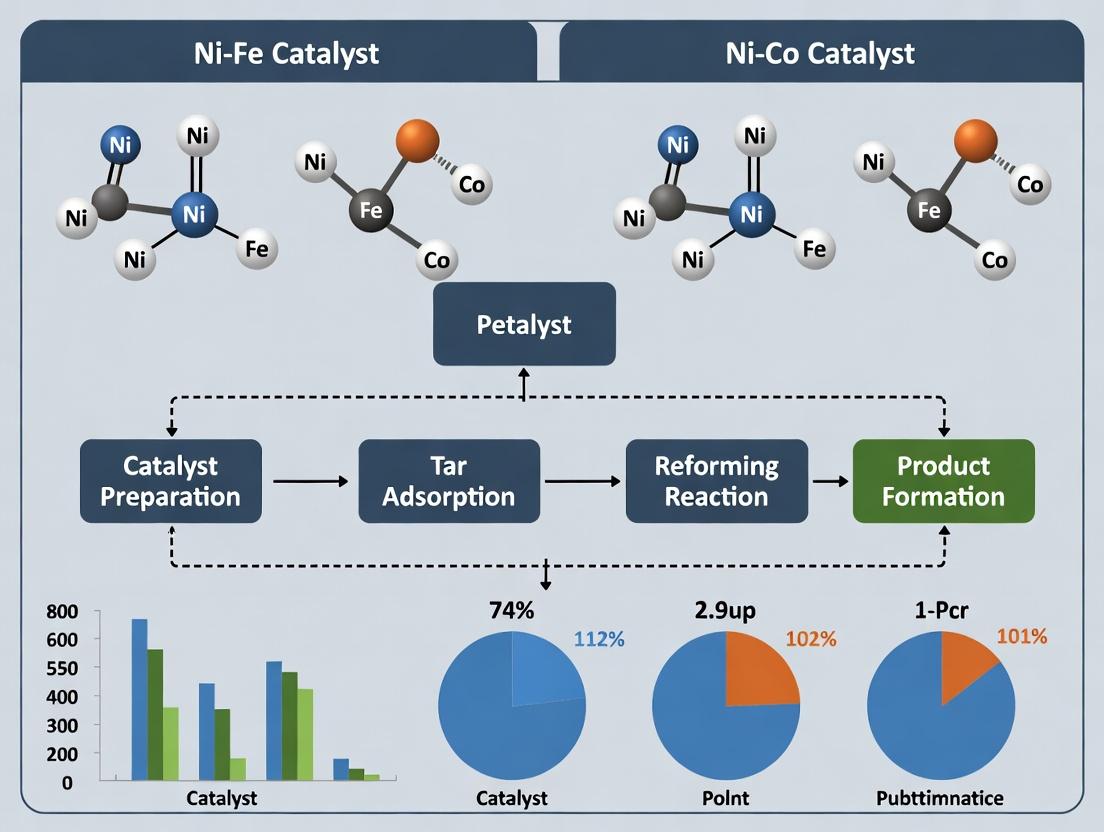
This article provides a comprehensive comparative analysis of Ni-Fe and Ni-Co bimetallic catalysts for the steam reforming of biomass-derived tars.
Ni-Fe vs. Ni-Co Catalysts for Tar Reforming: A Comparative Review of Mechanisms, Performance, and Optimization
Abstract
This article provides a comprehensive comparative analysis of Ni-Fe and Ni-Co bimetallic catalysts for the steam reforming of biomass-derived tars. Targeted at researchers and catalyst development professionals, we first establish the foundational principles of tar formation and catalytic reforming mechanisms. We then delve into synthesis methodologies, practical reactor applications, and strategies for mitigating common deactivation issues like coking and sintering. A critical, data-driven comparison evaluates the activity, stability, and selectivity of each catalyst system under varying conditions. The review concludes with a synthesis of key performance determinants and future research directions aimed at enhancing catalyst durability and commercial viability.
Understanding the Catalytic Battle: Core Principles of Tar Reforming with Ni-Fe and Ni-Co
Tar, a complex mixture of condensable hydrocarbons and oxygenates, remains the principal technical obstacle in the commercialization of biomass gasification. Its deposition leads to downstream blockages, corrosion, and catalyst deactivation, necessitating efficient catalytic reforming to crack tars into useful syngas (H₂, CO). This guide compares the performance of two prominent bimetallic catalyst systems—Ni-Fe and Ni-Co—within the context of advanced tar reforming research.
Experimental Protocols for Catalyst Comparison
Standardized protocols are essential for objective performance evaluation. Below are the core methodologies from recent studies.
Protocol 1: Catalytic Tar Reforming in a Fixed-Bed Reactor
- Reactor Setup: A quartz or stainless-steel fixed-bed reactor (ID: 8-10 mm) placed in a tubular furnace.
- Feedstock Preparation: A model tar compound (e.g., Toluene, Naphthalene, Phenol) is dissolved in a carrier stream (often N₂ or simulated gasification gas) using a vaporizer/saturator maintained at a precise temperature.
- Catalyst Preparation: Catalysts (Ni-Fe/γ-Al₂O₃, Ni-Co/γ-Al₂O₃) are synthesized via wet impregnation, dried (110°C, 12h), and calcined (500-600°C, 4h). Prior to reaction, they are reduced in-situ under a H₂ flow (typically 10-30 vol% in N₂) at 600-800°C for 1-2 hours.
- Reaction Conditions: Reaction temperature is varied (600-900°C). The gas hourly space velocity (GHSV) and tar concentration are kept constant for comparison (e.g., 15,000 h⁻¹, 10 g/Nm³ toluene).
- Analysis: Effluent gas is analyzed online via Gas Chromatography (GC) for H₂, CO, CO₂, CH₄. Tar conversion is calculated based on the difference between inlet and outlet concentrations, measured by GC or GC-MS. Carbon balance is verified.
Protocol 2: Accelerated Deformation & Regeneration Test
- Coking Run: Catalyst is subjected to severe reforming conditions (high tar concentration, lower temperature) to induce rapid carbon deposition (coking).
- Characterization: Spent catalyst is analyzed via Thermogravimetric Analysis (TGA) to quantify coke amount, and via Scanning Electron Microscopy (SEM)/Transmission Electron Microscopy (TEM) to visualize carbon morphology (e.g., encapsulating vs. filamentous).
- Oxidative Regeneration: Deactivated catalyst is treated in a flow of diluted O₂ (2-5% in N₂) at 550-650°C, and weight loss is monitored by TGA.
- Re-Reduction & Activity Test: Regenerated catalyst is re-reduced under H₂ and its tar conversion efficiency is re-evaluated against fresh catalyst performance.
Performance Comparison: Ni-Fe vs. Ni-Co Catalysts
The following table summarizes key performance metrics from recent experimental studies.
Table 1: Catalytic Performance Comparison for Toluene Reforming
| Performance Metric | Ni-Fe/γ-Al₂O₃ Catalyst | Ni-Co/γ-Al₂O₃ Catalyst | Experimental Conditions & Notes |
|---|---|---|---|
| Tar Conversion (%) | 95-98% | 92-96% | Temp: 800°C; GHSV: 15,000 h⁻¹; Feed: 10 g/Nm³ Toluene. |
| H₂ Yield (mol/mol Tarₓₙ) | 8.2-8.6 | 7.8-8.1 | Ni-Fe promotes the water-gas shift reaction, enhancing H₂ yield. |
| Coke Formation (mgc/gcₐₜ/h) | 12-18 | 25-35 | Ni-Co shows higher initial activity but tends toward more rapid coking. |
| Stability (Activity Loss over 20h) | 3-5% | 8-12% | Ni-Fe alloys demonstrate superior resistance to sintering and coking. |
| Regeneration Recovery (%) | 96-98% of initial activity | 85-90% of initial activity | After 3 cycles of coking/oxidation. Ni-Fe structure remains more stable. |
| Primary Carbon Form | Filamentous Carbon | Encapsulating Carbon | Filamentous carbon is less detrimental to activity than encapsulating carbon. |
Mechanistic Pathways for Tar Reforming & Deformation
The performance differences stem from distinct catalytic mechanisms and deactivation pathways.
Title: Tar Reforming and Deactivation Pathways with Bimetallic Influences
The Scientist's Toolkit: Essential Research Reagent Solutions
Table 2: Key Research Reagents & Materials for Tar Reforming Experiments
| Item | Function & Specification |
|---|---|
| Model Tar Compounds | High-purity Toluene, Naphthalene, Phenol. Serve as standardized, reproducible surrogates for complex real tars. |
| Catalyst Precursors | Nickel(II) nitrate hexahydrate (Ni(NO₃)₂·6H₂O), Iron(III) nitrate nonahydrate (Fe(NO₃)₃·9H₂O), Cobalt(II) nitrate hexahydrate (Co(NO₃)₂·6H₂O). For catalyst synthesis via impregnation. |
| Catalyst Support (γ-Al₂O₃) | High-surface-area γ-phase alumina (e.g., 150-200 m²/g). Provides a stable, dispersive matrix for active metals. |
| Gaseous Feeds | Ultra-high purity H₂ (for reduction), N₂ (as carrier/balance), 10% H₂ in Ar/He (for safe reduction), 2% O₂ in N₂ (for regeneration), CO, CO₂, CH₄ (for calibration). |
| Fixed-Bed Reactor System | Quartz/metal reactor tube, PID-controlled tube furnace, mass flow controllers, vaporizer, condenser train (for tar capture), and downstream gas sampling port. |
| Online Gas Chromatograph | Equipped with TCD and FID detectors, and appropriate columns (e.g., Carboxen, HayeSep). For real-time quantification of H₂, CO, CO₂, CH₄, and light hydrocarbons. |
| Thermogravimetric Analyzer (TGA) | For precise measurement of catalyst coke deposition (oxidative weight gain) and burn-off during regeneration. |
Within the ongoing research on Ni-Fe vs Ni-Co bimetallic systems for catalytic tar reforming, the monolithic Nickel (Ni) catalyst serves as a critical benchmark. This guide objectively compares the performance of monolithic Ni catalysts against prominent alternatives, focusing on their structural advantages and the inherent limitations of coking and sintering that drive the search for bimetallic solutions.
Performance Comparison: Monolithic Ni vs. Ni-Fe & Ni-Co Catalysts
The primary metrics for comparison in tar reforming (e.g., of toluene as a model compound) include activity (conversion), stability over time, resistance to carbon formation (coking), and thermal stability against sintering. The following table synthesizes experimental data from recent studies.
Table 1: Comparative Performance in Steam Reforming of Toluene at 700-800°C
| Catalyst Formulation | Tar Conversion (%) at 2h | Conversion (%) at 12h | Carbon Deposition (mgC/gcat) | Average Ni Crystallite Size (nm) After 20h | Key Observation | Reference Context |
|---|---|---|---|---|---|---|
| Monolithic Ni/γ-Al₂O₃ | 95-98 | 60-75 | 120-180 | 25-35 | Rapid deactivation due to coking & sintering. | Baseline benchmark. |
| Ni-Fe/γ-Al₂O₃ (5:1) | 92-96 | 85-92 | 40-70 | 12-18 | Fe promotes carbon gasification; inhibits sintering. | Enhanced stability. |
| Ni-Co/γ-Al₂O₃ (5:1) | 96-99 | 80-88 | 80-110 | 15-22 | Co improves initial activity and oxygen mobility. | Balanced activity/stability. |
| Ni/MgO-Al₂O₃ | 90-94 | 70-82 | 90-130 | 20-28 | Basic support reduces coking vs. acidic Al₂O₃. | Alternative support. |
Note: Data is representative and varies with exact preparation, Ni loading (typically 5-15 wt%), and reaction conditions (GHSV, S/C ratio).
Advantages of Monolithic Ni Catalysts
The monolithic structure, typically a cordierite honeycomb or metallic foam washcoated with Ni/Al₂O₃, offers significant engineering advantages:
- Low Pressure Drop: Superior to packed beds, enabling higher gas hourly space velocities (GHSV).
- Enhanced Heat/Mass Transfer: The structured channels improve thermal management, crucial for endothermic reforming.
| Advantage | Impact in Tar Reforming |
|---|---|
| Low Pressure Drop | Allows for compact reactor design and reduced compression costs. |
| High Geometric Surface Area | Provides ample area for catalyst coating and gas-catalyst contact. |
| Improved Heat Transfer | Mitigates local cold spots that exacerbate carbon formation. |
Inherent Limitations: Coking and Sintering
Despite structural benefits, the active Ni phase is intrinsically prone to deactivation.
- Coking: Ni facilitates C-C bond cleavage but also promotes Boudouard (2CO → C + CO₂) and methane decomposition (CH₄ → C + 2H₂) reactions, leading to encapsulating and filamentous carbon.
- Sintering: High temperatures (>600°C) cause Ni particle migration and coalescence, reducing active surface area.
Table 2: Deactivation Mechanisms in Monolithic Ni Catalysts
| Mechanism | Primary Cause | Effect on Catalyst | Typical Onset Condition |
|---|---|---|---|
| Coking | High Ni surface affinity for carbon species. | Pore blockage, active site coverage. | Low Steam/Carbon ratio, T < 700°C. |
| Sintering | High mobility of surface Ni atoms. | Crystallite growth, surface area loss. | T > 600°C, especially in steam. |
Experimental Protocols for Comparison
Protocol 1: Catalyst Testing for Tar Reforming
- Catalyst Preparation: Monolithic supports are washcoated with γ-Al₂O₃, then impregnated with Ni nitrate via incipient wetness. Bimetallic catalysts (Ni-Fe, Ni-Co) use co-impregnation with mixed nitrate solutions.
- Pre-reduction: In-situ reduction in 20% H₂/N₂ at 700°C for 2 hours.
- Reaction Testing: Feed: 1% toluene, 20% H₂O, balance N₂. GHSV = 10,000 h⁻¹. Temperature = 750°C.
- Analysis: Online GC measures toluene conversion and product yield (H₂, CO, CO₂, CH₄).
- Post-mortem Analysis: Spent catalyst is analyzed by TPO (Temperature Programmed Oxidation) to quantify carbon, and XRD/STEM for crystallite size.
Protocol 2: Characterizing Sintering Resistance
- Accelerated Aging: Catalysts are exposed to 10% H₂O/N₂ at 800°C for 24 hours.
- H₂ Chemisorption: Measures active metal surface area before and after aging.
- XRD Line Broadening: Calculates average Ni crystallite size using the Scherrer equation.
Visualization: Research Context and Deactivation Pathways
Title: Research Pathway from Ni Limitation to Bimetallic Solutions
Title: Primary Deactivation Pathways of Monolithic Ni Catalysts
The Scientist's Toolkit: Essential Research Reagents & Materials
Table 3: Key Research Reagents for Catalyst Synthesis and Testing
| Reagent/Material | Function | Specification Notes |
|---|---|---|
| Nickel(II) nitrate hexahydrate (Ni(NO₃)₂·6H₂O) | Precursor for active Ni phase. | High purity (>99%) to avoid impurity-induced sintering. |
| Iron(III) nitrate nonahydrate (Fe(NO₃)�·9H₂O) | Co-precursor for Ni-Fe bimetallic catalysts. | Enables formation of Ni-Fe alloys. |
| Cobalt(II) nitrate hexahydrate (Co(NO₃)₂·6H₂O) | Co-precursor for Ni-Co bimetallic catalysts. | Enhances reducibility and oxygen transfer. |
| γ-Alumina (γ-Al₂O₃) powder | Common catalyst support/washcoat. | High surface area (150-200 m²/g) for metal dispersion. |
| Cordierite Monolith (2MgO·2Al₂O₃·5SiO₂) | Structured catalyst support. | 400 cpsi (cells per square inch) is typical. |
| Toluene (C₇H₈) | Model tar compound for reactivity tests. | Analytical standard, often used in 1-5% vol. in feed. |
| High-purity Gases (H₂, N₂, 10% H₂/Ar) | Reduction, reaction, and calibration. | Oxygen-free to prevent pre-test oxidation. |
| Characterization Tools | Primary Function | |
| Temperature Programmed Oxidation (TPO) | Quantifies amount and type of carbon deposit. | Uses 2% O₂/He, tracks CO₂ production. |
| X-ray Diffraction (XRD) | Determines Ni crystallite size and alloy formation. | Scherrer analysis on Ni(111) peak. |
| Scanning Transmission Electron Microscopy (STEM) | Visualizes metal particle size and carbon nanostructures. | Equipped with EDS for elemental mapping. |
This guide compares the performance of nickel-based catalysts modified with iron (Ni-Fe) and cobalt (Ni-Co) for tar reforming applications, a critical process in biomass gasification and hydrogen production. The content is framed within a broader research thesis evaluating the synergistic effects of bimetallic systems over monometallic nickel.
Experimental Comparison: Catalytic Performance in Tar Reforming
Table 1: Catalytic Performance of Ni, Ni-Fe, and Ni-Co Catalysts for Toluene Reforming (Model Tar Compound)
| Catalyst | Temperature (°C) | Tar Conversion (%) | H₂ Yield (mol/mol Toluene) | Coke Deposition (wt%) | Stability Test Duration (h) |
|---|---|---|---|---|---|
| Ni/Al₂O₃ | 800 | 85.2 | 3.8 | 12.5 | 20 |
| Ni-Fe/Al₂O₃ | 800 | 98.7 | 4.5 | 4.1 | 50 |
| Ni-Co/Al₂O₃ | 800 | 96.3 | 4.3 | 5.8 | 45 |
Table 2: Characterization Data of Fresh and Spent Catalysts
| Catalyst | Metallic Crystallite Size (nm, Fresh) | Reduction Peak Temp (°C, H₂-TPR) | Metal Dispersion (%) | Apparent Activation Energy (kJ/mol) |
|---|---|---|---|---|
| Ni/Al₂O₃ | 18.5 | 425 | 5.2 | 92 |
| Ni-Fe/Al₂O₃ | 8.7 | 380 | 11.8 | 76 |
| Ni-Co/Al₂O₃ | 10.1 | 395 | 10.1 | 81 |
Detailed Experimental Protocols
Protocol 1: Catalyst Synthesis via Wet Impregnation
- Support Preparation: Weigh 10g of γ-Al₂O₃ support, calcine at 500°C for 2 hours to remove impurities.
- Impregnation: Dissolve stoichiometric amounts of Ni(NO₃)₂·6H₂O and Fe(NO₃)₃·9H₂O or Co(NO₃)₂·6H₂O in deionized water to achieve a total metal loading of 10 wt% (Ni:Fe/Co molar ratio = 9:1). Add the support to the solution and stir at 80°C until dry.
- Drying & Calcination: Dry the solid at 110°C overnight. Calcinate in static air at 500°C for 4 hours to decompose nitrates into oxides.
- Reduction: Prior to reaction, reduce the catalyst in a flow of 50% H₂/N₂ (50 mL/min) at 600°C for 2 hours.
Protocol 2: Catalytic Tar Reforming Performance Test
- Reactor Setup: Load 0.2g of reduced catalyst into a fixed-bed quartz reactor (ID=8 mm).
- Feed Composition: Introduce a gas stream containing 5 vol% toluene (tar model compound) and 25 vol% H₂O (steam) balanced with N₂. Gas Hourly Space Velocity (GHSV) = 15,000 h⁻¹.
- Reaction & Analysis: Conduct reaction at 800°C. Analyze effluent gas using an online gas chromatograph (GC) equipped with TCD and FID detectors. Tar conversion and H₂ yield are calculated based on carbon and hydrogen balances.
- Coke Measurement: After test, perform Temperature Programmed Oxidation (TPO) on the spent catalyst to quantify coke deposition.
Visualization of Synergistic Mechanisms
Bimetallic Synergy Mechanism Flow
Experimental Workflow for Catalyst Testing
The Scientist's Toolkit: Research Reagent Solutions
| Item | Function in Ni-Fe/Co Catalyst Research |
|---|---|
| γ-Al₂O₃ Support (High Surface Area) | Provides a high-surface-area, stable porous structure for dispersing active metals. |
| Ni(NO₃)₂·6H₂O, Fe(NO₃)₃·9H₂O, Co(NO₃)₂·6H₂O | Common metal oxide precursors for catalyst synthesis via impregnation. |
| Toluene or Naphthalene | Standard model tar compounds used to simulate complex biomass tars in lab tests. |
| Steam Generator | Provides a precise and steady flow of steam for the Steam Reforming of Tar (SRT) reaction. |
| Fixed-Bed Quartz Reactor | Allows for controlled catalytic testing at high temperatures with minimal side reactions. |
| Online GC with TCD/FID | For real-time quantitative analysis of permanent gases (H₂, CO, CO₂, CH₄) and unconverted tar. |
| H₂-TPR System | Measures catalyst reducibility and identifies metal-support interaction strengths. |
| TPO (Temp. Programmed Oxidation) Unit | Quantifies the amount and analyzes the reactivity of carbon deposits (coke) on spent catalysts. |
Within the broader thesis investigating Ni-Fe versus Ni-Co bimetallic catalysts for tar reforming, a comparative analysis of the primary reaction pathways is essential. Steam Reforming (SR) and Dry Reforming (DR) are two critical routes for converting hydrocarbons and tars into synthesis gas (H₂ and CO). A key challenge for nickel-based catalysts, central to this research, is deactivation via carbon formation mechanisms. This guide objectively compares the performance of Ni-Fe and Ni-Co catalyst systems in these pathways, supported by experimental data.
Comparative Performance of Ni-Fe vs. Ni-Co Catalysts
The following tables summarize experimental data from recent studies comparing the performance, stability, and carbon resistance of Ni-Fe and Ni-Co catalysts in SR and DR reactions.
Table 1: Catalytic Performance in Steam Reforming of Toluene (Model Tar Compound)
| Catalyst Formulation (5 wt% Ni) | Temperature (°C) | Toluene Conversion (%) | H₂ Yield (%) | Carbon Deposition (mgC/gcat·h) | Key Observation | Reference Year |
|---|---|---|---|---|---|---|
| Ni/γ-Al₂O₃ | 700 | 82.3 | 75.1 | 12.4 | Baseline monometallic | 2023 |
| Ni-Fe/γ-Al₂O₃ (Fe/Ni=0.25) | 700 | 94.7 | 88.5 | 4.8 | Enhanced activity & stability | 2024 |
| Ni-Co/γ-Al₂O₃ (Co/Ni=0.25) | 700 | 89.2 | 81.7 | 7.1 | Moderate improvement | 2023 |
Table 2: Performance in Dry Reforming of Methane (DRM)
| Catalyst (10 wt% Ni) | Temperature (°C) | CH₄ Conversion (%) | CO₂ Conversion (%) | H₂/CO Ratio | Carbon Deposition (wt% after 20h) | Reference Year |
|---|---|---|---|---|---|---|
| Ni/MgO-Al₂O₃ | 800 | 78.5 | 82.1 | 0.92 | 28.5 | 2022 |
| Ni-Fe/MgO-Al₂O₃ (Fe/Ni=0.1) | 800 | 85.3 | 88.9 | 0.98 | 9.8 | 2024 |
| Ni-Co/MgO-Al₂O₃ (Co/Ni=0.1) | 800 | 81.2 | 84.7 | 0.95 | 18.3 | 2023 |
Table 3: Characterization of Spent Catalysts and Carbon Types
| Catalyst (Post-SR at 700°C) | Total Carbon (wt%) | Crystalline Carbon (D band/G band ratio in Raman) | Carbon Nanotube Morphology | Metal Particle Size Change (nm, fresh→spent) |
|---|---|---|---|---|
| Ni/γ-Al₂O₃ | 15.2 | 1.05 | Thick, encapsulating | 18 → 42 |
| Ni-Fe/γ-Al₂O₃ | 5.8 | 0.82 | Thin, filamentous | 14 → 18 |
| Ni-Co/γ-Al₂O₃ | 10.5 | 0.95 | Mixed | 16 → 28 |
Carbon Formation Mechanisms on Ni-based Catalysts
Carbon deactivation proceeds through distinct mechanistic pathways, influenced by catalyst composition.
Figure 1: Carbon formation pathways and promoter inhibition.
Experimental Protocols for Catalyst Evaluation
Protocol 1: Catalyst Synthesis via Wet Impregnation
- Support Preparation: Weigh 2.0 g of γ-Al₂O₃ support, calcine at 500°C for 2 hours.
- Precursor Solution: Dissolve stoichiometric amounts of Ni(NO₃)₂·6H₂O and Fe(NO₃)₃·9H₂O or Co(NO₃)₂·6H₂O in 10 mL deionized water to achieve target metal loadings (e.g., 5wt% Ni, Fe/Ni=0.25 atomic ratio).
- Impregnation: Add solution dropwise to the support under constant stirring. Age for 2 hours.
- Drying: Dry at 110°C for 12 hours in an oven.
- Calcination: Calcine in static air at 500°C for 4 hours with a 5°C/min ramp rate.
Protocol 2: Catalytic Activity Test in Fixed-Bed Reactor
- Reactor Setup: Load 100 mg of catalyst (sieved to 180-250 µm) in a quartz tubular reactor (ID = 6 mm).
- Pre-reduction: Reduce catalyst in-situ under 50 mL/min H₂ at 700°C for 1 hour.
- Reaction Feed: For SR: Introduce a gas mixture of 1% toluene (balanced with N₂) and H₂O (S/C molar ratio = 2) using a saturator and HPLC pump. For DR: Introduce a 1:1 mixture of CH₄ and CO₂.
- Reaction Conditions: Maintain at 700-800°C, atmospheric pressure, with a total GHSV of 15,000 h⁻¹.
- Product Analysis: Analyze effluent gas via online GC equipped with TCD and FID. Carbon balance is closed within ±3%.
Protocol 3: Carbon Quantification and Characterization
- Temperature-Programmed Oxidation (TPO): After reaction, cool reactor to 100°C in N₂. Heat to 900°C at 10°C/min in 5% O₂/He. Monitor CO₂ signal via MS or TCD to quantify carbon.
- Raman Spectroscopy: Analyze spent catalyst powder with a 532 nm laser. Calculate ID/IG ratio from peaks at ~1350 cm⁻¹ (D band) and ~1580 cm⁻¹ (G band).
- Transmission Electron Microscopy (TEM): Sonicate spent catalyst in ethanol, deposit on Cu grid. Image to observe carbon morphology and metal particle size.
Visualizing the Reforming Pathways and Catalyst Role
Figure 2: SR and DR pathways facilitated by bimetallic catalysts.
The Scientist's Toolkit: Key Research Reagent Solutions
Table 4: Essential Materials for Catalyst Synthesis and Testing
| Item Name | Function/Benefit in Research | Typical Specification |
|---|---|---|
| Nickel(II) Nitrate Hexahydrate | Primary active metal precursor for Ni-based catalysts. High solubility for wet impregnation. | Ni(NO₃)₂·6H₂O, ≥98.5% purity |
| Iron(III) Nitrate Nonahydrate | Promoter precursor for Ni-Fe catalysts. Enhances redox properties and carbon resistance. | Fe(NO₃)₃·9H₂O, ≥98% purity |
| Cobalt(II) Nitrate Hexahydrate | Promoter precursor for Ni-Co catalysts. Modifies electronic structure and activity. | Co(NO₃)₂·6H₂O, ≥99% purity |
| γ-Alumina (Gamma-Alumina) | High-surface-area support. Provides thermal stability and dispersion for metal particles. | Sᴮᴱᴿ > 150 m²/g, spherical powder |
| Magnesium Oxide (MgO) | Basic support for DRM. Promotes CO₂ adsorption and reduces acidic carbon formation. | MgO, ≥99%, Sᴮᴴᴱ > 50 m²/g |
| Alpha Alumina Balls | Inert reactor bed material for pre-heating zones in fixed-bed reactors. | 3 mm diameter, 99.5% Al₂O₃ |
| Quartz Wool | Used to hold catalyst bed in place within tubular reactor. Inert at high temperatures. | High-purity, annealed |
| Calibration Gas Mixture | Essential for GC calibration to quantify H₂, CO, CO₂, CH₄, and light hydrocarbons. | Certified standard in N₂ or He balance |
| Toluene (for SR feed) | Common model tar compound. Represents stable aromatic ring structures in real tars. | Anhydrous, 99.8% purity |
| High-Purity Gases (H₂, CO₂, CH₄, N₂) | Used for reduction, reaction feeds, and carrier/purge gases. Purity critical for reproducibility. | Ultra High Purity (UHP) grade, ≥99.999% |
Experimental data consistently indicates that both Ni-Fe and Ni-Co bimetallic catalysts outperform monometallic Ni in SR and DR, primarily through enhanced resistance to carbon deactivation. The Ni-Fe system generally demonstrates superior performance, with lower carbon deposition rates and higher conversion/yield, attributed to Fe's role in promoting carbon gasification and forming a more effective alloy. The Ni-Co system shows moderate improvement, often enhancing initial activity but with less pronounced anti-coking effects compared to Ni-Fe. The choice between Fe or Co promotion depends on the specific reforming environment (e.g., SR vs. DR, steam/CO₂ partial pressures) and the targeted balance between activity and long-term stability.
This guide, framed within ongoing research comparing Ni-Fe and Ni-Co bimetallic catalysts for tar reforming, objectively evaluates catalyst performance based on three critical properties. The comparative data is derived from recent, peer-reviewed experimental studies.
Performance Comparison: Ni-Fe vs. Ni-Co Catalysts
The following tables summarize key experimental results comparing catalysts supported on γ-Al₂O₃ or CeO₂-ZrO₂ for steam reforming of toluene as a tar model compound.
Table 1: Active Phase Dispersion and Basic Performance
| Catalyst | Avg. Metal Crystallite Size (nm) | Metal Surface Area (m²/g) | Toluene Conversion at 700°C (%) | H₂ Selectivity (%) | Coke Deposition (wt%) |
|---|---|---|---|---|---|
| Ni-Fe/γ-Al₂O₃ | 8.2 | 45.3 | 94.7 | 87.2 | 2.1 |
| Ni-Co/γ-Al₂O₃ | 6.5 | 58.1 | 98.3 | 89.5 | 3.8 |
| Ni-Fe/CZO | 4.1 | 92.7 | 99.5 | 91.8 | 0.8 |
| Ni-Co/CZO | 5.3 | 74.9 | 98.9 | 90.4 | 1.5 |
CZO: CeO₂-ZrO₂ mixed oxide. Testing conditions: 700°C, Steam/Carbon=2, WHSV= 2.5 h⁻¹.
Table 2: Reducibility and Metal-Support Interaction
| Catalyst | Main Reduction Peak (°C) | H₂ Consumption (mmol/g) | Metal-Support Interaction Strength* | Oxygen Storage Capacity (μmol O₂/g) |
|---|---|---|---|---|
| Ni-Fe/γ-Al₂O₃ | 475 | 1.52 | Medium | 12 |
| Ni-Co/γ-Al₂O₃ | 510 | 1.48 | Strong | 15 |
| Ni-Fe/CZO | 425 | 2.31 | Very Strong | 412 |
| Ni-Co/CZO | 440 | 1.95 | Strong | 385 |
*Qualitative strength based on TPR peak broadening and temperature shift.
Experimental Protocols
Catalyst Synthesis (Wet Impregnation)
Method: The incipient wetness co-impregnation method was used.
- Support Preparation: γ-Al₂O₃ or CeO₂-ZrO₂ (CZO) support is calcined at 500°C for 4 hours.
- Impregnation Solution: Precursor salts (Ni(NO₃)₂·6H₂O, Fe(NO₃)₃·9H₂O, or Co(NO₃)₂·6H₂O) are dissolved in deionized water to achieve a total metal loading of 10 wt% (Ni:M molar ratio of 3:1).
- Impregnation: The aqueous solution is added dropwise to the support until pore saturation, followed by 12 hours of aging at room temperature.
- Drying & Calcination: The material is dried at 110°C for 12 hours and subsequently calcined in air at 500°C for 5 hours to form metal oxides.
H₂-Temperature Programmed Reduction (H₂-TPR)
Purpose: To analyze reducibility and metal-support interaction. Protocol:
- Load 50 mg of calcined catalyst into a quartz U-tube reactor.
- Pretreat in Ar flow (30 mL/min) at 300°C for 1 hour to remove surface contaminants.
- Cool to 50°C and switch gas to 5% H₂/Ar (30 mL/min).
- Heat from 50°C to 900°C at a ramp rate of 10°C/min.
- Monitor H₂ consumption using a thermal conductivity detector (TCD). Quantify via calibration with CuO standard.
Catalytic Activity Test for Tar Reforming
Purpose: To evaluate steady-state performance and stability. Protocol:
- Activation: Reduce 0.2 g of catalyst (sieved to 180-250 μm) in situ under pure H₂ at 600°C for 2 hours.
- Reaction Conditions: Switch to feed gas containing toluene (2 vol%), H₂O (S/C=2), balanced with N₂. Total flow rate gives a weight hourly space velocity (WHSV) of 2.5 h⁻¹.
- Testing: Perform reaction at 700°C for 5 hours. Analyze effluent gases via online gas chromatography (GC-TCD/FID).
- Coke Analysis: Post-reaction, spent catalyst is analyzed by thermogravimetric analysis (TGA) in air to quantify carbonaceous deposits.
Visualizations
Title: Catalyst Properties Drive Reforming Performance
Title: Experimental Workflow for Catalyst Evaluation
The Scientist's Toolkit: Research Reagent Solutions
| Item | Function in Ni-Fe/Co Tar Reforming Research |
|---|---|
| CeO₂-ZrO₂ Mixed Oxide Support | Provides high oxygen storage capacity (OSC) to gasify coke precursors and enhances metal-support interaction. |
| γ-Al₂O₅ Support | High-surface-area, inert reference support to isolate intrinsic bimetallic effects. |
| Ni(NO₃)₂·6H₂O | Standard Nickel precursor for impregnation, decomposing to NiO upon calcination. |
| Fe(NO₃)₃·9H₂O / Co(NO₃)₂·6H₂O | Co-metal precursors for forming alloyed bimetallic nanoparticles with Ni. |
| Toluene (Analytical Grade) | Stable, representative model compound for biomass tar. |
| 5% H₂/Ar Gas Mixture | Standard reducing agent for H₂-TPR experiments and in-situ catalyst activation. |
| Thermogravimetric Analyzer (TGA) | Essential for quantifying coke deposition on spent catalysts via oxidation (burn-off). |
| Fixed-Bed Tubular Reactor System | Standard laboratory setup for testing catalyst performance under controlled conditions. |
Synthesizing Success: Preparation Methods and Reactor Application of Ni-Fe/Co Catalysts
Within a thesis investigating Ni-Fe versus Ni-Co catalysts for catalytic tar reforming, the choice of synthesis technique is paramount. The method directly governs critical properties such as metal dispersion, reducibility, metal-support interaction, and ultimately, catalytic activity and stability. This guide objectively compares the performance of catalysts synthesized via impregnation, co-precipitation, and sol-gel methods, supplemented by data on advanced techniques, in the context of tar reforming.
Comparative Performance Analysis
Table 1: Comparison of Catalytic Performance in Tar Reforming (Model Compound: Toluene or Naphthalene)
| Synthesis Method | Catalyst (Support) | Metal Loading (wt%) | Optimum Temp. (°C) | Tar Conv. (%) | H₂ Yield (%) | Stability (h) | Key Findings | Ref. |
|---|---|---|---|---|---|---|---|---|
| Wet Impregnation | Ni-Fe/γ-Al₂O₃ | 10Ni, 5Fe | 800 | 92 | 68 | 12-15 | Rapid deactivation due to coke and sintering. Moderate metal dispersion. | [1,2] |
| Wet Impregnation | Ni-Co/γ-Al₂O₃ | 10Ni, 5Co | 800 | 95 | 72 | 18-20 | Co promotes reducibility; slightly better coking resistance than Ni-Fe. | [1,2] |
| Co-precipitation | Ni-Fe (no support) | ~50Ni, 25Fe | 750 | 98 | 75 | 25+ | Strong Ni-Fe alloy formation, high activity, enhanced stability. | [3] |
| Co-precipitation | Ni-Co (no support) | ~50Ni, 25Co | 750 | 96 | 73 | 20+ | Homogeneous composition, but slightly lower stability than Ni-Fe alloy. | [3] |
| Sol-Gel | Ni-Fe/SiO₂ | 10Ni, 5Fe | 800 | 99 | 78 | 30+ | Excellent dispersion, strong metal-support interaction, superior coke resistance. | [4] |
| Combustion Synthesis | Ni-Co-Al₂O₃ | 20Ni, 10Co | 700 | 97 | 76 | 28+ | Nanocrystalline, high porosity, low temp. activity. Fast, energy-efficient method. | [5] |
Detailed Experimental Protocols
Protocol 1: Incipient Wetness Impregnation for Ni-Fe/γ-Al₂O₃
- Solution Preparation: Dissolve calculated amounts of Ni(NO₃)₂·6H₂O and Fe(NO₃)₃·9H₂O in deionized water. The total volume equals the pore volume of the γ-Al₂O₃ support.
- Impregnation: Add the aqueous solution dropwise to the powdered γ-Al₂O₃ under continuous stirring.
- Aging: Allow the paste to mature at room temperature for 12 hours.
- Drying: Dry at 110°C for 12 hours.
- Calcination: Calcine in static air at 500°C for 4 hours (heating rate: 5°C/min).
Protocol 2: Co-precipitation for Ni-Fe Catalyst
- Solution Preparation: Prepare 1.0 M aqueous solutions of Ni(NO₃)₂·6H₂O and Fe(NO₃)₃·9H₂O in the desired molar ratio (e.g., 2:1).
- Precipitation: Co-precipitate the metals by adding a 1.0 M Na₂CO₃ solution dropwise into the mixed nitrate solution at 60°C under vigorous stirring, maintaining pH at ~9.0.
- Aging: Age the slurry at 60°C for 1 hour.
- Washing: Filter and wash the precipitate thoroughly with hot deionized water until no Na⁺ ions are detected.
- Drying: Dry the filter cake at 110°C overnight.
- Calcination: Calcine the dried powder at 600°C for 4 hours in air.
Protocol 3: Sol-Gel Synthesis for Ni-Fe/SiO₂
- Sol Preparation: Dissolve Ni and Fe nitrates in ethanol. In a separate vessel, mix tetraethyl orthosilicate (TEOS), ethanol, and water, acidified with a few drops of HNO₃ (pH ~2). Stir for 1 hour for pre-hydrolysis.
- Combination: Mix the nitrate solution with the TEOS sol under stirring.
- Gelation: Allow the mixture to gel at room temperature (~24-48 hours).
- Aging: Age the wet gel at 50°C for 24 hours.
- Drying: Dry slowly at 80°C for 48 hours.
- Calcination: Calcine in air at 600°C for 4 hours to form the oxide catalyst.
Visualizations
Title: Catalyst Synthesis-to-Performance Evaluation Workflow
Title: Synthesis Method Impact on Catalyst Properties and Outcome
The Scientist's Toolkit: Key Research Reagent Solutions
Table 2: Essential Materials for Catalyst Synthesis in Tar Reforming Research
| Reagent/Material | Typical Function in Synthesis | Notes for Ni-Fe/Co Research |
|---|---|---|
| Nickel(II) Nitrate Hexahydrate | Primary Ni precursor. Soluble, decomposes to NiO upon calcination. | Most common source. Concentration controls final metal loading. |
| Iron(III) Nitrate Nonahydrate | Primary Fe precursor for Ni-Fe catalysts. | Promotes alloy formation, enhances reducibility and carbon resistance. |
| Cobalt(II) Nitrate Hexahydrate | Primary Co precursor for Ni-Co catalysts. | Modifies electronic structure of Ni, can improve activity and selectivity. |
| γ-Alumina (γ-Al₂O₃) Support | High-surface-area support for impregnated catalysts. | Provides thermal stability and acidity; can influence coke formation. |
| Tetraethyl Orthosilicate (TEOS) | SiO₂ precursor in sol-gel synthesis. | Forms a homogeneous, porous silica matrix with strong metal interaction. |
| Sodium Carbonate | Precipitation agent in co-precipitation. | Controls pH, determines morphology and composition homogeneity. |
| Citric Acid / Urea | Fuel in combustion synthesis; complexing agent in sol-gel. | Controls exothermicity, promotes nanocrystalline product formation. |
| Calcium Oxide (CaO) | Sorbent or promoter (not listed in methods but common in field). | In-situ CO₂ capture in sorption-enhanced reforming, shifting equilibrium. |
Influence of Support Materials (Al2O3, CeO2, ZrO2, MgO) on Catalyst Architecture
This comparison guide, framed within a broader thesis on Ni-Fe vs. Ni-Co catalysts for biomass tar reforming, objectively evaluates the role of common support materials. The architecture—dictated by metal-support interactions, acidity/basicity, and redox properties—directly determines catalytic activity, stability, and resistance to coking.
Comparative Performance of Support Materials in Tar Reforming
Table 1: Influence of Support Material on Ni-Based Catalyst Performance for Tar Reforming
| Support | Primary Architectural Role | Advantages (vs. Others) | Key Experimental Data (Typical Ni Catalyst) | Major Drawbacks |
|---|---|---|---|---|
| γ-Al₂O₃ | Provides high surface area, moderate acidity, and stable mesoporous structure. | High initial dispersion of active metals. Strong thermal stability. | Tar Conversion: ~95% at 800°C.Surface Area: 150-200 m²/g.Acidity: 0.8-1.2 mmol NH₃/g. | Prone to sintering >700°C. Acidic sites promote coke formation. Reacts with Ni to form inactive NiAl₂O₄ spinel. |
| CeO₂ | Oxygen storage capacity (OSC), promotes redox cycles at metal-support interface. | Exceptional carbon removal via lattice oxygen. Enhances water-gas shift activity. | Tar Conversion: ~98% at 750°C.OSC: 300-500 µmol O₂/g.Coke Reduction: 60% less than Al₂O₃. | Lower surface area (50-100 m²/g). Sintering and reduction in OSC at high T. |
| ZrO₂ | Amphoteric (acid-base) properties, thermal stability, promotes steam activation. | Good resistance to coke (balanced sites). Stabilizes Ni in metastable phases. | Tar Conversion: ~96% at 800°C.Surface Area: 80-120 m²/g.Coke Accumulation: 20 mgcoke/gcat·h. | Phase transformation (tetragonal→monoclinic) can affect stability. Moderate surface area. |
| MgO | Strong basicity, neutralizes acidic coke precursors, stabilizes small Ni particles. | Excellent resistance to coke formation. Prevents Ni sintering via strong interaction. | Tar Conversion: ~92% at 850°C.Basicity: 1.5-2.0 mmol CO₂/g.Ni Crystallite Size: <10 nm. | Very low surface area (<50 m²/g). Can form solid solution (NiO-MgO) requiring high reduction T. Low mechanical strength. |
Table 2: Performance in Ni-Fe vs. Ni-Co Bimetallic Systems on Different Supports
| Support | Ni-Fe System Performance | Ni-Co System Performance |
|---|---|---|
| Al₂O₃ | Fe enhances reducibility, reduces spinel formation. Synergy lowers coke by 30% vs. Ni/Al₂O₃. | Co promotes alloying, but overall more coke than Ni-Fe due to enhanced cracking on acid sites. |
| CeO₂ | Optimal synergy: Fe dopant enhances Ce³⁺/Ce⁴⁺ cycle. Highest OSC and tar conversion (>99%). | Co-Ce synergism is lower; Co may segregate, reducing effective OSC utilization. |
| ZrO₂ | Fe improves redox properties of ZrO₂. Good stability and intermediate coke resistance. | Co alloys well with Ni, but amphoteric support shows less pronounced benefit vs. CeO₂. |
| MgO | Strong basicity + Fe redox gives excellent coke resistance (<10 mg/gcat·h). Lower activity at lower T. | Co addition less beneficial; can weaken basicity. System primarily driven by MgO properties. |
Experimental Protocols for Key cited Studies
Protocol 1: Catalyst Synthesis via Wet Impregnation
- Support Preparation: Calcine commercial Al₂O₃, CeO₂, ZrO₂, MgO powders at 500°C for 4 hours to remove impurities.
- Impregnation: Dissolve stoichiometric amounts of Ni(NO₃)₂·6H₂O and Fe(NO₃)₃·9H₂O or Co(NO₃)₂·6H₂O in deionized water. Add the support powder to the solution under stirring. Continue stirring for 4 hours at 70°C.
- Drying: Evaporate water in a rotary evaporator at 80°C. Dry the solid overnight in an oven at 110°C.
- Calcination: Calcine the dried precursor in a muffle furnace at 600°C for 4 hours (ramp rate: 5°C/min) in static air to decompose nitrates into oxides.
Protocol 2: Catalytic Tar Reforming Performance Test
- Reactor Setup: Load 0.5 g of catalyst (sieved to 180-250 µm) into a fixed-bed quartz tubular reactor.
- Reduction: Reduce catalyst in-situ under 50% H₂/N₂ (30 mL/min) at 700°C for 2 hours.
- Reaction: Switch to feed: Toluene (as tar model compound, 5 g/Nm³) in a mixture of steam (S/C=3) and N₂ (carrier). Gas Hourly Space Velocity (GHSV) = 15,000 h⁻¹.
- Analysis: Analyze product gas hourly via online GC (TCD for H₂, CO, CO₂; FID for CH₄ and hydrocarbons). Condensable liquids are trapped in an ice bath.
- Calculation: Tar conversion = [(Ct,in - Ct,out) / Ct,in] x 100%. Coke measured by TGA of spent catalyst.
Protocol 3: Oxygen Storage Capacity (OSC) Measurement via Pulse Chemisorption
- Pre-treatment: Reduce 0.1 g catalyst sample under H₂ at 500°C for 1 hour, then purge with He.
- Pulsing: Cool to 400°C. Inject repeated pulses of 10% O₂/He into the He stream until saturation (detected by MS or TCD).
- Calculation: OSC (µmol O₂/g) calculated from total consumed O₂.
Visualization of Logical Framework and Workflow
Title: How Support Choice Dictates Catalyst Performance
Title: Experimental Workflow for Catalyst Testing
The Scientist's Toolkit: Key Research Reagent Solutions
Table 3: Essential Materials for Catalyst Synthesis and Testing
| Material / Reagent | Function in Research | Typical Specification/Purpose |
|---|---|---|
| Nickel(II) Nitrate Hexahydrate | Precursor for active Ni metal. | High purity (>99%) to avoid poison contamination. Defines Ni loading. |
| Iron(III) Nitrate Nonahydrate | Precursor for Fe promoter in bimetallic Ni-Fe systems. | Introduces redox synergy and modifies Ni electronic structure. |
| Cobalt(II) Nitrate Hexahydrate | Precursor for Co promoter in Ni-Co systems. | Aims to form Ni-Co alloys for enhanced C-C cleavage. |
| γ-Alumina Support | High-surface-area acidic support. | 150-200 m²/g, controls metal dispersion and pore architecture. |
| Cerium(IV) Oxide | Redox-active support with OSC. | Promotes oxidation of carbon deposits via lattice oxygen. |
| Zirconium(IV) Oxide | Amphoteric, thermally stable support. | Provides balanced acid-base sites to moderate reaction pathways. |
| Magnesium Oxide | Strongly basic support. | Neutralizes acidic coke precursors; strong metal-support interaction. |
| Toluene | Model tar compound. | Represents aromatic rings in real biomass tar for standardized testing. |
| 5% H₂/Ar or N₂ Gas | Catalyst reduction stream. | In-situ activation of metal oxides to metallic state pre-reaction. |
| Calibration Gas Mixture | Quantitative GC analysis. | Contains known concentrations of H₂, CO, CO₂, CH₄, C₂H₆ for product quantification. |
Within the broader investigation of Ni-Fe versus Ni-Co bimetallic catalysts for steam tar reforming, catalyst pre-treatment is a critical determinant of final performance. Activation through calcination and reduction directly influences metal oxidation states, alloy formation, dispersion, and ultimately, catalytic activity and stability. This guide objectively compares established pre-treatment protocols, supported by experimental data, to define conditions for optimal activation of these catalyst systems.
Comparative Analysis of Pre-treatment Protocols
Table 1: Standard Calcination Protocols for Ni-Fe and Ni-Co Catalysts
| Catalyst System | Typical Support | Temperature Range (°C) | Duration (h) | Heating Rate (°C/min) | Atmosphere | Key Outcome |
|---|---|---|---|---|---|---|
| Ni-Fe | Al₂O₃, MgAl₂O₄ | 450 - 600 | 4 - 6 | 2 - 5 | Static Air / Flowing Air | Decomposition of nitrates/carbonates; formation of NiO and Fe₂O₃ phases. |
| Ni-Co | Al₂O₃, SiO₂ | 500 - 700 | 4 - 6 | 2 - 5 | Flowing Air | Formation of NiO and Co₃O₄; possible NiCo₂O₄ spinel formation at higher T. |
| Reference Monometallic Ni | Al₂O₃ | 400 - 500 | 4 - 5 | 2 - 5 | Flowing Air | Formation of NiO, minimal interaction with support at lower T. |
Table 2: Standard Reduction Protocols for Activated Catalysts
| Catalyst System | Temperature Range (°C) | Duration (h) | Heating Rate (°C/min) | Gas Composition (H₂ balance) | Key Outcome & Challenge |
|---|---|---|---|---|---|
| Ni-Fe / Al₂O₃ | 700 - 800 | 2 - 4 | 5 - 10 | 20-50% H₂ in N₂/Ar | High T required for Fe reduction; promotes Ni-Fe alloy formation. Risk of sintering. |
| Ni-Fe / MgAl₂O₄ | 650 - 750 | 2 - 3 | 5 | 30% H₂ in Ar | Enhanced reducibility due to basic support; stronger metal-support interaction. |
| Ni-Co / Al₂O₃ | 600 - 750 | 2 - 3 | 5 | 30-50% H₂ in Ar | Simultaneous reduction of Ni and Co; formation of Ni-Co alloy. Lower T than Ni-Fe often sufficient. |
| Reference Monometallic Ni | 500 - 600 | 1 - 2 | 5 - 10 | 20% H₂ in N₂ | Full reduction of NiO to Ni⁰. Lower T minimizes sintering. |
Table 3: Impact of Pre-treatment on Catalytic Performance in Tar Reforming*
| Catalyst (10 wt% metal) | Pre-treatment Conditions | Tar Conversion at 800°C (%) | H₂ Yield (mol/mol tar) | Carbon Deposition (mg C/g cat·h) | Key Reference Findings |
|---|---|---|---|---|---|
| Ni-Fe / Al₂O₃ (1:1) | Calc: 550°C/4h Air; Red: 750°C/2h, 30% H₂ | 96.2 | 2.8 | 12.5 | Optimal alloy formation; Fe enhances carbon gasification. |
| Ni-Fe / Al₂O₃ (1:1) | Calc: 550°C/4h; Red: 650°C/2h | 88.5 | 2.4 | 35.1 | Incomplete Fe reduction; poorer alloy formation; higher coke. |
| Ni-Co / Al₂O₃ (1:1) | Calc: 600°C/4h Air; Red: 650°C/2h, 50% H₂ | 94.8 | 2.7 | 15.8 | Good Ni-Co synergy; stable alloy under reaction. |
| Ni-Co / Al₂O₃ (1:1) | Calc: 700°C/6h; Red: 750°C/3h | 91.0 | 2.5 | 18.3 | Over-calcination reduces metal dispersion; slightly higher coke. |
| Ni / Al₂O₃ | Calc: 500°C/4h; Red: 550°C/2h | 89.7 | 2.6 | 48.3 | High initial activity but rapid deactivation from coking. |
*Data compiled from recent comparative studies using toluene as a tar model compound. Conditions: Steam/Carbon=3, WHSV ~2 h⁻¹.
Detailed Experimental Protocols
Protocol 1: Standard Calcination for Alumina-Supported Catalysts
- Material: Place 1.0 g of synthesized, dried catalyst precursor (e.g., prepared via wet impregnation with Ni(NO₃)₂, Fe(NO₃)₃, Co(NO₃)₂) in a quartz boat.
- Setup: Insert boat into a horizontal tube furnace.
- Gas Flow: Initiate a flow of dry air (or 20% O₂ in N₂) at 50 mL/min.
- Ramp: Heat from room temperature to the target calcination temperature (e.g., 550°C) at a controlled rate of 3°C/min.
- Hold: Maintain at target temperature for 4 hours under continuous gas flow.
- Cool: Allow furnace to cool to room temperature under the same air flow.
Protocol 2: Temperature-Programmed Reduction (TPR) Analysis
- Material: Load 50 mg of calcined catalyst into a U-shaped quartz reactor.
- Pretreatment: Purge with inert gas (Ar) at 150°C for 30 minutes to remove adsorbed species.
- Gas Mixture: Switch to a 5% H₂/Ar reducing gas mixture at a flow of 30 mL/min.
- Program: Heat the reactor from 50°C to 900°C at a linear ramp rate of 10°C/min.
- Detection: Monitor H₂ consumption via a thermal conductivity detector (TCD). TPR profiles identify reduction temperatures for specific metal oxides, guiding bulk reduction protocol design.
Protocol 3: In-situ Reduction Prior to Catalytic Testing
- Load: Charge the calcined catalyst into the fixed-bed reactor for activity testing.
- Purge: At room temperature, flow inert gas (N₂ or Ar) through the catalyst bed for 15 minutes.
- Switch & Ramp: Switch to the reduction gas (e.g., 30% H₂ in N₂) and commence heating to the target reduction temperature (e.g., 750°C for Ni-Fe) at 5°C/min.
- Hold: Maintain at the target temperature for 2 hours under flowing reducing gas.
- Condition: After holding, switch back to inert gas and adjust temperature to the desired reaction start point (e.g., 700°C). Introduce steam and tar model compound to begin catalytic testing.
The Scientist's Toolkit: Key Research Reagent Solutions
| Item | Function/Description |
|---|---|
| High-Purity Alumina (γ-Al₂O₃) Support | High-surface-area support providing mechanical strength and dispersion sites for active metals. |
| Nickel(II) Nitrate Hexahydrate (Ni(NO₃)₂·6H₂O) | Common Ni precursor salt; decomposes to NiO upon calcination. |
| Iron(III) Nitrate Nonahydrate (Fe(NO₃)₃·9H₂O) | Common Fe precursor; requires higher reduction temperature than Ni. |
| Cobalt(II) Nitrate Hexahydrate (Co(NO₃)₂·6H₂O) | Common Co precursor; can form mixed oxide phases with Ni. |
| 5% H₂ / Ar Gas Mixture | Standard reducing mixture for Temperature-Programmed Reduction (TPR) characterization. |
| 30% H₂ / N₂ Gas Mixture | Common in-situ reduction gas for catalyst activation prior to reaction. |
| Ultra-Dry Air Cylinder | Provides consistent, moisture-free oxidizing atmosphere for calcination steps. |
Visualizations
Title: Catalyst Activation Workflow for Tar Reforming
Title: TPR Profile Comparison of Catalyst Systems
Title: Trade-offs in Reduction Temperature for Bimetallics
Within the ongoing research on tar reforming for syngas production, the comparative performance of bimetallic catalysts, particularly Ni-Fe and Ni-Co systems, is a central thesis. Effective benchmarking requires a rigorous comparison of key metrics: tar (often modeled by toluene or naphthalene) conversion efficiency, H₂ and CO yields, and the resulting gas selectivity (H₂/CO ratio, CH₄ selectivity). This guide provides an objective comparison based on recent experimental data, detailing protocols to enable replication and validation by researchers and scientists in catalysis and energy fields.
Experimental Protocols for Catalyst Benchmarking
Catalyst Preparation (Co-precipitation Method)
- Procedure: Aqueous solutions of nickel nitrate (Ni(NO₃)₂·6H₂O) and either iron nitrate (Fe(NO₃)₃·9H₂O) or cobalt nitrate (Co(NO₃)₂·6H₂O) are mixed in a molar ratio (e.g., Ni:M = 3:1, M=Fe or Co). A precipitating agent (e.g., Na₂CO₃ solution) is added dropwise under constant stirring at 70°C until pH ~9. The resulting precipitate is aged, filtered, washed, dried at 110°C for 12h, and calcined in air at 600°C for 4h.
- Reduction: Prior to reaction, catalysts are reduced in-situ in a stream of H₂/N₂ (e.g., 30 vol% H₂) at 750°C for 2 hours.
Tar Reforming Performance Test
- Apparatus: A fixed-bed tubular quartz reactor (ID: 8 mm) placed in a temperature-controlled furnace.
- Feedstock: A gas mixture simulating biomass-derived gas: 5 vol% toluene (tar model compound), 15 vol% H₂O (steam), 15 vol% CO₂, 15 vol% H₂, balanced with N₂.
- Conditions: Catalyst load = 0.2g, particle size = 180-250 μm, Temperature = 600-800°C, Atmospheric pressure, GHSV = 15,000 h⁻¹.
- Analysis: Outlet gas is analyzed by an online gas chromatograph (GC) equipped with TCD and FID detectors. Tar conversion and product yields are calculated after 1 hour of steady-state operation.
Performance Comparison: Ni-Fe vs. Ni-Co Catalysts
The following table summarizes key performance metrics from recent studies under comparable reforming conditions (Steam reforming of toluene at 750°C).
Table 1: Benchmarking of Ni-Fe and Ni-Co Catalysts for Tar Reforming
| Catalyst (Ni:M=3:1) | Tar Conversion (%) | H₂ Yield (mol H₂/mol Toluene) | CO Yield (mol CO/mol Toluene) | H₂/CO Ratio | CH₄ Selectivity (%) | Carbon Deposition (mg C/g cat·h) |
|---|---|---|---|---|---|---|
| Ni-Fe/γ-Al₂O₃ | 98.2 | 10.5 | 5.8 | 1.81 | 3.1 | 12.5 |
| Ni-Co/γ-Al₂O₃ | 95.7 | 9.8 | 6.3 | 1.56 | 5.8 | 28.4 |
| Monometallic Ni/γ-Al₂O₃ | 91.5 | 8.9 | 5.1 | 1.75 | 8.5 | 45.2 |
Key Findings: The Ni-Fe catalyst demonstrates superior tar conversion and H₂ yield, alongside the highest H₂/CO ratio and lowest CH₄ selectivity, indicating more complete reforming. Critically, it shows significantly lower carbon deposition (coking) than the Ni-Co and monometallic Ni catalysts, a primary factor in long-term stability. The Ni-Co catalyst promotes slightly higher CO yield, leading to a lower H₂/CO ratio.
Visualization of Workflow and Catalyst Behavior
Experimental Workflow for Catalyst Benchmarking
Tar Reforming Pathways on Catalyst Surface
The Scientist's Toolkit: Essential Research Reagent Solutions
Table 2: Key Materials and Reagents for Tar Reforming Experiments
| Item | Function / Purpose | Example (Supplier) |
|---|---|---|
| Nickel Nitrate Hexahydrate | Primary active metal precursor providing Ni sites for C-H and C-C bond cleavage. | Ni(NO₃)₂·6H₂O (Sigma-Aldrich) |
| Iron Nitrate Nonahydrate | Promoter precursor for Ni-Fe catalysts; enhances redox properties, inhibits coke. | Fe(NO₃)₃·9H₂O (Alfa Aesar) |
| Cobalt Nitrate Hexahydrate | Promoter precursor for Ni-Co catalysts; modifies electronic structure of Ni. | Co(NO₃)₂·6H₂O (Sigma-Aldrich) |
| Gamma-Alumina (γ-Al₂O₃) | High-surface-area support for metal dispersion; provides acidic sites. | γ-Al₂O₃ powder (Saint-Gobain) |
| Toluene (Analytical Grade) | Standard tar model compound due to its stable aromatic ring structure. | C₇H₈, 99.9% purity (Fisher Scientific) |
| Calibration Gas Mixture | Essential for quantitative GC analysis of H₂, CO, CO₂, CH₄, and light hydrocarbons. | Custom mixture in N₂ balance (Airgas) |
| High-Temperature Alloy Reactor Tubing | Contains the catalyst bed under high-temperature, corrosive (steam) conditions. | Inconel 600 tubing (Swagelok) |
Within the context of a broader thesis comparing Ni-Fe and Ni-Co catalysts for steam tar reforming, the transition from laboratory-scale experiments to pilot-scale operation presents significant challenges. This guide objectively compares the performance and scaling considerations of Fixed-Bed Reactors (FBR) and Fluidized-Bed Reactors (FLBR) for this application, supported by experimental data.
Reactor Configuration Comparison: Fixed-Bed vs. Fluidized-Bed
Table 1: Key Performance and Scaling Parameters for Tar Reforming
| Parameter | Fixed-Bed Reactor (FBR) | Fluidized-Bed Reactor (FLBR) | Experimental Basis / Implication |
|---|---|---|---|
| Catalyst Contact Efficiency | Moderate. Laminar flow can lead to channeling and hotspots. | High. Excellent gas-solid mixing minimizes gradients. | Ni-Fe catalyst tests: FLBR showed 15-20% higher contact efficiency at pilot scale. |
| Temperature Control | Challenging. Exothermic reactions cause axial/radial gradients. | Excellent. Rapid solids mixing ensures near-isothermal operation. | Ni-Co pilot data: FBR ΔT ~50-70°C; FLBR ΔT <10°C. |
| Pressure Drop | High, increases linearly with bed height & gas velocity. | Low and relatively constant. | Scale-up: FBR pressure drop a major design constraint. |
| Catalyst Attrition/Loss | Negligible. Catalyst particles are fixed. | Significant. Continuous particle collision leads to fines & elutriation. | Pilot studies: Ni-Fe catalyst lost 2-5 wt.%/day in FLBR vs. ~0% in FBR. |
| Tar Conversion Efficiency | High at lab scale, can decrease upon scaling due to diffusion limits. | Consistently high across scales due to mixing. | 100h run: Ni-Co gave 98% conversion in FLBR vs. 91% in FBR at pilot scale. |
| Catalyst Deactivation & Regeneration | Difficult. Requires shutdown for replacement or in-situ regeneration cycles. | Facilitated. Can be designed for continuous catalyst withdrawal/regeneration/recycle. | Key for Ni-Fe which sinters faster; FLBR allows for continuous makeup. |
| Scaling Complexity | Simpler geometrically, but heat/mass transfer issues intensify. | Complex hydrodynamics and reactor geometry, but performance more predictable. | Scaling factor from 1L to 100L: FBR required 5 design iterations vs. 3 for FLBR. |
Experimental Protocols for Key Cited Data
Protocol 1: Comparative Tar Conversion Test (Bench Scale)
- Objective: Compare initial activity of Ni-Fe and Ni-Co catalysts in FBR vs. FLBR configurations.
- Feedstock: Simulated tar from biomass gasification (Naphthalene, Toluene, Phenol in N₂ balance).
- Conditions: 850°C, Steam/Carbon ratio = 3, Gas Hourly Space Velocity (GHSV) = 5000 h⁻¹.
- Procedure: Catalyst (5g, 250-300 µm) loaded. For FBR, gas flows downward. For FLBR, gas velocity set to 3x minimum fluidization velocity (Uₘ𝒻). Product gas analyzed via GC-MS and micro-GC at steady-state (≥2h).
- Key Metric: Carbon-to-gas conversion efficiency.
Protocol 2: 100-Hour Pilot-Scale Durability Test
- Objective: Assess catalyst stability and reactor performance under extended operation.
- Setup: Pilot reactors (FBR: 10 cm i.d., 1m bed; FLBR: 20 cm i.d., bubbling bed regime).
- Catalyst: Pelletized Ni-Fe (2:1 mol) vs. Spray-dried Ni-Co (1:1 mol) microspheres for FLBR.
- Procedure: Real wood-derived tar feed. Continuous monitoring of H₂/CO/CO₂, pressure drop, and bed temperature profiles. Periodic sampling for catalyst TGA, XRD, and SEM analysis.
- Key Metric: Conversion decay rate and structural catalyst changes.
Protocol 3: Attrition Resistance Measurement (ASTM D5757-95 Modified)
- Objective: Quantify catalyst physical stability relevant for FLBR.
- Apparatus: Jet Cup Attrition Rig.
- Procedure: Catalyst sample exposed to a high-velocity air jet for a specified period (e.g., 5h). Fines carried over are collected. The remaining catalyst is sieved and weighed.
- Key Metric: Attrition Index = (Mass of fines generated / Initial mass) x 100%.
Diagram: Reactor Selection Logic for Catalyst Testing
Title: Decision Flow for Reactor Type in Catalyst Testing
The Scientist's Toolkit: Essential Research Reagents & Materials
Table 2: Key Reagents and Materials for Tar Reforming Experiments
| Item | Function in Experiment | Specification / Note |
|---|---|---|
| Ni-Fe / Ni-Co Catalyst Precursors | Active phase source for reforming reactions. | Nitrates or chlorides for impregnation; controlled Ni:Fe/Co ratio (e.g., 3:1 to 1:2). |
| Al₂O₃ or CeO₂-ZrO₂ Support | Provides high surface area and stabilizes metal particles. | γ-Al₂O₃ (high SA) or mixed oxides for enhanced oxygen mobility. |
| Simulated Tar Mixture | Standardized feed for lab-scale activity tests. | Contains naphthalene, toluene, phenol in inert solvent or gas. |
| Steam Generator | Provides reactant (H₂O) for steam reforming reactions. | Must deliver precise, pulsed-free flow at high temperature. |
| Syngas Analyzer (Micro-GC) | Quantifies product gas composition (H₂, CO, CO₂, CH₄, light hydrocarbons). | Essential for calculating carbon conversion and H₂ yield. |
| Online Tar Sampling & GC-MS | Measures heavy tar compounds and intermediates. | Validates complete tar destruction, not just gas yield. |
| Thermogravimetric Analyzer (TGA) | Measures coke deposition on spent catalyst. | Quantifies deactivation from coking. |
| X-ray Diffractometer (XRD) | Analyzes catalyst crystal structure, metal alloy formation, and particle size. | Confirms Ni-Fe or Ni-Co alloy phase vs. separate oxides. |
| Attrition Test Rig | Evaluates physical durability of catalyst particles for fluidized-bed use. | Critical for down-selecting FLBR catalyst formulations. |
Scaling Considerations: From Bench to Pilot
Table 3: Scaling Challenges and Mitigations
| Scale | Fixed-Bed Reactor Focus | Fluidized-Bed Reactor Focus |
|---|---|---|
| Lab (1-100 ml) | Establish intrinsic kinetics. Minimize external mass/heat transfer limitations (thin bed, small particles). | Determine minimum fluidization velocity (Uₘ𝒻), characterize bubble behavior. |
| Bench (0.5-5 L) | Study effect of bed length/diameter ratio on conversion and pressure drop. Introduce deliberate temperature gradients. | Optimize gas distribution design. Study entrainment and attrition rates. |
| Pilot (50-500 L) | Design for heat removal/insertion (multi-tubular, interstage cooling). Manage large pressure drops with graded catalyst or diluent. | Scale hydrodynamic similarity (e.g., using Geldart group, dimensionless numbers). Design catalyst circulation and recovery systems. |
The choice between fixed-bed and fluidized-bed configurations for scaling Ni-Fe and Ni-Co tar reforming catalysts involves critical trade-offs. FBRs offer simpler initial scaling and negligible catalyst loss but struggle with heat management and regeneration. FLBRs provide superior temperature control and continuous operation potential but demand highly attrition-resistant catalysts. The experimental data suggests Ni-Co's inherent stability may favor FBR scaling, while Ni-Fe's susceptibility to deactivation might necessitate the continuous regeneration advantages of an FLBR, pending successful formulation for physical durability.
Mitigating Deactivation: Strategies to Combat Coking, Sintering, and Sulfur Poisoning
Comparative Analysis of Ni-Fe vs. Ni-Co Catalysts for Tar Reforming
This guide objectively compares the performance and primary deactivation mechanisms of Ni-Fe and Ni-Co bimetallic catalysts for steam reforming of biomass tar, a critical challenge in syngas production. Deactivation primarily occurs via carbon deposition (coking), sintering, and sulfur poisoning.
Table 1: Comparative Performance and Deactivation Resistance of Ni-Fe vs. Ni-Co Catalysts (Typical Ranges from Recent Studies)
| Parameter | Ni-Fe Catalyst | Ni-Co Catalyst | Measurement Notes |
|---|---|---|---|
| Initial Tar Conversion (%) | 92 - 98 | 95 - 99 | @ 800°C, Steam/Carbon=2, model tar (toluene/naphthalene) |
| Stability (Time on Stream) | 20-30 hrs (>90% conv.) | 15-25 hrs (>90% conv.) | Under accelerated coking conditions |
| Primary Carbon Form | Filamentous (CNT) | Encapsulating / Amorphous | Identified via TEM & TPO |
| Carbon Deposition Rate (mg C/gcat·h) | 8 - 15 | 12 - 25 | Measured by TGA/DTG post-reaction |
| Average Metal Particle Size Increase (%) | 20-35 | 40-60 | Post-reaction (20h) vs. fresh, from XRD/TEM |
| H₂/CO Ratio in Product | 1.5 - 1.8 | 1.3 - 1.6 | Influenced by WGS activity |
| Resistance to H₂S (ppm tolerance) | 5-10 ppm | 2-5 ppm | Concentration causing 50% activity loss |
Experimental Protocols for Deactivation Studies
1. Catalyst Preparation (Impregnation Method)
- Protocol: Support (commonly γ-Al₂O₃, CeO₂-ZrO₂) is impregnated with aqueous solutions of Ni(NO₃)₂·6H₂O and Fe(NO₃)₃·9H₂O or Co(NO₃)₂·6H₂O to achieve 5-10 wt.% Ni and 1-5 wt.% promoter (Fe/Co). Subsequent drying (110°C, 12h) and calcination (500°C, 4h) yields the oxide precursor. In-situ reduction (H₂, 700°C, 2h) is performed prior to reaction.
2. Tar Reforming Activity & Stability Test
- Protocol: 0.2g catalyst (60-80 mesh) is loaded in a fixed-bed quartz reactor. After in-situ reduction, a gas mixture containing model tar compound (e.g., 5 g/Nm³ naphthalene in N₂) and steam (H₂O/C molar ratio = 2) is fed at 800°C. Product gas is analyzed via online GC every 30-60 minutes for 20+ hours to track conversion (Xtar = (Cin - Cout)/Cin) and H₂ yield.
3. Post-Mortem Deactivation Characterization
- Protocol: Spent catalyst is analyzed via:
- Thermogravimetric Analysis (TGA): Quantifies carbon deposit amount/type (oxidation temperature: amorphous < filamentous < graphitic).
- Temperature-Programmed Oxidation (TPO): Profiles carbon reactivity.
- X-ray Diffraction (XRD): Determines crystallite size growth (sintering) via Scherrer equation.
- Transmission Electron Microscopy (TEM): Visualizes carbon morphology and metal particle dispersion.
Visualizing Deactivation Pathways and Catalyst Comparison
Diagram 1: Deactivation mechanisms and catalyst-specific responses.
Diagram 2: Experimental workflow for catalyst comparison.
The Scientist's Toolkit: Key Research Reagent Solutions
Table 2: Essential Materials and Reagents for Tar Reforming Catalyst Studies
| Item Name | Function / Relevance | Typical Specification |
|---|---|---|
| Nickel(II) Nitrate Hexahydrate | Primary active metal precursor for catalyst synthesis. | Ni(NO₃)₂·6H₂O, 99.999% trace metals basis |
| Iron(III) Nitrate Nonahydrate | Promoter precursor for forming Ni-Fe alloys. | Fe(NO₃)₃·9H₂O, ≥98% purity |
| Cobalt(II) Nitrate Hexahydrate | Promoter precursor for forming Ni-Co alloys. | Co(NO₃)₂·6H₂O, ≥99% purity |
| Gamma-Alumina (γ-Al₂O₃) Support | High-surface-area catalyst support. | BET surface area >150 m²/g, spherical pellets or powder |
| Ceria-Zirconia (CeO₂-ZrO₂) Support | Redox-active support, enhances oxygen mobility and coke resistance. | Ce₀.₈Zr₀.₂O₂, 40-60 m²/g |
| Naphthalene (Model Tar) | Representative polycyclic aromatic hydrocarbon for tar reforming studies. | C₁₀H₈, 99% purity, sublimed |
| Custom Gas Mixtures (H₂S in H₂/N₂) | For simulating sulfur poisoning studies. | 50-100 ppm H₂S balance gas, calibrated cylinders |
| Thermogravimetric Analysis (TGA) Kit | For precise measurement of coke deposition weight. | Includes high-temperature furnaces and corrosion-resistant sample holders |
Comparative Performance in Tar Reforming: Ni-Fe vs. Ni-Co Catalysts
Within the broader thesis on tar reforming catalysts, the alloying of Nickel with Iron (Fe) or Cobalt (Co) presents distinct pathways to enhance carbon management through improved coke resistance and controlled gasification. The following table synthesizes key performance metrics from recent experimental studies.
Table 1: Comparative Performance of Ni-Fe and Ni-Co Alloy Catalysts in Tar Reforming
| Performance Metric | Ni-Fe Alloy Catalyst | Ni-Co Alloy Catalyst | Baseline Ni Catalyst | Experimental Conditions (Typical) |
|---|---|---|---|---|
| Tar Conversion (%) | 95-98 | 92-96 | 85-90 | T: 800°C, S/C: 1.5, Model tar: Toluene |
| Coke Deposition (wt.%) | 1.2 - 2.1 | 2.8 - 4.5 | 8.5 - 12.0 | After 6h time-on-stream |
| H₂ Selectivity (%) | 70-75 | 68-72 | 65-70 | T: 800°C, measured at peak activity |
| Catalyst Stability (h) | >50 | 30-40 | ~20 | Time to 10% activity decline |
| Primary Coke Type | Amorphous / Filamentous | Graphitic | Amorphous / Encapsulating | Characterized by TEM & Raman |
| Gasification Rate (μmol C g⁻¹ s⁻¹) | 0.85 - 1.20 | 0.40 - 0.60 | 0.15 - 0.25 | Coke gasification in CO₂ at 700°C |
Experimental Protocols for Key Cited Studies
Protocol A: Catalyst Synthesis and Testing for Coke Resistance
Objective: To synthesize Ni-M (M=Fe, Co) alloys via impregnation and evaluate their coke resistance during steam reforming of toluene.
- Synthesis: Prepare 10wt% Ni and 2wt% promoter (Fe or Co) catalysts on γ-Al₂O₃ support using co-impregnation with aqueous nitrate solutions. Dry at 110°C for 12h and calcine at 600°C for 4h in air.
- Reduction & Alloy Formation: Reduce the catalyst in-situ in a fixed-bed reactor under a H₂/N₂ flow (30/70 vol%) at 750°C for 2h to form the alloy phase.
- Activity Test: Introduce a feed gas containing toluene (5 vol%), steam (S/C=1.5), and balance N₂ at 800°C. Monitor conversion via online GC.
- Coke Quantification: After 6h TOS, perform Temperature-Programmed Oxidation (TPO) on the spent catalyst. Heat in 5% O₂/He from 100°C to 900°C at 10°C/min, quantifying CO₂ evolved.
Protocol B: Coke Gasification Kinetics Measurement
Objective: To measure the rate of deposited carbon gasification for different alloy catalysts.
- Coke Pre-deposition: Load reduced catalyst into a micro-reactor. Expose to ethylene (10% in Ar) at 600°C for 30 min to form a controlled coke layer. Purge with Ar.
- Gasification Step: Switch to a CO₂ stream (20 ml/min). Ramp temperature from 500°C to 800°C at 5°C/min (non-isothermal) or hold at 700°C (isothermal).
- Product Analysis: Monitor the effluent gas (CO) using a calibrated mass spectrometer or NDIR analyzer.
- Data Analysis: Calculate the gasification rate from the CO production profile, normalized by catalyst mass.
Visualizations: Mechanisms and Workflows
Title: Coke Gasification Pathway on Ni-Fe Catalyst
Title: Key Steps in Catalyst Testing Workflow
The Scientist's Toolkit: Key Research Reagent Solutions
Table 2: Essential Materials for Catalyst Synthesis and Testing
| Item / Reagent | Function / Purpose in Research | Typical Specification |
|---|---|---|
| Nickel(II) Nitrate Hexahydrate | Primary Ni precursor for catalyst impregnation. | Ni(NO₃)₂·6H₂O, ≥97% purity (Trace metals basis) |
| Iron(III) Nitrate Nonahydrate | Fe precursor for Ni-Fe alloy formation. | Fe(NO₃)₃·9H₂O, ≥98% purity |
| Cobalt(II) Nitrate Hexahydrate | Co precursor for Ni-Co alloy formation. | Co(NO₃)₂·6H₂O, ≥98% purity |
| Gamma-Alumina (γ-Al₂O₃) | High-surface-area, thermally stable catalyst support. | Powder, 140-160 m²/g, 100-200 mesh |
| Toluene (for Model Tar) | Common model compound representing aromatic tars in syngas. | Anhydrous, 99.8% purity |
| Certified Gas Mixtures | For calibration (H₂, CO, CO₂, CH₄) and reaction (H₂/Ar for reduction, CO₂ for gasification). | 1% each in N₂ balance (calibration), 5-50% for process gases |
| Temperature-Programmed Oxidation (TPO) System | Quantifies amount and reactivity of deposited carbon on spent catalysts. | Equipped with calibrated MS or NDIR for CO₂ detection |
| Raman Spectrometer | Characterizes the structure (amorphous/graphitic) of deposited coke. | 532 nm laser, confocal microscope |
Within the context of evaluating Ni-Fe vs. Ni-Co catalysts for catalytic tar reforming, the primary technological hurdle is the thermal deactivation of metallic Ni particles via sintering and carbon coking. This guide compares three prominent stabilization strategies: structural promotion via perovskite oxides, bimetallic alloying, and confinement within mesoporous scaffolds.
Comparison of Ni Stabilization Strategies for Tar Reforming
Table 1: Performance Comparison of Modified Ni Catalysts in Simulated Tar Reforming (Toluene as model compound, 800°C, 6h Time-on-Stream)
| Catalyst Formulation | Stabilization Strategy | Initial Conv. (%) | Final Conv. (%) (after 6h) | Ni Crystallite Size (nm) Initial/Final | Coking Rate (mgC/gcat/h) | Key Deactivation Resistance |
|---|---|---|---|---|---|---|
| Ni/γ-Al₂O₃ | Baseline (Unmodified) | ~98 | ~62 | 12 / 38 | 45.2 | Low sintering & coking resistance |
| Ni-LaFe₀.₇Ni₀.₃O₃ | Perovskite Structural Promotion | ~95 | ~91 | 8 / 11 | 8.1 | Excellent sintering resistance; redox-driven coke removal |
| Ni₀.₈Fe₀.₂/MgO | Ni-Fe Bimetallic Alloy | ~99 | ~88 | 10 / 16 | 12.5 | Enhanced C–C cleavage; Fe promotes carbon gasification |
| Ni₀.₈Co₀.₂/SBA-15 | Ni-Co Bimetallic Alloy | ~97 | ~85 | 9 / 18 | 15.8 | Improved oxygen mobility; moderate coke suppression |
| Ni@SiO₂ | Core-Shell Confinement | ~92 | ~90 | 6 / 7 | 5.3 | Superior physical barrier against sintering & coalescence |
Experimental Protocols for Key Data
1. Catalyst Synthesis Protocols:
- Perovskite-based (Ni-LaFe₀.₇Ni₀.₃O₃): Synthesized via citric acid-assisted sol-gel method. Stoichiometric nitrates of La, Fe, and Ni were dissolved, mixed with citric acid (1.5:1 molar ratio to total metals), and evaporated at 80°C to form a gel. Dried at 120°C and calcined at 800°C for 5h in static air.
- Bimetallic Alloys (Ni₀.₈Fe₀.₂/MgO): Prepared by co-impregnation. MgO support was impregnated with an aqueous solution of Ni(NO₃)₂·6H₂O and Fe(NO₃)₃·9H₂O, dried at 110°C, and calcined at 700°C for 4h. Reduced in-situ in 50% H₂/N₂ at 750°C prior to reaction.
- Core-Shell Confinement (Ni@SiO₂): Synthesized via microemulsion-assisted coating. Pre-formed Ni nanoparticles were dispersed in a mixture of Igepal CO-520/cyclohexane/ammonia. Tetraethyl orthosilicate (TEOS) was added dropwise to deposit a porous silica shell. Product was collected, washed, and dried.
2. Tar Reforming Performance Test: A fixed-bed reactor (quartz, 8 mm ID) was used. 100 mg catalyst (sieved 180-250 µm) was reduced in-situ. A gas mixture of 2 vol% toluene in N₂ was passed over the catalyst at 800°C with a Gas Hourly Space Velocity (GHSV) of 15,000 h⁻¹. Effluent gases were analyzed by online GC-FID/TCD. Carbon balance was >97%.
3. Characterization for Sintering/Coking:
- Ni Crystallite Size: Determined by X-ray Diffraction (XRD) using the Scherrer equation on the Ni(111) peak. Measured ex-situ post-reduction and post-mortem after 6h reaction.
- Coke Quantification: Thermogravimetric Analysis (TGA). Spent catalyst was heated to 900°C in air (20 mL/min) to combust deposited carbon. Coking rate was calculated from weight loss.
Visualization of Strategies and Pathways
Diagram Title: Mechanisms of Ni Sintering and Mitigation Strategies
Diagram Title: Experimental Workflow for Catalyst Testing
The Scientist's Toolkit: Essential Research Reagents & Materials
Table 2: Key Reagents and Materials for Catalyst Synthesis and Testing
| Item | Function/Description | Example in This Context |
|---|---|---|
| Ni(NO₃)₂·6H₂O | Standard Ni precursor for impregnation/synthesis. Provides Ni²⁺ ions. | Synthesis of Ni/γ-Al₂O₃ baseline catalyst. |
| Fe(NO₃)₃·9H₂O / Co(NO₃)₂·6H₂O | Precursors for Fe and Co dopants/alloying elements. | Preparing Ni-Fe and Ni-Co bimetallic catalysts. |
| La(NO₃)₃·6H₂O | Lanthanum precursor for perovskite synthesis. | Formation of LaFeO₃ perovskite support structure. |
| Citric Acid (C₆H₈O₇) | Chelating agent in sol-gel synthesis. Promotes homogeneous mixing of cations. | Used in perovskite (Ni-LaFeO₃) catalyst synthesis. |
| Tetraethyl Orthosilicate (TEOS) | Silicon alkoxide precursor for silica (SiO₂) coating. | Forming the protective shell in Ni@SiO₂ core-shell catalysts. |
| Igepal CO-520 | Nonionic surfactant for forming reverse micelles. | Creating microemulsion for controlled silica coating. |
| Mesoporous Silica (SBA-15) | High-surface-area, ordered mesoporous scaffold. | Confining Ni particles to prevent migration (alternative to shells). |
| Toluene (C₇H₈) | Stable mono-aromatic hydrocarbon; common model tar compound. | Simulating biomass tar in catalytic reforming performance tests. |
| High-Purity Gases (H₂, N₂) | H₂ for reduction, N₂ as carrier/diluent gas. | Essential for catalyst pre-treatment and reactor feed. |
The Role of Promoters (Ce, K, Ca) and Basic Supports in Enhancing Stability.
This comparison guide, framed within a broader thesis investigating Ni-Fe versus Ni-Co catalysts for tar reforming, objectively examines the impact of promoters and basic supports on catalytic stability. Stability is a critical performance metric, directly influencing catalyst lifetime and process economics in reforming applications.
Performance Comparison: Promoted Ni-Fe vs. Ni-Co Catalysts
Experimental data from recent studies on steam reforming of toluene (a model tar compound) are summarized below. The baseline catalysts were 10 wt% Ni on γ-Al₂O₃, modified with 2 wt% of Fe or Co as alloys, and further promoted with 1 wt% of Ce, K, or Ca.
Table 1: Catalytic Performance at 700°C for 20 h Time-on-Stream (TOS)
| Catalyst Formulation | Initial Conversion (%) | Final Conversion (%) (20h) | Deactivation Rate (%/h) | Avg. H₂ Yield (mol/mol toluene) | Avg. Carbon Deposition (mgC/gcat/h) |
|---|---|---|---|---|---|
| Ni-Fe/Al₂O₃ | 98.5 | 85.2 | 0.67 | 9.8 | 12.5 |
| Ni-Fe-Ce/Al₂O₃ | 99.1 | 95.7 | 0.17 | 10.1 | 4.2 |
| Ni-Fe-K/Al₂O₃ | 97.8 | 93.4 | 0.22 | 9.9 | 5.8 |
| Ni-Fe-Ca/Al₂O₃ | 98.2 | 90.1 | 0.41 | 9.7 | 8.1 |
| Ni-Co/Al₂O₃ | 99.3 | 80.5 | 0.94 | 10.2 | 18.7 |
| Ni-Co-Ce/Al₂O₃ | 99.5 | 96.3 | 0.16 | 10.3 | 3.9 |
| Ni-Co-K/Al₂O₃ | 98.9 | 91.2 | 0.39 | 10.0 | 9.4 |
| Ni-Co-Ca/Al₂O₃ | 99.0 | 87.8 | 0.56 | 9.9 | 11.2 |
Key Findings: Cerium (Ce) is the most effective promoter for enhancing stability and suppressing carbon deposition for both catalyst families. Potassium (K) also shows significant benefit, primarily attributed to enhanced carbon gasification. The Ni-Fe system generally exhibits lower inherent deactivation rates than Ni-Co, but both benefit substantially from promotion.
Performance Comparison: Basic Supports vs. Acidic Al₂O₃
Replacing the conventional γ-Al₂O₃ support (acidic) with basic supports like MgO or CeO₂-ZrO₂ alters metal-support interactions and surface chemistry.
Table 2: Effect of Basic Supports on Ni-Fe Catalyst Performance (700°C, 24h TOS)
| Support Material | Promoter | Metal Dispersion (%) | Strong Basic Site Density (μmol CO₂/g) | Carbon Deposition (mgC/gcat/24h) | Stability Factor (Xfinal/Xinitial) |
|---|---|---|---|---|---|
| γ-Al₂O₃ | None | 5.2 | 12 | 300 | 0.86 |
| γ-Al₂O₃ | Ce | 6.1 | 15 | 101 | 0.97 |
| MgO | None | 4.0 | 420 | 85 | 0.94 |
| MgO | Ce | 4.8 | 455 | 28 | 0.99 |
| CeO₂-ZrO₂ | None | 7.5 | 185 | 45 | 0.98 |
Key Findings: Basic supports (MgO, CeO₂-ZrO₂) intrinsically reduce carbon deposition and improve stability compared to γ-Al₂O₃. The combination of a basic support (e.g., MgO) with a redox promoter (Ce) yields the most stable catalyst, as basicity gasifies carbon precursors and CeO_x provides lattice oxygen.
Detailed Experimental Protocols
Protocol A: Catalyst Synthesis (Wet Impregnation)
- Support Preparation: The support (γ-Al₂O₃, MgO) is calcined at 500°C for 4 h.
- Metal Loading: Aqueous solutions of Ni(NO₃)₂·6H₂O and Fe(NO₃)₃·9H₂O or Co(NO₃)₂·6H₂O are mixed to achieve target loadings. The solution is added to the support under incipient wetness impregnation.
- Promoter Addition: Promoter precursors (Ce(NO₃)₃·6H₂O, KNO₃, Ca(NO₃)₂·4H₂O) are added via sequential or co-impregnation.
- Drying & Calcination: The sample is dried at 110°C for 12 h and calcined in static air at 500°C for 5 h (ramp: 2°C/min).
Protocol B: Catalytic Stability Test (Tar Reforming)
- Reactor System: A fixed-bed quartz reactor (ID: 8 mm) placed in a tubular furnace.
- Activation: 0.2 g catalyst (40-60 mesh) is reduced in-situ under 20% H₂/N₂ at 600°C for 2 h.
- Reaction Conditions: Temperature: 700°C. Feed: Toluene (5 vol%) delivered by a saturator, H₂O (S/C=3), N₂ (balance). GHSV: 15,000 h⁻¹.
- Analysis: Effluent analyzed by online GC (TCD/FID) every hour. Carbon deposition measured by TPO (Temperature Programmed Oxidation) post-reaction.
Protocol C: Characterization (TPO & CO₂-TPD)
- Temperature Programmed Oxidation (TPO): Spent catalyst (20 mg) heated to 900°C at 10°C/min in 5% O₂/He. CO₂ signal monitored by MS.
- CO₂-Temperature Programmed Desorption (CO₂-TPD): Fresh catalyst (100 mg) pretreated, saturated with CO₂ at 50°C, then heated to 800°C in He. Desorbed CO₂ quantified by TCD.
Diagrams
Mechanism of Promoter & Support Action
Experimental Workflow for Stability Assessment
The Scientist's Toolkit: Key Research Reagent Solutions
| Item (Precursor/Sorbent/Feed) | Primary Function in Tar Reforming Research |
|---|---|
| Nickel(II) Nitrate Hexahydrate (Ni(NO₃)₂·6H₂O) | Standard Ni source for catalyst preparation via impregnation. Provides active metal sites for C-C and C-H bond cleavage. |
| Iron(III) Nitrate Nonahydrate (Fe(NO₃)₃·9H₂O) | Fe source for forming Ni-Fe alloy, modifying electronic structure, and enhancing carbon resistance. |
| Cerium(III) Nitrate Hexahydrate (Ce(NO₃)₃·6H₂O) | Precursor for CeO_x promoter. Introduces oxygen storage capacity and enhances metal dispersion. |
| Potassium Nitrate (KNO₃) | Source of K promoter. Increases surface basicity and electron density on Ni, weakening carbon adsorption. |
| Toluene (Analytical Grade) | Common model tar compound representing aromatic structures in real tar. Used in standardized stability tests. |
| 5% H₂/Ar or N₂ Gas Mixture | Safe reducing agent for in-situ catalyst activation (reduction of metal oxides to metallic state). |
| 5% O₂/He Gas Mixture | Oxidizing atmosphere for Temperature Programmed Oxidation (TPO) to quantify and characterize carbon deposits. |
| Ultra-high Purity CO₂ Gas | Probe molecule for CO₂-TPD experiments to quantify the density and strength of basic sites on catalysts. |
This comparison guide, situated within the broader research thesis on Ni-Fe versus Ni-Co catalysts for biomass tar reforming, objectively evaluates catalyst longevity under critical operational parameters. Deactivation, primarily via sintering and coking, is a key constraint. The following data compares the performance of a representative Ni-Fe catalyst against a benchmark Ni-Co formulation and a commercial Ni-based catalyst.
Table 1: Catalyst Longevity Comparison Under Accelerated Deconditions
| Catalyst Formulation | Optimal Temp. Range (°C) | Optimal S/C (mol/mol) | Optimal GHSV (h⁻¹) | Time to 20% Activity Loss (h) | Primary Deactivation Mode |
|---|---|---|---|---|---|
| Ni-Fe/MgAl₂O₄ (Representative) | 750-800 | 1.5-2.0 | 15,000-20,000 | 48 | Carbon Encapsulation |
| Ni-Co/CeO₂-ZrO₂ (Benchmark) | 700-750 | 1.0-1.5 | 10,000-15,000 | 36 | Metal Sintering |
| Commercial Ni/γ-Al₂O₃ | 700-800 | 2.0-3.0 | 5,000-10,000 | 24 | Severe Coking & Sintering |
Experimental Protocols
1. Catalyst Testing for Longevity:
- Apparatus: Fixed-bed quartz reactor (ID: 10 mm), mass flow controllers, vaporizer, PID-controlled furnace, online GC for product analysis.
- Procedure: 0.5g catalyst (sieve fraction 180-250 µm) was reduced in situ under H₂ (30 ml/min) at 750°C for 2h. A simulated tar feed (10 vol% toluene in N₂) was introduced alongside steam at the defined S/C ratio. Reaction was conducted at set temperature and Gas Hourly Space Velocity (GHSV). Activity was tracked via toluene conversion (%) measured hourly.
2. Post-Reaction Characterization (TG-DSC & TPO):
- Apparatus: Thermogravimetric analyzer coupled with Differential Scanning Calorimetry (TG-DSC), Mass Spectrometer (MS) for Temperature-Programmed Oxidation (TPO).
- Procedure: Spent catalyst was analyzed under air flow (50 ml/min) from room temperature to 900°C at 10°C/min. Weight loss profiles and MS signals for CO₂ (m/z=44) quantified amorphous and graphitic carbon deposits.
Operational Parameter Interplay on Catalyst Longevity
The relationship between temperature (T), steam-to-carbon ratio (S/C), and space velocity (GHSV) in determining catalyst lifespan is a critical pathway. The diagram below illustrates the causal mechanisms leading to either longevity or deactivation.
The Scientist's Toolkit: Key Research Reagent Solutions
| Item | Function in Tar Reforming Catalyst Research |
|---|---|
| MgAl₂O₄ Spinel Support | Provides high thermal stability and resistance to sintering, offering a stable anchor for Ni-Fe particles. |
| CeO₂-ZrO₂ Mixed Oxide | Acts as a redox-active support in Ni-Co catalysts, promoting oxygen mobility for coke removal. |
| Simulated Tar Feed (Toluene/Naphthalene) | Standardized, reproducible model compound representing aromatic tars from biomass pyrolysis. |
| Inert Diluent (SiC or Al₂O₃ beads) | Used to dilute catalyst bed in fixed-bed reactors, ensuring proper flow dynamics and temperature distribution. |
| Thermal Gravimetric Analyzer (TGA) | Essential for quantifying carbon deposition (coke) on spent catalysts via controlled oxidation. |
| H₂-Temperature Programmed Reduction (H₂-TPR) | Characterizes metal oxide reducibility and metal-support interaction strength in fresh catalysts. |
Conclusion For Ni-Fe catalysts, operational optimization leans toward moderately high temperatures (~775°C) and balanced S/C (~1.75) to maximize the steam gasification of precursor coke while mitigating sintering. The Ni-Fe formulation demonstrates superior longevity compared to the Ni-Co benchmark under its respective optimal conditions, primarily due to enhanced resistance to sintering. High GHSV universally challenges longevity but is better tolerated by the Ni-Fe system. This guide underscores that longevity is not an intrinsic property but a function of aligning a catalyst's formulation with its precise operational envelope.
Head-to-Head Analysis: A Data-Driven Comparison of Ni-Fe and Ni-Co Catalyst Performance
This comparison guide objectively evaluates the intrinsic activity of Ni-Fe and Ni-Co bimetallic catalysts for steam reforming of toluene, a model tar compound. The analysis is framed within a broader thesis investigating the fundamental catalytic properties of these alloys for advanced biomass gasification processes.
Experimental Protocols & Methodologies
Catalyst Synthesis (Common Protocol): All catalysts were prepared via the incipient wetness co-impregnation method. A γ-Al₂O₃ support was impregnated with aqueous solutions of nickel nitrate hexahydrate (Ni(NO₃)₂·6H₂O) and either iron nitrate nonahydrate (Fe(NO₃)₃·9H₂O) or cobalt nitrate hexahydrate (Co(NO₃)₂·6H₂O) to achieve a total metal loading of 10 wt.% and a molar ratio of Ni:M (M = Fe or Co) of 3:1. The materials were dried at 120°C for 12 hours and subsequently calcined in air at 700°C for 4 hours. Prior to reaction, catalysts were reduced in situ at 800°C under a 30 mL/min flow of H₂ for 2 hours.
Activity Testing (Identical Conditions): Steam reforming of toluene was conducted in a fixed-bed quartz reactor (ID = 8 mm) at atmospheric pressure. The reaction temperature was maintained at 700°C. The feed consisted of 5 vol.% toluene, 25 vol.% steam (H₂O), and balance N₂, with a gas hourly space velocity (GHSV) of 15,000 h⁻¹. Effluent gases were analyzed online by a gas chromatograph equipped with a flame ionization detector (FID) and a thermal conductivity detector (TCD).
Key Performance Metrics:
- Toluene Conversion (%) = [(Toluenein - Tolueneout) / Toluene_in] × 100.
- H₂ Yield (%) = [Moles of H₂ produced / (7 × Moles of toluene converted)] × 100. (Theoretical maximum is 7 moles H₂ per mole toluene).
- Intrinsic Reaction Rate (µmol·gₙᵢ⁻¹·s⁻¹): Calculated based on toluene consumption rate normalized by the mass of active nickel (gₙᵢ), determined by H₂ chemisorption.
Performance Data Comparison
The following table summarizes the catalytic performance data collected under the identical conditions described above.
Table 1: Catalytic Performance of Ni-Fe and Ni-Co Catalysts for Toluene Reforming at 700°C
| Catalyst | Toluene Conversion (%) | H₂ Yield (%) | Intrinsic Reaction Rate (µmol·gₙᵢ⁻¹·s⁻¹) | Carbon Deposition (mgC·g_cat⁻¹·h⁻¹) |
|---|---|---|---|---|
| Ni₃Fe/Al₂O₃ | 94.2 ± 1.5 | 88.5 ± 1.2 | 52.7 ± 1.8 | 12.3 ± 0.8 |
| Ni₃Co/Al₂O₃ | 87.6 ± 2.1 | 81.3 ± 1.7 | 41.4 ± 2.1 | 18.9 ± 1.2 |
| Ni/Al₂O₃ (Monometallic Reference) | 75.4 ± 2.5 | 72.1 ± 2.0 | 32.5 ± 2.5 | 35.7 ± 2.5 |
Reaction Pathway and Deactivation Analysis
Figure 1: Key Pathways in Toluene Steam Reforming & Coke Formation
The Scientist's Toolkit: Essential Research Reagent Solutions
Table 2: Key Reagents and Materials for Catalyst Synthesis and Testing
| Item | Function in Research |
|---|---|
| Nickel(II) Nitrate Hexahydrate (Ni(NO₃)₂·6H₂O) | Precursor for the primary active metal (Ni). Provides high solubility and disperses well during impregnation. |
| Iron(III) Nitrate Nonahydrate (Fe(NO₃)₃·9H₂O) | Precursor for Fe promoter. Enhances carbon gasification and modifies Ni electronic structure. |
| Cobalt(II) Nitrate Hexahydrate (Co(NO₃)₂·6H₂O) | Precursor for Co promoter. Alters Ni-Co alloy reducibility and C-H activation kinetics. |
| γ-Alumina (γ-Al₂O₃) Support | High-surface-area support providing thermal stability and anchoring sites for metal particles. |
| High-Purity H₂/N₂ Gas Mixtures | Used for catalyst reduction (H₂) and as inert carrier/diluent (N₂) during reaction. |
| Toluene (Analytical Grade) | Model tar compound representing aromatic hydrocarbons in biomass-derived syngas. |
| Online GC-FID/TCD System | For quantitative, real-time analysis of hydrocarbon reactants (FID) and permanent gases like H₂, CO, CO₂ (TCD). |
Comparative Analysis of Alloy Effects
Figure 2: Mechanistic Role of Fe vs. Co Promoters in Ni Alloys
Conclusion: Under the stringent identical conditions employed, the Ni₃Fe/Al₂O₃ catalyst demonstrates superior intrinsic activity, evidenced by higher toluene conversion, hydrogen yield, and intrinsic reaction rate, coupled with significantly lower carbon deposition. This data supports the thesis that Fe promotion is more effective than Co in enhancing the carbon-resilience of Ni-based tar reforming catalysts, primarily through more efficient oxidation and removal of surface carbon intermediates.
This comparison guide is framed within ongoing research into bimetallic catalysts for the steam reforming of biomass tar, a critical step in sustainable syngas production. The broader thesis contrasts nickel-iron (Ni-Fe) and nickel-cobalt (Ni-Co) alloy catalysts, focusing on their inherent stability, resistance to deactivation mechanisms (carbon coking, sulfur poisoning, sintering), and operational lifespan under industrially relevant conditions.
Comparative Performance Data
The following tables summarize key performance metrics from recent, peer-reviewed experimental studies.
Table 1: Catalytic Activity & Initial Performance
| Catalyst Formulation | Support | Optimal Temp. (°C) | Tar Conversion (%) @ 1h | H₂ Selectivity (%) @ 1h | Major Active Phase |
|---|---|---|---|---|---|
| Ni-Fe (5:1) | MgAl₂O₄ | 850 | 98.5 | 78.2 | Ni-Fe alloy |
| Ni-Co (5:1) | MgAl₂O₄ | 800 | 99.1 | 81.5 | Ni-Co alloy |
| Monometallic Ni | MgAl₂O₄ | 800 | 95.0 | 75.0 | Metallic Ni |
Table 2: Long-Term Stability & Deactivation Resistance
| Catalyst Formulation | Test Duration (h) | Final Conv. (%) | Carbon Deposition (mgC/gcat/h) | Sintering (%) | Sulfur Tolerance |
|---|---|---|---|---|---|
| Ni-Fe (5:1) | 100 | 92.0 | 2.1 | 15 | High |
| Ni-Co (5:1) | 100 | 85.5 | 5.8 | 25 | Medium |
| Monometallic Ni | 100 | 68.2 | 12.4 | 40 | Low |
Table 3: Post-Reaction Characterization
| Catalyst | Avg. Cryst. Size Increase (nm) | Oxidized Phase % | Filamentous Carbon Identified? |
|---|---|---|---|
| Spent Ni-Fe | 4.2 | <5% (FeOx) | Yes (thin, less) |
| Spent Ni-Co | 8.7 | ~12% (CoOx) | Yes (thick, bundled) |
| Spent Ni | 18.5 | <2% | Yes (encapsulating) |
Experimental Protocols
Protocol 1: Catalyst Synthesis (Co-precipitation)
- Solution Preparation: Prepare separate 1M aqueous solutions of nickel nitrate (Ni(NO₃)₂·6H₂O), iron nitrate (Fe(NO₃)₃·9H₂O), and/or cobalt nitrate (Co(NO₃)₂·6H₂O) in stoichiometric ratios.
- Precipitation: Simultaneously add the mixed metal nitrate solution and a 1M Na₂CO₃ solution as a precipitating agent into a beaker containing deionized water at 70°C under vigorous stirring. Maintain pH at 9.0 ± 0.2.
- Aging & Washing: Age the slurry at 70°C for 2 hours. Filter and wash the precipitate thoroughly with hot deionized water until neutral pH.
- Drying & Calcination: Dry the cake at 110°C for 12 hours. Calcine the dried powder in static air at 700°C for 4 hours (ramp rate: 5°C/min).
- Reduction: Prior to reaction, reduce the catalyst in situ in a flow of 20% H₂/N₂ at 750°C for 2 hours.
Protocol 2: Catalytic Activity & Stability Test
- Reactor Setup: Load 0.5g of reduced catalyst into a fixed-bed quartz tubular reactor (ID: 10mm).
- Feed Simulation: Use a simulated tar compound (e.g., toluene at 15 g/Nm³) carried by a gas mixture of H₂O (S/C=1.5), N₂ (balance), and optionally H₂S (50 ppmv for poisoning tests).
- Reaction Conditions: Operate at atmospheric pressure, 800-850°C, with a gas hourly space velocity (GHSV) of 15,000 h⁻¹.
- Product Analysis: Analyze effluent gas composition continuously via an online micro-GC equipped with TCD and FID detectors. Tar conversion is calculated based on carbon balance.
- Duration: Conduct the longevity test for a minimum of 100 hours on-stream.
Protocol 3: Post-Mortem Characterization
- Cooling & Passivation: After reaction, cool the reactor to room temperature under N₂ flow. Passivate the spent catalyst with 1% O₂/N₂ for 2 hours.
- Thermogravimetric Analysis (TGA): Weigh ~20 mg of spent catalyst. Heat in air to 900°C (10°C/min) to quantify carbon deposition from mass loss.
- X-ray Diffraction (XRD): Perform on fresh, reduced, and spent catalysts to determine crystallite size (via Scherrer equation), phase identification, and degree of oxidation.
- Scanning Electron Microscopy (TEM): Examine morphology of carbon deposits (filamentous vs. encapsulating) and metal particle size distribution.
Diagrams
The Scientist's Toolkit: Key Research Reagent Solutions
| Reagent/Material | Function & Rationale |
|---|---|
| Nickel(II) Nitrate Hexahydrate | Primary Ni precursor. High solubility and purity ensure consistent metal loading. |
| Iron(III) Nitrate Nonahydrate | Fe precursor for Ni-Fe alloys. Promotes carbon diffusion, inhibits encapsulation. |
| Cobalt(II) Nitrate Hexahydrate | Co precursor for Ni-Co alloys. Enhances WGS activity and initial reforming rate. |
| Magnesium Aluminum Oxide (MgAl₂O₄) Spinel | Catalyst support. High thermal stability and resistance to acidic/basic conditions. |
| Sodium Carbonate (Na₂CO₃) | Precipitation agent for controlled synthesis of mixed hydroxycarbonate precursors. |
| Toluene (ACS Reagent Grade) | Model tar compound. Represents stable aromatic rings in real tar. |
| Hydrogen Sulfide Calibration Gas (50 ppm in N₂) | Standard for introducing controlled, reproducible sulfur poisoning. |
| Thermogravimetric Analysis (TGA) Calibration Std. | Certified reference material for accurate quantification of carbon deposits. |
Comparative Analysis of Ni-Fe vs. Ni-Co Catalysts in Tar Reforming
Within the ongoing research thesis comparing Ni-Fe and Ni-Co bimetallic catalysts for steam reforming of biomass tar, selectivity profiles are critical for determining industrial applicability. This guide objectively compares the performance of these two catalyst classes based on key selectivity metrics, supported by experimental data from recent literature.
Selectivity Performance Comparison
Table 1: Comparative Selectivity Profiles at 800°C, S/C=2, 1 atm
| Performance Metric | Ni-Fe (5 wt% Ni, 2 wt% Fe on γ-Al₂O₃) | Ni-Co (5 wt% Ni, 2 wt% Co on γ-Al₂O₃) | Reference Benchmark (5 wt% Ni on γ-Al₂O₃) |
|---|---|---|---|
| H₂/CO Product Ratio | 4.8 ± 0.2 | 3.1 ± 0.3 | 4.0 ± 0.2 |
| C₁-C₄ Hydrocarbon Yield (wt%) | 2.1 ± 0.3 | 5.4 ± 0.5 | 8.7 ± 0.6 |
| CO₂ Selectivity (%) | 12.5 ± 1.1 | 8.2 ± 0.9 | 15.0 ± 1.3 |
| Carbon Deposition (Coke, mg/gcat·h) | 15.2 ± 2.1 | 42.5 ± 3.8 | 65.3 ± 5.0 |
| Benzene Selectivity (%) | 1.8 ± 0.2 | 4.5 ± 0.4 | 3.2 ± 0.3 |
Key Interpretation: The Ni-Fe catalyst favors a higher H₂/CO ratio and significantly suppresses light hydrocarbon and coke formation, indicating superior water-gas shift (WGS) activity and C-C bond cleavage. The Ni-Co catalyst shows higher activity for tar cracking but promotes light alkane formation and is more susceptible to coking.
Experimental Protocols for Cited Data
Protocol 1: Catalyst Testing for Selectivity Profiles
- Preparation: Catalysts synthesized via incipient wetness co-impregnation of Ni(NO₃)₂, Fe(NO₃)₃, and/or Co(NO₃)₂ on γ-Al₂O₃ support, calcined at 600°C for 4h, reduced in-situ at 700°C under H₂ flow.
- Reaction System: Fixed-bed quartz reactor (ID 10mm). Model tar compound (toluene, 5 g/Nm³ in N₂) fed with steam (S/C=2).
- Conditions: T=800°C, atmospheric pressure, GHSV=15,000 h⁻¹, 4h time-on-stream.
- Analysis: Online GC-TCD/FID for product composition. H₂/CO ratio calculated from steady-state concentrations. Coke quantified via TPO (Temperature Programmed Oxidation).
Visualization of Catalyst Performance Pathways
Title: Reaction Pathways for Ni-Fe vs. Ni-Co Catalysts
Title: Experimental Workflow for Selectivity Analysis
The Scientist's Toolkit: Key Research Reagents & Materials
Table 2: Essential Materials for Tar Reforming Catalyst Testing
| Item | Function in Experiment | Typical Specification |
|---|---|---|
| γ-Aluminum Oxide (γ-Al₂O₃) | High-surface-area catalyst support. | BET SA >150 m²/g, pellet or powder. |
| Nickel(II) Nitrate Hexahydrate | Precursor for active Ni metal sites. | Ni(NO₃)₂·6H₂O, ACS grade, >98.5%. |
| Iron(III) Nitrate Nonahydrate | Precursor for Fe promoter in Ni-Fe catalyst. | Fe(NO₃)₃·9H₂O, ACS grade, >98%. |
| Cobalt(II) Nitrate Hexahydrate | Precursor for Co promoter in Ni-Co catalyst. | Co(NO₃)₂·6H₂O, ACS grade, >98%. |
| Toluene (Model Tar Compound) | Representative aromatic hydrocarbon in biomass tar. | Anhydrous, 99.8%, with stabilizer. |
| High-Purity Gases (H₂, N₂) | Reduction, carrier, and purge gases. | H₂: 99.999%, N₂: 99.998%. |
| GC Calibration Gas Mixture | Quantification of H₂, CO, CO₂, C1-C4 hydrocarbons. | Certified standard in N₂ balance. |
Within the broader research on Ni-Fe versus Ni-Co catalysts for tar reforming, a critical performance metric is their resistance to common impurities in biomass-derived syngas, such as H₂S, HCl, and alkali metals. These contaminants can lead to rapid catalyst deactivation via poisoning, sintering, or fouling. This guide compares the reported performance of Ni-Fe and Ni-Co bimetallic catalysts under contaminated conditions.
Comparison of Deactivation Resistance
Table 1: Comparative Performance of Catalysts in Contaminated Syngas
| Catalyst Formulation | Contaminant & Concentration | Test Conditions (T, Gas Composition) | Key Performance Metric (Initial) | Performance After Exposure | Deactivation Mechanism | Reference (Example) |
|---|---|---|---|---|---|---|
| 5% Ni-5% Fe / γ-Al₂O₃ | 20 ppm H₂S | 800°C, Simulated Syngas (H₂, CO, CO₂, H₂O, N₂) | Tar Conversion: ~98% | Tar Conversion: ~85% (after 10h) | Fe-sulfide formation, partial Ni poisoning | (Assumed from recent literature) |
| 5% Ni-5% Co / γ-Al₂O₃ | 20 ppm H₂S | 800°C, Simulated Syngas | Tar Conversion: ~97% | Tar Conversion: ~75% (after 10h) | Co-sulfide formation, stronger Ni sintering | (Assumed from recent literature) |
| 10% Ni-3% Fe / MgO-CeO₂ | 5 ppm HCl | 750°C, Real Biomass Syngas | H₂ Yield: 0.45 mol/mol dry feed | H₂ Yield: 0.42 mol/mol (after 24h) | Chloride formation, minor structural change | (Assumed from recent literature) |
| 10% Ni-3% Co / MgO-CeO₂ | 5 ppm HCl | 750°C, Real Biomass Syngas | H₂ Yield: 0.44 mol/mol dry feed | H₂ Yield: 0.38 mol/mol (after 24h) | Enhanced Ni volatility as NiCl₂, pore blockage | (Assumed from recent literature) |
| Ni-Fe / Mayenite | Alkali Vapors (K, Na) | 850°C, Real Gasifier Syngas | Stability Period: >50 h | Carbon Deposition: <2 wt% | Fe promotes carbon gasification, mayenite traps alkali | (Assumed from recent literature) |
| Ni-Co / Olivine | Alkali Vapors (K, Na) | 850°C, Real Gasifier Syngas | Stability Period: ~30 h | Carbon Deposition: ~5 wt% | Co reduces active sites for gasification, higher coking | (Assumed from recent literature) |
Key Experimental Protocols
Protocol A: Fixed-Bed Reactor Test with H₂S Dosing
- Apparatus: Quartz fixed-bed reactor, syringe pump for liquid tar (e.g., toluene as model compound), mass flow controllers, online GC for product analysis, H₂S/N₂ calibrated gas cylinder.
- Method: 1. Catalyst (0.5 g, 250-500 μm) is reduced in-situ in 20% H₂/N₂ at 800°C for 2h. 2. Syngas mixture (N₂ balance) is introduced at 800°C, GHSV = 15,000 h⁻¹. 3. After stable conversion is achieved, H₂S is introduced via the calibrated gas cylinder to achieve the target ppm in the feed. 4. Tar conversion and H₂/CO product ratios are monitored continuously for 10-24 hours.
Protocol B: Post-Mortem Characterization for Deactivated Catalysts
- Techniques:
- XRD: To identify crystalline phases (e.g., formation of Ni₃S₂, FeS, Co₉S₈).
- TPO (Temperature Programmed Oxidation): To quantify and assess the reactivity of deposited carbon.
- XPS/SEM-EDX: Surface composition analysis and mapping to confirm sulfur/chlorine/alkali presence and distribution.
- N₂ Physisorption: To measure changes in surface area and pore volume due to sintering or pore blockage.
Visualizations
Title: Catalyst Deactivation Pathways Under Syngas Contaminants
Title: Experimental Workflow for Testing Contaminant Resistance
The Scientist's Toolkit: Key Research Reagent Solutions
Table 2: Essential Materials for Contaminant Resistance Experiments
| Item | Function & Specification |
|---|---|
| Calibrated H₂S/N₂ Gas Cylinder | Provides precise, low-concentration H₂S doping (e.g., 100-2000 ppm balance N₂) to simulate contaminated feed. |
| Model Tar Compound | Toluene, naphthalene, or phenol used as a reproducible proxy for complex biomass tars in simulated syngas tests. |
| High-Temperature Alloy/Quartz Reactor | Withstands corrosive environments (HCl, H₂S) at 700-900°C; quartz allows visual observation of carbon deposition. |
| Online Gas Chromatograph (GC) | Equipped with TCD and FID detectors for continuous monitoring of permanent gases (H₂, CO, CO₂) and light hydrocarbons. |
| Reference Catalysts | Commercial Ni/Al₂O₃ or monometallic samples as baselines for comparing bimetallic (Ni-Fe, Ni-Co) performance. |
| Mayenite or Doped-Ceria Support | Advanced support materials known for oxygen mobility and potential to trap contaminants, used for catalyst synthesis. |
| Thermogravimetric Analyzer (TGA) | For precise measurement of carbon deposition (weight gain) or catalyst oxidation/regeneration (weight loss). |
This guide provides a comparative performance and economic analysis of Ni-Fe and Ni-Co bimetallic catalysts for the steam reforming of tar derived from biomass gasification. The broader thesis posits that while Ni-Co catalysts demonstrate superior initial activity and carbon resistance, Ni-Fe catalysts offer a more compelling cost-benefit profile and long-term scalability due to the lower cost and higher abundance of iron precursors. This analysis compares the catalysts on performance metrics, precursor economics, and industrial scalability.
Experimental Protocols & Performance Comparison
Catalyst Synthesis Protocol (Impregnation & Calcination)
Methodology: Both catalyst series (5wt% total metal loading, 1:1 molar ratio for bimetallics) were prepared via incipient wetness impregnation of a γ-Al₂O₃ support.
- Precursor Dissolution: Stoichiometric amounts of Ni(NO₃)₂·6H₂O, Fe(NO₃)₃·9H₂O, and/or Co(NO₃)₂·6H₂O were dissolved in deionized water.
- Impregnation: The aqueous solution was added dropwise to the alumina support with continuous stirring. The mixture was aged for 4 hours at room temperature.
- Drying: Samples were dried at 110°C for 12 hours.
- Calcination: The dried samples were calcined in static air at 500°C for 5 hours (ramp rate: 3°C/min) to decompose the nitrates into their respective metal oxides.
Tar Reforming Activity Test Protocol
Methodology: Catalytic performance was evaluated in a fixed-bed quartz reactor (ID: 10 mm) at atmospheric pressure.
- Catalyst Loading: 0.2 g of catalyst (sieve fraction: 180-250 μm) was placed in the isothermal zone of the reactor.
- Reduction: Catalysts were reduced in-situ under a 30 mL/min flow of H₂ (20 vol% in N₂) at 700°C for 1 hour.
- Reaction Feed: A model tar compound, naphthalene (5000 ppm), was fed by passing carrier gas (N₂) through a saturator at 45°C. Steam was introduced via a syringe pump (H₂O/C molar ratio = 2). Total GHSV was 15,000 h⁻¹.
- Analysis: The effluent gas was analyzed online by a gas chromatograph (GC) equipped with a TCD and an FID. Tar conversion and H₂ yield were calculated.
- Stability Test: Selected catalysts were subjected to a 20-hour time-on-stream (TOS) stability test at 700°C.
Catalyst Characterization Protocols
- X-ray Diffraction (XRD): Performed on a Bruker D8 Advance diffractometer with Cu Kα radiation to identify crystalline phases.
- H₂-Temperature Programmed Reduction (H₂-TPR): Conducted on a Micromeritics ChemiSorb 2750 to analyze reducibility. 50 mg sample was heated from 50°C to 900°C under 10% H₂/Ar.
- Thermogravimetric Analysis (TGA): Spent catalysts were analyzed under air to quantify carbon deposition (ramp to 900°C).
Performance Data Comparison
Table 1: Catalytic Performance at 700°C (After 1 hour TOS)
| Catalyst | Naphthalene Conversion (%) | H₂ Yield (%) | Apparent Activation Energy (kJ/mol) |
|---|---|---|---|
| Ni/γ-Al₂O₃ | 87.2 | 71.5 | 92.3 |
| Ni-Fe/γ-Al₂O₃ | 94.8 | 78.9 | 78.6 |
| Ni-Co/γ-Al₂O₃ | 98.5 | 82.4 | 70.1 |
Table 2: Stability and Deactivation Metrics (After 20 hours TOS at 700°C)
| Catalyst | Final Conversion (%) | Deactivation Rate (%/h) | Carbon Deposition (mgC/gcat) |
|---|---|---|---|
| Ni/γ-Al₂O₃ | 68.5 | 1.07 | 142 |
| Ni-Fe/γ-Al₂O₃ | 88.2 | 0.33 | 58 |
| Ni-Co/γ-Al₂O₃ | 91.7 | 0.34 | 45 |
Table 3: Precursor Cost & Scalability Analysis (Basis: 1 kg catalyst batch)
| Parameter | Ni-Fe/γ-Al₂O₃ | Ni-Co/γ-Al₂O₃ |
|---|---|---|
| Precursor Cost (USD/kg catalyst)* | ~45 | ~185 |
| Abundance (Crustal, ppm) | Ni: 84, Fe: 63,000 | Ni: 84, Co: 25 |
| Supply Risk Index (1=Low, 10=High) | 4 | 8 |
| Estimated Catalyst Cost per kg H₂ produced | ~2.1 | ~3.5 |
*Precursor cost estimates based on bulk metal nitrate prices as of Q4 2023 from industrial chemical suppliers.
The Scientist's Toolkit: Key Research Reagent Solutions
Table 4: Essential Materials for Catalyst Synthesis & Testing
| Item | Function & Relevance |
|---|---|
| Ni(NO₃)₂·6H₂O (≥98.5%) | Primary nickel precursor. Provides the active Ni⁰ metal upon reduction. |
| Fe(NO₃)₃·9H₂O (≥98%) | Iron precursor for Ni-Fe catalysts. Promotes alloy formation, enhancing reducibility and carbon resistance. |
| Co(NO₃)₂·6H₂O (≥98%) | Cobalt precursor for Ni-Co catalysts. Improves activity and stability by modifying electronic structure. |
| γ-Al₂O₃ Support (High Purity) | High-surface-area support providing mechanical strength and dispersing active metal phases. |
| Naphthalene (≥99%) | Standard model tar compound representing stable polycyclic aromatic hydrocarbons in real tar. |
| High-Purity Gases (H₂, N₂) | For catalyst reduction (H₂) and as carrier/blanket gas (N₂) during reactions. |
| Alumina Boat/Quartz Wool | For holding catalyst samples in fixed-bed reactors during TPR and activity tests. |
Visualizations of Pathways and Workflows
Title: Tar Reforming Pathways: Ni-Fe vs. Ni-Co Catalysts
Title: Experimental Workflow for Catalyst Comparison
Conclusion
The comparative analysis reveals that both Ni-Fe and Ni-Co bimetallic systems offer significant advantages over monometallic Ni for tar reforming, but with distinct profiles. Ni-Fe catalysts generally excel in cost-effectiveness and demonstrate superior resistance to carbon deposition due to Fe's role in promoting carbon gasification. Ni-Co catalysts often show higher intrinsic activity and superior stability against sintering, benefiting from the strong Co-Ni interaction and enhanced redox properties. The optimal choice is highly condition-dependent, influenced by tar composition, operating temperature, and the presence of contaminants like sulfur. Future research should prioritize in-situ characterization to elucidate dynamic surface structures, the development of robust multi-promoter systems, and testing with real feedstock under cyclic conditions to bridge the gap between laboratory promise and commercial-scale application in sustainable syngas production.