Nusselt and Sherwood Numbers in Reactor Design: Optimizing Heat and Mass Transfer for Pharmaceutical Production
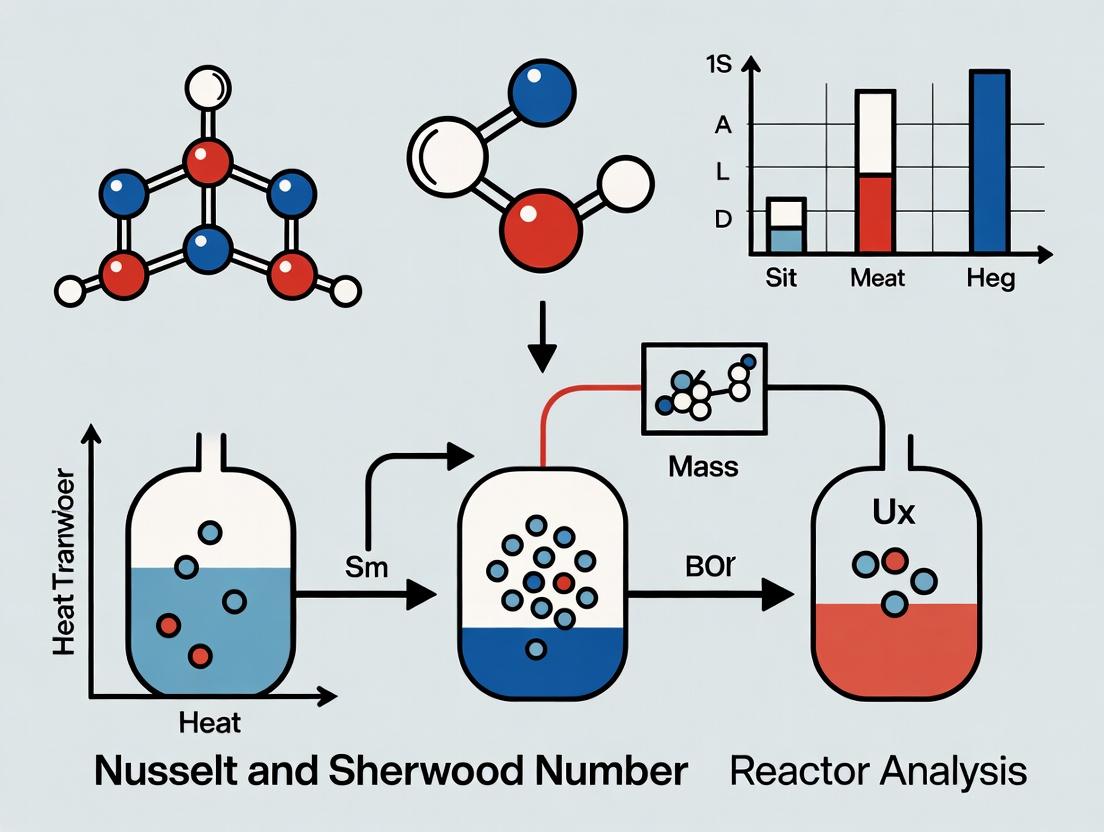
This article provides a comprehensive guide for researchers, scientists, and drug development professionals on the critical role of Nusselt (Nu) and Sherwood (Sh) numbers in chemical reactor design.
Nusselt and Sherwood Numbers in Reactor Design: Optimizing Heat and Mass Transfer for Pharmaceutical Production
Abstract
This article provides a comprehensive guide for researchers, scientists, and drug development professionals on the critical role of Nusselt (Nu) and Sherwood (Sh) numbers in chemical reactor design. We explore the foundational theory linking these dimensionless numbers to heat and mass transfer efficiency. The piece delves into practical methodologies for their calculation and application across various reactor types (e.g., CSTR, PFR, fixed-bed). We address common challenges in accurate determination and strategies for reactor optimization through enhanced transport phenomena. Finally, we examine validation techniques, experimental correlations, and comparative analyses of scaling approaches. This analysis is essential for improving yield, purity, and control in pharmaceutical synthesis and bioprocessing.
Understanding Nusselt and Sherwood Numbers: The Cornerstones of Transport Phenomena in Reactors
Within the scope of reactor design research—encompassing chemical, biochemical, and pharmaceutical applications—the Nusselt and Sherwood numbers are pivotal dimensionless parameters for analyzing and scaling transport phenomena. This foundational knowledge is critical for the design of efficient reactors, where precise control over heat and mass transfer directly impacts yield, selectivity, and product quality in processes like drug synthesis and fermentation.
Core Conceptual Framework
The Nusselt number (Nu) and Sherwood number (Sh) are analogous dimensionless groups that describe the enhancement of convective transfer relative to conductive/diffusive transfer at a boundary.
Nusselt Number (Nu): It is defined as the ratio of convective to conductive heat transfer across a boundary.
Nu = (h L) / k where h is the convective heat transfer coefficient [W/m²·K], L is the characteristic length [m], and k is the thermal conductivity of the fluid [W/m·K].
Sherwood Number (Sh): It is defined as the ratio of convective to diffusive mass transfer.
Sh = (kₘ L) / D where kₘ is the convective mass transfer coefficient [m/s], L is the characteristic length [m], and D is the mass diffusivity [m²/s].
Their primary utility lies in establishing correlations to predict transfer rates in complex systems based on other dimensionless numbers (Reynolds Re, Prandtl Pr, Schmidt Sc).
Quantitative Comparison of Key Dimensionless Numbers
Table 1: Core Dimensionless Numbers in Transport Phenomena
| Number | Symbol | Formula | Physical Interpretation | Typical Range in Reactors |
|---|---|---|---|---|
| Nusselt | Nu | (h L)/k | Enhanced heat transfer at surface | 1 - 10³ (Forced Convection) |
| Sherwood | Sh | (kₘ L)/D | Enhanced mass transfer at surface | 10 - 10⁴ (Liquid Phase) |
| Prandtl | Pr | ν/α | Momentum vs. thermal diffusivity | 0.7 (Gases) - 10³ (Oils) |
| Schmidt | Sc | ν/D | Momentum vs. mass diffusivity | 10³ (Liquids) - 10⁴ (Polymeric) |
| Reynolds | Re | (ρ u L)/μ | Inertial vs. viscous forces | 10⁰ (Laminar) - 10⁵ (Turbulent) |
Governing Relationships & Analogies
The Chilton-Colburn analogy formally links heat and mass transfer, a cornerstone for reactor design analysis:
jH = jD = f/2 where jH = *Nu* / (*Re* *Pr*^(1/3)) (Stanton number for heat) and jD = Sh / (Re Sc^(1/3)) (Stanton number for mass).
Diagram Title: Logical Relationship Between Transfer Processes and Dimensionless Numbers
Experimental Protocols for Determination
Protocol: Determination of Local Nusselt Number in a Packed Bed Reactor
Objective: To experimentally determine the local Nu for catalyst pellets in a gas-phase tubular reactor, validating heat transfer correlations. Principle: Measure temperature gradients near a heated pellet surface under controlled flow.
Materials & Equipment:
- Tubular reactor column (Stainless steel, ID=50 mm).
- Instrumented catalyst pellet (Single pellet with embedded micro-thermocouple at surface and center).
- Constant temperature bath & pre-heater for inlet gas.
- Thermal anemometer for flow measurement.
- Data acquisition system (DAQ).
Procedure:
- Setup: Pack the reactor column with inert material, placing the instrumented pellet at the axial and radial center. Connect thermocouples to DAQ.
- Conditioning: Set the inlet gas (e.g., N₂) to a known temperature (Tbulk) and desired flow rate (to set *Re*). Electrically heat the instrumented pellet to a constant surface temperature (Ts).
- Steady-State Achievement: Monitor temperatures until steady-state is reached (ΔT < 0.1°C over 5 min).
- Data Collection: Record Ts, Tbulk, and the heat input (Q) to the pellet from the heater.
- Calculation: The convective heat transfer coefficient h = Q / [As (Ts - Tbulk)], where As is pellet surface area. Nu = (h * dp) / kgas, where dp is pellet diameter and kgas is the thermal conductivity of the gas at film temperature.
Protocol: Determination of Volume-Averaged Sherwood Number in a Stirred Tank Bioreactor
Objective: To determine the volumetric mass transfer coefficient (kₗa) and subsequently the average Sh for oxygen dissolution in a fermentation broth. Principle: Use the dynamic gassing-out method to measure kₗa, relating it to the convective mass transfer coefficient.
Materials & Equipment:
- Bench-top bioreactor (e.g., 5 L working volume) with dissolved oxygen (DO) probe.
- Gas supply (Air, N₂).
- Data logging software for DO.
- Rotational speed sensor for impeller.
Procedure:
- Deoxygenation: Sparge the vessel containing the model broth with N₂ until DO reaches near zero (~2% saturation).
- Re-aeration: Switch the gas supply to air at a constant flow rate and impeller speed. Begin logging DO concentration (C) versus time (t).
- Data Analysis: The slope of ln[(C* - C)/(C* - C₀)] vs. time (t) gives kₗa, where C* is the saturation DO and C₀ is the initial DO.
- Calculation: The average mass transfer coefficient kₗ = kₗa / a, where 'a' is the specific interfacial area (estimated from correlation). Sh = (kₗ * L) / D, where L is the impeller diameter and D is the diffusivity of oxygen in the broth.
Table 2: Key Research Reagent Solutions & Materials for Featured Experiments
| Item | Function in Experiment | Example/ Specification |
|---|---|---|
| Instrumented Catalyst Pellet | Serves as both reaction site and sensor for local temperature gradient measurement. | Porous Al₂O₅ pellet (dp=3mm) with embedded Type K thermocouple. |
| Dissolved Oxygen Probe | Measures real-time oxygen concentration in broth for dynamic mass transfer analysis. | Clark-type polarographic DO probe, autoclavable. |
| Model Fermentation Broth | Simulates the physical properties (viscosity, density) of a real cell culture without biological activity. | 0.15 M NaCl with 0.1% (w/v) polyvinylpyrrolidone (PVP) to adjust viscosity. |
| Calibration Gas Mixtures | Calibrate sensors and establish known boundary conditions for mass transfer. | Certified N₂/Air mixtures for DO probe; Pure N₂ for deoxygenation. |
| Data Acquisition System (DAQ) | Records high-frequency analog signals (temperature, voltage) with precise time-stamping. | 16-bit ADC, minimum sampling rate 100 Hz per channel. |
Application in Reactor Design: A Correlative Framework
Empirical correlations are the workhorses for preliminary reactor design. Their general form is:
Nu or Sh = C * Re^m * Pr^n or Sc^n where C, m, n are constants dependent on geometry and flow regime.
Table 3: Common Correlations for Nu and Sh in Reactor Design
| Reactor Type / Geometry | Correlation | Applicability / Notes |
|---|---|---|
| Flow over flat plate | Sh_L = 0.664 Re_L^(1/2) Sc^(1/3) | Laminar flow, Re < 5x10⁵. Mass transfer analogy applies for Nu. |
| Packed Bed (Particle) | Nu = 2.0 + 1.1 Re_d^0.6 Pr^(1/3) | Wakao & Kaguei correlation for Re > 100. For Sh, replace Nu with Sh, Pr with Sc. |
| Stirred Tank (Liquid) | Sh = A * Re^B * Sc^0.33 * (μ/μ_w)^C | A, B, C depend on impeller type. Common for kLa estimation. |
| Tubular Flow (Inside pipe) | Nu = 0.023 Re^0.8 Pr^0.4 (Dittus-Boelter) | Fully developed turbulent flow, smooth tubes. |
Diagram Title: Workflow for Using Nu and Sh in Reactor Design and Scale-Up
Advanced Analysis: Interplay with Reaction Kinetics
In catalytic or biochemical reactors, the effectiveness factor (η) of a catalyst pellet or cell is governed by the interplay between intrinsic reaction kinetics and transport rates, described by the Thiele modulus (φ). The observable rate is thus a function of both Nu and Sh through external and internal temperature and concentration gradients.
For a first-order, irreversible reaction in a catalyst pellet:
η = f(φ) where φ = L √(krxn/Deff) The observed rate = η * krxn * Cs where C_s is the surface concentration, determined by the external Sh number.
This framework is essential for drug development professionals when scaling up API synthesis from laboratory batch reactors to continuous production systems, ensuring kinetic data is not confounded by transport limitations.
Within reactor design research, particularly for pharmaceutical applications involving catalytic synthesis, fermentation, or crystallization, the analysis of transport phenomena is fundamental. The Nusselt number (Nu) and Sherwood number (Sh) serve as pivotal dimensionless parameters for convective heat and mass transfer, respectively. The core analogy, derived from the similarity between the governing energy and species conservation equations under specific conditions, allows for the prediction of one transport coefficient from knowledge of the other. This is critical for scaling bioreactors or chemical reactors where simultaneous heat and mass transfer occur.
Key Quantitative Data & Analogous Relationships
Table 1: Fundamental Governing Equations & Correlations
| Parameter | Definition | Analogous Form | Common Correlation Form (e.g., for flow over a flat plate) |
|---|---|---|---|
| Nusselt Number (Nu) | Nu = hL/k (Convective / Conductive heat transfer) | — | Nu_L = C Re^m Pr^n |
| Sherwood Number (Sh) | Sh = k_m L/D (Convective / Diffusive mass transfer) | Sh Nu | Sh_L = C Re^m Sc^n |
| Prandtl Number (Pr) | Pr = ν/α (Momentum vs. Thermal diffusivity) | — | Property of fluid |
| Schmidt Number (Sc) | Sc = ν/D (Momentum vs. Mass diffusivity) | Sc Pr | Property of fluid system |
| Analogy Statement | Chilton-Colburn Analogy: j_H = j_D | St Pr^{2/3} = St_m Sc^{2/3} | For 0.6 < Pr < 60, 0.6 < Sc < 3000 |
Table 2: Typical Values & Reactor Design Implications
| Fluid / System | Typical Pr | Typical Sc | C, m, n in Nu/Sh = C Re^m Pr^n(Sc^n) | Reactor Design Implication |
|---|---|---|---|---|
| Water (Heat Transfer) | ~7 (at 20°C) | — | Varies with geometry & flow | Cooling jacket sizing. |
| Gases (Heat Transfer) | ~0.7 | — | C=0.664, m=0.5, n=0.33 (laminar flat plate) | Gas-phase catalytic reactor thermal management. |
| Drug in Aqueous Solution (Mass Transfer) | — | 500 - 2000+ | C=0.664, m=0.5, n=0.33 (laminar flat plate) | Controls dissolution rate, nutrient/O₂ uptake in fermenters. |
| Analogy Check: Air (Water Vapor Mass Transfer) | ~0.7 | ~0.6 | j_H ≈ j_D | Direct analogy valid for humidification/ drying processes. |
Experimental Protocol: Validating the Analogy in a Wetted-Wall Column
This protocol is designed to empirically validate the heat and mass transfer analogy, a key step in developing correlative models for multiphase reactor design.
Objective: To measure convective heat and mass transfer coefficients under analogous hydrodynamic conditions and calculate experimental Nu and Sh numbers for comparison with theoretical analogies (e.g., Chilton-Colburn).
Apparatus: Wetted-wall column, controlled air delivery system, steam generator/condenser, thermocouples, hygrometer or gas analyzer, data acquisition system, precision scales.
The Scientist's Toolkit: Key Research Reagent Solutions & Materials
| Item | Function in Protocol |
|---|---|
| Wetted-Wall Column (Glass/Stainless Steel) | Provides a known, controllable interfacial area for simultaneous/analogous heat and mass transfer. |
| Dry, Conditioned Air Supply | Serves as the bulk fluid for both experiments. Constant properties are essential. |
| Water (Deionized & Degassed) | Working fluid for both processes. Evaporation drives mass transfer; condensation drives heat transfer. |
| Ethanol-Water Solution (e.g., 20% v/v) | Alternative test fluid to vary Schmidt number (Sc) and explore analogy limits. |
| Calibrated K-type Thermocouples | Measure temperature gradients at the interface and bulk for h calculation. |
| Chilled Mirror Hygrometer | Precisely measures absolute humidity of effluent air for k_m calculation. |
| Data Logger (16-channel, 0.1°C resolution) | Synchronizes temperature, flow rate, and humidity readings for accurate coefficient determination. |
| Coriolis Mass Flow Controller | Precisely controls and measures air flow rate (Reynolds number Re). |
Procedure:
Part A: Mass Transfer Experiment (Evaporation)
- Setup: Circulate temperature-controlled water at rate ṁ_w from a constant-head tank to form a uniform laminar film down the inner wall of the column.
- Conditioning: Introduce dry air at a measured, constant volumetric flow rate (Q_air, set via MFC) counter-currently to the water film. Allow system to reach steady-state (15-20 mins).
- Data Collection:
- Record inlet air dry-bulb temperature (Tdb,in) and humidity (ωin).
- Record outlet air dry-bulb temperature (Tdb,out) and humidity (ωout) via hygrometer.
- Measure water inlet (Tw,in) and outlet (Tw,out) temperatures.
- Record air pressure and column wall/diameter (L, D) measurements.
- Analysis: Calculate mass transfer coefficient (k_m) from material balance on water vapor. Compute Sh = k_m L / D_AB, Re, and Sc.
Part B: Heat Transfer Experiment (Condensation)
- Setup: Replace water with condensing steam on the inner wall. Maintain the same air flow rate (Q_air, identical Re) as in Part A.
- Conditioning: Allow steam and air flows to stabilize at steady-state.
- Data Collection:
- Record inlet and outlet air temperatures.
- Measure condensate collection rate (ṁcond).
- Record steam saturation temperature at the wall (Tsat).
- Analysis: Calculate heat transfer coefficient (h) from energy balance. Compute Nu = h L / k, Re, and Pr.
Part C: Analogy Validation
- Calculate the Chilton-Colburn j-factors:
- jH = St Pr^{2/3}, where St = Nu / (Re Pr)
- jD = Stm Sc^{2/3}, where Stm = Sh / (Re Sc)
- Compare j_H and j_D. Agreement within experimental error validates the analogy for the system and Re range tested.
Visualization of Conceptual & Experimental Relationships
Diagram 1 Title: The Nu-Sh Analogy: From Theory to Reactor Application
Diagram 2 Title: Wetted-Wall Column Experimental Workflow
Why Dimensionless Numbers Are Crucial for Scaling Reactor Systems
Within the broader research on Nusselt and Sherwood number analysis for reactor design, this application note establishes the foundational role of dimensionless numbers in scaling chemical and biochemical reactor systems. These numbers, derived from dimensional analysis or scaling laws, provide the critical link between laboratory-scale experiments and industrial-scale production—a core challenge in pharmaceutical process development. By maintaining the constancy of key dimensionless groups, researchers can predict the behavior of momentum, heat, and mass transfer during scale-up, ensuring process consistency, product quality, and economic viability.
Core Dimensionless Numbers in Reactor Scaling
The following table summarizes the most crucial dimensionless numbers for scaling reactor systems, with particular emphasis on those relating to the thesis focus on heat (Nusselt, Nu) and mass (Sherwood, Sh) transfer analysis.
Table 1: Key Dimensionless Numbers for Reactor Scale-Up
| Dimensionless Number | Symbol | Formula | Scaling Principle | Primary Application in Reactors |
|---|---|---|---|---|
| Reynolds Number | Re | (ρ * u * L) / μ | Fluid flow regime (laminar/turbulent) | Impeller selection, power input, mixing time. |
| Nusselt Number | Nu | (h * L) / k | Convective to conductive heat transfer. | Scaling heat transfer for jacketed reactors, exothermic reaction control. |
| Sherwood Number | Sh | (kₗ * L) / D | Convective to diffusive mass transfer. | Scaling gas-liquid mass transfer (e.g., aeration), dissolution, crystallization. |
| Schmidt Number | Sc | μ / (ρ * D) | Momentum to mass diffusivity. | Correlating Sh with Re (via Sc) for mass transfer. |
| Prandtl Number | Pr | Cₚ * μ / k | Momentum to thermal diffusivity. | Correlating Nu with Re (via Pr) for heat transfer. |
| Power Number | Nₚ | P / (ρ * N³ * D⁵) | Power consumption for agitation. | Scaling impeller power draw and shear stress. |
| Froude Number | Fr | (N² * D) / g | Inertial to gravitational forces. | Scaling vortex formation in unbaffled tanks. |
Experimental Protocol: Determining Mass Transfer Coefficient (kₗa) and Sherwood Number
This protocol details a standard method for determining the volumetric mass transfer coefficient (kₗa), a critical parameter for calculating the Sherwood number (Sh) in gas-liquid reactors (e.g., fermenters, hydrogenation reactors).
Objective: To experimentally determine kₗa and subsequently Sh for scaling aeration efficiency from a 5 L bench-top bioreactor to a 500 L pilot-scale reactor.
Principle: The dynamic gassing-out method monitors the dissolved oxygen (DO) concentration over time after a step change in gas composition (e.g., from nitrogen to air).
Materials & Reagents: The Scientist's Toolkit: Key Reagent Solutions for kLa Determination
| Item | Function & Explanation |
|---|---|
| 5 L Bench-top Bioreactor | Controlled vessel with agitator, sparger, and integrated DO/temp/pH probes. |
| Dissolved Oxygen Probe | Clark-type or optical fluorescence probe for real-time DO concentration monitoring. |
| Nitrogen Gas (N₂) | For deoxygenation of the liquid medium to establish a low initial DO baseline. |
| Compressed Air or Oxygen | Gas phase for the absorption (gassing-in) step. |
| 0.9% (w/v) NaCl Solution | Model fluid for initial studies; viscosity and density similar to aqueous culture media. |
| Sodium Sulfite (Na₂SO₃), Cobalt Chloride (CoCl₂) | Chemical method for zero DO calibration (Na₂SO₃ removes O₂, CoCl₂ catalyzes). |
| Data Acquisition System | Software for recording DO (%) vs. time at high frequency (e.g., 10 Hz). |
Procedure:
- Calibration: Calibrate the DO probe at 0% (using the chemical method or N₂ sparging) and 100% (by sparging air to saturation) at the experimental temperature and agitation speed.
- Deoxygenation: Fill the reactor with the model fluid or medium. Sparge with N₂ while agitating until the DO reading is stable near 0%.
- Absorption Step: Instantly switch the gas supply from N₂ to air (or the desired O₂ mixture). Maintain constant gas flow rate, agitation speed, temperature, and pressure.
- Data Collection: Record the DO concentration (C) as a function of time (t) from the moment of the gas switch until saturation is reached (~80-100%).
- Data Analysis: Plot ln[(Cˢ - C⁰)/(Cˢ - C)] vs. time t, where Cˢ is the saturated DO concentration and C⁰ is the initial DO. The slope of the linear region of this plot is *kₗa.
- Calculate Sh: Using the determined kₗa, calculate the liquid-side mass transfer coefficient kₗ = (kₗa) / a (where specific interfacial area a can be estimated from correlations). Then compute: Sh = (kₗ * L) / D. Here, L is the characteristic length (e.g., impeller diameter), and D is the diffusivity of oxygen in the liquid.
Scale-Up Application: Perform this experiment at both bench and pilot scale under conditions that maintain geometric similarity and constant Re (or Nₚ). The resulting Sh numbers, correlated with Re and Sc, provide the scaling law for mass transfer performance.
Conceptual Framework: The Role of Dimensionless Numbers in Scale-Up
Title: Logical Flow of Reactor Scale-Up Using Dimensionless Numbers
Interrelationship of Heat and Mass Transfer Numbers
Title: Relationship Between Re, Pr, Sc, Nu, and Sh
Within the broader thesis on Nusselt (Nu) and Sherwood (Sh) number analysis in reactor design research, the precise interpretation of boundary layer physics is paramount. These dimensionless numbers fundamentally link transport phenomena at a surface to the bulk flow and fluid properties. In pharmaceutical reactor design—from chemical synthesis to bioreactor scale-up—mastery of these concepts enables the prediction of heat and mass transfer rates critical for reaction control, product quality, and yield optimization.
The Nusselt number is defined as Nu = hL/k, where h is the convective heat transfer coefficient, L is the characteristic length, and k is the thermal conductivity of the fluid. It represents the enhancement of heat transfer due to convection relative to conduction across the boundary layer. Analogously, the Sherwood number is defined as Sh = kmL/D, where km is the convective mass transfer coefficient and D is the mass diffusivity. It quantifies the enhancement of mass transfer relative to diffusion.
These coefficients (h, km) are not intrinsic fluid properties but are complex functions of flow regime (laminar/turbulent), geometry, and fluid properties (viscosity, density, specific heat, diffusivity), typically correlated via Reynolds (Re) and Prandtl (Pr) or Schmidt (Sc) numbers. The core physical interpretation is that the Nu and Sh numbers describe the relative thinness of the thermal and concentration boundary layers, respectively. A higher value indicates a steeper gradient at the wall and more efficient transfer.
Table 1: Fundamental Dimensionless Numbers in Transport Phenomena
| Number | Formula | Physical Interpretation | Primary Use |
|---|---|---|---|
| Nusselt (Nu) | hL / k | Ratio of convective to conductive heat transfer | Heat transfer coefficient prediction |
| Sherwood (Sh) | kmL / D | Ratio of convective to diffusive mass transfer | Mass transfer coefficient prediction |
| Reynolds (Re) | ρvL / μ | Ratio of inertial to viscous forces | Flow regime characterization |
| Prandtl (Pr) | ν / α = Cpμ / k | Ratio of momentum to thermal diffusivity | Linking velocity & thermal boundary layers |
| Schmidt (Sc) | ν / D = μ / (ρD) | Ratio of momentum to mass diffusivity | Linking velocity & concentration boundary layers |
Quantitative Correlations & Data
Empirical and theoretical correlations for Nu and Sh are the workhorses of reactor design. For forced convection in internal flows (e.g., tubular reactors), the Dittus-Boelter and Gnielinski equations are standard. For mass transfer, the Chilton-Colburn analogy (jH = jD) provides a critical link between heat and mass transfer where jH = StH Pr2/3 and jD = StD Sc2/3, with Stanton numbers St = Nu/(Re Pr).
Recent research in multiphase and microreactor systems has led to more nuanced correlations. For instance, in gas-liquid stirred tank reactors, correlations for the volumetric mass transfer coefficient (kLa) often take the form: kLa ∝ (P/V)α (vs)β, which can be related back to Sh through the specific interfacial area (a).
Table 2: Common Transport Correlations for Reactor Design
| Correlation | Equation | Applicability | Key Parameters |
|---|---|---|---|
| Dittus-Boelter | Nu = 0.023 Re0.8 Prn (n=0.4 heating, 0.3 cooling) | Smooth tubes, fully turbulent flow (Re > 10,000), 0.7 ≤ Pr ≤ 160 | Re, Pr |
| Gnielinski | Nu = [(f/8)(Re-1000)Pr] / [1+12.7(f/8)½(Pr2/3-1)] | Transition & turbulent flow (3000 < Re < 5×10⁶), 0.5 < Pr < 2000 | Re, Pr, friction factor f |
| Lévêque (Mass) | Sh = 1.85 (Re Sc d/L)1/3 | Laminar flow, mass transfer, developing concentration profile | Re, Sc, d/L (aspect ratio) |
| Chilton-Colburn Analogy | jD = jH or StD Sc2/3 = StH Pr2/3 | Turbulent flow, when 0.6 < Pr < 60 and 0.6 < Sc < 3000 | Links Nu and Sh via j-factors |
Experimental Protocols
Protocol 1: Determination of Volumetric Mass Transfer Coefficient (kLa) in a Stirred Tank Bioreactor
Objective: To experimentally determine the volumetric mass transfer coefficient (kLa) for oxygen in a bioreactor, enabling calculation of the Sherwood number and scale-up analysis.
Materials & Equipment:
- Bioreactor (bench-scale, 5-10 L working volume) with temperature, pH, and dissolved oxygen (DO) probes.
- Sterile air supply and gas flow meter.
- Data acquisition system for DO vs. time.
- Sodium sulfite (Na2SO3) solution (0.1-0.2 M) with cobalt chloride (CoCl2) catalyst (10-3 M).
Methodology:
- Setup & Calibration: Fill the reactor with a predetermined volume of distilled water. Calibrate the dissolved oxygen probe to 0% (under nitrogen sparge) and 100% saturation (vigorous air sparging).
- Chemical Method (Sulfite Oxidation): a. Replace the water with the sodium sulfite/cobalt catalyst solution. b. Sparge the reactor with air at a fixed flow rate (Qg). Start agitation at a fixed impeller speed (N). c. The reaction (SO32- + ½ O2 → SO42-) is instantaneous, consuming oxygen at the gas-liquid interface, making the bulk liquid DO = 0. The rate of sulfite consumption equals the maximum oxygen transfer rate (OTRmax = kLa C*). d. Take timed samples and titrate for sulfite concentration (iodometric method) to determine OTRmax. With known oxygen saturation concentration (C*), calculate kLa = OTRmax / C**.
- Dynamic Gassing-Out Method: a. With the reactor filled with water, sparge with nitrogen to deoxygenate to ~0% DO. b. Switch the gas supply to air at time t=0, maintaining constant Qg and N. c. Record the DO concentration (CL) as a function of time until saturation (~90-95%). d. The mass balance is: dCL/dt = kLa (C** - CL). e. Plot *ln[(C** - CL)/C**] vs. time. The slope of the linear region gives -kLa.
- Data Analysis & Sh Calculation:
- For the given reactor geometry and operating conditions, calculate the impeller Reynolds number Re = ρ N Di2 / μ.
- Using the measured kLa, extract the liquid-side mass transfer coefficient (kL) using an estimated interfacial area (a) from literature correlations for the specific agitator.
- Calculate the Sherwood number: Sh = kL db / D, where db is the Sauter mean bubble diameter (estimated from correlations) and D is the diffusivity of oxygen in water.
- Correlate Sh as a function of Re and Sc for your system.
Protocol 2: Measuring Local Heat Transfer Coefficient (h) in a Tubular Reactor
Objective: To determine the local convective heat transfer coefficient (h) and Nusselt number (Nu) along the wall of a heated tubular reactor section.
Materials & Equipment:
- Tubular test section (e.g., copper pipe) with an embedded electrical heating jacket (constant heat flux boundary condition).
- Thermocouples attached to the outer wall at multiple axial positions. An infrared thermometer/camera can be used as an alternative.
- Inline fluid thermocouple at inlet and outlet.
- Pump, reservoir, and flow meter for the working fluid (e.g., water).
- Power supply and wattmeter to measure heat input (Q).
Methodology:
- Setup: Insulate the test section thoroughly to minimize heat loss. Calibrate all temperature sensors.
- Steady-State Experiment: a. Circulate the fluid at a constant, known flow rate (to set Re). b. Apply a known, constant power (Q = VI) to the heating jacket. c. Allow the system to reach steady state (all temperatures stable). d. Record the inlet (Tin), outlet (Tout), and all local wall temperatures (Tw,x). Record fluid flow rate and heat input.
- Data Analysis: a. Calculate the bulk fluid temperature (Tb,x) at each axial position using an energy balance from the inlet. b. The local heat flux is q" = Q / As, where As is the interior surface area of the heated section. c. The local heat transfer coefficient is hx = q" / (Tw,x - Tb,x). d. Calculate the local Nusselt number: Nux = hx D / kf, where D is tube diameter and kf is the fluid thermal conductivity at the film temperature. e. Plot Nux vs. axial position (x/D) and compare to theoretical profiles (e.g., thermal entrance region, fully developed flow). f. Correlate the average Nu for the tube against the calculated Re and Pr.
Visualizations
Title: From Boundary Layers to Dimensionless Numbers
Title: Protocol Flow for Determining Nu and Sh
The Scientist's Toolkit: Research Reagent Solutions & Essential Materials
Table 3: Key Reagents and Materials for Transport Experiments
| Item | Function/Application | Key Considerations |
|---|---|---|
| Sodium Sulfite (Na₂SO₃) / Cobalt Chloride (CoCl₂) | Chemical method for kLa determination. Sulfite is oxidized by O₂, catalyzed by Co²⁺, creating a zero-DO bulk. | Purity is critical. Solution must be fresh. Cobalt concentration must be low to avoid altering fluid properties. |
| Dissolved Oxygen (DO) Probes (Clark-type or Optical) | Measures oxygen concentration in liquid in real-time. Essential for dynamic gassing-out method. | Requires careful calibration (0% & 100%). Membrane integrity and cleanliness are vital. Response time can affect dynamic method results. |
| Thermocouples (T-type, K-type) or RTDs | Accurate temperature measurement for heat transfer experiments (bulk and wall temperatures). | Calibration, placement (minimal intrusion), and data acquisition rate are crucial. Use multiple probes for spatial profiles. |
| Traceable Dyes or Conductivity Tracers (e.g., NaCl) | Used in mass transfer visualization and measurement via Residence Time Distribution (RTD) or planar laser-induced fluorescence (PLIF). | Dye must be inert and at low concentration to not affect fluid properties (density, viscosity). |
| Non-Newtonian Model Fluids (e.g., CMC, Xanthan Gum solutions) | To simulate the rheology of biological broths or polymer solutions in mass/heat transfer studies. | Allows investigation of Sh and Nu in non-Newtonian regimes. Concentration controls viscosity/power-law parameters. |
| Particle Image Velocimetry (PIV) Seed Particles | For quantifying flow fields (velocity vectors, turbulence) that underpin boundary layer development and Re. | Must be neutrally buoyant and scatter light effectively. Size must not alter flow. |
| Computational Fluid Dynamics (CFD) Software (e.g., ANSYS Fluent, OpenFOAM) | For virtual prototyping and simulation of transport phenomena, solving Navier-Stokes, energy, and species equations. | Requires validation against experimental Nu/Sh data. Critical for scaling from lab to pilot to production. |
Within the broader thesis on Nusselt and Sherwood number analysis in reactor design, this application note examines the direct influence of transport phenomena on chemical kinetics and reactor performance. The Nusselt number (Nu) characterizes convective heat transfer efficiency at a fluid-solid interface, while the Sherwood number (Sh) analogously describes convective mass transfer. Their analysis is critical for correlating reactor geometry, flow conditions, and transport rates with intrinsic reaction kinetics, ultimately dictating yield, selectivity, and scalability in processes such as pharmaceutical synthesis.
Quantitative Data: Correlations and Impact
Table 1: Common Correlations for Nu and Sh in Reactor Design
| Correlation | Application | Key Variables | Impact on Kinetics |
|---|---|---|---|
| Dittus-Boelter (Nu) | Turbulent flow in pipes | Re, Pr | Governs heat removal, controls temperature-sensitive kinetic rate constants (k). |
| Gnielinski (Nu) | Transitional flow regimes | Re, Pr, f (friction factor) | Allows accurate k(T) prediction in non-fully turbulent systems. |
| Leveque / Graetz (Sh) | Laminar flow, entry region | Re, Sc, L/D | Predicts mass-transfer-limited reaction rate in tubular reactors. |
| Ranz-Marshall (Sh) | Particles in fluid flow | Re, Sc | Determines external mass transfer resistance for catalytic or solid-fluid kinetics. |
Table 2: Experimental Impact of Sh on Observed Reaction Rate
| System (Sh Range) | Intrinsic Kinetic Rate (k) | Mass Transfer Coefficient (kₗ) | Observed/Effective Rate | Limiting Regime |
|---|---|---|---|---|
| Fast Reaction in Laminar Flow (Sh < 10) | 1.5 x 10⁻³ s⁻¹ | 2.0 x 10⁻⁵ m/s | ~2.0 x 10⁻⁵ m/s | Severe Mass Transfer Limitation |
| Catalytic Hydrogenation (Sh 10-100) | 0.15 s⁻¹ | 5.0 x 10⁻⁴ m/s | 4.8 x 10⁻⁴ m/s | Mixed Control |
| Well-Mixed Microreactor (Sh > 100) | 0.15 s⁻¹ | 2.0 x 10⁻² m/s | ~0.15 s⁻¹ | Kinetic Control |
Experimental Protocols
Protocol 3.1: Determining Mass Transfer Limitation via Sh Number Analysis
Objective: To diagnose whether a reaction is kinetically or mass-transfer-controlled by calculating the observed Sherwood number. Materials: See "The Scientist's Toolkit" below. Procedure:
- Reactor Setup: Conduct the reaction (e.g., a catalytic API step) in a well-characterized reactor (e.g., stirred tank, packed bed).
- Rate Measurement: Measure the initial observed reaction rate (r_obs) under standard conditions.
- Variation of Agitation/Flow: Systematically vary the stirring speed (Re) or flow rate and measure r_obs at each point.
- Mass Transfer Coefficient (kₗ) Estimation: Use a well-established correlation (e.g., Calderbank for stirred tanks) appropriate for your reactor geometry to estimate kₗ for each condition.
- Sh Calculation: Compute Sh = (kₗ * d)/D, where d is characteristic length (impeller diameter, particle diameter) and D is molecular diffusivity.
- Analysis: Plot robs vs. Sh. If robs increases with Sh, the reaction is mass-transfer-influenced. A plateau indicates kinetic control. The threshold Sh value marks the design target.
Protocol 3.2: Quantifying Heat Transfer Impact via Nu on Reaction Selectivity
Objective: To correlate Nusselt number with selectivity in a multi-pathway exothermic reaction. Procedure:
- Instrumentation: Fit a jacketed lab reactor with calibrated temperature probes at the bulk fluid, near the wall, and in the coolant stream.
- Isothermal Calibration: Perform reactions at several precise, uniform temperatures to establish intrinsic kinetic selectivity (S_int).
- Non-Isothermal Runs: Conduct reactions at higher cooling jacket temperatures or lower coolant flow rates, creating a temperature gradient.
- Nu Calculation: From coolant flow (Re), fluid properties (Pr), and geometry, calculate Nu using the appropriate correlation. Measure the wall-to-bulk temperature difference (ΔT).
- Data Correlation: Plot experimental selectivity (Sexp) vs. ΔT and vs. Nu. Model the system to show how low Nu (poor heat transfer) leads to hot spots, altering local k(T) and degrading Sexp from S_int.
Visualizations
Title: Interplay of Transport, Kinetics, and Performance
Title: Protocol for Transport-Limited Reactor Design
The Scientist's Toolkit
Table 3: Key Research Reagent Solutions & Materials
| Item | Function in Context of Nu/Sh Analysis |
|---|---|
| Non-Invasive Temperature Probes (Fiber Optic) | Accurately measure local temperature gradients for precise Nu calculation without disturbing flow. |
| Electrochemical Redox Probes (e.g., Ferro/Ferricyanide) | Standard method for experimental determination of mass transfer coefficient (kₗ) via limiting current. |
| Computational Fluid Dynamics (CFD) Software | Simulate complex reactor geometries to predict local Re, Nu, and Sh fields before physical prototyping. |
| Tracer Compounds (e.g., Dyes, Isotopes) | Characterize residence time distribution (RTD) and mixing, essential for validating flow regimes in correlations. |
| Calorimetric Flow Reactor (e.g., RC1e) | Precisely measure heat flow (q) in situ, enabling direct experimental validation of heat transfer coefficients (h). |
| Catalyst Coated Wafers or Pellets | Model systems with defined geometry for precise Sh number analysis in gas-solid or liquid-solid reactions. |
Calculating and Applying Nu & Sh: Practical Methods for Reactor Analysis and Design
Selecting and Applying Empirical Correlations for Nu and Sh.
Within the broader thesis on Nusselt and Sherwood number analysis in chemical and biochemical reactor design, the appropriate selection and rigorous application of empirical correlations are fundamental. This document provides detailed application notes and protocols for researchers, scientists, and drug development professionals engaged in modeling heat and mass transfer in systems such as catalytic reactors, fermenters, and crystallizers.
Empirical Correlation Data Tables
Table 1: Key Nusselt (Nu) Correlations for Forced Convection in Tubes
| Correlation Name | Equation | Applicability (Re, Pr) | Remarks |
|---|---|---|---|
| Dittus-Boelter | Nu = 0.023 Re⁰·⁸ Prⁿ (n=0.4 heating, 0.3 cooling) | Re > 10,000; 0.7 ≤ Pr ≤ 160; L/D > 10 | Standard for smooth tubes, moderate ΔT. |
| Sieder-Tate | Nu = 0.027 Re⁰·⁸ Pr¹/³ (μ/μ_w)⁰·¹⁴ | Re > 10,000; 0.7 ≤ Pr ≤ 16,700 | Accounts for fluid viscosity changes at wall. |
| Gnielinski | Nu = [(f/8)(Re-1000)Pr] / [1+12.7√(f/8)(Pr²/³-1)] | 3000 ≤ Re ≤ 5×10⁶; 0.5 ≤ Pr ≤ 2000 | Accurate for transition and turbulent flow. (f: Darcy friction factor) |
Table 2: Key Sherwood (Sh) Correlations for Mass Transfer in Packed Beds
| Correlation Name | Equation | Applicability | Remarks |
|---|---|---|---|
| Wakao & Funazkri | Sh = 2 + 1.1 Re⁰·⁶ Sc¹/³ | 3 < Re < 10,000 | General correlation for particle-fluid mass transfer. |
| Wilson & Geankoplis | Sh = (1.09/ε) Re⁰·³³ Sc¹/³ (Liquid) | 0.0015 < Re < 55 | For liquids in packed beds (ε: bed voidage). |
| Dwivedi & Upadhyay | Sh = 0.4548 Re⁰·⁵⁹³ Sc¹/³ | Re < 130 | Modified for lower Reynolds numbers. |
Experimental Protocols for Correlation Validation
Protocol 3.1: Determination of Convective Heat Transfer Coefficient (h) for Nu Calculation Objective: To experimentally determine h in a tubular reactor section for validation of Nu correlations. Materials: (See Scientist's Toolkit) Procedure:
- Setup: Install a test section of known diameter (D) and length (L) within the reactor flow loop. Equip with a controlled electrical heating jacket (constant heat flux, q") and multiple calibrated thermocouples (Tbulk,in, Tbulk,out, T_wall).
- Steady-State Operation: Circulate working fluid (e.g., water, air) at a fixed volumetric flow rate. Measure pressure drop to determine flow regime.
- Data Acquisition: Apply known heat flux. Monitor until all temperatures stabilize (±0.5°C for 5 mins). Record all T, flow rate (to calculate Re), and system pressure.
- Calculation:
- h = q" / (Twall - Tbulkavg)
- Tbulkavg = (Tbulk,in + Tbulk,out)/2
- Nuexp = (h * D) / k, where k is fluid thermal conductivity at Tbulkavg.
- Validation: Compare Nuexp with Nupredicted from Table 1 correlations using measured Re and Pr.
Protocol 3.2: Determination of Mass Transfer Coefficient (kc) for Sh Calculation via Dissolution Objective: To experimentally determine *kc* for solid dissolution in a packed bed or stirred vessel. Materials: (See Scientist's Toolkit) Procedure:
- Packing Preparation: Pack reactor column with well-characterized solid particles (e.g., benzoic acid, NaCl pellets). Measure bed voidage (ε).
- Flow & Sampling: Pass a solvent (water) of known, initially zero solute concentration, through the bed at a fixed Re. Maintain isothermal conditions.
- Sampling: Collect effluent samples at regular time intervals until steady-state concentration (C_out) is achieved.
- Analysis: Quantify solute concentration in samples via calibrated conductivity meter or UV-Vis spectroscopy.
- Calculation:
- Mass transfer rate, N = Q * (Cout - Cin)
- kc = N / (a * V * ΔClm), where a is specific surface area of packing, V is bed volume, and ΔClm is the log-mean concentration driving force.
- Shexp = (kc * dp) / DAB, where DAB is the solute diffusivity in the solvent.
- Validation: Compare Shexp with Shpredicted from Table 2 correlations using measured Re and Sc.
Visualization: Correlation Selection Workflow
Workflow for Selecting Nu and Sh Correlations in Reactor Design
The Scientist's Toolkit: Research Reagent Solutions & Essential Materials
Table 3: Essential Materials for Heat/Mass Transfer Coefficient Experiments
| Item | Function / Explanation |
|---|---|
| Calibrated Thermocouples (Type T/K) | Accurate measurement of fluid bulk and wall temperatures for heat transfer experiments. |
| Coriolis Mass Flow Meter | Provides precise, density-independent measurement of fluid mass flow rate for Re calculation. |
| Differential Pressure Transducer | Measures pressure drop across test section to infer flow characteristics and friction factors. |
| UV-Vis Spectrophotometer | Quantifies solute concentration in solution for mass transfer experiments (e.g., dissolution). |
| Conductivity Meter with Flow Cell | Alternative for tracking ionic solute concentration changes in real-time. |
| Constant-Temperature Circulating Bath | Maintains isothermal conditions for fluid properties stability during experiments. |
| Bench-Scale Tubular/Packed-Bed Reactor Rig | Modular flow system with test section, pre-heater/cooler, and sampling ports. |
| Standard Reference Materials (e.g., Benzoic Acid Pellets) | Well-defined solids with known solubility and interfacial properties for k_c determination. |
| Data Acquisition System (DAQ) | Synchronized logging of analog signals (T, P, flow rate) at high frequency. |
| Process Fluid with Known Properties (e.g., Water/Glycerol, Sucrose Solutions) | Fluids with well-documented temperature-dependent viscosity, conductivity, and diffusivity. |
This application note, framed within a broader thesis on transport phenomenon analysis in reactor design, provides standardized protocols for determining the Nusselt (Nu) and Sherwood (Sh) numbers for three critical reactor geometries. These dimensionless numbers are pivotal for modeling heat and mass transfer, directly impacting the scale-up and optimization of processes in pharmaceutical and chemical manufacturing.
Foundational Correlations: Data Tables
The following tables summarize the seminal and widely used correlations for predicting Nu and Sh in different flow regimes and geometries. These form the computational core of the analysis.
Table 1: Correlations for Tubular (Pipe) Reactors
| Correlation Name | Application (Nu or Sh) | Equation | Validity Range (Re, Pr/Sc) |
|---|---|---|---|
| Dittus-Boelter (Heating/Cooling) | Nu = 0.023 Re^0.8 Pr^n (n=0.4 heating, 0.3 cooling) | Re > 10,000; 0.7 ≤ Pr ≤ 160; L/D > 10 | |
| Sieder-Tate (Viscosity Correction) | Nu = 0.027 Re^0.8 Pr^(1/3) (μ/μ_w)^0.14 | Re > 10,000; 0.7 ≤ Pr ≤ 16,700 | |
| Gnielinski (Transition/Turbulent) | Nu = [(f/8)(Re-1000)Pr] / [1+12.7√(f/8)(Pr^(2/3)-1)] | 3000 < Re < 5x10^6; 0.5 < Pr < 2000 | |
| Lévêque (Graetz) (Laminar, Developing) | Sh = 1.85 (Re Sc D/L)^(1/3) | Laminar flow, developing concentration profile |
Table 2: Correlations for Stirred Tank Reactors (STR)
| Correlation Name | Impeller Type | Equation (For Sh) | Key Parameters |
|---|---|---|---|
| Midoux et al. | Flat Blade Turbine | Sh = 0.13 Re^0.67 Sc^0.33 (k_L) | Re = ρND²/μ; for gas-liquid mass transfer |
| Calderbank et al. | Various | Sh = 0.31 Re^0.67 Sc^0.33 (ε) | Power input (P/V) derived Re; for particles |
| Ranade et al. | Pitched Blade | Nu or Sh ∝ (P/V)^a (Vs)^b | Computational Fluid Dynamics (CFD) validated |
Table 3: Correlations for Packed Bed Reactors
| Correlation Name | Packing Type | Equation | Application Note |
|---|---|---|---|
| Wakao & Funazkri | Spherical | Sh = 2.0 + 1.1 Re^0.6 Sc^(1/3) | 3 < Re < 3000; most widely used |
| Gnielinski (Packed Bed) | Spherical | Nu = 2.0 + (f/8)Re Pr / [1+12.7√(f/8)(Pr^(2/3)-1)] | Modified pipe flow analogy |
| Ergun-based | Irregular | jD = jH = (f/2) / [Φ(Sc^(2/3) or Pr^(2/3))] | Uses friction factor (f) from Ergun equation |
Experimental Protocols for Empirical Determination
Protocol 3.1: Determining Sh in a Tubular Reactor via Dissolution of a Coated Wall
Objective: Experimentally determine the mass transfer coefficient (k_c) and Sh for laminar/turbulent flow in a tube. Principle: Measure the rate of dissolution of a sparingly soluble coating (e.g., benzoic acid, plaster of Paris) into flowing water. Methodology:
- Setup: Prepare a test section of known length (L) and diameter (D) with a uniform inner coating of the solute.
- Operation: Pump solvent (water) at a controlled, calibrated flow rate to achieve desired Reynolds number (Re). Maintain isothermal conditions.
- Sampling & Analysis: Collect effluent samples at steady state. Analyze solute concentration via conductivity, UV-Vis, or titration.
- Calculation:
- Mass transfer rate,
N = C * Q / (A_s), where As is the coated surface area. - Driving force,
ΔC = (C_sat - C_bulk), where Csat is solubility. k_c = N / ΔC.Sh = (k_c * D) / D_AB, where D_AB is the molecular diffusivity.
- Mass transfer rate,
Protocol 3.2: Determining Nu in a Stirred Tank via Heated Jacket Experiment
Objective: Measure the heat transfer coefficient (h) and Nu for a specific impeller design. Principle: Apply steady heat through the reactor jacket and measure the temperature difference to compute h. Methodology:
- Setup: Instrument a stirred tank with a thermocouple in the bulk fluid and at the inner wall. Use a jacketed vessel with controlled heating (e.g., thermostatic bath).
- Operation: Fill with a fluid of known properties (ρ, Cp, μ, k). Set impeller speed (N) to target Re. Circulate heating fluid at constant temperature (T_j).
- Steady-State Measurement: Record bulk fluid temperature (Tb) and jacket temperature (Tj) at thermal steady state.
- Calculation:
- Heat flux,
q = U * A * (T_j - T_b). For dominant reactor-side resistance,U ≈ h. h = q / [A * (T_j - T_b)].Nu = (h * D_t) / k, where D_t is the tank diameter.
- Heat flux,
Protocol 3.3: Determining Sh in a Packed Bed via Adsorption Breakthrough
Objective: Determine the overall mass transfer coefficient and Sh for a packed bed of adsorbent particles. Principle: Measure the breakthrough curve of an adsorbate (e.g., dye, weak acid) under controlled flow. Methodology:
- Packing: Pack a column of known diameter (Dcol) with spherical particles of uniform diameter (dp). Measure bed height (L).
- Operation: Perfuse a solution of known concentration (C0) through the bed at a constant superficial velocity (U). Monitor effluent concentration (C) over time (t) via flow-through spectrophotometer.
- Analysis: Fit the
C/C0 vs. tbreakthrough curve using a model (e.g., Adams-Bohart, Yoon-Nelson) to extract the overall mass transfer coefficient (K_L a). - Calculation: Relate
K_L ato the film coefficientk_cusing particle geometry and intraparticle diffusivity. ComputeSh = (k_c * d_p) / D_AB.
The Scientist's Toolkit: Research Reagent Solutions & Essential Materials
| Item/Reagent | Function/Explanation |
|---|---|
| Benzoic Acid Coating | A standard sparingly soluble solid for mass transfer experiments. Provides a constant surface concentration (C_sat). |
| Potassium Chloride (KCl) Solution | Calibrated tracer for conductivity measurements to determine residence time distribution (RTD) and mixing characteristics. |
| Sodium Hydroxide (NaOH) / HCl | Used in titration for concentration analysis of acidic/basic solutes (e.g., dissolution of benzoic acid). |
| FD&C Blue Dye No. 1 | Inert, visible adsorbate for packed bed breakthrough studies, analyzable via UV-Vis spectrophotometry. |
| Calcium Sulfate Hemihydrate (Plaster of Paris) | Forms a uniform, microporous coating for dissolution studies in tubular setups. |
| Silica Gel or Activated Carbon Particles | Standard adsorbents with well-characterized surface properties for packed bed mass transfer experiments. |
| Thermocouples (Type T or K) | For accurate temperature measurement in bulk fluid and at walls for heat transfer coefficient calculation. |
| Coriolis or Turbine Flow Meter | Provides precise and accurate measurement of volumetric flow rate, critical for calculating Re. |
| Data Acquisition System (DAQ) | Logs time-series data from multiple sensors (temperature, conductivity, pressure, flow) for integrated analysis. |
Visualized Workflows
Diagram Title: Tubular Reactor Sh Determination Workflow
Diagram Title: Thesis Framework: Geometry Dictates Correlation Form
Integrating Transport Models with Reaction Kinetics Simulations
Application Notes
Theoretical Integration for Reactor Design
The accurate design of chemical and biochemical reactors, pivotal in pharmaceutical manufacturing, requires the simultaneous solution of momentum, heat, and mass transfer equations with intrinsic reaction kinetics. This integration is formalized through the non-dimensional Nusselt (Nu) and Sherwood (Sh) numbers, which correlate convective to conductive transport rates. For a reacting system, the local reaction rate, often expressed via Arrhenius kinetics or Michaelis-Menten kinetics for biocatalysis, becomes a source/sink term in the species conservation equation. Coupling these domains allows for the prediction of concentration and temperature gradients, directly impacting yield, selectivity, and catalyst effectiveness in processes from API synthesis to bioreactor cultivation.
Computational Fluid Dynamics (CFD) Coupling
Modern simulation leverages CFD software (e.g., ANSYS Fluent, COMSOL Multiphysics) to solve the Navier-Stokes equations within complex reactor geometries (e.g., packed beds, microreactors). The reaction kinetics are integrated via User-Defined Functions (UDFs) or built-in chemistry modules. This approach enables the spatially-resolved calculation of local Sh and Nu, moving beyond empirical correlations. Key outputs include maps of species concentration, temperature, and velocity, identifying dead zones or hot spots that compromise reactor performance and product quality.
Application in Drug Development
In pharmaceutical process development, this integration is critical for scale-up. A reaction optimized in batch may fail in continuous flow due to altered transport limitations. By integrating kinetic models from lab-scale experiments with transport models of the pilot-scale reactor, scientists can virtually prototype and optimize conditions, ensuring consistent Critical Quality Attributes (CQAs). This is particularly vital for solid dosage form processing and sterile bioprocessing where heat and mass transfer govern product stability.
Experimental Protocols
Protocol 1: Determining Intrinsic Kinetics for Model Coupling
Objective: To obtain accurate kinetic parameters independent of transport limitations for subsequent integration into CFD models. Materials:
- Well-mixed batch reactor (ideal CSTR or small-scale slurry reactor)
- Online analytics (HPLC, UV-Vis, FTIR)
- Temperature and pH control system
- Catalyst or enzyme of interest
Procedure:
- System Degassing: Sparge the reactant mixture with inert gas (N₂) to remove dissolved oxygen if it interferes.
- Baseline Operation: Run the reactor under conditions that minimize gradients (high agitation, small particle size). Record initial concentrations (C₀).
- Isothermal Kinetic Runs: At a fixed temperature (T₁), initiate the reaction. Withdraw samples at precise time intervals (t₁, t₂,... tₙ) or use inline analytics.
- Parameter Variation: Repeat step 3 across a range of temperatures (T₁...Tₘ) and initial concentrations.
- Data Fitting: Fit concentration-time data to proposed kinetic models (e.g., power-law, Michaelis-Menten). Use non-linear regression to determine rate constants (k) and activation energy (Eₐ).
Protocol 2: Validating Coupled Models via Limiting Current Technique
Objective: To experimentally measure the Sherwood number (Sh) in an electrochemical reactor analog to validate the mass transport component of the coupled simulation. Materials:
- Electrochemical flow cell with known geometry
- Potentiostat/Galvanostat
- Redox couple solution (e.g., 0.01 M K₃Fe(CN)₆ / K₄Fe(CN)₆ in 1 M K⁺ electrolyte)
- Working, counter, and reference electrodes
Procedure:
- Cell Setup: Assemble the flow cell with the working electrode (e.g., Pt disk) positioned flush to the wall.
- Flow Calibration: Set the upstream pump to a specific flow rate (Q), calculating the average velocity (u).
- Voltammetry: Perform linear sweep voltammetry from 0.2 V to 0.8 V (vs. Ag/AgCl) at the set flow rate.
- Identify Limiting Current (IL): The current plateau corresponds to the maximum mass transfer rate. Record IL.
- Calculate Sh: Use the formula: Sh = (IL * L) / (n * F * A * Cb * D), where L is characteristic length, n is electrons transferred, F is Faraday's constant, A is electrode area, C_b is bulk concentration, and D is diffusion coefficient.
- Compare with Simulation: Input reactor geometry and flow conditions into the CFD model. Compare the simulated local Sh at the electrode surface with the experimental value.
Data Presentation
Table 1: Experimentally Determined Kinetic Parameters for Model API Synthesis
| Reaction Type | Rate Law Model | Pre-exponential Factor (A) [units vary] | Activation Energy (Eₐ) [kJ/mol] | Optimal pH | Temperature Range Studied [°C] |
|---|---|---|---|---|---|
| Heterogeneous Catalysis | Power Law: r = k·Cᴬᴮ⁰·⁸ | 5.2 x 10⁵ L⁰·⁸/(mol⁰·⁸·s·g_cat) | 65.2 ± 3.1 | 7.0 - 7.5 | 50 - 90 |
| Enzyme-Catalyzed | Michaelis-Menten: r = (Vmax·CS)/(Km + CS) | V_max = 1.8 x 10⁻³ mol/(L·s) | (Not Applicable) | 8.0 | 25 - 40 |
| Free-Radical Polymerization | Rate = kp·[M]·(f kd[I]/k_t)^0.5 | k_p = 2.1 x 10³ L/(mol·s) | 28.5 ± 1.5 | N/A | 60 - 80 |
Table 2: Comparison of Simulated vs. Experimental Transport Correlations in a Packed-Bed Reactor
| Flow Regime (Re) | Simulated Average Nu | Experimental Nu (from heat probe) | % Difference | Simulated Average Sh | Experimental Sh (from limiting current) | % Difference |
|---|---|---|---|---|---|---|
| 10 (Laminar) | 4.12 | 3.98 | 3.5% | 4.05 | 3.87 | 4.6% |
| 100 (Transition) | 12.67 | 13.21 | -4.1% | 13.45 | 14.02 | -4.1% |
| 1000 (Turbulent) | 48.91 | 52.34 | -6.5% | 55.60 | 58.91 | -5.6% |
Diagrams
Title: Coupled CFD-Reaction Kinetics Simulation Workflow
Title: Thesis Context: Integration Links to Reactor Performance
The Scientist's Toolkit
Table 3: Key Research Reagent Solutions & Materials
| Item Name | Function in Integration Studies | Example/Specification |
|---|---|---|
| Computational Fluid Dynamics (CFD) Software | Solves governing transport equations (Navier-Stokes, energy, species continuity) in complex geometries. | ANSYS Fluent, COMSOL Multiphysics, OpenFOAM. |
| Kinetic Parameter Estimation Software | Fits experimental concentration-time data to kinetic models to extract rate constants and activation energies. | MATLAB Simulink, COPASI, Kinetics Toolkit. |
| User-Defined Function (UDF) Compiler | Allows custom reaction rate laws (from Protocol 1) to be incorporated into commercial CFD software as source terms. | Microsoft Visual Studio (for ANSYS Fluent). |
| Electrochemical Redox Probe | A well-characterized system (e.g., Ferri/Ferrocyanide) used in Protocol 2 to experimentally measure mass transfer coefficients (Sh number). | 0.01 M K₃[Fe(CN)₆] / K₄[Fe(CN)₆] in 1.0 M KCl supporting electrolyte. |
| Micro-PIV (Particle Image Velocimetry) System | Measures velocity fields experimentally for validation of the momentum transport component of the CFD model. | Seeding particles, laser sheet, high-speed camera. |
| In-line Spectroscopic Probe | Provides real-time concentration data for kinetic studies (Protocol 1) and validation of simulated concentration fields. | FTIR (ReactIR), Raman, or UV-Vis flow cell. |
| Packed-Bed Reactor Kit (Lab Scale) | Provides a standardized, instrumented geometry for generating validation data for coupled models under controlled flow conditions. | Column with thermal wells, sampling ports, and calibrated packing. |
Application Notes
Within a broader thesis on Nusselt (Nu) and Sherwood (Sh) number analysis for reactor design, this case study investigates the optimization of a Continuous Stirred-Tank Reactor (CSTR) for an active pharmaceutical ingredient (API) synthesis. The core challenge involves improving mass and heat transfer to enhance mixing homogeneity and reaction yield, directly linked to the dimensionless Nu (convective to conductive heat transfer) and Sh (convective to diffusive mass transfer) numbers. Enhanced mixing reduces concentration gradients, increasing the effective Sh number, while optimized heat transfer improves temperature control, reflected in the Nu number.
Data Presentation
Table 1: CSTR Operating Conditions & Performance Metrics
| Parameter | Baseline Condition | Optimized Condition | Unit |
|---|---|---|---|
| Impeller Speed | 150 | 300 | RPM |
| Reaction Temperature | 60 | 65 | °C |
| Residence Time (τ) | 120 | 90 | min |
| Measured Yield | 72.5 ± 1.8 | 89.3 ± 0.9 | % |
| Estimated Sherwood Number (Sh) | 420 | 850 | - |
| Estimated Nusselt Number (Nu) | 135 | 210 | - |
| Power Input per Volume | 1.0 | 2.5 | kW/m³ |
Table 2: Key Physicochemical Parameters for API Synthesis
| Parameter | Value | Unit |
|---|---|---|
| Kinematic Viscosity (ν) | 1.2e-6 | m²/s |
| Thermal Diffusivity (α) | 1.4e-7 | m²/s |
| Mass Diffusivity (DAB) | 3.5e-10 | m²/s |
| Schmidt Number (Sc = ν/DAB) | ~3429 | - |
| Prandtl Number (Pr = ν/α) | ~8.57 | - |
Experimental Protocols
Protocol 1: Determination of Mixing Time & Characterization of Sh
Objective: To correlate impeller speed with mixing efficiency and estimate the mass transfer coefficient (kL) and Sherwood number. Methodology:
- Operate the CSTR at the desired temperature and flow rate.
- Inject a pulse of 10 mL 1.0 M NaCl tracer at the reactor feed port.
- Use an in-situ conductivity probe at a distal point to record concentration change over time.
- The mixing time (t95) is defined as the time for the normalized concentration to reach and remain within ±5% of the final value.
- Repeat for impeller speeds: 150, 200, 250, 300 RPM.
- Calculate kL from the mass balance and mixing time correlation. Estimate Sh = (kL * L)/DAB, where L is the characteristic length (impeller diameter).
Protocol 2: In-line Monitoring for Yield Calculation & Nu Estimation
Objective: To monitor reaction progression and estimate heat transfer parameters. Methodology:
- Equip the CSTR with an in-line FTIR or UV-Vis spectrometer calibrated for key reactant and product concentrations.
- Perform the API synthesis under baseline conditions (150 RPM, 60°C). Sample effluent every 15 minutes for offline HPLC validation.
- Calculate instantaneous yield from continuous concentration data.
- Use a calibrated heat flux sensor on the reactor jacket and an internal temperature probe to measure the temperature gradient.
- Calculate the convective heat transfer coefficient (h) from energy balance. Estimate Nu = (h * L)/k, where k is the thermal conductivity of the reaction mixture.
- Repeat under optimized conditions (300 RPM, 65°C).
Protocol 3: Scale-Down Verification using Dimensionless Numbers
Objective: To validate that enhancements in Sh and Nu at lab-scale predict performance at pilot scale. Methodology:
- Maintain geometric similarity between lab and pilot CSTR.
- Operate at constant power per volume (P/V) and Reynolds number (Re) to ensure dynamic similarity.
- Measure yield and mixing time at the pilot scale under the calculated equivalent conditions.
- Compare the measured Sh and Nu with values extrapolated from lab-scale data using appropriate correlations (e.g., Sh ∝ ReaSc1/3).
Visualizations
Title: How Nu and Sh Link Mixing to Yield in a CSTR
Title: Protocol Workflow for CSTR Optimization
The Scientist's Toolkit
Table 3: Key Research Reagent Solutions & Materials
| Item | Function in CSTR Study |
|---|---|
| Sodium Chloride Tracer (1.0 M) | Inert electrolyte used in pulse experiments to determine mixing time via conductivity change. |
| In-situ Conductivity Probe | Provides real-time, localized concentration data for mixing time and mass transfer calculations. |
| In-line FTIR/UV-Vis Spectrometer | Enables continuous, non-invasive monitoring of reactant and product concentrations for yield calculation. |
| Calibrated Heat Flux Sensor | Measures the rate of heat transfer across the reactor wall for calculating the convective heat transfer coefficient (h). |
| HPLC System with PDA Detector | Gold-standard offline analytical method for validating and calibrating in-line spectrometer data. |
| Precision Jacketed Glass CSTR | Allows controlled temperature via circulation bath and visual observation of mixing patterns. |
| Rushton Turbine Impeller | Standard radial-flow impeller used to generate high shear and effective gas-liquid dispersion. |
Software and Computational Tools for Transport Phenomenon Analysis (CFD, COMSOL)
Application Notes
The analysis of Nusselt (Nu) and Sherwood (Sh) numbers is critical for optimizing reactor design, particularly in pharmaceutical applications where heat and mass transfer govern reaction kinetics, mixing, and product uniformity. Computational tools enable precise, scale-agnostic analysis of these dimensionless numbers under complex geometries and operating conditions.
CFD (ANSYS Fluent/OpenFOAM) for Nu/Sh Analysis: Computational Fluid Dynamics (CFD) solves the fundamental Navier-Stokes, energy, and species transport equations. It provides high-fidelity, spatially resolved data for calculating local and average Nu and Sh. Key applications include:
- Turbulent Reactor Design: Using Realizable k-ε or SST k-ω models to predict heat and mass transfer coefficients in agitated vessels.
- Microreactor Optimization: Laminar flow simulations to precisely map Nu and Sh distributions in channels, aiding in lab-on-a-chip device development.
COMSOL Multiphysics for Coupled Phenomena: COMSOL excels at modeling tightly coupled physics, essential for systems where heat transfer directly influences mass transfer (e.g., crystallization, drying). The "Transport of Diluted Species" and "Heat Transfer in Fluids" modules are combined with CFD to solve for Sh and Nu simultaneously.
- Electrochemical Reactor Analysis: Modeling ion transport (for Sh) with joule heating (for Nu) in electrosynthesis flow cells.
- Packed Bed Reactor Simulation: Using the "Porous Media" and "Surface Reactions" features to derive effective Nu and Sh correlations.
Protocols
Protocol 1: CFD-Based Nusselt Number Analysis for a Jacketed Stirred-Tank Reactor
Objective: Determine the average Nusselt number at the reactor wall for a standard baffled, jacketed mixing vessel.
Methodology:
- Geometry & Meshing: Create a 3D model of the vessel, impeller, and baffles. Use a rotating reference frame or sliding mesh for impeller motion. Generate a fine boundary layer mesh at all walls.
- Physics Setup:
- Solver: Transient, pressure-based.
- Turbulence Model: SST k-ω.
- Boundary Conditions: Set wall temperature for cooling jacket surface. Define impeller rotational speed. Set bulk fluid temperature.
- Simulation: Run until convergence of residuals and stable monitoring points for temperature.
- Post-Processing & Nu Calculation:
- Extract area-averaged heat flux (
q") from the cooled wall. - Calculate convective heat transfer coefficient:
h = q" / (T_wall - T_bulk). - Compute Nusselt number:
Nu = (h * L) / k, where L is characteristic length (reactor diameter) and k is fluid thermal conductivity.
- Extract area-averaged heat flux (
Protocol 2: COMSOL-Based Sherwood Number Analysis in a Membrane Separation Module
Objective: Analyze the local Sherwood number profile along a membrane surface in a flow module for concentration polarization studies.
Methodology:
- Model Setup: Select 2D or 3D space. Add "Laminar Flow" and "Transport of Diluted Species" interfaces.
- Geometry & Materials: Draw the flow channel and membrane layer. Define fluid properties and solute diffusion coefficient.
- Physics Configuration:
- Fluid Flow: Set inlet velocity and outlet pressure.
- Species Transport: Set inlet concentration. At the membrane wall, apply a "Flux" boundary condition representing the permeation rate.
- Meshing: Use extremely fine mesh near the membrane wall.
- Study: Run a stationary study.
- Post-Processing & Sh Calculation:
- Compute the local mass transfer coefficient:
k_m = N_s / (C_wall - C_bulk), whereN_sis the local solute flux normal to the wall. - Compute Sherwood number:
Sh = (k_m * d_h) / D, whered_his hydraulic diameter andDis diffusion coefficient.
- Compute the local mass transfer coefficient:
Data Presentation
Table 1: Comparison of Computational Tools for Nu/Sh Analysis
| Feature | ANSYS Fluent | OpenFOAM | COMSOL Multiphysics |
|---|---|---|---|
| Core Strength | High-fidelity industrial CFD | Customizable open-source CFD | Coupled multiphysics |
| Typical Nu/Sh Output | Local & global averages from field data | Requires user-coded function objects | Built-in derived values and operators |
| Key Physics Coupling | Sequential (tight) via UDFs | Sequential via solvers | Fully simultaneous |
| Learning Curve | Steep | Very steep | Moderate |
| Typical Reactor Study Cost (CPU hrs) | 500-2000 | 300-1500 | 200-1000 |
| Optimal Use Case | Turbulent reactor scale-up | Novel solver development | Electrochemical, catalytic, or porous reactors |
Table 2: Representative Simulation-Derived Correlations for Reactor Design
| Reactor Type | Correlation Form (Simulation-Derived) | Application Range (Re, Pr/Sc) | Key Thesis Insight |
|---|---|---|---|
| Microfluidic Channel | Sh = 1.85 * (Re * Sc * d_h/L)^0.33 |
Re<100, Sc>100 | Entrance effects dominate mass transfer. |
| Packed Bed | Nu = 0.4 * Re^0.6 * Pr^0.33 |
50 | Validates non-isothermal catalyst pellet models. |
| Stirred Tank | Nu = 0.74 * Re^0.67 * Pr^0.33 |
10^4 | Correlates impeller power number to heat transfer. |
Diagrams
Title: Computational Workflow for Nusselt and Sherwood Number Analysis
The Scientist's Toolkit
Table 3: Essential Research Reagent Solutions & Computational Materials
| Item | Function in Nu/Sh Analysis |
|---|---|
| Validated Thermo-Physical Property Database | Provides accurate temperature-dependent density, viscosity, thermal conductivity (k), and specific heat (Cp) for Nu calculations. |
| Species Diffusion Coefficient (D) Data | Essential input for mass transfer simulations to calculate Schmidt number (Sc) and Sherwood number. |
| High-Performance Computing (HPC) Cluster | Enables solving large, transient, or multiphysics models with the necessary mesh resolution for boundary layers. |
| Mesh Independence Study Protocol | A systematic procedure to ensure simulation results (Nu, Sh) do not change with further mesh refinement. |
| User-Defined Function (UDF) / Equation Scripts | Allows implementation of custom reaction kinetics, property models, or boundary conditions in CFD/COMSOL. |
| Experimental Validation Dataset (e.g., from LDA/PIV) | Used to calibrate turbulence models and validate simulated velocity/temperature/concentration fields. |
Solving Reactor Challenges: Troubleshooting Poor Heat/Mass Transfer with Nu & Sh Analysis
Within reactor design research, particularly for pharmaceutical synthesis, the Nusselt (Nu) and Sherwood (Sh) numbers are pivotal dimensionless parameters. They govern convective heat and mass transfer rates, respectively. This application note, framed within a broader thesis on Nu and Sh analysis, details how low values of these numbers directly bottleneck reaction efficiency by limiting thermal homogeneity and reactant supply to catalyst surfaces. Accurate diagnosis and mitigation of these limitations are critical for scaling up robust and economical drug production processes.
Table 1: Correlation of Nu & Sh with Key Reaction Performance Metrics
| Dimensionless Group | Typical Range in Stirred Tanks | Low Value Regime | Impact on Reaction Efficiency | Measurable Outcome Change |
|---|---|---|---|---|
| Nusselt Number (Nu) | 10² - 10⁴ | < 100 | Poor convective heat removal. Localized hot/cold spots. | ±5-15°C spatial temp. gradient; >20% yield reduction in temp-sensitive reactions; runaway reaction risk. |
| Sherwood Number (Sh) | 10¹ - 10³ | < 10 | Limited mass transfer to/from catalyst or phase boundary. | Mass transfer coefficient kₗₐ < 0.01 s⁻¹; Reaction rate becomes diffusion-limited; Turnover Frequency (TOF) drops >50%. |
| Damköhler Number (Da II) | - | > 1 (with low Sh) | Confirms mass transfer limitation. Reaction rate >> diffusion rate. | Observed rate plateaus despite increased catalyst loading or temperature. |
Table 2: Protocol Outcomes for Enhancing Nu and Sh
| Intervention Target | Experimental Protocol (See Section 3) | Expected Change in Nu or Sh | Typical Efficiency Gain |
|---|---|---|---|
| Enhance Nu (Heat Transfer) | Protocol 1: Impeller Optimization & Baffling | Nu increase 70-150% | Yield improvement of 10-25% for exothermic reactions. |
| Enhance Sh (Mass Transfer) | Protocol 2: High-Shear Mixing & Dispersants | kₗₐ (proxy for Sh) increase 200-500% | Apparent reaction rate increase 3-8 fold for heterogeneous catalysis. |
| Simultaneous Enhancement | Protocol 3: Microreactor Implementation | Nu & Sh increase 1-2 orders of magnitude | Near-isothermal operation; elimination of mass transfer limitation; yield + selectivity improvements. |
Detailed Experimental Protocols
Protocol 1: Diagnosing and Mitigating LowNuvia Heat Transfer Analysis
Objective: Quantify spatial temperature gradients and enhance convective heat transfer (Nu) in a stirred tank reactor.
Materials: Jacketed glass/reactor vessel, RTD or thermocouple array (≥4 points), variable-speed impeller (pitched blade/turbine), baffles, data acquisition system, heating/cooling circulator, model exothermic reaction (e.g., acid-base neutralization with tracer).
Procedure:
- Baseline Setup: Fill reactor with solvent. Set circulator to a constant jacket temperature (T_j). Install impeller without baffles.
- Gradient Mapping: Start impeller at low RPM (e.g., 100). Initiate a constant, slow feed of reactant to simulate heat release. Record temperatures (T_1..T_n) from probes in the bulk, near wall, near impeller, and surface every 10 seconds for 10 minutes.
- Calculate ΔTmax: Determine maximum observed spatial temperature difference, ΔTmax = max(|Ti - Tavg|).
- Intervention - Baffling & Agitation: Stop. Install 4 equally spaced baffles. Repeat step 2 at incrementally higher RPMs (200, 400, 600).
- Data Analysis: Plot ΔTmax vs. Reynolds Number (*Re*). Correlate *Nu* (calculated from heat duty and ΔT) to *Re* and impeller power number. Identify the agitation regime where ΔTmax falls below the acceptable threshold (e.g., <2°C).
Protocol 2: Diagnosing and Overcoming LowShvia Mass Transfer Limitation Test
Objective: Determine if a catalytic reaction is mass-transfer-limited and apply techniques to increase the Sherwood number (Sh).
Materials: Multiphase reaction system (e.g., solid catalyst slurry, liquid-liquid), catalyst, reactants, high-shear mixer (ultrasonicator or rotor-stator), surfactant/dispersant, sampling syringe with filter, analytical HPLC/GC.
Procedure:
- Baseline Rate Measurement: Charge reactor with solvent and catalyst. Begin standard agitation. Start reaction by adding reactant. Take small, filtered samples at regular intervals to measure conversion vs. time via HPLC. Calculate initial observed rate (r_obs).
- Agitation Variation Test: Repeat the experiment at significantly increased agitation speeds (e.g., 2x, 4x baseline). A constant r_obs indicates the limitation is not external diffusion.
- Catalyst Loading Test: Repeat baseline experiment with increased catalyst loading (e.g., 2x, 4x). If r_obs increases linearly with loading, the reaction is kinetics-controlled. If it plateaus, it is mass-transfer-limited (low Sh).
- Intervention - Enhancing Sh: Perform the experiment under high-shear mixing (e.g., ultrasonication) or with the addition of a chemical dispersant (e.g., 0.1% w/v SDS).
- Analysis: Compare r_obs and calculated kₗₐ (from material balance) across conditions. A significant increase confirms Sh was the prior bottleneck.
Protocol 3: Implementing Continuous Flow (Microreactor) for HighNuandSh
Objective: Demonstrate superior heat and mass transfer performance in a continuous flow microreactor compared to batch.
Materials: Microreactor chip/coiled tube reactor (ID < 1mm), syringe pumps (2+), back-pressure regulator, inline temperature/pressure sensors, inline FTIR or UV analyzer for monitoring, collection vial.
Procedure:
- System Calibration: Prime pumps and reactor with solvent. Set back-pressure regulator to 5-10 bar. Calibrate inline analyzer with standard solutions.
- Batch Comparison Reaction: Perform a fast, exothermic reaction (e.g., a Grignard or nitration) in a small batch vial with magnetic stirring. Record maximum temperature via IR gun and final yield/selectivity.
- Flow Reaction Setup: Load reactant solutions into separate syringes. Connect to microreactor inputs via a T-mixer.
- Parameter Optimization: Initiate flow, varying total flow rate (altering residence time, τ) and reactor temperature setpoint. Monitor temperature profile and output concentration via inline analytics.
- Performance Comparison: Compare product selectivity and temperature profiles of batch vs. flow. The microreactor's high surface-area-to-volume ratio inherently gives high Nu and Sh, leading to isothermal operation and uniform mixing.
Visualization of Concepts and Workflows
Diagram Title: Diagnostic flowchart for identifying low Nu and Sh bottlenecks.
Diagram Title: Generalized experimental protocol workflow.
The Scientist's Toolkit: Key Research Reagent Solutions
Table 3: Essential Materials for Nu and Sh Analysis Experiments
| Item/Category | Example Product/Specification | Primary Function in Protocol |
|---|---|---|
| Jacketed Lab Reactor | 250mL - 1L glass vessel with control unit (e.g., from Buchi, Parr) | Provides controlled environment for Protocols 1 & 2; allows precise heating/cooling and agitation. |
| High-Shear Mixer | Ultrasonic homogenizer or rotor-stator disperser (e.g., IKA T25) | Dramatically increases interfacial area and turbulence to boost Sh in multiphase systems (Protocol 2). |
| Microreactor System | Chip-based or coiled tube reactor with syringe pumps (e.g., from Chemtrix, Vapourtec) | Inherently provides high Nu and Sh due to small channel diameters for superior heat/mass transfer (Protocol 3). |
| Temperature Sensor Array | Multiple calibrated RTD probes or fiber-optic sensors | Enables spatial temperature gradient mapping (ΔT_max) critical for diagnosing low Nu (Protocol 1). |
| Inline Analytical | ReactIR (FTIR) or UV/Vis flow cell | Provides real-time reaction monitoring for accurate kinetic data in both batch and flow settings (All Protocols). |
| Chemical Dispersant | Sodium dodecyl sulfate (SDS) or polyvinylpyrrolidone (PVP) | Stabilizes emulsions or suspensions, reducing particle/droplet size to enhance mass transfer (Sh) (Protocol 2). |
| Model Reaction Kit | Exothermic hydrolysis or catalytic hydrogenation kit | Standardized reactive system for benchmarking reactor performance and transfer coefficients (All Protocols). |
Within reactor design research, the dimensionless Nusselt number (Nu) is a critical parameter correlating convective to conductive heat transfer at a boundary. This analysis is often paired with the study of the Sherwood number (Sh), which analogously describes mass transfer. Optimizing Nu is paramount for efficient thermal management in pharmaceutical reactors, impacting reaction kinetics, product yield, and process safety. This application note, framed within a broader thesis on Nu and Sh analysis, details experimental strategies to enhance Nu via targeted modifications to impeller design and baffle configuration, thereby improving overall reactor performance.
Foundational Data: Impact of Design Parameters onNu
The following tables summarize key quantitative relationships from recent literature and experimental studies.
Table 1: Impeller Type Impact on Nusselt Number (Nu) in a Baffled Tank
| Impeller Type | Flow Pattern | Typical Power Number (Np) | Relative Nu Enhancement (vs. Radial) | Key Application |
|---|---|---|---|---|
| Rushton Turbine | Radial, high shear | ~5.0 | Baseline | High shear, gas dispersion |
| Pitched Blade Turbine (45°) | Axial, high flow | ~1.3 | +15-25% | Improved bulk blending, heat transfer |
| Hydrofoil (e.g., A310) | Axial, low power | ~0.3 | +20-35% | Efficient bulk fluid motion, low shear |
| Scaba 6SRGT | Radial, gas handling | ~4.5 | +5-15% | Fermentation, viscous blending |
Table 2: Effect of Baffle Configuration on Heat Transfer Coefficient (h) and Nu
| Baffle Setup (Standard 4-Baffle Reference) | Relative Power Draw | Relative Nu | Vortex Formation | Recommended Use Case |
|---|---|---|---|---|
| No Baffles | Very Low | Very Low (<50%) | Severe | Low viscosity, blending only |
| Full Baffles (Width = T/10) | High (100%) | High (100%) | Suppressed | Standard reaction, high heat load |
| Half-Width Baffles (T/20) | Medium (~70%) | Medium-High (~85%) | Moderate | Shear-sensitive processes |
| Off-Wall Baffles (Gap = 0.2*W) | Medium-High (~90%) | High (~95%) | Suppressed | For viscous or slurry systems |
Experimental Protocols
Protocol 1: MeasuringNufor Different Impeller Types
Objective: To quantify the heat transfer enhancement of different impeller types at constant rotational speed in a standardized baffled vessel.
Materials: See The Scientist's Toolkit below. Method:
- Setup: Assemble a jacketed glass reactor (e.g., 2L) with a calibrated heating/cooling circulator. Install four standard full baffles (width = T/10). Ensure all temperature probes (PT100) are calibrated.
- Instrumentation: Install a torque sensor between the motor and impeller shaft to measure power input (P). Install a temperature probe (T1) in the bulk fluid and another (T2) in the jacket inlet/outlet stream.
- Baseline Run: Fill the reactor with a model fluid (e.g., deionized water) at a known initial temperature (Tcold). Start the circulator to maintain a constant jacket temperature (Thot). Engage the Rushton turbine at a fixed speed (N = 300 rpm).
- Data Acquisition: Record T1, T2, torque (τ), and rotational speed (N) every 5 seconds until the bulk fluid temperature (T1) reaches steady state (ΔT < 0.1°C over 5 min).
- Calculation:
- Calculate power: ( P = 2πNτ )
- Calculate heat transfer coefficient (U): Using the logged temperature data and energy balance.
- Calculate Nusselt number: ( Nu = \frac{h D}{k} ), where h is the film coefficient, D is the impeller diameter, and k is the fluid thermal conductivity.
- Replication: Repeat steps 3-5 for the Pitched Blade Turbine and Hydrofoil impeller at the same rotational speed (300 rpm). Maintain identical fluid properties and initial conditions.
- Analysis: Plot Nu vs. Reynolds number (Re) for each impeller. Compare the slope (proportional to the exponent in the Nu-Re correlation) for each design.
Protocol 2: Evaluating Baffle Design Impact on Heat Transfer
Objective: To determine the effect of baffle width and arrangement on the Nu number at a constant impeller type and speed.
Method:
- Setup: Use the same reactor and circulator setup from Protocol 1. Install a standard Pitched Blade Turbine.
- Baffle Configurations: Test in the following order, resetting fluid conditions each time: a. Configuration A: Four full baffles (standard, T/10). b. Configuration B: Four half-width baffles (T/20). c. Configuration C: No baffles. d. Configuration D: Off-wall baffles (set a 2-3 mm gap between the baffle and vessel wall).
- Experimental Run: For each configuration, perform the heating procedure described in Protocol 1 (steps 3-5) at a constant impeller speed (e.g., 400 rpm to ensure adequate mixing in unbaffled cases).
- Data Calculation: Calculate the Nu number for each configuration. Normalize the power draw (P) and Nu against the values obtained for the standard full-baffle case (Configuration A).
- Analysis: Create a bar chart comparing normalized Nu vs. normalized power draw for each baffle configuration to assess efficiency.
Visualization of Experimental and Analytical Workflows
Experimental Workflow for Nu Optimization
The Scientist's Toolkit: Key Research Reagent Solutions & Materials
| Item | Function & Relevance to Nu Analysis |
|---|---|
| Jacketed Glass Reactor (Bench Scale) | Provides a controlled environment for heat transfer experiments. The jacket allows for precise thermal boundary conditions. |
| Calibrated PT100 RTD Probes | High-accuracy temperature measurement in the bulk fluid and jacket streams is critical for calculating the heat flux and subsequent h and Nu. |
| In-Line Torque Sensor / Dynamometer | Direct measurement of impeller shaft torque (τ) is necessary to calculate power input (P), a key parameter in Nu correlations (e.g., Nu ∝ P^a). |
| Variable Frequency Drive (VFD) Motor | Allows precise and reproducible control of impeller rotational speed (N), defining the Reynolds number (Re). |
| Model Fluids (e.g., Glycerol-Water Mixtures) | Enable the study of heat transfer across a range of viscosities and Reynolds numbers, extending findings beyond just water. |
| Thermal Camera (IR) | Non-invasive visualization of surface temperature gradients on the reactor wall, useful for identifying dead zones or uneven heat transfer. |
| Data Acquisition (DAQ) System | Synchronized, high-frequency logging of temperature, torque, and speed data is essential for dynamic and steady-state analysis. |
This document provides detailed application notes and protocols, framed within the context of a thesis investigating the analogies and scaling relationships between Nusselt (Nu) and Sherwood (Sh) numbers in multiphase reactor design. The optimization of mass transfer, quantified by the Sherwood number, is critical for enhancing gas-liquid reactions in pharmaceutical synthesis, fermentation, and crystallization processes. This work focuses on experimental and computational strategies to boost Sh by innovating sparger design and implementing active flow manipulation.
Current Data Synthesis: Sparger Performance & Flow Effects
Table 1: Impact of Sparger Hole Design on Mass Transfer Coefficient (kLa) and Estimated Sherwood Number
| Sparger Type | Orifice Diameter (mm) | Porosity (%) | Gas Flow Rate (vvm) | kLa (1/s) | Relative Sh Enhancement | Key Mechanism |
|---|---|---|---|---|---|---|
| Single Orifice | 2.0 | - | 1.0 | 0.015 | Baseline (1x) | Large bubbles, low interfacial area |
| Multi-Orifice | 0.5 | 1.5 | 1.0 | 0.038 | ~2.5x | Increased bubble count, smaller Sauter mean diameter |
| Porous Sintered (Metal) | 0.04 | 30 | 1.0 | 0.12 | ~8x | Very fine bubbles, maximum interfacial area |
| Micro-sparger (Coalescence inhibiting) | 0.10 | 5 | 1.0 | 0.065 | ~4.3x | Narrow bubble size distribution, reduced coalescence |
| Dynamic (Rotating) Sparger | 1.0 | 2 | 1.0 | 0.095 | ~6.3x | Shear-induced bubble breakup, improved dispersion |
Table 2: Effect of Flow Manipulation Techniques on Mass Transfer Parameters
| Manipulation Technique | Implementation | Energy Input (kW/m³) | kLa Enhancement Factor | Estimated Sh Number Correlation Change | Primary Effect on Boundary Layer |
|---|---|---|---|---|---|
| Mechanical Agitation | Rushton Turbine, 500 rpm | 2.5 | 3.2x | Sh ∝ Re^0.7 * Sc^0.33 (increased prefactor) | Turbulence reduces film thickness |
| Pulsed Flow | 1 Hz, 20% amplitude | 0.8 | 1.8x | Introduces periodic Re component | Unsteady state, periodic renewal |
| Ultrasound (Low Freq) | 20 kHz, 50 W/L | 3.0 | 4.0x | Sh ∝ (P/V)^0.4 * Sc^0.33 | Acoustic streaming & micro-mixing |
| Taylor-Couette Flow | Rotating inner cylinder | 1.5 | 2.5x | Sh ∝ Ta^0.5 * Sc^0.33 (Ta: Taylor #) | Creates stable, uniform vortices |
| Co-current Jet Mixing | Submerged jet, 10 m/s | 1.2 | 2.2x | Sh ∝ Jet Re^0.6 | High local shear, entrainment |
Experimental Protocols
Protocol 1: Determining kLa and Sherwood Number for a Novel Sparger Design
Objective: To experimentally determine the volumetric mass transfer coefficient (kLa) and calculate the Sherwood number for a gas-liquid system using a new sparger design.
Materials:
- Bioreactor/CSTR (2L working volume)
- Test sparger (e.g., multi-orifice, porous)
- Dissolved oxygen (DO) probe and meter
- Data acquisition system
- Air or oxygen supply with mass flow controller
- Aqueous electrolyte solution (0.15 M Na₂SO₄) to suppress coalescence
- Temperature control unit
Procedure:
- Setup: Install the test sparger at the base of the empty, clean reactor. Fill the reactor with 2L of the electrolyte solution. Calibrate the DO probe to 0% (using sodium sulfite) and 100% saturation (by sparging air until stable).
- Degassing: Sparge nitrogen into the liquid at a high flow rate (e.g., 3 vvm) to strip dissolved oxygen. Monitor DO until it reaches <5% saturation.
- Dynamic Gassing-In: Stop nitrogen flow. Immediately initiate air flow through the test sparger at the desired experimental flow rate (e.g., 1 vvm). Start high-frequency data logging of DO concentration (% saturation) versus time.
- Data Collection: Record until DO reaches 80-90% of saturation. Conduct triplicate runs for each gas flow rate (e.g., 0.5, 1.0, 1.5 vvm).
- Analysis: For each run, plot ln[(C* - C)/(C* - C₀)] versus time (t), where C* is the saturation DO concentration, C is DO at time t, and C₀ is initial DO. The slope of the linear region is kLa (1/s).
- Sherwood Calculation: Calculate the liquid-side mass transfer coefficient, kL = kLa / a, where the specific interfacial area 'a' is estimated from bubble size measurements (via high-speed imaging) or standard correlations. Compute the Sherwood number: Sh = (kL * db) / D, where db is the Sauter mean bubble diameter and D is the diffusivity of oxygen in water.
Protocol 2: Evaluating the Effect of Pulsed Flow on kLa
Objective: To quantify the enhancement in mass transfer achieved by superimposing a pulsed flow pattern on a continuous gas stream.
Materials:
- Same as Protocol 1, plus a fast-acting solenoid valve or pulsed flow generator integrated into the gas feed line.
- Function generator to control pulse frequency and duty cycle.
Procedure:
- Baseline Measurement: Perform Protocol 1 using the chosen sparger with continuous gas flow at the target average flow rate (e.g., 1 vvm). Record the steady-state kLa.
- Pulsed Flow Configuration: Install the pulsation device. Set the function generator to the desired frequency (e.g., 0.5, 1, 2 Hz) and duty cycle (e.g., 50%).
- Pulsed Experiment: Degas the system. Initiate the pulsed gas flow, ensuring the average volumetric flow rate (measured by a totalizer) matches the baseline. Record the DO response over time.
- Data Analysis: Calculate kLa for the pulsed system using the same dynamic method. Compare to the baseline.
- Correlation Development: Repeat at different frequencies and amplitudes. Correlate the enhancement factor (kLapulsed / kLacontinuous) to the dimensionless Strouhal and pulsation amplitude numbers.
Visualizations
Title: Pathways to Boost Sherwood Number via Sparger & Flow
Title: Experimental Protocol for kLa and Sh Determination
The Scientist's Toolkit: Key Research Reagent Solutions & Materials
Table 3: Essential Materials for Sparger & Flow Mass Transfer Studies
| Item | Function & Relevance to Sh Analysis |
|---|---|
| Coalescence-Inhibiting Electrolyte (e.g., 0.15 M Na₂SO₄) | Provides a consistent, non-coalescing bubble regime for reproducible interfacial area (a) estimation, crucial for accurate Sh calculation. |
| Non-Invasive DO Probe (e.g., Optical Spot Sensor) | Enables real-time, accurate measurement of dissolved gas concentration for dynamic kLa determination without disturbing the flow. |
| High-Speed Camera with Macro Lens | Allows quantification of bubble size distribution (Sauter mean diameter, d_b) and flow patterns, essential for calculating a and validating Sh correlations. |
| Programmable Mass Flow Controller (MFC) | Ensures precise and repeatable control of gas flow rates (vvm), a key variable in Reynolds number (Re) for sparger performance studies. |
| Pulsed Flow Generator / Solenoid Valve | Creates controlled, periodic perturbations in the gas or liquid feed to study the effect of unsteady flow on boundary layer thinning and Sh enhancement. |
| Computational Fluid Dynamics (CFD) Software with Population Balance Model (PBM) | Enables virtual prototyping of sparger designs and flow fields, predicting local Sh numbers by solving species transport equations. |
| Tracer Dyes (e.g., Methylene Blue for liquid, Helium for gas) | Used in residence time distribution (RTD) and mixing studies to characterize flow patterns that underpin mass transfer performance. |
Within the broader thesis on Nusselt and Sherwood number analysis in reactor design, this document addresses their practical application. The Nusselt number (Nu), a dimensionless parameter representing the ratio of convective to conductive heat transfer, is critical for predicting and mitigating thermal hotspots. The Sherwood number (Sh), the mass transfer analog representing the ratio of convective to diffusive mass transfer, is essential for understanding and controlling concentration gradients of sensitive reagents or intermediates. For exothermic and sensitive reactions, simultaneous analysis of Nu and Sh is paramount for scaling up reactions safely and reproducibly, ensuring uniform reaction conditions to prevent thermal runaways, side reactions, and degradations.
Effective management hinges on enhancing heat and mass transfer coefficients, which directly scale Nu and Sh. Key strategies include optimized agitation, reactor geometry, and the use of specialized equipment.
Table 1: Quantitative Impact of Reactor Parameters on Nu and Sh
| Parameter | Change | Effect on Heat Transfer (Nu) | Effect on Mass Transfer (Sh) | Typical Quantitative Impact* |
|---|---|---|---|---|
| Agitation Rate | Increase | Significant increase | Significant increase | Nu ∝ (RPM)^0.65-0.8; Sh ∝ (RPM)^0.5-0.7 |
| Baffle Presence | Addition | Major increase | Moderate increase | Nu can increase 50-300%; improves mixing index >0.9 |
| Cooling Jacket ΔT | Increase | Increase | Negligible direct effect | Governs by Q = U*A*ΔT; critical for hotspot suppression |
| Sparger (Gas-Liquid) | Use | Minor effect | Major increase for gas phase | Sh for O₂ can increase 5-10x vs. surface aeration |
| Reactor Scale (Batch) | Increase | Decrease (if not optimized) | Decrease (if not optimized) | Heat removal area/volume ↓; mixing time ↑ significantly |
| Flow Rate (CSTR/PFR) | Increase | Increase | Increase | Nu & Sh ∝ (Flow)^0.3-0.5 in turbulent regime |
*Coefficients are system-dependent; values represent common ranges from literature.
Table 2: Comparison of Reactor Technologies for Exothermic/Sensitive Reactions
| Reactor Type | Mechanism for Hotspot Control | Mechanism for Gradient Control | Max Temp. Deviation* | Key Scaling Parameter |
|---|---|---|---|---|
| Batch with Jacket | Convective cooling via jacket wall | Impeller-driven convection | High (5-15°C) | Nu based on impeller Re, Pr |
| Continuous Stirred-Tank (CSTR) | Steady-state heat exchange, dilution | Perfect mixing assumption | Low (1-3°C) | Residence Time Distribution, Sh from kₗa |
| Plug Flow (PFR) | Counter-current cooling jacket | Minimal axial dispersion | Medium, axial gradient (3-10°C) | Péclet Number (Pe) for Nu & Sh analysis |
| Microreactor | Extremely high surface area-to-volume | Laminar flow with short diffusion paths | Very Low (<1°C) | Nu & Sh ~ constant in developed flow |
| Oscillatory Baffled (OBR) | Enhanced heat transfer via baffles | Vortex generation & uniform mixing | Very Low (<1°C) | Oscillatory Re and net Re for Nu & Sh |
*Typical internal gradients under operational conditions.
Detailed Experimental Protocols
Protocol A: Calorimetric Measurement of Heat Transfer Coefficient (U) andNuEstimation
Objective: Determine the overall heat transfer coefficient (U) of a laboratory reactor system and estimate the operational Nusselt number. Materials: See Scientist's Toolkit below. Method:
- Setup: Fill the jacketed reactor (e.g., 1 L) with a known volume (V) of a solvent with known heat capacity (Cₚ), such as water. Install calibrated temperature probes (T1) in the reactor bulk and (T2) at the jacket inlet/outlet.
- Heating Phase: Circulate heated fluid from the thermostatic bath through the jacket at a constant flow rate (F_j). Start agitation at a defined RPM (N).
- Data Acquisition: Record T1 and T2 at 5-second intervals until T1 reaches a steady state (dT/dt ≈ 0). Note the steady-state temperatures: T_reactor and T_jacket,avg.
- Cooling Phase: Swiftly switch the jacket to a cooler circulating fluid. Record the temperature decay of T1 until it stabilizes at a lower temperature.
- Calculation:
- From the cooling curve, during the initial linear region, the heat transfer rate Q = m*Cₚ*(dT/dt), where m is the mass of solvent.
- The log mean temperature difference, ΔTLMTD = [(Treactor,initial - Tjacket,cool) - (Treactor,final - Tjacket,cool)] / ln[(Treactor,initial - Tjacket,cool)/(Treactor,final - Tjacket,cool)].
- Overall U = Q / (A * ΔTLMTD), where A is the heat transfer area.
- Estimate Nu = (U * Lc) / k, where Lc is the characteristic length (e.g., reactor diameter) and k is the thermal conductivity of the reaction mixture.
Protocol B: Determination of Mass Transfer Coefficient (kₗa) andShEstimation via Sulfite Oxidation
Objective: Quantify the volumetric mass transfer coefficient (kₗa) for gas-liquid systems as a basis for Sherwood number analysis. Method:
- Solution Preparation: Charge the reactor with a 0.5 M sodium sulfite (Na₂SO₃) solution in water containing 10⁻³ M cobalt sulfate (CoSO₄) as a catalyst.
- Oxygen Depletion: Sparge the solution with nitrogen to deplete dissolved oxygen. Monitor with a dissolved oxygen (DO) probe until reading is zero.
- Absorption Reaction: Initiate agitation at set RPM (N). Begin sparging with air at a fixed flow rate (Q_g). The reaction O₂ + 2SO₃²⁻ → 2SO₄²⁻ is instantaneous relative to mass transfer.
- Data Acquisition: The DO probe will remain at zero as long as the sulfite is in excess and O₂ transfer is rate-limiting. Record the precise time (t) from the start of air sparging.
- Titration: At a predetermined time t (e.g., 5 min), quickly withdraw a sample and quench it in excess iodine solution. Back-titrate the remaining iodine with standardized thiosulfate to determine the moles of sulfite consumed.
- Calculation:
- Oxygen transfer rate (OTR) = (Moles of O₂ consumed) / (t * V). Since O₂ partial pressure is constant, OTR = kₗa * C, where *C is the equilibrium DO concentration.
- Therefore, kₗa = OTR / C.
- Estimate Sh for mass transfer = (kₗ * db) / D, where kₗ = kₗa / a (interfacial area per volume), db is the bubble diameter, and D is the diffusivity of O₂ in water.
Visualization: Integrated Reactor Design Analysis Workflow
Diagram Title: Reactor Design Workflow Using Nu and Sh Analysis
The Scientist's Toolkit: Essential Research Reagent Solutions & Materials
Table 3: Key Reagents and Materials for Transfer Studies
| Item | Function in Protocols | Specification Notes |
|---|---|---|
| Reaction Calorimeter | Direct measurement of heat flow (ΔH) and heat transfer coefficient (U). | Essential for Protocol A; enables adiabatic, isothermal, or scanning modes. |
| Jacketed Lab Reactor | Provides controlled heating/cooling surface for Nu analysis. | Material: Glass or SS316L. Standard ports for probes, agitator, baffles. |
| Dissolved Oxygen Probe | Measures O₂ concentration in solution for kₗa determination. | Must have fast response time (<5s). Requires proper calibration. |
| Sodium Sulfite (Na₂SO₃) | Consumes dissolved O₂ in a rapid, catalyzed oxidation reaction. | Used in Protocol B. Must be fresh; solutions degrade over time. |
| Cobalt Sulfate (CoSO₄) | Catalyst for sulfite oxidation reaction. | Typically used at 10⁻³ to 10⁻⁴ M concentration. |
| Thermostatic Bath/Circulator | Provides precise temperature control to reactor jacket. | Requires sufficient heating/cooling power and flow rate. |
| High-Precision Agitator | Controls rotational speed (N) for defined fluid dynamics (Re). | Torque measurement capability is advantageous for scaling. |
| Baffles | Eliminates vortexing and promotes radial/axial mixing. | Typically 4 baffles at 90°, width 1/10 of tank diameter. |
| Microreactor System | Provides extreme heat/mass transfer for screening sensitive reactions. | Material: Glass, Si, or corrosion-resistant metal. Integrated temp. control. |
Balancing Transfer Rates with Reaction Rates for Optimal Selectivity and Yield
1. Introduction & Thesis Context Within the broader thesis on the application of Nusselt (Nu) and Sherwood (Sh) number analysis in reactor design, this application note addresses the critical interplay between mass/heat transfer rates and intrinsic reaction kinetics. Optimal selectivity and yield in multiphase catalytic or fast-parallel reaction systems (common in pharmaceutical intermediate synthesis) are not dictated by kinetics alone. They are governed by the dimensionless ratios of transfer to reaction rates, such as the Damköhler numbers (Da). This note provides protocols to quantify these parameters and design experiments that decouple and balance them for process optimization.
2. Theoretical Framework & Data Synthesis The core principle is that for a desired reaction pathway (A → B (desired) → C (undesired)), the observed selectivity is a function of the local concentration of reactants and intermediates, which is controlled by mass transfer. Key dimensionless numbers are:
- Sherwood Number (Sh): ( Sh = \frac{km \cdot L}{D} ), where ( km ) is the mass transfer coefficient, L is characteristic length, D is diffusivity. Correlates transport rate.
- Damköhler Number II (DaII): ( Da_{II} = \frac{\text{Reaction Rate}}{\text{Mass Transfer Rate}} ). The pivotal ratio for selectivity.
When DaII << 1, the system is kinetically controlled; when DaII >> 1, it is mass-transfer limited.
Table 1: Regime Analysis for a Consecutive Reaction A→B→C
| Regime | DaII Range | Selectivity (B) | Yield (B) | Governed by |
|---|---|---|---|---|
| Kinetic Control | < 0.1 | High | Moderate to High | Intrinsic catalyst/chemistry |
| Optimal Transfer | 0.1 - 1 | Maximum | Maximum | Balanced Sh and kinetics |
| Diffusion Limitation | > 10 | Low | Low | Mass transfer coefficient (km) |
Table 2: Experimentally Determined Parameters for Model Hydrogenation*
| Parameter | Symbol | Value | Unit | Method |
|---|---|---|---|---|
| Intrinsic Rate Constant (A→B) | k₁ | 0.15 ± 0.02 | s⁻¹ | Batch Slurry, High Agitation |
| Intrinsic Rate Constant (B→C) | k₂ | 0.03 ± 0.005 | s⁻¹ | Batch Slurry, High Agitation |
| Volumetric Mass Transfer Coefficient | kLa | 0.05 - 0.5 | s⁻¹ | Dynamic Gassing-Out |
| Catalyst Particle Diameter | dp | 50 | μm | Laser Diffraction |
| Effective Diffusivity in Particle | Deff | 2.1 x 10⁻¹⁰ | m²/s | Uptake/TGA |
| *Example system: Pyruvate to Lactate to Propionate over Pd/C. |
3. Experimental Protocols
Protocol 3.1: Determining the Volumetric Mass Transfer Coefficient (kLa) Objective: Measure kLa to calculate the external mass transfer rate.
- Setup: Use a stirred tank reactor (STR) equipped with a dissolved oxygen (DO) probe, precision agitator, and sparging system.
- Degassing: Sparge the reactor (filled with the relevant solvent) with N₂ until DO reaches ~0%.
- Gassing-In: Switch the gas supply to the reacting gas (e.g., H₂, O₂) at the desired flow rate and pressure. Start recording DO (or equivalent) concentration vs. time.
- Analysis: Fit the dynamic response curve to the equation: ( C = C^* [1 - \exp(-k_{L}a \cdot t)] ), where C* is the saturation concentration. Perform at multiple agitation speeds (RPM) and gas flow rates (vvm).
- Correlation: Correlate kLa with power input per volume (P/V) and gas superficial velocity to derive a Sh-number correlation for your reactor geometry.
Protocol 3.2: Decoupling Internal Diffusion from Kinetics (Weisz-Prater Criterion) Objective: Assess if internal pore diffusion limits the observed rate.
- Vary Particle Size: Perform the catalytic reaction under standard conditions using at least three different, narrowly sieved catalyst particle size fractions (e.g., 20-30 μm, 40-50 μm, 80-100 μm).
- Measure Rate: Determine the initial reaction rate (robs) for each fraction.
- Calculate: If robs is constant across sizes, kinetics control. If it increases with decreasing size, internal diffusion is significant. Calculate the Weisz-Prater modulus: ( \Phi = \frac{r{obs} \cdot \rho{cat} \cdot R^2}{D{eff} \cdot Cs} ). If Φ << 1, no limitation.
Protocol 3.3: Mapping Selectivity vs. Damköhler Number Objective: Experimentally construct a selectivity-yield profile like Table 1.
- Design Matrix: Run reactions varying parameters that change DaII independently:
- Vary Transfer Rate (Denominator): Conduct runs at different agitation speeds (altering km) while keeping catalyst loading and T constant.
- Vary Reaction Rate (Numerator): Conduct runs at different temperatures (altering k) while keeping agitation constant.
- Analysis: For each run, calculate the observed DaII (estimated as ( \frac{r{obs}}{km a \cdot C_{bulk}} )). Plot selectivity and yield to B against DaII to identify the optimum window.
4. Visualization: Workflow and Relationship Diagrams
Diagram 1: Reactor Optimization Workflow (95 chars)
Diagram 2: Mass Transfer & Reaction Pathways (78 chars)
5. The Scientist's Toolkit: Key Research Reagent Solutions & Materials
Table 3: Essential Materials for Transfer/Kinetics Analysis
| Item | Function/Justification |
|---|---|
| Differently Sieved Catalyst Fractions | To isolate and study the effect of internal diffusion (Weisz-Prater analysis). |
| In-situ Gas Concentration Probe (e.g., DO, H₂) | For dynamic measurement of volumetric mass transfer coefficient (kLa). |
| Particle Size Analyzer (Laser Diffraction) | To accurately characterize catalyst particle or droplet size distributions. |
| High-Pressure Stirred Reactor with Precision Agitator | Enables independent control of mixing intensity (shear, power input) to vary Sh number. |
| Benchmark Reaction Kit (e.g., Competitive Hydrogenation) | A well-characterized test reaction (like α-methylstyrene + 1-octene) to validate reactor mass transfer performance. |
| Thermogravimetric Analyzer (TGA) with Sorption Module | For measuring effective diffusivity (Deff) within porous catalyst particles. |
| Computational Fluid Dynamics (CFD) Software | To model fluid flow, shear, and predict local Sh and Nu numbers in complex geometries. |
Validating Reactor Models: Correlations, Scaling, and Comparative Analysis of Nu & Sh
Experimental Techniques for Measuring Local and Average Nu and Sh
1. Introduction & Thesis Context
Within the broader thesis on Nusselt and Sherwood number analysis for chemical reactor design, the accurate determination of these dimensionless parameters is paramount. The Nusselt number (Nu) characterizes convective heat transfer, while the Sherwood number (Sh) characterizes convective mass transfer. Reactor performance, selectivity, and yield—especially in pharmaceutical production—are governed by local and average transport phenomena. This document provides detailed application notes and protocols for contemporary experimental techniques to measure these critical values, enabling the optimization of reactor geometry, operating conditions, and scale-up strategies.
2. Core Experimental Techniques & Data Presentation
Table 1: Comparison of Key Experimental Techniques for Nu and Sh Measurement
| Technique | Measured Parameter (Nu/Sh) | Spatial Resolution | Key Measured Variable(s) | Typical Reactor Application |
|---|---|---|---|---|
| Local Electrochemical Microprobe | Local Sh | Sub-millimeter | Limiting diffusion current | Electrochemical reactors, corrosion studies, mass transfer at specific surfaces (e.g., catalyst coatings). |
| Temperature-Sensitive Paint (TSP) | Local Nu | ~1 mm | Surface temperature via luminescence intensity | Gas-phase flow over complex geometries (e.g., packed beds, internals). |
| Planar Laser-Induced Fluorescence (PLIF) | Local Sh (or concentration field) | ~0.1-1 mm | Tracer concentration via fluorescence intensity | Liquid-phase mixing, mass transfer in boundary layers, jet reactors. |
| Transient Heat/Mass Transfer | Average Nu / Sh | Reactor/segment average | Time-dependent temperature or concentration | Packed bed reactors, monolithic reactors, membrane contactors. |
| Micro-Particle Image Velocimetry (μ-PIV) with Thermography | Local Nu (indirect) | ~10-100 μm | Velocity field + temperature field | Microreactors, lab-on-a-chip devices for pharmaceutical synthesis. |
3. Detailed Experimental Protocols
Protocol 3.1: Local Sherwood Number Measurement via Electrochemical Microprobe
- Principle: The reduction/oxidation of a redox species (e.g., ferricyanide/ferrocyanide) at an electrode surface under limiting current conditions is diffusion-controlled. The local limiting current density (i_lim) is directly proportional to the local mass transfer coefficient.
- Reagents & Setup: 0.005 M K₃Fe(CN)₆, 0.01 M K₄Fe(CN)₆, 0.5 M NaOH supporting electrolyte. A miniature working electrode (WE, e.g., 100 µm Pt wire), a large counter electrode (CE), and a reference electrode (RE) are immersed. The reactor surface of interest can itself be the WE.
- Procedure:
- Deaerate the solution with nitrogen to remove oxygen.
- Apply a potential to the WE sufficient to drive the reduction of Fe(CN)₆³⁻ to Fe(CN)₆⁴⁻ at the mass transfer limit.
- Scan or step the microprobe WE across the surface of interest or use an array of microelectrodes.
- Record the local steady-state limiting current (I_lim) at each point.
- Calculation: Sh_local = (i_lim * L) / (n * F * D * C_bulk), where L is characteristic length, n is electrons transferred, F is Faraday's constant, D is diffusivity, and C_bulk is bulk concentration.
Protocol 3.2: Average Nusselt Number in a Packed Bed using Transient Thermal Response
- Principle: A heated fluid stream is introduced to a packed bed initially at a different temperature. The average heat transfer coefficient is derived from the thermal response (outlet temperature vs. time).
- Reagents & Setup: Packed bed reactor, thermocouples at inlet and outlet, a fast-response heating element or switched hot fluid reservoir, data acquisition system.
- Procedure:
- Establish a steady flow of cool fluid (e.g., air) at the desired Reynolds number through the packed bed.
- At time t=0, rapidly switch the inlet to an identical flow of pre-heated fluid at a constant temperature Thot.
- Continuously record the outlet fluid temperature (Tout) until it asymptotically approaches T_hot.
- Repeat for various flow rates (Re).
- Calculation: The log-mean temperature difference and energy balance are used with the transient response curve to compute the average heat transfer coefficient (h), hence Nu_avg = (h * d_p) / k_fluid, where d_p is particle diameter and k_fluid is fluid thermal conductivity.
4. Visualization of Experimental Workflows
Title: Workflow for Measuring Nu and Sh in Reactor Studies
Title: Electrochemical Microprobe Protocol for Local Sh
5. The Scientist's Toolkit: Essential Research Reagents & Materials
Table 2: Key Research Reagent Solutions for Featured Experiments
| Item Name | Function / Role | Example & Specification |
|---|---|---|
| Redox Couple Electrolyte | Provides the electrochemical reaction for mass transfer measurement. | Potassium ferri-/ferro-cyanide in NaOH or Na2CO3 support. High purity, known diffusivity. |
| Temperature-Sensitive Paint (TSP) | Coating whose luminescence intensity inversely correlates with temperature for surface thermography. | Ru(bpy)3-based paint; calibrated for specific temperature range and excitation wavelength. |
| Fluorescent Tracer Dye | Passive scalar for concentration field measurement via PLIF. | Rhodamine 6G (for liquid phase), acetone (vapor phase). High quantum yield, photostable. |
| Micro-Particle Seedings | Scatter light for velocity (PIV) or act as mini-thermometers for temperature (μ-PIV). | Fluorescent polymer microspheres (1-10 μm) or thermochromic liquid crystal (TLC) particles. |
| Calibrated Thermocouples | Provide point temperature validation for optical methods. | Type-T or Type-K, fine wire (< 100 μm) for fast response, calibrated traceably. |
| Data Acquisition (DAQ) System | Synchronizes sensor input (current, temperature) with actuator control (probe position, flow switch). | National Instruments or similar, with high-resolution ADC cards and LabVIEW/python control. |
Validating CFD and Simulation Results with Experimental Correlations
Application Note AN-RD-2024-01
1.0 Introduction and Thesis Context This protocol is framed within a doctoral thesis investigating advanced heat and mass transfer correlations (Nusselt, Nu, and Sherwood, Sh, numbers) for novel pharmaceutical reactor designs. The core challenge is bridging high-fidelity Computational Fluid Dynamics (CFD) simulations with empirical, bench-scale experimental data. This document provides a structured methodology for validating multiphysics CFD models using established and newly derived experimental correlations, ensuring predictive accuracy for scale-up in drug development.
2.0 Foundational Experimental Correlations: Data Summary Empirical correlations for Nu and Sh form the benchmark for CFD validation. Below are key standard and recent correlations relevant to stirred-tank and packed-bed reactors common in pharmaceutical processing.
Table 1: Summary of Key Experimental Correlations for Validation
| Correlation | Application | Formula | Parameters & Range |
|---|---|---|---|
| Dittus-Boelter (Standard) | Turbulent flow in smooth pipes (heat transfer). | Nu = 0.023 Re^0.8 Pr^0.4 | Re > 10,000; 0.7 ≤ Pr ≤ 160 |
| Gnielinski (Extended) | Transitional & turbulent flow in pipes. | Nu = [(f/8)(Re-1000)Pr] / [1+12.7√(f/8)(Pr^(2/3)-1)] | 3000 < Re < 5x10^6 |
| Ranz-Marshall | Mass/heat transfer for spherical particles. | Sh = 2.0 + 0.6 Re^(1/2) Sc^(1/3) | Re < 200; Valid for Nu with Pr |
| Modified Calderbank (Recent) | Gas-liquid mass transfer in stirred tanks. | Sh = k * (ε/ν)^0.25 * Sc^0.5 * d_b | k: system constant; ε: turbulent dissipation rate; d_b: bubble diameter |
3.0 Core Validation Protocol This protocol outlines a step-wise approach for validating a CFD simulation of a benchtop stirred-tank reactor against the modified Calderbank correlation for mass transfer.
3.1 Protocol: Validation of Local Sh Number in a Stirred Tank Objective: To validate CFD-predicted local Sherwood numbers against an empirical correlation derived from identical operating conditions. Materials & Equipment: See The Scientist's Toolkit (Section 5.0).
Procedure:
- Experimental Correlation Derivation (Benchmark): a. Conduct dissolution mass transfer experiments using a well-characterized benzoic acid-water system. b. Vary agitation speed (100-500 RPM) and sparging rate to modulate Re and gas holdup. c. Measure global mass transfer coefficient (k_La) via dynamic gassing-out method. d. Use particle image velocimetry (PIV) to estimate local turbulence parameters (ε). e. Perform dimensional analysis to derive a system-specific *Sh = f(Re, Sc, ε) correlation.
CFD Model Setup: a. Geometry & Mesh: Create a 1:1 CAD model of the experimental vessel. Generate a hybrid mesh with prismatic boundary layers near impeller and walls. Perform a mesh independence study. b. Physics & Solver: Use a transient, multiphase (Eulerian-Eulerian) model with the Realizable k-ε turbulence model. Enable species transport for benzoic acid. c. Boundary Conditions: Define rotating domain for impeller. Set inlet gas flow rate and outlet pressure. Set wall dissolution flux based on experimental saturation concentration.
Simulation Execution & Post-Processing: a. Run simulation until pseudo-steady state is achieved. b. Extract local data: velocity magnitude, turbulent kinetic energy dissipation rate (ε), and species concentration gradient at predefined probe locations matching PIV measurement planes. c. Calculate local Sh_CFD using the formula: Sh_CFD = (∂C/∂n * L) / ΔC, where L is characteristic length, and ΔC is driving force concentration difference.
Validation & Discrepancy Analysis: a. Plot Sh_CFD vs. Sh_Correlation for all probe locations. b. Calculate statistical metrics: Mean Absolute Percentage Error (MAPE < 15% target), Root Mean Square Error (RMSE). c. If discrepancy > 15%, investigate: turbulence model limitations, mesh resolution in key zones, or assumptions in the correlation's driving force definition.
4.0 Visual Workflow: Validation Logic
Title: CFD Validation Workflow Against Empirical Correlations
5.0 The Scientist's Toolkit: Essential Research Reagents & Materials
Table 2: Key Research Reagents and Materials for Validation Experiments
| Item | Function in Protocol |
|---|---|
| Benzoic Acid (ACS Grade) | Model compound for mass transfer studies; provides well-defined dissolution kinetics. |
| Deionized Water (Degassed) | Standardized fluid medium for heat/mass transfer experiments. |
| Particle Image Velocimetry (PIV) System | Measures instantaneous velocity fields and estimates turbulent kinetic energy dissipation. |
| Dissolved Oxygen Probe (High-Frequency) | Tracks oxygen concentration for dynamic gassing-out method to determine k_La*. |
| Lab-Scale Stirred-Tank Reactor (Borosilicate) | Geometrically precise vessel for generating benchmark experimental data. |
| Laser-Induced Fluorescence (LIF) Tracer | Visualizes and quantifies concentration fields for direct comparison with CFD contours. |
| High-Performance Computing (HPC) Cluster License | Enables execution of transient, multiphase CFD simulations with refined meshes. |
| ANSYS Fluent / COMSOL Multiphysics | Industry-standard CFD software for solving coupled momentum, heat, and mass transfer. |
Within the broader thesis on Nusselt (Nu) and Sherwood (Sh) number analysis for chemical and pharmaceutical reactor design, the accurate prediction of convective heat and mass transfer coefficients is paramount. The Nusselt number, defining the ratio of convective to conductive heat transfer, is directly analogous to the Sherwood number for mass transfer. Selecting the appropriate correlation—such as the foundational Dittus-Boelter or the more advanced Gnielinski—impacts reactor sizing, temperature control, mixing efficiency, and ultimately, reaction yield and product purity in drug development.
Theory and Quantitative Comparison of Key Correlations
The table below compares the most cited correlations for turbulent flow in smooth, circular tubes. The Prandtl (Pr) and Reynolds (Re) numbers are defined as Pr = Cpμ/k and Re = ρuD/μ. The Sherwood number (Sh) analog uses Schmidt number (Sc = ν/D_AB).
Table 1: Comparative Analysis of Key Turbulent Flow Correlations
| Correlation | Equation (Heat Transfer, Nu) | Analogous Mass Transfer (Sh) | Applicability Range | Key Assumptions/Limitations |
|---|---|---|---|---|
| Dittus-Boelter (1930) | Nu = 0.023 Re^0.8 Pr^n (n=0.4 heating, 0.3 cooling) | Sh = 0.023 Re^0.8 Sc^0.33 | Re > 10,000, 0.7 ≤ Pr ≤ 160, L/D > 10 | Fully developed turbulent flow. Moderate property variations. Smooth tubes. |
| Sieder-Tate (1936) | Nu = 0.027 Re^0.8 Pr^(1/3) (μ/μ_w)^0.14 | Sh = 0.023 Re^0.8 Sc^0.33 (μ/μ_w)^0.14 | Re > 10,000, 0.7 ≤ Pr ≤ 16,700 | Accounts for significant fluid property variation near wall (via viscosity ratio). |
| Gnielinski (1976) | Nu = ((f/8)(Re-1000)Pr) / (1+12.7√(f/8)(Pr^(2/3)-1)) | Sh = ((f/8)(Re-1000)Sc) / (1+12.7√(f/8)(Sc^(2/3)-1)) | 3000 < Re < 5e6, 0.5 ≤ Pr ≤ 2000 | Extends to lower Re (transitional flow). Uses Darcy friction factor f. More accurate. |
| Notter-Sleicher (1972) | Nu = 5 + 0.015 Re^a Pr^b (a, b functions of Pr) | N/A (complex Pr dependence) | Broad Re and Pr | Developed for liquid metals (very low Pr) to high Pr fluids. |
Note on Friction Factor (f): For smooth tubes, the Petukhov or Blasius correlations are used with Gnielinski. E.g., Blasius: f = 0.316 Re^(-0.25) for Re ~ 4000-10^5. Petukhov: f = (0.790 ln Re - 1.64)^-2.
Workflow for Correlation Selection in Reactor Design
Title: Workflow for Selecting a Heat/Mass Transfer Correlation
Experimental Protocols for Correlation Validation
Protocol: Experimental Determination of Nusselt Number in a Tube
Objective: Empirically determine the convective heat transfer coefficient (h) and Nu for validation of theoretical correlations.
Materials & Equipment: Table 2: Research Reagent Solutions & Essential Materials
| Item | Function/Explanation |
|---|---|
| Test Section | Electrically heated annular or straight tube (e.g., copper). Maintains constant heat flux boundary condition. |
| Insulation | High-temperature foam/blanket. Minimizes radial heat loss to environment, ensuring 1D heat transfer assumption. |
| Circulating Pump | Provides controlled, steady flow of working fluid (e.g., water, glycerol solutions) at specified Re. |
| Calibrated RTDs/Thermocouples | Measure bulk fluid temperature (inlet, Tb,in; outlet, Tb,out) and wall temperature (T_w) at multiple axial positions. |
| Coriolis/Ultrasonic Flow Meter | Precisely measures mass flow rate (ṁ) for Re calculation. |
| Data Acquisition System (DAQ) | Logs temperature, flow rate, and pressure data at high frequency. |
| Variable Frequency Drive (VFD) | Controls pump speed to vary Re systematically. |
| DC Power Supply | Provides precise electrical heating to the test section for known heat input (Q_elec = V*I). |
| Differential Pressure Transducer | Measures pressure drop (ΔP) for friction factor (f) estimation, required for Gnielinski. |
Procedure:
- Setup: Install the instrumented test section. Ensure thorough insulation. Calibrate all sensors.
- Fluid Preparation: Fill reservoir with working fluid. Degas to prevent air bubbles affecting flow and measurements.
- Steady-State Operation: a. Set pump to desired flow rate using VFD. Record stable mass flow rate (ṁ). b. Engage heating. Apply a fixed DC voltage/current to the test section. c. Monitor temperatures via DAQ. System reaches steady state when outlet bulk temperature and all wall temperatures stabilize (typically ±0.1°C over 5 minutes).
- Data Collection: a. Record: ṁ, Tb,in, Tb,out, axial wall temperatures (T_w,x), ΔP, applied voltage (V), and current (I). b. Repeat step 3-4a for a range of Re (e.g., 3000 to 50,000) and multiple heat fluxes.
- Data Analysis: a. Calculate heat transfer rate: Q = ṁ * C_p * (T_b,out - T_b,in). Verify Q ≈ Q_elec (within ~5%). b. Calculate average convective coefficient: h = Q / (A_s * ΔT_LM), where ΔT_LM is log-mean temperature difference. c. Calculate experimental Nu_exp = hD / k. d. Calculate theoretical *Nu using Dittus-Boelter, Sieder-Tate, and Gnielinski.
- Validation: Compare Nu_exp vs. predicted Nu. Calculate mean absolute percentage error (MAPE) for each correlation.
Protocol: Mass Transfer Analogy Experiment (Dissolution of a Wall-Coated Solid)
Objective: Determine Sherwood number (Sh) via the mass transfer analogy to validate heat transfer correlations using Sc in place of Pr.
Materials: As above, with modifications: Test section with a known length of wall coated with a soluble solid (e.g., benzoic acid). Conductivity probe or UV-Vis flow cell to measure bulk concentration change.
Procedure:
- Coating: Apply a uniform coating of the soluble solute to the inner tube wall.
- Flow & Sampling: Circulate solvent (e.g., water) at known Re. Sample outlet fluid at steady state.
- Analysis: Measure solute concentration (Cout) via calibrated conductivity or spectroscopy. Inlet concentration (Cin) is zero.
- Calculation: a. Mass transfer rate: N = ṁ * (C_out - C_in) / ρ. b. Mass transfer coefficient: k_c = N / (A_s * ΔC_LM). c. Experimental Sh_exp = k_cD / DAB*, where *DAB* is the solute diffusivity.
- Comparison: Compare Sh_exp to Sh predicted by analogous correlations (Table 1).
Title: Experimental Protocol for Validating Nu or Sh
Application in Pharmaceutical Reactor Design: A Case Framework
For a continuous tubular (plug flow) reactor for an API synthesis step, the selection impacts temperature control and mixing.
Scenario: Exothermic reaction in a solvent with Pr ~ 10, Re = 15,000, significant viscosity change expected.
- Gnielinski Correlation is selected for high accuracy, using f from measured/predicted ΔP.
- Calculated Nu provides h for the reactor cooling jacket design.
- Analogous Sh (using Sc) informs the design of a subsequent in-line tubular mixer for a quenching agent, ensuring rapid mass transfer to stop the reaction.
- Result: More precise control over reaction temperature and quench efficiency, leading to consistent product quality and reduced by-products.
Within reactor design research, a core thesis posits that dimensional analysis, specifically the rigorous application of the Nusselt (Nu) and Sherwood (Sh) numbers, provides a mechanistic framework for predictable scale-up. This article provides practical Application Notes and Protocols for employing these dimensionless numbers to translate processes from laboratory benchtop to commercial production, ensuring consistency in heat and mass transfer performance.
Theoretical Framework: Nu and Sh as Scale-Up Anchors
The Nusselt number (Nu = hL/k) relates convective to conductive heat transfer, while the Sherwood number (Sh = kₘL/D) relates convective to diffusive mass transfer. The thesis central to this work argues that by maintaining geometric and dynamic similarity—and thus constant Nu and Sh—across scales, one can preserve the critical transport phenomena governing reaction kinetics, selectivity, and yield.
Application Notes & Protocols
Protocol 3.1: Determining Baseline Transport Coefficients at Lab Scale
Objective: To experimentally determine the heat transfer coefficient (h) and mass transfer coefficient (kₘ) in a laboratory stirred-tank reactor (STR) for a model reaction system.
Materials & Setup:
- Lab-scale STR (e.g., 1 L working volume) with calibrated temperature and pH probes.
- Jacketed vessel connected to a thermostatic bath.
- Standard paddle or Rushton turbine impeller.
- Model reaction system: Aqueous saponification of ethyl acetate (NaOH + EtOAc) for its well-defined kinetics and exothermicity.
Procedure:
- Heat Transfer Calibration: Fill the reactor with water. At a fixed agitation rate (N) and coolant temperature (T_c), introduce a step change in jacket temperature. Record the bulk fluid temperature over time.
- Data Analysis: Calculate h from the energy balance:
mC_p(dT/dt) = hA(T_j - T). Derive Nu from h, the characteristic length (impeller diameter), and fluid thermal conductivity (k). - Mass Transfer Calibration: Conduct the saponification reaction under isothermal conditions. Monitor NaOH concentration via in-line conductivity.
- Data Analysis: Determine the global reaction rate. For a mass-transfer-limited regime (high agitation), calculate kₘ from the flux equation. Derive Sh using kₘ, impeller diameter, and diffusivity (D) of the limiting reagent.
Key Calculations:
- Reynolds Number:
Re = (ρ N D_i²)/μ - Nusselt Number:
Nu = f(Re, Pr) - Sherwood Number:
Sh = f(Re, Sc)
Protocol 3.2: Pilot-Scale Validation and Correlation Development
Objective: To validate lab-scale correlations and establish power-law relationships (Nu = a Re^b Pr^c; Sh = a' Re^b' Sc^c') at the 50L pilot scale.
Procedure:
- Geometric Scaling: Design the pilot reactor (50L) to be geometrically similar to the lab reactor (constant ratios: D_i/T, H/T, etc.).
- Dynamic Similarity: Perform experiments at identical Re values to the lab scale by adjusting agitation rate (Npilot = Nlab * (Dlab/Dpilot)²).
- Experimental Repeat: Execute Protocols 3.1 (heat & mass transfer) at multiple Re values covering laminar, transitional, and turbulent regimes.
- Correlation Fitting: Plot log(Nu) vs log(Re) and log(Sh) vs log(Re). Perform linear regression to determine constants a, b, a', b'.
Protocol 3.3: Production-Scale Design and Implementation
Objective: To specify operating conditions for a 5000L production reactor to match the transport performance of the lab and pilot scales.
Procedure:
- Define Target Nu & Sh: Use the optimal values identified from lab-scale kinetic studies.
- Solve for Operating Conditions: Using the validated pilot-scale correlations, back-calculate the required Re for the production reactor to achieve the target Nu and Sh.
- Set Agitation & Flow Rates: Calculate the required impeller speed:
N_prod = (Re_prod * μ) / (ρ * D_i_prod²). - Verify Power Input & Shear: Calculate power number (Np) and power per unit volume to ensure it is within acceptable limits for shear-sensitive products (e.g., biologics).
Data Presentation: Scale-Up Parameters
Table 1: Scale-Up Progression for a Model Reaction
| Parameter | Lab Scale (1L) | Pilot Scale (50L) | Production Scale (5000L) | Scaling Rule |
|---|---|---|---|---|
| Vessel Diameter, T (m) | 0.10 | 0.36 | 1.55 | Geometric |
| Impeller Diameter, D_i (m) | 0.05 | 0.18 | 0.78 | D_i ∝ T |
| Agitation Rate, N (rps) | 10.0 | 2.8 | 0.65 | N ∝ D_i⁻²/³ (for const. P/V) |
| Reynolds Number, Re | 25,000 | 25,000 | 25,000 | Held Constant |
| Nusselt Number, Nu | 42 | 42 | 42 | Target Constant |
| Sherwood Number, Sh | 580 | 580 | 580 | Target Constant |
| Power per Volume, P/V (W/m³) | 1,500 | 1,500 | 1,500 | Held Constant |
Table 2: Empirical Correlations Derived from Pilot Studies
| Correlation Type | Derived Equation | Range of Validity (Re) | R² |
|---|---|---|---|
| Heat Transfer | Nu = 0.74 Re^0.67 Pr^0.33 | 5,000 - 50,000 | 0.98 |
| Mass Transfer | Sh = 0.82 Re^0.65 Sc^0.33 | 5,000 - 50,000 | 0.97 |
The Scientist's Toolkit: Key Research Reagent Solutions
Table 3: Essential Materials for Nu/Sh Scale-Up Studies
| Item | Function in Protocol |
|---|---|
| Calibrated Temperature Probes (RTD/Pt100) | Accurate measurement of bulk and jacket temperatures for precise heat balance and h calculation. |
| In-Line Conductivity/ pH Probe | Real-time monitoring of ionic species concentration (e.g., NaOH) for kinetic and mass transfer analysis. |
| Thermostatic Circulator Bath | Provides precise and stable jacket temperature (T_j) for heat transfer experiments. |
| Standard Reaction System (e.g., NaOH/EtOAc) | A well-characterized, non-hazardous model reaction with known properties (k, D, ΔH) for calibration. |
| Computational Fluid Dynamics (CFD) Software | Validates flow regimes (Re) and predicts local shear, supplementing empirical correlations. |
| Data Acquisition (DAQ) System | High-frequency logging of temperature, conductivity, and agitator torque/power input. |
Mandatory Visualizations
Diagram 1: Nu/Sh-Based Scale-Up Workflow
Diagram 2: Impact of Constant Nu/Sh on Final Product Quality
This application note is framed within a broader thesis investigating the central role of dimensionless number analysis—specifically the Nusselt (Nu) and Sherwood (Sh) numbers—in rational reactor design. The Nusselt number (Nu = hL/k) characterizes the ratio of convective to conductive heat transfer, while the Sherwood number (Sh = kₘL/D) analogously describes the ratio of convective to diffusive mass transfer. A reactor's performance is often constrained by the slowest of these two transport phenomena. This document provides a detailed comparative analysis, experimental protocols, and a research toolkit to distinguish between mass transfer-limited and heat transfer-limited regimes, which is critical for scaling up processes in pharmaceutical and fine chemical synthesis.
Theoretical Framework & Data Comparison
The governing equations and key performance indicators for each regime are summarized below.
Table 1: Core Characteristics of Limiting Regimes
| Aspect | Mass Transfer-Limited Regime | Heat Transfer-Limited Regime |
|---|---|---|
| Rate-Controlling Step | Diffusion of reactants to/from the catalyst surface or phase interface. | Transfer of thermal energy into or out of the reaction zone. |
| Key Dimensionless Number | Sherwood Number (Sh). Low Sh indicates poor convective mass transfer. | Nusselt Number (Nu). Low Nu indicates poor convective heat transfer. |
| Typical Reactor Manifestation | Slurry reactors, gas-liquid reactors, packed beds with high intrinsic kinetics. | Highly exothermic/endothermic reactions in tubular or fixed-bed reactors. |
| Sensitivity to Agitation | High. Rate increases significantly with increased stirring speed (RPM). | Low. Rate is largely unaffected by fluid dynamics beyond a basic mixing point. |
| Sensitivity to Heater/Cooler Temp | Low. Reaction rate shows weak dependence on bulk temperature changes. | High. Reaction rate is directly controlled by the achievable temperature gradient. |
| Primary Scaling Challenge | Maintaining adequate interfacial area and turbulence (Sh) upon scale-up. | Maintaining equivalent heat removal/ addition per unit volume (Nu). |
| Observed Temperature Profile | Significant temperature gradient within the bulk fluid is unlikely. | Pronounced radial or axial temperature gradients ("hot spots"). |
Table 2: Experimental Diagnostic Data & Observations
| Diagnostic Test | Mass Transfer-Limited | Heat Transfer-Limited | Kinetically Limited |
|---|---|---|---|
| Vary Agitation Rate | Conversion increases sharply, then plateaus. | No significant change in conversion. | No significant change. |
| Vary Catalyst Loading | Conversion increases linearly with loading. | Complex effect; may exacerbate hot spots. | Linear increase in rate. |
| Measure Spatial Temperature | Minimal gradient (< 1°C). | Large gradients (> 5-10°C) detected. | Minimal gradient. |
| Change Bulk Temperature | Weak effect on rate (low apparent Eₐ). | Very strong effect; rate is coupled to heat flux. | Strong, Arrhenius-dependent effect. |
| Characteristic Signature | Sh << theoretical maximum for geometry. | Nu << theoretical maximum; ∆T is large. | High Sh and Nu, rate depends on [C], T. |
Experimental Protocols
Protocol A: Discriminating Between Limiting Regimes in a Slurry Reactor
Objective: To determine if a heterogeneous catalytic hydrogenation is limited by mass transfer of H₂ or by heat removal.
Materials: See "Scientist's Toolkit" (Section 5.0).
Procedure:
- Setup: Charge the autoclave with substrate solution and catalyst. Purge with N₂, then H₂. Set initial conditions (e.g., 50°C, 5 bar H₂, 500 RPM).
- Agitation Study (Mass Transfer Diagnostic):
- Conduct the reaction at a fixed temperature and pressure for 30 minutes at varying agitation speeds (300, 500, 800, 1000, 1200 RPM).
- Sample periodically for conversion analysis (e.g., via HPLC or GC).
- Plot final conversion vs. agitation speed. A plateau indicates exit from the mass-transfer limited regime.
- Temperature Gradient Study (Heat Transfer Diagnostic):
- Set agitation to a high, non-limiting speed (e.g., 1000 RPM) from Step 2.
- Perform the reaction at a higher, more exothermic condition (e.g., higher catalyst loading or concentration).
- Record the temperature reading from the internal probe (Tinternal) and the jacket set point (Tjacket) every 30 seconds.
- A sustained ∆T (Tinternal - Tjacket) > 5°C is indicative of a heat transfer limitation.
- Data Analysis:
- Calculate the observed reaction rate at each agitation speed.
- If the rate correlates with Sh (estimated from impeller correlations) and becomes agitation-independent, mass transfer is initially limiting.
- If a large ∆T persists even at high Sh, the system is heat transfer-limited, and Nu must be improved (e.g., via internal cooling coils or different reactor geometry).
Protocol B: Assessing Hot Spots in a Tubular Packed-Bed Reactor
Objective: To map axial and radial temperature profiles to diagnose heat transfer limitations in a fixed-bed catalytic reactor.
Procedure:
- Instrumentation: Equip the tubular reactor with multiple thermocouples along the axial length and at least two radial positions (center and near wall).
- Baseline Run: Establish a baseline with a low-activity catalyst or mild conditions. Record the stable temperature profile (∆Taxial, ∆Tradial).
- High Severity Run: Switch to the target high-activity catalyst and standard operating conditions (high feed concentration, standard flow rate).
- Profile Monitoring: Continuously log temperature data from all thermocouples. The appearance of a pronounced "hot spot" (a sharp axial temperature peak) and a significant radial gradient (center > wall) confirms a heat transfer limitation.
- Mitigation Experiment: Increase the flow rate (changing the fluid dynamics and Nu) or dilute the catalyst bed. Observe if the hot spot magnitude decreases. Correlate the reduction in ∆T_max with the calculated change in the Nusselt number.
Mandatory Visualizations
Diagnostic Flow for Limiting Regime Identification
Reactant Path & Heat/Mass Transfer Resistances
The Scientist's Toolkit
Table 3: Key Research Reagent Solutions & Essential Materials
| Item | Function & Relevance |
|---|---|
| High-Pressure Autoclave (Parr Reactor) | Bench-scale batch reactor with precise control over T, P, and agitation. Essential for Protocol A. |
| Internal Temperature Probe (Dip Tube) | Measures the actual reaction mixture temperature, critical for detecting ∆T and diagnosing HT limitations. |
| Calorimeter (RC1e, CPA) | Measures heat flow directly, allowing quantification of heat release rate and definitive identification of HT limitations. |
| Tubular Packed-Bed Reactor with Multi-Point Thermocouples | Allows mapping of axial/radial temperature profiles (hot spots) as per Protocol B. |
| Gas Mass Flow Controller (MFC) | Precisely controls and measures gas feed rates (e.g., H₂, O₂). Key for calculating mass transfer fluxes. |
| Online Gas Chromatograph (GC) / HPLC | Provides real-time conversion data for calculating instantaneous reaction rates under varying conditions. |
| Tracer Dyes & Particle Image Velocimetry (PIV) | Characterizes fluid flow and mixing patterns, informing the estimation of Sh and Nu. |
| Computational Fluid Dynamics (CFD) Software (e.g., COMSOL, ANSYS Fluent) | Models complex transport phenomena to predict Sh and Nu fields, guiding reactor design and scale-up. |
Conclusion
Mastering the analysis of Nusselt and Sherwood numbers is indispensable for the rational design and optimization of reactors in pharmaceutical development. As demonstrated, these dimensionless parameters provide a unified framework for diagnosing transport limitations (Intent 1), applying targeted design methodologies (Intent 2), troubleshooting performance issues (Intent 3), and validating models for reliable scale-up (Intent 4). Moving forward, the integration of advanced sensor data and machine learning with traditional correlations promises more predictive and adaptive reactor control. For biomedical research, this translates to more robust and reproducible processes for synthesizing complex drug molecules, biologics, and advanced therapeutics, ultimately ensuring higher quality, safety, and efficiency in clinical manufacturing.