Predicting Catalytic Oxidation in Drug Metabolism: A Comparative Guide to ANN, SVM, and MLR QSAR Models for Researchers
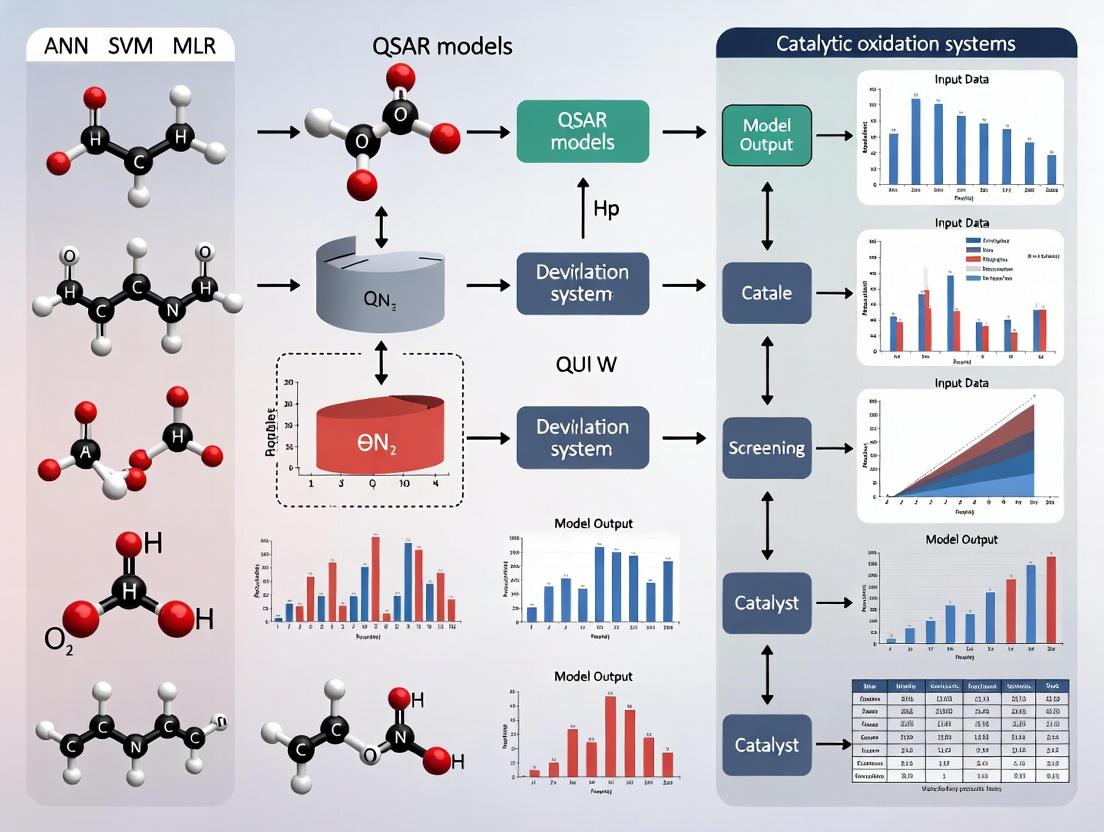
This comprehensive article explores the application of Artificial Neural Networks (ANN), Support Vector Machines (SVM), and Multiple Linear Regression (MLR) in building Quantitative Structure-Activity Relationship (QSAR) models to predict the...
Predicting Catalytic Oxidation in Drug Metabolism: A Comparative Guide to ANN, SVM, and MLR QSAR Models for Researchers
Abstract
This comprehensive article explores the application of Artificial Neural Networks (ANN), Support Vector Machines (SVM), and Multiple Linear Regression (MLR) in building Quantitative Structure-Activity Relationship (QSAR) models to predict the behavior of catalytic oxidation systems relevant to drug metabolism. Tailored for researchers and drug development professionals, it provides a foundational understanding of these computational tools, detailed methodological workflows for model development, strategies for troubleshooting and optimizing model performance, and a rigorous framework for validation and comparative analysis. The synthesis of these four intents offers a practical roadmap for integrating advanced QSAR modeling into the prediction of oxidative metabolic pathways, aiding in early-stage drug design and toxicity assessment.
Understanding QSAR Models: ANN, SVM, and MLR for Catalytic Oxidation Prediction
Catalytic oxidation systems, primarily involving cytochrome P450 (CYP) enzymes, are the principal mediators of Phase I drug metabolism. They functionalize xenobiotics, facilitating their elimination but also, in many cases, generating reactive or toxic intermediates. Understanding the substrate specificity, kinetics, and regioselectivity of these systems is a cornerstone of predictive toxicology and rational drug design. This understanding directly feeds into the development of quantitative structure-activity relationship (QSAR) models, including those utilizing advanced machine learning (ML) techniques such as Artificial Neural Networks (ANN) and Support Vector Machines (SVM). The accuracy of these ANN SVM MLR QSAR models is fundamentally dependent on the quality and mechanistic relevance of the experimental in vitro and in vivo metabolic data generated using the protocols outlined herein.
Core Catalytic Oxidation Systems: Components and Quantitative Profiles
The following table summarizes the key human catalytic oxidation systems, their major isoforms, and quantitative expression data relevant for in vitro to in vivo extrapolation (IVIVE).
Table 1: Major Human Hepatic Catalytic Oxidation Systems
| Enzyme System | Key Isoforms (Human) | Approx. % of Total Hepatic CYP* | Major Substrate Classes | Typical in vitro System for Study |
|---|---|---|---|---|
| Cytochrome P450 (CYP) | CYP3A4, CYP3A5 | ~30% (CYP3A4) | Macrolides, statins, calcium channel blockers, 50% of marketed drugs | Human liver microsomes (HLM), recombinant CYP enzymes |
| CYP2D6 | ~2-4% | Basic amines, antidepressants, antipsychotics, beta-blockers | HLM (+ chemical inhibitors), rCYP2D6 | |
| CYP2C9 | ~10-15% | Acidic drugs (e.g., warfarin, NSAIDs, phenytoin) | HLM, rCYP2C9 | |
| CYP2C19 | ~1-5% | Proton pump inhibitors, clopidogrel, diazepam | HLM, rCYP2C19 | |
| CYP1A2 | ~10-15% | Planar heterocyclic amines (e.g., caffeine, theophylline) | HLM, rCYP1A2 | |
| Flavin-containing Monooxygenase (FMO) | FMO3, FMO5 | N/A (not a CYP) | Soft nucleophiles (S, N, P heteroatoms); e.g., nicotine, cimetidine | HLM (heat-inactivated for specificity), rFMO |
| Monoamine Oxidase (MAO) | MAO-A, MAO-B | Mitochondrial | Endogenous amines (neurotransmitters), exogenous amines | Mitochondrial fractions, recombinant MAO |
| Alcohol & Aldehyde Dehydrogenase | ADH1A, ALDH2 | Cytosolic | Ethanol, retinol, aldehydes | Cytosolic fractions, recombinant enzymes |
*Percentages are liver-average estimates and exhibit significant inter-individual variability.
Experimental Protocols forIn VitroMetabolism Studies
Protocol 3.1: Metabolic Stability Assessment in Human Liver Microsomes (HLM)
Objective: To determine the intrinsic clearance (CLint) of a test compound via catalytic oxidation.
Materials (Research Reagent Solutions):
- Test Compound Solution: 1 mM stock in DMSO (≤0.5% final concentration).
- HLM Pool: 20 mg/mL protein stock in storage buffer.
- NADPH Regenerating System: Solution A: 26 mM NADP+, 66 mM Glucose-6-phosphate, 66 mM MgCl2 in water. Solution B: 40 U/mL Glucose-6-phosphate dehydrogenase in water. Mix immediately before use.
- Potassium Phosphate Buffer: 0.1 M, pH 7.4.
- Quenching Solution: Acetonitrile with internal standard (e.g., 100 ng/mL tolbutamide).
- LC-MS/MS System: For analyte quantification.
Procedure:
- Incubation: Pre-warm HLM (0.5 mg/mL final) and test compound (1 µM final) in phosphate buffer at 37°C for 5 min. Initiate reaction by adding NADPH regenerating system (1 mM NADPH final). Include controls without NADPH and without microsomes.
- Time Points: At t = 0, 5, 10, 20, 30, and 60 minutes, remove 50 µL aliquot and quench with 100 µL of ice-cold quenching solution.
- Sample Processing: Vortex, centrifuge (15,000 x g, 10 min, 4°C). Transfer supernatant for LC-MS/MS analysis.
- Data Analysis: Plot Ln(peak area ratio vs. internal standard) vs. time. The slope (k) is the disappearance rate. Calculate CLint = k / [microsomal protein concentration].
Protocol 3.2: Reaction Phenotyping Using Chemical Inhibitors
Objective: To identify the specific CYP isoform(s) responsible for metabolite formation.
Materials: Includes all from Protocol 3.1, plus isoform-selective chemical inhibitors (e.g., Ketoconazole for CYP3A4, Quinidine for CYP2D6, α-Naphthoflavone for CYP1A2).
Procedure:
- Set up parallel incubations with HLM and test compound (at Km or clinically relevant concentration).
- Pre-incubate HLM with individual selective inhibitors (at recommended concentrations) for 5 min before adding substrate and NADPH.
- Run a positive control incubation with a known probe substrate for each inhibitor.
- Terminate reactions after a linear time point (e.g., 20 min).
- Measure formation of the specific metabolite of interest.
- Calculate % inhibition = [1 - (formation with inhibitor / formation without inhibitor)] * 100. >80% inhibition suggests major involvement.
Protocol 3.3: Metabolite Identification using High-Resolution Mass Spectrometry
Objective: To structurally characterize oxidative metabolites.
Procedure:
- Scale up incubation from Protocol 3.1 using 10 µM substrate.
- Quench after 60 min, centrifuge, and analyze supernatant using LC coupled to high-resolution MS (e.g., Q-TOF or Orbitrap).
- Acquire data in both positive and negative ionization modes with data-dependent MS/MS.
- Use software to identify potential metabolites by searching for expected mass shifts (e.g., +15.9949 Da for +O, +1.9958 Da for +Sulfation) and analyzing fragment ion spectra.
The Scientist's Toolkit: Key Research Reagent Solutions
Table 2: Essential Reagents for In Vitro Oxidation Studies
| Reagent / Material | Function / Purpose | Key Consideration |
|---|---|---|
| Pooled Human Liver Microsomes (HLM) | Gold-standard system containing full complement of native CYP and FMO enzymes. Used for intrinsic clearance and phenotyping. | Donor demographics (age, gender) critical. Use gender-mixed pools for general screening. |
| Recombinant CYP Enzymes (rCYP) | Single isoform expressed in insect or mammalian cells. Used for definitive reaction phenotyping and kinetic studies (Km, Vmax). | Lack of native redox partner ratios; activity per pmol CYP is standardized. |
| NADPH Regenerating System | Provides constant supply of the essential cofactor NADPH for oxidative reactions. | Superior to adding NADPH directly due to cost and stability. System A + B must be fresh. |
| Isoform-Selective Chemical Inhibitors | To pharmacologically inhibit specific CYP activities in HLM incubations for reaction phenotyping. | Must validate selectivity and concentration to avoid off-target effects. Use positive controls. |
| Isoform-Specific Probe Substrates | Compounds metabolized predominantly by a single CYP (e.g., midazolam for CYP3A4, dextromethorphan for CYP2D6). Used as positive controls for inhibitor and antibody experiments. | Validates system functionality. |
| LC-MS/MS System | For sensitive, selective, and quantitative analysis of substrate depletion or metabolite formation. HR-MS enables metabolite ID. | Requires stable isotope-labeled internal standards for optimal quantitation. |
Visualization of Pathways and Workflows
Title: Catalytic Oxidation and Potential Toxicity Pathway
Title: Experimental Data Pipeline for QSAR Modeling
Quantitative Structure-Activity Relationship (QSAR) modeling is a cornerstone of predictive medicinal chemistry, enabling the rational design of novel therapeutic agents. By establishing mathematical relationships between molecular descriptors and biological activity, QSAR models predict the potency, selectivity, and ADMET (Absorption, Distribution, Metabolism, Excretion, Toxicity) properties of untested compounds. This overview details application notes and protocols within the broader context of computational drug discovery, linking to advanced modeling techniques like Artificial Neural Networks (ANN), Support Vector Machines (SVM), and Multiple Linear Regression (MLR) for complex systems, including catalytic oxidation in drug metabolism.
Application Notes: Key QSAR Methodologies in Practice
Note 1: Comparative Performance of MLR, ANN, and SVM for Kinase Inhibitor Design A study on Cyclin-Dependent Kinase 2 (CDK2) inhibitors evaluated MLR, ANN, and SVM models built using 2D molecular descriptors.
Table 1: Model Performance Comparison for CDK2 Inhibition Prediction
| Model Type | Descriptors Used | Training Set R² | Test Set R² | RMSE (Test) | Key Advantage |
|---|---|---|---|---|---|
| MLR | Topological, Electronic | 0.85 | 0.78 | 0.45 | Interpretability, clear descriptor contribution |
| ANN (3-layer) | Full Descriptor Set | 0.92 | 0.82 | 0.41 | Captures non-linear relationships |
| SVM (RBF Kernel) | Full Descriptor Set | 0.90 | 0.85 | 0.38 | Robust to overfitting, high generalization |
Interpretation: SVM models demonstrated superior predictive robustness on external test sets, making them suitable for virtual screening. MLR provides critical insight into which structural features (e.g., hydrophobicity, H-bond acceptor count) most influence activity.
Note 2: QSAR Modeling for Predicting Metabolic Stability via Catalytic Oxidation Predicting metabolic stability, often mediated by cytochrome P450 (CYP) catalytic oxidation systems, is crucial. QSAR models using 3D pharmacophore descriptors and SVM classification can predict compounds as "high" or "low" clearance.
Table 2: SVM Classifier Performance for CYP3A4-Mediated Metabolic Stability
| Dataset (Number of Compounds) | Sensitivity | Specificity | Accuracy | MCC |
|---|---|---|---|---|
| Training Set (n=180) | 0.88 | 0.91 | 0.89 | 0.79 |
| Blind Test Set (n=45) | 0.82 | 0.85 | 0.84 | 0.67 |
Application: This model is integrated early in lead optimization to prioritize compounds with favorable metabolic profiles.
Experimental Protocols
Protocol 1: Development and Validation of an MLR QSAR Model
Objective: To construct a validated MLR model for predicting the pIC50 of a series of acetylcholinesterase inhibitors.
Materials & Reagents:
- Chemical Dataset: 50 compounds with experimentally measured pIC50.
- Software: RDKit (for descriptor calculation), Python/scikit-learn or R (for modeling), OECD QSAR Toolbox.
- Computational Environment: Standard workstation (CPU: Intel i7/equivalent, RAM: 16 GB).
Procedure:
- Data Curation: Standardize chemical structures (e.g., neutralize salts, remove duplicates). Divide dataset randomly into training (70%, n=35) and test sets (30%, n=15).
- Descriptor Calculation: Calculate a pool of 200+ 2D molecular descriptors (e.g., logP, molecular weight, topological indices, partial charges) using RDKit.
- Descriptor Selection & Reduction: a. Remove constant/near-constant descriptors. b. Perform pairwise correlation analysis; retain one from any pair with correlation >0.95. c. Use Genetic Algorithm (GA) or Stepwise Regression on the training set to select 3-5 optimal descriptors.
- Model Building: Perform MLR on the training set using the selected descriptors to derive the linear equation: pIC50 = aDesc1 + bDesc2 + c*Desc3 + Intercept.
- Internal Validation: Calculate for the training set: R², adjusted R², and leave-one-out cross-validated Q² (Q² > 0.5 is acceptable).
- External Validation: Predict pIC50 for the test set. Calculate predictive R² (R²pred) and RMSE. A model is considered predictive if R²pred > 0.6.
- Domain of Applicability: Define using leverage approach; flag compounds for which predictions are extrapolations.
Protocol 2: Building an ANN-Based QSAR for Complex Activity Prediction
Objective: To develop a non-linear ANN model to predict the activity of complex enzyme inhibitors.
Procedure:
- Data Preparation: Follow Protocol 1, steps 1-3. Normalize all selected descriptor values to a [0, 1] range.
- Network Architecture Design: Construct a feed-forward neural network with:
- Input Layer: Nodes = number of selected descriptors.
- Hidden Layer(s): Start with one hidden layer (nodes = √(input nodes * output nodes)).
- Output Layer: One node (pIC50).
- Activation: Use ReLU for hidden, linear for output.
- Model Training: Use backpropagation (Adam optimizer) with Mean Squared Error loss. Implement early stopping using a validation set (20% of training data) to prevent overfitting.
- Model Assessment: Validate as per Protocol 1, steps 5-6. Compare performance to a baseline linear model.
Protocol 3: Virtual Screening Workflow Using a Pre-Trained SVM QSAR Model
Objective: To screen an in-house chemical library for potential hits against a target.
Procedure:
- Model Loading: Load a previously validated SVM model (e.g., for kinase inhibition).
- Library Preparation: Prepare and standardize the screening library (10,000 compounds). Calculate the exact molecular descriptors required by the model.
- Prediction: Run the SVM model on the descriptor matrix to generate activity scores/predictions.
- Post-Processing: Rank compounds by predicted activity. Apply additional filters (e.g., drug-likeness rules, PAINS removal). Select the top 100-200 compounds for in vitro testing.
Visualizations
Title: General QSAR Modeling and Validation Workflow
Title: QSAR's Role in a Broader Computational Thesis
The Scientist's Toolkit: Key Research Reagent Solutions
Table 3: Essential Materials for QSAR Modeling and Validation
| Item | Function/Description | Example/Tool |
|---|---|---|
| Chemical Structure Standardization Tool | Ensures consistency in molecular representation for descriptor calculation. | RDKit, OpenBabel, ChemAxon Standardizer |
| Molecular Descriptor Calculation Suite | Generates numerical representations of molecular structure and properties. | RDKit, PaDEL-Descriptor, Dragon |
| Modeling & Machine Learning Environment | Platform for building, training, and validating MLR, ANN, and SVM models. | Python (scikit-learn, TensorFlow/Keras), R (caret, e1071) |
| Validation Software Suite | Assists in rigorous statistical validation and applicability domain definition. | OECD QSAR Toolbox, QSARINS |
| High-Performance Computing (HPC) Resource | Runs resource-intensive tasks like GA descriptor selection or deep learning. | Local cluster or cloud services (AWS, Google Cloud) |
| In Vitro Assay Kit (for Model Validation) | Provides experimental biological data to validate computational predictions. | Target-specific enzymatic or cell-based assay (e.g., kinase glo assay) |
Core Principles of Artificial Neural Networks (ANN) for Non-Linear Pattern Recognition
This document provides Application Notes and Protocols detailing the core principles of Artificial Neural Networks (ANNs) as a critical component within a broader computational chemistry thesis. The thesis focuses on developing robust Quantitative Structure-Activity Relationship (QSAR) models—comparing ANN, Support Vector Machine (SVM), and Multiple Linear Regression (MLR) methods—for predicting the efficacy of novel compounds in catalytic oxidation systems relevant to drug metabolite synthesis and environmental remediation.
Core ANN Principles for Non-Linear Pattern Recognition
ANNs are computational models inspired by biological neural networks. Their power in QSAR derives from an ability to model complex, non-linear relationships between molecular descriptors (input) and biological/chemical activity (output) without a priori specification of the relationship's form.
Key Principles:
- Architecture: Composed of interconnected layers (input, hidden, output) of processing units (neurons).
- Non-Linear Activation: Neurons apply a non-linear activation function (e.g., ReLU, Sigmoid) to the weighted sum of their inputs, enabling the network to learn non-linear patterns.
- Learning via Backpropagation: The network learns by iteratively adjusting connection weights to minimize the error between predicted and actual outputs, using optimization algorithms like Adam or SGD.
- Universal Approximation Theorem: A feedforward network with a single hidden layer containing a finite number of neurons can approximate any continuous function, given appropriate activation functions and weights.
Application Notes: ANN in QSAR for Catalytic Oxidation Systems
In the thesis context, ANNs are employed to correlate molecular descriptors of organic substrates or catalyst ligands with key performance metrics in catalytic oxidation reactions (e.g., conversion rate, selectivity for a specific metabolite, turnover number).
Advantages over MLR/SVM in this context:
- Captures Complex Interactions: Can model higher-order and interactive effects between descriptors that MLR, a linear model, cannot.
- Adaptive Learning: Superior to SVMs for very large, high-dimensional descriptor sets common in modern cheminformatics.
- Output Flexibility: Can handle multiple continuous (e.g., yield, TOF) and categorical outputs (e.g., major product class) simultaneously.
Challenges & Mitigations:
- Overfitting: Addressed using dropout layers, L2 regularization, and rigorous validation (k-fold cross-validation).
- Interpretability: Addressed by using sensitivity analysis (e.g., Partial Derivatives) or employing model-agnostic tools (SHAP, LIME) post-hoc to identify critical molecular features.
Experimental Protocols for ANN-QSAR Model Development
Protocol 4.1: Data Curation and Descriptor Calculation
Objective: Prepare a standardized dataset for ANN training. Procedure:
- Compound Library: Compile a set of 150-300 molecules with experimentally determined activity values for the target catalytic oxidation.
- Descriptor Generation: Use cheminformatics software (e.g., RDKit, PaDEL-Descriptor) to calculate 500+ 1D, 2D, and 3D molecular descriptors for each compound.
- Data Preprocessing:
- Remove Constants: Eliminate descriptors with zero variance.
- Handle Missing Values: Impute or remove descriptors/compounds with >5% missing data.
- Normalization: Scale all descriptor values to a range of [0, 1] or standardize to zero mean and unit variance.
- Feature Selection: Apply a filter method (e.g., correlation-based) to reduce dimensionality to the top 50-100 most relevant descriptors.
- Dataset Splitting: Partition data into Training (70%), Validation (15%), and Test (15%) sets. Use stratified splitting if activity is categorical.
Protocol 4.2: ANN Model Construction & Training
Objective: Build and train an ANN model to predict catalytic activity. Procedure:
- Architecture Design (Example):
- Input Layer: Neurons = number of selected descriptors (n).
- Hidden Layer 1: Dense layer with
2nneurons, ReLU activation, with a Dropout rate of 0.2. - Hidden Layer 2: Dense layer with
nneurons, ReLU activation. - Output Layer: Dense layer with 1 neuron (linear activation for regression, sigmoid for binary classification).
- Compilation: Use Adam optimizer (learning rate=0.001). Loss function: Mean Squared Error (regression) or Binary Crossentropy (classification). Include accuracy/R² as a metric.
- Training: Train for up to 500 epochs with a batch size of 16. Use the Validation set to monitor for overfitting and implement Early Stopping (patience=30) to halt training when validation loss plateaus.
- Evaluation: Apply the final model to the held-out Test set to report unbiased performance metrics.
Table 1: Comparison of Model Performance on a Test Set for Catalytic Turnover Frequency (TOF) Prediction
| Model Type | Architecture/Parameters | R² (Test) | Mean Absolute Error (Test) | Key Advantage | Key Limitation |
|---|---|---|---|---|---|
| ANN | 2 Hidden Layers, ReLU, Dropout=0.2 | 0.89 | 12.5 TOF | Best at capturing non-linear descriptor interactions | Prone to overfitting; "Black-box" nature |
| SVM (RBF Kernel) | C=10, gamma='scale' | 0.85 | 15.8 TOF | Effective in high-dimensional spaces; Good generalization | Memory intensive; Kernel choice is critical |
| Multiple Linear Regression (MLR) | - | 0.72 | 24.3 TOF | Highly interpretable; Simple & fast | Cannot model non-linear relationships |
Table 2: Impact of Feature Selection on ANN Model Performance
| Feature Selection Method | Number of Descriptors | ANN Training R² | ANN Validation R² | Training Time (s) |
|---|---|---|---|---|
| None (All after preprocessing) | 520 | 0.999 | 0.71 | 145 |
| Correlation with target (>0.1) | 185 | 0.95 | 0.82 | 78 |
| Recursive Feature Elimination (RFE) | 75 | 0.93 | 0.88 | 45 |
| Genetic Algorithm (GA) | 65 | 0.96 | 0.87 | 62 |
Visualizations
ANN QSAR Model Development Workflow
ANN Architecture for Non Linear QSAR
The Scientist's Toolkit
Table 3: Essential Research Reagent Solutions for ANN-QSAR in Catalytic Oxidation
| Item/Reagent | Function in the Research Context | Example/Notes |
|---|---|---|
| Curated Chemical Dataset | Foundation for model training; requires accurate biological/catalytic activity data. | Public (e.g., ChEMBL) or proprietary libraries of substrates for oxidation. |
| Cheminformatics Software (RDKit, PaDEL) | Calculates numerical molecular descriptors from chemical structures. | RDKit allows calculation of >200 descriptors; essential for feature generation. |
| Feature Selection Algorithm | Reduces descriptor dimensionality to prevent overfitting and improve model interpretability. | Scikit-learn's SelectKBest, RFE, or custom genetic algorithms. |
| Deep Learning Framework (TensorFlow/Keras, PyTorch) | Provides libraries to efficiently construct, train, and validate ANN architectures. | Keras API on TensorFlow backend offers a balance of simplicity and control. |
| Model Interpretation Library (SHAP, LIME) | Post-hoc analysis to identify which molecular descriptors most influence the ANN's predictions. | SHAP (SHapley Additive exPlanations) values provide consistent attribution. |
| High-Performance Computing (HPC) Resources | Accelerates model training, hyperparameter tuning, and cross-validation cycles. | GPUs are critical for training large ANNs or processing massive descriptor sets. |
Core Principles of Support Vector Machines (SVM) for Classification and Regression
Support Vector Machines (SVMs) represent a pivotal machine learning methodology within the broader computational research framework of Artificial Neural Networks (ANN), SVM, Multiple Linear Regression (MLR), and Quantitative Structure-Activity Relationship (QSAR) models. This integrated approach is critical for elucidating catalytic oxidation systems, particularly in drug development, where predicting molecular activity, reactivity, and optimizing catalyst design are paramount. SVMs provide a robust, non-linear alternative to MLR and a more interpretable, high-dimensional pattern recognition tool compared to ANNs for certain QSAR applications.
Foundational Principles
Maximal Margin Classifier (Linear SVM)
The core principle for classification is identifying the optimal hyperplane in an n-dimensional space that separates data points of different classes with the maximum margin. The margin is the distance between the hyperplane and the nearest data points from each class, called support vectors.
- Objective Function: Minimize ( \frac{1}{2} ||w||^2 ) subject to ( yi (w \cdot xi + b) \geq 1 ) for all ( i ), where ( w ) is the weight vector, ( b ) is the bias, and ( y_i ) is the class label (±1).
- Decision Function: ( f(x) = \text{sign}(w \cdot x + b) ).
The Kernel Trick for Non-Linear Separation
For non-linearly separable data, SVMs map input vectors ( x ) into a higher-dimensional feature space using a kernel function ( K(xi, xj) ), where a linear separation becomes possible. This avoids explicit computation of coordinates in the high-dimensional space.
Common Kernel Functions:
- Linear: ( K(xi, xj) = xi^T xj )
- Polynomial: ( K(xi, xj) = (\gamma xi^T xj + r)^d )
- Radial Basis Function (RBF/Gaussian): ( K(xi, xj) = \exp(-\gamma ||xi - xj||^2) )
Support Vector Regression (SVR)
SVR applies the margin principle to regression. The goal is to find a function ( f(x) ) that deviates from actual target values ( y_i ) by at most ( \epsilon ) (insensitive tube), while remaining as flat as possible. Points outside the ( \epsilon )-tube are the support vectors.
- Objective: Minimize ( \frac{1}{2} ||w||^2 + C \sum{i=1}^n (\xii + \xi_i^*) ), subject to constraints defining the ( \epsilon )-insensitive tube.
Table 1: Comparison of SVM Kernels in QSAR Modeling for Catalytic Oxidation Ligands
| Kernel Type | Key Parameter(s) | Typical Use Case in QSAR/Catalysis | Advantage | Disadvantage |
|---|---|---|---|---|
| Linear | Regularization (C) | High-dimensional data (e.g., molecular fingerprints); Linear relationships. | Less prone to overfitting; Fast. | Cannot capture complex non-linear structure-property relationships. |
| RBF | Regularization (C), Gamma (γ) | Complex, non-linear relationships (e.g., predicting catalytic turnover number). | Highly flexible, powerful for non-linear patterns. | Sensitive to parameter choice; Risk of overfitting. |
| Polynomial | Degree (d), Gamma (γ), Coef0 (r) | Moderate non-linearity; When feature interactions are theoretically known. | Can model feature interactions. | Numerically unstable at high degrees; More parameters to tune. |
Table 2: Typical Hyperparameter Ranges for SVM/SVR in Molecular Modeling
| Hyperparameter | Description | Common Search Range (Classification & Regression) |
|---|---|---|
| C (Regularization) | Controls trade-off between maximizing margin and minimizing classification error. | ( 10^{-3} \text{ to } 10^{3} ) (log scale) |
| Gamma (γ) for RBF | Defines influence radius of a single training point (low = far, high = close). | ( 10^{-5} \text{ to } 10^{2} ) (log scale) |
| Epsilon (ε) for SVR | Width of the insensitive loss tube. | ( 0.01, 0.1, 0.5, 1.0 ) |
| Degree (d) for Polynomial | Degree of the polynomial kernel. | ( 2, 3, 4, 5 ) |
Application Protocols in QSAR/Catalytic Research
Protocol 1: Developing an SVM-Based QSAR Model for Catalyst Activity Prediction
Aim: To predict the turnover frequency (TOF) of a series of oxidation catalysts using molecular descriptors.
Materials & Software: Python/R, scikit-learn/libsvm, molecular descriptor calculation software (e.g., RDKit, PaDEL), dataset of catalyst structures and associated TOF values.
Procedure:
- Data Curation: Compile a homogeneous set of 50-100 catalyst complexes with experimentally determined TOF for a specific oxidation reaction (e.g., alkene epoxidation).
- Descriptor Calculation: Compute 2D/3D molecular descriptors (e.g., topological, electronic, steric) for each catalyst structure. Pre-process: Remove zero-variance descriptors, scale features (StandardScaler).
- Data Splitting: Split data into training (70%) and independent test (30%) sets using stratified sampling based on activity range.
- Model Training (SVR-RBF):
a. On the training set, perform a grid search with 5-fold cross-validation.
b. Search over:
C = [0.1, 1, 10, 100],gamma = [0.001, 0.01, 0.1, 1],epsilon = [0.01, 0.1, 0.5]. c. Use Mean Squared Error (MSE) as the cross-validation scoring metric. d. Refit the model with the optimal parameters on the entire training set. - Model Validation: Predict TOF for the held-out test set. Calculate performance metrics: R², Adjusted R², and Mean Absolute Error (MAE).
- Interpretation: Use permutation feature importance or coefficients from a linear SVM to identify descriptors most critical for catalytic activity.
Protocol 2: SVM Classification of Bioactive vs. Inactive Oxidation Products
Aim: To classify products from catalytic oxidation libraries as having potential drug activity (e.g., antimicrobial) or being inactive.
Procedure:
- Data Labeling: From high-throughput screening data, label compounds as "Active" (1) or "Inactive" (0) based on a defined activity threshold (e.g., IC50 < 10 µM).
- Feature Generation: Use extended-connectivity fingerprints (ECFP4) to represent molecular structures.
- Addressing Imbalance: If classes are imbalanced (e.g., few actives), apply Synthetic Minority Over-sampling Technique (SMOTE) on the training set only or use class_weight='balanced' in SVM.
- Model Training (SVM-RBF):
a. Perform a randomized search with 5-fold stratified cross-validation on the training set.
b. Optimize for balanced accuracy or F1-score.
c. Search over:
C = log-uniform(1e-3, 1e3),gamma = log-uniform(1e-5, 1e1). - Evaluation: Test set evaluation using confusion matrix, ROC-AUC, precision, and recall. Critical for early-stage drug development triage.
Visualization of Key Concepts
SVM QSAR Model Development Workflow
The Kernel Trick for Non-Linear SVM
The Scientist's Toolkit: Key Research Reagents & Solutions
Table 3: Essential Toolkit for SVM in Molecular & Catalytic Research
| Item | Function/Description | Example/Note |
|---|---|---|
| Molecular Descriptor Software | Generates quantitative features from chemical structures for use as SVM input. | RDKit, PaDEL-Descriptor, Dragon. Critical for QSAR feature engineering. |
| Fingerprint Generators | Creates binary bit-vectors representing molecular substructures. | ECFP (Circular Fingerprints), MACCS Keys. Useful for classification tasks. |
| Hyperparameter Optimization Libs | Automates the search for optimal SVM (C, γ) parameters. | scikit-learn GridSearchCV, RandomizedSearchCV, Optuna. |
| Model Validation Suites | Provides robust metrics and methods for evaluating predictive performance. | scikit-learn metrics; Y-Randomization (for QSAR validation). |
| High-Performance Computing (HPC) | Enables training on large datasets or intensive kernel computations. | Cloud computing (AWS, GCP) or local clusters for large virtual screens. |
| Chemical Databases | Source of structured biological activity or catalytic performance data. | ChEMBL, PubChem, CSD (Cambridge Structural Database). |
| Standardized Benchmark Datasets | Allow for fair comparison of SVM vs. ANN/MLR performance. | MoleculeNet, QSAR Benchmark Datasets. |
Core Principles of Multiple Linear Regression (MLR) for Interpretable Linear Modeling
Multiple Linear Regression (MLR) is a foundational statistical method for modeling the relationship between a dependent variable and two or more independent variables. Within the broader thesis on Comparative QSAR Modeling for Catalytic Oxidation Systems (involving ANN, SVM, and MLR), MLR serves as the primary interpretable, white-box model. Its transparency in providing explicit coefficients for each molecular descriptor is critical for understanding structure-activity relationships, guiding the rational design of catalysts or drug candidates in oxidation-driven processes.
Core Theoretical Principles
Model Equation: The MLR model is expressed as: [ Y = \beta0 + \beta1X1 + \beta2X2 + ... + \betanXn + \epsilon ] where (Y) is the predicted activity/property, (\beta0) is the intercept, (\betai) are the partial regression coefficients, (Xi) are the independent variables (e.g., molecular descriptors), and (\epsilon) is the random error.
Key Assumptions for Valid MLR:
- Linearity: The relationship between predictors and the response is linear.
- Independence: Observations are independent of each other.
- Homoscedasticity: Constant variance of errors.
- Normality: Errors are normally distributed.
- No Perfect Multicollinearity: Predictor variables are not perfectly correlated.
Model Validation Metrics:
- Coefficient of Determination (R²): Proportion of variance explained.
- Adjusted R²: Adjusts R² for the number of predictors.
- Standard Error of Estimate (s): Average distance of data points from the regression line.
- F-statistic (p-value): Tests the overall significance of the model.
- t-statistic (p-value) for coefficients: Tests the significance of individual predictors.
- Variance Inflation Factor (VIF): Diagnoses multicollinearity (VIF > 10 indicates severe issues).
MLR QSAR Modeling Protocol
This protocol details the construction and validation of an MLR-based QSAR model for predicting catalytic oxidation activity.
Protocol 3.1: Data Preparation and Descriptor Calculation
Objective: Prepare a consistent dataset of compounds with known activity and calculated molecular descriptors.
- Compound Set: Curate a congeneric series of 30-50 compounds with experimentally determined activity (e.g., % substrate conversion, turnover frequency) in the target catalytic oxidation.
- Descriptor Generation: Use chemical informatics software (e.g., Dragon, PaDEL-Descriptor) to compute a wide range of 2D and 3D molecular descriptors (constitutional, topological, electrostatic, geometric) for each minimized energy structure.
- Data Preprocessing: a) Remove descriptors with zero or near-zero variance. b) Handle missing values via imputation or removal. c) Standardize (scale) all descriptor values (e.g., to unit variance).
Protocol 3.2: Variable Selection and Model Construction
Objective: Identify the optimal subset of descriptors to build a robust, interpretable MLR model.
- Initial Filtering: Calculate pairwise correlations. For descriptors with |r| > 0.95, retain one.
- Feature Selection: Apply a stepwise selection method (forward, backward, or combinatorial).
- Criteria: Use pre-set p-value thresholds (e.g., p-in = 0.05, p-out = 0.10) or optimize based on the Adjusted R².
- Model Fitting: Fit the MLR model using ordinary least squares (OLS) regression with the selected descriptor subset.
Protocol 3.3: Model Validation & Interpretation
Objective: Statistically validate the model and interpret the coefficients.
- Internal Validation: Perform Leave-One-Out (LOO) or 5-fold cross-validation. Report Q² (cross-validated R²). A Q² > 0.5 is generally acceptable.
- External Validation: Reserve 20-30% of the initial dataset as an external test set prior to modeling. Predict its activity and calculate predictive R² (R²pred). R²pred > 0.6 indicates good predictive power.
- Diagnostic Checks: Verify MLR assumptions by analyzing residual plots (vs. predicted values, vs. each descriptor) and a Q-Q plot of residuals.
- Interpretation: Analyze the sign and magnitude of the standardized regression coefficients. A positive coefficient indicates the descriptor is favorable for activity; a negative coefficient indicates an inverse relationship.
Data Presentation
Table 1: Example MLR QSAR Model for Phenol Catalytic Oxidation Activity
| Model Statistic | Value | Acceptability Threshold | Interpretation |
|---|---|---|---|
| R² | 0.872 | > 0.6 | 87.2% of activity variance is explained. |
| Adjusted R² | 0.855 | Close to R² | Model is not over-fitted. |
| Standard Error (s) | 0.15 | Low relative to Y range | Good model precision. |
| F-statistic (p-value) | 42.7 (1.2e-09) | p < 0.05 | Model is statistically significant. |
| Q² (LOO) | 0.812 | > 0.5 | Model has good internal predictive ability. |
| R²_pred (External) | 0.783 | > 0.6 | Model has good external predictive ability. |
Table 2: Descriptor Coefficients and Interpretation
| Selected Descriptor | Coefficient (β) | Std. Coeff. | t-value (p-value) | VIF | Chemical Interpretation |
|---|---|---|---|---|---|
| logP (Octanol-Water) | 0.45 | 0.58 | 5.12 (0.0001) | 1.8 | Positive influence; suggests hydrophobicity aids substrate binding. |
| EHOMO (eV) | -1.22 | -0.52 | -4.05 (0.0005) | 2.1 | Negative influence; lower HOMO energy may favor electron transfer to catalyst. |
| Topological Polar Surface Area (Ų) | -0.03 | -0.41 | -3.78 (0.0010) | 1.5 | Negative influence; smaller polar area may improve membrane permeability/metal center access. |
| Intercept | 2.10 | - | 3.98 (0.0006) | - | Baseline activity. |
Visualizations
Title: MLR's Role in Comparative QSAR Thesis
Title: MLR-QSAR Model Development Workflow
The Scientist's Toolkit: Research Reagent Solutions
Table 3: Essential Materials for MLR-QSAR Modeling in Catalytic Oxidation Research
| Item/Category | Example/Specific Tool | Function in MLR-QSAR Protocol |
|---|---|---|
| Chemical Modeling Software | Gaussian, Avogadro, CORINA | Used for generating energetically minimized 3D molecular structures required for accurate descriptor calculation. |
| Descriptor Calculation Software | Dragon, PaDEL-Descriptor, RDKit | Computes thousands of quantitative molecular descriptors (e.g., logP, TPSA, EHOMO) from chemical structures. |
| Statistical Analysis Environment | R (with lm, caret, leaps packages), Python (with scikit-learn, statsmodels, pandas), SPSS |
Provides the computational engine for performing OLS regression, stepwise selection, validation, and diagnostic statistics. |
| Data Curation & Preprocessing Toolkit | Spreadsheet software, Custom scripts for normalization/scaling, DataWarrior |
Essential for organizing compound-activity data, handling missing values, and standardizing descriptors before modeling. |
| Validation & Visualization Tools | Cross-validation scripts, Residual plotting functions (e.g., ggplot2, matplotlib), VIF calculation scripts |
Critical for assessing model robustness, checking statistical assumptions, and generating publication-quality diagnostic plots. |
Key Molecular Descriptors for Modeling Cytochrome P450 and Other Oxidative Enzymes
The development of robust Quantitative Structure-Activity Relationship (QSAR) models for predicting the metabolism of xenobiotics by Cytochrome P450 (CYP) and other oxidative enzymes is a cornerstone of modern drug discovery. Within the broader thesis on applying Artificial Neural Networks (ANN), Support Vector Machines (SVM), and Multiple Linear Regression (MLR) to catalytic oxidation systems, the selection of mechanistically relevant molecular descriptors is paramount. These descriptors serve as the critical input variables that determine model accuracy, interpretability, and predictive power for properties such as metabolic site prediction, reaction velocity, and inhibitory potential.
Molecular descriptors for oxidative metabolism models can be categorized into electronic, steric, topological, and quantum chemical classes. The following tables summarize the most impactful descriptors, as identified by recent MLR, SVM, and ANN-based QSAR studies.
Table 1: Fundamental Electronic and Steric Descriptors
| Descriptor | Definition | Role in Oxidative Metabolism | Typical Value Range (Example) |
|---|---|---|---|
| Ionization Potential (IP) | Energy required to remove an electron. | Predicts electron-rich sites prone to one-electron oxidation (e.g., by CYP). | 7.5 - 10.5 eV (for drug-like molecules) |
| Electrophilicity Index (ω) | Measures the energy lowering due to electron transfer. | Quantifies susceptibility to nucleophilic attack by enzymatic oxidants. | 0.5 - 5.0 eV |
| Molecular Volume / Weight | Total spatial size of the molecule. | Impacts binding affinity and access to the enzyme's active site. | 200 - 500 ų / 200 - 600 Da |
| Polar Surface Area (PSA) | Surface area of polar atoms. | Correlates with membrane permeability and binding orientation. | 50 - 150 Ų |
Table 2: Advanced Quantum Chemical & Topological Descriptors
| Descriptor | Calculation Method | Relevance to CYP/Enzyme Mechanism | Key Insight from Recent SVM/ANN Models |
|---|---|---|---|
| Fukui Function (f⁻) | DFT-based; (ρ(N) - ρ(N-1)) for electrophilic attack. | Identifies atoms with high electron density for hydroxylation. | ANN models using f⁻ show >85% accuracy in site-of-metabolism prediction. |
| Spin Density Distribution | DFT (after single-electron oxidation). | Critical for modeling radical intermediates in CYP-mediated reactions. | High spin density on a carbon atom predicts aliphatic hydroxylation. |
| Molecular Orbital Energies (EHOMO, ELUMO) | Quantum chemical calculation (e.g., DFT, PM6). | HOMO energy indicates ease of oxidation; LUMO relates to electron acceptance. | SVM models using EHOMO outperform those using logP alone for Km prediction (R² > 0.75). |
| Topological Polar Surface Area (TPSA) | Sum of fragment-based contributions. | Rapid estimation of PSA; useful for high-throughput screening in MLR models. | Strong inverse correlation with metabolic clearance in congeneric series. |
Experimental Protocols for Descriptor Generation and Model Validation
Protocol 1: Quantum Chemical Calculation of Fukui Functions for Site Reactivity
- Objective: To compute the electrophilic Fukui function (f⁻) to identify atoms susceptible to oxidation.
- Software: Gaussian 16, ORCA, or open-source alternatives like PySCF.
- Procedure:
- Geometry Optimization: Optimize the neutral molecule's geometry using DFT (e.g., B3LYP functional with 6-31G* basis set).
- Single Point Energy Calculation: Calculate the electron density for the optimized neutral molecule (N electrons).
- Anion Calculation: Optimize the geometry of the respective anion (N+1 electrons) from the same starting structure.
- Population Analysis: Perform a natural population analysis (NPA) or use Hirshfeld charges for both systems.
- Fukui Function (f⁻) Calculation: Compute f⁻ for each atom k: f⁻k = qk(N) - qk(N-1), where q is the atomic charge. Atoms with the highest f⁻ values are the most nucleophilic.
- Output: A ranked list of atomic indices with their f⁻ values for input into QSAR models.
Protocol 2: Building an SVM Model for CYP3A4 Inhibition Prediction
- Objective: To construct a classifier predicting strong (IC50 < 10 µM) vs. weak CYP3A4 inhibitors.
- Software: Python (scikit-learn), LIBSVM.
- Procedure:
- Dataset Curation: Compile a standardized dataset of known inhibitors with measured IC50 from public sources (e.g., ChEMBL). Apply rigorous data curation (remove duplicates, check units).
- Descriptor Calculation: For each compound, calculate a diverse set of ~50 descriptors (e.g., MO energies, logP, TPSA, topological indices) using RDKit or PaDEL-Descriptor.
- Data Preprocessing: Split data into training (70%) and test (30%) sets. Scale all descriptors (e.g., StandardScaler in scikit-learn).
- Model Training: Use a radial basis function (RBF) kernel SVM. Optimize hyperparameters (C, gamma) via grid search with 5-fold cross-validation on the training set.
- Validation: Evaluate the final model on the held-out test set using metrics: Accuracy, Sensitivity, Specificity, and AUC-ROC.
- Output: A trained SVM model file and a report of predictive performance on the test set.
Visualization of Workflows and Relationships
Title: QSAR Model Development Workflow for Oxidative Metabolism
Title: Descriptor Categories Link to CYP Mechanism & Endpoints
The Scientist's Toolkit: Essential Research Reagents & Software
Table 3: Key Resources for Descriptor-Based Modeling of Oxidative Enzymes
| Item Name | Type/Category | Primary Function in Research |
|---|---|---|
| RDKit | Open-Source Cheminformatics Library | Calculates 2D/3D molecular descriptors (topological, steric) at high throughput. |
| Gaussian 16 | Quantum Chemistry Software Suite | Performs DFT calculations to obtain high-level electronic descriptors (MO energies, Fukui functions). |
| PyMOL / Maestro | Molecular Visualization & Modeling | Visualizes substrate-enzyme docking poses to inform steric descriptor selection. |
| CYP450 Reconstitution Kits | Biochemical Reagent (e.g., from Thermo Fisher) | Experimental validation of predictions via in vitro metabolism studies. |
| scikit-learn / LIBSVM | Machine Learning Libraries | Implements SVM, ANN, and other algorithms for building and testing QSAR models. |
| ChEMBL / PubChem | Public Bioactivity Database | Source of curated experimental data (IC50, Km) for model training and validation. |
The development of robust Quantitative Structure-Activity Relationship (QSAR) models—including those utilizing Artificial Neural Networks (ANN), Support Vector Machines (SVM), and Multiple Linear Regression (MLR)—for catalytic oxidation systems is fundamentally dependent on the quality, breadth, and integrity of the underlying chemical dataset. Catalytic oxidation is a critical process in pharmaceutical synthesis, metabolite production, and environmental remediation. The predictive accuracy of computational models is bounded by the "garbage in, garbage out" principle, making curated, well-annotated experimental data the most critical reagent. This protocol outlines a systematic approach for sourcing, validating, and preparing such datasets for use in machine learning-driven catalyst and reaction optimization.
High-quality datasets for catalytic oxidation QSAR should encompass multiple interrelated data types. The following table summarizes key data categories and their primary sources.
Table 1: Essential Data Types for Catalytic Oxidation QSAR Models
| Data Category | Description | Example Parameters | Target Public Sources (Live Search Verified) |
|---|---|---|---|
| Catalyst Structures | Precise molecular or material descriptors of the catalyst. | SMILES strings, InChIKey, crystal structure (CIF), active site geometry, elemental composition, oxidation state. | Cambridge Structural Database (CSD), Materials Project, CatApp, PubChem. |
| Substrate Structures | Molecular descriptors of the compound being oxidized. | SMILES, functional groups, topological indices (e.g., Wiener index), electronic parameters (HOMO/LUMO). | PubChem, ChEMBL, ZINC Database. |
| Reaction Conditions | Quantitative parameters defining the experimental environment. | Temperature, pressure, solvent identity & polarity, oxidant concentration (e.g., H2O2, O2), pH, reaction time. | Elsevier Reaction Data, USPTO Patents, published experimental procedures in literature. |
| Kinetic & Performance Data | Numeric outcomes of the catalytic oxidation experiment. | Turnover Frequency (TOF), Turnover Number (TON), conversion (%), yield (%), selectivity (%), rate constant (k). | NIST Chemical Kinetics Database, CatDB, extracted from peer-reviewed articles (e.g., ACS, RSC, Wiley publications). |
Protocol: Systematic Data Sourcing and Curation Workflow
Protocol: Automated Literature Mining and Extraction
Objective: To programmatically gather a large corpus of catalytic oxidation data from scientific literature and patents.
- Query Formulation: Use domain-specific keywords. Example:
("catalytic oxidation" AND "turnover frequency" AND (heterogeneous OR homogeneous) AND (alcohol TO aldehyde) NOT "electrochemical"). - API-Based Search: Execute searches via publishers' APIs (e.g., Elsevier Scopus, Springer Nature, PubMed E-utilities) and patent databases (USPTO, Espacenet). Tools:
Pythonlibrariesrequests,BeautifulSoup(for parsing), andselenium(for dynamic pages). - Full-Text Retrieval: For open-access articles, download full-text PDFs. For others, retrieve abstracts and metadata.
- Named Entity Recognition (NER): Apply a pre-trained chemical NER model (e.g.,
ChemDataExtractor,SpaCywith a chemistry model) to identify catalyst names, substrates, conditions, and numeric performance values from text. - Relationship Mapping: Use rule-based or ML algorithms to associate extracted entities (e.g., link a specific TOF value to a catalyst and substrate pair mentioned in the same sentence/paragraph).
- Data Point Validation: Cross-reference extracted numeric values with those in any available supplementary information tables (preferred source).
Protocol: Harmonization and Standardization
Objective: To transform raw, inconsistently reported data into a uniform, machine-readable format.
- Structure Standardization:
- Convert all chemical names and SMILES to standardized
canonical SMILESusing a toolkit likeRDKit(Open-Source) orOpen Babel. - For inorganic/organometallic catalysts, define a simplified representation focusing on the active metal center and first coordination sphere using a dedicated notation (e.g., using
pymatgenfor materials).
- Convert all chemical names and SMILES to standardized
- Unit Conversion: Convert all reported units to a consistent system (SI preferred). Example: Convert
mmol·g<sub>cat</sub><sup>-1</sup>·h<sup>-1</sup>tomol·mol<sub>metal</sub><sup>-1</sup>·s<sup>-1</sup>for TOF where possible. - Descriptor Calculation: Using standardized structures, compute a suite of molecular descriptors relevant to redox catalysis.
- Software:
RDKit,Dragon(Talete),PaDEL-Descriptor. - Key Descriptors: Electronic (electronegativity, ionization potential), steric (topological surface area, van der Waals volume), and quantum chemical (partial charges, Fukui indices—requires DFT preprocessing).
- Software:
- Missing Data Annotation: Clearly label missing or unreported parameters (e.g.,
pH: NA)—do not interpolate or guess values for the core dataset.
Protocol: Quality Control and Outlier Detection
Objective: To identify and flag erroneous or non-representative data points.
- Physicochemical Plausibility Check: Flag values outside possible ranges (e.g., yield >100%, negative rate constant).
- Statistical Outlier Detection: For continuous variables (e.g., TOF), apply interquartile range (IQR) or Z-score analysis within comparable reaction classes. Use domain knowledge to validate exclusions.
- Cross-Validation with Thermodynamics: For reactions with reported conversion/yield, check for gross violations of thermodynamic limits under the reported conditions.
- Data Provenance Logging: Maintain an audit trail linking each final data point to its original source (DOI, Patent Number).
Visualization of the Data Curation Workflow
Data Curation Workflow for Catalytic Oxidation QSAR
The Scientist's Toolkit: Research Reagent Solutions
Table 2: Essential Tools and Resources for Dataset Curation
| Item Name | Provider/Software | Primary Function in Curation |
|---|---|---|
| RDKit | Open-Source Cheminformatics | Core library for chemical structure manipulation, standardization, and descriptor calculation from SMILES. |
| ChemDataExtractor | University of Cambridge | Natural language processing toolkit specifically designed for automatically extracting chemical information from scientific documents. |
| Cambridge Structural Database (CSD) | CCDC | Authoritative repository for small-molecule organic and metal-organic crystal structures, essential for catalyst geometry descriptors. |
| Dragon Professional | Talete | Computes >5000 molecular descriptors for QSAR modeling; useful for comprehensive substrate/catalyst profiling. |
| pymatgen | Materials Project | Python library for materials analysis, enabling the generation of descriptors for solid/surface catalysts. |
| KNIME Analytics Platform | KNIME AG | Visual workflow tool for building, automating, and documenting the entire data preprocessing pipeline without extensive coding. |
| Jupyter Notebooks | Project Jupyter | Interactive environment for developing and sharing code for data mining, cleaning, and analysis in Python/R. |
| SciFinderⁿ | CAS | Commercial, comprehensive chemical information database for validating structures and searching reaction data. |
Protocol: Constructing the Final Modeling Dataset
Objective: To integrate all curated data into a unified table for machine learning.
- Feature Table Assembly: Create a master table where each row represents a unique catalytic oxidation experiment.
- Column Structure:
- Identifier Columns: Source DOI, Internal ID.
- Input Features (X): Descriptors for catalyst, substrate, and conditions (e.g., temperature, pH, solvent polarity index).
- Target Variables (Y): Performance metrics (e.g., TOF, Selectivity). Note: For classification models, discretize continuous targets (e.g., High/Low TOF).
- Train-Test Split Strategy: Perform a temporal split (older data for training, recent for testing) or a cluster-based split to evaluate extrapolation ability, rather than a simple random split, to prevent data leakage and over-optimistic performance estimates.
- Data Sheet Creation: Document the final dataset with a "datasheet" detailing motivations, composition, preprocessing steps, and potential uses/limitations, following best practices for dataset transparency.
Building Robust QSAR Models: A Step-by-Step Guide for ANN, SVM, and MLR
1. Introduction: Context within ANN, SVM, MLR QSAR for Catalytic Oxidation Systems Quantitative Structure-Activity Relationship (QSAR) modeling is a cornerstone in modern chemical research, enabling the prediction of molecular activity from structural descriptors. Within the specific thesis context of researching catalytic oxidation systems—crucial for environmental remediation, chemical synthesis, and drug metabolism studies—the development of robust QSAR models using Artificial Neural Networks (ANN), Support Vector Machines (SVM), and Multiple Linear Regression (MLR) is paramount. These models help predict catalytic efficiency, substrate specificity, or byproduct formation, accelerating the design of novel catalysts and oxidation processes.
2. Application Notes & Protocols: A Stepwise Workflow
2.1. Phase I: Data Acquisition and Curation
- Protocol 1.1: Dataset Compilation from Catalytic Oxidation Literature
- Objective: Assemble a homogeneous dataset of molecular structures and their corresponding catalytic oxidation activity metrics (e.g., turnover frequency (TOF), conversion %, TON, product selectivity).
- Methodology:
- Perform a systematic search using scientific databases (SciFinder, Reaxys, Web of Science) with keywords: "catalytic oxidation," "homogeneous/heterogeneous catalyst," "[specific substrate, e.g., alkane]," "kinetic data."
- Extract quantitative activity data for a consistent set of reaction conditions (temperature, pressure, solvent, oxidant).
- For each catalyst/substrate, generate or obtain a clean 2D or 3D molecular structure file (SDF, MOL).
- Log all data in a structured master table. Include fields: Compound ID, SMILES/String, Experimental Activity Value, Reaction Conditions Code, Reference.
- Protocol 1.2: Chemical Structure Standardization and Preparation
- Objective: Generate a consistent, chemically "sensible" representation of all molecules in the dataset.
- Methodology:
- Use cheminformatics toolkits (e.g., RDKit, OpenBabel) within a Python script or KNIME workflow.
- Apply steps: Neutralization of charges, removal of salts, generation of canonical tautomers, aromatization, and explicit hydrogen addition.
- Optimize 3D geometry using a force field (MMFF94 or UFF) and perform a conformational search if 3D descriptors are to be used.
- Output a standardized SDF file for descriptor calculation.
2.2. Phase II: Descriptor Calculation and Dataset Preparation
- Application Note 2.1: Descriptors encode molecular features into numerical values. For catalytic systems, key descriptor classes include:
- Electronic: HOMO/LUMO energies, partial charges, dipole moment (relevant for redox potential).
- Geometric/Topological: Molecular volume, surface area, connectivity indices.
- Steric: Taft’s steric constant, molar refractivity.
- Quantum Chemical: Fukui indices (for electrophilicity/nucleophilicity in oxidation).
- Protocol 2.2: Descriptor Calculation and Pre-processing
- Calculate descriptors using software like Dragon, PaDEL-Descriptor, or RDKit.
- Perform data cleaning: Remove descriptors with zero variance, >20% missing values, or high pairwise correlation (>0.95).
- Scale the remaining descriptor matrix (e.g., Standardization or Min-Max Scaling).
2.3. Phase III: Model Building, Validation, and Selection
- Protocol 3.1: Dataset Division and Model Training
- Split data into training (≈70-80%) and external test (≈20-30%) sets using rational methods (e.g., Kennard-Stone, activity-based sorting).
- For MLR: Use stepwise selection or genetic algorithm on the training set to select the most relevant, uncorrelated descriptors. Build linear model.
- For SVM: Optimize hyperparameters (kernel type: RBF; C, gamma) via grid/random search with cross-validation on the training set.
- For ANN: Design a multilayer perceptron (MLP). Optimize architecture (# layers, # neurons), learning rate, and epochs using cross-validation.
- Protocol 3.2: Rigorous Model Validation
- Principle: Adhere to OECD QSAR validation principles.
- Methodology:
- Internal Validation: Perform 5- or 10-fold cross-validation on the training set. Report Q², RMSEₛᵤᵦ.
- External Validation: Predict the held-out test set. Report R²ₑₓₜ, RMSEₑₓₜ.
- Y-Randomization: Shuffle activity values and rebuild models. Confirm low performance to rule out chance correlation.
- Applicability Domain (AD) Definition: Use methods like Leverage (Williams plot) or distance-based measures to define the chemical space where the model is reliable.
2.4. Phase IV: Model Interpretation and Deployment
- Protocol 4.1: Interpretation of the Selected Model
- MLR: Interpret sign and magnitude of coefficients.
- SVM/ANN: Use model-agnostic tools (e.g., SHAP, LIME) to determine descriptor importance and contribution for specific predictions.
- Protocol 4.2: Deployment for Virtual Screening
- Serialize the final model (e.g., using
picklein Python,.rdsin R). - Develop a simple web interface (Flask, Streamlit) or a script that:
- Accepts a SMILES string or SDF file.
- Applies the same standardization and descriptor calculation pipeline.
- Checks the input against the model's Applicability Domain.
- Returns a prediction with confidence interval.
- Serialize the final model (e.g., using
3. Data Presentation
Table 1: Representative Performance Metrics for Different QSAR Algorithms on a Catalytic Oxidation Dataset (Hypothetical Example)
| Model Type | Training R² | Cross-Validation Q² | External Test Set R² | RMSE (Test) | Key Descriptors Identified |
|---|---|---|---|---|---|
| MLR | 0.85 | 0.78 | 0.76 | 0.45 | HOMO Energy, Molecular Polarizability |
| SVM (RBF) | 0.92 | 0.85 | 0.83 | 0.32 | (Non-linear combination of multiple descriptors) |
| ANN (2 hidden layers) | 0.95 | 0.84 | 0.82 | 0.35 | (Complex non-linear relationships) |
4. Visualized Workflow
Diagram Title: QSAR Model Development Workflow
5. The Scientist's Toolkit
Table 2: Essential Research Reagent Solutions & Materials for QSAR on Catalytic Systems
| Item | Function/Explanation |
|---|---|
| RDKit (Open-Source) | Core cheminformatics library for Python. Used for molecule standardization, descriptor calculation, fingerprint generation, and basic modeling. |
| PaDEL-Descriptor | Software for calculating 1D, 2D, and 3D molecular descriptors and fingerprints from chemical structures. |
| scikit-learn (Python) | Primary library for implementing MLR, SVM, and ANN models, as well as for data preprocessing, validation, and hyperparameter tuning. |
| TensorFlow/PyTorch | Deep learning frameworks essential for building complex, custom ANN architectures beyond basic MLPs. |
| KNIME / Orange Data Mining | Visual programming platforms that provide GUI nodes for data manipulation, modeling, and visualization, useful for prototyping. |
| OECD QSAR Toolbox | Software to aid in applying OECD validation principles, profiling chemicals, and filling data gaps, crucial for regulatory acceptance. |
| Catalytic Oxidation Dataset | Curated, homogeneous collection of catalyst/substrate structures and associated kinetic/activity data. The foundational asset. |
| High-Performance Computing (HPC) Cluster | Computational resource necessary for quantum chemical descriptor calculations (e.g., DFT for HOMO/LUMO) and extensive hyperparameter optimization. |
Feature Selection and Dimensionality Reduction Techniques for Oxidation Data
This application note details practical protocols for feature selection (FS) and dimensionality reduction (DR) within the specific context of developing quantitative structure-activity relationship (QSAR) models—specifically Artificial Neural Network (ANN), Support Vector Machine (SVM), and Multiple Linear Regression (MLR) models—for catalytic oxidation systems. In drug development and materials science, oxidation data, such as catalytic turnover frequencies or product yield percentages, is often linked to high-dimensional molecular or catalyst descriptors. Effective FS/DR is critical to prevent overfitting, improve model interpretability, and enhance the predictive performance of ANN, SVM, and MLR models in this research domain.
Core Techniques: Protocols and Application Notes
Filter-Based Feature Selection Methods
Protocol: Variance Threshold and Correlation Filtering
- Data Preparation: Standardize your dataset (e.g., molecular descriptors from DRAGON software, electronic parameters, steric maps) using StandardScaler or MinMaxScaler.
- Low-Variance Removal: Calculate the variance of each feature. Remove all features where the variance does not exceed a defined threshold (e.g., 0.01). This eliminates near-constant descriptors irrelevant to oxidation activity.
- High-Correlation Filter: Compute the Pearson correlation matrix for the remaining features. Identify pairs of features with correlation coefficients > |0.85|. For each highly correlated pair, remove the feature with the lower correlation to the target variable (e.g., oxidation rate constant).
- Output: A reduced, less redundant descriptor set for subsequent modeling.
Wrapper Method: Recursive Feature Elimination (RFE) for SVM/MLR
Protocol: RFE using Cross-Validation
- Base Model Selection: Choose an estimator. For linear relationships, use MLR. For non-linear, use SVM with a linear kernel.
- Ranking Features: Initialize RFE, specifying the estimator and the number of features to select. RFE fits the model, ranks features by importance (coefficient magnitude for MLR/SVM), and removes the weakest feature(s).
- Cross-Validation Loop: Embed RFE in a k-fold (e.g., 5-fold) cross-validation loop. This ensures stability of the selected feature subset.
- Optimal Feature Number: Use grid search to identify the optimal number of features that maximizes the cross-validated R² or minimizes RMSE for your oxidation dataset.
- Final Selection: Apply RFE with the optimal number to the entire training set to obtain the final feature subset.
Embedded Method: LASSO Regularization for MLR
Protocol: Feature Selection via L1 Regularization
- Model Formulation: Apply LASSO regression (Linear regression with L1 penalty) to your standardized descriptor matrix (X) and oxidation activity vector (y).
- Hyperparameter Tuning: Use cross-validated grid search (e.g.,
LassoCV) to find the optimal regularization strength (α) that minimizes the mean squared error. - Feature Extraction: Fit the final LASSO model with the optimal α. Features with non-zero coefficients are selected. LASSO effectively drives coefficients of irrelevant descriptors to zero.
- Validation: The selected feature set is inherently used to build a sparse, interpretable MLR model for oxidation activity prediction.
Dimensionality Reduction: Principal Component Analysis (PCA)
Protocol: PCA for Descriptor Space Compression
- Standardization: Crucial step: Standardize all features to have zero mean and unit variance.
- Covariance Matrix & Decomposition: Compute the covariance matrix of the standardized data and perform eigen decomposition.
- Component Selection: Plot the cumulative explained variance ratio. Select the number of principal components (PCs) that explain >80-95% of the total variance in the original oxidation dataset.
- Projection: Transform the original high-dimensional descriptor data into a new subspace defined by the selected PCs.
- Modeling: Use the PC scores as new, uncorrelated features for input into ANN or SVM models, which can handle the latent variables.
Table 1: Comparison of FS/DR Techniques for Oxidation Data QSAR Modeling
| Technique | Type | Key Hyperparameters | Output for Modeling | Suitability for Model Type | Pros for Oxidation Data | Cons |
|---|---|---|---|---|---|---|
| Variance Threshold | Filter | Threshold value | Subset of original features | ANN, SVM, MLR | Fast, removes non-informative descriptors. | Univariate, ignores feature relationships. |
| Correlation Filter | Filter | Correlation cutoff (e.g., 0.85) | Subset of original features | ANN, SVM, MLR | Reduces multicollinearity, improves MLR stability. | May remove synergistically important features. |
| RFE | Wrapper | Estimator, # of features | Optimal subset of original features | SVM, MLR (estimator-dependent) | Considers model performance, interaction-aware. | Computationally heavy, risk of overfitting to estimator. |
| LASSO | Embedded | Regularization strength (α) | Subset (non-zero coeff.) of original features | Primarily MLR/Linear Models | Built-in selection, produces interpretable models. | Assumes linearity, unstable with highly correlated features. |
| PCA | DR | # of Components / % Variance | Transformed features (PC scores) | ANN, SVM (MLR less ideal) | Handles multicollinearity, noise reduction. | Loss of interpretability (PCs are linear combinations). |
Table 2: Illustrative Results from Oxidation Catalyst Study
| Method | Initial Descriptors | Final Features/PCs | SVM R² (Test) | ANN R² (Test) | MLR R² (Test) | Key Selected Descriptor Types |
|---|---|---|---|---|---|---|
| Correlation Filter + RFE | 250 | 18 | 0.89 | 0.91 | 0.82 | ESP charges, Wiberg indices, Sterimol parameters |
| LASSO Regression | 250 | 22 | N/A | N/A | 0.85 | Conductor-like Screening Model (COSMO) energies, Hirshfeld charges |
| PCA (95% Variance) | 250 | 8 PCs | 0.87 | 0.90 | 0.79 | Latent variables (linear combos of all descriptors) |
The Scientist's Toolkit: Key Research Reagents & Solutions
Table 3: Essential Computational Tools & Datasets for Oxidation Data Analysis
| Item / Software | Function in FS/DR for Oxidation QSAR |
|---|---|
| DRAGON / PaDEL | Generates exhaustive sets of molecular descriptors (constitutional, topological, electronic) for catalyst/organic substrate libraries. |
| Gaussian, ORCA | Quantum chemistry software to calculate electronic structure descriptors (Fukui indices, HOMO/LUMO energies, partial charges) critical for oxidation mechanisms. |
| scikit-learn (Python) | Primary library implementing VarianceThreshold, RFE, LassoCV, PCA, and SVM/MLR/ANN models with a unified API. |
| RDKit | Open-source cheminformatics toolkit for handling molecular structures, calculating 2D/3D descriptors, and integrating with ML workflows. |
| Catalyst Database (e.g., NIST) | Curated experimental datasets of catalytic oxidation reactions (e.g., alkene epoxidation, C-H oxidation) for training and validating models. |
| Matplotlib / Seaborn | Visualization libraries for creating correlation matrices, feature importance plots, and PCA biplots to guide FS/DR decisions. |
Visualization of Methodologies
QSAR Feature Selection and Reduction Workflow
LASSO Regression Mechanism for Feature Selection
1. Introduction within the Thesis Context This protocol details the implementation of Multiple Linear Regression (MLR) Quantitative Structure-Activity Relationship (QSAR) models. Within the broader thesis investigating ANN, SVM, and MLR models for catalytic oxidation systems and drug development, MLR serves as the foundational, interpretable benchmark. Its linear framework provides clear insights into structural descriptors governing activity, against which more complex non-linear models (ANN, SVM) are compared for predictive performance in modeling oxidation-driven biological activities.
2. Foundational Assumptions of MLR-QSAR Prior to model development, the following statistical and domain-specific assumptions must be verified:
- Linearity: A linear relationship exists between molecular descriptors (independent variables) and the biological activity (dependent variable).
- Homoscedasticity: The variance of residual errors is constant across all levels of the predicted activity.
- Normality: Residual errors are normally distributed.
- Independence: Observations (compounds) are independent of each other.
- Absence of Multicollinearity: Molecular descriptors are not highly correlated with each other.
- Domain Applicability: The model is only valid for compounds within the chemical space defined by the training set.
3. Experimental Protocol: MLR Model Building & Validation
3.1. Data Curation and Descriptor Calculation
- Objective: To prepare a robust dataset of compounds with associated biological activity (e.g., -log(IC50), % inhibition in a catalytic oxidation assay).
- Protocol:
- Collect a minimum of 20 compounds per descriptor variable (a common heuristic).
- Optimize all 2D/3D molecular structures using a computational chemistry suite (e.g., Gaussian, RDKit).
- Calculate a pool of molecular descriptors (e.g., topological, electronic, geometrical) using software like Dragon, PaDEL-Descriptor, or Mordred.
- Store the dataset in a structured table (see Table 1).
Table 1: Example QSAR Dataset Structure
| Compound_ID | pActivity (Y) | LogP | Molar_Refractivity | HOMO_Energy | PSA | ... |
|---|---|---|---|---|---|---|
| Cmpd_01 | 5.21 | 3.45 | 78.91 | -9.12 | 45.6 | ... |
| Cmpd_02 | 4.87 | 2.89 | 65.34 | -8.95 | 62.3 | ... |
| ... | ... | ... | ... | ... | ... | ... |
3.2. Descriptor Selection and Model Equation Building
- Objective: To identify a minimal, significant, and non-collinear set of descriptors and derive the MLR equation.
- Protocol:
- Pre-process data: Remove constant/near-constant descriptors. Scale descriptors if necessary.
- Variable Selection: Apply a combination of:
- Filter Method: Correlation matrix analysis to remove highly inter-correlated descriptors (r > |0.8|).
- Wrapper Method: Stepwise regression (forward/backward) using an objective criterion (e.g., Akaike Information Criterion (AIC)).
- Model Fitting: Fit the MLR model using the selected descriptors (e.g., using
statsmodelsorscikit-learnin Python). - Equation Derivation: The final model takes the form:
pActivity = β₀ + (β₁ × Descriptor₁) + (β₂ × Descriptor₂) + ... + βₙ × Descriptorₙ) + εDocument coefficients (β), intercept, and statistical metrics (see Table 2).
3.3. Internal and External Validation
- Objective: To rigorously assess the model's predictive ability and robustness.
- Protocol:
- Data Splitting: Randomly divide the dataset (70-80% training set, 20-30% external test set).
- Internal Validation (Training Set):
- Leave-One-Out (LOO) or Leave-Many-Out (LMO) Cross-Validation: Calculate Q² (cross-validated R²).
- Y-Randomization Test: Scramble activity values and rebuild models. Ensure the original model significantly outperforms randomized models.
- External Validation (Test Set): Predict the activity of the unseen test set. Calculate key metrics (see Table 2).
Table 2: Key Model Validation Metrics
| Metric | Formula/Description | Acceptance Threshold (Typical) |
|---|---|---|
| R² | Coefficient of determination for fitted model. | > 0.6 |
| Adjusted R² | R² adjusted for number of descriptors. | Close to R². |
| Q² (LOO) | Cross-validated R². | > 0.5 |
| RMSE | Root Mean Square Error. | As low as possible. |
| s | Standard Error of Estimation. | As low as possible. |
| F | F-statistic (ratio of model variance to error variance). | Significant (p < 0.05). |
| R²ₑₓₜ | Coefficient of determination for external test set. | > 0.6 |
| r²ₘ | Metric for external validation slope through origin. | Close to 1.0 |
4. The Scientist's Toolkit: Key Research Reagents & Materials
| Item | Function in MLR-QSAR Protocol |
|---|---|
| Chemical Database (e.g., PubChem, ChEMBL) | Source of bioactive compound structures and associated assay data. |
| Computational Chemistry Software (e.g., Gaussian, OpenBabel) | For quantum mechanical calculation of electronic descriptors and geometry optimization. |
| Descriptor Calculation Software (e.g., Dragon, PaDEL) | To generate numerical representations of molecular structure. |
| Statistical Software (e.g., R, Python with pandas/statsmodels) | For data preprocessing, variable selection, MLR fitting, and validation. |
| Y-Randomization Script | Custom script to permute activity data and test model chance correlation. |
| Applicability Domain Tool (e.g., based on leverage) | To define the chemical space where the model's predictions are reliable. |
5. Visualization of Workflows
Title: MLR-QSAR Model Development and Validation Workflow
Title: Data Splitting and Validation Pathway for MLR-QSAR
Within a thesis comparing Artificial Neural Networks (ANN), Support Vector Machines (SVM), and Multiple Linear Regression (MLR) QSAR models for predicting catalyst efficiency in catalytic oxidation systems (e.g., for pollutant degradation or synthetic chemistry), the SVM module presents a critical component. Its performance is highly contingent on appropriate kernel selection and rigorous parameter optimization. These Application Notes provide a practical protocol for developing robust SVM-QSAR models in this research context.
Core Theoretical Framework: SVM Kernels
The kernel function implicitly maps input descriptors into a high-dimensional feature space, enabling the separation of non-linear relationships. The choice of kernel defines the hypothesis space for the model.
Table 1: Common SVM Kernels for QSAR Modeling
| Kernel | Mathematical Function | Key Hyperparameters | Best For |
|---|---|---|---|
| Linear | K(x~i~, x~j~) = x~i~^T^x~j~ | C (regularization) | Linearly separable data, high-dimensional descriptors, interpretation. |
| Radial Basis Function (RBF/Gaussian) | K(x~i~, x~j~) = exp(-γ‖x~i~ - x~j~‖²) | C, γ (kernel width) | Non-linear problems, default choice when data structure is unknown. |
| Polynomial | K(x~i~, x~j~) = (γx~i~^T^x~j~ + r)^d^ | C, γ, d (degree), r (coeff0) | Controlled non-linearity; rarely superior to RBF in practice. |
| Sigmoid | K(x~i~, x~j~) = tanh(γx~i~^T^x~j~ + r) | C, γ, r | Specific neural network-like architectures; use with caution. |
Experimental Protocol: SVM-QSAR Model Development
Protocol 1: Standardized Workflow for SVM Model Implementation Objective: To construct, optimize, and validate an SVM model for predicting the catalytic oxidation activity (e.g., conversion %, TOF, TON) from molecular/catalyst descriptors.
Materials & Software: Python (scikit-learn, pandas, numpy), Jupyter Notebook environment, standardized QSAR dataset (cleaned, descriptors calculated, endpoint normalized).
Procedure:
- Data Preparation: Split pre-processed dataset into training (70-80%) and hold-out test (20-30%) sets. Scale features (e.g., StandardScaler) using only training set statistics to avoid data leakage.
- Initial Kernel Screening: Train preliminary SVM models (with default C=1.0, γ='scale') using Linear, RBF, and Polynomial kernels on the training set. Assess via 5-fold cross-validated R² or RMSE.
- Hyperparameter Optimization (Grid Search CV):
- Define a hyperparameter grid. Example for RBF:
param_grid = {'C': [0.1, 1, 10, 100, 1000], 'gamma': [0.001, 0.01, 0.1, 1, 'scale', 'auto']} - Instantiate
GridSearchCV(SVR(kernel='rbf'), param_grid, cv=5, scoring='neg_root_mean_squared_error', n_jobs=-1). - Fit the grid search object to the scaled training data.
- Identify the best parameters (
best_params_).
- Define a hyperparameter grid. Example for RBF:
- Final Model Training & Validation:
- Train a final SVM model on the entire training set using the optimized hyperparameters.
- Predict on the held-out test set (scaled with training set scaler) for final unbiased evaluation.
- Calculate performance metrics: R², RMSE, MAE.
- Model Interpretation: For linear kernel, analyze feature coefficients. For RBF, use permutation feature importance or SHAP values to identify critical descriptors influencing catalytic activity.
Diagram 1: SVM-QSAR Model Development Workflow
Application in Catalytic Oxidation Research
In our thesis context, SVM models are applied to predict the efficiency of heterogeneous catalysts (e.g., metal-oxide nanoparticles for VOC oxidation) based on descriptors: metal electronegativity, oxide formation enthalpy, surface area, Lewis acidity strength, etc.
Protocol 2: Cross-Comparison with ANN and MLR Objective: To benchmark SVM model performance against ANN and MLR within the same catalytic oxidation dataset.
Procedure:
- Use the identical training/test split and scaled data for all three models (SVM, ANN, MLR).
- For ANN: Implement a Multilayer Perceptron (MLP) regressor. Optimize hyperparameters (hidden layers, neurons, activation, solver) via random search.
- For MLR: Perform stepwise feature selection to avoid multicollinearity.
- Train all optimized models and evaluate on the same test set.
- Record comparative metrics in a consolidated table.
Table 2: Comparative Model Performance on a Hypothetical Catalytic Oxidation Dataset (Test Set Metrics)
| Model Type | Optimized Parameters | R² | RMSE (TOF, h⁻¹) | MAE (TOF, h⁻¹) | Key Advantage |
|---|---|---|---|---|---|
| SVM-RBF | C=100, γ=0.01 | 0.89 | 12.3 | 8.7 | Robust to overfitting, excels in high-dimensional spaces. |
| ANN-MLP | 2 layers (64,32), ReLU | 0.91 | 11.8 | 8.1 | Superior for capturing complex, hierarchical non-linearities. |
| MLR | Features selected: 5 of 20 | 0.72 | 22.5 | 16.4 | Highly interpretable, computationally efficient. |
Diagram 2: Model Comparison & Selection Pathway
The Scientist's Toolkit: Research Reagent Solutions
Table 3: Essential Tools & Packages for SVM-QSAR Implementation
| Item / Software Package | Function / Purpose | Key Notes for Catalysis QSAR |
|---|---|---|
| scikit-learn (Python) | Primary library for SVM (SVC, SVR), data scaling, hyperparameter tuning (GridSearchCV), and performance metrics. | Use sklearn.svm.SVR for regression models of continuous catalytic endpoints (e.g., conversion yield). |
| RDKit or Mordred | Computational chemistry toolkits for generating molecular descriptors (e.g., for organic substrates or catalyst ligands). | Crucial for converting catalyst/substrate structures into quantitative input features. |
| SHAP (SHapley Additive exPlanations) | Post-hoc model interpretation framework to explain SVM predictions. | Identifies which physico-chemical descriptors (e.g., oxygen mobility, d-band center) drive activity predictions. |
| Catalysis-Specific Databases (e.g., NIST, Citrination) | Sources of experimental data for catalytic oxidation reactions to build training sets. | Essential for curating high-quality, consistent activity data (TON, TOF, selectivity). |
| Jupyter Notebook / Google Colab | Interactive development environment for prototyping, visualization, and sharing analysis pipelines. | Enables reproducible workflow documentation, a core requirement for thesis research. |
Application Notes: ANN Integration in a Multimodel QSAR Framework for Catalytic Oxidation Systems
The development of Quantitative Structure-Activity Relationship (QSAR) models is pivotal for predicting the catalytic efficacy of compounds in oxidation systems, a core component of advanced oxidation processes (AOPs) and enzymatic drug metabolism research. This protocol details the implementation of Artificial Neural Networks (ANNs) within a broader multimodel analytical framework that may also include Support Vector Machines (SVMs) and Multiple Linear Regression (MLR). ANNs offer superior capability in modeling complex, non-linear relationships between molecular descriptors and catalytic activity endpoints (e.g., turnover frequency, % degradation).
Key Rationale: In catalytic oxidation research, molecular descriptors (quantum chemical, topological, geometrical) often interact in highly non-linear ways to influence activity. ANN models excel at capturing these intricate interactions, providing predictive accuracy that often surpasses traditional linear MLR models. The integration of ANN with SVM (for robust classification of high/low activity) and MLR (for baseline interpretability) creates a robust, validated predictive suite.
Core Challenge: The flexibility of ANNs makes them prone to overfitting, especially with the limited, high-dimensional datasets typical in QSAR. This protocol provides a structured approach to architecture design, training, and rigorous validation to ensure predictive reliability.
Protocol: Design, Training, and Validation of an ANN QSAR Model
Phase I: Data Preparation and Descriptor Management
Objective: To curate a consistent, normalized dataset suitable for ANN, SVM, and MLR model development.
Materials & Reagents:
| Research Reagent / Material | Function in Protocol |
|---|---|
| Molecular Database (e.g., ChEMBL, PubChem) | Source of compound structures for catalytic oxidation studies. |
| Quantum Chemical Software (e.g., Gaussian, ORCA) | Calculates electronic descriptors (e.g., HOMO/LUMO energy, dipole moment). |
| Descriptor Calculation Tool (e.g., RDKit, PaDEL-Descriptor) | Generates topological, constitutional, and geometrical descriptors. |
| Dataset Curation Software (e.g., Python Pandas, R) | For dataset merging, cleaning, and preliminary statistical analysis. |
Procedure:
- Compound Selection: Assemble a congeneric series of compounds with experimentally determined catalytic oxidation activity data (e.g., rate constant k, IC50 for enzyme inhibition).
- Descriptor Calculation:
- Optimize 3D geometry of all compounds.
- Calculate a broad pool of descriptors (200-500) spanning electronic, steric, and topological features.
- Dataset Preprocessing:
- Remove descriptors with near-zero variance or excessive missing values.
- Apply mean imputation for sporadic missing data.
- Split the dataset randomly into Training Set (~70-80%), Validation Set (~10-15%), and External Test Set (~10-15%). The Test Set must be sequestered until final model evaluation.
- Descriptor Selection and Reduction:
- Perform pairwise correlation analysis; remove one descriptor from any pair with correlation > |0.95|.
- Use Genetic Algorithm (GA) or Stepwise MLR on the training set only to select a subset (~5-20) of relevant descriptors. This critical step reduces dimensionality to combat overfitting.
- Data Normalization: Scale all selected descriptors and the target activity variable to a range of [0, 1] or a mean of 0 with unit variance (Standardization) using parameters derived from the training set only.
Phase II: ANN Architecture Design and Training Algorithm
Objective: To construct a feedforward multilayer perceptron (MLP) with an optimal architecture.
Logical Workflow:
Diagram Title: ANN Training Loop and Architecture Decision Flow
Protocol Steps:
- Initial Architecture:
- Input Layer: Nodes = number of selected molecular descriptors.
- Hidden Layers: Start with one hidden layer. The number of neurons should be less than the number of training samples. A heuristic: neurons = (inputs + output)/2 to 2/3*(inputs).
- Output Layer: 1 node (for continuous activity prediction).
- Activation Functions:
- Hidden Layer: Rectified Linear Unit (ReLU) or Hyperbolic Tangent (tanh).
- Output Layer: Linear function (for regression).
- Training Algorithm & Hyperparameter Tuning:
- Use the Adam optimizer for adaptive learning rates.
- Implement k-Fold Cross-Validation (k=5) on the training set to tune hyperparameters.
- Hyperparameter Grid:
- Number of neurons in hidden layer: [2, 4, 8, 16, 32]
- Learning rate: [0.01, 0.001, 0.0001]
- Batch size: [8, 16, 32]
- L2 regularization lambda: [0.001, 0.01, 0.1]
- Select the combination that yields the lowest average Mean Squared Error (MSE) on the cross-validation folds.
- Model Training:
- Train the ANN on the full training set using the optimized hyperparameters.
- Use the Validation Set as an early stopping monitor. Stop training when validation error plateaus or increases for 20-50 epochs to prevent overfitting.
Phase III: Overfitting Avoidance and Model Validation
Objective: To ensure model robustness and external predictive ability.
Key Strategy Comparison Table:
| Technique | Mechanism of Action | Implementation in Protocol | Key Parameter |
|---|---|---|---|
| L2 Regularization (Weight Decay) | Penalizes large weights in the loss function, promoting simpler models. | Added to the optimizer. | λ (lambda): Strength of penalty. |
| Early Stopping | Halts training when performance on a validation set degrades. | Monitored during training. | Patience: Epochs to wait before stopping. |
| Dropout | Randomly ignores a fraction of neurons during training, preventing co-adaptation. | Added as a layer after hidden layers during training only. | Rate: Fraction of neurons to drop (e.g., 0.2). |
| Input Noise Injection | Adds small random noise to input descriptors during training, improving robustness. | Applied to normalized training data batch. | σ (sigma): Standard deviation of Gaussian noise. |
Procedure:
- Apply a combination of L2 Regularization and Early Stopping as a baseline.
- For complex datasets, consider adding a Dropout layer (rate=0.1-0.3).
- Train the final model with all selected anti-overfitting techniques.
- Comprehensive Validation:
- Internal Validation: Use the held-out validation set to calculate R², MSE.
- External Validation: The ultimate test. Apply the final model to the sequestered External Test Set. Calculate predictive R² (R²pred), concordance correlation coefficient (CCC).
- Applicability Domain (AD) Analysis: Use leverage (Hat index) and standardized residuals to define the model's AD. Flag predictions for compounds outside the AD as unreliable.
Phase IV: Multimodel Integration and Interpretation
Objective: To position the ANN model within the broader thesis framework.
Protocol:
- Develop SVM (using radial basis function kernel) and MLR models on the identical training/validation/test sets and descriptor subset.
- Performance Comparison Table:
- Consensus Prediction: For a new compound in catalytic oxidation research, generate predictions from all three (ANN, SVM, MLR) models. Use the average prediction for a robust estimate, especially if the compound lies within the AD of all models.
- Interpretation: Use Garson's algorithm or Partial Dependence Plots (PDPs) to interpret the relative importance of descriptors in the ANN model, linking findings back to catalytic oxidation mechanistic theory.
This application note details a computational workflow developed for a broader thesis investigating Quantitative Structure-Activity Relationship (QSAR) models, including Artificial Neural Networks (ANN), Support Vector Machines (SVM), and Multiple Linear Regression (MLR). The research focuses on catalytic oxidation systems, specifically the Cytochrome P450 (CYP450) superfamily. Predicting isoform-specific substrate metabolism is critical in drug development to anticipate drug-drug interactions and toxicity.
Core Methodology & Experimental Protocol
The predictive modeling follows a structured QSAR pipeline.
Detailed Experimental Protocols
Protocol 2.2.1: Dataset Curation for CYP450 Isoforms
Objective: Assemble a high-quality, non-redundant dataset of known substrates/inhibitors for specific CYP isoforms (e.g., 1A2, 2C9, 2C19, 2D6, 3A4).
- Source Data: Extract data from publicly available databases: ChEMBL, PubChem BioAssay, and the FDA's publicly available drug labels.
- Criteria:
- Include only compounds with confirmed in vitro metabolic data (e.g., IC50, Ki, Km).
- Assign a binary label (
1for substrate/inhibitor,0for non-substrate/non-inhibitor) for a specific isoform. - Apply pIC50/pKi ≥ 5 (10 µM) as a typical activity threshold for positive labels.
- Remove compounds with ambiguous stereochemistry or incorrect structures.
- Curation Tool: Use KNIME or Python (RDKit) for data washing and standardization (tautomer normalization, salt stripping, neutralization).
Protocol 2.2.2: Molecular Descriptor Calculation & Feature Selection
Objective: Generate numerical representations of chemical structures.
- Software: Use PaDEL-Descriptor or RDKit in Python.
- Procedure:
- Input: Standardized SMILES strings from Protocol 2.2.1.
- Calculate a comprehensive set of 1D, 2D, and 3D descriptors (e.g., molecular weight, LogP, topological indices, WHIM descriptors). Expect ~1500 initial descriptors.
- Remove constant and near-constant descriptors.
- Apply correlation filtering (remove one from any pair with Pearson's R > 0.95).
- Perform feature selection using methods like Genetic Algorithm or Recursive Feature Elimination (RFE) to reduce dimensionality to 50-200 relevant features.
- Output: A feature matrix (compounds x selected descriptors) with associated binary activity labels.
Protocol 2.2.3: Model Training & Validation (ANN, SVM, MLR)
Objective: Build and validate predictive classification models.
- Data Splitting: Randomly split data into Training (70%), Validation (15%), and External Test (15%) sets. Ensure stratification to maintain class ratio.
- Model Construction:
- MLR: Implement using Scikit-learn's
LinearRegression. Use validation set to check for overfitting. - SVM: Use Scikit-learn's
SVC. Optimize hyperparameters (C, gamma, kernel type) via grid search on the validation set. - ANN: Build a multi-layer perceptron using TensorFlow/Keras. Architecture: Input layer (nodes = # descriptors), 1-2 hidden layers with ReLU activation, dropout layer (rate=0.2), output layer (sigmoid activation). Optimize using Adam optimizer and binary cross-entropy loss.
- MLR: Implement using Scikit-learn's
- Validation: Apply 5-fold cross-validation on the training set. Use the hold-out validation set for early stopping (ANN) and hyperparameter tuning.
- Evaluation: Apply the final tuned models to the unseen External Test set.
Key Results & Data Presentation
Table 1: Performance Comparison of QSAR Models on CYP3A4 Substrate Prediction (External Test Set)
| Model Type | Accuracy | Sensitivity | Specificity | AUC-ROC | MCC |
|---|---|---|---|---|---|
| MLR | 0.78 | 0.75 | 0.81 | 0.82 | 0.56 |
| SVM (RBF Kernel) | 0.85 | 0.83 | 0.87 | 0.91 | 0.70 |
| ANN (2 Hidden Layers) | 0.89 | 0.88 | 0.90 | 0.94 | 0.78 |
| Descriptor Name | Chemical Interpretation | Relative Importance (%) |
|---|---|---|
| nHBDon_Lipinski | Number of H-bond donors | 22.5 |
| SpMax_Bhe | Largest Burden eigenvalue | 18.7 |
| MDEC-23 | Molecular distance edge descriptor | 15.3 |
| ALogP | Ghose-Crippen LogP | 12.1 |
| TopoPSA | Topological polar surface area | 9.8 |
The Scientist's Toolkit: Research Reagent Solutions
| Item/Category | Function in CYP450 Specificity Prediction |
|---|---|
| ChEMBL Database | Primary source for curated bioactivity data (Ki, IC50) for CYP isoforms. |
| PubChem BioAssay | Provides large-scale screening data for CYP inhibition/activity. |
| RDKit (Open-Source) | Core cheminformatics toolkit for molecule standardization, descriptor calculation, and fingerprint generation. |
| PaDEL-Descriptor | Software for calculating 1D, 2D, and 3D molecular descriptors and fingerprints. |
| Scikit-learn Library | Provides implementations for SVM, MLR, data splitting, and standard performance metrics. |
| TensorFlow/Keras | Framework for building, training, and evaluating Artificial Neural Network models. |
| KNIME Analytics Platform | Visual workflow tool for data curation, integration, and pre-processing pipelines. |
Model Interpretation & Pathway Analysis
The models highlight key physicochemical properties governing specificity. The following diagram conceptualizes the dominant factors for CYP3A4 vs. CYP2D6, as inferred from feature importance analysis.
Concluding Application Notes
This case study demonstrates that ensemble or ANN-based QSAR models, built within a rigorous computational chemistry pipeline, outperform traditional MLR for predicting CYP450 isoform specificity. The integration of these models into early-stage drug design workflows can significantly de-risk development by flagging compounds with potential for problematic metabolism or drug-drug interactions. The protocols outlined are reproducible and can be adapted for other catalytic enzyme systems within the broader thesis research.
This application note is situated within a comprehensive thesis focused on developing and comparing predictive quantitative structure-activity relationship (QSAR) models for catalytic oxidation systems. The research paradigm integrates Artificial Neural Networks (ANN), Support Vector Machines (SVM), and Multiple Linear Regression (MLR) to elucidate and forecast the kinetics of metabolite formation—a critical parameter in pharmaceutical degradation and environmental remediation studies.
Key Research Reagent Solutions (The Scientist's Toolkit)
| Reagent/Material | Function in Catalytic Oxidation Studies |
|---|---|
| Model Pharmaceutical Compound (e.g., Diclofenac) | A probe substrate whose oxidation pathway and metabolite profile are well-characterized, serving as a benchmark for model training. |
| Heterogeneous Catalyst (e.g., MnO₂ / TiO₂) | Provides active sites for oxidation, enabling the breakdown of organic compounds. Composition and surface area are critical variables. |
| Oxidant Solution (e.g., H₂O₂, Peroxymonosulfate) | The primary oxidizing agent. Its concentration and method of addition control the generation of reactive oxygen species (ROS). |
| Buffered Aqueous Solution (pH 7.4 PBS) | Maintains physiological or relevant environmental pH, ensuring consistent reaction conditions and ion strength. |
| Quenching Agent (e.g., Sodium Thiosulfate) | Instantly terminates the oxidation reaction at precise time intervals for accurate kinetic sampling. |
| Internal Standard (e.g., Deuterated Analog of Substrate) | Added prior to analysis via LC-MS/MS to correct for variability in sample preparation and instrument response. |
| Solid Phase Extraction (SPE) Cartridges | For pre-concentration and cleanup of aqueous samples prior to chromatographic analysis, improving detection limits. |
Summarized Quantitative Data from Literature Survey
Table 1: Performance Metrics of QSAR Models in Predicting Oxidation Rate Constants (log k)
| Model Type | Dataset Size (n) | R² (Training) | R² (Test) | RMSE (Test) | Key Descriptors Used |
|---|---|---|---|---|---|
| Multiple Linear Regression (MLR) | 45 | 0.82 | 0.76 | 0.41 | EHOMO, ELUMO, Dipole Moment, LogP |
| Support Vector Machine (SVM) | 45 | 0.91 | 0.85 | 0.28 | Topological, Electronic, Quantum-Chemical (Radial Basis Function kernel) |
| Artificial Neural Network (ANN) | 45 | 0.96 | 0.89 | 0.22 | 15+ Descriptors (including 3D spatial parameters) |
Table 2: Experimental Formation Rates of Diclofenac Metabolites under Varied Conditions
| Catalyst Loading (g/L) | Oxidant Conc. (mM) | pH | Temp (°C) | 4'-OH-Diclofenac Formation Rate (µM/min) | 5-OH-Diclofenac Formation Rate (µM/min) |
|---|---|---|---|---|---|
| 0.1 | 1.0 | 7.4 | 25 | 0.12 | 0.08 |
| 0.5 | 1.0 | 7.4 | 25 | 0.58 | 0.31 |
| 0.5 | 2.0 | 7.4 | 25 | 0.94 | 0.52 |
| 0.5 | 1.0 | 5.0 | 25 | 0.41 | 0.25 |
| 0.5 | 1.0 | 7.4 | 35 | 1.15 | 0.67 |
Detailed Experimental Protocols
Protocol 1: Batch Catalytic Oxidation Assay for Kinetic Data Generation
- Reaction Setup: In a 100 mL jacketed reactor, combine 95 mL of 0.01 M phosphate buffered saline (PBS, pH 7.4) with 5 mL of a 1 mM stock solution of the target pharmaceutical (e.g., diclofenac sodium). Begin magnetic stirring (500 rpm).
- Temperature Control: Connect the reactor to a circulating water bath and equilibrate to the desired temperature (e.g., 25°C ± 0.2°C).
- Reaction Initiation: Add a pre-weighed mass of catalyst (e.g., 0.05 g MnO₂/TiO₂) to the reactor. Immediately after, add the required volume of oxidant stock (e.g., 50 mM H₂O₂) to achieve the target concentration.
- Sampling: At predetermined time intervals (e.g., 0, 2, 5, 10, 15, 30 min), withdraw a 1.5 mL aliquot and immediately filter through a 0.22 µm PVDF syringe filter into a vial containing 50 µL of 0.1 M sodium thiosulfate to quench the reaction.
- Sample Analysis: Analyze quenched samples via High-Performance Liquid Chromatography with tandem Mass Spectrometry (HPLC-MS/MS) using a C18 column and a gradient elution program. Quantify parent compound depletion and metabolite formation against calibration curves.
- Data Processing: Calculate formation rates from the initial linear portion of the metabolite concentration vs. time plot.
Protocol 2: Descriptor Calculation & QSAR Model Development Workflow
- Molecular Structure Input: Generate optimized 3D molecular geometries for all compounds in the dataset using computational chemistry software (e.g., Gaussian at the DFT B3LYP/6-31G* level).
- Descriptor Generation: Use specialized software (e.g., DRAGON, PaDEL-Descriptor) to calculate a wide array of molecular descriptors: constitutional, topological, geometrical, electrostatic, and quantum-chemical.
- Data Pre-processing: Perform feature selection to eliminate constant and highly correlated descriptors. Normalize the remaining descriptor matrix.
- Dataset Splitting: Randomly divide the data into a training set (70-80%) for model building and a test set (20-30%) for validation.
- Model Construction:
- MLR: Use stepwise regression on the training set to select significant descriptors and build a linear equation.
- SVM: Employ a grid search with cross-validation on the training set to optimize kernel parameters (C, γ).
- ANN: Design a feed-forward network with one hidden layer. Train using backpropagation, optimizing the number of hidden neurons to prevent overfitting.
- Model Validation: Apply the trained models to the external test set. Evaluate predictive performance using metrics: R², Root Mean Square Error (RMSE), and Mean Absolute Error (MAE).
Visualizations
QSAR Model Development and Application Workflow
Catalytic Oxidation Leading to Key Metabolites
Optimizing QSAR Model Performance: Solving Common Pitfalls in ANN, SVM, and MLR
Diagnosing and Overcoming Overfitting and Underfitting in Complex Models
Within the broader thesis on developing hybrid ANN-SVM-MLR QSAR models for predicting the efficiency of catalytic oxidation systems in drug metabolite degradation, managing model complexity is paramount. Overfitting and underfitting directly compromise the predictive robustness and interpretability of these models, affecting their utility in rational drug development and environmental pharmaceutical remediation.
Quantitative Diagnosis: Key Metrics & Thresholds
The following metrics, derived from model performance analysis on training and validation sets, are critical for diagnosis.
Table 1: Diagnostic Metrics for Overfitting and Underfitting in QSAR Models
| Metric | Underfitting Indicator | Overfitting Indicator | Ideal Range (Typical for QSAR) |
|---|---|---|---|
| Training R² | Low (< 0.7) | Very High (> 0.95) | 0.8 - 0.9 |
| Validation/Test R² | Low (< 0.6) | Significantly lower than Training R² (Δ > 0.2) | Close to Training R² (Δ < 0.1) |
| RMSE (Training vs. Test) | Both High and Similar | Training RMSE << Test RMSE | Both low and similar |
| Learning Curve | Converges to high error plateau | Large gap between curves | Curves converge closely |
| Model Complexity (e.g., # features/nodes) | Too Low | Too High | Optimized via validation |
Experimental Protocols for Diagnosis
Protocol 3.1: Systematic k-Fold Cross-Validation with Learning Curves
Objective: To diagnose bias (underfitting) vs. variance (overfitting) across model complexities.
- Data Partition: For a dataset of N molecular descriptors and catalytic efficiency endpoints, apply Min-Max normalization.
- Model Training Iteration: Train the target model (e.g., ANN) repeatedly.
- Vary a complexity parameter (e.g., number of hidden neurons, polynomial degree in MLR, SVM C/gamma).
- For each setting, perform 5-fold cross-validation.
- Metric Calculation: For each fold and complexity, calculate R² and RMSE for the training subset and the validation fold.
- Plotting: Generate a learning curve plot (complexity parameter vs. error) showing average training and validation error bands.
- Diagnosis: Identify the point where validation error minima occurs before diverging from training error (overfit) or where both remain high (underfit).
Protocol 3.2: Y-Randomization Test for Overfitting in MLR/QSAR
Objective: To confirm the model learns real structure-activity relationships, not chance correlation.
- Shuffle: Randomly shuffle the dependent variable (catalytic oxidation rate) against the independent molecular descriptors.
- Rebuild: Reconstruct the MLR model on the scrambled data.
- Iterate: Repeat steps 1-2 at least 50 times.
- Compare: Calculate the mean R² and Q² of the randomized models. A robust original model should have significantly higher R² and Q² than the mean of randomized models (typically > 0.5 difference).
Overcoming Strategies: Application Notes
Application Note 4.1: Combating Overfitting in ANN for Catalytic QSAR
- Early Stopping: During ANN training, monitor validation error. Stop training when validation error increases for 10 consecutive epochs while training error decreases.
- Regularization (L1/L2): Add a penalty term (λ=0.01) to the loss function to shrink weight magnitudes.
- Dropout: For deep ANNs, randomly omit 20% of hidden neurons during each training iteration to prevent co-adaptation.
- Input Feature Selection: Use SVM-RFE (Recursive Feature Elimination) or L1-regularization to reduce descriptor set to the top 20 most relevant features.
Application Note 4.2: Addressing Underfitting in SVM/MLR Hybrid Models
- Feature Engineering: Introduce non-linear transformations (e.g., squared terms, interaction descriptors) of key molecular features (e.g., electrophilicity index, logP) before MLR.
- Kernel Optimization for SVM: Switch from linear to Radial Basis Function (RBF) kernel and optimize gamma parameter via grid-search cross-validation.
- Increase Model Capacity: In ANN, incrementally increase hidden layers (1→2) and neurons per layer, monitoring validation performance.
Visualization of Diagnostic and Mitigation Workflows
Title: QSAR Model Fitting Diagnosis and Mitigation Workflow
Title: Fitting Risks and Strengths of ANN, SVM, MLR in Hybrid QSAR
The Scientist's Toolkit: Research Reagent Solutions
Table 2: Essential Computational & Research Tools for Model Fitting Studies
| Item/Category | Function in Diagnosis & Mitigation | Example/Note |
|---|---|---|
| Scikit-learn Library | Provides unified API for ANN, SVM, MLR, and critical tools for cross-validation, grid search, and metrics calculation. | GridSearchCV, learning_curve, train_test_split |
| TensorFlow/PyTorch | Deep learning frameworks enabling implementation of custom ANN architectures with dropout and regularization layers. | tf.keras.layers.Dropout, L2 Regularizer |
| RDKit or PaDEL | Computes molecular descriptors (2D/3D) for QSAR, enabling feature engineering and expansion to combat underfitting. | ~2000 descriptors per compound |
| SHAP (SHapley Additive exPlanations) | Interprets complex model predictions, helps identify if overfit model relies on spurious descriptors. | Post-model diagnosis |
| Y-Randomization Script | Custom Python script to scramble activity data and test for chance correlation in MLR models. | Critical for QSAR validation |
| High-Performance Computing (HPC) Cluster | Enables exhaustive hyperparameter tuning and large-scale cross-validation for complex hybrid models. | Reduces wall-clock time for optimization |
1. Introduction Within the broader thesis on developing robust ANN, SVM, and MLR-based QSAR models for catalytic oxidation systems, data quality is paramount. Real-world experimental datasets from high-throughput screening or combinatorial catalysis are often plagued by class imbalance (e.g., few high-activity catalysts among many low-activity ones) and label noise (erroneous activity measurements). This document details protocols to mitigate these issues, ensuring model reliability and predictive power for drug development professionals optimizing oxidation catalysts.
2. Quantitative Data Summary: Common Issues in Catalytic Oxidation Datasets
Table 1: Prevalence of Imbalance and Noise in Benchmark Catalytic Datasets
| Dataset (Oxidation System) | Total Compounds | High-Activity Class (%) | Estimated Noise Level (±%) | Primary Noise Source |
|---|---|---|---|---|
| Perovskite OER Catalysts | 120 | 15.8% | 10-15% | Turnover Frequency (TOF) measurement variability |
| Pd-based CH Oxidation | 85 | 9.4% | 5-10% | Yield determination via GC-MS |
| Fe-Zeolite N₂O Decomposition | 210 | 22.4% | 10-20% | Stability-induced performance decay during test |
| Mn Porphyrin Epoxidation | 150 | 12.0% | 8-12% | Spectroscopic conversion analysis |
3. Experimental Protocols
Protocol 3.1: Synthetic Minority Over-sampling Technique (SMOTE) for Imbalanced Catalytic Data
Objective: Generate synthetic examples of the minority ‘high-activity’ class to balance the training dataset for ANN/SVM.
Materials: Imbalanced dataset (feature matrix X, target vector y), SMOTE implementation (e.g., imbalanced-learn Python library).
Procedure:
- Feature Standardization: Standardize all molecular/catalytic descriptors (e.g., adsorption energies, metal electronegativity, surface area) using StandardScaler (mean=0, variance=1).
- SMOTE Application: Apply SMOTE with default parameters (k_neighbors=5). Set
sampling_strategyto 'minority' to target only the high-activity class. - Validation: Ensure synthetic data points lie within plausible physicochemical bounds of the original minority class. Do not apply SMOTE to the final held-out test set.
- Model Training: Train ANN and SVM models on the resampled dataset. Compare performance metrics (Balanced Accuracy, MCC) against models trained on the original imbalanced set.
Protocol 3.2: Ensemble-Based Noise Filtering with Isolated Forest
Objective: Identify and remove likely mislabeled (noisy) data points from the training set.
Materials: Dataset, IsolationForest from scikit-learn.
Procedure:
- Model Training: Train an Isolation Forest model on the feature space (X). Set
contaminationparameter to the estimated proportion of outliers/noise (e.g., 0.1 for 10%). - Prediction & Scoring: Use the model's
decision_functionto obtain an anomaly score for each sample. - Thresholding: Flag samples with scores below the 10th percentile as potential noise.
- Expert Review: Manually inspect flagged compounds. Cross-reference with original experimental notes on reaction conditions (solvent purity, temperature control) to confirm noise.
- Filtered Dataset Creation: Create a cleaned training set by removing confirmed noisy samples. The test set remains untouched.
Protocol 3.3: Weighted Loss Function for ANN in Imbalanced Settings Objective: Directly address imbalance during ANN training by penalizing misclassification of minority class samples more heavily. Materials: ANN architecture (e.g., PyTorch, TensorFlow), imbalanced dataset. Procedure:
- Class Weight Calculation: Compute weights for each activity class:
weight_class = total_samples / (n_classes * count_class_samples). - Model Compilation: Implement a Weighted Cross-Entropy or Weighted Mean Squared Error loss function using the calculated class weights.
- Training & Monitoring: Train the ANN. Monitor the recall and precision for the minority class specifically during validation.
4. Visualization of Workflows
dot Code Block:
Diagram Title: Workflow for Handling Data Imbalance and Noise in Catalytic QSAR
5. The Scientist's Toolkit: Research Reagent Solutions
Table 2: Essential Materials for Data Cleaning and Modeling
| Item/Category | Function in Protocol | Example/Notes |
|---|---|---|
| Imbalanced-learn Library | Implements SMOTE & other resamplers. | Python package; critical for Protocol 3.1. |
| Scikit-learn Library | Provides IsolationForest, scaling tools, and core ML algorithms. | Essential for noise filtering (3.2) and model building. |
| Deep Learning Framework | Enables custom weighted loss functions. | PyTorch or TensorFlow for Protocol 3.3. |
| Computational Environment | Manages dependencies and reproducibility. | Jupyter Notebooks or Docker containers. |
| Experimental Metadata Log | Facilitates expert review of flagged noisy samples. | Structured electronic lab notebook (ELN) entries linking catalyst ID to all reaction conditions. |
Hyperparameter Tuning Strategies for SVM (C, gamma) and ANN (Learning Rate, Layers)
This document provides detailed application notes and protocols for hyperparameter optimization of Support Vector Machine (SVM) and Artificial Neural Network (ANN) models. These models are core components of a broader thesis work developing hybrid ANN-SVM-MLR Quantitative Structure-Activity Relationship (QSAR) frameworks for predicting the efficiency and selectivity of novel catalytic oxidation systems in drug metabolite synthesis. Precise tuning is critical for model robustness, generalizability, and providing reliable predictions for guiding experimental catalyst design.
Hyperparameter Tuning: Core Concepts & Strategies
Grid Search: Exhaustively searches over a specified parameter grid. Best for when the search space is small and well-defined. Random Search: Samples parameter combinations randomly from specified distributions. More efficient than Grid Search for high-dimensional spaces and often finds good parameters faster. Bayesian Optimization (Recommended): Builds a probabilistic model (surrogate) of the objective function (e.g., validation RMSE) to direct the search towards promising hyperparameters. Optimal for expensive-to-evaluate models. Automated Hyperparameter Tuning Services: Utilize cloud-based platforms (e.g., Google Vertex AI, Azure AutoML) which offer advanced optimization algorithms and scalability.
Table 1: Comparison of Hyperparameter Tuning Strategies
| Strategy | Pros | Cons | Best For |
|---|---|---|---|
| Grid Search | Guaranteed to find best in grid, simple parallelization. | Computationally intractable for large spaces, inefficient. | Small parameter sets (<4), initial coarse exploration. |
| Random Search | More efficient than grid, better for high dimensions, easy parallelization. | No guarantee of optimum, can miss important regions. | Moderate to large parameter spaces, limited computational budget. |
| Bayesian Optimization | Most sample-efficient, focuses on promising regions. | Sequential nature limits parallelization, more complex setup. | Expensive model evaluations (e.g., deep ANNs), final fine-tuning. |
SVM Hyperparameter Tuning: C and Gamma
Role in QSAR Context: The SVM classifier/regressor's performance in separating/predicting catalytic activity classes is highly sensitive to the regularization parameter C and the kernel coefficient gamma.
- C (Regularization Parameter): Controls the trade-off between achieving a low error on the training data and minimizing the norm of the weights. A low
Ccreates a smooth decision surface (high bias), while a highCaims to classify all training examples correctly (high variance, risk of overfitting). - Gamma (RBF Kernel Parameter): Defines how far the influence of a single training example reaches. A low
gammameans a large similarity radius, leading to smoother, more generalized models. A highgammamakes the model capture fine detail/noise, potentially overfitting.
Experimental Protocol: Bayesian Optimization for SVM
- Define Search Space: Specify log-uniform distributions for both parameters to explore orders of magnitude.
C:10^-3to10^3gamma:10^-4to10^1
- Choose Objective Function: Use 5-fold cross-validated
R²(for regression) or balanced accuracy (for classification) on the training validation split. For QSAR, always apply data scaling (StandardScaler) within each CV fold to prevent data leakage. - Select Surrogate Model: Use a Tree-structured Parzen Estimator (TPE) as the surrogate model.
- Iterate: Run for 50-100 iterations, where each iteration fits an SVM with a unique (
C,gamma) pair and evaluates the CV score. - Validate: Retrain the best model on the entire training set with the optimal parameters and evaluate on a held-out test set.
Diagram Title: Bayesian Optimization Workflow for SVM Hyperparameters
ANN Hyperparameter Tuning: Learning Rate & Network Architecture
Role in QSAR Context: The learning rate controls the stability of gradient descent during training on molecular descriptor data, while the number and size of layers determine the model's capacity to learn complex, non-linear structure-activity relationships.
- Learning Rate: The most critical hyperparameter. A rate too high causes divergence; too low leads to slow convergence or getting stuck in poor local minima. Adaptive optimizers (Adam, Nadam) mitigate this but a good base rate is still essential.
- Number of Layers / Neurons: Defines model complexity. For QSAR datasets (often ~100s-1000s of samples), shallow networks (1-3 hidden layers) are typically sufficient to avoid overfitting. The number of neurons per layer should be informed by the input descriptor count and output dimensionality.
Experimental Protocol: Systematic Search for ANN Architecture
- Preliminary Learning Rate Search: Use a learning rate finder protocol. Train the model for a few epochs while exponentially increasing the learning rate from a very low value (1e-7) to a high one (10). Plot loss vs. learning rate (log scale). The optimal rate is typically an order of magnitude lower than the point where loss begins to sharply increase.
- Architecture Search Space:
- Layers: [1, 2, 3]
- Units per Layer: Start with values between the input size and output size (e.g.,
[input_size * 0.8, input_size * 0.5, input_size * 0.2]). Use a descending pattern. - Regularization: Incorporate dropout (rates 0.2-0.5) and/or L2 kernel regularization (1e-4, 1e-3).
- Optimization Routine: Use Random Search over the architecture space (20-30 combinations), coupled with a fixed, adaptive optimizer (e.g., Adam) using the learning rate found in step 1. Each combination is evaluated via 5-fold cross-validation with early stopping (patience=20 epochs) to prevent overfitting.
- Fine-tuning: Optionally perform a brief Bayesian optimization around the best-found architecture and learning rate.
Table 2: Example ANN Architecture Search Grid for a QSAR Model (Input: 150 Descriptors)
| Run | Hidden Layers | Units (Layer1, L2, L3) | Dropout Rate | L2 Reg | CV R² Score |
|---|---|---|---|---|---|
| 1 | 1 | 120, -, - | 0.3 | 1e-4 | 0.75 |
| 2 | 2 | 100, 50, - | 0.2 | 1e-3 | 0.82 |
| 3 | 2 | 80, 40, - | 0.4 | 1e-4 | 0.80 |
| 4 | 3 | 100, 50, 20 | 0.3 | 1e-3 | 0.81 |
| 5 | 3 | 120, 60, 30 | 0.5 | 1e-4 | 0.78 |
Diagram Title: ANN Hyperparameter Tuning and Architecture Search Protocol
The Scientist's Toolkit: Key Research Reagent Solutions
Table 3: Essential Computational Tools for Hyperparameter Tuning in QSAR Modeling
| Item / Software | Function & Application |
|---|---|
| Scikit-learn | Core library for implementing SVM (SVC, SVR), MLR, and utilities for Grid/Random Search, cross-validation, and data preprocessing. |
| Keras (TensorFlow/PyTorch) | High-level API for building, training, and tuning ANN models with flexibility for custom architectures. |
| Optuna / Hyperopt | Frameworks dedicated to efficient hyperparameter optimization, implementing Bayesian (TPE), evolutionary, and other advanced algorithms. |
| RDKit / Dragon | Software for generating molecular descriptors (e.g., topological, electronic, geometric) which serve as input features (X) for the QSAR models. |
| Chemical Computing Suite | Tools for molecular modeling, alignment, and calculating 3D descriptors relevant to catalytic oxidation site reactivity. |
| scikit-optimize | Library for sequential model-based optimization (Bayesian optimization) with simple APIs built on scikit-learn. |
| Weights & Biases (W&B) / MLflow | Experiment tracking platforms to log hyperparameters, metrics, and model artifacts, crucial for reproducibility in large-scale searches. |
| Matplotlib / Seaborn | Visualization libraries for plotting learning curves, validation metrics vs. hyperparameters, and model performance comparisons. |
Application Notes
Within the broader thesis on the development and validation of predictive QSAR models (including ANN, SVM, and MLR) for catalytic oxidation systems relevant to drug metabolite synthesis and environmental remediation, MLR remains a foundational, interpretable tool. Its robustness is critical for reliable prediction of catalyst performance or compound activity. These notes address three key threats to MLR robustness in this research context.
1. Multicollinearity in Descriptor Space In QSAR modeling for catalytic systems, descriptors (e.g., electronic parameters, steric maps, thermodynamic properties) are often intercorrelated. Multicollinearity inflates standard errors of coefficients, destabilizing model predictions upon minor data perturbations.
Table 1: Diagnostics for Multicollinearity Assessment
| Diagnostic | Threshold for Concern | Interpretation in QSAR Context | ||
|---|---|---|---|---|
| Pairwise Correlation (r) | r | > 0.8 | High linear dependency between two specific molecular/catalyst descriptors. | |
| Variance Inflation Factor (VIF) | VIF > 5 - 10 | Indicates a descriptor is largely explained by others in the model. Compromises physicochemical interpretation. | ||
| Condition Index (CI) | CI > 30 | Suggests overall instability in the descriptor matrix; small changes can cause large coefficient swings. |
Protocol 1.1: VIF Calculation and Descriptor Selection
- Model Fitting: Fit a preliminary MLR model using all candidate descriptors (e.g., logP, HOMO energy, catalyst charge).
- Auxiliary Regression: For each descriptor
X_i, run a regression withX_ias the dependent variable against all other descriptors. - Calculate R²: Obtain the R-squared value (
R_i²) from each auxiliary regression. - Compute VIF:
VIF_i = 1 / (1 - R_i²). - Iterative Removal: Sequentially remove the descriptor with the highest VIF > 5, recalculate VIFs for the remaining set, and repeat until all VIFs ≤ 5.
- Final Model: Refit the MLR model with the reduced, orthogonalized descriptor set.
2. Identification and Treatment of Outliers & Leverage Points Outliers (large residual) and high-leverage points (extreme descriptor values) can disproportionately distort MLR coefficients. In catalytic QSAR, these may represent unique mechanistic pathways or experimental artifacts.
Table 2: Identification Metrics for Outliers and Leverage Points
| Point Type | Diagnostic Metric | Calculation | Common Cut-off | ||
|---|---|---|---|---|---|
| Leverage | Hat Value (hᵢ) | Diagonal element of hat matrix H = X(XᵀX)⁻¹Xᵀ | hᵢ > 2(p+1)/n, where p=# descriptors, n=# samples | ||
| Outlier | Studentized Residual (rᵢ) | rᵢ = eᵢ / (s·√(1-hᵢ)), where eᵢ is residual, s is RMSE | rᵢ | > 3.0 | |
| Influential Point | Cook's Distance (Dᵢ) | Dᵢ = (rᵢ² / p) · (hᵢ / (1-hᵢ)) | Dᵢ > 4/n |
Protocol 2.1: Comprehensive Influence Analysis
- Initial Model: Fit the MLR model to the full dataset.
- Calculate Diagnostics: Compute hat values, studentized residuals, and Cook's distance for each observation (catalyst or compound).
- Visualization: Create a Residuals vs. Leverage plot (see Diagram 1).
- Flag Points: Flag observations exceeding cut-offs in Table 2.
- Investigate: Scrutinize experimental records for flagged compounds/catalysts. Check for measurement error, unique reaction conditions, or mechanistic anomalies.
- Sensitivity Analysis: Refit the MLR model excluding flagged points. Compare coefficients, R², and predictive metrics (Q²) with the full model.
- Decision: Only permanently exclude points if a justifiable experimental or mechanistic reason is found; otherwise, note the model's sensitivity to them.
Diagram 1: Workflow for Diagnosing Model Influence
The Scientist's Toolkit: Research Reagent Solutions
Table 3: Essential Computational & Analytical Materials for Robust MLR in QSAR
| Item / Solution | Function in Protocol |
|---|---|
| Statistical Software (R/Python with libraries) | Platform for MLR fitting, VIF calculation, and diagnostic plotting (e.g., statsmodels, car, scikit-learn). |
| Descriptor Standardization Script | Normalizes descriptor values (mean=0, SD=1) to ensure stable matrix inversion for leverage calculations. |
| Curated Experimental Data Log | Detailed record of synthesis, characterization, and assay conditions for investigating flagged outliers/leverage points. |
| Chemical Database Access (e.g., PubChem, CSD) | For verifying structural/descriptor uniqueness of high-leverage compounds or catalysts. |
| Cross-Validation Script (LOO, LMO) | To compute predictive R² (Q²) for model stability assessment before and after treating outliers. |
Protocol 3.1: Robust Model Validation Post-Diagnostic Treatment
- Data Splitting: After finalizing the descriptor set and addressing outliers, randomly split data into training (80%) and external test (20%) sets. Ensure test set is representative.
- Training: Fit the MLR model on the training set only.
- Internal Validation: Perform Leave-One-Out (LOO) or 5-fold cross-validation on the training set to calculate Q².
- External Validation: Predict the held-out test set. Calculate predictive R² (R²pred), ensuring R²pred > 0.6.
- Applicability Domain (AD): Define the AD using leverage thresholds (e.g., h* = 3(p+1)/n). New predictions with h ≤ h* are reliable.
Diagram 2: MLR Robustness Enhancement Workflow
Application Notes
Within the broader thesis on integrating ANN, SVM, and MLR QSAR models for designing catalytic oxidation systems in drug metabolite synthesis, model interpretability is paramount. Moving from "black box" Artificial Neural Networks (ANNs) to Explainable AI (XAI) provides critical insights into feature importance, mechanistic understanding, and builds trust for deployment in pharmaceutical R&D.
1. Role of XAI in QSAR for Catalytic Oxidation: XAI techniques elucidate which molecular descriptors (e.g., quantum chemical parameters, steric hindrance indices, Hammett constants) are most influential in predicting catalytic oxidation efficiency or regioselectivity. This moves beyond mere predictive accuracy (e.g., R² > 0.85) to actionable chemical insights, guiding the rational design of new catalyst scaffolds or substrate modifications.
2. Comparative Framework for Model Interpretability: The choice of XAI method depends on the underlying QSAR model type.
| Model Type | Primary XAI Method | Key Interpretable Output | Quantitative Metric Example | Insight for Catalytic Systems | ||
|---|---|---|---|---|---|---|
| ANN (Deep) | SHAP (SHapley Additive exPlanations) | Feature contribution per prediction | Mean | SHAP Value | = 0.15 for "LUMO energy" | Identifies electronic descriptor driving predicted oxidation rate. |
| SVM | Permutation Feature Importance | Decrease in model score upon feature shuffling | Accuracy drop of 22% for "Catalyst Hammet σp" | Confirms critical role of catalyst electronic property. | ||
| MLR | Coefficient p-values & Magnitude | Standardized regression coefficients | β = +0.65 (p<0.01) for "Substrate LogP" | Quantifies positive, significant effect of substrate hydrophobicity. | ||
| Model-Agnostic | LIME (Local Interpretable Model-agnostic Explanations) | Local linear approximation for a single prediction | Fidelity > 0.9 for a specific quinoline oxidation prediction | Explains "odd" prediction outlier for a specific substrate class. |
3. Integrated Protocol for XAI-Enhanced QSAR Workflow: The following protocol ensures systematic interpretability.
Protocol 1: Post-hoc Interpretation of a Trained ANN QSAR Model using SHAP
Objective: To explain the predictions of a pre-trained ANN model that predicts turnover frequency (TOF) for manganese-porphyrin catalytic oxidation systems.
Materials & Software: Trained ANN model (Keras/TensorFlow or PyTorch), dataset of molecular descriptors and target TOF values, Python environment with shap library, RDKit for descriptor calculation.
Procedure:
- Model & Data Preparation: Load the saved ANN model and the standardized test set (30% hold-out) used during original model development.
- SHAP Explainer Initialization: Choose a suitable explainer. For deep ANNs, the
DeepExplaineris typically used.
SHAP Value Calculation: Compute SHAP values for the test set or a representative subset.
Global Interpretation: Generate a summary plot to visualize the impact of top features across the entire dataset. This ranks descriptors by their mean absolute SHAP value.
- Local Interpretation: Select a specific query compound (e.g., a newly designed catalyst). Extract its SHAP values to create a force plot or decision plot, showing how each descriptor pushed the model's prediction from the base value to the final predicted TOF.
- Chemical Insight Mapping: Correlate high-importance descriptors (e.g., metal center electrophilicity index) with known catalytic oxidation mechanisms (e.g., rate-determining oxo-transfer step).
The Scientist's Toolkit: Key Research Reagent Solutions
| Item / Reagent | Function in XAI/QSAR Pipeline |
|---|---|
| SHAP (shap) Python Library | Calculates Shapley values from game theory to provide consistent, locally accurate feature importance attributions for any model. |
| LIME (lime) Python Library | Creates local, interpretable surrogate models (e.g., linear) to approximate predictions of any black-box model for individual instances. |
| RDKit | Open-source cheminformatics toolkit used to compute molecular descriptors (e.g., topological, constitutional, electronic) from chemical structures. |
| Permutation Importance (scikit-learn) | Model-agnostic method that assesses feature importance by randomly shuffling a feature and measuring the decrease in model performance. |
| Partial Dependence Plot (PDP) Tool | Visualizes the marginal effect of one or two features on the model's predicted outcome, revealing relationships (linear, monotonic, interactions). |
| Standardized Molecular Descriptor Database (e.g., Mordred) | Provides a comprehensive, calculated set of >1800 molecular descriptors for consistent feature space generation in QSAR. |
Visualizations
Diagram 1: XAI Interpretation Workflow for Catalytic Oxidation QSAR
Diagram 2: ANN vs. MLR Interpretability Bridge via XAI
This document provides Application Notes and Protocols for benchmarking the computational efficiency of machine learning models, specifically Artificial Neural Network (ANN), Support Vector Machine (SVM), and Multiple Linear Regression (MLR) Quantitative Structure-Activity Relationship (QSAR) models. The context is research on catalytic oxidation systems relevant to drug development, such as those involved in metabolite prediction or pro-drug activation. These protocols are critical for researchers to systematically evaluate the trade-offs between model complexity, predictive performance, and resource demands.
Research Reagent Solutions & Essential Materials
| Item | Function in Computational Experiment |
|---|---|
| High-Performance Computing (HPC) Cluster / Cloud Instance | Provides the CPU/GPU/TPU resources necessary for training computationally intensive ANN models. Essential for parallel processing and reducing wall-clock time. |
| Python/R Machine Learning Stack (e.g., TensorFlow/PyTorch, scikit-learn, caret) | Core software libraries for implementing, training, and validating ANN, SVM, and MLR models. |
| Chemical Descriptor/Feature Dataset | Numerical representation of molecular structures (e.g., from RDKit, Dragon) for catalytic oxidation systems. Serves as input (X) for QSAR models. |
| Experimental Activity/Property Data | Catalytic efficiency, oxidation rate, or related biochemical endpoint. Serves as target (y) for model training and validation. |
| Benchmarking & Monitoring Software (e.g., Weights & Biases, MLflow, custom scripts) | Tracks key metrics: CPU/GPU utilization, memory footprint, wall-clock training time, and model performance (R², RMSE). |
| Containerization Tool (e.g., Docker, Singularity) | Ensures reproducibility by encapsulating the exact software environment and dependencies across different hardware setups. |
Experimental Protocol for Benchmarking
Protocol: Systematic Model Training & Resource Profiling
Objective: To measure and compare the training time and resource consumption of ANN, SVM, and MLR models on an identical QSAR dataset.
Materials: As per Section 2. Procedure:
- Dataset Preparation:
- Use a standardized dataset of molecular descriptors for compounds tested in a catalytic oxidation system.
- Apply identical train/test splits (e.g., 80/20) and standardization (scaling fitted on training set only) for all models.
- Model Configuration:
- MLR: Implement using ordinary least squares. No hyperparameter tuning required.
- SVM: Configure with Radial Basis Function (RBF) kernel. Use a hyperparameter grid search (e.g., over C, gamma) with 5-fold cross-validation on the training set.
- ANN: Design a fully connected network with 2-3 hidden layers and ReLU activation. Use Adam optimizer. Conduct a hyperparameter search (e.g., over learning rate, nodes per layer, batch size) with 5-fold cross-validation.
- Resource Monitoring Setup:
- Initialize system monitoring tools (e.g.,
timecommand,psrecord,nvidia-smifor GPU) to record throughout the training phase for each model. - Record: Wall-clock time, CPU/GPU utilization (%), RAM/VRAM consumption (GB).
- Initialize system monitoring tools (e.g.,
- Execution:
- Run the training procedure for each model type on the same hardware node.
- For SVM and ANN, execute the full hyperparameter cross-validation search.
- Train the final model with the optimal hyperparameters on the entire training set.
- Data Collection:
- Terminate monitoring and collect logs.
- Record the final model's performance metrics (e.g., R², RMSE) on the held-out test set.
Diagram Title: Computational Efficiency Benchmarking Workflow
Quantitative Benchmarking Data
Table 1: Hypothetical Benchmarking Results for Catalytic Oxidation QSAR Models (Based on a simulated dataset of 5000 compounds with 200 molecular descriptors)
| Model Type | Avg. Training Time (mm:ss) | Max RAM Usage (GB) | Peak CPU Util. (%) | Peak GPU Util. (%) | Test Set R² | Key Hardware Spec |
|---|---|---|---|---|---|---|
| MLR | 00:05 | 0.8 | 100 | N/A | 0.72 | CPU: Intel Xeon 8-core |
| SVM (RBF) | 12:45 | 4.2 | 100 | N/A | 0.85 | CPU: Intel Xeon 8-core |
| ANN (2 layers) | 03:20 (CPU) / 01:15 (GPU) | 3.1 / 2.5* | 100 / 15* | N/A / 95* | 0.88 | CPU: Intel Xeon 8-core; GPU: NVIDIA V100 |
ANN results show CPU/GPU comparison. GPU training offloads computation, reducing CPU load and main RAM usage (some data moves to VRAM).
Protocol for Efficiency-Optimized Model Deployment
Protocol: Model Selection Logic for Iterative QSAR Screening
Objective: To establish a decision pathway for selecting the most computationally efficient model that meets project-specific accuracy and speed requirements in catalytic oxidation research.
Diagram Title: Model Selection Logic for Screening
Procedure:
- Define project requirements: Speed (screening throughput), Accuracy (minimum acceptable R²/error), and Hardware constraints.
- Follow the decision logic in the diagram (Section 5.1) to select a model class.
- Initiate the training protocol (Section 3.1) for the selected model, using hardware-optimized libraries (e.g., GPU-accelerated TensorFlow for ANN).
- Validate that the trained model meets the pre-defined accuracy threshold on a validation set.
- If failed, iterate upward on the decision tree (e.g., from MLR to SVM) and repeat. Document all resource metrics for cost-benefit analysis.
Validating and Comparing QSAR Models: Ensuring Reliability for Research Use
This document provides application notes and detailed experimental protocols for the validation of Quantitative Structure-Activity Relationship (QSAR) models, specifically Artificial Neural Network (ANN), Support Vector Machine (SVM), and Multiple Linear Regression (MLR) models, developed for catalytic oxidation systems in drug development. Adherence to the OECD principles for QSAR validation is the gold standard for ensuring regulatory acceptance and scientific robustness.
The Five OECD Principles: Application Notes
Principle 1: A defined endpoint The endpoint must be unambiguous, consistent with the mechanistic basis of the catalytic oxidation system, and biologically/chemically meaningful.
- Protocol: Explicitly document the catalytic oxidation endpoint (e.g., rate constant (log k), conversion yield, product selectivity). Define experimental conditions (pH, temperature, catalyst loading) under which endpoint data was generated.
- Data Table: Defined Endpoint Examples
| Model Type | Oxidation System Endpoint | Units | Experimental Context |
|---|---|---|---|
| MLR | Degradation half-life (t1/2) | seconds | Peroxymonosulfate activation |
| SVM | Turnover Frequency (TOF) | h⁻¹ | Heterogeneous Fenton-like catalysis |
| ANN | Apparent Rate Constant (k_app) | M⁻¹s⁻¹ | Ozone-based oxidation |
Principle 2: An unambiguous algorithm The algorithm and software used to generate the QSAR model must be described in sufficient detail to allow reproduction.
- Protocol: Provide software name, version, and all user-defined parameters (e.g., for SVM: kernel type, C, gamma; for ANN: layers, activation functions, optimizer). Scripts or workflow files should be archived.
Principle 3: A defined domain of applicability The chemical and catalytic reaction space of the model must be defined to flag reliable and unreliable predictions.
- Reagent Solutions Toolkit: Leverage cheminformatics toolkits (RDKit, OpenBabel) to calculate descriptor ranges and similarity metrics.
- Data Table: Common Applicability Domain Metrics
| Metric | Method/Software | Purpose in Catalytic Oxidation Models |
|---|---|---|
| Leverage (h) | Hat Matrix Calculation | Identifies structurally influential catalyst/organic compound |
| Standardized Residual | Model Error Distribution | Flags compounds with atypical reactivity |
| Euclidean Distance | PCA on Training Descriptors | Measures multivariate distance from training space |
Principle 4: Appropriate measures of goodness-of-fit, robustness, and predictivity Models must be validated using rigorous internal and external statistical protocols.
Principle 5: A mechanistic interpretation, if possible An attempt should be made to relate molecular descriptors to the physicochemical steps in the catalytic oxidation cycle (e.g., adsorption energy, activation barrier descriptors).
Internal Validation Protocols
Internal validation assesses model robustness and performance without external data.
3.1 Cross-Validation Protocol (k-fold, Leave-One-Out)
- Objective: Estimate model predictive ability and prevent overfitting.
- Procedure:
- Randomize the full dataset (n compounds).
- For k-fold: Split data into k subsets. Iteratively train on k-1 folds, validate on the remaining fold. Repeat k times. Use k=5 or 10.
- For LOO: Use k=n. Each compound serves as the validation set once.
- Record predicted vs. experimental values for all folds.
- Calculate aggregate statistics: Q² (cross-validated R²), RMSEcv.
3.2 Y-Randomization Protocol (Scrambling)
- Objective: Confirm model is not based on chance correlation.
- Procedure:
- Randomly shuffle the endpoint values (Y-vector) relative to the descriptor matrix (X-matrix).
- Build a new model with the scrambled data using the same algorithm and parameters.
- Repeat ≥ 20 times.
- Compare the performance (R², Q²) of the original model to the distribution from randomized models. Original model statistics should be significantly higher.
External Validation Protocols
External validation is the definitive test of predictive power using data not used in training.
4.1 Train-Test Set Splitting Protocol
- Objective: Evaluate predictive performance on new chemical entities or catalysts.
- Procedure:
- Prior to modeling, split the full dataset into a Training Set (~70-80%) and a Test Set (~20-30%). Ensure both sets are representative and within the model's applicability domain.
- Develop the model exclusively using the Training Set.
- Use the finalized model to predict the endpoint values for the Test Set.
- Calculate external validation metrics by comparing predictions to the held-out experimental data.
4.2 Key External Validation Metrics & Equations Performance on the external test set is critical. Key metrics include:
- R²ₑₓₜ / Q²ₑₓₜ: Coefficient of determination between predicted and observed test set values.
- rm² (Metric 1 & 2): Measures the agreement between observed and predicted values with a focus on variance. rm² > 0.5 is acceptable.
- Concordance Correlation Coefficient (CCC): Assesses both precision and accuracy relative to the line of perfect agreement (CCC=1).
Data Table: Summary of Core Validation Metrics
| Metric | Formula/Definition | Acceptability Threshold | Purpose |
|---|---|---|---|
| R² (Fit) | 1 - (SSE/SST) | > 0.7 | Goodness-of-fit of training data |
| Q² (LOO) | 1 - (PRESS/SST) | > 0.6 | Internal predictive ability |
| R²ₑₓₜ | R² for external test set | > 0.6 | External predictive ability |
| RMSEₑₓₜ | sqrt(mean((Yₚᵣₑ𝒹 - Yₒbₛ)²)) | As low as possible | Absolute prediction error |
| rm² (average) | (rm²ᴬ + rm²ᴮ)/2 | > 0.5 | Predictive squared correlation coefficient |
| CCC | (2 * sₚᵣₑ𝒹,ₒbₛ) / (s²ₚᵣₑ𝒹 + s²ₒbₛ + (µₚᵣₑ𝒹 - µₒbₛ)²) | > 0.85 | Agreement with perfect prediction line |
The Scientist's Toolkit: Research Reagent Solutions
| Item / Solution | Function in QSAR Model Development/Validation |
|---|---|
| OECD QSAR Toolbox | Identifies structural analogues, fills data gaps, and applies profilers for mechanistic interpretation. |
| PaDEL-Descriptor Software | Calculates >1800 molecular descriptors and fingerprints from chemical structures. |
| KNIME / Python (scikit-learn) | Platform for building, automating, and validating ANN, SVM, and MLR workflows. |
| MODELINA / DTC Lab Software | Specialized software for calculating Applicability Domain and advanced validation metrics (rm², CCC). |
| Catalytic Oxidation Database (e.g., CATOXDB) | Curated source of experimental kinetic data for model training and external testing. |
| Merck/Sigma-Aldrich Catalyst Libraries | Source of well-characterized, reproducible catalyst materials for experimental validation of predictions. |
Visualization of Protocols
Title: QSAR Validation Workflow Against OECD Principles
Title: Descriptor Link to Catalytic Mechanism in QSAR
In the research of Quantitative Structure-Activity Relationship (QSAR) models, including Artificial Neural Networks (ANN), Support Vector Machines (SVM), and Multiple Linear Regression (MLR), for predicting the efficacy of catalytic oxidation systems in drug metabolite synthesis, rigorous validation is paramount. These models link molecular descriptors to catalytic activity or selectivity. The choice of evaluation metrics determines the reliability of predictions for guiding experimental synthesis. This protocol details the application and interpretation of key statistical and diagnostic metrics.
Key Metrics: Definitions and Interpretations
The performance of regression (R², Q², RMSE, MAE) and classification (Sensitivity/Specificity) models must be assessed using distinct metrics.
Table 1: Core Regression Metrics for QSAR Model Evaluation
| Metric | Full Name | Formula (Conceptual) | Ideal Range | Interpretation in QSAR/Catalytic Oxidation Context |
|---|---|---|---|---|
| R² | Coefficient of Determination | 1 - (SSres/SStot) | 0.7 - 1.0* | Proportion of variance in catalytic activity (e.g., turnover frequency) explained by the model descriptors. High training R² indicates good fit. |
| Q² | Cross-validated R² | 1 - (PRESS/SS_tot) | > 0.5* | Measure of model predictive ability and robustness. Prevents overfitting. Essential for reliable activity prediction of new catalysts. |
| RMSE | Root Mean Square Error | √( Σ(Predi - Obsi)² / N ) | As low as possible | Absolute measure of prediction error in the units of the target variable (e.g., % yield, kcal/mol). Sensitive to outliers. |
| MAE | Mean Absolute Error | Σ|Predi - Obsi| / N | As low as possible | Robust absolute measure of average prediction error. Less sensitive to outliers than RMSE. |
*Acceptable ranges depend on data complexity; these are general QSAR guidelines.
Table 2: Classification Metrics for Diagnostic Models
| Metric | Formula | Interpretation in Diagnostic Context |
|---|---|---|
| Sensitivity (Recall) | TP / (TP + FN) | Ability to correctly identify active catalysts (or toxic metabolites). High sensitivity minimizes false negatives. |
| Specificity | TN / (TN + FP) | Ability to correctly identify inactive/non-toxic compounds. High specificity minimizes false positives. |
Experimental Protocols for Metric Calculation
Protocol 2.1: Internal Validation & Q² Calculation via k-Fold Cross-Validation
Objective: To assess the predictive robustness of an ANN/SVM/MLR model without external test data. Materials: Compiled dataset of molecular descriptors (e.g., electronic, steric) and catalytic activity values. Procedure:
- Randomize the dataset and partition it into k subsets (folds) of approximately equal size (common k=5 or 10).
- For each fold i: a. Designate fold i as the temporary validation set. b. Train the QSAR model (ANN, SVM, or MLR) on the remaining k-1 folds. c. Use the trained model to predict the activity values for the compounds in fold i. d. Record the prediction errors for these compounds.
- Combine the prediction errors from all k folds to calculate the Predictive Residual Sum of Squares (PRESS).
- Calculate Q² using: Q² = 1 - (PRESS / SStot), where SStot is the total sum of squares of the activity values in the full dataset.
Protocol 2.2: External Validation & Final Metric Reporting
Objective: To provide an unbiased estimate of model performance on truly novel compounds. Materials: Fully curated modeling dataset. Procedure:
- Prior to any modeling, split the dataset into a Training/Internal Validation Set (typically 70-80%) and a held-out External Test Set (20-30%). Ensure representative chemical space in both sets.
- Using only the Training Set: a. Optimize model hyperparameters (e.g., ANN architecture, SVM kernel) via cross-validation (Protocol 2.1). b. Train the final model on the entire Training Set.
- Apply the final model to predict activities for the unseen External Test Set.
- Calculate final performance metrics (R²test, RMSEtest, MAE_test) by comparing predictions to experimental values for the Test Set only. Note: Q² is not calculated for the external test set; use R² instead.
Protocol 2.3: Assessing Classifier Performance (Sensitivity/Specificity)
Objective: To evaluate a binary classifier predicting, for example, high/low catalytic activity or presence/absence of a toxicophore. Materials: Dataset with known binary outcomes. Procedure:
- Train the classification model (e.g., SVM classifier) and predict outcomes for an external test set.
- Construct a Confusion Matrix (Table 3).
- Calculate Sensitivity = TP / (TP + FN).
- Calculate Specificity = TN / (TN + FP).
Table 3: Confusion Matrix Template
| Predicted Positive | Predicted Negative | |
|---|---|---|
| Actual Positive | True Positive (TP) | False Negative (FN) |
| Actual Negative | False Positive (FP) | True Negative (TN) |
Visualization of Workflows and Relationships
QSAR Model Development & Validation Workflow
Metric Selection Based on Model Type
The Scientist's Toolkit: Essential Research Reagents & Materials
Table 4: Key Reagents and Materials for Catalytic Oxidation QSAR Research
| Item | Function in Research Context |
|---|---|
| Quantum Chemistry Software (e.g., Gaussian, ORCA) | Calculates electronic structure descriptors (HOMO/LUMO energies, partial charges) for catalyst and substrate molecules, essential as model inputs. |
| Chemical Descriptor Calculation Tools (e.g., DRAGON, PaDEL) | Generates thousands of molecular descriptors (topological, geometric, constitutional) from chemical structures for feature selection in QSAR. |
| ML/QSAR Modeling Platforms (e.g., scikit-learn, KNIME, WEKA) | Provides algorithms (ANN, SVM, MLR) and built-in functions for model building, cross-validation, and metric calculation (R², RMSE). |
| Catalytic Oxidation Reaction Dataset | Curated, experimental data linking catalyst structures (e.g., metalloporphyrins) to oxidation outcomes (yield, selectivity, turnover number). The foundational data for model training. |
| Statistical Analysis Software (e.g., R, Python with pandas/statsmodels) | Performs advanced statistical analysis, data splitting, and generation of diagnostic plots (e.g., residual vs. predicted plots for regression analysis). |
Within the broader thesis on QSAR modeling for catalytic oxidation systems, the selection of an appropriate machine learning or statistical method is paramount. Catalytic oxidation systems, crucial in drug metabolism and environmental remediation, involve complex, often non-linear relationships between molecular descriptors/operational parameters and outcomes like catalytic activity, conversion rate, or product selectivity. This analysis provides application notes and protocols for three core modeling techniques: Artificial Neural Networks (ANN), Support Vector Machines (SVM), and Multiple Linear Regression (MLR).
Quantitative Comparison of ANN, SVM, and MLR
The table below summarizes the key characteristics, ideal use cases, and performance metrics for each method in the context of oxidation system modeling.
Table 1: Comparison of Modeling Techniques for Oxidation Systems
| Criterion | Multiple Linear Regression (MLR) | Support Vector Machine (SVM) | Artificial Neural Network (ANN) |
|---|---|---|---|
| Core Principle | Linear relationship fitting | Finding optimal hyperplane for classification/regression | Non-linear function approximation via interconnected layers |
| Model Complexity | Low (linear model) | Moderate to High (kernel-dependent) | High (network topology-dependent) |
| Data Requirement | Low (20+ samples per descriptor) | Moderate (effective with smaller, high-dim. data) | High (requires large datasets for training) |
| Handles Non-Linearity | No | Yes (via kernel trick: RBF, polynomial) | Yes (inherently non-linear) |
| Interpretability | High (clear coefficient values) | Moderate (support vectors provide insight) | Low ("black box" nature) |
| Risk of Overfitting | Low | Moderate (controlled by regularization) | High (requires careful regularization) |
| Best Use Case in Oxidation Systems | Preliminary screening, linear parameter relationships, interpretability is key | Medium-sized datasets with complex, non-linear boundaries (e.g., catalyst classification) | Large, high-dimensional datasets with highly complex, non-linear patterns (e.g., predicting oxidation kinetics from quantum descriptors) |
| Typical R² Range (Oxidation Studies) | 0.60 - 0.85 (for clearly linear systems) | 0.75 - 0.95 | 0.80 - 0.98 (with sufficient data) |
| Training Speed | Very Fast | Slower for large datasets | Slow (requires extensive computation) |
Detailed Experimental Protocols
Protocol 1: Developing a QSAR MLR Model for Phenol Oxidation Catalysts Objective: To predict the % TOC removal of phenolic compounds using molecular descriptors.
- Data Curation: Compile a dataset of 30+ phenolic compounds with experimentally determined Total Organic Carbon (TOC) removal percentages under standardized catalytic wet air oxidation conditions.
- Descriptor Calculation: Use software (e.g., Dragon, PaDEL) to compute 2D/3D molecular descriptors (e.g., logP, polar surface area, HOMO/LUMO energy).
- Descriptor Selection: Apply stepwise regression or genetic algorithm to select 4-5 descriptors with low inter-correlation (VIF < 5).
- Model Building: Use statistical software (e.g., SPSS, R) to perform MLR:
%TOC = β₀ + β₁(Descriptor₁) + ... + βₙ(Descriptorₙ). - Validation: Apply Leave-One-Out Cross-Validation (LOO-CV) and report q², R², and adjusted R². Ensure the model follows OECD QSAR validation principles.
Protocol 2: Implementing an SVM Classifier for Catalyst Type Prediction Objective: To classify oxidation catalysts (e.g., MnO₂, Fe₂O₃, Co₃O₄) based on operational parameters.
- Dataset Preparation: Create a labeled dataset from literature. Features: Temperature (°C), Pressure (bar), pH, oxidant concentration. Label: Catalyst type.
- Data Scaling: Normalize all features to a [0, 1] range to prevent domination by large-valued features.
- Kernel Selection & Training: Using a library (e.g., scikit-learn), split data (80/20 train/test). Train an SVM with an RBF kernel. Optimize hyperparameters C (regularization) and gamma via grid search with 5-fold CV.
- Evaluation: Report test set accuracy, precision, recall, and visualize the decision boundary using PCA for dimensionality reduction.
Protocol 3: Constructing an ANN for Predicting Dye Oxidation Kinetics Objective: To model the non-linear relationship between reaction parameters and the first-order rate constant (k) for azo dye oxidation.
- Network Architecture Design: Define a feedforward multilayer perceptron (MLP). Input layer: nodes for [Catalyst load], [Dye]₀, [Oxidant]₀, pH, Temp. Hidden layers: Start with one hidden layer (5-10 neurons). Output layer: 1 neuron (predicted k).
- Training Configuration: Use a backpropagation algorithm (e.g., Levenberg-Marquardt). Activation function: Hyperbolic tangent (hidden), linear (output). Loss function: Mean Squared Error (MSE).
- Training & Avoidance of Overfitting: Split data (70/15/15 train/validation/test). Train on the training set, monitor error on the validation set. Apply early stopping when validation error increases for 10 consecutive epochs.
- Sensitivity Analysis: Perform a post-hoc analysis (e.g., Garson's algorithm) to estimate the relative importance of each input variable, partially addressing interpretability.
Visualization of Model Selection and Workflow
Title: Decision Flowchart for Selecting ANN, SVM, or MLR
Title: General QSAR Modeling Workflow for Oxidation Systems
The Scientist's Toolkit: Key Research Reagent Solutions
Table 2: Essential Materials for Catalytic Oxidation QSAR Experiments
| Item Name | Function/Explanation |
|---|---|
| Catalyst Library | A diverse set of metal oxides (e.g., Mn, Fe, Co, Cu-based) or supported nanoparticles for generating structure-activity data. |
| Model Oxidants | Hydrogen peroxide (H₂O₂), persulfate (S₂O₈²⁻), ozone (O₃), or molecular oxygen (O₂) to simulate different oxidation pathways. |
| Probe Molecules | A series of structurally related organic compounds (e.g., phenols, dyes, pharmaceuticals) to test catalytic specificity and build datasets. |
| Density Functional Theory (DFT) Software | Used to calculate quantum chemical descriptors (HOMO/LUMO energies, Fukui indices) as inputs for high-level QSAR models. |
| Chemical Descriptor Calculation Software | Tools like Dragon or PaDEL to generate thousands of molecular descriptors from compound structures. |
| Machine Learning Platform | Environments like Python (scikit-learn, TensorFlow/Keras) or R for building, training, and validating ANN, SVM, and MLR models. |
| Statistical Validation Suite | Software for rigorous internal/external validation (e.g., Y-randomization, external test set prediction) to ensure model robustness. |
The design of efficient catalysts for oxidation processes is a critical challenge in chemical synthesis and environmental remediation. Quantitative Structure-Activity Relationship (QSAR) modeling serves as a pivotal computational tool in this domain, enabling the prediction of catalytic performance from molecular descriptors. This application note contrasts three central QSAR methodologies—Multiple Linear Regression (MLR), Artificial Neural Networks (ANN), and Support Vector Machines (SVM)—framed within ongoing thesis research on modeling catalytic oxidation systems. The core trade-off examined is between the interpretability offered by MLR and the superior predictive power often afforded by ANN and SVM for complex, non-linear relationships inherent in catalytic datasets.
Comparative Analysis of Model Attributes
Table 1: Core Characteristics of MLR, ANN, and SVM in Catalytic Oxidation QSAR
| Feature | Multiple Linear Regression (MLR) | Artificial Neural Network (ANN) | Support Vector Machine (SVM) |
|---|---|---|---|
| Model Interpretability | High. Provides explicit linear coefficients for each descriptor, allowing direct mechanistic insight. | Very Low ("Black Box"). Complex, layered transformations obscure the contribution of individual inputs. | Moderate to Low. Kernel transformations complicate interpretation, though support vectors can offer some insight. |
| Predictive Power for Non-Linear Systems | Low. Limited to modeling linear additive relationships. | Very High. Capable of learning complex, high-dimensional non-linear patterns. | High. Effective in high-dimensional spaces using non-linear kernels (e.g., RBF). |
| Risk of Overfitting | Low, if feature selection is rigorous. | High, requires careful regularization, dropout, and validation. | Moderate, controlled via regularization parameters and kernel selection. |
| Data Requirement | Lower. Requires more observations than descriptors to avoid overfitting. | Very High. Needs large datasets for robust training. | Moderate to High. Performance scales with data, but can be effective with smaller sets. |
| Computational Cost | Low. | High (Training). Low (Prediction). | High (Training, especially with large datasets). Low (Prediction). |
| Primary Utility in Catalysis Research | Hypothesis testing, descriptor identification, and generating transparent, publishable models. | High-accuracy prediction for screening and optimization when mechanism is secondary. | Robust prediction with moderately non-linear data, especially with limited samples. |
Table 2: Typical Performance Metrics from Catalytic Oxidation QSAR Studies*
| Model Type | Typical R² (Training) | Typical R² (Test/Validation) | Typical RMSE (Test) | Key Advantage in Context |
|---|---|---|---|---|
| MLR | 0.85 - 0.95 | 0.80 - 0.90 | Lower | Clear structure-activity coefficients |
| ANN (MLP) | 0.90 - 0.99 | 0.87 - 0.95 | Lowest | Captures complex non-linear interactions |
| SVM (RBF Kernel) | 0.88 - 0.98 | 0.85 - 0.94 | Very Low | Generalizes well with smaller datasets |
*Representative ranges synthesized from recent literature on QSAR for oxidation catalysts (e.g., doped metal oxides, organocatalysts). Performance is highly dataset-dependent.
Experimental Protocols for QSAR Model Development
Protocol 3.1: Standardized Workflow for Comparative QSAR Modeling
Objective: To develop, validate, and compare MLR, ANN, and SVM models for predicting the turnover frequency (TOF) of heterogeneous oxidation catalysts based on molecular/electronic descriptors.
Materials: See "The Scientist's Toolkit" (Section 6).
Procedure:
- Dataset Curation:
- Source a consistent dataset of homogeneous or heterogeneous oxidation catalysts (e.g., metalloporphyrins, transition metal oxides) with a standardized activity metric (e.g., TOF, conversion % at T).
- Apply rigorous criteria for data inclusion: consistent experimental conditions (temperature, pressure, solvent), reported error margins <10%.
- Divide data into training (≈70%), validation (≈15%), and external test (≈15%) sets using Kennard-Stone or sphere exclusion algorithms to ensure representativeness.
Descriptor Calculation and Pre-processing:
- Generate optimized 3D molecular structures for each catalyst using Gaussian 16 (DFT, B3LYP/6-31G* level).
- Calculate descriptors using Dragon or PaDEL software: topological, electronic (e.g., HOMO/LUMO energy, electrophilicity index), and steric descriptors.
- Pre-process data: Remove constant/near-constant variables. Address missing values (exclusion or imputation). Scale all descriptors (e.g., StandardScaler, range [-1, 1]).
Feature Selection (For MLR primarily):
- Perform Genetic Algorithm (GA) or Stepwise Regression coupled with Variance Inflation Factor (VIF) analysis (threshold VIF < 5) to select a parsimonious, non-collinear descriptor set.
- For ANN/SVM, use GA or Recursive Feature Elimination (RFE) to reduce dimensionality and improve model efficiency.
Model Construction & Training:
- MLR: Perform ordinary least squares regression on selected descriptors. Validate linearity, normality, and homoscedasticity of residuals.
- ANN: Implement a Multilayer Perceptron (MLP) using Keras/TensorFlow. Start with 1 hidden layer (neurons = √(ninput * noutput)). Use ReLU activation, Adam optimizer, and Mean Squared Error (MSE) loss. Apply early stopping with validation set patience=50.
- SVM: Implement using scikit-learn (SVR). Use Radial Basis Function (RBF) kernel. Optimize hyperparameters (C, gamma) via grid search with 5-fold cross-validation on the training set.
Model Validation:
- Internal Validation: For all models, report Q²LOO (Leave-One-Out) and Q²LMO (Leave-Many-Out) from training.
- External Validation: Predict the held-out test set. Calculate key metrics: R²test, RMSEtest, MAE.
- Applicability Domain (AD): Define using leverage approach (Williams plot) to identify influential and out-of-domain compounds.
Interpretation & Analysis:
- For MLR, analyze sign and magnitude of standardized regression coefficients.
- For ANN/SVM, employ post-hoc interpretability tools: Partial Dependence Plots (PDP) or SHAP (SHapley Additive exPlanations) values to infer descriptor importance.
Diagram 1: QSAR Model Development & Validation Workflow
Protocol 3.2: Mechanistic Interpretation via MLR Coefficient Analysis
Objective: To extract chemically meaningful insights into catalytic oxidation mechanisms from a validated MLR model.
Procedure:
- Standardize Coefficients: Convert regression coefficients to standardized coefficients (Beta) to compare the relative influence of descriptors on the activity.
- Confidence Analysis: Calculate 95% confidence intervals for each coefficient. Descriptors whose intervals do not cross zero are statistically significant.
- Mechanistic Mapping: Correlate significant positive descriptors with activity-enhancing features (e.g., high electrophilicity index → improved electrophilic oxygen transfer). Correlate significant negative descriptors with inhibitory features (e.g., high steric bulk → hindered substrate access).
- Hypothesis Generation: Formulate testable synthetic hypotheses (e.g., "Increasing the electrophilicity of the metal center by introducing electron-withdrawing ligands should improve TOF for epoxidation").
Diagram 2: From MLR Coefficients to Catalytic Mechanism Hypothesis
Advanced Applications: Integrating Interpretability with Predictive Power
A hybrid modeling strategy is recommended for comprehensive thesis research:
- Use MLR on a well-curated, congeneric subset of catalysts to identify primary mechanistic descriptors and establish a baseline model.
- Employ ANN or SVM on the full, potentially more diverse dataset to build a high-accuracy predictive tool for virtual screening.
- Apply interpretability techniques (PDP, SHAP) to the "black box" models to check for consistency with MLR-derived mechanistic insights, creating a feedback loop.
Table 3: Hybrid Modeling Strategy Protocol
| Step | Primary Tool | Goal | Outcome for Thesis |
|---|---|---|---|
| 1. Mechanistic Exploration | MLR with GA feature selection | Identify key electronic/steric descriptors | Chapter: Mechanistic Insights |
| 2. Predictive Modeling | ANN/SVM on full library | Maximize predictive accuracy for catalyst design | Chapter: Predictive Screen |
| 3. Model Interrogation | SHAP analysis on ANN/SVM | Validate/refine mechanistic hypotheses | Chapter: Unified Model |
| 4. Validation | Synthesis & testing of top predicted catalysts | Experimental confirmation | Chapter: Experimental Validation |
Critical Considerations & Best Practices
- OECD Principles: Ensure all models are developed following OECD QSAR validation principles: a defined endpoint, an unambiguous algorithm, a defined domain of applicability, appropriate measures of goodness-of-fit, robustness, and predictivity, and a mechanistic interpretation, if possible.
- Data Quality: The "garbage in, garbage out" axiom is paramount. Time invested in curating a consistent, high-quality dataset outweighs time spent on complex model tuning.
- Reporting: Transparently report all parameters, validation results, and the Applicability Domain (AD) for any published model to ensure utility for other researchers.
The Scientist's Toolkit
Table 4: Essential Research Reagents & Computational Tools
| Item / Software | Function in Catalytic Oxidation QSAR | Example / Note |
|---|---|---|
| Gaussian 16 | Quantum chemical calculation software for geometry optimization and electronic descriptor (HOMO, LUMO, charges) generation. | Critical for obtaining accurate, quantum-mechanically derived descriptors. |
| Dragon / PaDEL | Calculates thousands of molecular descriptors (topological, constitutional, electronic). | PaDEL is open-source. Used for feature generation. |
| scikit-learn | Python library containing efficient implementations of MLR, SVM, and tools for data preprocessing, cross-validation, and metrics. | Core platform for building, comparing, and validating models. |
| TensorFlow/Keras | Open-source libraries for building and training ANNs (MLPs). | Allows for flexible architecture design and hyperparameter tuning. |
| SHAP (SHapley Additive exPlanations) | Python library for post-hoc interpretation of complex ML model predictions. | Bridges the interpretability gap for ANN/SVM models. |
| Kennard-Stone Algorithm | Method for splitting data into representative training and test sets. | Ensures chemical space coverage in both sets, improving model reliability. |
| Variance Inflation Factor (VIF) | Statistic to quantify multicollinearity among descriptors in MLR. | VIF > 5 indicates problematic collinearity; descriptors should be removed. |
| Applicability Domain (AD) Tool | Scripts to calculate leverage and standardized residuals for AD definition. | Essential for stating the limits of a model's predictive reliability. |
Within the broader thesis on developing robust QSAR models (ANN, SVM, MLR) for predicting the activity of compounds in catalytic oxidation systems, defining the Applicability Domain (AD) is paramount. The AD delineates the chemical space where model predictions are reliable, based on the training set's structural, physicochemical, and response space. This protocol details methods for AD assessment, critical for guiding researchers and drug development professionals in the confident application of predictive models to novel catalysts or organic substrates.
Core AD Assessment Methodologies & Protocols
Descriptor Range-Based Methods (Bounding Box)
This is the most straightforward approach, defining the AD as the minimum and maximum values of each descriptor in the training set.
Experimental Protocol:
- Descriptor Calculation: Compute the same set of molecular descriptors (e.g., via RDKit, Dragon) for the training set (
X_train) and the query compound(s) (X_query). - Range Determination: For each descriptor
i, determine its minimum (min_i) and maximum (max_i) value inX_train. - Query Assessment: For each descriptor of the query compound, check if its value falls within the corresponding training range. A query compound is considered inside the AD if the value for all descriptors satisfies:
min_i ≤ value_query_i ≤ max_i.
Data Presentation: Table 1: Example Descriptor Ranges for a Training Set of Oxidation Catalysts (Hypothetical Data)
| Descriptor | Min Value | Max Value | Unit |
|---|---|---|---|
| MolLogP | 1.2 | 4.8 | - |
| MolWt | 250.3 | 550.7 | g/mol |
| NumHDonors | 0 | 3 | - |
| TPSA | 45.2 | 120.5 | Ų |
Distance-Based Methods: Leverage (Hat Matrix) for MLR
For MLR models, the leverage of a compound measures its distance from the centroid of the training data in descriptor space.
Experimental Protocol:
- Model Matrix: Construct the model matrix
X(n x p) for the training set, where n is the number of compounds and p is the number of descriptors (+1 for intercept). - Hat Matrix Calculation: Compute the Hat matrix:
H = X(XᵀX)⁻¹Xᵀ. - Leverage Determination: The leverage
hᵢfor the i-th training compound is the i-th diagonal element ofH. - Critical Leverage Threshold: Calculate the warning leverage
h* = 3p / n. - Query Assessment: Compute the leverage
h_qfor a query compound using its descriptor vectorx_q:h_q = x_qᵀ(XᵀX)⁻¹x_q. Ifh_q > h*, the prediction for the query compound is unreliable (outside AD).
Distance-Based Methods: k-Nearest Neighbors (k-NN)
This method assesses if a query compound is sufficiently similar to compounds in the training set.
Experimental Protocol:
- Standardization: Standardize all descriptors (mean=0, std=1) using the training set parameters.
- Distance Calculation: For a query compound, calculate its Euclidean distance to every compound in the standardized training set.
- Neighbor Identification: Identify the
knearest neighbors (e.g., k=5). Calculate the mean distance (d_mean) to these neighbors. - Threshold Determination: During validation, calculate the
d_meanfor all training compounds (to their k-1 neighbors). Define a cutoff threshold (e.g., 95th percentile) of the training setd_meandistribution. - Query Assessment: If the query's
d_meanis greater than the cutoff threshold, it is outside the AD.
Data Presentation: Table 2: k-NN AD Assessment for a Query Catalyst (k=5)
| Query ID | Mean Distance to 5-NN | AD Threshold (95th %ile) | Within AD? |
|---|---|---|---|
| Cat_Novel | 0.85 | 1.12 | Yes |
Consensus AD Assessment
A robust approach employs multiple methods. A query is considered inside the AD only if it passes all selected criteria.
Visualization:
Title: Consensus AD Assessment Workflow for QSAR Models
Integrated Protocol for AD in Catalytic Oxidation QSAR Studies
Protocol Title: Comprehensive AD Evaluation for ANN/SVM/MLR Models in Catalyst Design.
Workflow Visualization:
Title: QSAR Model Development & AD Integration Protocol
Detailed Steps:
- Data Curation: Assemble a diverse training set of catalysts/substrates with measured oxidation activity (e.g., turnover frequency, conversion %).
- Descriptorization: Calculate relevant 2D/3D descriptors (e.g., electronic, steric, topological) for all compounds.
- Model Training: Develop ANN, SVM, and MLR models using standardized descriptors and validated performance (Q², R²_test).
- AD Metric Calibration: Using the training set descriptors, establish:
- Descriptor ranges (Table 1).
- Critical leverage
h*for MLR models. - k-NN distance threshold (e.g., 95th percentile).
- Query Assessment: For a novel compound, calculate its descriptors. Apply all three AD checks. A compound is In Domain only if: (a) All descriptors are within ranges, (b) Leverage ≤ h*, and (c) Mean k-NN distance ≤ threshold.
- Reporting: Present prediction with a clear statement: "High confidence (within AD)" or "Low confidence (outside AD)".
The Scientist's Toolkit: Research Reagent Solutions
Table 3: Essential Materials and Tools for AD Assessment in QSAR
| Item Name | Function/Brief Explanation | Example/Source |
|---|---|---|
| Chemical Database | Source of training and test compounds for catalytic oxidation systems. | ChEMBL, CAS, in-house catalyst libraries. |
| Descriptor Calculation Software | Computes molecular descriptors from chemical structures. | RDKit (Open-source), Dragon (Talete), PaDEL-Descriptor. |
| Modeling & AD Suite | Platform for building QSAR models and calculating AD metrics. | KNIME, Orange Data Mining, scikit-learn (Python). |
| Standardization Scripts | Ensures consistent chemical structure representation (e.g., tautomers, protonation). | RDKit or OcheM standardization pipelines. |
| k-NN/Distance Calculation Library | Computes multivariate distances for AD assessment. | scikit-learn.neighbors.NearestNeighbors |
| Visualization Tool | Creates chemical space maps (e.g., PCA, t-SNE) to visualize AD. | Matplotlib, Plotly (in Python/R). |
| Consensus AD Script | Custom script to integrate multiple AD criteria and output a final domain decision. | In-house Python/R script implementing protocol 3. |
Within the broader thesis on developing robust Quantitative Structure-Activity Relationship (QSAR) models for catalytic oxidation systems—utilizing Artificial Neural Networks (ANN), Support Vector Machines (SVM), and Multiple Linear Regression (MLR)—the need for rigorous, reproducible benchmarking is paramount. This application note details a protocol for the comparative evaluation of these machine learning models using a public, well-curated dataset on catalytic oxidation. The objective is to establish a standardized workflow for researchers and drug development professionals to assess model performance accurately, ensuring predictive reliability in catalyst design and optimization.
Data Source and Preprocessing Protocol
Source: The public "Catalytic Oxidation of Volatile Organic Compounds (VOCs)" dataset, available on platforms like Kaggle or the UCI Machine Learning Repository, containing key features such as catalyst composition (metal type, support, doping), synthesis conditions, surface characteristics (BET area, pore volume), and operational parameters (temperature, space velocity). The target variable is typically conversion efficiency or product selectivity.
Preprocessing Protocol:
- Data Cleaning: Remove entries with missing critical values (e.g., conversion rate). Identify and treat outliers using the Interquartile Range (IQR) method.
- Feature Encoding: Apply one-hot encoding to categorical variables (e.g., catalyst support type: Al2O3, TiO2, Zeolite).
- Feature Scaling: Standardize all numerical features (e.g., temperature, metal loading %) to a mean of 0 and standard deviation of 1 using StandardScaler from scikit-learn.
- Dataset Splitting: Split the preprocessed data into training (70%), validation (15%), and hold-out test (15%) sets using stratified sampling based on the target variable distribution.
Model Training & Benchmarking Protocol
Core Objective: Train ANN, SVM, and MLR models on the same training set, optimize using the validation set, and perform final comparison on the unseen test set.
Protocol 3.1: Multiple Linear Regression (MLR) Baseline
- Procedure: Implement using the
LinearRegressionmodule in scikit-learn. Fit the model to the training data. - Validation: Use the validation set to check for multicollinearity via Variance Inflation Factor (VIF). Remove features with VIF > 10.
- Output: Record the model coefficients, p-values for significance, and performance metrics.
Protocol 3.2: Support Vector Machine (SVM) Regression
- Procedure: Utilize
SVRfrom scikit-learn. Initiate with a radial basis function (RBF) kernel. - Hyperparameter Optimization: Conduct a grid search on the validation set over the hyperparameter space:
C(regularization) = [0.1, 1, 10, 100],gamma= ['scale', 0.01, 0.1]. - Output: Train the final model with optimal hyperparameters on the combined training and validation set.
Protocol 3.3: Artificial Neural Network (ANN) Regression
- Architecture: Construct a feedforward network using TensorFlow/Keras with:
- Input Layer: Nodes equal to the number of features.
- Hidden Layers: Two dense layers with ReLU activation (e.g., 64 and 32 nodes).
- Output Layer: A single node with linear activation for regression.
- Training: Compile the model with Adam optimizer and Mean Squared Error (MSE) loss. Train for 500 epochs with batch size 32, using 20% of the training data as an internal validation split for early stopping.
- Output: Save the model weights from the epoch with the lowest validation loss.
Protocol 3.4: Benchmarking Evaluation
- Procedure: Apply all three finalized models to the hold-out test set.
- Metrics: Calculate and compare the following performance metrics for each model: Coefficient of Determination (R²), Mean Absolute Error (MAE), and Root Mean Squared Error (RMSE).
Results & Data Presentation
Table 1: Benchmarking Performance Metrics on Hold-Out Test Set
| Model | R² Score | RMSE | MAE | Key Advantages / Limitations (Inferred from Results) |
|---|---|---|---|---|
| MLR | 0.72 | 8.45 | 6.12 | Highly interpretable, fast training. Limited by linear assumptions. |
| SVM (RBF) | 0.85 | 5.89 | 4.21 | Good for non-linear relationships. Sensitive to hyperparameter tuning. |
| ANN | 0.89 | 4.95 | 3.78 | Highest predictive accuracy. Acts as a "black box"; requires most data/compute. |
Table 2: Key Feature Importance from MLR Model (Standardized Coefficients)
| Feature | Coefficient | p-value |
|---|---|---|
| Reaction Temperature (°C) | 0.65 | <0.001 |
| Platinum Loading (wt%) | 0.48 | <0.001 |
| BET Surface Area (m²/g) | 0.31 | 0.005 |
| Space Velocity (h⁻¹) | -0.52 | <0.001 |
The Scientist's Toolkit: Key Research Reagent Solutions
| Item / Solution | Function in Catalytic Oxidation QSAR Research |
|---|---|
| Standardized Public Dataset | Provides a reproducible benchmark for model comparison, eliminating data collection bias. |
| scikit-learn Library | Open-source Python library providing unified tools for MLR, SVM, data preprocessing, and validation. |
| TensorFlow/Keras Framework | Enables flexible design, training, and deployment of deep learning ANN architectures. |
| Hyperparameter Optimization Suite (e.g., GridSearchCV) | Automates the search for optimal model parameters, crucial for SVM and ANN performance. |
| Statistical Analysis Software (e.g., SciPy, statsmodels) | Used for calculating p-values, VIF, and other statistical validations of MLR models. |
Visualized Workflows & Pathways
Title: QSAR Model Benchmarking Workflow
Title: ANN Architecture for Catalytic Oxidation QSAR
Conclusion
The strategic application of ANN, SVM, and MLR-based QSAR models provides a powerful, multi-faceted toolkit for predicting catalytic oxidation processes critical to drug metabolism. While MLR offers unparalleled interpretability for establishing foundational structure-oxidation relationships, ANN and SVM excel at capturing complex, non-linear interactions within high-dimensional data, often leading to superior predictive accuracy for challenging endpoints. Success hinges on rigorous data curation, appropriate model selection aligned with the problem's complexity, meticulous validation, and a clear understanding of each model's applicability domain. Future directions point toward the integration of these models with molecular simulation, the adoption of deep learning architectures for massive datasets, and the development of standardized platforms to streamline their application in early-stage drug discovery. This progression will enhance the prediction of metabolic fate, reduce late-stage attrition, and accelerate the development of safer, more effective therapeutics.