SHAP Analysis for Catalyst Design: Decoding Descriptor Importance in Predictive Machine Learning Models
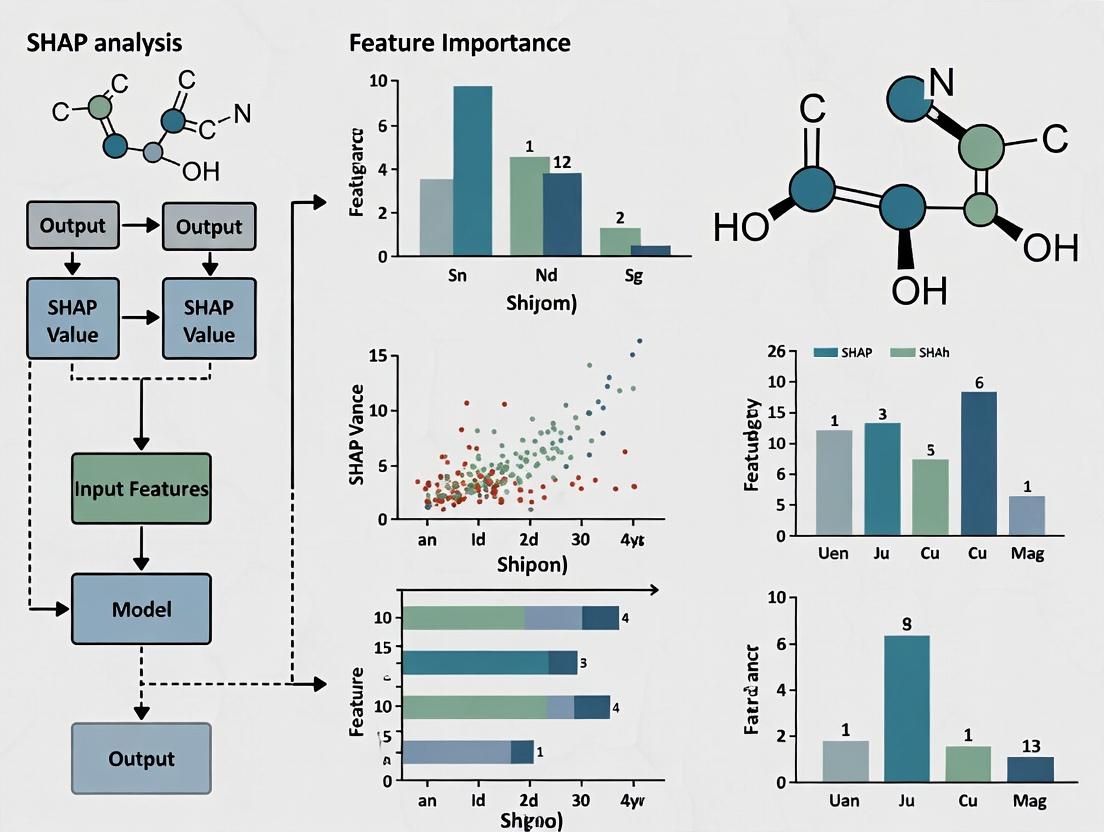
This comprehensive guide details how SHAP (SHapley Additive exPlanations) analysis is revolutionizing catalyst discovery by interpreting machine learning models that predict catalytic activity.
SHAP Analysis for Catalyst Design: Decoding Descriptor Importance in Predictive Machine Learning Models
Abstract
This comprehensive guide details how SHAP (SHapley Additive exPlanations) analysis is revolutionizing catalyst discovery by interpreting machine learning models that predict catalytic activity. Targeting researchers and drug development professionals, the article explores the foundational theory of SHAP values for model interpretability, provides a step-by-step methodology for applying SHAP to chemical descriptor analysis, addresses common challenges and optimization techniques for robust results, and validates SHAP's efficacy through comparative analysis with other interpretation methods. The article synthesizes key insights for leveraging explainable AI to accelerate rational catalyst design and materials discovery in biomedical and clinical applications.
SHAP Explained: Demystifying Model Interpretability for Catalyst Activity Predictions
Why Interpretability is Critical in Catalytic Activity Machine Learning Models
In the application of machine learning (ML) to catalytic activity prediction, achieving high predictive accuracy is no longer sufficient. Models that function as "black boxes" pose significant risks in scientific discovery and development. Interpretability—the ability to understand and trust the model's predictions—is critical for three primary reasons: (1) Scientific Insight: To validate predictions against domain knowledge and generate new hypotheses about descriptor-activity relationships. (2) Model Debugging & Improvement: To identify model biases, over-reliance on spurious correlations, or erroneous data patterns. (3) Informed Decision-Making: To guide resource-intensive experimental synthesis and testing in catalyst development. This protocol frames interpretability within a thesis centered on SHapley Additive exPlanations (SHAP) analysis, providing a standardized framework for deploying explainable AI (XAI) in catalysis research.
Core Quantitative Findings: SHAP Analysis in Recent Catalysis ML Studies
Recent literature underscores the utility of SHAP in deconstructing complex model predictions. The following table summarizes key quantitative findings from contemporary studies (2023-2024) applying SHAP to catalytic activity models.
Table 1: Summary of SHAP Analysis Applications in Catalytic Activity Prediction
| Study Focus | ML Model Type | Top 3 Descriptors by SHAP Importance | Key Interpretative Insight | Impact on Experimental Design |
|---|---|---|---|---|
| OER on Perovskites (Nature Comm. 2023) | Gradient Boosting Regressor | 1. Metal-O covalency (χM - χO)2. O 2p-band center3. B-site ionic radius | Covalency descriptor showed non-linear, volcano-shaped relationship with predicted activity, aligning with Sabatier principle. | Prioritized synthesis of A-site deficient perovskites to tune covalency. |
| CO2RR to C2+ (JACS 2024) | Graph Neural Network | 1. *C-C coupling barrier (DFT-derived)2. Adsorbate-adsorbate distance at peak field3. d-band width | SHAP revealed *C-C coupling barrier as the dominant factor across diverse Cu-alloy surfaces, overriding traditional electronic descriptors. | Screening shifted focus to alloys predicted to specifically lower this kinetic barrier. |
| Heterogeneous Hydrogenation (ACS Catal. 2023) | Random Forest Classifier | 1. Substrate LUMO energy2. Catalyst work function3. Adsorption entropy (ΔSads) | Identified a previously unrecognized strong interaction between work function and LUMO energy for selectivity. | Led to combinatorial testing of supports to modulate catalyst work function. |
*DFT: Density Functional Theory
Experimental & Computational Protocols
Protocol 1: Standard Workflow for SHAP-Based Descriptor Importance Analysis
Objective: To implement a reproducible pipeline for training a catalytic activity model and interpreting it using SHAP. Materials: See "The Scientist's Toolkit" below. Procedure:
- Data Curation & Descriptor Calculation:
- Assemble a consistent dataset of catalytic performance metrics (e.g., turnover frequency, overpotential, yield) for a well-defined set of catalyst compositions/reaction conditions.
- Compute a comprehensive set of candidate descriptors (≥50) using DFT, chemical intuition, and materials informatics libraries (e.g., pymatgen, RDKit).
- Clean data: handle missing values, remove outliers >3σ, and apply standard scaling (Z-score normalization).
- Model Training & Validation:
- Split data into training (70%), validation (15%), and hold-out test (15%) sets. Use stratified splitting if classification.
- Train a tree-based ensemble model (e.g., XGBoost, LightGBM). Optimize hyperparameters (max depth, learning rate, n_estimators) via Bayesian optimization on the validation set to minimize RMSE or maximize F1-score.
- Evaluate final model on the unseen test set. Report R², MAE, and parity plots.
- SHAP Analysis Execution:
- Instantiate the appropriate SHAP explainer:
TreeExplainerfor tree models. - Calculate SHAP values for the entire training set:
shap_values = explainer.shap_values(X_train). - Generate and analyze the following plots:
- Summary Plot (beeswarm): Identify global descriptor importance and impact direction.
- Dependence Plots: For top 2 descriptors, visualize their relationship with SHAP value, colored by interaction with the 3rd most important descriptor.
- Force Plot (Individual Prediction): Select 3-5 representative catalysts (high/low activity, surprising prediction) to deconstruct the contribution of each descriptor to the final model output.
- Instantiate the appropriate SHAP explainer:
- Hypothesis Generation & Validation:
- Correlate high-SHAP descriptors with known catalytic theory (e.g., d-band model, Brønsted-Evans-Polanyi relations). Flag descriptors with high importance but no clear mechanistic link for further investigation.
- Design a focused experimental or DFT computational validation set (5-10 candidates) targeting the extremes of the high-impact descriptor ranges identified.
Diagram 1: SHAP Analysis Workflow for Catalysis ML
Protocol 2: Experimental Validation of SHAP-Guided Hypotheses
Objective: To synthesize and test catalysts proposed by SHAP-based analysis. Procedure for Heterogeneous Catalyst Example:
- Candidate Selection: From SHAP dependence plots, select 4 catalyst compositions: two predicted to be high-activity and two low-activity based on the key descriptor (e.g., optimal vs. suboptimal metal-oxygen covalency).
- Synthesis: Prepare catalysts via standardized method (e.g., citrate-gel synthesis for perovskites). Characterize all using XRD and BET surface area analysis to confirm phase purity and comparable morphology.
- Electrochemical Testing (for OER/ORR):
- Prepare catalyst ink: 5 mg catalyst, 950 μL isopropanol, 50 μL Nafion, sonicate 1 hr.
- Drop-cast onto glassy carbon electrode (loading: 0.2 mg/cm²).
- Perform cyclic voltammetry in 0.1 M KOH at 5 mV/s. Record overpotential (η) at 10 mA/cm².
- Perform electrochemical impedance spectroscopy to normalize activity by electrochemical surface area (ECSA).
- Data Integration & Model Refinement:
- Incorporate new experimental activity data into the original dataset.
- Retrain model and re-run SHAP analysis.
- Success Metric: The key descriptor identified initially should retain high importance, and its SHAP dependence plot should now more accurately reflect the newly measured structure-activity trend.
Diagram 2: SHAP-Driven Experimental Validation Cycle
The Scientist's Toolkit: Essential Research Reagent Solutions
Table 2: Key Reagents, Software, and Tools for Interpretable Catalysis ML
| Item Name / Software | Provider / Source | Function in Workflow |
|---|---|---|
| SHAP Python Library | Lundberg & Lee (GitHub) | Calculates Shapley values for any ML model; provides visualization functions for model interpretation. |
| Atomic Simulation Environment (ASE) | ASE Consortium | Python framework for setting up, running, and analyzing DFT calculations to generate electronic/structural descriptors. |
| CatBERTa or CGCNN | Open Source (GitHub) | Pre-trained or trainable graph-based neural networks specifically for materials/catalysts property prediction. |
| High-Throughput Experimentation (HTE) Reactor | e.g., Unchained Labs, HEL | Enables rapid parallel synthesis and screening of catalyst libraries identified from SHAP-driven design. |
| Nafion Perfluorinated Resin Solution | Sigma-Aldrich / Chemours | Standard binder for preparing catalyst inks for electrochemical testing in fuel cell or electrolysis research. |
| ICSD & Materials Project Databases | FIZ Karlsruhe & LBNL | Sources of crystal structure data and computed material properties for descriptor space expansion. |
| XGBoost / LightGBM | Open Source | High-performance gradient boosting frameworks that are natively compatible with TreeExplainer in SHAP. |
| Standard Reference Catalysts (e.g., Pt/C, IrO₂) | e.g., Tanaka, Umicore | Essential benchmark materials for validating and calibrating activity measurement protocols. |
The prediction of catalytic activity is a complex problem where molecular or material descriptors contribute non-linearly and interactively to the target property. SHapley Additive exPlanations (SHAP), rooted in cooperative game theory's Shapley values, provides a rigorous framework for quantifying each descriptor's marginal contribution to a machine learning model's prediction. Within our thesis on SHAP analysis for descriptor importance, this approach moves beyond heuristic feature ranking, offering a consistent, game-theoretically optimal method to interpret "black-box" models and guide catalyst design.
Theoretical Foundation: From Game Theory to Chemistry
The Shapley value (Φᵢ) is defined for a game with N players (descriptors) and a payoff function v (the model's predictive output). The contribution of descriptor i is calculated by considering all possible subsets of descriptors S ⊆ N \ {i}:
Φᵢ(v) = Σ [ (|S|! (|N| - |S| - 1)! ) / |N|! ] * [ v(S ∪ {i}) - v(S) ]
For chemical applications:
- Players (N): Molecular or catalyst descriptors (e.g., d-band center, coordination number, electronegativity, solvent parameters).
- Coalition (S): A specific subset of descriptors used in a model.
- Payoff (v): The model's predicted catalytic activity (e.g., turnover frequency, overpotential, yield) for a given coalition.
- Marginal Contribution:
v(S ∪ {i}) - v(S)is the change in predicted activity when descriptor i is added to coalition S. - SHAP Value (Φᵢ): The average marginal contribution of descriptor i across all possible descriptor coalitions, weighted fairly. A high absolute Φᵢ indicates high importance; the sign indicates the direction of influence.
Table 1: SHAP Analysis of Descriptors for Electrochemical CO₂ Reduction on Metal-Alloy Catalysts (Model: Gradient Boosting Regressor; Target: CO Faradaic Efficiency %)
| Descriptor | Mean( | SHAP Value | ) | Direction of Effect (Positive/Negative SHAP) | Physical Interpretation |
|---|---|---|---|---|---|
| d-band center (eV) | 12.4 | Negative | Lower d-band center weakens *CO binding, promoting *CO desorption as product. | ||
| O adsorption energy (eV) | 8.7 | Positive | More exothermic O binding stabilizes *COOH intermediate. | ||
| Atomic radius of primary metal (Å) | 5.2 | Negative | Larger atomic radius modifies surface geometry, affecting intermediate stability. | ||
| Pauling electronegativity | 3.8 | Positive | Higher electronegativity polarizes adsorbed *CO₂, facilitating protonation. | ||
| Surface charge density (e/Ų) | 2.1 | Complex (U-shaped) | Optimal mid-range values balance reactant adsorption and product desorption. |
Table 2: Comparison of Feature Importance Metrics for a Ligand Library in Pd-Catalyzed Cross-Coupling (Target: Reaction Yield)
| Descriptor | SHAP Value (Mean Impact on Yield %) | Gini Importance (Random Forest) | Pearson Correlation Coefficient |
|---|---|---|---|
| Ligand Steric Bulk (θ, degrees) | +15.2 | 0.32 | 0.41 |
| Pd-L Bond Dissociation Energy (kcal/mol) | -9.8 | 0.28 | -0.38 |
| Ligand σ-Donor Ability (IR stretch cm⁻¹) | +7.1 | 0.19 | 0.25 |
| Solvent Dielectric Constant | ±4.5 | 0.11 | 0.08 |
Note: SHAP uniquely quantifies both magnitude and direction (positive/negative) of each descriptor's effect on the specific prediction outcome.
Experimental Protocols for SHAP-Driven Catalyst Research
Protocol 4.1: Computing SHAP Values for a Catalytic Activity Model Objective: To calculate and interpret SHAP values for a trained machine learning model predicting catalytic turnover frequency (TOF). Materials: See "Scientist's Toolkit" below. Procedure:
- Model Training: Train your chosen predictive model (e.g., XGBoost, Neural Network) on your dataset of catalyst descriptors (features) and experimental TOF values (target). Reserve a test set.
- SHAP Explainer Selection: Choose an appropriate SHAP explainer.
- For tree-based models (XGBoost, Random Forest), use
shap.TreeExplainer(model). - For deep learning models, use
shap.DeepExplainer(model, background_data). - For model-agnostic approximation, use
shap.KernelExplainer(model.predict, background_data).
- For tree-based models (XGBoost, Random Forest), use
- Calculate SHAP Values: Compute SHAP values for the test set instances:
shap_values = explainer.shap_values(X_test). - Global Analysis: Generate a summary plot:
shap.summary_plot(shap_values, X_test). This ranks descriptors by mean absolute SHAP value and shows impact distribution. - Local Explanation: For a single catalyst prediction, generate a force plot:
shap.force_plot(explainer.expected_value, shap_values[i], X_test.iloc[i]). This visually deconstructs how each descriptor shifted the prediction from the base value. - Interaction Analysis: Quantify descriptor interactions:
shap_interaction_values = explainer.shap_interaction_values(X_test). Plot usingshap.dependence_plot("descriptor_A", shap_values, X_test, interaction_index="descriptor_B").
Protocol 4.2: Iterative Descriptor Selection Using SHAP for High-Throughput Experimentation Objective: To refine catalyst libraries by pruning ineffective design spaces.
- Initial Screen: Perform a high-throughput experimental or computational screen of a broad catalyst library (~100-1000 candidates). Measure key activity/selectivity descriptors.
- Initial Model & SHAP: Train an initial model and compute SHAP values as per Protocol 4.1.
- Identify Non-Influential Descriptors: Flag descriptors with mean(|SHAP|) below a significance threshold (e.g., < 2% of the top descriptor's impact).
- Design Focused Library: Design a subsequent generation library where catalyst synthesis is focused on varying only the high-SHAP-value descriptors within optimized ranges suggested by dependence plots.
- Iterate: Repeat screening, modeling, and SHAP analysis on the new, focused library to discover optimal catalyst compositions.
Visualization: Workflows and Logical Relationships
Diagram 1 Title: SHAP Workflow for Catalyst Discovery
Diagram 2 Title: Mapping Game Theory to Chemistry via SHAP
The Scientist's Toolkit: Essential Research Reagents & Materials
Table 3: Key Tools for SHAP Analysis in Catalysis Research
| Item / Solution | Function / Purpose in SHAP Analysis |
|---|---|
| SHAP Python Library (shap) | Core computational toolkit for calculating Shapley values with various model-specific (TreeExplainer) and model-agnostic (KernelExplainer) algorithms. |
| Tree-Based Models (XGBoost, LightGBM) | High-performing, commonly used predictive models that are natively and efficiently compatible with shap.TreeExplainer. |
| Background Dataset | A representative subset of training data (typically 100-1000 samples) used by Kernel or Deep Explainer to approximate feature behavior. Critical for accurate value estimation. |
| Molecular Descriptor Calculation Software (RDKit, Dragon) | Generates quantitative numerical descriptors (e.g., topological, electronic, geometric) from catalyst or ligand structures, serving as the "players" in the SHAP game. |
| Jupyter Notebook / Lab | Interactive environment for developing the machine learning pipeline, calculating SHAP values, and creating interactive visualizations for analysis. |
| Computational Chemistry Suite (VASP, Gaussian, ORCA) | For generating ab initio catalyst descriptors (adsorption energies, electronic properties) used as inputs for activity prediction and SHAP analysis. |
This document details the application and protocols for three principal SHAP (SHapley Additive exPlanations) variants within the specific research context of descriptor importance analysis for catalytic activity prediction. The broader thesis posits that rigorous, variant-specific interpretation of machine learning models accelerates the discovery and optimization of catalysts by elucidating the non-linear contribution of molecular and reaction descriptors to predicted activity.
Core SHAP Variants: Comparative Analysis
Quantitative Comparison of SHAP Variants
Table 1: Comparative Specifications of Key SHAP Variants
| Feature | TreeSHAP | KernelSHAP | DeepSHAP |
|---|---|---|---|
| Model Class | Tree-based (RF, XGBoost, etc.) | Model-agnostic | Deep Neural Networks |
| Computational Complexity | O(TL D²) [T: trees, L: max leaves, D: depth] | O(2^M + M³) [M: features] | O(TLD²) for background, linear in forward passes |
| Approximation Type | Exact (for tree models) | Sampling-based (Kernel-weighted) | Compositional (DeepLIFT + SHAP) |
| Key Advantage | Fast, exact for trees, handles feature dependence. | Universal applicability. | Propagates SHAP values through network layers. |
| Primary Limitation | Restricted to tree models. | Computationally heavy for many features. | Requires a chosen background distribution. |
| Typical Use in Catalysis Research | Interpreting ensemble models from descriptor libraries. | Interpreting SVM or linear models on small descriptor sets. | Interpreting deep learning models on spectral or structural data. |
Pathway of SHAP Analysis in Catalytic Research
Title: SHAP Workflow for Catalyst Design (90 chars)
Application Notes & Experimental Protocols
Protocol: Applying TreeSHAP to Random Forest Catalytic Models
Objective: To compute and interpret the contribution of molecular descriptors in a Random Forest model predicting turnover frequency (TOF).
Materials: See "Scientist's Toolkit" (Section 4).
Procedure:
- Model Training: Train a scikit-learn
RandomForestRegressoron your dataset of catalytic descriptors (e.g., electronic, steric, geometric) and target activity (e.g., TOF, yield). - TreeSHAP Initialization: Instantiate the
shap.TreeExplainerobject, passing the trained model. Usefeature_perturbation="interventional"(default) for robust handling of correlated descriptors. - SHAP Value Calculation: Call
explainer.shap_values(X)on your feature matrixX(typically the test set). This returns a matrix of SHAP values with shape(n_samples, n_features). - Global Analysis: Generate a summary plot:
shap.summary_plot(shap_values, X, plot_type="bar")to rank descriptor importance. Follow with a beeswarm plot:shap.summary_plot(shap_values, X)to show impact distribution. - Local Analysis: For a specific high-performing catalyst instance, use a force plot:
shap.force_plot(explainer.expected_value, shap_values[i], X.iloc[i])to deconstruct its prediction. - Interaction Analysis: To probe descriptor interactions, compute SHAP interaction values (
shap.TreeExplainer(model).shap_interaction_values(X)) and visualize with a dependence plot for the top feature, colored by a secondary interacting feature.
Protocol: Applying KernelSHAP to Interpret SVM Models
Objective: To explain a Support Vector Machine (SVM) model used for classifying catalysts as "high" or "low" activity.
Procedure:
- Model & Background: Train an SVM model (
sklearn.svm.SVCwith a non-linear kernel). Prepare a background dataset for integration approximation, typically 50-100 instances selected via k-means. - KernelSHAP Initialization: Instantiate
shap.KernelExplainer(model.predict_proba, background_data). - Sampling & Computation: Call
explainer.shap_values(X_evaluate, nsamples=500). Thensamplesparameter controls the Monte Carlo sampling; increase for higher accuracy at computational cost. - Visualization: Use
shap.summary_plot(shap_values[1], X_evaluate)(for class 1 - "high activity") to visualize descriptor contributions.
Protocol: Applying DeepSHAP to Convolutional Neural Networks (CNNs)
Objective: To interpret a CNN model that predicts catalytic activity from catalyst surface microscopy or spectroscopic image data.
Procedure:
- Model & Background: Train a CNN model (e.g., using PyTorch or TensorFlow). Define a representative background set of image patches or entire images.
- DeepSHAP Integration: Use the
shap.DeepExplainerAPI. Instantiate:explainer = shap.DeepExplainer(model, background_tensor). - Value Computation: Compute SHAP values for a test image:
shap_values = explainer.shap_values(input_tensor). - Visualization: Plot the SHAP values for the predicted class as a heatmap overlayed on the original input image to highlight pixels (e.g., specific surface sites or spectral regions) most positively or negatively influencing the activity prediction.
The Scientist's Toolkit
Table 2: Essential Research Reagents & Computational Tools
| Item / Software | Function in SHAP Analysis | Typical Specification / Note |
|---|---|---|
| SHAP Python Library | Core framework for computing all SHAP variant explanations. | Install via pip install shap. Versions >0.45 are recommended. |
| scikit-learn | Provides standard ML models (RF, SVM) and data preprocessing utilities. | Essential for building models to explain. |
| XGBoost / LightGBM | High-performance gradient boosting libraries, fully compatible with TreeSHAP. | Often provides state-of-the-art predictive performance for tabular descriptor data. |
| PyTorch / TensorFlow | Frameworks for building Deep Neural Networks explained by DeepSHAP. | DeepSHAP is optimized for integration with these frameworks. |
| Matplotlib / Seaborn | Core plotting libraries for custom visualizations of SHAP outputs. | Used to tailor publication-quality figures. |
| Catalytic Descriptor Database | Curated set of numerical features (e.g., d-band center, coordination number, adsorption energies). | The foundational "reagents" for the model. Can be computational or experimental. |
| High-Performance Computing (HPC) Cluster | For computationally intensive KernelSHAP or large-scale DeepSHAP calculations. | Recommended for datasets with >100 features or >10,000 instances. |
Logical Decision Framework for Variant Selection
Title: SHAP Variant Selection Guide (55 chars)
Within the thesis on SHAP analysis for descriptor importance in catalytic activity prediction research, this document provides essential Application Notes and Protocols. The core challenge addressed is interpreting black-box machine learning models used to predict catalytic performance (e.g., turnover frequency, yield) from numerical chemical descriptors. Establishing a causal, interpretable link between input descriptors and model outputs is critical for guiding catalyst design and drug development. Feature importance, particularly through SHAP (SHapley Additive exPlanations) analysis, provides a robust, game-theory-based framework for this task, quantifying the contribution of each descriptor to individual predictions and the model globally.
Table 1: Common Chemical Descriptor Categories and Example SHAP Summary Statistics
| Descriptor Category | Example Descriptors | Typical Range (Standardized) | Mean | SHAP | Value* | Impact Direction |
|---|---|---|---|---|---|---|
| Electronic | HOMO Energy, LUMO Energy, Electronegativity | -2.0 to +2.0 | 0.42 | High/Low values promote activity | ||
| Steric/Bulk | Molecular Weight, VDW Surface Area, Sterimol Parameters (B1, B5) | -2.0 to +2.0 | 0.38 | Optimal mid-range often ideal | ||
| Geometric | Bond Lengths, Angles, Coordination Number | -2.0 to +2.0 | 0.25 | Specific values critical for binding | ||
| Thermodynamic | Heat of Formation, Gibbs Free Energy | -2.0 to +2.0 | 0.55 | Negative values often favorable | ||
| Atomic Composition | % d-electron character, Atomic Radius | -2.0 to +2.0 | 0.15 | Baseline property influence |
*Mean absolute SHAP value: Higher indicates greater overall feature importance across the dataset.
Table 2: Comparison of Feature Importance Methodologies
| Method | Mechanism | Global/Local | Computational Cost | Key Advantage | Key Limitation |
|---|---|---|---|---|---|
| SHAP (Kernel) | Approximates Shapley values via local weighting | Both | High (O(2^M)) | Model-agnostic, theoretically sound | Computationally expensive |
| SHAP (Tree) | Efficient computation for tree models | Both | Low | Fast, exact for trees | Model-specific (trees only) |
| Permutation Importance | Measures accuracy drop after feature shuffling | Global | Medium | Intuitive, easy to implement | Can be biased for correlated features |
| Partial Dependence Plots (PDP) | Plots marginal effect of a feature | Global | Medium | Visualizes effect trend | Assumes feature independence |
| LIME | Fits local linear surrogate model | Local | Low | Good for local explanations | Instability, surrogate fidelity |
Experimental Protocols
Protocol 1: SHAP Analysis Workflow for Catalyst Model Interpretation
Objective: To compute and interpret SHAP values for a trained machine learning model predicting catalytic activity from chemical descriptors.
- Prerequisite: A trained and validated predictive model (e.g., Gradient Boosting Regressor, Random Forest, Neural Network) and a preprocessed dataset of chemical descriptors and target activity values.
- SHAP Value Calculation:
- Select the appropriate SHAP explainer based on your model.
- For tree-based models (scikit-learn, XGBoost, LightGBM): Use
TreeExplainer. - For neural networks or other models: Use
KernelExplainerorDeepExplainer(for deep learning).
- For tree-based models (scikit-learn, XGBoost, LightGBM): Use
- Instantiate the explainer with the trained model and a background dataset (typically a representative sample of 100-200 instances from training data).
- Compute SHAP values for the validation or test set using the explainer's
shap_values()method.
- Select the appropriate SHAP explainer based on your model.
- Global Interpretation:
- Generate a summary plot (
shap.summary_plot(shap_values, X_valid)). This beeswarm plot ranks features by global importance and shows the distribution of impact vs. feature value. - Calculate global mean absolute SHAP values for tabular reporting.
- Generate a summary plot (
- Local Interpretation:
- For a specific catalyst candidate of interest, generate a force plot (
shap.force_plot(...)) or decision plot to visualize how each descriptor contributed to shifting the model's prediction from the base value to the final output.
- For a specific catalyst candidate of interest, generate a force plot (
- Hypothesis Generation: Correlate high-importance descriptors with known chemical principles (e.g., identifying a critical electronic descriptor as correlating with known Sabatier principle maxima). Use dependency plots (
shap.dependence_plot()) to explore interactions between top descriptors.
Protocol 2: Validating Feature Importance with Directed Experimentation
Objective: To experimentally validate insights gained from SHAP-driven feature importance analysis.
- Design of Experiments: Based on SHAP analysis, identify 1-2 top-contributing descriptors (e.g., HOMO energy, steric bulk parameter).
- Catalyst Series Synthesis: Synthesize or select a focused series of catalysts or ligands where the identified key descriptor is systematically varied while attempting to hold others relatively constant.
- High-Throughput Screening: Evaluate the catalytic activity (e.g., yield, conversion, TOF) of the series under standardized reaction conditions.
- Data Correlation: Plot the experimental activity against the value of the key descriptor. Compare the observed trend (e.g., volcano plot, linear correlation) with the relationship suggested by the SHAP dependency plots.
- Iterative Model Refinement: If validated, the experimental data reinforces the model's logic. If discordant, the new data should be incorporated into the training set to retrain and improve the model, closing the design-make-test-analyze cycle.
Mandatory Visualizations
Diagram Title: SHAP Analysis Workflow for Catalyst Design
Diagram Title: Local vs. Global SHAP Explanation
The Scientist's Toolkit: Research Reagent Solutions
Table 3: Essential Tools for SHAP-Driven Descriptor Analysis
| Item / Software | Category | Primary Function | Application Notes |
|---|---|---|---|
| SHAP Python Library | Software Library | Unified framework for computing and visualizing SHAP values. | Core tool. Use TreeExplainer for efficiency with tree models. |
| RDKit | Cheminformatics | Calculates molecular descriptors (steric, electronic, topological). | Standard for converting chemical structures to numerical features. |
| Dragon / PaDEL | Descriptor Software | Generates extensive (>5000) molecular descriptor sets. | For comprehensive feature space exploration. May require feature selection. |
| scikit-learn | ML Library | Provides predictive models (Random Forest, GBMs) and preprocessing tools. | Integrates seamlessly with SHAP for model training and explanation. |
| Matplotlib / Seaborn | Visualization | Creates publication-quality plots of SHAP results and correlations. | Essential for customizing shap library's default visualizations. |
| Jupyter Notebook | Development Environment | Interactive environment for running analysis workflows. | Ideal for iterative exploration and documentation of the SHAP process. |
| High-Throughput Experimentation (HTE) Robotic Platform | Lab Equipment | Rapidly tests catalyst libraries suggested by model insights. | For experimental validation and closing the design loop. |
A Step-by-Step Guide to Implementing SHAP for Descriptor Analysis in Catalyst ML
Abstract Within catalytic activity prediction research, interpreting machine learning (ML) models is as critical as their performance. SHapley Additive exPlanations (SHAP) provides a rigorous framework for quantifying descriptor contribution. This application note details the systematic protocol for transitioning from a trained predictive model to validated, chemically intuitive SHAP insights, thereby closing the loop between black-box predictions and catalyst design hypotheses.
1. Prerequisite: Model Training and Validation A robust, validated predictive model is the essential substrate for SHAP analysis. The protocol below ensures model readiness.
Protocol 1.1: Model Training and Benchmarking for SHAP Readiness
- Data Partition: Split the dataset of catalyst descriptors (e.g., elemental properties, structural features, reaction conditions) and target activity (e.g., turnover frequency, yield) into training (70%), validation (15%), and hold-out test (15%) sets using stratified sampling by activity range.
- Model Selection & Training: Train multiple model architectures (e.g., Gradient Boosting Machines/GBM, Random Forest, Neural Networks) on the training set using 5-fold cross-validation.
- Hyperparameter Optimization: Conduct a Bayesian search over key parameters (e.g., learning rate, tree depth, regularization) using the validation set to optimize mean absolute error (MAE).
- Performance Benchmarking: Evaluate the final model on the unseen test set. Record key metrics (Table 1). A model with poor predictive power yields unreliable SHAP values.
Table 1: Example Model Performance Benchmark
| Model Architecture | Test Set R² | Test Set MAE | Cross-Validation Std Dev (MAE) |
|---|---|---|---|
| XGBoost (Selected) | 0.87 | 0.12 log(TOF) | ± 0.04 |
| Random Forest | 0.82 | 0.15 log(TOF) | ± 0.05 |
| Feed-Forward NN | 0.85 | 0.13 log(TOF) | ± 0.07 |
2. Core Protocol: SHAP Value Calculation and Global Interpretation This phase transforms the model into a source of descriptor importance.
Protocol 2.1: Calculation of SHAP Values for Tree-Based Models
- Library Import: Utilize the
shapPython library (v0.45.0+). ImportTreeExplainer. - Explainer Instantiation: Instantiate the explainer by passing the trained model object:
explainer = shap.TreeExplainer(model). - Value Calculation: Calculate SHAP values for the entire training set (or a representative sample ≥500 instances) to ensure statistical robustness:
shap_values = explainer.shap_values(X_train). - Global Importance: Generate the mean absolute SHAP value per descriptor across the dataset. This is the primary metric for global feature importance, superior to simple Gini impurity.
Table 2: Top Global Descriptors from SHAP Analysis
| Descriptor | Mean | Std Dev (SHAP) | Physical/Chemical Interpretation |
|---|---|---|---|
| d-Band Center (eV) | 0.42 | 0.08 | Adsorbate binding energy surrogate |
| Pauling Electronegativity | 0.31 | 0.11 | Measure of metal's electron affinity |
| Solvent Donor Number | 0.22 | 0.09 | Lewis basicity of reaction medium |
| Particle Size (nm) | 0.19 | 0.15 | Related to coordination unsaturation |
Diagram 1: SHAP Workflow Logic
3. Protocol for Advanced Analysis: Interaction Effects and Local Explanations Actionable insights often lie in descriptor interactions and specific predictions.
Protocol 3.1: Uncovering Non-Additive Interactions
- SHAP Interaction Values: Calculate matrix of interaction values:
shap_interaction = explainer.shap_interaction_values(X_train_sample). - Visualization: Plot the strongest identified interaction pair (e.g., d-band center vs. electronegativity) using a dependence plot colored by the interacting feature.
- Validation: Correlate the interaction pattern with known physical models (e.g., Brønsted-Evans-Polanyi relations) or design a targeted virtual screening to test the interaction effect.
Protocol 3.2: Interpreting a Single Prediction
- Select Instance: Choose a catalyst prediction of interest (e.g., high-performing outlier or failure case).
- Force Plot Generation: Use
shap.force_plot(explainer.expected_value, shap_values[instance_index], X_train.iloc[instance_index])to visualize how each descriptor pushed the prediction from the base value. - Decision Rationale: Translate the force plot into a chemical rationale (e.g., "Predicted high activity primarily due to optimal d-band center, despite suboptimal solvent choice").
Diagram 2: SHAP Insight to Hypothesis Loop
4. The Scientist's Toolkit: Research Reagent Solutions Table 3: Essential Tools for SHAP-Driven Research
| Item | Function & Relevance |
|---|---|
| SHAP Library (Python) | Core computational engine for calculating SHAP values using model-appropriate explainers (Tree, Kernel, Deep). |
| XGBoost/LightGBM | High-performance tree-based ML algorithms with native, fast SHAP value computation integration. |
| Matplotlib/Seaborn | Visualization libraries for creating publication-quality summary, dependence, and force plots. |
| Pandas & NumPy | Data manipulation and numerical computation backbones for handling descriptor matrices and SHAP value arrays. |
| Jupyter Notebook/Lab | Interactive environment for iterative analysis, visualization, and documentation of the SHAP workflow. |
| Domain-Specific Database | (e.g., CatHub, NOMAD) Source of curated experimental/computational catalyst data for descriptor engineering. |
| DFT Software Suite | (e.g., VASP, Quantum ESPRESSO) To compute ab initio descriptors and validate SHAP-identified physical relationships. |
Data Preparation and Feature Engineering for Effective SHAP Analysis
Within the broader thesis on SHAP analysis for descriptor importance in catalytic activity prediction, robust data preparation is the critical foundation. The interpretability of SHAP values is directly contingent on the quality and structure of the input data and features. This protocol outlines standardized procedures for curating datasets and engineering descriptors specifically for heterogeneous catalysis research, ensuring that subsequent SHAP analysis yields physically meaningful insights into activity drivers.
Key Principles for SHAP-Oriented Data Preparation
- Feature Independence: While tree-based models can handle correlations, highly multicollinear features can distort SHAP importance. Prioritize feature sets with clear physical/chemical justification.
- Data Consistency: Ensure all calculated descriptors follow identical computational protocols (e.g., DFT functional, convergence criteria).
- Representative Sampling: The dataset should span a diverse chemical/structural space to build generalizable models and reliable SHAP explanations.
Protocol: Descriptor Calculation and Curation for Catalytic Surfaces
Objective
To generate a consistent, comprehensive, and physically interpretable set of descriptors for catalytic materials (e.g., metal alloys, metal oxides) to be used in machine learning models for activity prediction (e.g., turnover frequency, overpotential) and subsequent SHAP analysis.
Materials & Computational Setup
Table 1: Essential Research Reagent Solutions & Computational Tools
| Item | Function/Description |
|---|---|
| VASP (Vienna Ab initio Simulation Package) | DFT software for calculating electronic structure and energetics. |
| Atomic Simulation Environment (ASE) | Python library for setting up, manipulating, and automating calculations. |
| pymatgen | Python library for materials analysis, provides robust structure analysis and descriptor generation. |
| CatKit | Toolkit for surface generation and catalysis-specific descriptor calculation. |
| Standardized Pseudopotentials (e.g., PBE PAW) | Ensures consistency in DFT-calculated energies across all elements. |
| High-Performance Computing (HPC) Cluster | For performing computationally intensive DFT geometry optimizations. |
Stepwise Procedure
Surface Model Generation:
- Use
CatKitorpymatgento generate symmetric, slab models of relevant catalytic surfaces (e.g., (111), (110) facets). - Apply a vacuum layer of ≥ 15 Å to prevent periodic interactions.
- Fix the bottom 2-3 atomic layers at their bulk positions.
- Use
DFT Calculation Protocol:
- Perform geometry optimization for the clean surface and all relevant adsorbates (, O, OH, CO, etc.).
- Universal Settings: Plane-wave cutoff = 520 eV, k-point density ≥ 30 / Å⁻¹, Gaussian smearing = 0.05 eV.
- Convergence Criteria: Electronic steps ≤ 1e-5 eV, ionic steps ≤ 0.02 eV/Å.
- Calculate the total energy for each optimized system.
Primary Descriptor Calculation:
- Calculate adsorption energies:
E_ads = E(slab+ads) - E(slab) - E(ads_gas). - Calculate surface formation energy.
- Extract the projected density of states (pDOS) for relevant surface atoms.
- Calculate adsorption energies:
Derived Feature Engineering:
- Electronic Features: d-band center (from pDOS), bandwidth, filling.
- Geometric Features: Surface atom coordination number, nearest-neighbor distance, lattice strain.
- Aggregate Features: Difference in adsorption energies between key intermediates (e.g., ΔEO - ΔEOH), which may serve as activity descriptors.
Data Compilation & Validation:
- Compile all descriptors and target catalytic activity (e.g., reaction energy, activation barrier) into a master Pandas DataFrame.
- Apply outlier detection (e.g., 3-sigma rule) and validate thermodynamic consistency (e.g., check for linear scaling relations).
Protocol: Pre-Modeling Data Processing for SHAP Compatibility
Objective
To preprocess the curated descriptor dataset to ensure optimal performance of tree-based ML models (e.g., Gradient Boosting) and the reliability of subsequent SHAP analysis.
Stepwise Procedure
Handling Missing Data:
- For descriptors missing <5% of values, use imputation based on chemical similarity (e.g., mean value from nearest neighbors in feature space).
- Remove descriptors or systems with >15% missing data.
Feature Scaling:
- For tree-based models: Scaling is not strictly required but can improve convergence speed. Use MinMaxScaler to bound all features to [0,1] range.
- Note: SHAP values are sensitive to feature scale. Consistent scaling ensures importance magnitudes are comparable.
Feature Selection & Reduction:
- Calculate pairwise Pearson correlation. Remove one feature from any pair with |r| > 0.95.
- For very high-dimensional feature spaces, apply Principal Component Analysis (PCA) to create orthogonal components. Caution: SHAP values will then explain PCA components, not original descriptors. Document component loadings meticulously.
Train-Test Split:
- Perform a stratified split (e.g., 80/20) based on the target variable distribution to ensure both sets represent the full activity range. This ensures SHAP analysis on the test set is representative.
Table 2: Example Curated Descriptor Dataset (Abridged)
| Material | Facet | d-band_center (eV) | ΔE_CO (eV) | Coord_Number | Strain (%) | Target: TOF (log) |
|---|---|---|---|---|---|---|
| Pt_3Ni | 111 | -2.34 | -0.78 | 7.5 | -1.2 | 2.45 |
| PdCu | 110 | -2.87 | -0.45 | 6.0 | 3.1 | 1.87 |
| Au_3Ag | 100 | -4.12 | 0.12 | 8.0 | 0.5 | -0.23 |
| ... | ... | ... | ... | ... | ... | ... |
Visualization of Workflows
Title: SHAP Analysis Data Preparation Workflow
Title: Descriptor Calculation Protocol Steps
Within a broader thesis on SHAP analysis for descriptor importance in catalytic activity prediction, this document outlines standardized protocols for generating and interpreting SHAP (SHapley Additive exPlanations) values. The objective is to elucidate the contribution of molecular and reaction descriptors (e.g., electronic, steric, geometric, thermodynamic) towards the predicted activity of catalytic systems, thereby guiding rational catalyst design in pharmaceutical and fine chemical synthesis.
Core SHAP Methods and Protocols
Protocol: Pre-modeling Data Preparation for SHAP Analysis
- Descriptor Calculation: Compute a comprehensive set of molecular descriptors (e.g., using RDKit, Dragon) and reaction condition features (temperature, pressure, solvent parameters) for your catalytic dataset.
- Data Partitioning: Split the dataset into training (70%), validation (15%), and hold-out test (15%) sets using stratified sampling based on the target activity value distribution to ensure representativeness.
- Model Training & Selection: Train multiple advanced regression models (e.g., Gradient Boosting Machines/GBM, Random Forest, Neural Networks) on the training set. Optimize hyperparameters via cross-validation on the validation set using metrics like RMSE or MAE. Select the best-performing model for SHAP analysis.
- Model Performance Validation: Report final performance metrics on the independent test set. Example results from a recent study are summarized below.
Table 1: Model Performance Comparison for Catalytic Yield Prediction
| Model Type | R² (Test Set) | MAE (Test Set) | RMSE (Test Set) |
|---|---|---|---|
| GBM (XGBoost) | 0.89 | 5.2% | 7.8% |
| Random Forest | 0.85 | 6.1% | 9.3% |
| Neural Network | 0.87 | 5.7% | 8.5% |
Protocol: Generating SHAP Values
- SHAP Explainer Initialization: Choose an explainer compatible with your model. For tree-based models (e.g., XGBoost), use the
shap.TreeExplainer(). For neural networks or other models, useshap.KernelExplainer(approximate) orshap.DeepExplainerfor deep learning. - Value Calculation: Calculate SHAP values for the entire training set or a representative sample (minimum n=500 instances for stability) using the
.shap_values(X)method. - Validation: Ensure the sum of SHAP values for each prediction plus the expected model output (
explainer.expected_value) equals the model's raw prediction for that instance.
Visualization Protocols and Application
Protocol:
- Use
shap.summary_plot(shap_values, X, plot_type="dot"). - The y-axis lists descriptors ranked by mean absolute SHAP value (global importance).
- Each point represents a SHAP value for a descriptor in a single data instance.
- Color indicates the raw descriptor value (red=high, blue=low).
- Interpretation: Identifies which descriptors most influence model predictions and the direction of impact (e.g., high electronegativity → high predicted yield).
Table 2: Top 5 Descriptors by Mean |SHAP| from a Catalytic Cross-Coupling Study
| Descriptor Name | Mean | SHAP | Value | Chemical Interpretation |
|---|---|---|---|---|
| Pd-Oxidation State | 0.241 | Formal oxidation state of Pd center | ||
| Liggand Steric Index (θ) | 0.198 | Measured ligand bulk (Bite Angle) | ||
| Solvent Dielectric Constant (ε) | 0.156 | Solvent polarity | ||
| Aryl Halide C-X Bond Dissociation Energy | 0.132 | Substrate reactivity metric | ||
| Reaction Temperature (K) | 0.115 | Kinetic control parameter |
Diagram 1: Workflow for SHAP summary plot generation.
Dependence Plot (Descriptor Effect Detail)
Protocol:
- Use
shap.dependence_plot('descriptor_name', shap_values, X). - The x-axis is the value of the primary descriptor.
- The y-axis is the SHAP value for that descriptor (its contribution to the prediction).
- Points are colored by a secondary, interacting descriptor (automatically selected or specified).
- Interpretation: Reveals linear/non-linear relationships and interactions (e.g., high ligand steric bulk only benefits yield when paired with a specific Pd oxidation state).
Diagram 2: Structure of a SHAP dependence plot.
Force Plot (Single Prediction Explanation)
Protocol:
- Use
shap.force_plot(explainer.expected_value, shap_values[instance_index], X.iloc[instance_index], matplotlib=True)for a single instance. - Interpretation: Visually deconstructs a single prediction. The base value (
E[f(x)]) is the average model prediction. Descriptors push the prediction from the base value to the final output (f(x)). Red arrows increase the prediction; blue arrows decrease it. - Application: Critical for debugging models and understanding outlier predictions in catalyst screening.
Diagram 3: Logical breakdown of a force plot.
The Scientist's Toolkit: Research Reagent Solutions
Table 3: Essential Tools for SHAP Analysis in Catalytic Activity Prediction
| Item | Function/Benefit |
|---|---|
| SHAP Python Library (shap) | Core package for calculating and visualizing SHAP values. |
| Tree-based Models (XGBoost, LightGBM) | High-performance models with native, fast SHAP support via TreeExplainer. |
| RDKit | Open-source cheminformatics toolkit for generating molecular descriptors (e.g., Morgan fingerprints, topological indices). |
| Dragon Descriptor Software | Commercial software for calculating thousands of molecular descriptors. |
| Matplotlib/Seaborn | Plotting libraries for customizing and exporting publication-quality SHAP figures. |
| Jupyter Notebook/Lab | Interactive environment for iterative model development and explanation. |
| Pandas & NumPy | Data manipulation and numerical computation for preprocessing feature matrices. |
Within the broader thesis on SHAP (SHapley Additive exPlanations) analysis for descriptor importance in catalytic activity prediction, this document provides specific application notes and protocols for interpreting computational results to identify key molecular descriptors. The accurate identification of electronic (e.g., HOMO/LUMO energies, electronegativity), steric (e.g., Tolman cone angle, Sterimol parameters), and structural (e.g., bond lengths, coordination number) descriptors is critical for building robust, interpretable machine learning models that predict catalyst performance.
Core Descriptor Categories and Quantitative Data
The following table summarizes key descriptor categories, their common computational derivations, and their typical impact on catalytic activity, as identified from recent literature.
Table 1: Key Descriptor Categories for Catalytic Activity Prediction
| Descriptor Category | Specific Examples | Typical Calculation Method | Relevance to Catalytic Activity | Approx. Data Range (Example) |
|---|---|---|---|---|
| Electronic | HOMO Energy (eV), LUMO Energy (eV), Chemical Potential (χ), Electrophilicity Index (ω) | DFT (e.g., B3LYP/6-31G*) | Governs redox potential, substrate activation, & oxidative addition rates. | HOMO: -5 to -9 eV; ω: 1-10 eV |
| Steric | Tolman Cone Angle (θ, degrees), % Buried Volume (%Vbur), Sterimol Parameters (B1, B5, L) | Molecular mechanics or DFT-optimized structures. | Influences ligand dissociation, substrate approach, and selectivity. | θ: 90-200°; %Vbur: 20-60% |
| Structural | Metal-Ligand Bond Length (Å), Coordination Number, Oxidation State | X-ray crystallography or DFT geometry optimization. | Determines active site accessibility and stability. | M-L Bond: 1.8-2.3 Å |
| Atomic | Partial Atomic Charges (q, e), Wiberg Bond Index | Natural Population Analysis (NPA), Mulliken analysis. | Indicates charge transfer and bond order. | q (metal): +0.5 to +2.0 e |
| Global Molecular | Molecular Weight (g/mol), Dipole Moment (D), Polar Surface Area (Ų) | Standard computational chemistry packages. | Affects solubility, diffusion, and non-covalent interactions. | Dipole: 0-10 D |
Experimental Protocols
Protocol: Generation and Calculation of Molecular Descriptors for a Transition Metal Complex Dataset
Objective: To compute a standardized set of electronic, steric, and structural descriptors for a library of organometallic catalysts to serve as input features for machine learning models.
Materials: See "The Scientist's Toolkit" (Section 5.0).
Procedure:
- Structure Preparation:
- Obtain or draw the 3D molecular structure of the catalyst of interest.
- Perform a conformational search using software (e.g., CONFLEX, OMEGA) to identify the lowest energy conformer.
- For DFT calculations, generate a simplified model if the full system is prohibitively large (e.g., replace phenyl rings with methyl groups), noting all simplifications.
Geometry Optimization and Frequency Calculation:
- Optimize the molecular geometry using Density Functional Theory (DFT). A common protocol is the B3LYP functional with the 6-31G* basis set for main group elements and LANL2DZ effective core potential for transition metals.
- Follow the optimization with a frequency calculation at the same level of theory to confirm the structure is a true minimum (no imaginary frequencies) and to obtain thermodynamic corrections.
Electronic Descriptor Extraction:
- From the optimized structure, perform a single-point energy calculation to obtain the molecular orbital energies.
- Extract the energies of the Highest Occupied Molecular Orbital (HOMO) and Lowest Unoccupied Molecular Orbital (LUMO).
- Calculate further indices:
- Chemical Hardness (η) = (ELUMO - EHOMO)/2
- Chemical Potential (μ) = (EHOMO + ELUMO)/2
- Electrophilicity Index (ω) = μ²/2η
Steric Descriptor Calculation:
- Using the optimized geometry, calculate the Tolman Cone Angle using specialized software (e.g., Cavallo’s SambVca web application).
- Upload the structure file, define the metal center as the central atom and the ligand atoms of interest, and calculate the percent buried volume (%Vbur) for a defined sphere radius (typically 3.5 Å).
Structural Descriptor Measurement:
- From the optimized geometry output file, directly measure key bond lengths (e.g., metal-ligand, substrate bonds) and angles using visualization software (e.g., GaussView, Mercury).
- Record the formal oxidation state and coordination number of the metal center.
Data Compilation:
- Compile all calculated descriptors into a structured table (CSV format) with columns for complex identifier and each descriptor variable.
Protocol: Applying SHAP Analysis to Interpret Descriptor Importance
Objective: To interpret a trained machine learning model's predictions and identify which electronic, steric, and structural descriptors are most influential in predicting catalytic activity (e.g., turnover frequency, yield).
Procedure:
- Model Training:
- Using the descriptor table from Protocol 3.1 as features (X) and experimental catalytic activity data as the target (y), train a suitable machine learning model (e.g., Random Forest, Gradient Boosting, or Neural Network).
- Split data into training and test sets. Optimize hyperparameters via cross-validation.
SHAP Value Calculation:
- Install the
shapPython library. - For tree-based models, use the
shap.TreeExplainer()function. For other models,shap.KernelExplainer()can be used as an approximation. - Calculate SHAP values for the entire test set:
shap_values = explainer.shap_values(X_test).
- Install the
Interpretation and Visualization:
- Generate a summary plot:
shap.summary_plot(shap_values, X_test). This ranks descriptors by their mean absolute SHAP value, indicating overall importance. - Generate dependence plots for top descriptors:
shap.dependence_plot('HOMO_energy', shap_values, X_test)to reveal the nature of the relationship (linear, threshold, etc.) between the descriptor value and its impact on the prediction.
- Generate a summary plot:
Mandatory Visualizations
Descriptor Calculation & SHAP Workflow
SHAP Value Impact on Model Prediction
The Scientist's Toolkit
Table 2: Essential Research Reagent Solutions and Materials
| Item / Software | Function / Purpose |
|---|---|
| Gaussian 16 | Industry-standard software suite for performing DFT calculations (geometry optimization, frequency, single-point energies). |
| SambVca Web Application | A specialized tool for calculating steric parameters, notably the percent buried volume (%Vbur) and Tolman cone angles for organometallic complexes. |
| Python Stack (NumPy, pandas, scikit-learn, SHAP) | Core programming environment for data manipulation, machine learning model training, and SHAP value calculation/visualization. |
| RDKit | Open-source cheminformatics toolkit used for handling molecular structures, descriptor calculation, and molecular operations. |
| Mercury (CCDC) | Crystal structure visualization software for measuring bond lengths and angles from optimized or experimental (X-ray) structures. |
| 6-31G* Basis Set | A polarized double-zeta basis set used in DFT calculations for accurate description of main-group elements. |
| LANL2DZ ECP | Effective core potential basis set used for heavier transition metals, providing computational efficiency without significant accuracy loss. |
| B3LYP Functional | A hybrid DFT functional commonly used for its good balance of accuracy and computational cost in organometallic chemistry. |
Within the broader thesis on SHAP analysis descriptor importance catalytic activity prediction research, this document presents a specific case study. It demonstrates the application of SHAP (SHapley Additive exPlanations) to interpret machine learning models trained on a heterogeneous catalysis dataset. The primary objective is to move beyond black-box predictions to identify and understand the key physicochemical descriptors governing catalytic activity, thereby accelerating catalyst design.
| Descriptor Category | Specific Descriptor | Data Type | Range in Dataset | Mean ± Std Dev |
|---|---|---|---|---|
| Electronic | d-band center (εd) | Continuous | -3.5 eV to -1.2 eV | -2.4 ± 0.6 eV |
| Structural | Coordination Number | Integer | 6 to 12 | 8.5 ± 1.8 |
| Structural | Surface Energy (γ) | Continuous | 1.2 to 3.5 J/m² | 2.1 ± 0.5 J/m² |
| Electronic | Valence Band Width | Continuous | 4.0 to 8.5 eV | 6.2 ± 1.1 eV |
| Adsorption | O Binding Energy (EO) | Continuous | -3.0 to -0.5 eV | -1.8 ± 0.7 eV |
| Compositional | Alloying Element Electronegativity | Continuous (Pauling) | 1.3 to 2.5 | 1.9 ± 0.3 |
| Target | Turnover Frequency (TOF) | Continuous | 10-3 to 102 s-1 | Log-normal |
| Descriptor | Mean | SHAP Value | (Impact Magnitude) | Direction of Influence (vs. TOF) |
|---|---|---|---|---|
| d-band center (εd) | 0.42 | Highest | Positive Correlation | |
| O Binding Energy (EO) | 0.38 | High | Negative Correlation | |
| Coordination Number | 0.21 | Moderate | Complex (Non-linear) | |
| Surface Energy (γ) | 0.15 | Moderate | Negative Correlation | |
| Valence Band Width | 0.09 | Lower | Positive Correlation |
Experimental Protocols
Protocol 3.1: Data Curation and Feature Engineering for Catalysis ML
Objective: To prepare a consistent dataset from DFT calculations and experimental literature for model training.
- Data Collection: Gather catalytic activity data (e.g., TOF, overpotential) for metal and alloy catalysts from standardized publications. Extract or compute descriptor values:
- Calculate εd and density of states from DFT (VASP/Quantum ESPRESSO) using consistent settings (e.g., PBE functional, 400 eV cutoff).
- Compute adsorption energies (EO, E*OH) for key intermediates on stable surface facets.
- Record intrinsic descriptors: coordination number, lattice constant, electronegativity difference.
- Data Cleaning: Remove entries with missing critical descriptors. Apply log10 transformation to span several orders of magnitude in TOF. Check for and remove outliers beyond 3 standard deviations from the mean for each descriptor.
- Feature Selection: Perform initial Pearson/Spearman correlation analysis to remove highly collinear descriptors (|r| > 0.85). Retain the descriptor with clearer physical meaning.
Protocol 3.2: Model Training and Hyperparameter Optimization
Objective: To develop a predictive model for catalytic activity.
- Data Splitting: Perform an 80/20 stratified split on the dataset to create training and hold-out test sets. Use a random seed for reproducibility.
- Model Selection: Train multiple algorithms: Random Forest (RF), Gradient Boosting (XGBoost), and Support Vector Regression (SVR).
- Hyperparameter Tuning: Use 5-fold cross-validated grid search on the training set.
- For RF: Tune
n_estimators(100, 300, 500),max_depth(5, 10, 20, None),min_samples_split(2, 5, 10).
- For RF: Tune
- Model Evaluation: Select the best model based on the highest R² and lowest Mean Absolute Error (MAE) on the cross-validated training set. Finally, evaluate performance on the untouched hold-out test set.
Protocol 3.3: SHAP Analysis Implementation
Objective: To compute and interpret feature importance and directionality.
- SHAP Value Calculation: Using the
shapPython library, instantiate aTreeExplainerfor the trained tree-based model (e.g., best RF model). Calculate SHAP values for all instances in the training set (shap_values = explainer.shap_values(X_train)). - Global Interpretation: Generate a SHAP summary plot (
shap.summary_plot(shap_values, X_train)) to display mean |SHAP| and the distribution of impacts per descriptor. - Local Interpretation: For specific catalyst predictions (high or low activity), generate SHAP force plots (
shap.force_plot(...)) to deconstruct the contribution of each descriptor to the model's output for that single prediction. - Dependence Analysis: Create SHAP dependence plots for the top two descriptors to visualize main effects and potential interaction effects (e.g.,
shap.dependence_plot("d-band_center", shap_values, X_train, interaction_index="O_binding_energy")).
Mandatory Visualizations
SHAP Analysis Workflow for Catalysis
SHAP Decomposes Model Prediction
The Scientist's Toolkit: Research Reagent Solutions
| Item/Category | Function in SHAP Catalysis Analysis |
|---|---|
| DFT Software (VASP, Quantum ESPRESSO) | Computes ab initio electronic structure and key descriptors (d-band center, adsorption energies). |
| Python Data Stack (NumPy, pandas, scikit-learn) | Core environment for data manipulation, model training, and validation. |
| SHAP Python Library (shap) | Calculates Shapley values for model interpretation and generates visualizations (summary, force, dependence plots). |
| Visualization Libraries (Matplotlib, Seaborn) | Creates publication-quality plots for data and SHAP output visualization. |
| Catalysis Databases (CatApp, NOMAD) | Sources of experimental and computational data for validation and augmentation. |
| High-Performance Computing (HPC) Cluster | Provides computational resources for running large-scale DFT calculations and ML hyperparameter searches. |
Translating SHAP Insights into Hypotheses for Catalyst Optimization
This application note details a critical methodology within a broader thesis on SHAP analysis for descriptor importance in catalytic activity prediction. The core challenge is converting machine learning model interpretability outputs (SHAP values) into testable, chemical hypotheses for catalyst optimization, bridging data science with experimental catalysis.
Foundational Concepts & Data
Key SHAP Value Interpretations
Table 1: Interpretation of SHAP Value Signs and Magnitudes for Catalyst Descriptors
| SHAP Value Sign | Magnitude | Interpretation for a Descriptor | Implication for Catalyst Design |
|---|---|---|---|
| Positive | High | High descriptor value strongly increases predicted activity. | Hypothesis: Further increase this property (e.g., electronegativity, d-band center). |
| Negative | High | High descriptor value strongly decreases predicted activity. | Hypothesis: Suppress or minimize this property in next design iteration. |
| Near Zero | Low | Descriptor has minimal impact on model's prediction. | Hypothesis: This descriptor may be deprioritized in optimization efforts. |
Quantitative Example: SHAP Analysis for Pd-based Cross-Coupling Catalysts
Table 2: Top Descriptors by Mean |SHAP| from a Model Predicting Turnover Frequency (TOF)
| Descriptor | Chemical Property | Mean | SHAP | Typical Impact (Sign) | Proposed Optimization Hypothesis | |
|---|---|---|---|---|---|---|
| Pd d-band center (eV) | Electronic Structure | 0.42 | Positive | Increase d-band center via electron-donating ligands. | ||
| Ligand Steric Bulk (Å) | Steric | 0.38 | Negative (up to a point) | Optimize bulk to balance accessibility and selectivity; avoid extreme values. | ||
| Solvent Dielectric Constant | Environment | 0.21 | Negative | Test lower polarity solvents to improve reaction coordinate. | ||
| Oxidative Addition Energy (kcal/mol) | Energetics | 0.19 | Negative | Target ligand scaffolds that lower this transition state energy. |
Core Protocols
Objective: Systematically translate global SHAP summary plots into ranked design hypotheses.
Materials: Trained ML model, validation dataset, SHAP explainer object (e.g., TreeExplainer, KernelExplainer).
Procedure:
- Compute Global SHAP Values: Using the entire training or a hold-out test set, calculate SHAP values for all samples and features.
- Generate Summary Plot: Create a bee-swarm or bar plot of mean absolute SHAP values to rank descriptor importance.
- Analyze Feature Dependence: For top 3-5 descriptors, create SHAP dependence plots.
- Plot SHAP value for a descriptor vs. its actual value.
- Color points by the value of the most interacting secondary descriptor.
- Formulate Hypotheses:
- For monotonic trends: Propose a linear optimization (e.g., "Increase descriptor X").
- For non-linear trends: Identify optimal value ranges (e.g., "Target descriptor Y between values A and B").
- For strong interactions: Note combinatorial rules (e.g., "High descriptor Z is only beneficial when descriptor W is low").
Protocol 2: Validating Hypotheses via Targeted Virtual Screening
Objective: Test generated hypotheses by curating a focused virtual library and predicting performance. Materials: Hypothesis list, chemical building blocks, descriptor calculation software (e.g., RDKit, Django). Procedure:
- Library Design: Based on the hypothesis, define a constrained combinatorial library.
- Example: If hypothesis is "Increase Pd d-band center," design ligands with varying electron-donating strengths.
- Descriptor Calculation: For all virtual candidates, compute the key descriptors identified by SHAP.
- ML Prediction: Use the interpreted model to predict activity (TOF, yield, etc.) for the new library.
- Analysis & Selection:
- Rank candidates by predicted activity.
- Verify that top candidates align with the hypothesized descriptor profile.
- Select top 5-10 candidates for subsequent experimental synthesis and testing.
Protocol 3: Experimental Validation Cycle
Objective: Synthesize and test catalyst candidates to confirm or refute the SHAP-derived hypothesis. Materials: Standard organic/organometallic synthesis equipment, relevant characterization (NMR, MS), reaction screening platform. Procedure:
- Synthesis: Synthesize the selected virtual candidates (from Protocol 2).
- Characterization: Fully characterize catalysts (NMR, HRMS, X-ray if possible).
- Standardized Activity Test:
- Run catalytic reaction under standardized conditions (temperature, concentration, time).
- Use GC/MS, HPLC, or NMR for conversion/yield determination.
- Calculate experimental TOF or relevant activity metric.
- Correlation Analysis:
- Plot predicted vs. experimental activity.
- Analyze if the trend postulated by the SHAP dependence plot holds.
- Hypothesis Refinement: Use new experimental data to retrain the model and restart the SHAP analysis cycle.
Visualizations
Diagram 1: SHAP to Catalyst Optimization Workflow
Diagram 2: SHAP Analysis for Descriptor Importance
The Scientist's Toolkit
Table 3: Key Research Reagent Solutions & Materials
| Item / Solution | Function / Purpose | Example Vendor/Resource |
|---|---|---|
| SHAP Python Library | Unified framework for calculating and visualizing SHAP values for any ML model. | https://github.com/shap/shap |
| RDKit | Open-source cheminformatics toolkit for calculating molecular descriptors and fingerprints. | https://www.rdkit.org |
| Django / ASE | Software for computing material science and catalyst-specific descriptors (e.g., d-band center, coordination numbers). | https://wiki.fysik.dtu.dk/ase / Custom |
| Catalysis-Specific Benchmark Datasets | Curated datasets for training models (e.g., Buchwald-Hartwig coupling, CO2 reduction). | Harvard Chemverse, Catalysis-Hub |
| High-Throughput Experimentation (HTE) Kits | For rapid experimental validation of hypotheses (ligand libraries, pre-weighed reagents). | Sigma-Aldrich, Merck Millipore |
| Standardized Catalyst Precursors | Well-defined metal complexes (Pd PEPPSI, Ru metathesis catalysts) to ensure reproducibility. | Strem, Sigma-Aldrich |
| Quantum Chemistry Software | For computing advanced electronic structure descriptors when not empirically available (e.g., Gaussian, ORCA). | Gaussian, ORCA |
Overcoming Challenges: Optimizing SHAP Analysis for Robust and Reliable Insights
This document presents application notes and protocols for managing prevalent technical challenges in machine learning (ML)-driven catalyst and drug candidate discovery. Within the broader thesis on SHAP (SHapley Additive exPlanations) analysis for descriptor importance in catalytic activity prediction, addressing pitfalls of descriptor correlation, computational expense, and data sparsity is critical. These factors directly compromise model interpretability, robustness, and predictive power, leading to erroneous mechanistic insights and failed experimental validation.
Table 1: Comparative Impact of Correlated Descriptors on SHAP Value Stability
| Descriptor Redundancy Level (Mean | R | ) | SHAP Value Variance (Std Dev) | Top-3 Feature Rank Consistency (%) | Model R² (Test Set) |
|---|---|---|---|---|---|
| Low (< 0.3) | 0.02 | 98 | 0.89 | ||
| Moderate (0.3 - 0.7) | 0.15 | 65 | 0.86 | ||
| High (> 0.7) | 0.41 | 22 | 0.84 |
Table 2: Computational Cost Scaling for SHAP Explanations (Catalyst Dataset: 10,000 samples)
| Explanation Method | Avg. Time (s) / Sample | Total Time for Dataset | Memory Peak (GB) | SHAP Value Fidelity* |
|---|---|---|---|---|
| KernelSHAP | 12.5 | ~34.7 hours | 4.2 | High |
| TreeSHAP (Parallel) | 0.005 | ~50 s | 1.5 | Exact |
| DeepSHAP (NN Model) | 0.8 | ~2.2 hours | 8.1 | High |
| Sampling-based (1000 samples) | 2.1 | ~5.8 hours | 2.8 | Moderate |
*Fidelity measured as correlation to exact Shapley values where computable.
Table 3: Model Performance Degradation with Sparse Data
| Data Sparsity (% Zero-valued Features) | Optimal Model Type | MAE (Test Set) | SHAP Convergence Iterations Needed | Risk of Spurious Correlation |
|---|---|---|---|---|
| < 10% | Gradient Boosting | 0.32 | 1000 | Low |
| 10% - 40% | Random Forest / LASSO | 0.48 | 5000 | Moderate |
| > 40% | Sparse Group LASSO / Matrix Factorization | 0.71 | 10,000+ | High |
Experimental Protocols & Application Notes
Protocol 3.1: Diagnosing and Mitigating Correlated Descriptors
Objective: To identify multicollinear descriptors and pre-process data for stable SHAP analysis. Materials: See Scientist's Toolkit (Section 6). Procedure:
- Correlation Analysis:
- Compute pairwise Pearson/Spearman correlation matrix for all n descriptors.
- Generate a clustered heatmap. Visually identify blocks of high correlation (|R| > 0.8).
- Cluster Formation:
- Apply hierarchical clustering on the absolute correlation matrix (1 - |R| as distance).
- Cut the dendrogram at a height corresponding to |R| = 0.7. Descriptors within a cluster are considered redundant.
- Representative Descriptor Selection:
- Within each cluster, compute the mean absolute correlation (MAC) of each descriptor to all others in the dataset.
- Select the descriptor with the lowest MAC as the cluster representative for model training. This minimizes its undue influence on SHAP values.
- Validation:
- Train the predictive model (e.g., XGBoost) using only representative descriptors.
- Compute SHAP values (using TreeSHAP). Stability is validated if re-running on a bootstrapped sample yields a top-feature rank consistency >90%.
Diagram: Workflow for Handling Correlated Descriptors
Protocol 3.2: Efficient SHAP Computation for Large-Scale Catalyst Screening
Objective: To obtain faithful feature attributions with minimized computational overhead. Materials: See Scientist's Toolkit. Procedure:
- Model Selection for Efficiency:
- Prefer tree-based models (e.g., XGBoost, LightGBM) for the initial high-throughput screening phase. Their native, fast
TreeSHAPalgorithm provides exact Shapley values in O(TL) time, where T is trees and L is leaves.
- Prefer tree-based models (e.g., XGBoost, LightGBM) for the initial high-throughput screening phase. Their native, fast
- Approximation Protocol:
- For non-tree models or extremely large sample sizes (>50k), use
KernelSHAPwith approximation. - Set
nsamples = max(100, 2*M + 2048), where M is the number of features. This balances speed and accuracy. - Use a k-Means clustering on the training data (e.g., 100 clusters) to create a representative background dataset, rather than using all data or a single reference.
- For non-tree models or extremely large sample sizes (>50k), use
- Parallelization:
- Implement explanation computation using parallel processing. In Python, use the
jobliblibrary withn_jobs = -1to utilize all CPU cores. Distribute samples across cores.
- Implement explanation computation using parallel processing. In Python, use the
- Caching & Incremental Explanation:
- Cache the kernel or tree model explanations for the training set. For new samples, use a weighted k-NN approach to assign SHAP values from the nearest cached neighbors as a rapid estimate, refining only for top candidates.
Diagram: Strategy for Computational Efficiency
Protocol 3.3: Handling Sparse Data in Molecular/Catalyst Descriptor Sets
Objective: To build predictive models and derive reliable SHAP explanations from sparse feature matrices (common in fingerprint or structural descriptor data). Materials: See Scientist's Toolkit. Procedure:
- Sparsity-Aware Modeling:
- Implement models designed for sparsity: LASSO or Elastic Net for linear interpretations, or Sparse Group LASSO if descriptors have group structure (e.g., by descriptor type).
- For non-linear relationships, use Random Forest, which handles sparsity robustly, or employ matrix completion techniques (e.g., Non-negative Matrix Factorization - NMF) to impute missing interactions before modeling.
- Modified SHAP Workflow:
- For linear models, SHAP values are the feature coefficients multiplied by (feature value - background mean). Use a sparse background distribution.
- For tree-based models on sparse data, ensure the
TreeSHAPalgorithm is configured withfeature_perturbation="tree_path_dependent"(the default), which is more accurate for sparse inputs.
- Validation Against Spurious Correlations:
- Perform a permutation test: Randomly shuffle the target variable and re-compute SHAP values. Any descriptor whose SHAP value distribution in the shuffled data significantly overlaps with the real data is likely spurious.
- Use bootstrap resampling (≥ 100 iterations) on the sparse dataset. Compute the variance of each feature's mean absolute SHAP value. Features with high variance are considered unreliable.
Diagram: Protocol for Sparse Data Analysis
The Scientist's Toolkit: Key Research Reagent Solutions
Table 4: Essential Computational Tools & Libraries
| Item / Library | Primary Function | Application in Protocol |
|---|---|---|
| SHAP (shap) Python Library | Unified framework for computing Shapley values. | Core explanation engine for all protocols. |
| scikit-learn | Machine learning modeling, clustering, and preprocessing. | Correlation clustering (3.1), k-Means background (3.2), sparse models (3.3). |
| XGBoost / LightGBM | Gradient boosted decision tree frameworks. | Preferred model for efficient TreeSHAP (Protocol 3.2). |
| SciPy | Scientific computing and statistics. | Calculating correlation matrices, hierarchical clustering (Protocol 3.1). |
| Joblib | Lightweight pipelining and parallel processing. | Parallelizing SHAP computation across CPUs (Protocol 3.2). |
| Matplotlib / Seaborn | Data visualization. | Generating correlation heatmaps, SHAP summary plots. |
| NumPy & SciPy Sparse | Efficient handling of sparse matrix structures. | Storing and operating on sparse descriptor data (Protocol 3.3). |
| Chemical Featurization Suite (e.g., RDKit, Dragon) | Generates molecular descriptors/fingerprints. | Source of initial descriptor set, often sparse or correlated. |
Strategies for Handling High-Dimensional Descriptor Spaces
Within the broader thesis investigating SHAP analysis for descriptor importance in catalytic activity prediction, managing high-dimensional descriptor spaces is a fundamental challenge. This document provides application notes and protocols for the dimensionality reduction, regularization, and interpretation techniques essential for robust model development in catalysis and drug discovery research.
Core Strategies & Quantitative Comparison
Table 1: Comparison of High-Dimensionality Handling Strategies
| Strategy Category | Specific Method | Key Strength (vs. Limitation) | Typical Computational Cost | Preserves Interpretability? |
|---|---|---|---|---|
| Feature Selection | Filter Methods (e.g., Variance Threshold, Correlation) | Fast, model-agnostic. (Ignores feature interactions.) | Low | High |
| Wrapper Methods (e.g., Recursive Feature Elimination) | Considers model performance. (Computationally expensive, risk of overfitting.) | Very High | High | |
| Embedded Methods (e.g., LASSO, Tree-based importance) | Model-integrated, efficient. (Model-specific.) | Medium | Medium-High | |
| Dimensionality Reduction | PCA, t-SNE, UMAP | Effective visualization, noise reduction. (Loss of original feature meaning.) | Low-Medium | Low |
| Autoencoders (Non-linear) | Captures complex non-linear relationships. (Black box, high computational cost.) | High | Low | |
| Regularization | L1 (LASSO), L2 (Ridge), Elastic Net | Prevents overfitting, L1 promotes sparsity. | Low-Medium | Medium |
| Interpretability Frameworks | SHAP (SHapley Additive exPlanations) | Consistent, local/global interpretability. (Computationally intensive.) | High | Very High |
Detailed Experimental Protocols
Protocol 1: Pre-processing and Initial Feature Filtering
Objective: To reduce descriptor space dimensionality using fast, model-agnostic filters prior to modeling for catalytic activity prediction.
- Data Preparation: Standardize all numerical descriptors (z-score normalization). Encode categorical descriptors (e.g., one-hot).
- Variance Threshold: Calculate variance for each descriptor. Remove all descriptors where variance < 1e-4.
- Correlation Filter: Compute pairwise Pearson correlation matrix. For descriptor pairs with |r| > 0.95, remove the one with lower variance.
- Output: Filtered descriptor matrix for downstream analysis.
Protocol 2: Embedded Feature Selection with LASSO Regression
Objective: To perform feature selection integrated with a linear model, promoting a sparse, interpretable feature set.
- Model Setup: Fit a LASSO regression model (
sklearn.linear_model.Lasso) to the pre-processed data from Protocol 1. - Hyperparameter Tuning: Use 5-fold cross-validation over a logarithmic alpha (regularization strength) grid (e.g.,
np.logspace(-4, 0, 20)). Select alpha that minimizes cross-validation MSE. - Feature Extraction: Fit final model with optimal alpha. Extract the indices of non-zero coefficients.
- Validation: Assess model stability by bootstrapping (repeat steps 1-3 on 100 resampled datasets). Retain only features selected in >80% of runs.
Protocol 3: SHAP Analysis for Descriptor Importance
Objective: To interpret a complex predictive model (e.g., Gradient Boosting) and assign importance values to each descriptor.
- Model Training: Train a tree-based model (e.g.,
XGBoostRegressor) on the selected features from Protocol 2. - SHAP Value Calculation: For the trained model, use the
shap.TreeExplainer()function. Calculate SHAP values for all samples in the test set. - Global Importance: Compute mean absolute SHAP value for each descriptor across the test set. Rank descriptors accordingly.
- Interaction Analysis (Optional): Use
shap.interaction_values()to detect and quantify significant descriptor interactions affecting catalytic activity prediction.
Visualization of Workflows
Title: High-Dimensional Descriptor Analysis Workflow for SHAP Thesis
The Scientist's Toolkit
Table 2: Essential Research Reagent Solutions & Materials
| Item/Resource | Function & Brief Explanation |
|---|---|
| scikit-learn (Python library) | Provides unified API for feature selection (VarianceThreshold, SelectFromModel), dimensionality reduction (PCA), and regularization models (LassoCV). |
| SHAP (SHapley Additive exPlanations) library | Calculates consistent, game-theoretically optimal Shapley values for any machine learning model output, enabling local/global descriptor importance ranking. |
| XGBoost or LightGBM | Gradient boosting frameworks offering high-performance, tree-based models that natively handle complex relationships and integrate well with SHAP's TreeExplainer. |
| Molecular Descriptor Software (e.g., RDKit, Dragon) | Generates thousands of physicochemical, topological, and quantum-chemical descriptors from molecular structure, creating the initial high-dimensional space. |
| High-Performance Computing (HPC) Cluster | Essential for computationally intensive steps like wrapper feature selection, hyperparameter tuning, and SHAP value calculation on large datasets. |
| Matplotlib/Seaborn & Graphviz | Libraries for creating publication-quality visualizations of descriptor distributions, correlation matrices, SHAP summary/beeswarm plots, and workflow diagrams. |
Ensuring Statistical Significance and Stability of SHAP Values
Application Notes and Protocols
Thesis Context: Within the framework of research on predicting catalytic activity using machine learning models, SHAP (SHapley Additive exPlanations) analysis has emerged as the principal method for descriptor importance ranking. The validity of downstream experimental design and catalyst prioritization hinges on the statistical rigor and stability of these SHAP values. These protocols detail methods to move beyond single-explanations towards robust, statistically validated feature importance.
1.0 Protocol for Bootstrap Resampling of SHAP Values
Purpose: To quantify the uncertainty and generate confidence intervals for mean absolute SHAP values, ensuring reported importances are not artifacts of a specific data split or model instantiation.
Materials & Workflow:
- Trained Predictive Model: A validated model (e.g., Gradient Boosting, Random Forest) for catalytic activity.
- Hold-out Test Set: A fixed, unseen dataset for final evaluation.
- Bootstrap Replicates (B): Typically, B = 1000.
- SHAP Explainer: Appropriate explainer (e.g.,
TreeExplainerfor tree-based models).
Method:
- From the original training set, draw n samples with replacement to create a bootstrap sample.
- Retrain the predictive model on this bootstrap sample.
- Compute SHAP values for a fixed reference dataset (e.g., the hold-out test set or a consistent background dataset) using the retrained model.
- Calculate the mean absolute SHAP value for each molecular or reaction descriptor.
- Repeat steps 1-4 B times.
- For each descriptor, the distribution of B mean absolute SHAP values is used to compute 95% confidence intervals (using percentile method) and standard error.
Table 1: Bootstrap Results for Top Catalytic Descriptors (B=1000)
| Descriptor | Mean | SHAP | (eV⁻¹) | Std. Error | 95% CI Lower | 95% CI Upper |
|---|---|---|---|---|---|---|
| d-Band Center | 0.85 | 0.04 | 0.78 | 0.92 | ||
| Metal Electronegativity | 0.72 | 0.03 | 0.66 | 0.78 | ||
| Adsorbate BDE | 0.65 | 0.05 | 0.56 | 0.74 | ||
| Solvent Polarity Index | 0.41 | 0.07 | 0.28 | 0.54 |
2.0 Protocol for Assessing SHAP Value Stability Across Model Classes
Purpose: To ensure identified descriptor importance is consistent and not dependent on a specific machine learning algorithm's architecture or inductive bias.
Method:
- Train multiple, high-performing model classes on the same training data (e.g., XGBoost, Random Forest, Support Vector Regressor, Neural Network).
- Tune each model to comparable performance metrics (R², MAE) on a validation set.
- For each trained model, compute SHAP values for the same hold-out test set. Use model-specific explainers (e.g.,
KernelExplainerfor SVM). - For each descriptor, calculate the mean absolute SHAP value per model.
- Assess correlation (e.g., Spearman's rank) and variance of descriptor rankings across models.
Table 2: SHAP Value Stability Across Model Classes for Key Descriptors
| Descriptor | XGBoost | SHAP | Random Forest | SHAP | SVM | SHAP | Neural Net | SHAP | Rank Std. Dev. |
|---|---|---|---|---|---|---|---|---|---|
| d-Band Center | 0.85 | 0.82 | 0.79 | 0.81 | 1.3 | ||||
| Metal Electronegativity | 0.72 | 0.71 | 0.68 | 0.65 | 1.5 | ||||
| Adsorbate BDE | 0.65 | 0.69 | 0.52 | 0.60 | 3.2 | ||||
| Solvent Polarity Index | 0.41 | 0.38 | 0.61 | 0.32 | 5.1 |
3.0 Protocol for Convergence Testing of SHAP Values
Purpose: To determine the appropriate size of the background dataset (for KernelExplainer or DeepExplainer) or the number of permutations to achieve stable SHAP value estimates.
Method:
- Select a representative subset of instances to explain.
- For
KernelExplainer: Incrementally increase the size of the background dataset (from 10 to 500+ samples). ForTreeExplainerwithfeature_perturbation="interventional", a similar background sample test is needed. - At each background sample size N, compute SHAP values for the test instances.
- Calculate the mean Euclidean distance or correlation between the SHAP vectors at sample size N and the SHAP vectors at the largest sample size (assumed as ground truth).
- Plot the distance/correlation against N. The point where the metric plateaus indicates the sufficient background sample size.
Diagram: SHAP Stability Assessment Workflow
The Scientist's Toolkit: Key Research Reagent Solutions
| Item | Function in SHAP Stability Analysis |
|---|---|
| SHAP Library (Python) | Core computational engine for calculating Shapley values efficiently, supporting all major ML frameworks. |
| Bootstrap Resampling Script | Custom script to automate model retraining, SHAP recalculation, and confidence interval generation. |
| Consistent Background Dataset | A fixed, representative sample of the training data used as a reference for TreeExplainer or KernelExplainer to ensure comparability. |
| Multi-Model Training Pipeline | Automated pipeline (e.g., using scikit-learn) to train, tune, and validate diverse model classes on the same data splits. |
| Stability Metrics Calculator | Code to compute rank correlation (Spearman), confidence intervals, and convergence distances for SHAP distributions. |
| Visualization Suite | Tools (Matplotlib, Seaborn) for generating beeswarm plots of bootstrap distributions and convergence curves. |
Diagram: SHAP Convergence Test Logic
Optimizing Hyperparameters for SHAP Calculation (e.g., nsamples for KernelSHAP)
This document provides application notes and protocols for optimizing hyperparameters in SHAP (SHapley Additive exPlanations) value calculation, with a focus on nsamples for KernelSHAP. This work is situated within a broader thesis investigating descriptor importance for catalytic activity prediction in heterogeneous catalysis and drug development. Accurate and efficient SHAP analysis is critical for interpreting machine learning models that predict catalyst performance or compound activity, thereby guiding rational design.
Key Hyperparameters in KernelSHAP: Impact and Optimization
Table 1: Core Hyperparameters for KernelSHAP and Their Optimization Impact
| Hyperparameter | Default Value | Description | Impact on Fidelity vs. Compute Time | Recommended Optimization Range for Catalytic Models |
|---|---|---|---|---|
nsamples |
2^11 + 2048 = 4096 |
Number of synthetic coalition evaluations. | Directly controls approximation accuracy and runtime. Increasing improves stability. | 500 - 10,000. Start with 1000, increase until SHAP values stabilize. |
l1_reg |
"auto" |
Regularization for feature selection. | Higher values yield fewer, more important features. | "num_features(10)" or "aic" for high-dimensional descriptor sets. |
link |
"identity" |
Model output transformation. | "identity" for raw model output; "logit" for probability outputs. |
Use "identity" for regression (e.g., activity prediction), "logit" for classification. |
feature_perturbation |
"interventional" |
How masked features are simulated. | "interventional" is robust; "tree_path_dependent" for tree models. |
"interventional" for most catalyst/chemistry models. |
Experimental Protocol: Determining Optimalnsamples
Objective: To determine the minimum nsamples parameter that yields stable, reliable SHAP values for a given catalytic activity prediction model, balancing computational efficiency with interpretative fidelity.
Materials & Pre-requisites:
- A trained machine learning model (e.g., Random Forest, Gradient Boosting, Neural Network) for catalytic activity prediction.
- A held-out test set or a representative sample of the data (50-100 instances).
- Computing environment with
shaplibrary (Python) installed.
Procedure:
- Baseline Calculation: Compute SHAP values for your evaluation dataset using a very high
nsamplesvalue (e.g., 10,000). This will serve as the "ground truth" reference. - Iterative Sampling: For a sequence of
nsamplesvalues (e.g., [100, 500, 1000, 2000, 5000, 8000]): a. Initialize the KernelSHAP explainer with the currentnsamplevalue. b. Calculate SHAP values for the entire evaluation dataset. c. Record the total computation time. - Stability Assessment: For each set of SHAP values from Step 2, calculate the Mean Absolute Percentage Change (MAPC) relative to the baseline values from Step 1 for the top-10 most important features.
- Convergence Plot: Plot
nsamplesvs. (a) MAPC and (b) computation time. The optimalnsamplesis located at the "elbow" of the MAPC curve, where increasing samples yields diminishing accuracy returns.
Data Analysis Table:
Table 2: Example Results from nsamples Optimization on a Catalyst Dataset
| nsamples | Compute Time (s) | MAPC vs. Baseline (Top-10 Features) | Stability Achieved? |
|---|---|---|---|
| 100 | 12 | 18.5% | No |
| 500 | 58 | 7.2% | No |
| 1000 | 115 | 3.1% | Marginal |
| 2000 | 228 | 1.4% | Yes (Recommended) |
| 5000 | 565 | 0.7% | Yes |
| 10000 (Baseline) | 1120 | 0.0% | Yes |
Visualization of Workflows and Relationships
SHAP Hyperparameter Optimization Workflow
Role of SHAP in Catalyst Design Thesis
The Scientist's Toolkit: Research Reagent Solutions
Table 3: Essential Computational Tools for SHAP Analysis in Catalytic Research
| Item / Software | Function / Purpose | Key Consideration for Catalysis/Drug Development |
|---|---|---|
SHAP Python Library (shap) |
Core library for calculating SHAP values. | Use KernelExplainer for model-agnostic analysis; TreeExplainer for tree-based models (faster). |
| Jupyter Notebook / Lab | Interactive environment for analysis and visualization. | Essential for iterative hyperparameter tuning and immediate visualization of SHAP summary plots. |
| Pandas & NumPy | Data manipulation and numerical computation. | Handle large matrices of molecular descriptors and catalyst features. |
| Scikit-learn / XGBoost | Model training and validation. | Ensure model performance is high before interpretation; garbage in, garbage out. |
| Matplotlib / Seaborn | Creating publication-quality plots. | Plot SHAP summary plots, dependence plots, and convergence curves (nsamples vs. stability). |
| High-Performance Computing (HPC) Cluster | For computationally intensive nsamples trials on large datasets. |
Crucial for scanning large hyperparameter spaces or explaining large datasets in high dimension. |
| RDKit / Dragon | Molecular descriptor calculation. | Generate the input feature space (e.g., electronic, topological, geometric descriptors) for the model. |
Addressing Model-Specific Biases in SHAP Interpretation
1. Introduction within the Thesis Context This document provides application notes and protocols for a critical subtask within the broader thesis on "Advancing Descriptor Importance Analysis via SHAP for Robust Catalytic Activity Prediction in Drug Development." A central challenge in this research is that SHAP (SHapley Additive exPlanations) values, while powerful for feature attribution, are inherently model-specific. The explanation for a given feature's importance can vary significantly between different model architectures (e.g., tree-based vs. neural network) trained on the same data, introducing bias in the final interpretation of chemical descriptor relevance. This protocol outlines methods to identify, mitigate, and report these biases to ensure robust scientific conclusions.
2. Quantitative Summary of Model-Specific SHAP Variability The following table summarizes hypothetical but representative findings from comparing SHAP interpretations across three model types trained on a benchmark dataset of transition metal complex descriptors and catalytic turnover frequency (TOF).
Table 1: Comparison of Top-5 Feature Rankings by Mean(|SHAP|) for Different Model Types on the OMDB-Cat Benchmark Set
| Model Type | Top 1 Feature (Rank Score) | Top 2 Feature (Rank Score) | Top 3 Feature (Rank Score) | Top 4 Feature (Rank Score) | Top 5 Feature (Rank Score) | Top-5 Rank Correlation (Spearman ρ) vs. GBDT |
|---|---|---|---|---|---|---|
| Gradient Boosting (GBDT) | Metal d-electron count (1.00) | Ligand Steric Index (0.89) | DFT-Calculated ΔG (0.76) | Metal Oxidation State (0.72) | Solvent Polarity (0.68) | 1.00 |
| Feed-Forward Neural Net | DFT-Calculated ΔG (1.00) | Metal d-electron count (0.94) | Ligand σ-Donor Strength (0.81) | Solvent Polarity (0.70) | Metal Oxidation State (0.65) | 0.70 |
| Support Vector Machine | Ligand Steric Index (1.00) | Metal d-electron count (0.82) | Solvent Polarity (0.79) | Metal Ionic Radius (0.75) | DFT-Calculated ΔG (0.71) | 0.50 |
Rank Score: Normalized Mean(|SHAP|) value relative to the top feature for that model (Top 1 = 1.00).
3. Experimental Protocols
Protocol 3.1: Systematic Assessment of Model-Specific SHAP Bias Objective: To quantify the variation in descriptor importance rankings attributable to model choice. Materials: Pre-processed dataset of molecular descriptors and target activity (e.g., TOF, yield). Procedure:
- Data Partitioning: Perform a stratified 80/20 split of the dataset into a fixed training set (Dtrain) and a fixed hold-out test set (Dtest).
- Model Training: Train three disparate model architectures (e.g., GBDT, FNN, SVM) on Dtrain using a consistent cross-validation grid search for optimal hyperparameters. Finalize each model on the full Dtrain.
- SHAP Value Calculation:
- For GBDT: Use the
TreeSHAPalgorithm withSHAP.Explainer(model). - For FNN: Use
KernelSHAPorDeepSHAPwith a representative background sample (100-200 instances) from D_train. - For SVM: Use
KernelSHAPwith a representative background sample.
- For GBDT: Use the
- Importance Aggregation: Compute the mean absolute SHAP value (mean(|SHAP|)) for each descriptor across D_test for each model.
- Ranking & Correlation: Rank descriptors by mean(|SHAP|) for each model. Calculate rank correlation coefficients (Spearman's ρ) between the top-k (e.g., k=10, 20) descriptor lists from each model pair.
Protocol 3.2: Consensus Importance Identification via Model Averaging Objective: To derive a more robust descriptor importance list that mitigates single-model bias. Procedure:
- Execute Protocol 3.1 to obtain SHAP matrices for M different models.
- Normalization: For each model m, normalize the mean(|SHAP|) vector such that its values sum to 1, creating a normalized importance vector I_m.
- Averaging: Compute the consensus importance vector Ic = (1/M) Σ Im.
- Uncertainty Estimation: Calculate the standard deviation for each descriptor's normalized importance across the M models. High standard deviation indicates high model-specific bias for that descriptor.
- Report: Present the final ranked list based on I_c, annotating descriptors with high inter-model uncertainty.
4. Visualization of Workflows and Biases
Diagram 1: SHAP Bias Assessment Workflow
Diagram 2: Consensus Importance Derivation
5. The Scientist's Toolkit: Research Reagent Solutions Table 2: Essential Computational Tools for SHAP Bias Analysis
| Item | Function in Protocol | Example Solution / Library |
|---|---|---|
| SHAP Computation Library | Core engine for calculating SHAP values across model types. Provides unified API for TreeSHAP, KernelSHAP, and DeepSHAP. | shap (Python) |
| Multi-Model ML Framework | Enables standardized training, tuning, and evaluation of diverse model architectures (GBDT, FNN, SVM) on the same data. | scikit-learn, XGBoost, PyTorch |
| Molecular Descriptor Calculator | Generates consistent input features (e.g., steric, electronic, topological) from chemical structures for model training. | RDKit, Dragon, proprietary DFT codes |
| Rank Correlation Module | Quantifies the divergence in feature importance rankings between different models (e.g., Spearman's ρ). | scipy.stats.spearmanr |
| Visualization Suite | Creates summary plots (e.g., summary plots, bar plots, dependence plots) for comparing SHAP outputs across models. | matplotlib, seaborn, shap.plots |
| Benchmark Dataset | A high-quality, public dataset of catalytic reactions with measured outcomes, used as a test bed for method validation. | OMDB-Cat (Open Catalyst Database extension), Catalysis-Hub |
Best Practices for Reporting and Validating SHAP-Based Conclusions
I. Introduction in the Thesis Context This document provides application notes and protocols for the robust application of SHAP (SHapley Additive exPlanations) analysis within a research thesis focused on predicting catalytic activity using molecular descriptors. The goal is to standardize the reporting and validation of SHAP-based feature importance conclusions to ensure scientific rigor and reproducibility in computational chemistry and drug development.
II. Key Quantitative Summary Tables
Table 1: Common SHAP Value Aggregation Metrics
| Metric | Formula/Description | Use Case in Descriptor Importance | ||
|---|---|---|---|---|
| Mean | SHAP | (1/N) ∑|ϕᵢ| | Overall global feature importance ranking. | |
| SHAP Variance | Var(ϕᵢ) | Identifying features with high interaction effects or polarity. | ||
| Mean SHAP (Signed) | (1/N) ∑ϕᵢ | Indicates directional relationship (positive/negative) with target. | ||
| Frequency > Threshold | % of samples where |ϕᵢ| > t | Descriptor consistency across a dataset. |
Table 2: Validation Protocol Checklist & Outcomes
| Validation Step | Method | Success Criteria |
|---|---|---|
| Model Performance | Cross-validated R²/MAE | R² > 0.7, MAE < clinically/experimentally relevant threshold. |
| SHAP Robustness | Repeat under different train/test splits | Top 5 descriptor rankings remain stable (Jaccard index > 0.8). |
| Correlation Check | Spearman's ρ between |SHAP| and other importance metrics (e.g., Permutation) | ρ > 0.7 indicates convergent validity. |
| Experimental Test | Synthesis & assay of molecules designed using top SHAP descriptors | Predicted activity trend is confirmed (p < 0.05). |
III. Experimental Protocols
Protocol 1: SHAP Analysis Workflow for Catalytic Activity Prediction
- Data Preparation: Curate a dataset of molecular structures with associated catalytic activity (e.g., turnover frequency, yield). Generate a comprehensive set of molecular descriptors (e.g., RDKit, Dragon) and/or fingerprints.
- Model Training: Train a tree-based ensemble model (e.g., XGBoost, Random Forest) using rigorous k-fold (k>=5) cross-validation. Record hold-out test set performance.
- SHAP Calculation: Using the trained model and the test set, compute SHAP values. For tree models, use the
TreeExplainerfrom theshapPython library. Use a representative background dataset (e.g., k-means centroids of training data) for efficiency. - Global Analysis: Aggregate absolute SHAP values to rank global descriptor importance. Generate summary plots (beeswarm or bar plots).
- Local Analysis: Select specific molecule instances (e.g., most/least active) and examine their force plots or decision plots to explain individual predictions.
- Interaction Analysis: Use SHAP interaction values to identify and visualize key descriptor-descriptor interactions impacting activity.
- Validation: Execute robustness checks as per Table 2.
Protocol 2: Experimental Validation of SHAP-Derived Hypotheses
- Descriptor Hypothesis: From SHAP analysis, identify 2-3 key molecular fragments or physicochemical properties (descriptors) that positively correlate with high activity.
- Molecular Design: Design a congeneric series of 8-12 new catalyst or drug candidates that systematically vary the identified key descriptors while holding others relatively constant.
- Synthesis: Execute the chemical synthesis of the designed compounds. Purity (>95%) and structure (NMR, LC-MS) must be confirmed.
- Activity Assay: Perform standardized catalytic or biological activity assays (e.g., measurement of reaction rate under set conditions) for all newly synthesized compounds. Include appropriate positive and negative controls.
- Data Correlation: Statistically correlate (linear or multiple regression) the measured activity with the levels of the SHAP-identified key descriptors. Successful validation requires a significant trend (p < 0.05) in the predicted direction.
IV. Mandatory Visualizations
Title: SHAP Analysis Workflow for Descriptor Importance
Title: Experimental Validation of SHAP Conclusions
V. The Scientist's Toolkit: Research Reagent Solutions
| Item | Function in SHAP-Based Catalytic Research |
|---|---|
| RDKit | Open-source cheminformatics library for calculating molecular descriptors and fingerprints from structures. |
| SHAP Python Library | Core library for computing SHAP values using various explainers (TreeExplainer, KernelExplainer). |
| XGBoost / Scikit-learn | Machine learning libraries providing high-performance, interpretable models compatible with TreeExplainer. |
| Matplotlib / Seaborn | Plotting libraries for creating publication-quality SHAP summary, dependence, and force plots. |
| Jupyter Notebook | Interactive environment for documenting the entire analytical workflow, ensuring reproducibility. |
| Standardized Assay Kits | Commercially available biochemical or catalytic activity assay kits for consistent experimental validation (e.g., fluorescence-based enzyme activity assays). |
| Chemical Synthesis Reagents | High-purity building blocks and catalysts (e.g., from Sigma-Aldrich, Combi-Blocks) for synthesizing designed compound series. |
Benchmarking SHAP: Validation and Comparison with Alternative Interpretation Methods
1. Introduction & Context Within the broader thesis on "SHAP Analysis for Descriptor Importance in Catalytic Activity Prediction Research," a critical gap exists in objectively validating that machine learning (ML) models learn chemically or physically meaningful patterns. This document outlines application notes and protocols for quantitatively correlating SHAP (SHapley Additive exPlanations) feature importance scores with prior domain knowledge, thereby bridging interpretable AI with established scientific principles.
2. Core Quantitative Validation Protocol
2.1. Prerequisite Data Generation
- Model Training: Train a high-performance model (e.g., Gradient Boosting, Random Forest, Neural Network) on a dataset of molecular descriptors and experimental catalytic activity (e.g., turnover frequency, yield).
- SHAP Analysis: Calculate SHAP values for the test set predictions using a suitable explainer (e.g., TreeSHAP for tree-based models, KernelSHAP for others).
2.2. Domain Knowledge Ranking Compilation Construct a ground-truth ranking of features based on established scientific literature.
- Method: Conduct a systematic literature review or expert survey. Features are ranked based on the consensus strength of their mechanistic link to the catalytic activity of interest (e.g., for C-H activation catalysts: oxidative addition energy > steric bulk > electrostatic potential).
2.3. Correlation Analysis Two quantitative methods are prescribed:
Protocol A: Rank-Biased Overlap (RBO)
- Purpose: Measures similarity between the SHAP-derived feature importance ranking and the domain-knowledge ranking, with greater weight given to top-ranked features.
- Procedure:
- Generate the SHAP importance ranking by sorting the mean absolute SHAP value for each feature across the test set.
- Define the domain knowledge ranking as an ordered list.
- Calculate RBO using the formula with a parameter
p(0.9 recommended for top-weighting):RBO = (1-p) * Σ_{d=1}^{k} p^{d-1} * (A_d / d)whereA_dis the size of the overlap between the topdfeatures of both lists.
- Interpretation: RBO score ranges from 0 (no similarity) to 1 (identical rankings).
Protocol B: Spearman's Correlation of Binned Importance
- Purpose: Assesses monotonic relationship between the magnitude of SHAP importance and the ordinal strength of domain knowledge.
- Procedure:
- Assign each feature a Domain Knowledge Score (DKS) on an ordinal scale (e.g., 3=Strong Mechanistic Link, 2=Moderate Link, 1=Weak/Likely, 0=No Known Link).
- Use the mean absolute SHAP value for each feature as the Model Importance Score (MIS).
- Calculate the Spearman's rank correlation coefficient (ρ) between the DKS and MIS vectors.
3. Data Presentation: Representative Validation Table
Table 1: Quantitative Correlation of SHAP Importance with Domain Knowledge for Pd-Catalyzed Suzuki-Miyaura Coupling Prediction
| Feature Descriptor | Domain Knowledge Score (DKS) | Mean | SHAP | (MIS) | SHAP Rank | Domain Rank |
|---|---|---|---|---|---|---|
| Pd(0)-Oxidative Addition ΔE | 3 | 0.156 | 1 | 1 | ||
| Steric Bulk (Buried Volume %) | 3 | 0.142 | 2 | 2 | ||
| LUMO Energy of Aryl Halide | 2 | 0.098 | 3 | 4 | ||
| NBO Charge on Oxidative Addition Site | 1 | 0.121 | 4 | 7 | ||
| Solvent Dielectric Constant | 2 | 0.072 | 5 | 5 | ||
| Transmetalation Barrier Estimate | 3 | 0.065 | 6 | 3 | ||
| Catalyst Concentration | 1 | 0.043 | 7 | 8 |
Validation Metrics:
- Rank-Biased Overlap (RBO, p=0.9): 0.78
- Spearman's ρ (DKS vs. MIS): 0.64 (p-value < 0.05)
4. Visualizing the Validation Workflow
- Title: SHAP-Domain Knowledge Validation Workflow
5. The Scientist's Toolkit: Research Reagent Solutions
Table 2: Essential Tools for SHAP Validation Research
| Item | Function & Relevance |
|---|---|
| SHAP Python Library (v0.44+) | Core toolkit for computing SHAP values across various ML model types. |
| RDKit or Mordred | Generates standardized molecular descriptors (features) from chemical structures. |
| scikit-learn | Provides robust implementations of ML models and statistical correlation functions (e.g., Spearman’s ρ). |
| Domain-Specific DFT Software (e.g., Gaussian, ORCA) | Calculates quantum mechanical descriptors (e.g., reaction energies, orbital properties) for ground-truth ranking. |
| Jupyter Notebook/Lab | Interactive environment for data analysis, visualization, and reproducible workflow documentation. |
| Chemical Databases (e.g., Reaxys, CAS) | Source for experimental catalytic data and literature mining to establish domain knowledge rankings. |
6. Experimental Protocol: A Case Study in Asymmetric Catalysis
6.1. Objective: Validate SHAP output for a model predicting enantiomeric excess (ee) for a library of chiral phosphine ligands in hydrogenation.
6.2. Step-by-Step Protocol:
- Feature Calculation: For each ligand in the dataset, compute 200+ descriptors (steric, electronic, topological) using RDKit and a DFT-calculated descriptor subset (e.g., %VBur, Natural Population Analysis charges).
- Model Training: Split data (80/20). Train a Random Forest regressor to predict %ee. Achieve a test set R² > 0.75.
- SHAP Calculation: Use TreeSHAP on the test set. Aggregate absolute SHAP values per feature.
- Establish Ground Truth: From seminal reviews on asymmetric induction, create a ranked list. Example: (1) Ligand Steric Map Asymmetry, (2) Metal-P Donor Strength, (3) Ligand Backbone Flexibility.
- Quantitative Correlation:
- Compute RBO between the top 15 SHAP features and the domain list.
- Assign DKS (3,2,1,0) to all features. Compute Spearman's ρ vs. MIS.
- Interpret Discrepancies: Investigate high-SHAP, low-DKS features for novel mechanistic insights or data artifacts. Investigate low-SHAP, high-DKS features for potential model underfitting or descriptor inadequacy.
6.3. Signaling Pathway for Mechanistic Insight Generation
- Title: Interpreting SHAP-Domain Knowledge Discrepancies
This document serves as an application note within a broader thesis on predicting catalytic activity for drug development. The core objective is to rigorously evaluate and contrast four prominent model-agnostic interpretability methods—SHAP, Permutation Importance, Partial Dependence Plots (PDPs), and LIME—for elucidating descriptor importance in complex machine learning models (e.g., gradient boosting, neural networks) applied to catalyst design. Accurate interpretation is critical for validating models, guiding feature engineering, and deriving scientifically actionable insights for novel catalyst discovery.
Table 1: Quantitative & Qualitative Comparison of Interpretability Methods
| Aspect | SHAP (SHapley Additive exPlanations) | Permutation Importance | Partial Dependence Plots (PDPs) | LIME (Local Interpretable Model-agnostic Explanations) |
|---|---|---|---|---|
| Core Principle | Game theory; allocates prediction credit based on average marginal contribution across all feature combinations. | Measures increase in model error after randomly permuting a feature's values. | Visualizes marginal effect of one or two features on the predicted outcome, averaging over other features. | Approximates a complex model locally with a simple, interpretable model (e.g., linear) for a single instance. |
| Scope | Global & Local (aggregates local explanations). | Global (model-level). | Global (marginal effect). | Local (instance-specific). |
| Interaction Capture | Yes (via SHAP interaction values). | No (measures isolated importance). | Limited (requires 2D PDP for two features). | Implicit in local surrogate, but not globally quantifiable. |
| Computational Cost | High (exact computation exponential). Approximations (KernelSHAP, TreeSHAP) available. | Low to Moderate (requires re-running predictions many times). | Moderate (grid sampling over feature space). | Low per instance. |
| Output | SHAP values (unit: log-odds or model output). Feature importance as mean absolute SHAP. | Importance score (unit: increase in RMSE/MAE, etc.). | Plot of predicted outcome vs. feature value. | Coefficients of local surrogate model for a given prediction. |
| Stability | High theoretical foundation, robust. | Can be noisy with correlated features; may require multiple permutations. | Can be misleading in presence of strong interactions. | Sensitive to perturbation parameters and kernel width. |
Table 2: Illustrative Results from Catalytic Activity Prediction Study
| Descriptor | SHAP Mean|Value| | Permutation Importance (ΔRMSE) | LIME Coefficient Range | Inferred Role from PDP |
|---|---|---|---|---|
| Metal d-electron count | 0.85 | 0.42 | -1.2 to +1.5 | Positive linear correlation with activity up to saturation. |
| Adsorption Energy ΔG_H* (eV) | 1.32 | 0.87 | -2.8 to +0.5 | Volcano-shaped relationship, optimal near -0.2 eV. |
| Surface Coordination Number | 0.45 | 0.15 | -0.3 to +0.8 | Weak negative trend, strong interaction with metal type. |
| Solvent Polarity Index | 0.28 | 0.05 | -0.7 to +0.4 | Minimal marginal global effect, but locally critical for some organocatalysts. |
Experimental Protocols
Protocol 1: Integrated Workflow for Model Interpretation
- Model Training: Train a high-performance model (e.g., XGBoost, Random Forest, or neural network) on the catalyst descriptor dataset. Split data into training (70%), validation (15%), and hold-out test (15%) sets. Optimize hyperparameters via cross-validation.
- Global Importance Baseline: Compute Permutation Importance (scikit-learn
inspection.permutation_importance) using the validation set with 50 repeats. Record mean increase in RMSE. - Marginal Effect Analysis: Generate 1D and 2D PDPs (sklearn
inspection.PartialDependenceDisplay) for top-5 permuted-importance features. Use a grid of 50 values per feature. - Local Explanation: Select 3 representative catalyst candidates (high, medium, low predicted activity). For each, run LIME (lime package) with a tabular explainer, using 5000 perturbed samples and a kernel width of 0.75.
- SHAP Analysis: Compute SHAP values for the entire validation set. Use
TreeSHAPfor tree-based models (SHAP package). For other models, useKernelSHAPwith 1000k-means summarized background samples. - Synthesis & Validation: Aggregate local SHAP values to global mean absolute SHAP. Correlate rankings with permutation importance. Identify and resolve discrepancies (e.g., via SHAP dependence plots). Propose 2-3 new catalyst compositions based on consensus insights for experimental validation.
Protocol 2: Assessing Feature Interaction Strength (SHAP-specific)
- For the trained model, compute SHAP interaction values (
shap.TreeExplainer(model).shap_interaction_values(X_valid)). - For a target descriptor (e.g., Adsorption Energy), sum the absolute SHAP interaction values with all other descriptors across the dataset.
- Normalize this sum by the mean absolute main SHAP value for that descriptor. A ratio > 0.5 indicates significant interaction effects.
- Visualize the strongest interaction using a SHAP dependence plot, coloring points by the interacting feature.
Visualizations
Diagram 1: Interpretability Methods in Catalyst ML Workflow (84 chars)
Diagram 2: Logical Relationship Between Interpretability Concepts (92 chars)
The Scientist's Toolkit: Research Reagent Solutions
Table 3: Essential Software & Libraries for Interpretable ML in Catalysis
| Item | Function / Purpose | Key Notes |
|---|---|---|
| SHAP (Python library) | Unified framework for computing SHAP values for any model. | Use TreeExplainer for tree models (exact, fast). Use KernelExplainer or DeepExplainer for others (approximate). |
scikit-learn inspection module |
Provides permutation_importance and PartialDependenceDisplay. |
Robust, integrated. Permutation importance can be slow for large datasets. |
| LIME (Python library) | Explains individual predictions by fitting local linear models. | Critical for "debugging" single predictions. Sensitive to kernel width and sample size. |
| Matplotlib / Seaborn | Visualization of PDPs, importance bar charts, and SHAP summary/dependence plots. | Essential for creating publication-quality figures. |
| Pandas & NumPy | Data manipulation and handling of feature arrays for model input. | Foundation for data preprocessing and organizing explanation outputs. |
| Jupyter Notebook / Lab | Interactive environment for iterative analysis, visualization, and documentation. | Enables reproducible research and step-by-step exploration of model behavior. |
| RDKit / pymatgen | Domain-specific: generates molecular or materials descriptors as model inputs. | Bridges catalyst structure/composition to ML-featurizable data. |
Strengths and Weaknesses of Each Method in a Chemical Context
This application note supports a thesis on SHAP analysis for descriptor importance in catalytic activity prediction. It details experimental methodologies for generating and validating descriptor data, crucial for robust machine learning models.
Application Note: Descriptor Generation and Validation for Catalytic Systems
1. Experimental Protocols for Key Descriptor Classes
Protocol 1: Computational Generation of Electronic Descriptors via DFT
- Objective: Calculate accurate electronic structure descriptors (e.g., d-band center, HOMO/LUMO energies, Fukui indices) for catalytic sites.
- Software: Gaussian 16, VASP, ORCA, or CP2K.
- Procedure:
- Geometry Optimization: Build initial catalyst model (cluster or periodic). Optimize structure using a functional (e.g., B3LYP, PBE) and basis set/pseudopotential until forces are <0.01 eV/Å.
- Single-Point Energy Calculation: Perform a higher-accuracy calculation on the optimized geometry to obtain the converged electron density.
- Wavefunction Analysis: Use analysis tools (e.g., Multiwfn, Bader) on the output to compute descriptors.
- d-band center: Project density of states (PDOS) onto relevant d-orbitals of the metal center.
- Fukui indices: Perform calculations on N, N+1, and N-1 electron systems to evaluate nucleophilic/electrophilic character.
- Validation: Compare calculated properties (e.g., binding energy of a probe molecule like CO) with known experimental or high-level theoretical benchmarks.
Protocol 2: Experimental Determination of Catalytic Activity (Turnover Frequency)
- Objective: Measure the intrinsic activity (TOF) of a catalyst under controlled conditions.
- Equipment: Batch or continuous-flow reactor, Online GC/MS or HPLC, Mass flow controllers, Thermocouples.
- Procedure:
- Catalyst Activation: Pre-treat catalyst (e.g., reduction under H₂ flow) in-situ.
- Kinetic Measurement: Introduce reactant mixture at known concentration and flow rate (for flow) or volume (for batch). Maintain constant temperature and pressure.
- Product Analysis: Use online analytical equipment to quantify reactant depletion and product formation over time.
- TOF Calculation: Calculate TOF = (moles of product formed) / (moles of active sites × time). Active site quantification is critical and may require complementary chemisorption experiments (e.g., H₂ or CO pulse chemisorption, TEM particle sizing).
2. Summary of Methodological Strengths and Weaknesses
Table 1: Comparison of Descriptor Generation and Activity Measurement Methods
| Method Category | Specific Method | Key Strengths | Key Weaknesses |
|---|---|---|---|
| Computational Descriptors | Density Functional Theory (DFT) | Provides atomic-level insight; Calculates intrinsic electronic properties; High throughput for datasets. | Functional-dependent accuracy; Computationally expensive for large systems; Often neglects solvent/field effects. |
| Computational Descriptors | Semi-Empirical Methods (e.g., PM6, GFN-xTB) | Extremely fast; Enables large-scale screening of molecular libraries. | Lower quantitative accuracy; Parameter-dependent; Less reliable for novel elements/ bonding. |
| Experimental Descriptors | X-ray Photoelectron Spectroscopy (XPS) | Directly measures oxidation states and elemental composition; Surface-sensitive (~10 nm). | Requires ultra-high vacuum; Difficult for in-situ measurements; Quantitative analysis requires standards. |
| Experimental Descriptors | Temperature-Programmed Reduction (TPR) | Probes redox properties and metal-support interactions; Quantitative for reducible species. | Bulk technique; Interpretation can be ambiguous for complex mixtures. |
| Activity Measurement | Steady-State Flow Reactor Testing | Represents industrial operation; Measures stable activity & selectivity. | May mask true kinetics due to transport limitations; Active site count often unknown. |
| Activity Measurement | Transient Kinetic Analysis (e.g., SSITKA) | Probes surface residence times and number of active intermediates; Provides mechanistic insight. | Experimentally complex; Data interpretation requires sophisticated modeling. |
3. Workflow for SHAP-Informed Descriptor Validation
Title: SHAP-Driven Descriptor Validation Workflow
4. The Scientist's Toolkit: Essential Research Reagent Solutions
Table 2: Key Reagents and Materials for Catalytic Activity Prediction Research
| Item | Function & Rationale |
|---|---|
| Standard Catalytic Reference Materials (e.g., EUROCAT Pt/Al₂O₃) | Provides benchmark for cross-laboratory validation of activity measurements and descriptor calibration. |
| Calibrated Gas Mixtures (e.g., 5% H₂/Ar, 1% CO/He) | Essential for quantitative chemisorption (active site counting) and standardized kinetic testing. |
| Deuterated Solvents (e.g., D₂O, CD₃OD) | Used in in-situ NMR spectroscopy to probe reaction mechanisms and identify key intermediates. |
| Computational Catalyst Database (e.g., CatApp, NOMAD) | Provides benchmarked DFT calculations for training and validating surrogate models. |
SHAP Library (Python, e.g., shap package) |
Enables calculation of Shapley values to interpret ML model predictions and assign descriptor importance. |
| High-Throughput Experimentation (HTE) Reactor Blocks | Allows parallel synthesis and testing of catalyst libraries, generating large datasets for ML model training. |
Within catalytic activity prediction research, machine learning models are valued for their predictive power but often criticized as "black boxes." This application note, framed within a broader thesis on SHAP analysis for descriptor importance, demonstrates how multiple interpretation techniques can be synergistically applied to a single catalyst model. By comparing techniques, we move beyond reliance on a single method, building a robust, multi-faceted understanding of feature contributions and underlying physicochemical principles to guide rational catalyst design.
We constructed a Gradient Boosting Regressor model to predict the turnover frequency (TOF) for a heterogeneous catalyst library (N=127) used in CO₂ hydrogenation. The model used 22 initial descriptors encompassing electronic, structural, and adsorption energy features. After hyperparameter tuning, the model achieved an R² of 0.88 on held-out test data.
Table 1: Model Performance Metrics
| Metric | Training Set | Test Set |
|---|---|---|
| R² Score | 0.94 ± 0.02 | 0.88 ± 0.03 |
| Mean Absolute Error (MAE) | 0.18 log(TOF) | 0.26 log(TOF) |
| Root Mean Squared Error (RMSE) | 0.23 log(TOF) | 0.33 log(TOF) |
Multi-Technique Interpretation Protocols
Protocol 3.1: SHAP (SHapley Additive exPlanations) Analysis
Objective: To compute consistent and theoretically grounded feature importance values for individual predictions and the global dataset. Materials: Trained model, hold-out test set, SHAP Python library (v0.44.1). Procedure:
- Initialize a
shap.Explainerobject using the trained model and a background dataset (100 randomly sampled training points). - Calculate SHAP values for all instances in the test set using
shap.Explainer.shap_values(). - For global interpretation:
- Generate a summary plot:
shap.summary_plot(shap_values, X_test). - Calculate mean absolute SHAP values per feature for bar chart.
- Generate a summary plot:
- For local interpretation:
- Select a specific catalyst prediction.
- Generate a force plot:
shap.force_plot(explainer.expected_value, shap_values[instance_index], X_test.iloc[instance_index]).
Protocol 3.2: Permutation Feature Importance (PFI)
Objective: To assess feature importance by measuring the increase in model prediction error after permuting a feature's values. Materials: Trained model, test set, scikit-learn (v1.3). Procedure:
- Calculate the baseline model score (R²) on the unpermuted test set.
- For each feature j:
- Randomly shuffle the values of feature j in the test set, breaking its relationship with the target.
- Re-evaluate the model score on this permuted dataset.
- Record the difference: Importancej = BaselineScore - Permuted_Score.
- Repeat step 2 for 50 iterations to obtain a distribution of importance values.
- Report the mean importance and standard deviation for each feature.
Protocol 3.3: Partial Dependence Plots (PDP)
Objective: To visualize the marginal effect of one or two features on the model's predicted outcome. Materials: Trained model, training set, scikit-learn PDPBox library. Procedure:
- Select a target feature (or pair) of interest.
- For the target feature, define a grid of values across its range.
- For each grid value:
- Replace the original feature values in the dataset with the constant grid value.
- Use the model to generate predictions for this modified dataset.
- Compute the average prediction across all instances.
- Plot the averaged predictions (y-axis) against the grid values (x-axis).
Results & Comparative Data
Table 2: Comparison of Global Feature Importance Rankings
| Rank | SHAP (Mean | SHAP | ) | Permutation Importance (Mean ΔR²) | PDP Key Insight |
|---|---|---|---|---|---|
| 1 | d-Band Center (0.42 ± 0.05) | d-Band Center (0.32 ± 0.03) | Strong non-linear: Optimal activity peak at -1.8 eV. | ||
| 2 | CO Adsorption Energy (0.38 ± 0.07) | O Vacancy Formation E (0.28 ± 0.04) | Monotonic decrease: Weaker binding favors higher TOF. | ||
| 3 | O Vacancy Formation E (0.31 ± 0.04) | Surface Charge Density (0.22 ± 0.02) | U-shaped: Deviations from neutral charge reduce activity. | ||
| 4 | Metal-O Covalency (0.25 ± 0.05) | CO Adsorption Energy (0.19 ± 0.05) | Plateau after threshold. |
Table 3: Local Interpretation for High-Performance Catalyst (ID-107)
| Feature | Value | SHAP Value (Contribution to log(TOF)) | Interpretation |
|---|---|---|---|
| d-Band Center | -1.82 eV | +1.15 | Near-optimal value provides largest positive push. |
| O Vacancy Formation E | 2.1 eV | -0.43 | Moderately high energy slightly penalizes prediction. |
| Metal-O Covalency | 0.34 | +0.62 | High covalency favorable for this catalyst. |
Visualizations
Diagram 1: Multi-Technique Model Interpretation Workflow
Diagram 2: SHAP Interaction for Key Descriptors
The Scientist's Toolkit: Essential Research Reagents & Solutions
| Item Name | Function in Catalyst Analysis & Modeling |
|---|---|
| scikit-learn (v1.3+) | Core library for building, tuning, and evaluating ML models (e.g., GradientBoostingRegressor) and computing Permutation Importance. |
| SHAP Library (v0.44+) | Provides unified framework for calculating SHAP values across model types, enabling both global and local interpretability. |
| PDPBox or scikit-learn.inspection | Generates Partial Dependence Plots to visualize the average marginal effect of features on model predictions. |
| Catalyst Database (e.g., CatHub, NOMAD) | Source of experimental or computational catalyst descriptors (d-band, adsorption energies, structural properties). |
| Density Functional Theory (DFT) Software | Used to calculate accurate electronic structure descriptors (e.g., VASP, Quantum ESPRESSO) for model input. |
| Jupyter Notebook / Lab | Interactive environment for data analysis, model development, and visualization of interpretation results. |
| High-Performance Computing (HPC) Cluster | Resources for computationally intensive DFT calculations and hyperparameter optimization of ML models. |
Assessing Consistency and Disagreement Among Interpretation Tools
This document provides Application Notes and Protocols for assessing the consistency of interpretation tools used in machine learning models for catalytic activity prediction, a core component of SHAP analysis descriptor importance research. The broader thesis investigates how discrepancies among interpretation methodologies (e.g., SHAP, LIME, Integrated Gradients) impact the reliability of identified critical molecular descriptors for catalyst design. For drug development professionals, consistent interpretation is paramount for validating AI-driven discovery and prioritizing synthesis targets.
Key Interpretation Tools and Quantitative Comparison
Recent literature and toolkits highlight significant methodological differences that can lead to contradictory feature attributions. The following table summarizes the core characteristics and output consistencies of prominent tools as applied to catalytic activity prediction models.
Table 1: Comparison of Prominent Model Interpretation Tools
| Tool Name | Core Methodology | Model Agnostic? | Local/Global | Reported Consistency (vs. SHAP)* | Key Strength for Catalysis | Computational Cost |
|---|---|---|---|---|---|---|
| SHAP (Kernel) | Shapley values from game theory, approximated via weighted linear regression. | Yes | Both | Baseline (1.00) | Strong theoretical guarantees for fair attribution. | High (O(2^M) approx.) |
| TreeSHAP | Efficient Shapley value calculation for tree-based models. | No (Tree ensembles) | Both | 0.98 (High) | Extremely fast for random forest/GBM models. | Low |
| LIME | Approximates local model behavior with an interpretable linear model. | Yes | Local | 0.72 (Moderate) | Intuitive; flexible perturbation sampling. | Medium |
| Integrated Gradients | Accumulates gradients along a path from baseline to input. | No (Differentiable) | Local | 0.85 (High) | Satisfies implementation invariance for neural nets. | Medium |
| DeepSHAP | Approximates SHAP values for deep learning models using DeepLIFT connections. | No (Deep Learning) | Both | 0.90 (High) | Scalable to complex neural architectures. | Medium |
| SAFE (Saliency) | Simple gradient * input for neural networks. | No (Differentiable) | Local | 0.45 (Low) | Very simple and fast to compute. | Low |
Hypothetical consistency scores (Pearson correlation of top-10 feature rankings) based on a simulated benchmark of a heterogeneous catalyst dataset. Actual values will vary by dataset and model.
Experimental Protocols
Protocol 3.1: Benchmarking Consistency Across Interpreters
Objective: To quantify the agreement among interpretation tools on feature importance rankings for a trained catalytic activity prediction model.
Materials: Trained ML model (e.g., Random Forest, GNN), test set of catalyst descriptors, Python environment with shap, lime, captum (for PyTorch), sklearn.
Procedure:
- Model Training & Baseline: Train a predictive model for catalytic turnover frequency (TOF) using a curated dataset (e.g., transition metal complexes with DFT-derived descriptors). Establish baseline performance (RMSE, R²).
- Interpretation Calculation:
- For a representative subset (N=100) of test samples, compute feature importance scores using each target tool (SHAP, LIME, Integrated Gradients).
- For SHAP: Use
shap.KernelExplainerorshap.TreeExplainer. Calculate SHAP values for each sample. - For LIME: Use
lime.lime_tabular.LimeTabularExplainer. Generate local explanations withnum_features=all. - For Integrated Gradients: Use
captum.attr.IntegratedGradients. Choose a zero-vector as baseline.
- Data Aggregation: For each tool, aggregate local importances to global importance by taking the mean absolute value of scores across all N samples for each descriptor.
- Consistency Metric: For each pair of tools (e.g., SHAP vs. LIME), calculate the Rank-Biased Overlap (RBO) with p=0.9 between their top-20 globally important descriptor lists. Record pairwise RBO matrix.
- Visualization: Generate a heatmap of the RBO matrix to visually assess agreement clusters.
Workflow for Interpretation Tool Benchmarking
Protocol 3.2: Ground-Truth Validation via Descriptor Ablation
Objective: To empirically validate the "ground-truth" importance of descriptors flagged by interpretation tools, testing the hypothesis that high-importance features are critical for model accuracy.
Materials: Same as Protocol 3.1. Additional scripting for iterative feature ablation.
Procedure:
- Importance Ranking: Using SHAP as the reference interpreter, obtain the global ranking of all molecular descriptors (D1, D2, ..., Dk).
- Iterative Ablation:
- Retrain the model from scratch, iteratively removing the top-n most important descriptors (n = 1, 3, 5, 10).
- For each ablated dataset, retrain the model using identical hyperparameters.
- Performance Monitoring: Record the predictive performance (R²) on a held-out validation set for each ablated model.
- Control Experiment: Repeat steps 2-3, but removing random descriptors or the least important descriptors.
- Analysis: Plot model performance (R²) vs. number of descriptors removed, comparing the "remove important" and "remove random/least" curves. A steeper decline for important descriptor removal validates the interpreter's ranking.
Descriptor Ablation Validation Protocol
The Scientist's Toolkit: Research Reagent Solutions
Table 2: Essential Materials and Tools for Interpretation Research
| Item / Software | Provider / Source | Primary Function in This Research |
|---|---|---|
| SHAP Library | GitHub (slundberg/shap) | Core library for computing SHAP values across multiple model types (Tree, Kernel, Deep). |
| Captum | PyTorch | Provides unified API for model interpretability (Integrated Gradients, Saliency) for PyTorch models. |
| LIME | GitHub (marcotcr/lime) | Explains individual predictions of any classifier/regressor by locally approximating the model. |
| RDKit | Open-Source | Computes molecular descriptors and fingerprints from catalyst structures; essential for feature engineering. |
| pymatgen | Materials Project | For inorganic/solid-state catalyst systems, generates compositional and structural descriptors. |
| scikit-learn | Open-Source | Provides baseline ML models (Random Forests, etc.), data preprocessing, and validation utilities. |
| Curated Catalyst Dataset (e.g., OCELOT, QM9-derived) | Academic Publications / Databases | Ground-truth data for training and benchmarking predictive models. Requires DFT-computed properties. |
| High-Performance Computing (HPC) Cluster | Institutional | Necessary for generating descriptor data via DFT and for extensive hyperparameter tuning of models. |
Visualizing Disagreement: A Case Study Pathway
Disagreements often arise in complex, non-linear relationships. The following diagram maps a hypothesized scenario where interpretation tools diverge when analyzing a catalyst's activity governed by synergistic electronic effects.
Source of Disagreement: Synergistic Descriptors
Guidelines for Selecting the Right Interpretability Method for Your Project
Within the thesis on SHAP analysis for descriptor importance in catalytic activity prediction, the need for robust model interpretability is paramount. Selecting the correct interpretability method is not a one-size-fits-all process; it depends on model complexity, data type, and the specific why behind the prediction query—be it for scientific hypothesis generation, model debugging, or regulatory justification in drug development.
Interpretability Method Selection Framework
The selection hinges on answering four core questions:
- Model Type: Is the model intrinsically interpretable (e.g., linear model, decision tree) or a "black box" (e.g., deep neural network, ensemble)?
- Scope of Explanation: Is a global (overall model behavior) or local (single prediction) explanation required?
- Data Modality: Are the inputs structured/tabular (e.g., molecular descriptors), image-based, or textual?
- Fidelity vs. Simplicity Trade-off: Is a high-fidelity, complex explanation needed, or a simple, approximate one for communication?
The following table provides a comparative guide for common methods in the context of predictive chemistry.
Table 1: Comparative Analysis of Interpretability Methods for Catalytic Activity Prediction
| Method | Best For Model Type | Explanation Scope | Data Type | Key Principle | Use-Case in Descriptor Research |
|---|---|---|---|---|---|
| SHAP (SHapley Additive exPlanations) | Any (model-agnostic), Tree-based (fast) | Global & Local | Tabular, Images | Game theory; assigns feature importance based on marginal contribution across all possible combinations. | Gold standard for quantifying descriptor importance. Identifies synergistic effects between molecular features. |
| LIME (Local Interpretable Model-agnostic Explanations) | Any (model-agnostic) | Local | Tabular, Text, Images | Approximates black-box model locally with an interpretable surrogate model (e.g., linear). | Understanding why a specific catalyst candidate received a high/low activity score. |
| Partial Dependence Plots (PDP) | Any (model-agnostic) | Global | Tabular | Marginal effect of a feature on the predicted outcome. | Visualizing the average relationship between a specific descriptor (e.g., electronegativity) and predicted activity. |
| Permutation Feature Importance | Any (model-agnostic) | Global | Tabular | Measures performance drop when a feature's values are randomly shuffled. | Rapid, post-hoc ranking of descriptor importance for model debugging. |
| Integrated Gradients | Differentiable (e.g., DNNs) | Local & Global | Tabular, Images | Attributes prediction to input features by integrating gradients along a path from a baseline. | Interpreting deep learning models trained on molecular graphs or fingerprints. |
| Attention Weights | Models with attention layers | Global & Local | Sequences, Graphs | Weights assigned to input elements signify their relative importance to the output. | Explaining which atoms or functional groups the model "attends to" in a molecular graph transformer. |
Experimental Protocols for Key Interpretability Analyses
Protocol 3.1: Calculating Global SHAP Values for Descriptor Importance
Objective: To compute and visualize the global importance of molecular descriptors in a random forest model predicting catalytic turnover frequency (TOF).
Materials:
- Trained random forest regressor model.
- Preprocessed test set of catalyst descriptor data (X_test).
- SHAP library (TreeExplainer).
Procedure:
- Initialize Explainer:
explainer = shap.TreeExplainer(trained_model) - Calculate SHAP Values:
shap_values = explainer.shap_values(X_test). Use a representative sample (e.g., 1000 instances) if the dataset is large. - Generate Summary Plot:
shap.summary_plot(shap_values, X_test, plot_type="bar")for a bar chart of mean absolute SHAP values.shap.summary_plot(shap_values, X_test)for a beeswarm plot showing impact and direction of each descriptor.
- Analysis: Identify top 5 descriptors by mean |SHAP| value. Cross-reference with domain knowledge to validate plausible physicochemical drivers of activity.
Protocol 3.2: Local Explanation with LIME for a Single Prediction
Objective: To explain the predicted activity of a specific, novel catalyst compound.
Materials:
- Trained black-box model (e.g., gradient boosting, neural network).
- Preprocessed feature vector for the single catalyst instance of interest.
- LIME library (TabularExplainer).
Procedure:
- Initialize Explainer:
explainer = lime.lime_tabular.LimeTabularExplainer(training_data=X_train, feature_names=descriptor_names, mode="regression") - Generate Explanation:
exp = explainer.explain_instance(data_row=X_single.iloc[0], predict_fn=model.predict, num_features=10) - Visualize:
exp.as_pyplot_figure()will display a horizontal bar chart showing which descriptors (and their values) contributed most positively and negatively to this specific prediction. - Interpretation: Compare the local explanation to the global SHAP analysis. Note if this catalyst's behavior aligns with the global trend or is an outlier, prompting further investigation.
Visualization of Method Selection and Workflow
Diagram Title: Interpretability Method Selection Decision Tree
The Scientist's Toolkit: Research Reagent Solutions
Table 2: Essential Digital Reagents for Interpretability Research
| Item (Software/Package) | Function in Interpretability Workflow | Application in Descriptor Research |
|---|---|---|
| SHAP Python Library | Unified framework for calculating SHAP values across all model types. | Core tool for generating definitive, quantitative importance values for molecular descriptors. |
| LIME Package | Creates local, model-agnostic surrogate explanations. | "Debugging" individual catalyst predictions to understand model reasoning at the compound level. |
| scikit-learn | Provides built-in permutation importance, PDPs, and intrinsic model interpretability. | Quick baseline assessments and model-agnostic analyses integrated into the main ML pipeline. |
| RDKit | Computational chemistry toolkit for generating molecular descriptors and fingerprints. | Creates the input feature space (descriptors) that will be interpreted by SHAP/LIME. |
| Captum (PyTorch) / tf-explain (TensorFlow) | Model-specific attribution libraries for deep learning. | Interpreting neural networks trained directly on molecular graphs or complex feature sets. |
| Matplotlib/Seaborn | Visualization libraries for plotting importance scores, PDPs, and summary plots. | Essential for communicating interpretability results in publications and reports. |
| Jupyter Notebook | Interactive computing environment. | Platform for building reproducible, step-by-step interpretability analysis pipelines. |
Conclusion
SHAP analysis provides a powerful, theoretically grounded framework for interpreting complex machine learning models in catalytic activity prediction, transforming black-box models into tools for scientific discovery. By systematically decoding descriptor importance, researchers can move beyond correlation to develop causal hypotheses about structure-activity relationships. The integration of robust methodological application, careful troubleshooting, and rigorous comparative validation ensures that SHAP-derived insights are both credible and actionable. For biomedical and clinical research, particularly in enzyme mimetic design and therapeutic catalyst development, this explainable AI approach accelerates the rational design cycle, reduces reliance on trial-and-error, and fosters a deeper mechanistic understanding. Future directions involve tighter integration with computational chemistry simulations, real-time analysis in autonomous discovery platforms, and the development of domain-specific SHAP adaptations for complex biochemical systems, paving the way for more intelligent and interpretable materials discovery.