Sol-Gel Catalyst Synthesis: A Guide to Advanced Materials for Biomedical and Environmental Applications
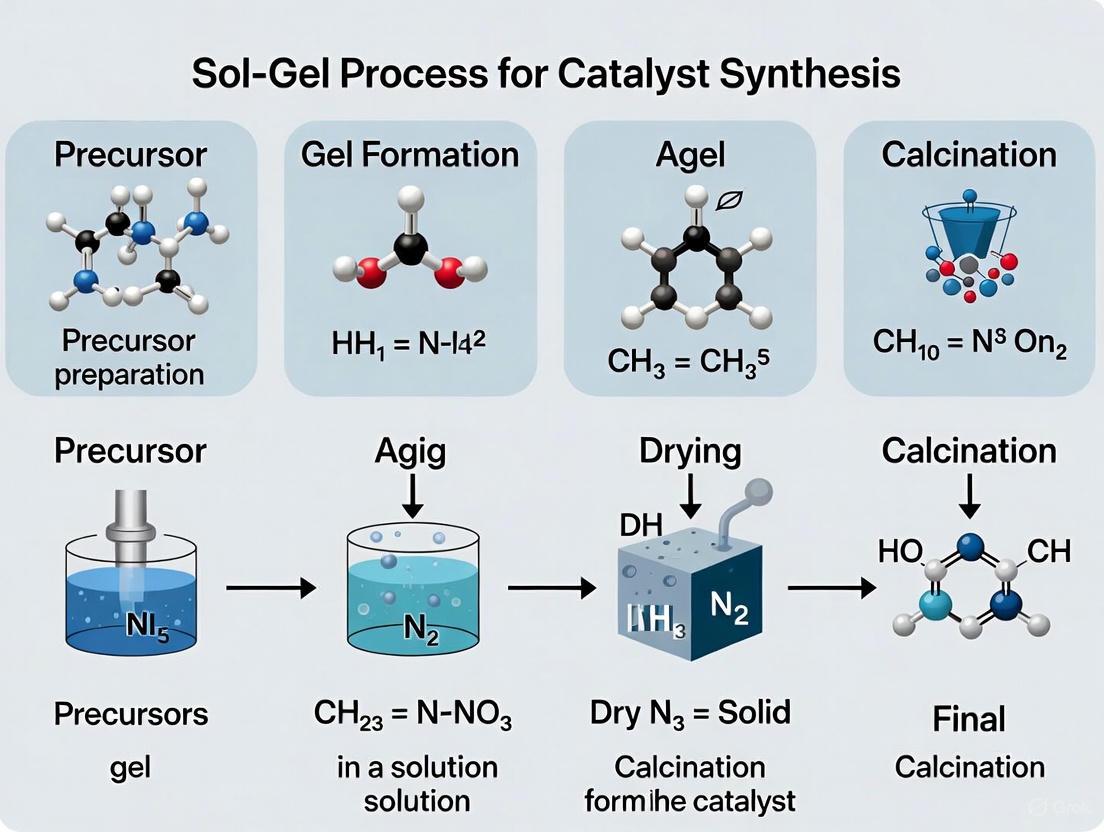
This article provides a comprehensive exploration of the sol-gel process for synthesizing advanced catalytic materials, tailored for researchers and drug development professionals.
Sol-Gel Catalyst Synthesis: A Guide to Advanced Materials for Biomedical and Environmental Applications
Abstract
This article provides a comprehensive exploration of the sol-gel process for synthesizing advanced catalytic materials, tailored for researchers and drug development professionals. It covers the foundational chemistry of sol-gel reactions, detailed methodologies for creating catalysts for drug delivery and environmental uses, strategies for optimizing critical parameters like heat treatment and composition, and modern validation techniques including AI-assisted analysis. The content synthesizes recent research to serve as a practical guide for developing high-performance, tailored catalysts.
The Chemistry and Principles of Sol-Gel Synthesis for Advanced Catalysts
The sol-gel process is a versatile wet-chemical technique widely employed for the fabrication of solid materials, ranging from metal oxides and ceramics to organic-inorganic hybrids [1]. This method involves the transformation of a colloidal solution (sol) into a solid, three-dimensional network (gel) that encapsulates a liquid phase [2] [3]. Its significance in modern materials science, particularly in catalyst synthesis, stems from its ability to produce materials with fine microstructural control, high purity, and homogeneous composition at relatively low temperatures [1] [4]. The process is considered a green synthesis route, as it often utilizes mild conditions, with water or alcohols as solvents, and operates frequently at room temperature [2]. For catalytic applications, the sol-gel method enables the design of high-surface-area materials with stable surfaces and the precise incorporation of catalytic active sites, such as vanadium oxide, into a support matrix like silica [4].
Core Chemical Principles
The sol-gel process is fundamentally governed by two sequential types of chemical reactions: hydrolysis and condensation. These reactions transform molecular precursors into an extended oxide network.
Hydrolysis
Hydrolysis is the initial step where metal alkoxide precursors (e.g., tetraethyl orthosilicate, or TEOS, for silica) react with water. This reaction replaces alkoxide groups (OR) with hydroxyl groups (OH) [1] [5].
General Reaction: Si(OR)4 + H2O → HO-Si(OR)3 + R-OH [1]
Condensation
Following hydrolysis, condensation reactions occur, leading to the formation of metal-oxygen-metal (M-O-M) bridges. This step is responsible for building the polymeric network and liberates small molecules like water or alcohol as byproducts [1] [5].
Polymerization Example: (OR)3Si-OH + HO-Si(OR)3 → (OR)3Si-O-Si(OR)3 + H2O [1]
The progression of these reactions is critically influenced by several parameters, which are summarized in the table below.
Table 1: Key Parameters Influencing the Sol-Gel Process and Final Material Properties
| Parameter | Influence on Process & Material | Typical Experimental Levers |
|---|---|---|
| pH (Acid/Base Catalyst) | Determines reaction rates and network structure. Acid catalysis favors linear, polymeric gels; base catalysis favors particulate, colloidal gels [1]. | Use of HNO₃, HCl (acidic) or NH₄OH (basic) [4] [3]. |
| Precursor to Water Ratio ([H₂O]/[M]) | Affects the extent of hydrolysis. Low ratios lead to incomplete hydrolysis and weakly branched networks; high ratios drive hydrolysis toward completion [1]. | Varying the molar amount of water added to the alkoxide precursor. |
| Reaction Temperature | Influences reaction kinetics and network density. Higher temperatures accelerate reactions and can lead to higher condensation degrees and a more cross-linked network [6]. | Conducting reactions at room temperature vs. elevated temperatures (e.g., 65 °C) [6]. |
| Solvent Type | Affects the polarity of the medium, nanocrystal growth, and self-assembly, ultimately influencing the morphology and porosity of the final nanostructures [3]. | Use of water, ethanol, dimethylformamide (DMF), or toluene [3]. |
The Core Stages of the Sol-Gel Process
The transformation from a solution of precursors to a final solid material can be broken down into several distinct stages. The following workflow diagram illustrates the primary pathway and key decision points in a standard sol-gel synthesis.
Diagram 1: The Sol-Gel Process Workflow
Sol Formation
The process begins with the formation of a sol—a stable colloidal suspension of solid particles (ranging from 1 to 100 nm) in a liquid medium [5] [6]. This is achieved through the controlled hydrolysis of molecular precursors (e.g., metal alkoxides like TMOS or TEOS). The hydrolysis reaction is often catalyzed by an acid or a base, which determines the size and nature of the resulting particles [1].
Gelation
The sol gradually evolves into a gel through polycondensation reactions. During gelation, the particles or polymers in the sol link together to form a three-dimensional, continuous solid network that spans the entire volume of the liquid medium, trapping it within its pores [1] [3]. This point is marked by a sharp increase in viscosity, leading to a solid-like, often gelatinous material [5].
Aging
After gelation, the wet gel is typically aged for a period that can range from hours to weeks. Aging strengthens the gel network through processes like Ostwald ripening and neoformation, where condensation reactions continue, thickening the network strands and increasing the gel's mechanical strength [1] [5]. This step is crucial to prevent cracking during the subsequent drying stage.
Drying
The drying stage involves the removal of the liquid pore fluid from the gel network. The method chosen for drying profoundly impacts the final material's properties, leading to different classes of products:
- Xerogels: Formed when the gel is dried under ambient conditions or at moderately low temperatures (25–100 °C). This process is accompanied by significant capillary pressure, leading to substantial shrinkage and densification of the network [1].
- Aerogels: Produced when the liquid is removed under supercritical conditions, which avoids the formation of a liquid-vapor meniscus. This method minimizes shrinkage and collapse of the pore structure, resulting in a highly porous and extremely low-density material [1].
Thermal Treatment (Firing)
A final thermal treatment is often applied to xerogels or other densified gels. This firing process serves several purposes: it removes residual organic species and hydroxyl groups, enhances polycondensation, and promotes sintering and grain growth [1]. This step is essential for achieving the desired mechanical properties, structural stability, and crystallinity in the final ceramic or glass product. A key advantage of the sol-gel route is that densification is often achieved at much lower temperatures than those required by traditional ceramic processing [1].
The Scientist's Toolkit: Essential Reagents & Materials
The following table details key reagents and materials commonly used in sol-gel synthesis for catalyst research.
Table 2: Essential Research Reagents for Sol-Gel Synthesis
| Reagent/Material | Typical Examples | Function in the Sol-Gel Process |
|---|---|---|
| Metal Alkoxide Precursors | Tetraethyl orthosilicate (TEOS), Tetramethyl orthosilicate (TMOS), Titanium isopropoxide, 3-methacryloxypropyltrimethoxysilane (MPTS) [1] [6] | Primary network formers. They undergo hydrolysis and condensation to build the inorganic or hybrid matrix. MPTS is an example of an organically-modified silicate for hybrid materials. |
| Solvents | Ethanol, Water, Dimethylformamide (DMF), Toluene [2] [3] | To dissolve precursors and facilitate homogenization. Solvent polarity can be used to control nanocrystal growth and final morphology [3]. |
| Catalysts | Nitric acid (HNO₃), Hydrochloric acid (HCl), Ammonia (NH₄OH) [4] [6] | To accelerate hydrolysis and condensation reactions. The choice of acid or base dictates the structure of the resulting gel network [1]. |
| Dopant/Active Phase Precursors | Vanadium acetylacetonate, Metal chlorides (e.g., MnCl₂, CuCl₂), Metal acetates, Rare-earth salts [1] [4] [3] | To introduce specific functional properties (e.g., catalytic activity) into the gel matrix. They can be added to the initial sol for homogeneous dispersion. |
| Chelating Agents | Citric Acid [1] | Used in processes like the Pechini method to chelate metal cations, preventing premature precipitation and ensuring atomic-level homogeneity in multi-component systems [1]. |
Experimental Protocol: Base-Catalyzed Synthesis of Mesoporous Metal Oxide Nanostructures
This protocol is adapted from a study demonstrating the synthesis of shape-controlled manganese oxide (Mn₃O₄) and copper oxide (CuO) nanostructures, relevant for catalysis applications [3].
Objective
To synthesize mesoporous metal oxide nanostructures via a base-catalyzed sol-gel approach combined with solvent-driven self-assembly.
Materials
- Metal Precursor: Manganese(II) chloride (MnCl₂) or Copper(II) chloride (CuCl₂).
- Base Solution: Sodium hydroxide (NaOH) solution.
- Solvents: Deionized water, ethanol, dimethylformamide (DMF), toluene.
- Equipment: Magnetic stirrer, beakers, centrifuge, drying oven.
Step-by-Step Procedure
- Sol Preparation: Dissolve the metal precursor (e.g., MnCl₂) in a 50 mL mixture of solvent (e.g., water, 70% ethanol, DMF, or a water/toluene mixture) under constant stirring. The concentration of the metal ion should be in the range of 0.1 M.
- Base Addition and Hydrolysis: Add a NaOH solution to the metal precursor solution dropwise. The study utilized molar ratios of metal precursor to base of 1:5, 1:10, and 1:15 [3]. The addition will initiate hydrolysis and the formation of a colloidal sol.
- Gelation and Aging: Continue stirring the mixture at low temperature (<80 °C) for several hours. The sol will gradually evolve into a gel. Allow the gel to age in the mother liquor for 24 hours to strengthen the network.
- Washing and Drying: Recover the gel by centrifugation. Wash the precipitate repeatedly with deionized water and ethanol to remove excess ions and byproducts. Dry the resulting product in an oven at 60-80 °C for 12 hours to obtain a xerogel.
- Characterization: The final nanostructures can be characterized by X-ray diffraction (XRD) for crystallinity, nitrogen adsorption-desorption for surface area and porosity, and scanning electron microscopy (SEM) for morphology.
Expected Outcomes
Using this method, the authors reported the formation of:
- Mn₃O₄ with hexagonal, irregular particle, or ribbon-like morphologies, with a high BET surface area of up to 91.68 m²/g [3].
- CuO nanostructures in the form of highly nanoporous thin sheets [3].
Advanced Applications in Catalyst Synthesis
The sol-gel process offers unique advantages for the design and synthesis of heterogeneous catalysts.
- High Dispersion of Active Sites: The process allows for the incorporation of catalytic active phases, such as vanadium oxide, directly into the sol, resulting in a highly dispersed and homogeneous distribution within the final oxide support (e.g., SiO₂) [4]. This can lead to stronger metal-support interactions compared to traditional impregnation methods.
- Organic-Inorganic Hybrid Catalysts: The sol-gel method can be used to create metal-organic frameworks (MOFs) and metal phosphonate hybrids, which have shown promise in catalysis for reactions such as aerobic oxidation and hydrogenation [2].
- Control over Porosity and Morphology: By manipulating sol-gel parameters and employing templating agents, catalysts with tailored pore sizes and high surface areas can be synthesized, enhancing mass transfer and accessibility to active sites [1] [3].
Troubleshooting and Best Practices
- Cracking During Drying: To mitigate cracking, ensure adequate aging time to strengthen the gel network. Slow, controlled drying rates and the use of drying control chemical additives (DCCAs) can also be effective.
- Precipitation Instead of Gelation: This often results from overly rapid hydrolysis and condensation. Slow down the reaction by using less vigorous catalyst concentrations, adding water slowly, or cooling the reaction mixture.
- Reproducibility: Maintain strict control over all parameters, including precursor concentration, [H₂O]/[Precursor] ratio, pH, temperature, and solvent type, as small variations can significantly alter the final product.
The sol-gel process is a versatile synthetic methodology for producing advanced inorganic and organic-inorganic hybrid materials, widely employed in catalyst synthesis, drug development, and materials science. This bottom-up approach involves the transition of a system from a colloidal solution (sol) into a porous, three-dimensional network (gel) through controlled chemical reactions. The fundamental chemistry driving this process centers on two pivotal reaction classes: hydrolysis and condensation. These sequential and parallel reactions transform molecular precursors—typically metal alkoxides—into extended oxide networks under mild, low-temperature conditions, enabling fine control over the composition, structure, and texture of the final material [4] [1] [7]. For researchers designing catalytic materials, mastering these mechanisms is essential for tailoring critical parameters such as surface area, porosity, active site distribution, and structural stability.
Fundamental Reaction Mechanisms
Hydrolysis Reactions
Hydrolysis is the initial and critical step in the sol-gel process, wherein a water molecule attacks the metal alkoxide precursor. This nucleophilic substitution reaction results in the replacement of an alkoxy group (-OR) with a hydroxyl group (-OH).
The general form of the hydrolysis reaction is:
≡Si-OR + H₂O → ≡Si-OH + R-OH [1] [8]
This reaction is catalyzed by acids or bases and is the first step in activating the precursor for subsequent condensation. The mechanism proceeds through a nucleophilic addition of a water molecule to the metal center (e.g., Si, Ti, Zr), which is followed by a proton transfer, making the alcohol (ROH) a suitable leaving group [7]. The kinetics and extent of hydrolysis are profoundly influenced by the strength of the M-OR bond, the steric hindrance of the alkyl group R, the water-to-precursor ratio (R value), the pH of the solution, and the nature of the catalyst used [8].
Condensation Reactions
Following hydrolysis, condensation reactions link the hydrolyzed monomers to form a growing M-O-M network. These polycondensation reactions are the primary builders of the inorganic framework and can proceed via two distinct pathways, both of which liberate a small molecule:
- Water-Forming Condensation:
≡Si-OH + HO-Si≡ → ≡Si-O-Si≡ + H₂O[1] [8] - Alcohol-Forming Condensation:
≡Si-OH + RO-Si≡ → ≡Si-O-Si≡ + R-OH[9] [1] [8]
Condensation can occur between various species in the solution, including molecules and particles, leading to the formation of dimers, trimers, and eventually, a macroscopic gel network. The relative rates of the two condensation pathways depend on the reaction conditions, particularly the catalyst type [10].
Quantitative Kinetic Analysis
The rates of hydrolysis and condensation reactions determine the structure and properties of the final gel. Kinetic studies using techniques like ¹H and ²⁹Si NMR spectroscopy provide quantitative insight into these processes.
Table 1: Experimentally Determined Rate Constants for Acid-Catalyzed TMOS Hydrolysis and Condensation [10]
| Reaction Type | Rate Constant (1/(mol·min)) | Relative Rate |
|---|---|---|
| Hydrolysis | > 0.2 | Much Faster |
| Water-Forming Condensation | 0.006 | ~3-6x Slower than Hydrolysis |
| Alcohol-Forming Condensation | 0.001 | ~3x Slower than Water-Forming |
The data in Table 1 confirms that under acid-catalyzed conditions, hydrolysis is significantly faster than condensation, allowing for a high degree of precursor hydrolysis before significant network formation begins. This typically results in more extended and less branched polymer networks, which can lead to the formation of microporous gels with high specific surface area [10] [1].
Table 2: Factors Influencing Hydrolysis and Condensation Kinetics [1] [7] [8]
| Factor | Effect on Hydrolysis | Effect on Condensation |
|---|---|---|
| Catalyst (pH) | Acid catalysis: Faster. Base catalysis: Faster. | Acid catalysis: Favors linear chains. Base catalysis: Favors branched clusters/particles. |
| Water/Si Ratio (R) | Higher ratio drives reaction to completion. | Lower ratio limits cross-linking, leading to less branched polymers. |
| Precursor Type | Si(OCH₃)₄ > Si(OC₂H₅)₄ (due to sterics). Transition metal alkoxides are much more reactive. |
Reactivity correlates with hydrolysis rate; affects network density and homogeneity. |
| Solvent | Polar solvents can accelerate the reaction. | Influences the reaction medium's polarity and the solubility of growing oligomers. |
| Temperature | Increases reaction rate. | Increases reaction rate and can affect the gel time. |
Experimental Protocols
Protocol 1: Acid-Catalyzed Synthesis of Silica Gel via TMOS Hydrolysis and Condensation
This protocol describes the synthesis of a silica xerogel through the acid-catalyzed sol-gel route, ideal for producing materials with high surface area and microporosity [11] [1] [7].
Research Reagent Solutions: Table 3: Essential Reagents for Acid-Catalyzed Silica Synthesis
| Reagent | Function | Typical Purity |
|---|---|---|
| Tetramethoxysilane (TMOS) | Primary silica network precursor | >98% |
| Anhydrous Methanol | Solvent | >99.8% |
| Deionized Water | Hydrolyzing agent | N/A |
| Hydrochloric Acid (HCl, 0.1M) | Acid catalyst for hydrolysis & condensation | ACS Reagent Grade |
Step-by-Step Procedure:
- Solution Preparation: In a sealed vessel to prevent solvent evaporation, mix 2.85 mL of TMOS with 6 mL of anhydrous methanol under vigorous stirring.
- Hydrolysis Initiation: Slowly add a solution containing 2.43 mL of deionized water and 0.07 mol of 0.1M HCl catalyst to the TMOS/methanol solution drop-by-drop.
- Sol Formation: Continue stirring the mixture at room temperature for 1-2 hours. The solution will remain clear (the "sol") as hydrolysis progresses.
- Gelation and Aging: Transfer the sol to a static container and seal it. Gelation typically occurs within 4-8 hours, forming a rigid, wet gel. Age the gel for 24 hours at room temperature to strengthen the network via continued condensation.
- Drying: Dry the aged gel in an oven at 60-80°C for 16-24 hours to remove the liquid phase, resulting in a porous silica xerogel.
- Thermal Treatment (Optional): For enhanced mechanical stability and removal of residual organics, calcine the xerogel in a furnace at 500-600°C for 2-5 hours.
Troubleshooting Notes:
- Slow Gelation: Increase the catalyst concentration or the aging temperature slightly.
- Cracking During Drying: This is often due to rapid solvent evaporation. Slower drying rates or the use of a drying control chemical additive (DCCA) can mitigate this.
- Precipitation: If a precipitate forms instead of a gel, it may indicate that the condensation rate is too high relative to hydrolysis. Ensure the catalyst is well-mixed during the addition step.
Protocol 2: Base-Catalyzed Synthesis of Monodisperse Silica Nanoparticles (Stöber Process)
The Stöber process is a classic example of a base-catalyzed sol-gel synthesis that yields uniform, spherical silica particles [1].
Research Reagent Solutions: Table 4: Essential Reagents for the Stöber Process
| Reagent | Function | Typical Purity |
|---|---|---|
| Tetraethoxysilane (TEOS) | Silica precursor | >98% |
| Absolute Ethanol | Solvent | >99.9% |
| Ammonium Hydroxide (NH₄OH, 28-30%) | Base catalyst | ACS Reagent Grade |
| Deionized Water | Hydrolyzing agent | N/A |
Step-by-Step Procedure:
- Base Solution Preparation: In a clean flask, mix 50 mL of absolute ethanol, 5 mL of deionized water, and 3 mL of ammonium hydroxide.
- Precursor Addition: Under continuous stirring, rapidly add 2.5 mL of TEOS to the base solution.
- Reaction and Aging: Allow the reaction to proceed under stirring for 2-4 hours at room temperature. The solution will turn opalescent due to the formation of monodisperse silica nanoparticles.
- Product Isolation: Recover the nanoparticles by centrifugation (e.g., 10,000 rpm for 15 minutes), wash several times with ethanol to remove unreacted precursors and ammonia, and finally dry the powder at 80°C.
Protocol 3: One-Pot Sol-Gel Synthesis of a Supported Metal Catalyst (Ru/SiO₂)
This protocol illustrates the integration of a catalytic metal (Ruthenium) into a silica matrix during the sol-gel process, ensuring high dispersion of the active phase [11].
Research Reagent Solutions: Table 5: Essential Reagents for Ru/SiO₂ Catalyst Synthesis
| Reagent | Function | Typical Purity |
|---|---|---|
| Tetraethoxysilane (TEOS) | SiO₂ support precursor | >98% |
| Ruthenium(III) Chloride Hydrate (RuCl₃·xH₂O) | Metal catalyst precursor | Reagent Grade |
| Absolute Ethanol | Solvent | >99.8% |
| Deionized Water | Hydrolyzing agent | N/A |
| Hydrochloric Acid (HCl, conc.) or Ammonium Hydroxide (NH₄OH, conc.) | Reaction catalyst | ACS Reagent Grade |
Step-by-Step Procedure:
- Precursor Dissolution: Dissolve 0.06 g of RuCl₃·3H₂O in 6 mL of absolute ethanol.
- Silica Precursor Addition: Add 4.1 mL of TEOS dropwise to the ruthenium solution under vigorous stirring.
- Catalyzed Hydrolysis: Prepare a solution of 1.30 mL of deionized water with either concentrated HCl (0.07 mol) or concentrated NH₄OH (0.06 mol). Add this solution to the metal/TEOS mixture to initiate the catalyzed hydrolysis.
- Reflux and Gelation: Reflux the resulting sol until gelation occurs. The time is highly catalyst-dependent: ~4 hours for acid-catalysis and ~8 hours for base-catalysis.
- Drying and Calcination: Dry the gel in vacuo at 80°C for 16 hours. Finally, calcine the material under a nitrogen stream at 300°C for 5 hours to form the final Ru/SiO₂ catalyst.
Visualization of Sol-Gel Pathways and Workflows
Sol-Gel Process Workflow
Hydrolysis and Condensation Reaction Network
The sol-gel process represents a cornerstone of modern materials science, enabling the synthesis of advanced catalytic frameworks with tailored properties for applications ranging from heterogeneous catalysis to drug development. This transformative technology facilitates the transition of molecular precursors into integrated solid networks through controlled hydrolysis and condensation reactions, operating at low temperatures that preserve structural integrity and functionality. The strategic selection of precursors—primarily metal alkoxides and metal salts—dictates the architecture, porosity, and surface chemistry of the resulting metal oxides, thereby governing their catalytic performance. Within the broader context of sol-gel research for catalyst synthesis, understanding the chemical behavior and application protocols of these precursors is paramount for designing materials with precision. This document provides a comprehensive overview of the essential precursors used in sol-gel chemistry, detailing their reaction mechanisms, comparative advantages, and practical synthesis protocols to equip researchers with the foundational knowledge for innovative catalyst development.
Fundamental Chemistry of Sol-Gel Precursors
Metal Alkoxides: Structure and Reactivity
Metal alkoxides (M(OR)ₓ) are metal cations coordinated by alkoxide anions (RO⁻). Their chemical nature is fundamentally different from silicon alkoxides, as theoretical calculations reveal localization of occupied bonding molecular orbitals essentially solely on the oxygen atoms of the alkoxide ligands [12]. This indicates that these species are primarily held together by electrostatic, ionic bonding, which is associated with quick and reversible ligand exchange reactions [12]. The structure of oligonuclear alkoxide complexes is governed by the dense packing of cations and anions and the minimization of surface energy, often resulting in spheroidal or ellipsoidal topologies [13]. These complexes can be considered molecular models for metal oxide surfaces, providing insights into surface complexation and redox properties [13].
The high reactivity of metal alkoxides stems from the strong basicity of the alkoxide ligands and the electrophilic character of the metal center. The kinetics of hydrolysis and condensation are significantly faster than those of silicon alkoxides due to the lower electronegativity of metal atoms and their ability to readily expand their coordination sphere [12] [14]. This high reactivity often necessitates chemical modification of precursors to control reaction rates and achieve desired material properties.
Metal Salts: Aqueous Chemistry and Condensation
In the aqueous sol-gel route, metal salts (e.g., chlorides, nitrates) dissolved in water serve as inexpensive and accessible precursors. When dissolved, metal cations become solvated, forming aquo complexes [M(H₂O)ₙ]ᶻ⁺ [15]. The subsequent hydrolysis and condensation processes are heavily influenced by the solution pH, which controls the formation of hydroxo and oxo ligands.
The forced hydrolysis of metal salts in aqueous solutions proceeds through the formation of hydroxo complexes, which then condense via two primary pathways [14] [15]:
- Olation: Bridging by hydroxide groups (OH⁻), typically favored for low-valent metal cations and leading to polycations and hydroxide precipitation.
- Oxolation: Bridging by oxide groups (O²⁻), common for high-valent cations and resulting in the formation of polyanions and oxide networks.
A key challenge in the aqueous route is avoiding uncontrolled precipitation. Techniques such as the epoxide-mediated method are employed to raise the pH homogeneously and gradually, promoting controlled gelation instead of precipitate formation [14]. This method uses propylene oxide, which undergoes irreversible ring-opening reactions to consume protons and uniformly increase pH throughout the solution [14].
Comparative Analysis of Key Precursor Classes
Table 1: Comparative Characteristics of Metal Alkoxides and Metal Salts as Sol-Gel Precursors
| Feature | Metal Alkoxides | Metal Salts |
|---|---|---|
| Chemical Nature | M(OR)ₓ, ionic bonding [12] | [M(H₂O)ₙ]ᶻ⁺X⁻, ionic in water [15] |
| Primary Solvent | Organic (alcohols, THF) [7] | Aqueous [15] |
| Reactivity | Very high, fast hydrolysis [14] | Moderate, controlled by pH [15] |
| Cost | Relatively high [15] | Low, cost-effective [15] |
| Handling | Air- and moisture-sensitive, require inert atmosphere [7] | Less sensitive, easier to handle [15] |
| Process Control | Requires modification (chelation) for control [7] [12] | Controlled via pH, concentration, and complexing agents [15] |
| Key Advantage | High purity, molecular-level mixing, direct M-O-M bonds [7] [16] | Low cost, scalability, industrial suitability [15] |
| Key Challenge | Differing hydrolysis rates in multi-component systems [7] | Risk of uncontrolled precipitation, anion incorporation [14] [15] |
| Typical Products | High-purity oxides, thin films, mixed oxides [7] [16] | Bulk oxides, supported catalysts, monoliths [17] [14] |
Selecting Precursors for Multi-Component Systems
Synthesizing complex mixed oxides and supported catalysts requires careful precursor selection to achieve homogeneity. The Pechini process, a variant of the sol-gel method, is particularly effective for multi-cation systems [1]. It involves using a chelating agent, most often citric acid, to surround aqueous cations and sterically entrap them, preventing phase segregation that results from differing hydrolysis rates [1]. A polymer network, typically formed by polyesterification with ethylene glycol, is then created to immobilize the chelated cations in a gel or resin [1]. Subsequent combustion removes the organic material, yielding a homogeneous mixed oxide.
For alkoxide-based systems, the use of heterometallic alkoxides or careful matching of hydrolysis rates through chelating ligands (e.g., acetylacetonate) is crucial for achieving atomic-level dispersion [7] [12].
Experimental Protocols
Protocol 1: Base-Catalyzed Synthesis of SiO₂ Nanoparticles from TEOS
This protocol describes the synthesis of monodisperse silica nanoparticles via the hydrolysis and condensation of tetraethyl orthosilicate (TEOS) under basic conditions, adapting the well-known Stöber process [1] [12].
Research Reagent Solutions: Table 2: Essential Reagents for SiO₂ Nanoparticle Synthesis
| Reagent | Function | Specifications |
|---|---|---|
| Tetraethyl Orthosilicate (TEOS) | Primary silica precursor | ≥99% purity, store under anhydrous conditions |
| Anhydrous Ethanol | Solvent medium | Low water content (<0.1%) to control hydrolysis |
| Ammonium Hydroxide (NH₄OH) | Base catalyst | 28-30% NH₃ in water, analytical grade |
| Deionized Water | Hydrolyzing agent | 18.2 MΩ·cm resistivity |
Procedure:
- Preparation of Reaction Mixture: In a 250 mL polypropylene bottle, add 100 mL of anhydrous ethanol, 20 mL of deionized water, and 5 mL of ammonium hydroxide. Seal the bottle and mix thoroughly on a magnetic stirrer.
- Precursor Addition: Rapidly add 5 mL of TEOS to the stirring mixture. Note the time of addition (t=0).
- Gelation and Aging: Continue stirring for 2 hours at room temperature. The solution will turn opalescent, indicating the formation of a silica sol. After stirring, allow the mixture to age without disturbance for 24 hours.
- Recovery and Calculation: Recover the nanoparticles by centrifugation (10,000 rpm for 15 minutes). Wash the pellet three times with anhydrous ethanol to remove residual ammonia and water. Dry the white powder at 80°C for 12 hours. For complete condensation and removal of organic residues, calcine the powder at 550°C for 4 hours in a muffle furnace (ramp rate: 2°C/min).
Notes: The size of the resulting nanoparticles can be tuned by varying the concentration of TEOS, water, and catalyst [12]. The base-catalyzed conditions favor faster gelation and the formation of highly cross-linked, spherical particles compared to acid catalysis [18] [12].
Protocol 2: Acid-Catalyzed Sol-Gel Synthesis of a NiO-Fe₂O₃-SiO₂/Al₂O₃ Catalyst
This protocol outlines the synthesis of a bimetallic catalyst supported on alumina, demonstrating the use of heat treatment control to achieve high dispersion and surface area [17].
Research Reagent Solutions: Table 3: Essential Reagents for NiO-Fe₂O₃-SiO₂/Al₂O₃ Catalyst Synthesis
| Reagent | Function | Specifications |
|---|---|---|
| Aluminum Oxide (Al₂O₃) Powder | Catalyst support | High-purity γ-phase, high surface area |
| Nickel Nitrate Hexahydrate (Ni(NO₃)₂·6H₂O) | Nickel oxide precursor | ≥98% purity |
| Iron Nitrate Nonahydrate (Fe(NO₃)₃·9H₂O) | Iron oxide precursor | ≥98% purity |
| Tetraethoxysilane (TEOS) | Binder and matrix former | ≥99% purity |
| Nitric Acid (HNO₃) | Acid catalyst | 2M solution in ethanol |
| Anhydrous Ethanol | Solvent |
Procedure:
- Support Impregnation: Dissolve 2.90 g of Ni(NO₃)₂·6H₂O and 4.04 g of Fe(NO₃)₃·9H₂O (Ni/Fe molar ratio = 1/1) in 50 mL of ethanol. Add 10 g of Al₂O₃ powder to the solution and sonicate for 30 minutes to ensure uniform wetting. Stir the suspension for 4 hours.
- Sol Preparation: In a separate beaker, hydrolyze 5 mL of TEOS in 50 mL of ethanol containing 1 mL of 2M HNO₃. Stir this mixture for 1 hour to allow for partial hydrolysis and the formation of a silica sol.
- Combination and Gelation: Slowly add the hydrolyzed TEOS sol to the metal salt-impregnated alumina suspension under vigorous stirring. Continue stirring until a thick gel forms (typically 1-2 hours).
- Drying: Age the gel for 12 hours, then dry it in an oven at 100°C for 24 hours.
- Controlled Calcination: Place the dried material in a furnace and heat to 400°C at a controlled ramp rate of 5°C/min. Hold at this temperature for 40 minutes. Critical Step: Exceeding a ramp rate of 5°C/min can lead to microcracks, elemental segregation, and deterioration of the catalyst's structural integrity [17].
Characterization: The optimized catalyst prepared with this protocol is expected to have a particle size of approximately 44 nm and a specific surface area of 134.79 m²/g [17].
Synthesis Workflow and Precursor Reaction Pathways
The following diagram illustrates the general decision-making workflow and chemical pathways involved in selecting and processing metal alkoxide and metal salt precursors for sol-gel synthesis.
The strategic selection and application of metal alkoxides and metal salts form the molecular cornerstone of sol-gel catalyst synthesis. While alkoxides offer unparalleled control and purity for advanced material design, salts provide a robust and economical pathway for industrial-scale catalyst production. The protocols and analyses presented herein underscore the criticality of understanding precursor chemistry—including hydrolysis kinetics, condensation mechanisms, and strategies for homogeneity control—in the rational design of catalytic frameworks. As the field progresses, the integration of these fundamental principles with emerging approaches, such as green solvent systems [19] and machine-learning-assisted optimization [16] [17], will further empower researchers to push the boundaries of catalytic material science, enabling more efficient and sustainable chemical processes.
The sol-gel process represents a fundamental shift in ceramic and catalyst synthesis methodology, enabling unprecedented control over material properties at the nanoscale. This bottom-up approach facilitates the fabrication of ceramic materials through preparation of a sol, gelation of the sol, and removal of the solvent [20]. Unlike traditional impregnation methods that often suffer from loss of material dispersion, reduced specific surface area, and uneven particle distribution [17], sol-gel processing offers a versatile pathway to materials with tailored architectures. For researchers and drug development professionals, this methodology provides critical advantages in developing catalytic systems with enhanced performance characteristics, particularly through its ability to achieve nanoscale homogeneity and exceptional purity in multicomponent systems.
The fundamental chemistry of sol-gel processing revolves around hydrolysis and condensation reactions of molecular precursors, typically metal alkoxides (M(OR)ₙ) [20] [4]. This process converts precursors into a colloidal solution (sol), which then evolves toward forming an integrated network (gel) of discrete particles or polymer chains [2]. The transition from sol to gel state represents the foundation for creating materials with controlled porosity, high surface area, and uniform component distribution - attributes particularly valuable in catalyst design and pharmaceutical development.
Key Advantages: Quantitative Comparisons with Traditional Methods
Nanoscale Homogeneity Through Molecular-Level Control
The sol-gel process provides exceptional control over material composition at the molecular level, enabling homogeneous multi-component systems that are difficult to achieve through traditional methods [4]. This homogeneity stems from the ability to mix precursors in solution, ensuring uniform distribution of components before network formation. In catalyst synthesis, this translates to highly dispersed active sites and consistent performance characteristics.
Table 1: Comparative Analysis of Sol-Gel vs. Traditional Impregnation Methods
| Parameter | Sol-Gel Method | Traditional Impregnation | Experimental Evidence |
|---|---|---|---|
| Component Distribution | Molecular-level mixing [21] | Surface deposition only [17] | Elemental mapping shows uniform distribution vs. clustering [17] |
| Particle Size Control | Narrow distribution (e.g., 44 nm achieved) [17] | Broad distribution, often >100 nm | SEM analysis demonstrates uniform particles [17] |
| Specific Surface Area | High (e.g., 134.79 m²/g for NiO-Fe₂O₃-SiO₂/Al₂O₃) [17] | Moderate to low (significant reduction after calcination) [17] | BET analysis confirms enhanced surface area [17] |
| Processing Temperature | Low (room temperature to 100°C) [21] | High (typically >400°C) [17] | Successful synthesis at 400°C with maintained dispersion [17] |
| Doping Precision | Excellent (systematic Mn-doping in Ca₃Co₂O₆) [22] | Limited control | XRD reveals lattice parameter shifts consistent with dopant incorporation [22] |
| Phase Purity | High (avoids spinel formation at lower temperatures) [17] | Contamination common (e.g., NiAl₂O₄ formation) [17] | XRD confirms desired phases without intermediates [17] [22] |
The statistical analysis of NiO-Fe₂O₃-SiO₂/Al₂O₃ catalysts demonstrates that optimal sol-gel processing produces materials with particle sizes of 44 nm and specific surface area of 134.79 m²/g, substantially outperforming traditional methods where high-temperature treatment causes "coarsening of active components" [17]. This nanoscale homogeneity directly enhances catalytic performance by providing uniform active sites and improved accessibility to reactants.
Enhanced Purity and Structural Control
Sol-gel processing enables exceptional material purity due to the use of high-purity precursors and the absence of contamination from crucibles or processing equipment [21]. The low processing temperatures (room temperature to ~100°C) prevent thermal degradation and undesirable phase transformations that commonly plague traditional high-temperature methods [21].
Table 2: Purity and Structural Advantages in Experimental Systems
| Material System | Sol-Gel Advantage | Traditional Method Limitation | Characterization Evidence |
|---|---|---|---|
| NiO-Fe₂O₃-SiO₂/Al₂O₃ | Prevents NiAl₂O₄ spinel formation at 400°C [17] | Spinel formation reduces reducibility of nickel phase [17] | XRD confirms absence of spinel phases [17] |
| Mn-doped Ca₃Co₂O₆ | Precise dopant incorporation [22] | Inhomogeneous doping common | XRD shows lattice parameter shifts [22] |
| Silica-based Ionogels | Continuous 3D network with controlled porosity [23] | Limited control over pore architecture | SEM/TEM reveal micropores and mesopores (≤20 nm) [23] |
| VOx-SiO₂ Catalysts | Stronger V-SiO₂ interactions [4] | Weaker interaction leads to crystalline V₂O₅ formation [4] | Enhanced catalytic activity in oxidative dehydrogenation [4] |
| Organic-Inorganic Hybrids | Molecular-level integration [2] | Physical mixing only | Proton conduction demonstrated [2] |
The ability to control structure and composition at a molecular level represents perhaps the most significant advantage of sol-gel processing [20]. This capability enables researchers to "impose kinetic constraints on a system and thereby stabilize metastable phases" while "fine-tuning the activation behavior of a sample" to trace the genesis of active species [20]. For pharmaceutical researchers, this level of control is invaluable for developing tailored catalyst systems with predictable performance characteristics.
Experimental Protocols: Methodologies for Reproducible Synthesis
Standard Sol-Gel Protocol for Mixed Oxide Catalysts
This protocol details the synthesis of NiO-Fe₂O₃-SiO₂/Al₂O₃ catalysts as representative of mixed oxide systems, with adaptations for other compositions noted [17].
Materials and Reagents:
- Tetraethyl orthosilicate (TEOS, ≥98% purity)
- Nickel and iron precursors (nitrates or alkoxides)
- Al₂O₃ support (high purity, specific surface area >150 m²/g)
- Ethanol (anhydrous, ≥99.8%)
- Hydrochloric acid (37%) or ammonia solution (25%) as catalysts
- Deionized water (18 MΩ·cm)
Synthetic Procedure:
Sol Formation: Combine 0.0448 mol (10 mL) of TEOS with 0.1200 mol (7 mL) of ethanol in a sealed glass vessel. Heat to 60°C with continuous stirring for 30 minutes using a magnetic stirrer [17].
Precursor Addition: Rapidly add 1g of ionic liquid templating agent (if using) and metal precursors at desired molar ratios (e.g., Ni/Fe = 1/1 for optimal homogeneity) [17].
Catalyzed Hydrolysis: Add 0.0303 mol of HCl (2.5 mL, 37% concentration) diluted with 3 mL deionized water. Continue stirring for 10 minutes to ensure complete hydrolysis [17].
Gelation and Aging: Transfer solution to controlled environment and allow gelation to proceed (typically 24-72 hours). Age the resulting gel for 48 hours at 40°C to strengthen the network through continued condensation and localized reprecipitation [20].
Controlled Drying: Implement slow drying protocol at ambient temperature for xerogel formation or supercritical drying for aerogel synthesis. Critical point drying with CO₂ preserves nanostructure for high-surface-area materials [20].
Thermal Treatment: Calcine materials at precisely controlled heating rates (1-5°C/min) to target temperature (400°C for optimal dispersion [17] or 1000°C for specific crystalline phases [22]). Maintain at target temperature for 10 hours to ensure complete crystallization [22].
Critical Parameters for Reproducibility:
- Maintain strict control of hydrolysis water ratio (R = [H₂O]/[M])
- Precisely control catalyst concentration and type (acid vs. base)
- Implement controlled heating rates during thermal treatment (≤5°C/min)
- Standardize aging conditions (time, temperature, atmosphere)
Advanced Protocol: Acid vs. Base Catalysis for Tailored Morphologies
The choice of catalyst (acid or base) significantly impacts the structural properties of the final material, enabling tailored morphologies for specific applications [23].
Acid-Catalyzed Protocol (Continuous Network Formation):
- Use HCl, HNO₃, or formic acid as catalyst at pH 2-4
- Produces linear polymer chains with microporous structures
- Results in continuous 3D networks ideal for crystal growth applications [23]
- Yields materials with micropores and mesopores (≤20 nm diameter) [23]
Base-Catalyzed Protocol (Particulate Morphology):
- Use NH₄OH or amines as catalyst at pH 8-11
- Produces compact, dense structures through clustered particle growth
- Results in weakly connected nanoparticles with large voids [23]
- Creates materials with textural properties less suited for confined crystal growth [23]
The Scientist's Toolkit: Essential Research Reagent Solutions
Table 3: Key Reagents for Sol-Gel Catalyst Synthesis
| Reagent Category | Specific Examples | Function in Synthesis | Purity Requirements |
|---|---|---|---|
| Metal Alkoxides | Tetraethyl orthosilicate (TEOS), Titanium isopropoxide, Aluminum isopropoxide | Molecular precursors for oxide network formation [21] | ≥98% (moisture-free storage critical) |
| Solvents | Ethanol, Methanol, Isopropanol | Dissolution medium, reaction environment [2] [21] | Anhydrous (water content <0.01%) |
| Catalysts | HCl, HNO₃, NH₄OH, Formic acid | Control hydrolysis/condensation rates [23] [21] | ACS grade, precise concentration verification |
| Structure Directors | Alkyl-imidazolium ILs, Pluronic surfactants | Template pore structure, control morphology [23] | Purified to remove synthesis byproducts |
| Dopant Precursors | Metal acetylacetonates, nitrates, chlorides | Introduce specific functionality [4] [22] | ≥99% purity for reproducible doping |
| Water Sources | Deionized water, Buffer solutions | Hydrolysis agent, reaction medium [20] | 18 MΩ·cm resistance for controlled reactivity |
Structural and Performance Advantages: Mechanism of Enhancement
The fundamental advantage of sol-gel processing lies in its ability to create materials with controlled nanostructures that directly enhance performance in catalytic applications. The relationship between synthesis conditions, resulting morphology, and catalytic performance can be visualized as follows:
The mechanism of performance enhancement operates through several interconnected pathways:
Enhanced Active Site Accessibility: The controlled porosity and high surface area (e.g., 134.79 m²/g demonstrated in NiO-Fe₂O₃ systems [17]) enables optimal access to active sites, significantly improving catalytic efficiency compared to traditionally synthesized materials where pore blockage and inhomogeneous distribution limit accessibility.
Synergistic Effects in Multicomponent Systems: The molecular-level mixing achievable through sol-gel processing creates synergistic interactions between components. In bimetallic Ni-Fe systems, the "synergistic effect of metal interaction" allows regulation of "electronic and redox properties," significantly increasing system stability compared to monometallic catalysts [17].
Thermal Stability and Sinter Resistance: The integrated network structure of sol-gel derived materials provides enhanced resistance to thermal degradation and sintering. The ability to form strong bonds between active components and support matrices (e.g., through silica binding agents [17]) prevents aggregation and maintains dispersion under operational conditions.
The sol-gel process demonstrates unequivocal advantages over traditional synthetic methods for catalyst preparation, particularly through its ability to achieve nanoscale homogeneity and exceptional purity. The quantitative improvements in surface area, particle size control, and compositional uniformity directly translate to enhanced catalytic performance across diverse applications. For researchers in catalysis and pharmaceutical development, these advantages provide critical tools for designing next-generation materials with tailored properties.
Future developments in sol-gel processing will likely focus on advancing continuous flow methodologies to address traditional scalability challenges [21], developing novel organic-inorganic hybrid architectures [2], and refining computational approaches to predict and optimize synthesis parameters. The integration of artificial intelligence and machine learning for experimental optimization, as demonstrated in the statistical analysis of NiO-Fe₂O₃ catalysts [17], represents a particularly promising direction for achieving unprecedented control over material properties at the nanoscale.
As the demands for specialized catalytic materials continue to grow across pharmaceutical, energy, and environmental applications, the sol-gel approach will remain an indispensable methodology for researchers seeking to overcome the limitations of traditional synthesis routes and develop materials with precisely controlled architectures and enhanced performance characteristics.
The sol-gel process has emerged as a transformative synthesis platform in materials science, enabling the precise engineering of materials across a spectrum of functionality from passive bioinert substrates to interactive bioactive and stimuli-responsive systems. This technological evolution mirrors the increasing sophistication required in advanced biomedical and catalytic applications, where material systems must not only provide structural support but also actively participate in biological and chemical processes. The inherent versatility of sol-gel chemistry facilitates bottom-up design of materials with tailored porosity, surface functionality, and compositional control at the molecular level, making it particularly suitable for developing next-generation intelligent materials.
Within catalyst synthesis research, the sol-gel method offers distinct advantages over traditional approaches, including superior control over catalyst morphology, composition, and particle size distribution. The ability to achieve molecular-level mixing of precursors results in highly homogeneous multifunctional materials with enhanced catalytic properties and stability. This application note details the protocols and mechanistic insights for synthesizing and characterizing three generations of sol-gel derived materials, providing researchers with practical methodologies for advancing their catalytic and biomedical research.
Application Note: Bioactive Sol-Gel Systems for Drug Delivery
Protocol: Synthesis of Drug-Loaded Bioactive Glass Scaffolds
Principle: This protocol describes the synthesis of CaO-SiO₂-P₂O₅-Na₂O bioglass and bioceramics via the sol-gel method for use as drug delivery matrices. The process leverages low-temperature synthesis to preserve the bioactivity and drug-loading capacity of the materials, making them suitable for controlled release applications and antimicrobial therapy [24].
Reagents and Materials:
- Calcium carbonate (CaCO₃) as CaO precursor
- Silicon dioxide (SiO₂) powder as primary glass former
- Phosphorus pentaoxide (P₂O₅) powder as secondary glass former
- Sodium hydroxide (NaOH) as network modifier (Na₂O source)
- Nitric acid (HNO₃) as catalyst
- Deionized water as solvent
- Therapeutic agents: ciprofloxacin, amoxicillin, or levofloxacin
Equipment:
- Analytical balance
- Magnetic stirrer with heating capability
- pH meter
- Drying oven
- Muffle furnace
- Characterization tools: XRD, FTIR, TGA, SEM
Procedure:
- Solution Preparation: Prepare stoichiometric mixtures of precursors to achieve the desired 45S5 bioglass composition (45% SiO₂, 24.5% Na₂O, 24.5% CaO, 6% P₂O₅ by weight).
- Hydrolysis: Gradually add the precursor mixture to deionized water under constant stirring at room temperature. Maintain a liquid/solid ratio of 20:1.
- Catalysis: Add nitric acid to adjust pH to approximately 2.5-3.0 to catalyze hydrolysis and condensation reactions.
- Gelation: Allow the solution to stand undisturbed at 40°C for 48 hours until a rigid gel forms.
- Ageing: Age the gel at 60°C for 72 hours to strengthen the network structure.
- Drying: Dry the aged gel gradually, increasing temperature from 60°C to 130°C over 24 hours.
- Stabilization: Thermally treat the dried gel at 700°C for 2 hours to remove residual organics and stabilize the structure.
- Drug Loading: Immerse the synthesized bioglass scaffolds in antibiotic solutions (0.75% w/v drug concentration) for 24 hours under vacuum to facilitate drug incorporation.
- Characterization: Perform structural, chemical, and thermal characterization using XRD, FTIR, and TGA to confirm material properties [24].
Performance Data and Analysis
Table 1: Drug loading and release profiles of sol-gel derived bioglass systems
| Therapeutic Agent | Drug Loading Capacity (%) | Cumulative Release (%) | Release Duration (Hours) | Antimicrobial Efficacy (Inhibition Zone, mm) |
|---|---|---|---|---|
| Ciprofloxacin | 0.65 | 30 | 72 | 33.5 ± 1.32 (against S. abony) |
| Levofloxacin | 0.75 | 70 | 72 | 29.8 ± 1.15 (against S. aureus) |
| Amoxicillin | 0.10 | 10 | 72 | 25.3 ± 0.95 (against E. coli) |
Table 2: Structural properties of sol-gel synthesized bioactive materials
| Material Type | Crystallographic Structure | Specific Surface Area (m²/g) | Thermal Stability (°C) | Key Functional Groups |
|---|---|---|---|---|
| Bioglass | Amorphous | 134-150 | Up to 700 | Si–O–Si, P–O |
| Bioceramics | Semi-crystalline | 100-120 | Up to 650 | Si–O–Si, P–O, Ca–O |
The drug release profiles demonstrate the sustained release capability of sol-gel derived bioglass, with variations attributable to drug-polymer interactions and scaffold porosity. The superior antimicrobial efficacy of ciprofloxacin-loaded bioglass against Gram-negative pathogens highlights its potential for targeted infection control [24].
Diagram 1: Synthesis workflow for drug-loaded bioactive glass scaffolds via sol-gel process
Application Note: Stimuli-Responsive Nanostructured Catalysts
Protocol: Sol-Gel Synthesis of NiO-Fe₂O₃-SiO₂/Al₂O₃ Catalysts
Principle: This protocol outlines the synthesis of bimetallic nickel-iron catalysts supported on silica-alumina matrices using sol-gel technology. The method enables precise control over metal distribution and particle size, critical for catalytic activity in hydrocarbon oxidation reactions. The optimized process reduces heat treatment temperature while maintaining high material dispersion, eliminating the need for expensive modifiers [17].
Reagents and Materials:
- Nickel and iron precursors (e.g., nitrates or chlorides)
- Tetraethoxysilane (TEOS) as silica source
- Aluminum oxide (Al₂O₃) as support material
- Solvents (ethanol, isopropanol)
- Acid or base catalysts for hydrolysis control
Equipment:
- Precision heating mantle with temperature control
- Reflux condenser
- Vacuum filtration system
- Tube furnace for controlled calcination
- Characterization equipment: SEM, XRD, BET surface area analyzer
Procedure:
- Precursor Preparation: Dissolve nickel and iron salts in molar ratios ranging from 20:1 to 1:20 (Ni:Fe) in suitable solvent.
- Support Integration: Disperse Al₂O₃ support in the solution under continuous stirring.
- Sol Formation: Add tetraethoxysilane (TEOS) dropwise to the mixture while maintaining temperature at 60°C to initiate hydrolysis.
- Gelation: Adjust pH to promote polycondensation reactions, continuing stirring until gel point is reached.
- Ageing: Age the gel for 24 hours at room temperature to strengthen the network.
- Controlled Drying: Implement gradual drying at 80°C for 12 hours to prevent cracking.
- Optimized Heat Treatment: Calcine the material at 400°C for 40 minutes using a controlled heating rate of 5°C/min to preserve structural integrity.
- Characterization: Analyze morphological characteristics using SEM and elemental distribution through EDS mapping [17].
Performance Optimization and Analysis
Table 3: Effect of synthesis parameters on catalyst properties
| Synthesis Parameter | Optimal Value | Impact on Catalyst Properties | Performance Outcome |
|---|---|---|---|
| Ni/Fe Ratio | 1:1 | Homogeneous particle distribution | Balanced active sites |
| Heating Rate | 5°C/min | Prevents microcrack formation | Enhanced structural integrity |
| Calcination Temperature | 400°C | Maintains high surface area | Improved catalytic activity |
| TEOS Content | 10-15 mol% | Optimal binding with support | Strong metal-support interaction |
The structural analysis reveals that the optimized catalyst exhibits a particle size of 44 nm with a specific surface area of 134.79 m²/g. The critical synthesis parameters identified are the Ni/Fe ratio and the heating rate during thermal treatment. Catalytic testing in decane oxidation demonstrates significant activity, with the synergistic effect between nickel and iron enhancing both stability and performance [17].
Advanced Protocol: Automated Synthesis of Nanoporous Silica
High-Throughput Sol-Gel Synthesis Platform
Principle: This advanced protocol describes an automated workflow for sol-gel synthesis of mesoporous silica nanoparticles using the open-source Science-Jubilee automation platform integrated with small-angle X-ray scattering (SAXS) for real-time characterization. This approach enables high-throughput exploration of synthesis parameter space and reproducible production of silica nanomaterials with controlled pore architectures for catalytic and drug delivery applications [25].
Reagents and Materials:
- Tetraethyl orthosilicate (TEOS) as silica precursor
- Cetyltrimethylammonium bromide (CTAB) as surfactant template
- Pluronic F127 as dispersing agent
- Ammonium hydroxide (catalyst)
- Anhydrous ethanol
- Ultra-pure water (18 MΩ·cm resistivity)
Equipment:
- Science-Jubilee automation platform with Digital Pipette tools
- SAXS instrument (lab-scale or synchrotron)
- NIST-AFL sample loading module
- Temperature-controlled mixing stations
Procedure:
- System Setup: Configure Science-Jubilee platform with five Digital Pipette tools dedicated to specific reagents (water, TEOS, ammonia, surfactants, ethanol).
- Reagent Dispensing: Automatically dispense precise volumes of CTAB and Pluronic F127 surfactant solutions using dedicated pipettes.
- Precursor Addition: Add TEOS and ammonium hydroxide solution using glass syringes to prevent solvent compatibility issues.
- Mixing Protocol: Implement automated mixing sequence using 10 cm³ disposable syringe for consistent reagent combination.
- Gelation Control: Maintain reaction at ambient temperature for 20 minutes to form mesoporous structures.
- In-Line Characterization: Transfer samples to SAXS instrument via NIST-AFL sample loader for structural analysis.
- Morphology Assessment: Analyze SAXS data for particle size, polydispersity, internal porosity, and pore-phase order.
- Iterative Optimization: Use characterization data to refine synthesis parameters for target morphologies [25].
The Scientist's Toolkit: Essential Research Reagent Solutions
Table 4: Key reagents for sol-gel synthesis of functional materials
| Reagent | Function | Application Examples | Considerations |
|---|---|---|---|
| Tetraethyl orthosilicate (TEOS) | Primary silica precursor | Mesoporous silica nanoparticles, catalyst supports | Hydrolysis rate controlled by pH and catalysts |
| Tetraethyl orthotitanate (TTIP) | Titanium source for mixed oxides | TiO₂-SiO₂ photocatalysts | Sensitivity to moisture requires anhydrous conditions |
| Cetyltrimethylammonium bromide (CTAB) | Surfactant template | Mesoporous silica with controlled pore size | Concentration determines pore diameter and ordering |
| Pluronic F127 | Block copolymer dispersant | Colloidally stable nanoparticles | Enhances monodispersity and prevents aggregation |
| Calcium carbonate (CaCO₃) | Bioactivity enhancer precursor | Bioactive glasses for drug delivery | Transforms to CaO during calcination |
| Nickel/iron salts | Catalytic active sites | NiO-Fe₂O₃-SiO₂/Al₂O₃ catalysts | Ratio determines synergistic effects and activity |
Mechanistic Insights: Structure-Property Relationships
The functional performance of sol-gel derived materials is governed by fundamental structure-property relationships that originate from the synthesis conditions. Understanding these relationships enables precise engineering of material characteristics for specific applications.
Diagram 2: Structure-property relationships in sol-gel derived functional materials
The sol-gel process enables precise control over material properties through manipulation of synthesis parameters. Precursor chemistry and concentration directly influence the porosity and pore architecture, which subsequently determines drug release profiles and catalytic activity. Catalyst type and concentration during synthesis control the surface chemistry, affecting both bioactivity and catalytic performance. Processing temperature governs crystallinity and phase composition, which directly impacts structural stability. Surfactant templates direct particle morphology, which influences biological integration and functionality [24] [17] [25].
The integration of advanced characterization techniques with automated synthesis platforms has accelerated the understanding of these structure-property relationships, enabling data-driven optimization of material performance. Small-angle X-ray scattering provides real-time insights into structural development during synthesis, while machine learning approaches facilitate the identification of optimal synthesis parameters for target material properties [25].
The evolution of sol-gel derived materials from simple bioinert substrates to sophisticated bioactive and stimuli-responsive systems represents a significant advancement in materials design for catalytic and biomedical applications. The protocols detailed in this application note provide researchers with robust methodologies for synthesizing functional materials with tailored properties. The integration of automation and advanced characterization techniques continues to accelerate the development of next-generation sol-gel materials, with emerging trends pointing toward intelligent systems with adaptive functionality and enhanced therapeutic and catalytic capabilities.
Future developments in the field will likely focus on multi-functional materials that combine catalytic activity with biological functionality, such as the TiO₂-SiO₂ composites that exhibit both photocatalytic performance and bioactivity [26]. Additionally, the incorporation of machine learning and AI-driven design approaches will further enhance our ability to navigate the complex synthesis parameter space and optimize material properties for specific applications [25]. As these technologies mature, sol-gel derived materials are poised to play an increasingly important role in advanced catalytic systems, personalized medicine, and sustainable technologies.
Synthesis Protocols and Biomedical Applications of Sol-Gel Catalysts
The sol-gel process is a versatile wet-chemical technique for fabricating solid materials from small molecules, widely used for synthesizing advanced catalytic systems with precise control over composition and structure [1]. This method involves the transition of a colloidal solution (sol) into a network-containing gel phase, followed by aging and drying to produce materials with tailored porosity, high surface area, and homogeneous component distribution [1] [27]. For catalytic applications, particularly in the synthesis of systems like NiO-Fe2O3-SiO2/Al2O3 catalysts, the sol-gel route offers significant advantages over traditional methods like impregnation, including lower processing temperatures, enhanced dispersion of active components, and avoidance of expensive modifiers [17] [28]. The ability to control the hydrolysis and polycondensation of precursors such as metal alkoxides enables the production of catalysts with optimized textural and structural properties for applications in hydrocarbon processing, oxidation reactions, and biomass conversion [17] [28].
Foundational Principles and Key Concepts
Chemical Mechanisms
The sol-gel process is governed by two principal chemical reactions: hydrolysis and condensation. Hydrolysis involves the replacement of alkoxide groups (OR) with hydroxyl groups (OH) through reaction with water [1]. For a metal alkoxide precursor M(OR)n, this can be represented as: M(OR)n + xH2O → M(OH)x(OR)n-x + xROH [27]
Condensation follows, wherein hydrolyzed species link together via the formation of M-O-M bonds, liberating water or alcohol as byproducts [1] [27]: ≡M-OH + HO-M≡ → ≡M-O-M≡ + H2O (Water Liberation) ≡M-OR + HO-M≡ → ≡M-O-M≡ + ROH (Alcohol Liberation)
These polymerization reactions build a three-dimensional network, progressively increasing viscosity until gelation occurs [27].
Catalyst Influence on Gel Structure
The choice of catalyst (acid or base) profoundly influences the kinetics of hydrolysis/condensation and the final gel morphology [23] [18]. The table below summarizes the key differences:
Table: Effects of Acid vs. Base Catalysis on Sol-Gel Process
| Parameter | Acid-Catalyzed Process | Base-Catalyzed Process |
|---|---|---|
| Hydrolysis Rate | Faster [18] | Slower [18] |
| Condensation Rate | Slower [18] | Faster [18] |
| Primary Reaction | Hydrolysis favored [18] | Condensation favored [18] |
| Gel Time | Longer [18] | Shorter [18] |
| Resulting Gel Structure | Linear, polymer-like chains leading to higher micropore volume [29] [23] | Particulate, colloidal network with larger pores and voids [29] [23] |
| Typical Surface Area | Higher [29] | Lower [29] |
Experimental Protocols: A Detailed Guide
The Scientist's Toolkit: Essential Reagents and Equipment
The following table details key reagents and their functions in a typical sol-gel synthesis for catalysts, as exemplified by the preparation of NiO-Fe2O3-SiO2/Al2O3 systems [17] [28] [30].
Table: Essential Research Reagent Solutions for Sol-Gel Catalyst Synthesis
| Reagent/Material | Typical Example(s) | Function in Synthesis |
|---|---|---|
| Metal Alkoxide Precursor | Tetraethyl orthosilicate (TEOS), Titanium isopropoxide [1] [31] | Source of metal oxide framework (e.g., SiO₂); undergoes hydrolysis and condensation. |
| Active Component Precursors | Nickel and Iron salts (e.g., nitrates) [17] [28] | Introduce catalytically active phases (e.g., NiO, Fe₂O₃) into the gel matrix. |
| Solvent | Ethanol, Methanol [23] [30] | Dissolves precursors to form a homogeneous solution; controls viscosity and reaction rate. |
| Catalyst | HCl (acid), NH₄OH (base) [29] [23] [18] | Modifies pH to control hydrolysis/condensation rates and the final gel porosity. |
| Support Material | Al₂O₃ powder [17] [28] | Provides a high-surface-area support for the active gel phases. |
Required Laboratory Equipment:
- Reaction Vessel: Multi-neck round-bottom flask equipped with a reflux condenser and drying tube [23].
- Temperature Control: Thermostatic oil bath or heating mantle with a magnetic stirrer for precise temperature maintenance [23].
- Drying Oven: Programmable oven for controlled xerogel formation [29].
- Furnace: High-temperature furnace for calcination/thermal treatment of the dried gel [17] [31].
- Characterization Tools: BET surface area analyzer, XRD, SEM/EDS [17] [28].
Protocol 1: Standard Acid-Catalyzed Sol Preparation and Gelation
This protocol is adapted for synthesizing a silica-based catalyst support with high microporosity [29] [23].
Step 1: Solution Preparation
- In a clean multi-neck flask, add 100 mL of anhydrous ethanol.
- Under vigorous stirring, introduce 0.045 mol (10 mL) of Tetraethyl Orthosilicate (TEOS).
- Heat the mixture to 60°C in a thermostatic oil bath while stirring for 30 minutes to ensure homogeneity [23].
Step 2: Catalyzed Hydrolysis
- Prepare an acidic solution by diluting 0.030 mol of concentrated HCl (e.g., 2.5 mL of 37% HCl) in 3 mL of deionized water [23].
- Critical: Add the acidified water dropwise (approximately 1 drop per second) to the TEOS/ethanol solution under continuous stirring.
- After complete addition, continue stirring at 60°C for 60 minutes. The sol will remain clear.
Step 3: Gelation and Aging
- Stop stirring and heating. Seal the flask and transfer it to an oven at 40°C.
- Allow the sol to undergo undisturbed gelation. This process may take from several hours to days, depending on precursor concentrations and pH.
- Once gelation is complete (a rigid, shape-retaining mass is formed), age the gel in its mother liquor at 40°C for 24-48 hours to strengthen the network [29].
Protocol 2: Base-Catalyzed Synthesis for Mesoporous Materials
This method yields materials with larger mesopores, suitable for reactions involving large molecules [29] [23].
Step 1: Solution Preparation
- Mix 0.045 mol of TEOS with 100 mL of ethanol in the reaction flask.
- Heat to 60°C with stirring for 30 minutes.
Step 2: Catalyzed Hydrolysis and Gelation
- Instead of acid, add an ammonia solution as the catalyst. The concentration can be varied: for example, using 0.5 M NH₃(aq) yields mesopores around 4.0 nm, while 2.0 M NH₃(aq) shifts the pore size to about 5.4 nm [29].
- Add the base catalyst in one portion under rapid stirring.
- Gelation in base-catalyzed systems is typically rapid. The sol will turn translucent or opaque as it approaches the gel point.
- Age the resulting gel in the basic solution for 24 hours to promote Ostwald ripening, which increases the average pore size and strengthens the network [29].
Protocol 3: Incorporation of Active Components (NiO/Fe2O3)
This procedure outlines the integration of catalytic active phases into the silica gel matrix [17] [28].
Step 1: Precursor Mixing
- During Step 1 of Protocol 1 or 2, after the TEOS is dissolved in ethanol, add stoichiometric amounts of nickel and iron precursor salts (e.g., nitrates).
- The Ni/Fe ratio is critical. A 1:1 molar ratio is recommended for the formation of a homogeneous mixed oxide phase with strong adhesion to the Al₂O₃ support. Deviations (e.g., 20/1 or 1/20) lead to phase separation and weak adhesion [17] [28].
Step 2: Support Introduction
- After the hydrolysis step, introduce the Al₂O₃ support powder into the sol.
- Maintain stirring for an additional 30-60 minutes to ensure uniform coating of the support particles by the hydrolyzing sol before gelation occurs.
Drying and Thermal Treatment Protocols
Xerogel Formation (Atmospheric Drying) [29] [30]
- Carefully transfer the aged gel to a drying vessel.
- Dry in an oven at 60-80°C for 24-48 hours. Crucially, control the heating rate to a maximum of 5°C/min. Faster rates (e.g., 10°C/min) induce capillary stresses that cause severe cracking and macropore formation, rendering the material unsuitable for catalysis [17] [28].
- After solvent evaporation, a xerogel is obtained.
Aerogel Formation (Supercritical Drying) [29] [30]
- Transfer the wet gel to a high-pressure autoclave.
- Fill the autoclave with ethanol (or another solvent) and slowly raise the temperature and pressure above the solvent's critical point (for ethanol: Tc = 243°C, Pc = 63 bar).
- Maintain supercritical conditions while flushing with an inert gas (e.g., argon) to remove the solvent without creating a liquid-vapor interface, thus avoiding capillary forces.
- Slowly release the pressure and cool to ambient conditions to obtain an aerogel with extremely high porosity and low density.
Calcination and Thermal Treatment [17] [31]
- Subject the dried xerogel or aerogel to a final heat treatment (calcination) to remove residual organics, enhance crystallinity, and develop the final active phases.
- For the NiO-Fe2O3-SiO2/Al2O3 catalyst, an optimized calcination at 400°C for 40 minutes with a controlled heating rate of up to 5°C/min produces a catalyst with a particle size of 44 nm and a specific surface area of 134.79 m²/g [17] [28].
- Warning: High-temperature treatments (>800°C) can cause sintering, phase transformations (e.g., formation of less reducible NiAl2O4 spinel), and significant loss of surface area [17] [28].
Data Presentation and Analysis
Quantitative Analysis of Synthesis Parameters
The following table consolidates key quantitative data from research on how synthesis parameters affect the final material's properties [17] [29].
Table: Effect of Synthesis Parameters on Final Gel Properties
| Synthesis Parameter | Condition/Variable | Resulting Material Property | Quantitative Outcome |
|---|---|---|---|
| Aging Solution | Ethanol | Surface Area / Micropore Volume | Higher [29] |
| Aging Solution | 0.5 M NH₃(aq) | Mesopore Size (BJH Max) | 4.0 nm [29] |
| Aging Solution | 2.0 M NH₃(aq) | Mesopore Size (BJH Max) | 5.4 nm [29] |
| Drying Method | Atmospheric (Xerogel) | Primary Porosity | Micro/Mesoporous [29] |
| Drying Method | Supercritical (Aerogel) | Primary Porosity / Macropore Volume | Macroporous / >92% [29] |
| Heating Rate during Treatment | 5 °C/min | Morphology / Elemental Distribution | Coherent structure, uniform distribution [17] [28] |
| Heating Rate during Treatment | 10 °C/min | Morphology | Macrocracks, fragmentation [17] [28] |
| Ni/Fe Ratio | 1/1 | Structure / Elemental Distribution | Homogeneous particles, strong adhesion [17] [28] |
| Ni/Fe Ratio | 20/1 or 1/20 | Structure | Fragmented aggregates, weak adhesion [17] [28] |
Workflow and Process Visualization
The diagram above illustrates the complete sol-gel pathway, highlighting critical decision points (catalyst type, drying method) that determine the final material's structural properties.
Troubleshooting and Optimization
Problem: Gel Cracks during Drying.
- Cause: Excessive capillary pressure from rapid solvent evaporation [17] [30].
- Solution: Implement a slower drying rate (<5°C/min) and use a controlled humidity environment. For monolithic structures, consider chemical additives like formamide as drying control chemical additives (DCCAs) [30].
Problem: Low Surface Area or Non-Uniform Active Phase.
- Cause: Incorrect Ni/Fe ratio or excessively high calcination temperature leading to sintering and spinel formation [17] [28].
- Solution: Maintain a 1:1 Ni/Fe ratio for homogeneity and optimize the final heat treatment to a lower temperature (e.g., 400°C) [17] [28].
Problem: Long or Uncontrollable Gelation Times.
- Cause: Improper catalyst type or concentration [18].
- Solution: For faster gelation, use a base catalyst. Pre-hydrolyze the precursor under acidic conditions before adding active components for a two-step acid-base process that offers better control over the microstructure [29].
Dip-Coating and Other Deposition Techniques for Creating Thin-Film Catalysts
The synthesis of advanced catalysts via the sol-gel process provides unparalleled control over structural and compositional homogeneity at the molecular level. This wet-chemical technique involves the transition of a solution system from a liquid "sol" into a solid "gel" phase through a series of hydrolysis and condensation reactions [7]. The resulting materials can be engineered with tailored porosity, high specific surface area, and controlled active site distribution, making them particularly valuable for catalytic applications. However, the ultimate performance of these catalytic materials is profoundly influenced by the deposition method used to create thin films on appropriate substrates.
Deposition techniques serve as the critical bridge between sol-gel chemistry and functional catalyst design, determining key characteristics such as film uniformity, thickness control, adhesion properties, and microstructural organization. The selection of an appropriate deposition method depends on multiple factors including the nature of the substrate, desired film properties, scalability requirements, and economic considerations. This application note provides a comprehensive overview of major deposition techniques used in fabricating thin-film catalysts, with detailed protocols and comparative analysis to guide researchers in selecting and optimizing these methods for specific catalytic applications.
Various deposition methods are available for creating thin films from sol-gel precursors, each offering distinct advantages and limitations. The table below summarizes the key characteristics of these techniques:
Table 1: Comparison of Thin-Film Deposition Techniques for Sol-Gel Catalysts
| Technique | Typical Film Thickness | Uniformity | Scalability | Wastage | Complexity | Best Applications |
|---|---|---|---|---|---|---|
| Dip Coating | 0.05-5 μm [32] | High on simple geometries [32] | Moderate | High [32] | Low | Complex shapes, R&D, uniform coatings [32] |
| Spin Coating | Nanometers to microns [32] | High on flat substrates [32] | Low (batch) | Very High [32] | Low | Flat substrates, R&D, microelectronics [32] [33] |
| Spray Coating | Variable | Low to Moderate | High | Low | Moderate | Large areas, curved surfaces, industrial scale [32] |
| Doctor Blade Coating | >10 μm [32] | Moderate | High | Low [32] | Low | Thick films, prototyping, industrial scale [32] |
| Slot Die Coating | 0.5-100 μm | High | Very High [32] | Very Low [32] | High | Patterned coatings, roll-to-roll manufacturing [32] |
Detailed Deposition Protocols
Dip-Coating Protocol
Dip coating stands as one of the most versatile and widely implemented techniques for depositing sol-gel derived catalyst films, particularly valued for its simplicity and applicability to complex geometries.
Materials and Equipment
- Sol-gel precursor solution: Typically metal alkoxides (e.g., tetraethoxysilane, titanium isopropoxide) in appropriate solvent [7]
- Substrate: Properly cleaned and functionalized support material
- Dip coater apparatus: Precision withdrawal rate control (Stable Microsystems Texture Analyser or equivalent) [33]
- Environmental control chamber: For temperature and humidity regulation
- Drying oven: For solvent evaporation and preliminary processing
- Muffle furnace: For calcination treatments
Step-by-Step Procedure
Substrate Preparation: Clean substrates thoroughly using appropriate solvents (e.g., THF, isopropanol/water mixture) and dry with filtered nitrogen gas to ensure complete removal of contaminants [33].
Precursor Solution Preparation: Formulate sol-gel solution with controlled viscosity and concentration. For example, prepare a solution containing tetraethoxysilane (TEOS) as the SiO₂ precursor, ethanol as solvent, with hydrochloric acid or ammonia as catalyst for hydrolysis [11] [7].
Immersion: Slowly immerse the substrate into the sol-gel solution at a constant rate, ensuring complete wetting of the surface. Maintain immersion for 30-60 seconds to establish equilibrium at the solid-liquid interface [27].
Withdrawal: Withdraw the substrate at a controlled speed typically between 0.1-10 mm/s [33]. The withdrawal speed is a critical parameter determining final film thickness according to the Landau-Levich relationship: h ∝ u₀²/³, where h is thickness and u₀ is withdrawal speed [33].
Drying: Allow solvent evaporation under controlled environmental conditions (temperature, humidity, airflow). For complex systems, this may involve a multi-stage drying process to prevent cracking.
Thermal Treatment: Apply appropriate calcination protocol to develop crystalline structure and remove organic residues. For instance, heat treatment at 400°C for 40 minutes with controlled heating rate (1-5°C/min) to preserve structural integrity [17].
Optimization Parameters
- Withdrawal speed: Primary control parameter for film thickness [33]
- Solution viscosity: Influenced by precursor concentration and degree of hydrolysis
- Environmental conditions: Temperature, humidity, and evaporation rate significantly impact film quality [32]
- Withdrawal acceleration: Can affect uniformity during the initial withdrawal phase
Diagram 1: Dip-coating workflow for thin-film catalyst fabrication.
Spin-Coating Protocol
Spin coating provides exceptional uniformity on flat substrates and is widely employed in research and development settings for catalyst film fabrication.
Materials and Equipment
- Spin coater: Programmable spin speed and acceleration (e.g., Karl Suss RC 8 GYRSET) [33]
- Sol-gel precursor solution: Adjusted viscosity for spin coating applications
- Flat substrates: Typically glass, silicon wafers, or metallic discs
- Environmental control: Optional controlled atmosphere chamber
Step-by-Step Procedure
Substrate Preparation: Clean and dry substrates as described in the dip-coating protocol, ensuring completely flat, contamination-free surfaces.
Solution Deposition: Dispense precise volume of sol-gel precursor solution onto the center of the substrate while it is stationary or rotating slowly (500-1000 rpm).
Acceleration Stage: Rapidly accelerate to the final spin speed (typically 1000-5000 rpm) with acceleration rates of 1000-5000 rpm/s.
Spinning Stage: Maintain at constant spin speed for 30-60 seconds to allow film thinning and stabilization [33]. Film thickness decreases with increasing spin speed (ω) according to the relationship: h ∝ ω⁻¹/² [33].
Solvent Evaporation: During spinning, solvent evaporation occurs, increasing solution viscosity and forming a solid film. The GYRSET system or similar closed chambers can control evaporation rates [33].
Post-processing: Conduct appropriate drying and thermal treatment sequences as required by the specific catalyst system.
Optimization Parameters
- Spin speed: Primary factor controlling final film thickness
- Spin time: Typically 40-60 seconds for complete solvent evaporation [33]
- Solution viscosity and concentration: Critical for achieving desired film characteristics
- Acceleration rate: Affects initial film distribution
- Environmental conditions: Temperature, humidity, and atmospheric composition
Alternative Deposition Techniques
Spray Coating
Spray coating offers distinct advantages for large-scale applications and deposition on non-planar surfaces:
- Procedure: The sol-gel precursor is atomized through a nozzle and directed onto the substrate surface using carrier gas. Successive layers are built up through multiple passes.
- Optimization: Nozzle design, carrier gas pressure, solution flow rate, and substrate temperature are critical parameters.
- Applications: Particularly suitable for large-area coatings and substrates with complex geometries [32].
Doctor Blade Coating
Doctor blade coating provides a versatile approach for thicker film fabrication:
- Procedure: A sharp blade spreads the sol-gel precursor across the substrate surface with a precisely controlled gap determining wet film thickness.
- Optimization: Blade height, coating speed, and solution viscoelastic properties determine final film characteristics.
- Applications: Well-suited for applications requiring thicker films and serves as an effective prototyping method for slot die coating [32].
Characterization and Performance Evaluation
Comprehensive characterization is essential to correlate deposition parameters with catalytic performance and structural properties.
Structural and Morphological Characterization
Table 2: Key Characterization Techniques for Thin-Film Catalysts
| Technique | Information Obtained | Typical Results |
|---|---|---|
| SEM | Surface morphology, particle size, film uniformity | Homogeneous particles (44 nm) with strong adhesion to support [17] |
| XRD | Crystalline structure, phase composition, crystal size | Identification of NiO, Fe₂O₃ phases in mixed oxide catalysts [17] |
| BET | Specific surface area, pore size distribution | Surface area of 134.79 m²/g for optimized NiO-Fe₂O₃-SiO₂/Al₂O₃ catalysts [17] |
| TEM | Metal particle size distribution, dispersion | Mean metal particle size from 3.5-12.3 nm depending on synthesis [11] |
Catalytic Performance Assessment
The catalytic activity of deposited films should be evaluated using standardized testing protocols:
Reactor Design: Utilize specialized reactor systems tailored for thin-film catalyst characterization, such as cm-scale cell reactors with direct current heating for accurate temperature control [34].
Model Reactions: Employ established probe reactions such as:
Performance Metrics: Quantify conversion efficiency, selectivity, apparent rate constants (kₐₚₚ), and turnover frequencies under standardized conditions.
Durability Testing: Assess operational stability through multiple reaction cycles (e.g., 8 cycles for Mn-doped calcium cobalt oxide catalysts) [22].
Research Reagent Solutions and Materials
Table 3: Essential Research Reagents for Sol-Gel Catalyst Deposition
| Reagent/Category | Representative Examples | Function in Synthesis |
|---|---|---|
| Metal Alkoxide Precursors | Tetraethoxysilane (TEOS), Tetramethoxysilane (TMOS), Titanium isopropoxide, Aluminum sec-butoxide | Network formers, support matrix, active component sources [11] [7] [17] |
| Solvents | Ethanol, Methanol, THF, Isopropanol | Dissolving precursors, viscosity control, influencing reaction kinetics [11] [7] |
| Catalysts | HCl, NH₄OH, HNO₃, NH₄F | Control hydrolysis and condensation rates, pH adjustment [11] [7] |
| Active Components | RuCl₃·3H₂O, Ru₃(CO)₁₂, Nickel nitrate, Iron nitrate | Sources of catalytically active metal centers [11] [17] |
| Structure-Directing Agents | Carbohydrates, Surfactants, Polymers | Pore size control, morphology templating, particle stabilization [11] |
Diagram 2: Decision workflow for selecting appropriate deposition technique.
Troubleshooting and Optimization Guidelines
Successful implementation of deposition techniques requires attention to potential challenges and optimization strategies:
Common Issues and Solutions
- Film Cracking: Resulting from rapid drying or excessive thickness. Mitigate through controlled humidity during drying, slower withdrawal rates, or multilayer deposition.
- Poor Adhesion: Often due to substrate contamination or mismatched surface energies. Address through improved substrate cleaning, surface functionalization, or adhesion promoters.
- Non-uniform Coverage: Caused by improper withdrawal/spin speeds or solution contamination. Optimize process parameters and implement solution filtration.
- Microstructural Defects: In sol-gel coatings on reactive substrates (e.g., Mg alloys), hydrogen gas bubble formation causes defects. Apply primer layers or use multi-layer approaches [35].
Process Optimization Strategies
- Statistical Design of Experiments: Systematically vary critical parameters (withdrawal/spin speed, precursor concentration, thermal treatment conditions) to identify optimal processing windows [17].
- AI-Assisted Analysis: Employ machine learning algorithms and large language models to interpret complex relationships between synthesis parameters and catalytic performance [17].
- In-situ Characterization: Implement real-time monitoring techniques to observe film formation dynamics and identify defect formation mechanisms.
Dip-coating and alternative deposition techniques provide powerful methodologies for fabricating advanced thin-film catalysts with tailored structural and catalytic properties. The selection of an appropriate deposition strategy must consider substrate characteristics, production scale requirements, and desired film properties. Through careful optimization of process parameters and comprehensive characterization, these techniques enable the development of next-generation catalytic materials with enhanced activity, selectivity, and durability for diverse applications in energy conversion, environmental remediation, and chemical synthesis.
Engineering Mesoporous Silica Nanoparticles (MSNs) for Drug and Gene Delivery
Mesoporous Silica Nanoparticles (MSNs) have emerged as a cornerstone of nanomedicine, offering a highly tunable platform for therapeutic delivery. Their significance is rooted in their unique physicochemical properties—high surface area, tunable pore size, and facile surface functionalization—which make them exceptionally suitable for encapsulating and transporting a diverse range of therapeutic agents, from small-molecule drugs to large biomolecules like DNA and RNA [36] [37]. The synthesis of MSNs primarily relies on the sol-gel process, a versatile bottom-up chemical technique. This process involves the hydrolysis and condensation of molecular precursors to form a solid silica network, templated by surfactant micelles [38] [25]. The principles of catalyst-mediated hydrolysis and condensation, central to the sol-gel method, provide a direct conceptual link to catalyst synthesis research, underscoring the role of catalytic agents in directing the formation of complex inorganic matrices [39]. This application note details the synthesis, functionalization, and application of MSNs, providing structured protocols and data for researchers and drug development professionals.
Synthesis and Functionalization of MSNs
The foundational step in engineering MSNs is their synthesis, which dictates core structural characteristics. Subsequent functionalization tailors these nanoparticles for specific biological interactions and therapeutic functions.
Synthesis Strategies and Optimization
The most prevalent method for MSN synthesis is the surfactant-templated sol-gel process. A common protocol involves a modified Stöber method, where a silica precursor, typically tetraethyl orthosilicate (TEOS), undergoes base-catalyzed hydrolysis and condensation in an aqueous ethanol solution containing a structure-directing agent like cetyltrimethylammonium bromide (CTAB) [38] [25]. The resulting MSNs are then calcined to remove the surfactant template, revealing the mesoporous structure.
Recent research has focused on optimizing this process for specific delivery applications. For instance, delivering large nucleic acids like mRNA requires precisely controlled pore sizes. A 2025 study demonstrated that a two-stage synthesis method using CTAC as a surfactant produced well-ordered MSNs with an optimal size of ~80 nm and large pore diameters of 15–20 nm, enabling the effective encapsulation of PARK7 mRNA (926 nucleotides) for potential brain gene therapy [40]. In parallel, growing emphasis on sustainability has spurred the development of green synthesis routes. A systematic comparison of biosources found that rice husk (RH) and horsetail (HT) plant yielded high-purity silica suitable for producing MSNs with well-defined mesoporosity and pH-responsive drug release capabilities [41].
Innovative catalysis approaches are also being explored. A novel method employs transition metal salts (e.g., Ni(II), Co(II), Mn(II)) to catalyze the hydrolysis and condensation of tetramethyl orthosilicate (TMOS) at room temperature, eliminating the need for traditional acids or bases. This green synthesis route produces ultra-small, ordered mesoporous silica with high surface areas (680–871 m²/g) in a drastically reduced time [39].
Figure 1: MSN Synthesis Workflow. The sol-gel process involves the co-assembly of a silica network around surfactant micelles, followed by template removal to create the final mesoporous structure.
Surface Functionalization Strategies
Surface engineering is critical for transforming bare MSNs into intelligent delivery systems. Functionalization can be achieved through post-synthetic grafting or co-condensation during synthesis [36]. Common strategies include:
- Amination: Introducing 3-aminopropyltriethoxysilane (APTES) provides primary amine groups (-NH₂) that confer a positive surface charge, enhancing interaction with negatively charged cell membranes and nucleic acids [40] [37].
- Biomimicry and Targeting: Conjugating targeting ligands (e.g., antibodies, aptamers) enables cell-specific delivery. Coating with lipid bilayers can mimic cell membranes, improving biocompatibility and circulation time [36] [40].
- Stimuli-Responsive Gatekeepers: Sealing MSN pores with molecular "gatekeepers" such as cyclodextrins, polymers, or supramolecular nanovalves allows for controlled drug release in response to specific stimuli like pH, redox potential, or enzymes [36] [42].
Table 1: Common Surface Modifications and Their Functional Outcomes in MSNs
| Modification | Reagent Example | Key Functional Outcome | Primary Application |
|---|---|---|---|
| Amination | (3-aminopropyl)triethoxysilane (APTES) | Confers positive charge for enhanced nucleic acid binding and cellular uptake. [40] [43] | Gene delivery (siRNA, mRNA) |
| PEGylation | Poly(ethylene glycol) silanes | Improves colloidal stability, reduces immune recognition, and prolongs blood circulation. [40] [42] | Systemic drug delivery |
| Targeting Ligands | Folic acid, peptides, aptamers | Enables receptor-mediated endocytosis into specific cell types (e.g., cancer cells). [36] [41] | Targeted therapy |
| Stimuli-Responsive Groups | Disulfide linkages, pH-labile linkers | Allows controlled drug release in response to intracellular signals (e.g., low pH, high GSH). [36] [42] | Controlled release systems |
Application Protocols in Drug and Gene Delivery
Protocol 1: MSN Synthesis for mRNA Encapsulation
This protocol is optimized for the encapsulation of large nucleic acids like mRNA, based on a two-stage method that yields large-pore MSNs [40].
- Objective: To synthesize monodisperse MSNs with pore sizes of 15–20 nm and diameters of ~80 nm suitable for loading PARK7 mRNA.
- Materials:
- Silica precursor: Tetraethyl orthosilicate (TEOS).
- Structure-directing agent: Cetyltrimethylammonium chloride (CTAC).
- Functionalization agent: 3-aminopropyltriethoxysilane (APTES).
- Catalyst: Ammonium hydroxide (NH₄OH).
- Solvents: Ethanol, deionized water.
- Procedure:
- Surfactant Solution: Dissolve CTAC (1.0 g) in a mixture of deionized water (50 mL) and ethanol (10 mL). Stir until clear.
- Base Catalysis: Add ammonium hydroxide (28%, 1.0 mL) to the surfactant solution under constant stirring.
- Silica Condensation: Slowly add TEOS (2.0 mL) dropwise to the solution. Stir for 2 hours at room temperature to allow for nanoparticle formation.
- Amination (Two-Stage): Add APTES (0.2 mL) and continue stirring for an additional 4 hours.
- Purification: Recover the white precipitate by centrifugation (15,000 rpm, 20 minutes). Wash thrice with ethanol and water.
- Template Removal: Calcinate the product at 550 °C for 5 hours in a muffle furnace to remove CTAC, or extract using an acidic ethanol solution.
- Key Parameters: Using CTAC over CTAB and employing the two-stage amination method are critical for achieving larger pore sizes and better particle uniformity [40].
Protocol 2: Drug Loading and In Vitro Evaluation in a 3D Microfluidic Model
This protocol outlines drug loading and a physiologically relevant evaluation using a 3D microfluidic platform, moving beyond conventional 2D cultures [41].
- Objective: To load doxorubicin (Dox) into green-synthesized MSNs and evaluate their efficacy under dynamic flow conditions.
- Materials:
- MSNs: Synthesized from rice husk (RH-MSNs) or horsetail (HT-MSNs) [41].
- Drug: Doxorubicin hydrochloride.
- Cells: HUVECs and U87 cancer cell lines.
- Microfluidic device: Collagen-coated chip to simulate a vascular environment.
- Procedure:
- Drug Loading:
- Prepare a Dox solution (1 mg/mL in PBS).
- Incubate MSNs (10 mg) with the Dox solution (5 mL) for 24 hours in the dark under gentle agitation.
- Centrifuge to collect Dox-loaded MSNs (Dox@MSNs) and wash to remove surface-adsorbed drug.
- Determine loading capacity and encapsulation efficiency via UV-Vis spectroscopy of the supernatant.
- Static vs. Dynamic Uptake Assay:
- Static 2D Culture: Incubate cells with fluorescently labelled MSNs in standard well plates.
- Dynamic 3D Culture: Seed cells into the microfluidic chip and allow to form a 3D structure. Perfuse fluorescently labelled MSNs through the chip channels using a syringe pump to simulate blood flow.
- Quantify cellular uptake after 6-24 hours using flow cytometry or confocal microscopy.
- Cytotoxicity Assessment: Evaluate the efficacy of Dox@MSNs against U87 cells using the MTT assay under both static and dynamic conditions.
- Drug Loading:
- Key Findings: Studies show that cellular uptake of MSNs is significantly enhanced under dynamic flow conditions in 3D microfluidic models compared to static 2D cultures. Furthermore, Dox-loaded MSNs exhibit strong anticancer effects at lower drug concentrations due to improved delivery [41].
Critical Data and Analysis
The performance of MSN-based delivery systems is governed by a complex interplay of physicochemical properties. The following tables consolidate key quantitative data to guide rational design.
Table 2: Impact of MSN Physicochemical Properties on Biological Interactions and Delivery Efficacy
| Property | Influence on Delivery Process | Optimal Range for Discussed Applications |
|---|---|---|
| Particle Size | Cellular uptake, BBB crossing, biodistribution, and degradation rate. Smaller particles (< 100 nm) show better cellular uptake and potential to cross biological barriers. [40] [42] | 50-100 nm for cytosolic delivery; < 100 nm for BBB penetration. [40] |
| Pore Size | Determines the size of therapeutic cargo that can be encapsulated. Small pores restrict loading of large biomolecules. [40] [42] | 2-5 nm for small molecules; > 15 nm for mRNA and large biomolecules. [40] |
| Surface Charge (Zeta Potential) | Impacts colloidal stability, interaction with cell membranes, and protein corona formation. [42] | Near-neutral for reduced clearance; positive for enhanced nucleic acid binding. |
| Surface Functionalization | Dictates targeting, stealth properties, biocompatibility, and stimuli-responsive release. [36] [42] | Application-specific (e.g., PEG for stealth, amines for gene delivery). |
Table 3: Performance Metrics of MSNs from Recent Studies (2025)
| MSN Type / Synthesis | Pore Size (nm) | Particle Size (nm) | Surface Area (m²/g) | Key Cargo / Outcome | Reference |
|---|---|---|---|---|---|
| Two-Stage (CTAC) | 15 - 20 | ~80 | - | Successful PARK7 mRNA encapsulation for brain gene therapy. [40] | [40] |
| Green (Rice Husk) | Controlled | - | High | pH-responsive Dox release; strong cytotoxicity against U87 cells. [41] | [41] |
| Transition Metal Catalysed | 1.2 - 3.0 (primary), 7.5 - 33.4 (secondary) | Ultra-small | 680 - 871 | Rapid, room-temperature synthesis; potential for catalysis and delivery. [39] | [39] |
| PE9400 with TMB Expander | Highly uniform, bottle-shaped | - | Increased | Superior dye uptake and fast adsorption rates. [44] | [44] |
Figure 2: Structure-Property-Performance Relationship in MSN Design. The physicochemical properties of MSNs directly dictate their biological interactions and, consequently, the efficacy of the therapeutic outcome.
The Scientist's Toolkit: Essential Research Reagents
Table 4: Key Reagents for MSN Synthesis and Functionalization
| Reagent Category | Specific Examples | Function in MSN Development |
|---|---|---|
| Silica Precursors | Tetraethyl orthosilicate (TEOS), Tetramethyl orthosilicate (TMOS) | The molecular source of silica for the sol-gel condensation reaction, forming the nanoparticle matrix. [38] [39] |
| Structure-Directing Agents (Templates) | Cetyltrimethylammonium bromide (CTAB), Cetyltrimethylammonium chloride (CTAC), Pluronic P123, F127 | Forms micellar templates around which silica condenses, determining pore size and structure. [40] [25] [44] |
| Catalysts | Ammonium hydroxide (NH₄OH), Transition metal salts (e.g., Ni(II), Co(II)) | Catalyzes the hydrolysis and condensation reactions of the silica precursors. [39] [25] |
| Functionalization Agents | (3-aminopropyl)triethoxysilane (APTES), Poly(ethylene glycol) (PEG) silanes | Modifies the silica surface to introduce amine groups, improve stability, or add targeting capabilities. [40] [41] [37] |
| Pore Expanders | 1,3,5-Trimethylbenzene (TMB), n-Heptane, Cyclohexane | Swells the surfactant micelles to create larger pore sizes in the final MSNs. [40] [44] |
The development of efficient and cost-effective catalysts is crucial for modern catalytic processes, particularly in oxidation reactions essential for chemical manufacturing and environmental protection [17]. The sol-gel method has emerged as a powerful synthesis technique, enabling the production of nanostructured catalysts with superior control over composition, morphology, and textural properties compared to traditional impregnation methods [17] [31]. This case study examines the synthesis, characterization, and catalytic performance of NiO-Fe2O3-SiO2/Al2O3 catalysts prepared via sol-gel processing, with a specific focus on their application in hydrocarbon oxidation reactions. The optimized sol-gel approach facilitates lower processing temperatures while maintaining high material dispersion and eliminating the need for expensive modifiers, offering significant advantages for industrial catalyst development [17].
Experimental Protocols
Sol-Gel Synthesis of NiO-Fe2O3-SiO2/Al2O3 Catalysts
The following protocol details the optimized sol-gel synthesis of NiO-Fe2O3-SiO2/Al2O3 catalysts based on experimental data from recent research [17].
Principle: The sol-gel process involves the formation of a colloidal suspension (sol) from molecular precursors, which subsequently evolves into a gel-like network containing both liquid and solid phases. This method enables molecular-level mixing of components, resulting in highly homogeneous catalysts with controlled porosity and surface properties [31].
Materials and Equipment:
- Precursors: Nickel and iron salts (e.g., nitrates or chlorides), tetraethoxysilane (TEOS, Si(OC₂H₅)₄), aluminum oxide (Al₂O₃) support
- Solvents: Ethanol or deionized water
- Catalyst: Acid (e.g., HNO₃) or base (e.g., NH₄OH) for pH control
- Equipment: Round-bottom flask, magnetic stirrer, heating mantle, temperature controller, drying oven, muffle furnace
Procedure:
- Sol Preparation: Dissolve appropriate quantities of nickel and iron precursors in solvent to achieve the desired Ni/Fe ratio (1:1 molar ratio recommended for optimal homogeneity). Add TEOS as the silica source while maintaining vigorous stirring.
- Hydrolysis and Condensation: Add the Al₂O₃ support to the solution. Carefully control hydrolysis by adding water and maintain acidic conditions (pH ≈ 3-4) using HNO₃ to slow the reaction rate and promote uniform particle formation [17] [31].
- Gelation: Allow the mixture to stir until viscosity increases significantly, indicating gel formation. This typically requires 24-48 hours at room temperature.
- Aging: Age the wet gel for 24 hours to strengthen the network through continued condensation reactions and Ostwald ripening [31].
- Drying: Slowly dry the gel at 80-100°C for 12-24 hours to remove solvents, forming a xerogel.
- Heat Treatment: Calcine the dried material in a muffle furnace with a controlled heating rate of 5°C/min up to 400°C. Maintain at this temperature for 40 minutes to crystallize the metal oxide phases without excessive sintering [17].
Critical Parameters:
- Ni/Fe Ratio: Maintain 1:1 ratio for homogeneous distribution and strong adhesion to support
- Heating Rate: Precisely control at 5°C/min during calcination to prevent cracking and maintain structural integrity
- Calcination Temperature: Optimized at 400°C to preserve high surface area and dispersion
Catalyst Characterization Protocol
Specific Surface Area and Porosity:
- Method: N₂ physisorption using Brunauer-Emmett-Teller (BET) analysis
- Conditions: Degas sample at 150°C for 4 hours prior to measurement
- Expected Outcome: Specific surface area of approximately 134.79 m²/g for optimized catalysts [17]
Structural and Morphological Analysis:
- X-ray Diffraction (XRD): Identify crystalline phases (NiO, Fe₂O₃) using Cu Kα radiation, 2θ range 10-80°
- Scanning Electron Microscopy (SEM): Examine surface morphology and elemental distribution using energy dispersive X-ray spectroscopy (EDS)
- Particle Size Analysis: Determine average particle size from SEM images (approximately 44 nm for optimized catalysts) [17]
Experimental Workflow:
Results and Data Analysis
Optimization of Synthesis Parameters
Effect of Ni/Fe Ratio on Catalyst Morphology [17]:
The Ni/Fe ratio significantly influences catalyst morphology and active phase distribution. At a 1:1 ratio, SEM images reveal homogeneous particles with solid structure and strong adhesion to the Al₂O₃ support. Elemental analysis confirms balanced nickel and iron distribution across the surface, indicating formation of a mixed spinel-type phase. In contrast, unbalanced ratios (20:1, 15:5, 5:15, 1:20) lead to fragmented structures with aggregate formation, weak adhesion, and phase separation, ultimately reducing catalytic efficiency.
Influence of Heating Rate on Structural Properties [17]:
The heating rate during calcination critically affects the morphological and structural characteristics of the final catalyst. At 1°C/min, materials exhibit uniform but compacted surfaces with reduced porosity. At 5°C/min, optimal microrelief with distinct textural features forms without cracking, yielding a homogeneous surface with balanced mechanical strength and functional characteristics. Increasing the heating rate to 6°C/min induces microcracks and elemental fluctuations, while 10°C/min causes severe macrocracking, fragmentation, and localized compositional changes, rendering the material unsuitable for technical applications.
Catalyst Performance Data
Table 1. Physicochemical Properties of Optimized NiO-Fe₂O₃-SiO₂/Al₂O₃ Catalyst
| Parameter | Value | Measurement Method |
|---|---|---|
| Specific Surface Area | 134.79 m²/g | BET Analysis [17] |
| Particle Size | 44 nm | SEM [17] |
| Optimal Ni/Fe Ratio | 1:1 | Elemental Analysis [17] |
| Heat Treatment Temperature | 400°C | Thermal Analysis [17] |
| Heating Rate | 5°C/min | Controlled Calcination [17] |
Table 2. Comparative Performance of Sol-Gel vs. Traditional Catalyst Synthesis
| Characteristic | Sol-Gel Method | Traditional Impregnation |
|---|---|---|
| Processing Temperature | 400°C [17] | Typically >500°C [17] |
| Material Dispersion | High [17] | Moderate to Low [17] |
| Particle Size Control | Excellent (~44 nm) [17] | Limited [17] |
| Component Distribution | Homogeneous at molecular level [17] [31] | Often inhomogeneous [17] |
| Modifier Requirements | Not required [17] | Often requires expensive modifiers [17] |
Structure-Property Relationships:
The Scientist's Toolkit: Research Reagent Solutions
Table 3. Essential Materials for Sol-Gel Catalyst Synthesis
| Reagent/Material | Function | Application Notes |
|---|---|---|
| Tetraethoxysilane (TEOS) | SiO₂ precursor; binding agent that ensures strong adhesion of active components to Al₂O₃ support [17] | Hydrolyzes to form silanol groups (Si-OH) that create chemical bonds with support hydroxyl groups [17] |
| Nickel Precursors (Nitrates/Chlorides) | Source of NiO active phase for oxidation reactions [17] | Synergistic interaction with iron enhances thermal stability and modifies reaction pathways [17] |
| Iron Precursors (Nitrates/Chlorides) | Source of Fe₂O₃ active phase; enhances redox properties [17] | Regulates electronic properties of nickel; increases system stability compared to monometallic catalysts [17] |
| Al₂O₃ Support | High-surface-area substrate; provides stabilizing and structure-forming properties [17] | Prevents NiAl₂O₄ spinel formation at optimized calcination temperature (400°C) [17] |
| Ethanol/Water Solvents | Reaction medium for sol formation; enables molecular-level mixing [31] | Alcohol solvents preferred for metal alkoxides; water-based systems for salt precursors [31] |
| pH Modifiers (HNO₃/NH₄OH) | Control hydrolysis and condensation rates [31] | Acidic conditions (pH ≈ 3-4) slow hydrolysis, promoting uniform particle size [31] |
Application in Oxidation Reactions
The synthesized NiO-Fe₂O₃-SiO₂/Al₂O₃ catalysts demonstrate excellent performance in oxidation reactions, particularly in hydrocarbon oxidation. The catalytic activity was confirmed in a model reaction of decane oxidation, showing significant conversion efficiencies [17]. The synergistic effect between nickel and iron components enhances the redox properties and stability of the catalytic system, making it effective for various oxidation processes relevant to industrial applications.
The sol-gel synthesis approach enables the production of catalysts with optimized characteristics for oxidation reactions, including high specific surface area, controlled active phase distribution, and enhanced thermal stability. These attributes are particularly valuable for selective oxidation processes that require precise control over reaction pathways to maximize desired product formation while minimizing competing reactions [17] [45].
This case study demonstrates that the sol-gel method enables the synthesis of highly efficient NiO-Fe₂O₃-SiO₂/Al₂O₃ catalysts with optimized properties for oxidation reactions. Critical synthesis parameters include a Ni/Fe ratio of 1:1 and a controlled heating rate of 5°C/min during calcination at 400°C, which collectively produce catalysts with high surface area (134.79 m²/g), nanoscale particle size (44 nm), and homogeneous active component distribution. The protocol detailed herein provides researchers with a reproducible methodology for preparing advanced oxidation catalysts with superior performance characteristics compared to those obtained through traditional impregnation methods.
The synthesis of high-performance catalysts is a cornerstone of advanced chemical processes, particularly in the realm of sustainable energy. Among the various strategies employed, the design of bimetallic and promoted catalysts represents a paradigm shift from traditional monometallic systems, enabling enhanced activity, selectivity, and stability through synergistic effects. The sol-gel synthesis method is exceptionally well-suited for fabricating these complex catalytic systems, as it allows for the creation of materials with a homogeneous distribution of components at the atomic or nanoscale level [7]. This one-pot process facilitates intimate contact between different metals and promoters, which is a prerequisite for realizing synergistic effects. Within this framework, the Pt-Co-CeOx catalyst system exemplifies the power of this approach, combining the high activity of platinum, the modifying properties of cobalt, and the exceptional redox capabilities of ceria to create a superior catalyst for demanding reactions like biogas reforming [46].
The synergistic effects in such a system are multifaceted. In the Pt-Co bimetallic pair, the formation of a Pt-Co alloy is critical. This alloy facilitates the decomposition of CO2, a key step in reforming processes, and enhances the catalyst's resistance to deactivation [46]. The addition of CeOx as a promoter introduces a dynamic redox cycle (Ce³⁺ Ce⁴⁺) and provides high oxygen storage capacity [46]. This property is crucial for mitigating carbon deposition—a common cause of catalyst deactivation in reforming reactions—by facilitating the oxidation of carbonaceous species as they form. Furthermore, the cobalt itself can participate in a Co-CoOx redox cycle, creating a dual redox system with ceria that continuously removes carbon from the catalyst surface [46]. The sol-gel method excels in creating a structure where these components are optimally dispersed and interact synergistically, outperforming catalysts prepared by conventional methods like impregnation or co-precipitation, which often suffer from issues like sintering or uneven carbon deposition [46].
Experimental Protocols and Methodologies
Sol-Gel Synthesis of a Monolithic Pt-Co-CeOx/Cordierite Catalyst
The following protocol details the synthesis of a Pt-Co-CeOx catalyst supported on a monolithic cordierite support, as adapted from a study on biogas reforming to methanol-compatible syngas [46].
Materials and Reagents
- Metal Precursors: Platinum nitrate solution (Pt(NO₃)₂, 15 wt% Pt), cobalt nitrate hexahydrate (Co(NO₃)₂·6H₂O, ≥99%), cerium nitrate hexahydrate (Ce(NO₃)₃·6H₂O, ≥99.5%).
- Sol-Gel Agents: Citric acid (C₆H₈O₇, ≥99.5%) and β-Cyclodextrin (C₄₂H₇₀O₃₅, ≥98.0%).
- Support: Commercial cordierite monolith (e.g., from Corning Inc.).
- Solvent: Deionized water.
Step-by-Step Procedure
- Solution Preparation: Dissolve stoichiometric amounts of Pt(NO₃)₂, Co(NO₃)₂·6H₂O, and Ce(NO₃)₃·6H₂O in deionized water. Citric acid is added as a complexing agent, and β-Cyclodextrin is used as a dispersing agent to significantly improve the dispersibility of Pt and Co on the support [46].
- Support Immersion: Immerse the clean, dry cordierite monolith into the prepared precursor solution, ensuring complete coverage.
- Gelation and Aging: Allow the impregnated monolith to remain in the solution at room temperature until a wet gel layer forms on its surface. Subsequently, age the gel-coated monolith for 24 hours to strengthen the gel network.
- Drying: Carefully remove the monolith from the solution and dry it in an oven at 100-120°C for several hours to remove the solvent and form a xerogel layer.
- Calcination: Subject the dried monolith to a calcination step in a muffle furnace or tube oven. Heat in air or an inert atmosphere at 500-600°C for 2-5 hours to decompose the metal nitrates and organic compounds, forming the final metal oxide phases.
- Reduction (Activation): Prior to catalytic testing, reduce the catalyst in a stream of hydrogen (e.g., 5% H₂ in N₂) at an elevated temperature (e.g., 500-700°C) for several hours. This critical step reduces the metal oxides to their metallic states and facilitates the formation of the active Pt-Co alloy phase [46].
Synthesis of Pt-Co Alloy Nanoparticles for Reverse Water-Gas Shift
An alternative, well-defined synthesis of Pt-Co alloy nanoparticles with controlled ratios is described below [47].
Materials and Reagents
- Metal Precursors: Chloroplatinic acid (H₂PtCl₆·H₂O) and cobalt nitrate hexahydrate (Co(NO₃)₂·6H₂O).
- Solvents and Stabilizers: Oleylamine, poly(vinylpyrrolidone) (PVP, MW=40000), ethylene glycol, hexane, acetone.
- Support (Optional): Mesoporous silica support like MCF-17.
- Reaction Mixture: Dissolve appropriate amounts of H₂PtCl₆·H₂O and Co(NO₃)₂·6H₂O in 5 mL of oleylamine to achieve the desired Pt:Co ratio (e.g., 1:1, 1:2).
- Dehydration: Heat the solution to 80°C while evacuating with a rotary vane vacuum pump to remove moisture and absorbed gases.
- Reduction and Alloying: Under an inert argon atmosphere, heat the mixture at 230°C for 2 hours. The solution will turn black, indicating the formation of metallic nanoparticles.
- Purification: Cool the suspension to room temperature. Precipitate the nanoparticles by adding acetone, then separate them by centrifugation.
- Washing and Storage: Wash the collected nanoparticles with hexane to remove excess organics and re-disperse them in 10 mL of ethanol for storage.
- Support Loading (Optional): The nanoparticle suspension can be impregnated onto a mesoporous silica support like MCF-17, followed by drying and a mild thermal treatment to remove the capping ligands for catalytic applications.
Workflow Diagram of the Sol-Gel Catalyst Synthesis
The following diagram visualizes the key stages of the sol-gel catalyst synthesis protocol.
Figure 1: Sol-Gel Catalyst Synthesis Workflow
Data Presentation and Performance Metrics
The superior performance of sol-gel synthesized bimetallic and promoted catalysts is demonstrated through quantitative data from catalytic testing. The tables below summarize key performance metrics for the Pt-Co-CeOx system in biogas reforming and Pt-Co alloys in the reverse water-gas shift (RWGS) reaction.
Table 1: Performance of Pt-Co-CeOx/Cordierite Catalyst in Biogas Reforming (Lab-Scale, 100 h Test) [46]
| Performance Metric | Value | Reaction Conditions |
|---|---|---|
| CH₄ Conversion | 97 % | Temperature: 800 °C |
| CO₂ Conversion | 56 % | GHSV: 10,600 mL cm⁻³ h⁻¹ |
| H₂/CO Ratio | ≈ 2.0 | Feed: CH₄:CO₂:N₂:H₂O = 3:2:1:2 |
| Stability | >100 h (Lab) | Pressure: Atmospheric |
| Pilot Scale Stability | 720 h | Pilot Conditions: 820 °C, Realistic Biogas |
Table 2: Performance of Supported Pt-Co Alloy Nanoparticles in Reverse Water-Gas Shift Reaction [47]
| Catalyst | Actual Pt:Co Ratio | Relative Activity vs. Pt* | CO Selectivity at 500 °C |
|---|---|---|---|
| Pt Benchmark | N/A | 1.0 | >96 % |
| L-PtCo | 3.54 | Not Specified | Not Specified |
| M-PtCo | 1.51 | 2.6x Higher | ~100 % |
| H-PtCo | 0.96 | Lower than M-PtCo | Not Specified |
Table 3: Comparative Analysis of Catalyst Synthesis Methods for Pt-Co-CeOx/Cordierite [46]
| Synthesis Method | Key Advantages | Primary Deactivation Pathway |
|---|---|---|
| Sol-Gel | Excellent metal dispersion; formation of stable Pt-Co alloy; effective mitigation of carbon deposition; superior activity & stability. | Minimized deactivation. |
| Impregnation | Simplicity. | Sintering of Pt-Co particles. |
| Co-precipitation | N/A | Carbon deposition. |
The Scientist's Toolkit: Essential Research Reagents
The successful synthesis of bimetallic catalysts via the sol-gel route relies on a specific set of chemical reagents, each serving a critical function.
Table 4: Essential Reagents for Sol-Gel Synthesis of Pt-Co-CeOx Catalysts
| Reagent | Function / Role | Examples |
|---|---|---|
| Metal Salt Precursors | Source of active and promoter metal atoms. | Pt(NO₃)₂, Co(NO₃)₂·6H₂O, Ce(NO₃)₃·6H₂O [46] [47] |
| Complexing / Gelling Agents | Controls hydrolysis/condensation; chelates metal ions for homogeneity. | Citric acid, Tetraethoxysilane (TEOS) [46] [17] |
| Dispersing / Stabilizing Agents | Prevents agglomeration; improves dispersion of active phases. | β-Cyclodextrin, Polyvinylpyrrolidone (PVP) [46] [47] |
| Solvents | Medium for precursor dissolution and reaction. | Deionized water, Ethanol, Oleylamine [46] [47] |
| Support Materials | Provides high surface area; stabilizes nanoparticles; enhances mechanical strength. | Cordierite monolith, Mesoporous Silica (MCF-17) [46] [47] |
Visualization of Synergistic Mechanisms
The enhanced performance of the Pt-Co-CeOx catalyst system arises from the synergistic interaction of its components, as illustrated below.
Figure 2: Synergistic Mechanism of Pt-Co-CeOx Catalyst
Optimizing Sol-Gel Catalysts: Controlling Parameters to Overcome Synthesis Challenges
The sol-gel process is a versatile synthetic method for producing advanced inorganic and organic-inorganic hybrid materials, widely used in catalyst design, drug delivery, and separation technologies [7] [2] [25]. This "soft chemistry" approach facilitates the fabrication of metal oxides, supported metal catalysts, and porous nanomaterials through the transition of a colloidal solution (sol) into a networked structure (gel) at low temperatures [7] [1]. The precise control over the material's structural and textural properties is paramount for catalytic performance, governed primarily by four critical synthesis parameters: precursor ratio, pH, temperature, and solvent selection. These parameters directly influence the kinetics of hydrolysis and condensation reactions, determining the final material's porosity, surface area, active site distribution, and ultimately, its catalytic efficiency and stability [7] [28]. This application note details protocols and control strategies for leveraging these parameters in the synthesis of heterogeneous catalysts.
Parameter Analysis and Quantitative Data
The following tables summarize the quantitative effects and optimal ranges for the critical control parameters in sol-gel catalyst synthesis.
Table 1: Control Parameters and Their Impact on Catalyst Properties
| Parameter | Typical Range | Impact on Material Properties | Catalytic Implication |
|---|---|---|---|
| Precursor Ratio (M/Si) | 0.01 - 0.5 (e.g., Ni/Si) [28] | Homogeneity, phase segregation, surface area, active site dispersion [7] [28] | Optimizes active phase distribution; excess metal leads to aggregation and poor adhesion [28] |
| pH | Acidic (pH < 4) or Basic (pH > 9) [7] [1] | Basic: Colloidal particles, dense gels. Acidic: Polymer-like networks, low-density gels [7] [1] | Determines pore network structure, affecting reactant mass transfer and accessibility [7] |
| Temperature | Room Temp. - 80°C (Aging/Drying); 400-600°C (Calcination) [28] [48] [49] | Crystal phase, particle size, specific surface area, decomposition of organics [28] [48] | Lower calcination preserves surface area; higher temperature drives crystallization [28] [49] |
| H2O/Precursor Ratio | 2 - 50 [7] | Hydrolysis rate, gelation time, porosity [7] | Controls the extent of reaction and the density of the resulting solid network [7] |
| Heating Rate (Calcination) | 1 - 5 °C/min [28] | Structural integrity, avoidance of cracks, preservation of active phase-support bond [28] | Prevents rapid removal of solvents/volatiles, maintaining structural coherence [28] |
Table 2: Exemplary Parameter Sets from Catalytic Studies
| Catalyst System | Precursor Ratio | pH / Catalyst | Temperature | Solvent | Key Outcome | Ref. |
|---|---|---|---|---|---|---|
| NiO-Fe2O3-SiO2/Al2O3 | Ni/Fe = 1/1 (mol/mol) | Not specified | Heat treatment: 400°C; Heating rate: 5 °C/min | Not specified | Particle size: 44 nm; Surface area: ~135 m²/g; Homogeneous structure [28] | [28] |
| Ni-MgO | Not specified | Not specified | Calcination: 300-500°C | Not specified | Smaller Ni nanoparticles; Abundant oxygen vacancies; High activity for low-temp CO2 methanation [49] | [49] |
| ZnSnO3 Thin Films | Zn/Sn = 1/1 | Not specified | Annealing: 350-450°C | Solution-based | >85% transparency; Low resistivity (5.2 ×10⁻³ Ω·cm); High gas sensitivity [48] | [48] |
| Mesoporous SiO2 (Stöber) | TEOS concentration varied | Basic (Ammonia) | Room Temperature synthesis | Ethanol/Water | Controlled particle size, internal porosity, and pore-phase order [25] | [25] |
Experimental Protocols
Protocol: Synthesis of Bimetallic Ni-Fe-SiO2/Al2O3 Catalyst
This protocol yields a homogeneous, high-surface-area catalyst with strong adhesion of active components to the support [28].
Research Reagent Solutions
| Reagent | Function / Explanation |
|---|---|
| Nickel and Iron Precursors (e.g., Nitrates) | Source of active catalytic phases (NiO, Fe2O3) for oxidation reactions [28]. |
| Tetraethoxysilane (TEOS) | SiO2 precursor; acts as a binding agent, ensuring strong adhesion of active components to the Al2O3 support [28]. |
| Alumina (Al2O3) Support | Provides a high-surface-area, thermally stable structure to disperse active components [28]. |
| Ethanol / Water | Solvent medium for hydrolysis and condensation reactions [2]. |
Procedure:
- Sol Preparation: Dissolve the required amounts of nickel and iron precursors in a solvent mixture (e.g., ethanol/water) to achieve a target Ni/Fe molar ratio of 1:1. A balanced ratio is critical to prevent phase segregation and ensure the formation of a homogeneous mixed oxide phase [28].
- Incorporation of Support and Binder: Disperse the Al2O3 support powder in the solution. Add TEOS under constant stirring to serve as the silica matrix precursor.
- Gelation and Aging: Continue stirring until the mixture transitions to a wet gel. Age the gel for a specified period (e.g., 24 hours) at room temperature to allow for continued polycondensation and strengthening of the network.
- Drying: Dry the gel at 80-120°C to remove the solvent, forming a xerogel.
- Controlled Calcination: Place the dried material in a furnace and calcine. Use a critical heating rate of 5 °C/min to the final calcination temperature of 400 °C. Hold at this temperature for 40-120 minutes. The controlled heating rate is essential to relax internal stresses and prevent the formation of microcracks, which compromise the structural integrity and active phase adhesion [28].
Protocol: Acid vs. Base Catalyzed Synthesis of Silica
This protocol demonstrates the profound influence of pH on the texture and morphology of the final silica material [7] [1].
Procedure:
- Precursor Solution: Prepare a solution of tetraethyl orthosilicate (TEOS) in ethanol.
- pH Adjustment and Hydrolysis:
- For Base-Catalyzed (Particulate) Gels: Add an ammonium hydroxide solution to the TEOS/ethanol mixture to create a basic condition (pH > 9). Then, add water with vigorous stirring. This typically results in the formation of dense, colloidal particles [1] [25].
- For Acid-Catalyzed (Polymeric) Gels: Add a dilute mineral acid (e.g., HCl) to the TEOS/ethanol mixture to create an acidic condition (pH < 4). Then, add water with vigorous stirring. This favors the formation of linear, polymer-like chains that interweave into a low-density network [7] [1].
- Gelation and Aging: Allow both solutions to stand undisturbed until gelation occurs. The acid-catalyzed gel may take significantly longer to set. Age the gels for 24 hours.
- Drying and Calcination: Dry the gels slowly at room temperature or elevated temperatures (e.g., 60°C) to form xerogels. Subsequently, calcine at 450-550°C to remove residual organics and consolidate the silica network.
Workflow Visualization
Diagram 1: Sol-gel synthesis workflow with critical control points.
The Scientist's Toolkit: Essential Reagents
Table 3: Key Reagents for Sol-Gel Catalyst Synthesis
| Reagent Category | Specific Examples | Function in Synthesis |
|---|---|---|
| Metal Precursors | Metal alkoxides (e.g., TEOS, Ti(OiPr)4), Metal chlorides, Nitrates (e.g., Ni(NO3)2, Fe(NO3)3) [7] [28] [1] | Source of metal oxide network or active catalytic phase. Alkoxides are highly reactive for hydrolysis. |
| Solvents | Water, Ethanol, Methanol [2] [25] | Medium for hydrolysis reactions. Alcohols also act as mutual solvents for alkoxides and water. |
| Catalysts | Hydrochloric Acid (HCl), Ammonium Hydroxide (NH4OH) [7] [25] | Catalyze hydrolysis and condensation reactions, dictating the final gel structure (polymeric vs. particulate). |
| Structure-Directing Agents | Cetyltrimethylammonium bromide (CTAB), Pluronic F127 [25] | Surfactants that template mesoporous structures, controlling pore size and ordering. |
| Chelating Agents | Citric Acid [1] | Used in methods like Pechini process to complex metal cations, ensuring atomic-level homogeneity in multi-component systems. |
| Support Materials | Alumina (Al2O3), pre-formed silica [28] | Provide a high-surface-area matrix to disperse and stabilize active metal phases. |
Mastery over precursor ratio, pH, temperature, and solvent is fundamental to tailoring the properties of sol-gel-derived catalysts. As demonstrated, a Ni/Fe ratio of 1:1 combined with a slow calcination heating rate of 5 °C/min is essential for achieving a homogeneous, crack-free bimetallic catalyst [28]. Furthermore, the selection of acid or base catalysis provides a powerful tool for engineering the pore network architecture [7] [1]. Adherence to these controlled parameters and protocols enables the reproducible synthesis of advanced catalytic materials with optimized activity, selectivity, and stability for applications ranging from hydrocarbon processing to environmental remediation.
Within the context of advanced catalyst synthesis via the sol-gel process, precise control over thermal treatment is a critical determinant of final material properties. Calcination, the controlled heat treatment of a precursor gel, directly dictates the development of crystalline phases, morphological features, and ultimate catalytic performance. This application note elucidates the fundamental relationship between calcination temperature and material characteristics, providing validated experimental protocols and analytical data to guide researchers in optimizing thermal parameters for specific catalytic applications, including environmental remediation and drug development.
The sol-gel method is a cornerstone technique for synthesizing high-purity, homogeneous mixed-oxide catalysts with tailored properties. A key feature of this method is the low-temperature initiation of the process, which is followed by a crucial calcination step to induce crystallization and formation of the desired active phases. The temperature selected for calcination profoundly influences the nucleation rate, grain growth, and phase composition of the resulting nanomaterial. Systematic optimization of this parameter is therefore not merely a procedural step, but a powerful tool for engineering catalysts with enhanced activity, selectivity, and stability.
Quantitative Impact of Calcination Temperature on Material Properties
The following tables consolidate experimental data from recent studies, demonstrating the quantitative effects of calcination temperature on key material properties across various metal oxide systems.
Table 1: Impact of Calcination Temperature on Crystallographic and Optical Properties
| Material | Calcination Temperature (°C) | Crystalline Phase | Crystallite Size (nm) | Band Gap (eV) | Citation |
|---|---|---|---|---|---|
| MnNb₂O₆ | 650 / 800 | Mixed Phases (Mn₂O₃, Nb₂O₅) | Not Specified | Not Specified | [50] |
| 950 | Pure MnNb₂O₆ | Not Specified | Not Specified | [50] | |
| TiO₂ | 400 | Anatase | 5.11 - 24.97 | 3.07 | [51] |
| 600 | Anatase | 15.85 - 24.72 | 3.07 | [51] | |
| 800 | Rutile (Phase Transformation) | 24.72 | 3.07 | [51] | |
| CoFe₂O₄ | 500 - 1000 | Spinel | 33 - 169 | 3.00 - 3.52 | [52] |
| Cd₀.₆Mg₀.₂Cu₀.₂Fe₂O₄ | 950 | Spinel | Not Specified | Not Specified | [53] |
| 1050 | Spinel | Not Specified | Not Specified | [53] |
Table 2: Influence of Calcination Temperature on Morphological and Performance Metrics
| Material | Calcination Temperature (°C) | Surface Area (m²/g) | Particle Morphology | Performance Metric | Citation |
|---|---|---|---|---|---|
| MgAl₂O₄ | 700 | 188 | Nearly Spherical | Catalyst Support | [54] |
| 900 | 94 | Agglomerated | Catalyst Support | [54] | |
| TiO₂ | 400 | 82.1 | Not Specified | 48.9% NOx Degradation | [55] |
| 800 | Not Specified | Not Specified | Reduced Degradation | [55] | |
| NiFe₂O₄ | 500-900 | Not Specified | Irregular, Aggregated | High Coercivity | [56] |
Experimental Protocols for Sol-Gel Synthesis and Calcination
This section provides a generalized, adaptable protocol for the sol-gel synthesis and thermal processing of oxide catalysts, followed by specific examples from the literature.
Generic Workflow for Sol-Gel Catalyst Synthesis
The diagram below outlines the core decision points and procedural flow in a standard sol-gel synthesis leading to calcination.
Detailed Protocol: Synthesis of MnNb₂O₆ Photocatalyst
This protocol is adapted from the synthesis of MnNb₂O₆ for photocatalytic dye degradation [50].
- Materials: Manganese (II) nitrate tetrahydrate, Ammonium niobate (V) oxalate hydrate, Citric acid, Ethylene glycol, Deionized water.
- Procedure:
- Sol Preparation: Dissolve citric acid in deionized water. Add manganese nitrate and ammonium niobate oxalate to the solution under constant stirring, maintaining a molar ratio of 1:3:10 for metal cations:citric acid:ethylene glycol.
- Complexation: Introduce ethylene glycol into the mixture.
- Gel Formation: Heat the solution at 90°C under continuous stirring until a viscous gel forms.
- Drying: Transfer the gel to an oven and dry at 250°C for 12 hours to obtain a solid precursor.
- Calcination: Grind the dried precursor into a fine powder using an agate mortar. Calcine the powder in a furnace at temperatures of 650°C, 800°C, or 950°C for 2 hours to achieve different phase compositions.
- Key Findings: A pure MnNb₂O₆ phase was obtained only at 950°C, while lower temperatures yielded a heterostructure of Mn₂O₃ and Nb₂O₅. The heterostructured samples calcined at lower temperatures demonstrated enhanced photocatalytic activity for methylene blue degradation due to reduced electron-hole recombination [50].
Detailed Protocol: Synthesis of NiO-Fe₂O₃-SiO₂/Al₂O₃ Catalyst
This protocol highlights the importance of heating rate during calcination for a bimetallic catalyst system [17].
- Materials: Nickel nitrate, Ferric nitrate, Tetraethoxysilane (TEOS), Al₂O₃ support, Water, Ethanol.
- Procedure:
- Sol Preparation: Dissolve metal nitrate precursors in a solvent. Add TEOS as a binding agent to the solution.
- Support Impregnation: Immerse the Al₂O₃ support into the prepared sol.
- Gelation and Drying: Allow the gel to form on the support and subsequently dry.
- Calcination: Heat the dried sample in a furnace to a final temperature of 400°C. Critically, control the heating rate (1°C/min, 5°C/min, or 6°C/min) during this step.
- Key Findings: The heating rate significantly influenced the catalyst's microstructure. A rate of 5°C/min produced a stable microrelief with high homogeneity and no cracking, whereas a slower rate (1°C/min) caused excessive compaction and a faster rate (6°C/min) led to microcracks and phase instability [17].
The Scientist's Toolkit: Essential Research Reagent Solutions
Table 3: Key Reagents for Sol-Gel Synthesis of Oxide Catalysts
| Reagent Category & Examples | Function in Synthesis |
|---|---|
| Metal Precursors | |
| • Metal Salts (e.g., Nitrates, Chlorides) | Provide the metal cations for the oxide framework; nitrates are common due to good solubility and low decomposition temperatures [52] [56]. |
| • Metal Alkoxides (e.g., Titanium Isopropoxide, Tetraethyl Orthosilicate) | Highly reactive precursors that undergo hydrolysis and condensation to form the metal-oxide network; allow for excellent molecular-level mixing [57] [55] [51]. |
| Complexing & Gelling Agents | |
| • Citric Acid | A common chelating agent that binds to metal ions, promoting homogeneity in the sol and preventing premature precipitation [50] [52] [53]. |
| • Ethylene Glycol | Acts as a cross-linking agent during polyesterification with citric acid, facilitating the formation of a polymerized gel [50] [53]. |
| Solvent Systems | |
| • Ethanol / Water | The liquid medium for precursor dissolution and hydrolysis reactions; water content and pH are critical controlled parameters [57] [51]. |
| Stabilizers & Surfactants | |
| • Polypropylene Glycol | A stabilizing agent that reduces nanoparticle agglomeration by providing steric hindrance [56]. |
| • Nitric Acid / Acetic Acid | Catalyzes the hydrolysis and condensation reactions, controlling the reaction kinetics and the structure of the resulting gel network [55] [51]. |
The controlled application of heat through calcination is a pivotal, versatile tool in the sol-gel synthesis of advanced catalysts. As demonstrated, temperature directly and predictably governs critical material properties, including crystallinity, phase composition, surface area, and morphology. The provided data and protocols establish that there is no universal optimal calcination temperature; instead, it must be strategically selected and optimized for the specific material system and intended application, whether for photocatalytic degradation, methanation, or spintronics. By systematically varying calcination parameters and employing the characterization techniques outlined, researchers can rationally design and synthesize bespoke catalytic materials with tailored performance characteristics.
In the synthesis of catalysts via the sol-gel process, controlling the formation of microstructural defects is paramount to achieving optimal performance. Cracking and agglomeration represent two prevalent challenges that can severely compromise the structural integrity, surface area, and active site accessibility of the final catalytic material [58] [20]. These defects originate from the complex interplay of capillary stresses, uncontrolled particle growth, and shrinkage during the various stages of sol-gel synthesis—from precursor hydrolysis and gelation to aging and drying [27] [20]. This application note provides a consolidated experimental framework, rooted in recent research, to help scientists systematically mitigate these issues, thereby enhancing the reproducibility and efficacy of sol-gel derived catalysts.
Understanding the Defect Mechanisms
The Origin of Cracking
Cracking in sol-gel derived materials primarily occurs during the drying stage due to the development of capillary stresses. As the solvent evaporates from the pores of the gel network, menisci form at the liquid-vapor interface, generating tensile stresses that can exceed the fracture strength of the fragile gel body [58] [20]. The critical cracking thickness (CCT), beyond which a film is prone to cracking, is theoretically described as being proportional to the particle radius ((r)) and the shear modulus ((G)) of the material, following the relationship (h_{max} ∝ r^{3/2}G^{1/2}) [58]. Consequently, colloidal films with smaller nanoparticles are more susceptible to cracking, as observed in confocal microscopy studies where air invasion occurred via cracking for 100 nm colloids but via bursting for their 1000 nm counterparts under identical conditions [58].
The Drivers of Agglomeration
Agglomeration, the undesirable assembly of primary particles into larger clusters, typically stems from uncontrolled condensation kinetics and high surface energy of nascent nanoparticles. In the absence of stabilizing agents, particles lower their surface energy through aggregation, leading to a loss of specific surface area and pore blocking [59] [60]. The choice of catalyst—acid or base—profoundly influences this process; base-catalyzed conditions often promote faster condensation, yielding larger, more monolithic structures, whereas acid catalysis tends to produce smaller primary particles that can agglomerate if not properly stabilized [60].
The table below summarizes the primary strategies available for preventing cracking and agglomeration, along with their mechanisms and limitations.
Table 1: Defect Mitigation Strategies in Sol-Gel Synthesis
| Strategy | Target Defect | Mechanism of Action | Key Parameters | Considerations |
|---|---|---|---|---|
| Polymer Gelation [58] | Cracking | Introduces short-range attraction & forms a flexible network that resists capillary stress. | Polymer type, molecular weight, concentration. | Can alter porosity; requires compatibility with precursor. |
| Colloidal Stability Control [59] [60] | Agglomeration | Uses electrostatic or steric forces to prevent uncontrolled particle attachment. | pH, solvent choice, use of surfactants/peptizing agents. | Critical for obtaining monosized nanoparticles. |
| Controlled Drying [20] | Cracking | Minimizes capillary pressure by controlling solvent removal. | Drying rate, humidity, use of surfactants. | Slow evaporation rates or supercritical drying required. |
| Optimized Aging [20] | Cracking | Strengthens gel network through continued condensation and reprecipitation. | Aging time, temperature, solvent. | Increases process time but enhances mechanical strength. |
| Dopants & Additives [27] | Agglomeration & Cracking | Modifies suspension viscosity & interface properties. | Additive type (e.g., hydrogels, inorganic particles). | Can introduce impurities; requires optimization. |
Experimental Protocols for Defect Prevention
Protocol 1: Preventing Cracking via Gelation with Non-Adsorbing Polymers
This protocol is adapted from studies on PMMA colloids and is effective for creating crack-free, uniform coatings [58].
Research Reagent Solutions
- Non-adsorbing Polymer (e.g., linear Polystyrene): Acts as a depletant to drive gelation via short-range attraction, creating a network that dissipates stress [58].
- Colloidal Suspension (e.g., PMMA, 100 nm radius): The primary material for film formation.
- Solvent (e.g., appropriate organic solvent): Disperses the polymer and colloidal particles uniformly.
Methodology
- Preparation of Polymer Solution: Dissolve linear polystyrene (e.g., Mw ~ 6.67 × 10⁵ g/mol) in the same solvent as your colloidal suspension to create a concentrated stock solution. Ensure complete dissolution.
- Mixing: Gradually add the polymer stock solution to the colloidal suspension under gentle stirring to achieve a final polymer concentration that induces weak gelation. The optimal concentration must be determined empirically but is typically in the range of 0.1-1.0% w/w.
- Evaporation and Film Formation: Deposit the mixture onto your substrate (e.g., via dip-coating, spin-coating, or drop-casting). Allow the solvent to evaporate under controlled conditions (ambient or low humidity).
- Validation: The resulting dried film should be visually and microscopically inspected for cracks. Confocal laser microscopy can be used for direct visualization of the internal structure and confirmation of crack prevention [58].
Protocol 2: Suppressing Agglomeration in Colloidal Sol-Gel Synthesis
This protocol is ideal for synthesizing nanosized ceramic powders and suspensions with high homogeneity and low agglomeration [59].
Research Reagent Solutions
- Metal Precursor (e.g., metal alkoxide or salt): The source of the metal oxide.
- Peptizing Agent (e.g., nitric acid, HCl): A catalyst that charges particle surfaces, inducing electrostatic repulsion.
- Solvent (e.g., water, ethanol): The reaction medium.
Methodology
- Hydrolysis: Rapidly mix the metal precursor (e.g., tetraethyl orthosilicate for silica) with a water-alcohol solvent mixture under vigorous stirring. The hydrolysis reaction is typically exothermic.
- Peptization: After hydrolysis, add a peptizing agent (e.g., 1M HNO₃) to the cloudy solution. The molar ratio of acid to precursor is a critical parameter (e.g., H⁺/M⁺ ≈ 0.1). Heat the mixture (e.g., at 80-90°C for 30-60 minutes) under reflux with continuous stirring. The solution will transition from cloudy to transparent, indicating the formation of a stable sol.
- Growth and Stabilization: Maintain the sol at an elevated temperature for several hours to allow for controlled growth and stabilization of the nanoparticles.
- Recovery: The stable sol can be used directly for coatings. Alternatively, to obtain powder, the sol can be dried via spray-drying or supercritical drying to prevent re-agglomeration during solvent removal.
The following workflow diagram illustrates the decision-making process and parallel experimental pathways for mitigating these two primary defects.
The Scientist's Toolkit: Essential Research Reagents
The following table catalogs key reagents and their functions for implementing the described defect mitigation strategies.
Table 2: Essential Reagents for Defect Prevention in Sol-Gel Synthesis
| Reagent Category | Specific Examples | Primary Function in Defect Prevention |
|---|---|---|
| Gelation Agents | Linear Polystyrene [58] | Induces a flexible particle network to resist capillary stress and prevent cracking. |
| Catalysts/Peptizers | Nitric Acid (HNO₃) [59] [60], Ammonia (NH₃) [60] | Controls hydrolysis/condensation rates and charges particle surfaces to prevent agglomeration. |
| Precursors | Tetraethyl Orthosilicate (TEOS) [60], Metal Alkoxides (e.g., Ti(OR)₄) [20] | Molecular starting points; purity and reactivity influence nucleation and growth homogeneity. |
| Surfactants | Cetyl Trimethylammonium Bromide (CTAB) [61], Pluronic polymers [61] | Acts as structure-directing and pore-forming agents, sterically stabilizing growing particles. |
| Solvents | Ethanol, 2-Methoxyethanol [62] | Medium for precursor dissolution and reaction; polarity affects reaction kinetics and gel structure. |
Defect mitigation is not an ancillary consideration but a central aspect of rational sol-gel catalyst design. The strategies outlined herein—employing polymer-assisted gelation to manage stress and controlling colloidal stability to suppress agglomeration—provide a robust experimental toolkit. By understanding the underlying mechanisms of capillary stress and condensation kinetics, and by systematically applying these protocols, researchers can reliably produce sol-gel catalysts with enhanced structural fidelity, surface area, and catalytic performance. The integration of these defect prevention strategies is a critical step towards the reproducible and scalable manufacturing of advanced catalytic materials.
In the synthesis of catalysts and advanced materials via the sol-gel process, sintering represents a significant challenge, often leading to the undesirable growth of crystallites, loss of surface area, and ultimately, degradation of catalytic performance at elevated temperatures. Zirconia (ZrO₂) has emerged as a highly effective additive to mitigate these issues. Its exceptional thermal stability and ability to influence the microstructural evolution of materials during calcination and sintering make it a valuable component in the design of robust catalytic systems [63] [64].
The efficacy of zirconia stems from its fundamental interactions within a host material. It functions by reducing grain boundary mobility and forming protective layers that prevent direct contact between primary particles of the active phase or support, thereby physically hindering their coalescence [65]. Furthermore, the incorporation of zirconia can enhance the mechanical strength of the final material, contributing to its longevity under operational stress [66]. This application note, framed within broader thesis research on sol-gel catalyst synthesis, details the protocols and mechanistic insights into using zirconia additives to enhance thermal stability.
Quantitative Data on Zirconia's Inhibiting Effects
The impact of zirconia additives on the thermal stability of various metal oxide systems has been quantitatively demonstrated in multiple studies. The following table summarizes key findings from recent research, highlighting the effectiveness of zirconia in suppressing crystal growth.
Table 1: Quantitative Effects of Zirconia Additives on Thermal Stability
| Host Material | Zirconia Form/Additive | Calcination Temperature | Key Finding on Stability | Reference |
|---|---|---|---|---|
| γ-Al₂O₃ Support | ZrO₂ (7.5 wt%) | 550°C | Prevented sintering of nickel particles; maintained high specific surface area. | [63] |
| Nanosized ZrO₂ | Surface phosphate treatment* | 600-1000°C | Enabled ZrO₂ to remain as nanosized crystals; inhibited grain growth. | [65] |
| Ni / Al₂O₃ Catalyst | ZrO₂ modified support | High temperature | Inhibited sintering of nickel particles and the Al₂O₃ support itself. | [63] |
| SnO₂, TiO₂ | Phosphate treatment (comparative study) | High temperatures | Effectively inhibited grain growth (mechanism analogous to ZrO₂ study). | [65] |
Note: The study on phosphate treatment, while not using ZrO₂ directly, provides a clear mechanistic analogy for how a surface species (P species) can reduce grain boundary mobility and prevent direct particle contact, which is a key mechanism for zirconia's effect [65].
The data confirms that zirconia incorporation, either as a dopant or a structural modifier, consistently improves the resistance of materials to thermal degradation.
Mechanism of Action: How Zirconia Prevents Sintering
Zirconia enhances thermal stability through a combination of physical and chemical mechanisms that act at the nanoscale during heat treatment.
Physical Barrier and Grain Boundary Pinning
Zirconia particles, when uniformly dispersed within a host material, act as physical obstacles to the movement of grain boundaries. During the thermal treatment that drives sintering and grain growth, these boundaries must curve around the stable zirconia particles, a process that requires additional energy. This phenomenon, known as Zener pinning, significantly reduces the driving force for grain coarsening, thereby preserving the nanoscale structure [63].
Reduction of Surface Diffusion
Sintering is primarily driven by the diffusion of atoms along surfaces and interfaces. The incorporation of zirconia alters the surface energy and chemistry of the host material, which in turn reduces the rate of surface diffusion. A lower diffusion rate directly translates to slower neck formation and growth between adjacent particles, which is the initial stage of sintering [65].
Enhancement of Mechanical and Structural Integrity
Beyond inhibiting grain growth, zirconia contributes to the overall robustness of the material. It is a thermally stable ceramic that resists particle fusion, helping to maintain a high specific surface area even at high temperatures. This prevents the collapse of the porous network that is critical for catalytic activity [63] [66]. The following diagram illustrates the multi-faceted mechanism by which zirconia operates.
Diagram 1: Zirconia's multi-mechanism action
Experimental Protocol: Sol-Gel Synthesis of a Zirconia-Modified Alumina (ZrO₂-Al₂O₃) Support
This protocol provides a detailed methodology for the synthesis of a zirconia-alumina composite support via the sol-gel process, suitable for hosting active catalytic metals like nickel [63].
Reagents and Materials
Table 2: Essential Research Reagents and Materials
| Reagent/Material | Function in the Synthesis |
|---|---|
| Zirconium oxynitrate hydrate (ZrO(NO₃)₂·xH₂O) | Zirconia precursor. |
| Boehmite (AlOOH) | Alumina support precursor. |
| Nitric acid (HNO₃) | Peptizing agent for boehmite and catalyst for hydrolysis. |
| Deionized Water | Solvent for the sol-gel reaction. |
| Nickel Nitrate (Ni(NO₃)₂·6H₂O) | Active metal precursor (for subsequent impregnation). |
Step-by-Step Procedure
Sol Preparation:
- Disperse an appropriate amount of boehmite (e.g., 10 g) in deionized water (∼100 mL) under vigorous stirring.
- Add dilute nitric acid (e.g., 1 M) dropwise to the suspension to peptize the boehmite. The mixture will gradually form a clear, viscous sol of aluminum hydroxide.
- In a separate container, dissolve zirconium oxynitrate in deionized water to achieve the desired ZrO₂ loading (e.g., 7.5 wt% of the final support) [63].
- Slowly add the zirconium precursor solution to the alumina sol under continuous stirring. Maintain stirring for 1-2 hours to ensure a homogeneous mixture.
Gelation and Aging:
- Allow the mixed sol to stand at room temperature. Gelation typically occurs within several hours.
- Once gelation is complete, age the resulting wet gel for 24 hours at room temperature. This aging process, also known as syneresis, strengthens the gel network through continued condensation and localized reprecipitation [20].
Drying:
- Dry the aged gel in an oven at 80-110°C for 12-24 hours to remove the bulk of the solvent. This step produces a xerogel.
Calcination:
Optional: Active Metal Incorporation:
- The resulting ZrO₂-Al₂O₃ support can be impregnated with an active metal like nickel using an aqueous solution of nickel nitrate.
- After impregnation, the material should be dried and calcined again at a moderate temperature (e.g., 400-500°C) to form the oxide of the active metal.
The entire experimental workflow, from precursor preparation to final calcination, is summarized in the diagram below.
Diagram 2: Sol-gel synthesis workflow
Critical Parameters for Optimization
The effectiveness of zirconia in preventing sintering is highly dependent on the synthesis conditions. Key parameters to control include:
Precursor Concentration and Type: The molar ratio of zirconia to the host material (e.g., alumina) is critical. A study on Ni/ZrO₂-Al₂O₃ catalysts identified 7.5 wt% ZrO₂ as optimal for preventing sintering while maintaining high surface area [63]. The choice of precursor (e.g., zirconium oxynitrate vs. zirconium propoxide) can also influence the homogeneity of the final composite.
pH of the Sol: The acidity of the sol-gel mixture profoundly affects the kinetics of hydrolysis and condensation, which dictate the gel's microstructure. Studies on pure zirconia synthesis show that acidic conditions (using HNO₃) can lead to a more extended stability of the metastable tetragonal phase and inhibit phase transformation, which is often coupled with grain growth [67].
Calcination Temperature and Ramp Rate: The thermal treatment protocol must be carefully tuned. A slow heating rate (e.g., up to 5°C/min) is often necessary to avoid the formation of cracks, structural defects, and the rapid expulsion of solvents that can compromise the material's integrity [17]. The final calcination temperature must be high enough to achieve the desired crystallinity without inducing the sintering it is meant to prevent.
The strategic incorporation of zirconia additives via the sol-gel process presents a powerful and versatile method for enhancing the thermal stability of catalytic materials. By acting through mechanisms of grain boundary pinning, reduction of surface diffusion, and structural reinforcement, zirconia effectively mitigates the detrimental effects of sintering. The provided experimental protocol and critical parameter analysis offer a foundational framework for researchers to design and synthesize advanced, thermally stable catalyst supports tailored for high-temperature applications. This approach directly contributes to the development of more durable and efficient catalytic systems, a core objective in modern materials science and chemical engineering research.
In sol-gel synthesis for catalytic applications, precise control over material morphology—specifically particle size, porosity, and surface area—directly determines critical performance parameters including catalytic activity, selectivity, stability, and mass transfer efficiency [68]. The sol-gel process enables this control through molecular-level engineering of the chemical pathway from liquid precursor to solid gel network [69]. The hydrolysis and condensation reactions of metal alkoxides form the foundational framework, while subsequent aging and drying stages dictate the final architectural properties of the porous gel network [68] [69]. This protocol details strategies for manipulating these stages to achieve target morphologies optimized for heterogeneous catalysis, providing application notes for catalyst synthesis researchers.
Key Control Strategies and Quantitative Outcomes
Advanced sol-gel strategies employ templating agents, reaction kinetics control, and sophisticated drying techniques to precisely engineer material morphology. The table below summarizes the primary control strategies and their quantitative impacts on the resulting material properties.
Table 1: Strategies for Morphological Control in Sol-Gel Synthesis and Their Outcomes
| Control Strategy | Mechanism of Action | Typical Morphological Outcome | Key Applications in Catalysis |
|---|---|---|---|
| Surfactant Templating [25] | Micelles act as sacrificial templates for condensation, creating ordered mesopores. | Surface area: >1000 m²/g; Pore size: 2-50 nm; Particle size: 50-500 nm [25]. | High-surface-area catalyst supports, shape-selective catalysis. |
| Chemical Additives (e.g., MPD) [70] | Modifies precursor structure & condensation kinetics to increase gel network porosity. | Specific surface area up to 1108 m²/g after calcination [70]. | Maximizing active surface area for supported metal catalysts. |
| Acid-Base "Activation-Retardation" [71] | Dual modulators (e.g., acetic acid/urea) control polycondensation rate for microstructure tuning. | Particle size: ~5 nm; Pore size: ~23 nm; Surface area: 778 m²/g [71]. | Creating transparent catalyst monoliths with controlled nanostructure. |
| Catalyst Selection (e.g., HF/HCl) [72] | Co-catalysts control hydrolysis/condensation rates, leading to stronger gels with larger pores. | Large pore sizes & high fracture modulus; facilitates high dopant concentrations [72]. | Synthesis of crack-free doped catalytic glasses and oxides. |
Detailed Experimental Protocols
Protocol A: Surfactant-Templated Synthesis of Mesoporous Silica Nanoparticles
This protocol describes the synthesis of monodisperse mesoporous silica nanoparticles (MSNs) using a binary surfactant system, suitable for catalyst supports and drug delivery carriers [25].
Research Reagent Solutions:
- Tetraethyl orthosilicate (TEOS): Silicon alkoxide precursor.
- Cetyltrimethylammonium bromide (CTAB): cationic surfactant, serves as a pore template.
- Pluronic F127: non-ionic block copolymer surfactant, controls particle dispersity.
- Ammonium hydroxide (NH₄OH): base catalyst for hydrolysis and condensation.
- Ethanol (anhydrous): solvent.
- Ultra-pure water: reactant and solvent.
Procedure:
- Solution Preparation: Prepare separate aqueous solutions of CTAB (1-5 wt%) and Pluronic F127 (1-5 wt%).
- Reagent Combination: In a reaction vessel, combine ethanol (10 mL), the CTAB solution (2 mL), the Pluronic F127 solution (1 mL), and ammonium hydroxide (0.5-1 mL) under gentle stirring.
- Precursor Addition: Rapidly add TEOS (1-2 mL) to the stirring solution to initiate the reaction. The solution will turn translucent.
- Aging and Reaction: Stir the mixture at room temperature for 20 minutes to allow for complete hydrolysis, condensation, and particle formation around the surfactant micelles.
- Recovery and Template Removal: Recover the solid product via centrifugation (10,000 rpm, 15 minutes). Wash the precipitate with ethanol and water. To remove the surfactant template and activate the pores, calcine the material at 450-550°C for 4-6 hours [25].
Protocol B: Transparent Polymethylsilsesquioxane (PMSQ) Aerogel Monoliths via Activation–Retardation
This protocol uses a pH-modulation strategy to create gel inks for 3D printing or casting of transparent, porous PMSQ aerogels with defined nanostructures [71].
Research Reagent Solutions:
- Methyltrimethoxysilane (MTMS): precursor bearing -CH₃ groups for inherent hydrophobicity.
- Acetic acid: acidic catalyst for hydrolysis and polycondensation retardant.
- Urea: thermally decomposes to ammonia, acting as a base catalyst for polycondensation.
- Cetyl-trimethyl-ammonium chloride (CTAC): surfactant, prevents phase separation and regulates rheology.
- Deionized water: reactant.
Procedure:
- Acidic Hydrolysis: In a sealed container, add MTMS (1 part molar) to an aqueous solution of acetic acid (pH ≈ 4) and CTAC (0.1-1 wt%). Stir vigorously at room temperature for 1-2 hours to hydrolyze the silane and form a sol of oligomeric products [71].
- Initial Polycondensation (Activation): Raise the solution temperature to 60°C. The urea in the solution thermally decomposes, shifting the pH to 6.5-7, which "activates" the polycondensation reaction. Monitor the viscosity until the system forms a loosely crosslinked gel network.
- Reaction Retardation: Before the gel loses fluidity, cool the system and add a calculated amount of acetic acid to lower the pH back to ~4. This "retards" further polycondensation, kinetically stabilizing the loose gel network with the desired printing/casting rheology.
- Gelation and Aging: For 3D printing, use the ink immediately. For monoliths, cast the ink into a mold and re-heat to 60°C to allow ammonia from urea decomposition to fully solidify the gel. Age the gel at 60°C for several hours to strengthen the network.
- Drying: Subject the wet gel to supercritical CO₂ drying to remove the solvent without collapsing the delicate pore structure, resulting in a monolithic aerogel.
Protocol C: High-Strength Crack-Free Silica Glass for Doped Catalysts
This protocol is designed for the efficient synthesis of crack-free, monolithic silica-based glasses, ideal as hosts for high concentrations of catalytic metal ions (e.g., Cu, Ni, Co) [72].
Research Reagent Solutions:
- Tetraethoxysilane (TEOS): Silicon alkoxide precursor.
- Hydrofluoric acid (HF): potent catalyst dramatically accelerating gelation.
- Hydrochloric acid (HCl): acid catalyst.
- Ethanol: solvent.
- Metal Nitrate Salts (e.g., Bi(NO₃)₃·5H₂O, Al(NO₃)₃·9H₂O): sources of dopant ions.
Procedure:
- Precursor Mixing: Mix TEOS, ethanol, and deionized water in a molar ratio of 1:4:5.
- Doping: Add the desired metal nitrate salts to the solution to introduce catalytic dopants. Al³⁺ is often used as a co-dopant to facilitate the incorporation of other metals.
- Catalytic Gelation: Employ HF and HCl as co-catalysts. HF content can be tuned to control gelation time from hundreds of hours (HCl alone) down to minutes [72]. Stir the mixture until gelation occurs.
- Aging and Drying: Age the wet gel at 90°C for 4 hours to significantly strengthen the gel skeleton. Subsequently, dry the gel using a careful sequential drying process to prevent cracking, typically starting at ambient conditions and gradually increasing temperature.
- Vitrification: Place the dried gel in a high-temperature furnace and use a rapid quenching process after a high-temperature treatment to densify the gel into transparent, crack-free glass.
The Scientist's Toolkit: Essential Research Reagents
Table 2: Key Reagents for Sol-Gel Morphology Control
| Reagent | Function / Rationale | Exemplar Use |
|---|---|---|
| Tetraethyl Orthosilicate (TEOS) | Common silicon alkoxide precursor for silica networks; offers a balance of reactivity and control. | Base material for mesoporous silica nanoparticles and catalyst supports [70] [25]. |
| Cetyltrimethylammonium Bromide (CTAB) | Cationic surfactant template for forming ordered hexagonal (MCM-41 type) mesopores. | Creating uniform mesopores with diameters around 2-4 nm [25]. |
| Pluronic F127 | Non-ionic triblock copolymer template for generating larger mesopores (e.g., SBA-15). | Producing materials with larger pore sizes (~10 nm) and enhancing particle dispersity [25]. |
| Methyltrimethoxysilane (MTMS) | Organosilane precursor introducing hydrophobic -CH₃ groups; reduces gel brittleness. | Synthesis of hydrophobic, flexible PMSQ aerogels [71]. |
| Acid-Base Dual Modulators (e.g., Acetic Acid/Urea) | Provide precise spatiotemporal control over the polycondensation reaction rate. | Engineering gel inks for 3D printing with controlled microstructure [71]. |
| HF/HCl Co-catalyst System | Enables rapid synthesis of strong, crack-free gels with large pores and high doping capacity. | Efficient production of monolithic doped silica glasses for optical catalyst applications [72]. |
Workflow Visualization for Morphology Control
The following diagram illustrates the core decision-making workflow for selecting the appropriate strategy to achieve a target morphology in sol-gel catalyst synthesis.
Diagram 1: Strategy selection for target morphology.
Characterization and Performance Validation of Sol-Gel Derived Catalysts
In the synthesis of functional materials via the sol-gel process, comprehensive characterization is paramount for correlating synthesis parameters with the resulting material's physicochemical properties and ultimate performance. This application note details the essential characterization techniques—X-ray Diffraction (XRD), Brunauer-Emmett-Teller (BET) analysis, Scanning Electron Microscopy (SEM), and Fourier-Transform Infrared (FTIR) spectroscopy—within the context of advanced catalyst research. The integrated use of these methods provides researchers with a multidimensional understanding of crystal structure, textural properties, morphology, and surface chemistry, enabling rational design and optimization of sol-gel-derived materials for catalytic and energy applications.
X-ray Diffraction (XRD)
Purpose: XRD is employed for identifying crystalline phases, determining lattice parameters, estimating crystallite size, and assessing phase purity in synthesized materials.
Experimental Protocol:
- Sample Preparation: Gently grind the calcined powder sample to a fine, homogeneous consistency using an agate mortar and pestle. Avoid excessive pressure to prevent inducing strain. For powder analysis, evenly spread the sample into a quartz or zero-background holder and level the surface.
- Instrument Setup: Load the sample holder into the diffractometer. Configure the X-ray source (typically Cu Kα radiation, λ = 1.5406 Å or Co Kα, λ = 1.78897 Å) and the detector. Set the scanning range (e.g., 10° to 80° 2θ) based on expected phases. A step size of 0.01° to 0.02° and a counting time of 1-2 seconds per step are standard for good resolution.
- Data Collection: Initiate the scan under ambient conditions. The goniometer rotates the sample and detector according to the Bragg-Brentano geometry.
- Data Analysis: Process the obtained diffraction pattern using software (e.g., HighScore Plus, JADE). Identify crystalline phases by matching peak positions with reference patterns in the ICDD or COD databases. Determine lattice parameters via Rietveld refinement. Estimate crystallite size using the Debye-Scherrer equation (D = Kλ/βcosθ, where K is the shape factor, λ is the X-ray wavelength, β is the full width at half maximum, and θ is the Bragg angle).
Brunauer-Emmett-Teller (BET) Analysis
Purpose: BET analysis quantifies the specific surface area, pore volume, and pore size distribution of porous materials, which are critical parameters influencing catalytic activity and mass transport.
Experimental Protocol:
- Sample Preparation: Accurately weigh (typically 50-200 mg) the sample into a pre-weighed analysis tube. To remove adsorbed contaminants (water, volatile organics), the sample must be degassed. This involves heating the sample under vacuum or flowing inert gas at a suitable temperature (e.g., 150-300°C) for several hours (e.g., 6-12 hours). The specific temperature and time must be optimized to avoid structural damage.
- Instrument Setup: After degassing, re-weigh the sample tube to determine the exact mass of the degassed sample. Mount the tube onto the BET analyzer (e.g., Micromeritics ASAP series, Tristar).
- Data Collection: The analysis is performed at the boiling point of liquid nitrogen (77 K). The instrument measures the volume of nitrogen gas adsorbed by the sample at a series of relative pressures (P/P₀), generating an adsorption isotherm. A desorption isotherm is also recorded by progressively lowering the pressure.
- Data Analysis: The BET equation is applied to the adsorption data in the relative pressure range of 0.05-0.3 P/P₀ to calculate the specific surface area. The total pore volume is typically estimated from the amount of nitrogen adsorbed near saturation pressure (e.g., P/P₀ = 0.99). Pore size distribution is calculated from the desorption branch of the isotherm using methods such as the Barrett-Joyner-Halenda (BJH) theory.
Scanning Electron Microscopy (SEM)
Purpose: SEM provides high-resolution images of a material's surface morphology, particle size, shape, and distribution. When equipped with Energy-Dispersive X-ray Spectroscopy (EDS), it enables elemental analysis and mapping.
Experimental Protocol:
- Sample Preparation: For powdered catalysts, disperse a small amount of powder onto an adhesive conductive carbon tape mounted on an aluminum stub. Gently blow off excess, unadhered powder. Due to the insulating nature of many oxides, the sample must be coated with a thin, conductive layer (e.g., 5-20 nm of gold or carbon) using a sputter coater to prevent charging under the electron beam.
- Instrument Setup: Insert the sample stub into the microscope chamber and evacuate to high vacuum. Select an appropriate accelerating voltage (e.g., 5-20 kV) to balance image resolution with minimizing sample damage.
- Data Collection: Navigate the sample stage to locate areas of interest. Acquire micrographs at various magnifications to assess overall morphology and local features. For EDS analysis, focus the beam on a specific particle or area to collect an elemental spectrum or scan the beam across a region to generate elemental maps.
- Data Analysis: Micrographs are analyzed qualitatively for morphological features (e.g., spherical aggregates, plate-like structures, cracks) and quantitatively for particle size distribution using image analysis software. EDS spectra identify elements present and their relative atomic percentages.
Fourier-Transform Infrared (FTIR) Spectroscopy
Purpose: FTIR spectroscopy identifies functional groups, monitors the progress of sol-gel reactions (hydrolysis, condensation), confirms the removal of organic templates, and probes the nature of surface acid sites.
Experimental Protocol:
- Sample Preparation:
- Transmission Mode (KBr Pellet): This is common for powder samples. Thoroughly mix ~1 mg of the sample with 100-200 mg of dry potassium bromide (KBr) in an agate mortar and press into a transparent pellet under high pressure.
- Attenuated Total Reflectance (ATR): A simpler, non-destructive method where the powder is placed directly on the ATR crystal and clamped to ensure good contact.
- Instrument Setup: Load the prepared sample into the FTIR spectrometer. For analysis of surface acidity, the instrument may be coupled with a vacuum chamber and heating stage for in-situ treatments and pyridine adsorption.
- Data Collection: Acquire the spectrum over a wavenumber range of 4000-400 cm⁻¹. A background spectrum (e.g., of air or an empty KBr pellet) must be collected and automatically subtracted by the software. For each spectrum, 32-64 scans at a resolution of 4 cm⁻¹ are typically sufficient for a good signal-to-noise ratio.
- Data Analysis: Identify characteristic absorption bands and assign them to specific molecular vibrations. For example, in sol-gel materials, broad bands around 3200-3600 cm⁻¹ and ~1630 cm⁻¹ are assigned to O-H stretching and bending of adsorbed water, respectively. The Si-O-Si asymmetric stretching vibration typically appears at ~1080 cm⁻¹. To probe acid sites, pyridine is adsorbed onto the sample; bands at ~1450 cm⁻¹ and ~1540 cm⁻¹ indicate Lewis and Brønsted acid sites, respectively [73].
Application Data in Sol-Gel Catalyst Research
The following tables consolidate quantitative characterization data from recent studies on sol-gel synthesized materials, illustrating the critical insights provided by these techniques.
Table 1: XRD and BET Analysis of Sol-Gel Synthesized Catalysts
| Material | Calcination Temperature (°C) | Crystalline Phase(s) Identified | Crystallite Size (nm) | BET Surface Area (m²/g) | Reference |
|---|---|---|---|---|---|
| Mn-doped Ca₃Co₂O₆ | 1000 | Ca₃Co₂O₆ | Not Specified | Non-monotonic change with Mn doping | [22] |
| NiO-Fe₂O₃-SiO₂/Al₂O₃ | 400 | NiO, Fe₂O₃ | 44 | 134.79 | [17] |
| MgAl₂O₄ Spinel | 900 | Cubic MgAl₂O₄ | ~12 | Not Specified | [74] |
| Cu-Mg-O System | 500 | CuO, MgO | Not Specified | Not Specified | [75] |
| Tb₂FeMnO₆ | 700 | Double Perovskite | Varies with fuel type | Not Specified | [76] |
Table 2: FTIR and SEM Characterization Findings
| Material | Key FTIR Absorbance Bands (cm⁻¹) | Band Assignment | SEM Morphology Observations | Reference |
|---|---|---|---|---|
| Mn-doped Ca₃Co₂O₆ | Not Specified | Confirmed phase formation | Significant change in particle morphology with Mn doping | [22] |
| SiO₂/PEG/CGA Composites | ~1080 (Si-O-Si) | Silica network formation | Not Specified | [77] |
| Fe₂O₃-TiO₂ | ~1450, 1540 (after pyridine adsorption) | Lewis and Brønsted acid sites | Not Specified | [73] |
| NiO-Fe₂O₃-SiO₂/Al₂O₃ | Not Specified | Not Specified | Lamellar agglomerates; homogeneous distribution at Ni/Fe=1/1; cracking at high heating rates | [17] |
| Tb₂FeMnO₆ | Not Specified | Not Specified | Particle size and morphology depend on fuel (maleic acid, pomegranate paste) used in auto-combustion | [76] |
Integrated Workflow for Catalyst Characterization
The effective development of a sol-gel catalyst relies on a logical sequence of characterization techniques, where the results from one method inform the next analysis. The following diagram illustrates this interconnected workflow.
Research Reagent Solutions
Table 3: Essential Materials and Reagents for Sol-Gel Synthesis and Characterization
| Reagent/Material | Function/Application | Example from Literature |
|---|---|---|
| Metal Alkoxides (e.g., Titanium Isopropoxide, Tetraethyl Orthosilicate) | High-purity precursors for the inorganic network in sol-gel synthesis. | Fe-Ti mixed oxides from Titanium Isopropoxide [73]; SiO₂ matrices from TEOS [77]. |
| Metallic Nitrates/Salts (e.g., Fe(NO₃)₃·9H₂O, Mn(NO₃)₂·6H₂O) | Common and versatile metal cation sources for sol-gel and auto-combustion routes. | Tb₂FeMnO₆ from nitrate salts [76]; NiO-Fe₂O₃ catalysts from metal nitrates [17]. |
| Fuel Agents (e.g., Oxalic Acid, Maleic Acid) | Provides energy for auto-combustion synthesis; influences particle size and morphology. | Maleic acid produced optimal Tb₂FeMnO₆ nanoparticles [76]. |
| Capping Agents/Structure Directors (e.g., Stearic Acid, PEG) | Controls particle growth, prevents agglomeration, and can modify surface properties. | Stearic acid used in MgAl₂O₄ spinel synthesis [74]; PEG in silica hybrids [77]. |
| Potassium Bromide (KBr) | Matrix for preparing translucent pellets for FTIR analysis in transmission mode. | Used for FTIR characterization of MgAl₂O₄ and SiO₂-based hybrids [74] [77]. |
| Probe Molecules (e.g., Pyridine) | Adsorbed onto the catalyst surface to characterize type and strength of acid sites via FTIR. | Used to identify Lewis acid sites on Fe₂O₃-TiO₂ catalysts [73]. |
| Nitrogen Gas (N₂), High Purity | Analysis adsorbate for BET surface area and porosity measurements. | Used for BET analysis of various materials, including Tb₂FeMnO₆ and NiO-Fe₂O₃ catalysts [17] [76]. |
Within the broader context of thesis research on the sol-gel process for catalyst synthesis, this document provides detailed application notes and protocols for benchmarking catalytic performance. Evaluating catalysts in well-established model reactions is a critical step in materials design, allowing for the direct comparison of activity, selectivity, and stability. The oxidation of n-decane, a representative volatile organic compound (VOC) and a model for long-chain alkane oxidation, serves as a key probe reaction for assessing environmental catalysts [78]. The following sections summarize quantitative performance data for relevant catalysts, detail the experimental protocol for a benchmark Pt/CeO₂ system, and provide essential resources for the practicing researcher.
Quantitative Performance Data
The following tables summarize catalytic performance data for n-decane oxidation and other model reactions, providing a benchmark for comparing newly synthesized sol-gel catalysts.
Table 1: Performance of Catalysts in n-Alkane Oxidation Reactions
| Catalyst | Preparation Method | Reaction | Test Conditions | Performance Metric | Key Finding | Ref. |
|---|---|---|---|---|---|---|
| Pt/CeO₂-SR | Solution Reduction | n-Decane Oxidation | 150 °C | Rate: 0.164 μmol min⁻¹ m⁻² | High activity and stability for 1800 min | [78] |
| Pt/CeO₂-SR | Solution Reduction | n-Decane Oxidation | GHSV: 30,000 h⁻¹, 1000 ppm C₁₀H₂₂ | Stable for 1800 min at 150 °C | Performance linked to surface oxygen availability | [78] |
| Pt/CeO₂-WI | Wet Impregnation | n-Decane Oxidation | 150 °C | Lower activity & stability | Low surface oxygen limits performance | [78] |
| Fe₃O₄/C | Sol-gel-assisted SHS | Furfural Hydrogenation | 150 °C, 5 h | Superior activity | Demonstrates sol-gel method versatility | [79] |
| Ni-Co/MgAl₂O₄ | Sol-gel & Impregnation | CO₂ Methanation | 350 °C, 1 atm | ~85% CO₂ conversion, high CH₄ selectivity | Highlights sol-gel support benefits | [54] |
Table 2: Physicochemical Properties of Pt/CeO₂ Catalysts for Alkane Oxidation
| Catalyst | BET Surface Area (m²/g) | Pt Loading (wt%) | Pt Dispersion (%) | Primary Pt Species | Key Structural Features |
|---|---|---|---|---|---|
| Pt/CeO₂-SR | 98 | 0.91 | 5 | Pt⁰ and Pt²⁺ nanoparticles | Metallic Pt nanoparticles (~20-30 nm), promotes O₂ activation |
| Pt/CeO₂-WI | 101 | 0.97 | 37 | Pt–O–Ce structures | Highly dispersed ionic Pt, strong metal-support interaction |
Experimental Protocol: n-Decane Oxidation over Sol-Gel Derived Pt/CeO₂
This protocol outlines the procedure for assessing catalytic activity based on the study by Wang et al. (2023) [78].
Catalyst Synthesis via Sol-Gel
- Objective: To prepare a Pt/CeO₂ catalyst via the solution reduction (SR) method.
- Principle: The method involves the reduction of a platinum precursor in a solution containing cerium oxide, leading to the deposition of Pt nanoparticles on the CeO₂ support [78].
- Materials:
- Platinum precursor (e.g., Chloroplatinic acid)
- Cerium Oxide (CeO₂) support (BET area ~116 m²/g)
- Reducing agent (e.g., Sodium borohydride)
- Solvent (e.g., Deionized water)
- Procedure:
- Disperse the CeO₂ support in an appropriate solvent using an ultrasonic bath for 30 minutes.
- Add the platinum precursor to the suspension under vigorous stirring.
- Slowly add a freshly prepared aqueous solution of the reducing agent (e.g., NaBH₄) to the mixture.
- Continue stirring for 4-6 hours at room temperature to ensure complete reduction and deposition.
- Recover the catalyst by filtration or centrifugation and wash thoroughly with deionized water.
- Dry the catalyst overnight in an oven at 100-120 °C.
- Calcine the dried catalyst in a muffle furnace at a specified temperature (e.g., 300-400 °C) for 3-5 hours.
Catalytic Activity Test
- Objective: To evaluate the catalytic performance of the synthesized material in n-decane oxidation.
- Materials:
- Fixed-bed tubular reactor (Quartz or stainless steel)
- Mass flow controllers for gases
- n-Decane vapor saturator
- Online Gas Chromatograph (GC) with a Flame Ionization Detector (FID)
- Procedure:
- Catalyst Loading: Load a known mass of catalyst (e.g., 100 mg) into the reactor. Dilute the catalyst with inert quartz sand to maintain a consistent bed volume.
- Reaction Mixture: Create a feed stream containing 1000 ppm n-decane in air, balanced with high-purity N₂. Use a mass flow controller to maintain a Gas Hourly Space Velocity (GHSV) of 30,000 h⁻¹.
- Activity Test: Heat the reactor to the target temperature (e.g., 150 °C). Monitor the inlet and outlet concentrations of n-decane using online GC-FID.
- Data Analysis: Calculate n-decane conversion (X) using the formula: ( X (\%) = \frac{[C{in} - C{out}]}{C{in}} \times 100 ), where ( C{in} ) and ( C_{out} ) are the inlet and outlet n-decane concentrations, respectively.
- Stability Test: To assess stability, maintain the reaction at a constant temperature (e.g., 150 °C) for an extended period (e.g., 30 hours) while continuously monitoring conversion.
Workflow and Pathway Visualization
The following diagram illustrates the logical workflow for the synthesis, testing, and performance analysis of a sol-gel catalyst for a model reaction like n-decane oxidation.
Diagram 1: Catalyst Synthesis and Testing Workflow. This diagram outlines the key stages from initial catalyst design through synthesis and characterization to final performance evaluation, establishing a logical framework for research.
The reaction pathway for n-decane oxidation involves adsorption and activation on the catalyst surface, followed by a series of steps leading to complete oxidation.
Diagram 2: Proposed n-Decane Oxidation Pathway. This diagram illustrates the proposed mechanism of n-decane oxidation on a Pt/CeO₂ catalyst surface, from adsorption and activation to final products.
The Scientist's Toolkit: Essential Research Reagents and Materials
Table 3: Key Reagent Solutions for Sol-Gel Catalyst Synthesis and Testing
| Item | Function/Brief Explanation | Example in Context |
|---|---|---|
| Metal Alkoxides | Common molecular precursors in sol-gel process; undergo hydrolysis and polycondensation to form metal oxide networks [1] [7]. | Tetraethyl orthosilicate (TEOS) for SiO₂, Titanium isopropoxide for TiO₂. |
| Chelating Agents | Control hydrolysis rates of metal alkoxides, prevent precipitation, and promote homogeneity in multi-component systems [7] [54]. | Citric acid (used in Pechini process). |
| Structure-Directing Agents (Templates) | Used to create controlled porosity and high surface area in the final catalyst material [7]. | Surfactants, block copolymers. |
| Cerium Oxide (CeO₂) | High oxygen storage capacity, crucial for oxidation reactions, can be used as a support or catalyst [78]. | Support for Pt in n-decane oxidation. |
| Platinum Precursors | Source of active noble metal for oxidation catalysts. | Chloroplatinic acid for Pt/CeO₂-SR catalyst [78]. |
| n-Decane | Model reactant for probing long-chain alkane oxidation; representative of VOCs [78]. | Feedstock for catalytic activity testing. |
The synthesis of heterogeneous catalysts is a critical step in developing efficient processes for chemical production, energy conversion, and environmental remediation. Among the various fabrication techniques available, sol-gel, impregnation, and co-precipitation represent three fundamental approaches with distinct advantages and limitations. This application note provides a structured comparison of these methods, focusing on their impact on catalyst physicochemical properties and performance metrics. The content is framed within a broader thesis on advanced catalyst synthesis, specifically highlighting how the sol-gel process enables precise structural control at the molecular level. Designed for researchers and scientists in catalyst development, this analysis synthesizes experimental data and provides detailed protocols to inform methodological selection for specific catalytic applications.
Comparative Methodological Analysis
The fundamental principles, procedural steps, and key influencing factors for each synthesis method are summarized in the table below.
Table 1: Fundamental Principles and Procedural Comparison of Catalyst Synthesis Methods
| Aspect | Sol-Gel Method | Impregnation Method | Co-Precipitation Method |
|---|---|---|---|
| Basic Principle | Molecular precursor transformation via hydrolysis/condensation to form an inorganic network [80] [7] | Dispersion of active phase onto a pre-formed porous support [81] [82] | Simultaneous precipitation of multiple metal salts from a solution [81] [83] |
| Key Steps | 1. Precursor solution preparation2. Hydrolysis & condensation (Sol formation)3. Gelation4. Aging5. Drying6. Calcination [7] [84] | 1. Support preparation2. Contact with metal precursor solution (wetness impregnation)3. Drying4. Calcination [81] | 1. Preparation of mixed salt solution2. Controlled addition of precipitating agent3. Filtration & washing of precipitate4. Drying5. Calcination [83] |
| Critical Control Parameters | pH, temperature, precursor concentration, water-to-precursor ratio, catalyst type, aging time & temperature [7] [84] | Precursor concentration, impregnation time, pore volume of support, drying rate [81] | pH, temperature, mixing rate, order of addition, aging time [83] |
Performance Comparison and Experimental Data
Experimental studies directly comparing catalysts synthesized via these methods demonstrate significant differences in structural properties and catalytic performance.
Structural and Textural Properties
Table 2: Comparative Physicochemical Properties of Ni/Al₂O₃ Catalysts Prepared by Different Methods [81] [82]
| Synthesis Method | Surface Area (m²/g) | Average Ni Particle Size (nm) | Metal Dispersion | Porosity |
|---|---|---|---|---|
| Sol-Gel | 305.21 | 15.40 | High | Well-developed |
| Impregnation | Data not explicitly stated in search results | Data not explicitly stated in search results | Intermediate | Less developed than sol-gel |
| Co-Precipitation | Data not explicitly stated in search results | Data not explicitly stated in search results | Uniform but less active | Lower |
Catalytic Performance Metrics
Table 3: Catalytic Performance in Different Chemical Processes
| Catalyst System | Process | Performance Metrics | Conclusion | Source |
|---|---|---|---|---|
| Ni/Al₂O₃ | Pyrolysis-catalytic steam reforming of waste plastics (Polystyrene feed) | H₂ Production:• Sol-Gel: 62.26 mmol g⁻¹plastic• Impregnation/Co-precipitation: Lower | Sol-gel superior due to high porosity and Ni dispersion [81] [82] | [81] |
| PtCoCe/Cordierite | Biogas Reforming | CH₄ Conversion:• Sol-Gel: ~97%• Impregnation/Co-precipitation: LowerStability: Sol-gel showed exceptional 100h stability | Sol-gel minimized sintering/coking, superior activity & stability [46] | [46] |
| ZnO Nanoparticles | Photocatalytic Dye Degradation (Methylene Blue) | Degradation Efficiency:• Co-Precipitation: 100% (30-45 min)• Sol-Gel (S. officinalis): 86.9% (75-90 min)• Sol-Gel (A. esculentus): 41.0% (90 min) | Co-precipitation showed fastest kinetics in this specific application [83] | [83] |
Detailed Experimental Protocols
Protocol: Sol-Gel Synthesis of Ni/Al₂O₃ Catalyst
This protocol is adapted from studies on catalysts for pyrolysis-catalytic steam reforming [81] [82].
Research Reagent Solutions:
- Metal Precursor: Nickel nitrate hexahydrate (Ni(NO₃)₂·6H₂O)
- Support Precursor: Aluminum alkoxide (e.g., aluminum isopropoxide) or aluminum nitrate
- Solvent: Ethanol or deionized water
- Gelling Agent/Chelator: An acid or base catalyst (e.g., nitric acid or ammonia) or a complexing agent like citric acid
Procedure:
- Solution Preparation: Dissolve the aluminum precursor and the nickel precursor in the solvent under vigorous stirring to ensure a homogeneous mixture.
- Hydrolysis: Add a controlled amount of water (for hydrolysis) and a catalyst (e.g., nitric acid) to the solution dropwise. Stir continuously to form the 'sol'.
- Gelation: Allow the sol to stand under controlled conditions (temperature, pH) until gelation occurs. This may take from several hours to days.
- Aging: Age the wet gel for 24-72 hours to strengthen the network.
- Drying: Dry the gel slowly at elevated temperatures (e.g., 80-110°C) to form a xerogel.
- Calcination: Calcine the dried material in a muffle furnace at a predetermined temperature (e.g., 500-700°C) for several hours to decompose the precursors and form the final metal oxide catalyst.
Protocol: Impregnation Synthesis of Ni/Al₂O₃ Catalyst
This protocol outlines the wet impregnation method used for comparative studies [81].
Research Reagent Solutions:
- Support: Pre-formed, calcined γ-Al₂O₃ with high surface area
- Active Phase Precursor: Aqueous solution of nickel nitrate (Ni(NO₃)₂·6H₂O)
Procedure:
- Support Preparation: Dry and sieve the γ-Al₂O₃ support to the desired particle size.
- Impregnation: Add the support to the nickel nitrate solution. The volume of the solution is typically equal to or slightly less than the total pore volume of the support (incipient wetness impregnation).
- Contact: Allow the mixture to stand for a specific period (e.g., 1-2 hours) to ensure uniform distribution of the solution within the pores.
- Drying: Remove the solvent by drying in an oven at 100-120°C for several hours.
- Calcination: Calcine the dried material in air at 400-500°C to convert the nickel salt to nickel oxide.
Protocol: Co-Precipitation Synthesis of ZnO Nanoparticles
This protocol is based on the comparative study of ZnO nanoparticles for photocatalysis [83].
Research Reagent Solutions:
- Metal Salt Solution: 0.1 M Zinc nitrate (Zn(NO₃)₂·6H₂O) in distilled water.
- Precipitating Agent Solution: 0.8 M Sodium hydroxide (NaOH) in distilled water.
Procedure:
- Solution Preparation: Prepare the zinc nitrate and sodium hydroxide solutions separately.
- Precipitation: Gradually add the NaOH solution dropwise to the stirred Zn(NO₃)₂ solution. Maintain the pH at around 11, which is optimal for sedimentation.
- Aging: Continue stirring for 2 hours after the complete addition of NaOH to ensure the reaction goes to completion.
- Washing: Centrifuge the precipitate and wash it with distilled water and ethanol multiple times to remove residual ions and by-products (e.g., NaNO₃).
- Drying: Dry the purified precipitate in an oven at 60°C for 3 hours.
- Calcination: Heat treatment converts the zinc hydroxide precipitate (Zn(OH)₂) into zinc oxide (ZnO) nanoparticles.
Workflow and Logical Diagram
The following diagram illustrates the key decision-making workflow for selecting an appropriate catalyst synthesis method based on target application requirements.
Diagram 1: Catalyst Synthesis Method Selection Workflow
The Scientist's Toolkit: Essential Research Reagents
Table 4: Key Reagents and Their Functions in Catalyst Synthesis
| Reagent Category | Specific Examples | Primary Function in Synthesis |
|---|---|---|
| Metal Precursors | Nickel nitrate (Ni(NO₃)₂·6H₂O), Cobalt nitrate (Co(NO₃)₂·6H₂O), Zinc nitrate (Zn(NO₃)₂·6H₂O), Chloroplatinic acid (H₂PtCl₆), Metal alkoxides (e.g., Al(O-iPr)₃) | Source of the active metal or support cation in the final catalyst [81] [85] [46] |
| Support Materials | Gamma-Alumina (γ-Al₂O₃), Cordierite monoliths, Precipitated oxides | Provide high surface area and porosity to disperse the active phase, enhance mechanical strength, and sometimes participate in catalytic reactions [81] [46] |
| Solvents & Dispersants | Deionized Water, Ethanol, β-Cyclodextrin | Medium for dissolving precursors, facilitating mixing, and controlling the viscosity of the solution. Dispersants can improve metal distribution [2] [46] |
| Precipitating/Gelling Agents | Sodium/Potassium Hydroxide (NaOH/KOH), Ammonia (NH₃), Citric Acid, Nitric Acid | Initiate precipitation of hydroxides or catalyze hydrolysis and condensation reactions to form the gel network [7] [83] [85] |
The Role of Statistical and AI-Based Analysis in Interpreting Experimental Data
The sol-gel process for catalyst synthesis represents a cornerstone of modern materials science, enabling the production of sophisticated nanostructured oxides with tailored properties for catalytic applications. However, the optimization of these materials is inherently complex, governed by numerous interactive parameters including precursor chemistry, catalyst concentration, hydrolysis ratio, aging time, temperature, and pH. Traditional experimental approaches to establish robust structure-property relationships are often time-consuming, require significant resources, and must be repeated extensively to achieve acceptable reproducibility and reliability [86]. In this context, the integration of statistical design and artificial intelligence (AI) based analysis has emerged as a transformative methodology, dramatically accelerating the development and optimization of sol-gel derived catalytic materials while providing deeper mechanistic insights [17] [86].
The adoption of these data-driven approaches marks a paradigm shift in materials science. While statistical methods like Design of Experiments (DoE) have enabled researchers to reduce experimental trials through systematic planning, the recent incorporation of machine learning (ML) offers unprecedented predictive capabilities by extracting hidden patterns from complex, multidimensional datasets [86]. This article presents comprehensive application notes and protocols for implementing these powerful analytical techniques within sol-gel catalyst research, providing practical frameworks that researchers can adapt to advance their own catalytic material development programs.
Statistical Design Applications in Sol-Gel Synthesis
Foundational Principles and Methodologies
Statistical design approaches, particularly Design of Experiments (DoE), provide structured methodologies for efficiently exploring the complex parameter spaces inherent to sol-gel processes. These techniques enable researchers to systematically investigate the effects of multiple factors and their interactions on critical response variables while minimizing experimental effort [86]. Response Surface Methodology (RSM) with Central Composite Design (CCD) represents one of the most powerful implementations, creating mathematical models that describe how input parameters influence outputs and identifying optimal synthesis conditions [87].
In practice, DoE begins with the identification of key input variables (factors) and output measurements (responses) relevant to the catalytic material's performance. For sol-gel synthesis, typical factors include precursor concentrations, catalyst amount, hydrolysis ratio, reaction temperature, and aging time, while responses may encompass product yield, surface charge, specific surface area, particle size, and catalytic activity [88] [87]. Through carefully designed experimental matrices, researchers can develop predictive models and quantify factor significance using analysis of variance (ANOVA) [88].
Table 1: Statistical Design Applications in Sol-Gel Synthesis
| Material System | Statistical Method | Key Factors Studied | Optimized Responses | Reference |
|---|---|---|---|---|
| NiO-Fe₂O₃-SiO₂/Al₂O₃ catalysts | Statistical analysis | Ni/Fe ratio, heating rate | Particle size (44 nm), Specific surface area (134.79 m²/g) | [17] |
| (Amino)organosilane hybrid nanoparticles | Response Surface Methodology | Polymerization time/temperature, TEOS/APTES ratio | Zeta potential (+61.2 to -48.8 mV), Product yield (up to 4.7 g) | [88] |
| SiO₂ superhydrophobic coatings | Central Composite Design (CCD) | Water, ethanol, ammonia, PDMS concentrations | Contact angle (166.5°) | [87] |
| TiO₂ nanoparticles | Polynomial Regression | Precursor concentration, hydrolysis ratio, aging time, pH | Synthesis yield (R² = 0.9522) | [89] |
Experimental Protocol: Response Surface Methodology for Sol-Gel Optimization
Application Note: This protocol provides a systematic approach for optimizing sol-gel synthesis parameters using Response Surface Methodology (RSM) with Central Composite Design (CCD), adapted from methodologies successfully applied to superhydrophobic coatings and hybrid nanoparticles [88] [87].
Materials and Equipment:
- Sol-gel precursors (e.g., tetraethoxysilane, metal alkoxides)
- Solvents (e.g., ethanol, distilled water)
- Catalysts (e.g., ammonia, HCl)
- Standard laboratory glassware
- Magnetic stirrer with temperature control
- Characterization equipment (specific to response measurements)
Procedure:
- Factor Identification: Select critical process variables (e.g., precursor concentration, catalyst amount, hydrolysis ratio, reaction temperature) based on preliminary experiments or literature data.
- Experimental Design: Configure a CCD matrix using statistical software (e.g., Design-Expert, Minitab, R) with coded factor levels (-1, 0, +1) representing low, middle, and high values for each parameter.
- Randomized Experimentation: Execute sol-gel syntheses according to the designed matrix in randomized order to minimize systematic error.
- Response Measurement: Quantify critical material properties (e.g., zeta potential, product yield, surface area, catalytic activity) using standardized characterization techniques.
- Model Development: Apply multiple regression analysis to the experimental data to generate quadratic polynomial models describing factor-response relationships.
- Model Validation: Verify model adequacy through statistical indicators (R², adjusted R², predicted R², p-values) and confirmatory experiments.
- Optimization: Utilize numerical optimization or graphical response surface analysis to identify parameter combinations that maximize desired material properties.
Data Interpretation Guidelines:
- Evaluate model significance using ANOVA with p-value < 0.05 indicating statistical significance.
- Assess model adequacy through R² values (>0.8 generally acceptable) and adequate precision (signal-to-noise ratio >4 desirable).
- Interpret interaction effects through response surface plots and perturbation diagrams.
- Verify optimal conditions through confirmatory experiments, comparing predicted versus actual responses.
AI and Machine Learning Applications
Machine Learning Frameworks for Sol-Gel Synthesis
Artificial intelligence, particularly machine learning (ML), has emerged as a powerful complement to traditional statistical methods in sol-gel research, offering enhanced predictive capabilities and the ability to handle complex, non-linear relationships in experimental data [86]. ML algorithms can recognize subtle patterns in datasets, adapt over time, and extrapolate useful insights for experiment design, effectively reducing reliance on traditional trial-and-error approaches [86]. The integration of ML in sol-gel studies represents a relatively recent but rapidly advancing frontier, with publication rates steadily increasing since approximately 2020 [86].
Supervised learning approaches have demonstrated particular utility in sol-gel optimization tasks. These methods involve training algorithms on labeled datasets, where the input parameters (e.g., synthesis conditions) are paired with corresponding outputs (e.g., material properties) [86]. Through this training process, the algorithm learns to map the relationship between inputs and outputs, creating predictive models that can forecast material properties for new, unexplored parameter combinations. Commonly employed algorithms include random forests, support vector machines, artificial neural networks, and gradient boosting regression, each with distinct strengths for handling different types of data structures and relationships [89] [86].
Table 2: Machine Learning Applications in Sol-Gel Synthesis
| Material System | ML Algorithm | Key Predictors | Prediction Performance | Reference |
|---|---|---|---|---|
| TiO₂ nanoparticles | Random Forest, Polynomial Regression | Precursor concentration, hydrolysis ratio, aging time, pH | R² = 0.9314 (RF), R² = 0.9522 (Polynomial Regression) | [89] |
| NiO-Fe₂O₃-SiO₂/Al₂O₃ catalysts | Large Language Models, AI-based analysis | Ni/Fe ratio, heat treatment parameters | Mechanistic interpretation of experimental results | [17] |
| Hybrid nanofluids (CuO-Al₂O₃) | Artificial Neural Networks, Genetic Algorithm | Cutting speed, feed rate, depth of cut, nanofluid concentration | R² = 0.942 for material removal rate | [90] |
| Sol-gel derived hybrid materials | General ML frameworks | Formulation parameters, processing conditions | Prediction of key material properties | [86] |
Experimental Protocol: Machine Learning-Guided Sol-Gel Optimization
Application Note: This protocol outlines a methodology for implementing machine learning to optimize sol-gel synthesis parameters and predict resultant material properties, based on successful applications in TiO₂ and catalytic material development [17] [89].
Materials and Computational Resources:
- Historical experimental dataset or capability to generate systematic training data
- Programming environment (Python, R, or commercial software)
- ML libraries (scikit-learn, TensorFlow, PyTorch, XGBoost)
- Standard sol-gel synthesis and characterization equipment
Procedure:
- Data Collection and Preprocessing:
- Compile comprehensive dataset of synthesis parameters (features) and corresponding material properties (target variables)
- Clean data by handling missing values and outliers
- Normalize or standardize features to comparable scales
- Split dataset into training, validation, and test subsets (typical ratio: 70/15/15)
Feature Selection and Engineering:
- Identify most influential synthesis parameters through correlation analysis or feature importance ranking
- Create interaction terms or polynomial features if using linear models
- Apply dimensionality reduction techniques (PCA, t-SNE) for visualization if needed
Model Selection and Training:
- Test multiple algorithms (random forest, gradient boosting, neural networks, etc.)
- Implement k-fold cross-validation to assess model generalizability
- Optimize hyperparameters using grid search or Bayesian optimization
- Train final model on complete training set with optimized parameters
Model Validation and Interpretation:
- Evaluate model performance on holdout test set using metrics (R², MAE, RMSE)
- Analyze feature importance rankings to identify critical synthesis parameters
- Visualize prediction versus actual plots to assess fit quality
- Utilize SHAP or partial dependence plots for model interpretability
Prediction and Experimental Validation:
- Use trained model to predict optimal synthesis conditions for target properties
- Conduct confirmation experiments at predicted optimum conditions
- Compare predicted versus actual material properties
- Iteratively update model with new experimental data for continuous improvement
Implementation Considerations:
- For limited datasets (<100 experiments), ensemble methods (random forests) often outperform deep learning approaches
- Incorporate domain knowledge to constrain realistic parameter ranges during optimization
- Prioritize model interpretability to gain scientific insights, not just predictive accuracy
- Plan for iterative model refinement as additional experimental data becomes available
Integrated Workflow and Research Reagents
Integrated Analytical Workflow for Sol-Gel Research
The synergistic integration of statistical design and machine learning creates a powerful workflow for accelerating sol-gel catalyst development. The following diagram illustrates this integrated approach, highlighting how experimental data flows through sequential analysis stages to optimize synthesis parameters and predict material properties.
Integrated Data Analysis Workflow: This diagram illustrates the synergistic relationship between statistical design and machine learning in sol-gel research, creating a continuous improvement cycle through data feedback.
Essential Research Reagent Solutions
The following table details key reagents and materials commonly employed in statistically-designed sol-gel studies for catalyst synthesis, along with their specific functions in the synthesis process.
Table 3: Essential Research Reagents for Sol-Gel Catalyst Synthesis
| Reagent/Material | Function in Sol-Gel Process | Application Notes |
|---|---|---|
| Tetraethoxysilane (TEOS) | SiO₂ precursor, network former | Forms silica matrix; ensures strong adhesion to support; controls porosity [17] [91] |
| Metal Alkoxides (e.g., Ti(OiPr)₄, Al(OsecBu)₃) | Active oxide phase precursors | Source of catalytic metals; molecular-level mixing with silica network [89] [16] |
| 3-Aminopropyltriethoxysilane (APTES) | Functionalizing agent | Introduces amine groups; modifies surface charge; enhances functionality [88] |
| Methyltriethoxysilane (MTES) | Organosilica precursor | Imparts hydrophobic properties; reduces crosslinking density [91] |
| Hydrochloric Acid (HCl) | Acid catalyst | Controls hydrolysis rate; affects network structure through pH control [89] [87] |
| Ammonia (NH₄OH) | Base catalyst | Promotes condensation; affects particle size and morphology [87] |
| Poly(dimethylsiloxane) (PDMS) | Surface modification agent | Reduces surface energy; creates hydrophobic surfaces [87] |
| Ethanol | Solvent | Controls reaction rate; affects gelation time and texture [87] |
The integration of statistical design and AI-based analysis represents a transformative advancement in sol-gel catalyst research, enabling unprecedented efficiency in optimization and fundamental understanding of synthesis-property relationships. These data-driven approaches have demonstrated tangible benefits across diverse material systems, from nickel-iron catalysts [17] to titanium dioxide nanoparticles [89] and functional hybrid coatings [87]. As these methodologies continue to evolve, their implementation will undoubtedly accelerate the development of next-generation catalytic materials with enhanced performance and tailored functionalities.
Future developments in this field will likely focus on several key areas: increased automation through closed-loop experimental systems, enhanced model interpretability to extract fundamental scientific insights, multi-fidelity modeling that integrates computational chemistry with experimental data, and improved handling of material variability and synthesis reproducibility [86] [16]. By adopting the protocols and applications outlined in this article, researchers can immediately begin leveraging these powerful analytical techniques to advance their own sol-gel catalyst development programs, ultimately contributing to more efficient and sustainable chemical processes through rationally-designed catalytic materials.
High-Throughput and Automated Synthesis Platforms for Accelerated Development
The development of advanced catalytic materials via the sol-gel process has been transformed through the implementation of high-throughput and automated synthesis platforms. These integrated systems address the fundamental challenge of navigating vast chemical design spaces by combining automated liquid handling, rapid synthesis workflows, and in-line characterization. Where traditional sol-gel methods rely on sequential, manual preparation with limited parameter exploration, automated platforms enable researchers to systematically investigate complex multivariate relationships between synthesis conditions and resulting material properties [25]. This accelerated experimentation paradigm is particularly valuable for optimizing sol-gel derived catalysts, where subtle variations in precursor ratios, catalysts, surfactants, and processing conditions can significantly impact critical properties such as surface area, pore structure, and active site distribution [7] [92].
The integration of open-source automation with advanced characterization techniques has emerged as a powerful trend, making high-throughput sol-gel synthesis more accessible to research institutions. These platforms facilitate the reproducible synthesis of tailored materials including mesoporous silica supports, multicomponent metal oxides, and dispersed metal catalysts with precise control over structural and compositional parameters [25]. This application note details the implementation, protocols, and key considerations for deploying automated high-throughput platforms specifically for sol-gel catalyst development, providing researchers with practical frameworks for accelerating materials discovery and optimization.
Automated Platform Components and Configuration
Hardware Architecture
Automated sol-gel synthesis platforms typically integrate several core components that enable precise, reproducible material preparation with minimal manual intervention. The Science-Jubilee open-hardware platform represents an accessible, modular system that can be adapted for sol-gel synthesis through the integration of specialized tools and peripherals [25]. This platform extends the capabilities of open-hardware 3D printers to create a flexible laboratory automation system capable of handling various synthesis workflows.
Key hardware components include:
- Digital Pipette Tools: Multiple dedicated syringe systems (1-10 cm³ volume) with materials compatibility considerations (glass syringes for corrosive reagents like TEOS and ammonia, plastic for aqueous solutions) [25]
- Multi-vessel Reactor Stations: Platforms accommodating parallel synthesis in multiple reaction vials with temperature control capabilities
- Liquid Handling Robotics: Custom-programmed pipetting robots capable of precisely dispensing precursor solutions with volumes tailored to catalyst synthesis requirements [93]
- Sample Management Systems: Integrated positioning systems that transfer samples between synthesis stations and characterization instruments
For catalyst synthesis, the platform must accommodate the specific requirements of sol-gel chemistry, including controlled addition rates, mixing parameters, and temperature profiles during the critical hydrolysis and condensation phases [7]. The system configuration should enable both room-temperature syntheses (e.g., for silica nanoparticles) and elevated-temperature processes required for more complex metal oxide catalysts [92].
Software and Control Systems
The operational efficiency of automated platforms depends on integrated software systems that coordinate hardware components and experimental workflows. Science-Jubilee utilizes Python-based control libraries that enable precise programming of liquid handling sequences, positioning, and timing parameters [25]. These open-source software solutions provide researchers with flexibility to customize synthesis protocols for specific catalyst systems.
Advanced platforms incorporate sample tracking systems that maintain chain of custody for each synthesis vessel, linking process parameters with characterization results. This digital thread is essential for establishing correlations between synthesis conditions and catalytic properties, enabling machine learning approaches to optimize catalyst formulations [94]. The software architecture should support both predefined experimental campaigns and adaptive workflows where characterization results inform subsequent synthesis iterations.
Experimental Protocols for Automated Sol-Gel Catalyst Synthesis
Protocol: High-Throughput Synthesis of Mesoporous Silica Supports
This protocol details the automated synthesis of surfactant-templated mesoporous silica nanoparticles suitable as catalyst supports, adapted from the workflow demonstrated by Pelkie et al. [25].
Materials and Precursors:
- Tetraethyl orthosilicate (TEOS) as silica precursor
- Cetyltrimethylammonium bromide (CTAB) as cationic surfactant template
- Pluronic F127 as dispersity control agent
- Ammonium hydroxide aqueous solution (catalyst)
- Anhydrous ethanol solvent
- Ultra-pure water (resistivity > 18 MΩ·cm)
Automated Synthesis Procedure:
Platform Initialization: Calibrate Digital Pipette tools and initialize Science-Jubilee platform. Verify cleaning procedures between synthetic iterations to prevent cross-contamination.
Reagent Dispensing Sequence:
- Dispense ethanol (10 mL) to each reaction vessel using 10 cm³ syringe tool
- Add aqueous CTAB solution (0.55 mL, 0.1 M) using dedicated 1 cm³ plastic syringe
- Add Pluronic F127 solution (0.20 mL, 1.0 wt%) using shared surfactant syringe
- Add ammonium hydroxide solution (0.80 mL, 28 wt%) using dedicated glass syringe
- Initiate mixing protocol (200 rpm, 60 seconds) to form homogeneous solution
Precursor Addition and Reaction:
- Add TEOS (0.50 mL) dropwise using dedicated glass syringe over 120-second period
- Continue mixing (300 rpm, 20 minutes) for complete hydrolysis and condensation
- Monitor gelation progress via visual inspection or in-situ scattering measurements
Sample Processing:
- Transfer aliquot (1.0 mL) to SAXS sample holder for immediate structural characterization
- Process remaining material for template removal (calcination or extraction)
- Execute cleaning cycle for all fluidic pathways between syntheses
Quality Control Parameters:
- Reaction temperature: 25±2°C
- TEOS addition rate: 0.25 mL/min
- Total synthesis time: 22-25 minutes per sample
- Between-sample cleaning: 3-5 minutes with ethanol rinse
This automated protocol enables the synthesis of mesoporous silica with controlled pore ordering (hexagonal MCM-41, cubic MCM-48) and particle morphology through variation of surfactant composition, precursor ratios, and reaction conditions [25]. The platform can execute up to 24 syntheses per day with minimal researcher intervention, enabling rapid mapping of synthesis-composition-property relationships.
Protocol: Automated Synthesis of Transition Metal Oxide Catalysts
This protocol describes the automated synthesis of transition metal oxide catalysts (e.g., Fe-Ni-Co oxides) using liquid-handling robotics, adapted from the methodology reported by Koc et al. [93].
Materials and Precursors:
- Metal nitrate precursors (Fe(NO₃)₃·9H₂O, Ni(NO₃)₂·6H₂O, Co(NO₃)₂·6H₂O)
- Citric acid as complexing agent
- Ethylene glycol as solvent and polymerization agent
- Ammonium hydroxide for pH adjustment
Automated Synthesis Procedure:
Precursor Solution Preparation:
- Prepare stock solutions of each metal nitrate (0.5 M in ethylene glycol)
- Prepare citric acid solution (1.0 M in ethylene glycol)
- Filter all solutions (0.45 μm) to remove particulates
Compositional Library Synthesis:
- Program liquid-handling robot to dispense calculated volumes of metal nitrate stocks to achieve target compositions (e.g., FeₓNiᵧCo₂ oxides with 10% compositional increments)
- Add citric acid solution (1:1 molar ratio with total metals)
- Adjust pH to 8-9 using ammonium hydroxide solution
- Transfer samples to parallel reactor block for thermal processing
Gel Formation and Processing:
- Heat samples to 70°C with mixing (250 rpm) for 4 hours to promote complexation and gelation
- Increase temperature to 120°C for 12 hours to remove solvent and form xerogels
- Transfer samples to calcination vessels
Thermal Treatment:
- Program temperature-controlled furnace with multi-zone capability
- Execute calcination protocol (350-500°C, 2-4 hours, air atmosphere)
- Cool samples to room temperature under controlled conditions
Library Design Considerations:
- Compositional spacing: 10-20% increments for ternary systems
- Replicate center-point compositions to assess reproducibility
- Include reference materials (binary compositions, pure components) for calibration
- Total library size: 15-30 compositions per synthesis campaign
This automated approach enables the systematic investigation of complex multi-component metal oxide catalysts, generating consistent samples for parallel activity and stability testing [93]. The platform can prepare catalyst libraries of 20-50 compositions in a single run, dramatically accelerating the discovery of novel catalytic formulations.
Data Presentation and Analysis
Quantitative Synthesis-Structure Relationships in Sol-Gel Catalysts
Table 1: Correlation between sol-gel synthesis parameters and structural properties of catalytic materials
| Material System | Synthesis Parameter | Parameter Range | Structural Impact | Performance Correlation |
|---|---|---|---|---|
| Mesoporous SiO₂ [25] | NH₃ concentration | 0.1-0.5 M | Particle size: 50-500 nm | Surface area: 600-1000 m²/g |
| Mesoporous SiO₂ [25] | CTAB:TEOS ratio | 0.1-0.3 | Pore ordering: disordered → hexagonal | Pore volume: 0.4-1.0 cm³/g |
| TiO₂-ZrO₂-CaO [92] | Calcination temperature | 400-600°C | Crystallite size: 5-25 nm | Surface area: 150-280 m²/g |
| TiO₂-ZrO₂-CaO [92] | Acid ratio (pH) | 0.75-1.5 | Phase composition: amorphous → crystalline | Esterification conversion: 50-97% |
| Fe-Ni-Co oxides [93] | Ni:Co ratio | 0.1-0.9 | Electronic structure modification | OER activity: 2-8 mA/cm² |
Table 2: High-throughput screening results for bimetallic catalysts identified through computational-experimental approach
| Catalyst Composition | DOS Similarity to Pd | Experimental Activity | Stability Performance | Cost Normalized Productivity |
|---|---|---|---|---|
| Ni₆₁Pt₃₉ | 1.42 | Comparable to Pd | Good | 9.5× enhancement |
| Au₅₁Pd₄₉ | 1.58 | Comparable to Pd | Moderate | 0.8× reference |
| Pt₅₂Pd₄₈ | 1.21 | Comparable to Pd | Excellent | 1.2× reference |
| Pd₅₂Ni₄₈ | 1.65 | Comparable to Pd | Good | 2.3× enhancement |
| CrRh (B2) | 1.97 | Not comparable | N/A | N/A |
Characterization Data Integration
Automated platforms generate multidimensional datasets that require specialized analysis approaches. The integration of in-situ characterization techniques such as small-angle X-ray scattering (SAXS) provides real-time structural information during sol-gel synthesis [25]. This enables direct correlation of process parameters with evolving material structure, capturing transient intermediates that may influence final catalyst properties.
For catalytic performance assessment, high-throughput electrochemical screening coupled with inductively coupled plasma mass spectrometry (ICP-MS) enables simultaneous evaluation of activity and stability [93]. This comprehensive approach identifies not only highly active compositions but also those with sufficient durability for practical applications, addressing a critical limitation of conventional screening methods that often prioritize activity over stability.
Workflow Visualization
Automated Catalyst Development Workflow - Integrated process for high-throughput sol-gel catalyst synthesis and optimization.
The Scientist's Toolkit: Essential Research Reagents and Materials
Table 3: Essential research reagents for automated sol-gel catalyst synthesis
| Reagent Category | Specific Examples | Function in Synthesis | Compatibility Notes |
|---|---|---|---|
| Silica Precursors | Tetraethyl orthosilicate (TEOS), Tetramethoxysilane (TMOS) | Network formation through hydrolysis and condensation | Use glass syringes for automated dispensing [25] |
| Metal Precursors | RuCl₃·3H₂O, Ru₃(CO)₁₂, Metal nitrates, alkoxides | Source of catalytic active sites | Stability varies - some require inert atmosphere [11] |
| Structure-Directing Agents | CTAB, Pluronic F127, carbohydrate templates | Control pore size and ordering through self-assembly | Concentration determines mesostructure type [25] |
| Solvents | Ethanol, methanol, water, ethylene glycol | Reaction medium and transport vehicle | Affects hydrolysis rates and gelation kinetics [7] |
| Catalysts | NH₄OH, HCl, HNO₃, NH₄F | Control hydrolysis and condensation rates | pH critically impacts structural properties [11] |
| Complexing Agents | Citric acid, ethylene glycol (Pechini method) | Control metal ion distribution and prevent segregation | Enables homogeneous multicomponent oxides [92] |
Implementation Considerations and Best Practices
Platform Validation and Calibration
Before initiating high-throughput screening campaigns, rigorous validation of automated platforms is essential. This includes:
- Dispensing Accuracy: Verify volume delivery across the operational range of syringe tools, with particular attention to viscous precursors like TEOS [25]
- Cross-contamination Assessment: Conduct control experiments to quantify carry-over between sequential syntheses
- Reprodubility Validation: Execute replicate syntheses at center-point conditions to establish process capability
- Reference Material Correlation: Include benchmark materials synthesized manually to ensure automated processes yield equivalent materials
Experimental Design Strategies
Effective utilization of high-throughput platforms requires careful experimental design:
- Composition Space Mapping: For multicomponent systems, employ ternary or quaternary design approaches to efficiently cover composition space
- Parameter Prioritization: Initial screening should focus on factors with greatest impact (e.g., calcination temperature often dominates structural development) [92]
- Iterative Refinement: Use results from broad initial screens to define narrower regions for focused optimization
- Orthogonal Characterization: Combine high-throughput primary screens with detailed characterization of selected hits to validate performance-structure relationships
Data Management and Analysis
The substantial data generated by automated platforms requires systematic management:
- Metadata Capture: Automatically record all process parameters (temperatures, times, volumes) with timestamps
- Centralized Repository: Implement structured database systems to link synthesis conditions with characterization results
- Machine Learning Integration: Employ regression and classification algorithms to identify non-obvious relationships between synthesis parameters and material properties [94]
- Visualization Tools: Develop interactive dashboards for exploratory data analysis and hypothesis generation
Automated high-throughput synthesis platforms have fundamentally transformed the approach to sol-gel catalyst development, enabling researchers to navigate complex multivariate optimization spaces with unprecedented efficiency. The integration of open-source automation hardware, modular synthesis tools, and in-line characterization creates a powerful ecosystem for accelerated materials discovery [25]. These platforms have demonstrated particular value in optimizing multicomponent catalyst systems where compositional nuances significantly impact performance [93].
Future developments will likely focus on increasing platform autonomy through the implementation of closed-loop optimization systems where characterization data directly informs subsequent synthesis iterations. Advances in machine learning and robotic integration will further reduce researcher intervention, enabling more comprehensive exploration of complex synthesis landscapes [94]. Additionally, the growing adoption of open-source approaches promises to democratize access to high-throughput experimentation, making these powerful tools available to broader research communities.
For research groups implementing these technologies, success depends not only on technical platform capabilities but also on thoughtful experimental design, robust validation protocols, and systematic data management. When properly implemented, automated high-throughput platforms for sol-gel synthesis provide a transformative approach to catalyst development, dramatically accelerating the journey from conceptual design to optimized functional materials.
Conclusion
The sol-gel process offers unparalleled control for synthesizing bespoke catalytic materials, enabling precise tuning of composition, nanostructure, and functionality. For biomedical researchers, this translates to highly efficient drug delivery platforms, while broader chemical applications benefit from robust, high-surface-area catalysts. Future directions point toward the increased use of AI and high-throughput automated systems to navigate the vast synthesis parameter space, accelerating the discovery of next-generation catalysts for targeted therapies and sustainable chemical processes. The integration of functional nanoparticles and smart, responsive materials will further push the boundaries of what is possible in clinical and environmental applications.
References
- 1. Sol–gel process - Wikipedia [https://en.wikipedia.org/wiki/Sol%E2%80%93gel_process]
- 2. The Sol–Gel Process, a Green Method Used to Obtain ... [https://pmc.ncbi.nlm.nih.gov/articles/PMC11507187/]
- 3. A sol–gel synthesis to prepare size and shape-controlled ... [https://pmc.ncbi.nlm.nih.gov/articles/PMC9051609/]
- 4. Sol Gel Process - an overview [https://www.sciencedirect.com/topics/chemistry/sol-gel-process]
- 5. Sol-Gel Processing - an overview [https://www.sciencedirect.com/topics/agricultural-and-biological-sciences/sol-gel-processing]
- 6. Polysiloxane Hybrids via Sol-Gel Process: Effect of ... [https://www.mdpi.com/2079-6412/10/7/677]
- 7. “Traditional” Sol-Gel Chemistry as a Powerful Tool for the ... [https://pmc.ncbi.nlm.nih.gov/articles/PMC6416638/]
- 8. Kinetics of Alkoxysilanes and Organoalkoxysilanes ... [https://pmc.ncbi.nlm.nih.gov/articles/PMC6473841/]
- 9. 5.4: Hydrolysis Reactions [https://chem.libretexts.org/Courses/Georgia_Southern_University/CHEM_1152%3A_Survey_of_Chemistry_II_(GSU_-_Dr._Osborne)/05%3A_Organic_Chemical_Reactions/5.04%3A_Hydrolysis_Reactions]
- 10. Sol-gel kinetics I. Functional group kinetics [https://www.sciencedirect.com/science/article/pii/0022309388904413]
- 11. Sol-Gel Catalyst - an overview [https://www.sciencedirect.com/topics/chemistry/sol-gel-catalyst]
- 12. Molecular mechanisms of the metal oxide sol-gel process ... [https://link.springer.com/article/10.1007/s10971-023-06120-y]
- 13. Metal alkoxides as models for metal oxides—the concept ... [https://link.springer.com/article/10.1007/s10971-024-06548-w]
- 14. Synthesis of Hierarchically Porous Metal Oxide Monoliths ... [https://www.frontiersin.org/journals/chemical-engineering/articles/10.3389/fceng.2021.787788/full]
- 15. Sol–gel synthesis of heterogeneous catalysts from ... [https://www.sciencedirect.com/science/article/abs/pii/S0920586198000340]
- 16. Sol–Gel-Synthesized Metal Oxide Nanostructures [https://www.mdpi.com/2310-2861/11/8/657]
- 17. Sol–Gel Synthesis of NiO-Fe2O3-SiO2/Al2O3 Catalysts ... [https://www.mdpi.com/1420-3049/30/22/4469]
- 18. Catalytic activity of acid and base with different ... [https://www.sciencedirect.com/science/article/pii/S1350417714003642]
- 19. Development of a Tailored Sol-Gel Immobilized Biocatalyst for ... [https://pmc.ncbi.nlm.nih.gov/articles/PMC9407315/]
- 20. Sol-Gel Processing - an overview [https://www.sciencedirect.com/topics/materials-science/sol-gel-processing]
- 21. What is the sol-gel method for nanoparticle synthesis? [https://acceleratedmaterials.co/what-is-the-sol-gel-method-for-nanoparticle-synthesis/]
- 22. Sol-gel synthesis, characterization and catalytic activity of ... [https://www.sciencedirect.com/science/article/pii/S2949822825003612]
- 23. Comparison of acid- and base-catalysed sol–gel synthesis for ... [https://pubs.rsc.org/en/content/articlehtml/2025/sm/d5sm00608b]
- 24. Preparation of bio-glass and bio-ceramic utilizing sol-gel ... [https://www.sciencedirect.com/science/article/abs/pii/S0272884225021297]
- 25. Accelerated sol–gel synthesis of nanoporous silica via ... [https://pubs.rsc.org/en/content/articlehtml/2025/dd/d5dd00274e]
- 26. Sol–Gel TiO2–SiO2 Mixed Oxides as Dual-Functional ... [https://www.sciencedirect.com/science/article/pii/S246821792500190X]
- 27. The Role of the Sol-Gel Synthesis Process in ... [https://pmc.ncbi.nlm.nih.gov/articles/PMC9315552/]
- 28. Sol–Gel Synthesis of NiO-Fe2O3-SiO2/Al2O3 Catalysts with ... [https://pmc.ncbi.nlm.nih.gov/articles/PMC12655306/]
- 29. Effects of aging and drying conditions on the structural ... [https://www.sciencedirect.com/science/article/abs/pii/S1387181107000248#!]
- 30. Sol-Gel Process - an overview [https://www.sciencedirect.com/topics/engineering/sol-gel-process]
- 31. Key Steps in the Sol-Gel Process for Nanoparticle Synthesis [https://www.azonano.com/article.aspx?ArticleID=6857]
- 32. Thin Film Deposition | Comparing Coating Methods [https://www.ossila.com/pages/solution-processing-techniques-comparison]
- 33. Spin and dip coating of light-emitting polymer solutions [https://www.sciencedirect.com/science/article/abs/pii/S0009250905009619]
- 34. Reactor design for thin film catalyst activity characterization [https://www.sciencedirect.com/science/article/pii/S1385894723056577]
- 35. Sol Gel Deposition - an overview [https://www.sciencedirect.com/topics/materials-science/sol-gel-deposition]
- 36. Mesoporous silica nanoparticle-based nanomedicine [https://www.sciencedirect.com/science/article/pii/S2590006425007938]
- 37. Recent Applications of Mesoporous Silica Nanoparticles in ... [https://pmc.ncbi.nlm.nih.gov/articles/PMC12335612/]
- 38. Recent advances in mesoporous silica nanoparticle [https://www.frontiersin.org/journals/nanotechnology/articles/10.3389/fnano.2025.1564188/full]
- 39. Transition metal salt catalysed green synthesis of ... [https://www.sciencedirect.com/science/article/abs/pii/S1387181124002555]
- 40. Optimizing mesoporous silica synthesis procedures to ... [https://pubs.rsc.org/en/content/articlehtml/2025/pm/d5pm00066a]
- 41. Green synthesized mesoporous silica nanoparticles offer a ... [https://pubs.rsc.org/en/content/articlehtml/2025/ra/d5ra06132f?page=search]
- 42. Mesoporous Silica Nanoparticles as Drug Delivery Systems [https://pmc.ncbi.nlm.nih.gov/articles/PMC12472845/]
- 43. Different Precursors, Catalysts and Structure Directing Agents [https://link.springer.com/article/10.1007/s12633-025-03348-x]
- 44. Mesoporous Silicas of Well-Organized Structure: Synthesis ... [https://www.mdpi.com/1422-0067/26/18/9255]
- 45. Local solid-state processes adjust the selectivity in catalytic ... [https://www.nature.com/articles/s41929-025-01449-9]
- 46. Sol-gel synthesis of Pt-Co-CeOx codierite catalyst for ... [https://www.sciencedirect.com/science/article/abs/pii/S0360544225023497]
- 47. Optimized Pt–Co Alloy Nanoparticles for Reverse Water– ... [https://pmc.ncbi.nlm.nih.gov/articles/PMC11091851/]
- 48. A modified sol-gel synthesis protocol for high-quality ... [https://www.sciencedirect.com/science/article/pii/S221501612500473X]
- 49. Ni–MgO catalyst prepared by a sol-gel method for low ... [https://www.sciencedirect.com/science/article/pii/S0360319924013168]
- 50. Temperature-controlled synthesis of MnNb 2 O 6 by an ... [https://www.sciencedirect.com/science/article/abs/pii/S0019452225005849]
- 51. Heat-assisted sol–gel synthesis of tio 2 nanoparticles ... [https://jksus.org/heat-assisted-solgel-synthesis-of-tio2-nanoparticles-structural-morphological-and-optical-analysis-for-self-cleaning-application/]
- 52. Effect of calcination temperature on nano-cobalt ferrite ... [https://pubs.rsc.org/en/content/articlehtml/2025/ma/d5ma00209e]
- 53. Impact of Calcination Temperature on the Properties and ... [https://www.mdpi.com/2073-4352/15/5/457]
- 54. Synthesis of MgAl2O4 by sol-gel method and investigation ... [https://link.springer.com/article/10.1007/s10971-025-06799-1]
- 55. Influence of Synthesis and Optimization Parameters on NO ... [https://www.sciencedirect.com/science/article/abs/pii/S0022369725004573]
- 56. Effect of calcination temperature on structural and magnetic ... [https://bmcchem.biomedcentral.com/articles/10.1186/s13065-025-01454-w]
- 57. Sol–gel synthesis and characterization of ZnO–SiO 2 ... [https://pubs.rsc.org/en/content/articlehtml/2025/na/d5na00612k]
- 58. Crack formation and prevention in colloidal drops [https://www.nature.com/articles/srep13166]
- 59. Colloidal sol-gel: A powerful low-temperature aqueous ... [https://www.sciencedirect.com/science/article/pii/S2666539521001462]
- 60. Key Parameters for the Rational Design, Synthesis, and ... [https://pmc.ncbi.nlm.nih.gov/articles/PMC9788600/]
- 61. Sol–gel based materials for biomedical applications [https://www.sciencedirect.com/science/article/pii/S0079642516000025]
- 62. Precursor reaction pathway leading to BiFeO 3 formation [https://pubs.rsc.org/en/content/articlehtml/2025/dd/d5dd00160a]
- 63. Optimization of Sol–Gel Catalysts with Zirconium and ... [https://pmc.ncbi.nlm.nih.gov/articles/PMC11547982/]
- 64. Zirconia-based nanomaterials: recent developments in ... [https://pubs.rsc.org/en/content/articlehtml/2022/na/d2na00367h]
- 65. The hindering function of phosphate on the grain growth ... [https://www.sciencedirect.com/science/article/abs/pii/S0272884210004372]
- 66. Stabilization of zirconia nanoparticles by collagen protein and ... [https://arabjchem.org/stabilization-of-zirconia-nanoparticles-by-collagen-protein-and-calcium-carbonate-extracted-from-eggshell-and-its-biodegradation-radical-scavenging-and-mineralization-activity/]
- 67. Phase transformation kinetics of zirconia nanoparticles [https://www.sciencedirect.com/science/article/abs/pii/S0272884225025155]
- 68. Sol-gel strategies for controlled porosity inorganic materials [https://www.sciencedirect.com/science/article/abs/pii/0376738893E01298]
- 69. The Global Sol-Gel Coatings Market 2025-2035 [https://www.futuremarketsinc.com/the-global-sol-gel-coatings-market-2025-2035/]
- 70. Control of the specific surface area of silica by a sol–gel ... [https://pubs.rsc.org/doi/jm9950501893]
- 71. Activation–retardation in sol–gel reactions for additive ... [https://www.nature.com/articles/s41467-025-63356-8]
- 72. An efficient sol–gel process for synthesizing Bi-doped silica ... [https://www.sciencedirect.com/science/article/abs/pii/S0272884225045122]
- 73. Sol–gel synthesis, characterization and catalytic properties ... [https://www.sciencedirect.com/science/article/abs/pii/S0926860X04006337]
- 74. Sol-gel synthesis, characterization, and electrochemical ... [https://link.springer.com/article/10.1007/s10971-023-06260-1]
- 75. Sol-Gel Synthesis and Characterization of the Cu-Mg-O ... [https://pmc.ncbi.nlm.nih.gov/articles/PMC8948996/]
- 76. Sol–gel auto combustion synthesis, characterization, and ... [https://pmc.ncbi.nlm.nih.gov/articles/PMC9037740/]
- 77. Sol-Gel Synthesis, Spectroscopic and Thermal Behavior ... [https://www.mdpi.com/2073-4360/10/6/682]
- 78. Catalytic Oxidation of n-Decane, n-Hexane, and Propane ... [https://pmc.ncbi.nlm.nih.gov/articles/PMC9948155/]
- 79. A high-activity composite catalyst via sol-gel-assisted self- ... [https://www.sciencedirect.com/science/article/abs/pii/S0926860X25000651]
- 80. Sol-Gel - an overview [https://www.sciencedirect.com/topics/materials-science/sol-gel]
- 81. Co-precipitation, impregnation and so-gel preparation of Ni ... [https://www.sciencedirect.com/science/article/pii/S0926337318307173]
- 82. Co-precipitation, impregnation and so-gel preparation of Ni ... [https://eprints.whiterose.ac.uk/id/eprint/137374/]
- 83. A comparative study versus co-precipitation-synthesized ... [https://pmc.ncbi.nlm.nih.gov/articles/PMC10828648/]
- 84. The evolution of 'sol–gel' chemistry as a technique for ... [https://pubs.rsc.org/en/content/articlehtml/2016/mh/c5mh00260e]
- 85. CoMn 2 O 4 Catalyst Prepared Using the Sol-Gel Method ... [https://www.mdpi.com/2079-4991/9/5/774]
- 86. AI/Machine Learning and Sol-Gel Derived Hybrid Materials [https://www.mdpi.com/1420-3049/30/14/3043]
- 87. Synthesis of superhydrophobic coatings based on silica ... [https://www.nature.com/articles/s41598-023-27811-0]
- 88. A statistical design approach to the sol–gel synthesis ... [https://pubs.rsc.org/en/content/articlelanding/2023/cp/d3cp01404e]
- 89. Data-Driven Optimization of TiO2 Sol-Gel Synthesis [https://ijcaonline.org/archives/volume187/number49/data-driven-optimization-of-tio2-sol-gel-synthesis-insights-from-statistical-and-machine-learning-approaches/]
- 90. Sol–gel and co-precipitation synthesized hybrid nanofluids ... [https://www.nature.com/articles/s41598-025-25102-4]
- 91. Model-based molecular rules for electrospinning solutions ... [https://www.sciencedirect.com/science/article/abs/pii/S1385894725053458]
- 92. Modelling and Optimisation of the Sol-Gel Conditions for ... [https://www.mdpi.com/2073-4344/12/2/239]
- 93. Automated high-throughput activity and stability screening ... [https://www.sciencedirect.com/science/article/pii/S2667109322005115]
- 94. High-throughput computational-experimental screening ... [https://www.nature.com/articles/s41524-021-00605-6]