Strategies for Preventing Catalyst Poisoning: Mechanisms, Mitigation, and Advanced Solutions for Biomedical and Industrial Applications
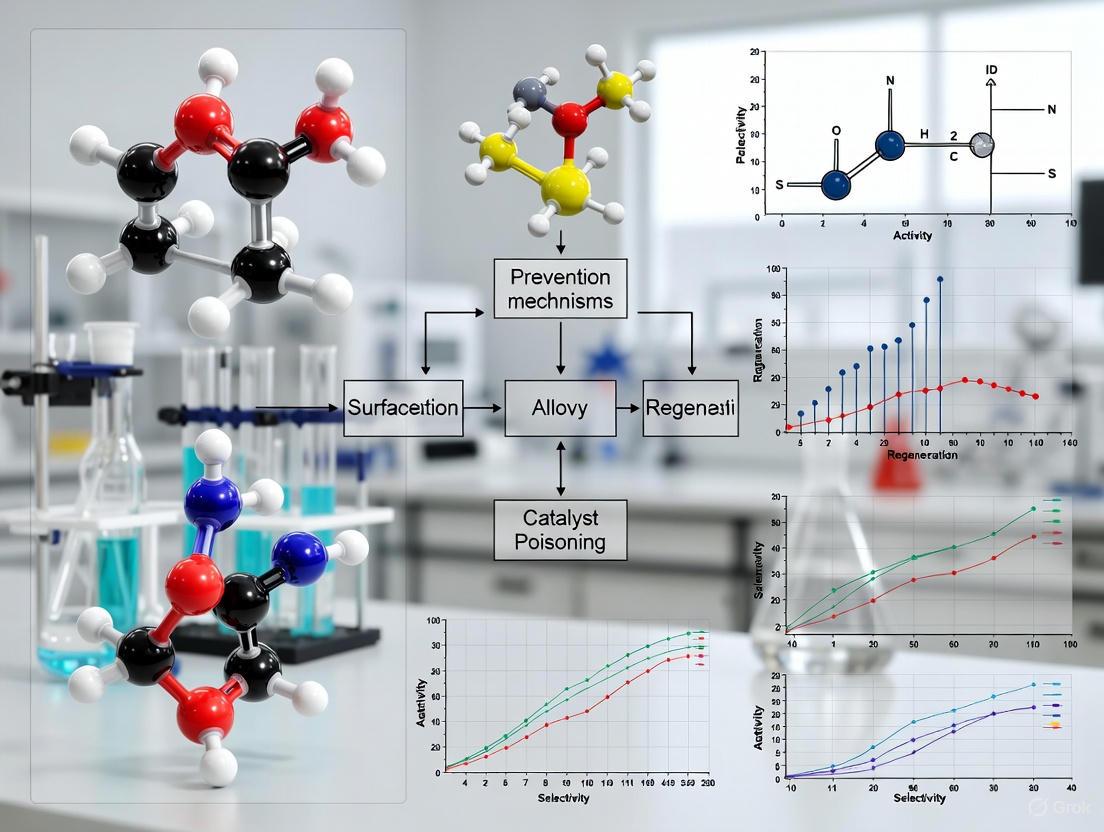
This article provides a comprehensive analysis of catalyst poisoning mechanisms and prevention strategies, tailored for researchers and professionals in drug development and biomedical fields.
Strategies for Preventing Catalyst Poisoning: Mechanisms, Mitigation, and Advanced Solutions for Biomedical and Industrial Applications
Abstract
This article provides a comprehensive analysis of catalyst poisoning mechanisms and prevention strategies, tailored for researchers and professionals in drug development and biomedical fields. It explores the fundamental chemical principles of deactivation, including chemical adsorption, site blocking, and irreversible poisoning. The content covers advanced methodological approaches such as surface engineering, alloy development, and feed purification. It further details troubleshooting and optimization techniques for regenerating poisoned catalysts and enhancing longevity, supported by validation through case studies and comparative analyses of different catalytic systems. The review synthesizes these insights to guide the design of robust, poison-resistant catalysts critical for pharmaceutical synthesis and sustainable energy applications.
Understanding Catalyst Poisoning: Fundamental Mechanisms and Chemical Principles
Catalyst poisoning is a form of chemical deactivation where a substance strongly interacts with a catalyst's active sites, reducing or eliminating its activity [1]. For researchers and scientists, distinguishing between reversible and irreversible poisoning is critical for diagnosing issues and developing effective mitigation strategies in processes ranging from chemical synthesis to fuel cell operation [2] [3]. This guide provides a technical framework for identifying, troubleshooting, and preventing these deactivation mechanisms.
Frequently Asked Questions (FAQs)
1. What is the fundamental difference between reversible and irreversible catalyst poisoning?
The core difference lies in the strength of the interaction between the poison and the catalyst's active sites and whether this interaction can be readily reversed under practical process conditions.
- Reversible Poisoning occurs when the poison is not too strongly adsorbed. The catalyst's original activity can be restored by removing the poison from the feed or through simple in-situ regeneration, without permanently altering the catalyst's nature [2] [4]. An example is the poisoning of ammonia synthesis catalysts by oxygen-containing compounds like water (H₂O); activity is restored by eliminating these compounds from the feed and treating with hydrogen [4].
- Irreversible Poisoning occurs when the poison forms very strong chemical bonds with the active components of the catalyst. It is difficult to remove the poison through general methods, often requiring harsh conditions that may damage the catalyst. In many cases, the catalyst must be replaced [2]. Sulfur poisoning of nickel catalysts at low temperatures is a classic example, where regeneration is not feasible even with hydrogen treatment [4].
2. Which common substances act as potent catalyst poisons?
The toxicity of a substance depends highly on the catalyst material. Common poisons include:
- Sulfur Compounds: Hydrogen sulfide (H₂S) and sulfur dioxide (SO₂) are notorious poisons for many metal catalysts, including platinum, palladium, and nickel [5] [6]. They form stable metal sulfides on the catalyst surface [2].
- Heavy Metals: Lead (Pb), mercury (Hg), and arsenic (As) are potent poisons for various catalysts, including those in automotive catalytic converters [5] [6].
- Carbon Monoxide (CO): CO can act as a poison by strongly adsorbing to active sites, particularly in platinum-based fuel cell catalysts, preventing the desired reactants from binding [5] [3] [6].
- Halogens: Chlorine and other halogens can poison catalysts, especially in polymerization processes [6].
- Alkali and Alkaline Earth Metals: Ions such as K⁺, Na⁺, Ca²⁺ can poison acidic catalysts by neutralizing Brønsted acid sites [7].
3. How can I experimentally determine if my catalyst poisoning is reversible?
A combination of activity tests and surface analysis can provide a diagnosis. The flowchart below outlines a logical diagnostic workflow.
4. Are there any beneficial applications of catalyst poisoning?
Yes, a technique called selective poisoning is sometimes intentionally employed to improve a catalyst's selectivity [1]. By carefully poisoning the most active sites that are responsible for unwanted side reactions, the reaction can be steered toward a desired intermediate or product. A classic example is the Lindlar catalyst, which is palladium partially poisoned with lead and quinoline. This modified catalyst selectively hydrogenates alkynes to alkenes without further reduction to alkanes, a transformation crucial in fine chemical and pharmaceutical synthesis [1].
Troubleshooting Guide: Identifying and Addressing Catalyst Poisoning
Problem: Sudden Drop in Reaction Rate
Possible Cause: Exposure to a strong poison in the feedstock.
Diagnostic Steps:
- Analyze Feedstock: Use techniques like Gas Chromatography-Mass Spectrometry (GC-MS) or Inductively Coupled Plasma Mass Spectrometry (ICP-MS) to detect and quantify trace poisons such as sulfur compounds, heavy metals, or organophosphorus molecules [6].
- Check Guard Beds: If your system uses a guard bed (e.g., ZnO for sulfur removal), inspect it for exhaustion [5] [8].
- Perform Pulse Test: Under controlled conditions, deliberately introduce a small amount of the suspected poison. A sharp, permanent activity drop suggests strong, potentially irreversible poisoning [9].
Solutions:
- Immediate: Replace feedstock with a purified source.
- Short-term: If poisoning is reversible, attempt regeneration via high-temperature oxidation (to remove carbon/organics) or reduction (to remove sulfur as H₂S) [5]. The appropriate method depends on the catalyst and poison.
- Long-term: Enhance feedstock pre-treatment (e.g., hydrodesulfurization) [5] or install/refresh a guard bed upstream of the main reactor [8].
Problem: Gradual, Long-Term Activity Decline
Possible Cause: Slow accumulation of a poison from impure feedstocks or formation of a poison as a reaction by-product.
Diagnostic Steps:
- Trend Analysis: Correlate the gradual activity loss with historical data on feedstock impurity levels.
- Post-mortem Analysis: Characterize spent catalyst samples using surface analysis techniques like X-ray Photoelectron Spectroscopy (XPS) to identify the chemical nature of the accumulated poison [3] [6].
Solutions:
- Optimize Purification: Improve the specificity of feedstock purification systems to remove the identified trace poison.
- Catalyst Reformulation: Switch to or develop a poison-tolerant catalyst. Strategies include using alloy catalysts (e.g., Pt/Ru for CO tolerance in fuel cells) [5] [3] or catalysts with protective coatings [8].
Problem: Change in Product Selectivity
Possible Cause: Selective poisoning, where specific types of active sites are blocked, altering the reaction pathway [2] [6].
Diagnostic Steps:
- Product Distribution Analysis: Monitor changes in the ratio of desired to undesired products over time.
- Surface Characterization: Use Temperature-Programmed Desorption (TPD) to probe the distribution and strength of different active sites on fresh and used catalysts [6].
Solutions:
- Process Control: Fine-tune operating conditions (temperature, pressure) to compensate for the altered catalyst profile.
- Controlled Poisoning: In some cases, intentionally pre-treating the catalyst with a selective poison can be designed to permanently block sites that cause undesirable side reactions, thereby enhancing the yield of the target product [1] [6].
Experimental Protocols for Poisoning Studies
Protocol 1: Assessing Poisoning Resistance in Catalyst Screening
This protocol is designed for the rapid evaluation of new catalyst formulations' susceptibility to a specific poison.
Objective: To determine the tolerance of a novel Pt-alloy catalyst to carbon monoxide (CO) poisoning.
Materials:
- Reactor System: Fixed-bed flow reactor with mass flow controllers, heating zone, and online Gas Chromatograph (GC).
- Catalysts: Novel Pt-alloy catalyst (e.g., Pt/TiWN) and a reference catalyst (e.g., pure Pt/C).
- Gases: H₂ (99.999%), CO (1000 ppm in H₂), inert gas (N₂ or Ar).
- Analytical Equipment: Online GC for product stream analysis.
Methodology:
- Catalyst Reduction: Load catalyst into the reactor. Reduce the catalyst under a pure H₂ stream at the recommended temperature and duration (e.g., 300°C for 2 hours).
- Baseline Activity: Measure the baseline catalytic activity (e.g., Hydrogen Oxidation Reaction rate) under pure H₂ feed.
- Poison Introduction: Switch the feed to a H₂ stream containing 1000 ppm CO [3].
- Activity Monitoring: Continuously monitor the reaction rate for a set period (e.g., 1-2 hours) or until a steady, poisoned state is reached.
- Recovery Test: Switch the feed back to pure H₂ and monitor for any recovery of catalytic activity.
- Data Analysis: Calculate the percentage loss in activity and assess the extent of recovery. Compare the performance of the novel catalyst against the reference.
Protocol 2: Regeneration of a Reversibly Poisoned Catalyst
Objective: To regenerate a solid acid catalyst (e.g., Zeolite) poisoned by chemisorbed ammonia (NH₃).
Materials:
- Reactor System: Same as Protocol 1.
- Catalyst: Spent, ammonia-poisoned zeolite catalyst.
- Gases: Inert gas (N₂), air or O₂ in N₂.
Methodology:
- Poisoned Catalyst Characterization: Optionally, measure the residual activity of the spent catalyst to establish a baseline.
- Thermal Treatment: Purge the reactor with inert gas (N₂). Ramp the temperature to 500°C at a controlled rate (e.g., 5°C/min) under the N₂ flow to desorb weakly bound species.
- Oxidative Regeneration: Switch the feed to a stream of air or a diluted oxygen mixture (e.g., 2% O₂ in N₂). Hold the temperature at 500°C for 2-4 hours. This step oxidizes any strongly adsorbed organic residues and ammonia.
- Cool-down and Reduction: Switch back to N₂ and cool the reactor to the reduction temperature. If the catalyst contains a reducible metal, a subsequent reduction step under H₂ may be required.
- Activity Verification: Measure the catalytic activity again under standard test conditions and compare it to the fresh catalyst's performance to determine the regeneration efficiency.
The following table summarizes key quantitative information on common catalyst poisons, crucial for setting experimental thresholds and safety limits.
Table 1: Common Catalyst Poisons and Their Effects
| Poison | Catalyst Affected | Exemplary Concentration Causing Poisoning | Primary Effect | Typical Regeneration Method |
|---|---|---|---|---|
| H₂S / Sulfur [5] | Ni, Pt, Pd, Fe | Parts per billion (ppb) levels sufficient for surface coverage [5] | Strong chemisorption, forms metal sulfides [2] | High-temp oxidation (forms SOₓ) or H₂ treatment (forms H₂S) [5] |
| CO [5] [3] | Pt, Fe | 10 ppm in H₂ for PEM fuel cells [5] | Strong adsorption, blocks H₂ dissociation sites [5] | Oxidation to CO₂, potential reversal at high potential [3] |
| Heavy Metals (Pb, Hg, As) [5] | Various Metals | Trace amounts | Forms stable alloys or surface compounds [5] | Often irreversible; requires catalyst replacement [4] |
| Alkali Metals (K⁺, Na⁺) [7] | Acidic Catalysts (Zeolites) | Varies | Ion exchange, neutralizes Brønsted acid sites [7] | Ion exchange with acid; washing [7] |
| Phosphates/ H₃PO₄ [3] | Pt (in HT-PEMFCs) | Small quantities | Adsorption of bulky anions, blocks O₂ sites [3] | Surface engineering, protective layers [3] |
The Scientist's Toolkit: Key Reagents and Materials
Table 2: Essential Research Reagents and Materials for Poisoning Studies
| Item | Function / Application |
|---|---|
| Guard Bed Materials (e.g., ZnO) | Placed upstream of the main reactor to selectively adsorb and remove poisons like H₂S from the feed, protecting the expensive primary catalyst [5] [8]. |
| Poison-Tolerant Alloy Catalysts (e.g., Pt/Ru, Pt/Mo) | Bimetallic formulations where the second metal modifies the electronic structure of the primary catalyst, weakening the binding strength of poisons like CO [5] [3]. |
| Calibration Gas Mixtures | Certified gas mixtures with precise concentrations of poisons (e.g., 1000 ppm CO in H₂) for controlled poisoning experiments and sensor calibration [3]. |
| Core-Shell Catalysts (e.g., Pt/TiWN) | Advanced materials where a core material (e.g., transition metal nitride) electronically modifies a thin noble metal shell, leading to reduced binding energy for poisons like CO and enhanced tolerance [3]. |
| High-Temperature Membrane (e.g., TR-PBO) | A thermally rearranged polybenzoxazole membrane capable of selectively removing water (a common by-product that can cause poisoning or side reactions) from the reaction zone at temperatures up to 400°C, preventing deactivation [10]. |
FAQs on Catalyst Poisoning Mechanisms
FAQ 1: What are the primary chemical mechanisms responsible for catalyst poisoning?
Catalyst poisoning primarily occurs through three interconnected chemical mechanisms [2]:
- Strong Chemisorption: Poison molecules form strong, specific chemical bonds with the active sites on the catalyst surface, preventing reactant molecules from adsorbing and reacting [11] [2].
- Site Blocking: The adsorbed poisons physically occupy and block the active sites, rendering them unavailable for the intended catalytic reaction. This is also known as a geometric effect [11] [2].
- Formation of Inactive Compounds: The poison chemically reacts with the active components of the catalyst to form new, inert surface compounds, permanently destroying the active sites [2].
FAQ 2: What is the difference between temporary and permanent catalyst poisoning?
The key difference lies in the strength of the interaction and the possibility of regeneration [2]:
- Temporary (Reversible) Poisoning: The poison is adsorbed or bonded with relatively weak strength. The catalyst's activity can be restored through specific regeneration procedures, such as water washing or treatment with specific gases, without permanently altering the catalyst's structure. An example is the poisoning of ammonia synthesis catalysts by oxygen-containing compounds, which can be reversed by removal from the feed and reduction with hydrogen [11] [12].
- Permanent (Irreversible) Poisoning: The poison forms very strong chemical bonds with the active sites, leading to the formation of stable, inactive compounds. It is difficult to remove these poisons, and the catalyst's activity cannot be easily recovered. Gross oxidation of an iron catalyst is an example of irreversible poisoning [11] [2].
FAQ 3: How does selective poisoning affect catalytic reactions?
Selective poisoning occurs when a poison targets only specific types of active sites on a catalyst [11] [2]. This is common in multifunctional catalysts that possess active sites of different natures. For example [11]:
- In Pt/Al₂O₃ reforming catalysts, basic nitrogen compounds selectively poison the acid sites on the alumina support, reducing isomerization and cracking activity, while having little effect on the dehydrogenation activity of the platinum metal sites.
- Selective poisons can sometimes be used intentionally to temper a catalyst and improve its selectivity for a desired product [11].
FAQ 4: What are common poisons for precious metal and metal oxide catalysts?
Different types of catalysts are susceptible to different poisons [11]:
- Metal-based Catalysts (e.g., Fe, Ni, Pd, Pt): Typical poisons include molecules containing elements from groups V A (N, P, As, Sb) and VI A (O, S, Se, Te). For instance, H₂S can strongly poison the methanation activity of Ni catalysts at concentrations as low as parts per billion (ppb) [11].
- Metal Oxide-based Catalysts (e.g., acid catalysts): These are typically poisoned by basic materials, such as alkali metals or basic nitrogen compounds [11].
FAQ 5: What are the main strategies to prevent or mitigate catalyst poisoning?
Several strategies can be employed to combat catalyst poisoning [11] [12]:
- Feedstock Purification: Removing poisons from the reaction feed to acceptable levels is the most effective method. This can involve catalytic hydrodesulfurization to remove sulfur, methanation to remove COx, or adsorption beds (e.g., ZnO for H₂S) [11].
- Use of Guard Beds: Installing a bed of adsorbent material or a sacrificial catalyst before the main reactor bed to trap poisons [11].
- Catalyst Design and Formulation: Developing catalysts with built-in resistance. This can include using sacrificial components (e.g., ZnO in Cu-based catalysts to trap sulfur) or optimizing the physical structure (e.g., pore size distribution) to improve poison resistance [11].
- Operational Optimization: Adjusting process conditions, such as temperature, can sometimes reduce the strength of poison adsorption [11].
- Early Consideration in R&D: Considering deactivation mechanisms during early catalyst research and using extended-duration experiments to assess stability [12].
Troubleshooting Guide: Identifying and Addressing Catalyst Poisoning
Problem: Sudden and severe drop in catalyst activity.
| Observation | Possible Cause | Diagnostic Experiment | Mitigation Strategy |
|---|---|---|---|
| Rapid activity decline shortly after exposure to a new feedstock batch. | Poisoning by impurities (e.g., S, P, As, heavy metals) in the feed [11] [2]. | Elemental Analysis: Perform X-ray Photoelectron Spectroscopy (XPS) or Inductively Coupled Plasma (ICP) analysis on the spent catalyst to detect and quantify poison elements on the surface [11]. | 1. Feed Pre-treatment: Implement guard beds (e.g., ZnO for H₂S) or catalytic hydrodesulfurization [11]. 2. Catalyst Reformulation: Use a catalyst with a sacrificial component or higher poison tolerance [11]. |
| Gradual activity loss over time, with changes in product distribution (selectivity). | Selective Poisoning where the poison deactivates one type of active site in a multifunctional catalyst [11] [2]. | Selectivity Testing: Measure reaction rates for different probe reactions that are specific to each type of active site (e.g., isomerization vs. dehydrogenation) [11]. | 1. Feedstock Analysis: Identify and remove the selective poison from the feed. 2. Catalyst "Tempering": Intentional, controlled poisoning to passivate overly active, non-selective sites [11]. |
| Activity loss that can be partially or fully recovered after specific treatment. | Reversible Poisoning by chemisorbed species (e.g., H₂O, COx on ammonia synthesis catalysts) [11] [2]. | Regeneration Test: Subject the deactivated catalyst to a regeneration protocol (e.g., reduction with H₂, water washing [12]) and re-measure activity. | 1. In-situ Regeneration: Implement periodic regeneration cycles in the process [11] [12]. 2. Process Control: Tighten control over feed composition to prevent poison ingress. |
| Permanent activity loss that cannot be reversed by regeneration. | Irreversible Poisoning via formation of stable, inactive surface compounds (e.g., Pt sulfide, Pd arsenide) [11] [2]. | Surface Characterization: Use techniques like XPS or XRD to identify the formation of new, stable chemical compounds on the catalyst surface [11]. | 1. Preventative Purification: Rigorous removal of irreversible poisons from the feed is critical [11]. 2. Catalyst Replacement: The only solution once irreversible poisoning has occurred. |
Problem: Experimental results indicate catalyst deactivation, but the mechanism is unknown.
Diagnostic Workflow:
The following diagram outlines a systematic workflow to diagnose the primary mechanism of catalyst deactivation.
Experimental Protocols for Studying Poisoning Mechanisms
Protocol 1: Simulating and Quantifying Potassium Poisoning on Pt/TiO₂
This protocol is based on a case study investigating potassium deactivation, a common contaminant in biomass conversion [12].
Objective: To probe the influence of an alkali metal poison (potassium) on the active sites and stability of a Pt/TiO₂ catalyst.
Materials:
- Catalyst: Pt/TiO₂
- Poison precursor: Potassium salt solution (e.g., potassium nitrate, KNO₃)
- Characterization equipment: X-ray Photoelectron Spectrometer (XPS), Scanning/Transmission Electron Microscope (S/TEM)
- Reactor system for catalytic activity measurements
Methodology:
- Poison Deposition: Simulate potassium accumulation by impregnating the Pt/TiO₂ catalyst with a controlled amount of potassium salt solution, followed by drying and calcination [12].
- Detailed Characterization: Analyze the fresh and potassium-doped catalysts using techniques like XPS to determine the chemical state and distribution of potassium. Use S/TEM to observe any morphological changes [12].
- Catalytic Activity Measurement: Perform kinetic measurements of relevant probe reactions (e.g., model compound conversion from catalytic fast pyrolysis) using both the fresh and poisoned catalysts. Correlate the loss in activity for specific reactions with the characterization data [12].
- Reversibility Test: Regenerate the poisoned catalyst by water washing. Re-measure the catalytic activity to determine if the poisoning is reversible [12].
Protocol 2: Investigating Sulfur Poisoning of Metal Catalysts
Objective: To evaluate the resistance of a metal catalyst (e.g., Ni, Pt) to sulfur poisoning and identify the deactivation mechanism.
Materials:
- Catalyst: Metal catalyst (e.g., on Al₂O₃ support)
- Poison gas: H₂S diluted in an inert gas or H₂ stream.
- Equipment: Tubular reactor system with online gas analyzer (e.g., GC), Mass Flow Controllers.
Methodology:
- Baseline Activity: Determine the initial catalytic activity for a target reaction (e.g., CO methanation for Ni catalysts) under defined conditions (temperature, pressure, feed composition) without any poison [11].
- Controlled Poisoning: Introduce a low, controlled concentration of H₂S (e.g., 10-100 ppm) into the reactant feed stream. Continuously monitor the catalyst's conversion and selectivity over time (time-on-stream) [11].
- Post-Reaction Characterization: After a significant activity drop, stop the experiment and characterize the spent catalyst using XPS to confirm sulfur chemisorption and XRD to check for the formation of bulk metal sulfides [11] [2].
- Data Analysis: Plot activity vs. poison exposure. A sharp initial drop suggests strong chemisorption and site blocking. Correlate the degree of deactivation with the amount of sulfur detected on the surface [11].
The Scientist's Toolkit: Research Reagent Solutions
| Item | Function in Poisoning Research | Example Application |
|---|---|---|
| Guard Bed Adsorbents | Placed upstream of the main catalyst to selectively remove specific poisons from the feed stream, protecting the valuable primary catalyst [11]. | ZnO beds for removing H₂S; sulfured activated charcoal for Hg removal; alkalinized alumina for HCl [11]. |
| Sacrificial Components | Additives within the catalyst formulation that are designed to react with and trap poisons, sparing the active metal sites [11]. | ZnO in Cu/ZnO/Al₂O₃ methanol synthesis catalysts reacts with S-compounds to form ZnS, protecting the copper [11]. |
| Metal Alloys | Combining an active precious metal with a second metal can alter the electronic structure and surface properties, improving resistance to certain poisons [2]. | Pt-Ru alloys in direct methanol fuel cells show improved tolerance to CO poisoning compared to pure Pt [2]. |
| Model Poison Compounds | Well-defined chemical substances used in laboratory studies to simulate the effect of real-world impurities and understand poisoning mechanisms [11] [12]. | Using H₂S to study S-poisoning of Ni catalysts [11]; using potassium salts to simulate alkali metal poisoning from biomass [12]. |
| Regeneration Agents | Chemicals or treatments used to remove reversibly adsorbed poisons and restore catalyst activity [11] [12]. | Using hydrogen reduction to remove chemisorbed oxygen from ammonia synthesis catalysts [11]; water washing to remove potassium from Pt/TiO₂ [12]. |
Visualizing the Primary Poisoning Mechanisms
The following diagram illustrates the three primary chemical mechanisms of catalyst poisoning at the molecular level.
Catalyst poisoning is a critical challenge in industrial and pharmaceutical processes, where trace impurities can significantly reduce catalyst activity, selectivity, and lifespan. This technical support center provides troubleshooting guides and experimental protocols focused on four major poisoning agents: sulfur compounds, carbon monoxide, heavy metals, and organophosphates. The content is framed within the broader research context of understanding and preventing catalyst poisoning mechanisms to enhance process efficiency and catalyst durability.
Troubleshooting Guides and FAQs
Sulfur Poisoning
FAQ: Why does my ruthenium-based catalyst rapidly lose activity during biomass gasification? Sulfur poisoning is a primary cause. In processes like supercritical water gasification (SCWG), even trace sulfur concentrations (as low as 16 ppm) from biomass feedstocks can deactivate Ru-based catalysts by irreversibly adsorbing onto active sites [13]. The sulfur originates from organic compounds in the biomass (e.g., cysteine, methionine in microalgae) and forms stable surface species that block reactant access [13].
Troubleshooting Guide: Diagnosing Sulfur Poisoning in Catalytic Systems
- Symptom: Sharp decrease in gasification efficiency and gas yield, but an atypical increase in CO production [13].
- Confirmation: Characterize spent catalyst using X-ray Photoelectron Spectroscopy (XPS) to detect sulfur species on the surface and measure an increased S/Ru atomic percentage [13].
- Solution:
- Pre-treatment: Purify the feedstock to remove sulfur-containing compounds.
- Catalyst Design: Use bimetallic catalysts (e.g., Ni-Ru/γ-Al₂O₃). DFT calculations show the presence of Ru can reduce S adsorption energy, enhancing tolerance [13].
- Regeneration: Implement periodic oxidative regeneration cycles to remove sulfur deposits (specific protocols depend on catalyst formulation).
FAQ: How does sulfur poison Proton Exchange Membrane Fuel Cell (PEMFC) catalysts? In PEMFCs, sulfur compounds (especially H₂S) in the hydrogen feedstream strongly adsorb onto platinum anode catalysts. This dissociative adsorption leads to sulfur atoms occupying active sites, blocking the hydrogen oxidation reaction (HOR), and resulting in voltage drop and power loss [14]. The strong Pt-S bond makes this poisoning potent and often irreversible under normal operating conditions.
Carbon Monoxide (CO) Poisoning
FAQ: My fuel cell performance drops unexpectedly. Could CO be the cause? Yes. Carbon monoxide is a common poison in reactions involving hydrogen, such as the water gas shift reaction and in fuel cells. CO binds strongly to the active sites of metal catalysts (e.g., iron, copper, platinum), preventing the adsorption and reaction of other reactant molecules [8].
Troubleshooting Guide: Addressing CO Poisoning
- Symptom: Loss of catalytic activity for hydrogen-related reactions; in fuel cells, a drop in voltage under load is observed.
- Confirmation: Analyze reactor effluent or exhaust gas using gas chromatography or mass spectrometry for CO presence [8].
- Solution:
- Feedstock Purification: Use CO scrubbers or preferential oxidation (PROX) reactors in the fuel stream.
- Catalyst Selection: Employ CO-tolerant catalyst formulations (e.g., platinum-ruthenium alloys in PEMFCs).
- Operational Adjustment: Increase operating temperature to facilitate CO desorption, if the process allows.
Heavy Metal Poisoning
FAQ: What is the impact of heavy metals on Selective Catalytic Reduction (SCR) denitration catalysts? Heavy metals like Arsenic (As), Mercury (Hg), and Lead (Pb) in flue gas cause severe deactivation of SCR catalysts (e.g., V₂O₅-WO₃/TiO₂) [15]. They primarily cause chemical deactivation by occupying active sites, reacting with catalytic components to form new inactive compounds, and inhibiting the adsorption and activation of reactants like NH₃ [15].
Troubleshooting Guide: Mitigating Heavy Metal Poisoning in SCR Systems
- Symptom: Continuous decline in NOx conversion efficiency over time.
- Confirmation: Inductively Coupled Plasma (ICP) analysis of spent catalyst samples to detect accumulation of As, Pb, Hg, etc [15].
- Solution:
- Fuel Pre-treatment: Install adsorption traps (e.g., activated carbon) upstream to capture heavy metal vapors from the flue gas [15].
- Catalyst Modification: Dope catalysts with resistant elements (e.g., Mo, W) or use composite oxide supports (e.g., CeO₂) to create sacrificial sites [15].
- Regeneration: Regenerate poisoned catalysts using methods like solution wet washing (acidic or alkaline), microwave heating, or H₂ thermal reduction to remove heavy metal compounds [15].
Organophosphate Poisoning
FAQ: Are organophosphates only a human toxicity concern, or do they affect industrial catalysts? While primarily known as potent acetylcholinesterase inhibitors in humans, organophosphates (OPs) are a major component of many pesticides and herbicides [16]. In industrial contexts, OP residues can potentially deactivate biological catalysts (enzymes) used in certain pharmaceutical syntheses or bioremediation processes by irreversibly binding to their active sites. Their impact on heterogeneous catalysts is less documented but possible due to strong adsorption characteristics.
Experimental Protocols for Studying Poisoning Mechanisms
Protocol 1: Evaluating Sulfur Poisoning in Ru-based Catalysts via SCWG
Objective: To quantify the deactivating effect of sulfur on Ru-based catalysts during supercritical water gasification of glycerol and analyze the poisoning mechanism [13].
Materials:
- Reactor: High-pressure, high-temperature batch or continuous-flow supercritical water reactor.
- Catalysts: Ru/γ-Al₂O₃, Ni/γ-Al₂O₃, NiRu/γ-Al₂O₃.
- Feedstock: Glycerol solution with dimethyl sulfoxide (DMSO) as a soluble sulfur source (e.g., 0.1-0.6 wt% S) [13].
- Analytical: Gas Chromatograph (GC) for gas yield (H₂, CO, CO₂, CH₄) analysis, XPS, XRD, STEM for catalyst characterization.
Methodology:
- Catalyst Testing: Conduct SCWG of the glycerol-DMSO feed at standard conditions (e.g., 400°C, 25 MPa) over different catalysts.
- Performance Metrics: Calculate Hydrogen Gasification Efficiency (HGE) and Carbon Gasification Efficiency (CGE) for each run.
- Kinetic Analysis: Fit experimental data to kinetic models (e.g., Langmuir-Hinshelwood) to determine rate constants and adsorption parameters for poisoned and unpoisoned catalysts.
- DFT Calculations: Perform computational studies to model the adsorption energy of S on different metal surfaces (Ru, Ni, Ru-Ni) and map electron density differences.
- Post-reaction Analysis: Characterize spent catalysts using XPS to identify sulfur species and measure S/Ru atomic ratios. Use STEM to examine morphological changes.
Expected Outcome: Quantitative data showing performance loss, kinetic parameters revealing inhibition strength, and DFT results providing a molecular-level understanding of S-binding on active sites [13].
Protocol 2: Assessing Heavy Metal (As) Poisoning on SCR Catalysts
Objective: To investigate the poisoning mechanism of Arsenic (As) on a V₂O₅-WO₃/TiO₂ SCR catalyst and evaluate regeneration methods [15].
Materials:
- Catalyst: Commercial V₂O₅-WO₃/TiO₂ catalyst.
- Poisoning Agent: Gaseous As₂O₃, generated in a simulated flue gas setup.
- Reactor: Fixed-bed reactor system with flue gas simulation (NO, NH₃, O₂, N₂).
- Analytical: NOx analyzer, BET surface area analyzer, XRD, FT-IR, H₂-TPR.
Methodology:
- Accelerated Poisoning: Pass a simulated flue gas containing a controlled concentration of As₂O₃ vapor over the catalyst in the fixed-bed reactor at the target temperature (e.g., 300-400°C) for a set duration.
- Activity Measurement: Periodically measure the NOx conversion efficiency of the catalyst at standard conditions to track deactivation.
- Characterization: Analyze fresh and poisoned catalysts. Use BET for surface area, XRD for crystalline phase changes, FT-IR for surface acidity, and H₂-TPR for redox properties.
- Regeneration Test: Subject the poisoned catalyst to regeneration techniques:
- Wet Washing: Immerse in acidic (e.g., H₂SO₄) or alkaline (e.g., NaOH) solution.
- Thermal Treatment: Heat in an inert or reducing (H₂) atmosphere.
- Post-regeneration Analysis: Re-evaluate the catalytic activity and characterize the regenerated catalyst to assess recovery effectiveness.
Expected Outcome: Identification of the deactivation mechanism (e.g., pore blockage, loss of surface acidity, inhibition of redox cycles) and a comparative assessment of regeneration method efficacy [15].
Research Reagent Solutions
The following table lists key reagents and materials used in experiments related to catalyst poisoning and mitigation research.
| Reagent/Material | Function in Experiment | Example Application |
|---|---|---|
| Dimethyl Sulfoxide (DMSO) | Soluble, model sulfur-containing compound to simulate feedstock impurities [13]. | Sulfur poisoning studies in SCWG of glycerol [13]. |
| γ-Alumina (γ-Al₂O₃) | High-surface-area catalyst support material. | Supporting active metals (Ru, Ni) in SCWG and other catalytic reactions [13]. |
| Ruthenium (III) Chloride (RuCl₃) | Precursor for synthesizing Ru-based catalysts. | Preparation of Ru/γ-Al₂O� catalysts for gasification studies [13]. |
| V₂O₅-WO₃/TiO₂ Catalyst | Commercial selective catalytic reduction (SCR) catalyst. | Studying heavy metal (As, Pb) poisoning and regeneration in denitrification [15]. |
| Arsenic Trioxide (As₂O₃) | Model heavy metal poison in gaseous or solid form. | Accelerated poisoning experiments on SCR catalysts [15]. |
| Platinum on Carbon (Pt/C) | Anode catalyst for fuel cells. | Investigating sulfur (H₂S) and CO poisoning mechanisms in PEMFCs [14]. |
| Hydrogen Sulfide (H₂S) | Potent gaseous sulfur poison. | Studies on the deactivation of Pt catalysts in fuel cells and other processes [14]. |
| Atropine Sulfate & Pralidoxime | Antidotes for organophosphate poisoning in biological systems [16]. | Used in safety protocols or studies involving OP toxicity to enzymes. |
Experimental and Diagnostic Workflows
Catalyst Sulfur Poisoning Study Workflow
The following diagram illustrates a generalized experimental workflow for investigating sulfur poisoning mechanisms in catalysts, integrating experimental and computational approaches.
SCR Catalyst Heavy Metal Poisoning and Regeneration
This diagram outlines the logical process for assessing heavy metal poisoning on SCR catalysts and evaluating different regeneration methods.
The Impact of Poisoning on Catalyst Activity, Selectivity, and Lifespan
FAQs: Understanding Catalyst Poisoning
What is catalyst poisoning? Catalyst poisoning is the chemical deactivation of a catalyst, where certain substances (poisons) in the process stream strongly adsorb onto or react with the catalyst's active sites, preventing reactants from accessing them. This leads to a significant reduction in catalytic activity and effectiveness [8] [2].
Is catalyst poisoning always permanent? No, catalyst poisoning can be either reversible (temporary) or irreversible (permanent). Reversible poisoning occurs when the poison is weakly chemisorbed and can be removed through processes like water washing or thermal treatment, restoring catalyst activity. Irreversible poisoning involves the formation of very strong chemical bonds between the poison and the active sites, making regeneration extremely difficult and necessitating catalyst replacement [5] [2] [17].
What are the most common catalyst poisons? Common poisons vary by process but often include:
- Sulfur compounds (e.g., H₂S): Notorious for poisoning metal catalysts in hydrogenation and reforming processes [8] [5].
- Heavy metals (e.g., Pb, Hg, As): Can form stable complexes with active sites [8] [5].
- Alkali and alkaline-earth metals (e.g., K, Ca): Particularly problematic in emissions control and biomass conversion, where they inhibit adsorption and redox cycles [18] [12] [17].
- Carbon Monoxide (CO): Strongly binds to metal sites, such as platinum in fuel cells, blocking hydrogen dissociation [8] [5] [3].
- Organic compounds/amines: Can decompose to form coke or directly bind to acidic sites, deactivating catalysts in polymerization and other processes [8] [19].
How does poisoning differ from other forms of deactivation like coking or sintering? Poisoning is a chemical phenomenon where a specific component in the feed interacts with active sites. In contrast, coking (or fouling) involves the physical deposition of carbonaceous materials that block pores and sites, and sintering is a thermal degradation where catalyst particles agglomerate at high temperatures, reducing surface area [20] [21]. While coking is often reversible through combustion, and sintering is largely irreversible, poisoning can be either, depending on the strength of the poison-catalyst interaction [5] [21].
Troubleshooting Guides: Identifying and Addressing Catalyst Poisoning
Guide 1: Diagnosing a Sudden Drop in Catalyst Activity
Problem: A rapid decline in reaction conversion rate is observed.
Possible Causes & Solutions:
| Observation | Potential Poison | Confirmation Method | Mitigation Strategy |
|---|---|---|---|
| Activity drop in hydrogenation process; sulfur in feed. | Sulfur Compounds (H₂S) | Analyze feedstock with Gas Chromatography-Mass Spectrometry (GC-MS) [8]. | Implement a guard bed (e.g., ZnO adsorbent) upstream to remove sulfur compounds [5]. |
| Activity loss in fuel cell or syngas process. | Carbon Monoxide (CO) | In-situ Infrared (IR) Spectroscopy to detect CO adsorbed on metal sites [8]. | Use CO-tolerant bimetallic catalysts (e.g., Pt/Ru) or selective CO oxidation [5] [3]. |
| Activity decline in biomass conversion or emissions control. | Alkali Metals (K) | Inductively Coupled Plasma (ICP) analysis of spent catalyst; X-ray Photoelectron Spectroscopy (XPS) [18] [17]. | Water washing of the catalyst to remove potassium; use catalysts with higher alkali tolerance [12] [17]. |
| Gradual activity loss with selectivity change in polymerization. | Amines (e.g., DMA, DEA) | Fourier-Transform Infrared (FTIR) spectroscopy to identify Al-N coordination bonds [19]. | Improve feedstock purification to remove trace amine contaminants [19]. |
Guide 2: Managing Loss of Product Selectivity
Problem: The catalyst is still active, but the distribution of products has changed unfavorably.
Possible Causes & Solutions:
| Observation | Mechanism | Solution |
|---|---|---|
| Increased yield of an intermediate product. | Selective Poisoning: The poison deactivates only the active sites responsible for a subsequent reaction, halting the process at an intermediate stage [2]. | Characterize the poison and its specific site affinity. This effect can sometimes be leveraged to maximize intermediate yield. |
| Shift in product distribution (e.g., from n-butyraldehyde to isobutyraldehyde). | Altered Reaction Path: The poison changes the electronic or geometric properties of the catalyst surface, stabilizing different intermediates and favoring an alternative reaction pathway [2]. | Redesign the catalyst formulation (e.g., using promoters or different supports) to be less susceptible to electronic modification by the poison. |
Quantitative Data: Poisoning Impacts on Performance
The following tables summarize experimental data on the effects of specific poisons on different catalytic systems.
Table 1: Impact of Alkali and Alkaline-Earth Metals on De-NOx Catalysts
Data adapted from studies on NH₃-SCR (Selective Catalytic Reduction) catalysts, showing how metal poisons reduce NOx conversion [18].
| Catalyst Type | Poison | Poison Loading (wt%) | Decrease in NOx Conversion | Key Mechanism |
|---|---|---|---|---|
| V-W-Ti | K | 0.8 % | ~80% | Destruction of acid sites and redox cycles [18]. |
| V-W-Ti | Ca | 5.0 % | ~65% | Inhibition of reducibility [18]. |
| TEOS&Mn-BTC (Fresh) | - | - | >90% (at 90-240°C) | Baseline activity [18]. |
| TEOS&Mn-BTC | K | - | ~40% (at 150°C) | Lowers d-band center, inhibits electron transport [18]. |
| TEOS&Mn-BTC | Ca | - | ~25% (at 150°C) | Destroys Lewis acid sites [18]. |
Table 2: Catalyst Poisoning Tolerance and Regeneration Efficacy
Data on poisoning reversibility and regeneration effectiveness across different systems.
| Catalytic System / Catalyst | Poison | Regeneration Method | Efficacy | Reference |
|---|---|---|---|---|
| Pt/TiO₂ (for biomass pyrolysis) | Potassium (K) | Water Washing | >90% activity recovery | [12] [17] |
| PEM Fuel Cell Pt Catalysts | CO (100 ppm) | Use of Pt/Ru alloy catalyst | Tolerance up to 100 ppm CO | [5] |
| ZSM-5 (for hydrocarbon processing) | Coke | Oxidation with Ozone (O₃) | Effective low-temperature regeneration | [21] |
Experimental Protocols for Poisoning Research
Protocol 1: Investigating Potassium Poisoning and Regeneration of a Pt/TiO₂ Catalyst
This protocol is based on research into catalyst deactivation during catalytic fast pyrolysis of biomass [12] [17].
1. Objective: To simulate potassium poisoning, characterize the deactivated catalyst, and evaluate a water washing procedure for regeneration.
2. Materials and Reagents:
- Catalyst: Platinum on Titanium Dioxide (Pt/TiO₂)
- Poison Precursor: Potassium nitrate (KNO₃)
- Solvents: Ultrapure water, ethanol
- Equipment: Fixed-bed reactor tube, furnace, rotary evaporator, analytical instruments (e.g., ICP, XPS, TEM)
3. Methodology:
- Poisoning Simulation:
- Prepare a solution of KNO₃ in a water-ethanol mixture (e.g., 1:3 volume ratio).
- Add the Pt/TiO₂ catalyst to the solution.
- Stir and heat the mixture (e.g., at 80°C) to evaporate the solvent, ensuring uniform deposition of potassium on the catalyst surface.
- Dry and calcine the catalyst to fix the poison.
- Catalyst Characterization:
- Kinetic Measurements: Test the catalytic activity (e.g., for a model reaction) before and after poisoning in a reactor system to quantify activity loss.
- Surface Analysis: Use X-ray Photoelectron Spectroscopy (XPS) to determine the chemical state and surface concentration of potassium. Use Transmission Electron Microscopy (TEM) to examine any morphological changes.
- Acid Site Probe: Use probe molecules with Infrared (IR) Spectroscopy to confirm the poisoning of Lewis acid sites on the TiO₂ support.
- Regeneration:
- Subject the poisoned catalyst to washing with ultrapure water.
- Dry the washed catalyst.
- Re-test the catalytic activity to measure the extent of recovery.
4. Expected Outcome: The study typically shows that potassium preferentially poisons the Lewis acid Ti sites, not the metallic Pt clusters, and that water washing can effectively remove potassium and restore most of the original activity [17].
Protocol 2: Computational Analysis of Amine Poisoning in Ziegler-Natta Catalysis
This protocol uses Density Functional Theory (DFT) to study the molecular-level mechanism of poisoning [19].
1. Objective: To model the interaction energies and reaction pathways involved in the deactivation of a Ziegler-Natta catalyst system by amine inhibitors.
2. Computational Setup:
- Software: Gaussian 16.
- Method: DFT, using the B3LYP functional with D3 dispersion correction.
- Basis Set: 6-311++G(d,p) for main group elements.
- Catalyst Model: A TiCl₄/(MgCl₂)₁₄ nanocluster to represent the active surface.
- Solvation Model: SMD model to simulate reactions in n-hexane solvent.
3. Methodology:
- Geometry Optimization: Fully optimize the structures of the catalyst cluster, triethylaluminum (TEAL) co-catalyst, amine inhibitors (e.g., dimethylamine - DMA), and their potential complexes.
- Frequency Calculations: Perform vibrational frequency calculations on optimized structures to confirm they are energy minima (no imaginary frequencies) and to obtain thermodynamic corrections.
- Energy Calculations:
- Calculate the adsorption energy (ΔE) of the TEAL·amine complex onto the catalyst cluster.
- Calculate the reaction kinetics (activation energy, ΔG) for the formation of the TEAL·amine complex.
- Electronic Analysis: Compute Fukui functions and electrophilicity indices to identify the most reactive sites in the molecules.
4. Expected Outcome: The calculations will reveal that the formation of the TEAL·DMA complex is kinetically and thermodynamically favored. The results will show strong adsorption of this complex on the active Ti sites, blocking monomer insertion and explaining the significant productivity loss observed experimentally [19].
Research Workflow and Mechanisms
The following diagram illustrates a comprehensive experimental workflow for investigating catalyst poisoning, integrating both experimental and computational approaches from the protocols.
Investigation Workflow for Catalyst Poisoning
The Scientist's Toolkit: Key Research Reagent Solutions
Essential materials and computational tools for researching catalyst poisoning mechanisms.
| Reagent / Tool | Function in Poisoning Research | Specific Example |
|---|---|---|
| Poison Precursors | To simulate real-world contamination in a controlled laboratory setting. | KNO₃ (source of K) [17], H₂S gas (source of S) [8], Dimethylamine (amine poison) [19]. |
| Guard Bed Adsorbents | Used in experimental setups to pre-purify feedstocks and prove the role of a specific poison. | ZnO (for H₂S removal) [5]. |
| Bimetallic Catalysts | Materials used to test improved poison tolerance. | Pt/Ru alloys (for CO tolerance) [5] [3], Pt/TiWN core-shell nanoparticles [3]. |
| DFT Software & Models | To model the atomic-scale interactions between poisons and catalyst active sites, predicting binding energies and deactivation pathways. | Gaussian 16 software with B3LYP-D3 functional and SMD solvation model [19]. |
| Characterization Standards | Well-defined catalyst samples with known levels of poison, used for calibrating analytical techniques. | Pre-poisoned catalyst standards (e.g., with 0.8 wt% K on V-W-Ti) [18]. |
Troubleshooting Guide: Common FAQs on Catalyst Poisoning
FAQ 1: What are the most common catalyst poisons in pharmaceutical synthesis, and how do they affect my precious metal catalysts?
Common poisons include sulfur-containing compounds (e.g., from residual solvents or reagents), phosphorus, nitrogen compounds like amines, heavy metals (e.g., lead, mercury), and carbon monoxide [2] [8]. These substances strongly adsorb to precious metal active sites (e.g., Pt, Pd, Rh), blocking reactant access. Poisoning can be reversible (weak adsorption) or irreversible (strong chemical bonding, forming inactive compounds like platinum sulfide) [2]. Effects include reduced reaction rates, altered selectivity, and incomplete conversions, leading to failed syntheses or costly purification steps.
FAQ 2: My hydrogenation reaction is slowing down. How can I determine if catalyst poisoning is the cause?
Follow this diagnostic checklist:
- Step 1 - Analyze Feedstock: Use analytical techniques (e.g., gas chromatography-mass spectrometry) to detect trace impurities (sulfur, phosphorus, heavy metals) in your reactants and solvents [8].
- Step 2 - Characterize Catalyst: Perform post-reaction analysis on the catalyst. Techniques like X-ray photoelectron spectroscopy (XPS) can identify poisons on the surface, while BET surface area analysis quantifies active site loss [22].
- Step 3 - Compare Performance: Test a fresh catalyst batch with purified feed. If performance is restored, poisoning is the likely culprit [22].
FAQ 3: Are there specific functional groups or reagents in drug synthesis that pose a high poisoning risk?
Yes. Be cautious with:
- Thiols and Sulfides: Common in certain protecting groups or intermediates; highly poisonous [23].
- Organophosphorus Compounds: Used in ligands or reagents; can permanently deactivate catalysts [2].
- Amines: Can act as poisons, particularly for platinum catalysts [23].
- Heavy Metal Impurities: May be present in low-cost reagents or leach from equipment [8].
FAQ 4: What practical steps can I take to prevent catalyst poisoning in my lab experiments?
- Purify Feedstocks: Use high-purity solvents and reactants. Employ guard beds (e.g., ZnO for sulfur removal) or pre-treatment columns to scrub impurities from feeds [8] [24].
- Maintain Pristine Conditions: Ensure a clean work environment to avoid airborne contaminants (e.g., volatile organic compounds). Use dedicated, clean equipment and wear gloves to prevent skin-borne contaminants [23].
- Select Resistant Catalysts: Consider catalyst design. Alloying precious metals (e.g., Pt-Ru) or using modified supports can enhance poison resistance [25].
- Control Reaction Parameters: Optimize temperature and pressure to minimize side reactions that generate poisons [24].
FAQ 5: My catalyst is poisoned. Can it be regenerated, or must it be replaced?
Some poisoning is reversible.
- Carbon monoxide or organic deposits can often be removed by oxidation with air or oxygen, or gasification with steam or hydrogen [24] [21].
- A case study on potassium-poisoned Pt/TiO₂ showed activity was restored by over 90% using a simple water washing regeneration method [17] [12].
- Irreversible poisoning (e.g., by strong chemisorption of sulfur or phosphorus that forms stable compounds) typically requires catalyst replacement [2] [26]. Characterization helps determine the most economical path [22].
Table 1: Common Catalyst Poisons and Their Impacts
| Poison Category | Specific Examples | Mechanism of Action | Effect on Catalysis |
|---|---|---|---|
| Sulfur Compounds | H₂S, thiols, mercaptans [2] [8] | Strong chemisorption; forms stable surface sulfides [2] | Rapid, often irreversible activity loss; altered selectivity [2] |
| Nitrogen Compounds | Amines, ammonia, nitrogen oxides [8] [23] | Adsorption on acid sites and/or metal sites [23] | Reduced activity; can be reversible or irreversible [26] |
| Phosphorus Compounds | Phosphines, phosphates [2] [23] | Strong adsorption and reaction with active sites [2] | Permanent deactivation; blocks active sites [2] |
| Heavy Metals | Lead (Pb), Mercury (Hg), Arsenic (As) [8] [22] | Forms stable alloys or intermetallic compounds [8] | Irreversible poisoning; requires catalyst replacement [22] |
| Carbon Monoxide | CO [8] | Strong, competitive chemisorption on metal sites [8] | Reversible site blocking; reduces reaction rate [8] |
Table 2: Catalyst Deactivation Diagnosis and Mitigation
| Symptom | Possible Causes | Diagnostic Methods | Corrective & Preventive Actions |
|---|---|---|---|
| Gradual activity loss | Slow poisoning, coking, sintering [26] [22] | BET surface area, elemental analysis (XRF), spectroscopy (XPS) [22] | Feed purification; optimize temperature; use guard beds [8] [24] |
| Sudden activity drop | Introduction of a strong poison, thermal runaway [26] | Feed impurity analysis, temperature profile review [26] | Immediate feed stoppage; inspect and replace feedstock sources [26] |
| Altered selectivity | Selective poisoning of specific active sites [2] | Product distribution analysis, TPD to probe site strength [2] [22] | Use more selective/robust catalyst; tighten feed specs [2] [25] |
| Increased pressure drop | Physical blockage from fines or coke [26] | Visual inspection, particle size analysis [26] | Improve feedstock filtration; modify reactor internals [26] |
Experimental Protocols for Poisoning Analysis
Protocol 1: Accelerated Potassium Poisoning and Regeneration of Pt/TiO₂
- Objective: To simulate, characterize, and regenerate a catalyst poisoned by alkali metals common in biomass feedstocks [17] [12].
- Materials: Pt/TiO₂ catalyst, potassium salt solution (e.g., KNO₃), tubular reactor, furnace, deionized water.
- Method:
- Poisoning Simulation: Impregnate the Pt/TiO₂ catalyst with varying concentrations of potassium salt. Dry and calcine to fix potassium on the surface [17].
- Activity Measurement: Conduct catalytic fast pyrolysis or a probe reaction (e.g., isomerization) in a lab-scale reactor. Measure reaction rate and product distribution for both fresh and poisoned catalysts [17] [12].
- Characterization: Use surface analysis techniques (e.g., XPS, TEM) to confirm potassium location and its preferential poisoning of Lewis acid Ti sites [12].
- Regeneration: Subject the poisoned catalyst to a water washing process. Dry and re-calcine the catalyst [17] [12].
- Activity Recovery: Re-measure catalytic activity. This protocol successfully restored >90% of initial activity [17].
- Significance: Provides a model for understanding reversible poisoning mechanisms and developing regeneration strategies.
Protocol 2: Root-Cause Analysis of a Deactivated Catalyst
- Objective: To systematically identify the primary cause of catalyst deactivation in a used sample [22].
- Materials: Used catalyst sample, fresh reference catalyst, analytical suite (BET, XPS, XRF).
- Method:
- Activity Comparison: Test the used catalyst's activity in a standard reaction versus a fresh catalyst to quantify activity loss [22].
- Physical Characterization (BET): Measure the surface area and pore volume. A significant decrease suggests sintering (thermal degradation) or pore blocking by coke/ deposits [24] [22].
- Surface Chemical Analysis (XPS): Identify chemical states of elements on the catalyst surface. Detect the presence of poisons like sulfur, phosphorus, or silicon [22].
- Bulk Elemental Analysis (XRF): Quantify the concentration of foreign elements (e.g., heavy metals) deposited throughout the catalyst [22].
- Data Correlation: Correlate findings from all techniques to pinpoint the dominant deactivation mechanism (e.g., high sulfur on surface + low surface area = poisoning and sintering) [22].
Diagrams for Signaling Pathways and Workflows
Diagram 1: Catalyst Poisoning Mechanisms
Diagram 2: Catalyst Deactivation Troubleshooting Workflow
The Scientist's Toolkit: Research Reagent Solutions
Table 3: Essential Materials for Catalyst Poisoning Research
| Reagent / Material | Function in Research | Key Considerations |
|---|---|---|
| Guard Beds (e.g., ZnO) | Pre-treatment layer to remove specific poisons (e.g., H₂S) from feedstock before it contacts the primary catalyst [24]. | Select based on the primary poison threat. Requires periodic replacement. |
| Poison-Trap Materials | Integrated materials designed to preferentially bind and trap poisoning agents within the reactor system, protecting the primary catalyst [8]. | An emerging advanced strategy for complex feedstocks. |
| Regeneration Agents | Gases (e.g., O₂, H₂) or liquids (e.g., H₂O) used to remove reversibly bound poisons or deposits (like coke) and restore catalyst activity [17] [24] [21]. | Selection is poison-dependent. O₂ for coke, H₂O for alkali metals. Monitor conditions to prevent damage. |
| High-Purity Solvents/Feeds | Minimize the introduction of trace metallic or heteroatom impurities that can act as poisons [8] [23]. | Critical for reliable lab-scale results and reproducible syntheses. |
| Alloyed Catalysts (e.g., Pt-Ru) | Precious metal catalysts modified with a second metal to enhance electronic properties and resistance to certain poisons like CO [2] [25]. | Can offer improved stability and longevity in challenging environments. |
Proactive Anti-Poisoning Strategies: Material Design and System Integration
Catalyst Material Selection and Design for Intrinsic Poison Resistance
FAQ: Core Concepts and Material Strategies
What is intrinsic poison resistance in catalysts? Intrinsic poison resistance refers to a catalyst's inherent ability, derived from its material composition and structural design, to maintain activity and prevent deactivation when exposed to chemical impurities (poisons) in the feedstream. Unlike operational strategies like feed purification, this involves designing the catalyst itself to be robust against poisons such as CO, SO₂, alkali metals, and phosphates [8] [3].
What are the primary material-based strategies to achieve poison resistance? The main strategies can be categorized into three approaches:
- Alloying and Intermetallic Compounds: Modifying the electronic structure of active sites, often using platinum group metals, to weaken poison adsorption [27] [3].
- Defect Engineering and Non-Metal Active Sites: Creating alternative, less-sensitive active sites, such as nitrogen dopants in metal oxides, to avoid traditional metal-site poisoning [28].
- Surface Engineering and Protective Coatings: Applying protective layers or using core-shell structures to physically shield active sites from poison molecules [3] [29].
How does alloying improve a catalyst's resistance to CO poisoning? Alloying, particularly for Pt-based catalysts, introduces a second metal (e.g., Ru, Fe) that donates electrons to Pt. This donation causes a downshift of the d-band center of Pt, which reduces the adsorption energy of CO on the surface. With weaker binding, CO is less likely to permanently block active sites, and it can be more easily oxidized and removed, thereby restoring the site for the target reaction [27] [3].
Can I design a poison-resistant catalyst without using precious metals? Yes. One promising approach involves using defect engineering on metal oxides. For example, hydrogenated TiO₂ with oxygen vacancies can be in-situ doped with nitrogen during the NH₃-SCR reaction. The resulting N-doped material provides active sites for the reaction, demonstrating high resistance to poisons like SO₂, alkali metals, and phosphorus, while completely avoiding precious or transition metals [28].
FAQ: Experimental Design and Selection
How do I select the right strategy for my specific catalytic system? Your choice depends on the reaction, the primary poison, and operating conditions. The following table summarizes the suitability of different strategies for common poisoning scenarios.
Table: Strategy Selection for Common Catalyst Poisons
| Primary Poison | Recommended Strategy | Example Material | Key Mechanism |
|---|---|---|---|
| CO | Alloying / Intermetallic | Fe-Pt, Pt-Ru [27] | d-band center downshift weakens CO adsorption. |
| Alkali Metals (K, Na) | Defect Engineering / Sacrificial Sites | N-doped H-TiO₂, Fe₂O₃-based [28] [7] | Provides alternative sites that do not strongly interact with alkali ions. |
| SO₂ / H₂S | Surface Engineering / Protective Coatings | Core-shell Pt/TiWN [3] | Coating limits access of sulfur compounds to active sites. |
| Phosphate ions | Surface Engineering / Acidic Additives | Modified Pt surfaces [3] | Use of additives to compete with or prevent phosphate adsorption. |
| Multiple Impurities | High-Entropy Alloys (HEAs) | Multi-component FCC/BCC HEAs [30] | Complex surface creates a wide range of adsorption energies and self-cleaning sites. |
What are the essential reagents and materials for developing these catalysts? The required materials vary by strategy. Below is a toolkit of common reagents and their functions.
Table: Research Reagent Solutions for Anti-Poisoning Catalyst Development
| Reagent / Material | Function | Typical Application |
|---|---|---|
| Chloroplatinic Acid (H₂PtCl₆) | Precursor for Pt-based active sites. | Synthesis of Pt alloys and core-shell catalysts [27] [3]. |
| Iron Nitrate (Fe(NO₃)₃) | Precursor for Fe oxide active sites or Fe alloying component. | Preparation of iron-based SCR catalysts or Fe-Pt alloys [27] [7]. |
| Titanium Dioxide (TiO₂) | Common catalyst support material. | Support for V, W, Mo oxides in SCR catalysts; base for defect engineering [28] [31]. |
| Oleylamine | Surfactant and stabilizing agent in nanoparticle synthesis. | Controls nanoparticle size and prevents aggregation during synthesis of alloy NPs [27]. |
| Ammonia (NH₃) / Nitrogen (N₂) | Source for nitridation or in-situ N-doping. | Creating transition metal nitride cores (e.g., TiWN) or doping TiO₂ [3] [28]. |
| Formic Acid (HCOOH) | Mild acidic regenerant for metal-poisoned catalysts. | Selective removal of alkali metal poisons (e.g., K) from SCR catalysts without leaching V [31]. |
Troubleshooting Guide: Common Experimental Problems
Problem: The alloy catalyst shows poor activity even before poisoning.
- Potential Cause 1: Incorrect atomic ordering. The anti-poisoning effect in alloys like Fe-Pt is highly dependent on the ordered atomic structure. A disordered structure will not properly modify the electronic surface properties.
- Solution: Verify the crystal structure using X-ray diffraction (XRD). Ensure the synthesis and annealing protocols (e.g., temperature, atmosphere) are optimized to achieve the desired ordered phase [27].
- Potential Cause 2: Inhomogeneous alloy formation. The elements may not be uniformly mixed, leading to isolated domains of inactive material.
- Solution: Use techniques like STEM-EDX mapping to confirm a homogeneous distribution of all elements. Optimize the reduction and thermal treatment steps to promote alloying [3].
Problem: A defect-engineered catalyst loses activity rapidly during stability testing.
- Potential Cause: Instability of the defect sites. Defects like oxygen vacancies can be re-oxidized upon exposure to air or reaction conditions, leading to deactivation.
- Solution: Implement a strategy to stabilize the defects in-situ. For example, pre-treat or design the catalyst so that reactants (e.g., NH₃ and NO) interact with and stabilize the defects during the reaction itself [28].
Problem: The protective coating is blocking reactants as well as poisons.
- Potential Cause: The coating is too dense or thick, limiting mass transfer.
- Solution: Optimize the coating process to create a thinner, more porous layer. Techniques like atomic layer deposition (ALD) can provide ultra-thin, conformal coatings that are more selective. The goal is to create a kinetic barrier for larger poison molecules while allowing smaller reactants to diffuse through [21] [29].
Problem: Catalyst performance drops severely in the presence of SO₂ and H₂O.
- Potential Cause: Competitive adsorption and site blocking. SO₂ can strongly adsorb on metal sites, while H₂O can compete for adsorption on both metal and acid sites.
- Solution: Incorporate sacrificial components or promoters that have a higher affinity for SO₂ than the main active sites. Alternatively, design catalysts with enhanced hydrophobicity or increased surface acidity to better compete with water adsorption [28] [7].
Experimental Protocols
Protocol 1: Synthesis of an Ordered Fe-Pt Intermetallic Catalyst for CO Tolerance [27]
Objective: To prepare a carbon-supported face-centered tetragonal (fct) FePt catalyst with high impurity tolerance.
Materials: Chloroplatinic acid (H₂PtCl₆), Iron(III) acetylacetonate (Fe(acac)₃), Oleylamine, Carbon black support (e.g., Vulcan XC-72R), Anhydrous ethanol.
Procedure:
- Dispersion: Disperse 200 mg of carbon black in 200 mL of anhydrous ethanol using bath ultrasonication for 1 hour.
- Precursor Mixing: In a separate vessel, dissolve H₂PtCl₆ and Fe(acac)₃ in oleylamine, which acts as both a solvent and a surfactant. The molar ratio of Fe:Pt should be 1:1.
- Combination and Reduction: Combine the carbon dispersion with the metal precursor solution. Heat the mixture to 80°C under vigorous stirring and maintain for 2 hours to allow for adsorption and reduction of the metal precursors onto the carbon support.
- Separation: Collect the solid product via centrifugation and wash thoroughly with ethanol to remove residual oleylamine.
- Annealing (Critical for Ordering): Dry the catalyst and anneal it under a controlled reductive atmosphere (e.g., 5% H₂/Ar) at a temperature between 500-700°C for 1-2 hours. This high-temperature step is crucial for inducing the atomic rearrangement from a disordered to an ordered intermetallic structure.
- Characterization: Confirm the ordered fct structure using XRD, which should show superlattice peaks. Analyze nanoparticle size and distribution using TEM.
Protocol 2: Creating a Poison-Resistant N-Doped TiO₂ Catalyst via Defect Engineering [28]
Objective: To synthesize a hydrogenated TiO₂ (H-TiO₂₋ₓ) catalyst with oxygen vacancies and subsequent in-situ N-doping for high poison resistance in NH₃-SCR.
Materials: Titanium Dioxide (TiO₂, P25), High-purity Hydrogen Gas (H₂), Ammonia (NH₃) gas, NO gas.
Procedure:
- Hydrogenation: Place pristine TiO₂ in a tubular furnace. Purge the system with an inert gas (e.g., Ar) to remove air. Introduce a flow of H₂ gas (e.g., 100 sccm) and heat the furnace to 400-500°C. Maintain this temperature for 2-4 hours to create oxygen vacancies, producing black-colored H-TiO₂₋ₓ.
- Catalyst Testing and In-Situ Doping: Load the H-TiO₂₋ₓ into a fixed-bed reactor for NH₃-SCR activity testing.
- Feed Introduction: Introduce the reaction feed containing NO, NH₃, and O₂ (balanced with N₂) at the desired temperature (e.g., 300-400°C).
- In-Situ Process: During the SCR reaction, the NH₃ and NO reactants will interact with the oxygen vacancies, leading to the stabilization of the defects through the incorporation of nitrogen into the TiO₂ lattice. This process creates the active N-doped catalyst (N-H-TiO₂₋ₓ) during operation.
- Validation: Confirm the presence of nitrogen dopants and the stability of the defect structure using techniques like X-ray photoelectron spectroscopy (XPS) and Electron Paramagnetic Resonance (EPR) after reaction.
Protocol 3: Regeneration of Alkali-Poisoned SCR Catalysts via Precise Acid Washing [31]
Objective: To selectively remove alkali metal poisons (e.g., Potassium) from a V₂O₅-WO₃/TiO₂ catalyst using formic acid without leaching active vanadium species.
Materials: Potassium-poisoned V₂O₅-WO₃/TiO₂ catalyst (K-VWTi), Formic Acid solution (0.5 M), Deionized water.
Procedure:
- Impregnation (for creating poisoned catalyst): Prepare the K-VWTi catalyst by impregnating the fresh VWTi catalyst with an aqueous solution of potassium nitrate (KNO₃), followed by drying and calcination.
- Acid Washing: Immerse the poisoned K-VWTi catalyst in the 0.5 M formic acid solution. Use a solid-to-liquid ratio of 1 g catalyst per 20 mL solution. Stir the mixture at room temperature for 2 hours.
- Washing and Drying: After treatment, filter the catalyst and wash thoroughly with deionized water to remove any residual acid and dissolved potassium ions.
- Drying and Calcination: Dry the regenerated catalyst at 110°C for 12 hours, followed by calcination in air at 450°C for 4 hours.
- Activity Testing: Evaluate the recovered NH₃-SCR activity of the regenerated catalyst in a fixed-bed reactor and compare it to the fresh and poisoned samples. The selection of formic acid is based on the Sabatier principle, as its ionization constant is similar to that of vanadic acid, allowing it to remove potassium effectively without dissolving the active VOx species.
Visual Workflows and Diagrams
Diagram Title: Decision Workflow for Selecting an Anti-Poisoning Strategy
Diagram Title: How Alloying Reduces Catalyst Poisoning
Catalyst poisoning is a primary cause of deactivation in industrial and research processes, leading to significant losses in efficiency and productivity. This technical support center provides targeted troubleshooting guides and FAQs to assist researchers in diagnosing and mitigating catalyst poisoning through advanced surface engineering strategies, specifically focusing on protective molecular canopies and carbon shells.
Troubleshooting Guides
Guide 1: Diagnosing Catalyst Poisoning Mechanisms
Problem: Observed decline in catalytic activity and selectivity.
Solution: Follow this diagnostic workflow to identify the poisoning mechanism.
Guide 2: Implementing Protective Carbon Shells
Problem: Catalyst requires protection from poisoning agents while maintaining activity.
Solution: Apply a protective carbon shell via chemical vapor deposition (CVD).
Table 1: Carbon Shell Deposition Parameters via CVD
| Parameter | Typical Range | Effect on Protection | Characterization Method |
|---|---|---|---|
| Carbon Precursor | Ethylene, Acetylene, Benzene | Determines graphitization degree and shell porosity | Thermogravimetric Analysis (TGA) |
| Deposition Temperature | 500-800°C | Higher temperature increases graphitic order and strength | Raman Spectroscopy (ID/IG ratio) |
| Reaction Time | 10-120 minutes | Controls shell thickness (1-10 nm typical) | Transmission Electron Microscopy (TEM) |
| Carrier Gas Flow Rate | 50-200 mL/min | Affects precursor concentration and uniformity | Electron Energy Loss Spectroscopy (EELS) |
Experimental Protocol:
- Preparation: Place catalyst in CVD quartz tube reactor. Purge with inert gas (Ar or N₂) at 200 mL/min for 30 minutes.
- Heating: Heat to target temperature (e.g., 600°C) at 10°C/min under inert atmosphere.
- Deposition: Introduce carbon precursor (e.g., 20% C₂H₄ in Ar) at 100 mL/min for predetermined time.
- Cooling: Maintain inert gas flow during cool-down to room temperature.
- Characterization: Confirm shell formation and thickness via TEM and Raman spectroscopy.
Guide 3: Applying Molecular Canopy Coatings
Problem: Protection needed for catalysts operating in liquid-phase or low-temperature environments.
Solution: Create a superamphiphobic molecular canopy using silane-based chemistry.
Table 2: Molecular Canopy Formulation Components
| Component | Function | Example Materials | Typical Concentration |
|---|---|---|---|
| Low Surface Energy Compound | Provides liquid repellency | Fluorinated silanes (e.g., PFDTES) | 1-5 wt% in solvent |
| Nanoparticle Additives | Creates hierarchical roughness for super-repellency | SiO₂, ZnO, PTFE | 5-20 wt% in coating suspension |
| Binder/Matrix | Ensures mechanical stability and adhesion | Epoxy resin, Polymeric precursors | Balance of formulation |
| Solvent | Controls viscosity and application properties | Ethanol, Isopropanol, Water | Adjust for target viscosity |
Experimental Protocol:
- Surface Preparation: Clean substrate via abrasive blasting to SA 2.5 standard. Degrease with industrial degreaser [32] [33].
- Coating Synthesis: Suspend nanoparticles (e.g., SiO₂, ZnO, PTFE) in solvent. Add fluorinated silane (e.g., PFDTES) under continuous stirring for 4-6 hours [34].
- Application: Apply via spray coating to achieve uniform coverage. Multiple thin layers preferred over single thick layer.
- Curing: Heat at 80-120°C for 1-2 hours to complete condensation and cross-linking reactions.
- Validation: Measure contact angles (>150° for water and >140° for low surface tension liquids) and sliding angles (<10°) [34].
Frequently Asked Questions (FAQs)
Q1: What are the most common catalyst poisons and how do protective coatings mitigate them? Common poisons include sulfur compounds (H₂S, SO₂), nitrogen compounds, heavy metals (Pb, Hg, As), carbon monoxide, and organic bases [8] [5]. Protective coatings function through several mechanisms: molecular canopies create a physical barrier that repels liquid-borne contaminants due to superamphiphobicity [34], while carbon shells can selectively exclude larger poison molecules based on size while allowing substrate diffusion to active sites.
Q2: How do I determine if my catalyst deactivation is due to poisoning versus other mechanisms? Characterization techniques can distinguish poisoning from other deactivation mechanisms like coking or sintering. Use temperature-programmed reduction (TPR) to assess metal-support interactions and X-ray photoelectron spectroscopy (XPS) to identify poisonous elements on the catalyst surface [5] [12]. For example, potassium poisoning specifically targets Lewis acid sites rather than metallic clusters [12].
Q3: Can protective coatings be regenerated after poison exposure, or must they be replaced? Regeneration depends on the coating type and poison. Carbon shells can often be regenerated by controlled oxidation at 400-500°C in dilute oxygen to remove contaminants without damaging the core catalyst [5]. Molecular canopies may require solvent washing or thermal treatment; for example, potassium poisoning can be reversed through water washing [12]. However, heavy metal poisoning typically causes irreversible damage, requiring catalyst replacement [5].
Q4: What are the trade-offs between using protective coatings and catalyst activity? Protective coatings typically introduce mass transfer limitations that can reduce overall reaction rates. The key is optimizing coating porosity and thickness to balance protection and activity. Well-designed carbon shells with controlled microporosity can exclude poison molecules while allowing reactant access [34]. Molecular canopies with proper hierarchical structure provide repellency without completely blocking active sites.
Q5: How can I test the effectiveness of a protective coating in my specific application? Develop an accelerated aging protocol that exposes the coated catalyst to concentrated poison under realistic process conditions. Monitor activity decay rates compared to uncoated catalysts. For quantitative assessment, use electrochemical impedance spectroscopy (EIS) to evaluate corrosion resistance [34] and surface analysis techniques (XPS, TEM) to confirm the absence of poison penetration.
The Scientist's Toolkit
Table 3: Essential Research Reagents and Materials
| Reagent/Material | Function in Experimentation | Key Considerations |
|---|---|---|
| Fluorinated Silanes (e.g., PFDTES) | Creates low surface energy layer in molecular canopies | Provides oil and water repellency; handle in fume hood |
| Metal Oxide Nanoparticles (SiO₂, ZnO) | Builds hierarchical roughness for superrepellency | Control particle size (20-100 nm) and surface chemistry |
| Carbon Precursors (Ethylene, Acetylene) | Forms protective carbon shells via CVD | Purity >99.9% required; graphitization temperature critical |
| Epoxy Binders (e.g., E51 Epoxy) | Provides mechanical stability to composite coatings | Ensure compatibility with nanoparticles and substrate |
| Spectroscopic Standards | Reference materials for surface analysis | Certified reference materials for quantitative analysis |
| Abrasive Blasting Media | Surface preparation for coating adhesion | Control surface profile (1.5-3.0 mil) per SSPC-SP standards [33] |
Experimental Workflow for Coating Development
The following diagram illustrates the complete workflow for developing and testing protective coatings for catalyst poisoning prevention.
Technical Troubleshooting Guides
Frequently Asked Questions (FAQs)
Q1: Why does our newly developed Pt-based alloy catalyst still suffer from rapid performance degradation in the presence of 10 ppm CO?
A: This is typically caused by an incorrect alloying ratio of the secondary metal. The balance between CO tolerance and hydrogen oxidation reaction (HOR) activity is critically regulated by the alloying ratio. The strain effect induced by transition metal introduction synergistically modulates the position of the Pt surface d-band center [35].
- Low alloying ratios (<20 at.%) result in insufficient compressive strain, leading to over-expansion of CO adsorption.
- High alloying ratios (>35 at.%) cause an over-expansion of the d-band, weakening CO-binding energy but resulting in declined H adsorption kinetics and HOR activity decay [35].
- Solution: Optimize the alloying ratio within the critical threshold (20–35 at.%) to achieve a dynamic balance between reducing CO desorption energy barriers and fine-tuning H adsorption energies [35].
Q2: How can we prevent irreversible poisoning from H₂S impurities when operating at low temperatures?
A: H₂S poisoning involves strong chemical adsorption and sulfide formation, which can be irreversible. Consider these approaches:
- Utilize Ru-based catalysts with appropriate supports. Ru/Ti₄O₇ catalysts demonstrate exceptional H₂S tolerance due to significant electron transfer between Ru nanoparticles and the Ti₄O₇ support, forming a d-p orbital hybridization that weakens H₂S adsorption [36].
- Implement ternary alloy systems (Pt-Ru-Ni, Pt-Ru-Mo) to enhance stability against acidic conditions and high potentials, preventing dissolution of non-precious metals that can expose vulnerable sites [35].
- Apply protective coatings such as carbon molecular sieve coatings or molecular canopy structures that physically block larger H₂S molecules while allowing H₂ access [3] [37].
Q3: What characterization techniques are most effective for verifying electronic structure modifications in novel alloy catalysts?
A: A combination of techniques provides comprehensive verification:
- X-ray Photoelectron Spectroscopy (XPS): Detects core level shifts in binding energies, indicating charge redistribution and modifications in Pt's electronic and chemical properties due to transition-metal carbide or nitride cores [3].
- STEM-EDX Mapping: Confirms core-shell structure preservation and elemental distribution in complex alloy systems [3].
- DFT Calculations: Compute d-band center positions and density of states to predict adsorption strengths of CO and H₂S based on electronic structure modifications [38].
Q4: How can we accelerate the development of alloy catalysts with targeted poison tolerance?
A: Move beyond traditional trial-and-error approaches:
- Implement machine learning to predict phase stability, mechanical strength, and adsorption properties, enabling rapid screening of vast compositional spaces [39].
- Utilize electronic descriptors such as d-band center (εd) and d-band filling (fd) that incorporate local chemical environment effects to predict binding strengths of intermediates on complex alloy surfaces [38].
- Employ high-throughput experiments combining rapid synthesis and parallel testing to efficiently explore multi-element compositional spaces [40].
Advanced Diagnostic Table
Table 1: Common Catalyst Poisoning Symptoms and Remedial Actions
| Observed Symptom | Potential Root Cause | Immediate Remedial Action | Long-term Solution |
|---|---|---|---|
| Rapid voltage decay (<50h) in reformate gas containing CO | Insufficient oxophilic sites for CO oxidation at low potentials | Increase operating temperature temporarily; introduce air bleeding | Develop PtRu ternary alloys (e.g., PtRuMo, PtRuNi) with optimized Ru content (20-35 at.%) to enhance bifunctional mechanism [35] [37] |
| Irreversible activity loss after H₂S exposure | Strong sulfide formation on precious metal sites | Implement H₂S scavengers upstream; perform oxidative regeneration | Design Ru/Ti₄O₇ catalysts with electron transfer-induced d-p hybridization to weaken H₂S adsorption [36] |
| Gradual performance decline despite low impurity levels | Non-precious metal leaching leading to structural instability | Check operating potential windows; avoid excessive cycling | Develop high-entropy alloys with entropy-stabilized structures; use core-shell architectures with stable cores [39] [38] |
| Selectivity shift toward undesirable reaction products | Selective poisoning of specific active sites | Modify operating conditions (T, P) to favor alternative pathways | Implement surface engineering with selective coverages (e.g., molecular canopies) that block poison access while maintaining reactant pathways [3] |
Experimental Protocols & Methodologies
Standard Protocol for Assessing CO Tolerance in Alloy Catalysts
Objective: Quantitatively evaluate the CO tolerance of newly developed alloy catalysts through electrochemical measurements.
Materials:
- Catalyst ink (alloy catalyst powder, isopropanol, Nafion solution)
- CO-tolerant reference electrode (e.g., RHE)
- Working electrode (glassy carbon rotating disk electrode)
- CO-containing H₂ gas mixture (100-1000 ppm CO in H₂)
- Electrochemical workstation with potentiostat
Procedure:
- Electrode Preparation: Prepare catalyst ink by ultrasonically dispersing 5 mg catalyst powder in 1 mL isopropanol with 50 μL Nafion solution. Deposit 10 μL ink onto polished glassy carbon electrode (catalyst loading: 0.2 mg/cm²) [36].
- Initial Activity Assessment: In pure H₂-saturated 0.1 M HClO₄ electrolyte, record cyclic voltammograms from 0.05 to 1.0 V vs. RHE at 50 mV/s to establish baseline HOR activity [35].
- CO Poisoning Test: Switch to CO-containing H₂ (1000 ppm) and record polarization curves at 5 mV/s.
- Recovery Assessment: Measure recovery of HOR activity at low potentials (0.1 V) after switching back to pure H₂ [3].
- CO Stripping Analysis: After CO adsorption at 0.1 V for 10 minutes, purge with N₂ and record CO stripping voltammetry from 0.1 to 1.0 V at 20 mV/s [37].
Data Analysis:
- Calculate CO tolerance index as: I₀(CO) / I₀(pure H₂) × 100%, where I₀ is exchange current density [35].
- Determine CO oxidation onset potential - lower values indicate better CO tolerance [37].
Advanced Electronic Structure Characterization Workflow
Diagram 1: Electronic structure characterization workflow for alloy catalysts.
Quantitative Performance Data
Alloy Catalyst Performance Comparison
Table 2: Comparative Performance of CO and H₂S Tolerant Alloy Catalysts
| Catalyst Type | CO Oxidation Onset Potential (V vs. RHE) | Tolerance to CO Concentration (ppm) | H₂S Resistance | Mass Activity (A/g) | Stability (cycles) |
|---|---|---|---|---|---|
| Commercial Pt/C | 0.68 | <10 | Poor (complete poisoning) | 92 | <100 [36] |
| PtRu/C (1:1) | 0.45 | 100 | Moderate | 180 | 500 [35] |
| Pt/Ru Nanoclusters | 0.32 | 1000 | Good | 215 | >1000 [37] |
| Ru/Ti₄O₇ | 0.28 | 1000 | Excellent (H₂S tolerance) | 527 | >2000 [36] |
| Pt/TiWN Core-Shell | 0.35 | 1000 | Good | 195 | >1500 [3] |
| High-Entropy Alloy (PdAgIrPtRu) | 0.41 | 500 | Good | 240 | >1200 [38] |
The Scientist's Toolkit
Essential Research Reagent Solutions
Table 3: Key Research Materials for Alloy Catalyst Development
| Reagent/Material | Function | Application Notes | Key References |
|---|---|---|---|
| Ruthenium chloride hydrate (RuCl₃·xH₂O) | Ru precursor for alloy synthesis | Use in microwave-assisted synthesis for uniform nanoparticle distribution | [36] |
| Magnéli phase Ti₄O₇ support | Conductive metal oxide support | Enhances electron transfer; creates d-p hybridization with supported metals | [36] |
| Transition metal carbides/nitrides (TiWC, TiWN) | Core materials for core-shell structures | Modify electronic structure of noble metal shells; reduce noble metal loading | [3] |
| Carbon molecular sieve coatings | Selective barrier layer | Physically block CO/H₂S access while allowing H₂ permeation; pore size <4Å | [37] |
| Nafion ionomer solutions | Proton conductor | Optimize ionomer/catalyst ratio (typically 0.2-0.5) for triple-phase boundaries | [36] |
| High-entropy alloy precursors | Multi-principal element catalysts | Leverage configurational entropy for stability; diverse active sites | [39] [38] |
Diagram 2: Strategic approaches for enhancing catalyst poison tolerance.
Feedstock Purification and Pre-Treatment Techniques to Remove Contaminants
Catalyst poisoning is a critical challenge in chemical processes, leading to significant reductions in activity, altered selectivity, and shorter catalyst lifespans. This occurs when contaminants in feedstocks strongly adsorb or react with active sites, preventing normal reactant-catalyst interaction [2]. For researchers and scientists, particularly in biofuel and chemical production, effective feedstock purification and pre-treatment is the primary defense mechanism. This technical support center provides targeted troubleshooting guides and FAQs to help you identify and resolve common pre-treatment issues, safeguarding your catalysts and ensuring the efficiency and longevity of your processes.
Troubleshooting Guides
Common Contamination Problems and Solutions
Table: Common Contaminants, Symptoms, and Corrective Actions
| Contaminant | Observed Symptoms | Potential Consequences | Recommended Corrective Actions |
|---|---|---|---|
| Phosphorus & Phospholipids | Catalyst fouling, reduced activity, increased pressure drop [41]. | Permanent catalyst poisoning, pore blockage, unplanned shutdowns [42]. | Implement acid- or enzyme-catalyzed degumming to remove phospholipids [43] [42]. |
| Alkali Metals (e.g., Potassium) | Rapid catalyst deactivation, loss of catalytic function [44]. | Selective site poisoning, altered reaction pathways, need for frequent catalyst replacement [44]. | Employ water washing of feedstock; for poisoned catalysts, a water wash regeneration can restore >90% activity [44]. |
| Metals (e.g., Ca, Mg, Na) | Catalyst deactivation, sludge formation, black emulsion in overhead systems [45]. | Coke deposition, equipment corrosion, poor product quality [45] [42]. | Use acid pre-treatment or bleaching with adsorbents (e.g., silica, activated earth) [43] [42] [41]. |
| Chlorides | Low pH (3-4) in overhead systems despite amine injection, corrosion [45]. | Severe acid corrosion of equipment, catalyst degradation [45]. | Inject sodium hydroxide (NaOH) upstream of desalting vessels to neutralize hydrochlorides [45]. |
| Solids & Polyethylene | Equipment clogging, increased filter replacement frequency, presence in low-grade fats [41]. | Physical blockage of reactor beds, flow disruption, catalyst bed channeling [41]. | Implement multi-stage filtration (pre-filtration and polishing to 10 microns or below) [42] [41]. |
| Free Fatty Acids (FFA) | Feedstock acidity, soap formation during processing [42]. | Catalyst decay, corrosion, and product contamination [42]. | Conduct neutralization and drying steps to eliminate FFAs and moisture [42]. |
Feedstock-Specific Pre-Treatment Flows
Different feedstocks require tailored pre-treatment strategies to meet catalyst protection standards. The following workflows outline generalized protocols for high-quality and low-quality feedstocks.
Diagram: Pre-treatment Workflow for High-Quality Feedstocks
Diagram: Pre-treatment Workflow for Low-Quality Feedstocks
Frequently Asked Questions (FAQs)
1. What are the key quality parameters for HVO feedstocks to prevent catalyst poisoning? Strict limits are required for hydroprocessing catalysts. Key parameters include Phosphorus (<2 ppm), Metals (Na, Ca, Mg, P; <1 ppm total), Chlorides (<1 ppm), and Free Fatty Acids (FFA; controlled) [41]. Effective pre-treatment is critical to achieve these levels and ensure catalyst longevity.
2. Why are both CCR and Asphaltene content measured separately in hydrocracker feed? While CCR (Carbon Conradson Residue) is directly related to asphaltenes, other components like resins, aromatics, and saturates also contribute to feedstock stability and coke laydown tendency [45]. Complementary analysis like SARA (Saturates, Aromatics, Resins, Asphaltenes) provides a more adequate analysis of feedstock stability and coking tendency [45].
3. Our overhead system shows black sludge and low pH, but chloride readings are normal. What's the cause? This is likely a Pickering emulsion stabilized by iron particles [45]. Despite normal chloride and pH control, past corrosion can release iron that accumulates at the naphtha/water interface. The low pH is likely from HCl formation due to chloride salt hydrolysis in the crude; injecting NaOH upstream of desalters can help neutralize this [45].
4. Is catalyst poisoning always permanent? No, poisoning can be temporary (reversible) or permanent (irreversible) [2]. Temporary poisoning involves weak adsorption where the poison can be removed to restore activity. Permanent poisoning involves strong chemical bonding that forms inactive compounds, typically requiring catalyst replacement [2].
5. How does biological purification work for contaminants like H₂S? Biological methods use specific bacteria in a bioreactor to oxidize hydrogen sulfide (H₂S) into elemental sulfur or sulfate [46]. This is an efficient and sustainable method for desulfurization of gas streams.
The Scientist's Toolkit: Key Research Reagent Solutions
Table: Essential Reagents and Materials for Feedstock Pre-Treatment Research
| Reagent/Material | Function in Pre-Treatment | Brief Rationale |
|---|---|---|
| Acid (e.g., Phosphoric, Citric) | Degumming | Promotes hydration and separation of phospholipids from oils [42] [41]. |
| Bleaching Earth (e.g., Activated Clays, Silica) | Adsorption | Removes pigments, trace metals, and residual phospholipids via physical adhesion [43] [42]. |
| Sodium Hydroxide (NaOH) | Neutralization | Reacts with Free Fatty Acids (FFA) to form soapstock, which is then separated [42]. |
| Enzymes (e.g., Phospholipase) | Enzymatic Degumming | Specifically hydrolyzes phospholipids, often yielding higher oil recovery compared to acid degumming [43]. |
| Reducing Agents (e.g., DTT) | Preventing Oxidation | Protects oxygen-sensitive catalysts and feedstocks by maintaining a reduced environment [47]. |
| Filter Aids (e.g., Diatomaceous Earth) | Filtration | Improves solid separation and filter cake characteristics during removal of spent bleaching earth and gums [42]. |
Experimental Protocol: Adsorbent Bleaching for Contaminant Removal
This protocol details a laboratory-scale method for removing trace metals and polar contaminants from oil feedstocks using adsorbent bleaching, a critical step for protecting hydroprocessing catalysts [42] [41].
Background and Principle
Bleaching is a physical adsorption process where impurities like phospholipids, pigments, and metal ions are removed from oil by mixing with a solid adsorbent material [43] [42]. This step is essential after degumming to achieve the low contaminant levels (e.g., phosphorus < 2 ppm) required by sensitive hydrotreating catalysts [41]. The efficiency depends on adsorbent type, dosage, temperature, and contact time.
Materials and Equipment
- Oil Sample: Pre-degummed oil (e.g., soybean oil, used cooking oil).
- Adsorbents: Activated bleaching earth or silica.
- Laboratory Equipment: Thermostatically controlled heated stirrer or water bath, 250-500 mL glass beakers, vacuum filtration setup (Buchner funnel, filter flask, vacuum pump), filter paper (Whatman No. 1 or equivalent), balance (0.001 g precision), thermometer, syringes.
- Analytical Equipment: ICP-OES or ICP-MS for metals analysis.
Step-by-Step Procedure
- Sample Preparation: Ensure the oil sample has been previously degummed and dried. Record the exact weight of the oil sample (e.g., 100 g) to be treated.
- Heating: Place the oil sample in a beaker and begin heating with constant agitation. Raise the temperature to the target bleaching temperature, typically between 90°C and 110°C [41].
- Adsorbent Addition: Under constant agitation, add a precise amount of the dry adsorbent (e.g., 0.5% to 2.0% by weight of oil) to the heated oil. Record the exact dosage.
- Bleaching Reaction: Maintain the temperature and agitation for a specified time, typically 20-30 minutes, under a slight vacuum (e.g., 50-100 mbar absolute pressure) to remove moisture and air.
- Cooling and Filtration: After the contact time, cool the mixture to approximately 70°C. Filter the oil-adsorbent mixture through the vacuum filtration setup using filter paper.
- Sample Collection: Collect the clarified, bleached oil. Ensure the filtrate is clear and free of any adsorbent particles.
- Analysis: Analyze the bleached oil sample for key contaminant levels, particularly phosphorus and metals (Ca, Mg, Fe, Na), using ICP-OES to confirm pre-treatment efficacy.
Diagram: Bleaching Experiment Workflow
Frequently Asked Questions (FAQs)
Q1: What are poison traps and how do they function in an integrated catalyst system?
Poison traps are materials integrated into the catalyst system upstream of the primary catalyst that are specifically designed to bind and trap poisoning agents before they reach and deactivate the main catalyst's active sites [8]. They function by having a higher affinity for common poison molecules than the primary catalyst itself. In industrial purification systems, these are often implemented as sacrificial purification beds or guard beds [48] [6]. The traps chemically or physically adsorb poisons such as sulfur compounds, heavy metals, or chlorine compounds, effectively scrubbing the feedstock stream and protecting the more valuable primary catalyst, thereby extending the overall system's operational lifespan [8] [6].
Q2: What is the fundamental difference between an in-situ protective layer and a poison trap?
The fundamental difference lies in their placement and mechanism of action. An in-situ protective layer is a coating or engineered barrier directly applied to the catalyst particles themselves, designed to shield the active sites from poison molecules while still allowing reactant molecules to diffuse through and react [8] [29]. In contrast, a poison trap is a separate, distinct unit or component placed upstream within the reactor system that removes poisons from the process stream before they contact the primary catalyst [8]. The protective layer works on a molecular scale on the catalyst, while the poison trap works on a system scale.
Q3: Which industrial catalyst poisons are most critical to address with these protective designs?
The critical poisons vary by industry but several are universally problematic. The table below summarizes the most common and damaging poisons.
Table 1: Common Catalyst Poisons and Their Industrial Impact
| Poison Category | Specific Examples | Primary Industries Affected | Mechanism of Poisoning |
|---|---|---|---|
| Sulfur Compounds [8] [6] | H₂S, SO₂, COS | Petroleum refining, Fuel processing [8] | Strong, often irreversible chemisorption on metal active sites [6]. |
| Heavy Metals [8] [6] | Lead (Pb), Mercury (Hg), Arsenic (As) | Automotive emissions, Chemical synthesis [6] | Form stable surface alloys or complexes that block sites [8]. |
| Carbon Monoxide (CO) [8] | CO | Fuel cells, Water-gas shift reactions [8] | Strong adsorption on catalyst surfaces, competing with desired reactants [8]. |
| Halogens [6] | Chlorine, Fluorine | Polymerization, Cracking processes [6] | React with catalyst surfaces to form metal halides, altering properties [6]. |
Q4: What are the common signs of breakthrough or failure in a poison trap system?
Common signs indicating that a poison trap is nearing the end of its service life or has failed include:
- A gradual decline in the conversion rate or activity of the primary catalyst downstream, indicating poisons are reaching it [8].
- An increase in pressure drop across the trap vessel, which can occur if the trap material swells or if physical plugging happens [48].
- Detection of target poison species in analytical samples taken from the process stream between the trap and the main reactor, as confirmed by techniques like Gas Chromatography-Mass Spectrometry (GC-MS) [6].
- Changes in product selectivity, which can occur if the poison selectively neutralizes certain active sites on the primary catalyst before others [6].
Troubleshooting Guides
Problem 1: Rapid Deactivation of Primary Catalyst Despite Poison Trap Installation
Possible Causes and Solutions:
Cause A: Insufficient Trap Capacity
- Diagnosis: Calculate the total expected poison load over the desired run length and compare it to the adsorption capacity of the trap material. If the load exceeds capacity, the trap will be exhausted quickly.
- Solution: Increase the volume of the trap bed or select a trap material with a higher adsorption capacity for the specific poison.
Cause B: Wrong Trap Material Selection
- Diagnosis: The trap may not have a high affinity for the specific poison present in the feedstock. Analyze the feedstock composition more thoroughly to identify all potential poisons [48] [6].
- Solution: Re-select a trap material designed for the identified poison. For example, a zinc oxide bed is excellent for H₂S, while an alumina guard bed may be better for chlorides.
Cause C: Unexpected Poison or Co-feed Contamination
- Diagnosis: The system may be exposed to a poison not considered in the original design. This requires detailed analysis of the feed using techniques like Inductively Coupled Plasma Mass Spectrometry (ICP-MS) for metals or GC-MS for organic poisons [6].
- Solution: Identify the new contaminant and either purify the feed source or add a secondary, specific trap to the system.
Problem 2: Excessive Pressure Drop Across the Integrated System
Possible Causes and Solutions:
Cause A: Fines Generation or Trap Material Attrition
- Diagnosis: Inspect the trap material during a shutdown. Fines generation can be caused by mechanical degradation or overly high gas velocities.
- Solution: Ensure the trap material has sufficient mechanical strength (crush strength). Reduce gas velocity if possible, or consider a different trap material morphology (e.g., larger pellets or structured monoliths).
Cause B: Fouling from Heavy Hydrocarbons or Particulates
- Diagnosis: The trap may be acting as a filter for particulates not related to catalyst poisoning. A pre-filter might be missing.
- Solution: Install a particulate filter upstream of the poison trap to remove solids.
Table 2: Regeneration Strategies for Different Poisoning Scenarios
| Poisoning Type | Regeneration Method | Typical Conditions | Effectiveness & Limitations |
|---|---|---|---|
| Coking / Carbon Deposition [29] | Thermal Regeneration (Oxidation) | Controlled heating in air or oxygen (e.g., 450-550°C) [29]. | Highly effective for carbon removal; risk of thermal damage/sintering to catalyst if temperature is not carefully controlled [29]. |
| Sulfur Poisoning [29] | Chemical Regeneration | Oxidative or reductive treatments with specific gases; may involve temperature programming [29]. | Can be effective but is highly catalyst and poison-specific; may not restore fresh-level activity [29]. |
| Heavy Metal Deposition [29] | Chemical Washing | Treatment with acids, chelating agents, or solvents to dissolve deposits [29]. | Selective removal is challenging; can potentially damage the catalyst's porous structure or active components [29]. |
Experimental Protocols
Protocol 1: Designing and Testing a Poison Trap for Sulfur Removal
Objective: To evaluate the efficacy of a zinc oxide (ZnO)-based poison trap in removing hydrogen sulfide (H₂S) from a hydrogen feed stream for a palladium-catalyzed hydrogenation reactor.
Materials: Table 3: Essential Research Reagent Solutions for Poison Trap Testing
| Item / Reagent | Function / Explanation |
|---|---|
| ZnO Adsorbent Pellets | The poison trap material; chemisorbs H₂S to form ZnS, protecting downstream catalysts [8]. |
| Palladium on Alumina (Pd/Al₂O₃) | The primary, sulfur-sensitive catalyst being protected [8]. |
| Hydrogen Gas Cylinder (H₂) | The main process reactant and carrier gas. |
| H₂S Gas Cylinder (diluted) | The model poison source for creating a contaminated feed stream. |
| Gas Chromatograph (GC) with FPD or SCD | For sensitive, quantitative measurement of sulfur species in the gas stream before and after the trap [6]. |
| Fixed-Bed Microreactor System | The core experimental setup for testing under controlled temperature and pressure. |
Methodology:
- System Setup: Pack the fixed-bed reactor with two zones in series: an upstream bed of ZnO pellets followed by a downstream bed of the Pd/Al₂O₃ catalyst.
- Baseline Activity: Establish the initial activity of the fresh Pd/Al₂O₃ catalyst using a pure H₂ stream and the model hydrogenation reaction (e.g., ethylene hydrogenation). Measure conversion.
- Poisoning Challenge: Introduce a low concentration of H₂S (e.g., 50 ppm) into the H₂ feed stream.
- Continuous Monitoring: Use online GC to continuously monitor:
- The concentration of H₂S after the ZnO trap to detect breakthrough.
- The conversion of the model reaction in the Pd/Al₂O₃ catalyst bed to monitor its activity.
- Data Collection: Run the experiment until the conversion over the primary catalyst drops below a predetermined threshold (e.g., 50% of initial activity). Record the total time and the total amount of H₂S fed until breakthrough.
- Post-Mortem Analysis: Characterize the spent ZnO and Pd/Al₂O₃ materials using techniques like X-ray Photoelectron Spectroscopy (XPS) to confirm the presence of sulfur (as ZnS on the trap and potentially as PdS on the catalyst) [29] [6].
The workflow for this experimental protocol is outlined below.
Protocol 2: Evaluating an In-Situ Protective Coating on a Catalyst
Objective: To assess the effectiveness of a porous zirconia coating in protecting a cobalt-based Fischer-Tropsch catalyst from sintering and trace arsenic poisoning.
Materials:
- Cobalt catalyst nanoparticles (uncoated and coated with porous zirconia)
- Synthesis gas (CO + H₂)
- Arsine (AsH₃) gas, highly diluted, for poisoning challenge
- Fixed-bed reactor system with temperature control
- BET Surface Area Analyzer
- Transmission Electron Microscopy (TEM)
Methodology:
- Characterization: Measure the initial surface area (via BET) and particle size distribution (via TEM) of both the coated and uncoated catalyst samples.
- Activity Testing: Load each catalyst into the reactor separately and determine their initial activities for CO conversion under standard Fischer-Tropsch conditions.
- Stress Test: Subject both catalysts to a accelerated aging test involving:
- A series of thermal cycles to promote sintering.
- Exposure to a low concentration of AsH₃ in the syngas stream.
- Post-Test Analysis: After the stress test, cool the reactor and unload the catalysts.
- Re-characterization: Measure the surface area and particle size distribution again using BET and TEM. Compare the changes for the coated vs. uncoated catalyst.
- Performance Comparison: Re-test the catalytic activity of the stressed samples under the same conditions as Step 2. The catalyst with the smaller loss in surface area and activity is the one with better in-situ protection.
Diagnosing Deactivation and Implementing Regeneration Protocols
Frequently Asked Questions (FAQs)
FAQ 1: What is the most effective way to distinguish between coke deposition and chemical poisoning on a catalyst? The most effective method is a combined diagnostic approach. Temperature-Programmed Oxidation (TPO) can identify and quantify coke by burning off carbon deposits while monitoring for CO₂. Subsequently, surface-sensitive techniques like X-ray Photoelectron Spectroscopy (XPS) can detect the presence of foreign poison elements (e.g., S, Cl) on the catalyst surface and determine their chemical state. This combination differentiates the carbonaceous nature of coke from the elemental composition of poisons [21] [49].
FAQ 2: Our catalyst activity drops rapidly in the presence of industrial flue gas. How can we identify the specific poison? Start with an analysis of your feed stream composition. Then, use XPS to examine the spent catalyst surface for elements like sulfur or chlorine, which are common poisons [49] [8]. Temperature-Programmed Reduction (TPR) is particularly powerful here, as the reduction profile of your deactivated catalyst will be altered by the presence of poisons, providing a fingerprint of the poison-metal interaction [8]. For example, a catalyst poisoned by sulfur will show a shifted reduction peak compared to a fresh sample.
FAQ 3: Can predictive maintenance principles from engineering be applied to laboratory catalytic reactors? Yes, the core principle of using data to predict failures is highly applicable. The P-F Curve (Potential-Functional Failure) concept is central to this approach [50]. By continuously monitoring key parameters like catalyst bed temperature differentials, pressure drop, or product selectivity, you can detect the earliest signs of deactivation (Point P). This gives you a window (the P-F interval) to plan regeneration or replacement before the catalyst fails completely (Point F), preventing the loss of valuable experimental time and materials [50] [51].
FAQ 4: What are the key considerations for setting up a TPR experiment to characterize a new catalyst? A successful TPR experiment requires careful setup. Key parameters to control and document include the catalyst mass, particle size, gas flow rate, and heating rate, as these all influence the shape and position of the reduction profile. The table below outlines the essential components and their functions for a standard TPR setup.
Troubleshooting Guides
Problem: Inconsistent or Irreproducible TPR Profiles
| Possible Cause | Diagnostic Step | Solution |
|---|---|---|
| Moisture or contaminants in the feed gas. | Use a moisture trap and check gas purity. Run a blank (empty reactor) TPR profile. | Install high-quality gas purifiers and use ultra-high-purity (UHP) gases. |
| Inadequate pre-treatment of the catalyst. | Review and standardize the pre-treatment protocol (e.g., calcination temperature, oxidation). | Ensure identical pre-treatment conditions (temperature, time, gas environment) for all samples. |
| Thermal lag or mass transfer limitations. | Test with a smaller catalyst mass or smaller particle size. | Reduce sample mass, use finer particle size, and ensure proper packing to avoid channeling. |
Problem: Sudden Loss of Catalytic Activity During a Run
| Symptom | Possible Cause | Diagnostic Tools to Use |
|---|---|---|
| Gradual activity decline with increased pressure drop. | Coking/Fouling: Pore blockage by carbon deposits [21]. | TPO: To confirm and quantify coke. BET Surface Area: To measure pore volume/surface area loss. |
| Rapid, often permanent, activity loss. | Chemical Poisoning: Strong chemisorption of impurities (e.g., S, Cl) on active sites [49] [8]. | XPS: To identify poison elements on the surface. TPR: To observe changes in reducibility. |
| Loss of activity and selectivity. | Sintering: Agglomeration of active metal particles, reducing active surface area. | TEM or SEM: To directly observe particle size growth. Chemisorption: To measure the loss of active metal surface area. |
Problem: Unexpected Results from Spectroscopic Analysis (XPS)
| Issue | Diagnostic Step | Solution |
|---|---|---|
| No signal or very weak signal. | Sample is not conducting and is charging. Sample height misalignment. | Use a flood gun for charge compensation. Ensure precise height alignment to the spectrometer. |
| Peak shifting between analyses. | Charge referencing is inconsistent. | Consistently reference to a known peak, such as adventitious carbon (C 1s at 284.8 eV). |
| Presence of unexpected elements. | Contamination from the reactor, handling, or environment. | Review sample handling procedures; use gloves and tweezers. Analyze in a controlled atmosphere. |
Experimental Protocols
Protocol 1: Temperature-Programmed Reduction (TPR) for Catalyst Characterization
Purpose: To determine the reducibility of a catalyst, identify the temperature at which reduction occurs, and quantify the amount of hydrogen consumed, which relates to the number of reducible species.
Materials and Reagents:
- Apparatus: TPR system with a microreactor, thermal conductivity detector (TCD), mass flow controllers, and a temperature-programmed furnace.
- Gases: 5% H₂/Ar (reducing gas), Ultra High Purity (UHP) Ar (carrier gas).
- Consumables: High-purity quartz tube reactor, quartz wool.
Methodology:
- Sample Preparation: Load a precisely weighed amount of catalyst (typically 50-100 mg) into the quartz reactor. Secure the sample plug with quartz wool.
- Pre-treatment: Flush the system with inert gas (Ar) at room temperature. Heat the sample to a set temperature (e.g., 150°C) in Ar flow and hold for 30-60 minutes to remove physisorbed water and contaminants.
- Cooling and Baseline: Cool the reactor to room temperature (e.g., 50°C) under Ar flow. Establish a stable baseline on the TCD while flowing the 5% H₂/Ar mixture over the sample.
- Reduction: Initiate a linear temperature ramp (e.g., 10°C/min) from room temperature to a final temperature (e.g., 800-900°C), while continuously monitoring the H₂ concentration in the effluent gas with the TCD.
- Data Analysis: The TCD signal (hydrogen consumption) is plotted against temperature. Integrate the area under the reduction peaks. Quantify hydrogen consumption by calibrating the TCD with a known standard.
Protocol 2: In-situ DRIFTS (Diffuse Reflectance Infrared Fourier Transform Spectroscopy) for Monitoring Surface Intermediates
Purpose: To identify adsorbed species and reaction intermediates on the catalyst surface under controlled atmospheres and temperatures, providing insight into reaction and poisoning mechanisms.
Materials and Reagents:
- Apparatus: FTIR spectrometer equipped with a DRIFTS accessory, a high-temperature/vacuum environmental chamber with KBr windows, and gas dosing system.
- Gases: Reactant gases (e.g., CO, O₂), inert gas (e.g., He, N₂).
Methodology:
- Sample Loading: Place a thin layer of the catalyst powder into the cup of the DRIFTS environmental chamber.
- In-situ Pre-treatment: Seal the chamber and subject the catalyst to the desired pre-treatment (e.g., oxidation in O₂, reduction in H₂, or evacuation) at elevated temperature directly in the DRIFTS cell.
- Background Collection: After pre-treatment and cooling to the desired analysis temperature, collect a background spectrum in flowing inert gas.
- Gas Exposure and Data Collection: Expose the catalyst to a specific gas or reaction mixture. Collect IR spectra at regular time intervals to monitor the formation and disappearance of surface species.
- Spectral Analysis: Analyze the difference spectra (sample spectrum minus background spectrum) to identify the vibrational frequencies of adsorbed species, which can indicate the presence of poisons or reaction intermediates [49].
Research Reagent Solutions & Essential Materials
The following table details key materials and their functions in catalyst testing and diagnostics.
| Research Reagent / Material | Primary Function in Experimentation |
|---|---|
| 5% H₂/Ar Gas Mixture | Standard reducing agent for TPR experiments; simulates reducing atmospheres and probes metal-support interactions [8]. |
| Cerium Oxide (CeO₂) Support | A versatile support material known for its oxygen storage capacity; studies show it can promote Metal-Support Interactions (MSI) that enhance resistance to sulfur poisoning [52]. |
| Deactivation Precursors (e.g., SO₂, HCl) | Used in controlled poisoning studies to simulate industrial flue gas conditions and evaluate catalyst robustness and anti-poisoning strategies [49]. |
| Calibration Gas Mixtures (e.g., CO/Ar, CH₄/Ar) | Essential for quantitative analysis; used to calibrate detectors like the TCD in TPR/TPO systems for accurate quantification of gas consumption/evolution. |
| Nitrogen-Doped Carbon Support | Engineered support for Single-Atom Catalysts (SACs); the N-coordination environment stabilizes metal atoms and can modulate electronic structure to enhance activity and stability [53]. |
Diagnostic Workflow and Predictive Maintenance Logic
The following diagram illustrates the integrated logic of using diagnostic tools to monitor catalyst health and predict maintenance needs, directly applying the P-F curve principle to a research context.
Catalyst Health Monitoring Workflow
Catalyst deactivation through poisoning is a significant challenge in industrial processes and research, leading to reduced activity, selectivity, and lifespan. Conventional regeneration methods—oxidation, gasification, and hydrogenation—are essential for restoring catalytic performance and ensuring process sustainability. This technical support center provides troubleshooting guidance and experimental protocols for researchers addressing catalyst poisoning in their work.
Frequently Asked Questions (FAQs)
1. What are the most common signs that my catalyst is poisoned and needs regeneration? A noticeable decline in reaction conversion rate or product yield is the primary indicator. You may also observe increased pressure drops across a fixed-bed reactor due to physical blockage or need to gradually increase temperature to maintain conversion, indicating deactivated active sites. Selective poisoning may also alter product distribution, increasing undesired by-products [2].
2. Is catalyst poisoning always permanent? No, poisoning is classified as either temporary (reversible) or permanent (irreversible). Temporary poisoning, where poisons form relatively weak bonds with active sites, can often be reversed with regeneration methods like oxidation or hydrogenation. Permanent poisoning involves strong chemical bonding that forms inactive compounds, which are typically impossible to reverse with conventional methods [2].
3. How do I choose between oxidation, gasification, and hydrogenation for regeneration? The optimal method depends on the poisoning mechanism and catalyst composition. Use oxidation for carbon-based deposits (coke) using air or oxygen. Gasification is suitable for carbon deposits when steam or CO₂ is preferred to avoid high exotherms. Hydrogenation is effective for regenerating catalysts poisoned by sulfur, nitrogen, or oxygen compounds, or for reducing catalyst metals to their active state [21].
4. What are the primary risks during catalyst regeneration? Oxidation processes are highly exothermic and can cause thermal damage through runaway temperatures if not carefully controlled. Hydrogenation requires handling high-pressure H₂, presenting safety and equipment challenges. All methods risk incomplete regeneration or even additional damage if conditions are not optimized for the specific catalyst-poison system [21] [8].
5. Can I fully restore the original activity of a poisoned catalyst? While conventional methods can typically restore >90% of initial activity for reversibly poisoned catalysts, some permanent degradation often occurs, particularly after multiple regeneration cycles. Support structure changes or metal leaching may be irreversible. Successful regeneration depends on the poison type, exposure severity, and regeneration protocol [17].
Troubleshooting Guides
Problem: Coke Deposits Deactivating Catalyst
Issue: Carbonaceous deposits (coke) blocking active sites and pores, a common issue in reforming, cracking, and dehydrogenation reactions.
Solution: Apply controlled oxidation.
- Principle: Combust carbon deposits to CO/CO₂ using oxygen-containing gases [21].
- Procedure:
- Purge: Inert gas (N₂) purge to remove process gases.
- Diluted Oxidation: Introduce 0.5-2% O₂ in N₂ at low temperature (300-400°C).
- Temperature Ramp: Gradually increase temperature and O₂ concentration to combust coke.
- Hold: Maintain at 450-550°C until CO/CO₂ in off-gas is minimal.
- Cool Down: Flush with inert gas and cool.
- Key Parameters:
| Parameter | Typical Range | Impact of Deviation |
|---|---|---|
| Temperature | 300-550°C | Too Low: Incomplete removal; Too High: Catalyst sintering [21] |
| O₂ Concentration | 0.5-2 vol% (initial) | High Concentration: Runaway temperature, damage [21] |
| Space Velocity | 500-2000 h⁻¹ | Low: Long cycle times; High: Channeling, poor regeneration |
Problem: Sulfur Poisoning
Issue: Strong chemisorption of H₂S or organic sulfur compounds on precious metal sites (Pt, Pd).
Solution: Oxidative or reductive regeneration.
- Principle: Oxidize sulfur to SO₂ or reduce to H₂S for removal [2] [8].
- Procedure (Oxidative):
- Purge with N₂.
- Oxidation: Treat with dilute O₂ at 400-500°C.
- Monitor SO₂ in exit gas.
- Reduce in H₂ to restore metal to active state.
- Procedure (Reductive):
- Purge with N₂.
- Hydrogenation: Treat with H₂ at 300-400°C.
- Monitor H₂S in exit gas.
- Passivate if needed before air exposure.
- Key Parameters:
| Parameter | Oxidative Method | Reductive Method |
|---|---|---|
| Agent | Dilute Air (O₂) | Hydrogen (H₂) |
| Temperature | 400-500°C | 300-400°C |
| Advantage | Complete S removal | Lower temperature, avoids metal oxidation |
| Limitation | High-temp. risk, metal oxidation | H₂ safety, potential for metal sintering |
Problem: Catalyst Deactivation by Nitrogen Compounds
Issue: Adsorption of nitrogen-containing compounds (e.g., ammonia, pyridine) on acid sites.
Solution: Controlled thermal treatment.
- Principle: Desorb poisons through elevated temperature.
- Procedure:
- Purge reactor with inert gas.
- Temperature Ramp: Heat to 50-100°C above operating temperature.
- Hold: Maintain until activity is restored.
- Cool to operating temperature.
- Key Parameters:
| Parameter | Typical Range | Consideration |
|---|---|---|
| Temperature | 400-600°C | Function of poison-catalyst bond strength |
| Time | 2-24 hours | Depends on poison loading and desorption kinetics |
| Gas Atmosphere | Inert or slightly oxidizing | Oxidizing can help remove carbonaceous residues |
Experimental Protocols
Protocol 1: Oxidation Regeneration for Coke Removal
Objective: Safely remove coke deposits from a coked catalyst sample via controlled oxidation.
Materials:
- Coked catalyst sample
- Tubular furnace reactor system
- Mass flow controllers for air and N₂
- Temperature controller and thermocouples
- Gas analysis system (GC or MS for CO/CO₂)
Procedure:
- Loading: Place coked catalyst (1-5 g) in quartz tube reactor.
- System Check: Ensure no leaks; calibrate temperature and gas flows.
- Initial Purge: Purge with N₂ at 200 mL/min; heat to 300°C; hold 30 min.
- Diluted Oxidation: Introduce 1% O₂ in N₂ (total flow 200 mL/min).
- Temperature Programming: Ramp temperature 2°C/min to 450°C.
- Combustion Monitoring: Monitor CO/CO₂ concentration; maintain until levels drop to baseline.
- Cool Down: Switch to pure N₂; cool to room temperature.
- Activity Testing: Evaluate regenerated catalyst activity versus fresh catalyst.
Safety Notes: Always use diluted O₂; have quenching capability; monitor for hot spots.
Protocol 2: Hydrogenation Regeneration for Sulfur Poisoning
Objective: Regenerate a sulfur-poisoned metal catalyst using hydrogen treatment.
Materials:
- Sulfur-poisoned catalyst
- High-pressure reactor system (if for high-pressure H₂)
- H₂ gas supply and purge gas (N₂/Ar)
- H₂S detector or trap
- Temperature and pressure control systems
Procedure:
- Loading: Place poisoned catalyst in reactor.
- Leak Test: Pressure with N₂; check for leaks.
- System Purge: Purge with inert gas.
- H₂ Introduction: Introduce H₂ at desired pressure (1-10 bar).
- Heating: Heat to 300-400°C at 3-5°C/min; hold for 2-4 hours.
- Effluent Monitoring: Trap or monitor H₂S in exit stream.
- Cool Down: Cool to <100°C under H₂; purge with inert gas.
- Reactivation: Catalyst may need mild oxidation followed by reduction.
Safety Notes: Use explosion-proof equipment; ensure adequate ventilation for H₂; trap H₂S.
Research Reagent Solutions
Essential materials for catalyst regeneration experiments:
| Reagent / Material | Function in Regeneration |
|---|---|
| High-Purity Gases (N₂, O₂, H₂) | Primary regeneration agents and purge gases [21]. |
| Diluted Oxygen Mixtures (1-5% in N₂) | Enables safe coke oxidation, prevents thermal runaway [21]. |
| Carbon Monoxide (CO) | Probe molecule for assessing active site restoration [54]. |
| Thermogravimetric Analysis (TGA) | Quantifies coke burn-off and monitors regeneration progress [21]. |
| Fixed-Bed Reactor System | Standard laboratory setup for catalyst testing and regeneration [17]. |
| Gas Chromatography/Mass Spectrometry | Analyzes effluent gases to monitor regeneration completeness [8]. |
Workflow and Mechanism Diagrams
Catalyst Regeneration Decision Pathway
Oxidation Regeneration Mechanism
Frequently Asked Questions (FAQs) and Troubleshooting
FAQ 1: What are the primary indicators that my catalyst requires regeneration? A noticeable decline in reaction conversion rate and a loss of product selectivity are the most common indicators. This often manifests as reduced process efficiency, increased energy consumption to achieve the same output, or a change in the distribution of reaction products. Advanced diagnostics include a drop in surface area measured by BET, the appearance of poison elements (e.g., sulfur) on the catalyst surface via X-ray Photoelectron Spectroscopy (XPS), or the detection of carbonaceous deposits (coke) through Temperature Programmed Oxidation (TPO) [21] [8].
FAQ 2: How do I select the most appropriate regeneration technology for my specific catalyst and poison? The choice depends on the deactivation mechanism and the catalyst's thermal stability.
- For coke deposition, supercritical fluid extraction and oxidative plasma techniques are highly effective, with the former being superior for heat-sensitive catalysts [21] [55].
- For sulfur poisoning, which strongly bonds to metal sites, advanced methods like microwave-assisted regeneration can help break these bonds and restore activity, as demonstrated with Ru-based catalysts [13] [21].
- For catalysts deactivated by adsorbed organic pollutants, non-thermal plasma offers a low-temperature alternative that avoids thermal degradation of the catalyst support [56].
FAQ 3: What are the common pitfalls during supercritical fluid regeneration and how can they be avoided? A major challenge is salt precipitation and reactor clogging, which occurs when inorganic salts present in the feedstock become insoluble in supercritical water. This can be mitigated by pre-treatment of the feed to remove inorganics or by using a reactor design that allows for continuous salt removal [55]. Another pitfall is incomplete regeneration due to sub-optimal temperature or pressure; precise control of supercritical conditions is essential for efficient extraction of poisons [55].
FAQ 4: Why did my catalyst's performance degrade further after a plasma regeneration process? Excessive energy input or improper parameters in plasma regeneration can cause structural damage to the catalyst support. High-energy electrons and reactive species can etch the porous structure, leading to a loss of surface area and collapse of pores. To prevent this, optimize plasma parameters such as power, exposure time, and the use of carrier gases. Characterizing the catalyst's textural properties (e.g., pore volume and surface area) post-regeneration is crucial to assess structural integrity [56].
FAQ 5: Can these advanced methods be applied to a catalyst poisoned by heavy metals? Regeneration of heavy metal poisoning (e.g., Pb, Hg, As) is exceptionally challenging. These poisons form stable, often irreversible, compounds with the catalyst's active sites. While supercritical fluids may help in some leaching, regeneration is frequently not economically feasible. The most effective strategy is prevention through rigorous feed purification and the use of guard beds to trap metals before they reach the primary catalyst [8].
Experimental Protocols for Advanced Regeneration
Protocol: Regeneration of a Coked Catalyst Using Supercritical CO₂
Objective: To remove coke deposits from a heterogeneous catalyst using supercritical CO₂ extraction, restoring its surface area and active sites.
Principle: Supercritical CO₂ possesses high diffusivity and solvating power, enabling it to penetrate catalyst pores and dissolve and extract heavy hydrocarbon deposits (coke) that conventional solvents cannot [21] [55].
Table 1: Key Reagents and Equipment for Supercritical CO₂ Regeneration
| Item Name | Function/Description |
|---|---|
| Supercritical Fluid Extractor | A high-pressure system comprising a CO₂ pump, a pressurized extraction vessel, a temperature-controlled oven, and a back-pressure regulator. |
| Carbon Dioxide (CO₂) Supply | High-purity (≥99.99%) CO₂ serves as the supercritical solvent. |
| Co-solvent (e.g., Ethanol) | Optional polar modifier to enhance extraction of polar coke components. |
| Spent Catalyst | The coked catalyst sample, typically pre-dried to remove moisture. |
Step-by-Step Methodology:
- Loading: Place the spent catalyst (e.g., 2-5 g) into the extraction vessel of the supercritical fluid extractor.
- System Seal and Pre-heating: Seal the vessel and set the system temperature to 40-60°C and pressure to 150-300 bar to achieve supercritical conditions for CO₂ (Tc = 31°C, Pc = 73.8 bar).
- Dynamic Extraction: Initiate the flow of CO₂ through the vessel at a controlled rate (e.g., 2-5 mL/min) for a set duration (60-120 minutes). The coke is dissolved into the supercritical fluid and carried out of the vessel.
- Separation and Collection: The CO₂ stream, now laden with coke, is passed through a separator where pressure is reduced, causing CO₂ to lose its solvating power and precipitate the coke. The clean CO₂ can be recycled.
- Catalyst Recovery: Depressurize the system, retrieve the regenerated catalyst, and reactivate it if necessary (e.g., reduction in H₂ for metal catalysts).
Troubleshooting: Low regeneration efficiency may be due to insufficient pressure/temperature or extraction time. Consider adding a small percentage (1-5%) of a co-solvent like ethanol to improve extraction of aromatic coke.
Protocol: Microwave-Assisted Oxidative Regeneration
Objective: To rapidly burn off coke deposits from a catalyst using microwave energy, leveraging selective heating.
Principle: Coke deposits absorb microwave radiation more efficiently than the clean catalyst support, leading to localized and rapid heating that combusts the coke into CO₂ and H₂O [57] [21].
Table 2: Key Reagents and Equipment for Microwave-Assisted Regeneration
| Item Name | Function/Description |
|---|---|
| Laboratory Microwave Reactor | A system capable of operating at controlled power (e.g., 300-1000 W) and temperature, with provisions for gas flow. |
| Reactive Gas Mixture | Typically 2-10% O₂ in an inert gas (N₂ or Ar) for controlled combustion of coke. |
| Quartz Reactor Tube | Microwave-transparent vessel to hold the catalyst during treatment. |
Step-by-Step Methodology:
- Setup: Load the spent catalyst into a quartz reactor tube and place it in the microwave cavity.
- Gas Flow: Establish a continuous flow of the dilute O₂/inert gas mixture through the catalyst bed at a steady rate (e.g., 50-100 mL/min).
- Microwave Treatment: Apply microwave power in controlled pulses or at a set power level. The temperature will rise rapidly in the coked regions. Monitor the outlet gas for CO₂ to track combustion.
- Cooling and Recovery: After the CO₂ concentration in the outlet gas drops (indicating combustion completion), stop the microwave power and continue the gas flow until the catalyst cools to room temperature.
Troubleshooting: If the catalyst sinters, the microwave power was too high, causing overheating. Use lower power with longer duration or more dilute O₂. Ensure the catalyst and coke are microwave-absorbent for this method to be effective.
Protocol: Dielectric Barrier Discharge (DBD) Plasma Regeneration
Objective: To regenerate a catalyst poisoned by organic compounds or light coke using non-thermal plasma at low temperatures.
Principle: A DBD plasma generates high-energy electrons, ions, and reactive radicals (e.g., ·O, ·OH, O₃) that oxidize and break down adsorbed poisoning molecules without significantly heating the catalyst bulk, thus preserving its structure [21] [56].
Table 3: Key Reagents and Equipment for DBD Plasma Regeneration
| Item Name | Function/Description |
|---|---|
| DBD Plasma Reactor | Consists of two electrodes separated by a dielectric barrier (e.g., quartz), connected to a high-voltage AC power supply. |
| High-Voltage Power Supply | Provides AC power at high frequency (kHz range) and voltage (5-20 kV) to generate the plasma. |
| Regeneration Gas | Oxygen or air, used to generate oxidative species within the plasma. |
Step-by-Step Methodology:
- Reactor Configuration: Place the spent catalyst in the DBD plasma reactor, ensuring it is in the discharge zone between the electrodes.
- System Flushing: Purge the reactor with the regeneration gas (O₂ or air) to remove air/moisture.
- Plasma Ignition: Initiate the gas flow at a fixed rate and turn on the high-voltage power supply to ignite the plasma. A visible glow should be observed.
- Treatment: Maintain the plasma for a predetermined time (e.g., 10-30 minutes). The reactive species will oxidize the poisons.
- Post-treatment: Turn off the plasma and power supply. Continue gas flow briefly before retrieving the catalyst.
Troubleshooting: If no plasma is formed, check for gas leaks or insufficient voltage. If catalyst damage occurs, reduce the treatment time or power input. The use of oxygen generally leads to more effective oxidative regeneration than inert gases.
Data Presentation and Comparison
Table 4: Comparative Analysis of Advanced Regeneration Technologies
| Technology | Optimal Operating Parameters | Typical Regeneration Efficiency | Advantages | Limitations |
|---|---|---|---|---|
| Supercritical Fluid (e.g., CO₂) | Pressure: 150-300 barTemperature: 40-60°CTime: 60-120 min | Can restore >90% of initial activity for coke fouling [55] | Non-oxidative environment; suitable for thermal-sensitive materials; no residual solvent [21] | High capital cost; less effective for strongly chemisorbed poisons like sulfur; risk of salt precipitation (with SCW) [55] |
| Microwave-Assisted | Power: 300-1000 WAtmosphere: 2-10% O₂ in N₂Time: 5-30 min | Very rapid; can achieve >85% activity recovery in minutes [57] [21] | Selective and volumetric heating; extreme speed; energy-efficient [57] | Risk of thermal runaway and catalyst sintering; requires microwave-absorbent catalyst/coke [21] |
| Plasma (DBD) | Voltage: 5-20 kV (AC)Frequency: 1-20 kHzAtmosphere: O₂ or AirTime: 10-30 min | 70-95% depending on poison and catalyst [56] | Operates at low bulk temperature; prevents sintering; effective for organic pollutants [56] | Potential for erosion of catalyst support; complex scale-up; can form unwanted by-products (e.g., O₃) [56] |
Workflow and Pathway Visualizations
Optimizing Regeneration Parameters to Prevent Secondary Catalyst Damage
Troubleshooting Guides
Guide 1: Addressing Thermal Degradation and Sintering During Regeneration
Problem: After a standard regeneration cycle, my catalyst shows a permanent loss of activity. Characterization suggests metal sintering and thermal degradation.
Solution: Sintering is often irreversible, so prevention is the primary strategy. If sintering has occurred, specific metal redispersion techniques can be attempted [58].
- Check Your Temperatures: Ensure the regeneration temperature remains significantly below the melting point of the active metal. A common guideline is to select process temperatures lower than 30–50% of the metal's melting point (in Kelvin) to prevent sintering [58].
- Control the Atmosphere: The presence of steam (H₂O) can dramatically accelerate the sintering of oxide supports and the restructuring of catalyst particles. Always strive to lower the water vapor concentration during high-temperature regeneration steps [58].
- Attempt Metal Redispersion:
- For Ni/Al₂O₃ Catalysts: Calcination in air at high temperatures can remove coke. Subsequent reduction can lead to the redispersion of Ni nanoparticles, especially if a strong metal-support interaction forms a spinel phase like NiAl₂O₄, which hinders the movement and aggregation of Ni crystals [58].
- General Approach: Treatment in an inert atmosphere (e.g., Ar) at elevated temperatures (up to 800 °C) has been shown to cause redispersion of Ni nanoparticles on SiO₂ supports [58].
Guide 2: Managing Carbon and Coke Deposits Without Causing Damage
Problem: Attempts to gasify carbon deposits lead to either incomplete regeneration or further damage to the catalyst.
Solution: The regeneration strategy must be tailored to the type of carbon deposit and the catalyst's composition.
- Identify the Carbon Type: Standard coke deposits can typically be removed with H₂ or H₂O at temperatures as low as 400 °C. Oxygen (in air) can achieve this even faster, in 15-30 minutes at 300 °C [58].
- Use the Correct Gasifying Agent: For more refractory, graphitic carbon species, higher temperatures between 700–900 °C may be required, but this drastically increases the risk of sintering [58].
- Prevent Oxidation of Active Metal: If using CO₂ for carbon gasification, be aware that it may oxidize the active metal (e.g., Ni⁰ to NiO). A subsequent short reduction step with H₂ is necessary to restore the active metal phase [58].
Guide 3: Dealing with Catalyst Poisoning and Irreversible Deactivation
Problem: Catalyst activity does not recover after regeneration, suggesting strong chemical poisoning.
Solution: Regeneration of poisoned catalysts is highly dependent on the poison-catalyst interaction. In many cases, prevention is more feasible than cure [58] [4].
- For Sulfur Poisoning:
- At Low Temperatures: Sulfur poisoning is often irreversible. Regeneration by treatment with hydrogen is typically unsuccessful [4].
- At Higher Temperatures: Sulfur can sometimes be removed by hydrogenation or steam treatment [4].
- Best Practice: Implement robust feedstock pre-treatment, such as hydrodesulfurization and the use of ZnO guard beds, to remove sulfur compounds before they contact the catalyst [5] [4].
- For Heavy Metal Poisoning: Poisoning by metals like Pb, Hg, or Cd is typically irreversible and complex to remediate. The only practical solution is often catalyst replacement [5].
- Improve Catalyst Resistance: Consider formulating catalysts with promoters that enhance poison tolerance. For nickel catalysts, the addition of molybdenum, gold, silver, copper, or ceria (CeO₂) has been shown to improve resistance to sulfur poisoning [58].
Frequently Asked Questions (FAQs)
FAQ 1: What are the most critical parameters to monitor during catalyst regeneration to prevent secondary damage?
The most critical parameters are temperature, gas composition, and time. Precise temperature control is vital to remove poisons or deposits without inducing sintering. The gas atmosphere (e.g., H₂ vs. O₂) must be selected based on the deactivation mechanism, as using the wrong agent can lead to oxidation of the active metal or formation of inactive species [58] [4].
FAQ 2: How can I determine if my catalyst's deactivation is due to poisoning versus sintering or coking?
Characterization is key:
- Poisoning: Techniques like X-ray photoelectron spectroscopy (XPS) can detect foreign elements (e.g., S, P) strongly adsorbed on active sites [58].
- Sintering: A decrease in surface area measured by BET and an increase in metal nanoparticle size observed via Transmission Electron Microscopy (STEM) or X-ray Diffraction (XRD) indicate sintering [58].
- Coking/Carbon Deposition: Thermogravimetric analysis (TGA) can measure the mass loss associated with burning off carbonaceous deposits. Elemental analysis can also quantify carbon content [58].
FAQ 3: Are there regeneration strategies that can actually improve the catalyst beyond its initial fresh-state activity?
Yes, in specific cases. For example, a regenerated Ni/Al₂O₃ catalyst was shown to have smaller Ni nanoparticle diameters and enhanced distribution compared to the fresh catalyst, resulting in superior catalytic activity and higher tolerance to carbon deposition in CO methanation [58].
FAQ 4: My catalyst is permanently poisoned. What are my options?
If the poisoning is irreversible (e.g., by heavy metals), the options are to either reclaim and recycle the valuable catalytic elements from the spent material or dispose of the catalyst. The choice of recycling is generally preferred for both economic and environmental reasons [58].
The following table summarizes key regeneration parameters for different deactivation mechanisms, as identified in the literature.
Table 1: Regeneration Parameters for Common Catalyst Deactivation Mechanisms
| Deactivation Mechanism | Regeneration Method | Typical Parameters | Key Considerations & Risks |
|---|---|---|---|
| Carbon/Coke Deposition [58] | Gasification with H₂ or H₂O | ~400 °C, several hours | Effective for common coke. Low sintering risk at this temperature. |
| Gasification with O₂ (Air) | ~300 °C, 15-30 minutes | Faster removal. Must control exothermic reaction to prevent runaway temperatures. | |
| Gasification of Graphitic Carbon | 700-900 °C | High risk of irreversible sintering of the active metal. | |
| Sintering [58] | Metal Redispersion | High-temp reduction (e.g., 900-1000 °C for Ni/Al₂O₃) | Highly system-specific. Successful examples are rare and require strong metal-support interaction. |
| Sulfur Poisoning [4] | High-Temp Treatment with H₂ or Steam | Requires high temperatures | May be possible for some systems (e.g., steam reforming), but often irreversible at low temperatures. |
Experimental Protocols
Protocol 1: Standard Laboratory-Scale Regeneration via Calcination
Objective: To remove carbonaceous deposits from a catalyst surface via combustion in a controlled air atmosphere.
Materials:
- Tubular furnace capable of controlled temperature ramping.
- Quartz tube reactor.
- Temperature controller and thermocouple.
- Compressed air supply with mass flow controller.
- Spent catalyst sample.
Methodology:
- Loading: Place the spent catalyst (typically 0.5-1.0 g) in the quartz tube reactor.
- Setup: Position the reactor in the furnace and connect the air supply. Ensure the thermocouple is near the catalyst bed.
- Gas Flow: Initiate a continuous flow of compressed air (e.g., 50 mL/min) through the reactor.
- Heating: Program the furnace to heat from room temperature to the target calcination temperature (e.g., 400 °C for coke removal [58]) at a controlled ramp rate (e.g., 5 °C/min).
- Hold: Maintain the target temperature for a specified duration (e.g., 3 hours [58]).
- Cooling: Allow the reactor to cool to room temperature under the air flow.
- Post-processing: The catalyst may require a subsequent reduction step if the active metal was oxidized during calcination.
Protocol 2: Regeneration via Reduction for Re-dispersion of Sintered Catalysts
Objective: To re-disperse sintered metal nanoparticles on a supported catalyst.
Materials:
- Tubular furnace and quartz reactor.
- High-purity H₂ and inert gas (Ar or N₂) supplies with mass flow controllers.
- Spent, sintered catalyst sample.
Methodology:
- Loading: Place the sintered catalyst in the quartz reactor.
- Purging: Purge the system with an inert gas (e.g., Ar) for 15 minutes to remove oxygen.
- Reduction: Switch the gas flow to a H₂/Ar mixture (e.g., 10% H₂, 50 mL/min).
- Heating: Heat the reactor to a high reduction temperature. The temperature is critical and system-specific (e.g., 900 °C for 1 hour for a Ni/Al₂O₃ catalyst [58]).
- Hold: Maintain the temperature and gas flow for the designated time.
- Cooling: Cool the reactor to room temperature under the inert gas flow.
- Characterization: Use techniques like XRD or STEM to confirm the redispersion of metal nanoparticles by comparing particle size distributions before and after treatment.
Regeneration Strategy and Optimization Workflow
The following diagram outlines a logical workflow for diagnosing catalyst deactivation and selecting an optimized regeneration strategy to prevent secondary damage.
Diagram 1: Catalyst Regeneration Decision Workflow
The Scientist's Toolkit: Key Research Reagent Solutions
Table 2: Essential Materials and Reagents for Catalyst Regeneration Studies
| Reagent / Material | Function in Regeneration Research | Common Examples / Notes |
|---|---|---|
| High-Purity Gases | Used as regeneration agents in controlled atmospheres. | H₂ (reducing agent), O₂/Air (oxidizing agent), Inert Ar/N₂ (purge/passivation) [58]. |
| Guard Bed Adsorbents | Used in pre-treatment to remove poisons from feedstock, preventing deactivation. | ZnO (for H₂S removal), Activated Carbon (for various organic/inorganic impurities) [5] [4]. |
| Catalyst Promoters | Additives incorporated into catalyst formulation to improve resistance to poisoning and sintering. | CeO₂ (oxygen storage, enhances S-tolerance), Mo, Cu, Au (modify electronic structure to reduce S adsorption on Ni) [58]. |
| Thermal Stabilizers | Additives that increase the catalyst's resistance to high-temperature sintering. | Noble metals with high melting points (e.g., Rh, Ru) added to base metals like Ni [58]. |
Developing Continuous Regeneration Systems for Sustained Operation
Core Concepts: Poisoning Mechanisms and Continuous Regeneration
Catalyst poisoning is a primary cause of deactivation in industrial and research catalysis, occurring when chemical impurities bind strongly to a catalyst's active sites, preventing reactants from accessing them [8] [1]. This leads to a significant reduction in reaction rates, process efficiency, and catalyst lifespan [2]. Continuous regeneration systems are designed to combat this by enabling ongoing or periodic restoration of catalyst activity without the need for process shutdown, thus ensuring sustained operation [29].
Common Catalyst Poisons and Mechanisms
The tables below summarize frequent catalyst poisons and their interaction mechanisms.
Table 1: Common Catalyst Poisons and Affected Processes
| Poison Category | Specific Examples | Commonly Affected Catalytic Processes |
|---|---|---|
| Sulfur Compounds [8] [1] | H₂S, Thiophene [1] [2] | Hydrodesulfurization (HDS) [8], Fuel Processing [8], Precious Metal Catalysis [2] |
| Carbon Monoxide (CO) [8] | Carbon Monoxide | Water Gas Shift Reactions [8], Fuel Cells [1] |
| Heavy Metals [8] [29] | Lead (Pb), Mercury (Hg), Arsenic (As) [8] | Automotive Catalytic Converters [1], SCR Systems [8] |
| Nitrogen Compounds [1] [29] | Nitriles, Nitro Compounds [1] | Hydrogenation, Organic Synthesis |
| Halides [1] | Chlorides, Bromides | Various Pd-catalyzed reactions [1] |
Table 2: Primary Poisoning Mechanisms
| Mechanism | Description | Reversibility |
|---|---|---|
| Chemical Adsorption [1] [2] | Poison molecules form strong, irreversible chemical bonds with the catalyst's active sites [1]. | Often Irreversible [2] |
| Physical Blockage [2] [29] | Deposits (e.g., coke, inorganic salts) physically cover active sites or plug catalyst pores without chemical bonding [29]. | Often Reversible [29] |
| Selective Poisoning [1] | A poison selectively binds to specific types of active sites, altering the catalyst's selectivity rather than completely deactivating it [1]. | Varies |
The Principle of Continuous Regeneration
Continuous regeneration systems represent a dynamic solution to catalyst poisoning [8]. These systems are engineered to periodically or constantly regenerate the catalyst's active sites, often in a dedicated reactor loop, allowing the main catalytic process to run with minimal interruption [29]. This approach is particularly valuable in processes where catalyst deactivation is rapid or where production interruptions for batch regeneration would be economically prohibitive [29]. Advanced designs incorporate multiple regeneration zones to address different deactivation mechanisms sequentially [29].
The following diagram illustrates the workflow of a generalized continuous regeneration system.
Troubleshooting Guide: Common System Failures & Solutions
This section addresses specific issues researchers might encounter when developing or operating continuous regeneration systems.
Problem 1: Rapid Decline in Regeneration Efficiency
- Q: Why is my system failing to restore catalyst activity to its baseline level after multiple regeneration cycles?
- A: This is often caused by irreversible poisoning or structural damage to the catalyst.
- Causes & Solutions:
- Irreversible Poisoning: Heavy metals (e.g., As, Hg) or sulfur can form permanent, strong chemical bonds with active sites [2]. Solution: Implement a robust pre-purification stage for the feedstock to remove these poisons [8].
- Catalyst Sintering: Exposure to excessively high temperatures during thermal regeneration can cause catalyst particles to fuse, reducing active surface area [29]. Solution: Precisely control regeneration temperature and atmosphere to stay within the catalyst's thermal stability window [29].
- Pore-Mouth Poisoning: When poisons block the entrance to catalyst pores, the interior active sites become inaccessible, and regeneration becomes difficult [1]. Solution: Consider catalysts with larger pore sizes or design regeneration protocols with specific chemical treatments to dissolve blockages [59].
- Causes & Solutions:
Problem 2: Inconsistent Product Quality Despite Regeneration
- Q: After regeneration, the catalyst is active, but the selectivity of the reaction has changed, yielding unwanted by-products.
- A: This typically indicates selective poisoning or an incomplete regeneration process.
- Causes & Solutions:
- Selective Poisoning: A poison may be selectively blocking active sites responsible for the desired reaction pathway, shifting selectivity [1] [2]. Solution: Analyze the poison and use a targeted regeneration method (e.g., chemical washing) to remove it [59].
- Incomplete Coke Removal: Partial combustion of carbon deposits can leave oxygenated intermediates on the catalyst surface, creating new, undesired active sites. Solution: Optimize thermal regeneration parameters (time, temperature, O₂ concentration) to ensure complete carbon gasification to CO₂ [29].
- Causes & Solutions:
Problem 3: Excessive Pressure Drop Across the Reactor Loop
- Q: The system is experiencing a significant increase in pressure, indicating a flow restriction.
- A: This is usually a mechanical issue related to catalyst physical integrity.
- Causes & Solutions:
- Catalyst Attrition: Mechanical abrasion in moving-bed or fluidized-bed systems produces fine catalyst dust that plugs filters and flow channels [29]. Solution: Source more robust, mechanically stable catalyst pellets or beads.
- Fouling: Soft deposits (e.g., polymers, salts) can physically block the catalyst bed [8]. Solution: Install guard beds upstream to trap foulants before they reach the main catalyst [8].
- Causes & Solutions:
Problem 4: The System Fails to Initiate Automatic Regeneration
- Q: The continuous regeneration cycle does not start automatically based on catalyst activity triggers.
- A: This points to a failure in the monitoring or control system.
- Causes & Solutions:
- Faulty Sensor: The activity monitor (e.g., a downstream product analyzer) or pressure/flow sensor may be malfunctioning. Solution: Perform regular calibration and maintenance of all sensors.
- Control System Error: The software or programmable logic controller (PLC) may have a bug or incorrect set-point. Solution: Review and validate the control algorithms and regeneration triggers.
- Causes & Solutions:
Experimental Protocols for Regeneration Method Development
Protocol: Thermal Regeneration for Coke Removal
This protocol is for regenerating catalysts deactivated by carbonaceous deposits (coking) [29].
- Setup: Place the deactivated catalyst in a fixed-bed quartz reactor within a temperature-controlled furnace. Connect to a gas delivery system supplying a controlled air/inert gas mixture.
- Inert Purge: Under an inert gas flow (e.g., N₂ at 50 mL/min), heat the reactor to 150°C and hold for 30 minutes to remove any residual moisture and volatile compounds.
- Controlled Combustion:
- Introduce a dilute oxygen stream (e.g., 2% O₂ in N₂) at a flow rate of 50 mL/min.
- Program the furnace to increase temperature slowly at a rate of 2-5°C/min to a maximum of 450-550°C (this temperature is catalyst-dependent and must be below its sintering point).
- Hold at the maximum temperature for 2-4 hours.
- Cool Down: Stop the oxygen flow and switch back to pure N₂. Allow the reactor to cool to room temperature.
- Activity Testing: Determine the regenerated catalyst's activity and compare it to its fresh state to calculate the regeneration efficiency.
Protocol: Chemical Washing for Inorganic Poison Removal
This protocol is for removing inorganic poisons like sulfates or phosphates via acid washing [59] [29].
- Reagent Preparation: Prepare a dilute acid solution (e.g., 0.1M nitric acid or a mild organic acid). Warning: The acid type and concentration must be selected to dissolve the poison without damaging the catalyst support.
- Washing: Immerse the poisoned catalyst in the acid solution (10 mL solution per 1 g catalyst) with gentle stirring for 1-2 hours at room temperature.
- Filtration and Rinsing: Filter the catalyst and rinse thoroughly with deionized water until the filtrate reaches a neutral pH.
- Drying: Dry the washed catalyst in an oven at 110°C for 4-6 hours.
- Re-activation (if needed): Some catalysts may require a final reduction step (e.g., under H₂ flow at elevated temperature) to restore the active metal to its metallic state before activity testing.
The Scientist's Toolkit: Key Research Reagent Solutions
The table below lists essential materials and reagents used in catalyst regeneration research.
Table 3: Essential Reagents for Regeneration Studies
| Reagent/Material | Function in Research |
|---|---|
| Model Poison Compounds (e.g., Thiophene, Carbon Monoxide, Quinoline) [8] [1] | Used to deliberately poison catalysts in a controlled manner to study deactivation mechanisms and test regeneration efficacy. |
| Thermogravimetric Analysis (TGA) | A core analytical instrument for measuring weight changes during thermal regeneration, allowing precise quantification of coke burn-off. |
| Dilute Acid/Base Solutions (e.g., HNO₃, Citric Acid) [29] | Used in chemical regeneration protocols to dissolve inorganic poisons (e.g., metal oxides, salts) from the catalyst surface. |
| Chelating Agents (e.g., EDTA) [29] | Used to selectively complex and remove specific metal poisons (e.g., Pb, As) from catalyst surfaces in chemical regeneration. |
| Porous Catalyst Supports (e.g., Al₂O₃, SiO₂, Zeolites) | The high-surface-area material that hosts the active catalytic phase. Understanding their stability under regeneration conditions is critical. |
| Poison Traps / Guard Bed Materials (e.g., ZnO for H₂S, Activated Carbon) [8] | Materials placed upstream of the main catalyst to selectively adsorb or react with poisons, serving as a preventative regeneration strategy. |
Frequently Asked Questions (FAQs)
Q1: What is the fundamental difference between reversible and irreversible catalyst poisoning?
- A: Reversible (temporary) poisoning occurs when the bond between the poison and the catalyst is relatively weak, allowing the poison to be removed through standard regeneration techniques like thermal treatment or chemical washing, thus restoring catalyst activity [2]. Irreversible (permanent) poisoning occurs when the poison forms very strong chemical bonds with the active sites, making them impossible to remove with standard methods without destroying the catalyst structure [2].
Q2: When should I consider developing a continuous regeneration system versus sticking with batch replacement?
- A: A continuous regeneration system is economically and operationally justified when: a) Catalyst deactivation is rapid (hours to days), b) The cost of the catalyst is very high (e.g., precious metals), c) Process shutdown for batch regeneration or replacement results in significant production and financial losses [29]. For slower deactivation processes or cheaper catalysts, batch replacement may be more cost-effective.
Q3: Are there emerging, innovative regeneration technologies beyond thermal and chemical methods?
- A: Yes, research is exploring several advanced methods. These include Microwave-Assisted Regeneration (MAR) for rapid and selective heating [60], Plasma-Assisted Regeneration (PAR) to use energetic species for poison removal at lower temperatures [60], and Supercritical Fluid Extraction (SFE), which uses fluids like CO₂ in a supercritical state to dissolve contaminants without thermal stress [60].
Q4: How can I monitor catalyst health and pinpoint the right time for regeneration in a continuous system?
- A: Advanced monitoring is key. Techniques include:
- Real-time Spectroscopy: Using methods like inline IR or Raman spectroscopy to detect the formation of poisons or coke on the catalyst surface [29].
- Pressure and Flow Monitoring: A sudden increase in pressure drop can indicate physical fouling or blockage [29].
- Product Analysis: A steady decline in the yield or selectivity of the desired product is a direct indicator of deactivation and the need for regeneration [8].
Evaluating Anti-Poisoning Solutions: Performance Metrics and Cross-Industry Applications
Foundational Concepts: Catalyst Poisoning and Resistance
What is catalyst poisoning and why is it a critical research area?
Catalyst poisoning refers to the chemical deactivation of catalysts when certain substances (poisons) interact with and block active sites, significantly diminishing activity and effectiveness [2] [8]. This phenomenon occurs through several mechanisms: strong chemical adsorption of poison molecules onto active sites; chemical reactions between poisons and active components forming inactive compounds; and physical blockage where deposits cover catalyst surfaces and pores [2]. Poisoning is a major challenge across industrial processes, reducing productivity and increasing operational costs [8], making the development of poison-resistant catalysts essential for sustainable catalytic processes [21].
What are the primary chemical mechanisms of catalyst poisoning?
The primary poisoning mechanisms involve specific chemical interactions:
- Active Site Occupation: Poison molecules strongly chemisorb to catalyst active sites, preventing reactant access. Sulfur compounds (H₂S) exemplify this by forming stable surface sulfides on platinum or palladium catalysts [2].
- Selective Site Poisoning: Poisons may target specific active sites, altering catalyst selectivity. In selective hydrogenation, sulfur atoms preferentially adsorb to specific palladium sites, shifting product distributions [2].
- Surface Coverage: Poisons form layers physically blocking active sites. Phosphates create covering layers preventing reactant adsorption [2].
- Reaction Path Alteration: Poisons can modify electronic or geometric surface properties, changing reaction pathways and intermediate stability [2].
How are poisoning resistance and catalyst longevity quantified in benchmarking studies?
Researchers employ standardized metrics to evaluate poison-resistant catalysts systematically. Key quantitative benchmarks include:
Table 1: Core Metrics for Benchmarking Poison-Resistant Catalysts
| Metric Category | Specific Parameters | Measurement Techniques |
|---|---|---|
| Catalytic Activity | - Conversion efficiency (%) at specified temperatures- Turnover frequency (TOF)- Activation energy (Ea) | - Gas chromatography- Mass spectrometry- In-situ spectroscopy |
| Poisoning Resistance | - Critical poison concentration causing 50% activity loss- Tolerance factor (activity ratio with/without poison)- Poison adsorption energy (via DFT calculations) | - Temperature-programmed desorption (TPD)- X-ray photoelectron spectroscopy (XPS)- DFT calculations |
| Longevity & Stability | - Time-on-stream (TOS) until 10% activity decline- Regeneration cycles sustained- Structural stability after poisoning | - Accelerated aging tests- X-ray diffraction (XRD)- Electron microscopy |
Experimental Protocols for Assessing Poison Resistance
What are the standard methodologies for evaluating catalyst resistance to alkali metal poisoning?
Alkali metal poisoning, particularly from potassium (K), is a significant challenge in biomass and emission control applications [61]. A robust experimental protocol involves:
Synthesis of K-Poisoned Catalysts via Wet Impregnation [61]
- Prepare aqueous solutions of KNO₃ at concentrations calculated to achieve target potassium loadings (typically 0.5-2.5 wt%).
- Add predetermined quantities of fresh catalyst to the KNO₃ solutions.
- Stir the mixture continuously for 4-6 hours at room temperature.
- Dry the samples at 105°C for 12 hours.
- Calcinate the dried samples at specified temperatures (e.g., 500°C) for 5 hours in air.
Performance Evaluation Protocol [61]
- Conduct catalytic activity tests in a fixed-bed reactor system.
- Use simulated flue gas composition: 500 ppm NO, 500 ppm NH₃, 5% O₂, balance N₂.
- Maintain gas hourly space velocity (GHSV) at 50,000 h⁻¹.
- Measure NO conversion efficiency across temperature range (150-300°C).
- Compare performance of poisoned versus fresh catalysts at identical conditions.
Characterization Techniques
- Acidity Measurement: NH₃-temperature programmed desorption (NH₃-TPD) to quantify acid site density and strength [61].
- Redox Properties: H₂-temperature programmed reduction (H₂-TPR) to assess redox capabilities [61].
- Surface Analysis: X-ray photoelectron spectroscopy (XPS) to determine surface elemental composition and chemical states [61].
- Structural Integrity: X-ray diffraction (XRD) to detect phase changes and crystallite growth [61].
How do researchers experimentally investigate sulfur poisoning mechanisms?
Sulfur poisoning poses severe challenges for emission control and fuel cell catalysts [3] [62]. Advanced experimental approaches include:
SOₛ Poisoning Experimental Design [62]
- Expose catalyst samples to simulated flue gas containing SO₂ (50-200 ppm) at relevant operating temperatures (150-400°C).
- Vary exposure duration to study time-dependent deactivation.
- Characterize adsorbed species using in-situ DRIFTS (Diffuse Reflectance Infrared Fourier Transform Spectroscopy).
- Employ temperature-programmed oxidation (TPO) to identify sulfate species formation temperatures.
- Use XPS to quantify sulfur accumulation on catalyst surfaces.
DFT Computational Supplementation [62]
- Model catalyst surface structures using established crystallographic data.
- Calculate adsorption energies for SO₂ and SO₃ on different surface sites.
- Simulate reaction pathways for sulfate formation and ammonium bisulfate deposition.
- Analyze electronic structure changes induced by sulfur adsorption.
Figure 1: Sulfur Poisoning Pathways in SCR Catalysts
What advanced strategies exist for designing poison-resistant catalysts?
Research has identified multiple strategic approaches to enhance catalyst poison resistance:
Elemental Doping for Poison Resistance [61] Niobium (Nb) doping demonstrates exceptional effectiveness against alkali metal poisoning through dual mechanisms:
- Sacrificial Site Formation: Nb creates sites that preferentially trap K⁺ ions, forming inert Nb-O-K complexes that protect active manganese and copper sites.
- Acidity Stabilization: Nb doping preserves surface acidity despite potassium presence, maintaining capacity for NH₃ adsorption and activation.
Surface Engineering and Alloy Development [3]
- Core-Shell Architectures: Pt/TiWN nanoparticles with thin noble metal layers exhibit enhanced CO tolerance due to modified electronic structures and reduced binding energies [3].
- Protective Coatings: Carbon-based protective layers and molecular architectures shield active sites from poisoning agents while permitting reactant access [3].
Poison-Trapping Systems [8]
- Integration of sacrificial materials that selectively bind and immobilize poisoning agents before they reach active catalytic sites.
- Guard beds containing ZnO for H₂S removal in reforming processes [5].
Troubleshooting Guide: Common Experimental Challenges
Why does my catalyst show initial high activity but rapid deactivation in poison-containing environments?
This pattern suggests insufficient poison resistance in your catalyst formulation. Consider these solutions:
- Inadequate Poison Trapping: Incorporate sacrificial doping elements (e.g., Nb) that preferentially bind poisons [61].
- Poor Site Isolation: Redesign catalyst architecture to physically separate active sites from poison access routes.
- Optimization Need: Fine-tune dopant concentrations (e.g., 0.05 wt% Nb optimal for Mn-Cu/BCN systems) [61].
How can I distinguish between different deactivation mechanisms (poisoning vs. sintering vs. coking)?
Differentiate deactivation mechanisms through systematic characterization:
Table 2: Diagnostic Framework for Catalyst Deactivation Mechanisms
| Deactivation Type | Characteristic Signs | Diagnostic Techniques | Preventive Strategies |
|---|---|---|---|
| Poisoning | - Selective activity loss for specific reactions- Correlation with poison concentration- Often reversible for weak chemisorption | - XPS surface analysis- TPD of poison molecules- DFT calculations | - Feed purification- Poison-resistant formulations- Guard beds [8] |
| Sintering | - Permanent activity loss- Increased particle size- Reduced surface area | - TEM particle size analysis- BET surface area measurement- XRD crystallite size | - Structural promoters- Lower operating temperatures- Refractory supports |
| Coking | - Gradual activity decline- Carbonaceous deposits visible- Often reversible by oxidation | - TPO to measure burn-off temperatures- TEM for direct observation- Elemental analysis | - Steam addition- Higher temperature operation- Hydrogen co-feed |
What are the most effective regeneration strategies for poisoned catalysts?
Regeneration approaches depend on poison type and catalyst system:
For Carbon-Based Poisons (Coking) [21]
- Oxidative Regeneration: Controlled coke combustion using air/O₂ at carefully managed temperatures to prevent thermal damage.
- Advanced Oxidation: Low-temperature ozone (O₃) treatment effectively removes coke from zeolite catalysts without structural damage [21].
For Sulfur Poisoning [5]
- High-Temperature Oxidation: Regeneration at elevated temperatures converts sulfides to SOₓ that desorb from catalyst surfaces.
- Limitation: Heavy metal sulfides often require complete catalyst replacement.
For Alkali Metal Poisoning [61]
- Acidic Washing: Treatment with mild acidic solutions to leach surface alkali metals.
- Challenge: Often results in partial activity recovery due to irreversible structural changes.
Research Reagent Solutions for Poison Resistance Studies
What essential materials and reagents are required for poison resistance experiments?
Table 3: Essential Research Reagents for Catalyst Poisoning Studies
| Reagent Category | Specific Examples | Research Function | Application Notes |
|---|---|---|---|
| Catalyst Precursors | - Manganese nitrate (Mn(NO₃)₂)- Copper nitrate (Cu(NO₃)₂)- Niobium oxalate (NbC₁₀O₁₀) | Active component sources for catalyst synthesis [61] | Ultrasonic-assisted impregnation enhances dispersion [61] |
| Poisoning Agents | - Potassium nitrate (KNO₃)- Sulfur dioxide (SO₂) gas- Hydrogen sulfide (H₂S) | Simulate real-world poisoning environments [61] [62] | Concentration ranges: K (0.5-2.5 wt%), SO₂ (50-200 ppm) |
| Support Materials | - Biochar (BCN)- Titanium dioxide (TiO₂)- Alumina (Al₂O₃) | High-surface-area carriers for active components [61] | Biochar offers cost and environmental advantages [61] |
| Characterization Reagents | - Ammonia (NH₃) for TPD- Hydrogen (H₂) for TPR- Nitric oxide (NO) for activity tests | Quantify acid sites, redox properties, and catalytic performance [61] | High-purity grades essential for accurate measurements |
| Dopant Compounds | - Niobium salts- Tungsten precursors- Cerium nitrate | Enhance poison resistance through electronic and structural effects [61] [3] | Optimal doping levels often low (0.03-0.2 wt% for Nb) [61] |
Figure 2: Systematic Workflow for Poison Resistance Research
Frequently Asked Questions (FAQs)
Can catalyst poisoning ever be beneficial?
In rare cases, selective poisoning can be advantageous. Partial poisoning may enhance selectivity toward desired products by blocking sites responsible for undesirable side reactions [2] [63]. For example, sulfur adsorption can promote activity of Pt nanoparticles in formic acid, formaldehyde, and methanol electro-oxidation [63]. However, such beneficial effects are highly system-specific and require precise control.
What is the difference between reversible and irreversible poisoning?
Reversible (temporary) poisoning occurs when poison adsorption is relatively weak, allowing activity restoration through appropriate treatments like oxidation or heating [2] [5]. Irreversible (permanent) poisoning involves strong chemical bonds between poison and catalyst, making regeneration difficult or impossible [2]. The distinction depends on poison-catalyst interaction strength and regeneration feasibility [5].
How do I choose between noble metal vs. transition metal catalysts for poison-resistant applications?
Selection depends on application requirements and economic factors:
- Noble Metal Catalysts (Pt, Pd, Rh): Superior intrinsic activity but higher cost and sensitivity to poisons like CO and sulfur [64] [3]. Effective when alloyed or engineered with protective architectures [3].
- Transition Metal Catalysts (Mn, Cu, Ce, Fe): Lower cost, broader operating temperature ranges, and often better inherent resistance to specific poisons [61] [64]. Mn-based catalysts excel in low-temperature SCR but require doping for alkali resistance [61].
What are the most promising research directions for next-generation poison-resistant catalysts?
Current promising directions include:
- Dual-Function Materials: Catalysts like Nb-doped systems that combine poison trapping with maintained catalytic activity [61].
- Atomically-Dispersed Catalysts: Single-atom architectures maximizing active site utilization while minimizing poison accessibility.
- Computationally Guided Design: Using DFT calculations to predict poison adsorption energies and screen candidate materials [62].
- Adaptive Surface Structures: Materials that dynamically reconfigure active sites in response to poison exposure.
- Multi-Scale Architectures: Hierarchical structures combining macroscopic poison traps with nanoscale active sites [3].
Fundamental Poisoning Mechanisms: FAQ
What is catalyst poisoning?
Catalyst poisoning is the chemical deactivation of a catalyst's active sites during a reaction, leading to a significant loss of activity. This occurs when certain substances (poisons) strongly chemisorb to or react with the active sites, preventing normal contact and reaction with the intended reactants [2].
What are the primary chemical mechanisms behind poisoning?
The three main mechanisms are:
- Strong Chemical Adsorption: Poison molecules form strong, irreversible bonds with active metal sites, blocking reactant access [5] [2].
- Chemical Reaction & Compound Formation: Poisons react with active components to form inactive surface compounds (e.g., sulfides, phosphides) [2] [7].
- Physical Blockage: Large poison molecules or deposits physically block catalyst pores or active sites [2].
Is catalyst poisoning always permanent?
No, poisoning can be reversible or irreversible:
- Temporary (Reversible) Poisoning: Weakly adsorbed poisons can be removed via treatments like oxidation, washing, or heating, restoring activity [5] [2] [12].
- Permanent (Irreversible) Poisoning: Strong chemical bonding (e.g., forming stable sulfides) makes regeneration difficult or impossible [5] [2].
- Selective Poisoning: A poison may deactivate only certain types of active sites, altering selectivity without completely killing activity [2].
Comparative Poisoning Behavior & Quantitative Data
How do common poisons affect Noble Metals versus Transition Metals?
Table 1: Comparative Poisoning Susceptibility of Noble vs. Transition Metal Catalysts
| Poison Type | Example Poisons | Effect on Noble Metals (Pt, Pd, Au) | Effect on Transition Metals (Fe, Mn, Co, Cu) |
|---|---|---|---|
| Sulfur Compounds | H₂S, SO₂ | Strong, often irreversible chemisorption; forms sulfides (Pt-S, Pd-S); even ppb levels can poison PEMFC Pt catalysts [3] [5]. | Sulfide formation (FeS, MnS); deactivates active sites; H₂S poisoning is a major challenge for Fe-based SCR catalysts [5] [7]. |
| Heavy Metals | Pb, Hg, Cd, As, Bi | Strong affinity; forms alloys or surface compounds; complex removal [5] [65]. | Ions can block redox cycles and active sites; e.g., Pb and Hg poison iron-based SCR catalysts [7]. |
| Alkali & Alkaline Earth Metals | K, Na, Ca | Can block surface sites; however, some (e.g., in Pt/Ru) can enhance CO tolerance in fuel cells [3]. | Severe poisoning of acid sites; K⁺ poisons Lewis acid sites on TiO₂ support and metal-support interface [12] [7]. |
| Carbon Monoxide (CO) | CO | Strong, preferential chemisorption on Pt, blocking H₂ oxidation in PEMFCs; a major issue at low temps (<150°C) [3] [5] [66]. | Generally weaker adsorption; less significant poisoning effect compared to noble metals [67] [66]. |
| Phosphorus/ Halides | Phosphate (PO₄³⁻), HCl | Phosphate anions strongly adsorb on Pt in HT-PEMFCs; Halides can form complexes [3] [7]. | P and HCl directly poison active sites and alter surface acidity in iron-based SCR catalysts [7]. |
| Regeneration Potential | Often difficult; may require oxidative treatment or chemical washing [5]. | Often more amenable; e.g., K-poisoned Ti sites regenerated by water washing [12]; Fe-catalysts regenerated after sulfur poisoning [7]. |
Table 2: Characteristic Poisoning Temperatures and Tolerances
| Catalyst System | Reaction | Poison | Key Observation (Temperature, Concentration) | Ref. |
|---|---|---|---|---|
| Pt-based PEMFC | H₂ Oxidation | CO | 10-100 ppm CO causes severe poisoning at <150°C; Bimetallic Pt/Ru tolerates up to 100 ppm [3] [5]. | [3] [5] |
| Pt/TiWC, Pt/TiWN Core-Shell | HOR (Fuel Cell) | CO (1000 ppm) | Core-shell catalysts recover activity at 0.1 V; superior CO tolerance vs. pure Pt [3]. | [3] |
| Fe-based SCR Catalysts | NH₃-SCR (NOx Reduction) | SO₂, H₂O, Alkali (K) | SO₂ and H₂O cause reversible deactivation; K poisons Lewis acid sites and reduces surface acidity [7]. | [7] |
| MnOx/TiO₂, CoOx/TiO₂ | CO Oxidation & Soot Combustion | - | MnOx/TiO₂ and CoOx/TiO₂ showed high activity (T₅₀ = 356-358°C for soot); Au addition enhanced CO oxidation [67]. | [67] |
Key Experimental Protocols for Poisoning Resistance Evaluation
Protocol 1: Accelerated Poisoning Test for Fuel Cell Catalysts
Aim: To evaluate the tolerance of Pt-based anode catalysts to CO poisoning. Materials:
- Test Catalyst: Pt/C, PtRu/C, or novel core-shell (e.g., Pt/TiWN) [3].
- Electrochemical Cell: 3-electrode setup with Nafion membrane.
- Gases: H₂ (pure), H₂/CO mixtures (10-1000 ppm CO), N₂ [3] [5].
- Potentiostat/Galvanostat for electrochemical measurements. Procedure:
- Prepare catalyst ink and deposit on a rotating disk electrode (RDE) to form a thin film.
- Activate the catalyst in pure H₂/N₂-saturated electrolyte via cyclic voltammetry (CV).
- Perform CV or linear sweep voltammetry (LSV) in pure H₂ to establish baseline HOR activity.
- Switch the fuel to H₂/CO mixture and record the decrease in HOR current over time.
- Apply various anode potentials (e.g., 0.1 V to 0.5 V) to study electrochemical oxidation and removal of CO.
- Switch back to pure H₂ to assess activity recovery (reversibility). Analysis: The loss of electrochemical surface area (ECSA), negative shift in CO stripping peak potential, and recovery percentage quantify poisoning resistance [3] [66].
Protocol 2: Alkali Metal Poisoning of Transition Metal Oxide SCR Catalysts
Aim: To study the effect of alkali metals (K) on the activity and regeneration of Fe-based SCR catalysts. Materials:
- Test Catalyst: Fe₂O₃-based catalyst (pure or supported on TiO₂) [12] [7].
- Poison Precursor: Aqueous KNO₃ or KCl solution.
- SCR Activity Test Rig: Fixed-bed reactor, gas blending system, NO/NOₓ analyzer.
- Model Flue Gas: NO (500 ppm), NH₃ (550 ppm), O₂ (5%), balance N₂; optionally add SO₂ and H₂O [7]. Procedure:
- Catalyst Synthesis & Poisoning: Prepare the base catalyst. Impregnate with KNO₃ solution to simulate K poisoning. Dry and calcine [12] [7].
- Activity Measurement: Pack the reactor with fresh catalyst. Feed model flue gas at 200-400°C. Measure NOx conversion at different temperatures to establish baseline activity.
- Repeat the activity test with the K-poisoned catalyst.
- Regeneration: Wash the poisoned catalyst with deionized water. Dry and re-test activity to assess regeneration [12]. Analysis: Characterize fresh, poisoned, and regenerated catalysts using NH₃-TPD (acidity), H₂-TPR (reducibility), and XPS. Correlate the loss of NOx conversion with the loss of surface acid sites [12] [7].
Troubleshooting Guides for Common Experimental Problems
Problem: Sudden Activity Drop in a Fixed-Bed Reactor
Possible Causes & Diagnostics:
- Cause 1: Feed Contamination. Check for traces of S, Cl, or heavy metals in feedstocks using GC-MS or specific sensors.
- Cause 2: Poison Accumulation. Perform Temperature-Programmed Oxidation (TPO) or XPS on spent catalyst to identify sulfur, carbon, or metal deposits.
- Cause 3: Masking by Coke. Perform TPO to distinguish coke (burns off) from permanent poisons (remain). Solutions:
- Install guard beds (e.g., ZnO for H₂S removal) upstream of the reactor [5].
- For reversible poisoning, implement periodic in-situ regeneration cycles (e.g., oxidative treatment for CO, water washing for K) [12] [21].
Problem: Loss of Selectivity (Not Activity) Over Time
Possible Causes & Diagnostics:
- Cause: Selective Poisoning. Certain poisons preferentially block specific active sites responsible for the desired reaction path.
- Diagnostic: Use probe reactions or TPD to characterize the type and strength of remaining active sites (e.g., acid vs. metal sites). Solutions:
- Consider this an opportunity. Selective poisoning can be designed to suppress unwanted side reactions. Tune catalyst formulation to mimic this selective site blocking permanently [2].
Problem: Failed Catalyst Regeneration Attempt
Possible Causes & Diagnostics:
- Cause 1: Irreversible Poisoning. Strong chemical bonds formed (e.g., stable sulfides).
- Cause 2: Regeneration Process Too Harsh. High-temperature oxidation caused sintering or phase changes (check via XRD, BET).
- Cause 3: Incomplete Poison Removal. The regeneration method (e.g., oxidation) may not remove the specific poison (e.g., alkali metals). Solutions:
- For irreversible poisoning, catalyst replacement is often the only option.
- For thermal damage, use milder regeneration (e.g., ozone at lower temperatures, supercritical fluids) or pre-treat to stabilize catalyst structure (e.g., ALD overcoat) [21].
- Switch regeneration method (e.g., use water washing for alkali poisons instead of oxidation) [12].
Visualization of Poisoning Mechanisms and Defenses
Diagram 1: Catalyst poisoning defense and mitigation workflow.
The Scientist's Toolkit: Essential Reagents & Materials
Table 3: Key Research Reagents for Poisoning Studies
| Reagent / Material | Function in Poisoning Research | Specific Application Example |
|---|---|---|
| Potassium Nitrate (KNO₃) | Simulates alkali poisoning from biomass or combustion flue gases. | Aqueous impregnation on Fe₂O₃ or V₂O₅/WO₃/TiO₂ SCR catalysts to study K deactivation [12] [7]. |
| Hydrogen Sulfide (H₂S) Gas | A potent sulfur poison for both noble and transition metal catalysts. | Doping in H₂ feed for PEMFC Pt anode tests or in model flue gas for SCR catalyst evaluation [5] [7]. |
| Carbon Monoxide (CO) Gas | The primary poison for low-temperature fuel cell catalysts. | Creating H₂/CO mixtures for anode catalyst tolerance tests in PEMFCs [3] [5] [66]. |
| Platinum on Carbon (Pt/C) | Benchmark noble metal catalyst for oxidation and electrocatalysis. | Baseline material for comparing poisoning resistance of new alloys or core-shell structures [3] [66]. |
| Transition Metal Salts (e.g., Fe(NO₃)₃, Mn(NO₃)₂, Co(NO₃)₂) | Precursors for synthesizing transition metal oxide catalysts. | Preparing supported (e.g., on TiO₂, CeO₂) or bulk oxide catalysts for poisoning studies in thermal catalysis [67] [7]. |
| Zinc Oxide (ZnO) | A common guard bed adsorbent for removing H₂S from feed streams. | Packed in a bed upstream of the main reactor to protect expensive noble metal catalysts from S poisoning [5]. |
| Titanium Dioxide (TiO₂) P25 | A widely used catalyst support material with good stability. | Support for depositing MnOx, FeOx, CoOx, or Au nanoparticles for catalytic oxidation studies [67]. |
Frequently Asked Questions (FAQs)
1. What are the primary heavy metals that cause SCR catalyst poisoning? The heavy metals most toxic to SCR catalysts are Arsenic (As), Lead (Pb), and Mercury (Hg). These are commonly found in flue gases from fossil fuel combustion and have a more severe poisoning effect compared to elements like Selenium (Sn) or Tin (Se) [15]. Their deactivating impact is typically chemical in nature and often dominant over physical deactivation mechanisms [15].
2. What are the main mechanisms of heavy metal poisoning? Heavy metals deactivate catalysts through several concurrent mechanisms [68] [69]:
- Pore Blockage and Surface Area Reduction: Heavy metal compounds deposit on the catalyst surface, physically blocking its pores. This reduces the specific surface area and pore volume, preventing reactant gases (NOx, NH3) from reaching the active sites [68] [69].
- Destruction of Active Sites: Poisoning elements chemically interact with the catalyst's active components. They can form stable surface compounds, cover active sites, and inhibit the redox properties and surface acidity essential for the SCR reaction [68] [15] [70].
3. How does the poisoning effect of different heavy metals compare? The toxicity and mechanism of poisoning vary by metal and the type of catalyst. The table below summarizes the effects on vanadium-based (V2O5-WO3/TiO2) and iron-based (Fe2O3) catalysts.
Table 1: Comparative Poisoning Effects of Heavy Metals on SCR Catalysts
| Heavy Metal | Effect on V2O5-WO3/TiO2 Catalysts | Effect on Fe2O3-Based Catalysts |
|---|---|---|
| Arsenic (As) | Forms As2O5, which blocks pores and reacts with active V2O5, reducing surface V5+ sites and weakening NH3 adsorption [15]. | Cited as a key poison, though specific mechanisms for iron-based systems are less highlighted in the reviewed literature [7]. |
| Lead (Pb) | Pb species (e.g., PbO, PbCl2) preferentially bind with active V=O and V-OH sites, destroying Brønsted acid sites and reducing surface chemisorbed oxygen [15]. | Deactivation occurs through the destruction of active sites; strategies like MoO3 doping can enhance Pb resistance [7]. |
| Mercury (Hg) | HgCl2 vapor reacts with active sites and ammonia, forming HgNH2Cl and (Hg2NCl, H2O), which consumes the reductant and masks active sites [15]. | Deactivation mechanisms are noted, with a focus on developing resistant formulations [7]. |
4. What strategies can enhance catalyst resistance to heavy metal poisoning? Several material-level strategies have been developed to improve catalyst resilience [68] [7] [15]:
- Element Doping: Adding metal oxides (e.g., MoO3, WO3, CeO2) or non-metal elements can modify the catalyst's electronic and acidic properties, creating sites that are less susceptible to heavy metal binding or that sacrificially capture poisons [7] [15].
- Structural Optimization: Controlling the exposed crystal facets or constructing heterojunctions can create more robust active sites with higher intrinsic resistance [7].
- Carrier Addition and Modification: Using advanced carrier materials or solid superacids (e.g., SO42-/TiO2) can improve the dispersion of active components and provide stronger surface acidity that is more tolerant to poisoning [68] [15].
5. Can a catalyst poisoned by heavy metals be regenerated? Yes, several regeneration methods have shown promise, though effectiveness depends on the type and extent of poisoning [15]:
- Solution Wet Washing: Using water or acidic solutions to dissolve and wash away soluble heavy metal compounds from the catalyst surface.
- Thermal Reduction: Treating the poisoned catalyst with H2 at high temperature to reduce and remove the poisonous species.
- Composite Method: A combination of washing and thermal treatment for severe poisoning cases.
- Microwave Heating: An emerging technique that can efficiently remove certain poisonous deposits.
Troubleshooting Guide: Identifying and Diagnosing Poisoning
Use this guide to identify signs of heavy metal poisoning in your experimental SCR system.
Table 2: Troubleshooting Guide for SCR Catalyst Poisoning
| Symptom | Potential Causes | Diagnostic Experiments & Characterization |
|---|---|---|
| Gradual decline in NOx conversion efficiency over time | Pore blockage and masking of active sites by heavy metal deposits [68]. | - Activity Test: Measure NOx conversion across the operating temperature window.- BET Surface Area Analysis: Quantify the loss of specific surface area and pore volume [68] [15]. |
| Shift in the optimal operating temperature window | Chemical alteration of active sites, affecting reaction kinetics and mechanism [7]. | - NH3-TPD (Temperature Programmed Desorption): Assess changes in the concentration and strength of acid sites [71] [15]. - H2-TPR (Temperature Programmed Reduction): Evaluate changes in the redox properties of the catalyst [8]. |
| Reduced N2 selectivity (increased N2O formation) | Destruction of specific active sites that facilitate the desired reaction pathway to N2 [7]. | - Product Gas Analysis: Use mass spectrometry or gas chromatography to quantify N2O in the outlet stream. |
| Increased pressure drop across the catalyst bed | Severe physical blockage of monolith channels or catalyst pores by deposits [72]. | - Pressure Monitoring: Measure inlet and outlet pressure. - Visual Inspection/Scanning Electron Microscopy (SEM): Examine the catalyst for physical fouling and deposits [68]. |
The Scientist's Toolkit: Research Reagents & Experimental Materials
Table 3: Essential Materials for SCR Catalyst Poisoning and Mitigation Research
| Item | Function in Experimentation |
|---|---|
| V2O5-WO3/TiO2 Catalyst | The commercial benchmark material; used as a baseline for poisoning and regeneration studies [70]. |
| Fe2O3-Based Catalyst | An environmentally friendly alternative with high N2 selectivity; a key material for developing poison-resistant formulations [7]. |
| CeO2, MoO3, WO3 | Metal oxide additives used for doping to enhance electronic structure, acidity, and poison resistance [7] [15]. |
| Model Flue Gas System | A setup with mass flow controllers to mix NO, NH3, O2, N2, and a source of heavy metal vapor (e.g., from a saturator) for controlled poisoning experiments [15]. |
| NH3-TPD Setup | A critical characterization tool to quantify the number and strength of acid sites before and after poisoning [71] [15]. |
| H2-TPR Setup | Used to characterize the redox properties of the catalyst, which are often degraded by heavy metal poisoning [8]. |
| Dilute Acid Solutions (e.g., H2SO4) | Used in the "solution wet washing" regeneration method to dissolve and remove heavy metal deposits from poisoned catalysts [15]. |
Experimental Protocols
Protocol 1: Accelerated Laboratory-Scale Poisoning of an SCR Catalyst
This protocol describes a method for simulating long-term heavy metal exposure in a laboratory setting.
Objective: To deactivate a fresh SCR catalyst sample in a controlled manner using a heavy metal precursor for subsequent regeneration or resistance studies.
Materials:
- Fresh catalyst (e.g., V2O5-WO3/TiO2 or Fe2O3-based)
- Heavy metal precursor (e.g., PbCl2, As2O3)
- Model flue gas components: NO, NH3, O2, N2
- Tubular quartz reactor
- Furnace with temperature control
- Online gas analyzer for NO/NH3
Procedure:
- Preparation: Place a known mass (e.g., 0.5 g) of fresh catalyst pellets or powder in the quartz reactor.
- Pre-Testing: Establish baseline activity by passing a standard SCR gas mixture (e.g., 500 ppm NO, 500 ppm NH3, 5% O2, balance N2) over the catalyst at a set gas hourly space velocity (GHSV). Measure the NOx conversion while ramping the temperature from 150°C to 450°C.
- Poisoning Step: Introduce a volatile heavy metal compound into the gas stream. This can be achieved by:
- Placing a boat of solid PbCl2 upstream of the catalyst in the same reactor and heating the system to sublimate the poison.
- Using a saturator to introduce a controlled concentration of metal vapor.
- Alternatively, aqueous impregnation can be used: prepare an aqueous solution of the metal salt (e.g., Pb(NO3)2), impregnate the catalyst with it, followed by drying and calcination [15].
- Aging: Maintain the catalyst at a target temperature (e.g., 300-350°C) for several hours in a flow of the poison-laden gas, optionally with O2 and water vapor to simulate real conditions.
- Post-Testing: Cool the system and repeat the activity test from Step 2 using the standard SCR gas mixture (without the poison) to quantify the loss in performance.
Protocol 2: Regeneration of a Heavy Metal-Poisoned Catalyst via Acid Washing
This protocol outlines a common wet chemical method for regenerating a deactivated catalyst.
Objective: To restore the activity of a heavy metal-poisoned SCR catalyst by removing the poisonous deposits using an acid solution.
Materials:
- Poisoned catalyst sample (from Protocol 1)
- Dilute acid solution (e.g., 0.5 M H2SO4)
- Deionized water
- Laboratory oven
- Muffle furnace
- Beakers and filtration setup
Procedure:
- Weighing: Record the mass of the poisoned catalyst.
- Washing: Immerse the catalyst in a beaker containing the dilute acid solution (e.g., 100 ml of 0.5 M H2SO4 per 10g of catalyst). Stir the mixture for 1-2 hours at room temperature [15].
- Rinsing: Filter the catalyst and rinse thoroughly with deionized water until the filtrate reaches a neutral pH to remove any residual acid and dissolved metal ions.
- Drying: Transfer the washed catalyst to a laboratory oven and dry at 105°C for 4-6 hours.
- Calcination: Place the dried catalyst in a muffle furnace and calcine in air at 500°C for 3-5 hours to restore the catalyst's oxide structure and surface properties.
- Activity Testing: Determine the regenerated activity by repeating the standard SCR activity test (as in Protocol 1, Step 2) and compare the performance to the fresh and poisoned states.
Visualizing the Poisoning Mechanism and Defense Strategies
The following diagram illustrates the journey of a heavy metal atom and the primary defense strategies at the catalyst surface.
This technical support guide provides researchers and scientists with practical solutions for implementing membrane reactors to shift reaction equilibrium and prevent catalyst poisoning. Membrane reactors integrate separation and reaction processes, enabling higher product yields and enhanced catalyst longevity by continuously removing byproducts. The following sections offer troubleshooting guidance, experimental data, and detailed protocols to support your research in advanced catalytic systems.
Troubleshooting Guides
Common Membrane Reactor Performance Issues
Table 1: Performance Issues and Diagnostic Indicators
| Problem | Symptoms | Possible Causes | Solutions |
|---|---|---|---|
| Loss of Conversion | Conversion below equilibrium prediction | Membrane degradation, poor permselectivity, concentration polarization | Check membrane integrity, optimize sweep gas flow, consider fluidized bed design to enhance mixing [73] [74] |
| Catalyst Deactivation | Progressive activity decline, selectivity changes | Poisoning (SO₂, alkali metals, amines), coking, thermal degradation | Implement guard beds, optimize temperature, use poisoning-resistant catalysts [21] [7] [19] |
| Membrane Fouling/Scaling | Increased pressure drop, reduced flux | Particulate accumulation, biofouling, mineral precipitation | Improve pretreatment, regular cleaning protocols, monitor differential pressure [75] [76] [77] |
| Mechanical Failure | Leaks, performance instability, visible damage | Telescoping, O-ring failure, fiber breakage, thermal shock | Verify proper installation, avoid pressure shocks, implement gentle heating/cooling cycles [75] [76] |
Quantitative Performance Data
Table 2: TR-PBO Membrane Performance Metrics (250-400°C) [73]
| Parameter | Value Range | Experimental Conditions |
|---|---|---|
| H₂O Permeance | Increases with temperature | Single gas permeance tests (250-400°C) |
| H₂O/Gas Permselectivity | Increases with temperature | Compared to H₂, CO, CO₂, CH₄ |
| Thermal Stability | Up to 440°C | No degradation observed in TGA |
| CO₂ Conversion Enhancement | Beyond equilibrium limit | RWGS reaction with CuZn catalyst |
| Stability Test | >350 hours stable operation | Temperature cycling from 250-440°C |
Table 3: Iron-Based Catalyst Poisoning Effects in NH₃-SCR [7]
| Poison | Impact on Activity | Mechanism |
|---|---|---|
| SO₂ + H₂O | Severe deactivation | Sulfate species formation, active site blocking |
| Alkali Metals (K, Na) | Significant activity loss | Neutralization of acid sites |
| Alkaline Earth (Ca) | Moderate deactivation | Physical blockage, pore plugging |
| Heavy Metals (Pb, As) | Severe deactivation | Chemical reaction with active components |
Experimental Protocols
Materials Required:
- Hydroxyl polyimide (HPI) precursor
- Nitrogen atmosphere
- Tube furnace (capable of 425°C)
- Spinning setup for hollow fibers
Methodology:
- Fabricate HPI hollow fibers using dry-jet/wet-quench method
- Thermally rearrange HPI to PBO by heating at 425°C under N₂ atmosphere
- Confirm conversion via ATR-IR: disappearance of O–H peaks (~2971 cm⁻¹) and appearance of C=N peaks (~1063 cm⁻¹)
- Verify thermal stability using TGA (stable to 500°C) and XRD (stable structure to 400°C)
Materials Required:
- TR-PBO hollow fiber membrane
- CuZn catalyst (commercial)
- Mass flow controllers for CO₂ and H₂
- Sweep gas system (N₂ or mixture)
- Gas chromatograph for product analysis
Methodology:
- Pack catalyst bed around membrane fibers in reactor assembly
- Set reaction temperature between 250-440°C
- Introduce feed gases (CO₂/H₂ mixture) to catalyst side
- Apply sweep gas to permeate side to remove water vapor
- Monitor CO₂ conversion and water permeation over time
- Compare performance with and without membrane operation
Materials Required:
- Deactivated catalyst sample
- Temperature-controlled furnace
- Oxidizing agents (O₂, O₃, or NOx)
- Gas flow control system
Methodology:
- Characterize deactivation extent via activity testing
- For oxidative regeneration: Use controlled O₂ concentration (air or diluted oxygen)
- Program temperature ramp to combustion temperature (typically 400-550°C)
- Monitor off-gas for CO₂ to track coke removal
- For low-temperature regeneration: Consider ozone (O₃) treatment at 100-150°C
- Validate regeneration success via activity recovery tests
Frequently Asked Questions (FAQs)
Q1: How does a membrane reactor shift reaction equilibrium?
Membrane reactors apply Le Chatelier's principle by continuously removing a reaction product, thereby shifting the equilibrium toward increased product formation. For example, in the reverse water-gas shift (RWGS) reaction, selective water removal through a TR-PBO membrane enables CO₂ conversion beyond thermodynamic equilibrium limits, demonstrating a direct correlation between water permeation and enhanced CO production [73].
Q2: What membrane characteristics are crucial for preventing catalyst poisoning?
Effective membranes must combine high permselectivity for poisoning species with exceptional thermal and chemical stability. The TR-PBO membrane demonstrates this with H₂O permselectivity maintained up to 400°C and a rigid structure that prevents degradation under reaction conditions. This allows continuous removal of deactivating species like water before they can poison catalytic sites [73].
Q3: How can I distinguish between different catalyst deactivation mechanisms?
Monitor specific performance indicators over time:
- Poisoning: Rapid activity decline with specific contaminants present
- Coking: Gradual activity loss, often reversible via oxidation
- Thermal degradation: Irreversible activity loss, structural changes
- Mechanical damage: Sudden performance changes, physical integrity issues Analytical techniques like TGA, XRD, and surface area analysis can confirm the specific mechanism [21] [7].
Q4: What are the most effective strategies for poisoning-resistant catalysts?
Strategies include:
- Doping with protective elements (e.g., WO₃ in Fe₂O₃ catalysts)
- Morphology control to minimize vulnerable active sites
- Acid site protection through strategic promoter addition
- Guard beds to remove poisons before reaching main catalyst These approaches have demonstrated improved resistance against SO₂, alkali metals, and other common poisons in NH₃-SCR systems [7].
Research Reagent Solutions
Table 4: Essential Materials for Membrane Reactor Research
| Material | Function/Application | Key Characteristics |
|---|---|---|
| TR-PBO Hollow Fibers | Water-selective membrane | Thermal stability to 440°C, bimodal porosity [73] |
| La₀.₅Sr₀.₅FeO₃ Perovskite | Oxygen-conducting membrane | Mixed ionic-electronic conductor, syngas production [78] |
| 10%Ni@Al₂O₃ | Methane partial oxidation catalyst | High selectivity (>90%) for syngas production [78] |
| Iron-based Catalysts | NH₃-SCR applications | Environmentally friendly, variable reactive oxygen species [7] |
| Triethylaluminum (TEAL) | Ziegler-Natta co-catalyst | Highly reactive, sensitive to amine poisoning [19] |
Conceptual Diagrams
Membrane Reactor Mechanism: This diagram illustrates how membrane reactors integrate separation with reaction processes to shift equilibrium and prevent catalyst poisoning through continuous byproduct removal.
Deactivation Pathways: This diagram outlines primary catalyst deactivation pathways researchers may encounter, highlighting the diverse mechanisms requiring different mitigation strategies.
Economic and Environmental Trade-offs in Anti-Poisoning Strategy Implementation
Frequently Asked Questions (FAQs)
1. What are the most common catalyst poisons in industrial processes? Common poisons include sulfur-containing compounds (e.g., H₂S), carbon monoxide (CO), certain metals (e.g., alkali metals), and heteroatom-containing organic molecules like amino acids. These substances strongly chemisorb to active sites, physically block pores, or react with active components to form inactive compounds [9] [2].
2. Are there economic alternatives to precious metal catalysts that are poisoning-resistant? Yes, research focuses on transition metal catalysts (e.g., Fe, Cu, Ce, Co) as cost-effective alternatives. They offer a broader operating temperature range, high catalytic activity, and often demonstrate better inherent anti-poisoning capabilities, providing a favorable economic and performance trade-off [64].
3. Can a poisoned catalyst be regenerated, and is it cost-effective? Regeneration is sometimes possible but depends on the poisoning type. Temporary (reversible) poisoning can often be reversed, for example, by washing or specific chemical treatments. Permanent (irreversible) poisoning typically requires catalyst replacement. The cost-effectiveness of regeneration must be evaluated against the price of new catalyst and process downtime [2].
4. What are the environmental trade-offs of pre-treatment vs. post-treatment anti-poisoning strategies? Pre-treating feedstocks to remove impurities often consumes energy and may generate waste streams, but it protects expensive catalysts. Developing highly resistant catalysts (a post-treatment strategy) can avoid this, but their synthesis might involve more complex, energy-intensive, or resource-heavy processes. The lifecycle environmental impact of each strategy should be considered [9] [64].
Troubleshooting Guides
Problem: Sudden Loss of Catalyst Activity
Possible Causes and Solutions:
- Cause: Feedstock Contamination
- Solution: Implement rigorous feedstock quality control and purification steps before the reaction. For biomass feedstocks, this is particularly crucial due to inherent impurities [9].
- Cause: In-Situ Poison Formation
- Solution: Optimize operating conditions like temperature and pressure to minimize the formation of side products like CO, which can act as a poison. For example, avoiding the use of formic acid as a hydrogen donor in some reactions can prevent CO poisoning [9].
- Cause: Irreversible (Permanent) Poisoning
- Solution: If the catalyst is permanently poisoned, replacement is typically necessary. To prevent recurrence, investigate switching to a catalyst formulation with higher tolerance to the identified poison [2].
Problem: Gradual Decline in Catalyst Activity and Selectivity
Possible Causes and Solutions:
- Cause: Reversible Poison Accumulation
- Solution: Implement periodic in-situ regeneration protocols. For instance, adsorbed species can sometimes be removed by pulse techniques or by sweeping the electrode potential in a certain range [9].
- Cause: Selective Poisoning
- Solution: A change in product selectivity often indicates that specific active sites are being blocked. Characterize the poisoned catalyst to identify the adsorbate and consider using a catalyst guard bed to protect the primary catalyst [2].
- Cause: Sintering and Poisoning
- Solution: A loss of electrochemical surface area (ESA) without a change in specific surface area (SSA) is a key indicator of poisoning. Optimizing operating conditions like temperature can mitigate both sintering and poisoning effects [9].
Experimental Protocols for Anti-Poisoning Research
Protocol 1: Assessing Poisoning Resistance in a Novel Catalyst
Aim: To evaluate a catalyst's susceptibility to a specific poison and the potential for activity recovery. Methodology:
- Baseline Activity: Establish the catalyst's initial activity and selectivity using a pure feedstock in a continuous flow reactor.
- Introduce Poison: Deliberately introduce a suspected poison (e.g., a sulfur-containing compound) into the feed at a known concentration.
- Monitor Deactivation: Continuously monitor catalytic activity and selectivity over time.
- Switch to Pure Feed: After significant deactivation, switch back to the pure, un-poisoned feed.
- Assess Recovery: Measure the degree to which the catalytic activity recovers.
- Full recovery suggests reversible poisoning.
- Partial or no recovery indicates irreversible poisoning [9].
Protocol 2: Evaluating Regeneration Strategies for a Poisoned Catalyst
Aim: To test and optimize a method for restoring activity to a poisoned catalyst. Methodology:
- Poison the Catalyst: Subject the catalyst to a poisoning event under controlled conditions until a target level of deactivation is achieved.
- Apply Regeneration Technique: Apply the proposed regeneration method (e.g., washing with a solvent, thermal treatment in a specific atmosphere, chemical treatment).
- Re-test Activity: Return the regenerated catalyst to the standard reaction conditions and measure its activity and selectivity.
- Compare to Fresh Catalyst: Compare the performance of the regenerated catalyst to that of a fresh sample to determine the regeneration efficiency [9].
- Cycling Test: Repeat the poisoning and regeneration cycles to assess the long-term stability and reusability of the catalyst.
Data Presentation
Table 1: Common Catalyst Poisons and Mitigation Strategies
| Poison Type | Example Compounds | Primary Effect | Economic & Environmental Mitigation Strategy |
|---|---|---|---|
| Sulfur Compounds | H₂S, SO₂, Cysteine | Strong, often irreversible chemisorption to metal sites [9]. | Pre-treatment: Desulfurization of feed. Trade-off: High operational cost vs. catalyst protection. Catalyst Development: Use of sulfur-tolerant alloys (e.g., Pt-Ru, Mo-based) [9] [64]. |
| Carbon Monoxide | CO | Competitive adsorption on active sites, blocking reactants [9]. | Process Optimization: Control temperature and feedstock to prevent formation. Catalyst Development: Use of catalysts with high oxygen storage capacity (e.g., Ce-based) to oxidize CO [64]. |
| Alkali & Alkaline Earth Metals | Na⁺, K⁺ | Ion exchange with Brønsted acid sites, neutralizing acidity [9]. | Feedstock Purification: Ion exchange resins. Regeneration: Can sometimes be restored by acid washing, adding operational complexity [9]. |
| Heavy Metals | Pb, Hg | Formation of inactive alloys or surface compounds [2]. | Guard Beds: Use of a sacrificial bed to capture metals before the main catalyst. Trade-off: Additional capital and replacement cost for the guard bed. |
Table 2: Economic Comparison of Anti-Poisoning Approaches
| Strategy | Typical Applications | Economic Pros | Economic Cons | Environmental Impact |
|---|---|---|---|---|
| Feedstock Pre-treatment | Bulk chemical processes, biomass conversion [9]. | Extends catalyst life, reduces frequency of expensive change-outs. | High capital and operating costs (energy, chemicals). | Can generate waste streams (e.g., spent adsorbents, sludge) requiring disposal [64]. |
| Catalyst Formulation | Automotive catalysts, fuel cells, fine chemicals [9] [64]. | Reduces or eliminates need for pre-treatment, higher process efficiency. | R&D costs; expensive promoters (e.g., Re, Ir) or alloys can increase catalyst price [9]. | Potential use of critical raw materials; longer catalyst life reduces waste generation. |
| In-Situ Regeneration | Large-scale continuous processes (e.g., methanation) [9]. | Avoids cost of new catalyst and disposal of old one. | Process downtime; energy consumption for thermal cycles; may not restore full activity. | Lower solid waste generation compared to replacement. |
Visualizations
Diagram 1: Catalyst Poisoning Mechanisms and Defense
Diagram 2: Experiment Workflow for Poisoning Resistance
The Scientist's Toolkit: Key Research Reagent Solutions
Table 3: Essential Materials for Catalyst Anti-Poisoning Research
| Reagent / Material | Function in Research | Example & Notes |
|---|---|---|
| Metal Precursors | Synthesis of catalyst active phases. | Chloroplatinic acid (for Pt), Palladium nitrate (for Pd), Ammonium heptamolybdate (for Mo). Used to create base catalysts and promoted formulations [2] [64]. |
| Promoter Elements | Enhance poison resistance of base catalysts. | Rhenium (Re), Cerium (Ce), Gold (Au). Re can enhance stability; Ce provides oxygen storage capacity to combat CO; Au can improve sulfur tolerance [9] [64]. |
| Support Materials | Provide high surface area and stabilize metal particles. | Silica (SiO₂), Alumina (Al₂O₃), Titania (TiO₂), Zeolites. The choice of support can influence metal-support interactions and poison resistance [64]. |
| Model Poison Compounds | To simulate poisoning in controlled experiments. | Hydrogen Sulfide (H₂S) for sulfur, Carbon Monoxide (CO), alkali salts (e.g., NaCl). Used in the "deliberate addition" method to assess resistance [9]. |
| Regeneration Agents | For testing reactivation of poisoned catalysts. | Acids (e.g., for leaching metal cations), Oxidizing agents, Steam. Selection depends on the nature of the poison and the catalyst's stability [9]. |
Conclusion
Preventing catalyst poisoning requires a multi-faceted approach integrating fundamental knowledge of deactivation mechanisms with advanced material design and smart process engineering. Key takeaways include the critical role of surface engineering and alloying in creating intrinsically resistant catalysts, the value of robust regeneration protocols for reversing deactivation, and the importance of real-time monitoring systems. For biomedical and clinical research, these strategies are paramount for ensuring the efficiency and reliability of catalytic processes in drug synthesis, from chiral catalysis to complex molecule construction. Future directions should focus on developing predictive models for poisoning susceptibility, designing smart catalysts with self-regenerating capabilities, and adapting poison-resistant strategies from energy applications to pharmaceutical manufacturing. The convergence of computational materials design with advanced diagnostic techniques will unlock next-generation catalysts with unprecedented longevity and poison tolerance, directly impacting the cost and sustainability of pharmaceutical production.
References
- 1. Catalyst poisoning [https://en.wikipedia.org/wiki/Catalyst_poisoning]
- 2. Understanding Catalyst Poisoning in Precious Metal ... [https://www.samaterials.com/content/catalyst-poisoning-in-precious-metal-catalysts-causes-problems-and-solutions.html]
- 3. Advanced Strategies for Mitigating Catalyst Poisoning in ... [https://www.mdpi.com/2073-4352/15/2/129]
- 4. Catalyst deactivation Common causes [https://ammoniaknowhow.com/catalyst-deactivation-common-causes/]
- 5. Catalyst Poisoning - an overview [https://www.sciencedirect.com/topics/engineering/catalyst-poisoning]
- 6. Catalyst Poisoning → Term [https://pollution.sustainability-directory.com/term/catalyst-poisoning/]
- 7. Deactivation mechanisms and strategies to mitigate ... [https://www.sciencedirect.com/science/article/abs/pii/S1383586624040073]
- 8. How to Prevent Catalyst Poisoning at the Industrial Scale [https://catalysts.com/how-to-prevent-catalyst-poisoning-at-the-industrial-scale/]
- 9. Catalyst Poisoning - an overview [https://www.sciencedirect.com/topics/materials-science/catalyst-poisoning]
- 10. Equilibrium shift, poisoning prevention, and selectivity ... [https://pmc.ncbi.nlm.nih.gov/articles/PMC10039873/]
- 11. Catalyst deactivation [https://www.sciencedirect.com/science/article/abs/pii/S0920586199000747]
- 12. Three Sources of Catalyst Deactivation and How To ... [https://www.chemcatbio.org/resources/technology-briefs/2023-tech-brief-three-sources-of-catalyst-deactivation]
- 13. Mechanism of sulfur poisoning to Ru-based catalysts in ... [https://www.sciencedirect.com/science/article/abs/pii/S1385894723013530]
- 14. PEMFC Sulfur Poisoning Mechanisms → Term [https://energy.sustainability-directory.com/term/pemfc-sulfur-poisoning-mechanisms/]
- 15. Recent advances in heavy metal poisoning mechanism ... [https://www.sciencedirect.com/science/article/abs/pii/S0016236123020434]
- 16. Organophosphate Toxicity - StatPearls - NCBI Bookshelf - NIH [https://www.ncbi.nlm.nih.gov/books/NBK470430/]
- 17. Unlocking the Mystery of Catalyst Poisoning [https://www.energy.gov/eere/bioenergy/articles/unlocking-mystery-catalyst-poisoning]
- 18. Poisoning mechanism of potassium and calcium on a Mn- ... [https://www.sciencedirect.com/science/article/abs/pii/S0304389425026330]
- 19. Computational Study of Catalytic Poisoning Mechanisms in ... [https://www.mdpi.com/2073-4360/17/13/1834]
- 20. Catalyst Life Extension → Term [https://energy.sustainability-directory.com/term/catalyst-life-extension/]
- 21. Unlocking catalytic longevity: a critical review of catalyst ... [https://pubs.rsc.org/en/content/articlehtml/2025/ya/d5ya00015g]
- 22. How Characterization Can Identify the Root Cause [https://catalysts.com/catalyst-deactivation/]
- 23. Solving the Problem of Catalyst Poisoning in Encapsulants [https://www.goodgitube.com/en-gb/catalyst_poisoning]
- 24. How to Prevent Catalyst Deactivation? [https://www.samaterials.com/how-to-prevent-catalyst-deactivation.html]
- 25. Recent progress in Pt-based alloy catalysts - RSC Publishing [https://pubs.rsc.org/en/content/articlehtml/2025/gc/d5gc03371c?page=search]
- 26. Troubleshooting of Catalytic Reactors | PPTX [https://www.slideshare.net/slideshow/troubleshooting-of-catalytic-reactors/130602843]
- 27. Overcoming poisoning issues in hydrogen fuel cells with ... [https://www.sciencedirect.com/science/article/abs/pii/S1005030224005127]
- 28. An anti-poisoning defective catalyst without metal active sites ... [https://pubs.rsc.org/en/content/articlehtml/2023/ey/d2ey00077f]
- 29. Poisoning Mechanisms And Regeneration Strategies [https://eureka.patsnap.com/report-poisoning-mechanisms-and-regeneration-strategies]
- 30. High entropy alloys for advanced electrocatalysis with ... [https://pmc.ncbi.nlm.nih.gov/articles/PMC12513287/]
- 31. Precise regeneration of NOx reduction catalysts poisoned ... [https://www.sciencedirect.com/science/article/abs/pii/S095965262302125X]
- 32. Common Challenges and Solutions in Industrial Protective ... [https://www.ipspaint.co.uk/industrial-paints/overcoming-challenges-in-industrial-protective-coatings-ips-paint-supplies/]
- 33. How Industrial Coatings Prevent Corrosion [https://wasinc.com/how-industrial-coatings-prevent-corrosion-in-chemical-plants/]
- 34. Surface engineering of Q235 carbon steel through a ... [https://www.sciencedirect.com/science/article/abs/pii/S2452213924003048]
- 35. Recent advance and perspectives on CO tolerant platinum- ... [https://www.sciencedirect.com/science/article/abs/pii/S2589778025000156]
- 36. Advanced Ru/Ti4O7 catalyst for Tolerating CO and H2S ... [https://www.sciencedirect.com/science/article/abs/pii/S0360319924012850]
- 37. CO-tolerant electrocatalysts for hydrogen fuel cells [https://www.sciencedirect.com/science/article/abs/pii/S1385894724041135]
- 38. Electronic descriptors for designing high-entropy alloy ... [https://www.nature.com/articles/s41467-025-56421-9]
- 39. Recent progresses on high entropy alloy development ... [https://www.sciencedirect.com/science/article/pii/S2950463525000146]
- 40. Design methods of high-entropy alloys: Current status and ... [https://www.sciencedirect.com/science/article/abs/pii/S0925838825021991]
- 41. Requirements and Solutions for Pretreatment of HVO ... [https://www.biobased-diesel.com/post/requirements-and-solutions-for-pretreatment-of-hvo-feedstocks]
- 42. Renewable Diesel Feedstocks: Pretreatment and Purification [https://www.myandegroup.com/blog/renewable-diesel-feedstock-pretreatment-purification]
- 43. Challenges and Strategies for Renewable Diesel ... [https://blog.burnsmcd.com/challenges-and-strategies-for-renewable-diesel-feedstock-pretreatment-design]
- 44. Unlocking the Mystery of Catalyst Poisoning [https://advancedbiofuelsusa.info/unlocking-the-mystery-of-catalyst-poisoning]
- 45. Updated Troubleshooting Guide for Crude Oil Refining ... [https://www.linkedin.com/pulse/updated-troubleshooting-guide-crude-oil-refining-da-silva-mba--mb5hf]
- 46. The Ultimate Guide to Biogas Purification Methods [https://greengasinc.com/energy/biogas-purification-methods/]
- 47. Protein Purificaiton Troubleshooting & Best Practices [https://www.bostonind.com/blog/protein-purificaiton-troubleshooting-and-best-practices?srsltid=AfmBOorFEvySsg7D785ECdlHSzh3v0bkoOXwZuGACRSGqusX7f4pEESK]
- 48. Catalyst systems: The future of industrial purification [https://pharmaceuticalmanufacturer.media/pharmaceutical-industry-insights/latest-pharmaceutical-manufacturing-industry-insights/catalyst-systems-the-future-of-industrial-purification/]
- 49. Recent Research on the Anti-Poisoning Catalysts in ... [https://www.mdpi.com/2073-4344/15/3/234]
- 50. Fan Predictive Maintenance: The 2025 Ultimate Guide [https://f7i.ai/blog/the-ultimate-guide-to-fan-predictive-maintenance-in-2025-from-theory-to-roi]
- 51. Predictive maintenance best practices [https://www.plantengineering.com/predictive-maintenance-best-practices/]
- 52. Valence restrictive metal-support interaction for boosting ... [https://www.nature.com/articles/s41467-025-64140-4]
- 53. Advances of earth-abundant cobalt-based single-atom ... [https://www.sciopen.com/article/10.26599/NR.2025.94907593]
- 54. Revealing the CO Tolerance Mechanism in Acidic ... [https://pubmed.ncbi.nlm.nih.gov/39822031/]
- 55. A Review of the Design and Performance of Catalysts ... - PMC [https://pmc.ncbi.nlm.nih.gov/articles/PMC10343235/]
- 56. Plasma-Assisted Regeneration of Activated Carbon [https://www.mdpi.com/2304-6740/13/7/209]
- 57. All About Microwave Drying Machine: Your Ultimate Guide [https://loyal-microwavedryer.com/blog/all-about-microwave-drying-machine-your-ultimate-guide/]
- 58. Catalyst Regeneration - an overview [https://www.sciencedirect.com/topics/materials-science/catalyst-regeneration]
- 59. Catalyst-Regeneration Methods for Catalytic TOs [https://shipandshore.com/catalyst-regeneration-methods-for-catalytic-tos/]
- 60. Unlocking catalytic longevity: a critical review of catalyst ... [https://www.sciencedirect.com/org/science/article/pii/S275314572500045X]
- 61. Study on the mechanism of Nb-doping modification to ... [https://www.sciencedirect.com/science/article/abs/pii/S2213343725026363]
- 62. Selective Catalytic Reduction of NO by NH3 and SOx ... [https://www.mdpi.com/2073-4344/15/3/241]
- 63. Prevent Poisoning of Catalysts [https://www.chemistryviews.org/details/ezine/1010577/Prevent_Poisoning_of_Catalysts/]
- 64. Recent Advances in CO Selective Catalytic Reduction ... [https://www.sciencedirect.com/science/article/abs/pii/S2213343725048195]
- 65. Heavy Metals Toxicity and the Environment - PMC [https://pmc.ncbi.nlm.nih.gov/articles/PMC4144270/]
- 66. Recent advances in noble metal-based catalysts for CO ... [https://pmc.ncbi.nlm.nih.gov/articles/PMC11421417/]
- 67. Comparative study of transition metal (Mn, Fe or Co ... [https://www.sciencedirect.com/science/article/abs/pii/S1385894719332632]
- 68. Heavy metal challenge in NH3-SCR DeNOx catalysts [https://www.sciencedirect.com/science/article/pii/S2468025724003212]
- 69. Current research progress in heavy metals poisoning of ... [https://chemistryworldconference.com/program/scientific-program/2025/current-research-progress-in-heavy-metals-poisoning-of-selective-catalytic-reduction-scr-denitration-catalysts]
- 70. The Deactivation of Industrial SCR Catalysts—A Short ... [https://www.mdpi.com/1996-1073/13/15/3870]
- 71. Experimental investigation on the coupling mechanism ... [https://pubs.rsc.org/en/content/articlelanding/2025/cy/d5cy00758e]
- 72. Maintenance and Troubleshooting of SCR Systems in ... [https://www.205diesel.com/articles/maintenance-and-troubleshooting-of-scr-systems-in-heavy-duty-vehicles]
- 73. , Equilibrium ... | Nature Communications shift poisoning prevention [https://www.nature.com/articles/s41467-023-37298-y?error=cookies_not_supported&code=2a8f5183-726c-48fd-9d0b-12ad289fe452]
- 74. Latest Developments in Membrane (Bio)Reactors [https://www.mdpi.com/2227-9717/8/10/1239]
- 75. Troubleshooting Basics for Membrane Units [https://caloris.com/blog/troubleshooting-membrane-units/]
- 76. Reverse Osmosis Troubleshooting: 4 Common Issues [https://www.watertechusa.com/reverse-osmosis-troubleshooting]
- 77. Membrane Fouling Troubleshooting Guide [https://membraneworks.com.au/membrane-fouling-troubleshooting-guide/]
- 78. Development of Membrane Reactor Coupling Hydrogen and ... [https://pmc.ncbi.nlm.nih.gov/articles/PMC10384818/]