TEA (Techno-Economic Analysis) Methodology for Biomass Gasification Catalysts: A Complete Guide for Catalyst Developers
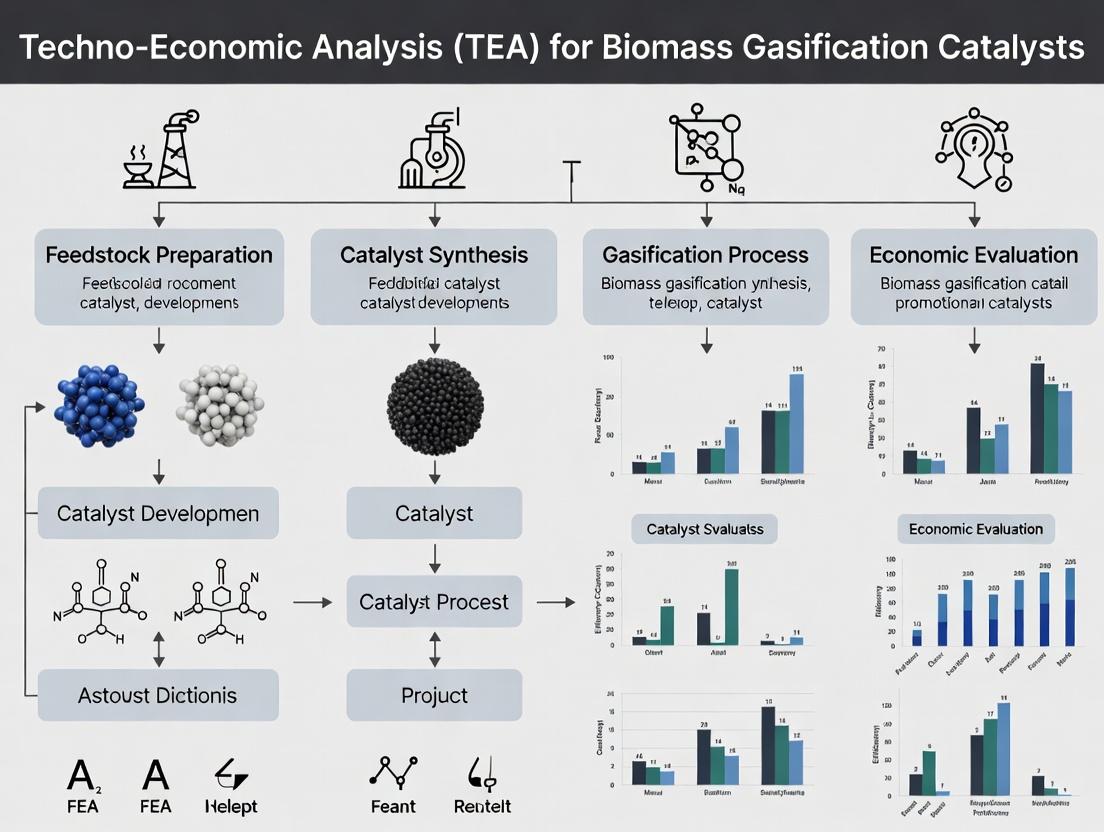
This article provides a comprehensive framework for applying Techno-Economic Analysis (TEA) specifically to biomass gasification catalyst development and selection.
TEA (Techno-Economic Analysis) Methodology for Biomass Gasification Catalysts: A Complete Guide for Catalyst Developers
Abstract
This article provides a comprehensive framework for applying Techno-Economic Analysis (TEA) specifically to biomass gasification catalyst development and selection. Targeting researchers, scientists, and drug development professionals, it covers foundational concepts of TEA, detailed methodological steps for application to catalytic processes, strategies for troubleshooting and optimizing catalyst performance based on economic and technical constraints, and approaches for validating and comparing catalyst options. The guide synthesizes the latest methodologies to empower professionals in making data-driven decisions that balance catalytic performance with process economics and sustainability.
What is TEA for Biomass Gasification Catalysts? Foundational Principles and Economic Drivers
Defining Techno-Economic Analysis (TEA) in the Context of Catalytic Gasification
Application Notes
Techno-Economic Analysis (TEA) is a systematic, iterative framework for evaluating the technical feasibility and economic viability of a proposed process or technology. In the context of catalytic gasification for biomass conversion, TEA integrates process simulation, experimental data, and financial modeling to assess the impact of catalyst performance on overall process economics. The primary objective is to identify cost drivers, optimize key operational parameters, and quantify the minimum fuel or product selling price (MFSP/MPSP) required for profitability. For a thesis focused on TEA methodology for biomass gasification catalysts, the analysis serves as a critical bridge between laboratory-scale catalyst research and commercial deployment.
Key technical parameters influenced by the catalyst and evaluated in a TEA include:
- Gasification Efficiency: Directly impacts biomass feed rate and yield.
- Syngas Composition (H₂/CO ratio): Determines suitability for downstream synthesis (e.g., Fischer-Tropsch, methanol).
- Tar Yield and Composition: Affects gas cleaning complexity and cost.
- Carbon Conversion and Catalyst Lifetime: Dictates catalyst make-up rate and solid waste.
- Required Operating Conditions (T, P): Influences capital cost of reactors and energy balance.
The economic assessment translates these parameters into capital expenditures (CAPEX), operating expenditures (OPEX), and revenue. Catalyst performance directly affects multiple cost centers: its purchase cost (CAPEX), its activity and stability (affecting reactor size and biomass throughput), and its resistance to poisoning (affecting replacement frequency and OPEX).
Protocols
Protocol 1: Integrated TEA Workflow for Catalyst Assessment
- Objective: To provide a step-by-step methodology for incorporating experimental catalyst data into a standardized TEA.
- Methodology:
- Define System Boundaries: Establish the complete process flow diagram (PFD), from biomass reception to final product purification. The catalytic gasifier is the core unit.
- Develop Process Model: Using simulation software (e.g., Aspen Plus), develop a mass and energy balance model. Base case uses non-catalytic or reference catalyst data.
- Incorporate Experimental Data: Input key performance data from Protocol 2 into the model. This includes updated reaction kinetics, product yields, and utility demands.
- Size Major Equipment: Scale equipment based on model stream results. Correlate gasifier design with catalyst activity.
- Estimate Capital Costs: Use scaling factors, vendor quotes, and literature databases to calculate installed equipment costs (ISBL), plus off-site costs (OSBL).
- Estimate Operating Costs: Calculate variable costs (biomass, catalyst replacement, utilities) and fixed costs (labor, maintenance).
- Conduct Financial Analysis: Apply discounted cash flow (DCF) analysis over a project lifetime (e.g., 20 years). Calculate MFSP/MPSP, net present value (NPV), and internal rate of return (IRR).
- Perform Sensitivity & Uncertainty Analysis: Identify critical parameters (e.g., catalyst cost, lifetime, activity) and model their impact on MFSP using Monte Carlo simulation.
Protocol 2: Experimental Protocol for Generating TEA Input Data for Catalyst Screening
- Objective: To generate consistent, comparable technical performance data for novel gasification catalysts for integration into the TEA model.
- Methodology:
- Feedstock Preparation: Mill and sieve biomass feedstock (e.g., pine wood chips) to a specified particle size range (e.g., 250-500 µm). Dry to constant weight.
- Catalyst Loading: Load a fixed mass of catalyst (e.g., 5 wt% Ni on Al₂O₃) into the fixed-bed or fluidized-bed micro-reactor. Reduce catalyst in-situ under H₂ flow at specified conditions.
- Gasification Experiment: Conduct gasification at setpoint conditions (e.g., 800°C, 1 atm, steam-to-biomass ratio of 1.0). Use an inert carrier gas.
- Product Analysis:
- Permanent Gases: Analyze effluent gas stream continuously via online micro-GC for H₂, CO, CO₂, CH₄ composition.
- Tars: Capture tars downstream using a cold solvent trap (e.g., isopropanol). Quantify gravimetrically and analyze via GC-MS.
- Char/Coke: Determine solid residue mass post-experiment. Analyze catalyst for coke deposition via TPO.
- Data Recording: Record all data at steady-state operation. Key metrics: carbon conversion efficiency, gas yield, H₂/CO ratio, tar yield (g/Nm³).
- Lifetime Test: For promising catalysts, conduct extended duration tests (e.g., 50+ hours) to measure deactivation rate and estimate catalyst lifetime.
Quantitative Data Summary
Table 1: Key Technical Performance Metrics from Experimental Studies for TEA Input
| Metric | Formula / Measurement Method | Baseline (Non-catalytic) | 5% Ni/Al₂O₃ | 10% Ni-CaO/TiO₂ | Unit |
|---|---|---|---|---|---|
| Carbon Conversion Efficiency | (Carbon in gas / Carbon in feed) × 100 | 65% | 88% | 92% | % |
| H₂ Yield | Volume of H₂ per mass dry biomass | 45 | 110 | 125 | g H₂/kg biomass |
| CO Yield | Volume of CO per mass dry biomass | 92 | 65 | 58 | g CO/kg biomass |
| H₂/CO Ratio in Syngas | Molar ratio from GC analysis | 0.6 | 1.9 | 2.4 | mol/mol |
| Tar Yield | Gravimetric analysis of trapped tars | 35 | 8 | 2 | g/kg biomass |
| Estimated Catalyst Lifetime* | Time to 50% activity loss (H₂ yield) | N/A | ~200 | ~350 | hours |
Table 2: Economic Parameter Ranges for Sensitivity Analysis in Catalytic Gasification TEA
| Parameter | Baseline Value | Range for Sensitivity Analysis | Key Impact |
|---|---|---|---|
| Plant Capacity | 2000 | 1000 - 5000 | Dry Metric Tonnes/day |
| Catalyst Cost | 50 | 25 - 100 | $/kg |
| Catalyst Lifetime | 200 | 100 - 500 | hours |
| Biomass Cost | 80 | 50 - 120 | $/dry tonne |
| Discount Rate (WACC) | 8% | 5% - 12% | % |
Visualizations
TEA Workflow for Catalyst Development
Experimental Setup for TEA Data Generation
The Scientist's Toolkit: Key Research Reagent Solutions & Materials
Table 3: Essential Materials for Catalytic Gasification Experiments
| Item | Function/Description |
|---|---|
| Biomass Feedstock (e.g., Pine) | Standardized, representative carbon source. Must be characterized (ultimate/proximate analysis). |
| Catalyst Precursors (e.g., Ni(NO₃)₂·6H₂O) | Source of active metal for impregnation onto catalyst support. |
| Catalyst Support (e.g., γ-Al₂O₃, TiO₂) | High-surface-area material providing structural stability and dispersion for active sites. |
| Fluidizing Gas (High-purity N₂, Ar) | Inert carrier for reactor start-up, shutdown, and bed fluidization. |
| Gasifying Agent (Steam) | Reactant for the gasification process; generated via a precision syringe pump and vaporizer. |
| Reduction Gas (High-purity H₂) | Used for in-situ activation of the metal catalyst prior to gasification. |
| Calibration Gas Mixture | Certified standard gas for quantitative calibration of the online GC. |
| Tar Solvent (e.g., HPLC-grade Isopropanol) | For cold-trapping and dissolving condensable tars from the product stream for analysis. |
| Fixed/Fluidized-Bed Micro-Reactor | Bench-scale reactor system capable of high temperatures with precise mass flow and temperature control. |
| Online Micro-Gas Chromatograph (GC) | For real-time, quantitative analysis of permanent gas composition (H₂, CO, CO₂, CH₄). |
Within Techno-Economic Analysis (TEA) methodology for biomass gasification catalyst research, the economic viability of the entire process is critically dependent on four interlinked catalyst performance parameters: Cost, Lifetime, Activity, and Selectivity. This application note details protocols for measuring and analyzing these drivers, enabling their integration into predictive TEA models for catalyst screening and development.
Table 1: Typical Ranges for Key Catalyst Economic Drivers in Biomass Tar Reforming
| Driver | Typical Range for Ni-based Catalysts | Impact on TEA | Benchmark Target (Current Research) |
|---|---|---|---|
| Cost | $50 - $150 /kg (fresh catalyst) | Directly impacts capital expenditure (CapEx) & replacement costs. | < $80 /kg via novel supports/synthesis. |
| Lifetime | 500 - 2000 h (time-on-stream) | Determines replacement frequency, operating costs (OpEx), and downtime. | > 4000 h via enhanced coke/poison resistance. |
| Activity | 90-99% tar conversion at 750-900°C | Defines reactor sizing, throughput, and process efficiency. | >99.5% conversion at <700°C (energy saving). |
| Selectivity | H₂/CO ratio 1.5 - 3.0; CO₂ selectivity 15-30% | Dictates downstream gas separation costs and product value. | Tunable H₂/CO (1.0-2.0) for specific synthesis. |
Table 2: Interdependency of Economic Drivers
| Primary Variable Change | Direct Impact on Other Drivers | Net Economic Effect (TEA) |
|---|---|---|
| ↑ Catalyst Cost (e.g., Noble metal) | ↑ Activity, ↑ Selectivity, ↑ Lifetime (potential) | CapEx ↑; may be justified if OpEx ↓ significantly. |
| ↑ Lifetime (via doping/support) | ↑ Effective Activity (less downtime), ↓ Effective Cost | OpEx ↓, Plant Availability ↑ → Positive NPV. |
| ↑ Activity (new formulation) | Possible ↓ Lifetime (harsher conditions), ↓ Selectivity (potential) | Reactor CapEx ↓; must monitor lifetime/selectivity trade-off. |
| ↑ Selectivity (tailored sites) | Possible ↓ Activity (kinetic trade-off) | Downstream Separation CapEx & OpEX ↓. |
Experimental Protocols
Protocol 1: Accelerated Catalyst Deactivation for Lifetime Estimation
Objective: To project catalyst lifetime under accelerated poisoning/coking conditions for TEA input. Materials: Fixed-bed microreactor, simulated biomass syngas (H₂, CO, CO₂, CH₄, N₂, with toluene/naphthalene as tar model), steam generator. Procedure:
- Catalyst Loading: Load 0.5 g of catalyst (250-355 μm sieve fraction) into a quartz tubular reactor (ID 10 mm) using quartz wool plugs.
- In-situ Reduction: Purge with N₂ (100 mL/min), heat to 800°C at 10°C/min. Switch to 20% H₂/N₂ (100 mL/min) for 2 hours.
- Accelerated Aging: Switch to reaction feed: 10% H₂O, 15% CO, 10% CO₂, 5% CH₄, 5000 ppmv toluene, balance N₂. Gas Hourly Space Velocity (GHSV) = 20,000 h⁻¹. Maintain at 800°C.
- Monitoring: Analyze effluent gas hourly via online GC for tar (model compound) conversion and permanent gas composition.
- Endpoint: Run until tar conversion drops to 50% of its initial steady-state value. Record time-on-stream (TOS).
- Lifetime Projection: Correlate accelerated TOS with real condition TOS using a deactivation kinetic model (e.g., power-law decay). Project time to 50% conversion under standard industrial GHSV (e.g., 5000 h⁻¹).
Protocol 2: Simultaneous Measurement of Activity and Selectivity
Objective: To obtain standardized metrics for catalyst comparison and TEA modeling. Materials: As in Protocol 1, with additional GC/TCD/FID and mass spectrometer for detailed analysis. Procedure:
- Standard Test: After standard reduction (Protocol 1, Step 2), expose catalyst to standard test feed: 12% H₂O, 20% CO, 13% CO₂, 5% CH₄, 10,000 ppmv naphthalene, balance N₂. GHSV = 15,000 h⁻¹. T = 750°C.
- Data Acquisition: After 1 hour stabilization, perform triplicate analyses at 30-minute intervals.
- Calculations:
- Activity: % Tar Conversion = [([Tar]ₐᵢₙ - [Tar]ₒᵤₜ) / [Tar]ₐᵢₙ] × 100.
- Selectivity: Calculate carbon-based selectivity to key products.
- SH₂ = (H₂ produced) / (Total carbon converted from tar/CH₄) Note: Requires carbon balance.
- SCO = (CO produced) / (Total carbon converted).
- S_CO₂ = (CO₂ produced) / (Total carbon converted).
- Reporting: Report activity as average % conversion ± standard deviation. Report selectivity as molar ratios (H₂/CO) and % carbon selectivity to CO₂.
Protocol 3: Post-mortem Analysis for Deactivation Mechanism
Objective: To identify cause of lifetime limitation (coking, sintering, poisoning) to guide catalyst reformulation. Procedure:
- Spent Catalyst Recovery: After deactivation (Protocol 1), cool reactor under N₂ flow. Seal spent catalyst sample in an argon glove box.
- Thermogravimetric Analysis (TGA): Weigh 20 mg spent catalyst. Heat in air to 900°C (10°C/min) to burn off coke. Weight loss = coke deposition (%w).
- X-ray Diffraction (XRD): Grind sample. Analyze crystallite size of active phase (e.g., Ni) using Scherrer equation on primary peak. Compare to fresh catalyst to assess sintering.
- Inductively Coupled Plasma Optical Emission Spectroscopy (ICP-OES): Digest sample. Measure concentration of potential poisons (S, Cl, alkali metals) leached from biomass.
Visualization
TEA Model Flow for Catalyst Drivers
Experimental Workflow for TEA Data Generation
The Scientist's Toolkit: Research Reagent Solutions
Table 3: Essential Materials for Catalyst Testing
| Item | Function & Relevance to Economic Drivers |
|---|---|
| Nickel Nitrate Hexahydrate (Ni(NO₃)₂·6H₂O) | Common, low-cost precursor for active Ni phase. Directly impacts Catalyst Cost. |
| γ-Alumina, CeO₂-ZrO₂, Mayenite (Ca₁₂Al₁₄O₃₃) Supports | Supports modify activity, inhibit sintering, and enhance coke resistance. Critical for Lifetime and Activity. |
| Promoters (MgO, CaO, La₂O₃, K₂CO₃) | Dopants to improve dispersion, basicity (for CO₂ adsorption), and poison resistance. Affects Lifetime, Selectivity. |
| Tar Model Compounds (Toluene, Naphthalene) | Standardized, representative molecules for reproducible Activity and Selectivity testing. |
| Simulated Biomass Syngas Mixtures | Controlled, reproducible feed gas for benchmarking. Contains H₂, CO, CO₂, CH₄, N₂, balanced with tar/steam. |
| Thermogravimetric Analyzer (TGA) | Quantifies coke deposition (Lifetime limitation) and regeneration potential. |
| Fixed-Bed Microreactor System | Bench-scale system for obtaining intrinsic kinetic data on Activity and Selectivity under controlled conditions. |
| Online Gas Chromatograph (GC) | Equipped with TCD and FID for precise quantification of product distribution, enabling Selectivity calculation. |
Understanding the Biomass-to-Syngas Value Chain and the Catalyst's Role
Biomass gasification is a thermochemical process converting carbonaceous materials into syngas (primarily CO and H₂). The process value chain is defined by sequential stages: Feedstock Preprocessing → Gasification → Syngas Cleaning & Conditioning → Synthesis/Fuel Production. The catalyst is pivotal, primarily in the gasification and conditioning stages, influencing reaction rates, product distribution, and tar cracking efficiency, directly impacting the overall techno-economic analysis (TEA).
Key Catalyst Functions and Quantitative Performance Data
Catalysts in biomass gasification serve to: 1) Lower activation energy for tar reforming, 2) Enhance water-gas shift reaction, 3) Improve carbon conversion efficiency, and 4) Mitigate coke formation. Performance is measured by tar conversion efficiency, syngas yield (Nm³/kg biomass), H₂/CO ratio, and catalyst lifetime.
Table 1: Comparative Performance of Common Catalyst Types in Biomass Gasification
| Catalyst Type | Example Material | Tar Conversion (%) | H₂/CO Ratio Achieved | Coke Deposition (wt%) | Typical Lifetime (h) | Key Advantage | Major Limitation |
|---|---|---|---|---|---|---|---|
| Natural Mineral | Dolomite (CaMg(CO₃)₂) | 75-90 | 1.2-1.8 | 5-15 | 50-200 | Low cost, disposable | Low strength, high attrition |
| Alkali Metal | K₂CO₃ / Na₂CO₃ | 80-95 | 1.5-2.2 | 8-20 | 100-300 | High activity, promotes gasification | Volatilization, recovery difficult |
| Nickel-Based | Ni/Al₂O₃, Ni/Olivine | >95 | 1.8-2.5 | 3-10 | 500-1000 | High tar reforming activity | Sensitive to sulfur, prone to coking |
| Noble Metal | Rh/CeO₂, Pt/Al₂O₃ | >98 | 1.5-2.0 | 1-5 | 1000+ | Excellent activity & stability | Extremely high cost |
| Char-Based | Biomass-derived char | 60-85 | 0.8-1.5 | 10-25 | 50-150 | Inexpensive, from process itself | Low & deactivating activity |
Note: Data synthesized from recent studies (2022-2024); performance ranges depend on operating conditions (T=700-900°C, reactor type, feedstock).
Application Notes & Experimental Protocols
Protocol: Catalyst Screening for Tar Reforming
Objective: To evaluate and compare the tar conversion efficiency and syngas quality enhancement of different candidate catalysts. Materials: Fixed-bed microreactor, gas chromatograph (GC-TCD/FID), simulated tar mixture (toluene, naphthalene), catalyst samples (powder or pellets), N₂, steam generator. Procedure:
- Catalyst Preparation: Sieve catalyst to 150-300 µm. Pre-reduce nickel-based catalysts in 20% H₂/N₂ at 600°C for 2h.
- Reactor Setup: Load 0.5g catalyst in reactor's isothermal zone. Pack quartz wool above and below.
- Experimental Run: Heat reactor to 800°C under N₂ flow (50 ml/min). Introduce steam (S/C molar ratio = 2) and tar-laden N₂ stream (tar concentration: 10 g/Nm³).
- Product Analysis: After 30 min stabilization, analyze product gas every 15 min via GC for 3h. Trap and quantify residual tars using cold solvent traps.
- Data Analysis: Calculate tar conversion: [1 - (Tarout/Tarin)] x 100%. Determine H₂ yield and H₂/CO ratio.
Protocol: Accelerated Catalyst Deactivation & Regeneration Testing
Objective: To assess catalyst lifetime under harsh conditions and efficacy of regeneration protocols. Materials: Same as 3.1, plus thermo-gravimetric analyzer (TGA), air supply for regeneration. Procedure:
- Longevity Test: Extend Protocol 3.1 run to 24-48h, monitoring key product yields hourly.
- Post-mortem Analysis: Cool reactor under N₂. Recover catalyst for TGA (burn-off coke in air), SEM (morphology), and XRD (crystal structure).
- Regeneration Cycle: For coked catalyst, heat in situ in 5% O₂/N₂ at 700°C for 2h. Repeat activity test (Protocol 3.1) for 3 cycles to measure activity recovery.
- TEA Parameter Extraction: Record initial activity decay rate and residual activity after regeneration. Calculate expected total service life.
Visualizing the Value Chain and Catalyst Role
Title: Biomass-to-Syngas Value Chain with Catalyst Integration
Title: Catalytic Tar Reforming and Deactivation Pathways
The Scientist's Toolkit: Key Research Reagent Solutions
Table 2: Essential Materials for Catalyst Research in Biomass Gasification
| Item Name | Function in Research | Key Considerations for TEA |
|---|---|---|
| Ni(NO₃)₂·6H₂O | Precursor for impregnation of nickel-based catalysts. | Cost, metal loading efficiency, and calcination energy input. |
| γ-Al₂O₃ Support | High-surface-area support for dispersing active metals. | Stability under steam, attrition resistance, and unit cost. |
| Olivine Sand | Natural, low-cost in-bed catalyst for primary tar cracking. | Lifetime, need for pre-activation, and disposal/replacement cost. |
| Simulated Tar Mix | Standardized feed for reproducible catalyst testing (e.g., toluene, phenol). | Relevance to real biomass tars, simplifying complex mixture for screening. |
| Certified Calibration Gases | (H₂, CO, CO₂, CH₄, C₂H₄) for accurate GC quantification. | Critical for precise yield calculation, a major input for TEA models. |
| Thermogravimetric Analyzer (TGA) | Measures coke deposition and catalyst oxidation/regeneration kinetics. | Capital cost vs. value of obtaining deactivation rate constants for lifetime prediction. |
| Fixed-Bed Microreactor System | Bench-scale unit for catalyst activity and selectivity testing. | Scalability of data to pilot plant, operating cost (energy, gas flows). |
| X-ray Diffraction (XRD) | Identifies crystalline phases, metal particle size, and stability. | Access cost; essential for diagnosing sintering and phase changes. |
Application Notes
Within a comprehensive Techno-Economic Analysis (TEA) methodology for biomass gasification catalysts research, the rigorous quantification of CAPEX, OPEX, and Revenue is critical for assessing economic viability and guiding R&D priorities. These components are interdependent, forming the financial framework for evaluating novel catalytic materials and processes at various scales, from laboratory bench to pilot and conceptual commercial plant.
CAPEX represents the upfront, depreciable investment required to construct and commission the gasification and catalytic upgrading facility. For catalyst research, this extends beyond reactor vessels to include specialized catalyst synthesis and characterization equipment. A pivotal consideration is the catalyst loading cost, which is a direct function of the researcher-developed catalyst's lifetime, density, and reactor volume.
OPEX encompasses all recurring costs of operation. Catalyst-related costs are a significant OPEX subcategory, calculated as the cost of catalyst consumed per unit of product. This is heavily influenced by research outcomes: catalyst lifetime (stability/deactivation rate), selectivity (which impacts downstream separation costs), and activity (which affects reactor size and utilities). Feedstock cost (biomass) and utilities for syngas conditioning are other major OPEX drivers.
Revenue is generated primarily from the sale of primary products (e.g., Fischer-Tropsch liquids, renewable natural gas, hydrogen) and potential secondary products (heat, power, biochar). Catalyst performance directly dictates revenue through its impact on product yield and quality. High-selectivity catalysts minimize byproduct formation, maximizing revenue from the target product stream.
The following tables summarize key parameters and quantitative ranges based on current literature and project data for biomass gasification-to-fuels pathways.
Table 1: Key CAPEX Components for a Catalytic Biomass Gasification Plant
| Component | Description | Typical Range (USD) | Notes for Catalyst Research |
|---|---|---|---|
| Direct Costs | |||
| Feed Handling & Preparation | Biomass reception, storage, sizing, drying. | $15 - $30 million | Scale-dependent; not directly catalyst-influenced. |
| Gasification Island | Gasifier, oxidant supply, ash removal. | $40 - $80 million | Base technology cost. |
| Catalytic Synthesis & Upgrading | Catalytic reformer, Fischer-Tropsch reactor, etc. | $20 - $60 million | Most sensitive to catalyst choice. Reactor size depends on catalyst activity. |
| Gas Cleaning & Conditioning | Tar cracker, scrubbers, sulfur removal. | $25 - $50 million | Catalyst stability affects tar cracking replacement costs. |
| Catalyst Initial Charge | First load of catalyst for all reactors. | $2 - $10 million | Direct function of catalyst price ($/kg) and reactor volume. |
| Indirect Costs | Engineering, construction, contingency. | 20-35% of Direct Costs | Contingency higher for novel catalytic processes. |
Table 2: Key OPEX Components and Catalyst-Driven Variables
| Category | Item | Typical Annual Cost | Catalyst Research Linkage |
|---|---|---|---|
| Fixed OPEX | Labor, Maintenance, Insurance | 2-4% of CAPEX | Larger CAPEX from low-activity catalysts increases this. |
| Variable OPEX | |||
| Biomass Feedstock | Cost per dry ton. | $40 - $80 /ton | Major cost driver; catalyst yield impacts $/product. |
| Catalyst Replacement | Consumed catalyst. | Variable | = (Catalyst Cost / Lifetime). Key metric from testing. |
| Utilities | Power, steam, cooling water. | Significant | Catalyst activity/conditions dictate energy needs. |
| Other Chemicals | Sorbents, solvents. | Variable | Catalyst selectivity influences cleanup needs. |
Table 3: Revenue Streams and Catalyst Performance Impact
| Product Stream | Basis | Value | Catalyst Performance Determinant |
|---|---|---|---|
| Renewable Fuels | Gasoline/Diesel Gallon Equivalent | $3.00 - $4.50 /GGE | Product Yield: Primary revenue driver. Selectivity: To desired hydrocarbon chain length. |
| Renewable H2 | per kg | $4.00 - $6.00 /kg | H2 Yield: From reforming catalysts. Purity: Affects upgrading cost. |
| Biochar / Bio-Carbon | per ton | $500 - $1,500 /ton | Byproduct; gasifier-dependent. |
| Export Power | per MWh | $60 - $100 /MWh | Byproduct from excess syngas or heat. |
Experimental Protocols
Protocol 1: Determining Catalyst Lifetime for OPEX Calculation
Objective: To measure catalyst deactivation rate under simulated process conditions to estimate operating lifetime, a critical variable for catalyst replacement OPEX. Materials: Fixed-bed reactor system, gas mixing panel, simulated syngas (H2, CO, CO2, N2, H2O, tars), biomass gasification catalyst (e.g., Ni-based, noble metal on support). Procedure:
- Conditioning: Load 1.0 g of catalyst (sized 180-250 μm) into reactor. Heat to 500°C under inert flow (N2, 50 mL/min). Reduce under H2 (20% in N2, 50 mL/min) at 600°C for 2 hours.
- Activity Baseline: Switch to simulated syngas feed (e.g., 25% H2, 25% CO, 10% CO2, 5% H2O, 300 ppm toluene as tar model, balance N2) at WHSV = 30,000 mL g⁻¹ h⁻¹. Maintain at reaction temperature (e.g., 750°C).
- Long-Term Stability Test: Operate continuously for ≥500 hours. Analyze effluent gas composition via online GC every 12 hours. Key metric: Carbon Conversion to desired products.
- Deactivation Analysis: Plot key metric (e.g., CO conversion) vs. time on stream (TOS). Determine time (TOS) to 50% of initial activity (T50). This defines effective lifetime under test conditions.
- Post-Mortem Analysis: Recover catalyst. Analyze for carbon deposition (TGA), sintering (XRD), and poisoning (XPS, ICP-MS).
Protocol 2: Measuring Catalyst Selectivity for Revenue & OPEX Impact
Objective: To quantify product distribution from catalytic syngas upgrading, directly impacting revenue potential and downstream separation OPEX. Materials: Micro-reactor system with high-pressure capability, online GC-MS/FID/TCD, H2/CO feed, Fischer-Tropsch or methanation catalyst. Procedure:
- Calibration: Calibrate all GC detectors for expected products (C1-C20 hydrocarbons, oxygenates, CO2).
- Experimental Run: Load 0.5 g catalyst. Reduce in situ. Pressurize system to 20 bar with H2/CO (2:1 molar ratio). Set temperature to catalyst-specific optimal (e.g., 220°C for FT).
- Steady-State Measurement: After 24 hours TOS to reach steady state, collect triplicate effluent samples over 6 hours via automated sampling valve to GC.
- Data Analysis: Calculate:
- CO Conversion (%) = (COin - COout) / CO_in * 100.
- Selectivity to product i (%) = (Carbon atoms in product i) / (Total carbon in all products) * 100.
- Chain Growth Probability (α) from Anderson-Schulz-Flory distribution plot.
- Impact Modeling: Feed selectivity data into process model to estimate yields (kg product/kg biomass) for revenue calculation and separation unit sizing for OPEX.
Protocol 3: Benchmarking Catalyst Activity for CAPEX Sizing
Objective: To determine reaction kinetics for reactor sizing, a major CAPEX component. Materials: Differential reactor (conversion <15%), highly accurate mass flow controllers, catalyst in powder form (<100 μm) to eliminate mass transfer limitations. Procedure:
- Intrinsic Rate Measurement: Conduct experiments at varying temperatures (e.g., 180-260°C) and partial pressures of H2 and CO at low conversion.
- Kinetic Modeling: Fit rate data to a Langmuir-Hinshelwood type model (e.g., ( r = k * P{CO}^a * P{H2}^b / (1 + K{CO}P{CO})^2 )).
- Activation Energy: Determine from Arrhenius plot.
- Scale-Up for CAPEX: Use derived kinetic model in process simulation software (Aspen Plus, ChemCAD) to size the catalytic reactor volume required for target plant capacity. Reactor volume directly scales major equipment CAPEX.
Visualizations
TEA Components & Catalyst Performance Links
From Catalyst Testing to TEA Assessment Workflow
The Scientist's Toolkit: Research Reagent Solutions for TEA-Informed Catalyst Testing
| Item / Reagent | Function in Experiment | Relevance to TEA Components |
|---|---|---|
| Bench-Scale Fixed-Bed Reactor System | Provides controlled environment (T, P, flow) for testing catalyst performance under realistic conditions. | Primary data generator for activity, selectivity, lifetime metrics feeding into all CAPEX, OPEX, Revenue models. |
| Simulated Syngas Mixtures | Custom gas blends (H2, CO, CO2, N2) with tar model compounds (e.g., toluene, naphthalene). | Enables lifetime testing under relevant feeds, critical for accurate catalyst replacement OPEX prediction. |
| Online Gas Chromatograph (GC) | Quantifies reactant conversion and product distribution in real-time during stability tests. | Provides selectivity and yield data for revenue calculation and deactivation rates for OPEX. |
| Thermogravimetric Analyzer (TGA) | Measures carbon deposition (coke) on spent catalyst post-reaction. | Quantifies deactivation mechanism; informs catalyst lifetime and regeneration cycles for OPEX. |
| High-Pressure Microreactor | Allows testing at industrial relevant pressures (e.g., 20-30 bar for Fischer-Tropsch). | Generates kinetic data for accurate reactor sizing (CAPEX) and high-pressure selectivity data for revenue. |
| Inductively Coupled Plasma Mass Spectrometry (ICP-MS) | Analyzes trace element contamination on catalyst (e.g., S, Cl from biomass). | Identifies poisoning sources; critical for predicting real-world catalyst lifetime and OPEX. |
| Reference Catalysts (e.g., commercial Ni/Al2O3) | Benchmark for comparing novel catalyst performance (activity, stability, selectivity). | Establishes baseline economic performance for comparative TEA of new research catalysts. |
The Critical Link Between Catalyst Performance Metrics and Process Economics
This Application Note details the critical relationship between catalyst performance metrics and the overall process economics for biomass gasification, framed within a Techno-Economic Analysis (TEA) methodology. For researchers and scientists, optimizing catalyst performance is not solely a chemical engineering challenge but a direct lever for economic viability. Key metrics—including activity, selectivity, stability (lifetime), and regenerability—are quantitatively linked to capital expenditure (CAPEX), operating expenditure (OPEX), and key economic indicators like Minimum Fuel Selling Price (MFSP) or Internal Rate of Return (IRR).
Key Catalyst Performance Metrics & Economic Impact
The following table summarizes the primary performance metrics, their quantitative measures, and their direct economic implications.
Table 1: Catalyst Performance Metrics and Economic Impact Links
| Performance Metric | Quantitative Measure | Primary Economic Impact | Key TEA Parameter Affected |
|---|---|---|---|
| Activity | Conversion Rate (X%), Space-Time Yield (STY) | Reactor Size, Catalyst Loading (CAPEX) | Equipment Cost, Catalyst Inventory Cost |
| Selectivity | Yield to Target Product (Y%), Carbon Efficiency | Product Yield, Downstream Separation Cost (OPEX/CAPEX) | Raw Material Efficiency, Purification Cost |
| Stability (Lifetime) | Time-on-Stream to 50% activity loss (TOS), Deactivation Rate | Catalyst Replacement Frequency, Process Downtime (OPEX) | Annual Catalyst Cost, Plant Availability Factor |
| Regenerability | Number of Cycles to 80% Original Activity | Total Catalyst Consumable Cost (OPEX) | Annual Catalyst Cost, Waste Disposal Cost |
| Mechanical Strength | Attrition Loss (wt%/day) | Catalyst Make-up Rate, Dust Handling (OPEX) | Catalyst Consumable, Filtration Equipment Cost |
| Poison Resistance | Tolerance to S, Cl, Alkali (ppm) | Pre-treatment Requirements, Lifetime (CAPEX/OPEX) | Feedstock Pre-purification Cost, Catalyst Lifetime |
Experimental Protocols for Critical Performance Evaluation
Protocol 3.1: Determining Catalyst Activity & Selectivity in Biomass Syngas Conditioning
- Objective: To measure the conversion of tar/model compounds and selectivity towards desired syngas components (H₂, CO) under simulated biomass-derived syngas conditions.
- Materials: Fixed-bed reactor system, online GC/TCD/FID, mass flow controllers, steam generator, catalyst sample (50-100 mg, sieved), simulated syngas mixture (H₂, CO, CO₂, CH₄, N₂, with toluene/naphthalene as tar model compound).
- Procedure:
- Load catalyst into reactor tube with quartz wool plugs.
- Activate catalyst under 10% H₂/N₂ at 500°C for 2 hours (ramp: 5°C/min).
- Cool to reaction temperature (e.g., 700-850°C).
- Switch to reaction feed: Simulated syngas with 10 g/Nm³ tar model compound and 20 vol% H₂O.
- Analyze effluent gas composition hourly via online GC.
- Calculate: Tar Conversion (%) = [(Cin - Cout)/C_in] * 100. H₂ Selectivity (%) = (Moles H₂ produced) / (Moles of Carbon converted from tar) * Stoichiometric factor.
Protocol 3.2: Accelerated Lifetime and Deactivation Testing
- Objective: To assess catalyst stability and predict operational lifetime under accelerated, realistic conditions.
- Materials: As in 3.1, with addition of alkali (e.g., KCl) aerosol generator or H₂S cylinder for poison studies.
- Procedure:
- Follow activation and initial reaction steps from Protocol 3.1.
- Maintain continuous reaction under baseline conditions for 24h to establish initial activity.
- Introduce a low concentration of poison (e.g., 50 ppmv H₂S or 5 ppmw KCl aerosol) to the feed stream.
- Monitor key activity (tar conversion) and selectivity metrics continuously for 100+ hours.
- Plot activity vs. Time-on-Stream (TOS). Determine Deactivation Rate (k_d, % activity/h) and T50 (Time for 50% activity loss).
- Correlate T50 with full-scale reactor catalyst charge replacement schedules.
Protocol 3.3: Catalyst Regeneration Protocol
- Objective: To evaluate the recoverability of catalyst activity after coke deposition deactivation.
- Materials: Deactivated catalyst from 3.2, thermogravimetric analyzer (TGA) or the fixed-bed reactor.
- Procedure (In-situ Regeneration in Reactor):
- After deactivation, switch feed to inert N₂ and cool to 550°C.
- Introduce 2% O₂ in N₂ (slowly, control exotherm) for 2-5 hours to combust coke.
- Re-activate per Protocol 3.1, Step 2.
- Re-run activity/selectivity test (Protocol 3.1, Steps 3-6).
- Calculate Activity Recovery (%) = (Activityafterregeneration / Initial_Activity) * 100.
- Repeat deactivation-regeneration cycles 3-5 times to establish cycle limit.
Visualization of the Performance-Economics Relationship
Diagram Title: Catalyst Metrics Drive TEA Inputs
Experimental Workflow for Integrated Performance-TEA
Diagram Title: Catalyst R&D to TEA Feedback Loop
The Scientist's Toolkit: Key Research Reagent Solutions
Table 2: Essential Materials for Catalyst Performance Evaluation
| Item / Reagent Solution | Function in Experiment | Key Consideration for TEA |
|---|---|---|
| Ni/Al₂O₃, Ni-olivine, Rh/CeO₂ | Benchmark catalysts for tar reforming. | Baseline for cost vs. performance comparison. |
| Simulated Biomass Syngas Mixture (H₂, CO, CO₂, CH₄, N₂) | Provides realistic, controllable feed for bench tests. | Composition affects equilibrium conversion and downstream costs. |
| Tar Model Compounds (Toluene, Naphthalene, Phenol) | Represents challenging, deactivating species in real tar. | Different compounds test selectivity; impacts separation design. |
| Alkali & Sulfur Dopants (KCl, K₂CO₃, H₂S gas) | Simulates real feedstock poisons for lifetime testing. | Directly informs feedstock pre-treatment requirements and cost. |
| Thermogravimetric Analyzer (TGA) | Quantifies coke deposition, regeneration efficiency. | Coke burn-off rate impacts reactor downtime (OPEX). |
| Fixed-Bed or Fluidized-Bed Microreactor | Mimics industrial reactor hydrodynamics at lab scale. | Data scalability is critical for accurate CAPEX estimation. |
| Online GC/MS & Micro-GC | Provides real-time activity/selectivity data. | Product distribution is a primary input for process flow sheeting. |
| BET, XRD, TEM, XPS | Characterizes fresh/spent catalyst (surface area, structure, poisoning). | Links deactivation mechanisms to lifetime and regenerability estimates. |
How to Conduct a TEA for Gasification Catalysts: A Step-by-Step Methodological Framework
Application Notes
In Techno-Economic Analysis (TEA) for biomass gasification catalyst research, the precise definition of system boundaries is the foundational step that determines the scope, inventory, and ultimate validity of the study. This step isolates the catalytic gasification process from upstream (e.g., biomass cultivation, transport) and downstream (e.g., Fischer-Tropsch synthesis, grid injection) operations, allowing for a focused assessment of the catalyst's impact on process economics and sustainability. The Base Case PFD is the primary visual and conceptual tool that operationalizes these boundaries, translating a complex process into a manageable system for modeling.
A critical consideration is the distinction between an attributional boundary, which includes only the direct inputs and outputs of the gasification and catalytic upgrading steps, and a consequential boundary, which may include indirect effects like changes in biomass supply chains. For catalyst screening, an attributional boundary focusing on the gasification island is typically appropriate. The Base Case PFD must include all major unit operations (e.g., feedstock pre-processing, gasifier, catalytic reformer/tar cracker, gas cleaning, heat recovery) and stream connections (mass and energy). This diagram serves as the reference against which all catalytic alternatives are compared.
Table 1: Typical System Boundary Definitions for Biomass Gasification TEA
| Boundary Type | Included Unit Operations | Excluded Elements | Primary Use Case |
|---|---|---|---|
| Core Process (Attributional) | Drying, size reduction, gasifier, catalytic reformer, cyclone, scrubber, compressor. | Feedstock production/transport, final fuel synthesis, carbon sequestration. | Initial catalyst performance screening and comparison. |
| Gate-to-Gate | All operations within the plant fence: from biomass receipt to clean syngas output. | Upstream forestry/agriculture, downstream product upgrading to final marketable fuel. | Integrated plant design and optimization studies. |
| Well-to-Wheel | Full lifecycle: biomass cultivation, transport, gasification, fuel synthesis, combustion in engine. | Indirect land-use change (often handled separately). | Full environmental lifecycle assessment (LCA) coupled with TEA. |
Experimental Protocols
Protocol 1: Defining the Base Case System Boundary for Catalytic Gasification TEA
Objective: To establish a consistent and reproducible system boundary for the comparative TEA of biomass gasification catalysts.
Materials:
- Process simulation software (e.g., Aspen Plus, SuperPro Designer).
- Data on a reference non-catalytic or baseline catalytic gasification process.
- Stream composition, temperature, pressure, and flow rate data for key points.
Methodology:
- Identify the Functional Unit: Define the basis of comparison (e.g., 1 tonne of dry ash-free biomass feedstock or 1 GJ of clean syngas (H₂ + CO) produced).
- Delineate the Boundary: Draw a physical box around the process. The conventional starting point is the point of biomass delivery to the plant gate. The endpoint is the production of a clean, specification-grade syngas.
- List Inflows: Identify all material, energy, and utility inputs crossing the boundary into the system (e.g., biomass, steam, air, electricity, catalyst make-up, cooling water).
- List Outflows: Identify all products, by-products, wastes, and emissions leaving the system (e.g., clean syngas, slag/ash, wastewater, vent gases, spent catalyst).
- Document Assumptions: Explicitly state assumptions for cut-off rules (e.g., neglect of capital for buildings, exclusion of laboratory overheads).
Protocol 2: Constructing the Base Case Process Flow Diagram (PFD)
Objective: To create a standardized PFD that quantitatively represents the mass and energy balances of the baseline gasification system.
Materials:
- PFD drafting tool (e.g., Microsoft Visio, draw.io, or process simulator graphical output).
- Base case mass & energy balance data table.
- Standard PFD symbology library.
Methodology:
- Place Major Equipment: Position icons for all primary unit operations (reactors, separators, heat exchangers, pumps, compressors) in a logical left-to-right flow sequence.
- Connect Process Streams: Draw lines connecting all equipment. Number each process stream uniquely.
- Annotate Stream Data: Create a accompanying stream table (Table 2) listing for each numbered stream: Temperature (°C), Pressure (bar), Mass Flow (kg/hr), and key Component Mass Fractions (e.g., H₂, CO, CO₂, CH₄, H₂O, Tars).
- Add Critical Control Points: Indicate key process conditions on the PFD (e.g., gasifier temperature/pressure, catalytic reformer space velocity, scrubber inlet temperature).
- Integrate Energy Streams: Show the integration of major heat recovery streams (e.g., syngas cooler generating steam).
Table 2: Example Stream Table for Base Case PFD (Partial)
| Stream No. | 1 | 2 | 3 (to Catalytic Reactor) | 4 (from Catalytic Reactor) |
|---|---|---|---|---|
| Description | Dried Biomass | Air | Raw Syngas | Upgraded Syngas |
| Temperature (°C) | 25 | 25 | 850 | 800 |
| Pressure (bar) | 1 | 1 | 1 | 1 |
| Mass Flow (kg/h) | 1000 | 1500 | 2380 | 2350 |
| Composition (wt%) | ||||
| H₂ | 0 | 0 | 2.1 | 8.5 |
| CO | 0 | 0 | 15.7 | 19.2 |
| CO₂ | 0 | 0 | 12.5 | 10.1 |
| CH₄ | 0 | 0 | 3.8 | 2.5 |
| Tars (as C₆H₆) | 0 | 0 | 2.5 | 0.1 |
| N₂ | 0 | 77.0 | 47.2 | 46.5 |
| H₂O | 10.0 | 23.0 | 16.2 | 12.6 |
| Ash | 5.0 | 0 | 2.5 | 2.5 |
Diagrams
The Scientist's Toolkit
Table 3: Key Research Reagent Solutions for Catalytic Gasification Experiments
| Item | Function in Research Context | Typical Specification / Example |
|---|---|---|
| Model Tar Compound | Serves as a chemical surrogate for complex biomass tar in bench-scale catalyst activity tests. | Naphthalene, toluene, or phenol dissolved in a carrier gas (N₂) or steam. |
| Synthetic Syngas Mixture | Provides a consistent, simplified feed gas for catalyst performance screening under controlled conditions. | Certified gas cylinder with specified % of H₂, CO, CO₂, CH₄, N₂, balanced. |
| Biomass Reference Material | A standardized, well-characterized biomass for reproducible gasification experiments. | NIST willow shrub SRM 8493 or similar, with certified proximate/ultimate analysis. |
| Catalytic Precursor Salts | Used for the laboratory-scale synthesis of candidate catalysts (e.g., via impregnation). | Nitrates or chlorides of Ni, Fe, Co, Mo, Ru, Mg, K, etc., in aqueous solution. |
| Bench-Scale Fluidized Bed Reactor | The core experimental unit for simulating the gasification environment and testing catalyst performance. | Typically quartz or stainless steel, with temperature-controlled heating, gas feeding system, and tar sampling ports. |
| Tar Analysis Kit | For quantifying tar concentration in syngas before and after catalytic treatment, a key performance metric. | Includes tar condensation train (impinger bottles in ice bath), solvent (dichloromethane or acetone), and GC-MS for analysis. |
This document details the second, critical data-gathering phase of a broader Techno-Economic Analysis (TEA) methodology for evaluating biomass gasification catalysts. Precise and comprehensive collection of catalyst properties, kinetic parameters, and deactivation models is foundational for constructing accurate process simulations and subsequent economic and life-cycle assessments. This phase transforms qualitative catalyst concepts into quantitative engineering data.
Catalyst Properties Data Matrix
The following properties must be cataloged for each candidate catalyst (e.g., Ni/Al₂O₃, Rh/CeO₂-ZrO₂, Olivine, Char). Data should be sourced from peer-reviewed literature, reputable databases (e.g., NIST, CatBase), and direct experimental characterization.
Table 1: Essential Catalyst Properties for TEA Modeling
| Property Category | Specific Parameter | Units | Example Value (Ni/Al₂O₃) | Measurement Protocol (ASTM/ISO/Common) |
|---|---|---|---|---|
| Physical | BET Surface Area | m²/g | 150-200 | ASTM D3663 / ISO 9277 (N₂ physisorption) |
| Pore Volume | cm³/g | 0.4-0.6 | ASTM D4284 (Mercury porosimetry) | |
| Pore Size Distribution | nm | Bimodal: 10, 100 | BJH method from adsorption isotherm | |
| Particle Size / Shape | μm / - | 50-100 μm, spherical | SEM/TEM imaging, laser diffraction | |
| Bulk Density | kg/m³ | 800-1200 | ASTM D7481 | |
| Chemical | Active Metal Loading | wt.% | 10-15% Ni | ICP-OES / AAS (Post-digestion) |
| Dispersion / Crystallite Size | % / nm | 5% / 20 nm | H₂ chemisorption, XRD Scherrer eq. | |
| Reduction Degree | % | 70-85% | H₂-TPR analysis | |
| Surface Acidity/Basicity | mmol/g | 0.1 mmol NH₃/g | NH₃/CO₂-TPD | |
| Support Composition | - | γ-Al₂O₃ | XRD, XRF | |
| Mechanical | Crush Strength | N/mm | >20 | ASTM D6175 (radial crush) |
| Attrition Resistance | wt.% loss | <2% | ASTM D5757 (jet cup test) | |
| Thermal | Thermal Conductivity | W/m·K | 5-10 | Laser flash analysis |
| Heat Capacity | J/g·K | 0.8-1.0 | Differential Scanning Calorimetry |
Kinetics Data Collection Protocol
Kinetic data informs reactor sizing and operating conditions in the TEA flowsheet.
Experimental Protocol: Intrinsic Kinetics Measurement
Aim: Determine rate constants, reaction orders, and activation energies for key gasification/tar reforming reactions (e.g., ( CnHm + nH2O \rightarrow nCO + (n+m/2)H2 )).
Workflow:
- Reactor Setup: Use a fixed-bed micro-reactor with low catalyst bed height to diameter ratio (>10) to minimize mass/heat transfer limitations (gradientless regime).
- Feedstock: Simulated syngas mixture with model tar compound (e.g., toluene, naphthalene) at relevant concentrations (5-20 g/Nm³).
- Experimental Matrix: Vary temperature (500-900°C), partial pressures of reactants (H₂O, H₂, CO, tar), and space velocity (WHSV).
- Analysis: Online GC/MS and micro-GC for product gas composition (H₂, CO, CO₂, CH₄, light hydrocarbons).
- Data Fitting: Fit experimental rates to power-law or Langmuir-Hinshelwood-Hougen-Watson (LHHW) models using non-linear regression.
Table 2: Representative Kinetic Parameters for Tar Reforming
| Catalyst | Reaction Model | Activation Energy, Eₐ (kJ/mol) | Pre-exponential Factor, A | Reaction Order in Tar | Reaction Order in H₂O | Reference Conditions |
|---|---|---|---|---|---|---|
| 10% Ni/Al₂O₃ | Power-Law (Toluene) | 87 ± 5 | 4.2 x 10⁵ (mol/g·s·Pa) | 0.7 | 0.3 | 600-750°C, 1 atm |
| Rh/CeO₂ | LHHW (Naphthalene) | 102 ± 8 | - | - | - | 700-850°C, 1 atm |
| Olivine | 1st Order (Phenol) | 75 ± 4 | 8.1 x 10³ (1/s) | 1.0 | - | 800-900°C, 1 atm |
Diagram 1: Workflow for collecting intrinsic kinetic data.
Deactivation Models Data Collection Protocol
Catalyst lifetime is a paramount economic variable. Data must inform a time-dependent activity function, a(t).
Experimental Protocol: Accelerated Deactivation Testing
Aim: Quantify deactivation rate constants and mechanisms (sintering, coking, poisoning) under simulated, accelerated conditions.
Workflow:
- Long-Duration Test: Perform time-on-stream (TOS) experiment (>100 h) under realistic syngas with impurities (H₂S, tars, alkali).
- Accelerated Stressors: Employ higher temperature, poison concentration, or carbon potential to accelerate decay within a shorter test.
- Periodic Measurement: At fixed intervals, return to standard "reference" conditions to measure residual activity.
- Post-mortem Analysis: Characterize spent catalyst via TGA (coke burn-off), TEM (sintering), XPS (surface poisoning).
- Model Fitting: Fit activity decay (a = f(t)) to common models: separable (a(t)=exp(-k_d t)), or core-shell for pore poisoning.
Table 3: Common Deactivation Models & Parameters
| Deactivation Mechanism | Typical Model Form | Key Parameters | Example Values (Ni Catalyst) |
|---|---|---|---|
| Sintering | ( a(t) = \frac{1}{1 + k_s t} ) | Sintering rate constant, k_s (1/h) | 0.005 - 0.02 h⁻¹ (at 700°C) |
| Coking (Pore Mouth) | Core-Shell Model | Coke deposition rate, Thiele modulus | Dependent on tar concentration |
| Poisoning (Uniform) | ( a(t) = exp(-kp Cp t) ) | Poisoning rate constant, k_p (ppm⁻¹·h⁻¹) | k_p(H₂S) ≈ 0.05 - 0.1 |
| Combined | ( \frac{da}{dt} = -(ks + kp Cp + kc) a^m ) | Deactivation order (m) | Often 1 (first-order decay) |
Diagram 2: Primary catalyst deactivation pathways.
The Scientist's Toolkit: Research Reagent Solutions & Materials
Table 4: Essential Materials for Catalyst Data Collection
| Item / Reagent | Function / Application | Key Specifications / Notes |
|---|---|---|
| Bench-Scale Tubular Reactor | Core unit for kinetic & deactivation studies. | Quartz or Inconel, up to 900°C, 10-30 atm capability. |
| Synthetic Gas Mixtures | Simulating biomass syngas feed. | Custom blends of H₂, CO, CO₂, CH₄, N₂, with C₂H₄, C₆H₆ for tars. |
| Online Micro-GC | Real-time analysis of permanent gases (H₂, CO, CO₂, CH₄, C₂s). | Equipped with TCD and multiple columns (e.g., Molsieve, Plot U). |
| Online GC-MS | Analysis of heavier tar compounds and byproducts. | Capillary column, scan mode for identification. |
| Temperature Programmed Desorption (TPD) System | Measuring surface acidity/basicity and metal dispersion. | Equipped with TCD, using probe gases (NH₃, CO₂, H₂). |
| Inductively Coupled Plasma Optical Emission Spectrometer (ICP-OES) | Quantitative analysis of bulk metal loadings. | Requires acid digestion (HF, aqua regia) of catalyst samples. |
| Reference Catalyst | Validating experimental setups and protocols. | e.g., EUROPT-1 (Pt/SiO₂) or other certified industrial catalysts. |
| Thermogravimetric Analyzer (TGA) | Quantifying coke deposition on spent catalysts. | Can perform O₂ burn-off (to CO₂) or H₂ reduction. |
| High-Purity Calibration Gases | Calibrating analytical equipment (GC, MS). | NIST-traceable standards for all relevant species. |
Within a Techno-Economic Analysis (TEA) methodology for biomass gasification catalysts research, process modeling and simulation are indispensable for scaling laboratory catalyst performance data to an industrial context. This integration enables the prediction of mass/energy balances, equipment sizing, and operational parameters critical for accurate cost estimation.
1. Core Application Notes
The primary function of simulation software (e.g., Aspen Plus, ChemCAD, UniSim) is to create a rigorous digital twin of the proposed gasification process integrated with downstream syngas conditioning (cleaning, water-gas shift) and potentially fuel synthesis (Fischer-Tropsch, methanol synthesis). Key outputs for TEA include:
- Stream Data: Composition, temperature, pressure, and flow rates for all process streams.
- Utility Requirements: Quantification of steam, cooling water, electricity, and other utilities.
- Equipment Specifications: Sizing data for reactors, heat exchangers, separators, and compressors, which form the basis for capital cost estimation.
- Sensitivity Analysis: Understanding the impact of catalyst performance variables (e.g., activity, selectivity, deactivation rate) on overall process efficiency and economics.
Table 1: Comparison of Key Process Simulators for Gasification TEA
| Feature / Software | Aspen Plus | ChemCAD | DWSIM (Open-Source) |
|---|---|---|---|
| Primary Use Case | Large-scale, rigorous chemical processes | Refining, petrochemical, gas processing | Conceptual design & educational modeling |
| Key Strengths | Extensive thermodynamic databases, robust equation-oriented solving, advanced optimization tools. | User-friendly interface, cost-effective for standard unit operations. | No license cost, active community, fully customizable. |
| Biomass-Specific Libraries | Extensive solids handling & non-conventional components. | Standard unit operations with some customizability. | Limited built-in; requires user-defined components. |
| TEA Integration | Direct linkage to Aspen Process Economic Analyzer (APEA). | Can export equipment lists to costing tools. | Manual data export required for external TEA. |
| Typical Cost (Academic) | High (subject to institutional license) | Moderate | Free |
2. Protocol: Integrating Experimental Catalyst Data into Aspen Plus for TEA
This protocol details the steps to model a fluidized-bed biomass gasifier where a novel catalyst impacts the water-gas shift reaction equilibrium.
- Objective: To model the gasification island incorporating experimental catalyst kinetics and generate output for downstream TEA.
- Materials & Software: Aspen Plus V14 (or later); Experimental data on catalyst kinetics (e.g., rate law, activation energy); Proximate & Ultimate analysis of biomass feed; Workstation with adequate RAM (≥16 GB recommended).
Research Reagent Solutions & Essential Materials
| Item | Function in Simulation Context |
|---|---|
| Aspen Plus Software Suite | Platform for steady-state process simulation, thermodynamics definition, and unit operation modeling. |
| Catalyst Kinetic Data (.xlsx/.txt) | Experimentally derived rate equations and parameters to customize reactor models. |
| Biomass Property Database | Proximate/ultimate analysis data to define the non-conventional "BIOMASS" component. |
| Thermodynamic Method (e.g., RK-SOAVE, PR-BM) | Defines physical property calculations for high-temperature, non-ideal gas mixtures. |
| Process Economic Analyzer (APEA) | Integrated tool for translating simulation equipment data into detailed capital and operating costs. |
Protocol Steps:
- Component Definition:
- Define conventional components (H₂, CO, CO₂, H₂O, CH₄, N₂, O₂, etc.) from the databanks.
- Define a non-conventional component "BIOMASS" using its ultimate (C, H, O, N, S) and proximate (fixed carbon, volatile matter, ash, moisture) analysis via the "NC-Props" interface.
- Property Method Selection:
- Select "RK-SOAVE" or "PR-BM" as the global property method suitable for high-pressure gas-phase systems.
- Ensure enthalpy and density models are set correctly for solids (BIOMASS, ASH, CHAR).
- Process Flowsheet Development:
- Decomposition: Use a RYield reactor block to decompose the non-conventional BIOMASS stream into its elemental basis (C, H, O, etc.) using yield distribution calculated from the analysis.
- Gasification & Catalytic Shift: Connect the output to a RGibbs reactor (for equilibrium-limited gasification) or, preferably, a RCSTR (for kinetic control). For the catalytic water-gas shift section, use a RPlug reactor.
- Kinetics Input: In the RPlug reactor specification sheet, navigate to the Kinetics tab. Input the experimental catalytic rate law (e.g., Langmuir-Hinshelwood form) and parameters (pre-exponential factor, activation energy, adsorption constants) obtained from laboratory studies.
- Specification of Operating Conditions:
- Set reactor conditions (temperature, pressure) to match experimental or target operational windows.
- Define biomass feed rate, steam-to-biomass ratio, and air/oxygen feed as per the TEA baseline case.
- Simulation & Convergence:
- Run the simulation. Use Design Specs and Sensitivity analysis tools to vary catalyst performance parameters (like rate constant multiplier) and observe their impact on key outputs (e.g., H₂/CO ratio, carbon conversion).
- Data Export for TEA:
- Generate a comprehensive stream report and equipment summary.
- For capital costing, ensure all major equipment blocks (reactors, heat exchangers) have appropriate design parameters (e.g., reactor volume, heat transfer area) calculated by the simulator. Export this data to a spreadsheet or directly to Aspen Process Economic Analyzer.
3. Visualization of the Integration Workflow
Title: Catalyst R&D to TEA Integration Path
Title: Aspen Simulation Protocol Steps
Application Notes
This section details the integration of catalyst cost variables into a comprehensive Techno-Economic Analysis (TEA) for biomass gasification processes. Accurate cost estimation for heterogeneous catalysts is not limited to the purchase price but encompasses manufacturing complexity, in-situ performance degradation, replacement frequency, and the consequential impact on reactor engineering and process scheduling.
Key Cost Drivers Identified:
- Catalyst Manufacturing: Synthesis method (impregnation, co-precipitation, sol-gel) dictates precursor consumption, energy intensity, and scalability, directly affecting the cost per kg of active catalyst.
- Deactivation & Replacement: The rate of deactivation via coking, sintering, or poisoning determines the optimal replacement schedule (e.g., fixed bed swing systems, continuous regeneration in fluidized beds). This impacts both direct material costs and indirect costs from process downtime.
- Reactor Design Impact: Catalyst particle size, mechanical strength, and regeneration strategy dictate reactor type (fixed bed, fluidized bed), complexity of support structures, and the need for integrated regeneration loops, significantly influencing capital expenditure (CapEx).
TEA Integration Protocol: Catalyst cost data must be fed into process simulation software (e.g., Aspen Plus) to model lifetime and regeneration cycles. Outputs (tonnage, cycle time) are used in conjunction with economic costing models (e.g., Guthrie/NETL methodologies) to calculate annualized catalyst costs and their contribution to the minimum fuel selling price (MFSP).
Experimental Protocols for Catalyst Lifetime and Cost Parameterization
Protocol 1: Accelerated Deactivation Testing for Replacement Scheduling
Objective: To simulate long-term catalyst deactivation under accelerated conditions to estimate in-situ lifetime and replacement frequency. Workflow:
- Catalyst Loading: Load 5.0 g of fresh catalyst (e.g., Ni/Al₂O₃) into a bench-scale fixed-bed quartz reactor (ID: 10 mm).
- Activity Baseline: Under standard gasification conditions (e.g., 750°C, 1 atm, feed: steam/biomass syngas mimic), measure initial conversion of a key tar model compound (e.g., naphthalene) and H₂/CO ratio every 30 minutes for 6 hours to establish baseline activity (X₀).
- Accelerated Deactivation: Introduce a known deactivating agent:
- For coking: Add 1000 ppmv C₂H₄ to the feed gas.
- For poisoning: Add 50 ppmv H₂S to the feed gas.
- Maintain all other conditions. Monitor conversion every hour.
- Endpoint Criteria: Run the test until catalyst activity drops to 50% of its baseline (X/X₀ = 0.5). Record total time-on-stream (TOS_acc).
- Lifetime Extrapolation: Using a known correlation factor (k) from validated long-term tests (e.g., 1 hour accelerated ≈ 100 hours operational), calculate estimated operational lifetime: TOSoperational = TOSacc × k.
- Replacement Mass Calculation: Using reactor catalyst load (kg), TOS_operational, and annual plant operating hours (e.g., 8000 h/yr), calculate annual catalyst consumption.
Protocol 2: Wash-Coating & Pelletizing for Manufacturing Cost Benchmarking
Objective: To compare two common catalyst manufacturing routes for monolithic and packed-bed reactors, quantifying material use and labor time. Workflow A: Wash-Coating on Monolithic Substrate
- Slurry Preparation: Mill catalyst powder (e.g., Rh/CeO₂) to D₉₀ < 10 µm. Prepare a stable aqueous slurry containing 30 wt% catalyst powder, 2 wt% colloidal alumina binder, and 0.5 wt% acetic acid dispersant.
- Coating & Drying: Immerse a cordierite honeycomb monolith (400 cpsi) into the slurry for 60 seconds. Remove, blow excess slurry from channels with air. Dry at 110°C for 2 hours.
- Calcination & Weighing: Calcine at 450°C for 4 hours. Weigh to determine wash-coat loading (mass gain). Repeat steps 2-3 until target loading (e.g., 20 wt%) is achieved. Record total time, precursor, and binder consumed.
Workflow B: Extrusion Pelletizing
- Paste Formation: Mix catalyst powder with pseudoboehmite binder (20 wt%), nitric acid peptizing agent (2 wt%), and water to form a homogeneous, plastic paste.
- Extrusion: Force the paste through a die plate to form cylindrical pellets (3 mm diameter). Cut to length (5 mm).
- Drying & Calcination: Dry at 110°C for 12 hours, then calcine at 500°C for 6 hours. Sieve to collect pellets of 3-4 mm length. Record throughput (kg/h), yield of usable pellets, and material inputs.
Cost Analysis: For both workflows, calculate cost per kg of finished, active catalyst using lab-recorded material quantities, energy for calcination, and estimated scale-up factors for labor.
Data Presentation
Table 1: Comparative Cost Analysis for Catalyst Manufacturing Routes
| Parameter | Unit | Wash-Coating (Monolith) | Extrusion Pelletizing | Notes / Source |
|---|---|---|---|---|
| Typical Active Phase Loading | wt% | 15-25 | 100 | Pellet is bulk catalyst. |
| Binder Requirement | wt% of solids | 5-10 | 15-25 | Critical for adhesion vs. mechanical strength. |
| Process Energy Intensity | kWh/kg product | ~12 | ~8 | Includes drying & calcination. |
| Estimated Capex (Scaled) | Relative Index | 1.5 | 1.0 | Monolith coating line complexity. |
| Catalyst Cost (Lab-Scale) | USD/kg | 450 - 650 | 200 - 350 | Based on Ni (10wt%)/Al₂O₃ synthesis. |
| Key Cost Driver | Substrate cost, multi-step coating | Binder & energy, single-step forming |
Table 2: Impact of Deactivation Rate on Annual Catalyst Cost
| Deactivation Mechanism | Estimated Lifetime (Months)* | Replacement Frequency (/yr) | Reactor Strategy | Annual Cost Impact (per ton catalyst) |
|---|---|---|---|---|
| Slow Sintering | 18 - 24 | 0.5 - 0.67 | Fixed Bed, On-stream Replacement | Low (+5-10%) |
| Moderate Coking | 6 - 12 | 1 - 2 | Dual Fixed Beds (Swing) | Medium (+15-30%) |
| Fast Poisoning (Sulfur) | 1 - 3 | 4 - 12 | Fluidized Bed with Continuous Regeneration | High (+50-150%) |
Based on accelerated testing extrapolation at typical biomass syngas conditions. *Includes cost of lost catalyst activity, replacement labor/downtime, and disposal.
Diagrams
Diagram Title: Catalyst Cost Drivers in TEA Workflow
Diagram Title: Accelerated Catalyst Deactivation Test Protocol
The Scientist's Toolkit: Research Reagent Solutions for Catalyst Cost Analysis
Table 3: Essential Materials and Tools for Cost-Estimization Experiments
| Item / Reagent | Function in Cost Analysis | Specification / Rationale |
|---|---|---|
| Bench-Scale Tubular Reactor System | Provides controlled environment for accelerated deactivation and lifetime testing. | Must include precise temperature control, mass flow controllers, and online GC/TCD for activity monitoring. |
| Catalyst Precursors (e.g., Ni(NO₃)₂·6H₂O) | Active phase source for in-house catalyst synthesis, allowing manufacturing cost tracking. | High-purity (>99%) to ensure reproducible activity and accurate material costing. |
| Structural Promoters / Binders (e.g., Pseudoboehmite, Colloidal Alumina) | Essential for forming pellets or wash-coat layers; a major cost component in manufacturing. | Define particle size and peptizing chemistry to optimize loading and adherence. |
| Model Tar Compounds (e.g., Naphthalene, Toluene) | Used in standardized activity and deactivation tests to generate comparable lifetime data. | Representative of real gasification tars; allows for controlled deactivation studies. |
| Deactivation Promoters (e.g., H₂S gas, C₂H₄ gas) | Accelerate poisoning or coking in controlled laboratory tests to predict long-term behavior. | Certified gas mixtures at known concentrations (e.g., 1000 ppmv in N₂) for reproducibility. |
| Thermogravimetric Analyzer (TGA) | Quantifies coke deposition or oxidation weight changes post-reaction, key for deactivation analysis. | Links deactivation mechanism to rate for cost model inputs. |
| Process Simulation Software License (e.g., Aspen Plus) | Platform for integrating catalyst lifetime and cost data into full-process TEA models. | Critical for translating lab data to plant-scale economic impact. |
Application Notes
Within the Techno-Economic Analysis (TEA) methodology for biomass gasification catalysts research, the final analytical step involves calculating definitive financial metrics to evaluate project viability. These Key Performance Indicators (KPIs)—Net Present Value (NPV), Internal Rate of Return (IRR), and Minimum Fuel Selling Price (MFSP)—translate technical catalyst performance (e.g., conversion efficiency, yield, lifetime) and operational cost data into economic benchmarks. For researchers and development professionals, these KPIs are critical for prioritizing catalyst formulations, scaling strategies, and process configurations. They provide a common financial language to communicate the potential of a novel catalyst technology to stakeholders and funding bodies, bridging the gap between laboratory innovation and commercial feasibility.
1. Net Present Value (NPV): NPV aggregates all projected future cash flows (revenues and costs) of the proposed biomass gasification plant using the novel catalyst, discounted back to their present value using a defined discount rate (reflecting the cost of capital and risk). A positive NPV indicates that the project is expected to generate value over its lifetime, exceeding the required return on investment. Catalyst improvements that reduce capital expenditure (CAPEX), operating expenditure (OPEX), or increase product yield directly enhance NPV.
2. Internal Rate of Return (IRR): IRR is the discount rate at which the NPV of all cash flows equals zero. It represents the project's inherent annualized rate of return. An IRR exceeding the company's hurdle rate (often 10-15% for biofuels) signals an attractive investment. Catalyst research aiming for a commercially viable process must demonstrate an IRR that competes with alternative investments.
3. Minimum Fuel Selling Price (MFSP): MFSP is the break-even price at which the biofuel product must be sold for the project's NPV to equal zero, using a target discount rate. It is the paramount KPI for comparing the economic competitiveness of a biofuel produced via a specific catalyst pathway against conventional fossil fuel prices and other renewable alternatives. The research objective is often to develop catalysts that push the MFSP below market fuel prices.
Table 1: Summary of Key Financial KPIs and Their Interpretation
| KPI | Formula/Calculation | Decision Rule | Primary Catalyst Research Lever |
|---|---|---|---|
| Net Present Value (NPV) | ∑ (Cash Flow_t / (1 + r)^t) | NPV > 0: Project adds value | Increase yield, reduce catalyst cost/replacement frequency |
| Internal Rate of Return (IRR) | Discount rate (r) where NPV = 0 | IRR > Hurdle Rate: Attractive return | Lower CAPEX/OPEX, improve process efficiency |
| Minimum Fuel Selling Price (MFSP) | Fuel price where NPV = 0 (at target r) | MFSP < Market Fuel Price: Competitive | All of the above, integrated process optimization |
Experimental Protocols
Protocol 1: Data Compilation for TEA Model Input
This protocol details the collection of catalyst-specific parameters required for KPI calculation.
- Define System Boundary: Specify the gasification and catalytic upgrading process flowsheet (e.g., biomass to Fischer-Tropsch liquids, syngas to methanol).
- Catalog Capital Costs (CAPEX): Itemize equipment costs (reactor, separators), accounting for catalyst loading volume. Derive installed plant cost using scaling factors.
- Determine Catalyst Cost: Obtain price quotes for novel catalyst materials (active metal, support) from suppliers or estimate based on bulk precursor costs.
- Establish Operating Parameters:
- Catalyst Lifetime: Use accelerated aging test data (Protocol 2) to estimate on-stream time before replacement/regeneration.
- Product Yield: Input mass or molar yield of target fuel per ton of dry biomass from bench-scale catalytic testing.
- Utility Consumption: Model energy demands (heat, electricity) of the catalytic reactor system.
- Annualize Costs & Revenues: Scale laboratory data to annual plant capacity (e.g., 1000 dry tons/day biomass). Calculate annual OPEX (catalyst replacement, utilities, labor) and revenue based on a projected fuel selling price.
Protocol 2: Accelerated Catalyst Lifetime Testing for OPEX Estimation
A key variable for OPEX is catalyst replacement frequency.
- Reactor Setup: Load a fixed bed of the novel catalyst (e.g., 5 mL) into a tubular reactor.
- Accelerated Deactivation: Subject the catalyst to a representative but intensified syngas feed (containing typical poisons like tars, H2S at elevated concentrations) at the target operating temperature.
- Periodic Activity Monitoring: At defined time intervals (e.g., every 24 hours), revert to standard test conditions (clean syngas: H2/CO/CO2) and measure key activity metrics (e.g., CO conversion, product selectivity).
- Endpoint Criteria: Run the test until catalyst activity falls below a predefined threshold (e.g., 50% of initial conversion).
- Lifetime Extrapolation: Correlate accelerated poison exposure with real-world gasifier syngas composition to estimate practical catalyst lifetime in operating hours.
Protocol 3: Iterative KPI Calculation Using Discounted Cash Flow (DCF) Analysis
This is the core computational protocol.
- Construct Cash Flow Timeline: Project annual after-tax cash flows over the plant's economic life (e.g., 20 years). Year 0 includes total CAPEX. Subsequent years include: Revenue - OPEX - Taxes + Depreciation.
- Calculate NPV:
- Select a discount rate (
r), typically the Weighted Average Cost of Capital (WACC). - For each year
t, discount the net cash flow:Discounted Cash Flow_t = Net Cash Flow_t / (1 + r)^t. - Sum all discounted cash flows:
NPV = Σ Discounted Cash Flow_t.
- Select a discount rate (
- Calculate IRR:
- Use a numerical solver (e.g., Excel's IRR function) to find the discount rate (
r) that makes NPV = 0.
- Use a numerical solver (e.g., Excel's IRR function) to find the discount rate (
- Calculate MFSP:
- Set NPV = 0, using the target discount rate (e.g., 10%).
- Use a solver to iteratively adjust the unit selling price of the fuel product in the revenue term until the NPV condition is met. This price is the MFSP.
Visualizations
TEA to KPI Calculation Workflow
DCF Model Input-Output Structure
The Scientist's Toolkit: Research Reagent Solutions for TEA KPI Analysis
Table 2: Essential Tools for Catalytic TEA and KPI Calculation
| Tool / Reagent | Function in TEA/KPI Analysis |
|---|---|
| Process Simulation Software (e.g., Aspen Plus, SuperPro Designer) | Models mass/energy balances of integrated biomass gasification and catalysis, generating crucial yield and utility data for cash flow models. |
| Accelerated Aging Test Rig | Generates catalyst deactivation kinetics data under simulated syngas, enabling estimation of catalyst lifetime—a critical OPEX variable. |
| Financial Modeling Platform (e.g., Excel, Python with NumPy) | The computational environment for constructing discounted cash flow models and performing iterative NPV, IRR, and MFSP calculations. |
| Catalyst Cost Database | Compiled quotes or models for active metals (Ni, Pt, Ru), supports (Al2O3, ZrO2), and preparation costs to inform CAPEX and replacement OPEX. |
| Sensitivity Analysis Add-ins (e.g., @RISK, Crystal Ball) | Performs Monte Carlo simulations on the TEA model to understand how uncertainty in catalyst performance (yield, lifetime) propagates to KPI risk. |
Application Notes: In the context of a Techno-Economic Analysis (TEA) methodology for biomass gasification catalysts research, sensitivity analysis is the critical step that quantifies the influence of individual catalyst parameters on overall process economics and performance. It moves beyond fixed-parameter modeling to identify which variables most significantly impact key performance indicators (KPIs) such as minimum fuel selling price (MFSP), carbon conversion efficiency, hydrogen yield, or net present value (NPV). This allows researchers to prioritize R&D efforts on the most impactful parameters, such as active metal loading, support porosity, or catalyst lifetime, thereby optimizing resource allocation in catalyst development and scaling.
Quantitative Data Summary:
Table 1: Example Sensitivity Analysis Results for a Ni-based Gasification Catalyst on TEA Output (Minimum Fuel Selling Price - MFSP)
| Catalyst Parameter | Baseline Value | Test Range | Change in MFSP (%) | Rank by Influence |
|---|---|---|---|---|
| Active Metal (Ni) Loading | 10 wt% | 5 - 15 wt% | -8.2 to +12.5 | 1 |
| Catalyst Lifetime | 1000 h | 500 - 1500 h | +15.1 to -9.8 | 2 |
| Support Surface Area | 200 m²/g | 100 - 300 m²/g | +4.1 to -3.3 | 4 |
| Reduction Temperature | 500 °C | 400 - 600 °C | +2.5 to -1.9 | 5 |
| Promoter (Ce) Concentration | 2 wt% | 1 - 3 wt% | +3.8 to -2.7 | 3 |
Table 2: Impact of Key Parameters on Process KPIs
| KPI | Most Influential Parameter | Secondary Parameter | Correlation |
|---|---|---|---|
| H₂ Yield (mol/kg biomass) | Ni Loading | Support Surface Area | Positive |
| Tar Concentration (g/Nm³) | Catalyst Lifetime | Promoter Concentration | Negative |
| Carbon Conversion (%) | Ni Loading | Reduction Temperature | Positive |
| Catalyst Cost ($/kg) | Ni Loading | Manufacturing Yield | Positive |
Experimental Protocols:
Protocol 1: High-Throughput Catalyst Screening for Initial Parameter Sensitivity
- Objective: To rapidly assess the relative impact of synthesis parameters (e.g., metal loading, support type) on catalytic activity.
- Materials: Automated liquid handler, multi-channel syringe pump, library of catalyst precursors (e.g., Ni(NO₃)₂, Co(NO₃)₂, various support powders), 96-well microreactor plate.
- Procedure: a. Using an automated handler, prepare a combinatorial array of catalysts in a 96-well format by varying one parameter per row/column (e.g., row A-H: Ni loading from 5-12 wt%; column 1-12: different support materials). b. Dry and calcine the plate in a programmable muffle furnace. c. Reduce the catalysts in situ in a parallel reduction station under H₂ flow. d. Evaluate activity by introducing a standardized biomass-derived syngas mimic into each microreactor well at 800°C. e. Analyze effluent from each well via parallel micro-GC for CO, CO₂, H₂, and CH₄ yields. f. Normalize data and perform a preliminary Analysis of Variance (ANOVA) to rank parameter influence on conversion and selectivity.
Protocol 2: Fixed-Bed Reactor Testing for Detailed Lifetime & Deactivation Sensitivity
- Objective: To quantify the sensitivity of long-term performance and deactivation rate to catalyst formulation and operating conditions.
- Materials: Fixed-bed tubular reactor, mass flow controllers, biomass feeder, online GC/TCD/FID, temperature-controlled furnace, candidate catalyst pellets.
- Procedure: a. Load 5.0 g of catalyst (sized to 300-500 µm) into the reactor's isothermal zone. b. Reduce catalyst under pure H₂ (50 mL/min) at 500°C for 2 hours. c. Switch to biomass gasification conditions: introduce steam and N₂-carried biomass particles (e.g., pine sawdust) at a set steam-to-carbon ratio and 850°C. d. Monitor product gas composition (H₂, CO, CO₂, CH₄, C₂-C4, tars) at 15-minute intervals for the first 2 hours, then hourly for up to 100 hours. e. Calculate key metrics (carbon conversion, H₂ yield, tar yield) as a function of time on stream (TOS). f. Fit deactivation curves (e.g., exponential decay models). The decay constant (kd) becomes the critical output for sensitivity analysis, tested against variations in catalyst parameters like promoter addition or support acidity.
Visualizations:
TEA Sensitivity Analysis Workflow
Key Catalyst Parameter Influence Map
The Scientist's Toolkit: Research Reagent Solutions
Table 3: Essential Materials for Catalyst Sensitivity Analysis Experiments
| Item | Function / Role in Sensitivity Analysis |
|---|---|
| Nickel(II) Nitrate Hexahydrate | Primary precursor for active Ni phase; varying concentration directly tests loading sensitivity. |
| Cerium(III) Nitrate | Common promoter precursor; used to test sensitivity of stability and selectivity to promotion. |
| γ-Alumina Support (various S.A.) | High-surface-area support; different grades allow testing of support porosity/surface area sensitivity. |
| Silica (SiO₂) Support | Inert, low-acidity support for comparative studies on support effect sensitivity. |
| Steam Generator | Provides consistent steam feed for gasification experiments; critical for testing sensitivity to steam-to-carbon ratio. |
| Online Micro-Gas Chromatograph (GC) | Provides rapid, parallel analysis of gas products from high-throughput screening, enabling data-rich parameter studies. |
| Thermogravimetric Analyzer (TGA) | Quantifies coke deposition on spent catalysts, linking formulation parameters to deactivation sensitivity. |
| Brunauer-Emmett-Teller (BET) Surface Area Analyzer | Measures specific surface area and pore volume, key characterization variables for structure-sensitivity correlation. |
Optimizing Catalyst Design and Process Economics: Troubleshooting Common TEA Pitfalls
Application Notes
Within the framework of Techno-Economic Analysis (TEA) for biomass gasification catalyst research, a primary conflict arises between catalyst performance and material cost. High-performance catalysts often rely on precious or rare earth metals (e.g., Pt, Pd, Rh, Ce, La), leading to significant precursor costs that can derail project economics. These application notes detail the protocol for systematically evaluating this trade-off to identify the point of cost overrun—where incremental performance gains are economically unjustifiable.
Key Insight: The optimal catalyst is not necessarily the one with the highest activity or selectivity, but the one that achieves commercial viability benchmarks at the lowest total cost. TEA must be integrated early into the R&D cycle to guide synthesis toward economically feasible materials.
Experimental Protocol: Catalyst Synthesis & Performance-Cost Evaluation
Objective: To synthesize a series of Ni-based catalysts with progressively costly promoters (e.g., Ni/Al₂O₃, Ni-Ce/Al₂O₃, Ni-La/Al₂O₃, Ni-Pt/Al₂O₃) and evaluate their performance in model tar (toluene) reforming against their normalized total precursor cost.
Protocol 1: Impregnation Synthesis of Promoted Ni Catalysts
- Support Preparation: Weigh 10g of γ-Al₂O₃ support (pelletized, 250-500 µm). Activate by calcining in a muffle furnace at 500°C for 2 hours.
- Precursor Solution Preparation: For each catalyst (5g target), prepare aqueous solutions of metal nitrates (or chloroplatinic acid for Pt) to achieve the desired metal loading (e.g., 10wt% Ni, with 1wt% promoter metal).
- Wet Impregnation: Add the support to the precursor solution under mild stirring. Incubate for 2 hours at 80°C to evaporate water slowly, ensuring even deposition.
- Drying & Calcination: Dry the solid overnight at 110°C. Calcine in static air at 550°C for 4 hours to decompose the salts into their respective oxides.
- Reduction: Prior to testing, reduce catalysts in situ in a flow of 10% H₂/N₂ at 600°C for 1 hour.
Protocol 2: Catalytic Performance Testing (Microreactor Setup)
- Reactor System: Load 100mg of reduced catalyst into a fixed-bed quartz microreactor (ID = 6 mm).
- Feed Composition: Simulate gasifier syngas with: 15% H₂, 20% CO, 10% CO₂, 5% CH₄, balanced N₂. Introduce toluene as a tar model compound at 10 g/Nm³ via a saturator.
- Test Conditions: Run at atmospheric pressure, 700°C, Gas Hourly Space Velocity (GHSV) = 15,000 h⁻¹. Maintain each condition for 1 hour to achieve steady state.
- Product Analysis: Analyze effluent gas via online GC-TCD/FID. Key metrics:
- Tar Conversion (%): [(Toluenein - Tolueneout) / Toluene_in] * 100.
- H₂ Yield (mol/mol C₇H₈ fed): Moles of H₂ produced per mole of toluene converted.
- Stability: Monitor conversion over 24 hours at 700°C.
Protocol 3: Precursor Cost Normalization & TEA Precursor Input
- Material Costing: Use current market prices (e.g., from Sigma-Aldrich, Alfa Aesar) for reagent-grade precursors. Calculate total precursor cost per gram of synthesized catalyst (
C_prec). - Performance-Cost Index (PCI): Calculate for each catalyst:
PCI_Activity = (Tar Conversion %) / (C_prec [$g⁻¹])PCI_Stability = (Time to 10% Deactivation [hr]) / (C_prec [$g⁻¹])
- TEA Integration: Feed
C_precand performance data (allowing for catalyst lifetime estimation) into a granular TEA model. The model calculates the minimum fuel selling price (MFSP) or internal rate of return (IRR) for each catalyst scenario.
Table 1: Catalytic Performance and Direct Precursor Cost Data
| Catalyst Formulation | Tar Conversion @ 1h (%) | H₂ Yield (mol/mol) | Decrease after 24h (ppt) | Total Precursor Cost ($/g cat.) | PCI_Activity (%/($/g)) | PCI_Stability (hr/($/g)) |
|---|---|---|---|---|---|---|
| 10% Ni / Al₂O₃ | 84.2 | 8.1 | 18.5 | 0.32 | 263.1 | 46.9 |
| 10% Ni - 1% Ce / Al₂O₃ | 91.5 | 9.0 | 12.0 | 0.41 | 223.2 | 58.5 |
| 10% Ni - 1% La / Al₂O₃ | 93.1 | 9.2 | 9.8 | 0.85 | 109.5 | 28.2 |
| 10% Ni - 0.5% Pt / Al₂O₃ | 99.8 | 10.5 | 2.5 | 3.15 | 31.7 | 7.6 |
Table 2: TEA Model Output (Simplified)
| Catalyst | Est. Lifetime (hr) | Cat. Cost per Run ($/kg prod.) | MFSP ($/GJ) | IRR (%) |
|---|---|---|---|---|
| Ni / Al₂O₃ | 300 | 1.05 | 18.50 | 8.2 |
| Ni-Ce / Al₂O₃ | 450 | 0.95 | 17.90 | 9.1 |
| Ni-La / Al₂O₃ | 550 | 2.10 | 19.85 | 6.5 |
| Ni-Pt / Al₂O₃ | 1200 | 12.50 | 27.30 | -2.8 |
Visualizations
Diagram 1: Catalyst R&D to TEA Integration Workflow
Diagram 2: Performance-Cost Trade-off Logic
The Scientist's Toolkit: Key Research Reagent Solutions
| Item | Function in Protocol | Critical Specification |
|---|---|---|
| Nickel(II) nitrate hexahydrate | Primary active phase precursor. | High purity (>99%) to avoid poisoning by impurities like sulfur. |
| Cerium(III) nitrate hexahydrate | Promoter precursor (oxygen storage, stability). | >99.9% purity to ensure reproducible redox properties. |
| Chloroplatinic acid solution | High-performance promoter precursor. | Precise Pt concentration (e.g., 8 wt% in H₂O) for accurate loading. |
| Gamma-Alumina (γ-Al₂O₃) | High-surface-area catalyst support. | Controlled pore size (e.g., 5-10 nm), pelletized for fixed-bed use. |
| Toluene (anhydrous) | Tar model compound for performance testing. | 99.8% purity, water-free to prevent unrelated side reactions. |
| Certified Calibration Gas Mixture | For creating simulated syngas feed (Protocol 2). | NIST-traceable composition of H₂, CO, CO₂, CH₄, N₂. |
| Thermogravimetric Analyzer (TGA) | For characterizing coke deposition (stability metric). | High-temperature furnace capable of 1000°C in air/steam. |
Application Notes
Within the framework of Techno-Economic Analysis (TEA) methodology for biomass gasification catalysts, the decision between catalyst regeneration and replacement is a critical economic pivot point. This document provides a structured approach to evaluating this decision, focusing on experimental protocols for deactivation diagnosis and regeneration feasibility.
1. Core Quantitative Data Summary
Table 1: Economic and Performance Parameters for Catalyst Management Strategies
| Parameter | Catalyst Replacement | Catalyst Regeneration (On-site) | Catalyst Regeneration (Ex-situ) |
|---|---|---|---|
| Typical Cost Range | 100% of new catalyst price | 20-40% of new catalyst price | 30-60% of new catalyst price |
| Process Downtime | Moderate to High | Low to Moderate | High (includes shipping) |
| Performance Recovery | 100% (fresh activity) | 70-95% | 80-98% |
| Lifetime Cycles | 1 | 3-8 (varies by method) | 3-10 (varies by method) |
| Key Economic Drivers | Catalyst price, disposal cost | Utility costs, labor, activity loss | Regeneration fee, shipping, activity loss |
| Common for Deactivation Type | Irreversible poisoning, severe sintering | Carbon deposition, mild sintering | Sulfur poisoning, complex fouling |
Table 2: Common Deactivation Mechanisms in Biomass Gasification Catalysts (e.g., Ni-based)
| Mechanism | Primary Cause | Reversibility | Diagnostic Technique |
|---|---|---|---|
| Carbon Fouling (Coking) | Boudouard reaction, methane cracking | Often Reversible | TPO, TEM, Raman |
| Sintering | High T, steam | Partially Reversible (Oxidation-Reduction) | XRD, Chemisorption, TEM |
| Poisoning (S, Cl) | Biomass contaminants (e.g., straw) | Often Irreversible | XPS, EDS, TPD |
| Attrition/Crushing | Mechanical stress | Irreversible | Sieve analysis, PSD |
2. Experimental Protocols for Deactivation Diagnosis & Regeneration
Protocol 2.1: Temperature-Programmed Oxidation (TPO) for Coke Characterization
- Objective: Quantify and qualify carbonaceous deposits on spent catalyst.
- Materials: Spent catalyst (50-100 mg), 5% O₂ in He, mass spectrometer (MS), tubular quartz reactor.
- Procedure:
- Load spent catalyst into reactor.
- Purge with inert gas (He) at 150°C for 30 min to remove physisorbed species.
- Cool to 50°C.
- Switch to 5% O₂/He flow (30 mL/min).
- Heat from 50°C to 900°C at 10°C/min ramp rate.
- Monitor MS signals for CO₂ (m/z = 44) and O₂ (m/z = 32).
- Data Analysis: The temperature profile of CO₂ evolution indicates coke type (amorphous vs. graphitic). Quantify total coke from integrated CO₂ signal.
Protocol 2.2: Ex-situ Chemical Regeneration for Coked Catalysts
- Objective: Regenerate catalyst activity via controlled carbon burn-off.
- Materials: Spent coked catalyst, fixed-bed reactor, 2% O₂ in N₂, thermocouple.
- Procedure:
- Place spent catalyst in reactor.
- Flow 2% O₂/N₂ at low space velocity (e.g., 1000 h⁻¹ GHSV).
- Heat slowly to 450°C (max) at 2°C/min. Critical: Control exotherm to prevent sintering.
- Hold at 450°C for 2-4 hours until O₂ concentration stabilizes.
- Cool in inert gas.
- Optionally, reduce in H₂ at standard conditions to re-activate metal sites.
- Validation: Measure recovered surface area (BET) and catalytic activity in a standard test reaction.
Protocol 2.3: Acid Wash for Poison Removal (e.g., Sulfur)
- Warning: Can damage catalyst structure; perform on small batch first.
- Objective: Leach irreversible poisons from catalyst surface.
- Materials: Spent catalyst, dilute nitric acid (0.1M), deionized water, oven.
- Procedure:
- Immerse 5g spent catalyst in 100mL 0.1M HNO₃.
- Stir gently at 60°C for 1 hour.
- Filter and wash thoroughly with deionized water until filtrate is pH-neutral.
- Dry at 110°C overnight.
- Calcine and reduce following original activation protocol.
- Validation: Perform elemental analysis (ICP-MS) on leachate and regenerated catalyst to confirm removal.
3. Visualizations: Decision and Diagnostic Pathways
Title: Catalyst Regeneration Decision Pathway
Title: Catalyst Deactivation Diagnostic Workflow
4. The Scientist's Toolkit: Key Research Reagent Solutions
Table 3: Essential Materials for Catalyst Regeneration Research
| Item | Function in Research | Example/Note |
|---|---|---|
| Fixed-Bed Microreactor System | Core unit for testing activity, deactivation, and in-situ regeneration. | Must have precise T/C control, multiple gas inlets, and online GC/MS. |
| Temperature-Programmed (TP) Suite | For characterization of surface species (TPO, TPR, TPD). | Critical for studying coke (TPO) and reducibility (TPR) post-regeneration. |
| Calibration Gas Mixtures | For precise reaction and regeneration atmospheres (e.g., 2% O₂/He, 5% H₂/Ar). | Certified standards ensure reproducible regeneration conditions. |
| Dilute Acid Solutions (HNO₃, HCl) | For leaching of metallic poisons (S, Cl, K) from spent catalysts. | Use high-purity reagents to avoid introducing new contaminants. |
| High-Purity Reductants (H₂, CO) | For re-activation of metallic sites post-regeneration burn-off. | Essential final step for recovering hydrogenation/dehydrogenation activity. |
| Reference Catalyst Materials | Fresh and intentionally deactivated standards for method validation. | Crucial for benchmarking regeneration protocol efficacy. |
| Porous Support Materials | (e.g., γ-Al₂O₃, SiO₂, ZrO₂) for re-impregnation studies. | Used in experiments to recover activity via active phase re-deposition. |
Optimizing Catalyst Loading, Shape, and Reactor Configuration for Cost Efficiency
This application note is framed within a broader Techno-Economic Analysis (TEA) methodology for biomass gasification catalysts research. The goal is to provide protocols and data for optimizing catalyst design parameters—specifically loading, shape (geometry), and reactor configuration—to maximize process efficiency and minimize levelized cost of fuel/chemical production. These parameters directly influence key TEA inputs: catalyst cost, activity, selectivity, lifetime, and pressure drop.
Table 1: Impact of Catalyst Shape on Performance and Pressure Drop (Representative Data)
| Catalyst Shape | Typical Size (mm) | Surface Area/Volume Ratio (m²/m³) | Bed Porosity (-) | Relative Pressure Drop (Index) | Key Applications/Notes |
|---|---|---|---|---|---|
| Powder | 0.05-0.1 | ~10⁶ | Variable (slurry) | N/A (slurry reactors) | Lab-scale kinetics, slurry reactors. |
| Spherical Beads | 1-5 | 10³-10⁴ | 0.36-0.40 | 1.0 (Baseline) | Fixed-bed, easy to load, standard reference. |
| Cylindrical Extrudates | 1-5 (Dia) | 10³-10⁴ | 0.33-0.38 | 0.8 - 1.2 | Common industrial form, good mechanical strength. |
| Trilobes | 1-3 | ~1.5x Cylinders | 0.40-0.45 | 0.6 - 0.8 | Lower pressure drop, better effectiveness factor. |
| Rings / Hollow Cylinders | 5-10 (OD) | Moderate | 0.60-0.70 | 0.3 - 0.5 | Very low ΔP, used for dirty gases or high space velocity. |
| Foams / Monoliths | 1-2 cpsi | Low (wall) | 0.70-0.85 | 0.1 - 0.3 | Minimal ΔP, structured reactors, fast transient response. |
Table 2: Optimization Matrix for Catalyst Loading & Reactor Configuration in Biomass Tar Reforming
| Parameter | Low Value / Config. | High Value / Config. | Impact on Performance | Impact on Cost (Capex/Opex) | TEA-Optimized Recommendation |
|---|---|---|---|---|---|
| Catalyst Loading (wt% Ni on Al2O3) | 5% | 15% | Activity ↑, but may increase sintering/coking risk. | Catalyst cost ↑ linearly with loading. | 8-12% for optimal activity-cost balance; use promoters (Ce, Mg) for stability. |
| Bed Configuration | Single Fixed Bed | Dual Bed (Guard + Main) | Guard bed protects main catalyst from poisons (e.g., H2S, Cl). | Reactor cost ↑, but extends catalyst life. | Dual-bed recommended for biomass syngas with >50 ppm tars or known poisons. |
| Space Velocity (GHSV, h⁻¹) | 5,000 | 20,000 | Higher throughput but lower conversion per pass. | Smaller reactor (Capex ↓), may need higher temp (Opex ↑). | Optimize via kinetics: target >99% tar conversion at ≤850°C for max efficiency. |
| Reactor Type | Adiabatic Fixed Bed | Tubular Reactor with External Heating | Better temperature control for endothermic reactions (e.g., steam reforming). | Higher Capex, but improved yield and selectivity. | For steam reforming of tars, use multi-tubular design with precise T control. |
Experimental Protocols
Protocol 3.1: Determining Optimal Catalyst Loading via Incipient Wetness Impregnation
Objective: To synthesize a series of catalysts with varying active metal loadings and evaluate their performance-cost trade-off for biomass tar reforming.
Materials:
- Support material (e.g., γ-Al2O3 pellets, crushed and sieved to 250-500 µm)
- Metal precursor salt (e.g., Nickel(II) nitrate hexahydrate, Ni(NO₃)₂·6H₂O)
- Deionized water
- Muffle furnace
- Tube furnace with quartz reactor
- Analytical balance
- Volumetric flasks
Procedure:
- Calculate Precursor Solutions: For target loadings (e.g., 5, 8, 12, 15 wt% NiO), calculate the mass of Ni salt needed per gram of support. Dissolve the required mass in a volume of water equal to 95-100% of the total pore volume of the support (pre-determined by water titration).
- Impersonation: Slowly add the aqueous precursor solution dropwise to the dry support while continuously mixing in a ceramic dish. Ensure uniform dampness without forming a slurry.
- Aging: Cover the dish and let it stand at room temperature for 4-12 hours for equilibrium.
- Drying: Dry the impregnated material in an oven at 110°C for 12 hours.
- Calcination: Place the dried material in a muffle furnace. Heat in static air at a ramp rate of 5°C/min to 500°C and hold for 4 hours. This decomposes the nitrate to NiO.
- Reduction (Pre-reduction Option): For performance testing, reduce the catalyst in-situ in the test reactor. Typically, heat under a 20% H₂/Ar flow (50 mL/min) at a ramp of 5°C/min to 600°C, hold for 2 hours.
- Activity Testing: Follow Protocol 3.3.
Protocol 3.2: Pressure Drop Comparison for Different Catalyst Shapes
Objective: To measure and compare the pressure drop across fixed beds packed with catalysts of identical composition but different geometries.
Materials:
- Catalyst samples (Ni/Al2O3) in different shapes (spheres, cylinders, trilobes, rings) of comparable major dimension (~3 mm).
- Laboratory-scale stainless steel tube reactor (ID = 25 mm, L = 300 mm).
- Differential pressure transducer (0-1 bar range).
- Mass flow controller for air/N₂.
- Data acquisition system.
Procedure:
- Packing: For each shape, pack the reactor tube to a consistent bed length (e.g., 150 mm). Use the same packing method (e.g., tapping a set number of times) for all shapes.
- Setup: Connect the reactor inlet to the gas supply via the mass flow controller. Connect the pressure ports before and after the catalyst bed to the differential pressure transducer.
- Measurement: With the reactor at ambient conditions, flow dry N₂ at increasing superficial velocities (e.g., 0.05, 0.1, 0.15, 0.2 m/s). Allow the system to stabilize at each flow rate for 5 minutes.
- Recording: Record the steady-state pressure drop (ΔP) across the bed at each velocity.
- Analysis: Plot ΔP vs. superficial velocity for each shape. Use the Ergun equation to compare bed porosity and shape factors.
Protocol 3.3: Evaluating Catalyst Performance in a Simulated Biomass Syngas
Objective: To test catalyst activity (tar conversion) and stability under relevant conditions for TEA input generation.
Materials:
- Tubular quartz reactor (ID = 10 mm) with heating furnace.
- Catalyst sample (sized to 250-500 µm if testing powder kinetics, or intact shapes for ΔP-inclusive tests).
- Syngas mixture cylinders (e.g., H₂, CO, CO₂, CH₄, N₂).
- Tar model compound delivery system (e.g., syringe pump for naphthalene/toluene in methanol).
| Model Tar Compound | Concentration in Feed (g/Nm³) | Common Choice Rationale |
|---|---|---|
| Toluene | 5-50 | Represents light, single-ring tars; relatively volatile. |
| Naphthalene | 1-20 | Represents heavy, refractory polycyclic tars; challenging to reform. |
- Online gas chromatograph (GC) with FID/TCD detectors.
- Condensation train for liquid by-product collection.
Procedure:
- Loading: Load 0.5-1.0 g of catalyst (diluted with inert quartz sand if needed for heat management) into the isothermal zone of the reactor.
- Pre-conditioning: Reduce the catalyst in-situ following Protocol 3.1, Step 6.
- Reaction Conditions: Set reactor temperature (e.g., 750-850°C). Start flow of simulated syngas (e.g., 15% H₂, 20% CO, 10% CO₂, 5% CH₄, balance N₂) at a set GHSV (e.g., 10,000 h⁻¹). Start the model tar compound feed.
- Sampling & Analysis: After 30 min stabilization, start periodic sampling of the effluent gas via the online GC. Quantify permanent gases (CO, CO₂, CH₄, H₂) and light hydrocarbons. Collect liquid condensate for 1-2 hours and weigh/analyze for unconverted tar (by GC-MS or gravimetric analysis).
- Calculation: Calculate tar conversion (%) and product selectivity (H₂/CO ratio).
- Stability Test: Run the catalyst at optimal conditions for a minimum of 50 hours, monitoring key performance indicators (KPIs) hourly for the first 12 hours, then every 6-12 hours. This provides critical deactivation rate data for TEA.
Visualization: TEA-Optimization Logic & Workflow
The Scientist's Toolkit: Key Research Reagent Solutions & Materials
Table 3: Essential Materials for Catalyst Optimization Research
| Item / Reagent Solution | Function in Research | Key Consideration for TEA |
|---|---|---|
| High-Purity γ-Al2O3 Supports (Various Shapes) | Provides high surface area, mechanical stability, and acidity/basicity tuning. The shape dictates pressure drop and mass transfer. | Cost per kg varies significantly with shaping complexity (powder < spheres < extrudates < monoliths). |
| Nickel Nitrate Hexahydrate (Ni(NO₃)₂·6H₂O) | Common, water-soluble precursor for incipient wetness impregnation of Ni-based catalysts. | A major cost driver. Loading optimization directly balances precursor cost vs. activity. |
| Cerium(III) Nitrate / Magnesium Nitrate | Promoter precursors. CeO₂ enhances oxygen storage and coke resistance. MgO stabilizes Ni dispersion and neutralizes acid sites. | Adds ~5-15% to raw material cost but can dramatically improve lifetime, a critical TEA factor. |
| Model Tar Compounds (Toluene, Naphthalene) | Simulate the complex tar mixture from biomass gasification in controlled laboratory tests. | Choice affects severity of test; naphthalene gives conservative (pessimistic) performance estimates for TEA. |
| Simulated Syngas Mixtures (H₂, CO, CO₂, CH₄, N₂, balance) | Provide a reproducible, representative feed gas for catalyst activity screening under relevant conditions. | Exact composition should match downstream TEA process design (e.g., air vs. oxygen gasification). |
| Quartz Wool & Sand (Inert) | Used to position catalyst bed, provide pre-heating zones, and dilute catalyst for improved heat distribution in micro-reactors. | Inert, low-cost materials essential for experimental fidelity but negligible in full-scale TEA. |
| On-Line Micro-GC with TCD/FID | For real-time, quantitative analysis of permanent gases (CO, CO₂, CH₄, H₂) and light hydrocarbons in effluent stream. | Capital equipment cost. Data quality is non-negotiable for reliable TEA input generation. |
| Tube Furnace with PID Temperature Control | Provides the high temperatures (700-900°C) required for biomass tar reforming reactions. | Reproducible temperature control is vital for obtaining accurate kinetic data for reactor scaling in TEA. |
Balancing Selectivity (e.g., H2/CO ratio) with Downstream Processing Costs
Techno-Economic Analysis (TEA) is a cornerstone methodology for evaluating the commercial viability of biomass gasification processes. A critical, often overlooked, nexus in this analysis is the direct relationship between catalytic selectivity—specifically the H₂/CO ratio—and the capital/operational expenditures (CAPEX/OPEX) of downstream gas separation and purification units. This application note details protocols for experimentally determining this relationship and integrating the data into a robust TEA framework, providing researchers with a systematic approach to catalyst optimization beyond mere activity metrics.
Application Notes: The Selectivity-Cost Interdependence
The H₂/CO ratio from the gasifier directly dictates the complexity and cost of downstream processing. A ratio close to the requirement for the target product (e.g., ~2.0 for Fischer-Tropsch synthesis, ~3.0 for methanol production) minimizes the need for costly water-gas shift (WGS) or reverse water-gas shift (RWGS) reactors and associated separation units. Conversely, a non-optimal ratio necessitates extensive gas conditioning, increasing both CAPEX (larger equipment) and OPEX (higher energy input for separation).
Key Cost Drivers Influenced by Selectivity:
- Pressure Swing Adsorption (PSA) Units: The purity requirement for H₂ and the volume of syngas to be processed scale with non-optimal ratios.
- Acid Gas Removal (AGR): While primarily for H₂S and CO₂, the efficiency of AGR units can be affected by the bulk gas composition.
- WGS/RWGS Reactors: Additional catalytic reactors and their associated heat integration systems represent significant cost additions.
- Compression Costs: The total volume of gas requiring compression before synthesis is directly impacted.
Experimental Protocols
Protocol 3.1: Catalytic Testing for H₂/CO Selectivity
Objective: To determine the H₂/CO product ratio of a candidate catalyst under simulated biomass-derived syngas conditions.
Materials & Setup:
- Fixed-bed tubular reactor (Quartz or Stainless Steel, Inconel-lined for high temperature).
- Mass Flow Controllers (MFCs) for gas feeds (H₂, CO, CO₂, N₂).
- Steam generator (syringe pump + vaporizer).
- Online Gas Analyzer: Micro-Gas Chromatograph (μ-GC) or FTIR equipped for H₂, CO, CO₂, CH₄ quantification. A TCD is essential for H₂ detection.
- Catalyst: Sieved to 150-250 μm to minimize internal mass transfer limitations.
Procedure:
- Catalyst Loading: Load 100-500 mg of catalyst (diluted with inert quartz sand to a uniform bed volume) into the reactor isothermal zone.
- In-situ Reduction: Purge system with inert gas (N₂/Ar). Heat to reduction temperature (e.g., 500°C for Ni-based catalysts) under 5% H₂/N₂ flow (50 mL/min) for 2 hours.
- Reaction Conditions: Cool to target reaction temperature (e.g., 600-850°C). Switch to simulated syngas feed. A standard baseline feed composition is 25% H₂, 25% CO, 10% CO₂, 40% N₂ (balance), with 10-20% steam introduced via the vaporizer.
- Data Acquisition: After 30 minutes stabilization, analyze effluent gas hourly via μ-GC. Record concentrations of H₂, CO, CO₂, CH₄, and light hydrocarbons.
- Calculation: H₂/CO ratio = (Effluent H₂ vol%) / (Effluent CO vol%). Report as an average of at least 3 measurements at steady-state.
Protocol 3.2: Downstream Separation Energy Penalty Calculation
Objective: To quantify the energy cost associated with conditioning the catalytic output to a target H₂/CO ratio.
Procedure:
- Define Target: Set desired H₂/CO ratio (e.g., 2.0).
- Model Conditioning: Using the experimental effluent composition from Protocol 3.1, model the required conditioning:
- If H₂/CO < target: Model a WGS reactor to consume CO and produce H₂. Use stoichiometry: CO + H₂O → CO₂ + H₂.
- If H₂/CO > target: Model a RWGS reactor to consume H₂ and produce CO. Use stoichiometry: CO₂ + H₂ → CO + H₂O.
- Energy Calculation: Calculate the theoretical heat duty (ΔHᵣ) for the required shift reaction extent. For a more practical estimate, use process simulation software (e.g., Aspen Plus) with a validated property method to model the adiabatic reactor and associated heat exchangers, extracting the compressor and heater/cooler duties.
- Cost Correlation: Use literature or vendor data to correlate the calculated energy duty (MJ per Nm³ syngas) with an operating cost ($/GJ).
Data Presentation
Table 1: Catalytic Performance vs. Downstream Conditioning Energy Penalty
| Catalyst Formulation | Temp. (°C) | H₂/CO Ratio (Exp.) | Target H₂/CO | Required Shift Extent (mol%) | Estimated Separation Energy Penalty (MJ/Nm³ syngas) |
|---|---|---|---|---|---|
| Ni/γ-Al₂O₃ | 750 | 1.2 | 2.0 | WGS: 40% | 0.85 |
| Rh/CeO₂-ZrO₂ | 800 | 2.8 | 2.0 | RWGS: 28% | 0.72 |
| Ni-Fe/CaO-Al₂O₃ | 700 | 1.8 | 2.0 | WGS: 10% | 0.21 |
| Co/MgO | 850 | 1.0 | 2.0 | WGS: 50% | 1.15 |
Table 2: Key Research Reagent Solutions & Materials
| Item | Function/Description |
|---|---|
| Simulated Biosyngas Mix | Certified gas cylinder containing balanced mixture of H₂, CO, CO₂, CH₄, and N₂ for reproducible feed conditions. |
| Micro-Gas Chromatograph (μ-GC) | Provides rapid, online quantification of permanent gases (H₂, CO, CO₂, CH₄, C₂) essential for selectivity calculation. |
| Steam Generator System | Precise syringe pump coupled with heated vaporizer and trace-heated lines to deliver consistent steam partial pressure. |
| Fixed-Bed Reactor System | High-temperature reactor with independent control of heating zones to ensure isothermal catalytic bed. |
| Process Simulation Software | Tool (e.g., Aspen Plus, ChemCAD) to model downstream separation units and calculate energy penalties accurately. |
| Catalytic Precursors | High-purity nitrate or chloride salts of active metals (Ni, Rh, Co, Fe) and support materials (Al₂O₃, CeO₂, MgO). |
Visualization of the TEA-Integrated Workflow
Diagram 1: TEA Catalyst Optimization Workflow
Diagram 2: Syngas Conditioning Cost Relationship
Operational Expenditure (OPEX) is a decisive metric in the Techno-Economic Analysis (TEA) of advanced biomass gasification processes, particularly those employing novel catalysts. High OPEX, driven by energy consumption and waste handling, can render an otherwise active catalyst economically unviable. This document details application notes and protocols for two core OPEX reduction strategies: (1) thermal energy integration via pinch analysis, and (2) catalyst-related waste minimization through solvent recovery and spent catalyst valorization. Implementation directly improves the net present value (NPV) and minimum selling price (MSP) of bio-products in a comprehensive TEA framework.
Application Note & Protocol: Pinch Analysis for Process Heat Integration
Objective: To systematically identify and quantify energy recovery potential between process streams, reducing external utility (steam, cooling water) demand.
Theoretical Basis: Pinch Analysis establishes thermodynamic targets for minimum hot and cold utility requirements by constructing composite curves of all hot streams (to be cooled) and cold streams (to be heated) within a process.
Experimental/Process Data Requirements:
- Stream identification (all relevant reactor feeds, effluents, separation columns).
- Supply and target temperatures for each stream (°C).
- Heat capacity flow rate (CP, kW/°C) or mass flow rate and heat capacity.
- Phase changes (latent heat).
Protocol:
- Data Extraction: For a representative biomass gasification and catalytic upgrading plant (e.g., producing Fischer-Tropsch liquids or renewable natural gas), compile the required data for all process streams. Table 1 summarizes example data from a simulated syngas-to-methanol process with catalytic reforming.
- Temperature Interval Analysis: Rank all stream temperatures (both supply and target) in descending order to create temperature intervals.
- Cascade Calculation: Perform a heat balance within each interval to compute the net heat flow. Identify the point where net heat flow is zero—this is the Pinch Point.
- Composite Curves: Plot the cumulative heat content against temperature for both hot and cold composite curves.
- Target Setting: Determine the minimum hot utility (Qh,min) and cold utility (Qc,min) from the composite curves. The approach temperature (ΔT_min) is a key design parameter, typically 10-20°C for gas-solid systems.
- Heat Exchanger Network (HEN) Design: Apply the "Pinch Rules": No heat transfer across the pinch and No external cooling above the pinch or heating below the pinch. Design a network of heat exchangers to meet the utility targets.
Table 1: Stream Data for Pinch Analysis (Example: Catalytic Syngas Upgrading Section)
| Stream Name | Type | Supply Temp. (°C) | Target Temp. (°C) | CP (kW/°C) | Duty (kW) |
|---|---|---|---|---|---|
| FT Reactor Effluent | Hot | 220 | 50 | 15.2 | 2584 |
| Reformer Feed | Cold | 180 | 215 | 12.8 | 448 |
| Boiler Feed Water | Cold | 25 | 180 | 3.5 | 542.5 |
| Distillation Reboiler | Cold | 190 | 191 | 210.0 | 210 |
| Condenser Duty | Hot | 65 | 64 | 185.0 | -185 |
Diagram Title: Pinch Analysis Workflow for Energy Integration
Application Note & Protocol: Solvent Recovery & Spent Catalyst Valorization
Objective: To minimize waste generation and raw material costs by implementing solvent recovery via distillation and exploring pathways for spent catalyst metal reclamation.
A. Protocol: Solvent Recovery via Batch Distillation Application: Recovery of polar aprotic solvents (e.g., N-Methyl-2-pyrrolidone (NMP), dimethylformamide (DMF)) used in catalyst wash-coating or biomass extraction.
Experimental Setup:
- Apparatus: 2L round-bottom flask, fractionating column (e.g., Vigreux), condenser, heating mantle, temperature probe, collection flasks.
- Procedure:
- Charge the waste solvent mixture (e.g., NMP + water + organics) into the distillation flask.
- Assemble the distillation setup ensuring all joints are tight. Begin heating with stirring.
- Monitor head temperature closely. Collect the fore-run (low-boiling impurities) until the temperature stabilizes at the target solvent's boiling point (e.g., 202°C for NMP).
- Collect the main fraction of pure solvent. Stop collection if temperature deviates significantly.
- Analyze purity of recovered solvent via Gas Chromatography (GC) or refractive index. Redistill if necessary.
B. Protocol: Acid Leaching for Spent Catalyst Metal Reclamation Application: Recovery of precious (Pt, Pd) or transition (Ni, Co) metals from spent deactivated gasification catalysts.
Experimental Setup:
- Apparatus: Lab fume hood, hotplate with magnetic stirring, Teflon beakers, temperature controller, vacuum filtration unit, pH meter, atomic absorption spectroscopy (AAS) or ICP-MS.
- Procedure:
- Characterization: Grind spent catalyst. Determine initial metal content via digesting a sample in aqua regia and analysis by ICP-MS (Baseline).
- Leaching: Weigh 10g of spent catalyst into a Teflon beaker. Add 100mL of leaching agent (e.g., 2M HNO₃ for base metals, aqua regia for precious metals). Heat to 80°C with stirring for 3 hours.
- Separation: Cool and vacuum filter the leachate to separate insoluble silica/alumina support.
- Analysis: Analyze the leachate (filtrate) for target metal concentration via AAS/ICP-MS. Calculate leaching efficiency.
- Downstream Processing: Subject leachate to standard hydrometallurgical steps (e.g., precipitation, electrowinning) for metal recovery.
Table 2: Quantitative Impact of OPEX Reduction Strategies (Simulated Data)
| Strategy | Key Metric | Baseline Case | Optimized Case | Reduction | OPEX Savings (Annual) |
|---|---|---|---|---|---|
| Heat Integration | Hot Utility Demand | 4,850 kW | 3,120 kW | 35.7% | ~$320,000* |
| Solvent Recovery | Fresh NMP Purchase | 15,000 L/yr | 3,500 L/yr | 76.7% | ~$57,000 |
| Catalyst Valorization | Metal Waste to Landfill | 100 kg Pd/yr | 15 kg Pd/yr | 85.0% | ~$280,000* |
*Assumes natural gas cost of $4/MMBtu. Assumes NMP cost of $6/L. *Assumes Pd cost of $35,000/kg and includes disposal cost savings.
Diagram Title: Spent Catalyst Valorization via Hydrometallurgy
The Scientist's Toolkit: Key Research Reagent Solutions
Table 3: Essential Materials for OPEX-Focused Process Research
| Item | Function in Protocol | Example Vendor/Product Note |
|---|---|---|
| N-Methyl-2-pyrrolidone (NMP) | High-boiling polar aprotic solvent used in catalyst synthesis/purification; target for recovery. | Sigma-Aldrich, 328634 (HPLC grade). Use in fume hood. |
| Nitric Acid (HNO₃), 70% | Primary leaching agent for base metals (Ni, Co, Cu) from spent catalysts. | VWR, 7647-37-2. TraceMetal grade for ICP analysis. |
| Aqua Regia (3:1 HCl:HNO₃) | Powerful oxidizing agent for leaching precious metals (Pt, Pd, Au). | Must be prepared fresh in a fume hood. Extremely hazardous. |
| Multi-Element Standard Solution | Calibration standard for quantifying metal concentrations in leachates via ICP-MS/AAS. | Inorganic Ventures, IV-ICPMS-71A. |
| Gas Chromatography System with FID/TCD | For analyzing purity of recovered solvents and process stream compositions. | Agilent 8890, Agilent J&W DB-Wax column for oxygenates. |
| Process Simulation Software | For performing Pinch Analysis and energy modeling (e.g., Aspen Plus, DWSIM). | AspenTech, open-source DWSIM. |
| pH/Conductivity Meter | Monitoring leachate conditions during catalyst valorization experiments. | Mettler Toledo SevenExcellence. |
Application Note: Cost Sensitivity Modeling Framework for TEA of Gasification Catalysts
A robust TEA methodology must account for the inherent volatility in key cost drivers. This framework integrates Monte Carlo simulation with deterministic process models to quantify the impact of cost fluctuations on key economic indicators like Minimum Fuel Selling Price (MFSP) or Return on Investment (ROI).
Table 1: Recent Historical Price Fluctuations and Projected Ranges for Key Materials (2023-2024 Data)
| Material Category | Specific Example | Baseline Cost (USD/kg) | Observed Fluctuation Range (%) | Key Market Drivers |
|---|---|---|---|---|
| Biomass Feedstock | Wood Chips (industrial grade) | 85 - 115 / metric ton | ± 40% | Seasonality, regional logistics, demand for competing uses (pellets). |
| Biomass Feedstock | Agricultural Residue (corn stover) | 60 - 90 / metric ton | ± 50% | Harvest yield, collection infrastructure, policy incentives. |
| Heterogeneous Catalyst | Nickel (Ni) on Alumina Support | 45 - 65 / kg catalyst | ± 60% | Global Ni metal prices, energy costs for calcination. |
| Heterogeneous Catalyst | Ruthenium (Ru) on Promoted Support | 15,000 - 25,000 / kg catalyst | ± 35% | PGM market speculation, supply chain geopolitical factors. |
| Catalyst Support | Gamma-Alumina (γ-Al₂O₃) | 30 - 50 / kg | ± 25% | Specialty chemical production costs. |
Protocol 1: Monte Carlo-Based Scenario Analysis for TEA
- Model Setup: Define the base-case process model with fixed material/energy balances (e.g., gasifier yield, catalyst lifetime).
- Parameter Identification: Select volatile cost inputs (e.g., Feedstock Cost F, Catalyst Cost C, Catalyst Lifetime L). Assign probability distributions (e.g., triangular, normal) based on data in Table 1.
- Simulation Execution: Run ≥10,000 iterations using software (e.g., @RISK, Python
numpy.random). Each iteration draws a random value for F, C, and L from their defined distributions. - Output Analysis: Calculate target economic metric (e.g., MFSP) for each iteration. Analyze the output distribution to determine:
- Mean and standard deviation of MFSP.
- Probability of MFSP exceeding a target threshold (e.g., $3/GGE).
- Key driver contribution to variance (via sensitivity analysis, e.g., Sobol indices).
- Scenario Testing: Define specific scenarios (e.g., "High Feedstock, Low Catalyst Cost") by modifying the input distributions and re-running the simulation to compare output distributions.
Experimental Protocols for Catalyst Development Under Cost Constraints
Protocol 2: High-Throughput Screening of Abundant Metal Catalysts Objective: Identify active, stable, and cost-effective alternatives to scarce PGMs.
- Library Synthesis: Prepare a combinatorial library of catalyst formulations via automated incipient wetness impregnation on low-cost supports (e.g., Al₂O₃, SiO₂, biochar). Focus on Fe, Ni, Co, Cu, and their bimetallic combinations.
- Activity Testing: Employ a parallel, fixed-bed micro-reactor system. Condition catalysts in-situ under H₂ at 500°C for 1h. Evaluate performance for tar reforming (e.g., using naphthalene as a model compound in a simulated syngas) at 800°C, GHSV = 10,000 h⁻¹.
- Stability Assay: For promising candidates (conversion >95%), conduct a 100-hour time-on-stream study. Analyze effluent gas via online GC.
- Post-Reaction Characterization: Recover spent catalysts for XRD, Raman, and TEM-EDS analysis to quantify carbon deposition and metal sintering.
Protocol 3: Accelerated Catalyst Deactivation & Lifetime Estimation Objective: Rapidly estimate catalyst lifetime to inform replacement cost models in TEA.
- Accelerated Aging: Subject the catalyst to extreme but process-relevant conditions, e.g., higher temperature (850°C vs. 700°C), higher tar concentration, or cyclic oxidation/reduction.
- Performance Monitoring: Track key activity metrics (e.g., tar conversion, H₂/CO ratio) over accelerated time.
- Model Fitting: Fit deactivation data (e.g., activity vs. cumulative tar processed) to a kinetic deactivation model (e.g., separable kinetics with power-law decay).
- Lifetime Extrapolation: Use the fitted model to extrapolate the time/cumulative feed until activity falls below a threshold (e.g., 80% initial conversion) under standard operating conditions. This estimated lifetime is a critical, variable input for TEA.
Visualizations
TEA Scenario Analysis Workflow
Cost-Constrained Catalyst Development Pipeline
The Scientist's Toolkit: Key Research Reagent Solutions
| Item / Reagent | Function in Biomass Gasification Catalyst Research |
|---|---|
| Nickel(II) Nitrate Hexahydrate | Most common, cost-effective precursor for active Ni metal phase deposition on supports. |
| Gamma-Alumina (γ-Al₂O₃) Support | High-surface-area, mechanically robust support for dispersing active metals; industry standard. |
| Biochar Support | Low-cost, potentially carbon-negative support derived from biomass itself; can enhance tar reforming. |
| Naphthalene / Toluene | Model tar compounds used in bench-scale reactors to simulate and study catalyst deactivation by coking. |
| Simulated Syngas Mix | Custom gas cylinders (H₂, CO, CO₂, CH₄, N₂) for testing catalyst performance under controlled, reproducible conditions. |
| Thermogravimetric Analyzer (TGA) | Critical instrument for quantifying catalyst coking (mass gain) and regeneration (mass loss) kinetics. |
| Parallel Fixed-Bed Reactor System | Enables high-throughput screening of multiple catalyst formulations simultaneously for activity and selectivity. |
Benchmarking and Validating Catalyst Performance: A Comparative TEA Framework
Establishing a Standardized Protocol for Catalyst TEA Comparison
Within the broader thesis on Techno-Economic Analysis (TEA) methodology for biomass gasification catalysts, a critical gap is the lack of standardized protocols for catalyst performance and economic comparison. Inconsistent experimental data, system boundaries, and economic assumptions lead to incomparable TEA results, hindering the identification of truly promising catalysts. These Application Notes establish a standardized framework for generating comparable catalyst performance data and integrating it into a consistent TEA model, ensuring robust, reproducible comparisons to accelerate research and development.
Standardized Experimental Protocol for Catalyst Performance Evaluation
This protocol is designed to generate the essential kinetic and deactivation data required for TEA modeling under comparable conditions.
2.1. Materials & Preparation
- Catalyst: Sieve to 180-250 µm fraction. Pre-reduce in situ in 20 vol% H₂/N₂ at 500°C for 2 hours (ramp: 5°C/min).
- Feedstock: Use a standardized, characterized biomass model compound (e.g., cellulose powder) or a reference real biomass (e.g., pine sawdust, ASTM E870). Dry to <10% moisture content.
- Reactor System: Fixed-bed, down-flow, quartz reactor (ID: 10 mm). Ensure thermocouple is placed within the catalyst bed.
2.2. Experimental Procedure
- Load 100.0 mg of pre-reduced catalyst mixed with 900.0 mg of inert quartz sand (same sieve fraction) into the isothermal zone of the reactor.
- Purge system with inert gas (N₂, 50 mL/min) at room temperature for 15 minutes.
- Heat to reaction temperature (e.g., 700°C, 800°C, 900°C) under N₂ flow (50 mL/min, ramp 10°C/min).
- At reaction temperature, switch feed to standardized gasification agent: 20 vol% H₂O in N₂. Achieve steam using a calibrated syringe pump and vaporizer.
- Introduce biomass via a calibrated auger feeder at a standardized Weight Hourly Space Velocity (WHSV_bio) of 1.0 h⁻¹.
- Maintain reaction for a minimum of 6 hours. Analyze product gas composition via online Micro-GC every 10 minutes (H₂, CO, CO₂, CH₄, C₂). Collect condensable tars in a series of cold traps (0°C, -20°C) for offline GC-MS analysis at 1, 3, and 6 hours.
- After 6 hours, switch feed back to N₂, cool, and recover spent catalyst for characterization (XRD, TPO, SEM).
2.3. Key Data to Record
- Time-on-stream (TOS) profiles for gas composition and yield.
- Carbon conversion efficiency (CCE).
- H₂/CO ratio in the product syngas.
- Tar yield and composition (mg/Nm³) at specified intervals.
- Catalyst deactivation rate (% conversion loss per hour).
TEA Integration Protocol
3.1. System Boundary & Baseline Plant All catalyst TEAs must be compared against a standardized baseline gasification plant model.
- Scale: 2,000 dry metric tonnes biomass/day.
- Process Steps: Feed handling, drying, gasification, syngas cleaning & conditioning (including tar reformer), compression, and product synthesis (e.g., Fischer-Tropsch liquids).
- Financial Assumptions: See Table 1.
Table 1: Standardized Financial Assumptions for TEA
| Parameter | Value | Note |
|---|---|---|
| Plant Life | 20 years | |
| Operating Hours | 8,000 h/year | |
| Discount Rate | 8% | |
| Equity Financing | 40% | |
| Debt Financing | 60% | |
| Loan Term | 10 years | |
| Interest Rate | 5% | |
| Internal Carbon Price | $50/tonne CO₂e | For emissions penalty/credit |
| Biomass Feedstock Cost | $80/dry tonne | Delivered cost |
3.2. Data Translation from Experiment to Model
- Kinetic Data: Use initial (first hour average) activity data to size the primary gasifier.
- Deactivation Data: Model catalyst replacement schedule or continuous regeneration energy/cost based on the observed deactivation rate.
- Product Distribution: Use average gas composition and CCE to calculate raw syngas flow and quality.
- Tar Yield: Translate to required severity/cost of downstream cleaning and tar reforming.
Table 2: Example Catalyst Performance Data Input for TEA
| Catalyst ID | Ni/γ-Al₂O₃ | Co/CeO₂ | Fe-Ca/SiO₂ |
|---|---|---|---|
| Initial CCE (%) | 92.5 | 88.1 | 76.4 |
| Initial H₂/CO Ratio | 1.8 | 1.5 | 0.9 |
| Avg. Tar Yield (g/Nm³) | 2.1 | 5.5 | 12.8 |
| Deactivation Rate (%/h) | 1.5 | 0.8 | 0.2 |
| Projected Regeneration Interval (h) | 300 | 500 | 1500 |
| Key Poison Identified | Coke, H₂S | Coke | Attrition |
The Scientist's Toolkit: Key Research Reagent Solutions
Table 3: Essential Materials for Protocol Implementation
| Item | Function & Rationale |
|---|---|
| Standardized Biomass Reference Material | Ensures feedstock consistency across labs, isolating catalyst performance variables. |
| Calibrated Steam Generation System | Precise control of the gasifying agent (H₂O partial pressure) is critical for kinetic reproducibility. |
| Online Micro-Gas Chromatograph (Micro-GC) | Provides real-time, high-frequency analysis of permanent gases for accurate time-on-stream profiles. |
| Certified Gas Calibration Mixtures | Essential for accurate quantification of syngas components (H₂, CO, CO₂, CH₄, C₂s). |
| Tar Sampling Train (SPET Protocol) | Standardized tar and aerosol collection for gravimetric and GC-MS analysis, enabling comparison of tar yields. |
| Particle Size Sieve Set (180-250 µm) | Controls for mass transfer limitations, ensuring data is in the kinetic regime for fair comparison. |
Visualization of the Standardized TEA Comparison Workflow
Standardized TEA Comparison Workflow
This protocol establishes a cradle-to-grave framework for the fair comparison of biomass gasification catalysts within TEA studies. By standardizing the experimental generation of critical performance data (activity, selectivity, deactivation) and its translation into a fixed economic model, researchers can derive directly comparable figures of merit such as Minimum Fuel Selling Price (MFSP) or net GHG reduction. This methodology, embedded within the broader thesis, transforms catalyst TEA from a descriptive tool into a powerful, predictive instrument for guiding catalyst development.
Application Notes
Context within TEA Methodology for Biomass Gasification Catalysts
Techno-economic analysis (TEA) is a critical methodology for evaluating the commercial viability of catalytic processes in biomass gasification. This case study compares three catalyst classes—Nickel-Based, Noble Metal (e.g., Pt, Pd, Ru), and Novel Bimetallic systems (e.g., Ni-Fe, Pt-Co)—focusing on their performance, cost, and lifecycle impacts. The analysis integrates experimental catalytic data with process modeling and cost estimation to guide sustainable catalyst selection and R&D prioritization.
Key Performance and Economic Indicators
The assessment hinges on multiple indicators: catalytic activity (conversion, yield), stability/lifetime, resistance to deactivation (coking, sintering, sulfur poisoning), material and manufacturing costs, and potential for regeneration. TEA modeling scales lab-scale results to pilot and commercial scales, accounting for feedstock variability, reactor design, and downstream separation costs.
Table 1: Catalyst Performance & Cost Comparison (Representative Data)
| Parameter | Nickel-Based (Ni/Al2O3) | Noble Metal (Pt/γ-Al2O3) | Novel Bimetallic (Ni-Fe/CeO2-ZrO2) |
|---|---|---|---|
| Syngas (H2+CO) Yield (wt%) | 78-85 | 82-88 | 85-92 |
| Operating Temperature (°C) | 700-850 | 600-750 | 650-800 |
| Stability (Time on Stream, h) | 50-200 | 300-1000 | 400-1200 |
| Coke Formation (mg C/gcat·h) | 15-40 | 2-10 | 5-15 |
| Approx. Catalyst Cost ($/kg) | 50-150 | 25,000-60,000 | 200-800 (est.) |
| Estimated Lifetime Cost ($/kg syngas) | 0.8-1.5 | 3.0-7.0 | 1.0-2.0 (projected) |
| Sulfur Tolerance | Low | Moderate | High (for certain pairs) |
| Ease of Regeneration | Moderate | High | High to Moderate |
Note: Data synthesized from recent literature (2023-2024). Ranges reflect different supports, promoters, and reaction conditions.
Table 2: TEA Input Parameters for Process Modeling
| TEA Component | Nickel-Based | Noble Metal | Novel Bimetallic |
|---|---|---|---|
| Catalyst Loading (wt%) | 10-20 | 1-5 | 5-10 |
| Replacement Frequency | High | Low | Moderate |
| Energy for Regeneration | High | Low | Moderate |
| Capital Cost Impact | Standard | Lower (smaller reactors) | Standard |
| Waste Disposal Cost | Moderate | Low | Low-Moderate |
| Key Economic Driver | Catalyst Replacement | Initial Catalyst Purchase | Balanced Performance/Cost |
Experimental Protocols
Protocol: Catalyst Synthesis via Wet Impregnation
- Objective: Prepare supported metal catalysts (e.g., Ni/Al2O3, Pt/Al2O3, Ni-Fe/CeO2-ZrO2).
- Materials: See "Scientist's Toolkit" below.
- Procedure:
- Support Pretreatment: Calcine the support material (e.g., γ-Al2O3) at 500°C for 4 hours in a muffle furnace.
- Precursor Solution: Dissolve the required metal precursors (e.g., Ni(NO3)2·6H2O, H2PtCl6·6H2O) in deionized water to achieve target metal loadings.
- Impregnation: Add the support to the precursor solution under continuous stirring. Maintain at 70°C until a thick paste forms.
- Drying: Dry the paste in an oven at 110°C for 12 hours.
- Calcination: Calcine the dried material in air at 400-500°C (specific to metal) for 4 hours to decompose salts to oxides.
- Reduction (Activation): Reduce the catalyst in a flow of H2/N2 (20/80 vol%) at 500-700°C (metal-dependent) for 2-3 hours prior to reaction testing.
Protocol: Catalytic Performance Evaluation in Micro-Reactor
- Objective: Measure syngas yield, conversion, and stability.
- Materials: Fixed-bed micro-reactor, mass flow controllers, online GC (TCD/FID), biomass model compound (e.g., cellulose, guaiacol).
- Procedure:
- Reactor Setup: Load 100-500 mg of reduced catalyst into a quartz tubular reactor (ID = 6 mm). Add quartz wool plugs.
- Conditioning: Purge system with inert gas (N2/Ar). Apply reaction temperature under inert flow.
- Reaction: Switch feed to biomass vapor/N2/steam mixture. Typical conditions: WHSV = 2-5 h⁻¹, Temperature = 600-850°C, atmospheric pressure.
- Product Analysis: Analyze effluent gas every 30 min via online GC. Condensable products collected in cold trap for off-line analysis.
- Stability Test: Run continuous operation for 24-100 hours, monitoring key product yields over time.
- Post-reaction Analysis: Recover catalyst for TGA (coke analysis), XRD (sintering), and XPS (surface state).
Protocol: Deactivation and Regeneration Cycle Testing
- Objective: Assess catalyst longevity and regenerability.
- Procedure:
- Perform a standard activity test (Protocol 3.2) for 12 hours.
- Switch feed to inert gas and cool.
- Regeneration Step: Heat catalyst in flow of 2% O2/N2 to 550°C (programmed oxidation) to burn off coke. Hold for 2 hours.
- Re-reduce the catalyst following Protocol 3.1, Step 6.
- Repeat the activity test (Protocol 3.2).
- Complete 3-5 such cycles. Plot key activity metric (e.g., biomass conversion) vs. cycle number.
Visualizations
TEA Methodology Workflow for Catalyst Assessment
Catalyst Deactivation Pathways in Biomass Gasification
The Scientist's Toolkit: Key Research Reagent Solutions
| Item | Function in Catalyst Research | Example Product/CAS |
|---|---|---|
| Metal Precursors | Source of active catalytic metal during synthesis. | Nickel(II) nitrate hexahydrate (Ni(NO3)2·6H2O, 13478-00-7), Chloroplatinic acid (H2PtCl6·6H2O, 16941-12-1) |
| High-Surface-Area Supports | Provide a stable, dispersive matrix for metal particles. | γ-Alumina (Al2O3), Cerium-Zirconium oxide (CeO2-ZrO2), Silicon Dioxide (SiO2) |
| Model Biomass Compounds | Simulate complex biomass for controlled reactivity studies. | Cellulose (9004-34-6), Guaiacol (90-05-1), Glucose (50-99-7) |
| Temperature-Programmed Reduction (TPR) Gases | Analyze metal-support interactions and reduction profiles. | 5% H2/Ar mixture, 10% H2/N2 mixture |
| Thermogravimetric Analysis (TGA) Standards | Calibrate instruments for accurate coke quantification. | Calcium oxalate monohydrate (CaC2O4·H2O, 5794-28-5) |
| Surface Area & Porosity Standards | Calibrate BET analyzers for surface area measurement. | Nitrogen (7727-37-9), Reference alumina powders |
| Catalyst Bonding Agents | Form catalyst pellets for fixed-bed testing without affecting activity. | Polyvinyl alcohol (PVA, 9002-89-5), Graphite powder |
| Online GC Calibration Gases | Quantify syngas and light hydrocarbon products (H2, CO, CH4, CO2, C2-C4). | Certified calibration gas mixtures in N2 balance |
Application Notes & Protocols
Introduction Within a broader thesis on Techno-Economic Analysis (TEA) methodology for biomass gasification catalysts research, bridging lab-scale catalyst performance data with pilot-scale economic projections is critical. This document provides protocols for generating validated lab-scale data and a framework for its integration into preliminary TEA models, ensuring research directions are economically grounded.
Protocol 1: Lab-Scale Catalyst Performance Testing for TEA Inputs
Objective: To generate consistent, reproducible activity, selectivity, and stability data under conditions scalable to pilot reactor design.
Materials & Equipment:
- Fixed-Bed Microreactor System (ID: 6-10 mm)
- Mass Flow Controllers (for H₂, N₂, CO, CO₂, simulated syngas)
- Liquid Feed Pump & Vaporizer (for biomass tar model compounds, e.g., toluene, naphthalene)
- Online Gas Chromatograph (GC) with TCD & FID detectors
- Catalyst Sieve Fraction (e.g., 180-250 µm)
- Quartz Wool, Thermocouples
Detailed Procedure:
- Catalyst Pre-treatment: Load 100-500 mg of catalyst (diluted with inert quartz sand) into the reactor. Purge with inert gas (N₂) at 30 mL/min. Heat to 500°C at 10°C/min under reducing atmosphere (e.g., 20% H₂/N₂) and hold for 2 hours.
- Activity Test: Cool to the target reaction temperature (e.g., 400-800°C). Switch feed to simulated biomass-derived syngas (e.g., 40% H₂, 20% CO, 10% CO₂, 2% CH₄, 28% N₂) containing 10 g/Nm³ of a tar model compound (e.g., toluene). Set Gas Hourly Space Velocity (GHSV) to 20,000 h⁻¹. Monitor outlet gas composition via online GC every 30 minutes.
- Stability Test: Maintain reaction conditions from Step 2 for a minimum of 100 hours. Collect GC data at defined intervals (e.g., hourly for first 6h, then every 6h).
- Post-reaction Analysis: Cool reactor to room temperature under N₂. Recover catalyst for characterization (e.g., TPO for coke quantification, XPS for oxidation state).
Key Performance Indicators (KPIs) for TEA:
- Tar Conversion (%):
[(C_in - C_out) / C_in] * 100 - Syngas Adjustment Yield (H₂/CO Ratio Change): Tracked via water-gas-shift (WGS) activity.
- Carbon Balance: Must close within 95-105% for reliable data.
- Deactivation Rate: % conversion loss per hour over the stability test.
Table 1: Example Lab-Scale Data Output for TEA Comparison
| Catalyst ID | Temp (°C) | Tar Conversion @ 24h (%) | H₂/CO Ratio @ 24h | Deactivation Rate (%/h) | Coke Deposit (wt%) |
|---|---|---|---|---|---|
| Ni/γ-Al₂O₃ | 650 | 98.5 | 1.8 | 0.15 | 4.2 |
| Ni-Ce/γ-Al₂O₃ | 650 | 99.2 | 1.9 | 0.08 | 2.7 |
| Fe/Dolomite | 750 | 85.0 | 2.1 | 0.30 | 8.5 |
Protocol 2: Framework for Preliminary Pilot-Scale Economic Projections
Objective: To translate lab-scale KPIs into inputs for a discounted cash flow (DCF) model targeting a minimum fuel selling price (MFSP).
Procedure:
- Scale-up Assumptions:
- Define a baseline pilot plant capacity (e.g., 1 ton dry biomass/hour).
- Use lab deactivation rates to estimate catalyst bed replacement frequency and inventory cost.
- Map lab GHSV to required catalyst volume in a scaled-up fixed-bed reactor design.
Key Economic Model Inputs from Lab Data:
- Catalyst Lifetime: Derived from stability test; e.g., deactivation to 80% conversion.
- Product Yield & Quality: Syngas composition dictates downstream synthesis value (e.g., for Fischer-Tropsch).
- Operating Conditions: Reaction temperature directly influences energy balance and utility costs.
Sensitivity Analysis: Vary key lab-derived parameters (e.g., catalyst cost, activity lifetime, operating temperature) in the TEA model to identify performance benchmarks for further R&D.
Table 2: TEA Inputs Derived from Lab-Scale Catalyst Testing
| TEA Input Parameter | Source from Lab Protocol | Impact on Economic Model |
|---|---|---|
| Catalyst Lifetime | Stability Test (Deactivation Rate) | OPEX (replacement cost), downtime |
| Target Operating Temperature | Activity Test Optimal Temperature | OPEX (utility/energy costs) |
| H₂/CO Ratio Output | GC Analysis from Activity/Stability Tests | Product value, downstream process efficiency |
| Tar Destruction Efficiency | Tar Conversion % | OPEX (downstream cleaning costs), maintenance |
| Required Reactor Volume | GHSV from Activity Test, scaled flow rates | CAPEX (reactor vessel cost) |
The Scientist's Toolkit: Research Reagent Solutions
| Item | Function in Catalyst TEA Research |
|---|---|
| Fixed-Bed Microreactor System | Provides controlled environment for high-temperature catalytic testing, generating intrinsic kinetic data. |
| Simulated Biomass Syngas Mixture | Represents actual gasifier output for relevant performance testing under reproducible conditions. |
| Tar Model Compounds (Toluene, Naphthalene) | Probes specific catalyst functionality for cracking/reforming complex aromatic molecules. |
| Online GC-TCD/FID | Enables real-time, quantitative analysis of gas-phase products for conversion and selectivity calculations. |
| Thermogravimetric Analyzer (TGA) | Quantifies coke deposition (post-reaction) linking deactivation to catalyst stability. |
| Process Modeling Software (Aspen Plus, CHEMCAD) | Scales lab data to process flowsheets for mass/energy balance, informing TEA. |
| TEA Software (Excel, specialized platforms) | Integrates technical parameters with financial assumptions to calculate MFSP and ROI. |
Visualizations
Diagram 1: Lab-to-TEA Workflow Integration
Diagram 2: Catalyst Performance Parameter Impact
Techno-Economic Analysis (TEA) provides the essential framework for evaluating biomass gasification catalyst options. The core trade-off lies between low-cost, low-activity catalysts (e.g., natural ore-derived, calcined dolomite) and high-cost, high-activity synthetic catalysts (e.g., Rh, Pt, engineered Ni-based). The optimal choice is not purely scientific but economic, determined by the point where the cost of catalyst deactivation and replacement balances with the initial capital outlay and operational efficiency gains. This analysis provides application notes and protocols to generate data for such TEA-driven decisions.
Application Notes
Note 1: Defining Activity Metrics for TEA
Activity must be quantifiable for economic modeling. Key metrics include:
- Tar Conversion Efficiency (%): Primary indicator for reducing downstream cleaning costs.
- Carbon Conversion Efficiency (%): Directly impacts syngas yield and feedstock economy.
- Space-Time Yield (g product / g catalyst / h): Critical for determining reactor sizing (capital cost) and catalyst volume.
- Stability/Lifetime (h to 50% activity): Defines replacement frequency and operating expenditure (OPEX).
Note 2: Cost Categories for Catalysts in TEA
- Cheap Catalysts (< $10/kg): Natural dolomite, olivine, limestone, basic iron oxides. Costs are dominated by pretreatment (calcination) and replacement logistics.
- Expensive Catalysts ($100 - $10,000/kg): Supported noble metals (Rh, Pt, Pd), advanced bimetallic Ni-Co, Ni-Fe on engineered supports. Costs dominated by raw materials and complex synthesis.
Note 3: TEA Integration Protocol
- Baseline Experiment: Perform gasification runs with an inert bed material to establish baseline tar yield.
- Parallel Testing: Conduct identical, controlled gasification runs using shortlisted cheap and expensive catalysts.
- Data Collection: Measure tar content (via GC-MS or gravimetric methods), syngas composition (via GC), and pressure drop over time.
- Parameter Extraction: Calculate all activity metrics (Note 1) for each catalyst.
- Degradation Modeling: Fit activity decay data to a deactivation model (e.g., exponential decay).
- Economic Modeling: Input catalyst cost, lifetime data, and performance gains into a TEA model to calculate levelized cost of syngas or minimum fuel selling price.
Experimental Protocols
Protocol 1: Bench-Scale Catalyst Activity & Stability Test
Objective: To quantitatively compare tar reforming activity and deactivation rates of candidate catalysts.
Materials:
- Bench-scale fluidized bed gasifier (e.g., 1-2" diameter reactor).
- Feedstock: Milled biomass (e.g., pine, 500-1000 µm).
- Catalysts: Pre-calcined dolomite (cheap) vs. 5% Ni/Al₂O₃ (expensive).
- Analytical: Online micro-GC for syngas (H₂, CO, CO₂, CH₄), tar sampling line.
Procedure:
- Catalyst Preparation: Sieve catalyst to 300-500 µm. Reduce Ni/Al₂O₃ in 20% H₂/N₂ at 500°C for 2 hours.
- Reactor Loading: Load 50g of catalyst into the reactor bed.
- Gasification Run: Initiate biomass feeding at 0.5 kg/h with steam or air as gasification agent at 800-850°C.
- Sampling: At 1-hour intervals, perform: a. Syngas sampling for online GC analysis. b. Isokinetic tar sampling per ASTM E2407 or similar (absorbing in methanol, followed by GC-MS analysis).
- Duration: Run continuously for 20-50 hours or until significant deactivation (e.g., >50% drop in tar conversion).
- Data Processing: Calculate tar conversion % and carbon conversion % for each time point. Plot vs. time.
Protocol 2: Post-Mortem Catalyst Characterization
Objective: To link deactivation mechanisms to catalyst cost and inform lifetime predictions. Procedure:
- Spent Catalyst Collection: Recover catalyst post-run from Protocol 1.
- Carbon Deposition Analysis (TGA):
- Weigh ~20 mg of spent catalyst.
- Run Temperature Programmed Oxidation (TPO) in air from ambient to 800°C at 10°C/min.
- Quantify % weight loss from coke/char burn-off.
- Structural Analysis (BET Surface Area):
- Use N₂ physisorption to measure surface area of fresh vs. spent catalyst.
- A sharp decline indicates sintering (common for cheap, low-T melting point catalysts) or pore blockage.
- Elemental Analysis (ICP-MS):
- Digest catalyst sample and analyze for trace contaminants (e.g., S, Cl, K, Na) which poison active sites.
Data Presentation
Table 1: Typical Performance & Cost Data for Catalyst Classes
| Parameter | Cheap Catalyst (Calcined Dolomite) | Expensive Catalyst (5% Ni/Al₂O₃) | Test Conditions (Reference) |
|---|---|---|---|
| Initial Tar Conversion (%) | 70-85% | 95-99% | Pine, 850°C, S/C=1.5 |
| Time to 50% Activity (h) | 15-30 | 40-100 | Continuous biomass feed |
| Carbon Conversion (%) | 75-82 | 88-95 | Pine, 850°C, S/C=1.5 |
| Primary Deactivation Mode | Attrition, Pore Blockage | Coke, Sintering, Sulfur Poisoning | Post-mortem analysis |
| Approx. Cost ($/kg) | 2 - 10 | 50 - 200 | Bulk industrial quotes |
| Key TEA OPEX Driver | Frequent Replacement | High Initial Purchase | Model-dependent |
Table 2: Research Reagent Solutions & Essential Materials
| Item | Function/Explanation | Example Vendor/Catalog |
|---|---|---|
| Calcined Dolomite (CaO-MgO) | Low-cost, disposable tar cracker. Provides basic sites for tar decomposition. | Sigma-Aldrich (467947) or mined locally. |
| γ-Alumina Support (high SA) | High-surface-area support for dispersing expensive active metals. | Alfa Aesar (45734) |
| Nickel Nitrate Hexahydrate | Common, soluble precursor for synthesizing Ni-based catalysts via impregnation. | Sigma-Aldrich (72253) |
| Rhodium(III) Chloride Hydrate | Noble metal precursor for highest-activity, sulfur-tolerant reforming catalysts. | Sigma-Aldrich (520777) |
| Quartz Wool & Beads | Inert bed material for pre-heating zones and baseline experiments. | Sigma-Aldrich (224579) |
| Custom Gas Mixtures | Calibration standards for syngas GC (H₂, CO, CO₂, CH₄, C₂) and reduction gas (H₂/N₂). | Linde, Airgas |
| Tar Standard Mixture | Calibration mix for GC-MS containing key tar model compounds (e.g., toluene, naphthalene, phenol). | Restek, Sigma-Aldrich |
Visualizations
Title: TEA Decision Framework for Catalysts
Title: Catalyst Activity Test Protocol
Integrating Life Cycle Assessment (LCA) with TEA for Sustainable Catalyst Selection
Application Notes and Protocols
Within a broader thesis on TEA methodology for biomass gasification catalysts research, integrating LCA is paramount for moving beyond purely economic metrics to include environmental sustainability. This holistic approach ensures catalyst selection optimizes for cost, performance, and ecological impact, crucial for the development of circular bioeconomies.
1. Integrated LCA-TEA Framework for Catalyst Screening The concurrent application of LCA and TEA provides a multi-criteria decision matrix. Early-stage screening with this framework identifies catalysts that may be economically favorable but environmentally detrimental (e.g., high energy-intensive production, use of critical raw materials) or vice-versa.
Table 1: Comparative LCA-TEA Metrics for Representative Catalyst Classes in Biomass Gasification
| Catalyst Class/Example | TEA Metric: Estimated Cost per kg ($) | LCA Metric: Global Warming Potential (kg CO2-eq/kg catalyst) | Key Performance Indicator (e.g., Tar Conversion %) | Integrated Sustainability Score (Normalized) |
|---|---|---|---|---|
| Ni-based (Virgin) | 120 - 180 | 8 - 12 | 95-98% | 0.45 |
| Ni-based (Spent, Regenerated) | 60 - 90 | 2 - 4 | 92-95% | 0.82 |
| Dolomite (Natural) | 10 - 30 | 0.5 - 1.5 | 70-85% | 0.75 |
| Novel Bimetallic (e.g., Ni-Fe) | 200 - 300 | 10 - 15 | 97-99% | 0.35 |
| Bio-char derived | 5 - 20 | Negative (-1 to -3)* | 60-80% | 0.90 |
*Negative value indicates carbon sequestration from feedstock.
2. Detailed Experimental Protocols
Protocol 2.1: Concurrent LCA and TEA Data Generation for Catalyst Life Cycle Objective: To generate the primary data required for both economic and environmental impact inventories for a candidate catalyst. Materials: Candidate catalyst (fresh), relevant precursors, laboratory-scale synthesis setup, characterization equipment (XRD, BET), activity test rig (micro-gasifier). Procedure:
- Synthesis & Manufacturing Phase:
- Record exact masses and volumes of all precursor chemicals, solvents, and water.
- Measure total energy consumption (kWh) for all processes: mixing, calcination furnace, reduction reactor.
- Account for catalyst yield and any waste streams generated.
- Characterize fresh catalyst (surface area, composition, morphology).
- Performance Testing Phase:
- Conduct standard gasification activity tests (e.g., using a model tar compound like toluene in a syngas stream).
- Measure key metrics: tar conversion efficiency, hydrogen yield, catalyst stability over time (e.g., 24-hour test).
- Periodically sample and characterize catalyst to track deactivation (coking, sintering).
- End-of-Life Phase:
- After deactivation, subject spent catalyst to regeneration protocols (e.g., calcination in air, re-reduction).
- Measure energy/chemical inputs for regeneration and determine activity recovery (%).
- If regeneration is not viable, perform leaching tests to determine metal recoverability or assess disposal pathways.
Protocol 2.2: System Boundary Definition and Inventory Analysis for Integrated LCA-TEA Objective: To define the "cradle-to-gate" or "cradle-to-grave" system and compile an exhaustive inventory for analysis. Procedure:
- Define System Boundaries: Choose from "cradle-to-gate" (raw material to finished catalyst) or "cradle-to-grave" (includes use, regeneration, final disposal/recycling). For gasification catalysts, "cradle-to-gate" plus "use-phase" is often most relevant.
- Compile Foreground Inventory: Use primary data from Protocol 2.1 for all direct inputs/outputs.
- Compile Background Inventory: Use commercial LCA databases (e.g., Ecoinvent, GREET) to obtain impact data for upstream processes (e.g., nickel mining and refining, electricity grid mix, chemical production).
- Compile TEA Cost Data: Assign current market prices to all material and energy inputs from Step 3. Include capital depreciation for synthesis equipment if at pilot/commercial scale.
- Allocation: For multi-product processes (e.g., biochar production yielding both catalyst and soil amendment), use allocation by mass, energy content, or economic value. Economic allocation is often preferred in TEA.
Protocol 2.3: Impact Assessment and Cost Modeling Integration Objective: To calculate environmental impact scores and total cost, followed by integrated interpretation. Procedure:
- LCA Impact Calculation: Use impact assessment methods (e.g., ReCiPe 2016, IPCC GWP 100y) within LCA software (OpenLCA, SimaPro) to convert inventory data into impact category scores (Global Warming, Acidification, Water Use, etc.).
- TEA Cost Calculation: Calculate total manufacturing cost (CAPEX + OPEX). For use-phase, compute cost per unit of syngas produced or per kg of tar removed, incorporating catalyst lifetime.
- Normalization & Weighting (Optional): Normalize LCA results to a reference system (e.g., a baseline catalyst). Apply stakeholder-defined weighting to combine different LCA impact categories into a single score.
- Integrated Visualization: Create a two-axis plot: Environmental Impact Score (x-axis) vs. Total Cost (y-axis). The ideal catalyst resides in the lower-left quadrant (low cost, low impact).
3. Visualization Diagrams
Title: Integrated LCA-TEA Catalyst Selection Workflow
Title: Catalyst Life Cycle with Recycling Pathway
4. The Scientist's Toolkit: Key Research Reagent Solutions & Materials
Table 2: Essential Materials for Integrated LCA-TEA Catalyst Research
| Item/Reagent | Function in Research |
|---|---|
| Model Tar Compounds (Toluene, Naphthalene) | Standardized proxies for complex biomass tars used in lab-scale catalytic activity and stability tests. |
| Reference Catalysts (Ni/γ-Al2O3, Dolomite) | Benchmarks for comparing the performance, cost, and environmental impact of novel catalyst formulations. |
| LCA Database Subscription (e.g., Ecoinvent) | Provides critical background inventory data for upstream processes (e.g., metal production, energy generation). |
| Process Modeling Software (Aspen Plus, SuperPro Designer) | Enables rigorous TEA by modeling mass/energy balances, equipment sizing, and determining capital/operating costs. |
| LCA Software (OpenLCA, SimaPro) | Performs impact assessment calculations from inventory data, allowing for comparison across multiple environmental categories. |
| Syngas Analyzer (Micro-GC, FTIR) | Quantifies gas composition (H2, CO, CO2, CH4) and tar conversion efficiency, providing key performance data for both TEA and LCA use-phase modeling. |
| Critical Raw Material List (EU or US List) | Checklist to identify catalysts containing elements with high supply risk, informing both economic and geopolitical aspects of TEA and LCA. |
Application Note AN-001: Techno-Economic Performance of Tar Reforming Catalysts in Biomass Gasification
This application note synthesizes validated economic outcomes from commercial-scale fluidized bed gasification projects implementing in-situ and downstream catalytic tar reforming.
Validated Cost and Performance Data
Table 1: TEA Summary for Near-Commercial Biomass Gasification with Catalytic Tar Reforming
| Project / Technology | Scale (MWth) | Catalyst Type | Avg. Catalyst Lifetime (h) | Tar Reduction (%) | CAPEX Impact (%) | LCOE / MWh (USD) | Key Economic Finding |
|---|---|---|---|---|---|---|---|
| GoBiGas (Phase 2) | 160 | Commercial Ni-based | 8,000 | >99 | +12 | ~120 | High catalyst cost offset by gas cleaning savings & efficiency gain. |
| Enerkem Edmonton | 100 | Proprietary (Ni/CeO2-Al2O3) | 6,500 | 98 | +8 | 95-110 | Robustness against poisoning is primary cost driver. |
| VTT's Steam Gasifier | 15 | Olivine + Ni-Olivine | 4,500 | 96 | +5 | 130-150 | Dual-bed (guard + active) extends life, optimizes TEA. |
| Güssing Plant (Upgrade) | 8 | Commercial Ni-based | 3,200 | 97 | +15 | N/A | For small scale, lower-cost disposable catalysts favored. |
Table 2: Operational Cost Breakdown (Normalized)
| Cost Component | Low-Tolerance Process (e.g., Methanation) | Syngas for Boiler/Engine |
|---|---|---|
| Biomass Feedstock | 40-50% | 50-65% |
| Catalyst Replacement & Disposal | 15-25% | 5-10% |
| Gas Cleaning (downstream of cat.) | 5-10% | 10-15% |
| Maintenance & Labor | 10-15% | 10-15% |
| Other (Utilities, etc.) | 10-15% | 5-10% |
Protocol P-001: Accelerated Catalyst Deactivation & Lifetime Prediction
Purpose: To simulate long-term, in-situ deactivation by coke and sulfur to generate data for TEA models.
Materials & Equipment:
- Bench-scale fixed-bed reactor system with gas blending.
- Candidate catalyst pellets (e.g., Ni-based, noble metal).
- Simulated biomass syngas cylinders (H2, CO, CO2, CH4, N2).
- Tars (e.g., naphthalene, toluene) in vapor delivery system.
- Sulfur source (e.g., H2S gas blend).
- Online GC/TCD for syngas composition.
- TGA for coke deposition analysis.
Procedure:
- Conditioning: Reduce catalyst under 20% H2/N2 at 600°C for 2 h.
- Baseline Activity: Expose catalyst to clean syngas mix at S/C=1.5, 800°C. Measure tar conversion (via GC-MS of outlet) hourly for 6 h.
- Accelerated Deactivation: Introduce low-concentration tars (e.g., 10 g/Nm³ naphthalene) and trace H2S (50-100 ppmv). Maintain for 48-72 h continuous operation.
- Monitoring: Sample outlet gas every 6 h for tar analysis and permanent gas composition. Record pressure drop.
- Post-Test Analysis: Perform TGA on spent catalyst to determine coke yield. Perform ICP-MS for sulfur uptake.
- Lifetime Modeling: Correlate activity decay (tar conversion vs. time) with contaminant uptake. Extrapolate to economic end-of-life threshold (e.g., 90% tar conversion).
Visualization: Catalytic Tar Reforming Process & Cost Drivers
Title: Biomass Gasification with Catalytic Tar Reforming Process & TEA Drivers
The Scientist's Toolkit: Key Research Reagent Solutions
Table 3: Essential Materials for Catalyst TEA Research
| Item | Function in TEA-Oriented Research | Example / Specification |
|---|---|---|
| Bench-Scale Fluidized Bed Reactor | Mimics commercial hydrodynamics & contact modes for realistic performance data. | System with precise T, P control, particle feeding. |
| Synthetic Tar Mixtures | Standardized contaminant feed for reproducible activity & deactivation tests. | Gravimetrically prepared naphthalene, toluene, phenol in carrier gas. |
| Trace Gas Blends (H2S, HCl) | Simulates poisons present in real syngas to study lifetime. | Certified cylinders, 50-1000 ppmv in N2 balance. |
| Reference Catalysts (Commercial) | Benchmark for novel catalyst performance (activity, lifetime, cost). | e.g., Sud-Chemie G-90, Katalco 71-5. |
| Accelerated Aging Test Rigs | Generates lifetime data in weeks, not years, for TEA models. | Fixed-bed with controlled contaminant spikes. |
| Portable GC-MS / Micro-GC | Rapid, on-site syngas & tar analysis for process optimization. | Must measure benzene to pyrene range. |
| Thermogravimetric Analyzer (TGA) | Quantifies coke deposition on spent catalyst, a key deactivation metric. | With steam-capable furnace. |
Protocol P-002: Integration of Laboratory Data into TEA Model
Purpose: To translate experimental catalyst performance parameters into economic model inputs.
Materials: Experimental data from P-001, process modeling software (e.g., Aspen Plus), spreadsheet TEA model.
Procedure:
- Parameter Extraction:
- From P-001, determine intrinsic activity (rate constant at operating T).
- Extract deactivation rate constant (k_d) from activity decay curve.
- Determine maximum contaminant (S, Cl) uptake capacity.
- Scale-Up Simulation:
- Use activity data to size the catalytic reactor in process simulator for target syngas flow.
- Use deactivation rate to calculate required catalyst charge and replacement frequency.
- Cost Mapping:
- CAPEX: Correlate reactor size (from step 2) with vendor data for vessel cost.
- OPEX:
- Catalyst replacement cost = (catalyst charge cost) / (lifetime in hours).
- Include disposal cost if catalyst is hazardous.
- Model energy penalty/gain from catalyst activity on overall plant efficiency.
- Sensitivity Analysis:
- Run TEA model varying key catalyst parameters (±20%): initial activity, deactivation rate, price ($/kg).
- Identify the parameter with the largest impact on LCOE (the "cost driver").
Visualization: From Lab Data to TEA Model Integration
Title: Integration Pathway from Lab Catalyst Data to TEA Model
Conclusion
A robust TEA methodology is indispensable for translating promising laboratory catalyst discoveries into economically viable solutions for biomass gasification. By systematically integrating foundational economic principles with detailed process modeling, developers can move beyond isolated activity metrics to a holistic view of performance. The methodology enables targeted troubleshooting, strategic optimization of catalyst and process design, and validated comparison between alternatives. The future of catalytic gasification lies in the convergence of TEA with advanced multi-scale modeling and sustainability assessments (like LCA), guiding the development of next-generation catalysts that are not only highly active and selective but also economically resilient and environmentally sustainable, accelerating the path to commercial biorefineries and bio-based chemical production.