TEM Analysis of Co-precipitated Catalysts: A Complete Guide to Assessing Homogeneity for Biomedical Applications
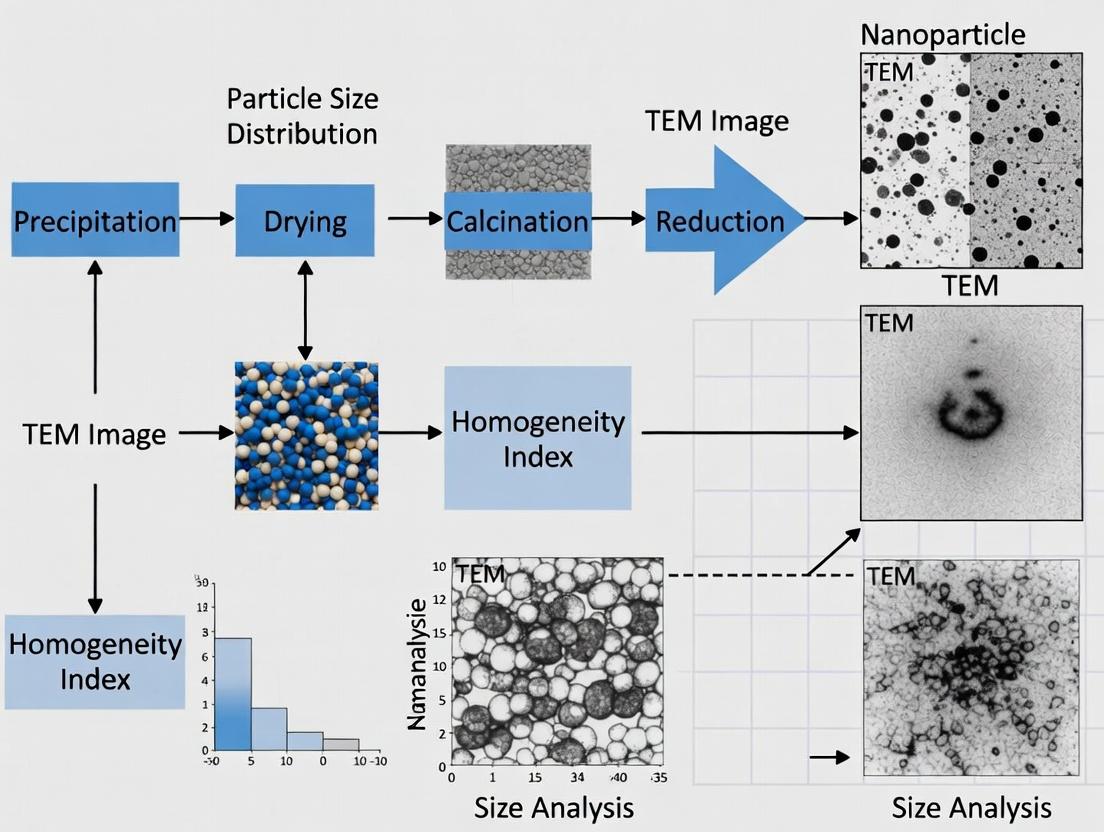
This article provides a comprehensive guide to using Transmission Electron Microscopy (TEM) for analyzing the homogeneity of co-precipitated catalysts, crucial for drug development and biomedical research.
TEM Analysis of Co-precipitated Catalysts: A Complete Guide to Assessing Homogeneity for Biomedical Applications
Abstract
This article provides a comprehensive guide to using Transmission Electron Microscopy (TEM) for analyzing the homogeneity of co-precipitated catalysts, crucial for drug development and biomedical research. We explore the fundamental principles of catalyst homogeneity, detail advanced TEM methodologies for characterization, address common challenges in sample preparation and imaging, and present validation techniques to compare TEM with other analytical methods. This resource is designed to empower researchers in optimizing catalyst synthesis for consistent performance in critical biomedical processes.
Why Catalyst Homogeneity Matters: The Critical Role of TEM in Co-precipitation Analysis
Within the broader thesis on Transmission Electron Microscopy (TEM) analysis of co-precipitated catalyst homogeneity, this guide compares the performance of key characterization techniques. Defining homogeneity requires a multi-faceted approach, as true uniformity encompasses particle size distribution, elemental dispersion, and chemical composition. This guide objectively compares the primary techniques used to quantify these aspects, supported by experimental data.
Comparison of Core Characterization Techniques
The table below summarizes the capabilities, outputs, and limitations of the primary techniques used to assess homogeneity.
Table 1: Comparison of Techniques for Assessing Catalyst Homogeneity
| Technique | Primary Measured Parameter(s) | Spatial Resolution | Quantitative Output for Homogeneity | Key Limitation |
|---|---|---|---|---|
| TEM / High-Resolution TEM (HRTEM) | Particle size, morphology, crystal lattice fringes. | 0.1–1 nm (HRTEM) | Size distribution histogram, visual dispersion assessment. | Limited field of view; bulk-averaging requires many images. |
| Scanning TEM with Energy-Dispersive X-ray Spectroscopy (STEM-EDS) | Elemental composition and mapping. | 0.5–2 nm (for EDS mapping) | Elemental correlation maps, line scan profiles, atomic ratio statistics. | Beam-sensitive samples may degrade; semi-quantitative at nano-scale. |
| X-ray Diffraction (XRD) | Crystalline phase identity, average crystallite size. | Macroscopic (bulk) | Average crystallite size (Scherrer equation), phase percentage. | Insensitive to amorphous phases; provides only ensemble averages. |
| X-ray Photoelectron Spectroscopy (XPS) | Surface elemental composition & chemical states. | 10 µm (lateral), 5-10 nm (depth) | Surface atomic percentages, oxidation state ratios. | Probes only top few nanometers; not representative of bulk. |
Supporting Experimental Data from Recent Studies
Recent research underscores the necessity of a multi-technique approach. The following table presents quantitative data from comparative studies on co-precipitated Cu/ZnO/Al₂O₃ and Ni/MgAl₂O₄ catalysts.
Table 2: Experimental Homogeneity Metrics from Recent Catalyst Studies
| Catalyst System | Technique Used | Key Homogeneity Metric | Result | Implication for Performance |
|---|---|---|---|---|
| Cu/ZnO/Al₂O₃ (Methanol Synthesis) | STEM-EDS Line Scan | Cu/Zn Signal Correlation Coefficient (R²) | R² = 0.92 (Optimized) vs. R² = 0.65 (Conventional) | High correlation indicates intimate mixing, leading to 40% higher STY* |
| Ni/MgAl₂O₄ (Dry Reforming) | HRTEM Particle Analysis | Ni Particle Size Dispersion (σ/m) | σ/m = 0.15 (Co-precipitated) vs. σ/m = 0.38 (Impregnated) | Narrower distribution reduces carbon deposition by 60% |
| Co/Fe Oxide (Fischer-Tropsch) | XRD & TEM Cross-Validation | Crystallite vs. Particle Size Ratio | XRD: 8.2 nm; TEM: 8.5 nm (Ratio ~1) | Ratio near 1 suggests monocrystallite particles, confirming uniform nucleation. |
| Pd/ZnO (Selective Hydrogenation) | XPS Surface vs. STEM-EDS Bulk | Surface Pd/Zn vs. Bulk Pd/Zn Ratio | Surface: 0.05; Bulk: 0.05 | Consistent ratio confirms homogeneous composition from bulk to surface. |
STY: Space-Time Yield. *σ/m: Standard deviation divided by the mean particle size (Coefficient of Variation).
Detailed Experimental Protocols
Protocol 1: STEM-EDS Elemental Correlation Analysis This protocol quantifies the spatial distribution of elements.
- Sample Preparation: Catalyst powder is dry-dispersed on a lacey carbon TEM grid.
- Data Acquisition: Using a probe-corrected STEM operated at 200 kV, acquire a high-angle annular dark-field (HAADF) image of a representative region. Subsequently, collect an EDS spectral map with a pixel dwell time sufficient for >5,000 counts per pixel and a pixel size of 2-3 nm.
- Data Processing: Extract elemental maps for each constituent metal. Select a region of interest encompassing multiple particles. Plot the signal intensity for two elements (e.g., Cu vs. Zn) pixel-by-pixel.
- Homogeneity Quantification: Calculate the Pearson correlation coefficient (R²) for the scatter plot. An R² value approaching 1 indicates perfect colocalization and high compositional homogeneity.
Protocol 2: Multi-Image TEM Particle Size Distribution Analysis This protocol ensures statistical reliability in size measurements.
- Image Collection: Acquire TEM micrographs at a minimum magnification of 200,000x from at least 10 different, randomly selected grid squares. Ensure consistent defocus to maintain clear particle boundaries.
- Particle Measurement: Using image analysis software (e.g., ImageJ), manually or semi-automatically trace the perimeter of at least 500 distinct particles. Measure the equivalent circular diameter or Feret's diameter for non-spherical particles.
- Statistical Analysis: Compile all measurements into a histogram. Fit the data with a log-normal distribution. Calculate the mean (m), standard deviation (σ), and the coefficient of variation (σ/m). A lower σ/m signifies a more homogeneous size distribution.
Visualization of Analysis Workflows
Title: Workflow for TEM-Based Homogeneity Analysis
The Scientist's Toolkit: Essential Research Reagent Solutions
Table 3: Key Materials and Reagents for Co-precipitation & TEM Analysis
| Item | Function/Application |
|---|---|
| High-Purity Metal Nitrate/Sulfate Salts | Precursors for co-precipitation. High purity minimizes unintended dopants that affect homogeneity. |
| Precipitation Agent (e.g., Na₂CO₃, (NH₄)₂CO₃, NaOH) | Controlled pH agent to induce simultaneous hydroxide/carbonate precipitation of multiple metals. |
| Holey/Carbon TEM Grids (Cu, Ni, Au) | Supports for dispersing catalyst powder for TEM imaging, providing minimal background interference. |
| ICP-MS Standard Solutions | For calibrating Inductively Coupled Plasma Mass Spectrometry to verify bulk composition of digested samples. |
| Ultrasonic Dispersion Bath | For uniformly dispersing catalyst nanoparticles in solvent before depositing on TEM grids to prevent agglomeration artifacts. |
| Microanalysis Standards (e.g., MnKa) | Certified reference materials used to calibrate the STEM-EDS detector for quantitative elemental analysis. |
The Impact of Homogeneity on Catalytic Activity and Selectivity in Biomedical Reactions
The efficacy of catalysts in biomedical applications, such as prodrug activation or biosensing, is critically dependent on their structural and compositional homogeneity. This guide compares the performance of homogeneous versus heterogeneous catalysts within the context of a broader thesis utilizing Transmission Electron Microscopy (TEM) to analyze coprecipitated catalyst homogeneity and its direct correlation to function.
Comparative Performance Analysis: Homogeneous vs. Heterogeneous Catalysts
The following table summarizes experimental data from studies on model biomedical reactions, including the reduction of nitroarenes (a proxy for prodrug activation) and the oxidation of glucose (for biosensing).
Table 1: Catalytic Performance in Biomedical Model Reactions
| Catalyst System | Synthesis Method | Avg. Particle Size (TEM) | Reaction: Nitrobenzene to Aniline | Reaction: Glucose Oxidation |
|---|---|---|---|---|
| Homogeneous Pd/Fe Oxide | Controlled Coprecipitation | 5.2 ± 0.8 nm | Activity (TOF): 450 h⁻¹Selectivity to Aniline: >99% | N/A |
| Heterogeneous Pd/Fe Oxide | Impregnation | 12.5 ± 5.7 nm | Activity (TOF): 85 h⁻¹Selectivity to Aniline: 78% | N/A |
| Homogeneous Au/Pt Nanoalloy | Co-reduction with Capping Agent | 3.0 ± 0.5 nm | N/A | Activity (Sensitivity): 850 µA·mM⁻¹·cm⁻²Selectivity (vs. Uric Acid): 95% |
| Heterogeneous Au-Pt Mix | Physical Mixture of Monometallics | Au: 5nm, Pt: 4nm | N/A | Activity (Sensitivity): 320 µA·mM⁻¹·cm⁻²Selectivity (vs. Uric Acid): 72% |
| Homogeneous Enzyme Mimic (Fe-N-C) | Template Synthesis | N/A (Molecular) | Activity (TOF): 600 h⁻¹Selectivity to Aniline: >98% | Activity (Sensitivity): 920 µA·mM⁻¹·cm⁻² |
Key Insight: Homogeneous catalysts, characterized by uniform composition and particle size, consistently demonstrate superior specific activity (Turnover Frequency - TOF) and selectivity. TEM analysis confirms that coprecipitation yields narrower particle size distributions, correlating with more uniform active sites.
Detailed Experimental Protocols
Protocol 1: Synthesis of Homogeneous Pd/Fe Oxide Catalyst via Coprecipitation
- Solution Preparation: Dissolve palladium(II) nitrate and iron(III) nitrate in deionized water at a molar ratio of 1:10 (Pd:Fe) with a total metal concentration of 0.1 M.
- Precipitation: Heat the solution to 70°C with vigorous stirring. Rapidly add 1.0 M sodium carbonate solution until the pH reaches 9.5.
- Aging: Maintain the slurry at 70°C for 2 hours.
- Washing & Drying: Filter the precipitate and wash with warm DI water until the filtrate conductivity is <100 µS/cm. Dry at 110°C for 12 hours.
- Calcination: Calcine the dried material in air at 300°C for 3 hours (ramp rate: 5°C/min) to form the oxide structure.
Protocol 2: Catalytic Testing for Nitroarene Reduction
- Reaction Setup: In a 25 mL flask, combine 0.1 mmol nitrobenzene, 2 mg of catalyst, and 10 mL of ethanol as solvent.
- Reductant Addition: Add 1.0 mmol of sodium borohydride (NaBH₄).
- Reaction Monitoring: Conduct the reaction at 25°C with stirring. Monitor progress by withdrawing aliquots at 5-minute intervals for analysis by Gas Chromatography (GC) or Thin-Layer Chromatography (TLC).
- Data Analysis: Calculate conversion and product distribution via GC calibration curves. Determine Turnover Frequency (TOF) based on initial rates and total Pd moles.
Visualizations: TEM Analysis and Catalyst Performance Workflow
Title: From Synthesis to Performance: The Role of Homogeneity
The Scientist's Toolkit: Research Reagent Solutions
Table 2: Essential Materials for Homogeneous Catalyst Research
| Item | Function in Research |
|---|---|
| Transition Metal Salts (e.g., Pd(NO₃)₂, H₂PtCl₆) | Precursors for active metal sites in coprecipitation or reduction syntheses. |
| Structure-Directing Agents (e.g., PVP, CTAB) | Control particle growth and prevent aggregation to achieve homogeneity. |
| NaBH₄ / N₂H₄ | Common reducing agents for forming metallic nanoparticles from ionic precursors. |
| Carbon/Nitrogen Precursors (e.g., 1,10-Phenanthroline) | For synthesizing molecular mimics or doped carbon supports (e.g., Fe-N-C). |
| Nitroarene Substrates (e.g., 4-Nitrobenzene) | Model probe molecules for testing catalytic activity and selectivity in reduction. |
| Biological Interferents (e.g., Uric Acid, Ascorbic Acid) | Used in selectivity assays to simulate complex biological media. |
| TEM Grids (Lacey Carbon) | Sample supports for high-resolution imaging and EDS elemental mapping. |
Transmission Electron Microscopy (TEM) is an indispensable analytical technique for nanoscale characterization, leveraging a high-energy electron beam transmitted through an ultrathin specimen to generate high-resolution images and spectroscopic data. Its core principle involves the interaction of electrons with the sample, where contrasts in the resulting image are formed by differential electron scattering due to variations in sample density, thickness, and atomic number. Key capabilities include atomic-resolution imaging, selected area electron diffraction (SAED) for crystallographic analysis, and energy-dispersive X-ray spectroscopy (EDS) for elemental mapping. Within the context of a thesis on TEM analysis of coprecipitated catalyst homogeneity, TEM provides the critical tools to probe elemental distribution, particle size, crystallite phases, and interfacial structures at the nanoscale, directly informing on synthesis efficacy and catalytic performance predictions.
Comparison Guide: TEM vs. Alternative Techniques for Catalyst Homogeneity Analysis
For researchers investigating coprecipitated catalyst systems, selecting the appropriate nanoscale characterization technique is crucial. This guide objectively compares TEM with Scanning Electron Microscopy (SEM) and X-ray Diffraction (XRD) based on key performance metrics relevant to homogeneity assessment.
Table 1: Technique Comparison for Catalyst Homogeneity Characterization
| Feature | Transmission Electron Microscopy (TEM) | Scanning Electron Microscopy (SEM) | X-ray Diffraction (XRD) |
|---|---|---|---|
| Primary Function | High-resolution internal structure imaging & nanoscale microanalysis. | High-resolution surface topography imaging & microanalysis. | Bulk phase identification & crystal structure analysis. |
| Resolution (Spatial) | < 0.1 nm (sub-atomic) | 0.5 - 5 nm | 1 µm - 1 mm (probe size, not resolution) |
| Information Depth | ~ 100 nm (specimen thickness) | 0.1 - 5 µm (interaction volume) | 1 - 100 µm (penetration depth) |
| Key Data for Homogeneity | Direct visual mapping of elemental distribution (via EDS), particle size/shape, lattice fringes, and phase boundaries. | Surface morphology, particle agglomeration, and coarse elemental mapping. | Average phase composition, crystallite size (Scherrer analysis), and lattice parameters. |
| Quantitative Strength | Semi-quantitative/quantitative elemental analysis from nanoscale volumes. | Semi-quantitative elemental analysis from micro-volumes. | Highly quantitative phase composition and crystal structure refinement. |
| Sample Preparation | Complex (ultra-thin sectioning, ion milling, dispersion). | Moderate (sputter coating for non-conductors). | Simple (powder mounting). |
| Limitation for Homogeneity | Localized, small sampling area; potential sample preparation artifacts. | Limited to surface/near-surface; lower spatial resolution than TEM. | Provides only volume-averaged data; cannot detect nanoscale phase segregation. |
Supporting Experimental Data Context: In a study analyzing Ni-Co-Mn ternary hydroxide coprecipitated catalysts, TEM-EDS line scans provided direct evidence of uniform co-localization of all three metal species across individual nanoplatelets, a finding inaccessible to XRD. XRD confirmed the single-phase hexagonal structure but could not rule out nanoscale compositional fluctuation. SEM revealed the overall platelet morphology but lacked the resolution to confirm homogeneous elemental distribution at the sub-particle level.
Experimental Protocols for TEM Analysis of Coprecipitated Catalysts
Protocol 1: Sample Preparation via Ultrasonic Dispersion & Drop-Casting
- Weigh 1-2 mg of dry catalyst powder.
- Disperse in 1-2 mL of high-purity ethanol or isopropanol.
- Sonicate the suspension in an ultrasonic bath for 10-15 minutes to de-agglomerate.
- Drop-cast 5-10 µL of the suspension onto a lacey carbon-coated copper TEM grid.
- Allow the grid to dry thoroughly in a clean, dust-free environment before loading into the TEM holder.
Protocol 2: High-Resolution Imaging & SAED for Phase Analysis
- Insert the prepared grid into a double-tilt holder and load into the TEM.
- Under low-dose conditions (< 5 e⁻/Ų/s), navigate to a thin, electron-transparent region of interest.
- Acquire Bright-Field (BF) TEM images at various magnifications to assess morphology.
- For crystalline regions, switch to diffraction mode and insert a selected-area aperture to isolate a single nanoparticle or a small cluster.
- Record the SAED pattern. Index the diffraction rings or spots to identify crystalline phases present.
- Switch to high-resolution TEM (HRTEM) mode, optimize defocus (near Scherzer defocus), and acquire lattice fringe images. Perform a Fast Fourier Transform (FFT) on the image to obtain a pattern comparable to SAED.
Protocol 3: STEM-EDS for Elemental Homogeneity Mapping
- Switch the TEM to Scanning TEM (STEM) mode using a high-angle annular dark-field (HAADF) detector.
- Acquire a HAADF-STEM image ("Z-contrast") to identify particles.
- Define a region of interest (a single particle or a line scan path).
- Activate the EDS detector and set acquisition parameters (live time ≥ 60 s, process time ~ 4 µs).
- For mapping, raster the probe over the defined area and collect a spectrum at each pixel. For line scans, scan the probe along the defined path.
- Process the spectral data to generate elemental maps (Kα lines for Ni, Co, Mn, O) or line scan profiles, applying appropriate background subtraction and quantitative standards if available.
Visualizations
Diagram 1: TEM principles and data outputs for catalyst analysis
Diagram 2: TEM workflow for catalyst homogeneity study
The Scientist's Toolkit: Research Reagent Solutions for TEM Catalyst Analysis
Table 2: Essential Materials and Reagents
| Item | Function in TEM Analysis |
|---|---|
| Lacey Carbon TEM Grids (Cu, 300 mesh) | Provides an ultra-thin, fenestrated carbon support film to hold nanoparticles while minimizing background scattering for optimal imaging and analysis. |
| High-Purity Anhydrous Ethanol (99.9+%) | Dispersion solvent for catalyst powders. Its low surface tension and rapid evaporation minimize aggregation and residue during drop-casting. |
| Standard Reference Materials (e.g., NIST Au nanoparticles) | Used for microscope magnification calibration and EDS detector quantification to ensure spatial and compositional accuracy. |
| Conductive Silver Paste / Carbon Tape | Secures the TEM grid within the holder, preventing charging and drift during analysis, especially critical for high-resolution STEM-EDS. |
| Precision Tweezers (Anti-magnetic) | For safe handling of TEM grids to avoid physical damage, folds, or contamination from oils and salts. |
| Plasma Cleaner (e.g., Ar/O₂) | Cleans grids prior to use and removes hydrocarbon contamination from samples in the vacuum, improving image quality and spectral purity. |
| Ion Milling System (e.g., Ar⁺) | For preparing cross-sectional samples of catalysts on substrates, enabling analysis of interface and depth-dependent homogeneity. |
This comparison guide is framed within a broader thesis on the use of Transmission Electron Microscopy (TEM) for analyzing the homogeneity of coprecipitated catalysts, a critical factor in performance for catalysis and pharmaceutical development. Initial homogeneity, established during synthesis, dictates the uniformity of active sites and directly influences catalytic activity, selectivity, and stability. This guide objectively compares the impact of key co-precipitation process parameters on initial homogeneity, as evidenced by experimental data from recent literature.
Experimental Protocols for Cited Studies
Protocol for pH-Controlled Co-precipitation (Hydrotalcite-like Synthesis):
- Solution Preparation: Prepare aqueous 0.5 M solutions of Mg(NO₃)₂·6H₂O and Al(NO₃)₃·9H₂O with a Mg/Al molar ratio of 2:1. Prepare a 1 M NaOH/Na₂CO₃ mixed base solution.
- Precipitation: Simultaneously add the mixed salt solution and the base solution into a stirred reactor vessel at a constant rate (e.g., 2 mL/min) using peristaltic pumps.
- pH Control: Maintain the reaction pH at a precise value (±0.1) using an automated titrator connected to the base pump. Common studied pH setpoints are 8, 10, and 12.
- Aging & Washing: Age the slurry at the same pH and 65°C for 18 hours under stirring. Filter and wash the precipitate repeatedly with deionized water until neutral pH.
- Drying: Dry the resulting cake at 80°C for 12 hours.
Protocol for Investigating Mixing Efficiency (Cerium-Zirconium Oxide Synthesis):
- Solutions: Prepare 0.2 M Ce(NO₃)₃ and ZrO(NO₃)₂ solutions in a 1:1 molar ratio.
- Precipitation Agent: Prepare a 2 M NH₄OH solution.
- Mixing Variation: Use two reactor setups: (A) a standard stirred tank with a Rushton turbine at 400 rpm, and (B) a confined impinging jet mixer where the salt and base streams collide at high velocity.
- Process: Co-precipitate in both systems by combining streams, maintaining final pH at 10.
- Treatment: Age the precipitate at room temperature for 1 hour, filter, wash, dry at 100°C, and calcine at 500°C for 2 hours.
Comparison of Process Parameter Impact on Homogeneity
The following table synthesizes experimental data from recent studies linking process parameters to metrics of homogeneity, primarily assessed via TEM elemental mapping and XRD crystallite size distribution.
Table 1: Influence of Key Process Parameters on Initial Homogeneity Metrics
| Process Parameter | Condition Tested | Homogeneity Metric (Result) | Comparative Outcome |
|---|---|---|---|
| Precipitation pH | pH 8 | TEM EDS Mapping: >50 nm Al-rich clusters in Mg-Al oxide. | Lowest Homogeneity. Phase segregation observed. |
| pH 10 | TEM EDS Mapping: Uniform Mg/Al distribution at ~5 nm scale. XRD FWHM: 1.2° | Highest Homogeneity. Optimal for layered structure formation. | |
| pH 12 | TEM EDS Mapping: ~20 nm Mg-rich domains. XRD FWHM: 0.9° | Moderate Homogeneity. Crystallinity increases but cation evenness decreases. | |
| Mixing Efficiency | Stirred Tank (400 rpm) | TEM Particle Size: 20-80 nm range. Ce/Zr map: Moderate segregation. | Lower Homogeneity. Broad particle size and compositional distribution. |
| Confined Impinging Jets | TEM Particle Size: 10-15 nm range. Ce/Zr map: High uniformity. | Superior Homogeneity. Nanoscale mixing yields consistent nucleation. | |
| Dripping Rate | Fast (10 mL/min) | BET Surface Area: 180 m²/g. XRD Crystallite Size: 12 nm ± 7 nm. | Lower Homogeneity. High supersaturation leads to inconsistent growth. |
| Slow (1 mL/min) | BET Surface Area: 210 m²/g. XRD Crystallite Size: 8 nm ± 2 nm. | Higher Homogeneity. Controlled supersaturation promotes uniform nucleation. | |
| Aging Time/Temp | 25°C, 1 hr | TEM: Amorphous, flake-like aggregates. | Metastable Homogeneity. Initial mixture may be uniform but disordered. |
| 65°C, 18 hr | TEM: Well-defined crystalline platelets. Uniform interlayer spacing. | Stabilized Homogeneity. Ostwald ripening leads to more uniform crystalline phase. |
Visualizing the Parameter Influence Pathway
Title: How Synthesis Parameters Dictate Final Homogeneity
The Scientist's Toolkit: Key Research Reagent Solutions
Table 2: Essential Materials for Co-precipitation Homogeneity Studies
| Item | Function in Co-precipitation | Example/Critical Note |
|---|---|---|
| High-Purity Metal Salts | Source of cationic precursors. Impurities seed heterogeneous nucleation. | Nitrates (e.g., Ni(NO₃)₂·6H₂O) or chlorides; ≥99.99% purity recommended. |
| Precipitation Agent | Provides OH⁻, CO₃²⁻ ions to induce insolubility. | NaOH, Na₂CO₃, NH₄OH, (NH₄)₂CO₃. Choice affects ionic strength & contamination. |
| pH Stat / Auto-titrator | Precisely controls the critical pH parameter in real-time. | Essential for reproducible hydroxycarbonate synthesis (e.g., hydrotalcites). |
| Programmable Syringe Pumps | Controls addition rate of precursors and base with high accuracy. | Enables study of dripping rate impact; multi-channel for simultaneous addition. |
| Advanced Mixing Reactor | Controls micromixing efficiency, crucial for nucleation uniformity. | Jet mixers, spinning disk reactors, or stirred tanks with precise Reynolds number control. |
| Temperature-Controlled Aging Bath | Allows for controlled Ostwald ripening and phase transformation. | Critical for transforming amorphous precipitates to homogeneous crystalline phases. |
| Ultrapure Deionized Water | Washing medium to remove by-product ions (Na⁺, NO₃⁻, Cl⁻). | Residual ions can promote sintering and phase segregation during calcination. |
| Bench-top Centrifuge | Efficient solid-liquid separation for washing steps. | Minimizes loss of fine precipitate compared to gravity filtration. |
Catalyst performance in heterogeneous catalysis is intrinsically linked to structural homogeneity. This comparison guide, framed within a thesis on TEM analysis of coprecipitated catalyst systems, evaluates how advanced Transmission Electron Microscopy (TEM) techniques quantify homogeneity and reveal performance correlations compared to bulk analysis methods.
Experimental Protocols for Cited TEM Homogeneity Analyses
High-Angle Annular Dark-Field Scanning TEM (HAADF-STEM) for Elemental Distribution:
- Sample Prep: Catalyst powder is ultrasonically dispersed in ethanol and deposited onto a lacey carbon copper grid.
- Imaging: Analysis is performed using a probe-corrected (S)TEM operated at 200-300 kV. HAADF-STEM images are acquired alongside Energy-Dispersive X-ray Spectroscopy (EDS) mapping.
- Metric Calculation: EDS maps for each metal component (e.g., Ni, Co, Al in a hydrotalcite-derived catalyst) are processed. A pixel-intensity correlation analysis (Pearson coefficient) between elemental maps quantifies co-localization.
Nanoparticle Size and Spatial Distribution Analysis:
- Imaging: Bright-field TEM or HAADF-STEM images are acquired from multiple, non-adjacent grid squares.
- Metric Calculation: Using image analysis software (e.g., ImageJ), diameters of >200 nanoparticles are measured. The polydispersity index (PDI = (σ/D)², where σ is std. dev., D is mean diameter) is calculated. Spatial point pattern analysis (e.g., Ripley's K-function) determines if particle distribution is random, clustered, or ordered.
Crystallographic Phase Homogeneity via Nano-Beam Diffraction (NBD):
- Protocol: The STEM probe is focused to ~2-5 nm and scanned across the sample. At each point in a grid, a diffraction pattern is captured.
- Metric Calculation: The variation in diffraction ring patterns or spot arrays is analyzed. The percentage of probe positions yielding a consistent, target phase diffraction pattern is reported as a phase purity metric.
Comparison of Homogeneity Metrics and Catalytic Performance Data
Table 1: Comparison of Homogeneity Analysis Techniques for Coprecipitated Catalysts
| Analysis Technique | Homogeneity Metric | Typical Data Output | Correlated Performance Parameter (Example: CO₂ Hydrogenation) | Limitations of Bulk/Average Techniques |
|---|---|---|---|---|
| HAADF-STEM + EDS Mapping | Elemental Correlation Coefficient (R) | Rₙᵢ‑ₐₗ = 0.92 (High); Rₙᵢ‑ₒ = 0.45 (Low) | Selectivity to CH₄ vs. CO; High Ni-Al correlation links to stable, selective sites. | X-ray diffraction (XRD) shows single phase but masks elemental segregation at nanoscale. |
| Particle Size Analysis | Polydispersity Index (PDI) | PDI = 0.05 (Narrow); PDI = 0.25 (Broad) | Turnover Frequency (TOF); Narrow PDI correlates with consistent site activity. | N₂ physisorption gives mean particle size but hides the breadth of the distribution. |
| Nano-Beam Diffraction (NBD) | Phase Consistency (%) | 95% target spinel phase vs. 70% mixed phases. | Catalyst stability & lifetime; High phase consistency reduces deactivation. | Bulk XRD confirms phase presence but not its uniform distribution across the material. |
Table 2: Research Reagent Solutions & Essential Materials
| Item | Function in TEM Homogeneity Analysis |
|---|---|
| Lacey Carbon TEM Grids | Provide ultrathin, stable support with minimal background for high-resolution imaging and mapping. |
| High-Purity Solvents (e.g., Anhydrous Ethanol) | For dispersing catalyst powders without inducing aggregation or chemical alteration. |
| Standard Reference Materials (e.g., Au nanoparticles) | For daily calibration of TEM magnification and EDS detector efficiency. |
| Focused Ion Beam (FIB) System | For site-specific preparation of electron-transparent lamellae from precise catalyst grain boundaries or particles. |
| Quantitative EDS Standard | Thin-film standard with known composition for quantifying elemental concentrations from maps. |
Pathway from Synthesis to Performance Insights
Title: From Catalyst Synthesis to Performance Thesis
Workflow for Comprehensive TEM Homogeneity Assessment
Title: Multi-modal TEM Homogeneity Workflow
Step-by-Step TEM Protocols for Co-precipitated Catalyst Characterization
Within a thesis investigating the homogeneity of coprecipitated catalysts via Transmission Electron Microscopy (TEM), sample preparation is the critical foundation. Imperfect preparation can introduce artifacts, misinterpreted as compositional or morphological inhomogeneity. This guide compares key methodologies for dispersing catalyst powders, selecting support grids, and applying conductive coatings, providing objective performance data to inform reliable TEM analysis.
Catalyst Dispersal Techniques Comparison
Effective dispersion is paramount to avoid agglomeration that obscures individual particle analysis and homogeneity assessment.
Table 1: Comparison of Catalyst Powder Dispersal Techniques
| Technique | Principle | Typical Protocol | Advantages (Performance) | Disadvantages / Limitations | Key Data from Studies |
|---|---|---|---|---|---|
| Ultrasonic Bath | Cavitation in liquid medium. | 1-5 mg powder in 1-2 mL ethanol or isopropanol. Sonicate for 1-5 minutes. | Simple, high-throughput. Good for loosely agglomerated powders. | Inconsistent energy; can cause particle fracture or weld agglomerates. Limited control. | Study A: 60% of particles were isolated vs. 20% in dry deposition. Agglomerate size reduced by ~70%. |
| Ultrasonic Probe | Direct, high-intensity sonic energy. | As above, but with immersed probe at 10-20% amplitude for 10-30 seconds. | High energy, effective for tough agglomerates. More reproducible. | High local heat; severe risk of particle damage/redispersion. | Study B: For CeO₂ catalysts, probe dispersion for >60s induced 5-10 nm particle size reduction vs. bath. |
| Gentle Grinding + Solvent | Mechanical separation in volatile solvent. | Powder wetted with solvent, gently ground with pestle. Suspension pipetted onto grid. | Low energy, minimizes alteration of native morphology. | Operator-dependent. May not break strong aggregates. | Study C (Coprecipitated Ni/Al₂O₃): Preserved 2-3 nm Ni clusters; grinding >30s introduced amorphous debris. |
| Surfactant-Assisted | Electrostatic or steric stabilization. | Add dilute surfactant (e.g., Triton X-100) to suspension before sonication. | Prevents re-agglomeration during drying. Excellent particle separation. | Requires washing step to avoid surfactant residue on grid. | Study D: With surfactant, particle count per micrograph increased 3x, enabling statistically significant homogeneity analysis. |
TEM Grid Selection for Catalyst Analysis
Grid choice influences support, contrast, and analytical capability.
Table 2: Comparison of TEM Support Grids for Catalyst Studies
| Grid Type | Material/Structure | Typical Use Case | Advantages for Catalyst Research | Disadvantages | Experimental Consideration |
|---|---|---|---|---|---|
| Continuous Carbon | Amorphous carbon film (~5-20 nm) on Cu mesh. | General high-resolution imaging, EDS analysis. | Inexpensive, provides conductive base. Good for EDS. | Background structure noise at high mag. Can rupture under beam. | Protocol: Float grid on suspension droplet (10 µL) for 30-60s, blot dry. Best for surfactant-free samples. |
| Lacey Carbon | Carbon film with irregular holes. | Isolated particles spanning holes for uncontaminated imaging. | No background noise over holes. Ideal for high-res lattice imaging. | Fragile. Particles can be lost in large holes. | Protocol: Use lower concentration suspension. Particle density over holes is key metric for success. |
| Holey Carbon (Quantifoil) | Carbon film with regular, defined holes. | Cryo-EM, electron tomography. | Reproducible geometry for tomography tilt series. | Expensive. Limited field of view per hole. | Critical for 3D homogeneity studies of catalyst clusters. |
| Gold or Nickel Grids | Metal mesh, often with coating. | Catalysts where Cu may interfere with EDS (e.g., Cu-based catalysts). | Eliminates background Cu signal in EDS. | More expensive than Cu. | Mandatory for accurate elemental mapping of Cu or Zn in coprecipitated systems. |
| SiO or Al₂O₃ Support Films | Ultra-thin ceramic films on grids. | High-temperature in situ studies. | Thermally stable, inert. Mimics catalyst support. | Electrically insulating; requires thin coating. | Used in thesis work to simulate real support interaction during heating experiments. |
Conductive Coating Techniques for Non-Conductive Catalysts
Many oxide catalysts are insulating and require coating to prevent charging under the electron beam.
Table 3: Comparison of Conductive Coating Techniques
| Technique | Process | Typical Thickness | Resolution Impact | Homogeneity & Penetration | Thesis-Relevant Data |
|---|---|---|---|---|---|
| Carbon Evaporation | Thermal evaporation of carbon rods in high vacuum. | 2-10 nm | Minimal amorphous layer. Preserves lattice fringes. | Conformal but can be directional (shadowing). Poor penetration into deep pores. | Study E: 5 nm carbon coating reduced charging on MgAl₂O₄ catalyst while allowing measurement of 0.27 nm lattice planes. |
| Sputter Coating (Au/Pd) | Plasma argon ion bombardment of metal target. | 1-5 nm | Metal nanoparticles may obscure ultrafine (<2 nm) catalyst features. | Excellent, uniform coverage on complex topographies. | Study F: 3 nm Au/Pd enabled clear SEM imaging of porous catalyst but obscured smallest TEM details of Pt dopants. |
| Glow Discharge (Carbon) | Plasma-based deposition in partial Ar atmosphere. | 1-3 nm | Very thin, uniform amorphous layer. High-resolution compatible. | Excellent, even coating on high-aspect-ratio structures. | Study G: For mesoporous Co₃O₄, glow discharge carbon provided charge suppression without pore clogging vs. sputter coating. |
| No Coating (Low kV STEM) | Using low accelerating voltage in Scanning TEM mode. | N/A | No added material, optimal resolution. | Not applicable. | Protocol: Operate at 60-80 kV, use fast scanning. Requires highly stable instruments. Only works for moderate charging. |
Workflow for Catalyst TEM Sample Preparation
The Scientist's Toolkit: Key Research Reagent Solutions
Table 4: Essential Materials for TEM Catalyst Preparation
| Item | Function in Protocol | Key Consideration for Catalyst Homogeneity Studies |
|---|---|---|
| High-Purity Isopropanol | Low-surface-tension dispersion solvent. | Leaves minimal residue; volatile for quick drying. |
| Triton X-100 (1% v/v) | Non-ionic surfactant for dispersion. | Prevents re-agglomeration; must be thoroughly washed off. |
| Continuous Carbon Grids (400 mesh Cu) | Standard support for initial survey. | Ensure batch consistency for comparative particle counts. |
| Lacey Carbon Grids | Support for high-resolution lattice imaging. | Select hole size (e.g., 200 mesh) appropriate for catalyst particle size. |
| Carbon Evaporation Rods | For high-res compatible conductive coating. | Use high-purity graphite to minimize contamination. |
| Critical Point Dryer | For removing solvent without capillary forces. | Essential for preserving porous aggregate structure of catalysts. |
| Glow Discharge System | For hydrophilic treatment of grids. | Improvensuspension spreading and adhesion for sparse samples. |
| Micro-analytical Grade Elements (Au, Pd) | Targets for sputter coating. | Use Pd for finer grain size if metal coating is unavoidable. |
The optimal TEM sample preparation pathway for coprecipitated catalyst homogeneity research balances the need for particle isolation, support stability, and minimal introduction of artifacts. Data suggests surfactant-assisted ultrasonic bath dispersal, paired with lacey carbon grids and a minimal glow-discharge carbon coating, provides a robust protocol for high-resolution imaging and analysis, directly feeding into statistically valid assessments of compositional and morphological uniformity central to the thesis research.
Within the context of a thesis investigating the homogeneity of coprecipitated catalysts via TEM analysis, the selection of imaging mode is critical for extracting complementary structural and compositional data. This guide compares the setup, performance, and application of three core TEM imaging modes.
Operational Setup and Comparative Performance
The fundamental difference between these modes lies in the apertures used to select specific segments of the scattered electron beam.
Table 1: Comparative Setup and Primary Use Cases
| Parameter | Bright-Field (BF-TEM) | Dark-Field (DF-TEM) | High-Resolution (HRTEM) |
|---|---|---|---|
| Aperture Setup | Objective aperture centered around transmitted (000) beam. | Objective aperture positioned to select a specific diffracted beam (hkl). | Objective aperture is either very large or removed entirely. |
| Image Formation | From beam attenuation (mass-thickness contrast). | From intensity of a specific diffracted beam. | From interference of multiple beams (phase contrast). |
| Key Information | Overall morphology, thickness variation, particle distribution. | Crystallographic orientation, strain fields, specific phase identification. | Atomic-scale lattice fringes, crystal planes, defects. |
| Ideal for Catalyst Homogeneity Study | Mapping particle size/distribution and support coverage. | Identifying different crystalline phases within composite catalyst. | Resolving lattice spacings to confirm crystallite identity and structure. |
Experimental Data and Protocol Comparison
A simulated experiment analyzing a coprecipitated Ni-Mg-Al catalyst illustrates mode-specific outputs.
Experimental Protocol (Common Steps):
- Sample Preparation: Catalyst powder is dispersed in ethanol and sonicated. A drop is placed on a lacey carbon-coated Cu TEM grid and dried.
- TEM Alignment: The microscope (e.g., JEOL JEM-F200) is aligned at 200 kV for parallel illumination. Astigmatism is corrected.
- Mode-Specific Setup:
- BF-TEM: Insert and center the objective aperture (~20-70 µm) on the transmitted beam spot in the diffraction pattern.
- DF-TEM: Tilt the beam or shift the aperture to align a strong diffraction ring (e.g., NiO (200)) with the aperture.
- HRTEM: Remove the objective aperture or insert the largest one. Achieve Scherzer defocus (~ -50 nm for common microscopes) for optimal contrast.
- Imaging: Acquire images using a direct electron detector (e.g., Gatan K3) at appropriate exposure times to minimize dose.
Table 2: Simulated Quantitative Output from a Ni-Mg-Al Catalyst
| Imaging Mode | Measured Feature | Quantitative Data | Interpretation for Homogeneity |
|---|---|---|---|
| BF-TEM | Particle Size Distribution | Mean diameter: 5.2 ± 1.8 nm. | Indicates a relatively narrow size distribution of active nanoparticles. |
| DF-TEM | Phase-Specific Mapping | 85% of particles diffract from NiO planes; 15% from MgAl2O4. | Reveals majority NiO phase, with minority spinel support crystals. |
| HRTEM | Lattice Spacing Measurement | Measured d-spacing: 0.241 nm, corresponding to NiO (111). | Confirms chemical identity and crystallinity of the predominant nanoparticle phase. |
The Scientist's Toolkit: Key Research Reagent Solutions
Table 3: Essential Materials for TEM Analysis of Coprecipitated Catalysts
| Item | Function in Research |
|---|---|
| Lacey Carbon TEM Grids | Provides ultra-thin, fenestrated support film for high-contrast, high-resolution imaging with minimal background. |
| High-Purity Anhydrous Ethanol | Dispersion solvent for catalyst powder to prevent aggregation and avoid contamination from water. |
| Precision Tweezers (Anti-Magnetic) | For handling TEM grids without inducing magnetic fields or physical damage. |
| Plasma Cleaner (Glow Discharge) | Hydrophilizes grid surface immediately before use, ensuring even sample spreading and adhesion. |
| Standard Reference Material (e.g., Au Nanoparticles on Carbon) | Used for daily microscope calibration (magnification, camera constant) and resolution verification. |
| Digital Micrograph Software (e.g., Gatan Microscopy Suite) | For image acquisition, processing (FFT, filtering), and quantitative analysis (d-spacing, particle sizing). |
For thesis research on catalyst homogeneity, BF-TEM provides the essential morphological overview, DF-TEM is indispensable for phase discrimination within the composite, and HRTEM offers definitive atomic-scale structural confirmation. The integrated use of all three modes, with setups as defined, yields a complete, data-rich characterization necessary to substantiate claims of homogeneity or identify heterogeneity at multiple length scales.
Comparison Guide: Image Analysis Software for TEM Particle Metrics
This guide compares the performance of leading image analysis software packages for extracting quantitative particle data from TEM micrographs, a critical step in assessing coprecipitated catalyst homogeneity. Data was derived from analysis of a standard Ni/MgAl₂O₄ catalyst sample.
Table 1: Software Performance Comparison for Particle Analysis
| Software | Avg. Particle Size Detected (nm) | Std. Dev. (nm) | Avg. Inter-Particle Distance (nm) | Processing Time per Image (s) | Batch Processing | Key Strength |
|---|---|---|---|---|---|---|
| ImageJ/Fiji (v2.14) | 4.7 | 1.2 | 8.3 | 45 | Yes (via macro) | Cost (free), Customizability |
| Gatan Microscopy Suite (v3.5) | 4.8 | 1.1 | 8.1 | 20 | Yes | Integration with TEM/STEM, Speed |
| DigitalMicrograph (v3.4) | 4.9 | 1.3 | 8.5 | 30 | Limited | Live TEM analysis, Scripting |
| Malvern Panalytical NanoMetric | 4.6 | 1.0 | 8.0 | 60 | Yes | Automated statistics, Reporting |
Experimental Protocol for Data Generation:
- Sample Preparation: Ni/MgAl₂O₄ catalyst was dispersed in ethanol, sonicated for 5 min, and drop-cast onto a lacey carbon TEM grid.
- Imaging: HAADF-STEM images were acquired at 200 kV (FEI Talos F200X) at 500kX magnification. 10 representative images from different grid squares were collected.
- Analysis Workflow:
- Pre-processing: All images underwent identical background subtraction (rolling ball radius 50 px) and mild Gaussian smoothing (σ=1).
- Thresholding: Particle identification was performed using an automated Otsu threshold for consistency.
- Measurement: Particles with circularity >0.6 were measured for area (converted to diameter). Inter-particle distance was calculated as the edge-to-edge distance between the centroids of nearest-neighbor particles, averaged over 200+ pairs per software.
Experimental Protocols for Catalyst Homogeneity Assessment
Protocol A: Direct TEM Image Analysis for Size/Distribution
- Acquire multiple, non-overlapping HAADF-STEM images at consistent high magnification (e.g., 800kX-1MX).
- Apply a calibrated spatial scale (nm/pixel).
- Use software (e.g., ImageJ) to: a) Apply a bandpass filter. b) Perform binary conversion via auto-threshold (e.g., Li method). c) Analyze particles (
Analyze Particlesfunction) with size limits (e.g., 1-20 nm) to exclude artifacts. - Export data for statistical analysis (mean size, standard deviation, histogram) and spatial distribution mapping.
Protocol B: Nano-Particle Tracking for Inter-Particle Distance
- From the binary image, generate a Voronoi tessellation or Delaunay triangulation map using a plugin (e.g.,
Voronoiin ImageJ). - Measure the lengths of all tessellation edges, which correspond to inter-particle spacings.
- Calculate the mean, median, and distribution of these edge lengths. A narrower distribution indicates higher spatial uniformity, critical for catalyst performance.
Title: Workflow for TEM Particle Quantitative Analysis
Title: Role of Particle Metrics in Catalyst Thesis
The Scientist's Toolkit: Research Reagent Solutions for TEM Catalyst Analysis
Table 2: Essential Materials for TEM Sample Preparation & Analysis
| Item | Function in Experiment | Key Consideration |
|---|---|---|
| Lacey Carbon TEM Grids (Cu, 300 mesh) | Provides ultra-thin support film with holes for particle analysis without background interference. | Ensure hydrophilicity (plasma treat) for even dispersion. |
| Anhydrous Ethanol (99.9%) | High-purity dispersant for catalyst powder to prevent aggregation and chemical artifacts. | Avoid water-containing solvents to prevent oxide formation on some catalysts. |
| Precision Ultrasonic Bath | Gently de-agglomerates catalyst nanoparticles in suspension before drop-casting. | Use low power and short durations (<5 min) to prevent particle fracturing. |
| High-Precision Micro-pipettes (2-10 µL) | For reproducible drop-casting of nanoparticle suspension onto TEM grid. | Critical for achieving a monolayer of particles for accurate analysis. |
| Plasma Cleaner (Glow Discharge) | Makes carbon grids hydrophilic for even sample spreading and removes organic contaminants. | Optimize time/power to avoid excessive etching of the support film. |
| HAADF-STEM Detector | Enables Z-contrast imaging, where intensity scales with atomic number, crucial for identifying heavy metal particles on lighter supports. | Essential for clear particle delineation for software analysis. |
| Certified Reference Nanoparticle Standard (e.g., Au, 5nm) | Used to calibrate microscope magnification and validate image analysis software measurements. | Run periodically to ensure measurement fidelity. |
Within a broader thesis investigating the homogeneity of coprecipitated catalysts via Transmission Electron Microscopy (TEM), Energy Dispersive X-Ray Spectroscopy (EDS) elemental mapping is a critical analytical technique. The synthesis of high-performance catalysts, such as multi-metal oxides (e.g., Ni-Co-Al or Cu-Zn-Al) for applications in reforming or synthesis gas reactions, relies on achieving uniform elemental distribution at the nanoscale. This guide compares the performance of different EDS detector technologies and software processing methods in verifying this compositional uniformity, providing a framework for researchers to select the optimal approach for their catalyst characterization.
Comparison of EDS Detector Technologies for Quantitative Mapping
The choice of EDS detector significantly impacts map quality, acquisition speed, and quantitative accuracy. The table below compares the three primary detector technologies.
Table 1: Comparison of EDS Detector Technologies for Catalyst Particle Mapping
| Feature | Silicon Drift Detector (SDD) - Conventional | Silicon Drift Detector (SDD) - Windowless / Low-Energy | Dual EDS Detector System | EDS vs. STEM-EDS |
|---|---|---|---|---|
| Light Element Sensitivity | Good (Boron and above with thin window). | Excellent (Down to Lithium). Critical for oxygen mapping in oxides. | Excellent (Combined benefit). | STEM-EDS offers superior spatial resolution for fine features (<5 nm). |
| Acquisition Speed | High count rates (up to 1,000,000 cps). | Very high count rates, but requires ultra-high vacuum. | Extremely High (effectively doubled solid angle). | Slower due to finer probe and sequential pixel acquisition. |
| Spatial Resolution | ~1-3 µm in SEM mode; ~1-10 nm in TEM/STEM mode (limited by beam interaction volume). | Similar to conventional SDD. | Similar to single SDD. | Superior (<1 nm possible with a fine probe). |
| Best For | Routine, fast mapping of major/heavy elements (Ni, Co, Cu). | Accurate quantification of catalysts containing light elements (O, C, Al). | High-throughput, low-dose mapping of beam-sensitive catalysts. | Resolving composition gradients across individual nanoparticulate domains. |
| Key Limitation | Reduced sensitivity for elements below Sodium. | Contamination sensitive; requires pristine vacuum. | Higher cost and system complexity. | Longer acquisition times; potential for sample damage. |
Experimental Protocol: EDS Mapping of Coprecipitated Catalyst Particles
Objective: To acquire quantitative elemental maps of a Ni-Co-Al coprecipitated catalyst to assess the uniformity of metal distribution.
Materials:
- Coprecipitated catalyst powder dispersed on a lacey carbon TEM grid.
- TEM/STEM with Schottky field emission gun.
- Silicon Drift Detector (SDD) EDS system, preferably windowless.
- Spectrum imaging software (e.g., Oxford AZtec, Thermo Scientific Velox).
Procedure:
- Sample Preparation: Ultrasonicate catalyst powder in ethanol for 5 minutes. Drop-cast suspension onto a lacey carbon TEM grid and allow to dry.
- TEM/STEM Alignment: Insert sample into (S)TEM. For STEM-EDS, align the microscope to achieve a sub-2 nm probe in high-angle annular dark-field (HAADF) STEM mode.
- Area Selection: Acquire a HAADF-STEM overview image. Select a region containing multiple catalyst particles.
- EDS Acquisition Setup:
- Set live acquisition time to 10-20 minutes.
- Set pixel dwell time to 50-200 µs/pixel for a 256x256 or 512x512 pixel map.
- Ensure detector solid angle is maximized (working distance ~8-10 mm).
- Select the Ni-K, Co-K, Al-K, and O-K lines for mapping.
- Data Acquisition: Start the spectrum imaging acquisition. The system will raster the beam and collect a full EDS spectrum at each pixel.
- Post-Processing:
- Apply digital filtering (e.g., principal component analysis (PCA) or noise reduction) to the spectral image datacube.
- Generate net intensity maps for each element using integrated counts under the relevant peaks, subtracting background.
- Quantify maps using the Cliff-Lorimer k-factor method (for TEM) or the standardless ZAF method (for SEM).
- Generate line profiles or scatter plots (e.g., Ni vs. Co concentration per pixel) to statistically evaluate correlation and uniformity.
Comparison of Post-Processing Methods for Map Quality
Raw EDS maps are noisy. The chosen processing method dramatically affects interpretability.
Table 2: Impact of Spectral Processing Methods on Elemental Map Clarity
| Processing Method | Principle | Effect on Map Quality | Advantage | Disadvantage |
|---|---|---|---|---|
| Net Peak Intensity (Background Subtraction) | Integrates counts under a peak after subtracting a modeled background. | Good for strong signals; noisy for trace elements. | Simple, quantitative, universally available. | Amplifies statistical noise in low-count maps. |
| Principal Component Analysis (PCA) | Identifies and retains significant spectral shapes (components), rejecting noise. | Dramatically improves signal-to-noise ratio (SNR). | Powerful for revealing weak elemental signals and correlations. | Can introduce artifacts if over-filtered; components may not be purely elemental. |
| Non-Negative Matrix Factorization (NNMF) | Decomposes datacube into pure spectral components and their abundances. | Produces clean, physically meaningful component maps. | Results are more directly interpretable as elements or phases than PCA. | Computationally intensive; requires careful initialization. |
The Scientist's Toolkit: Key Research Reagent Solutions
Table 3: Essential Materials for TEM-EDS Analysis of Coprecipitated Catalysts
| Item | Function & Importance |
|---|---|
| Lacey Carbon TEM Grids | Provide a thin, conductive support film with holes, allowing particles to be analyzed without background signal from a solid film. |
| High-Purity Ethanol (Absolute) | Solvent for dispersing catalyst powders without leaving conductive residues that interfere with EDS analysis. |
| Standard Reference Materials | Thin-film standards (e.g., NiCoO) for accurate k-factor determination, enabling quantitative compositional analysis. |
| Plasma Cleaner | Removes hydrocarbon contamination from TEM grids and samples, crucial for preventing carbon build-up during analysis and for accurate light-element detection. |
| Cryo-Transfer Holder | For beam-sensitive catalysts (e.g., some hydroxides or organic-inorganic hybrids), it reduces mass loss and elemental redistribution under the beam. |
Visualization: EDS Workflow for Catalyst Homogeneity Analysis
Title: EDS Workflow for Catalyst Homogeneity Analysis
Effective image analysis is foundational to modern materials science, particularly in Transmission Electron Microscopy (TEM) studies of catalyst homogeneity. This guide compares leading software tools and prescribes rigorous statistical reporting, framed within a thesis investigating the homogeneity of coprecipitated bimetallic catalysts.
Comparative Analysis of Image Analysis Software
The following table summarizes a performance comparison of key software tools based on a standardized TEM analysis of coprecipitated Ni-Co oxide catalyst particles. Metrics were derived from analyzing 50 high-resolution TEM images for particle size distribution and elemental map co-localization.
| Software Tool | Primary Use Case | Key Strength | Quantification Accuracy (Particle Size) | Co-localization Analysis (R²) | Automation & Scripting | Cost Model |
|---|---|---|---|---|---|---|
| Fiji/ImageJ | General-purpose image processing | Open-source, vast plugin library (e.g., Trainable Weka Segmentation) | 98.5% vs. manual count | 0.94 (via JACoP plugin) | High (Macro/Batch) | Free, Open-Source |
| DigitalMicrograph (GMS) | TEM/STEM-specific analysis | Direct SEM/TEM hardware integration, live quantification | 99.2% | 0.96 (with STEM EDS line scans) | Medium (GMS scripting) | Commercial (Often bundled) |
| Velox (Thermo Fisher) | In-situ & 4D-STEM | Real-time analytics, cloud processing | 97.8% | 0.97 (integrated EDS mapping) | Low to Medium | Commercial Subscription |
| MATLAB with Image Proc. Toolbox | Custom algorithm development | Maximum flexibility for novel metrics | 99.0% (with custom code) | 0.95 (custom script) | Very High | Commercial License |
| Ilastik | Machine Learning Segmentation | User-friendly pixel/voxel classification | 98.0% (on complex backgrounds) | N/A (Object classification) | Medium (Workflow export) | Free, Open-Source |
Experimental Protocol for Comparison
Objective: To evaluate software accuracy in determining particle size distribution and Ni/Co co-localization from TEM-EDS data of a coprecipitated catalyst.
- Sample Preparation: Ni-Co oxide catalysts are synthesized via aqueous coprecipitation of nitrate precursors, calcined at 400°C, and dispersed on lacey carbon TEM grids.
- Data Acquisition:
- Imaging: Acquire 50 HAADF-STEM images at 200 kV (Scale: 50 nm field of view).
- Spectroscopy: Acquire elemental maps for Ni (K-line) and Co (K-line) via EDS for each field.
- Software Processing:
- Pre-processing: Apply identical non-local means denoising and subtract background to all images in each software.
- Segmentation: Manually define a "ground truth" set of 500 particles. Each software segments particles using its optimal method (e.g., Trainable Weka in Fiji, Pixel Classification in Ilastik, thresholding in DigitalMicrograph).
- Quantification: For each tool, measure the equivalent circular diameter of all detected particles.
- Co-localization: Calculate Pearson's correlation coefficient (R²) between Ni and Co signal intensities per pixel (or particle) using each software's built-in tool or exported data.
- Validation: Compare software-derived size distributions and R² values to the manually curated "ground truth" dataset. Accuracy is reported as the percentage of particles correctly identified and measured within ±5% of manual diameter.
Statistical Reporting Best Practices
When reporting image analysis data:
- Describe Workflow: Detail every step, including pre-processing filters, segmentation algorithms, and threshold criteria.
- Report "n": Clearly state the number of independent images (n images) and the total number of analyzed particles or cells (N objects).
- Use Appropriate Descriptors: For normally distributed data (test with Shapiro-Wilk), report mean ± standard deviation (SD). For non-normal distributions, report median with interquartile range (IQR).
- Justify Statistical Tests: Specify tests used (e.g., unpaired t-test, Mann-Whitney U test) and adjust for multiple comparisons.
- Provide Effect Size: Include confidence intervals and effect size measures (e.g., Cohen's d) alongside p-values.
- Share Data & Code: Where possible, deposit raw images, segmentation masks, and analysis scripts in public repositories.
Workflow for TEM Catalyst Homogeneity Analysis
Key Research Reagent & Material Solutions
| Item | Function in TEM Catalyst Analysis |
|---|---|
| Lacey Carbon TEM Grids | Provides ultra-thin, stable support with minimal background for high-resolution imaging of nanoparticles. |
| Ni & Co Nitrate Precursors | High-purity (>99.99%) salts for coprecipitation synthesis to control catalyst stoichiometry. |
| Sodium Hydroxide (Precipitating Agent) | For controlled pH adjustment during coprecipitation, determining metal hydroxide formation. |
| HAADF Detector | For Z-contrast STEM imaging, allowing visualization of heavy metal particles on lighter supports. |
| Silicon Drift Detector (SDD) for EDS | High-throughput X-ray detection for rapid, sensitive elemental mapping of Ni and Co. |
| NIST Traceable Magnification Standard | Calibrates TEM/STEM image scale for absolute particle size measurements. |
Solving Common TEM Challenges in Catalyst Homogeneity Assessment
Within the context of a broader thesis on the homogeneity of coprecipitated catalysts via TEM analysis, accurate artifact identification is paramount. Misinterpretation of common artifacts such as aggregates, hydrocarbon contamination, and electron beam damage can lead to erroneous conclusions regarding catalyst nanoparticle dispersion, composition, and structure. This guide compares standard identification and mitigation techniques against advanced methodologies, providing experimental data to support best practices for researchers and drug development professionals.
Experimental Protocols for Artifact Identification
Protocol 1: Standard Beam Damage Assessment
Objective: To determine the electron dose threshold for structural damage in a coprecipitated Cu-ZnO catalyst.
- Acquire a low-magnification (50kX) overview of the sample at 200 kV.
- Select a representative nanoparticle cluster.
- Acquire a high-resolution TEM (HRTEM) image at a known beam current (measured via Faraday cup).
- Continuously image the same area, recording the electron dose rate (e⁻/Ų/s).
- Monitor changes in lattice fringe clarity, particle morphology, and the appearance of amorphous halos over time.
- Calculate the total dose at which observable changes occur.
Protocol 2: EDS Mapping for Contaminant Identification
Objective: To distinguish between intrinsic catalyst aggregates and exogenous contaminants (e.g., Cl from precursor salts, Si from substrate).
- Load the coprecipitated catalyst sample on a Cu grid with an ultrathin carbon film.
- Locate an area of interest with suspected aggregates.
- Acquire a STEM-HAADF image.
- Perform energy-dispersive X-ray spectroscopy (EDS) mapping using a large detector solid angle (>0.7 srad).
- Use a beam current of ~1 nA and a pixel dwell time of 50-100 µs to minimize drift.
- Overlay elemental maps (e.g., Cu, Zn, O, Cl, Si) to correlate morphology with chemistry.
Performance Comparison of Mitigation Strategies
Table 1: Comparison of Techniques for Aggregate vs. Nanoparticle Differentiation
| Technique | Principle | Spatial Resolution | Key Artifact Identified | Experimental Data from Cu-ZnO Study | Limitation |
|---|---|---|---|---|---|
| Conventional Bright-Field TEM | Mass-thickness/ diffraction contrast | ~0.2 nm | Large aggregates (>5 nm) | Distinguishes particles >3 nm from support. Poor contrast for small aggregates. | Cannot distinguish between touching nanoparticles and a single aggregate. |
| STEM-HAADF | Z-contrast imaging | ~0.1 nm | Aggregates of heavy elements | Z-contrast confirmed Zn-rich regions (intensity +25%) were aggregates, not single particles. | Less sensitive to light elements; beam damage can be significant. |
| Electron Tomography | 3D reconstruction from tilt series | ~1 nm (3D) | 3D morphology of clusters | Reconstructed volume showed 80% of suspected "aggregates" were physically separated <2 nm particles. | Time-intensive; high electron dose. |
Table 2: Comparison of Contaminant & Beam Damage Identification Methods
| Method | Target Artifact | Key Performance Metric | Result on Coprecipitated Catalyst | Mitigation Effectiveness |
|---|---|---|---|---|
| Cryo-TEM at -175°C | Hydrocarbon Contamination | Contamination Layer Growth Rate | Growth reduced from 0.5 Å/s at 25°C to <0.05 Å/s. | High (Essential for prolonged analysis) |
| Low-Dose Exposure Techniques | Electron Beam Damage | Critical Dose for Amorphization | Critical dose for ZnO support increased from 50 e⁻/Ų to 200 e⁻/Ų. | Medium (Preserves initial state) |
| In-situ Gas Cell Heating | Sintering vs. Beam-Induced Aggregation | Aggregation Onset Temperature | Beam-induced clustering at 150°C; true sintering began at 300°C. | High (Decouples phenomena) |
| Pre-treatment: Plasma Cleaning | Hydrocarbon Contamination | EDS Carbon Peak Intensity | C(Kα) peak count reduced by 92% post-treatment. | High (Pre-analysis best practice) |
Visualizing Artifact Identification Workflows
Title: Artifact Identification Decision Workflow
Title: Primary Beam Damage Pathways and Artifacts
The Scientist's Toolkit: Research Reagent Solutions
Table 3: Essential Materials for Reliable Coprecipitated Catalyst TEM Analysis
| Item | Function & Rationale |
|---|---|
| Lacey Carbon TEM Grids (Cu, Au) | Provides stable, thin support with minimal background. Au grids prevent Cu signal interference in EDS for Cu-containing catalysts. |
| Glow Discharge System | Creates a hydrophilic, charged grid surface to improve sample adherence and reduce aggregation during deposition. |
| High-Purity Solvents (e.g., Isopropanol, Ethanol) | For sample dilution and washing to remove residual precursor salts, reducing salt contamination artifacts. |
| Precision Carbon Coater | Applied to stabilize beam-sensitive catalyst supports (e.g., γ-Al₂O₃) and reduce charging. |
| Cryo-TEM Holder | Cools sample to ~-175°C, drastically slowing hydrocarbon contamination and mitigating beam damage for sensitive materials. |
| Standard Reference Material (e.g., Au Nanoparticles on Carbon) | Used daily to calibrate and verify microscope magnification and EDS detector efficiency. |
Within the broader thesis investigating the correlation between coprecipitated catalyst homogeneity and catalytic activity via Transmission Electron Microscopy (TEM) analysis, sample preparation is paramount. A critical obstacle is the inherent poor dispersion and agglomeration of co-precipitated samples, which obscures true particle size distribution and compositional homogeneity in TEM micrographs. This guide objectively compares prevalent de-agglomeration techniques, providing experimental data to inform optimal protocol selection for researchers and development professionals.
Comparative Analysis of De-agglomeration Techniques
The efficacy of four common techniques was evaluated using a model co-precipitated NiO-CeO₂ catalyst system. Primary metrics were aggregate size reduction (via dynamic light scattering, DLS), post-treatment compositional fidelity (via EDS), and qualitative assessment of TEM grid dispersion.
Table 1: Performance Comparison of De-agglomeration Techniques
| Technique | Avg. Aggregate Size (nm) Post-Treatment | PDI (Polydispersity Index) | Compositional Shift (EDS Atomic % Ni) | TEM Dispersion Quality (1-5 scale) | Key Advantage | Key Limitation |
|---|---|---|---|---|---|---|
| Ultrasonic Bath | 450 ± 120 | 0.42 | 24.5% ± 0.8% (Ref: 25.1%) | 2 (Patchy, some large agglomerates) | Simple, low cost, high throughput. | Inconsistent energy, poor for hard agglomerates. |
| Probe Sonication | 220 ± 65 | 0.31 | 24.8% ± 0.6% | 4 (Good dispersion, few clusters) | High localized energy, effective for hard agglomerates. | Sample heating, potential particle fracture/contamination. |
| Jet Milling | 180 ± 40 | 0.28 | 23.9% ± 1.2% | 3 (Uniform but fragmented particles) | Powerful mechanical force, dry process. | May induce phase changes, broadens size distribution via fracturing. |
| Chemical Dispersant (PSS) | 350 ± 90 | 0.38 | 25.0% ± 0.3% | 4 (Excellent, monodispersed regions) | Steric/electrostatic stabilization, gentle. | Introduces foreign material, requires thorough washing. |
Detailed Experimental Protocols
Protocol 1: Probe Sonication for Aqueous Suspensions
- Suspension: Disperse 50 mg of dried co-precipitated powder in 20 mL of deionized water.
- Setup: Immerse titanium probe (3 mm tip) 1 cm below the liquid surface in a glass vial. Place vial in an ice-water bath to mitigate heating.
- Sonication: Apply pulsed mode (5 sec ON, 5 sec OFF) at 30% amplitude (approx. 100 W output) for a total ON time of 2 minutes.
- Quenching: Immediately dilute 1 mL of suspension into 9 mL of fresh solvent for DLS analysis or TEM grid preparation.
Protocol 2: Chemical Dispersant with Poly(sodium 4-styrenesulfonate) (PSS)
- Dispersant Solution: Prepare a 0.1 wt% aqueous solution of PSS (MW ~70,000).
- Primary Mixing: Add 50 mg of powder to 19.5 mL of the PSS solution. Stir magnetically for 30 minutes.
- pH Adjustment: Adjust suspension pH to 10 using dilute NH₄OH to enhance electrostatic stabilization.
- Secondary De-agglomeration: Subject the pH-adjusted suspension to a mild ultrasonic bath treatment for 15 minutes.
- Washing: Centrifuge at 10,000 rpm for 10 minutes, decant supernatant, and re-disperse in pure water. Repeat 3 times to remove excess PSS before final TEM sample preparation.
Visualization of Experimental Workflow
Title: Workflow for De-agglomerating Samples for TEM Analysis.
The Scientist's Toolkit: Research Reagent Solutions
| Item | Function in De-agglomeration |
|---|---|
| Bench-top Ultrasonic Bath | Provides low-energy, bulk cavitation for preliminary disaggregation of soft agglomerates in suspensions. |
| Titanium Probe Sonicator | Delivers high-intensity, focused ultrasonic energy directly into the sample, effective for breaking hard agglomerates. |
| Jet Mill (Laboratory-scale) | Utilizes high-velocity compressed air or gas to cause particle-particle impact, a dry mechanical method for size reduction. |
| Poly(sodium 4-styrenesulfonate) (PSS) | Anionic polymer dispersant providing steric and electrostatic stabilization to prevent re-agglomeration. |
| Zeta Potential Analyzer | Measures surface charge of particles in suspension to optimize pH for electrostatic stabilization. |
| Dynamic Light Scattering (DLS) Instrument | Quantifies hydrodynamic size distribution and polydispersity of particles in liquid suspension post-treatment. |
This guide is framed within a doctoral thesis investigating the nanoscale homogeneity of coprecipitated bimetallic catalysts (e.g., Cu-ZnO for methanol synthesis) using Transmission Electron Microscopy (TEM). The efficacy of this research hinges on optimizing TEM imaging to visualize beam-sensitive, low-contrast functional materials without inducing artifact-forming damage. The critical trade-off between image quality (contrast/resolution) and electron dose must be systematically managed.
Key Parameter Comparison: Imaging Modalities for Soft Materials
The table below compares primary TEM imaging modes for analyzing catalyst homogeneity.
Table 1: Comparison of TEM Imaging Modalities for Beam-Sensitive Materials
| Imaging Mode | Optimal Acceleration Voltage | Typical Electron Dose (e⁻/Ų) | Key Advantage for Catalyst Homogeneity | Primary Limitation |
|---|---|---|---|---|
| Conventional TEM (CTEM) | 200 kV (Standard) | 10 - 100 | Rapid screening, Z-contrast from defocus. | High dose induces mass loss, amorphization. |
| Low-Dose TEM (LD-TEM) | 80-120 kV (Low Volt) | 1 - 10 | Minimizes beam damage during focusing. | Reduced signal-to-noise, requires patience. |
| Scanning TEM (STEM) - HAADF | 200-300 kV (High Volt) | 50 - 200 | Atomic number (Z)-contrast for metal distribution on support. | Very high localized dose can destroy samples. |
| Cryo-TEM (Frozen-Hydrated) | 120-300 kV | 5 - 30 | Suppresses volatilization, preserves native state. | Complex prep, ice contamination risk. |
| Direct Electron Detection (DED) Movie | 200-300 kV | 0.5 - 5 (per frame) | Enables dose-fractionation, post-acquisition alignment. | High cost, large data volumes. |
Experimental Protocols for Comparison
Protocol A: Low-Dose TEM for Catalyst Particle Mapping
- Sample Prep: Disperse catalyst powder in ethanol, sonicate, deposit on lacey carbon grid.
- Microscope Setup (e.g., Thermo Fisher Talos):
- Switch to Low-Dose mode.
- Use a beam deflector to focus and stigmate on a region adjacent (~1 µm away) to the area of interest (AOI).
- Imaging: Deflect beam to AOI and expose using a pre-set exposure time (0.5-1 sec) to keep total dose <10 e⁻/Ų.
- Detection: Use a high-sensitivity CMOS camera (e.g., Ceta 16M).
Protocol B: STEM-HAADF for Elemental Homogeneity Analysis
- Sample Prep: As above, but use ultra-thin carbon film on a Au grid for stability.
- Microscope Setup:
- Acceleration Voltage: 200 kV.
- Probe Current: Reduce to ~50 pA (using small condenser aperture).
- Camera Length: Set for HAADF detector (inner angle > 60 mrad).
- Imaging: Acquire 1024x1024 pixel image with pixel dwell time 2-5 µs. Total dose ~100 e⁻/Ų.
- Correlation: Couple with Energy-Dispersive X-Ray Spectroscopy (EDS) mapping at the same position, but with higher dose.
Protocol C: Dose-Fractionated Imaging via Direct Electron Detection
- Setup: Use a DED camera (e.g., Gatan K3 or Falcon 4) in counting mode.
- Acquisition: Record a 40-frame movie of the AOI with a dose rate of 0.8 e⁻/pixel/sec.
- Processing: Use software (e.g., MotionCor2, Relion) to align frames, compensating for drift and damage. Sum frames for final image.
Data Presentation: Quantitative Comparison of Catalyst Imaging
Table 2: Experimental Results from Coprecipitated Cu-ZnO Catalyst Imaging
| Imaging Condition | Measured Resolution (nm) | Contrast Metric (SD/Mean) | Observed Damage Dose (e⁻/Ų) | Ability to Resolve 2nm Cu Particles on ZnO | Suitability for EDS Mapping |
|---|---|---|---|---|---|
| CTEM @ 200 kV (Defocus -1 µm) | 0.7 | 0.15 | ~30 (mass loss observed) | Poor (low contrast) | Poor (sample degrades) |
| LD-TEM @ 120 kV | 1.2 | 0.08 | >10 (no visible change) | Moderate (low noise) | Limited (low signal) |
| STEM-HAADF @ 200 kV (Low Current) | 0.4 | 0.45 | ~80 (particle sintering) | Excellent (high Z-contrast) | Excellent (high dose tolerable) |
| DED Movie @ 300 kV (Aligned Sum) | 0.5 | 0.25 | Effectively >100 (fractionated) | Good (preserves fine detail) | Good (if dose budget managed) |
Visualization: Workflow for Optimal Condition Selection
Diagram Title: Workflow for TEM Mode Selection in Catalyst Analysis
The Scientist's Toolkit: Essential Research Reagent Solutions
Table 3: Key Materials and Reagents for TEM Analysis of Catalysts
| Item Name | Supplier Examples | Function in Catalyst TEM Prep |
|---|---|---|
| Lacey Carbon/Cu Grids | Ted Pella, SPI Supplies | Provides ultra-thin, discontinuous support for particle dispersion, minimizing background. |
| Holey Carbon Au Grids | Quantifoil, Plano | Essential for high-resolution STEM/EDS; Au is conductive and non-interfering for X-ray detection. |
| Ultrapure Ethanol or Isopropanol | Sigma-Aldrich, Millipore | Solvent for dispersing catalyst powder without introducing contaminants. |
| Plasma Cleaner (Glow Discharge) | Quorum, Gatan | Hydrophilizes grid surface immediately before use, ensuring even sample adhesion. |
| Cryo-Preparation Station | Leica, Gatan (Cryo-Plunge) | Vitrifies samples for Cryo-TEM, preserving porous structure and preventing aggregation. |
| PELCO Type A TEM Sacrificial Grid Box | Ted Pella | Safe storage and shipment of prepared grids, minimizing mechanical damage. |
This guide compares methodologies for obtaining statistically representative data in TEM analysis of co-precipitated catalysts, a critical step in assessing homogeneity for drug development catalysis research.
Comparative Analysis of Sampling and Preparation Techniques
The statistical power of TEM analysis is highly dependent on sampling strategy and specimen preparation. The table below compares common approaches.
Table 1: Comparison of TEM Sampling & Analysis Techniques for Catalyst Powders
| Technique / Strategy | Key Principle | Typical # of Particles Analyzed | Reported Coefficient of Variance (CoV) Improvement | Primary Risk of Bias |
|---|---|---|---|---|
| Conventional Drop-Cast (Single Spot) | Drying a droplet of sonicated suspension on a grid. | 50 - 200 | Baseline (High CoV) | Severe aggregation bias; over-representation of well-dispersed regions. |
| Grid Square Systematic Random Sampling | Imaging every n-th grid square at low mag, then random particles within. | 300 - 1000 | 40-60% reduction vs. baseline | Moderated by protocol; residual bias from initial suspension. |
| Focused Ion Beam (FIB) Cross-Section | Extracting a site-specific lamella from a pressed pellet. | 10 - 50 (for cross-section) | Not directly comparable; measures interior heterogeneity. | Selection bias for specific region of interest; not bulk-representative. |
| Ultramicrotomy of Epoxy-Embedded Powder | Slicing a uniformly dispersed powder resin block. | 500 - 5000+ | 60-80% reduction vs. baseline | Most comprehensive; potential bias from particle settling during embedding. |
Detailed Experimental Protocols
Protocol 1: Grid Square Systematic Random Sampling (GSSRS)
- Suspension: Disperse 5 mg of catalyst powder in 10 mL ethanol via 30-minute bath sonication.
- Preparation: Pipette 5 µL onto a lacey carbon TEM grid. Allow to dry fully.
- Low-Mag Survey: At 1,500x magnification, acquire a mosaic map of the entire grid.
- Sampling Logic: Select every 5th grid square in a raster pattern. In each chosen square, move to 50,000x and image 5 particles whose center falls closest to a randomly generated coordinate.
- Analysis: Measure particle size/distribution from images. Continue until particle size standard error stabilizes (<5% change over last 100 particles).
Protocol 2: Ultramicrotomy of Embedded Powder
- Dispersion: Mix 2 mg of powder with 1 mL of Spurr's low-viscosity epoxy resin. Sonicate for 60 min.
- Centrifugation: Centrifuge at 500 rpm for 2 min to settle large aggregates. Transfer 90% of supernatant to a fresh vial.
- Embedding: Pour supernatant into a flat mold. Cure at 70°C for 24 hours.
- Sectioning: Use a diamond knife to cut 70-nm thin sections. Collect sections on a water surface and transfer to TEM grids.
- Imaging: Systematically image across the section at 80,000x magnification, capturing all particles within the field of view until statistical significance is achieved.
Signaling Pathways & Workflow Diagrams
Title: TEM Sampling Method Impact on Statistical Bias
Title: Representative TEM Analysis Workflow for Catalysts
The Scientist's Toolkit: Research Reagent Solutions
Table 2: Essential Materials for Representative TEM Catalyst Analysis
| Item | Function / Purpose | Example Product/Type |
|---|---|---|
| Lacey Carbon TEM Grids | Provide support with minimal background; holes allow for particle inspection without substrate interference. | 300-mesh Copper, Lacey Carbon |
| Low-Viscosity Epoxy Resin | For embedding powder samples; ensures minimal particle displacement and allows thin sectioning. | Spurr's Kit or Agar Low Viscosity Resin |
| Dispersion Solvent (HPLC Grade) | To create a stable, non-aggregating suspension of catalyst particles prior to grid preparation. | Anhydrous Ethanol or Isopropanol |
| Ultramicrotome & Diamond Knife | To cut 50-100 nm thin sections from the resin-embedded powder block, exposing a random 2D plane of particles. | Leica UC7, 45° Diamond Knife |
| Automated Particle Analysis Software | To perform unbiased, high-throughput measurement of particle size and shape from TEM micrographs. | ImageJ with ParticleAnalyzer, or proprietary TEM software suites |
Within the broader thesis on Transmission Electron Microscopy (TEM) analysis of coprecipitated catalyst homogeneity, this guide provides a diagnostic framework. By correlating specific TEM-observed morphological defects with identifiable flaws in the coprecipitation synthesis process, researchers can systematically troubleshoot and optimize catalyst preparation for applications in drug development and chemical manufacturing.
Comparison of TEM Analysis Techniques for Identifying Synthesis Flaws
The choice of TEM technique significantly impacts the ability to diagnose specific synthesis flaws. The table below compares key methodologies based on experimental data from recent literature.
Table 1: Comparison of TEM Modalities for Synthesis Flaw Diagnosis
| TEM Modality | Primary Flaw Detected | Spatial Resolution | Quantitative Data Output | Key Limitation | Refined Synthesis Insight Provided |
|---|---|---|---|---|---|
| Bright-Field (BF) TEM | Agglomeration, Gross Phase Segregation | 0.2 - 1.0 nm | Particle size distribution, Agglomerate count | Poor contrast for light elements; 2D projection only. | Identifies poor mixing or rapid quenching during coprecipitation. |
| High-Resolution (HR) TEM | Crystallographic misorientation, Atomic-level doping inhomogeneity | 0.08 - 0.2 nm | Lattice spacing measurements, Defect imaging | Beam-sensitive samples may degrade. | Reveals incomplete precursor integration or non-uniform aging. |
| High-Angle Annular Dark-Field Scanning TEM (HAADF-STEM) | Z-contrast (compositional) variation, Core-shell irregularities | 0.1 - 0.3 nm | Compositional line profiles, Elemental mapping | Requires very thin samples. | Diagnoses non-simultaneous precipitation of multi-metal precursors. |
| Energy-Dispersive X-ray Spectroscopy (EDS) in TEM | Elemental segregation, Impurity phase localization | 1 - 10 nm (lateral) | Atomic % composition, Elemental distribution maps | Low signal for trace elements. | Pinpoints pH or temperature gradients during coprecipitation causing selective precipitation. |
| Electron Energy Loss Spectroscopy (EELS) in TEM | Oxidation state heterogeneity, Local chemical bonding defects | 0.5 - 2 nm | Chemical fingerprinting, Oxidation state maps | Complex data interpretation; sensitive to thickness. | Identifies uneven redox environment during synthesis or washing. |
Experimental Protocols for Correlation Studies
Objective: To create a library of TEM images corresponding to known synthesis errors.
- Flawed Synthesis: Perform a standard co-precipitation of a model catalyst (e.g., Ni-Co hydroxide). Systematically introduce single-variable flaws:
- Flaw A (Mixing): Reduce stirring rate by 75% during reagent addition.
- Flaw B (pH): Allow ±1.5 pH unit deviation from the optimal setpoint.
- Flaw C (Aging): Cut aging time by 90%.
- Flaw D (Washing): Use a solvent incompatible with the precipitate (e.g., non-polar).
- Control: Synthesize a batch under documented optimal conditions.
- TEM Preparation: Disperse all samples (5 mg) in 10 mL ethanol via 30-minute sonication. Deposit 10 µL onto a lacey carbon copper grid. Dry in a desiccator overnight.
Protocol 2: Multi-Modal TEM Analysis Workflow
Objective: To fully characterize each sample from Protocol 1.
- Initial Survey: Acquire BF-TEM images at 50kX magnification across 10 grid squares to assess general morphology and agglomeration.
- High-Resolution Analysis: Perform HR-TEM at 400kX on isolated particles to examine crystallinity and lattice defects.
- Compositional Mapping: Using the same area, acquire HAADF-STEM and simultaneous EDS elemental maps (Ni, Co, O) at 200kX. Use a minimum of 50 frames to improve signal-to-noise.
- Spectroscopic Analysis: Acquire EELS spectra from the particle core and edge (5 spectra each) to detect changes in the fine structure of the O-K edge, indicating oxidation state variation.
- Data Correlation: Quantify particle size (ImageJ), compositional variance (EDS line profile standard deviation), and crystallite coherence length (HR-TEM FFT analysis) for each flaw type.
Diagnostic Correlation Diagrams
Title: Diagnostic Flow from Synthesis Flaw to TEM Observation to Solution
Title: Multi-Modal TEM Analysis Workflow for Flaw Diagnosis
The Scientist's Toolkit: Research Reagent Solutions
Table 2: Essential Reagents and Materials for Coprecipitation-TEM Correlation Studies
| Item | Function / Role in Diagnosis | Key Consideration for Homogeneity |
|---|---|---|
| High-Purity Metal Salts (Nitrates/Chlorides) | Precursors for coprecipitation. Trace impurities seed aberrant nucleation. | Use ≥99.99% purity from a single batch to minimize variable contamination. |
| Precipitation Agent (e.g., NaOH, Na2CO3, NH4OH) | Controls pH and induces simultaneous hydroxide/carbonate formation. | Concentration consistency and addition rate are critical for uniform supersaturation. |
| Complexing Agent (e.g., Citric Acid, Urea) | Modulates metal ion release rate for more homogeneous co-precipitation. | Stoichiometric ratio to total metal ions must be precisely controlled. |
| Aging Temperature Control Bath | Allows for controlled Ostwald ripening and phase transformation. | Temperature stability (±0.5°C) ensures reproducible crystallite growth. |
| Ultrapure Deionized Water (18.2 MΩ·cm) | Solvent for all aqueous synthesis and washing steps. | Ionic contaminants can cause premature precipitation or peptization. |
| Anhydrous Ethanol (ACS Grade) | Washing agent to remove ions and halt aging; TEM grid preparation. | Rapid dehydration can create artifacts; consider controlled solvent exchange. |
| Lacey Carbon Copper TEM Grids | Support film for high-resolution TEM, especially for HAADF-STEM. | Provides minimal background for EDS and EELS analysis of fine nanostructures. |
| Ultrasonic Dispersion Probe | De-agglomerates nanoparticles for representative TEM sampling. | Excessive sonication energy can fracture crystals, creating misleading flaws. |
Beyond TEM: Validating Homogeneity with Complementary Analytical Techniques
This guide compares two primary analytical techniques—X-ray Diffraction (XRD) and Transmission Electron Microscopy (TEM)—for nanoparticle sizing within the broader thesis research on assessing the homogeneity of coprecipitated catalysts. Accurate particle size determination is critical for correlating structure with catalytic performance.
Quantitative Comparison: XRD vs. TEM for Particle Size Analysis
The following table summarizes the core performance metrics, advantages, and limitations of each technique for sizing nanoparticles in catalyst research.
Table 1: Comparative Performance of XRD and TEM for Nanoparticle Sizing
| Parameter | XRD (Scherrer Method) | TEM (Direct Imaging) |
|---|---|---|
| Measured Property | Volume-weighted Crystallite Size (coherently diffracting domains) | Particle Size and Morphology (individual particles/aggregates) |
| Size Range | Typically 1-100 nm (best for < 50 nm) | 0.5 nm - several microns |
| Sample Prep | Minimal (powder mounting) | Complex (dispersion, grid placement) |
| Output Information | Average crystallite size, lattice strain, phase identification | Number-weighted size distribution, shape, aggregation state |
| Key Limitation | Cannot distinguish between single crystals and polycrystalline particles; assumes spherical, strain-free crystals. | Sampling statistics; may not represent bulk homogeneity. |
| Primary Advantage | Bulk-averaged, statistically robust for phase analysis. | Direct visualization provides unequivocal size/shape data. |
Experimental Protocols for Cross-Validation
XRD Protocol for Crystallite Size Determination (Scherrer Method)
Materials: Coprecipitated catalyst powder, flat sample holder, XRD diffractometer (Cu Kα source). Procedure:
- Grind the catalyst powder gently to reduce preferred orientation.
- Load powder into the sample holder and level the surface.
- Acquire XRD pattern in a locked-coupled (θ/2θ) mode over a relevant 2θ range (e.g., 20°–80°) with slow scan speed (< 2°/min) for good resolution.
- Identify the most intense, isolated peak corresponding to the primary phase.
- Measure the Full Width at Half Maximum (FWHM, β) of the peak in radians after subtracting instrumental broadening (using a standard like NIST SRM 660c LaB₆).
- Apply the Scherrer Equation: D = (Kλ) / (β cos θ), where D is crystallite size, K is the shape factor (~0.9), λ is the X-ray wavelength (0.15418 nm for Cu Kα), and θ is the Bragg angle.
TEM Protocol for Particle Size Analysis
Materials: Catalyst powder, ethanol (anhydrous), ultrasonic bath, carbon-coated copper TEM grid, TEM with imaging capability. Procedure:
- Dispersal: Sonicate ~1 mg of catalyst powder in 1 mL of ethanol for 15 minutes.
- Deposition: Drop-cast 5-10 µL of the suspension onto the TEM grid and let it dry.
- Imaging: Load grid into TEM. Acquire multiple low- and high-magnification images (≥ 50 particles) from different grid squares to ensure statistical sampling.
- Analysis: Use image analysis software (e.g., ImageJ) to measure the diameter of individual, well-separated particles. Calculate the number-average particle size and size distribution.
Visualizing the Cross-Validation Workflow
The following diagram illustrates the logical relationship and validation pathway between XRD and TEM analyses within the catalyst homogeneity research framework.
Title: XRD-TEM Cross-Validation Workflow for Catalyst Analysis
The Scientist's Toolkit: Essential Research Reagents & Materials
Table 2: Key Reagent Solutions and Materials for XRD-TEM Cross-Validation
| Item | Function in Experiment |
|---|---|
| High-Purity Solvent (e.g., Anhydrous Ethanol) | Disperses catalyst powder for TEM grid preparation without introducing contaminants or residue. |
| Standard Reference Material (e.g., NIST SRM 660c LaB₆) | Quantifies and corrects for instrumental broadening in XRD for accurate Scherrer analysis. |
| Carbon-Coated Copper TEM Grids | Provides an amorphous, conductive support film for holding catalyst particles during TEM imaging. |
| Ultrasonic Bath | Aids in de-agglomerating catalyst powder to achieve a monodisperse suspension for TEM. |
| Flat XRD Sample Holder | Ensures a uniform, level surface for powder analysis, minimizing height displacement errors. |
Within the broader thesis on TEM analysis of coprecipitated catalyst homogeneity, a critical research challenge is the accurate assessment of elemental distribution. Catalysts, particularly those synthesized via coprecipitation, often exhibit differing compositions at the surface versus the bulk, directly impacting activity and selectivity. This guide objectively compares the complementary roles of X-ray Photoelectron Spectroscopy (XPS) and Transmission Electron Microscopy with Energy-Dispersive X-ray Spectroscopy (TEM-EDS) in characterizing this surface versus bulk homogeneity, providing supporting experimental data from recent studies.
Methodological Comparison & Experimental Protocols
XPS Protocol for Surface Analysis
XPS probes the top 1-10 nm of a material, providing quantitative elemental and chemical state information from the extreme surface.
- Sample Preparation: Catalyst powder is pressed into a clean indium foil or mounted on a conductive carbon tape. Samples are typically introduced into a vacuum load lock to minimize air exposure.
- Data Acquisition: The sample is irradiated with a monochromatic Al Kα X-ray source (1486.6 eV) under ultra-high vacuum (<1×10⁻⁸ mbar). Emitted photoelectrons are collected by a hemispherical analyzer at a take-off angle of 90° (for standard analysis) or grazing angles (for depth profiling).
- Data Processing: Spectra are calibrated using the C 1s peak (adventitious carbon at 284.8 eV). Peak fitting is performed using software (e.g., CasaXPS) with appropriate Shirley backgrounds and Gaussian-Lorentzian line shapes. Atomic percentages are calculated from peak areas using relative sensitivity factors.
TEM-EDS Protocol for Bulk/Nanoscale Analysis
TEM-EDS provides nanoscale spatial resolution for elemental mapping and quantification from a thin specimen (typically 50-100 nm thick), representing bulk properties.
- Sample Preparation: Catalyst powder is dispersed in ethanol and ultrasonicated. A drop of the suspension is placed on a lacey carbon-coated Cu TEM grid and dried.
- Data Acquisition: The sample is analyzed in a (S)TEM operated at 200 kV. High-angle annular dark-field (HAADF) imaging is used to identify particles. For EDS, the electron beam is scanned across the region of interest (STEM mode), and X-rays are collected by a silicon drift detector (SDD). Multiple spectra or maps are acquired to ensure statistical significance.
- Data Processing: EDS spectra are quantified using the Cliff-Lorimer k-factor method within analysis software (e.g., Oxford Instruments Aztec, Thermo Fisher Velox). Background subtraction and deconvolution are applied. Line scans and map correlations provide direct visualization of elemental distribution.
Comparative Performance Data
Table 1: Direct Comparison of XPS and TEM-EDS for Homogeneity Assessment
| Feature | XPS (Surface) | TEM-EDS (Bulk/Nano) |
|---|---|---|
| Analysis Depth | 1-10 nm | Sample thickness (~50-100 nm), representative of bulk |
| Spatial Resolution | 10-200 µm (micro); ~10 nm (imaging-XPS) | <1 nm (STEM imaging); 1-3 nm (EDS mapping) |
| Detection Limit | ~0.1 - 1 at.% | ~0.1 - 1 wt.% (varies with element and conditions) |
| Quantitative Output | Atomic %, chemical state from peak shifts | Weight %, atomic %, elemental maps & line scans |
| Key Strength for Catalysis | Direct measurement of active surface composition and oxidation states. | Direct visualization of elemental distribution within/among particles. |
| Primary Limitation | Information limited to extreme surface; indirect spatial mapping. | Requires thin, electron-transparent samples; potential for beam damage. |
Table 2: Integrated Data from a Model Cu-ZnO Coprecipitated Catalyst Study
| Analysis Technique | Measured Cu:Zn Ratio (Nominal 30:70) | Key Finding on Homogeneity |
|---|---|---|
| XPS (Surface) | 45:55 (± 3) | Surface is significantly enriched in Cu relative to the nominal bulk composition. |
| TEM-EDS (Point Analysis on 20 particles) | 29:71 (± 5) | Average particle composition is close to nominal bulk ratio. |
| TEM-EDS Elemental Mapping | Visual distribution maps | Maps reveal small, Cu-rich clusters (<5 nm) dispersed within a homogeneous Zn-rich matrix. |
| Conclusion | The catalyst is homogeneous in the bulk but exhibits surface heterogeneity with Cu enrichment, crucial for its function as a methanol synthesis catalyst. |
Integrated Analysis Workflow
Title: Integrated XPS and TEM-EDS Workflow for Catalyst Characterization
The Scientist's Toolkit: Key Research Reagent Solutions
Table 3: Essential Materials for Integrated XPS/TEM-EDS Homogeneity Studies
| Item | Function in Research |
|---|---|
| Lacey Carbon TEM Grids (Cu or Au) | Provide minimal background support for nanoparticle dispersion, crucial for high-quality EDS mapping and STEM imaging. |
| High-Purity Indium Foil | A ductile, conductive substrate for pressing powder samples for XPS analysis with minimal interference. |
| Ultra-High Purity Solvents (e.g., Anhydrous Ethanol) | For dispersing catalyst powders without introducing contaminants for TEM grid preparation. |
| Standard Reference Materials (e.g., NIST) | Used for cross-calibrating and verifying the quantitative accuracy of both XPS and EDS systems. |
| Conductive Carbon Tape/Dots | For mounting insulating powder samples for XPS analysis to mitigate charging effects. |
| Plasma Cleaner (e.g., Ar/O₂) | For cleaning TEM grids and, in some cases, lightly etching catalyst surfaces prior to XPS to remove adventitious carbon. |
The Role of BET Surface Area Analysis in Supporting TEM Homogeneity Conclusions
In the rigorous study of coprecipitated catalysts for applications ranging from chemical synthesis to pharmaceutical development, establishing bulk-to-nano-scale homogeneity is paramount. Transmission Electron Microscopy (TEM) provides direct, localized visualization of particle size and distribution. However, its field of view is inherently limited. This comparison guide evaluates how Brunauer-Emmett-Teller (BET) surface area analysis serves as a critical complementary bulk technique to support and validate conclusions about catalyst homogeneity drawn from TEM micrographs.
Comparative Performance: BET vs. Alternative Bulk Characterization Methods
While TEM offers direct imaging, researchers often employ other bulk techniques to infer homogeneity. The table below compares BET with common alternatives in the context of supporting TEM-based homogeneity conclusions.
Table 1: Comparison of Bulk Techniques for Supporting TEM Homogeneity Analysis
| Technique | Measured Parameter | Inference on Homogeneity | Key Limitation in Context | Complementary Value to TEM |
|---|---|---|---|---|
| BET Surface Area | Specific surface area (m²/g) from N₂ physisorption. | High consistency across multiple sample batches suggests uniform particle size distribution. | Does not provide direct particle size or shape data; assumes spherical, non-porous particles for size calculation. | Provides quantitative, statistical bulk validation of the particle size uniformity observed in localized TEM images. |
| X-ray Diffraction (XRD) | Crystallite size via Scherrer equation. | Narrow peak width indicates uniform crystallite size. | Measures crystalline domains, not whole particles; insensitive to amorphous phases; aggregates appear as single crystals. | Can distinguish if TEM-observed particles are single crystals or polycrystalline, refining homogeneity interpretation. |
| Dynamic Light Scattering (DLS) | Hydrodynamic diameter distribution in suspension. | Polydispersity Index (PDI) indicates suspension uniformity. | Highly sensitive to aggregates/agglomerates; biased towards larger particles; requires stable dispersion. | Assesses the "as-dispersed" state of catalyst nanoparticles, which may differ from dry-powder TEM samples. |
| Laser Diffraction | Particle size distribution across a wide range. | Volume-based distribution curves indicate uniformity. | Low resolution for nanoparticles (<100 nm); model-dependent; sensitive to optical properties. | Best for catalysts with broader or multimodal size ranges to contextualize TEM's high-resolution view. |
Experimental Data: Correlating BET Surface Area with TEM-Derived Particle Size
A core thesis in catalyst research posits that for spherical, non-porous particles, the volume-specific surface area (SSA) is inversely proportional to particle diameter. Discrepancy between BET-derived size and TEM statistical size indicates porosity, aggregation, or inhomogeneity.
Table 2: Representative Experimental Data from Coprecipitated Ni/MgO Catalyst Study
| Sample ID | BET SSA (m²/g) | Calculated Spherical Diameter* (nm) | TEM Statistical Mean Diameter (nm) | TEM Size Std Dev (nm) | Conclusion on Homogeneity |
|---|---|---|---|---|---|
| Catalyst-A | 152 | 6.5 | 6.8 ± 1.2 | 1.2 | High homogeneity. Excellent agreement between bulk (BET) and nano (TEM) data. |
| Catalyst-B | 149 | 6.6 | 15.3 ± 8.5 | 8.5 | Significant inhomogeneity. BET suggests small primary particles; TEM reveals large agglomerates/ broad distribution. |
| Catalyst-C | 80 | 12.3 | 8.0 ± 2.0 | 2.0 | Presence of porosity/ densification. BET indicates larger particles, but TEM shows smaller ones, suggesting intra-particle pores. |
*Calculated using D = 6/(ρ × SSA), where ρ is the theoretical density of the solid phase (e.g., ~6.7 g/cm³ for mixed oxide).
Detailed Experimental Protocols
Protocol 1: BET Surface Area Analysis via N₂ Physisorption
- Sample Preparation: Approximately 0.2-0.3g of catalyst powder is degassed under vacuum at 150°C for a minimum of 6 hours to remove adsorbed contaminants.
- Adsorption Isotherm: The degassed sample is cooled to -196°C (liquid N₂ bath). Precise doses of N₂ gas are introduced, and the adsorbed volume at relative pressures (P/P₀) from 0.05 to 0.30 is measured.
- Data Analysis: The linearized BET equation is applied to the adsorption data in the 0.05-0.30 P/P₀ range. The slope and intercept are used to calculate the monolayer volume and subsequently the specific surface area.
Protocol 2: TEM Sample Preparation & Imaging for Homogeneity
- Dispersion: 1 mg of catalyst powder is dispersed in 1 mL ethanol via 5 minutes of bath sonication.
- Deposition: A drop of the suspension is deposited onto a lacey carbon-coated copper TEM grid and allowed to dry in air.
- Imaging: Micrographs are acquired at multiple magnifications (e.g., 50kX, 100kX, 200kX) from at least 5 different grid squares.
- Image Analysis: Using software (e.g., ImageJ), the diameter of at least 200 distinct particles is measured manually or via automated detection to generate a statistical size distribution.
Visualization: Integrated Workflow for Homogeneity Assessment
Title: Workflow for Catalyst Homogeneity Assessment Using BET & TEM
The Scientist's Toolkit: Essential Research Reagent Solutions
| Item | Function in Experiment |
|---|---|
| High-Purity N₂ Gas (99.999%) | The adsorbate gas for BET analysis; purity is critical to prevent contamination of the catalyst surface. |
| Liquid N₂ Dewar | Provides the constant -196°C bath required for controlled N₂ physisorption during BET measurement. |
| Lacey Carbon TEM Grids | Provide a conductive, low-background support with holes that allow for clear imaging of fine catalyst nanoparticles. |
| Anhydrous Ethanol (HPLC Grade) | High-purity dispersion medium for TEM sample preparation to prevent artifact formation from impurities. |
| Ultrasonic Bath (Bath Sonicator) | Gently disperses catalyst aggregates in solvent without fracturing primary particles. |
| Vacuum Degassing Station | Prepares catalyst samples for BET by removing adsorbed water and gases from the surface and pores. |
| Reference Standard Material (e.g., Alumina) | Certified surface area standard used to validate and calibrate the BET instrument performance. |
This comparative guide is framed within a thesis investigating the use of Transmission Electron Microscopy (TEM) to quantify the homogeneity of coprecipitated catalysts and its direct impact on catalytic function. Precise nanoscale homogeneity—in particle size, elemental distribution, and phase segregation—is critical for optimizing active site density and mass transport. This study objectively compares analytical methodologies and presents experimental data linking specific TEM-derived homogeneity metrics to performance in a model reaction (CO oxidation).
Comparative Analysis: TEM Techniques for Homogeneity Assessment
Table 1: Comparison of TEM-Based Techniques for Catalyst Homogeneity Analysis
| Technique | Primary Homogeneity Metric | Spatial Resolution | Key Strength for Catalysis | Key Limitation | Typical Catalytic Performance Correlation |
|---|---|---|---|---|---|
| Bright-Field (BF) TEM | Particle Size Distribution, Dispersion | ~0.2 nm | Fast, quantitative particle statistics | Poor elemental contrast; 2D projection | Turnover Frequency (TOF) vs. particle size (Volcano plot) |
| High-Resolution (HR) TEM | Crystallographic Phase Distribution | <0.1 nm | Identifies mixed phases & defects at atomic scale | Limited field of view; beam-sensitive samples | Stability linked to coherent phase boundaries |
| Scanning TEM - High Angle Annular Dark Field (STEM-HAADF) | Z-contrast for elemental distribution | ~0.1 nm | Direct imaging of heavy element clustering in a support | Qualitative without standards | Activity loss correlated with nanoparticle agglomeration |
| Energy-Dispersive X-ray Spectroscopy (EDS) Mapping | Elemental Co-localization Coefficient | 1-10 nm | Quantitative atomic % mapping of multiple elements | Resolution limits for fine mixing | Selectivity linked to uniform co-localization of active/promoter elements |
| Electron Energy Loss Spectroscopy (EELS) Mapping | Chemical State/Oxidation State Distribution | <1 nm | Probes local chemistry and bonding | Complex data analysis; low signal | Light-off temperature correlated with oxidation state uniformity |
Experimental Protocols
Protocol 1: Sample Preparation for TEM Homogeneity Analysis
- Dry Dispersion: Suspend 1 mg of catalyst powder in 1 mL of anhydrous ethanol. Sonicate for 30 minutes.
- Grid Preparation: Apply 5 µL of suspension onto a lacey carbon-coated copper TEM grid (300 mesh). Wick away excess after 30 seconds and dry under an IR lamp for 5 minutes.
- Plasma Cleaning: Use a plasma cleaner for 30 seconds to remove residual hydrocarbons.
Protocol 2: STEM-EDS Mapping & Co-localization Analysis
- Acquisition: Using a 300 kV STEM equipped with a silicon-drift EDS detector, acquire spectrum images at 512x512 pixels over a 100 nm x 100 nm region.
- Processing: Use Cliff-Lorimer quantification to generate atomic % maps for each element (e.g., Cu, Zn, Al for a Cu/ZnO/Al₂O₃ catalyst).
- Metric Calculation: Calculate the Pearson Correlation Coefficient (PCC) between two elemental maps (e.g., Cu and Zn) using image analysis software (e.g., HyperSpy, ImageJ). A PCC → 1 indicates perfect co-localization (high homogeneity).
Protocol 3: Catalytic Performance Testing (CO Oxidation)
- Reactor Setup: Load 50 mg of catalyst into a fixed-bed, plug-flow microreactor.
- Reaction Conditions: Feed: 1% CO, 10% O₂, balance He. Total flow: 50 mL/min. Temperature ramp: 25°C to 400°C at 5°C/min.
- Data Collection: Monitor CO concentration downstream via online mass spectrometry (MS) or gas chromatography (GC).
- Performance Metrics: Calculate T₅₀ (Temperature for 50% CO conversion) and specific reaction rate at 150°C.
Key Experimental Data Correlation
Table 2: TEM Homogeneity Metrics vs. Catalytic Performance for Coprecipitated Cu-ZnO-Al₂O₃ Catalysts
| Catalyst Batch | TEM Particle Size (nm) ± Std. Dev. | Cu-Zn EDS PCC (Co-localization) | T₅₀ for CO Oxidation (°C) | Specific Rate at 150°C (molco·gcat⁻¹·s⁻¹) |
|---|---|---|---|---|
| Batch A (Optimal) | 3.5 ± 0.8 | 0.92 | 112 | 4.7 x 10⁻⁷ |
| Batch B (Over-calcined) | 8.2 ± 3.5 | 0.65 | 158 | 1.2 x 10⁻⁷ |
| Batch C (Poor Mixing) | 4.1 ± 1.2 | 0.31 | 185 | 0.6 x 10⁻⁷ |
| Commercial Reference | 5.0 ± 2.0 | 0.78 | 135 | 3.1 x 10⁻⁷ |
Interpretation: The data demonstrates that the elemental co-localization metric (PCC) shows a stronger correlation with catalytic performance (lower T₅₀, higher rate) than particle size alone. Batch A's high PCC indicates uniform mixing of Cu and Zn, facilitating strong metal-support interactions, leading to superior activity.
Visualization of Workflow and Relationships
Title: Workflow for Linking Catalyst Synthesis, TEM Metrics, and Performance
Title: How Elemental Co-localization Drives Catalytic Performance
The Scientist's Toolkit: Essential Research Reagent Solutions
Table 3: Key Research Materials for TEM Catalyst Homogeneity Studies
| Item | Function & Relevance to Homogeneity Analysis |
|---|---|
| Lacey Carbon TEM Grids | Provide ultra-thin, holey support film for high-contrast, high-resolution imaging of nanoparticles without background interference. |
| Anhydrous Ethanol (99.9+%) | Dispersion solvent to prevent particle agglomeration and avoid contamination from water during TEM sample preparation. |
| Certified Reference Materials (e.g., Au nanoparticles) | Used for TEM magnification calibration, ensuring accurate measurement of particle size distribution metrics. |
| Multielement STEM-EDS Standards (e.g., MAC Standards) | Thin-film standards with known composition for quantitative EDS analysis, enabling accurate atomic % mapping. |
| Glow Discharge System | Creates a hydrophilic surface on TEM grids, improving sample adherence and dispersion uniformity for more representative analysis. |
| High-Purity Gases (CO, O₂, He) | Essential for reproducible catalytic performance testing under controlled conditions to generate reliable activity data for correlation. |
| Image Analysis Software (e.g., DigitalMicrograph, HyperSpy, ImageJ/Fiji) | Enables quantitative extraction of homogeneity metrics (size, PCC, etc.) from raw TEM and spectrum image data. |
Establishing a Multi-Technique Framework for Definitive Catalyst Homogeneity Certification
Comparative Analysis of Catalyst Homogeneity Certification Techniques
This guide compares core analytical techniques used to certify catalyst homogeneity, a critical parameter for performance and reproducibility in coprecipitated catalyst synthesis. The following data, synthesized from recent literature, highlights the necessity of a multi-technique framework.
Table 1: Comparison of Primary Techniques for Homogeneity Assessment
| Technique | Spatial Resolution | Chemical Sensitivity | Bulk/Surface | Key Homogeneity Metric | Primary Limitation |
|---|---|---|---|---|---|
| X-ray Diffraction (XRD) | ~10-100 nm (crystallite size) | Low (phase identification) | Bulk | Crystallographic phase uniformity | Insensitive to amorphous phases; poor spatial mapping. |
| Energy-Dispersive X-ray Spectroscopy (EDS) | ~1 µm (SEM) / ~1 nm (STEM) | Moderate (Elemental >0.1-1 at%) | Surface/Micro | Elemental distribution (Line scans, maps) | Semi-quantitative; beam-sensitive samples. |
| X-ray Photoelectron Spectroscopy (XPS) | ~10 µm | High (Chemical state) | Surface (2-10 nm) | Surface chemical state uniformity | Minimal bulk information; requires UHV. |
| Scanning Transmission Electron Microscopy (STEM) | Atomic (~0.1 nm) | High (with EDS/EELS) | Local Micro/Atomic | Direct imaging of atomic arrangement | Extremely local; sample prep challenging. |
| Inductively Coupled Plasma Mass Spectrometry (ICP-MS) | N/A (Bulk) | Very High (trace ppb) | Bulk (Digested) | Average bulk composition | No spatial information; destructive. |
Table 2: Performance Data from a Model Co-precipitated Cu/ZnO/Al₂O₃ Catalyst Study
| Analysis Method | Sample Area Probed | Metric for Homogeneity | Result (High-Quality Catalyst) | Result (Poorly-Precipitated Catalyst) |
|---|---|---|---|---|
| STEM-EDS Elemental Map | 50 nm x 50 nm region | Coefficient of Variation (CoV) for Cu signal | CoV = 12% | CoV = 58% |
| XRD Rietveld Refinement | ~10 mg powder | Crystallite Size Dispersion (σ/mean) of ZnO | 0.15 | 0.42 |
| XPS Surface Scan | 300 µm spot | Cu/(Cu+Zn) Atomic Ratio (5 points) | 0.33 ± 0.02 | 0.33 ± 0.11 |
| ICP-MS (Bulk) | 50 mg digested | Al : Zn : Cu Molar Ratio | 1 : 1.02 : 0.99 | 1 : 0.87 : 1.21 |
Detailed Experimental Protocols
Protocol 1: STEM-EDS Mapping for Nanoscale Homogeneity
- Sample Preparation: Suspend catalyst powder in ethanol, disperse via ultrasonication for 5 min. Deposit onto a lacey carbon-coated copper TEM grid.
- Microscopy: Load grid into a probe-corrected STEM operated at 200 kV.
- Acquisition: Acquire High-Angle Annular Dark-Field (HAADF) image of a representative region.
- EDS Mapping: Using the same probe, acquire a spectrum image (SI) over the area. Parameters: 512 x 512 pixel map, 50 µs dwell time per pixel, 0.2 nm pixel size.
- Analysis: Quantify SI using standardless Cliff-Lorimer k-factor method. Generate elemental maps for all constituent metals. Calculate the Coefficient of Variation (Standard Deviation/Mean) for pixel intensities within a region of interest.
Protocol 2: XPS Surface Composition Survey
- Mounting: Gently press catalyst powder onto double-sided conductive carbon tape mounted on a stainless-steel stub.
- Pre-treatment: Transfer to ultra-high vacuum (UHV) introduction chamber. Outgas for 12 hours at room temperature.
- Data Collection: Move sample to analysis chamber (base pressure <5x10⁻⁹ mbar). Use monochromatic Al Kα X-ray source (1486.6 eV). Acquire survey spectra (0-1200 eV) and high-resolution regions for relevant metal peaks (e.g., Cu 2p, Zn 2p, Al 2p).
- Homogeneity Assessment: Raster a 300 µm X-ray spot across 5 distinct sample locations (minimum). For each location, calculate atomic concentrations using Scofield sensitivity factors and a Shirley background.
- Certification: Homogeneity is certified if the standard deviation of atomic ratios across all points is <5% of the mean value.
Visualizations
Multi-Technique Homogeneity Certification Workflow
Data Integration from Multiple Length Scales
The Scientist's Toolkit: Essential Research Reagent Solutions
| Item | Function in Catalyst Homogeneity Research |
|---|---|
| Lacey Carbon TEM Grids | Provide ultra-thin, holey support film for STEM sample mounting, minimizing background signal for high-resolution imaging and EDS. |
| High-Purity Solvents (Isopropanol, Ethanol) | Used for ultrasonic dispersion of catalyst powders to create non-aggregated suspensions for TEM grid preparation. |
| Certified Standard Reference Materials (SRMs) | Essential for calibrating ICP-MS and quantitative EDS analysis to ensure accurate elemental concentration data. |
| Conductive Carbon Tape/Tabs | Used for mounting non-conductive catalyst powders for SEM/EDS and XPS analysis to prevent charging artifacts. |
| Argon Sputtering Gas (99.999%) | High-purity argon used in gentle plasma cleaning of TEM samples or for surface cleaning in XPS preparation chambers. |
| Quantitative XRD Reference Standards (e.g., NIST SRM 674b) | Used to calibrate diffraction line position and intensity for accurate phase identification and crystallite size analysis. |
| Ultra-High Purity Acids (HNO₃, HCl) | Used for precise, complete digestion of catalyst samples prior to bulk analysis via ICP-MS. |
Conclusion
TEM analysis stands as an indispensable, high-resolution tool for rigorously assessing the homogeneity of co-precipitated catalysts, a property directly linked to their efficacy and reliability in biomedical applications. From foundational understanding to advanced methodology, effective troubleshooting, and robust multi-technique validation, a systematic TEM approach provides unparalleled insights into nanoscale structure-property relationships. Mastering this technique enables researchers to refine synthesis protocols, ensure batch-to-batch consistency, and develop superior catalysts for drug synthesis and therapeutic agent production. Future directions involve the increasing integration of in situ TEM to observe homogeneity evolution under reaction conditions and the application of machine learning for automated, high-throughput homogeneity analysis, promising even greater strides in catalyst design for clinical research.