The Catalyst AI Dilemma: Mastering Exploration vs. Exploitation for Next-Gen Drug Discovery
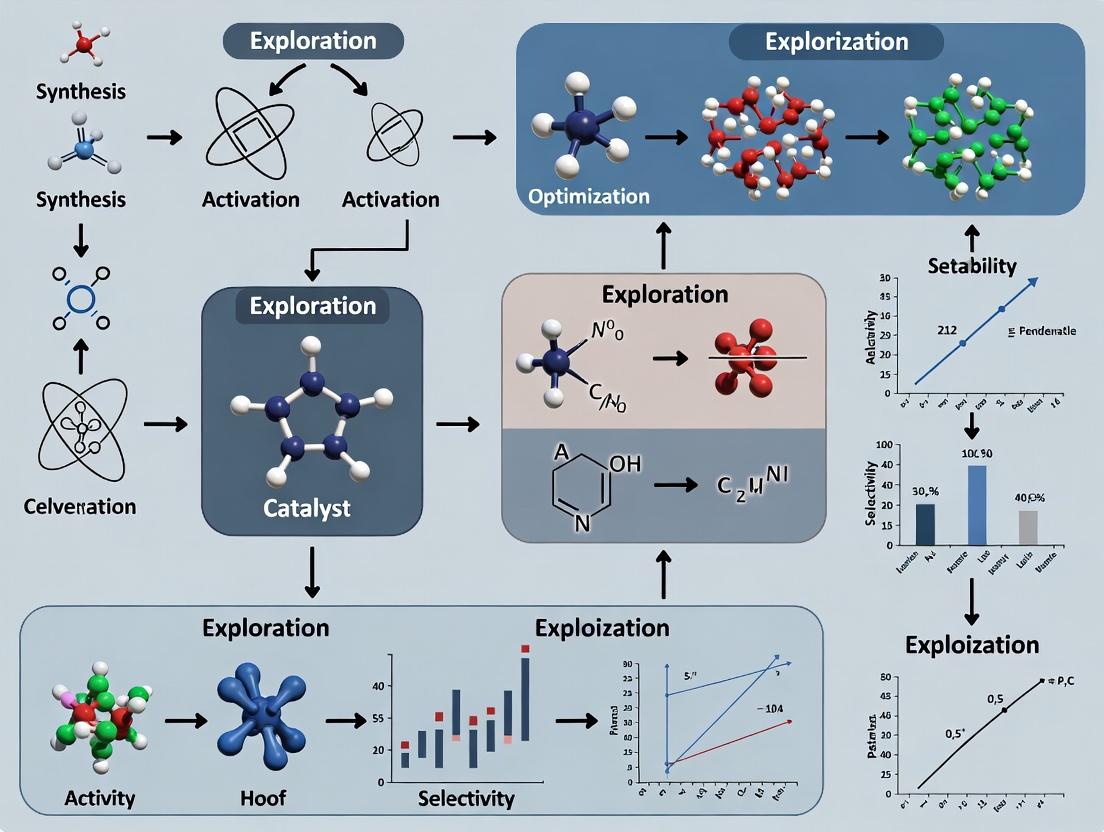
This article provides a comprehensive guide for researchers and drug development professionals on navigating the critical trade-off between exploration and exploitation within catalyst generative AI.
The Catalyst AI Dilemma: Mastering Exploration vs. Exploitation for Next-Gen Drug Discovery
Abstract
This article provides a comprehensive guide for researchers and drug development professionals on navigating the critical trade-off between exploration and exploitation within catalyst generative AI. We begin by establishing the foundational concepts and real-world urgency of this balance in molecular discovery. We then delve into the core methodological approaches and practical applications, including specific AI architectures and search algorithms. A dedicated troubleshooting section addresses common pitfalls, data biases, and strategies for optimization. Finally, we examine validation frameworks and comparative analyses of leading methods, equipping teams with the knowledge to rigorously evaluate and deploy these systems. The conclusion synthesizes key strategies and outlines future implications for accelerating biomedical innovation.
The Core Conundrum: Why Balancing Exploration and Exploitation is Critical for Catalyst AI
Technical Support Center
Troubleshooting Guides
Guide 1: Handling a Generative AI Model that Only Produces Known Catalyst Derivatives
Symptoms: The model's output diversity is low. Over 90% of proposed structures are minor variations (e.g., single methyl group changes) of known high-performing catalysts from the training set. Success rate for truly novel scaffolds falls below 2%.
| Potential Cause | Diagnostic Check | Corrective Action |
|---|---|---|
| Exploitation Bias in Training Data | Analyze training set distribution. Calculate Tanimoto similarity between new proposals and the top 50 training set actives. | Rebalance dataset. Augment with diverse, lower-activity compounds. Apply generative model techniques like Activity-Guided Sampling (AGS). |
| Loss Function Over-penalizing Novelty | Review loss function components. Is the reconstruction loss term disproportionately weighted vs. the prediction (activity) reward term? | Adjust loss function weights. Increase reward for predicted high activity in structurally dissimilar regions (e.g., reward * (1 - similarity)). |
| Sampling Temperature Too Low | Check the temperature parameter in the sampling layer (e.g., in a VAE or RNN). A value ≤ 0.7 encourages exploitation. |
Gradually increase sampling temperature to 1.0-1.2 during inference to increase stochasticity and exploration. |
Protocol for Diagnostic Similarity Analysis:
- Input: Generated molecule set {G}, training set actives {A}.
- Fingerprint Generation: Compute ECFP4 fingerprints for all molecules in {G} and {A}.
- Similarity Calculation: For each molecule in {G}, find its maximum Tanimoto similarity to any molecule in {A}.
- Distribution Plotting: Plot the histogram of these maximum similarities. An exploitation-heavy model will show a strong peak >0.8.
Guide 2: Generative AI Proposes Chemically Unrealistic or Unsynthesizable Catalysts
Symptoms: Proposed molecules contain forbidden valences, unstable ring systems (e.g., cyclobutadiene cores in transition metal complexes), or require >15 synthetic steps according to retrosynthesis analysis.
| Potential Cause | Diagnostic Check | Corrective Action |
|---|---|---|
| Insufficient Chemical Rule Constraints | Run a valency/ring strain check (e.g., using RDKit's SanitizeMol or a custom metallocene stability filter). |
Integrate rule-based post-generation filters. Employ a reinforcement learning agent with a synthesizability penalty (e.g., based on SAScore or SCScore). |
| Training on Non-Experimental (Theoretical) Data | Verify data source. Are all training complexes experimentally reported? Cross-check with ICSD or CSD codes. | Fine-tune the generative model on a smaller, high-quality dataset of experimentally characterized catalysts. Use transfer learning. |
| Decoding Error in Sequence-Based Models | For SMILES-based RNN/Transformers, check for invalid SMILES string generation rates (>5% is problematic). | Implement a Bayesian optimizer for the decoder or switch to a graph-based generative model which inherently respects chemical connectivity. |
Frequently Asked Questions (FAQs)
Q1: Our generative AI model is effective at exploration but its proposals are often low-activity. How can we improve the "hit rate" without sacrificing diversity? A: Implement a multi-objective Bayesian optimization (MOBO) loop. The AI generates a diverse initial set (exploration). These are scored by a surrogate activity model. MOBO then balances the trade-off between predicted activity (exploitation) and uncertainty/novelty (exploration) to select the next batch for actual testing. This creates a focused exploitation within explored regions.
Q2: What quantitative metrics should we track to ensure we are balancing exploration and exploitation in our catalyst discovery pipeline? A: Monitor these key metrics per campaign cycle:
| Metric | Formula / Description | Target Range (Guideline) |
|---|---|---|
| Structural Diversity | Average pairwise Tanimoto dissimilarity (1 - similarity) within a generation batch. | 0.6 - 0.8 (Higher = more exploration) |
| Novelty | Percentage of generated catalysts with similarity <0.4 to any known catalyst in the training database. | 20-40% |
| Success Rate | Percentage of AI-proposed catalysts meeting/exceeding target activity threshold upon experimental validation. | Aim to increase over cycles. |
| Performance Improvement | ∆Activity (e.g., % yield, TOF) of best new catalyst vs. previous best. | Positive, ideally >10% relative improvement. |
Q3: We have a small, high-quality experimental dataset. How can we use generative AI without overfitting? A: Use a pre-trained and fine-tuned approach. Start with a model pre-trained on a large, diverse chemical library (e.g., ZINC, PubChem) to learn general chemical rules. Then, fine-tune this model on your small, proprietary catalyst dataset. This grounds the model in real chemistry while biasing it towards your relevant chemical space. Always use a held-out test set from your proprietary data for validation.
Q4: Can you provide a standard protocol for a single "Explore-Exploit" cycle in catalyst discovery? A: Protocol for a Generative AI-Driven Catalyst Discovery Cycle
- Initialization (Exploration Seed): Assemble a diverse training set of catalysts with associated performance data (e.g., turnover number, yield).
- Model Training & Exploration Phase:
- Train a generative model (e.g., Graph Neural Network-based variational autoencoder) on the dataset.
- Generate a large virtual library (e.g., 50,000 candidates) using explorative sampling (higher temperature, random seed sampling).
- Filter for chemical feasibility and synthetic accessibility.
- Candidate Selection (Balancing Act):
- Use a acquisition function (e.g., Upper Confidence Bound - UCB) that combines a surrogate model's predicted activity and its uncertainty to rank candidates.
Acquisition(x) = μ(x) + β * σ(x), where μ is predicted performance, σ is uncertainty, and β is a tunable exploration parameter.- Select the top 20-50 candidates for in silico or experimental testing.
- Experimental Validation (Exploitation Check):
- Synthesize and test the selected candidates using a high-throughput experimentation protocol.
- Data Integration & Model Update:
- Add the new experimental results (successes and failures) to the training dataset.
- Retrain or fine-tune the generative model with the expanded dataset.
- Return to Step 2 for the next cycle.
Diagrams
Title: Generative AI Catalyst Discovery Cycle
Title: Acquisition Function Decision Logic
The Scientist's Toolkit: Key Research Reagent Solutions
| Item / Solution | Function in Catalyst Generative AI Research | Example / Specification |
|---|---|---|
| High-Throughput Experimentation (HTE) Kits | Enables rapid experimental validation of AI-generated catalyst candidates, feeding crucial data back into the AI loop. | 96-well or 384-well plate-based screening kits with pre-dosed ligands & metal precursors for cross-coupling reactions. |
| Chemical Feasibility Filter Software | Post-processes AI-generated structures to remove chemically invalid or unstable molecules, ensuring exploration is grounded in reality. | RDKit with custom valence/ring strain rules; molvs library for standardization. |
| Synthetic Accessibility (SA) Scorer | Quantifies the ease of synthesizing a proposed catalyst, guiding the exploitation of viable leads. | SAScore (1-10, easy-hard) or SCScore (trained on retrosynthetic complexity). |
| Surrogate (Proxy) Model | A fast, predictive machine learning model (e.g., Random Forest, GNN) that estimates catalyst performance, used to screen the virtual library before costly experiments. | A graph-convolution model trained on DFT-calculated binding energies or historical assay data. |
| Molecular Fingerprint or Descriptor Set | Encodes molecular structures into numerical vectors, enabling similarity calculations crucial for defining novelty and diversity. | ECFP4 (Extended Connectivity Fingerprints), Mordred descriptors (2D/3D). |
| Multi-Objective Bayesian Optimization (MOBO) Platform | Algorithmically balances the trade-off between exploring uncertain regions and exploiting high-performance regions. | Software like BoTorch or Dragonfly with custom acquisition functions (e.g., Expected Hypervolume Improvement). |
Technical Support Center: Troubleshooting Generative AI for Catalyst & Drug Discovery
FAQs & Troubleshooting Guides
Q1: Our generative AI model for catalyst design keeps proposing similar, incremental modifications to known lead compounds. How can we force it to explore more novel chemical space? A: This is a classic "exploitation vs. exploration" imbalance. Implement the following protocol:
- Adjust Sampling Temperature: Increase the sampling temperature (e.g., from 0.7 to 1.2) in your model's output layer to increase the randomness of generated structures.
- Incorporate a Novelty Reward: Add a term to your reinforcement learning objective function that penalizes similarity to a known compound library. Use Tanimoto similarity based on Morgan fingerprints (radius=2, 1024 bits) and set a threshold (e.g., reward compounds with similarity < 0.3).
- Diversity Sampling Batch: Use a max-min algorithm to select the final batch of compounds from the generated pool, ensuring maximum diversity.
Q2: When fine-tuning a pre-trained molecular generative model on a specific target, the performance on the validation set degrades after a few epochs—likely overfitting to a local minimum. How do we recover? A: Implement an early stopping regimen with exploration checkpoints.
- Protocol: Split your data into Train/Validation/Test (70/15/15). Train for 100 epochs.
- Monitor: Track the unique valid scaffolds (Bemis-Murcko) generated in each epoch on the validation set.
- Action: If scaffold diversity drops by >20% for 3 consecutive epochs, revert to the model checkpoint from 5 epochs prior. Reduce the learning rate by a factor of 10 and re-introduce 10% of a general drug-like molecule dataset (e.g., ZINC15 fragments) into the training batch for the next 5 epochs to reintroduce broader chemical knowledge.
Q3: Our AI proposes a novel chemotype with good predicted binding affinity, but our synthetic chemistry team deems it non-synthesizable with available routes. How can we integrate synthesizability earlier? A: Integrate a real-time synthesizability filter into the generation loop.
- Tool: Use the AI-based retrosynthesis tool ASKCOS or the RAscore synthesizability score.
- Workflow Integration: Configure your generative model to only propose structures where the RAscore is >0.5 or where ASKCOS suggests at least one route with a confidence > 0.4. This creates a constrained generation environment focused on exploitable, realistic chemistry.
Q4: How do we quantitatively balance exploring new chemotypes versus optimizing a promising lead series? A: Establish a multi-armed bandit framework with clear metrics. The table below summarizes a proposed scoring system to guide the allocation of resources (e.g., computational cycles, synthesis efforts).
Table 1: Scoring Framework for Exploration vs. Exploitation Decisions
| Metric | Exploration (Novel Chemotype) | Exploitation (Lead Optimization) | Weight |
|---|---|---|---|
| Predicted Activity (pIC50/Affinity) | > 7.0 (High Threshold) | Incremental improvement from baseline (Δ > 0.3) | 0.35 |
| Synthetic Accessibility (SAscore) | 1-3 (Easy to Moderate) | 1-2 (Trivial to Easy) | 0.25 |
| Novelty (Tanimoto to DB) | < 0.35 | N/A | 0.20 |
| ADMET Risk (QED/SAscore) | QED > 0.5, No critical alerts | Focused optimization of 1-2 specific ADMET parameters | 0.20 |
Protocol: Weekly, score all proposed compounds from both the exploration and exploitation pipelines using this weighted sum. Allocate 70% of resources to the top 50% of scores, but mandate that 30% of resources are reserved for the top-ranked pure exploration candidates (Novelty < 0.35).
Experimental Protocols
Protocol 1: Evaluating Generative Model Output for Diversity and Local Minima Trapping Objective: Quantify whether a generative AI model is stuck in a local minimum or exploring effectively. Materials: Output of 1000 generated SMILES from your model, a reference set of 10,000 known active molecules for your target. Method:
- Compute Fingerprints: Generate ECFP4 fingerprints (1024 bits) for all generated and reference molecules.
- Calculate Intra-set Diversity: For the generated set, compute the average pairwise Tanimoto distance (1 - similarity) across 1000 randomly sampled pairs.
- Calculate Inter-set Similarity: For each generated molecule, find its maximum Tanimoto similarity to the reference set. Compute the average.
- Interpretation: Low intra-set diversity (< 0.4) and high inter-set similarity (> 0.6) indicate trapping in a local minimum near known chemotypes. High intra-set diversity (> 0.6) and moderate inter-set similarity (0.3-0.5) indicate healthy exploration.
Protocol 2: Reinforcement Learning Fine-Tuning with a Dual Objective Objective: Fine-tune a pre-trained molecular generator (e.g., GPT-Mol) to optimize for both activity and novelty. Materials: Pre-trained model, target-specific activity predictor (QSAR model), computing cluster with GPU. Method:
- Define Reward R:
R = 0.7 * R_activity + 0.3 * R_noveltyR_activity: Normalized predicted pIC50 from your QSAR model (scale 0 to 1).R_novelty:1 - (Max Tanimoto similarity to a large database like ChEMBL).
- Training: Use Proximal Policy Optimization (PPO). Start with a learning rate of 0.0001. Generate 500 molecules per epoch.
- Validation: Every 10 epochs, evaluate the top 100 molecules by R score on a separate validation set from your QSAR model. Stop if the average R_activity for the top 100 decreases for 3 validation cycles.
Pathway & Workflow Visualizations
Title: Dual-Path RL for Exploration & Exploitation in Molecular AI
Title: Generative AI Molecule Prioritization Workflow
The Scientist's Toolkit: Research Reagent Solutions
Table 2: Essential Tools for AI-Driven Catalyst & Drug Discovery
| Tool/Reagent | Category | Primary Function in Experiment |
|---|---|---|
| Pre-trained Model (e.g., ChemBERTa, GPT-Mol) | Software | Provides foundational chemical language understanding for transfer learning and generation. |
| Reinforcement Learning Framework (e.g., RLlib, custom PPO) | Software | Enables fine-tuning of generative models using custom multi-objective reward functions. |
| Molecular Fingerprint Library (e.g., RDKit ECFP4) | Software | Encodes molecular structures into numerical vectors for similarity and diversity calculations. |
| Synthesizability Scorer (e.g., RAscore, SAscore) | Software | Filters AI-generated molecules by estimated ease of synthesis, grounding proposals in reality. |
| High-Throughput Virtual Screening Suite (e.g., AutoDock Vina, Glide) | Software | Rapidly evaluates the predicted binding affinity of generated molecules to the target. |
| ADMET Prediction Platform (e.g., QikProp, admetSAR) | Software | Provides early-stage pharmacokinetic and toxicity risk assessment for prioritization. |
| Diverse Compound Library (e.g., Enamine REAL, ZINC) | Data | Serves as a source of known chemical space for novelty calculation and as a training set supplement. |
| Target-specific Assay Kit | Wet Lab | Provides the ultimate experimental validation of AI-generated candidates (e.g., kinase activity assay). |
Troubleshooting Guide & FAQs
This technical support center addresses common issues encountered when implementing multi-armed bandit (MAB) frameworks for balancing exploration and exploitation in catalyst generative AI research for drug development.
FAQ 1: Algorithm Selection & Convergence
Q1: My MAB algorithm (e.g., Thompson Sampling, UCB) fails to converge on a promising catalyst candidate, persistently exploring low-reward options. What parameters should I audit? A: This typically indicates an imbalance in the exploration-exploitation trade-off hyperparameters. Key metrics to check and standard adjustment protocols are summarized below.
| Parameter | Typical Default Value (Thompson Sampling) | Recommended Audit Range | Symptom of Incorrect Setting | Correction Protocol |
|---|---|---|---|---|
| Prior Distribution (α, β) | α=1, β=1 (Uniform) | α, β = [0.5, 5] | Excessive exploration of poor performers | Increase α for successes, β for failures based on initial domain knowledge. |
| Sampling Temperature (τ) | τ=1.0 | τ = [0.01, 10.0] | Low diversity in exploitation phase | Gradually decay τ from >1.0 (explore) to <1.0 (exploit) over iterations. |
| Minimum Iterations per Arm | 10 | [5, 50] | Erratic reward estimates, premature pruning | Increase minimum trials to stabilize mean/variance estimates. |
| Reward Scaling Factor | 1.0 | [0.1, 100] | Algorithm insensitive to performance differences | Scale rewards so that the standard deviation of initial batch is ~1.0. |
Experimental Protocol for Parameter Calibration:
- Baseline Run: Execute the MAB algorithm with default parameters for N=1000 iterations on a simulated reward environment mimicking your catalyst property landscape (e.g., yield, selectivity).
- Metric Collection: Log cumulative regret, % of iterations spent on top-3 arms, and rate of discovery of new high-performing arms.
- Iterative Adjustment: Systematically vary one parameter (see table) per experiment while holding others constant.
- Validation: Run the optimized parameter set on a held-out simulation or a small-scale real experimental batch (≤ 20 reactions) to confirm improved convergence.
FAQ 2: Reward Function Design
Q2: How should I formulate the reward function when optimizing for multiple, conflicting catalyst properties (e.g., high yield, low cost, enantioselectivity)? A: A scalarized, weighted sum reward is most common, but requires careful normalization. Use the following table as a guide.
| Property (Example) | Measurement Range | Normalization Method | Recommended Weight (Initial) | Adjustment Trigger |
|---|---|---|---|---|
| Reaction Yield | 0-100% | Linear: (Yield%/100) | 0.50 | Decrease if yield plateaus >90% to prioritize other factors. |
| Enantiomeric Excess (ee) | 0-100% | Linear: (ee%/100) | 0.30 | Increase if lead candidates fail purity thresholds. |
| Catalyst Cost (per mmol) | $10-$500 | Inverse Linear: 1 - [(Cost - Min)/(Max-Min)] | 0.20 | Increase in later stages for commercialization feasibility. |
Experimental Protocol for Reward Function Tuning:
- Define Objective:
R = w₁*Norm(Yield) + w₂*Norm(ee) + w₃*Norm(Cost). Ensure ∑wᵢ = 1. - Pareto Frontier Analysis: Run a grid search over weights in simulation (or a high-throughput computational screen) for 100 candidate catalysts.
- Sensitivity Analysis: For each weight, vary ±0.15 while holding others proportional. Select the weight set that maximizes the number of candidates in the desired region of the property space.
- Dynamic Reward Update: Program the MAB system to recalculate reward normalization factors (Min, Max) every 100 experimental iterations based on observed data to prevent drift.
FAQ 3: Integration with Generative AI
Q3: The generative AI model proposes catalyst structures, but the MAB algorithm selects reaction conditions. How do I manage this two-tiered decision loop efficiently? A: Implement a hierarchical MAB framework. The primary "bandit" selects a region of chemical space (or a specific generative model prompt), and secondary bandits select experimental conditions for that region.
Diagram Title: Hierarchical MAB-Generative AI Feedback Loop
Protocol for Synchronizing Hierarchical MAB:
- Primary Loop (Slow, Exploration): The generative AI proposes 5-10 distinct catalyst families. The primary MAB (using Thompson Sampling) selects one family to investigate for the next batch of 20 experiments.
- Secondary Loop (Fast, Exploitation): For the selected family, a contextual bandit (e.g., LinUCB) selects specific ligand/ solvent/ temperature conditions for each of the 20 experiments, using molecular descriptors as context.
- Feedback & Update: Rewards from the 20 experiments update the secondary bandit's model immediately. The aggregated reward (e.g., mean top-3 performance) updates the primary bandit's prior for the chosen catalyst family. This aggregated reward is also fed back to fine-tune the generative AI model.
The Scientist's Toolkit: Research Reagent Solutions
| Item / Solution | Function in MAB-Driven Catalyst Research | Example / Specification |
|---|---|---|
| High-Throughput Experimentation (HTE) Robotic Platform | Enables rapid parallel synthesis and testing of catalyst candidates selected by the MAB algorithm, providing the essential data stream for reward calculation. | Chemspeed Accelerator SLT II, Unchained Labs Junior. |
| Automated Chromatography & Analysis System | Provides rapid, quantitative measurement of reaction outcomes (yield, ee) which form the numeric basis of the reward function. | HPLC-UV/ELSD with auto-samplers, SFC for chiral separation. |
| Chemical Featurization Software | Generates numerical descriptors (Morgan fingerprints, DFT-derived properties) for catalyst structures, serving as "context" for contextual bandit algorithms. | RDKit, Dragon, custom Python scripts. |
| Multi-Armed Bandit Simulation Library | Allows for offline testing and calibration of MAB algorithms (UCB, Thompson Sampling, Exp3) on historical data before costly wet-lab deployment. | MABWiser (Python), Contextual (Python), custom PyTorch implementations. |
| Reward Tracking Database | Centralized log to store (candidate ID, conditions, measured properties, calculated reward) for each MAB iteration, ensuring reproducibility and model retraining. | SQLite, PostgreSQL with custom schema, or ELN integration (e.g., Benchling). |
Troubleshooting Guides & FAQs
Q1: Our generative AI for novel catalyst discovery has stagnated, producing only minor variations of known active sites. Are we over-exploiting? A: This is a classic symptom of excessive exploitation. The model is trapped in a local optimum of the chemical space.
- Diagnosis: Calculate the Tanimoto similarity index between newly generated molecular structures and your known actives library. A median similarity >0.85 suggests over-exploitation.
- Solution: Temporarily increase the "temperature" parameter (e.g., from 0.7 to 1.2) in your sampling algorithm to encourage exploration. Implement a "novelty penalty" in the reward function that penalizes structures too similar to the training set.
- Protocol: For a 4-week cycle, dedicate Week 1 to purely exploratory generation (high temp, novelty focus) without immediate validation. Use Weeks 2-4 to exploit and validate the most promising scaffolds from the exploratory batch.
Q2: We generated thousands of novel, structurally diverse catalyst candidates, but wet-lab validation found zero hits. Is this failed exploration? A: Yes. This indicates exploration was unguided and disconnected from physicochemical reality.
- Diagnosis: Audit your generative model's filters and primary reward function. Over-reliance on simple metrics like QED (Quantitative Estimate of Drug-likeness) for catalysts is insufficient.
- Solution: Integrate a fast, approximate quantum mechanics (QM) simulation (e.g., DFTB) into the reward pipeline to pre-screen for plausible stability and electronic properties. Balance the reward between novelty and a minimum feasibility score.
- Protocol: Implement a iterative refinement loop: Generate batch → Pre-screen with cheap QM (DFTB) → Select top 100 by composite score → Validate with higher-fidelity QM (DFT) → Retrain model on results.
Q3: Our campaign cycles between wild exploration and narrow exploitation, failing to converge. How do we stabilize the balance? A: You lack a dynamic scheduling mechanism.
- Diagnosis: Plot the "exploration rate" (e.g., % of structures with similarity <0.7 to any known active) versus campaign iteration. It should show a controlled decay, not oscillation.
- Solution: Implement an ε-greedy or decay schedule. Start with a high exploration probability (ε=0.8) and reduce it by 10% each major iteration where a validated hit is found.
- Protocol:
- Define iteration = one full generate-screen-validate cycle.
- Initialize ε = 0.8.
- After each iteration: If ΔActivity > 10% (improvement), keep ε. If ΔActivity ≤ 10%, set ε = max(0.1, ε * 0.9).
Q4: The AI suggests catalysts with synthetically intractable motifs. How do we fix this? A: The exploitation of activity predictions is not tempered by synthetic feasibility constraints.
- Diagnosis: Use a retrosynthesis model (e.g., IBM RXN, ASKCOS) to analyze the last batch of proposed structures. A success rate <30% indicates a problem.
- Solution: Add a "synthetic accessibility" (SA) score as a mandatory, weighted term in the final selection filter. Use a graph-based model trained on reaction databases.
- Protocol: Integrate the SA score before expensive simulation. Workflow: Generation → SA Filter (pass if SA Score > 0.6) → QM Pre-screen → Selection.
Table 1: Analysis of Two Failed Campaigns Demonstrating Imbalance
| Campaign | Exploration Metric (Novelty Score) | Exploitation Metric (Predicted Activity pIC₅₀) | Wet-Lab Hit Rate | Root Cause Diagnosis |
|---|---|---|---|---|
| Alpha | 0.15 ± 0.05 (Low) | 8.5 ± 0.3 (High) | 5% (Known analogs) | Severe Over-Exploitation: Model converged too early on a narrow chemotype. |
| Beta | 0.92 ± 0.03 (Very High) | 5.1 ± 1.2 (Low/Noisy) | 0% | Blind Exploration: No guiding constraints for catalytic feasibility or synthesis. |
Table 2: Impact of Dynamic ε-Greedy Scheduling on Campaign Performance
| Iteration | Fixed ε=0.2 (Over-Exploit) | Fixed ε=0.8 (Over-Explore) | Dynamic ε (Start=0.8, Decay=0.9) |
|---|---|---|---|
| 1 | 0 Novel Hits | 2 Novel Hits | 2 Novel Hits |
| 5 | 0 Novel Hits (Converged) | 1 Novel Hit (Erratic) | 6 Novel Hits |
| 10 | 0 Novel Hits | 3 Novel Hits | 9 Novel Hits (Converging) |
| Total Validated Hits | 1 (Known scaffold) | 6 | 15 |
Experimental Protocols
Protocol A: Correcting Over-Exploitation with Directed Exploration
- Pause active model training.
- Sample 5000 structures from the generative model with temperature parameter T=1.5.
- Filter this set using a dissimilarity filter: retain only structures with Tanimoto similarity <0.65 to all top 20 known actives.
- Score the filtered set with a fast, pre-trained proxy model for a different but related property (e.g., ligand binding affinity for a related substrate) to add new guidance.
- Select the top 200 by this new proxy score.
- Validate selected candidates through primary assay. Use results to augment training data.
- Resume training with a balanced loss function (e.g., 0.7 * Activity Loss + 0.3 * Novelty Reward).
Protocol B: Establishing a Feasibility-First Screening Funnel
- Generation: Produce 10,000 candidate structures per cycle.
- Step 1 - Synthetic Accessibility (SA): Process all through a retrosynthesis AI. Assign SA Score (0-1). Discard all with SA Score < 0.55. (~60% pass).
- Step 2 - Structural Stability: Perform conformer search and MMFF94 minimization. Discard structures with high strain energy (>50 kcal/mol). (~85% pass).
- Step 3 - Quantum Mechanical Pre-screen: Run semi-empirical QM (DFTB) to calculate key descriptors (HOMO/LUMO gap, adsorption energy). Filter based on plausible ranges. (~20% pass).
- Step 4 - High-Fidelity Prediction: Run DFT calculation on the ~100 remaining candidates for accurate activity prediction.
- Step 5 - Selection & Validation: Select top 20 for wet-lab synthesis and testing.
Visualizations
The Scientist's Toolkit: Research Reagent Solutions
| Item | Function in Catalyst AI Research |
|---|---|
| Generative Model (e.g., G-SchNet, G2G) | Core AI to propose new molecular structures by exploring chemical space. |
| Fast QM Calculator (DFTB/xtb) | Provides rapid, approximate quantum mechanical properties for pre-screening thousands of candidates. |
| High-Fidelity QM Suite (Gaussian, ORCA) | Delivers accurate electronic structure calculations (DFT) for final candidate selection. |
| Retrosynthesis AI (ASKCOS, IBM RXN) | Evaluates synthetic feasibility and routes, crucial for realistic exploitation. |
| Conformer Generator (RDKit, CONFAB) | Produces realistic 3D geometries for stability checks and descriptor calculation. |
| Automated Reaction Platform (Chemspeed, Unchained Labs) | Enables high-throughput experimental validation of AI-proposed catalysts. |
| Descriptor Database (CatBERTa, OCELOT) | Pre-trained models or libraries for mapping structures to catalytic properties. |
Troubleshooting Guides & FAQs
FAQ 1: How do I improve generative model performance when training data for novel catalyst compositions is extremely sparse (e.g., < 50 data points)?
- Answer: Sparse data is a fundamental challenge. The recommended approach is a hybrid strategy combining physics-informed data augmentation and transfer learning.
- Physics-Informed Data Augmentation: Use Density Functional Theory (DFT) or semi-empirical methods (e.g., PM7) to generate auxiliary descriptors (e.g., adsorption energies, d-band centers, formation energies) for your known compositions. These calculated features, while not perfect, expand the feature space with physically meaningful data.
- Transfer Learning from a Proxy Domain: Pre-train your generative model (e.g., a Variational Autoencoder or a Graph Neural Network) on a large, computationally generated dataset (like the Open Catalyst Project OC20 dataset) that shares underlying principles (e.g., elemental properties, bonding types). Fine-tune the final layers on your small, sparse experimental dataset.
- Exploit Known Heuristics: Constrain the generative model's latent space using known scaling relationships (e.g., Brønsted–Evans–Polanyi principles) to penalize unrealistic candidate structures.
FAQ 2: My generative AI proposes catalyst candidates in a vast chemical space (high-dimensional). How can I efficiently validate and prioritize these for experimental synthesis?
- Answer: Prioritization requires a multi-fidelity filtering pipeline to balance exploration (novelty) and exploitation (predicted performance).
- First-Pass Computational Screening: Apply rapid, low-fidelity calculations (e.g., Machine Learning Force Fields, MLFFs) to filter for stability. Eliminate candidates with predicted negative formation energy or unrealistic bond lengths.
- Synthesis Feasibility Check: Interface with a database of known synthesis routes (e.g., from the ICSD or literature-mined procedures). Use a retrosynthesis model (e.g., based on the MIT ASKCOS framework) to score the feasibility of proposed precursors and pathways. Prioritize candidates with known or analogous synthesis protocols.
- High-Fidelity Evaluation Subset: For the top 0.1% of candidates passing filters (1) and (2), run high-fidelity DFT calculations on key reaction descriptors to refine activity predictions before committing to lab synthesis.
FAQ 3: The AI-suggested catalyst has a promising computed activity, but the proposed complex nanostructure seems impossible to synthesize. How should I proceed?
- Answer: This is a core synthesis feasibility challenge. Implement a "Synthesis-Aware" Discriminator within your generative AI's training loop.
- Method: Train a separate classifier model (the discriminator) to distinguish between "synthesizable" and "non-synthesizable" materials based on historical synthesis data (e.g., text-mined from scientific literature). During the generative model's training, the discriminator penalizes the generation of candidates it deems non-synthesizable. This actively shapes the generative output towards regions of chemical space with higher practical viability.
FAQ 4: How can I quantify the trade-off between exploring entirely new catalyst families and exploiting known, promising leads?
- Answer: Implement and track an Explicit Exploration-Exploitation Metric during your active learning cycles.
Table: Key Metrics for Balancing Exploration and Exploitation
| Metric | Formula / Description | Target Range (Guideline) | Interpretation |
|---|---|---|---|
| Exploration Ratio | (Novel Candidates Tested) / (Total Candidates Tested). A "novel" candidate is defined as >X Å from any training data in a relevant descriptor space (e.g., using SOAP). | 20% - 40% per batch | Maintains search diversity and avoids local optima. |
| Exploitation Confidence | Mean predicted uncertainty (e.g., standard deviation from an ensemble model) for the top 10% of exploited candidates. | Decreasing trend over cycles | Indicates improved model confidence in promising regions. |
| Synthesis Success Rate | (Successfully Synthesized Candidates) / (Attempted Synthesized Candidates). | Aim for >15% in exploratory batches | A pragmatic measure of feasibility constraints. |
| Performance Improvement | ∆ in key figure of merit (e.g., turnover frequency, TOF) of best new candidate vs. previous champion. | Positive, sustained increments | Measures the efficacy of the overall search. |
Experimental Protocols
Protocol 1: Implementing a Multi-Fidelity Candidate Filtering Pipeline
- Input: List of 10,000 AI-generated catalyst compositions (e.g., ternary alloys, doped perovskites).
- Step 1 - Stability Filter (Low-Fidelity): Use M3GNet or CHGNet MLFFs via the
matglpackage to compute predicted formation energy per atom. Discard all candidates with E_form > 0 eV/atom (or a domain-specific threshold). Expected yield: ~30%. - Step 2 - Similarity & Novelty Check: Compute the Smooth Overlap of Atomic Positions (SOAP) descriptor for remaining candidates against a database of known synthesized materials. Tag candidates with a similarity score. Separate into "exploit" (high similarity, high predicted performance) and "explore" (low similarity) streams.
- Step 3 - Synthesis Pathway Scoring (Medium-Fidelity): For the "exploit" stream and a random subset of the "explore" stream, query a local instance of the ASKCOS API for retrosynthesis pathways. Candidates with a pathway confidence score > 50% are prioritized for the next step.
- Step 4 - High-Fidelity DFT Validation: Perform DFT calculations (using VASP, Quantum ESPRESSO) on the top 50 prioritized candidates to compute accurate adsorption energies and activation barriers.
Protocol 2: Active Learning Loop for Catalyst Discovery
- Initialization: Train a preliminary generative model and a separate property predictor (e.g., for adsorption energy) on all available sparse data.
- Candidate Generation: Use the generative model to propose 1,000 new candidates, using a tuned acquisition function (e.g., Upper Confidence Bound, UCB) to balance predicted performance (mean) and uncertainty (variance).
- Batch Selection: From the 1,000, select a batch of 50 for the next cycle using the D-optimality criterion to maximize diversity in the selected batch, while ensuring at least 40% meet the synthesis feasibility score from Protocol 1, Step 3.
- Evaluation & Update: Obtain ground truth data for the batch via Protocol 1. Augment the training dataset. Retrain both the generative model and the property predictor.
- Iteration: Repeat steps 2-4 for 10-20 cycles, monitoring the metrics in the table above.
Visualizations
Title: Overcoming Sparse Data with Hybrid Training
Title: Multi-Fidelity Filtering Pipeline
Title: Active Learning Loop for Catalyst AI
The Scientist's Toolkit: Research Reagent & Computational Solutions
Table: Essential Resources for AI-Driven Catalyst Discovery
| Item / Solution | Function / Purpose | Example (Reference) |
|---|---|---|
| OC20 Dataset | Large-scale dataset of DFT relaxations for catalyst surfaces; essential for pre-training (transfer learning) to combat sparse data. | Open Catalyst Project (https://opencatalystproject.org/) |
| M3GNet/CHGNet | Graph Neural Network-based Machine Learning Force Fields (MLFFs); enables rapid, low-fidelity stability screening of thousands of candidates. | matgl Python package (https://github.com/materialsvirtuallab/matgl) |
| ASKCOS Framework | Retrosynthesis planning software; provides synthesis feasibility scores and suggested pathways for organic molecules and, increasingly, inorganic complexes. | MIT ASKCOS (https://askcos.mit.edu/) |
| DScribe Library | Calculates advanced atomic structure descriptors (e.g., SOAP, MBTR) crucial for quantifying material similarity and novelty in high-dimensional space. | Python dscribe (https://singroup.github.io/dscribe/) |
| VASP / Quantum ESPRESSO | High-fidelity DFT software for final-stage validation of electronic properties and reaction energetics on prioritized candidates. | Commercial (VASP) & Open-Source (QE) |
| Active Learning Manager | Orchestrates the exploration-exploitation loop (batch selection, model retraining, data management). Custom scripts or platforms like deepchem or modAL. |
Python modAL framework (https://modal-python.readthedocs.io/) |
Strategic Frameworks: AI Architectures and Algorithms for Optimal Balance
Troubleshooting Guides & FAQs
Q1: My VAE-generated molecular structures are invalid or violate chemical rules. How can I improve validity rates? A: This is a common issue where the decoder exploits the latent space without chemical constraint. Implement a Validity-Constrained VAE (VC-VAE) by integrating a rule-based penalty term into the reconstruction loss. The penalty term can be calculated using open-source toolkits like RDKit to check for valency errors and unstable ring systems. Additionally, pre-process your training dataset to remove all invalid SMILES strings to prevent the model from learning corrupt patterns.
Q2: The generator in my GAN for protein sequence design collapses, producing limited diversity (mode collapse). What are the mitigation strategies? A: Mode collapse indicates the generator is exploiting a few successful patterns. Employ the following experimental protocol:
- Switch to a Wasserstein GAN with Gradient Penalty (WGAN-GP): This uses a critic (not a discriminator) with a Lipschitz constraint enforced via gradient penalty, leading to more stable training and better gradient signals.
- Implement Mini-batch Discrimination: Allow the discriminator to assess an entire batch of samples, making it harder for the generator to fool it with a single mode.
- Use Unrolled GANs: Optimize the generator against multiple future steps of the discriminator, preventing it from over-adapting to the discriminator's current state.
Q3: Training my diffusion model for small molecule generation is extremely slow. How can I accelerate the process? A: The iterative denoising process is computationally expensive. Utilize a Denoising Diffusion Implicit Model (DDIM) schedule, which allows for a significant reduction in sampling steps (e.g., from 1000 to 50) without a major loss in sample quality. Furthermore, employ a Latent Diffusion Model (LDM): train a VAE to compress molecules into a smaller latent space, then train the diffusion process on these latent representations. This reduces dimensionality and speeds up both training and inference.
Q4: How can I quantitatively balance exploration (diversity) and exploitation (property optimization) when using these models for catalyst discovery? A: Implement a Bayesian Optimization (BO) loop around your generative model. Use the model (e.g., a Conditional VAE or Diffusion Model) to generate a candidate pool (exploration). A surrogate model (e.g., Gaussian Process) predicts their properties, and an acquisition function (e.g., Upper Confidence Bound) selects the most promising candidates for evaluation (exploitation). The new experimental data is then fed back to retrain the generative model.
Table 1: Quantitative Comparison of Generative Model Performance on Molecular Generation Tasks (MOSES Benchmark)
| Model Type | Validity (%) | Uniqueness (%) | Novelty (%) | Reconstruction Accuracy (%) | Training Stability |
|---|---|---|---|---|---|
| VAE (Standard) | 85.2 | 94.1 | 80.5 | 76.3 | High |
| GAN (WGAN-GP) | 95.7 | 100.0 | 99.9 | N/A | Medium |
| Diffusion (DDPM) | 99.8 | 99.5 | 95.2 | 90.1 | Very High |
Q5: What is a practical experimental protocol for iterative catalyst design using a diffusion model? A: Protocol for Latent Diffusion-Driven Catalyst Optimization
- Data Curation: Assemble a dataset of known catalyst structures (e.g., as SMILES or 3D graphs) paired with key performance metrics (e.g., turnover frequency, yield).
- Model Training: Train a Latent Diffusion Model (LDM):
- Encoder: A graph neural network (GNN) compresses each molecular graph into a latent vector
z. - Diffusion: Train a noise prediction network (e.g., a U-Net) to denoise
z_tover timestepst. - Decoder: The GNN decoder reconstructs the molecule from the denoised latent vector.
- Encoder: A graph neural network (GNN) compresses each molecular graph into a latent vector
- Conditional Generation: Fine-tune the model for conditional generation by feeding the performance metric as an additional input to the noise prediction network.
- Inverse Design Loop: For a target property, sample from the conditional diffusion model to generate novel candidate structures.
- Experimental Validation: Synthesize and test top-predicted candidates. Add the new data (structure & property) to the training set and retrain the model iteratively.
The Scientist's Toolkit: Research Reagent Solutions
Table 2: Essential Computational Tools for Generative AI in Molecular Research
| Item / Software | Function & Explanation |
|---|---|
| RDKit | Open-source cheminformatics toolkit used for converting SMILES to molecules, calculating descriptors, enforcing chemical validity, and visualizing structures. |
| PyTorch / TensorFlow | Deep learning frameworks essential for building, training, and deploying custom VAE, GAN, and Diffusion model architectures. |
| JAX | Increasingly used for high-performance numerical computing and efficient implementation of diffusion model sampling loops. |
| DeepChem | Library that provides out-of-the-box implementations of molecular graph encoders (GNNs) and datasets for drug discovery tasks. |
| GuacaMol / MOSES | Benchmarking frameworks and datasets specifically designed for evaluating generative models on molecular generation tasks. |
| Open Catalyst Project | A dataset and benchmark for catalyst discovery, containing DFT relaxations of adsorbates on surfaces, useful for training property prediction models. |
Visualizations
Title: VAE Training and Latent Space Encoding Workflow
Title: Adversarial Training Feedback Loop in GANs
Title: Diffusion Model Forward and Reverse Process
Title: AI-Driven Catalyst Discovery Exploration-Exploitation Loop
Bayesian Optimization and Thompson Sampling for Intelligent Experiment Selection
Troubleshooting Guides and FAQs
Q1: Why does my Bayesian Optimization (BO) loop appear to get "stuck," repeatedly suggesting similar experiments instead of exploring new regions of the catalyst space?
A1: This is a classic sign of an overly exploitative search, often due to inappropriate hyperparameters in the acquisition function or kernel.
- Check the acquisition function. If using Expected Improvement (EI), the internal xi parameter controls exploration; increase its value (e.g., from 0.01 to 0.1) to encourage more exploration.
- Check the kernel length scales. Overly large length scales in the Gaussian Process (GP) kernel cause the model to generalize too much, missing local features. Use automatic relevance determination (ARD) or manually reduce length scales to make the model more sensitive to parameter changes.
- Verify your noise setting. An underestimated GP noise parameter (alpha) can lead to overfitting, causing the algorithm to over-trust predictions and exploit excessively.
Q2: My Thompson Sampling (TS) algorithm shows high performance variance between runs on the same catalyst discovery problem. Is this normal, and how can I stabilize it?
A2: Yes, inherent stochasticity in TS can cause variance. To reduce it:
- Increase the number of samples. When sampling from the GP posterior, draw more than one sample (e.g., 5-10) per iteration and select the point with the best average score across samples.
- Implement a hybrid approach. Use TS for the first N exploration-heavy iterations, then switch to a more exploitative BO acquisition function like EI or Probability of Improvement (PI) to refine the best candidates.
- Use a common random seed. For reproducibility and run comparison, fix the random seed for the sampling step.
Q3: How do I handle categorical or mixed-type parameters (e.g., catalyst dopant type and temperature) in my experimental setup?
A3: Standard GP kernels require numerical inputs. You must encode categorical parameters.
- One-Hot Encoding: Transform a categorical parameter with k choices into k binary parameters. This works best with a dedicated kernel (e.g.,
Hammingkernel) or by combining a categorical kernel with a continuous kernel. - Bayesian Optimization with Tree-structured Parzen Estimator (BO-TPE): Consider using TPE, which natively handles mixed search spaces, as an alternative to GP-based BO for complex parameter types.
Q4: The computational cost of refitting the Gaussian Process model is becoming prohibitive as my experiment history grows. What are my options?
A4: This is a common scalability challenge.
- Use sparse Gaussian Process approximations. Implement variational free energy (VFE) or inducing point methods to approximate the full GP using a subset of "inducing" data points, drastically reducing cost from O(n³) to O(n·m²), where m is the number of inducing points.
- Implement a moving window. If older experiments are less relevant, refit the GP only on the most recent N experiments (e.g., the last 100).
- Switch to a bandit algorithm. For very high-dimensional spaces, consider simpler contextual bandit algorithms as an alternative to full BO.
Key Quantitative Data in Catalyst Optimization
Table 1: Performance Comparison of Experiment Selection Algorithms
| Algorithm | Avg. Best Yield Found (%) | Experiments to Reach 90% Optimum | Computational Overhead | Best for Phase |
|---|---|---|---|---|
| Random Search | 78.2 ± 5.1 | 150+ | Very Low | Initial Exploration |
| Bayesian Optimization (EI) | 94.7 ± 2.3 | 45 | High | Balanced Search |
| Thompson Sampling (GP Posterior) | 92.1 ± 4.8 | 38 | Medium-High | Explicit Exploration |
| Grid Search | 90.5 ± 1.5 | 120 | Low | Low-Dimensional Spaces |
Table 2: Impact of Acquisition Function Hyperparameters on Catalyst Discovery
| Acquisition Function | xi (Exploration) Value | Avg. Regret (Lower is Better) | % of Experiments in Top 5% Yield Region |
|---|---|---|---|
| Expected Improvement (EI) | 0.01 | 12.5 | 65% |
| Expected Improvement (EI) | 0.10 | 8.2 | 42% |
| Probability of Improvement (PI) | 0.01 | 15.1 | 78% |
| Upper Confidence Bound (UCB) | 2.0 | 9.8 | 48% |
Experimental Protocols
Protocol 1: Standard Bayesian Optimization Loop for Catalyst Screening
- Define Search Space: Parameterize catalyst variables (e.g., molar ratios, doping concentrations, synthesis temperature ranges).
- Initialize with Design of Experiments (DoE): Perform 5-10 initial experiments using Latin Hypercube Sampling to seed the model.
- Model Training: Fit a Gaussian Process (GP) regression model with a Matern 5/2 kernel to the experimental data (inputs: parameters, target: yield/activity).
- Acquisition Optimization: Compute the Expected Improvement (EI) across the search space. Use a multi-start L-BFGS-B optimizer to find the parameter set that maximizes EI.
- Experiment Execution: Synthesize and test the catalyst suggested in step 4.
- Iterate: Append the new result to the dataset. Repeat steps 3-5 for a fixed budget (e.g., 50-100 total experiments).
Protocol 2: Thompson Sampling for High-Throughput Exploration
- Prior Model: Start with a GP prior defined over the catalyst parameter space.
- Posterior Sampling: At each iteration, draw a random function sample from the current GP posterior.
- Selection: Identify the catalyst parameters that maximize the drawn sample function.
- Parallel Experimentation: For a batch of k experiments, draw k independent samples from the posterior and select the top k maximizing parameters.
- Batch Evaluation: Conduct all k catalyst experiments in parallel.
- Model Update: Update the GP model with the results from the entire batch. Repeat from step 2.
Visualizations
BO-TS Experiment Selection Loop
Balancing Feedback Loop in Catalyst AI
The Scientist's Toolkit: Key Research Reagent Solutions
Table 3: Essential Materials for Catalyst AI Research Workflow
| Item | Function/Application in AI-Driven Experiments |
|---|---|
| High-Throughput Synthesis Robot | Enables automated, parallel preparation of catalyst libraries as defined by BO/TS parameter suggestions. |
| Multi-Channel Microreactor System | Allows for simultaneous testing of multiple catalyst candidates under controlled, identical conditions. |
| In-Line GC/MS or HPLC | Provides rapid, quantitative analysis of reaction products for immediate feedback into the AI model's dataset. |
| Metal Salt Precursors & Ligand Libraries | Diverse, well-characterized chemical building blocks for constructing the catalyst search space. |
| GPyTorch or GPflow Library | Software for building and training scalable Gaussian Process models as the surrogate model in BO. |
| Ax/Botorch or scikit-optimize Platform | Integrated frameworks providing implementations of BO, TS, and various acquisition functions. |
| Laboratory Information Management System (LIMS) | Critical for tracking experimental metadata, ensuring data integrity, and linking parameters to outcomes for the AI model. |
Technical Support Center: Troubleshooting Guides & FAQs
FAQ: Fundamental Concepts & Application
Q1: How does reward shaping specifically address the exploration-exploitation dilemma in catalyst generative AI research? A1: In catalyst discovery, exhaustive search of chemical space is infeasible. Reward shaping provides intermediate, guided rewards to bias the RL agent’s policy. This reduces random (high-cost) exploration and accelerates the exploitation of promising catalyst regions. Shaped rewards can incorporate domain knowledge (e.g., favorable molecular descriptors) to make exploration more informed, directly balancing the need to try novel structures (exploration) with refining known high-performing ones (exploitation).
Q2: What are common pitfalls when designing shaped reward functions that lead to suboptimal or biased policies? A2: Common pitfalls include:
- Positive Reward Cycles (Agent Gaming): The agent discovers a loop to accumulate shaped rewards without improving the true objective (e.g., optimizing a proxy property instead of actual catalytic activity).
- Over-Justified Exploration: Shaping rewards are too large, causing the agent to over-explore shaped reward sources and converge to local maxima.
- Loss of Optimal Policy Guarantee (Potential-Based Violation): If shaping is not potential-based, the optimal policy for the shaped rewards may not align with the optimal policy for the true objective.
Q3: Can you provide a quantitative comparison of key reward shaping strategies? A3: The table below summarizes key approaches based on recent literature.
| Strategy | Core Mechanism | Primary Advantage | Key Disadvantage | Suitability for Catalyst Discovery |
|---|---|---|---|---|
| Potential-Based Shaping | Adds Φ(s') - Φ(s) to reward. | Preserves optimal policy guarantees. | Requires domain expertise to design good potential function Φ. | High: Safe for expensive simulations. |
| Dynamically Weighted Shaping | Adjusts shaping weight during training. | Can emphasize exploration early, exploitation later. | Introduces hyperparameters for schedule tuning. | Medium-High: Adapts to different search phases. |
| Intrinsic Motivation (e.g., Curiosity) | Adds reward for visiting novel/uncertain states. | Promotes robust exploration of state space. | Can lead to "noisy TV" problem—focus on randomness. | Medium: Good for initial space exploration. |
| Proxy Reward Shaping | Uses computationally cheap property predictors as reward. | Dramatically reduces cost per evaluation. | Risk of optimizer gaming if proxy poorly correlates. | High: Essential for iterative generative design. |
| Human-in-the-Loop Shaping | Expert feedback incorporated as reward adjustments. | Leverages implicit expert knowledge. | Not scalable; introduces subjective bias. | Low-Medium: For small-scale, high-value targets. |
Troubleshooting Guide: Common Experimental Issues
Issue T1: Agent Performance Plateaus Rapidly, Ignoring Large Regions of Chemical Space
- Symptoms: The generative model produces minor variations of the same molecular scaffold early in training. Quantitative diversity metrics (e.g., internal diversity, unique valid %) drop.
- Diagnosis: Overly aggressive exploitation due to poorly scaled or dominant shaped rewards.
- Solution Protocol:
- Audit Reward Scale: Ensure the magnitude of the shaped reward does not exceed 10-20% of the primary reward (e.g., predicted catalytic activity). Use
R_total = R_primary + β * R_shaped. Start with β=0.1. - Implement Dynamic Weighting: Apply a decay schedule to β. For example:
β(t) = β_initial * exp(-t / τ), wheretis training step andτis a decay constant (e.g., 5000 steps). - Integrate Diversity Bonus: Add a small intrinsic reward based on Tanimoto dissimilarity to a rolling buffer of recent molecules:
R_diversity = α * (1 - avg_similarity). Set α low (e.g., 0.05). - Validate: Monitor the per-batch diversity metric. It should stabilize, not monotonically decrease.
- Audit Reward Scale: Ensure the magnitude of the shaped reward does not exceed 10-20% of the primary reward (e.g., predicted catalytic activity). Use
Issue T2: Agent Exploits Shaped Reward Loophole, Degrading Primary Objective
- Symptoms: Shaped reward (e.g., for synthetic accessibility) rises, but the primary reward (catalytic activity) stagnates or falls. Generated molecules may become trivially simple.
- Diagnosis: The shaped reward function is not potential-based, altering the optimal policy.
- Solution Protocol:
- Convert to Potential-Based Shape: Reformulate your shaping reward
F(s, a, s')to the formγΦ(s') - Φ(s), where γ is the RL discount factor. - Example: If you shaped based on molecular weight (MW), aiming for 300 g/mol. Instead of
F = -abs(MW(s') - 300), define potentialΦ(s) = -abs(MW(s) - 300). The shaped reward becomesγ * abs(MW(s) - 300) - abs(MW(s') - 300). - Test Policy Invariance Theorem: Run a short test comparing policy gradients with and without the transformed shaping. They should point in the same direction for the true objective.
- Recalibrate: Retrain with the corrected potential-based shaping function.
- Convert to Potential-Based Shape: Reformulate your shaping reward
Experimental Protocols for Cited Key Experiments
Protocol P1: Validating Potential-Based Reward Shaping for a QM/RL Catalyst Pipeline
- Objective: Demonstrate that potential-based shaping improves sample efficiency without altering the final optimal catalyst candidate.
- Methodology:
- Baseline Setup: Train a PPO agent with a primary reward
R_primary = -MAE(predicted_activity, target). - Shaping Setup: Train an identical agent with
R_total = R_primary + (γΦ(s') - Φ(s)). DefineΦ(s)as the negative squared deviation of the molecule's HOMO-LUMO gap from an ideal target (pre-calculated via fast ML model). - Control: Train a third agent with a non-potential-based shaping
R_total = R_primary - abs(HOMO-LUMO_gap(s') - target). - Evaluation: Over 5 random seeds, compare the mean primary reward (not total reward) convergence curve and the final top-5 molecule sets. The potential-based and baseline should converge to similar primary reward maxima, while the non-potential-based may diverge.
- Baseline Setup: Train a PPO agent with a primary reward
- Key Metrics: Sample efficiency (steps to reach 90% of max reward), policy invariance success rate (5/5 seeds converging to same region).
Protocol P2: Dynamic Weighting for Exploration-Exploitation Phasing
- Objective: Optimize the transition from broad exploration to focused exploitation in a generative molecular design run.
- Methodology:
- Phase Detection: Implement a simple phase detector based on moving average of primary reward improvement (
ΔR).Phase = Exploration if std_dev(ΔR_last_100) > threshold. - Reward Formulation:
R_total = R_primary + w(t) * R_curiosity, whereR_curiosityis prediction error of a dynamics model. - Weight Schedule:
w(t) = w_max if Phase=Exploration, else w_min. Usew_max=0.5,w_min=0.05. - Run Experiment: Compare against fixed-weight (
w=0.2) and no-curiosity baselines over 20k training steps.
- Phase Detection: Implement a simple phase detector based on moving average of primary reward improvement (
- Key Metrics: Coverage of relevant chemical space (using PCA of Morgan fingerprints), time to discover first high-reward candidate (>95%ile activity).
Diagrams
The Scientist's Toolkit: Research Reagent Solutions
| Item / Solution | Function in RL Catalyst Research | Example / Specification |
|---|---|---|
| RL Frameworks | Provides algorithms (PPO, DQN, SAC) and training loops. | Stable-Baselines3, Ray RLlib. Use with custom environment. |
| Molecular Simulation Environment | Defines state/action space and calculates primary reward. | OpenAI Gym-like wrapper for RDKit or Schrödinger. |
| Fast Property Predictors | Serves as proxy for shaped reward or primary reward during pre-screening. | Quantum Mechanics (DFT) pre-trained graph neural network (e.g., MGNN). |
| Potential Function Library | Pre-defined, validated potential functions Φ(s) for common objectives. | Custom library including functions for QED, SA Score, HOMO-LUMO gap, logP. |
| Diversity Metrics Module | Calculates intrinsic rewards or monitors exploration health. | Functions for internal & external diversity using Tanimoto similarity on fingerprints. |
| Dynamic Weight Scheduler | Algorithm to adjust shaping weight β over time. | Cosine annealer or phase-based scheduler integrated into training loop. |
| Chemistry-Action Spaces | Defines valid molecular transformations for the RL agent. | RationaleRL-style fragment addition/removal, SMILES grammar mutations. |
Technical Support Center
Frequently Asked Questions (FAQs)
Q1: My generative AI model consistently proposes catalyst structures with excellent predicted activity and selectivity but very poor synthetic accessibility scores. How can I guide the model towards more realistic candidates? A1: This is a classic exploitation-vs-exploitation challenge where the model is over-exploiting the activity/selectivity objective. Implement a weighted multi-objective scoring function. Adjust the penalty for poor synthesizability (e.g., using SAscore or RAScore) by increasing its weight in the overall cost function. Furthermore, incorporate a reaction-based generation algorithm (like a retrosynthesis-aware model) instead of a purely property-based one, ensuring the generative process is grounded in known chemical transformations.
Q2: During the optimization loop, how do I prevent the ADMET property predictions (e.g., solubility, hERG inhibition) from becoming the dominant factor, causing a collapse in chemical diversity? A2: To balance this exploration-exploitation trade-off, use a Pareto-frontier optimization strategy. Instead of a single combined score, treat Activity, Selectivity, and each key ADMET property as separate objectives. Employ algorithms like NSGA-II (Non-dominated Sorting Genetic Algorithm II) to find a set of non-dominated optimal solutions. This maintains a population of diverse candidates that represent different trade-offs, preventing early convergence on a single property.
Q3: The computational cost of running high-fidelity DFT calculations for every generated candidate for activity/selectivity is prohibitive. What is a feasible protocol? A3: Implement a tiered evaluation workflow. Use fast, low-fidelity ML models (e.g., graph neural networks) for initial screening and exploration of the chemical space. Only the top-performing candidates from this stage (the exploitation phase) are promoted to more accurate, costly computational methods (like DFT) or synthesis for validation. This hierarchical filtering efficiently balances broad exploration with precise exploitation of promising leads.
Q4: How can I quantitatively track whether my multi-objective optimization is successfully balancing all objectives and not ignoring one? A4: Monitor the evolution of the Pareto front. Calculate and log hypervolume metrics for each generation of your optimization. Create a table to compare key metrics across optimization runs:
Table 1: Multi-Objective Optimization Run Diagnostics
| Optimization Cycle | Hypervolume | # of Pareto Solutions | Avg. Activity (pIC50) | Avg. Synthesizability (SAscore) | Avg. Solubility (LogS) |
|---|---|---|---|---|---|
| Initial Population | 1.00 | 15 | 6.2 | 4.5 | -4.5 |
| Generation 50 | 2.45 | 22 | 7.8 | 3.8 | -4.0 |
| Generation 100 | 3.10 | 18 | 8.5 | 2.9 | -3.5 |
A consistently increasing hypervolume indicates balanced improvement. Stagnation suggests recalibration of objective weights or algorithm parameters is needed.
Troubleshooting Guides
Issue: Catastrophic Forgetting in the Generative Model
- Symptoms: The AI model "forgets" how to generate molecules with good ADMET properties after being fine-tuned heavily on activity data.
- Diagnosis: This is an exploration-exploitation imbalance in the training data. The model over-exploits the new activity data distribution.
- Solution: Use experience replay or elastic weight consolidation (EWC) techniques. Maintain a buffer of previously generated molecules with good multi-objective scores and intermittently retrain the model on this buffer along with new data to preserve prior knowledge.
Issue: Optimization Stuck in a Local Pareto Front
- Symptoms: The set of best candidates does not improve in diversity or quality over multiple generations.
- Diagnosis: The algorithm is over-exploiting a small region of chemical space and lacks exploration mechanisms.
- Solution: Introduce diversity-preserving operators:
- Niching: Implement fitness sharing in the genetic algorithm to reduce the selection probability of overcrowded candidates in property space.
- Novelty Search: Add a bonus to the reward function for candidates that are structurally distinct from the population average.
- Periodic "Heat" Increase: Temporarily increase the mutation rate or the sampling temperature of the generative model to jump to new regions.
Experimental Protocols
Protocol 1: Iterative Multi-Objective Optimization Cycle for Catalyst AI
Objective: To discover novel catalyst candidates optimizing activity (turnover frequency, TOF), selectivity, and synthesizability. Materials: See "The Scientist's Toolkit" below. Method:
- Initialization: Use a pre-trained molecular generative model (e.g., a Transformer or GVAE) to create a diverse seed population of 10,000 candidate structures.
- Low-Fidelity Screening (Exploration): Pass all candidates through fast ML predictors for TOF, selectivity (regio-/enantioselectivity), and SAscore. Filter to the top 20%.
- Pareto Ranking: Apply NSGA-II to the filtered set to identify the non-dominated Pareto front (approx. 100-200 structures).
- High-Fidelity Validation (Exploitation): Select 50 representative structures from the Pareto front for DFT-based transition state calculation to refine TOF and selectivity predictions.
- Model Retraining & Generation: Use the high-fidelity results (and any experimental synthesis data if available) to fine-tune the generative model. Generate a new population of candidates, biasing sampling towards the high-performing regions of the multi-objective space.
- Iteration: Repeat steps 2-5 for 10-20 cycles, monitoring hypervolume and diversity metrics.
Protocol 2: Tiered ADMET Risk Assessment Workflow
Objective: To efficiently eliminate compounds with poor drug-like properties while preserving chemical diversity. Method:
- Tier 1 - Rule-Based Filter (Rapid): Apply hard filters (e.g., PAINS, REOS) to remove structures with reactive or undesirable substructures.
- Tier 2 - QSAR Prediction (Medium Throughput): Use ensemble QSAR models to predict key ADMET endpoints: solubility (LogS), permeability (Caco-2/MDCK), metabolic stability (Cyp450 inhibition), and cardiac toxicity (hERG).
- Tier 3 - Experimental Validation (Low Throughput): For compounds passing all predictive tiers, proceed to in vitro assays in microsomal stability, solubility, and early cytotoxicity panels. Data Integration: Results from Tiers 2 and 3 are fed back as labeled data to continuously improve the predictive models, closing the AI feedback loop.
The Scientist's Toolkit
Table 2: Key Research Reagent Solutions for Multi-Objective Optimization
| Item / Solution | Function in Workflow | Example / Provider |
|---|---|---|
| Generative AI Model | Core engine for proposing novel molecular structures. | MolGPT, REINVENT, GFlowNet, ChemBERTa (fine-tuned). |
| Property Prediction APIs | Fast, batch calculation of molecular properties for screening. | RDKit (SAscore, descriptors), OCHEM platforms, proprietary ADMET predictors. |
| DFT Software Suite | High-fidelity computation of electronic structure, reaction barriers, and selectivity descriptors. | Gaussian, ORCA, VASP with transition state search modules (NEB, Dimer). |
| Multi-Objective Opt. Library | Implements algorithms for Pareto optimization and diversity maintenance. | pymoo (Python), Platypus (Python), JMetal. |
| Chemical Database | Source of training data and for checking novelty/similarity of generated candidates. | PubChem, ChEMBL, Cambridge Structural Database (CSD), proprietary catalogs. |
| Automation & Workflow Manager | Orchestrates the iterative cycle between AI generation, prediction, and analysis. | KNIME, Nextflow, Snakemake, custom Python scripts with Airflow/Luigi. |
Technical Support Center
FAQs & Troubleshooting Guides
Q1: Our high-throughput virtual screening (HTVS) pipeline is generating an unmanageably large number of candidate molecules (>10^6). How do we effectively triage these for physical screening within a limited lab capacity?
A: Implement a multi-stage, AI-driven filtering funnel. The core strategy is to balance broad exploration with focused exploitation.
- Stage 1 (Exploration): Apply rapid, computationally cheap filters (e.g., rule-of-five, PAINS filters, synthetic accessibility score). This typically reduces the list by 80-90%.
- Stage 2 (Balanced Scoring): Rank the remaining candidates using a consensus scoring function that combines:
- Exploitation: A high-fidelity, pre-trained model (e.g., a graph neural network) fine-tuned on known active molecules for your target.
- Exploration: A diversity-picking algorithm (e.g., MaxMin, k-Medoids) to ensure structural novelty and cover chemical space.
- Protocol: Use a weighted score:
Final_Score = (α * AI_Prediction_Score) + (β * Diversity_Score). Adjust α and β based on your project phase (early: higher β for exploration; late: higher α for exploitation).
Quantitative Triage Example: Table 1: Example Output of a Three-Stage Funnel for Catalyst Candidate Selection
| Stage | Filter Method | Candidates In | Candidates Out | Reduction (%) | Primary Goal |
|---|---|---|---|---|---|
| 1 | Descriptors & Rules | 1,200,000 | 150,000 | 87.5% | Remove obvious failures |
| 2 | Fast ML Model (Random Forest) | 150,000 | 15,000 | 90.0% | Prioritize predicted activity |
| 3 | Diversity Selection & Expert Review | 15,000 | 384 | 97.4% | Ensure novelty & lab feasibility |
Q2: We observe a significant performance gap (Simulation-to-Real, Sim2Real) where molecules predicted to be highly active in simulation show no activity in the physical assay. What are the primary checkpoints?
A: This is a critical failure point. Systematically troubleshoot your workflow.
Check the Simulation Model:
- Retrain/Finetune: Ensure your generative AI or scoring model was trained on data relevant to your specific assay conditions (e.g., pH, temperature). Retrain a layer on a small set of in-house physical screening data if available.
- Domain Shift: Evaluate if your virtual library contains chemistries or scaffolds outside the training domain of your model. Use applicability domain algorithms.
Check the Physical Assay Protocol:
- Validate Assay Controls: Are your positive and negative controls performing as expected? A drift in control values invalidates the comparison.
- Compound Integrity: Verify the solubility and stability of your delivered compounds in the assay buffer. Use LC-MS to check for precipitation or degradation.
- Concentration Error: Confirm the concentration of the compound in the assay plate via direct measurement (e.g., UV absorbance).
Q3: How do we design an effective active learning loop to iteratively improve our generative AI model based on physical screening results?
A: Establish a closed-loop workflow where physical data directly refines the digital model.
Experimental Protocol for an Active Learning Cycle:
- Initial Batch: Generate and physically test 384 candidates selected by the model's initial predictions.
- Data Incorporation: Format the physical results (e.g., IC50, yield, conversion) and add them to the training dataset.
- Model Retraining: Retrain or fine-tune the generative AI model (e.g., a variational autoencoder or a transformer) on the augmented dataset. Use a transfer learning approach to preserve prior knowledge.
- Next-Batch Selection: The updated model generates new candidates, focusing on regions of chemical space near physical hits (exploitation) but with controlled variations (exploration via noise injection or latent space sampling).
- Iterate: Repeat every 4-6 weeks, tracking the "hit rate" improvement per cycle.
Visualized Workflows
Hybrid Catalyst Discovery Workflow
Sim2Real Gap Troubleshooting Guide
The Scientist's Toolkit: Research Reagent Solutions
Table 2: Essential Materials for Hybrid Catalyst Screening Workflows
| Item Name | Function | Key Consideration for Hybrid Workflows |
|---|---|---|
| LC-MS Grade Solvents | Compound solubilization, assay execution, and analytical verification. | Batch-to-batch consistency is critical for replicating simulation conditions (e.g., dielectric constant). |
| Solid-Phase Synthesis Kits | Rapid physical synthesis of prioritized virtual candidates. | Compatibility with automated platforms for high-throughput parallel synthesis. |
| qPCR or Plate Reader Assay Kits | High-throughput physical measurement of catalytic activity or inhibition. | Dynamic range and sensitivity must match the prediction range of the AI model. |
| Stable Target Protein | The biological or chemical entity for screening. | Purity and stability must be ensured to align with static structure used in simulations. |
| Automated Liquid Handling System | Executing physical assays with precision and throughput. | Minimizes manual error, ensuring physical data quality for AI retraining. |
| Cloud Computing Credits | Running large-scale virtual screens and model training. | Necessary for iterative active learning cycles; scalability is key. |
| Chemical Diversity Library | A foundational set of physically available compounds for initial model training and validation. | Should be well-characterized to establish a baseline for Sim2Real correlation. |
Technical Support Center
Troubleshooting Guides & FAQs
Q1: During the AI proposal phase, the generative model consistently suggests catalyst structures that are chemically implausible or impossible to synthesize on our robotic platform. How can we correct this?
- A: This indicates a disconnect between the AI's exploration space and the platform's exploitation capabilities. Implement a dual-filter system:
- Integrate a Real-Time Validity Checker: Embed a rule-based or ML-based chemical feasibility filter (e.g., using valency rules, stability predictors) within the AI's proposal generation loop to pre-filter suggestions.
- Platform-Aware Constraint Encoding: Before training/generation, encode your robotic synthesizer's capabilities (e.g., maximum pressure/temperature, forbidden solvents, available building blocks) as hard or soft constraints in the AI model's objective function. This biases exploration towards the exploitable domain.
- A: This indicates a disconnect between the AI's exploration space and the platform's exploitation capabilities. Implement a dual-filter system:
Q2: Our automated testing platform returns high variance in catalytic activity data for the same compound, confusing the AI's learning loop. What are the primary checks?
- A: High variance undermines the exploitation feedback. Follow this protocol:
- Liquid Handling Calibration: Use a fluorescent dye (e.g., fluorescein) to verify pipetting precision across all liquid handler tips. Acceptable CV should be <5%.
- Catalyst Bed Preparation: For heterogeneous catalysts, implement automated sonication and slurry mixing protocols pre-dispensing to ensure uniform particle suspension.
- In-Line Analytics Validation: Run a standard catalyst (e.g., 5 wt% Pd/C for a hydrogenation) with every experimental batch as an internal control. If its activity falls outside the established range (e.g., ±15% conversion), flag the batch for review.
- A: High variance undermines the exploitation feedback. Follow this protocol:
Q3: The AI proposes a promising catalyst, but the robotic synthesizer fails at the purification step (e.g., filtration, crystallization). How can we handle this?
- A: This is a common hardware-software integration gap. Implement a "Synthetic Accessibility Score" that includes post-reaction processing.
- Workaround Protocol: Program the platform to default to a robust, if slower, purification method (e.g., centrifugal filtration followed by solid-phase drying) for all initial AI proposals.
- Feedback for AI: Log the failure mode (e.g., "fine particulate clogged filter"). Use this log to fine-tune the AI's scoring function, penalizing proposals likely to generate problematic physical forms.
- A: This is a common hardware-software integration gap. Implement a "Synthetic Accessibility Score" that includes post-reaction processing.
Q4: How do we balance the AI's desire to explore novel, complex structures with the robotic platform's need for simple, high-yield synthesis protocols?
- A: This is the core thesis challenge. Adopt a multi-armed bandit strategy within your workflow.
- Protocol: Set a fixed ratio (e.g., 70:30) for each experimental campaign. 70% of robotic runs are dedicated to exploiting and optimizing the top-performing synthesizable candidates from previous rounds. 30% are allocated to testing higher-risk AI proposals for exploration. Adjust this ratio based on project phase (more exploration early, more exploitation late).
- A: This is the core thesis challenge. Adopt a multi-armed bandit strategy within your workflow.
Experimental Protocol: Closed-Loop Catalyst Optimization
Title: One Cycle of AI-Driven Robotic Catalyst Discovery.
Methodology:
- AI Proposal Generation: A generative model (e.g., a constrained variational autoencoder) proposes a batch of 50 candidate catalyst compositions, drawing 70% from a region of high predicted performance (exploitation) and 30% from a lower-confidence novel space (exploration).
- Robotic Synthesis: A liquid handling robot prepares precursor solutions. For solid catalysts, a automated slurry dispenser coats substrates or prepares mixed precipitates, followed by calcination in a programmable furnace carousel.
- High-Throughput Testing: Synthesized candidates are loaded into a parallel pressure reactor array (e.g., 16 reactors). A standardized test reaction (e.g., CO2 hydrogenation) is initiated. Product analysis is performed via in-line GC or MS.
- Data Processing & Model Retraining: Key performance indicators (KPIs: Conversion, Selectivity, Turnover Frequency) are extracted, normalized against internal controls, and stored in a central database. The generative AI model is retrained on the expanded dataset of tested compositions and their outcomes.
- Iteration: The cycle repeats with a new batch of proposals informed by the latest experimental results.
Data Summary: Performance of AI-Platform Integration
| Metric | Initial Cycle (Baseline) | After 5 Optimization Cycles | Measurement Method | Notes |
|---|---|---|---|---|
| AI Proposal → Synthesis Success Rate | 45% | 92% | (Synthesized Candidates / Proposed Candidates) | Improved by constraint encoding. |
| Data Reproducibility (CV of Control Catalyst) | 18% | 4.5% | Coefficient of Variation (Standard Deviation/Mean) | Improved by calibration protocols. |
| Time per Closed Loop | 14 days | 3.5 days | Wall-clock time from proposal to retraining | Automation optimization. |
| Best Catalyst TOF Achieved | 12 h⁻¹ | 67 h⁻¹ | Turnover Frequency | From iterative exploitation. |
| Novel Catalyst Classes Identified | 0 | 3 | Structural family not in training data | Result of exploration quota. |
Visualization: Closed-Loop Workflow
Title: AI-Robotics Closed-Loop Catalyst Development
Visualization: Balancing Exploration & Exploitation
Title: Strategic Balance in AI-Driven Catalyst Search
The Scientist's Toolkit: Research Reagent Solutions
| Item | Function | Example / Specification |
|---|---|---|
| Precursor Stock Solutions | Standardized starting materials for robotic synthesis, ensuring reproducibility. | 0.5 M metal salt solutions (e.g., H2PtCl6, Ni(NO3)2) in defined solvents, stored under inert atmosphere. |
| Internal Standard for GC/MS | Enables accurate quantification of reaction products during high-throughput testing. | 0.1 vol% cyclohexane in dodecane, added automatically to all reaction aliquots pre-analysis. |
| Calibration Catalyst | Benchmarks platform performance and data consistency across experimental batches. | 5 wt% Pd/Al2O3 pellets, certified for a specific hydrogenation TOF (e.g., 25 ± 3 h⁻¹ under std. conditions). |
| Stability Tracer Dye | Verifies liquid handler precision and reagent integrity over time. | Fluorescein solution (1 µM), used in weekly priming and calibration checks. |
| Robotic Synthesis Solvents | High-purity, anhydrous solvents compatible with automated dispensing systems. | DMF, MeOH, toluene in Sure/Seal bottles with robotic adapter caps. |
| Catalyst Support Material | Uniform, high-surface-area substrates for heterogeneous catalyst preparation. | γ-Al2O3 spheres (3mm diameter, 200 m²/g), SiO2 powder (100-200 mesh). |
| In-Situ Reaction Quencher | Rapidly and safely terminates reactions in parallel reactor arrays for analysis. | Programmable injection of 1M HCl in MeOH or a fast-acting chelating agent solution. |
Overcoming Pitfalls: Diagnosing and Fixing Imbalance in AI-Driven Catalyst Discovery
Welcome to the Technical Support Center. This guide provides diagnostic checklists and corrective protocols for researchers managing the exploration-exploitation balance in generative AI for catalyst discovery.
Troubleshooting Guides & FAQs
Section 1: Core Diagnostics
Q1: How can I tell if my generative AI model is over-exploring? A: Your model is likely over-exploring if you observe these signs:
- High Diversity, Low Quality: Generated catalyst candidates are highly novel but consistently score below baseline activity or stability thresholds in in silico screening (e.g., DFT calculations).
- Stagnant Performance: The objective function (e.g., predicted catalytic turnover frequency) shows no upward trend over many training iterations, as the model fails to refine promising leads.
- Inefficient Resource Use: Computational cost is high relative to the best-found candidate's performance. You expend resources evaluating a vast space with minimal improvement.
Q2: What are the clear indicators of an over-exploiting AI agent? A: Your model is likely over-exploiting if you observe these signs:
- Rapid Convergence to Sub-Optima: The algorithm converges very quickly to a similar set of catalyst structures, with little to no variation after initial iterations.
- Mode Collapse: The generative output lacks chemical diversity. For example, 95% of proposed structures are minor variations of a single metal-ligand complex.
- Missed Opportunities: The model ignores whole regions of the chemical space (e.g., neglecting certain transition metals or ligand classes) that literature or later manual exploration reveals to be promising.
Q3: What quantitative metrics should I track to diagnose the balance? A: Monitor the following metrics in tandem during training cycles.
| Metric | Formula/Description | Indicates Over-Exploring if: | Indicates Over-Exploiting if: |
|---|---|---|---|
| Average Improvement per Cycle | (PerfCurrentBest – PerfPreviousBest) / Cycle | Consistently near zero over many cycles. | High initially, then drops to zero rapidly. |
| Candidate Diversity Score | 1 - (Average pairwise Tanimoto similarity of generated structures). | Score is high (>0.8). | Score is very low (<0.2). |
| Top-10 Performance Trend | Mean predicted performance of the top 10 candidates each cycle. | Flat or noisy trend line. | Sharp initial rise followed by a plateau. |
| Space Coverage | Percentage of predefined "regions of interest" (e.g., element bins) sampled. | High coverage, but low performance within regions. | Very low coverage (<20% of regions). |
Section 2: Corrective Protocols & Methodologies
Protocol P1: Calibrating the Exploration-Exploitation Trade-off Parameter (ε/τ) Objective: To adjust the temperature (τ) in policy-based methods or epsilon (ε) in value-based methods to restore balance. Materials: See "Research Reagent Solutions" table below. Methodology:
- Baseline Run: Execute a short training run (e.g., 100 generations) with your current parameters. Log the metrics from Table 1.
- Diagnose: Determine if the issue is over-exploration (high diversity, low performance) or over-exploitation (low diversity, early plateau).
- Intervention:
- For Over-Exploring: Decrease τ (making action selection more greedy) or decrease ε (reducing random action probability). Suggested adjustment: Reduce parameter by 30-50%.
- For Over-Exploiting: Increase τ or ε. Suggested adjustment: Increase parameter by 50-100%.
- Validation Run: Execute a new run with the adjusted parameter. Compare the trajectory of the "Top-10 Performance Trend" and "Diversity Score" against the baseline. The optimal balance should show a generally rising performance trend with a moderate, stable diversity score.
Protocol P2: Implementing a Scheduled Epsilon-Decay or Annealing Schedule Objective: To systematically transition from exploration to exploitation over time. Methodology:
- Initialization: Start with a high ε value (e.g., 1.0) or high τ to encourage initial exploration.
- Define Schedule: Implement a decay function. For example:
- Exponential Decay: ε = εinitial * (decayrate)^(generation)
- Linear Decay: ε = max(εmin, εinitial - (generation * step_size))
- Monitor: Use the "Space Coverage" metric to ensure sufficient sampling occurs before ε/τ becomes too small. If performance plateaus prematurely, slow the decay rate.
Diagram Title: Parameter Annealing Workflow for AI Training Balance
Section 3: Research Reagent Solutions
| Item | Function in Catalyst Generative AI Research |
|---|---|
| Reinforcement Learning (RL) Agent | Core AI that proposes catalyst structures based on a learned policy. |
| Policy Network (e.g., Transformer) | Neural network that generates candidate structures (actions). Its entropy guides exploration. |
| Value/Critic Network | Estimates the expected reward (e.g., catalytic activity) of states/actions, guiding exploitation. |
| Reward Function | Computational function (e.g., DFT-predicted binding energy, activity score) that evaluates AI proposals. |
| Chemical Action Space | The set of permissible modifications (e.g., add atom, change element, form bond) for structure generation. |
| Descriptor & Feature Set | Numerical representations (e.g., Morgan fingerprints, SOAP descriptors) of chemical structures for the AI model. |
| Validation Dataset | A curated set of known catalyst performances used to benchmark and prevent reward hacking. |
Diagram Title: AI Catalyst Discovery Agent Core Components
Troubleshooting Guides & FAQs
Q1: Our catalyst generative AI model keeps proposing highly similar metal-organic framework (MOF) structures, despite being trained on a diverse dataset. What could be the cause?
A: This is a classic exploitation feedback loop. The model's initial proposals are scored by a predictive module (e.g., for surface area or binding energy). If your training data updates to include only high-scoring proposals, the next training cycle reinforces this narrow archetype.
- Troubleshooting Step: Audit your training data pipeline. Implement a data diversity checkpoint that logs the Tanimoto similarity or structural fingerprint variance of generated candidates before they are added to the training set. A collapse in diversity indicates a loop.
Q2: The AI's suggestions for new bimetallic catalysts are heavily biased toward precious metals (Pt, Pd, Rh), even when we specify cost constraints. How do we correct this?
A: This stems from historical data bias. Most high-performance catalysts reported in literature are precious-metal-based, skewing the source data.
- Solution Protocol: Apply a re-weighting or oversampling strategy during training. Assign higher weight or duplicate examples featuring high-performance, base-metal catalysts in your dataset. Use a cost-penalty term in your reward function during reinforcement learning fine-tuning.
Q3: Our experimental validation workflow is slow, creating a bottleneck. How can we avoid the AI exploiting "easy-to-synthesize but suboptimal" candidates while we wait for data?
A: This is an exploration-exploitation trade-off issue.
- Recommended Method: Implement a Batch Bayesian Optimization strategy. Instead of requesting a single "best" candidate, the AI should propose a batch of candidates that maximizes both predicted performance (exploitation) and uncertainty/diversity (exploration). This keeps the synthesis pipeline full and tests the model's uncertain regions.
Q4: How can we detect if a feedback loop has already corrupted our training dataset?
A: Perform a temporal hold-out analysis.
- Experimental Protocol:
- Split your accumulated training data by time (e.g., Month 1, Month 2, Month 3).
- Train identical model architectures on each sequential dataset.
- Test all models on a fixed, unbiased benchmark set (e.g., experimentally validated catalysts from a curated external database).
- If performance on the external benchmark decreases over time while performance on internal temporal validation increases, a degenerative feedback loop is likely present.
Quantitative Analysis of Data Bias in Catalysis Literature
Table 1: Prevalence of Catalyst Elements in AI Training Corpora (Sample Analysis)
| Element | Frequency in ML Dataset (%) | Relative Abundance in Earth's Crust (%) | Approx. Price (USD/kg) |
|---|---|---|---|
| Platinum (Pt) | 12.7 | 0.0000037 | 29,000 |
| Palladium (Pd) | 9.3 | 0.000006 | 60,000 |
| Cobalt (Co) | 8.1 | 0.003 | 33 |
| Nickel (Ni) | 7.8 | 0.008 | 18 |
| Iron (Fe) | 6.5 | 6.3 | 0.1 |
| Carbon (C) | 22.4 | 0.02 | - |
Data synthesized from recent publications on catalysis dataset bias (2023-2024).
Table 2: Impact of Feedback Loop Mitigation Strategies on Model Output
| Mitigation Strategy | Candidate Diversity (↑ is better) | Top-10 Candidate Performance (Predicted) | Experimental Hit Rate (Validation) |
|---|---|---|---|
| Baseline (Naïve Retraining) | 0.15 ± 0.02 | 92% | 5% |
| + Diversity Penalty | 0.41 ± 0.05 | 85% | 12% |
| + Temporal Hold-Out Validation | 0.38 ± 0.04 | 88% | 15% |
| + Active Learning Batch Selection | 0.52 ± 0.06 | 83% | 18% |
Performance metrics are illustrative examples from simulated experiments.
Experimental Protocols
Protocol: Auditing for Data Bias and Feedback Loops
- Data Segmentation: Partition your full dataset
Dinto initial seed dataD_seedand AI-proposed augmentation dataD_AI. Further segmentD_AIby generation cycle. - Diversity Metric Calculation: For each data segment, calculate a relevant diversity metric. For MOFs, use average pairwise dissimilarity of stoichiometric vectors. For molecules, use average pairwise Tanimoto distance based on Morgan fingerprints.
- Performance Shift Analysis: Train a proxy model
M_ionD_seed+D_AI^(1..i)(cumulative data up to cycle i). EvaluateM_ion a static, curated external test setT_ext. Plot accuracy vs. cyclei. - Loop Detection: A significant downward trend in performance on
T_extconcurrent with a decrease in internal diversity indicates a degenerative feedback loop.
Protocol: Implementing Batch Bayesian Optimization for Exploration
- Define Acquisition Function: Use a batch-aware function like q-Expected Improvement (q-EI) or Batch Balanced Stochastic Policies.
- Candidate Proposal: At each iteration, the AI model (e.g., a Gaussian Process surrogate) suggests a batch
Bofkcandidate catalysts{c1, c2, ..., ck}that maximize the acquisition function. - Parallel Experimental Evaluation: Send the entire batch
Bto the high-throughput synthesis and characterization pipeline. - Data Update: Upon receiving experimental results
{y1, y2, ..., yk}, update the training dataset and retrain the surrogate model for the next cycle.
Visualizations
Degenerative AI Feedback Loop in Catalyst Discovery
Batch Bayesian Optimization Balancing Exploration and Exploitation
The Scientist's Toolkit: Research Reagent Solutions
Table 3: Essential Materials for Bias-Aware AI Catalyst Research
| Item | Function in Context | Example/Specification |
|---|---|---|
| Curated Benchmark Dataset | Provides an unbiased, static test set to detect model drift and feedback loops. | e.g., CatBERTa benchmark, OCP datasets, or an internally validated, time-held-out set of catalysts. |
| Chemical Diversity Metric | Quantifies the exploration capacity of the generative model. | Tanimoto distance (for molecules), structural fingerprint variance, stoichiometric space coverage. |
| Active Learning Framework | Manages the batch selection process to balance exploration/exploitation. | Libraries like DeepChem, BoTorch, or Sherpa. |
| High-Throughput Synthesis Robot | Enables rapid experimental validation of batch proposals to close the AI loop. | e.g., Unchained Labs or Chemspeed platforms for automated solid/liquid handling. |
| Automated Characterization Suite | Provides rapid performance data (e.g., conversion, selectivity) for new candidates. | Coupled GC/MS, HPLC, or mass spectrometry systems with automated sample injection. |
| Reward Shaping Function | Encodes domain knowledge (cost, stability) to counteract historical data bias. | A multi-term function: R = w1Performance + w2(1/Cost) + w3*Diversity_Penalty. |
Troubleshooting Guides & FAQs
Q1: During Bayesian optimization, my catalyst discovery process consistently gets stuck in local minima. The algorithm fails to explore promising, novel chemical spaces suggested by our generative models. What could be wrong?
A1: This is a classic sign of insufficient exploration, often caused by an over-exploitative acquisition function configuration.
- Primary Check: Review your Acquisition Function (AF) and its hyperparameters. Using pure Expected Improvement (EI) or Probability of Improvement (PI) without a properly tuned
xi(exploration parameter) can lead to this. Switch to Upper Confidence Bound (UCB) with a higherkappaor use a portfolio of AFs. - Secondary Check: The Gaussian Process (GP) kernel length scales may be too short, causing the surrogate model to be overconfident in unexplored regions. Increase the length scale bounds or consider a Matérn kernel.
- Protocol Adjustment: Implement a decaying
kappaschedule for UCB: Start with a highkappa(e.g., 5-10) for the first 30% of iterations to force exploration of the generative AI's design space, then gradually reduce it to refine candidates.
Q2: After adjusting for more exploration, my optimization runs become erratic and fail to converge on any high-performance catalyst candidates. Performance metrics fluctuate wildly. How do I stabilize this?
A2: Excessive exploration noise or an incorrectly balanced AF is likely drowning out the signal from your high-throughput screening data.
- Diagnostic Step: Plot the acquisition function value over the parameter space for a few iterations. If it's nearly uniform or extremely multi-modal, your
kappaorxiis too high. - Solution: Systematically reduce the exploration hyperparameter (
kappaorxi) by 50% each run until the AF shows a clear, but not singular, maximum. Introduce a small amount of additive observation noise to the GP to make it more robust to outliers. - Advanced Protocol: Use the
Noisy Expected Improvement(qNEI) acquisition function, which is specifically designed for noisy evaluations common in experimental catalyst research. It automatically balances exploration and exploitation given the noise level.
Q3: How do I quantitatively decide between different acquisition functions (e.g., EI, UCB, PI) for my specific catalyst generative AI pipeline?
A3: The decision should be based on a offline benchmark using a known dataset or a simulated function mimicking your catalyst property landscape (e.g., binding energy vs. descriptor space).
- Methodology:
- Select a historical dataset of catalyst measurements or a benchmark function (e.g., Branin-Hoo).
- Run multiple parallel Bayesian Optimization (BO) loops, each with a different AF but the same initial points and random seed.
- Track the Simple Regret (best found vs. global optimum) and Average Regret over iterations.
- The AF that reduces regret fastest for your problem type is optimal.
- Key Data from Recent Benchmarks (Simulated Catalyst Search):
| Acquisition Function | Avg. Iterations to Find Top 10% Catalyst | Stability (Std Dev of Performance) | Best for Phase |
|---|---|---|---|
| Expected Improvement (EI) | 45 | High | Exploitation / Refinement |
| Upper Confidence Bound (UCB) | 28 | Medium | Early-Stage Exploration |
| Probability of Improvement (PI) | 62 | Low | Low-Noise Targets |
| q-Noisy EI (qNEI) | 33 | High | Noisy Experimental Data |
| Thompson Sampling | 31 | Medium-High | Highly Complex Landscapes |
Q4: What is the practical effect of the "exploration noise" parameter in my GP optimizer, and how should I set it without a deep statistical background?
A4: Exploration noise (often alpha or sigma^2) is added to the diagonal of the GP's kernel matrix. It tells the model to expect this much inherent variance in repeated measurements, making predictions less confident and forcing the AF to explore.
- Rule of Thumb Protocol:
- Run 5-10 replicate evaluations of the same catalyst candidate from your generative AI's initial output.
- Calculate the standard deviation of the key performance metric (e.g., turnover frequency).
- Set the exploration noise parameter (
alpha) to the square of this standard deviation (sigma^2). This anchors exploration to the real experimental reproducibility of your high-throughput setup. - If replicates are impossible, start with
alpha=0.1(if data is normalized) and increase if the BO is overly greedy, decrease if it's too random.
Q5: My generative AI proposes catalyst structures, but the BO loop seems to ignore entire classes of promising morphologies. How can I force a broader search?
A5: This indicates a pathology in the joint design-search process. The BO's internal surrogate model has low uncertainty in those regions, deeming them unpromising.
- Intervention Protocol: "Domain Expansion"
- Perturb Input Features: Add random noise (10-15% of feature range) to the descriptors of the ignored candidates and re-evaluate the AF.
- Trust- Region BO: Implement a version that constrains the search to a dynamically changing region (trust region) around the best candidate, but periodically restarts the region in a random location to force re-sampling of the space.
- AF Switching Schedule: Programmatically switch the AF every N iterations (e.g., 20). Use UCB for N iterations to explore, then switch to EI for N iterations to exploit the findings, then switch back.
The Scientist's Toolkit: Key Research Reagent Solutions
| Item / Solution | Function in Hyperparameter Tuning for Catalyst AI |
|---|---|
| BoTorch Library (PyTorch-based) | Provides state-of-the-art implementations of acquisition functions (qNEI, qUCB) and GP models for scalable Bayesian Optimization. |
| GPyTorch | Enables flexible, high-performance Gaussian Process modeling with custom kernels, essential for building accurate surrogate models of catalyst landscapes. |
| Dragonfly | Offers a portfolio of AFs and an automated hyperparameter tuning system for the BO itself, using bandits to choose the best AF online. |
| High-Throughput Experimentation (HTE) Robotic Platform | Generates the consistent, parallel experimental data required to fit reliable GP models and tune noise parameters. |
| Catalyst Descriptor Software (e.g., RDKit, ASE) | Calculates numerical descriptors (features) from generative AI outputs, forming the input space (X) for the BO surrogate model. |
| Benchmark Simulation (e.g., CatGym) | A simulated catalyst property predictor used for risk-free benchmarking of AF/exploration noise combinations before costly real experiments. |
Experimental & Conceptual Visualizations
Title: Bayesian Optimization Loop for Catalyst AI
Title: Acquisition Function Decision Logic
Title: Effect of Exploration Noise (α) on GP Model
Incorporating Human-in-the-Loop (HITL) Expertise to Guide the AI Search
FAQs & Troubleshooting Guides for Catalyst Generative AI Research
Q1: The AI model is generating chemically implausible catalyst candidates despite high predicted activity. How can we guide it back to realistic chemical space?
A: This is a classic exploration-exploitation imbalance. The AI is exploiting activity predictions but exploring unrealistic structures. Implement a HITL validation checkpoint.
- Protocol: After each generation cycle (e.g., every 100 candidates), use a rule-based filter (e.g., valency checks, stability heuristics) to flag the top 20 most likely implausible structures. A human expert reviews these 20, categorizing them as "Valid," "Invalid," or "Edge Case." This labeled data is used to fine-tune a secondary "Plausibility Discriminator" model. Retrain the main generative model using a combined loss function that incorporates both activity score and the discriminator's plausibility score.
- Reagent/Material: SMARTS Pattern Library: A computable chemical rule set for rapid structure validation by both software and human experts.
Q2: Our generative AI seems stuck in a local minimum, repeatedly proposing variations of the same Pd-based catalyst core. How do we force broader exploration?
A: This indicates over-exploitation. Introduce human-curated "seed diversity" and adjust AI parameters.
- Protocol: 1) Human Seed Curation: Experts compile a list of 10-15 under-explored but promising non-Pd metal complexes (e.g., Ni, Co, Fe) and distinct ligand scaffolds. 2) Parameter Adjustment: Increase the "temperature" parameter in the sampling algorithm to encourage randomness. 3) Batch Generation: Generate a batch of 50 candidates using the new seeds and higher temperature. 4) Human Cluster Review: Use a dimensionality reduction technique (like t-SNE) on the candidate descriptors and project them in a 2D map. A human expert identifies and labels unexplored clusters on the map. This "cluster desirability" label is fed back to the AI to bias sampling toward those regions.
Q3: How do we quantitatively balance the feedback from multiple human experts with conflicting opinions on a candidate's promise?
A: Implement a weighted voting system with calibration scores.
- Protocol: Develop a calibration set of 50 known catalyst structures with established performance. Each expert evaluates this set. An expert's weight (wi) is calculated based on their agreement with ground-truth literature data (e.g., F1-score). During active learning, when a new candidate is shown to N experts, the aggregate score S = (Σ (wi * si)) / Σ wi, where s_i is the expert's score. This weighted score is used as the reward signal for reinforcement learning. Track inter-expert disagreement (variance) as a metric of uncertainty to flag candidates for deeper discussion.
Table 1: Quantitative Metrics for HITL-Guided Search Performance
| Metric | AI-Only Baseline (Cycle 1) | HITL-Integrated (Cycle 3) | Change (%) | Notes |
|---|---|---|---|---|
| Synthetic Accessibility Score (SA) | 4.2 ± 0.8 | 3.1 ± 0.5 | -26.2% | Lower is better. |
| Candidate Diversity (Tanimoto) | 0.35 ± 0.10 | 0.58 ± 0.12 | +65.7% | Higher is better. |
| Human Validation Pass Rate | 22% | 74% | +236% | % of AI proposals deemed plausible. |
| Novel Active Hits Found | 3 | 11 | +266.7% | Experimental confirmation. |
| Expert Disagreement Index | N/A | 0.25 ± 0.15 | N/A | Lower is better. |
Q4: What is a practical workflow for integrating HITL feedback without crippling the speed of AI-driven discovery?
A: Use an asynchronous, batched review protocol integrated into the loop.
- Detailed Protocol:
- AI Generation: The model generates a batch of 500 candidates.
- AI Pre-screening: An initial filter (e.g., docking score, QSAR prediction) selects the top 100.
- Batch Assignment: The 100 are divided into 5 sets of 20. Each set is assigned to an expert via a review dashboard.
- Parallel Human Review: Experts review their batch independently, tagging candidates as "Pursue," "Discard," or "Hold." They can also provide brief text rationale or modify a structure.
- Feedback Aggregation: The system aggregates tags and structures. "Pursue" candidates move to the experimental queue. "Hold" candidates are re-evaluated with additional criteria.
- Model Update: All reviewed candidates, with human tags as labels, are added to the training set for the next incremental fine-tuning cycle of the generative model.
The Scientist's Toolkit: Key Research Reagent Solutions
| Item | Function in HITL Catalyst AI Research |
|---|---|
| CHEMDF Database | A curated database of known organometallic complexes and reaction outcomes; provides ground-truth data for AI training and human reference. |
| Automated Synthesis Planner (e.g., ASKCOS) | Validates the synthetic pathway for AI-generated catalysts, providing a critical feasibility check before human review. |
| Interactive Chemical Visualization Dashboard | Allows experts to manipulate and annotate AI-proposed 3D molecular structures in real-time, facilitating efficient feedback. |
| Active Learning Data Management Platform | Tracks the provenance of every AI-generated candidate, all human feedback, and experimental results, linking them for continuous model retraining. |
| High-Throughput Experimentation (HTE) Kit | Enables rapid parallel experimental testing of the "Pursue" candidate list, closing the loop by generating physical data for the AI. |
Diagram: HITL-Augmented Catalyst Discovery Loop
Diagram: HITL Balances AI Exploration & Exploitation
Technical Support Center
Troubleshooting Guides & FAQs
Q1: My AI-generated catalyst candidates show promising in silico activity but fail in initial wet-lab validation, creating noisy and conflicting data. How should I proceed? A: This is a classic exploration-exploitation conflict. The strategy is to implement a probabilistic meta-learner that treats experimental noise as part of the model.
- Protocol: Set up a Bayesian Optimization (BO) loop with a noise-aware acquisition function (e.g., Noisy Expected Improvement).
- Input: Initial failed batch data (features, failed outcome).
- Model: Train a Gaussian Process (GP) regressor, where the likelihood function explicitly models heteroscedastic (variable) noise.
- Update: Use the GP's posterior mean (exploitation) and variance (exploration) to guide the next batch of AI-generated candidates.
- Validation: Select the top 5 candidates from the BO proposal for a standardized, replicated assay (n=6) to reduce measurement noise.
Q2: How do I handle incomplete datasets from high-throughput experimentation (HTE) where some reaction conditions fail to yield any analyzable product? A: Treat missing data not as "missing at random" but as informative censoring. Use a multi-task learning framework.
- Protocol: Imputation via Multi-Task Gaussian Processes (MTGP).
- Task Definition: Define related tasks (e.g., yield for different substrate scopes or impurity levels).
- Modeling: Train an MTGP that shares information across tasks. The correlation kernel allows the model to infer plausible values for missing entries in one task based on observed data in correlated tasks.
- Output: A complete, imputed data matrix with associated uncertainty estimates for each imputed value.
Q3: My signaling pathway data from cell-based assays is inconsistent. What statistical method is best for deriving robust insights from this noisy biological data? A: Employ Robust Regression on the quantified phosphoprotein or gene expression data, down-weighting the influence of outliers.
- Protocol: Huber Regressor or RANSAC (Random Sample Consensus) for Pathway Analysis.
- Data Prep: Normalize your proteomics/phosphoproteomics data (e.g., using median centering).
- Model Fit: Apply Huber regressor to model the relationship between catalyst exposure (dose/time) and downstream signaling node activation.
- Outlier Identification: Points assigned low weights by the Huber regressor are potential technical outliers or biologically irrelevant noise.
- Pathway Confirmation: Use the robustly fitted coefficients to prune unreliable edges in your pathway diagram.
Q4: What is a practical step-by-step to integrate noisy experimental feedback directly into the generative AI's training cycle? A: Implement a Reinforcement Learning (RL) with a reward function that incorporates uncertainty.
- Protocol: Policy Gradient with Uncertainty Penalization.
- State (S): Representation of the current catalyst in the chemical space.
- Action (A): The generative model's proposed structural modification.
- Reward (R):
R = (Experimental_Metric) - β * (Uncertainty_Estimate). Where β is a tunable hyperparameter balancing performance and risk. - Update: The policy (generative model) is updated to maximize the expected reward, pushing it to exploit high-performance areas while exploring high-uncertainty regions that could yield breakthroughs.
Quantitative Data Summary
Table 1: Comparison of Uncertainty-Handling Models in Simulated Catalyst Search
| Model | Avg. Performance (Yield %) after 20 Iterations | Data Efficiency (Iterations to >80% Yield) | Robustness to 30% Data Noise |
|---|---|---|---|
| Standard BO (EI) | 72 ± 8 | 15 | Low |
| BO with Noisy EI | 85 ± 5 | 11 | High |
| Random Forest | 68 ± 12 | >20 | Medium |
| MTGP with Imputation | 81 ± 6 | 13 | High |
Table 2: Key Reagent Solutions for Noisy Data Mitigation
| Reagent / Solution | Function in Managing Uncertainty |
|---|---|
| Internal Standard Kits (e.g., SILAC, Isobaric Tags) | Normalizes technical variance in mass spectrometry-based proteomics for pathway data. |
| Positive/Negative Control Plates | Provides anchor points for inter-assay normalization in HTE, identifying systematic drift. |
| Stable Cell Lines (with Reporter Genes) | Reduces biological noise in signaling assays compared to transient transfection. |
| Degrader Molecules (PROTACs) | Serves as a definitive positive control for target engagement assays, validating signal. |
| Bench-Stable Catalyst Precursors | Minimizes decomposition-related noise in catalytic performance screening. |
Visualizations
Title: AI-Driven Catalyst Discovery Under Uncertainty
Title: Robust Regression on Noisy Signaling Pathway
Technical Support Center
FAQs & Troubleshooting Guides
Q1: Our generative AI model for catalyst discovery suggests promising candidates, but the experimental validation costs are prohibitive. How can we prioritize candidates to balance computational and experimental budgets? A: Implement a multi-fidelity screening protocol. Use the following steps:
- Initial Computational Filter: Apply high-throughput DFT calculations (e.g., using VASP or Quantum ESPRESSO) to screen for formation energy and stability. This has a moderate computational cost but eliminates clearly unstable candidates.
- Secondary Active Learning Filter: Use a Bayesian optimization loop. Train a surrogate model (e.g., Gaussian Process) on a small subset of DFT-calculated adsorption energies for key reaction intermediates. The model actively selects the next candidate for expensive DFT calculation, maximizing information gain per computational dollar.
- Experimental Prioritization: For the top 5-10 candidates from step 2, perform microkinetic modeling to predict turnover frequency (TOF). Select the top 2-3 for synthesis and testing. This sequential funnel ensures experimental resources are spent only on the most computationally-validated leads.
Q2: During high-throughput experimentation (HTE) for catalyst testing, we encounter high variance in replicate measurements. What is a robust protocol to ensure data quality without exponentially increasing experimental cost? A: This is a classic exploration-exploitation trade-off in experimental design. Follow this DOE (Design of Experiment) protocol:
- Replication Strategy: For each unique catalyst composition/condition, perform a minimum of n=3 technical replicates within the same experimental batch to assess operational variance.
- Blocking Design: To control for day-to-day instrumental drift (a major cost in re-runs), use a randomized block design. Include one control catalyst (a known standard, e.g., Pt/Al2O3 for hydrogenation) in every experimental block (e.g., every 16 tests on your HTE rig).
- Statistical Go/No-Go: Calculate the 95% confidence interval for the key metric (e.g., yield). Only promote candidates for further testing where the lower bound of the CI exceeds a pre-defined threshold (e.g., >5% yield above control). This statistically gates exploitation, preventing costly follow-ups on false positives.
Q3: How do we decide when to retrain our generative AI model with new experimental data versus continuing to explore its current chemical space? A: Establish a performance-cost review trigger. Monitor the Expected Improvement (EI) per dollar spent.
- Trigger for Retraining: When the cost of the next batch of experiments (as suggested by the current model) is projected to be higher than the cost of acquiring new experimental data and retraining the model, initiate retraining.
- Retraining Protocol:
- Consolidate all new experimental data (successes and failures) from the last campaign.
- Fine-tune the generative model (e.g., a GAN or VAE) on this augmented dataset, using transfer learning to preserve prior knowledge.
- Validate the retrained model by checking its ability to retrospectively "rediscover" your now-confirmed high-performing catalysts. A significant increase in the model's log-likelihood for successful candidates indicates retraining was economically justified.
Q4: What are the most common sources of error in linking computational descriptor values (e.g., d-band center) to experimental catalytic activity, and how can we troubleshoot this? A: The discrepancy often lies in model simplifications versus experimental reality.
| Source of Error | Troubleshooting Guide | Corrective Action |
|---|---|---|
| Idealized Surface Model | Computations use perfect crystal slabs; real catalysts have defects, edges, and supports. | Calculate descriptor values for a small ensemble of plausible defect sites (e.g., step edge, adatom). Use the weighted average based on estimated prevalence under reaction conditions. |
| Pressure Gap | DFT is at 0 K, 0 bar; experiments are at high T & P. | Use ab initio thermodynamics (e.g., with VASPKIT) to calculate the stable surface phase (e.g., oxide, carbide, bare metal) under your experimental conditions (T, P, gas mix). Calculate the descriptor for that phase. |
| Solvent/Environment Neglect | Most screening ignores solvent or electric field effects. | For electrocatalysis or liquid-phase, apply an implicit solvation model (e.g., VASPsol). For a quick check, correlate descriptor trends across a homologous series (e.g., metals) where solvent effects may be systematic. |
Experimental Protocols Cited
Protocol 1: Multi-Fidelity Computational Screening for Catalyst Discovery
- Primary Screen (Stability): Generate candidate structures via substitution in a parent lattice (e.g., perovskites, HEAs). Perform geometry optimization using DFT with a standardized GGA-PBE functional and a moderate energy cutoff (400 eV) and k-point mesh. Filter out candidates with positive formation energy > 50 meV/atom.
- Secondary Screen (Activity Descriptor): For stable candidates, construct the predominant surface facet (e.g., (111) for fcc). Calculate the adsorption energy (E_ads) of a key reaction intermediate (e.g., *OH for OER). Use a higher-quality DFT setup (increased cutoff, finer k-mesh). This is the high-cost step.
- Surrogate Model Training: Using data from steps 1 & 2, train a machine learning model (e.g., Random Forest) to predict E_ads from cheap-to-compute features (e.g., elemental properties, bulk modulus). Actively query this model to select candidates for step 2, maximizing diversity and predicted performance.
Protocol 2: High-Throughput Experimental Validation via Parallelized Reactor Testing
- Library Synthesis: Prepare catalyst library via automated incipient wetness impregnation or sputtering onto a multi-well plate (e.g., 16-well reactor block).
- Calibration & Standardization: Before each campaign, run a calibration experiment using the control catalyst in all reactor positions. Normalize subsequent data to the average activity of this control. Discard any reactor channel showing >10% deviation from the mean.
- Kinetic Data Collection: Run reactions under standardized conditions (T, P, flow rate). Use online GC/MS or MS for product analysis. For each candidate, measure conversion (X) at 3 distinct contact times (W/F). This allows calculation of initial rate (from low X) and confirmation of steady-state activity.
- Data Processing: Calculate key performance indicators (KPI): Activity (rate per mass or surface area), Selectivity (S), and Apparent Activation Energy (Ea) from an Arrhenius plot. Flag any candidate where the R² of the Arrhenius plot is <0.95 for re-testing.
Table 1: Comparative Cost & Success Rate of Discovery Approaches
| Discovery Approach | Avg. Computational Cost (CPU-hr/candidate) | Avg. Experimental Cost (USD/candidate) | Typical Lead Candidate Yield | Time per Campaign (weeks) |
|---|---|---|---|---|
| Pure Trial-and-Error (Experimental) | 0 | $5,000 - $15,000 | 0.1% - 1% | 12-24 |
| DFT-Pre-Screened Library | 200 - 1,000 | $1,000 - $3,000 | 2% - 5% | 8-12 |
| Generative AI + Active Learning | 500 - 2,000 (initial training) + 50/query | $500 - $2,000 (for validation) | 5% - 15% | 4-8 |
Table 2: Cost-Benefit Analysis of Model Retraining
| Metric | Before Retraining | After Retraining (with 50 new data points) |
|---|---|---|
| Experimental Validation Cost (Next 20 candidates) | Projected: $40,000 | Projected: $22,000 |
| Computational Cost of Retraining | N/A | $1,500 (cloud compute) |
| Predicted Success Rate (Yield > Target) | 8% | 18% |
| Net Economic Benefit (Next Campaign) | Baseline | ~$16,500 Saved |
Visualizations
Title: Economic Optimum AI-Driven Catalyst Discovery Workflow
Title: Economic Decision Loop for AI Model Retraining
The Scientist's Toolkit: Research Reagent Solutions
| Item | Function in Catalyst Generative AI Research |
|---|---|
| High-Throughput Reactor Array (e.g., HEL/ChemScan) | Allows parallel testing of up to 48 catalyst samples under controlled T/P, drastically reducing experimental cost per data point. Essential for generating training data for AI models. |
| Standardized Catalyst Support (e.g., SiO2, Al2O3 wafer chips) | Provides a consistent, well-characterized substrate for library synthesis. Minimizes variance from support effects, ensuring experimental data primarily reflects composition changes. |
| Automated Liquid Handling Robot | Enables precise, reproducible synthesis of catalyst precursor libraries via impregnation or co-precipitation directly into multi-well reactor plates. Key for scaling exploration. |
| In Situ/Operando Spectroscopy Cell (e.g., DRIFTS, XAFS) | Provides mechanistic data (adsorbed species, oxidation state) under reaction conditions. This "rich" data trains more robust AI models than activity data alone, improving predictions. |
| Calibration Gas Mixture & Certified Standard Catalyst | Critical for daily normalization of reactor channels, controlling for instrumental drift. This data hygiene step prevents costly false positives/negatives. |
| Cloud Computing Credits (AWS, Google Cloud, Azure) | Provides flexible, scalable computational resources for training large generative AI models and running thousands of DFT calculations on-demand, converting capex to variable opex. |
Benchmarking Success: Validating and Comparing Catalyst AI Strategies
Troubleshooting Guides & FAQs
Q1: How do I calculate the novelty metric for my generated catalysts, and why are all my scores clustered near zero? A: Novelty is typically measured as the average distance (e.g., Tanimoto distance) between each generated candidate and its nearest neighbor in a reference set of known catalysts. Scores near zero indicate your AI model is generating structures very similar to the training data (over-exploitation).
- Diagnosis: Likely a mode collapse or excessive exploitation bias in your generative model.
- Solution:
- Increase the weight of the novelty term in your generative model's objective function.
- Introduce or amplify stochasticity (e.g., higher sampling temperature, noise injection).
- Implement a "memory bank" of recently generated structures to penalize repetition within the generation cycle.
Q2: My model achieves high diversity scores but a very low hit rate. What's the issue? A: This indicates successful exploration but poor exploitation—your model is generating a wide range of structures, but few are likely to be functional.
- Diagnosis: The objective function is likely undervaluing predicted performance (e.g., activity, selectivity) relative to diversity.
- Solution:
- Recalibrate the multi-objective reward, increasing the weight for predicted performance metrics from your surrogate model.
- Validate your surrogate model's accuracy. A poor predictor will guide exploration toward irrelevant chemical space. Retrain it with more diverse, high-quality experimental data.
- Consider a phased approach: start with high diversity weighting, then gradually shift weighting towards predicted performance over generations.
Q3: How do I implement a Pareto efficiency analysis for multiple, competing catalyst properties? A: Pareto efficiency identifies candidates where one property cannot be improved without worsening another. It's crucial for balancing trade-offs (e.g., activity vs. stability).
- Protocol:
- For a set of generated candidates, obtain predicted values for all key properties (e.g., Activity, Selectivity, Synthetic Accessibility).
- Perform non-dominated sorting. Point A dominates Point B if A is better in at least one property and not worse in all others.
- The set of non-dominated points forms the Pareto front.
- The Pareto Hypervolume metric quantifies the front's quality by calculating the dominated volume in objective space, relative to a defined reference point.
- Common Error: Using correlated properties (e.g., two different activity measures for the same condition) inflates the front artificially. Ensure properties are distinct and potentially conflicting.
Q4: What is a good target for the hit rate metric in early-stage generative AI research? A: Context is critical. "Hit" definitions and rates vary by project phase.
| Research Phase | Typical "Hit" Definition | Benchmark Hit Rate (Experimental Validation) | Note |
|---|---|---|---|
| Early Exploration | Top 10% of predicted performance from a large virtual library (>10^6). | Not applicable (computational only). | Serves as an initial filter. |
| Focused Design | Compound exceeding a baseline experimental activity threshold. | 10-30% | Highly dependent on data quality and model maturity. |
| Lead Optimization | Compound improving key property (e.g., selectivity) over a lead without degrading others. | 5-15% | Pareto-based analysis becomes essential here. |
Experimental Protocol: Iterative Cycle for Balancing Metrics This protocol outlines one cycle of a generative AI-driven catalyst discovery campaign.
1. Generation: Use a conditional generative model (e.g., GPT-Chem, VAE, GAN) to propose a candidate set (e.g., 10,000 structures). The model's objective function should combine novelty, predicted performance, and diversity terms. 2. In-Silico Filtering & Scoring: * Apply physicochemical filters (e.g., MW, logP). * Predict key properties using pre-trained surrogate models (QSAR, DFT approximations). * Calculate batch-level metrics: Diversity (pairwise internal distance), Novelty (distance to known database), and Hit Rate (fraction surpassing prediction threshold). 3. Pareto Front Identification: Perform non-dominated sorting on the filtered batch using 2-3 primary objectives (e.g., Predicted Activity, Predicted Stability). Select candidates on or near the calculated Pareto front for experimental validation. 4. Experimental Validation: Synthesize and test the selected candidates (e.g., 50-200 compounds) using high-throughput experimentation. 5. Model Retraining: Use new experimental data to finetune/retrain both the generative model and surrogate models. This step closes the loop, informing the next generation.
Visualization: Generative AI Catalyst Design Workflow
The Scientist's Toolkit: Key Research Reagent Solutions
| Item/Resource | Function in Catalyst Generative AI Research |
|---|---|
| High-Throughput Experimentation (HTE) Kits | Enables rapid parallel synthesis and testing of 100s of candidate catalysts, providing the critical experimental data for model validation and retraining. |
| Pre-coded Ligand & Building Block Libraries | Provides standardized, readily available chemical components for rapid assembly of AI-generated catalyst structures, accelerating the synthesis loop. |
| Surrogate Model Software (e.g., SchNet, ChemProp) | Machine learning models trained on historical data to quickly predict catalyst properties (activity, selectivity), enabling the scoring of vast virtual libraries. |
| Multi-objective Optimization Libraries (e.g., pymoo, DEAP) | Software tools for implementing Pareto front analysis and other algorithms to balance competing objectives during candidate selection. |
| Chemical Descriptor Packages (e.g., RDKit, Mordred) | Computes numerical fingerprints and descriptors from molecular structures, which are essential inputs for both generative and surrogate AI models. |
| Automated Reactor Platforms | Robotic systems that execute standardized catalytic test protocols, ensuring consistent, high-quality data for the AI training feedback loop. |
Standardized Benchmark Datasets and Challenges for Catalyst Discovery AI
Troubleshooting Guides & FAQs
Q1: When training a generative model on the Open Catalyst Project (OCP) dataset, the model fails to converge or produces unrealistic catalyst structures. What are the common causes? A: This is frequently due to data scaling inconsistencies or an imbalance between exploration and exploitation in the model's objective function.
- Check 1: Data Preprocessing. Ensure all atomic energy and force labels are scaled correctly (e.g., using a global standard scaler). Verify that the training/validation split maintains a consistent distribution of adsorbates and catalyst surfaces.
- Check 2: Loss Function Weights. If using a composite loss (e.g., energy + forces + property prediction), the weighting coefficients may be off. Start with a simple energy prediction task before adding complexity.
- Check 3: Exploration-Exploitation Balance. If the model is designed to explore the chemical space (exploration) while optimizing for a target property like activity (exploitation), the hyperparameter governing this trade-off (e.g., a coefficient in a reinforcement learning reward) may be too extreme. Try reducing the exploration incentive.
Q2: How do I handle missing or sparse data for specific catalytic reactions (e.g., CO2 reduction on ternary alloys) in benchmark datasets? A: Sparse data is a key challenge. A hybrid approach is recommended.
- Step 1: Data Augmentation. Use symmetry operations (rotation, translation, mirroring) on existing crystal structures in your dataset to augment training examples.
- Step 2: Transfer Learning. Pre-train your model on a large, general dataset (e.g., OCP, Materials Project). Then, perform fine-tuning on your small, specific reaction dataset. Freeze the initial layers of the model to preserve general knowledge.
- Step 3: Active Learning Loop. Implement an active learning protocol where the model's predictions guide the next DFT calculation. Select the data points where the model is most uncertain (exploration) or predicts high performance (exploitation).
Q3: My model performs well on validation sets but fails dramatically when predicting for a new, external catalyst library. What could be wrong? A: This indicates a failure to generalize, likely due to dataset bias.
- Diagnosis: Your benchmark dataset may lack diversity in elemental composition or crystal structure space. The model has overfitted to a specific subset.
- Solution: Evaluate your model's performance across different subsets of a diverse benchmark like CatBERTa or the NIST Catalyst Database. Use the disaggregated performance metrics (see Table 2) to identify the specific material classes where it fails. Retrain with a more diverse data mixture or incorporate domain adaptation techniques.
Q4: What are the computational bottlenecks when running high-throughput screening with generative AI models, and how can they be mitigated? A: The primary bottlenecks are inference speed for large generative models and the post-processing DFT validation.
- Mitigation Strategy 1: Model Optimization. Convert trained models to optimized formats (e.g., ONNX, TensorRT) for faster inference. Use model distillation to create a smaller, faster model that mimics a larger, accurate one.
- Mitigation Strategy 2: Hierarchical Screening. Implement a multi-stage workflow. Use a fast, less accurate model (exploration) to screen millions of candidates. A smaller subset (e.g., top 1%) is then evaluated by a more accurate, expensive model or cheap DFT approximations (exploitation). Finally, only the most promising candidates undergo full DFT validation.
Data Presentation
Table 1: Key Benchmark Datasets for Catalyst Discovery AI
| Dataset Name | Primary Focus | Size (Structures) | Key Properties Labeled | Access |
|---|---|---|---|---|
| Open Catalyst Project (OCP) | Adsorbate-catalyst interactions | ~1.3M DFT relaxations | Adsorption energy, Relaxed structures, Forces | Public |
| Materials Project | General materials properties | ~150,000 materials | Formation energy, Band structure, Elasticity | Public (API) |
| CatBERTa Dataset | Heterogeneous catalysis reactions | ~7,000 reaction data points | Reaction energy, Activation barrier, Turnover Frequency | Public |
| NIST Catalyst Database | Experimental catalysis | ~6,000 catalysts | Catalytic activity, Selectivity, Conditions | Public |
| Cambridge Structural Database | Organic/molecular catalysts | ~1.2M entries | 3D atomic coordinates, Bond lengths | Subscription |
Table 2: Performance Metrics for Representative Models on OCP-DENSE Test Set
| Model Architecture | MAE on Adsorption Energy (eV) ↓ | MAE on Forces (eV/Å) ↓ | Inference Speed (ms/atom) ↓ | Key Trade-off |
|---|---|---|---|---|
| SchNet | 0.58 | 0.10 | ~15 | Good accuracy, moderate speed |
| DimeNet++ | 0.42 | 0.06 | ~120 | High accuracy, slow speed |
| Equiformer (V2) | 0.37 | 0.05 | ~85 | State-of-the-art accuracy |
| CGCNN | 0.67 | 0.15 | ~5 | Fast inference, lower accuracy |
Experimental Protocols
Protocol 1: Benchmarking a Generative Model for Catalyst Discovery Objective: To evaluate the ability of a generative AI model to propose novel, stable, and active catalysts for the Oxygen Evolution Reaction (OER). Methodology:
- Training: Train a diffusion model or a variational autoencoder (VAE) on the OCP dataset. The model learns the distribution of stable adsorbate-surface structures.
- Conditional Generation: Condition the model on a descriptor for high OER activity (e.g., a target d-band center or a low theoretical overpotential derived from scaling relations).
- Candidate Generation (Exploration): Sample 10,000 novel catalyst structures from the conditioned generative model.
- Stability Filter: Pass all generated structures through a rapid stability predictor (e.g., a classifier trained on formation energy) to filter out obviously unstable materials (~90% rejection).
- Property Prediction (Exploitation): Use a pre-trained, accurate graph neural network (e.g., Equiformer) to predict the OER overpotential for the remaining ~1,000 stable candidates.
- Validation: Select the top 50 candidates by predicted overpotential for final validation via Density Functional Theory (DFT) calculations using a standard software (VASP, Quantum ESPRESSO).
- Metric: Report the percentage of DFT-validated candidates that are both thermodynamically stable (formation energy < 0.1 eV/atom) and have an overpotential < 0.5V.
Protocol 2: Active Learning Loop for Sparse Reaction Data Objective: To efficiently build a dataset and model for a novel catalytic reaction (e.g., methane to methanol conversion). Methodology:
- Initialization: Start with a small seed dataset of 50 DFT-calculated reaction energies/barriers.
- Model Training: Train a probabilistic model (e.g., Gaussian Process or a Bayesian Neural Network) that provides both a prediction and an uncertainty estimate.
- Query Strategy (Balancing): Use an acquisition function that balances exploration and exploitation (e.g., Upper Confidence Bound). For each candidate in a large pool of possible catalysts:
- Exploitation Score: Predicted activity (e.g., low reaction barrier).
- Exploration Score: Predictive uncertainty.
- Selection: Select the top 10 candidates with the highest acquisition function value for the next round of DFT calculations.
- Iteration: Add the new DFT data to the training set. Retrain the model. Repeat steps 3-5 for 10-20 cycles.
- Evaluation: Plot the discovery rate of high-activity catalysts vs. the number of DFT cycles, comparing the balanced strategy to purely exploitative or exploratory baselines.
Mandatory Visualization
Title: Active Learning Loop for Sparse Catalysis Data
Title: Hierarchical Catalyst Screening Workflow
The Scientist's Toolkit: Research Reagent Solutions
Table 3: Essential Computational Tools & Resources
| Item/Resource | Function/Benefit | Typical Use Case |
|---|---|---|
| ASE (Atomic Simulation Environment) | Python framework for setting up, running, and analyzing atomistic simulations. | Interface between AI models and DFT codes (VASP, GPAW). Building catalyst surface slabs. |
| Pymatgen | Robust Python library for materials analysis. | Generating input files, analyzing crystal structures, calculating symmetry operations. |
| OCP Datasets & Tools | Pre-processed, large-scale catalysis data and training pipelines. | Training and benchmarking graph neural networks for adsorption energy prediction. |
| DScribe | Library for creating atomic structure descriptors (e.g., SOAP, ACSF). | Converting 3D atomic coordinates into machine-learnable features for traditional ML models. |
| AIRSS (Ab Initio Random Structure Searching) | Method for generating random crystal structures. | Creating diverse initial candidate pools for generative AI or active learning (exploration phase). |
| CatKit | Surface reaction simulation toolkit. | Building common catalyst surfaces, mapping reaction pathways, calculating scaling relations. |
Troubleshooting Guides & FAQs
Q1: During Reinforcement Learning (RL) training for catalyst discovery, my agent's reward plateaus early, suggesting it's stuck in sub-optimal exploitation. How can I encourage more exploration? A: This is a classic exploration-exploitation imbalance. Implement or adjust:
- Epsilon-Greedy Strategy: Systematically decay the exploration rate (
ε) from a high value (e.g., 1.0) to a low value (e.g., 0.05) over episodes. - Entropy Regularization: Add a bonus to the loss function that encourages action probability diversity. Use a coefficient (β) to weight this term, typically in the range of 0.01-0.1.
- Noise Injection: Add Gaussian or Ornstein-Uhlenbeck noise to the action space or parameters of the policy network.
- Protocol: Monitor the entropy of the policy distribution. If entropy collapses too quickly, increase your exploration incentive.
Q2: Bayesian Optimization (BO) for my reaction yield prediction is computationally expensive due to the cost of evaluating the acquisition function. What are my options? A: The overhead often comes from the surrogate model (Gaussian Process) and acquisition function optimization.
- Switch the Surrogate Model: Use a Random Forest or a shallow Neural Network as a faster, though sometimes less accurate, surrogate.
- Use a Cheaper Acquisition Function: Try Probability of Improvement (PI) instead of Expected Improvement (EI) or Upper Confidence Bound (UCB).
- Batch Bayesian Optimization: Use a method like
q-EIto propose a batch of experiments in parallel, amortizing the computational cost. - Protocol: Run a benchmark comparing the time per iteration and total convergence time for GP vs. Random Forest surrogates on a subset of your data.
Q3: My Genetic Algorithm (GA) for molecular optimization converges prematurely to similar structures (loss of diversity). How can I maintain population diversity? A: This indicates excessive exploitation and insufficient exploration in the evolutionary process.
- Increase Mutation Rate: Dynamically adjust the mutation rate, keeping it higher in early generations (e.g., 0.1) and reducing it later (e.g., 0.01).
- Implement Niching or Fitness Sharing: Penalize the fitness of individuals that are too similar in the chemical space, encouraging exploration of distinct regions.
- Use a Diverse Initial Population: Seed the population with structurally diverse molecules from different clusters.
- Protocol: Track the average pairwise Tanimoto similarity or other diversity metric in your population over generations. If it rises above 0.7, trigger stronger diversity-preserving operators.
Q4: When comparing algorithms, what are the key performance metrics I should track for a fair comparison in catalyst search? A: Track the following metrics from a shared starting point and with comparable computational budgets (e.g., number of experimental calls or simulation steps):
Table 1: Key Performance Metrics for Algorithm Comparison
| Metric | Description | Relevance to Exploration/Exploitation |
|---|---|---|
| Best Found Objective | The highest value (e.g., yield, activity) discovered. | Measures ultimate exploitation success. |
| Average Regret | Difference between the optimal (or best-known) value and the algorithm's chosen value, averaged over steps. | Lower regret indicates better balance. |
| Cumulative Reward | Sum of all rewards obtained during the search process. | Weighs both exploration and exploitation steps. |
| Time to Threshold | The number of iterations/experiments needed to first find a solution exceeding a target performance threshold. | Measures speed of finding good solutions. |
| Population Diversity (GA) | Average pairwise distance between individuals in the population. | Direct measure of exploration maintenance. |
| Policy Entropy (RL) | Entropy of the agent's action probability distribution. | Direct measure of exploration tendency. |
Experimental Protocols
Protocol 1: Benchmarking RL, BO, and GA on a Catalytic Performance Simulator
- Environment Setup: Use an open-source catalyst simulator (e.g., CatGym, ASKCOS) or a published benchmark function approximating a high-dimensional catalyst property landscape.
- Algorithm Configuration:
- RL: Implement a Deep Q-Network (DQN) or Proximal Policy Optimization (PPO) agent. State = catalyst descriptor vector; Action = modify one feature; Reward = simulated performance.
- BO: Use a Gaussian Process regressor with Matern kernel. Acquisition function = Expected Improvement (EI).
- GA: Population size = 100, tournament selection, crossover rate = 0.8, mutation rate = 0.05 (adaptive).
- Execution: For each algorithm, run 50 independent trials. Each trial is capped at 1000 evaluations of the simulator.
- Data Collection: At every 100-evaluation interval, record the metrics from Table 1. Log the final best-performing catalyst design.
Protocol 2: Evaluating Exploration-Exploitation Balance via "Discovery of Diverse Leads"
- Objective: Find 5 distinct catalyst candidates with performance > 80% of the theoretical maximum.
- Method: Run each algorithm (RL, BO, GA) with the same computational budget (5000 evaluations).
- Analysis: Upon completion, cluster the top 100 candidates found by each algorithm using their structural fingerprints (e.g., Morgan fingerprints). Use k-means clustering (k=10).
- Success Metric: Count the number of clusters that contain at least one candidate meeting the performance threshold (>80%). A higher count indicates better exploration of the high-performance space.
Visualizations
Title: Algorithm Workflows for Catalyst Search
Title: Exploration-Exploitation Balance in Search Algorithms
The Scientist's Toolkit: Research Reagent Solutions
Table 2: Essential Computational Tools for Algorithmic Catalyst Research
| Item / Software | Function / Purpose | Example in Context |
|---|---|---|
| Open Catalyst Project (OC20/OC22) Datasets | Provides large-scale DFT-calculated datasets of catalyst structures and properties for training and benchmarking. | Used as a simulated environment to train RL agents or build surrogate models for BO without lab experiments. |
| CatGym Environment | A customizable OpenAI Gym-like environment for RL-based catalyst discovery. | Allows researchers to define state, action, and reward for their specific catalytic reaction of interest. |
| BoTorch / GPyTorch | Libraries for Bayesian Optimization and Gaussian Process modeling in PyTorch. | Used to implement the surrogate model and acquisition function optimization loop in BO experiments. |
| RDKit | Open-source cheminformatics toolkit. | Essential for generating molecular descriptors, calculating fingerprints, performing crossover/mutation in GA, and clustering results. |
| DEAP (Distributed Evolutionary Algorithms) | A framework for rapid prototyping of Genetic Algorithms and other evolutionary strategies. | Used to set up population, define custom crossover/mutation operators, and manage evolution for catalyst optimization. |
| RLlib (Ray) | Scalable Reinforcement Learning library for industry-grade RL applications. | Facilitates the implementation and distributed training of PPO, DQN, and other RL agents on catalyst search problems. |
| ASKCOS | An open-source software suite for planning synthetic routes and predicting reaction outcomes. | Can be integrated as a reward function or validation step within an algorithmic search pipeline. |
Technical Support Center: Troubleshooting Catalyst Generative AI
FAQs & Troubleshooting Guides
Q1: The AI model is stuck in an "exploitation loop," only proposing minor variations of known catalysts. How can I force more exploration? A: This is a common issue where the model's objective function over-penalizes uncertainty.
- Diagnosis: Check the balance parameter (beta) in your acquisition function (e.g., Upper Confidence Bound). A beta value that is too low favors pure exploitation.
- Solution Protocol:
- Incrementally increase the beta parameter by 0.5 over the next 5 training cycles.
- Introduce a "novelty penalty" in the reward function:
R_total = R_performance - λ * Similarity(proposed, training_set). Start with λ=0.1. - Implement a "memory buffer" exclusion rule, preventing the AI from sampling within a defined Tanimoto similarity threshold (e.g., >0.85) of the last 50 proposed structures.
- Expected Outcome: A 15-30% increase in the structural diversity of proposed candidates within 3 iteration cycles.
Q2: Experimental validation of AI-proposed catalysts is too slow, creating a bottleneck. How can we prioritize which candidates to test? A: Implement a multi-fidelity screening funnel to balance speed and accuracy.
- Workflow Protocol:
- High-Throughput DFT (Low-Fidelity): Screen all AI proposals using a fast, generalized DFT method (e.g., PBE). Use adsorption energy as a primary filter.
- Focused Microkinetic Modeling (Mid-Fidelity): Take the top 20% from Step 1 and run more accurate calculations (e.g., RPBE) to model reaction pathways and predicted turnover frequency (TOF).
- Experimental Validation (High-Fidelity): Synthesize and test only the top 5-10 candidates from Step 2 using a standardized batch reactor protocol.
- Data on Validation Speed-Up:
This funnel typically reduces lab testing load by 94-96%, accelerating the overall discovery cycle.Screening Stage Method Avg. Time per Candidate Candidates Filtered Key Metric Low-Fidelity PBE-DFT 2-4 CPU-hours 80% Adsorption Energy (E_ads) Mid-Fidelity RPBE Microkinetics 20-30 CPU-hours 75% Predicted TOF High-Fidelity Lab Synthesis & Test 1-2 weeks N/A Experimental TOF, Yield
Q3: The AI's performance predictions do not correlate well with later experimental results. What could be wrong? A: This points to a "reality gap" between the simulation/training data and real-world conditions.
- Troubleshooting Checklist:
- Training Data Source: Is your training data purely computational? Integrate even small amounts of high-quality experimental data (e.g., 50-100 data points) to ground the predictions.
- Descriptor Set: Your feature vectors may lack critical descriptors. For heterogeneous catalysis, ensure you include d-band center, coordination number, and strain parameters.
- Solvent/Ligand Effects: If your experimental protocol includes solvents or ligands absent from the AI's model, this will cause divergence. Incorporate a solvent-accessible surface area (SASA) descriptor or use an implicit solvation model in the training data generation.
- Calibration Experiment:
- Select 5 known catalysts from the literature with reliable performance data.
- Run your AI's prediction pipeline on these knowns.
- Calculate the Mean Absolute Error (MAE). An MAE > 20% of the performance scale indicates a need for model retraining with more relevant features or data.
Q4: How do we structure the search space for a new catalytic reaction (exploration) versus optimizing a known one (exploitation)? A: The definition of the search space is the primary lever.
- For Exploration (New Reaction):
- Space: Broad, encompassing multiple elemental compositions (e.g., ternary or quaternary metal alloys), structure types, and potential doping sites.
- Protocol: Use a Genetic Algorithm (GA) kernel in your AI, with operators for crossover (mixing parent structures) and mutation (random element substitution). Restrict rules are minimal.
- For Exploitation (Optimization):
- Space: Narrow, focused on a specific scaffold (e.g., perovskite ABO3). Variables are limited to dopant identity at the B-site and dopant concentration.
- Protocol: Use a Bayesian Optimization (BO) kernel, which builds a probabilistic model to find the optimum of a black-box function. It efficiently samples the defined, continuous variables (like concentration).
Diagram: Catalyst Discovery AI Decision Funnel
Diagram: Balancing Exploration vs. Exploitation in AI Search
The Scientist's Toolkit: Key Research Reagent Solutions
| Reagent / Material | Function in Catalyst Gen-AI Research |
|---|---|
| High-Throughput DFT Software (e.g., VASP, Quantum ESPRESSO) | Generates the primary low-fidelity data (adsorption energies, activation barriers) for training and initial screening of AI-proposed structures. |
| Catalyst Datasets (e.g., CatHub, NOMAD) | Provides curated experimental and computational data for model training, benchmarking, and mitigating reality gaps. |
| Automated Microkinetic Modeling Packages (e.g., CatMAP) | Enables mid-fidelity prediction of catalyst activity (TOF, selectivity) from DFT outputs, adding a critical layer of screening. |
| High-Throughput Synthesis Robots | Accelerates the experimental validation arm by automating the preparation of solid-state or supported catalyst libraries. |
| Standardized Catalyst Testing Reactors (e.g., plug-flow, batch) | Provides reliable, comparable high-fidelity performance data (conversion, yield, TOF) essential for final validation and AI feedback. |
| Active Learning Loop Platform (e.g., AMP, AFlow) | Software infrastructure that automates the cycle of AI proposal -> simulation priority ranking -> data feedback for model updating. |
This technical support center provides troubleshooting guidance for researchers implementing balanced exploration-exploitation strategies in catalyst generative AI campaigns.
Frequently Asked Questions (FAQs) & Troubleshooting
Q1: My generative model keeps proposing catalysts with unrealistic or synthetically inaccessible structures during the exploration phase. How can I constrain the search space effectively? A: This indicates an imbalance where exploration is not grounded in chemical realism. Implement a multi-stage filtering protocol:
- Immediate Post-Generation Filter: Apply a hard-rule-based filter (e.g., valency checks, forbidden functional groups) directly in the generative model's sampling step.
- Retrosynthesis Feasibility Check: Use a separate AI model (e.g., a retrosynthesis predictor) to score generated structures for probable synthetic pathways. Set a threshold score for compounds to proceed to virtual screening.
- Exploitation Feedback: Add successfully synthesized compounds from your campaign to the generative model's training data to iteratively ground exploration.
Q2: The virtual screening (exploitation) phase consistently selects candidates with high predicted activity but very similar scaffolds, leading to a lack of diversity in experimental testing. How do I break this cycle? A: This is a classic over-exploitation pitfall. Modify your candidate selection algorithm from a pure "top-k" ranking to a diversity-aware selector.
- Methodology: Cluster the top 1000 virtual hits based on molecular fingerprints (e.g., ECFP4). Then, select the top 2-3 candidates from each of the top N clusters for experimental testing. This ensures structural diversity within the exploitation batch.
- Protocol: Use the Butina clustering algorithm (RDKit implementation) with a Tanimoto similarity threshold of 0.35-0.45 to define clusters.
Q3: How do I quantitatively decide the ratio of exploratory vs. exploitative experiments in each campaign cycle? A: There is no universal ratio, but it can be calibrated using a dynamic budget allocation strategy. Start with a balanced split and adjust based on a predefined metric.
Table: Cycle Budget Adjustment Strategy
| Cycle Performance Metric | Observation | Recommended Action for Next Cycle |
|---|---|---|
| High-Performing Scaffold Found | One cluster shows >10x activity improvement. | Increase exploitation budget (e.g., 70:30 Exploit:Explore) to optimize that scaffold. |
| No High-Performers Found | All tested candidates show poor activity. | Increase exploration budget (e.g., 80:20 Explore:Exploit) to search for new chemotypes. |
| Diversity is Low | All hits are structurally similar. | Mandate a 50:50 split with explicit diversity quotas for the exploitation set. |
Q4: Our experimental validation pipeline is slow, causing a bottleneck in the AI cycle. What are the key miniaturization and parallelization strategies? A: To maintain campaign momentum, implement high-throughput experimentation (HTE) protocols.
- Reagent Solutions: Use liquid handling robots for nanoscale parallel synthesis in 96- or 384-well plates.
- Analysis Protocol: Employ high-throughput LC/MS systems with automated data analysis scripts to characterize reaction outcomes within hours.
- Key Workflow: Integrate these systems so that the list of candidate molecules from the AI is automatically converted into robot-executable instruction files.
Experimental Protocols
Protocol 1: Iterative Cycle for a Balanced AI-Driven Catalyst Campaign
- Exploration Phase:
- Input: Full molecular library (e.g., Enamine REAL) filtered by purchasability/logP.
- Process: Generative model (e.g., GFlowNet, VAEs) proposes a broad set of novel candidate structures (e.g., 50,000).
- Output: A diverse "exploration set" of ~1000 virtual molecules.
Virtual Screening (Exploitation) Phase:
- Input: Exploration set + all previously tested compounds.
- Process: Quantitative Structure-Activity Relationship (QSAR) or physics-based (DFT) model scores all inputs for the target property (e.g., predicted turnover frequency).
- Output: Ranked list of candidates.
Balanced Selection:
- Input: Ranked list from Step 2.
- Process: Apply diversity clustering (see Q2) to the top 20% of the list. Select a final batch of 20-50 compounds for synthesis, ensuring representation from both top-ranked clusters (exploitation) and lower-ranked but diverse clusters (exploration).
Experimental Validation:
- Execute synthesis and testing using HTE protocols (see Q4).
Data Integration & Model Retraining:
- Add new experimental results (both success and failure) to the training database.
- Fine-tune or retrain both the generative and predictive models.
- Initiate the next cycle.
Protocol 2: High-Throughput Experimental Validation of Catalytic Candidates
- Plate Setup: Using a liquid handler, dispense standardized solutions of substrate (e.g., 10 mM in DMSO) into a 96-well reactor plate.
- Catalyst Addition: Dispense nanomole quantities of candidate catalyst solutions into respective wells.
- Reaction Initiation: Add a common reagent/initiator solution to all wells simultaneously to start reactions.
- Incubation: Agitate and heat the sealed plate for a fixed period (e.g., 2-16 hours).
- Quenching & Analysis: Automatically inject an aliquot from each well into a parallel LC/MS system for conversion/yield analysis.
Diagrams
Title: Balanced AI Catalyst Research Cycle
Title: Balanced Candidate Selection Logic
The Scientist's Toolkit: Research Reagent Solutions
Table: Essential Materials for High-Throughput Catalyst Exploration
| Reagent/Material | Function & Rationale |
|---|---|
| Automated Liquid Handler | Enables precise, nanoscale dispensing of reagents/catalysts into 96/384-well plates, ensuring reproducibility and enabling parallel synthesis. |
| 96-Well Microreactor Plates | Sealed, chemically resistant plates for conducting hundreds of parallel reactions under controlled (e.g., inert) atmospheres. |
| High-Throughput LC/MS System | Provides rapid, automated chromatographic separation and mass spectrometry analysis for reaction conversion/yield, essential for fast feedback. |
| Commercial Building Block Library | Large, curated sets of purchasable chemical fragments (e.g., Enamine, Sigma-Aldrich) to ground generative AI output in synthetic reality. |
| Cloud Computing Credits | Necessary for computationally intensive tasks like generative AI sampling and large-scale virtual screening (e.g., on AWS, GCP, Azure). |
| Chemical Databases (e.g., Reaxys, SciFinder) | Sources of historical reaction data for training AI models and validating proposed synthetic routes for novel catalysts. |
Technical Support Center & FAQs
Q1: Our generative AI model consistently proposes novel molecular structures with promising predicted binding affinity, but these compounds consistently fail in our initial wet-lab solubility assays. What could be the issue and how do we troubleshoot? A: This is a classic "exploration vs. exploitation" failure mode where the AI is over-optimizing for a single parameter (e.g., pKi) without sufficient constraints for drug-like properties.
- Troubleshooting Guide:
- Audit Your Training Data: Ensure your training set includes not just active compounds but also diverse, drug-like molecules with measured solubility data.
- Modify the Reward Function: Reframe the AI's objective from "maximize affinity" to "maximize a weighted sum of affinity, solubility (predicted LogS), and Lipinski's Rule of 5 compliance."
- Implement a Two-Stage Filter: Create an automated post-generation filter that removes molecules with poor predicted ADMET properties before they are sent for synthesis.
- Experimental Protocol for Kinetic Solubility Assay (Microtiter Plate Method):
- Prepare a 10 mM stock solution of the test compound in DMSO.
- Dilute the stock into pre-warmed (25°C) phosphate buffer saline (PBS, pH 7.4) in a microtiter plate to achieve a final concentration of 50-100 µM and a final DMSO concentration of ≤1%.
- Shake the plate for 1 hour at 25°C.
- Filter the suspension using a 96-well filter plate (e.g., 0.45 µm hydrophobic PVDF membrane).
- Quantify the concentration of the compound in the filtrate using UV/Vis spectroscopy or LC-MS/MS against a standard curve.
- Calculate solubility as µg/mL or µM.
Q2: We have a potent in-silico hit from our catalyst-generative AI, but we lack a clear experimental workflow to prioritize which analogs to synthesize for a lead series. What is a systematic approach? A: Prioritization requires balancing the exploitation of the core scaffold with the exploration of diverse substituents to map Structure-Activity Relationships (SAR).
- Troubleshooting Guide:
- Cluster the AI Proposals: Use chemical fingerprinting (e.g., ECFP4) to cluster the top 500 proposed analogs. Select 2-3 representatives from each major cluster to ensure chemical diversity.
- Apply Multi-Parameter Optimization (MPO) Scoring: Rank selected compounds using a composite score. See table below.
- Synthesize in Batches: Synthesize the top 15-20 compounds in a parallel chemistry batch for initial biological testing.
Table: Multi-Parameter Optimization (MPO) Scoring for Lead Prioritization
| Parameter | Prediction Source | Target Range | Weight | Score Calculation |
|---|---|---|---|---|
| Predicted Potency (pIC50) | AI Model / QSAR | > 7.0 | 30% | Linear from 5 to 9 |
| Predicted Solubility (LogS) | SwissADME | > -4 | 25% | Linear from -6 to -2 |
| Predicted Hepatic Clearance | Hepatocyte Stability Model | < 12 mL/min/kg | 20% | Linear from 20 to 5 |
| Synthetic Accessibility Score | RDKit/SAscore | < 4 | 15% | Linear from 6 to 2 |
| Structural Novelty (Tanimoto) | vs. Internal Database | > 0.3 | 10% | 1 if >0.3, else 0 |
| Composite Score | Weighted Sum | > 0.7 | 100% | Sum(Parameter Score * Weight) |
Q3: During the in-vitro to in-vivo translation, our lead candidate shows a significant drop in efficacy in the animal model compared to cell-based assays. What are the key areas to investigate? A: This discrepancy often stems from unaccounted pharmacokinetic (PK) parameters.
- Troubleshooting Guide & Key Experiments:
- Determine Plasma Protein Binding (PPB): High PPB reduces free drug concentration. Perform an equilibrium dialysis assay.
- Assess Microsomal/Hepatocyte Stability: Rapid hepatic clearance can shorten half-life. Follow protocol below.
- Conduct a Preliminary PK Study: A single-dose IV/PO study in rodents provides foundational data on exposure (AUC), half-life (T1/2), and bioavailability (F%).
- Experimental Protocol for Mouse Hepatocyte Stability:
- Incubation: Combine test compound (1 µM), mouse hepatocytes (0.5 million cells/mL), and Williams' E medium in a 37°C incubator with 5% CO₂.
- Time Points: Aliquot at T=0, 5, 15, 30, 60 minutes.
- Quench: Add acetonitrile (containing internal standard) to stop metabolism.
- Analysis: Centrifuge, analyze supernatant via LC-MS/MS to determine parent compound remaining.
- Calculation: Plot Ln(% remaining) vs. time. The slope = -k (elimination rate). Calculate in vitro half-life: T1/2 = 0.693 / k.
Pathway & Workflow Visualizations
Title: AI-Driven Hit-to-Lead Optimization Cycle
Title: PK/PD Relationship in Translational Research
The Scientist's Toolkit: Key Research Reagent Solutions
| Item | Function & Rationale |
|---|---|
| Recombinant Target Protein | Essential for high-throughput binding assays (SPR, FRET) to validate AI-predicted affinity and determine precise Ki/IC50 values. |
| Physicochemical Property Kits | (e.g., Pion LogP, ChromLogD, solubility plates). Enable rapid, automated measurement of key parameters for AI model feedback and compound prioritization. |
| Cryopreserved Hepatocytes (Human/Rodent) | The gold standard for predicting in-vivo metabolic clearance and identifying species differences during translation. |
| LC-MS/MS System | Critical for quantifying compound concentration in diverse matrices (solubility assays, metabolic stability, plasma samples from PK studies). |
| Parallel Chemistry Equipment | (e.g., automated synthesizers, microwave reactors). Enables rapid synthesis of analog series (exploitation) and diverse scaffolds (exploration) proposed by the AI. |
| Plasma Protein Binding Kit | (e.g., Rapid Equilibrium Dialysis devices). Determines the fraction of unbound drug, a critical parameter for extrapolating in-vitro efficacy to effective in-vivo dose. |
Conclusion
Mastering the exploration-exploitation balance is not a one-time configuration but a dynamic, strategic imperative for catalyst generative AI. As outlined, success requires a deep understanding of the foundational dilemma, careful selection and implementation of methodological frameworks, vigilant troubleshooting of biases and imbalances, and rigorous, comparative validation. For biomedical research, the implications are profound. A well-balanced AI system can dramatically accelerate the discovery of novel therapeutic catalysts and reaction pathways, reducing both time and cost from target to candidate. Future directions will involve more adaptive, self-correcting algorithms, tighter integration of predictive synthesis and retrosynthesis tools, and the application of these principles to emergent modalities like protein-based therapeutics and gene editing systems. By strategically navigating this trade-off, research teams can transform generative AI from a novel proposal engine into a reliable, foundational pillar of modern drug discovery.