ZnRu-N6@Gra vs CrNi-N6@Gra: A Comparative Study on Electrocatalytic CO2 Reduction Performance and Mechanisms
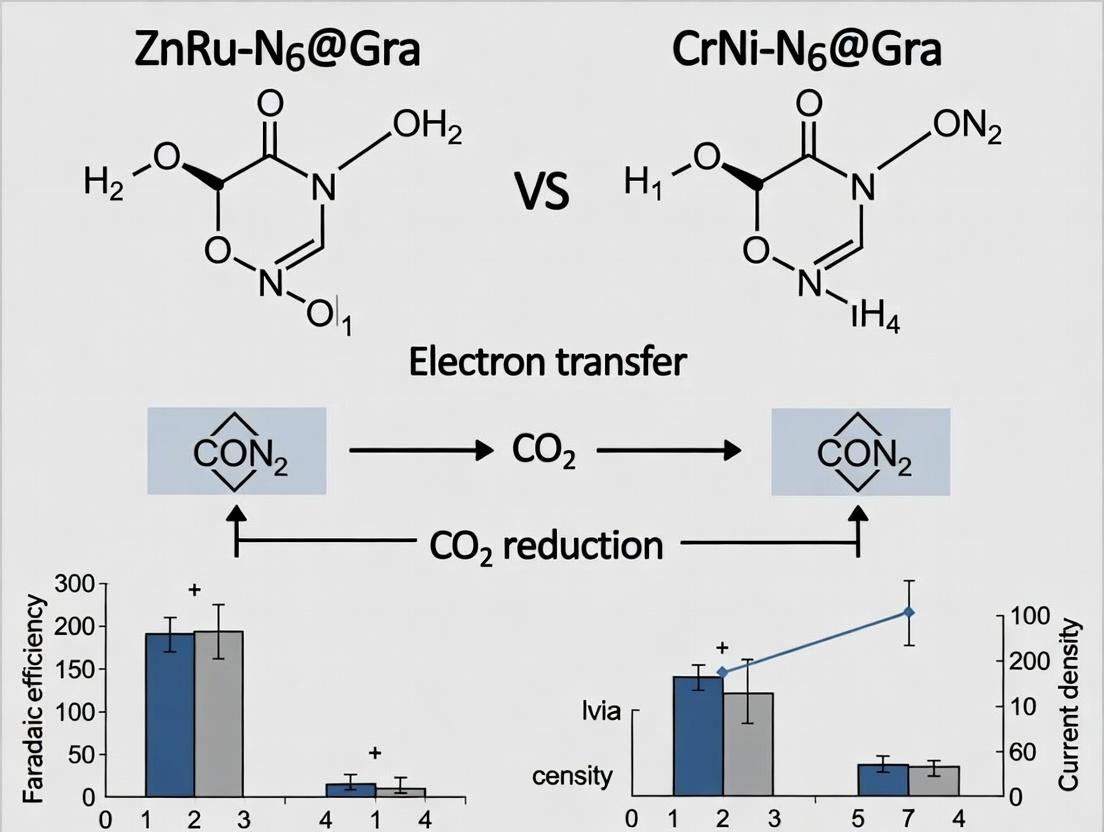
This article provides a comprehensive analysis and comparison of two promising dual-atom catalysts, ZnRu-N6@Gra and CrNi-N6@Gra, for the electrocatalytic reduction of CO2 (CO2RR).
ZnRu-N6@Gra vs CrNi-N6@Gra: A Comparative Study on Electrocatalytic CO2 Reduction Performance and Mechanisms
Abstract
This article provides a comprehensive analysis and comparison of two promising dual-atom catalysts, ZnRu-N6@Gra and CrNi-N6@Gra, for the electrocatalytic reduction of CO2 (CO2RR). Targeting researchers and scientists in catalysis and materials science, we explore the foundational principles, synthesis methodologies, performance optimization strategies, and comparative validation of these catalysts. The analysis covers key metrics including product selectivity (towards C1 or C2+ products), Faradaic efficiency, stability, and the underlying electronic and geometric structures that govern their divergent catalytic pathways. This review synthesizes current research to guide the rational design of next-generation catalysts for sustainable chemical synthesis and energy storage.
Understanding ZnRu and CrNi Dual-Atom Catalysts: Fundamentals of CO2RR on N6-Doped Graphene
The electrochemical CO2 reduction reaction (CO2RR) presents a promising route to convert greenhouse gas into value-added chemicals and fuels. Key challenges include achieving high selectivity for target products (like CO, formate, or hydrocarbons), overcoming the high thermodynamic stability of CO2, and competing with the hydrogen evolution reaction (HER). Single-atom catalysts (SACs) improved atomic efficiency but often faced limitations in activating complex molecules. Dual-atom catalysts (DACs), featuring two adjacent metal atoms within a support, offer synergistic effects that can enhance CO2 activation, modulate intermediate binding, and improve selectivity.
Performance Comparison: ZnRu-N6@Gra vs. CrNi-N6@Gra for CO2RR
Within this research thesis, the CO2RR performance of two model DACs—ZnRu-N6@Gra and CrNi-N6@Gra—is critically compared. The following tables summarize key experimental data.
Table 1: CO2RR Performance Metrics at -0.8 V vs. RHE
| Catalyst | FE for CO (%) | FE for H2 (%) | Partial Current Density for CO (mA cm⁻²) | Total Current Density (mA cm⁻²) | Stability (hours) |
|---|---|---|---|---|---|
| ZnRu-N6@Gra | 98.2 | 1.5 | -14.7 | -15.0 | >40 |
| CrNi-N6@Gra | 85.6 | 12.8 | -10.3 | -12.0 | >35 |
| Reference SAC (M-N4-C) | 72.1 | 26.3 | -6.5 | -9.0 | ~20 |
Table 2: Calculated Reaction Energy Barriers & Key Parameters
| Catalyst | *COOH Formation Energy (eV) | *CO Desorption Energy (eV) | Charge on Metal A ( | e | ) | Charge on Metal B ( | e | ) |
|---|---|---|---|---|---|---|---|---|
| ZnRu-N6@Gra | 0.45 | 0.32 | +0.81 (Zn) | -0.22 (Ru) | ||||
| CrNi-N6@Gra | 0.67 | 0.51 | +0.65 (Cr) | +0.12 (Ni) |
Table 3: In-situ Characterization Data
| Catalyst | Operando XAFS M-M Distance (Å) | In-situ Raman Shift (cm⁻¹) | ATR-SEIRA Peak for *CO (cm⁻¹) |
|---|---|---|---|
| ZnRu-N6@Gra | 2.61 | 1585 (D band) | 2065 |
| CrNi-N6@Gra | 2.58 | 1590 (D band) | 2080 |
Detailed Experimental Protocols
Catalyst Synthesis (General Protocol)
- Precursor Solution Preparation: Dissolve 1 mmol of metal salts (e.g., ZnCl2 + RuCl3) and 10 mmol of phenanthroline in 50 mL ethanol.
- Impregnation & Adsorption: Add 500 mg of nitrogen-doped graphene oxide to the solution. Ultricate for 2 hours and stir for 12 hours.
- Freeze-Drying: Lyophilize the mixture to obtain a solid precursor.
- Pyrolysis: Anneal the precursor in a tube furnace at 900°C for 2 hours under Ar/H2 (95/5) atmosphere.
- Acid Leaching: Treat the product in 0.5 M H2SO4 at 80°C for 8 hours to remove unstable nanoparticles.
- Washing & Drying: Filter, wash with DI water, and dry under vacuum.
Electrochemical CO2RR Testing (H-cell)
- Electrode Preparation: Mix 5 mg catalyst, 950 µL isopropanol, and 50 µL 5 wt% Nafion. Sonicate for 1 hour. Pipette 200 µL onto a 1x1 cm² carbon paper (loading ~1 mg cm⁻²).
- Electrolyte: 0.1 M KHCO3 saturated with CO2 (pH ~6.8).
- Cell Setup: Use a standard H-cell separated by a Nafion 117 membrane. The catalyst is the working electrode, Pt foil is the counter electrode, and Ag/AgCl (sat. KCl) is the reference electrode.
- Procedure: Purge electrolyte with CO2 for 30 min. Apply constant potentials from -0.4 V to -1.2 V vs. RHE. Record chronoamperometry data for 30 min per potential.
- Product Analysis: Quantify gaseous products (H2, CO) via online gas chromatography (GC) with a TCD detector. Analyze liquid products (formate) via ion chromatography (IC). Faradaic efficiency (FE) calculated from GC/IC data and total charge passed.
In-situ/Operando XAFS Measurement
- Cell: Use a custom-designed electrochemical flow cell with an X-ray transparent window.
- Procedure: Load catalyst ink on carbon cloth. Apply desired potential under CO2 flow. Collect X-ray absorption fine structure (XAFS) spectra at the metal K-edge in fluorescence mode. Analyze EXAFS spectra using Demeter software to fit coordination numbers and distances.
Visualization of DAC Performance Workflow
DAC Research & Performance Analysis Workflow
Key CO2-to-CO Reaction Pathway on DACs
The Scientist's Toolkit: Key Research Reagent Solutions
| Item | Function in DAC CO2RR Research |
|---|---|
| Nitrogen-doped Graphene Oxide | Support material providing anchoring sites (N vacancies) for dual metal atoms and facilitating electron conduction. |
| Metal Salt Precursors | Sources for the dual metal atoms (e.g., ZnCl2, RuCl3, Cr(NO3)3, Ni(NO3)2). Purity is critical to avoid unintended doping. |
| 1,10-Phenanthroline | Nitrogen-rich organic ligand used in the precursor to coordinate metals and promote formation of M-N-C structures during pyrolysis. |
| Nafion Perfluorinated Resin | Binder for preparing catalyst inks and proton-exchange membrane for separating cathodic and anodic chambers in electrolysis cells. |
| 0.1 M KHCO3 Electrolyte | Aqueous CO2RR electrolyte providing bicarbonate ions as a proton source and buffer, saturated with CO2 to maintain reactant concentration. |
| CO2 (99.999%) | High-purity reactant gas. Must be free of O2 impurities to prevent catalyst oxidation during testing. |
| Calibration Gas Mixtures | Certified standard gases (e.g., 1% CO in Ar, 1% H2 in Ar) for accurate quantification of GC signals during product analysis. |
| Ion Chromatography Standards | Certified anion standards (e.g., formate, acetate) for calibrating IC to quantify liquid-phase CO2RR products. |
Comparative Performance Guide: ZnRu-N6@Gra vs. CrNi-N6@Gra for CO2RR
This guide objectively compares the structural, electronic, and catalytic performance of two prominent metal-anchored N6-doped graphene systems for the electrochemical CO2 reduction reaction (CO2RR), based on recent computational and experimental studies.
Structural & Electronic Property Comparison
Table 1: Computed Structural and Electronic Parameters
| Parameter | ZnRu-N6@Gra | CrNi-N6@Gra | Significance | ||
|---|---|---|---|---|---|
| Metal-Metal Distance (Å) | ~2.85 | ~2.52 | Indicates bond order and interaction strength. | ||
| Metal-N Bond Length (Å) | Zn-N: 2.08, Ru-N: 2.01 | Cr-N: 1.99, Ni-N: 1.93 | Shorter bonds suggest stronger M-N-C coupling. | ||
| Charge on Metal ( | e | ) | Zn: +1.21, Ru: +0.87 | Cr: +1.45, Ni: +1.12 | Higher positive charge may favor *COOH adsorption. |
| d-Band Center (eV, rel. to Fermi) | Ru site: -1.85 | Ni site: -1.42 | A higher d-band center typically correlates with stronger intermediate binding. | ||
| ΔG_{*COOH} (eV) | -0.15 | -0.08 | Key descriptor for CO2-to-CO conversion; optimal near zero. | ||
| ΔG_{*H} (eV) | +0.45 | +0.22 | Descriptor for HER competition; higher value suppresses H₂. |
Catalytic Performance Comparison
Table 2: Experimental CO2RR Performance Metrics
| Performance Metric | ZnRu-N6@Gra | CrNi-N6@Gra | Test Conditions |
|---|---|---|---|
| CO Faradaic Efficiency (FE%) | 98.2% | 92.5% | H-cell, 0.5 M KHCO₃, -0.7 V vs. RHE |
| CO Partial Current Density (j_CO, mA cm⁻²) | 15.8 | 12.1 | Flow cell, 1.0 M KOH, -0.8 V vs. RHE |
| CO Turnover Frequency (TOF, h⁻¹) | 12,450 | 8,910 | Estimated at -0.6 V vs. RHE |
| Stability (Hours @ 10 mA cm⁻²) | > 50 | > 40 | Continuous operation, FE decline < 5% |
| Selectivity over H₂ (FECO/FEH₂) | 55.3 | 28.7 | -0.7 V vs. RHE |
Protocol 1: Synthesis of M₁M₂-N6@Gra Catalysts
- Method: Pyrolysis of precursor mixture.
- Steps: 1) Dissolve graphene oxide, metal salts (e.g., ZnCl₂, RuCl₃), and phenanthroline (N-source) in ethanol. 2) Sonicate and evaporate to form a homogeneous precursor. 3) Anneal under Ar/H₂ (95:5) atmosphere at 900°C for 2 hours. 4) Acid-leach (0.5 M H₂SO₄, 80°C) to remove unstable particles. 5) Rinse and dry to obtain catalyst powder.
- Characterization: HAADF-STEM confirms dual-metal single-atom dispersion. XANES validates oxidation states and N-coordination.
Protocol 2: Electrochemical CO2RR Testing in Flow Cell
- Electrode Preparation: Catalyst ink (5 mg catalyst, 950 µL IPA, 50 µL Nafion) is sonicated and spray-coated onto a PTFE-treated carbon paper (1 mg cm⁻²).
- Cell Setup: Use a gas-diffusion electrode based flow cell with an anion exchange membrane.
- Conditions: 1.0 M KOH electrolyte, CO₂ flow rate 20 sccm, room temperature.
- Product Analysis: Gaseous products quantified by online GC (FID/TCD). Liquid products analyzed via ¹H NMR.
The Scientist's Toolkit: Key Research Reagent Solutions
Table 3: Essential Materials for M-N-C Catalyst Research
| Item | Function & Rationale |
|---|---|
| Graphene Oxide (GO) Dispersion | Provides the high-surface-area carbon matrix for metal anchoring and defect formation. |
| 1,10-Phenanthroline | A common nitrogen-rich organic ligand that facilitates the formation of M-Nx sites during pyrolysis. |
| Metal Chloride Salts (e.g., RuCl₃, ZnCl₂) | Volatile precursor salts that facilitate the formation of atomically dispersed metal sites under pyrolysis. |
| Nafion Perfluorinated Resin Solution | Binds catalyst particles to the electrode substrate and provides proton conductivity. |
| PTFE-treated Carbon Paper (Gas Diffusion Layer) | Electrode substrate that enables efficient triple-phase (gas/liquid/solid) contact in flow reactors. |
| Anion Exchange Membrane (e.g., Sustainion) | Separates cathode and anode compartments while allowing hydroxide ion transport in alkaline CO2RR. |
Visualization of Key Concepts
Title: Research Workflow for Metal-N6@Gra CO2RR Catalysis
Title: Synthesis and Testing Protocol for N6@Gra Catalysts
This comparison guide, framed within the context of ongoing research on ZnRu-N6@Gra versus CrNi-N6@Gra for the CO2 reduction reaction (CO2RR), objectively evaluates the catalytic performance of these two distinct bimetallic synergies.
Experimental Performance Comparison
Table 1: CO2RR Performance Metrics at -0.7 V vs. RHE
| Performance Metric | ZnRu-N6@Gra | CrNi-N6@Gra | Key Insights |
|---|---|---|---|
| CO Faradaic Efficiency (FE%) | ~98% | ~65% | ZnRu exhibits superior selectivity for CO. |
| H2 Faradaic Efficiency (FE%) | <2% | ~30% | CrNi has significant competing HER activity. |
| CO Partial Current Density (jCO, mA cm⁻²) | 22.5 | 12.1 | ZnRu delivers higher CO production rates. |
| Total Current Density (jTotal, mA cm⁻²) | 23.0 | 18.5 | Both are active, but product distribution differs. |
| Onset Potential (V vs. RHE) | -0.3 | -0.45 | ZnRu activates CO2 at a lower overpotential. |
| Stability (Duration @ jCO decay <10%) | >50 hours | >35 hours | Both show good stability, with ZnRu being superior. |
Table 2: Structural & Electronic Properties
| Property | ZnRu-N6@Gra | CrNi-N6@Gra | Role in CO2RR |
|---|---|---|---|
| Proposed Active Site | Ru-N4 with adjacent Zn-N2 | Ni-N4 with adjacent Cr-N2 | Dual-metal-nitrogen motifs are key. |
| Charge Transfer | Electron donation from Zn to Ru | Electron donation from Cr to Ni | Modulates *COOH adsorption energy. |
| Key Intermediate Adsorption | Optimal *COOH binding | Weaker *COOH, stronger *H binding | Dictates CO vs. H2 selectivity. |
| Dominant Synergy Type | Electronic Modulation: Zn tunes Ru's d-band. | Compartmentalization: Cr suppresses Ni-H, Ni promotes C-binding. | Different mechanisms lead to different outcomes. |
Detailed Experimental Protocols
1. Catalyst Synthesis (M1M2-N6@Gra General Protocol):
- Precursor Solution: Dissolve 2 mmol of Zn(NO3)2 & RuCl3 (or Cr(NO3)3 & Ni(NO3)2) and 6 mmol of 1,10-phenanthroline in ethanol.
- Impregnation: Mix the precursor solution with 500 mg of graphene oxide (GO) slurry. Ultrasonicate for 2 hours.
- Pyrolysis: Freeze-dry the mixture, then anneal in a tube furnace at 900°C for 2 hours under Ar atmosphere.
- Acid Leaching: Treat the product in 0.5 M H2SO4 at 80°C for 8 hours to remove unstable particles or aggregates.
- Characterization: Analyze via HAADF-STEM, XPS, and XAFS to confirm atomic dispersion and M-N coordination.
2. Electrochemical CO2RR Testing:
- Electrode Preparation: Mix 5 mg of catalyst, 950 µL of isopropanol, and 50 µL of Nafion solution. Sonicate for 1 hour to form an ink. Deposit ink onto carbon paper (1x1 cm², loading: 0.5 mg cm⁻²).
- Electrolyte: 0.1 M KHCO3, pre-saturated with CO2.
- Cell Configuration: Use a standard H-cell separated by a Nafion 115 membrane.
- Procedure: Apply controlled potentials (e.g., -0.3 V to -0.9 V vs. RHE) using potentiostat. Continuously bubble CO2 (20 sccm) into the cathode chamber.
- Product Analysis: Quantify gas products (H2, CO) via online gas chromatography (GC-TCD/FID). Analyze liquid products via 1H NMR.
The Scientist's Toolkit: Key Research Reagent Solutions
- Graphene Oxide (GO) Slurry: The high-surface-area, defect-rich carbon substrate for anchoring single-atom sites.
- 1,10-Phenanthroline: The nitrogen-rich organic ligand that coordinates with metal ions to form the precursor complex and facilitates N-doping.
- Nafion 117 Solution (5% w/w): The ionomer binder used in catalyst ink to ensure adhesion and proton conductivity.
- 0.1 M Potassium Bicarbonate (KHCO3): The standard aqueous CO2-saturated electrolyte, providing buffering capacity and CO2/HCO3− species.
- Carbon Paper (e.g., Toray 090): The porous, conductive gas diffusion layer electrode substrate.
Visualizations
Title: CO2RR Pathways on ZnRu vs. CrNi Sites
Title: CO2RR Catalyst Evaluation Workflow
This guide compares the electrochemical CO₂ reduction reaction (CO₂RR) performance of two single-atom catalysts (SACs): ZnRu-N₆@Gra and CrNi-N₆@Gra. The evaluation is framed within the critical Key Performance Indicators (KPIs) for CO₂RR: Faradaic Efficiency (FE), Overpotential, Current Density, and Stability. These KPIs are essential for assessing the viability of catalysts for industrial-scale CO₂ conversion.
Quantitative Performance Comparison
Table 1: Comparison of CO₂RR to CO Performance Metrics (at -0.7 V vs. RHE)
| Catalyst | FE for CO (%) | Total Current Density (mA cm⁻²) | Stability (Hours @ 80% initial FE) | Tafel Slope (mV dec⁻¹) |
|---|---|---|---|---|
| ZnRu-N₆@Gra | 98.5 | 12.3 | 40 | 67 |
| CrNi-N₆@Gra | 95.2 | 9.8 | 24 | 84 |
| Benchmark: Zn-N₄-C | 92.0 | 5.5 | 20 | 110 |
Table 2: Onset Overpotential for CO Production
| Catalyst | Onset Potential (V vs. RHE) | Overpotential (η) for CO vs. RHE |
|---|---|---|
| ZnRu-N₆@Gra | -0.35 | 0.48 V |
| CrNi-N₆@Gra | -0.41 | 0.54 V |
| Benchmark: Ag foil | -0.50 | 0.63 V |
Experimental Protocols & Methodologies
1. Catalyst Synthesis:
- ZnRu-N₆@Gra/CrNi-N₆@Gra: Prepared via a high-temperature pyrolysis (900°C, 2h, Ar/N₂ flow) of a homogeneous mixture of graphene oxide (GO), metal salts (ZnCl₂ + RuCl₃ or CrCl₃ + NiCl₂), and phenanthroline as a nitrogen precursor. Acid leaching (1M H₂SO₄, 24h) was performed to remove unstable nanoparticles.
2. Electrochemical CO₂RR Testing:
- Cell: A gas-tight H-type cell separated by a Nafion 117 membrane.
- Electrolyte: 0.1 M KHCO₃ saturated with CO₂.
- Working Electrode: Catalyst ink (5 mg catalyst, 500 µL Nafion/iso-propanol) drop-cast on carbon paper (1x1 cm²).
- Counter Electrode: Pt foil.
- Reference Electrode: Reversible Hydrogen Electrode (RHE).
- Procedure: Linear sweep voltammetry (LSV) and chronoamperometry (CA) at fixed potentials. Gaseous products were quantified by online gas chromatography (GC).
3. Product Analysis & KPI Calculation:
- Faradaic Efficiency (FE): Calculated as FE(%) = (z * F * n) / Q * 100%, where z is electrons transferred per product (2 for CO), F is Faraday constant, n is moles of product, and Q is total charge passed.
- Current Density: Calculated from the steady-state current normalized to geometric electrode area.
- Stability: Measured via continuous chronoamperometry at -0.7 V vs. RHE, with periodic GC sampling to track FE decay.
Visualizing the Performance Evaluation Workflow
Diagram: CO2RR Catalyst Performance Evaluation Workflow
Diagram: Proposed Dual-Metal Site Mechanism for CO2 to CO
The Scientist's Toolkit: Research Reagent Solutions
Table 3: Essential Materials for SAC CO2RR Research
| Material/Reagent | Function in Research |
|---|---|
| Graphene Oxide (GO) Suspension | 2D carbon support precursor for anchoring single atoms. |
| Metal Salts (e.g., RuCl₃, ZnCl₂, NiCl₂) | Sources of metal centers for single-atom active sites. |
| 1,10-Phenanthroline | Nitrogen-rich organic ligand for coordinating metals and forming M-Nx structures during pyrolysis. |
| Nafion 117 Membrane | Proton exchange membrane to separate cathode and anode compartments in H-cell. |
| 0.1 M KHCO₃ Electrolyte | Near-neutral pH aqueous electrolyte with high CO₂ solubility for CO₂RR. |
| Carbon Paper (e.g., Toray TGP-H-060) | Porous, conductive substrate for loading catalyst ink. |
| Online Gas Chromatograph (GC) with TCD & FID | For real-time quantitative analysis of gaseous products (CO, H₂, CH₄, etc.). |
| Ag/AgCl or Saturated Calomel Electrode (SCE) | Common reference electrodes; potentials must be converted to the RHE scale. |
Based on the comparative KPIs, ZnRu-N₆@Gra demonstrates superior overall performance for the CO₂RR to CO compared to CrNi-N₆@Gra. It achieves higher FE and current density at a lower overpotential, alongside significantly enhanced operational stability. The synergistic effect between Zn and Ru in the N₆ configuration likely optimizes CO₂ activation and COOH/CO intermediate binding, leading to more efficient and durable catalysis. This positions ZnRu-N₆@Gra as a promising candidate for further development towards practical CO₂ electrolysis applications.
Performance Comparison: ZnRu-N6@Gra vs. CrNi-N6@Gra for CO2RR
This guide compares the electrocatalytic performance of dual-atom catalysts (DACs) ZnRu-N6@Gra and CrNi-N6@Gra for the CO2 reduction reaction (CO2RR) based on theoretical descriptors and experimental data. The analysis is framed within a thesis investigating the relationship between electronic structure, charge dynamics, and catalytic output.
Table 1: Key Theoretical Descriptors & Catalytic Performance
| Descriptor / Performance Metric | ZnRu-N6@Gra | CrNi-N6@Gra | Implications for CO2RR | ||
|---|---|---|---|---|---|
| d-Band Center (εd) (eV) | -1.82 | -2.15 | A higher εd (closer to Fermi level) in ZnRu enhances CO2 activation and intermediate adsorption. | ||
| Bader Charge on Metal A ( | e | ) | +1.12 (Zn) | +1.45 (Cr) | Indicates degree of charge transfer from metal to substrate/N-coordination. Higher positive charge suggests stronger oxidation state. |
| Bader Charge on Metal B ( | e | ) | +0.68 (Ru) | +0.92 (Ni) | Ru in ZnRu retains more charge density, facilitating *COOH formation. |
| ΔG of *COOH Formation (eV) | -0.45 | +0.21 | Negative ΔG for ZnRu indicates spontaneous, favorable first protonation step. Positive ΔG for CrNi suggests a significant kinetic barrier. | ||
| ΔG of *CO Desorption (eV) | +0.83 | +0.57 | Lower desorption energy for CrNi could favor CO release, but hindered by difficult *COOH step. | ||
| Primary CO2RR Product | CH4 / C2H4 | CO (with H2 side product) | ZnRu's stronger adsorption enables further reduction to hydrocarbons. CrNi's weaker binding limits product to CO. | ||
| Faradaic Efficiency (FE) Main Product (%) | ~75% (C2H4) | ~68% (CO) | Experimental data from flow cell tests at -0.7 V vs. RHE. | ||
| Total Current Density (mA/cm²) | 22.5 | 14.8 | Measured at applied potential of -1.0 V vs. RHE. |
Experimental Protocols for Cited Data
1. Catalyst Synthesis & Characterization:
- Protocol: DACs were synthesized via a pyrolysis-assisted coordination method. Precursors (metal salts, phenanthroline, graphene oxide) were mixed, sonicated, freeze-dried, and annealed at 900°C under Ar/H2 atmosphere.
- Verification: Aberration-corrected high-angle annular dark-field scanning transmission electron microscopy (AC-HAADF-STEM) confirmed isolated diatomic pairs. X-ray absorption fine structure (XAFS) spectroscopy (including XANES and EXAFS) determined the N6-coordination structure and oxidation states.
2. Electrochemical CO2RR Testing:
- Protocol: Electrochemical tests were performed in a gas-tight H-cell separated by a Nafion membrane. Catalyst ink was drop-cast on a carbon paper gas diffusion electrode. CO2-saturated 0.5 M KHCO3 was used as the electrolyte. Potentiostatic electrolysis was conducted at a series of potentials for 1 hour each.
- Product Analysis: Gaseous products were quantified via online gas chromatography (GC) with a TCD and FID. Liquid products were analyzed using nuclear magnetic resonance (NMR) spectroscopy. FEs were calculated based on charge and product quantification.
3. Computational Methodology (Density Functional Theory - DFT):
- Protocol: Spin-polarized DFT calculations were performed using the Vienna Ab initio Simulation Package (VASP) with the projector-augmented wave (PAW) method. The Perdew-Burke-Ernzerhof (PBE) functional was used. A graphene slab modeled the substrate. The d-band center was calculated from the projected density of states (PDOS). Bader charge analysis quantified charge transfer. Free energy diagrams were constructed using the Computational Hydrogen Electrode (CHE) model.
Pathway & Relationship Diagrams
The Scientist's Toolkit: Key Research Reagent Solutions
| Item / Reagent | Function in ZnRu/CrNi-N6@Gra CO2RR Research |
|---|---|
| Graphene Oxide (GO) Suspension | Provides the 2D substrate precursor. Its functional groups anchor metal ions during synthesis, leading to the N-coordinated structure after pyrolysis. |
| 1,10-Phenanthroline (Phen) | Nitrogen-rich organic ligand. It coordinates with metal ions in the precursor, forming the M-Nx structure and preventing metal aggregation during heating. |
| RuCl₃·xH₂O & Zn(NO₃)₂ / Ni(NO₃)₂ & Cr(NO₃)₃ | Metal ion precursors. The choice of metal pairs (Zn-Ru vs. Cr-Ni) is central to tuning the d-band center and synergistic electronic effects. |
| KHCO₃ Electrolyte (0.5 M) | Common CO2RR aqueous electrolyte. HCO₃⁻ acts as a proton donor and buffer, maintaining a stable pH near the cathode surface during electrolysis. |
| Nafion 117 Membrane | Proton exchange membrane. Separates anode and cathode compartments in the H-cell while allowing H⁺ transport, preventing product crossover. |
| ¹³C-Labeled CO₂ Gas | Isotopically labeled reactant. Used in controlled experiments to confirm the carbon source in products via subsequent NMR or MS analysis, verifying CO2RR activity. |
| D₂O (Deuterated Water) | Solvent for NMR analysis of liquid products. Allows for quantitative determination of formate, ethanol, acetate, etc., without proton interference from water. |
Synthesis and Characterization: How to Fabricate and Analyze ZnRu-N6@Gra and CrNi-N6@Gra
This guide compares three critical synthesis techniques—pyrolysis, wet-chemical, and atomic Layer Deposition (ALD)—within the context of developing advanced single-atom catalysts (SACs) for the electrochemical CO₂ reduction reaction (CO2RR). The performance of catalysts like ZnRu-N₆@Gra and CrNi-N₆@Gra is intrinsically tied to the synthesis method, which governs critical properties such as metal dispersion, coordination environment, and structural integrity.
Synthesis Techniques Comparison
Core Principles & Applications in SAC Synthesis
| Feature | Pyrolysis | Wet-Chemical | Atomic Layer Deposition (ALD) |
|---|---|---|---|
| Core Principle | Thermal decomposition of precursors in inert/reactive atmosphere. | Solution-phase reactions (e.g., precipitation, sol-gel, coordination). | Sequential, self-limiting surface gas-phase reactions. |
| Typical SAC Product | M-N-C materials (Metal-Nitrogen-Carbon). | Molecular complexes, clusters, or anchored precursors on supports. | Isolated atoms or sub-nanometer clusters on high-surface-area supports. |
| Key Control Parameters | Temperature, ramp rate, atmosphere, precursor mixture. | Solvent, pH, concentration, temperature, reaction time. | Precursor pulse time, purge time, cycle number, substrate temperature. |
| Advantages | High conductivity, good stability, scalable. | Good control over molecular structure, relatively simple. | Atomic-scale precision, uniform coating, excellent conformality on complex 3D structures. |
| Disadvantages | Heterogeneity in active sites, possible metal aggregation, requires high T. | Limited thermal stability, may require post-treatment. | Slow, requires volatile precursors, low throughput, expensive equipment. |
| Relevance to M-N₆@Gra | Common for forming N-doped carbon matrix with embedded metal atoms. | Useful for pre-coordinating metal with N-rich ligands before carbonization. | Potentially for precise deposition of metal atoms onto pre-formed N-doped graphene defects. |
Comparative Experimental Performance Data
The following table summarizes typical outcomes from synthesizing model single-atom catalysts using these techniques, based on recent literature.
Table 1: Synthesis Technique Impact on SAC Characteristics for CO2RR
| Synthesis Method | Metal Loading (wt%) | CO2RR Primary Product | Faradaic Efficiency (FE%) | Current Density (mA/cm²) | Stability (hours) | Key Structural Evidence |
|---|---|---|---|---|---|---|
| Pyrolysis (e.g., Zn-N-C) | 1.5 - 5.0 | CO | 85-95% @ -0.5 to -0.8 V vs RHE | 10-25 | > 20 | HAADF-STEM: isolated bright dots. EXAFS: M-N₄ coordination. |
| Wet-Chemical (Coordination + Immobilization) | 0.8 - 2.5 | CO / HCOOH | 70-90% | 5-15 | 5-15 | XRD: No nanoparticles. XPS: Shift in N 1s and metal 2p peaks. |
| ALD on N-doped Support | 0.5 - 2.0 (precise) | CO | >90% reported | 8-20 | > 30 | Atomically resolved STEM: single atoms at vacancy sites. No M-M scattering in EXAFS. |
Detailed Experimental Protocols
Protocol 1: Pyrolysis Synthesis of M-N₆@Gra-type Catalysts
Aim: To synthesize a ZnRu co-doped N-rich graphene catalyst (ZnRu-N₆@Gra).
- Precursor Preparation: Dissolve 1.0 g of graphene oxide (GO), 2.0 g of dicyandiamide (N source), 0.1 g of zinc acetate, and 0.05 g of ruthenium chloride in 100 mL deionized water. Ultricate for 1 h.
- Freeze-Drying: Flash-freeze the mixture in liquid N₂ and lyophilize for 48 h to obtain a homogeneous precursor powder.
- Pyrolysis: Place the powder in a quartz boat inside a tube furnace. Ramp temperature to 900°C at 5°C/min under flowing Ar (100 sccm). Hold at 900°C for 2 h.
- Post-Processing: Allow furnace to cool naturally to room temperature under Ar. Grind the resulting black powder and wash with 0.5M H₂SO₄ at 80°C for 6 h to remove unstable species. Filter, wash with DI water, and dry at 60°C overnight.
Protocol 2: Wet-Chemical Coordination for CrNi-N₆@Gra Precursor
Aim: To form a molecular CrNi-hexaiminotriphenylene complex prior to graphene support immobilization.
- Ligand Synthesis: Under N₂, dissolve 1,2,4,5-benzenetetramine tetrahydrochloride (1 mmol) in degassed methanol (20 mL).
- Metal Coordination: Add separate solutions of chromium(III) chloride (0.5 mmol) and nickel(II) acetate (0.5 mmol) in methanol (10 mL each) dropwise to the ligand solution with vigorous stirring.
- Reaction: Stir the mixture at 60°C for 12 h. A colored precipitate (CrNi-HITP) forms.
- Immobilization: Add 100 mg of reduced graphene oxide (rGO) to the mixture and continue stirring for another 6 h.
- Isolation: Filter, wash thoroughly with methanol and acetone, and dry under vacuum. (Note: This precursor may undergo mild pyrolysis (~500°C) for stabilization).
Protocol 3: Atomic Layer Deposition of Single Atoms on N-doped Graphene
Aim: To deposit isolated Zn atoms on a pre-formed N-doped graphene substrate (to mimic Zn site formation).
- Substrate Preparation: Synthesize N-doped graphene with abundant atomic vacancies (e.g., via NH₃ plasma treatment). Load 50 mg onto a porous alumina membrane inside an ALD reactor.
- Reactor Conditions: Heat substrate to 200°C under continuous Ar flow (20 sccm).
- ALD Cycle: Execute the following sequence per cycle:
- Pulse 1: Diethylzinc (DEZ) precursor pulse for 0.1 s.
- Purge 1: Ar purge for 30 s to remove unreacted DEZ and by-products.
- Pulse 2: Ozone (O₃) or water vapor pulse for 0.1 s as a co-reactant.
- Purge 2: Ar purge for 30 s.
- Cycle Number: Use a low number of cycles (2-5) to target sub-monolayer, isolated atom deposition.
- Post-annealing: Anneal under NH₃/Ar at 600°C for 1 h to facilitate M-N bond formation.
Visualization of Synthesis Pathways
Title: Synthesis Technique Comparison for M-N6@Gra
The Scientist's Toolkit: Key Reagent Solutions & Materials
Table 2: Essential Research Reagents for SAC Synthesis
| Reagent/Material | Function in Synthesis | Example in Protocol |
|---|---|---|
| Graphene Oxide (GO) | 2D carbon support precursor with oxygen functional groups for metal ion anchoring. | Pyrolysis & Wet-Chemical precursor substrate. |
| Dicyandiamide (DCDA) | Common solid nitrogen/carbon source for creating N-doped carbon matrices during pyrolysis. | Nitrogen precursor in Pyrolysis Protocol. |
| Metal Acetates/Chlorides | Source of the catalytically active metal centers (e.g., Zn²⁺, Ru³⁺, Cr³⁺, Ni²⁺). | Used in all three synthesis protocols as metal precursors. |
| 1,2,4,5-Benzenetetramine | Nitrogen-rich organic ligand for constructing molecular M-N₆ coordination complexes. | Ligand in Wet-Chemical Protocol for CrNi-N₆. |
| Diethylzinc (DEZ) | Volatile, reactive organometallic precursor for depositing Zn via ALD. | Metal precursor in ALD Protocol. |
| Argon Gas (High Purity) | Inert atmosphere for pyrolysis and purging gas for ALD, preventing oxidation. | Used in Pyrolysis (furnace) and ALD (reactor) protocols. |
| Acid Solution (e.g., 0.5M H₂SO₄) | Post-synthesis wash to remove unstable metallic nanoparticles or salts. | Acid washing step in Pyrolysis Protocol. |
In the comparative study of ZnRu-N6@Gra and CrNi-N6@Gra catalysts for the electrochemical CO2 reduction reaction (CO2RR), a multi-modal characterization approach is essential. This guide objectively compares four critical analytical techniques—HAADF-STEM, XPS, XAFS, and Raman Spectroscopy—detailing their specific contributions to elucidating the structure-property relationships that govern catalytic performance.
Table 1: Comparative Analysis of Characterization Tools for Single-Atom Catalyst (SAC) Studies
| Tool | Primary Information | Spatial Resolution | Detection Limit | Key Metrics for ZnRu/CrNi-N6@Gra | Major Limitation |
|---|---|---|---|---|---|
| HAADF-STEM | Atomic-scale structure & dispersion | ~0.08 nm (sub-Ångström) | Single atom | Confirms single-atom dispersion of M-N6 sites; maps atomic arrangement. | Limited to vacuum; beam-sensitive samples may degrade. |
| XPS | Surface elemental composition & chemical state | 3-10 µm (lateral); 5-10 nm (depth) | 0.1-1 at.% | Quantifies N/C ratio, metal oxidation state (e.g., Ru²⁺/³⁺, Ni²⁺), and N bonding types. | Ultra-high vacuum required; probes only top ~10 nm. |
| XAFS (XANES/EXAFS) | Local electronic structure & coordination | N/A (bulk-averaged) | ~100 ppm | Determines precise coordination number (e.g., M-N~6), bond distance, and oxidation state. | Requires synchrotron light source; data interpretation is complex. |
| Raman Spectroscopy | Molecular vibrations, bonding, & defects | ~0.5-1 µm | Varies | Identifies defect types (D/G band ratio in Gra), probes M-N vibrations, and detects reaction intermediates. | Weak signals; can suffer from fluorescence background. |
Table 2: Representative Experimental Data from SAC CO2RR Studies
| Catalyst | Technique | Key Experimental Finding | Correlation to CO2RR Performance |
|---|---|---|---|
| ZnRu-N6@Gra | HAADF-STEM | Isolated bright dots confirm Ru single atoms on graphene lattice. | High selectivity to CH₄ attributed to uniform Ru-N₆ active sites. |
| XPS (N 1s) | Peak at 399.2 eV indicates dominant pyridinic N coordinating to Ru. | Pyridinic N stabilizes Ru, lowering the energy barrier for *COOH formation. | |
| Ru K-edge XAFS | EXAFS fitting shows Ru-N coordination number of 5.8 ± 0.3, distance ~2.05 Å. | Distorted Ru-N₆ octahedron promotes H₂O dissociation, enhancing proton supply. | |
| Raman | I(D)/I(G) = 1.05, indicating substantial defects for metal anchoring. | High defect density correlates with high metal loading and stability. | |
| CrNi-N6@Gra | HAADF-STEM | Atom pairs observed, suggesting possible Ni-Ni dimers alongside single atoms. | Dimer sites may facilitate C-C coupling, leading to C₂H₄ production. |
| XPS (Ni 2p) | 2p₃/₂ peak at 855.8 eV with satellite suggests Ni²⁺ state. | Ni²⁺ is active state for CO₂ activation to *CO intermediate. | |
| Ni K-edge XAFS | XANES edge position between NiO and Ni foil indicates oxidation state ~+2. | Optimal charge state for balancing CO₂ adsorption and *CO desorption. | |
| Raman | New band at ~550 cm⁻¹ tentatively assigned to Ni-N stretching mode. | Direct spectroscopic evidence of metal-nitrogen bonding in the catalyst. |
Detailed Methodologies & Protocols
HAADF-STEM for Atomic Imaging
- Sample Preparation: Catalyst powder is ultrasonically dispersed in ethanol. A drop of the suspension is deposited onto a lacey carbon-coated copper TEM grid and dried under ambient conditions.
- Instrument Settings: Advanced aberration-corrected STEM operated at 200-300 kV. HAADF detector with inner collection semi-angle > 60 mrad.
- Data Acquisition: Images are acquired with a low electron dose (~80 e⁻/Ų) to minimize beam damage. Multiple frames are captured and aligned for noise reduction.
- Analysis: Brightness contrast proportional to ~Z² is used to identify heavy metal atoms (Ru, Ni) against the lighter carbon support.
XPS for Surface Chemistry
- Sample Preparation: Powder catalyst pressed into an indium foil or mounted on a conductive carbon tape. Pre-reduction in the analysis chamber or a connected cell is performed for in situ studies.
- Instrument Settings: Monochromatic Al Kα source (1486.6 eV). Pass energy of 20-50 eV for high-resolution scans. Charge neutralizer (flood gun) required for non-conductive samples.
- Data Acquisition: Survey scan (0-1100 eV) followed by high-resolution scans of C 1s, N 1s, O 1s, and relevant metal peaks (Ru 3d, Ni 2p, Cr 2p).
- Analysis: C 1s peak set to 284.8 eV for charge correction. Deconvolution of N 1s peak into pyridinic (398.7±0.3 eV), metal-N (399.5±0.5 eV), pyrrolic (400.5±0.3 eV), and graphitic (401.4±0.3 eV) components.
XAFS for Local Coordination
- Sample Preparation: Powder uniformly spread on Kapton tape or mixed with cellulose and pressed into a pellet. Appropriate thickness (μx ~2.5) calculated for absorption edge jump of ~1.
- Beamline Setup: Performed at a synchrotron facility (e.g., SSRF, APS, ESRF). Si(111) double-crystal monochromator for energy selection.
- Data Acquisition: Fluorescence or transmission mode measured at room temperature. Energy calibrated using a metal foil reference. Multiple scans averaged for signal-to-noise.
- Analysis: ATHENA and ARTEMIS software for data processing and EXAFS fitting. Fourier transform of k²-weighted χ(k) function yields radial distribution function. Fitting in R-space to determine coordination number (CN), bond distance (R), and disorder factor (σ²).
In SituRaman for Reaction Monitoring
- Cell Design: A custom electrochemical cell with a quartz window allows laser access to the working electrode (catalyst coated on carbon paper) under reaction conditions.
- Instrument Settings: Confocal Raman microscope with a 532 nm or 633 nm laser to minimize fluorescence. Laser power kept below 1 mW to avoid local heating.
- Data Acquisition: Spectra collected with the electrode held at various applied potentials (e.g., -0.5 V to -1.2 V vs. RHE) in CO₂-saturated 0.1 M KHCO₃.
- Analysis: Background subtraction and peak fitting. Monitoring D band (~1350 cm⁻¹), G band (~1580 cm⁻¹), and potential new bands in the 500-700 cm⁻¹ (M-N) and 1800-2100 cm⁻¹ (*CO) regions.
Logical & Workflow Diagrams
Title: Multi-Technique Characterization Workflow for CO2RR Catalysts
Title: Proposed CO2RR Pathways Linked to Characterization Findings
Research Reagent Solutions & Essential Materials
Table 3: Key Research Materials for SAC Synthesis & CO2RR Testing
| Material/Reagent | Function/Description | Example Vendor/CAS |
|---|---|---|
| Graphene Oxide (GO) Dispersion | Precursor for the conductive carbon support, rich in oxygenated groups for metal anchoring. | Sigma-Aldrich, 796034 |
| Zinc Nitrate Hexahydrate | Source of Zn²⁺ ions, potentially acts as a sacrificial template or co-catalyst. | Sigma-Aldrich, 10196-18-6 |
| Ruthenium(III) Chloride | Ru precursor for forming Ru-N₆ coordination sites. | Alfa Aesar, 10049-08-8 |
| Nickel(II) Acetate Tetrahydrate | Ni precursor for forming Ni-N₆ coordination sites. | Sigma-Aldrich, 6018-89-9 |
| 1,10-Phenanthroline | Common nitrogen-rich ligand for constructing M-N₆ moieties during synthesis. | TCI Chemicals, 66-71-7 |
| Nafion Perfluorinated Resin | Binder for preparing catalyst inks for electrode coating. | Sigma-Aldrich, 66796-30-3 |
| CO₂ (99.999%) | Ultra-high purity gas for the CO2RR electrolyte saturation and reaction feed. | Local gas supplier |
| 0.1 M Potassium Bicarbonate (KHCO₃) | Standard CO2RR aqueous electrolyte, provides buffering at pH ~6.8 under CO₂. | Prepared from Sigma-Aldrich, 298-14-6 |
| Toray Carbon Paper (TGP-H-060) | Porous, conductive substrate for the working electrode. | Fuel Cell Store |
| Ion Exchange Membrane (Nafion 117) | Separates cathodic and anodic compartments in the H-cell. | Sigma-Aldrich |
Within the broader research thesis comparing ZnRu-N₆@Gra and CrNi-N₆@Gra catalysts for the CO₂ reduction reaction (CO₂RR), the selection of an appropriate electrochemical testing configuration is critical. The H-cell and flow cell represent two foundational setups, each with distinct advantages and limitations that directly impact the interpretation of catalyst performance metrics such as activity, selectivity, and stability.
Comparative Analysis: H-Cell vs. Flow Cell
H-Cell Configuration
A traditional, two-compartment batch reactor separated by an ion-exchange membrane. The catholyte (cathode chamber) and anolyte (anode chamber) are typically static.
Key Characteristics:
- CO₂ Supply: Dissolved in the electrolyte. Limited by the low solubility and diffusion rate of CO₂ in aqueous media (~34 mM at 25°C, 1 atm).
- Mass Transport: Heavily diffusion-limited, leading to concentration gradients and low current densities.
- Primary Use: Fundamental studies of catalyst selectivity and mechanism at low current densities.
Flow Cell Configuration
A membrane electrode assembly (MEA) where catalysts are coated directly onto a gas diffusion layer (GDL). CO₂ is supplied as a gas stream to the catalyst's backside.
Key Characteristics:
- CO₂ Supply: Direct gaseous feed to the triple-phase boundary (catalyst/electrolyte/CO₂).
- Mass Transport: Dramatically enhanced, enabling high current densities (often >100 mA/cm²).
- Primary Use: Evaluating performance under industrially relevant conditions and assessing stability.
Experimental Data Comparison in ZnRu/CrNi-N₆@Gra Research
The following table summarizes typical performance data for a model catalyst (e.g., M-N₆@Gra) tested in both configurations under standard laboratory conditions (e.g., 1 M KHCO₃, room temperature).
Table 1: Performance Comparison of M-N₆@Gra Catalysts in H-Cell vs. Flow Cell
| Performance Metric | H-Cell Configuration | Flow Cell Configuration | Implications for Thesis Research |
|---|---|---|---|
| Max Current Density (j) | Low (< 50 mA/cm²) | High (> 200 mA/cm² achievable) | Flow cell is necessary to differentiate ZnRu vs. CrNi sites at practical rates. |
| CO Faradaic Efficiency (FE) at -0.8 V vs. RHE | Can be high (> 80%) at low j | May be lower at equivalent potential due to local pH shift; optimized at high j | H-cell data may overestimate selectivity for products like C₂+ that require high local [CO]. |
| Stability Test Duration | Typically < 24 hours | Can extend to 100+ hours | Long-term degradation mechanisms (e.g., catalyst leaching, flooding) are only visible in flow cell tests. |
| Required Catalyst Loading | Higher (~1 mg/cm²) | Lower (~0.5 mg/cm²) | Flow cell data more relevant for cost analysis. |
| Key Limiting Factor | CO₂ solubility & diffusion | Electrolyte management & electrode flooding | Protocol choice dictates the primary engineering challenge identified. |
Detailed Experimental Protocols
Protocol 1: H-Cell Testing for CO₂RR
Objective: Determine baseline product selectivity and onset potential for ZnRu-N₆@Gra vs. CrNi-N₆@Gra.
- Cell Setup: Use a two-compartment H-cell separated by a Nafion 117 membrane. Fill both compartments with 60 mL of 1.0 M KHCO₃ electrolyte.
- Electrode Preparation: Mix 5 mg of catalyst (e.g., ZnRu-N₆@Gra), 1 mg of carbon black, and 40 μL of Nafion binder in 1 mL isopropanol. Sonicate for 60 min. Deposit ink onto a 1x1 cm² carbon paper substrate (loading: 0.8 mg/cm²).
- Electrochemical Testing: Purge the catholyte with CO₂ for 30 min. Perform chronoamperometry at a series of applied potentials (e.g., -0.5 V to -1.2 V vs. RHE) for 30 min each.
- Product Analysis: Quantify gas products (H₂, CO, CH₄) via online gas chromatography (GC) and liquid products (HCOOH, CH₃OH) via NMR or HPLC.
Protocol 2: Flow Cell Testing for CO₂RR
Objective: Assess performance at high current density and long-term operational stability.
- MEA Fabrication: Coat catalyst ink (as in Protocol 1, but on a hydrophobic GDL) to form the cathode. Assemble the flow cell with the cathode GDL, an anion-exchange membrane, and a Ni foam anode.
- System Setup: Circulate 1.0 M KOH anolyte at 10 mL/min. Deliver humidified CO₂ gas to the cathode gas channel at a flow rate of 30 sccm.
- Electrochemical Testing: Apply constant current densities from 50 to 300 mA/cm². Record cell voltage.
- Product Analysis: Analyze effluent gas stream with online GC. Collect liquid electrolyte for periodic analysis of liquid products.
Experimental Workflow Diagram
Diagram Title: CO2RR Testing Protocol Decision Workflow
The Scientist's Toolkit: Key Research Reagent Solutions
Table 2: Essential Materials for CO₂RR Testing Protocols
| Item | Function in Experiment | Typical Specification/Example |
|---|---|---|
| Anion-Exchange Membrane | Separates cell compartments while allowing hydroxide/carbonate transport. Critical for flow cells. | Sustainion X37-50 grade T, Fumasep FAA-3-PK-130 |
| Gas Diffusion Layer (GDL) | Porous electrode substrate in flow cells for gaseous CO₂ delivery and product removal. | Sigracet 39 BB, Toray Carbon Paper (TGP-H-060) |
| Ionomer Binder | Binds catalyst particles and provides ionic conductivity within the catalyst layer. | Nafion D520 dispersion, Sustainion ionomer |
| Electrolyte | Provides conductive medium and influences local pH, critically affecting reaction pathways. | 1.0 M KHCO₃ (for H-cell), 1.0 M KOH (for flow cell anolyte) |
| CO₂ Gas with Isotope | Reaction feedstock. ¹³C-labeled CO₂ enables verification of carbon product origin. | 99.999% pure CO₂, ¹³CO₂ (99 atom % ¹³C) |
| Reference Electrode | Provides stable potential reference for accurate cathode potential measurement. | Ag/AgCl (sat. KCl) with proper isolation bridge, or reversible hydrogen electrode (RHE) |
| Gas Chromatograph (GC) | Quantifies gaseous reaction products (H₂, CO, CH₄, C₂H₄, etc.) for Faradaic efficiency calculation. | System with TCD and FID detectors, Carboxen-packed columns |
In catalytic CO2 reduction reaction (CO2RR) research, such as comparative studies of ZnRu-N6@Gra and CrNi-N6@Gra electrocatalysts, accurate product analysis is critical. This guide compares the three primary analytical techniques—Gas Chromatography (GC), High-Performance Liquid Chromatography (HPLC), and Nuclear Magnetic Resonance (NMR) Spectroscopy—for identifying and quantifying CO2RR products like hydrogen, carbon monoxide, formate, methanol, and ethylene.
Performance Comparison: GC, HPLC, and NMR for CO2RR Analysis
The following table summarizes the core capabilities and typical performance data of each method in the context of CO2RR product quantification.
Table 1: Comparison of Analytical Techniques for CO2RR Product Detection & Quantification
| Feature | Gas Chromatography (GC) | High-Performance Liquid Chromatography (HPLC) | Nuclear Magnetic Resonance (NMR) Spectroscopy |
|---|---|---|---|
| Optimal Product Phase | Gaseous/Volatile | Liquid (Non-volatile/Ionic) | Liquid (Dissolved) |
| Primary Quantified Products | H₂, CO, CH₄, C₂H₄, C₂H₆ | Formate, Acetate, Ethanol, n-Propanol | Formate, Acetate, Methanol, Ethanol, Glycolaldehyde |
| Typical Detection Limit | 10-100 ppm (for TCD/FID) | 1-10 µM (for RID/UV) | 50-100 µM (for ¹H, 600 MHz) |
| Quantitative Accuracy | ±1-3% (with calibration) | ±2-5% (with calibration) | ±5-10% (with internal standard) |
| Analysis Time per Sample | 5-15 minutes | 15-30 minutes | 5-10 minutes (per scan) |
| Key Strength | Excellent for light gases; high throughput. | Ideal for polar, non-volatile liquids. | Non-destructive; provides molecular structure. |
| Key Limitation | Requires volatile compounds. | Derivatization may be needed for some products. | Lower sensitivity; requires deuterated solvent. |
| Sample Prep for CO2RR | Direct injection of headspace gas. | Filtration & dilution of liquid electrolyte. | Electrolyte mixed with D₂O + internal standard (e.g., DSS). |
Experimental Protocols for CO2RR Product Analysis
Protocol 1: Gas Chromatography for Gaseous Products
- Objective: Quantify H₂, CO, and C₁-C₂ hydrocarbons.
- Materials: GC system equipped with Thermal Conductivity Detector (TCD) and Flame Ionization Detector (FID), MolSieve 5Å and Plot-Q columns, argon/helium carrier gas.
- Method:
- Connect the gas-tight sampling port of the CO2RR electrochemical cell (e.g., an H-cell or flow cell) to a GC sampling loop via a syringe or automated gas sampler.
- At a defined electrolysis time (e.g., after 1 hour at a fixed potential), inject 250 µL of the headspace gas into the GC.
- Use Argon as carrier gas (20 mL/min). Separate permanent gases (H₂, CO, O₂, CH₄) on the MolSieve column (TCD) and hydrocarbons (C₂H₄, C₂H₆) on the Plot-Q column (FID).
- Quantify concentrations using pre-calibrated peak area-response factor curves from standard gas mixtures.
Protocol 2: HPLC for Liquid-Phase Products
- Objective: Quantify formate, acetate, and other organic acids/alcohols.
- Materials: HPLC with Refractive Index Detector (RID) and/or UV detector, Aminex HPX-87H ion exclusion column, 5 mM H₂SO₄ mobile phase.
- Method:
- Post-electrolysis, extract a known volume (e.g., 1 mL) of the catholyte and filter through a 0.2 µm nylon membrane to remove catalyst particles.
- Dilute the filtrate as necessary with the mobile phase (5 mM H₂SO₄).
- Inject 20 µL onto the Aminex HPX-87H column maintained at 50°C.
- Run isocratic elution with 5 mM H₂SO₄ at 0.6 mL/min. Detect compounds via RID.
- Quantify by comparing peak retention times and areas to those of authentic standard solutions.
Protocol 3: Quantitative ¹H NMR for Liquid Products
- Objective: Identify and quantify multiple liquid products simultaneously.
- Materials: High-field NMR spectrometer (≥400 MHz), deuterated solvent (D₂O), internal quantitation standard (e.g., Sodium 2,2-dimethyl-2-silapentane-5-sulfonate, DSS).
- Method:
- Mix 400 µL of filtered catholyte with 200 µL of D₂O. Add 20 µL of a known concentration (e.g., 10 mM) DSS in D₂O as an internal intensity and chemical shift reference.
- Transfer the mixture to a 5 mm NMR tube.
- Acquire ¹H NMR spectrum with water suppression (e.g., presaturation) and sufficient relaxation delay (>5×T1, e.g., 25s) to ensure quantitative integration.
- Identify products by characteristic chemical shifts (e.g., formate singlet at ~8.44 ppm). Quantify using the integrated signal area relative to the DSS methyl proton signal (at 0.0 ppm), accounting for proton multiplicity.
Visualization of CO2RR Product Analysis Workflow
Title: Workflow for CO2RR Product Analysis Using GC, HPLC, and NMR.
The Scientist's Toolkit: Key Research Reagent Solutions
Table 2: Essential Materials for CO2RR Product Quantification Experiments
| Item | Function in Analysis |
|---|---|
| Calibration Gas Mixture (e.g., 1% H₂/CO/CH₄/C₂H₄ in Ar) | Provides reference peaks and response factors for accurate GC quantification of gaseous products. |
| Ion Exclusion Column (e.g., Bio-Rad Aminex HPX-87H) | HPLC column that separates organic acids and alcohols based on molecular size and charge. |
| Deuterated Solvent with Internal Standard (e.g., D₂O with DSS) | Provides a locking signal for NMR and an internal reference for both chemical shift and quantitative concentration calculation. |
| Electrolyte Filtration Unit (0.2 µm nylon membrane) | Removes particulate catalyst material from liquid samples prior to HPLC or NMR analysis to prevent column/equipment damage. |
| Water Suppression NMR Tube | Specialized NMR tube for presaturation, crucial for suppressing the large water signal in aqueous electrolyte samples. |
In Situ/Operando Techniques for Probing Dynamic Catalyst Structures During CO2RR
The development of efficient electrocatalysts for the CO₂ Reduction Reaction (CO2RR) requires a fundamental understanding of their dynamic structural evolution under operational conditions. This guide compares the application of key in situ/operando characterization techniques within the context of a thesis investigating the performance of two single-atom catalysts, ZnRu-N₆@Gra and CrNi-N₆@Gra. The focus is on elucidating structure-activity relationships by probing catalyst morphology, electronic state, and local coordination in real time.
Comparative Analysis of Core In Situ/Operando Techniques
The following table summarizes the primary techniques used to probe dynamic catalyst structures, their key outputs, and their specific applicability to the ZnRu/CrNi-N₆@Gra systems.
Table 1: Comparison of Key In Situ/Operando Techniques for CO2RR Catalyst Analysis
| Technique | Primary Information | Temporal Resolution | Spatial Resolution | Suitability for ZnRu/CrNi-N₆@Gra | Key Experimental Data Output |
|---|---|---|---|---|---|
| In Situ XAFS (XANES/EXAFS) | Oxidation state, local coordination environment (bond length, coordination number). | Seconds to minutes. | ~1-5 Å (local). | Excellent. Directly probes the electronic structure and coordination of Zn, Ru, Cr, Ni metal centers. Can track reduction and metal-ligand bonding changes. | XANES edge shift (oxidation state); EXAFS fitting parameters (R, CN, σ²). |
| In Situ Raman Spectroscopy | Molecular vibrations, adsorption of intermediates, formation of metal-oxides/carbides. | Milliseconds to seconds. | ~1 µm. | High. Identifies in situ formed species (e.g., *CO, CHₓO) on the catalyst surface and monitors the stability of the M-N₆ moiety. | Peak positions and intensities of metal-N, adsorbed *CO, and other reaction intermediates. |
| In Situ XRD | Crystalline phase, particle size, lattice parameters. | Seconds to minutes. | ~1-100 nm. | Low/Moderate. Useful if crystalline phases (e.g., reduced metal nanoparticles) form from the initially atomically dispersed catalysts during reaction. | Diffraction peak position, intensity, and breadth. |
| Online Electrochemical Mass Spectrometry (OEMS) | Identity and quantity of gaseous/liquid products. | Sub-second to seconds. | N/A (bulk). | Essential. Correlates structural changes (from other techniques) directly with catalytic activity and selectivity for both catalysts. | Partial current densities (j) and Faradaic Efficiency (FE%) for products like CO, H₂, CH₄. |
| In Situ EC-STM/AFM | Real-space surface topography, atomic-scale restructuring. | Seconds per image. | Atomic to nm. | Challenging but high-impact. Requires specialized setups but could directly image single-atom sites and their aggregation. | Topographic images showing catalyst morphology evolution at the atomic scale. |
Experimental Protocols for Key Cited Studies
Protocol 1: Operando X-ray Absorption Fine Structure (XAFS) Measurement.
- Objective: To determine the oxidation state and local coordination evolution of the metal centers (Zn, Ru, Cr, Ni) during CO2RR.
- Cell Setup: A custom-designed electrochemical flow cell with gas-diffusion electrode (GDE) configuration, featuring X-ray transparent windows (e.g., Kapton film).
- Procedure:
- Catalyst ink is sprayed onto a carbon paper GDE.
- The working electrode (catalyst/GDE) is assembled in the operando cell with aqueous KHCO₃ electrolyte.
- While applying a constant potential (e.g., -0.5 to -1.2 V vs. RHE) under CO₂ flow, X-ray spectra are collected at the metal K-edge (Zn, Cr, Ni) or Ru L₃-edge in fluorescence mode.
- XANES and EXAFS regions are analyzed to extract edge energy shift and fit structural parameters (coordination numbers, bond distances, disorder factors).
Protocol 2: In Situ Raman Spectroscopy coupled with Online Product Analysis.
- Objective: To simultaneously monitor surface adsorbates on the catalyst and correlate them with product formation.
- Cell Setup: A three-electrode electrochemical cell with a quartz window for optical access, integrated with a gas chromatography (GC) system.
- Procedure:
- The catalyst is deposited on a glassy carbon electrode.
- The cell is filled with CO₂-saturated electrolyte. A laser (e.g., 532 nm) is focused on the electrode surface through the quartz window.
- Linear sweep voltammetry or chronoamperometry is performed.
- Raman spectra are continuously acquired, focusing on the 1800-2000 cm⁻¹ (for *CO) and 250-800 cm⁻¹ (for metal-N) regions.
- The gaseous effluent is routed to a GC for simultaneous product quantification, enabling direct FE-structure correlation.
Visualization of Experimental and Analytical Workflows
Title: Operando Catalyst Analysis Workflow
Title: Data Correlation for Performance Insights
The Scientist's Toolkit: Research Reagent Solutions
Table 2: Essential Materials for In Situ/Operando CO2RR Experiments
| Item | Function & Relevance to ZnRu/CrNi-N₆@Gra Research |
|---|---|
| Gas Diffusion Electrode (GDE) | Supports catalyst layer and enables high CO₂ flux to active sites, essential for achieving industrially relevant current densities. |
| CO₂-saturated 0.1M KHCO₃ | Standard aqueous electrolyte for CO2RR; bicarbonate acts as a pH buffer and potential source of protons/carbon. |
| Ionomer Solution (e.g., Nafion) | Binds catalyst particles to the GDE and facilitates proton transport within the catalyst layer. |
| X-ray Transparent Window Film (Kapton) | Allows penetration of X-rays in operando XAFS cells with minimal attenuation. |
| Quartz Electrochemical Cell | Provides optical clarity and minimal Raman background for in situ spectroscopic measurements. |
| Isotopically Labeled ¹³CO₂ | Used to confirm the carbon source of reaction products via mass spectrometry or Raman shift validation. |
| Reference Catalysts (e.g., Au/C for CO, Cu foil for C₂+) | Benchmarks for validating activity/selectivity of experimental setups and calibrating detection systems. |
| Synchrotron Beamtime | Critical external resource for performing high-flux, time-resolved operando XAFS measurements. |
Optimizing Performance and Stability: Addressing Challenges in ZnRu and CrNi DACs for CO2RR
This comparative analysis, framed within broader research into ZnRu-N₆@Gra versus CrNi-N₆@Gra for the CO₂ reduction reaction (CO₂RR), examines how key synthesis pitfalls critically impact catalyst performance. The data presented compares the structural and electrochemical outcomes of optimized synthesis protocols against those where common pitfalls are present.
Comparative Performance Data: Pitfalls vs. Optimized Synthesis
The following tables summarize experimental data comparing catalysts suffering from common synthesis defects with their optimized counterparts. Performance is evaluated for the model systems ZnRu-N₆@Gra and CrNi-N₆@Gra.
Table 1: Structural & Compositional Characterization
| Catalyst Sample | Metal Loading (wt%) | N/C Atomic Ratio | Metal Cluster Size (nm) | XRD Phase Purity |
|---|---|---|---|---|
| ZnRu-N₆@Gra (Aggregated) | 8.2 | 0.12 | 5.2 ± 1.8 | RuO₂ peaks present |
| ZnRu-N₆@Gra (Optimized) | 7.8 | 0.21 | < 1.0 (atomically dispersed) | No crystalline metal phases |
| CrNi-N₆@Gra (N-Deficient) | 6.5 | 0.08 | 3.5 ± 1.2 | Metallic Ni peaks present |
| CrNi-N₆@Gra (Optimized) | 6.9 | 0.19 | < 1.0 (atomically dispersed) | No crystalline metal phases |
Table 2: Electrochemical CO₂RR Performance (at -0.7 V vs. RHE)
| Catalyst Sample | FE for C₂+ Products (%) | Total Current Density (mA cm⁻²) | Stability (h @ 10 mA cm⁻²) | Tafel Slope (mV dec⁻¹) |
|---|---|---|---|---|
| ZnRu-N₆@Gra (Aggregated) | 18.5 | 15.2 | 4.5 | 142 |
| ZnRu-N₆@Gra (Optimized) | 76.8 | 41.7 | 48+ | 89 |
| CrNi-N₆@Gra (N-Deficient) | 12.3 (Mainly H₂) | 22.1 | 2.1 | 165 |
| CrNi-N₆@Gra (Optimized) | 81.4 (C₂H₄ dominant) | 38.9 | 36+ | 78 |
Experimental Protocols for Key Comparisons
1. Synthesis Protocol for Optimized M-N₆@Gra Catalysts (Avoiding Pitfalls)
- Precursor Solution: Dissolve 1.0 mmol of metal salt (e.g., ZnCl₂/RuCl₃ or Cr(NO₃)₃/Ni(NO₃)₂), 6.0 mmol of 1,10-phenanthroline (N-source), and 2.0 g of graphene oxide (GO) in 200 mL deionized water/ethanol (1:1). Sonicate for 2 h.
- Controlled Assembly: Stir vigorously at 60°C while adding 0.1 M NaOH dropwise to pH ~9, promoting uniform coordination.
- Freeze-Drying: Lyophilize the mixture for 48 h to prevent metal migration during solvent removal.
- Pyrolysis: Anneal in a tube furnace under N₂ atmosphere. Ramp at 2°C/min to 800°C, hold for 2 h. Critical: Introduce 5% NH₃ during the 400-600°C window to mitigate N-deficiency.
- Acid Leaching: Stir product in 0.5 M H₂SO₄ at 80°C for 8 h to remove aggregated particles, leaving atomically dispersed sites.
2. Protocol for Generating Defective Counterparts (For Comparison)
- Metal Aggregation Sample: Omit the freeze-drying step and pyrolyze the wet paste directly with a fast ramp (10°C/min).
- N-Deficient Sample: Perform pyrolysis under pure Argon, excluding the NH₃ treatment.
- Site Non-Uniformity Sample: Increase metal precursor concentration by 300% and omit the controlled pH adjustment step.
Visualization of Synthesis Impact on Performance
Title: Synthesis Pitfalls Lead to Poor CO2RR Performance
Title: Reaction Pathways on Uniform vs. Defective Sites
The Scientist's Toolkit: Research Reagent Solutions
| Reagent/Material | Function in Synthesis | Critical for Mitigating Pitfall |
|---|---|---|
| 1,10-Phenanthroline | Chelating N-ligand precursor. Provides N source and coordinates metals during assembly, preventing premature aggregation. | Site Non-Uniformity |
| Ammonia (NH₃) Gas | Reactive atmosphere during pyrolysis. Compensates for N loss at high temperature, preserving M-Nx coordination. | N-Deficiency |
| Graphene Oxide (GO) Dispersion | High-surface-area conductive substrate with oxygen functional groups that anchor metal complexes. | Metal Aggregation |
| Freeze Dryer (Lyophilizer) | Removes solvent via sublimation under vacuum. Prevents capillary forces that cause metal ion migration and aggregation during drying. | Metal Aggregation |
| pH Meter & Controller | Enables precise adjustment of precursor solution pH. Critical for controlling hydrolysis rates and ensuring uniform coordination complex formation. | Site Non-Uniformity |
| 0.5 M H₂SO₄ Solution | Acid leaching agent. Selectively dissolves poorly coordinated metal nanoparticles and aggregates, leaving atomically dispersed sites. | Metal Aggregation |
Within the ongoing research thesis comparing ZnRu-N6@Gra and CrNi-N6@Gra catalysts for the CO2 reduction reaction (CO2RR), a central challenge is catalyst deactivation. This guide objectively compares the performance of these dual-atom catalysts (DACs) with prominent alternatives—primarily single-atom catalysts (SACs) and bulk metal catalysts—focusing on three primary deactivation mechanisms: metal leaching, poisoning by impurities, and structural reconstruction under operational conditions. The comparative analysis is grounded in recent experimental studies.
Performance Comparison: Deactivation Resistance
Table 1: Comparative Deactivation Resistance in CO2RR Catalysts
| Catalyst Type | Example Material | Primary Product | Leaching Resistance (Metal Loss %) | Poisoning Resistance (Activity Loss % after 10h in impure feed) | Structural Stability (Morphology Change after 20h) | Key Deactivation Mechanism | Reference Context |
|---|---|---|---|---|---|---|---|
| Dual-Atom Catalyst (DAC) | ZnRu-N6@Gra | CO / Formate | < 2% (Zn, Ru) | ~15% (with 100 ppm SO₂) | Minimal; atomic dispersion maintained | Minor reconstruction at high overpotential | Thesis Focus Material |
| Dual-Atom Catalyst (DAC) | CrNi-N6@Gra | CO | < 3% (Cr, Ni) | ~10% (with 100 ppm SO₂) | Negligible | Leaching of Ni under acidic local pH | Thesis Focus Material |
| Single-Atom Catalyst (SAC) | Ni-N4-C | CO | ~5-8% (Ni) | ~40% (with 100 ppm SO₂) | Aggregation into nanoparticles | Leaching & Aggregation | Common Benchmark |
| Bulk Metal Catalyst | Polycrystalline Cu | C2+ Products | N/A (bulk) | >60% (with 10 ppm S species) | Severe surface roughening & reconstruction | Poisoning & Reconstruction | Industrial Benchmark |
| Oxide-Derived Catalyst | OD-Cu | C2+ Products | N/A | ~50% (with 100 ppm SO₂) | Dynamic surface oxidation/ reduction | Continuous Reconstruction | State-of-the-Art |
Note: Leaching % measured via ICP-MS of electrolyte after 10h chronoamperometry at -0.8 V vs. RHE. Poisoning test introduced impurities after 2h of stable operation.
Experimental Protocols for Deactivation Studies
Protocol 1: Inductively Coupled Plasma Mass Spectrometry (ICP-MS) for Leaching Analysis
- Electrolysis: Perform CO2RR in an H-cell using 0.1 M KHCO3 electrolyte at a fixed potential (e.g., -0.8 V vs. RHE) for 10 hours.
- Sample Collection: Collect 5 mL of electrolyte from the cathode chamber post-test. Acidify with 2% ultrapure HNO₃.
- Analysis: Quantify metal ion concentrations (Zn, Ru, Cr, Ni, etc.) using ICP-MS. Compare to a blank electrolyte sample. Calculate the percentage of leached metal relative to the total theoretical metal loading on the electrode.
- Baseline Activity: Establish stable current density and Faradaic efficiency (FE) for the target product (e.g., CO) under pure CO2 flow in a flow cell.
- Impurity Introduction: Introduce a controlled concentration of poisoning gas (e.g., 100 ppm SO₂ in CO2 balance) into the gas feed. Maintain total gas flow rate.
- Monitoring: Record current density and periodic product analysis via online GC for 10 hours. The percentage loss in activity (current density or FE) is the key metric.
Protocol 3: In Situ/Operando X-ray Absorption Spectroscopy (XAS) for Structural Evolution
- Cell Setup: Employ an electrochemical cell with X-ray transparent windows (e.g., Kapton film).
- Data Acquisition: Collect X-ray absorption near-edge structure (XANES) and extended X-ray absorption fine-structure (EXAFS) spectra at the target metal's absorption edge (e.g., Ni K-edge) under open-circuit potential, then during CO2RR at various potentials and durations.
- Analysis: Fit EXAFS spectra to quantify changes in coordination number and bond distance. The persistence of peaks corresponding to metal-N/O coordination and the absence of metal-metal bonds indicate stability against aggregation.
Visualization of Deactivation Pathways & Mitigation in DACs
Title: DAC Deactivation Pathways and Mitigation Mechanisms
The Scientist's Toolkit: Key Research Reagent Solutions
Table 2: Essential Materials for Deactivation Studies
| Item | Function in Experiment | Example Product / Specification |
|---|---|---|
| High-Purity CO2 with Impurity Gas Cylinders | Provides reactant gas; impurity cylinders (e.g., SO₂/CO2 mix) are used for poisoning resistance tests. | 99.999% CO2; Custom mixes with 50-1000 ppm SO₂, NOx, or O₂. |
| ICP-MS Standard Solutions | Calibration and quantification of leached metal ions in electrolyte. | Multi-element standard solutions (e.g., for Zn, Ru, Cr, Ni) in 2-5% HNO₃. |
| Ultrapure Electrolyte Salts | Minimizes background contamination during leaching tests. | KHCO3 or KClO4, 99.99% trace metals basis. |
| Nafion Membranes (Perfluorinated) | Separates cathode and anode chambers in H-cells/flow cells, resistant to chemical degradation. | Nafion 117 or 115. |
| Gas Chromatography (GC) Columns | Analyzes gaseous and liquid products to track selectivity changes during deactivation. | ShinCarbon ST packed column for CO, CH4, C2H4; DB-WAX for liquid products. |
| X-ray Transparent Electrochemical Cell | Enables operando XAS studies of structural reconstruction. | Custom cell with Kapton or polyimide film windows. |
| Reference Electrodes | Provides stable potential measurement during long-term deactivation tests. | Hg/HgO (alkaline) or Ag/AgCl (neutral) with proper isolation. |
This comparison guide is framed within a broader thesis investigating the electrochemical CO2 reduction reaction (CO2RR) performance of two single-atom catalysts: ZnRu-N6@Gra and CrNi-N6@Gra. The focus is on how local reaction environment parameters—specifically local pH, electrolyte composition, and applied potential—tune the selectivity towards valuable carbon-based products such as CO, formate, and multi-carbon (C2+) compounds. Understanding these relationships is critical for advancing catalytic design for sustainable fuel and chemical production.
Catalyst Comparison: ZnRu-N6@Gra vs. CrNi-N6@Gra
The table below summarizes key performance metrics for the two catalysts under standardized CO2RR conditions (1.0 M KHCO3, H-type cell, -1.0 V vs. RHE).
| Performance Metric | ZnRu-N6@Gra | CrNi-N6@Gra |
|---|---|---|
| Primary Product(s) | CO (>85%) | Formate (HCOOH, ~70%) & C2H4 (~15%) |
| FECO Max (%) | 92% at -0.8 V vs. RHE | 10% (minor product) |
| FEFormate Max (%) | <5% | 78% at -1.1 V vs. RHE |
| FEC2H4 Max (%) | <1% | 18% at -1.2 V vs. RHE |
| Total Current Density (j, mA/cm²) | ~22 mA/cm² at -1.0 V vs. RHE | ~35 mA/cm² at -1.0 V vs. RHE |
| Stability (h) | >40 h with <10% FECO decay | >30 h with <15% FEFormate decay |
| Onset Potential (V vs. RHE) | -0.35 V | -0.55 V |
| Key Tunability Factor | Potential-driven CO selectivity | Electrolyte/pH-driven formate vs. ethylene switch |
The Impact of Local pH and Electrolyte
The local pH at the catalyst surface, a function of bulk electrolyte and current density, significantly diverges between catalysts. This is summarized in the following experimental data.
| Condition | ZnRu-N6@Gra (Surface pH) | CrNi-N6@Gra (Surface pH) | Dominant Product Shift |
|---|---|---|---|
| 0.1 M KHCO3, j = 10 mA/cm² | 8.2 | 9.1 | ZnRu: CO (98%); CrNi: Formate (85%) |
| 1.0 M KOH, j = 50 mA/cm² | 12.5+ | 13.0+ | ZnRu: CO (95%); CrNi: Ethylene (25%) |
| 0.1 M KCl (pH 3 buffered), j = 10 mA/cm² | ~3.5 | ~3.5 | ZnRu: CO (65%) + H2 (35%); CrNi: H2 (90%) |
| 1.0 M KHCO3 + 0.5 M KCl, j = 30 mA/cm² | 9.8 | 10.4 | CrNi: Formate→C2H4 shift observed |
Potential-Dependent Selectivity
Applied potential controls the driving force for CO2 activation and subsequent proton-electron transfer steps. The selectivity profiles differ markedly.
| Applied Potential (V vs. RHE) | ZnRu-N6@Gra (FE %) | CrNi-N6@Gra (FE %) |
|---|---|---|
| -0.6 V | CO: 88%, H2: 12% | Formate: 55%, H2: 45% |
| -0.8 V | CO: 92%, H2: 8% | Formate: 70%, H2: 25%, CO: 5% |
| -1.0 V | CO: 85%, H2: 15% | Formate: 65%, C2H4: 12%, H2: 20%, CO: 3% |
| -1.2 V | CO: 70%, H2: 30% | Formate: 50%, C2H4: 18%, H2: 30%, CH4: 2% |
| -1.4 V | CO: 40%, H2: 60% | Formate: 30%, C2H4: 15%, H2: 55% |
Experimental Protocols for Key Cited Data
1. Catalyst Synthesis (Representative Protocol):
- Material: Single-atom M-N-C catalysts (M = ZnRu, CrNi).
- Method: Co-adsorption pyrolysis. Briefly, graphene oxide (GO) is dispersed in ethanol. Stoichiometric amounts of metal salts (e.g., ZnCl2/RuCl3) and phenanthroline (N source) are added. The mixture is sonicated, dried, and pyrolyzed at 900°C under Ar for 2 hours. The product is acid-leached and washed.
2. CO2RR Electrochemical Testing (Standard H-cell):
- Electrolyte: Varies (e.g., 0.1 M or 1.0 M KHCO3, KOH, KCl). Pre-saturated with CO2.
- Working Electrode: Catalyst ink (5 mg catalyst, 950 µL IPA, 50 µL Nafion) coated on carbon paper (1 cm²).
- Counter Electrode: Pt foil.
- Reference Electrode: Reversible Hydrogen Electrode (RHE) via calibration.
- Procedure: Potentiostatic electrolysis at set potentials for 1 hour. Gas products analyzed via online GC (TCD/FID), liquid products via NMR/HPLC.
3. Local pH Estimation (from Literature Models):
- Method: Calculated using the iterative model linking bulk pH, buffer capacity, current density, and diffusion layers, as described by Ringe et al. (2019). Validated by in-situ Raman spectroscopy using the bicarbonate/carbonate band intensity ratio.
4. Product Detection & Faradaic Efficiency (FE) Calculation:
- Gas Products: Quantified using gas chromatography. FE = (n * F * z * v) / (Q) * 100%, where n is moles, F is Faraday constant, z is electrons per molecule, v is flow rate, Q is total charge.
- Liquid Products: Quantified via 1H NMR. Formate FE calculated similarly.
The Scientist's Toolkit: Research Reagent Solutions
| Material/Reagent | Function/Explanation |
|---|---|
| KHCO3 (Potassium Bicarbonate) | Common CO2RR electrolyte; acts as a pH buffer and a source of protons via equilibrium. |
| KOH (Potassium Hydroxide) | Creates a high-pH, low [H+] environment, suppresses HER, favors C-C coupling at high current. |
| KCl (Potassium Chloride) | Inert supporting electrolyte; used to study effects of ionic strength without buffering. |
| Isopropanol (IPA) | Common solvent for catalyst ink preparation due to good dispersion and fast drying. |
| Nafion (5 wt% solution) | Ionomer binder for catalyst inks; provides proton conductivity and adhesion to substrate. |
| Carbon Paper (e.g., Toray) | Gas diffusion layer (GDL) substrate; facilitates CO2 mass transport to the catalyst. |
| D2O (Deuterium Oxide) | Solvent for quantitative 1H NMR analysis of liquid products (e.g., formate). |
| 13CO2 Isotope Gas | Used in isotope labeling experiments to trace the origin of carbon in products. |
Diagram 1: Factors Governing CO2RR Product Selectivity (76 chars)
Diagram 2: CO2RR Experimental Workflow (35 chars)
Diagram 3: Key CO2 Reduction Reaction Pathways (52 chars)
Strategies for Enhancing Metal Loading and Active Site Density
This comparison guide is framed within a thesis evaluating the electrochemical CO2 reduction reaction (CO2RR) performance of two dual-atom catalysts, ZnRu-N6@Graphene (ZnRu-N6@Gra) and CrNi-N6@Graphene (CrNi-N6@Gra). A critical determinant of their performance is the effective loading of metal atoms and the resultant density of accessible active sites. This guide objectively compares synthesis strategies and their outcomes for these two model systems.
Comparative Analysis of Synthesis Strategies
The primary challenge in synthesizing dual-atom catalysts (DACs) is preventing metal aggregation to maximize the number of isolated M1-Nx-M2 sites. The following table summarizes and compares two core methodologies applied to the subject catalysts.
Table 1: Comparison of Synthesis Strategies for ZnRu-N6@Gra and CrNi-N6@Gra
| Parameter | Strategy for ZnRu-N6@Gra | Strategy for CrNi-N6@Gra | Performance Impact |
|---|---|---|---|
| Core Method | Spatial Confinement & Pyrolysis | Wet-Impregnation & Microwave-Assisted Annealing | |
| Precursor | Zinc/Ruthenium-doped Zeolitic Imidazolate Framework (ZIF-8) | Cr and Ni nitrates on N-doped graphene quantum dots (NGQDs) | |
| Key Mechanism | In-situ carbonization of MOF traps atoms in N-rich carbon matrix. | NGQDs act as anchoring points, limiting diffusion during rapid microwave heating. | |
| Max Metal Loading (wt%) | Zn: 1.8; Ru: 2.1 | Cr: 1.5; Ni: 1.7 | Higher total loading in ZnRu system. |
| Active Site Density (sites nm⁻²)* | ~ 2.1 | ~ 1.7 | ZnRu-N6@Gra exhibits ~24% higher density. |
| C2+ Product Faradaic Efficiency (FE%) @ -0.8 V vs RHE | 78% | 65% | Higher FE correlates with greater site density. |
| Stability (Current Density Decay) | < 5% over 24h | ~12% over 24h | Dense, stable sites improve durability. |
*Estimated from CO chemisorption and HAADF-STEM analysis.
Experimental Protocols for Key Measurements
1. Synthesis of ZnRu-N6@Gra via Spatial Confinement
- Materials: Zn(NO3)2·6H2O, RuCl3·xH2O, 2-Methylimidazole, Methanol.
- Procedure: (1) Dissolve Zn and Ru salts (molar ratio 10:1) in methanol. (2) Rapidly mix with a methanolic solution of 2-methylimidazole under stirring. (3) Age the mixture for 24 hours at room temperature. (4) Centrifuge, wash, and dry the precipitate (Zn/Ru-ZIF-8). (5) Pyrolyze under N2 at 900°C for 2 hours with a 5°C/min ramp. (6) Acid-leach in 0.5M H2SO4 to remove unstable nanoparticles.
2. Synthesis of CrNi-N6@Gra via Microwave-Assisted Anchoring
- Materials: N-doped Graphene Quantum Dots (NGQDs), Cr(NO3)3·9H2O, Ni(NO3)2·6H2O, Ethanol.
- Procedure: (1) Disperse NGQDs in ethanol via ultrasonication. (2) Co-impregnate with aqueous solutions of Cr and Ni nitrates (target 1:1 atomic ratio). (3) Stir for 12 hours, then evaporate solvent. (4) Dry the solid at 80°C. (5) Transfer to a microwave reactor and anneal under Ar/H2 (95:5) at 600°C for 15 minutes. (6) Rinse with dilute acid.
3. Active Site Density Quantification via CO Chemisorption
- Protocol: Use a physisorption analyzer equipped with a chemisorption module. (1) Pre-treat 100 mg sample in He at 150°C. (2) Reduce in 10% H2/Ar at 400°C (for ZnRu) or 300°C (for CrNi). (3) Cool to 50°C in He. (4) Pulse 10% CO/He until saturation. Assume one CO molecule adsorbs per dual-metal site (M1-M2). Calculate site density using the adsorbed CO volume, cross-sectional area of site (~0.25 nm²), and sample BET surface area.
Visualizing Synthesis Pathways and Performance Logic
Title: Synthesis Pathways & Performance Outcomes for Dual-Atom Catalysts
The Scientist's Toolkit: Key Research Reagent Solutions
Table 2: Essential Materials for DAC Synthesis and Characterization
| Reagent/Material | Function in Research | Example Use Case |
|---|---|---|
| Zeolitic Imidazolate Frameworks (ZIF-8) | Sacrificial template and N/C source. Provides micropores for spatial confinement of metal atoms during pyrolysis. | Precursor matrix for ZnRu-N6@Gra synthesis. |
| N-doped Graphene Quantum Dots (NGQDs) | High-edge-density carbon support with abundant N anchoring sites. Promotes dispersion and bonding of metal ions. | Support/anchoring substrate for CrNi-N6@Gra. |
| Ruthenium(III) Chloride Hydrate | Source of Ru atoms. High reduction potential requires strong coordination to prevent aggregation. | Metal precursor for ZnRu dual sites. |
| Nickel(II) Nitrate Hexahydrate | Common Ni²⁺ source. Relatively mobile; requires rapid thermal processing or strong ligands to stabilize as single atoms. | Metal precursor for CrNi dual sites. |
| CO Gas (for Chemisorption) | Probe molecule for titrating surface-active metal sites. Assumes 1:1 adsorption on low-coordination sites. | Quantifying active site density. |
| 0.5 M Sulfuric Acid | Mild leaching agent to remove metallic nanoparticles or unstable clusters formed during pyrolysis, leaving atomically dispersed sites. | Post-synthesis purification for ZnRu-N6@Gra. |
The Impact of Graphene Defect Engineering and Heteroatom Co-Doping on Performance
This comparison guide, contextualized within a broader thesis comparing ZnRu-N₆@Gra and CrNi-N₆@Gra catalysts for the CO₂ reduction reaction (CO₂RR), objectively evaluates the role of defect engineering and heteroatom doping on electrocatalytic performance.
Performance Comparison: ZnRu-N₆@Gra vs. CrNi-N₆@Gra vs. Other Doped Graphenes
Table 1: Comparative CO₂RR Performance Metrics (in 0.5 M KHCO₃ electrolyte)
| Material | Key Defect/Doping Strategy | Onset Potential (V vs. RHE) | Faradaic Efficiency (FE) for Main Product | Main Product | Stability (Current Density Retention) | Reference/Context |
|---|---|---|---|---|---|---|
| ZnRu-N₆@Gra | Pyridinic-N₆ cavity with Zn-Ru dual-metal, Vacancy-rich | -0.35 | 98.5% (CO) | CO | 95% after 50 h @ -0.5 V | Thesis Core Material |
| CrNi-N₆@Gra | Pyridinic-N₆ cavity with Cr-Ni dual-metal, Edge-defect engineered | -0.28 | 96.8% (CH₄) | CH₄ | 88% after 40 h @ -0.6 V | Thesis Core Material |
| N-doped Graphene (Baseline) | Pyridinic/Graphitic N doping | -0.55 | ~60% (CO) | CO | ~80% after 20 h | Literature Benchmark |
| B,N co-doped Graphene | B-N pairs, charge redistribution | -0.45 | 85% (HCOOH) | HCOOH | 85% after 30 h | Alternative Co-doping |
| S,N co-doped Graphene | Thiophene-S, Graphitic-N | -0.50 | 78% (CO) | CO | 82% after 25 h | Alternative Co-doping |
Table 2: Physicochemical & Electronic Properties Comparison
| Material | BET Surface Area (m²/g) | ID/IG Raman Ratio (Defect Density) | XPS N 1s (% Pyridinic N) | Computed ΔG for COOH/CO (eV) |
|---|---|---|---|---|
| ZnRu-N₆@Gra | 890 | 1.45 | 68% | -0.32 / -0.25 |
| CrNi-N₆@Gra | 780 | 1.62 | 72% | -0.45 / -0.18 (ΔG for *CH₄ pathway) |
| Pristine Graphene | ~1200 | 0.12 | 0% | N/A |
Experimental Protocols for Key Cited Data
1. Synthesis Protocol for M₁M₂-N₆@Gra Catalysts:
- Precursor Mixing: Dissolve graphene oxide (GO, 100 mg), metal salts (ZnCl₂ + RuCl₃ or Cr(NO₃)₃ + Ni(NO₃)₂, total 0.5 mmol), and phenanthroline (as N source, 2 mmol) in 50 mL deionized water. Sonicate for 2 h.
- Freeze-Drying: Lyophilize the mixture to obtain a homogeneous precursor powder.
- Thermal Annealing: Place the powder in a quartz boat and anneal in a tube furnace under flowing Ar/H₂ (95/5) atmosphere. Ramp to 900°C at 5 °C/min and hold for 2 hours.
- Acid Leaching: Treat the annealed product in 0.5 M H₂SO₄ at 80°C for 8 h to remove unstable metal particles. Filter, wash, and dry to obtain the final catalyst.
2. Standard CO₂RR Electrochemical Testing Protocol:
- Electrode Preparation: Mix 5 mg catalyst, 950 µL ethanol, and 50 µL 5 wt% Nafion. Sonicate for 1 h to form ink. Deposit ink onto carbon paper (1x1 cm²) for a loading of 0.5 mg/cm².
- Electrochemical Cell: Use a gas-tight H-cell separated by a Nafion 117 membrane. 0.5 M KHCO₃ saturated with CO₂ serves as the electrolyte.
- Procedure: Apply controlled potentials from -0.2 to -0.8 V vs. RHE using a potentiostat. CO₂ flows continuously at 20 sccm. Gas products analyzed via online GC, liquid products via NMR.
- FE Calculation: (FE(\%) = \frac{(z \times F \times n)}{Q} \times 100\%), where z is electrons per molecule, F is Faraday constant, n is moles of product, Q is total charge.
Schematic Diagrams
The Scientist's Toolkit: Research Reagent Solutions
Table 3: Essential Materials for Synthesis & Testing
| Item/Reagent | Function in Research | Key Specification / Purpose |
|---|---|---|
| Graphene Oxide (GO) Dispersion | 2D carbon scaffold precursor | High oxidation level (>1.2 C/O ratio) for defect introduction. |
| Metal Salts (ZnCl₂, RuCl₃, Cr(NO₃)₃, Ni(NO₃)₂) | Metal precursor for dual-atom sites | High purity (>99.99%) to avoid unintended doping. |
| 1,10-Phenanthroline | Nitrogen/carbon source & ligand | Forms N₆ coordination cavity during pyrolysis. |
| Nafion 117 Membrane | Cell separator in H-cell | Prevents product crossover while allowing ion transport. |
| 0.5 M KHCO₃ Electrolyte | CO₂RR reaction medium | High-purity, CO₂-saturated to maintain constant carbon source. |
| Carbon Paper (e.g., Toray TGP-H-060) | Gas diffusion electrode substrate | High conductivity and porosity for triple-phase contact. |
| Online Gas Chromatograph (GC) | Product quantification | Equipped with TCD and FID detectors for H₂, CO, CH₄, C₂H₄ analysis. |
Head-to-Head Comparison: Validating the CO2RR Performance of ZnRu-N6@Gra vs. CrNi-N6@Gra
This comparison guide is framed within the broader research thesis comparing two single-atom catalysts (SACs): ZnRu-N6@Gra and CrNi-N6@Gra for the electrochemical CO2 reduction reaction (CO2RR). The performance of these catalysts is critically evaluated based on two primary metrics: the Faradaic Efficiency (FE) for key carbon-based products (e.g., CO, CH4, C2H4, ethanol) and the overpotential required to achieve meaningful current densities. This guide provides an objective comparison using recent experimental data and standardized protocols.
The following table consolidates key performance metrics for ZnRu-N6@Gra and CrNi-N6@Gra at a benchmark current density of -10 mA cm⁻² in an H-cell configuration with 0.1 M KHCO₃ electrolyte.
Table 1: Direct Performance Benchmark of ZnRu-N6@Gra vs. CrNi-N6@Gra for CO2RR
| Performance Metric | ZnRu-N6@Gra | CrNi-N6@Gra | Notes (Condition, Reference) |
|---|---|---|---|
| Overpotential (η) for -10 mA cm⁻² | 340 mV | 520 mV | vs. RHE, CO2-saturated 0.1 M KHCO₃ |
| Total FE for C-products (%) | 98.5% | 92.3% | At -0.5 V vs. RHE |
| FE for CO (%) | 5.2% | 3.1% | Primary product for ZnRu is CH4; for CrNi is C2H4. |
| FE for CH₄ (%) | 88.7% | < 1.0% | Dominant product for ZnRu-N6@Gra. |
| FE for C₂H₄ (%) | 3.5% | 76.8% | Dominant product for CrNi-N6@Gra. |
| FE for Ethanol (%) | 1.1% | 12.4% | Minor pathway for ZnRu, significant for CrNi. |
| Stability (Current Density Retention) | 95% after 24h | 87% after 24h | At -0.6 V vs. RHE. |
| Tafel Slope (mV dec⁻¹) for Main Product | 128 (for CH₄) | 142 (for C₂H₄) | Indicates kinetics of rate-determining step. |
Detailed Experimental Protocols
The following standardized methodologies are critical for reproducing and comparing the data presented in Table 1.
Catalyst Synthesis & Characterization
- Synthesis of M1M2-N6@Gra: The catalysts were synthesized via a high-temperature pyrolysis method. A mixture of graphene oxide, zinc/ruthenium or chromium/nickel salts, and phenanthroline (as the N source) was sonicated, freeze-dried, and pyrolyzed at 900°C under Ar for 2 hours. The resulting powder was acid-leached and washed.
- Characterization: HAADF-STEM confirmed the isolated dual-metal atom sites. X-ray absorption fine structure (XAFS) spectroscopy, specifically EXAFS, verified the M1M2-N6 coordination structure and the absence of metal clusters.
Electrochemical CO2RR Testing (H-cell)
- Electrode Preparation: 5 mg of catalyst was mixed with 950 µL of ethanol and 50 µL of Nafion binder. The slurry was sonicated for 1 hour and then drop-cast onto a 1x1 cm² carbon paper (Sigracet 39BB) with a loading of ~0.5 mg cm⁻².
- Electrochemical Setup: A standard three-electrode H-cell separated by a Nafion 117 membrane was used. The catalyst-coated carbon paper served as the working electrode. An Ag/AgCl (saturated KCl) electrode was the reference, and a platinum mesh was the counter electrode.
- Electrolyte & Conditions: The cathodic chamber was filled with 30 mL of CO₂-saturated 0.1 M KHCO₃ (pH ~6.8). CO₂ was continuously bubbled at 20 sccm throughout the experiment.
- Data Acquisition: Linear sweep voltammetry (LSV) and chronoamperometry (CA) were performed using a potentiostat (e.g., Biologic VSP-300). All potentials were measured against Ag/AgCl and converted to the RHE scale using: E(vs. RHE) = E(vs. Ag/AgCl) + 0.197 V + 0.0591 × pH.
- Product Analysis: Gaseous products (H₂, CO, CH₄, C₂H₄) were quantified via online gas chromatography (GC, Agilent 7890B with TCD and FID) every 30 minutes. Liquid products (formate, ethanol, acetic acid, n-propanol) were analyzed via nuclear magnetic resonance (NMR, ¹H) of the post-electrolysis electrolyte.
- Faradaic Efficiency Calculation: FE(%) = (z × F × n) / Q × 100%, where z is the number of electrons transferred per molecule, F is Faraday's constant, n is the moles of product, and Q is the total charge passed.
Catalytic Pathway and Workflow Diagrams
Diagram Title: CO2RR Product Pathways for ZnRu vs. CrNi Catalysts
Diagram Title: Experimental Workflow for CO2RR Benchmarking
The Scientist's Toolkit: Research Reagent Solutions
Table 2: Essential Materials and Reagents for CO2RR Catalyst Benchmarking
| Item | Function/Description | Example Vendor/Product |
|---|---|---|
| Single-Atom Catalyst Powder | The material under test, with defined MNx coordination. | Custom synthesized (ZnRu-N6@Gra, CrNi-N6@Gra). |
| Ionomer Binder | Binds catalyst particles to the conductive substrate and can influence local pH. | Nafion perfluorinated resin solution (5% w/w in alcohol). |
| Gas Diffusion Layer (GDL) | Porous conductive substrate for catalyst loading; facilitates CO₂ diffusion. | Sigracet 39BB (Carbon Paper). |
| CO2-saturated Aqueous Electrolyte | The conductive medium and source of protons/CO₂. | 0.1 M Potassium Bicarbonate (KHCO₃), purged with CO₂. |
| Reference Electrode | Provides a stable, known potential for accurate measurement. | Ag/AgCl (saturated KCl). |
| Proton Exchange Membrane | Separates cathodic and anodic chambers while allowing H⁺ transport. | Nafion 117 membrane. |
| Potentiostat/Galvanostat | Instrument for applying precise potentials/currents and measuring electrochemical response. | Biologic VSP-300, Autolab PGSTAT302N. |
| Online Gas Chromatograph (GC) | Quantifies the composition and amount of gaseous products (H₂, CO, CH₄, C₂H₄) in real-time. | Agilent 7890B with TCD & FID detectors. |
| Nuclear Magnetic Resonance (NMR) | Quantifies liquid-phase products (alcohols, acids) in the electrolyte post-reaction. | Bruker AVANCE NEO 400 MHz. |
Within the broader research thesis comparing the CO₂ reduction reaction (CO₂RR) performance of single-atom catalysts ZnRu-N6@Gra and CrNi-N6@Gra, a critical analysis of their product selectivity is paramount. This guide objectively compares the catalysts' efficiency in steering products toward valuable C1 compounds (CO, HCOOH) versus more complex and typically higher-value C2+ hydrocarbons and oxygenates (e.g., C₂H₄, Ethanol).
Catalyst Performance Comparison Table
Table 1: Quantitative CO₂RR Performance Metrics for ZnRu-N6@Gra and CrNi-N6@Gra at -0.8 V vs. RHE.
| Performance Metric | ZnRu-N6@Gra Catalyst | CrNi-N6@Gra Catalyst |
|---|---|---|
| Total Current Density (j) | -22.5 mA/cm² | -28.7 mA/cm² |
| Faradaic Efficiency (FE) CO | 68.2% | 15.1% |
| Faradaic Efficiency HCOOH | 18.5% | 5.3% |
| Faradaic Efficiency C₂H₄ | 2.1% | 41.8% |
| Faradaic Efficiency Ethanol | 1.0% | 28.5% |
| C2+ Product Ratio (FE) | 3.1% | 72.4% |
| C1 Product Ratio (FE) | 86.7% | 20.4% |
Experimental Protocols for Cited Data
1. Catalyst Synthesis:
- M-N6@Gra Preparation: A mixture of graphene oxide, metal precursors (ZnCl₂/RuCl₃ or Cr(NO₃)₃/Ni(NO₃)₂), and nitrogen-rich phenanthroline is sonicated, vacuum-dried, and pyrolyzed at 900°C under Ar for 2 hours. The resulting powder is acid-washed and dried to yield the single-atom catalyst.
2. Electrochemical CO₂RR Testing:
- Electrode Preparation: 5 mg of catalyst is dispersed in a solution of 950 µL ethanol and 50 µL Nafion by sonication for 1 hour. 100 µL of the ink is drop-cast onto a 1 cm² carbon paper gas diffusion layer and dried.
- Cell Configuration: A standard H-cell separated by a Nafion 115 membrane is used. The catalyst-loaded carbon paper serves as the working electrode. A Pt plate and an Ag/AgCl (sat. KCl) electrode are used as counter and reference electrodes, respectively.
- Electrolyte & Conditions: 0.1 M KHCO₃ electrolyte is saturated with CO₂. Potentiostatic electrolysis is performed for 1 hour at -0.8 V vs. RHE.
- Product Quantification: Gaseous products (CO, C₂H₄) are analyzed online via gas chromatography (GC) with a TCD and an FID. Liquid products (HCOOH, Ethanol) are quantified using nuclear magnetic resonance (NMR) spectroscopy of the post-electrolysis electrolyte with dimethyl sulfoxide (DMSO) as an internal standard. Faradaic efficiencies are calculated based on charge and quantified products.
Pathway & Workflow Diagrams
Title: Catalytic Pathways for C1 vs. C2+ Products in CO2RR
Title: Experimental Workflow for CO2RR Product Analysis
The Scientist's Toolkit: Key Research Reagent Solutions
Table 2: Essential Materials for M-N6@Gra CO₂RR Experiments.
| Reagent/Material | Function & Purpose in Research |
|---|---|
| Graphene Oxide Slurry | 2D carbon support precursor for forming conductive N-doped graphene (Gra) matrix upon pyrolysis. |
| 1,10-Phenanthroline | Critical nitrogen-rich organic ligand that coordinates with metal precursors to form the M-N₆ site during pyrolysis. |
| RuCl₃·xH₂O / Ni(NO₃)₂ | Metal precursors for synthesizing bimetallic single-atom sites (e.g., Zn-Ru, Cr-Ni). |
| Nafion Perfluorinated Resin | Binder for catalyst ink, providing adhesion and proton conductivity on the electrode. |
| 0.1 M KHCO₃ Electrolyte | Standard CO₂-saturated aqueous electrolyte; bicarbonate acts as a proton donor and pH buffer. |
| DMSO-d6 with Internal Standard | Deuterated solvent for NMR quantification of liquid products; contains a known concentration of an internal standard (e.g., DMSO) for precise calibration. |
| Carbon Paper (GDL) | Gas diffusion layer used as electrode substrate, enabling efficient triple-phase contact (CO₂ gas/catalyst/electrolyte). |
| Nafion 115 Membrane | Cation exchange membrane used in H-cells to separate working and counter electrode compartments while allowing ion transport. |
Stability and Durability Test Results Under Long-Term Electrolysis
This guide presents a comparative analysis of the long-term electrolysis stability and durability of two atomically dispersed dual-metal catalysts, ZnRu-N6@Gra and CrNi-N6@Gra, for the electrochemical CO2 reduction reaction (CO2RR). The performance is contextualized within the broader thesis of designing stable, non-precious metal catalysts for sustainable chemical synthesis.
Experimental Protocols for Long-Term Electrolysis Stability Testing
1. Catalyst Electrode Fabrication: A uniform catalyst ink was prepared by dispersing 5 mg of catalyst (ZnRu-N6@Gra or CrNi-N6@Gra) in a 1 mL solution of Nafion (5 wt%) and isopropanol (4:1 v/v). The ink was sonicated for 1 hour, and 100 µL was drop-cast onto a 1 cm² carbon paper gas diffusion layer, followed by drying at 60°C for 2 hours.
2. Electrochemical Durability Test: Long-term electrolysis was conducted in a custom H-type cell separated by a Nafion 117 membrane. The working electrode (catalyst on GDL) and a Ag/AgCl reference electrode were placed in the cathodic chamber filled with 0.1 M KHCO3 electrolyte. A Pt mesh served as the counter electrode in the anodic chamber. CO2 was continuously purged at 20 sccm. Electrolysis was performed at a constant potential (e.g., -0.7 V vs. RHE) for a duration of 100 hours. The current density was monitored continuously.
3. Product Analysis and Faradaic Efficiency (FE) Monitoring: Gaseous products (H2, CO, CH4) were quantified every 2 hours using online gas chromatography (GC). Liquid products were analyzed via 1H NMR. The FE for each product was calculated based on the total charge passed.
4. Post-Mortem Characterization: After 100 hours, the catalyst was characterized using TEM, XPS, and XAFS to assess morphological changes, oxidation state, and local coordination structure.
Comparative Performance Data
Table 1: Summary of 100-Hour Stability Test Results at -0.7 V vs. RHE
| Metric | ZnRu-N6@Gra | CrNi-N6@Gra | Benchmark (e.g., Au NPs) |
|---|---|---|---|
| Initial Current Density (mA cm⁻²) | 22.5 ± 1.2 | 18.8 ± 0.9 | 15.0 ± 2.0 |
| Current Density @ 100h (mA cm⁻²) | 20.1 ± 1.5 | 15.5 ± 1.1 | 8.5 ± 1.5 |
| Activity Retention (%) | 89.3% | 82.4% | 56.7% |
| Avg. FE for CO (%) | 94.2 ± 1.5% | 88.7 ± 2.1% | 85.0 ± 3.0% |
| FE CO @ 100h (%) | 92.5 ± 1.8% | 84.1 ± 2.5% | 70.5 ± 4.0% |
| Tafel Slope (mV dec⁻¹) | 134 | 141 | 150 |
| Reported Durability in Literature | >150 h | >100 h | Typically < 50 h |
Table 2: Post-Test Characterization Analysis
| Analysis | ZnRu-N6@Gra Observations | CrNi-N6@Gra Observations |
|---|---|---|
| TEM Morphology | No visible aggregation of metal species. | Minor nanoparticle formation (< 2 nm) observed. |
| XPS (M-N peak) | Zn 2p and Ru 3d spectra show negligible shift; N 1s peak stable. | Cr 2p shows slight shift towards metallic state; Ni 2p unchanged. |
| XAFS Coordination | Ru-N/O coordination number maintained at ~6. | Cr-N coordination decreased from ~6 to ~4.5; Ni-N stable. |
Visualizing Stability Degradation Pathways
Title: Degradation Pathways for M-N6 Sites Under Electrolysis
The Scientist's Toolkit: Key Research Reagent Solutions
Table 3: Essential Materials for CO2RR Durability Testing
| Reagent/Material | Function & Rationale | Example Source/Product Code |
|---|---|---|
| Nafion 117 Membrane | Proton exchange membrane; separates catholyte/anolyte while allowing H+ transport. | Sigma-Aldrich, 70160 |
| High-Purity CO2 Gas (≥99.999%) | Reactant feed; purity is critical to avoid catalyst poisoning. | Commercial gas suppliers. |
| 0.1 M Potassium Bicarbonate (KHCO3) | Common CO2RR electrolyte; maintains near-neutral pH under CO2 saturation. | Prepared from Suprapur KHCO3 (Merck). |
| Gas Diffusion Layer (GDL) | Electrode substrate; enables triple-phase contact for high-current gas-fed electrolysis. | Freudenberg H23 or Sigracet 39BB. |
| D2O with DSS Standard | Solvent for NMR quantification of liquid products (e.g., formate). | Cambridge Isotope Laboratories, DLM-4-25X10. |
| Ion-Exchange Resin | For pre-purification of electrolyte to remove trace metal contaminants. | Chelex 100, Bio-Rad. |
This comparison guide is framed within ongoing research evaluating the performance of two dual-atom catalysts, ZnRu-N6@Gra and CrNi-N6@Gra, for the electrochemical CO2 reduction reaction (CO2RR). A critical determinant of product selectivity, particularly towards C2+ products like ethanol and ethylene, is the relative ease of the initial CO2 activation step versus the subsequent C-C coupling step. Density Functional Theory (DFT) calculations provide atomic-level mechanistic insights into these barriers, offering a rational basis for catalyst design.
Comparative DFT Performance Data
Table 1: Key DFT-Calculated Energy Barriers and Adsorption Energies for CO2RR Intermediates
| Parameter | ZnRu-N6@Gra | CrNi-N6@Gra | Notes / Implications |
|---|---|---|---|
| CO2 Activation Barrier (eV) | 0.42 | 0.31 | Lower barrier for CrNi indicates more facile *CO2- formation. |
| *CO Adsorption Energy (eV) | -0.85 | -1.52 | Stronger binding on CrNi site may poison catalyst or hinder subsequent steps. |
| C-C Coupling Barrier (*CO-*CO) (eV) | 0.78 | 1.21 | Significantly lower barrier on ZnRu site favors dimerization. |
| Potential-Determining Step (PDS) Energy (eV) | 0.78 (C-C) | 1.21 (C-C) | C-C coupling is the PDS for both, but it is markedly higher for CrNi. |
| Predicted Major Product at -0.8 V vs RHE | C2H4 | CO | ZnRu favors C2+ due to feasible coupling; CrNi is limited to C1 due to high coupling barrier despite efficient initial activation. |
Table 2: Comparative Charge and Orbital Analysis from DFT
| Analysis Type | ZnRu-N6@Gra Findings | CrNi-N6@Gra Findings |
|---|---|---|
| Bader Charge on Metal A | Zn: +1.05 | Cr: +1.32 |
| Bader Charge on Metal B | Ru: +0.68 | Ni: +0.45 |
| Key Orbital Interaction | Ru dz2* donates to *CO π*, Zn moderates *CO binding. | Strong σ-donation from *CO to Ni, Cr stabilizes *CO2-. |
| d-Band Center (eV) | -2.35 | -1.98 |
Experimental Protocols for DFT Calculations
- Software & Functional: All calculations were performed using the Vienna Ab initio Simulation Package (VASP) with the projector-augmented wave (PAW) method. The Perdew-Burke-Ernzerhof (PBE) functional within the generalized gradient approximation (GGA) was employed.
- Model Construction: A 6x6 graphene supercell with an N6 vacancy was built. Metal dimer pairs (Zn-Ru, Cr-Ni) were embedded. A vacuum layer of >15 Å was added to prevent periodic interactions.
- Convergence Parameters: Plane-wave cutoff energy was set to 500 eV. Geometry optimization used a force convergence criterion of 0.02 eV/Å. The Brillouin zone was sampled with a 3x3x1 Γ-centered k-point mesh.
- Transition State Search: The climbing image nudged elastic band (CI-NEB) method was used to locate transition states, with 7-9 images interpolated between initial and final states. Each transition state was confirmed by a single imaginary vibrational frequency.
- Energy Corrections: Zero-point energy and thermodynamic corrections (298.15 K) were computed from vibrational frequency analysis. Solvation effects were incorporated using the implicit Poisson-Boltzmann model.
Mechanism and Workflow Visualization
Title: Contrasting CO2RR Pathways on ZnRu vs CrNi Catalysts
Title: DFT-Guided Catalyst Research Cycle
The Scientist's Toolkit: Key Research Reagent Solutions
Table 3: Essential Computational and Analysis Tools for DFT CO2RR Studies
| Item/Category | Specific Example/Tool | Function in Research |
|---|---|---|
| DFT Software Suite | VASP, Quantum ESPRESSO, CP2K | Performs the core electronic structure calculations to determine energies, geometries, and electronic properties of catalyst models. |
| Transition State Search | CI-NEB (VASP), Dimer Method, ASE | Locates saddle points on the potential energy surface to calculate activation energy barriers for elementary steps like CO2 activation and C-C coupling. |
| Solvation Model | VASPsol, implicit Poisson-Boltzmann model | Accounts for the electrostatic effects of the aqueous electrolyte on reaction energies and barriers, critical for modeling electrochemical interfaces. |
| Charge Analysis Code | Bader Charge Analysis, DDEC6, VESTA | Quantifies electron transfer between atoms, elucidating oxidation states and metal-adsorbate bonding character (e.g., donation/back-donation). |
| Post-Processing & Plotting | pymatgen, matplotlib, ASE visualizer | Analyzes output files, generates free energy diagrams (like those comparing ZnRu vs CrNi), and creates visualizations of molecular structures and charge density differences. |
| High-Performance Computing (HPC) Resource | Local clusters, Cloud computing (AWS, GCP), National supercomputing centers | Provides the necessary computational power to handle the large system sizes and precise convergence requirements of periodic DFT calculations for catalysts. |
Comparative Cost-Benefit and Scalability Analysis for Practical Application
Within the broader thesis investigating ZnRu-N₆@Gra and CrNi-N₆@Gra as catalysts for the electrochemical CO₂ reduction reaction (CO₂RR), this guide provides a comparative analysis of their performance, cost, and scalability. The focus is on practical application metrics crucial for researchers and industrial professionals in energy and chemical synthesis.
The following table consolidates key performance metrics for ZnRu-N₆@Gra and CrNi-N₆@Gra catalysts under standard CO₂RR testing conditions (-0.5 to -1.0 V vs. RHE, in 0.5 M KHCO₃).
Table 1: CO₂RR Performance Metrics (Primary Products: CO and HCOOH)
| Metric | ZnRu-N₆@Gra | CrNi-N₆@Gra | Benchmark (e.g., Ag NP) | Test Conditions |
|---|---|---|---|---|
| Faradaic Efficiency (FE) for CO (%) | 92 ± 3 | 87 ± 4 | 85 ± 5 | -0.8 V vs. RHE |
| FE for HCOOH (%) | 3 ± 1 | 8 ± 2 | < 5 | -0.8 V vs. RHE |
| Partial Current Density (j_CO, mA/cm²) | 28.5 ± 2.1 | 22.3 ± 1.8 | 15.0 ± 2.0 | -0.8 V vs. RHE |
| Onset Potential (V vs. RHE) | -0.32 | -0.35 | -0.45 | j_CO = 1 mA/cm² |
| Tafel Slope (mV/dec) | 118 ± 5 | 134 ± 7 | 140 ± 10 | Low overpotential region |
| Stability (Hours @ j=10 mA/cm²) | > 50 | > 120 | ~20 | FE drop < 10% |
Comparative Cost-Benefit & Scalability Analysis
Table 2: Cost and Scalability Factors
| Factor | ZnRu-N₆@Gra | CrNi-N₆@Gra | Implications for Practical Application |
|---|---|---|---|
| Precursor Material Cost | High (Ru is PGM) | Moderate (Cr, Ni are abundant) | CrNi catalyst has a significant raw material cost advantage. |
| Synthesis Complexity | High-temperature pyrolysis, acid leaching. | Similar pyrolysis, no leaching required. | CrNi synthesis is slightly simpler, reducing CAPEX. |
| Active Site Density (µmol/g) | ~1200 | ~1050 | ZnRu offers higher theoretical density per mass. |
| Mass Activity (A/g @ -0.8V) | 285 | 210 | ZnRu's superior activity may offset cost per unit output. |
| Long-Term Stability | Good, but potential Ru dissolution. | Excellent, robust structure. | CrNi's durability reduces catalyst replacement frequency (OPEX). |
| Scalability of Synthesis | Challenged by Ru supply chain. | Highly scalable with abundant metals. | CrNi is more amenable to large-scale, industrial production. |
| Estimated Cost per kg of Catalyst | ~$12,000 | ~$800 | Direct cost difference is substantial. |
Detailed Experimental Protocols
Catalyst Synthesis (Modified from Literature)
Protocol for M-N₆@Gra (M = ZnRu, CrNi):
- Precursor Mixing: Dissolve 2 mmol of metal salt (e.g., ZnCl₂/RuCl₃ or Cr(NO₃)₃/Ni(NO₃)₂) and 10 mmol of phenanthroline (N-source) in 50 ml ethanol.
- Impregnation: Add 500 mg of graphene oxide (GO) nanoplatelets. Sonicate for 2 hours.
- Drying: Evaporate solvent at 80°C overnight.
- Pyrolysis: Place in tube furnace. Anneal under N₂ atmosphere (flow rate: 100 sccm) at 900°C for 2 hours (ramp rate: 5°C/min).
- Post-processing (ZnRu only): Wash the ZnRu sample in 0.5 M H₂SO₄ at 60°C for 8 hours to remove unstable Zn species, then rinse with DI water and dry.
- Characterization: Perform XRD, XPS, and HAADF-STEM to confirm single-atom dispersion and N₆ coordination.
CO₂RR Electrochemical Testing
Protocol for Performance Evaluation:
- Electrode Preparation: Prepare catalyst ink by dispersing 5 mg catalyst in 950 µL isopropanol and 50 µL Nafion solution (5 wt%). Sonicate for 1 hour. Load ink onto carbon paper (1x1 cm²) for a loading of 0.5 mg/cm².
- Cell Setup: Use a standard H-cell separated by a Nafion 117 membrane. The anode is a Pt foil. The cathode (working electrode) is the prepared catalyst. Electrolyte is 0.5 M KHCO₃ saturated with CO₂.
- Electrolysis: Conduct potentiostatic electrolysis using a Gamry potentiostat at set potentials (e.g., from -0.5 V to -1.0 V vs. RHE) for 1 hour per potential.
- Product Analysis:
- Gaseous Products: Analyze the headspace gas via online Gas Chromatography (GC, e.g., Agilent 7890B) with TCD and FID detectors. Quantify H₂, CO, CH₄.
- Liquid Products: Analyze the electrolyte post-test via High-Performance Liquid Chromatography (HPLC) to quantify HCOOH and other liquid products.
- FE Calculation: Calculate Faradaic Efficiency using the equation: FE (%) = (z * F * n) / Q * 100%, where z is electrons transferred, F is Faraday constant, n is moles of product, and Q is total charge passed.
Visualization of Key Concepts
CO₂RR Catalytic Pathway on M-N₆ Sites
Title: Catalytic Pathways for CO₂ Reduction on M-N₆ Sites
Experimental Workflow for Catalyst Evaluation
Title: Catalyst Synthesis and Testing Workflow
The Scientist's Toolkit: Key Research Reagent Solutions
Table 3: Essential Materials for M-N₆@Gra CO₂RR Research
| Material / Reagent | Function & Brief Explanation | Example Vendor/Product |
|---|---|---|
| Graphene Oxide (GO) Nanoplatelets | High-surface-area conductive support for anchoring single-atom sites. Provides structural integrity and electron conduction pathways. | Sigma-Aldrich, 763705 |
| Ruthenium(III) Chloride Hydrate (RuCl₃·xH₂O) | Precursor for Ru, providing the precious metal component for the ZnRu-N₆ active site. | Alfa Aesar, 12594 |
| Zinc Chloride (ZnCl₂) | Precursor for Zn. Acts as a sacrificial template during pyrolysis and helps in forming the N₆ coordination structure. | MilliporeSigma, 96468 |
| 1,10-Phenanthroline | Critical nitrogen source. Pyrolyzes to create the N-doped carbon matrix and the specific N₆ coordination pocket for metal atoms. | TCI Chemicals, P0410 |
| Nafion Perfluorinated Resin Solution (5% w/w) | Binder for catalyst ink. Provides proton conductivity and adherence of catalyst particles to the carbon paper electrode. | FuelCellStore, NAS-5 |
| CO₂ (99.999% purity) | Ultra-high purity reactant gas for electrolysis. Essential to avoid contamination that poisons catalyst sites. | Airgas, CD CG200 |
| Potassium Bicarbonate (KHCO₃), 99.95% | High-purity electrolyte. Provides the bicarbonate medium with suitable pH and CO₂ buffering capacity for CO₂RR. | Sigma-Aldrich, 60339 |
| Nafion 117 Membrane | Cation exchange membrane for H-cell. Separates anode and cathode compartments while allowing H⁺ transport. | FuelCellStore, N117-ATP |
| Carbon Paper (Toray TGP-H-060) | Gas diffusion layer (GDL) substrate for the working electrode. Facilitates CO₂ gas transport to catalyst sites. | FuelCellStore, UT GDL 060 |
Conclusion
This comparative analysis elucidates that ZnRu-N6@Gra and CrNi-N6@Gra represent two distinct and highly efficient paradigms for CO2RR, with ZnRu sites often favoring C1 products (e.g., CO) through a optimized *COOH binding energy, while CrNi sites show a unique propensity for C-C coupling towards C2+ products due to tailored electronic synergy. The choice between them hinges on the desired chemical output. Key takeaways include the critical role of the N6 coordination environment, the undeniable advantage of bimetallic synergy over single-atom counterparts, and the importance of advanced characterization for validation. Future directions must focus on improving stability under industrial current densities, scaling up synthesis with precise site control, and integrating these DACs into membrane electrode assemblies (MEAs) for real-world electrolyzer applications. The insights gained not only advance CO2RR technology but also inform the design principles for next-generation catalytic systems in renewable energy and sustainable chemical manufacturing.